Sample Category Title
BoJ Kuroda: No pressing need for firms to raise wages and selling prices
BoJ Governor Haruhiko Kuroda said in a speech, Japan's economy has "picked up", led by exports and the manufacturing sector. "If Japan can simultaneously protect public health and improve consumption activities through the use of vaccination certificates, for example, the economic recovery trend is very likely to become more pronounced, even in the services sector, also supported by the materialization of pent-up demand," he added.
On the contrasting development in CPI compared with the US, Kuroda said demand in Japan "has not recovered as rapidly as that in the U.S". Also, "many Japanese firms have essentially maintained their labor, supply-side constraints in Japan have not been as severe as in the U.S., and there has been no pressing need for firms to raise wages and selling prices."
NZD/USD dips mildly after RBNZ hike
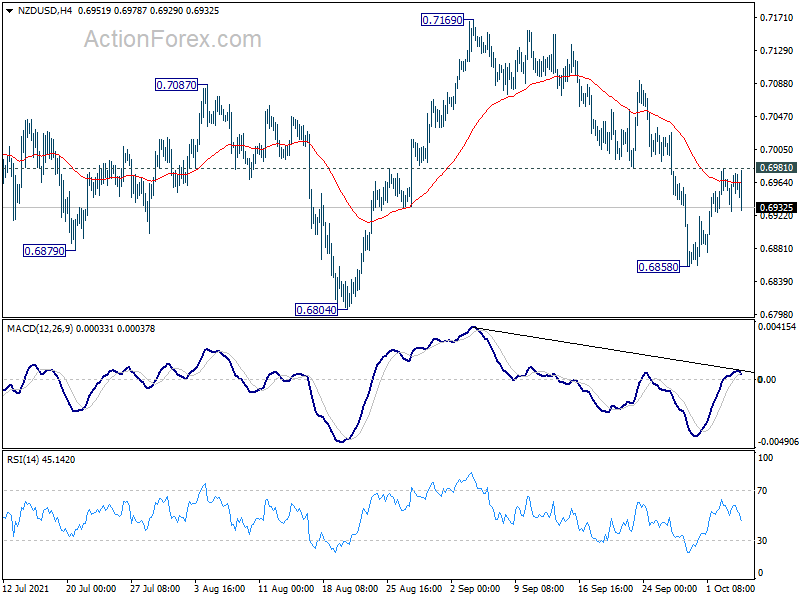
NZD/USD dips mildly after RBNZ rate hike but is bounded in very tight range. Rebound from 0.6858 is limited by 0.6981 minor resistance so far. Hence, fall from 0.7169 is still mildly in favor to extend lower. Break of 0.6858 will target 0.6804 low first.
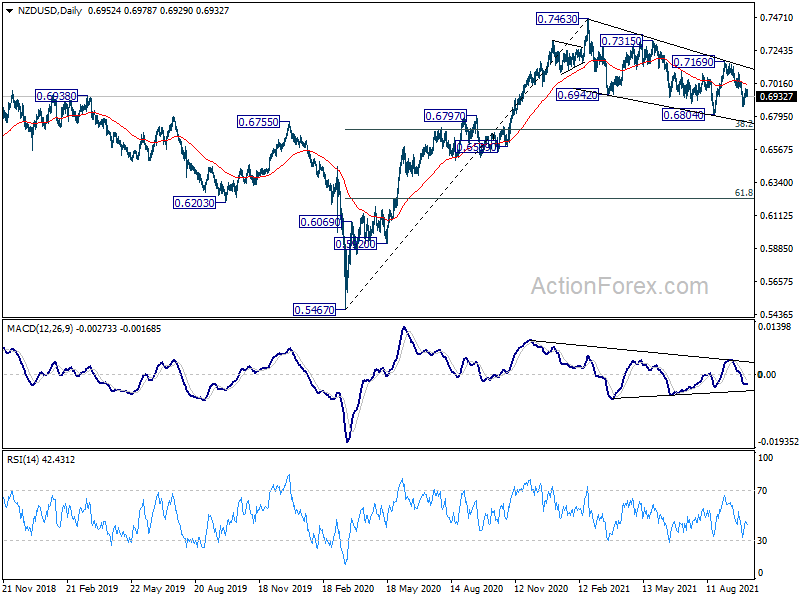
Also, NZD/USD is still staying in the corrective pattern from 0.7463 high. Break of 0.6804 will target 38.2% retracement of 0.5467 to 0.7463 at 0.6701. This will remain the favored case as long as 0.7169 resistance holds, even in case of stronger rebound.
First Impressions: RBNZ Monetary Policy Review
First impressions of the RBNZ's October 2021 Monetary Policy Review.
RBNZ Monetary Policy Review, October 2021
- The Reserve Bank increased the OCR by 25 basis points to 0.50%, as was widely expected.
- It also signalled that it would continue to remove monetary stimulus over time.
- The statement acknowledged that the current Covid restrictions have suppressed activity and are placing a strain on some businesses.
- However, it concluded that these restrictions have not materially changed the medium-term outlook for inflation and employment since the August review.
- Inflation is expected to spike above 4% in the near term before settling at around the 2% target midpoint in the medium term – this forecast is unchanged from August.
- Rising costs and capacity constraints are a significant driver of inflation in the short term. But in an environment of strong demand, there is a risk that this could translate into broader, more persistent price pressures.
Implications
The RBNZ statement was very much in line with what we expected, and with our own thinking. There is substantial evidence that demand in the New Zealand economy was running hot before the latest Covid lockdown. And the evidence so far suggests that, as in previous lockdowns, activity is capable of bouncing back quickly as restrictions are eased.
Our view remains that we will see further rate hikes at the reviews in November, February and May, taking the cash rate to 1.25%. Beyond that, we expect the pace of further hikes to be gradual, as the RBNZ starts to converge on what it would consider to be a ‘neutral’ level of the cash rate.
Financial markets were largely priced for a 25 basis point hike today. As such, there was little change in interest rates or the New Zealand dollar.
RBNZ hikes OCR to 0.50%, maintains hawkish bias
RBNZ raised the Official Cash Rate by 25bps to 0.50% as widely expected, as "it is appropriate to continue reducing the level of monetary stimulus so as to maintain low inflation and support maximum sustainable employment." It maintains a hawkish bias and said, "further removal of monetary policy stimulus is expected over time, with future moves contingent on the medium-term outlook for inflation and employment."
In the accompany statement, it's noted that current COVID-19-related restrictions "have not materially changed the medium-term outlook" for inflation and employment. Capacity pressures "remain evident" and economic data highlighted that the economy "has been performing strongly in aggregate". Headline CPI is expected to rise above 4% in the near term before returning towards 2% target midpoint over the medium term.
(RBNZ) Monetary Stimulus Further Reduced – Official Cash rate raised to 0.50 percent
The Monetary Policy Committee agreed to increase the Official Cash Rate (OCR) to 0.50 per cent. Consistent with their assessment at the time of the August Statement, it is appropriate to continue reducing the level of monetary stimulus so as to maintain low inflation and support maximum sustainable employment.
The level of global economic activity has continued to recover, supported by accommodative monetary and fiscal settings, and rising vaccination rates enabling a relaxation of mobility restrictions. While economic uncertainty remains elevated due to the prevalent impact of COVID-19, cost pressures are becoming more persistent and some central banks have started the process of reducing monetary policy stimulus.
New Zealand's public health settings are also evolving as domestic vaccination rates rise. The higher the vaccination rate, the less virus-related disruption there will be to New Zealand's economic activity over coming years.
The current COVID-19-related restrictions have not materially changed the medium-term outlook for inflation and employment since the August Statement. Capacity pressures remain evident in the economy, particularly in the labour market. A broad range of economic indicators highlight that the New Zealand economy has been performing strongly in aggregate.
While the economy contracted sharply during the recent nationwide health-related lockdown, household and business balance sheet strength, ongoing fiscal policy support, and a strong terms of trade provide confidence that economic activity will recover quickly as alert level restrictions ease. Recent economic indicators support this picture.
However, the Committee is aware that the latest COVID-19 restrictions have badly affected some businesses in Auckland and a range of service industries more broadly. There will be longer-term implications for economic activity both domestically and internationally from the pandemic.
Headline CPI inflation is expected to increase above 4 percent in the near term before returning towards the 2 percent midpoint over the medium term. The near-term rise in inflation is accentuated by higher oil prices, rising transport costs and the impact of supply shortfalls. These immediate relative price shocks risk leading to more generalised price rises. At this time, measures of core inflation and medium-term inflation expectations remain close to 2 percent.
The Committee noted that further removal of monetary policy stimulus is expected over time, with future moves contingent on the medium-term outlook for inflation and employment.
Summary Record of Meeting
The Monetary Policy Committee discussed economic developments since the August Statement. The Committee noted that the level of global economic activity has continued to recover, supported by rising COVID-19 vaccination rates in many countries, a gradual relaxation of mobility restrictions, and continued monetary and fiscal support. However the near-term outlook for global growth has weakened somewhat due to the spread of the Delta variant, fuel shortages, and rising risks to the Chinese economy. Considerable uncertainty exists regarding the longer-run economic impacts of COVID-19.
Global inflation has increased due to ongoing supply bottlenecks, resulting in higher costs. These supply disruptions and labour shortages are affecting productive capacity. At the same time demand is recovering causing pressure on prices. Global inflation has also been pushed higher in the near-term by rising energy prices. In part this reflects transition costs associated with climate change. In response to signs that inflation pressures are becoming more persistent, some central banks have started the process of reducing monetary policy stimulus.
The Committee noted that recent domestic economic data suggest that prior to the country re-entering lockdown in August, the New Zealand economy was starting from a strong aggregate position, and capacity pressures were building. The economy is expected to have contracted sharply as a result of the recent COVID-related restrictions, although by less than the first national lockdown in the second quarter of 2020.
The Committee noted that near-term growth will remain volatile, and will depend on the speed and extent to which public health restrictions are eased. However, the experience of last year suggests that timely Government support for business and jobs is effective at cushioning the near-term impact on economic activity.
Early data suggest that business and consumer confidence remained robust during the latest lockdown. Some customer-facing businesses in Auckland and a range of service sectors are experiencing more acute stress. Reflecting the tightness of the labour market, firms have sought to hold on to employees, in some cases supported by wage subsidies. Employment opportunities appear to have remained firm.
As in the global economy, rising demand alongside capacity constraints is contributing to higher domestic inflation. Cost pressure in New Zealand has been accentuated in the near term by higher oil prices, supply shortfalls and rising transport costs. This is expected to result in CPI inflation rising above 4 percent in the near term, before returning towards the 2 percent midpoint of the target band over the medium term. Core inflation remains near the target mid-point.
The Committee noted significant uncertainty about how changes to public health settings, border restrictions, and rising incidence of COVID-19 in the community will impact on economic outcomes as the response to the pandemic evolves. Achieving high vaccination rates will be crucial to reducing the ongoing disruption that COVID-19 has on people and the economy.
The Committee agreed that there will be longer-term implications for economic activity both domestically and internationally from the pandemic. The Committee will be watching closely how the economy adjusts to the ongoing disruption from endemic COVID-19 and the balance of pressure on demand and supply.
As required by their Remit, members assessed the impact of monetary policy on the Government's objective to support more sustainable house prices. The Committee noted the Reserve Bank's assessment is that the level of house prices is currently unsustainable. Members noted that a number of factors are expected to constrain house prices over the medium term. These include a high rate of house building, slower population growth, changes to tax settings, and tighter bank lending rules. Rising mortgage interest rates, as monetary stimulus is reduced, would also constrain house prices to a more sustainable level. Members noted a risk that any continued near-term price growth could lead to sharper falls in house prices in the future.
With regard to the stance of monetary policy, the Committee noted that the current restrictions are creating a different set of policy challenges than in 2020. Demand shortfalls are less of an issue than the economy hitting capacity constraints given the effectiveness of Government support and resilience of household and business balance sheets. While some capacity bottlenecks are likely to be short term, there is a risk that these become more persistent as we transition to a COVID-19 endemic state of the world.
The Committee agreed that rising capacity pressures would feed through into inflation. Employment is expected to remain at around its maximum sustainable level. Members concluded that monetary policy stimulus will need to be reduced to maintain price stability and maximum sustainable employment over the medium term.
The Committee agreed to further reduce the level of monetary stimulus at this meeting by increasing the Official Cash Rate (OCR) to 0.5 percent. The Committee noted that further removal of monetary policy stimulus is expected over time, with future moves contingent on the medium-term outlook for inflation and employment.
On Wednesday 6 October, the Committee reached a consensus to increase the OCR to 0.5 percent.
Attendees:
Reserve Bank staff: Adrian Orr, Geoff Bascand, Christian Hawkesby, Yuong Ha
External: Bob Buckle, Peter Harris, Caroline Saunders
Observer: Caralee McLiesh
Secretary: Chris Bloor
Eco Data 10/6/21
[php_everywhere instance="1"]
U.S. Service Sector Remains Strong
The ISM services index surprised with an increase to 61.9 in September from 61.7 in August. This was higher than market expectations for a decline to 60. Combined with the manufacturing reading, the ISM Composite reading moved to 61.8 from 61.5 in August. Demand regained some of its losses last month with business activity expanding by 2.2 ppts to 62.3 and new orders growing by 0.3 ppts to 63.5. The new export orders sub-index continued to edge lower, easing by 1.1 ppts to 59.5.
Supply chain disruptions remain problematic. The delivery performance of suppliers (68.8) was 0.8 ppts faster in September, but still much slower relative the pre-pandemic average of 52 (a lower reading indicates faster deliveries). Meanwhile, the backlog of orders sub-index increased slightly to 61.9 from 61.3 in August.
Inventories dropped by 0.8 ppts to 46.1, while inventory sentiment increased to 46.3 (+4.9 ppts) – a slight improvement from the previous five months of readings in the low forties.
The employment sub-component continued to decline for the second month in September, but remains in expansionary territory with a reading of 53.0 (from 53.7 in August). Respondents continue to complain about low labor supply with comments like “employee flight to better-paying jobs and lack of a pipeline to replace” and “labor shortages experienced at all levels” painting a more vivid picture than the numeric value of the sub-index.
The prices paid component rose to 77.5 in September with all 18 industries reportedly paying higher prices for inputs.
Seventeen industries expanded in September. The only industry to report a decrease was Agriculture, Forestry, Fishing & Hunting.
Key Implications
The services sector surprised with continued robust growth and an index reading well above 60. What's more, the index is primed by metrics indicating growing demand, while the supplier deliveries index – the major indicator for supply-chain disruptions – moderated. This is a favorable development, given a historically low level of inventories in the context of the current expansion. Before the pandemic, there were only two instances when the inventory sub-index was below 40 while the overall index was near 60. Since April of this year, we have observed it five times (including today's reading).
Looking ahead, the services sector should continue to expand as consumers' ability to spend is supported by excess saving and income growth. Meanwhile, based on the sentiment expressed in today's report, firms' are planning on keeping the pace of inventory restocking and hiring for the time being, while "demand remains very strong". As long as the economy remains uninterrupted by another COVID-19 outbreak, solid fundamentals should keep the service sector recovery going strong.
NZ Dollar on Hold ahead of RBNZ
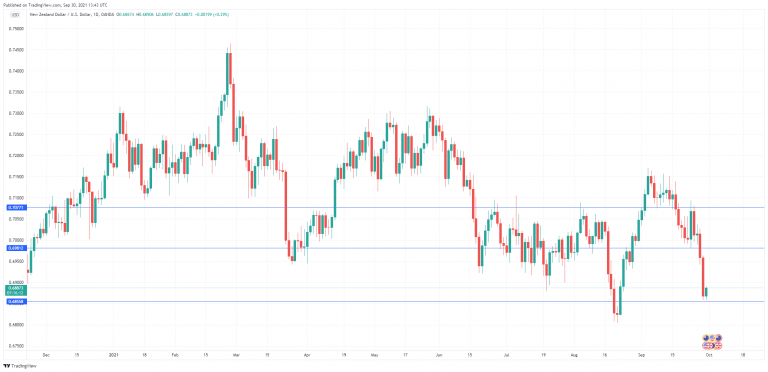
The New Zealand dollar is calm in the Tuesday session, ahead of the RBNZ policy decision. NZD/USD is currently trading at 0.6963, down 0.10% on the day. The currency has been on an impressive upturn, rising two full cents since Thursday.
RBNZ expected to hike rates
Just a few months ago, the Reserve Bank of New Zealand was talking openly about raising interest rates as Covid was completely contained and the economic recovery was in full swing. Fast forward as the Delta variant managed to get past the country’s strict border controls, causing the central bank to screech on the brakes and delay plans for a rate hike. Although Delta is yet to be contained and Auckland remains under lockdown, the RBNZ is widely expected to raise rates from the ultra-low 0.25% to 0.50% at the Wednesday policy meeting.
The RBNZ will lose bragging rights as the first major central bank to raise rates in the Covid era – Norway claimed that honor just two weeks ago. Still, if RBNZ pulls the rate trigger upwards, it will mark the bank’s first rate hike since 2014. The case for a rate hike is compelling – GDP jumped 2.8% in the second quarter and inflation is running at 3.3%, above the central bank’s upper level of its target of 1-3%.
With the RBNZ poised to raise rates, the question of the day is whether the New Zealand dollar will rise in response. True, the financial markets have priced in a rate hike, but given the sheer magnitude of such a move, I would be surprised if a hike did not provide a lift to the currency. This hike is expected to be the first of several, which should make the New Zealand dollar more attractive to investors.
NZD/USD Technical
- There is resistance at 0.7028, followed by 0.7117
- There is support at 0.6855. Below, there is support at 0.6771
Turnaround Tuesday, Pepsi’s Inflation Warning, Dollar Rebounds, Nothing Stopping Oil, Gold Lower
US stocks are rebounding as investors find value in beaten up tech stocks and are coming to the realization that the global natural gas crisis is good news for energy stocks. Yesterday, the Nasdaq selloff brought the recent slide to 8.5% from recent record highs. US growth exceptionalism will be the theme for the next couple of quarters and that will help make it easy for fund managers to buy every dip. Turnaround Tuesday might not lead to a substantial rally as Evergrande uncertainty remains, DC drama will last a couple more weeks, Treasury yields are consolidating ahead of Friday’s employment report, and Shanghai markets are closed for Golden Week.
The risks to the outlook remain and trading over the next couple of days may start to become rangebound. Pepsico’s results and commentary provided another check to the inflation is persisting camp, and if that theme appears apparent across all sectors, risk appetite will struggle.
Energy stocks will see continued support over surging oil prices. Oil prices are getting extra demand from the shortfall in natural gas. The oil market is heavily in deficit and that won't change until after the winter.
Pepsi
Pepsico delivered strong third quarter results with beats on the top and bottom lines, along with raising its full-year organic revenue guidance. Pepsico acknowledged they are navigating through the impact of higher commodity, transportation, and supply chain costs. Wall Street set the bar high for the beverage and snack maker, but with no optimism that the cost/inflationary environment will improve, the outlook for next year is on shaky ground. Pespico's share price isn't doing much this morning.
Pepsico CFO Johnston told CNBC that we’ll probably see a little bit more pricing increases in the first quarter. Inflationary pressures are not easing anytime soon and if this earnings season delivers broad price increases for the US consumer, the 2022 outlook will start to come into question.
FX
The dollar extended gains after the US trade deficit widened to a record as demand for imports surged. The 10-year Treasury yield is back above 1.50%, but still unlikely to deliver a substantial move above the last week’s high of 1.5565% until after Friday’s employment report. With oil prices potentially entering skyrocketing mode, commodity currencies are faring better than high-beta currencies.
Oil
Crude prices bought a one-way ticket higher as a global energy crisis provided an unexpected surge in demand that is swinging the oil market further into deficit. Brent crude did not waste much time with the $80 level and the profit-taking that has occurred following each surge has been somewhat limited. Even a stronger dollar is not disrupting the move in crude prices.
This week, energy traders could see $85 oil if US stockpiles start to decline again. Analysts have a mixed view so this afternoon’s weekly API crude oil inventory release could trigger a big move. Energy traders are ready to lock-in profits, so a small dip could happen if stockpiles deliver a decent sized build, which would likely be attributed to higher production, robust imports, and as refiners mostly rebound from the peak of hurricane season.
Gold
Gold prices got hit with a double dose of bearish drivers as turnaround Tuesday dampens demand for safe-havens and as Treasury yields rise, ending the dollar’s three-day slide. The upcoming nonfarm payroll report could be a gamechanger for gold prices, so prices will likely consolidate between the $1,745 and $1,775 range. With China closed for golden week, gold will likely see limited safe-haven flows from Asia despite the persisting uncertainty with Evergrande.
After Friday, Wall Street could have a unanimous view over Fed tapering that could lead to the last major move lower. Once tapering is fully priced in, financial markets will grow fixated over the risks to the 2022 outlook and that will be the greenlight for many investors to return to bullion.
Complicating the demand for bullion has been crypto resilience that is stealing away some institutional flows that would normally go gold’s way. Gold’s short-term outlook remains bearish, but the medium-term should become bullish.
Bitcoin
Bitcoin is closer to $100,000 than it is to zero. Recapturing the $50,000 level is a big deal for Bitcoin and significant for the cryptoverse. Bitcoin is starting to show bullish signs despite whatever risk mode is happening on Wall Street. It appears large parts of both the retail and institutional world have evolved and have embraced becoming Long-Term-Holders(LTH). The upcoming regulatory guidelines could prove to be disruptive over the short-term, but many cryptocurrency traders are gladly buying now in anticipation that we’ve seen the majority of the selling pressures. A Bitcoin ETF might take a little longer to get done, but it seems like it will certainly happen. That is expected to pave the way for the next boom.
Bitcoin volatility is always elevated on the passing of key psychological levels and that should remain the case this week. If Bitcoin rallies above the $52,000 level, that could trigger another wave of technical buying. Bitcoin could trade a handful of times through the $50,000 over the next couple of days.
Canadian Dollar May Head Further Up after Jobs Report
The Canadian dollar traded higher against the US dollar in the previous days and traders anticipate the release of the September’s employment report on Friday at 12:30 GMT. Even as oil prices have reached new highs, the Canadian dollar has been on a steady downward trend since June.
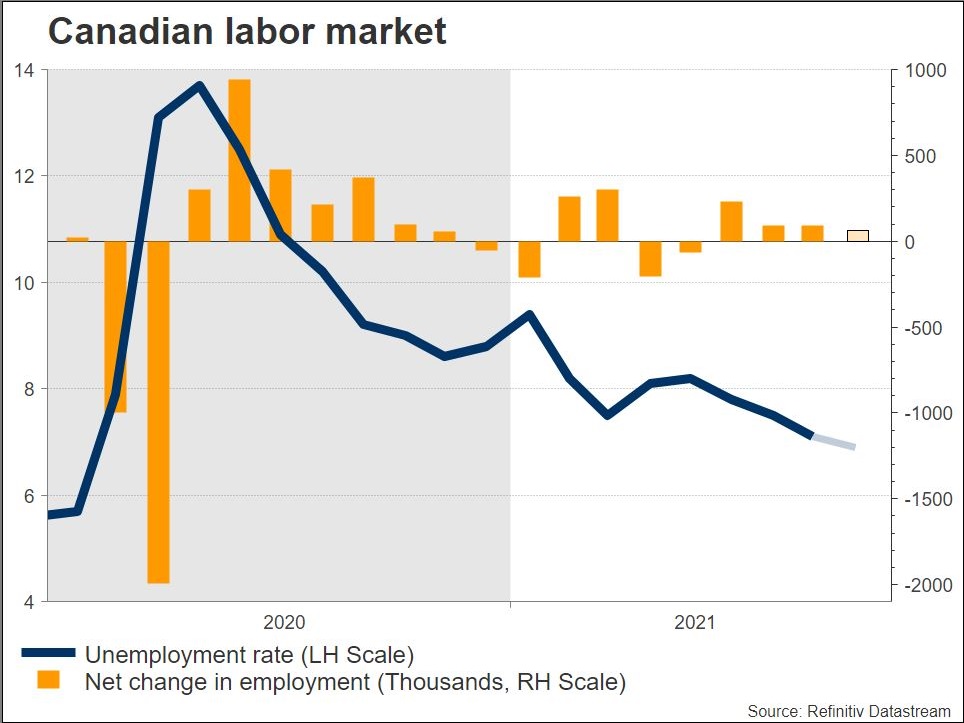
In August, Canada's unemployment rate declined for the third consecutive month to 7.1% the lowest unemployment rate since the beginning of the covid-19 pandemic. The unemployment rate is predicted to drop to 6.9% in September, while the economy is expected to add 65K jobs from 90.2K jobs in the preceding month. If the data shows a higher increase, the loonie could gain more ground against the dollar.
Oil rises to 7-year high after OPEC+ meeting
On Monday, OPEC+ made an announcement that it would continue implementing the existing agreement to increase oil output. In July, they agreed to boost output by 400,000 barrels per day each month until April 2022 to phase out 5.8 million bpd of existing production cuts. Oil surged to a seven-year high of $78.36/per barrel, supporting the loonie.
The Bank of Canada's steady reduction in bond purchases hasn't been enough to offset the negative consequences of a general decline in risk appetite and a resurgent US dollar. During the latest policy meeting, policymakers expected the economy to strengthen in the second half of 2021, while the fourth wave of covid infections and continued supply shortages could slow the recovery. Furthermore, the Bank of Canada believes that the Canadian economy still has significant surplus capacity and that the recovery will continue to need extraordinary monetary policy.
Loonie eases after the rise to 1-month high
The Canadian dollar strengthened versus the US dollar on Monday, reaching its highest level in over four weeks, as higher oil prices played a stronger role.
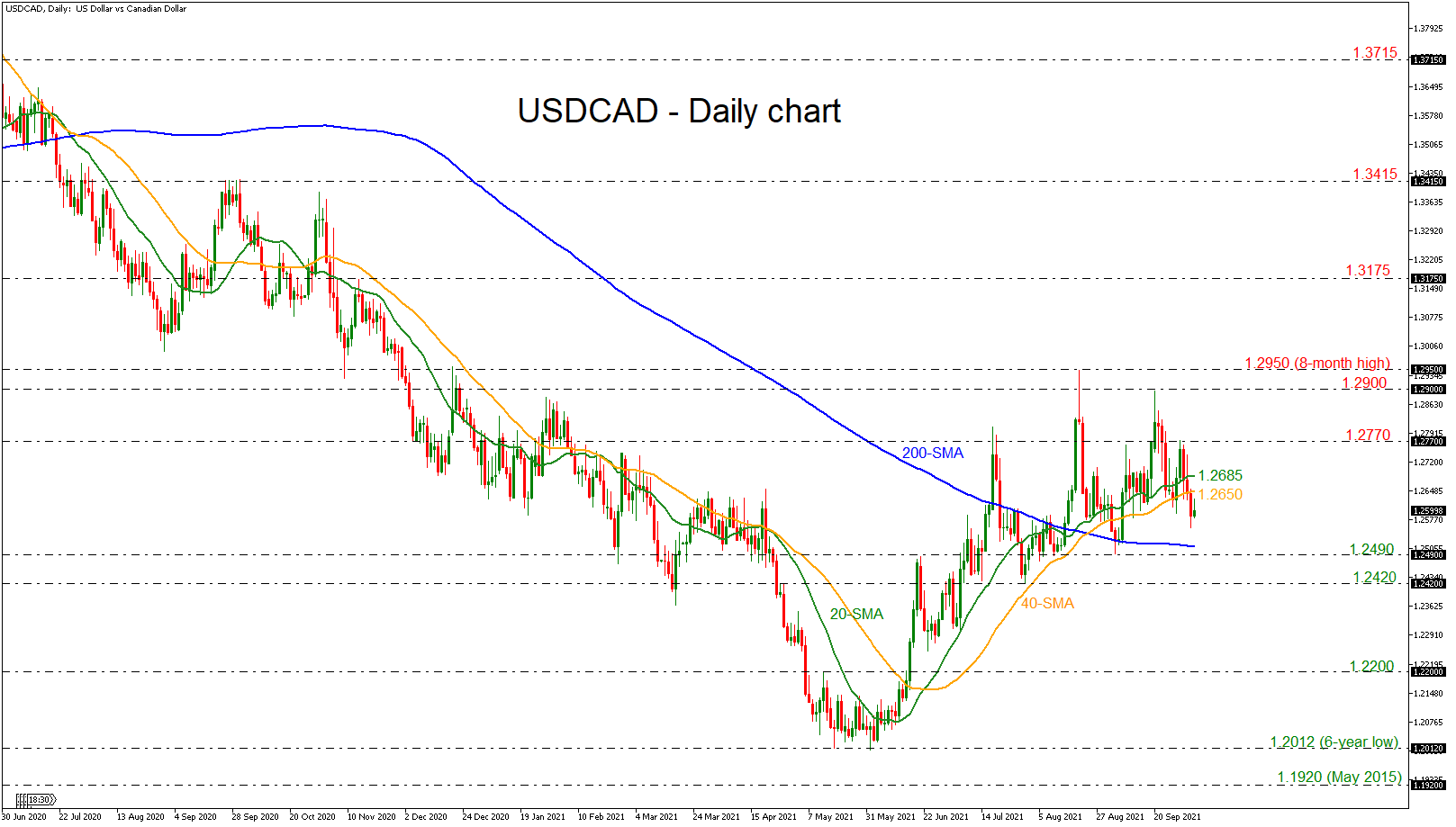
If the employment report shows slower job growth and a higher unemployment rate, it might push the pair closer to the 40- and then to the 20-day simple moving averages (SMAs) at 1.2650 and 1.2685 respectively. Higher still, the market could turn the focus to the 1.2770 barrier ahead of the 1.2900 psychological level.
A better-than-expected jobs report could encourage the bears to test the 1.2490 barrier as immediate support after meeting the 200-day SMA at 1.2512. If selling demand remains strong, the 1.2420 barrier might be the next target ahead of the 1.2200 handle.
However, given the current level of concern about global growth, any positive surprise from the employment numbers would most likely be minor.