Sample Category Title
US Open Note – Equities Heal Wounds But Risks Still in Play; RBNZ in Focus
Stock markets enjoy some recovery, but not for long
While central banks keep talking about a transitory inflation, investors seem to walk on thin ice, wondering whether the combination of supply chain disruptions, rocketing energy prices and labor shortages need to be taken more seriously as initial symptoms of stagflation.
Although there is no convincing evidence of stagflation yet, headlines have been more depressing than cheerful around business struggles lately, and that was enough to ghost traders and knock down stock markets once again on Monday.
The next day found the pan-European STOXX 600 index trying to heal its wounds from three-month lows, mainly on the back of financials and technology shares, as global bond yields lost some steam. Yet, the downfall in equities could still find more legs in the coming months as the energy crunch may intensify during the winter season on higher demand, while the property drama in China could make matters worse if more developers join Evergrande’s club like Fantasia Holdings Group did on Monday. Not to mention a potential dramatic ending in the debt ceiling debate in the US and a disappointing Q3 earnings season.
Turning to Wall Street, S&P 500, Nasdaq 100, and Dow Jones opened with moderate gains, trading up by around 0.45%.
Dollar index steady; traditional safe havens pull back
In FX markets, the US dollar index was in a wait-and-see mode ahead of Friday’s nonfarm payrolls report, remaining muted slightly below the almost one-year high of 94.49. The ISM non-manufacturing PMI index could provide some early warnings about the labor situation in the US and the rising input costs during the month of September at 14:00 GMT, though the preliminary Markit PMI readings have already stated a soft slowdown in previous weeks. Therefore, the impact on the greenback could be anemic.
The latest upturn in safe-haven currencies took a halt as investors engaged in some risk taking, helping dollar/yen bounce back above the 111.00 level after three days of declines. Dollar/loonie was less fortunate, as elevated oil prices kept supporting the loonie. Technically, the pair seems to be trading near the neckline of a bearish head and shoulder pattern at 1.2585 in the daily chart. Should the bears claim that territory, the price could tumble towards the 200-day moving average at 1.2525
Meanwhile, weaker-than-expected producer prices out of the Eurozone could only softly lift the euro as traders looked at July’s upside revision, though gains were quickly reversed in the next hour, with euro/dollar easing back to Monday’s low of 1.1587.
On the other hand, pound/dollar continued to strengthen for the fourth consecutive day, reaching an intra-day high of 1.3641 despite production cost pressures keep escalate.
RBNZ could raise interest rates
The Reserve Bank of New Zealand will be the highlight of the Asian session as the central bank is scheduled to announce its policy decision at 01:00 GMT.
Unlike its Australian counterpart, which stood pat on policy, keeping interest rates at record lows and sounding a warning about surging house prices on Monday, the RBNZ is widely expected to hike its benchmark rate by 25 bps to 0.50%. That is below the previous estimate of 50 bps, which suggests that some caution is speaking to investors’ mind, especially after a well-telegraphed rate hike was postponed during the August gathering.
Another delay cannot be ruled out, as some lockdown restrictions are still in place. That said, with the economy running hot, inflation standing above the 1-3.0% range target, and the labor market remaining tight, a 25 bps rate hike is possible. If true, the RBNZ would be the second central bank to raise borrowing costs post-Covid after Norway’s central bank. However, for the kiwi to speed up, the RBNZ needs to show confidence that the tightening phase will continue without breaks.
Kiwi/dollar was last seen weak at 0.6953. A major resistance territory for the pair remains the 0.7088 – 0.7100 area.
Sunset Market Commentary
Markets
Investors still have to navigate through multiple conflicting topics. Uncertainty on financial stability in China doesn’t abate as Evergrande apparently isn’t the only real estate developer failing to meet debt obligations (Fantasia). This kept Asian markets in risk-off mode. Surprisingly, European equities took a different view and saw the glass half full rather than half empty. A bit contra-intuitively, the European risk rebound was driven by energy/inflation sensitive sectors (energy, utilities & financials) as they profited from a further rise in oil/energy prices. Brent Oil ($82.5 p/b) extends its post-OPEC rebound, reaching the highest level in 3-years. EMU 10-y inflation swaps expectations (1.99%) are only a whisker away from 2.0% mark. An energy driven rise in inflation for sure won’t be a blessing for the EMU economy going forward. However at least today, that didn’t hold up. European equities regain between 0.5% and 1.0% on average. US indices open 0.5% higher. The sharp rise in inflation expectations still hardly moved core European yields (changes of less than 0.5 bp across the curve). Despite broader market uncertainty, intra-EMU-spreads versus Germany also remain a place of remarkable calm. US yields are rising up to 2.25 bp (5 & 10-y) also driven by higher inflation expectations. Eco data were second tier and largely ignored. After finishing this report, the US non-manufacturing ISM still has market moving potential. A modest decline to a still lofty 59.9 is expected. Markets will keep a close eye to what extend price rises might become an obstacle for this sector, too.
No outspoken, unequivocal trends in the major currency cross rates today. The dollar gains modestly and tries to regain the 94 mark. A record US trade deficit (goods and services, cf infra) at $73.3 bln currently is no issue. The yen underperforms (USD/JPY 111.35), suffering from the risk-on and higher oil prices. The euro (EUR/USD 1.159) also continues fighting an uphill battle despite the risk rebound. The 1.16 is a high hurdle and key support at 1.1563 stays within reach. The Norwegian krone remains a prominent beneficiary of the jump in oil prices with EUR/NOK testing the 9.90 support. Gains in the likes of the loonie (USD/CAD 1.259) remain more modest. The inflation-related risk-on also favours sterling over de euro (EUR/GBP 0.8520).
News Headlines
Romanian PM Citu and his Liberal government didn’t survive a no-confidence vote in parliament. The motion was tabled after former coalition partner USR Plus linked up with opposition parties on the left (Social Democrats) and on the extreme right (AUR). Romanian president Iohannis will now decide on the next step with possibilities ranging between installing an interim cabinet, proposing a new Liberal PM who could try to form a new government or appointing a technocratic government targeting snap elections. Romania holds the lowest possible investment grade rating at the three major rating agencies with both Moody’s and Fitch attributing a negative outlook. They warned that the collapse of the government might complicate necessary fiscal consolidation efforts. The political crisis and the raging Covid-pandemic (highest daily infections on record with second-lowest EU vaccination rate) didn’t hold the central bank back from unexpectedly hiking the policy rate today from 1.25% to 1.50%. Governor Isarescu stroke a hawkish tone pointing to risks from significantly higher inflation short term (5.6% expected by year-end) resulting from supply-side shocks. The Romanian leu barely recovered from recent weakness with EUR/RON still trading near the all-time high of 4.9550.
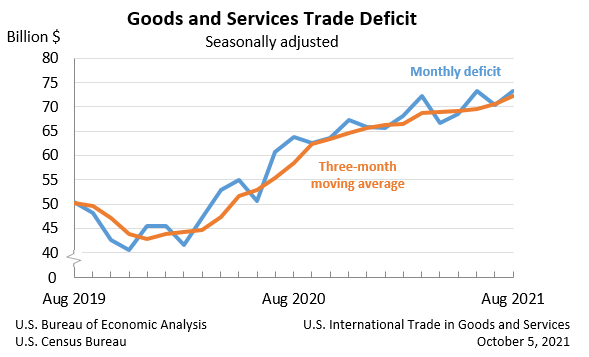
The US trade deficit widened to a record $73.3bn in August. According to the Commerce Department, import rose by 1.4% m/m (to $287bn) while exports were up only 0.5% m/m (to $213.7bn). The higher imports reflected both shipments of consumer goods and industrial supplies by business customers. Supply-side bottlenecks remain an issue as witnessed for example by declining exports and imports of vehicles and parts.
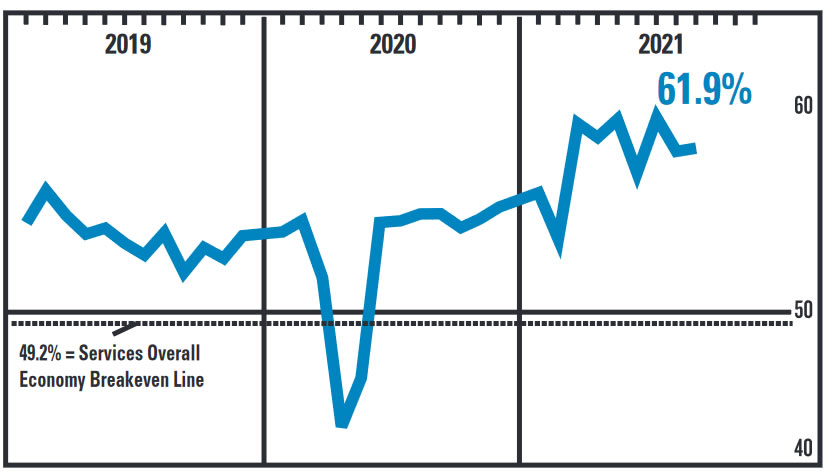
US ISM services rose to 61.9 in Sep, corresponds to 4.5% annualized GDP growth
US ISM Services PMI rose slightly from 61.7 to 61.9 in September, above expectation of 59.8. Looking at some details, business activity/production rose 2.2 to 62.3. New orders rose 0.3 to 63.5. Employment dropped -0.7 to 53.0. Prices rose 2.1 to 77.5.
ISM said: "The past relationship between the Services PMI® and the overall economy indicates that the Services PMI® for September (61.9 percent) corresponds to a 4.5-percent increase in real gross domestic product (GDP) on an annualized basis."
Australian Dollar Yawns after RBA Meeting
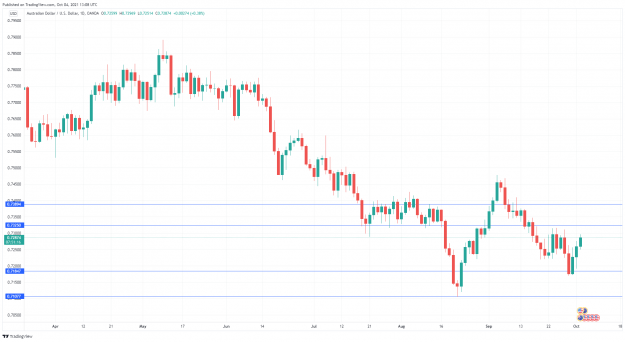
The Australian dollar’s rally has taken a pause in the Tuesday session. Currently, AUD/USD is trading at 0.7283, up 0.02% on the day.
RBA sticks to script
As expected, the RBA policy meeting was a sleeper. The bank maintained interest rates at a record low of 0.10% and its QE programme of AUD 4 billion/week. In his rate statement, RBA Governor Lowe noted that inflation was running at 1.75%, below the RBA’s inflation target. Lowe stressed that the RBA would not raise rates until inflation was within this target, which he expected would not occur prior to 2024. The bank has been criticized for maintaining interest rates despite the surge in house prices. Lowe acknowledged that housing prices had risen, but gave no indication that this would affect the bank’s monetary policy.
As for the economy, Lowe said that the Delta outbreak had hurt the recovery and GDP was expected to have “declined materially” in the third quarter. Still, Lowe sounded cautiously optimistic, adding that the economy would bounce back once, the vaccine program accelerated and restrictions were being eased. Bottom line? This rates statement was very similar to the September statement, meaning that nothing had really changed in the past month, as far as the Bank was concerned.
Lowe deserves full credit for being clear and candid with the markets in his communication with the financial markets – I am reminded at scratching my head in bewilderment whenever I came across Federal Reserve Chair Alan Greenspan’s notorious Fedspeak). Lowe said that the RBA will consider raising rates once inflation crosses the 2% threshold, which could occur in the next few months. Although a hike in rate is dependent on other factors, such as wage growth and job creation, if (when?) inflation shoots above 2%, speculation will no doubt increase about a possible rate hike, which would give the Australian dollar a lift.
AUD/USD Technical
- There is resistance at 0.7325. Next, there is resistance at 0.7389, protecting the round number of 0.7400
- The pair has support at 0.7184. Below, there is support at 0.7107
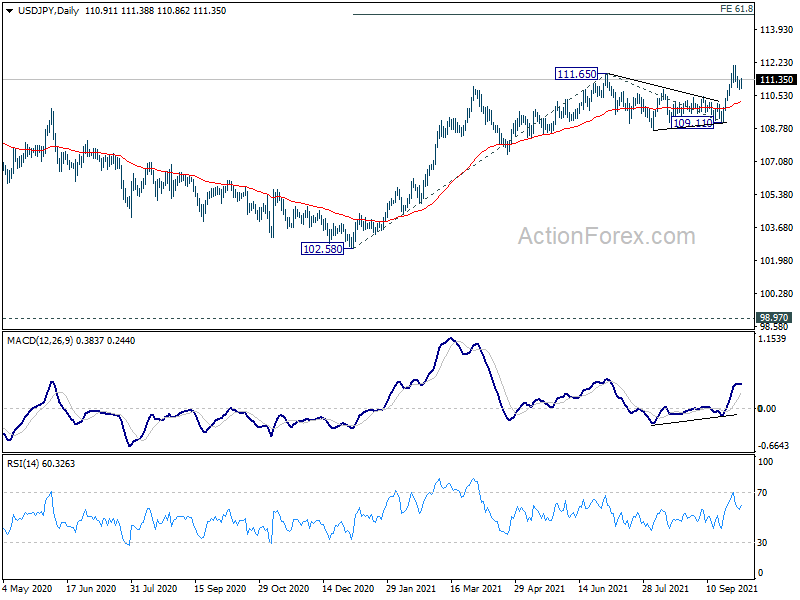
USD/JPY Mid-Day Outlook
Daily Pivots: (S1) 110.73; (P) 111.02; (R1) 111.20; More...
Intraday bias in USD/JPY remains neutral as consolidation from 112.07 is still extending. Deeper retreat cannot be ruled out but downside should be contained by 110.44 support to bring another rally. On the upside, above 112.07 will extend larger rise to 61.8% projection of 102.58 to 111.65 from 109.11 at 114.71 next. However, break of 110.44 will dampen the bullish case and turn focus back to 109.11 support.
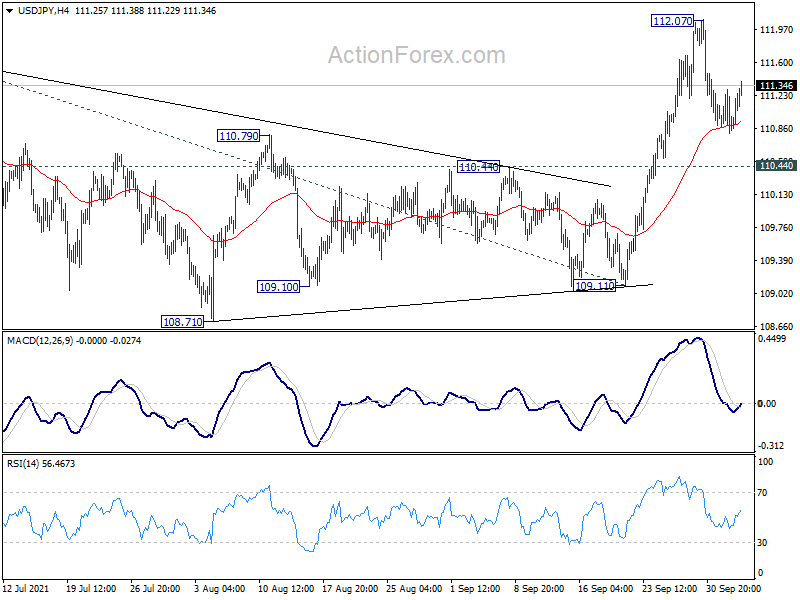
In the bigger picture, break of 111.71 resistance suggests that the whole corrective decline from 118.65 (2016 high) has completed at 101.18 (2020 low) already. Medium term bullishness is also affirmed as USD/JPY stays well above 55 week EMA (now at 108.60). Sustained trading above 111.71 will affirm this bullish case. Rise from 101.18 could then be resuming whole rally from 98.97 (2016 low) through 118.65. This will now be the preferred case as long as 108.71 support holds.
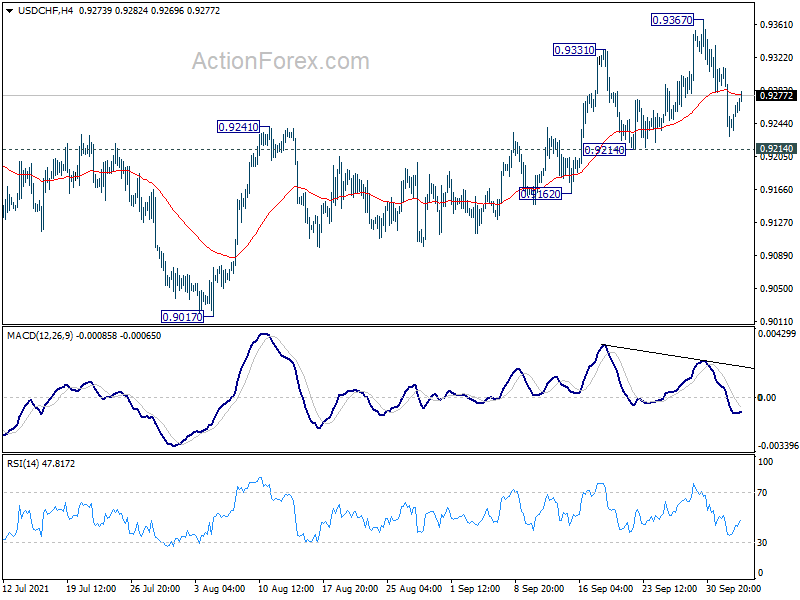
USD/CHF Mid-Day Outlook
Daily Pivots: (S1) 0.9214; (P) 0.9262; (R1) 0.9294; More....
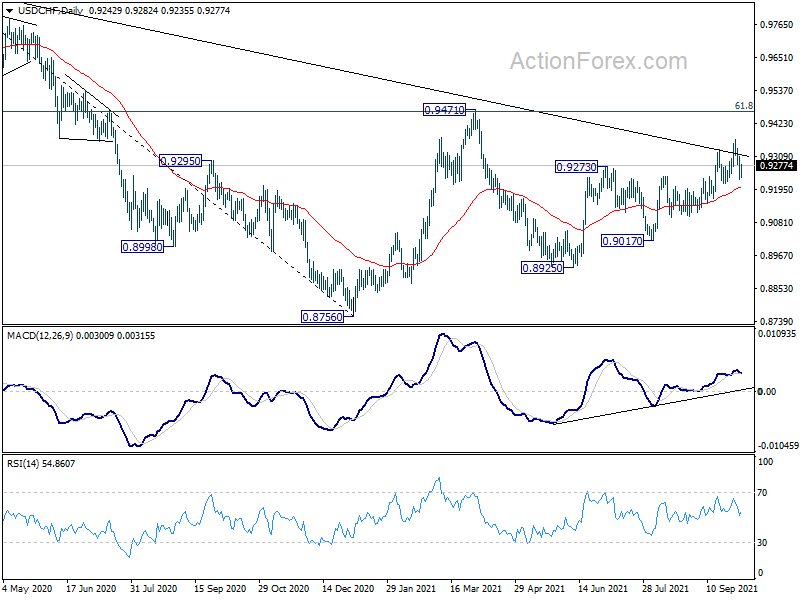
Intraday bias in USD/CHF remains neutral for the moment. As long as 0.9214 support holds, further rally is in favor. On the upside, break of 0.9367 will resume the rise from 0.8925 to 0.9471 key resistance next. On the downside, however, break of 0.9214 will turn bias back to the downside for 0.9017 support again.
In the bigger picture, the strong rally above 55 week EMA (now at 0.9188) now tilts favor to the case of bullish trend reversal. That is, decline from 1.3042 (2016 high) is probably completed at 0.8756 already. Sustained break of 0.9471 resistance should confirm this case and pave the way to retest 1.0342 ahead. However, rejection by 0.9471 will mix up the outlook again and retain some medium term bearishness.
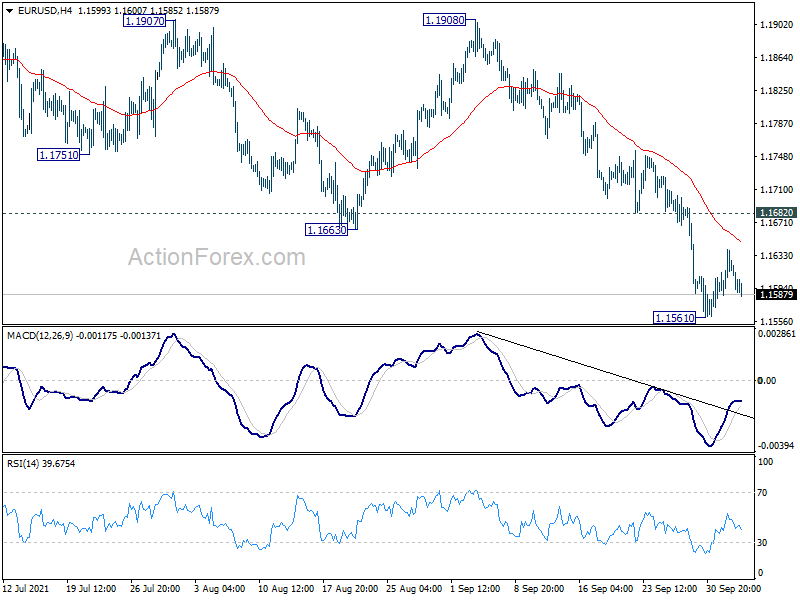
EUR/USD Mid-Day Outlook
Daily Pivots: (S1) 1.1592; (P) 1.1616; (R1) 1.1644; More...
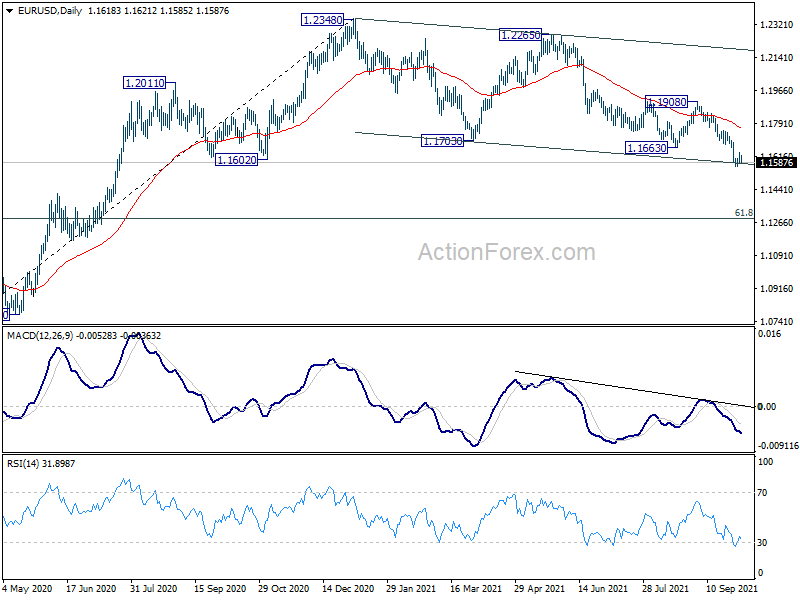
EUR/USD is still bounded in consolidation from 1.1561 and intraday bias remains neutral. Upside of recovery should be limited by 1.1682 resistance to bring fall resumption. On the downside, break of 1.1561 will target 1.1289 medium term fibonacci level. Nevertheless, sustained break of 1.1682 will bring stronger rebound back towards 1.1908 resistance.
In the bigger picture, sustained break of 1.1602 will argue that rise from 1.0635 (2020 low) has completed at 1.2348. Deeper fall would be seen to 61.8% retracement of 1.0635 to 1.2348 at 1.1289. Note also that rejection by 55 week EMA (1.1830) also carries medium term bearish implication. Firm break of 1.1289 will pave the way to retest 1.0635 low. On the upside, though, break of 1.1908 resistance will revive medium term bullishness and turn focus back to 1.2348 high.
GBP/USD Mid-Day Outlook
Daily Pivots: (S1) 1.3547; (P) 1.3594; (R1) 1.3655; More...
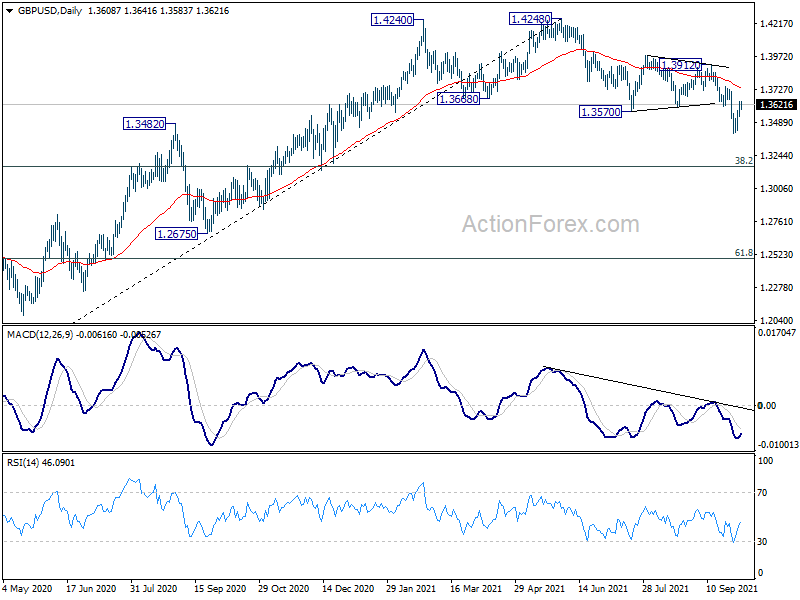
Intraday bias in GBP/USD remains mildly on the upside at this point. Rebound from 1.3410 short term bottom would target 1.3749 resistance first, which is close to 55 day EMA (now at 1.3745). On the downside, though, below 1.3530 minor support will retain near term bearishness, and turn bias back to the downside for 1.3410 low. Firm break there will extend the fall from 1.4248 and target 1.3164 medium term fibonacci level next.
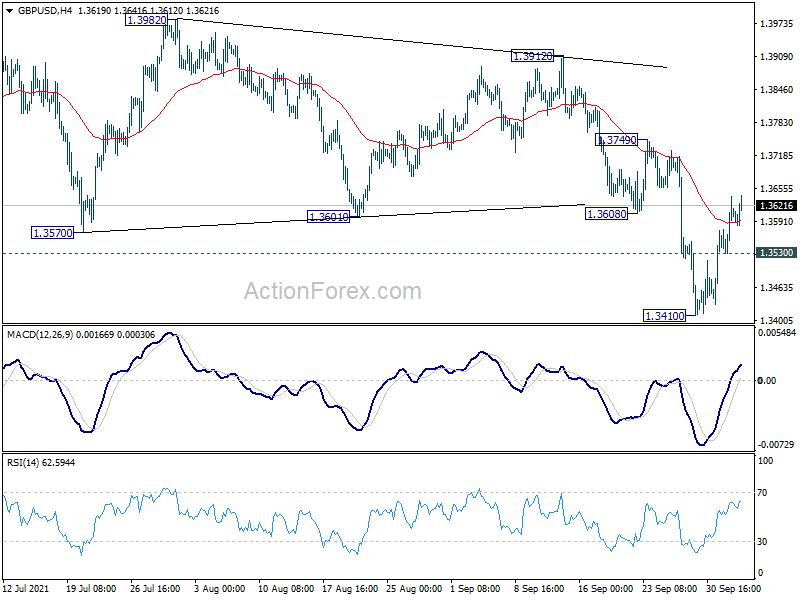
In the bigger picture, fall from 1.4248 is at least a correction to the up trend from 1.1409 (2020 low). Such correction could extend to 38.2% retracement of 1.1409 to 1.4248 at 1.3164 before completion. However, considering the rejection by 1.4376 key resistance (2018 high), sustained trading below 1.3164 will argue that it's indeed a bearish trend reversal and would target 61.8% retracement at 1.2493. Nevertheless, break of 1.3912 resistance will revive medium term bullishness and target 1.4248/4376 resistance zone again.
Sterling Rises in Stable Markets, Euro and Swiss Franc Soft
Market sentiment is stable today, with European index trading mildly higher while US futures point to a rebound. But overall direction remains rather unclear. Sterling is currently the stronger one, with additional help from buying against other European majors. Kiwi is also firmer, awaiting tomorrow's RBNZ rate hike, followed by Dollar. On the other hand, Swiss Franc, Yen and Euro are the softer ones. Aussie is mixed after an uneventful RBA decision earlier in the day.
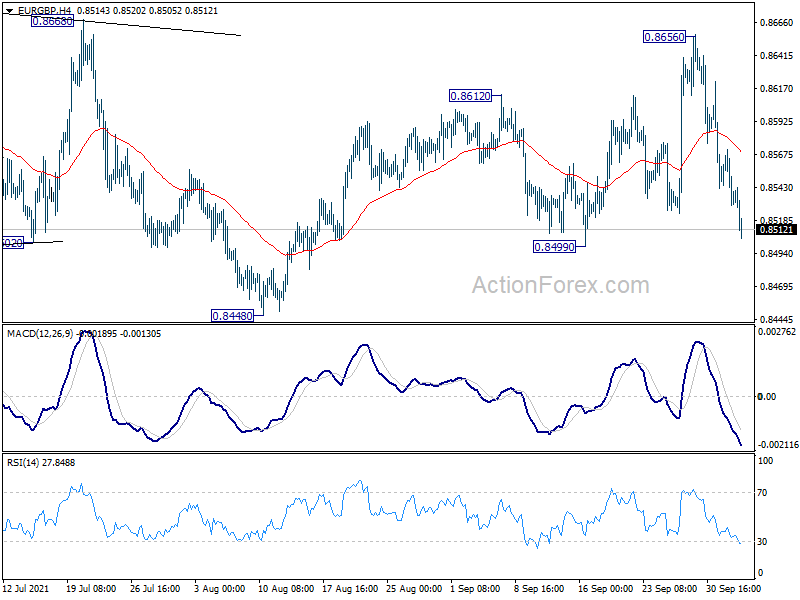
Technically, we'll keep an eye on Sterling again. In particular, EUR/GBP is heading closer to 0.8499 near term support. Firm break there will indicate completion of rebound from 0.8448 and bring retest of this low. Such development would also reaffirm medium term bearishness after prior rejection by 0.8668 resistance. GBP/JPY is also heading towards 152.54 resistance. Firm break there will suggest completion of correction from 156.05, after multiple test on 149.03 key support. Stronger rise would be seen back towards 156.05 high next.
In Europe, at the time of writing, FTSE is up 0.58%. DAX is up 0.37%. CAC is up 0.79%. Germany 10-year yield is up 0.0039 at -0.209. Earlier in Asia, Nikkei dropped -2.19%. Hong Kong HSI rose 0.28%. Singapore Strait Times dropped -0.70%. Japan 10-year JGB rose 0.0058 to 0.057. China was on holiday.
US trade deficit widened to USD 73.3B
US exports rose 0.4% to USD 213.7B in August. Imports rose 1.4% to USD 287.0B. Trade deficit widened to USD -73.3B, versus expectation of USD -70.5B.
Canada exports rose 0.8% in August while exports dropped -1.4%. Trade surplus widened to CAD 1.9B, versus expectation of CAD 0.3B.
Eurozone PPI rose 1.1% mom, 13.4% yoy in Aug
Eurozone PPI rose 1.1% mom, 13.4% yoy in August. Industrial producer prices increased by 2.0% mom in the energy sector, by 1.4% mom for intermediate goods, by 0.5% mom for capital goods, by 0.3% mom for durable consumer goods and by 0.2% mom for non-durable consumer goods. Prices in total industry excluding energy increased by 0.7% mom.
EU PPI rose 1.1% mom, 13.5% yoy. The highest monthly increases in industrial producer prices were recorded in Bulgaria (+4.2%), Denmark (+3.1%) and Latvia (+2.6%), while decreases were observed only in Ireland (-4.1%) and Malta (-0.1%).
Eurozone PMI composite finalized at 56.2, unwelcome mix of rising price pressures but slower growth
Eurozone PMI PMI Services was finalized at 56.4, down from August's 59.0. PMI Composite was finalized at 56.2, down from August's 59.0. Looking at some member states, Ireland PMI Composite was finalized at 61.5, Spain at 57.0, Italy at 56.6, Germany at 55.4, France at 55.3.
Chris Williamson, Chief Business Economist at IHS Markit said: "The current economic situation in the eurozone is an unwelcome mix of rising price pressures but slower growth. Both are linked to supply shortages, especially in manufacturing, which has seen a steeper fall in output growth than services... Although for now the overall rate of expansion remains relatively solid by historical standards, the economy enters the final quarter of the year on a slowing growth trajectory. A drop in business confidence to the lowest since February adds further downside risks to the outlook."
UK PMI services finalized at 55.4, supply chain crisis put a considerable brake on recovery
UK PMI Services was finalized at 55.4 in September, up slightly from August's 55.0. PMI Composite was finalized at 54.9, up fractionally form August's 54.8. Markit said charges rose at record pace amid supply constraints and spike in costs. Staff shortages held back output and new orders. Backlogs accumulated for the seventh month running.
Tim Moore, Economics Director at IHS Markit: "The supply chain crisis put a considerable brake on recovery in the UK service sector during September. Survey respondents widely noted that shortages of staff, raw materials and transport had resulted in lost business opportunities... Another spike in operating expenses was reported... even though this data is yet to fully reflect the inflationary impact of the UK fuel crisis and surging energy prices...
"Tight constraints on business capacity and rampant supply chain uncertainty meant that service providers have become more willing to pass on higher costs to customers. The latest rise in average prices charged by UK service sector firms was the fastest in over 25 years of data collection, with many businesses reporting more frequent reviews of pricing due to escalating cost increases by suppliers."
RBA keeps rate at 0.10%, continue QE until at least Feb 2022
RBA left monetary policy unchanged as widely expected. Cash rate is kept at 0.10%. Target for April 2024 Australian Government bond yield is also held at 0.10%. The asset purchase program will continue at AUD 4B per week until at least mid February 2022. RBA also maintained that the condition for rate hike "will not be met before 2024".
It maintained that the set back to economy expansion by the Delta outbreak is "expected to be only temporary". In the central scenario, the economy will be growing again in Q4, and is expected to be "back around its pre-Delta path in the second half of next year".
On labor market, RBA said it's business liaison and job vacancies data suggest that "many firms are seeking to hire workers ahead of the expected reopening in October and November." Wage and price pressures remain "subdued" and disruption to global supply chains on overall inflation "remains limited".
More on RBA:
- RBA Affirmed No Rate Hike Until 2024, Widening Policy Divergence with Counterparts
- RBA Board Maintains Current Policy Stance
- RBA Passes Without Event Providing Comfort To AUDUSD Shorts
Australia trade surplus swelled to another record in Aug
Australia goods and services exports rose AUD 1923m or 4% mom to AUD 48.52B in August. The surge in exports was led by LNG, hard coking coal and thermal coal, on both higher prices and volumes. Goods and services imports dropped AUD -506m or 1% mom to AUD 33.44B. Trade surplus rose from AUD 12.65B to AUD 15.08B, above expectation of AUD 10.10B, and hit another record high.
Also released, retail sales dropped -1.7% mom, -0.7% yoy in August. Ben James, Director of Quarterly Economy Wide Surveys, said: "Retail turnover continues to be negatively impacted by lockdown restrictions, with each of the eastern mainland states experiencing falls in line with their respective level of restrictions. In direct contrast, states with no lockdowns performed well with Western Australia and South Australia enjoying strong rises as physical stores were open for trade."
AiG Performance of Construction Index rose sharply from 38.4 to 53.3 in September. Ai Group Head of Policy, Peter Burn, said: "The bounce in the Australian PCI in September was largely due to many fewer builders and constructors reporting further falls in activity after the clear majority saw activity slump in August... Looking ahead, the further easing of restrictions, and the resumption of work put on hold should see more decisive improvement in the sector in the months ahead".
Japan PMI services composite finalized at 47.9, but firms optimist on eventual end to pandemic
Japan PMI Services was finalized at 47.8 in September, up from August's 42.9. PMI Composite was finalized at 47.9, up from August's 45.5. Markit said contractions in output and new business eased. Employment rose at quickest pace since April. Business optimism also strengthened to three-month high.
Usamah Bhatti, Economist at IHS Markit, said: "Overall private sector activity saw a sustained, albeit softer decline in September, led by a slower decline in the larger service sector. At the same time, manufacturing output and new orders were both in decline for the first time since late-2020.
"Businesses in the Japanese private sector also noted the strongest cost pressures for 13 years, as supply chain disruption continued to dampen domestic and global activity. Price rises were notably sharp for raw materials, staff and fuel. Regardless of this, firms were optimistic that an eventual end to the pandemic would occur within the coming 12 months, and provide a broad-based boost to demand and activity. As a result, IHS Markit expects the economy to grow 2.5% in 2021."
Also from Japan, Tokyo CPI core rose to 0.1% yoy in September, up from 0.0% yoy, missed expectation of 0.2% yoy.
GBP/USD Mid-Day Outlook
Daily Pivots: (S1) 1.3547; (P) 1.3594; (R1) 1.3655; More...
Intraday bias in GBP/USD remains mildly on the upside at this point. Rebound from 1.3410 short term bottom would target 1.3749 resistance first, which is close to 55 day EMA (now at 1.3745). On the downside, though, below 1.3530 minor support will retain near term bearishness, and turn bias back to the downside for 1.3410 low. Firm break there will extend the fall from 1.4248 and target 1.3164 medium term fibonacci level next.
In the bigger picture, fall from 1.4248 is at least a correction to the up trend from 1.1409 (2020 low). Such correction could extend to 38.2% retracement of 1.1409 to 1.4248 at 1.3164 before completion. However, considering the rejection by 1.4376 key resistance (2018 high), sustained trading below 1.3164 will argue that it's indeed a bearish trend reversal and would target 61.8% retracement at 1.2493. Nevertheless, break of 1.3912 resistance will revive medium term bullishness and target 1.4248/4376 resistance zone again.
Economic Indicators Update
| GMT | Ccy | Events | Actual | Forecast | Previous | Revised |
|---|---|---|---|---|---|---|
| 21:30 | AUD | AiG Performance of Construction Index Sep | 53.3 | 38.4 | ||
| 23:30 | JPY | Tokyo CPI Core Y/Y Sep | 0.10% | 0.20% | 0.00% | |
| 00:30 | AUD | Trade Balance (AUD) Aug | 15.08B | 10.10B | 12.12B | 12.69B |
| 03:30 | AUD | RBA Rate Decision | 0.10% | 0.10% | 0.10% | |
| 06:45 | EUR | France Industrial Output M/M Aug | 1.00% | 0.40% | 0.30% | 0.50% |
| 07:50 | EUR | France Services PMI Sep F | 56.2 | 56 | 56 | |
| 07:55 | EUR | Germany Services PMI Sep F | 56.2 | 56 | 56 | |
| 08:00 | EUR | Eurozone Services PMI Sep F | 56.4 | 56.3 | 56.3 | |
| 08:30 | GBP | Services PMI Sep F | 55.4 | 54.6 | 54.6 | |
| 09:00 | EUR | Eurozone PPI M/M Aug | 1.10% | 1.30% | 2.30% | 2.50% |
| 09:00 | EUR | Eurozone PPI Y/Y Aug | 13.40% | 13.50% | 12.10% | 12.40% |
| 12:30 | CAD | Trade Balance (CAD) Aug | 1.9B | 0.3B | 0.8B | 0.7B |
| 12:30 | USD | Trade Balance (USD) Aug | -73.3B | -70.5B | -70.1B | -70.3B |
| 13:45 | USD | Services PMI Sep F | 54.4 | 54.4 | ||
| 14:00 | USD | ISM Services PMI Sep | 59.8 | 61.7 | ||
| 14:00 | USD | ISM Services Employment Index Sep | 53.7 |
US trade deficit widened to USD 73.3B, deficit with China rose
US exports rose 0.4% to USD 213.7B in August. Imports rose 1.4% to USD 287.0B. Trade deficit widened to USD -73.3B, versus expectation of USD -70.5B.
The August figures show surpluses, in billions of dollars, with South and Central America ($5.7), Hong Kong ($2.2), Brazil ($2.1), Singapore ($1.0), and United Kingdom ($0.8). Deficits were recorded, in billions of dollars, with China ($28.1), European Union ($19.3), Mexico ($6.6), Germany ($5.8), Japan ($5.6), Canada ($5.1), Taiwan ($3.6), South Korea ($3.1), Italy ($3.1), India ($3.0), France ($1.4), and Saudi Arabia ($0.6).
The deficit with China increased $3.1 billion to $28.1 billion in August. Exports decreased $1.8 billion to $11.2 billion and imports increased $1.3 billion to $39.3 billion.