

Sample Category Title
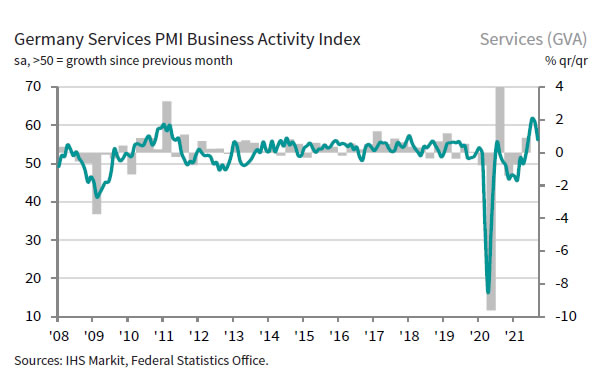
Germany PMI services finalized at 56.2, set for more moderate period of growth
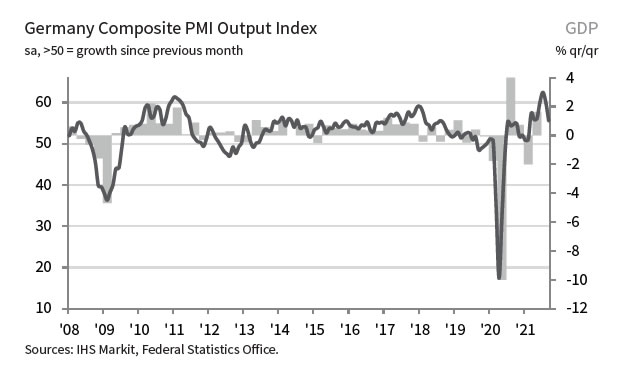
Germany PMI Services was finalized at 56.2 in September, down from August's 60.8., lowest since May. PMI Composite was finalized at 55.5, down from August's 60.0. Markit said business activity rose at slowest rate for four months. Rates of growth in new business and employment also eased. Average prices charged by services firms rose at near-record rate.
Phil Smith, Economics Associate Director at IHS Markit:
"Services activity grew strongly in the third quarter, but the pace of recovery is slowing and we're set for a more moderate period of economic growth in the final months of the year. Our current forecasts are for a 3.0% quarter-on- quarter rise in GDP in Q3, followed by a 1.2% gain in Q4.
"The loss of momentum is partly natural as activity gets closer to pre-pandemic levels, but the drag on growth from material shortages is also becoming more noticeable, impacting services firms directly and also via a slowdown in manufacturing.
"With cost pressures remaining stubbornly high and demand still picking up, the rate of services output price inflation continues to run at close to the quickest in the series history stretching back almost two decades.
"Supply bottlenecks are no longer just a manufacturing problem, and the threat of a continued spillover to other parts of the economy, coupled with inflationary pressures, has dampened service providers' growth expectations somewhat."
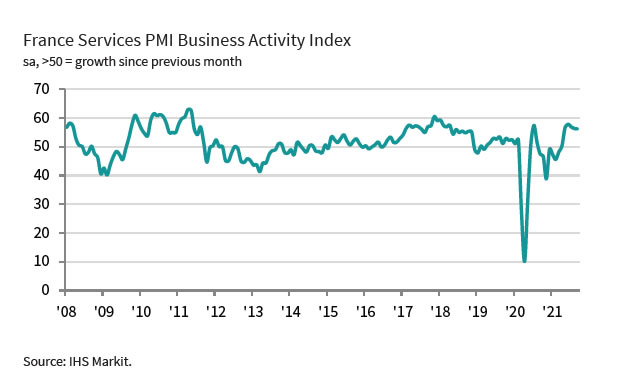
France PMI services finalized at 56.2, continued to drive broader recovery
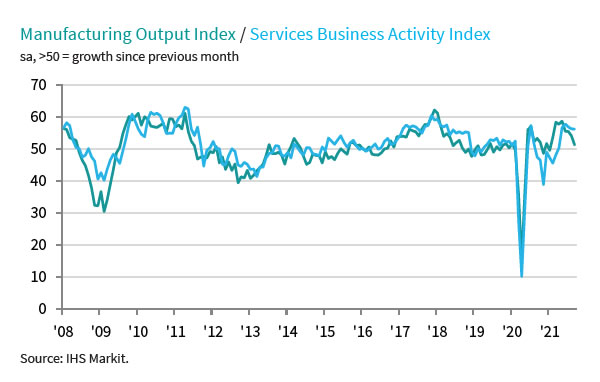
France PMI Services was finalized at 56.2 in September, down from August's 56.3. PMI Composite was finalized at 55.3, down from August's 55.9. Markit said growth ticked down to five-month low, but remained strong. Employment rose at fastest rate for almost three years. Inflationary pressure intensified amid higher staff and material costs.
Joe Hayes, Senior Economist at IHS Markit:
"France's service sector continued to drive the broader economic recovery in September. Although growth peaked earlier in the summer, services activity growth is still holding fairly close to that level.
"Reading through our panel member comments, it seems that demand is getting ever closer to reaching pre-pandemic levels, which explains why new order growth slowed in September, although some reports indicated that the "pass sanitaire" - which is used to prove members of the public have a low COVID-19 transmission risk - has had some negative impact on demand.
"More positively, however, employment growth accelerated and was close to a three-year high. Firms are shaping up their businesses to be capable of stronger activity growth, which is a clear positive sign as we head into what could potentially be a challenging winter period for Europe, fraught with uncertainty regarding the trajectory of the pandemic and associated challenges, especially in goods supply and price levels."
RBA Affirmed No Rate Hike Until 2024, Widening Policy Divergence with Counterparts
The RBA left the cash rate unchanged at 0.1%, and asset purchases at AUD 4B/month, in October. Despite sharp rise in housing prices, policymakers chose to stick with ultra-easy monetary policy in order to achieve the inflation target and full employment.
The central bank remained cautiously optimistic about the economic outlook. Policymakers acknowledged that “the Delta outbreak has interrupted the recovery of the Australian economy and GDP is expected to have declined materially in the September quarter”. Yet, they remained hopeful that the “setback to the economic expansion in Australia is expected to be only temporary”, thanks to rising vaccination rates and easing of restrictions. The central bank projected that the economy would return to growth in 4Q21, before returning to “pre-Delta path in the second half of next year”.
On the monetary policy, policymakers noted the substantial and ongoing supports to the economy. These included record low borrowing rates, very low sovereign bond yields, depreciation of the exchange rate as result of policy divergence between the RBA and its counterparts such as the Fed and the RBNZ. The RBA also retained the guidance that a rate hike won’t come until inflation is sustainably within the 2-3% target range. This condition would not be met before 2024.
The market was disappointed by the uneventful RBA meeting, reflected in further Aussie decline. The central bank's dovish stance to leave the policy rate unchanged at least until 2024 is in contrast with the Fed and the RBNZ. The former sent strong signal that QE tapering will begin later this year and the first rate hike could come in 2022. The latter will highly likely raise its policy rate tomorrow.
GER 40 Hovers Over Major Support
Stock markets still jitter over ongoing supply chain disruptions.
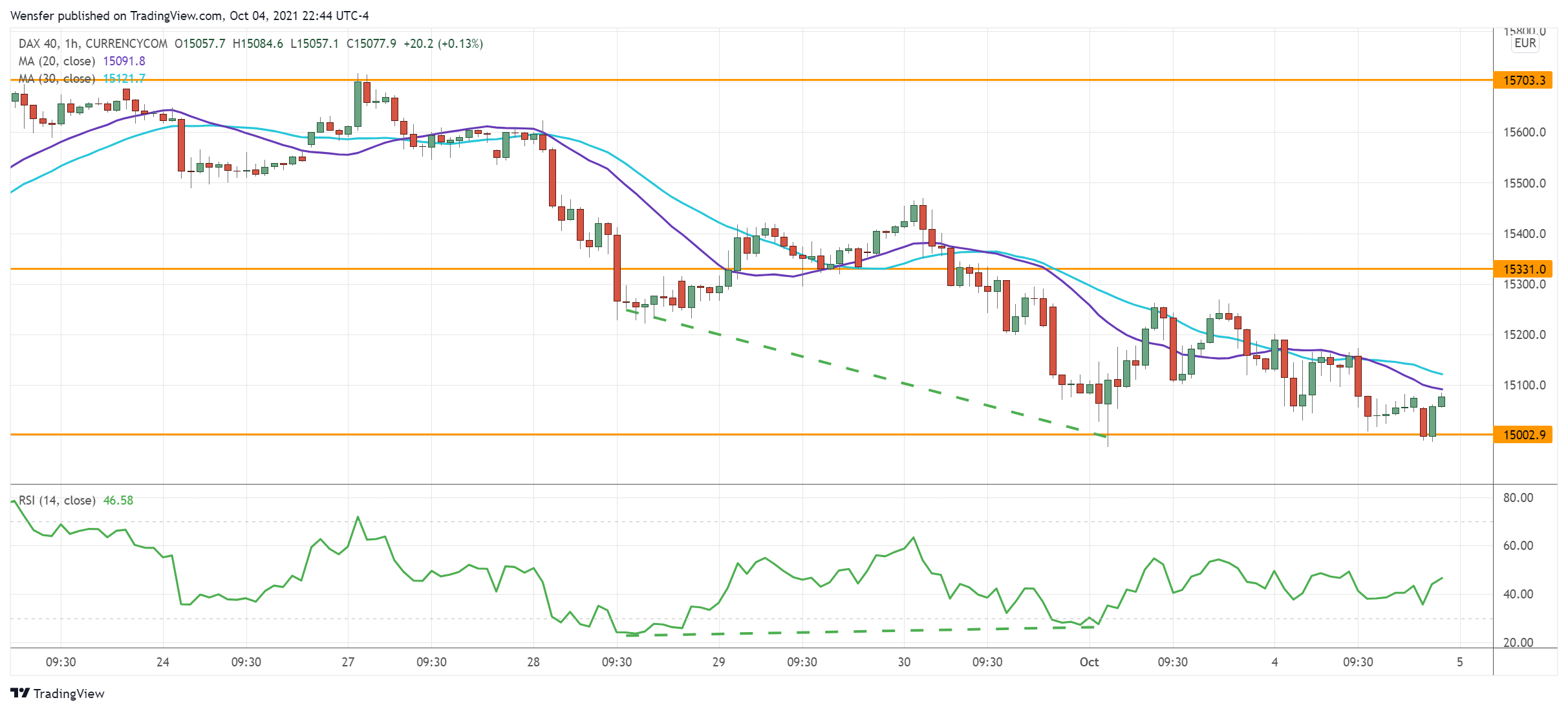
The Dax 40 has been treading water over the psychological level of 15000. A bullish RSI divergence in this important demand zone indicates that selling has become less aggressive.
However, it may be too soon to call for a U-turn. The bulls must take out 15330 before they could convince trend-followers of a turnaround. Then, 15700 would be the next hurdle.
On the downside, a bearish breakout would trigger a wave of stop-losses, sending the index towards 14500.
USD/NOK Tests Critical Support
Rally in oil prices helped lift the Norwegian krone against the greenback.
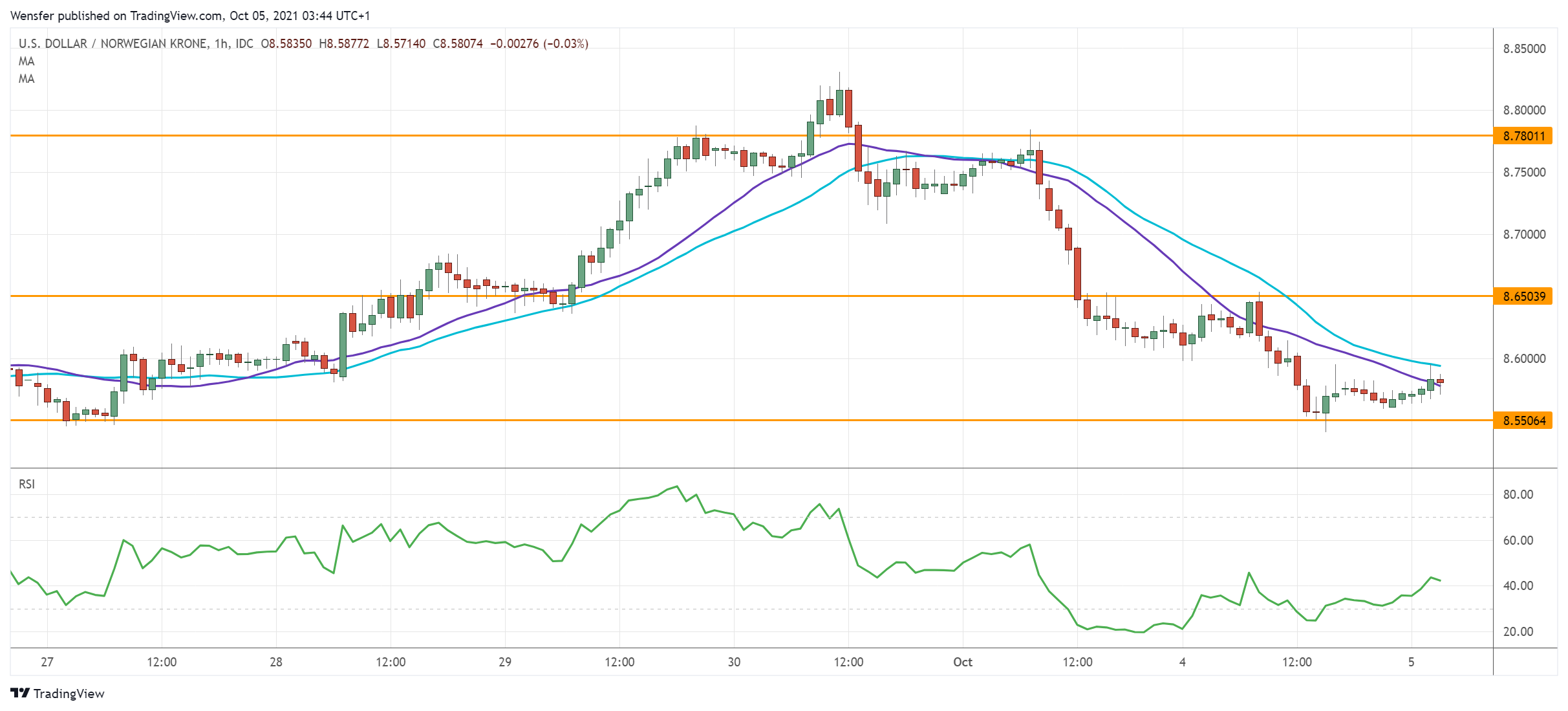
The pair had met stiff selling pressure in the supply zone around 8.8000. A sharp drop below 8.6500, which has turned into resistance, suggests that sellers have regained control of the action.
A close below 8.5500 (a major support from the daily chart) would invalidate the latest rebound and put the dollar on a bearish trajectory. An oversold RSI may cause a temporary bounce. 8.4500 would be the next stop when momentum traders stake in.
USD/JPY Retreats Below Resistance
The dollar bounced back against the yen after a weak Tokyo CPI in September.
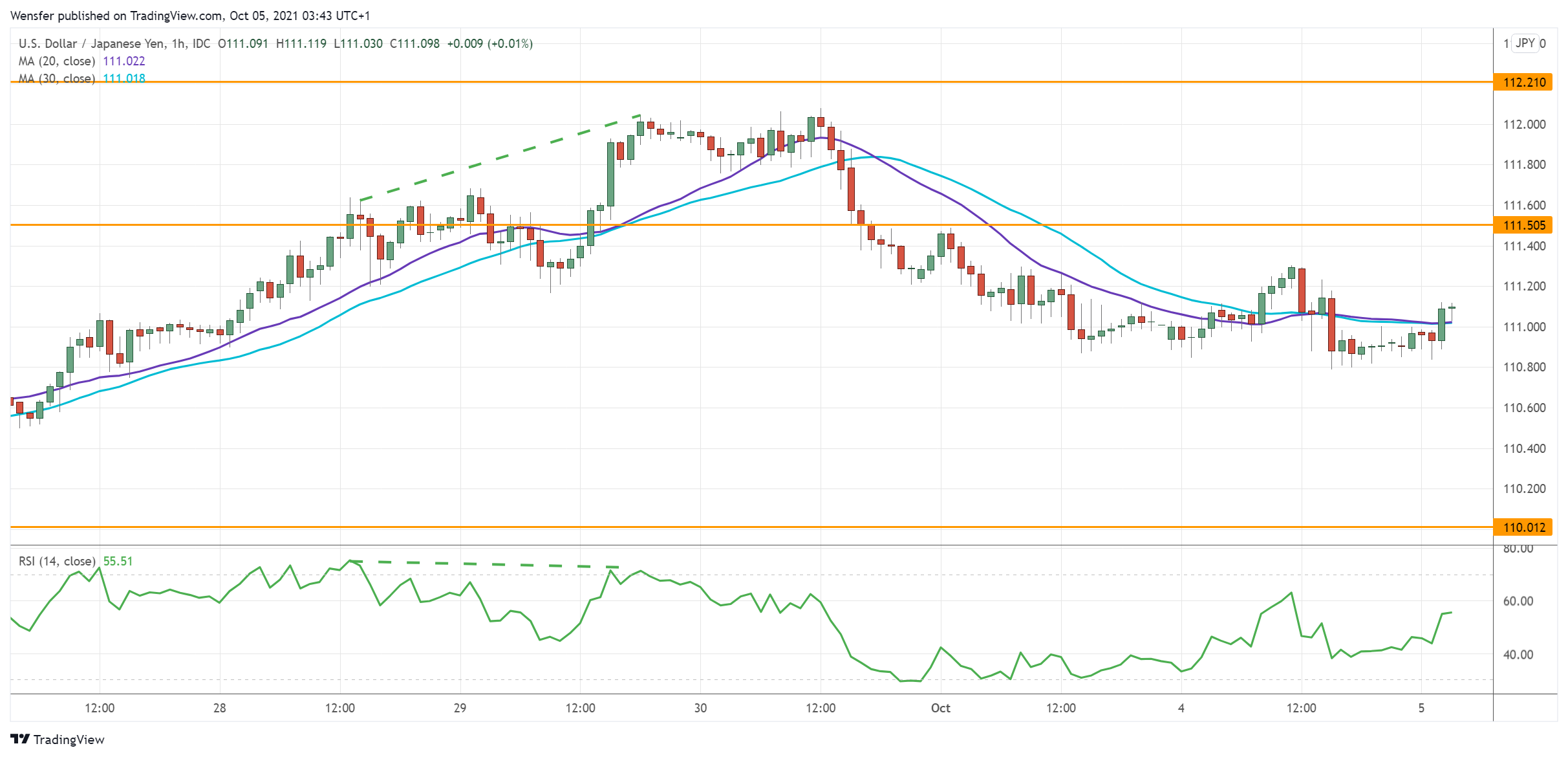
As the pair rose to the peak from February 2020 (112.20), a bearish RSI divergence revealed weakness in the momentum. A break below 111.20 and a bearish MA cross may have dented optimism.
The US dollar has seen bids at 110.90 when the RSI neared the oversold area. However, the bounce has been capped by 111.50 as trapped buyers were waiting to get out. A new round of sell-off would send the price to the psychological level of 110.00.
Crude Oil Cleared The Way To $100
OPEC has not accepted calls to accelerate oil production quotas amid a rally in gas and coal prices in Europe and Asia, boosting oil prices. WTI prices renewed their 7-year highs, climbing above $78 at one point. The gains for Brent were slightly more modest, with Brent hitting just three-year highs of $82.
Oil prices have risen almost uninterruptedly over the past seven weeks, adding more than 25% over that period. That does not mean that the potential of the rally has been exhausted. Much of the latest rise has been a recovery from a deep correction. Oil has lagged noticeably behind gas and coal in its momentum and potentially has significant upside potential.
The reluctance of OPEC+ to accelerate its production recovery schedule supports interest in oil among buyers. The recent corrective pullback and a decisive break from previous highs tend to accompany further price rallies.
In 2014, WTI crude fell almost non-stop from the $100 area to $45. As a result, a lofty space between $75-100 has formed on the charts, where quotes may not encounter any meaningful upside resistance.
There is a little more noise in Brent quotations due to the October 2018 peak near $86. But except for this episode, the $80-100 area often acts as a transitory area, with significant turning points concentrated outside it.
Simply put, there are no significant obstacles on the Tech analysis side for oil to rally to the $100 area. The only thing which would stop it is major fundamental events. For example, buyers now should be aware of signals of a sharp slowdown of economic growth, which threatens a decline in energy consumption. However, more risks for oil are posed by threats from the world’s biggest central banks to tighten monetary policy more aggressively as inflation becomes more persistent.
Daily Technical Analysis
EUR/USD
Current level - 1.1605
Last week’s sell-off seems to have been limited by the support zone at 1.1562 for now and, during the early hours of today`s trading, the EUR/USD is testing the resistance zone at 1.1601. If the bulls gain enough momentum and manage to keep the pair above the aforementioned level, the recovery will most likely continue towards the resistance at 1.1686. However, if the bears regain control of the market and manage to violate the zone of support, located at 1.1562, new losses for the common European currency against the greenback can be expected..This week, the most important news which the market participants will be focusing on is the unemployment rate and the change in the non-farm payrolls data (Friday; 13:30 GMT).
| Resistance | Support | ||
| intraday | intraweek | intraday | intraweek |
| 1.1686 | 1.1752 | 1.1601 | 1.1420 |
| 1.1708 | 1.1782 | 1.1562 | 1.1410 |

USD/JPY
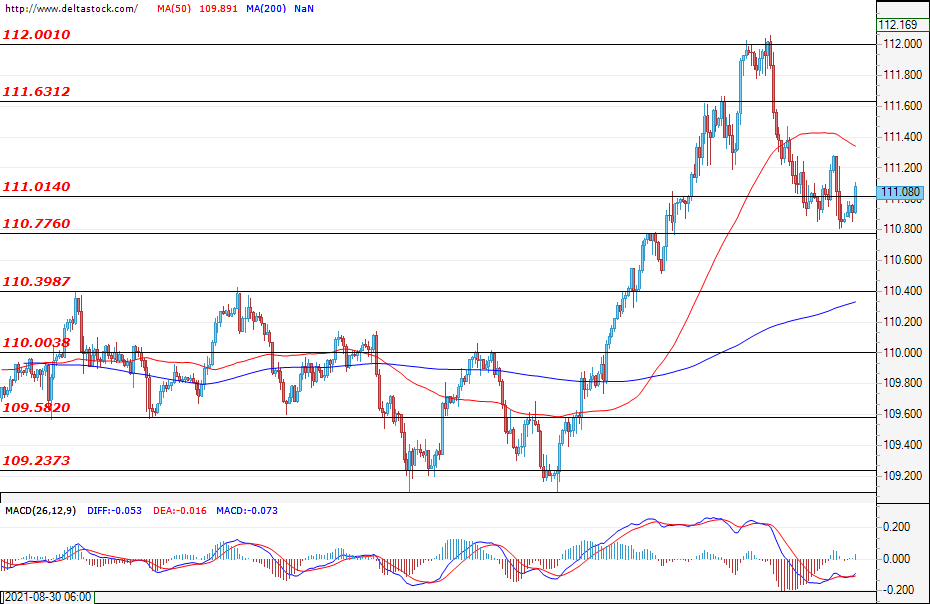
Current level - 111.08
After the increase from the previous week, we witnessed a corrective move, which currently remains limited above the support level of 110.77. If the bulls succeed in establishing themselves on the market, we can expect a resumption of the upward move towards the local peak area of 112.00. On the other hand, in the event of a deepening sell-off, the first significant support would lie at 110.40.
| Resistance | Support | ||
| intraday | intraweek | intraday | intraweek |
| 111.63 | 112.00 | 111.01 | 110.39 |
| 111.63 | 113.50 | 110.77 | 110.00 |
GBP/USD
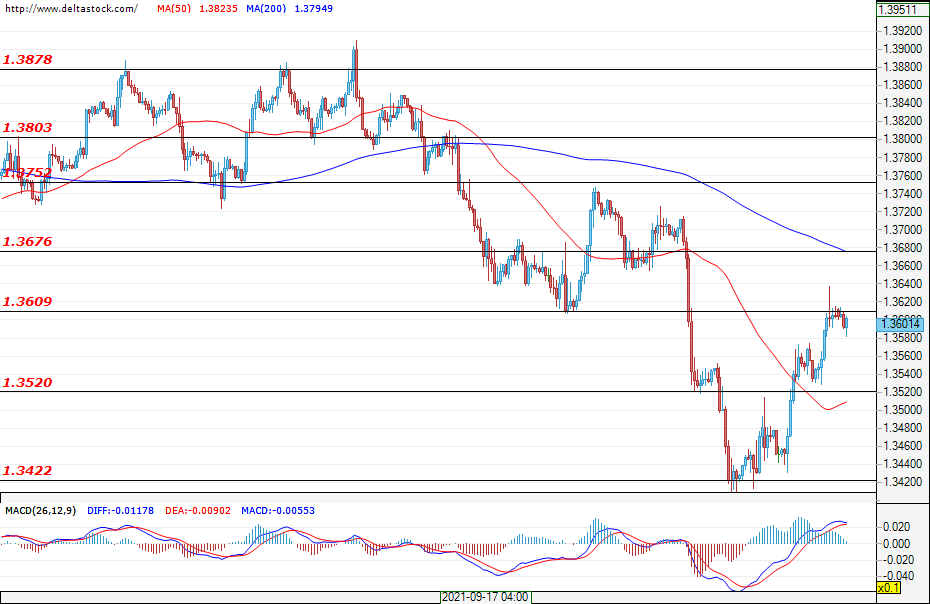
Current level - 1.3601
Part of the lost positions for the pound were recovered after the bulls managed to limit the sell-off down to the support level of 1.3422 at the end of last week. At the time of writing, the currency pair consolidated to just below the resistance of 1.3609 and a successful breach of the mentioned level would strengthen the positive sentiment, with the more significant goal being reaching and testing the significant resistance zone of 1.3752.
| Resistance | Support | ||
| intraday | intraweek | intraday | intraweek |
| 1.3609 | 1.3752 | 1.3520 | 1.3400 |
| 1.3676 | 1.3803 | 1.3422 | 1.3250 |
GBPUSD Finds Resistance At 23.6% Fibonacci In Descending Channel
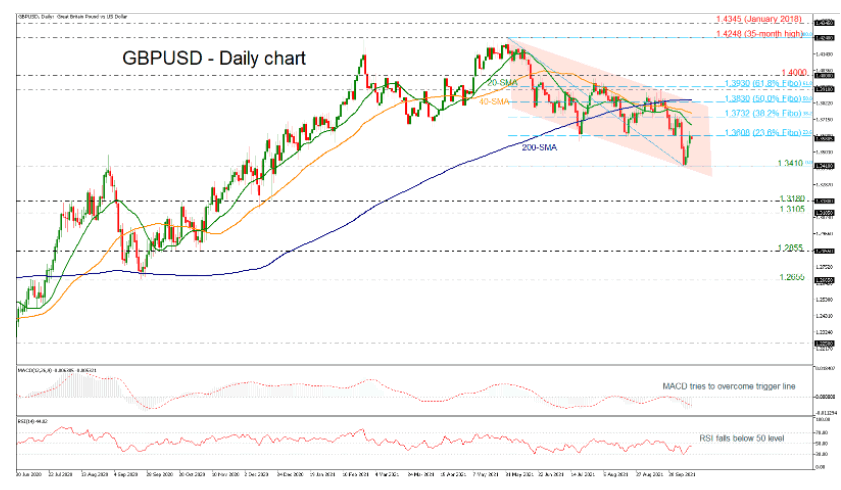
GBPUSD has been developing in a downward sloping channel since the beginning of June, with the price recently posting another rebound at the bottom of this structure at 1.3410.
The cable is currently testing the 23.6% Fibonacci retracement level of the down leg from 1.4248 to 1.3410 at 1.3608.
In technical indicators, the MACD oscillator is trying to overcome its trigger line in the negative territory. However, the RSI indicator is pointing down below its neutral threshold of 50, while the short-term simple moving averages (SMAs) are heading south for the moment.
If the pair fails to surpass the 1.3600 handle, the market could move lower again to meet the 1.3410 barrier, taken from the latest lows. Steeper decreases could open the way towards the 1.3105-1.3180 support area.
Alternatively, a jump above the immediate resistance of 1.3608 could see the market testing the 20-day SMA at 1.3678 and the 38.2% Fibonacci of 1.3732. Stretching higher, the bulls may head towards the 50.0% Fibonacci of 1.3830, which overlaps with the 200-day SMA.
To sum up, GBPUSD is in a bearish trend in the medium-term picture and only an advance above the 200-day SMA may change this outlook to neutral again.
RBA Board Maintains Current Policy Stance
There were no policy changes announced or much change in the Governor’s Statement. He did make us aware that the Council of Financial Regulators is closer to adopting some form of macro prudential tightening with loan serviceability buffers being singled out.
As expected the Reserve Bank Board decided to maintain its current policy stance at the October Board meeting.
The Governor’s Statement was particularly short and contained no significant new observations.
GDP in the September quarter is forecast to have “declined materially” .
However the setback is expected to be “only temporary” with the economy expected to bounce back. There is uncertainty about the timing and pace of the bounce- back which is expected to be slower than earlier in the year.
In the central scenario, “the economy will be growing again in the December quarter and is expected to be back around its pre-Delta path in the second half of next year.”
That description probably means that the level of GDP will be back at the level which was projected prior to Delta by the second half of next year. However it does not mean that total production over the period is expected to be unchanged. The loss in production during the September quarter is unlikely to be fully recouped by the second half of 2022 although the projected level of activity in the second half of 2022 will still be reached. That has implications for the output gap and associated inflation pressures but these inflation pressures will not be solely determined by demand with unusual supply pressures playing an important role.
The bank’s liaison and data on job vacancies “suggest that many firms are seeking to hire workers ahead of the expected reopening in October and November.”
However the Governor points out that wages and prices remain subdued.
In that regard he notes that underlying inflation is running at around 1.75% and wages increased by “just 1.7%” although this 1.7% was impacted by the COVID affected 0.1% increase in the September quarter last year.
There is an expanded commentary on the housing market.
The Reserve Bank’s Statement on Financial Stability is due to be released on October 8 and this report would have been discussed at the meeting. The Governor notes that The Council of Financial Regulators has been discussing the medium term risks to macroeconomic stability of rapid credit growth. The Governor concludes with the usual “it is important that lending standards are maintained “ but adds it is important “that loan serviceability buffers are appropriate”.
The latter comment refers to the need for lenders to be comfortable that a loan can still be serviced should the loan rate increase by that serviceability buffer. Increasing that buffer would provide a tougher stress test for any new borrowers.
At the moment banks and other regulated lenders must utilise an interest rate buffer of at least 2.5% over the loan’s interest rate.
Finally, the key conclusion that has been consistently used since April 2020 “It will not increase the cash rate until actual inflation is sustainably within the 2-3 per cent target range.” is repeated in this Statement. It is possible that the Governor may have decided to be more specific with that description of the policy approach following a recent speech when he noted“ We want to see inflation around the middle of the target range.”
Conclusion
As expected there was no policy change at today’s Board meeting.
However there was clearly a discussion about the prospect for macro prudential policy with the only “clue” being a consideration of loan serviceability buffers.
There is nothing in the Statement to cause Westpac to change its expectation that an increase in the overnight cash rate of 0.15% can be expected by the March quarter 2023.