

Sample Category Title
The Analytical Overview Of The Main Currency Pairs
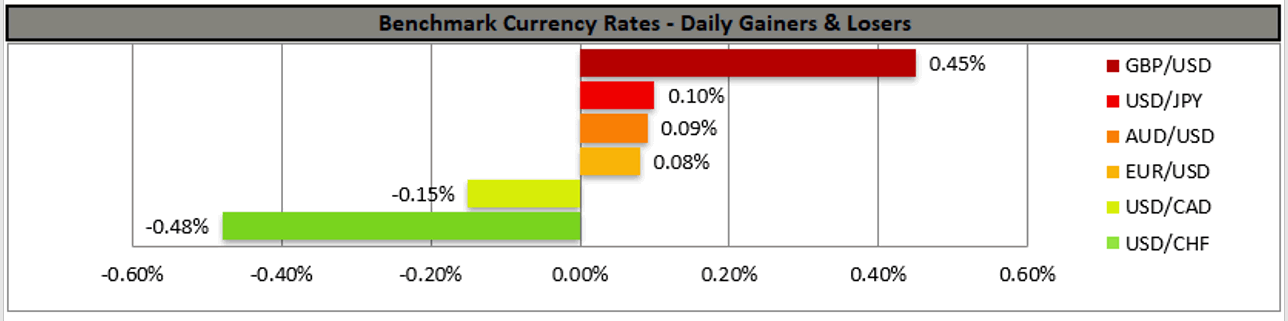
The EUR/USD currency pair
Technical indicators of the currency pair:
Prev Open: 1.1593
Prev Close: 1.1619
% chg. over the last day: +0.22%
ECB spokesman Paolo Gentiloni says that high inflation in EU countries is temporary, as supply chain problems and rising energy prices are pushing prices up. But the ECB expects EU countries to show a positive economic trend in the third quarter.
Trading recommendations
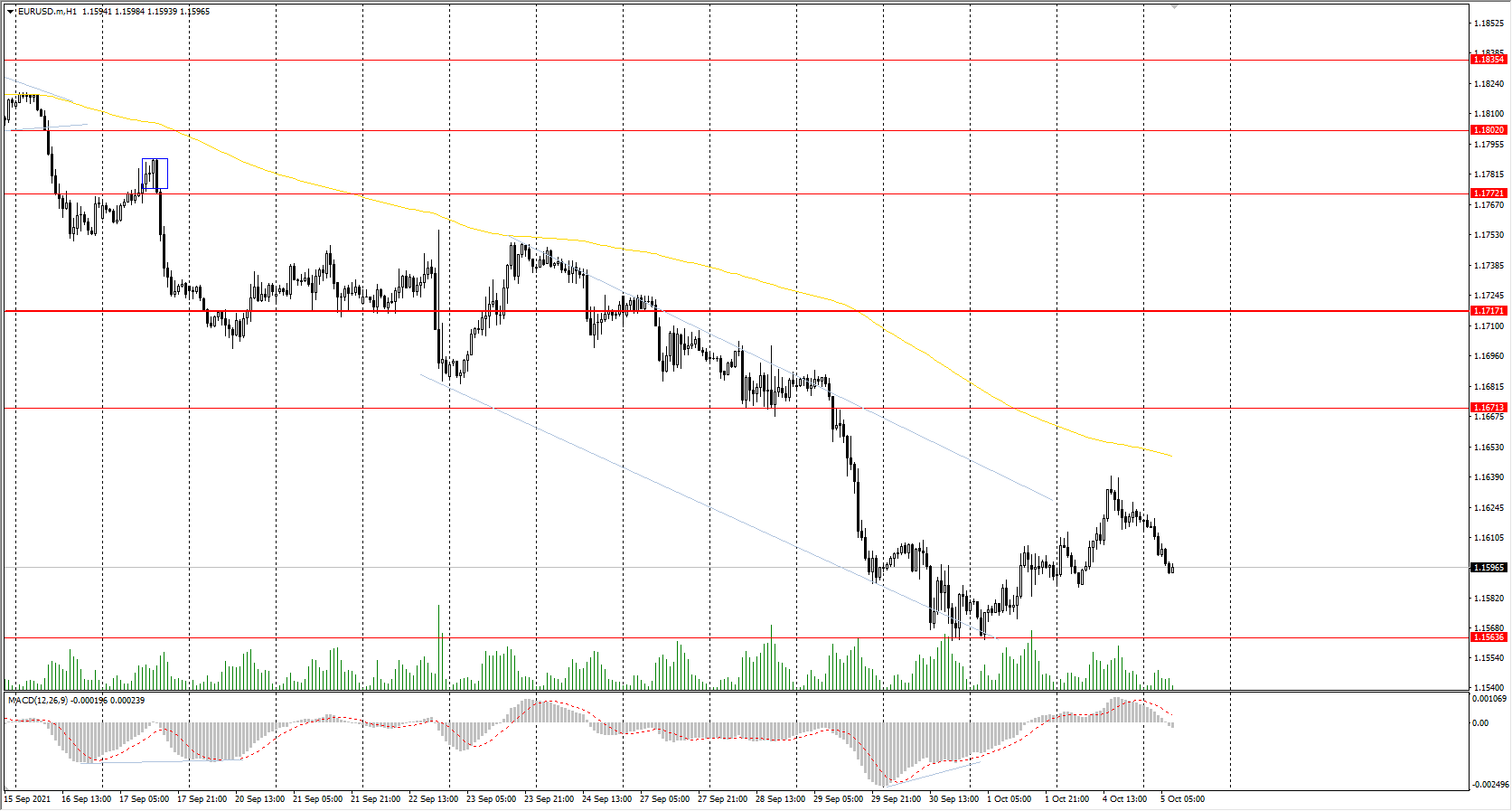
Support levels: 1.1564, 1.1453
Resistance levels: 1.1671, 1.1717, 1.1772, 1.1802, 1.1835
From the technical point of view, the EUR/USD trend is bearish. But the MACD indicator has become inactive. It indicates that the sellers have stopped putting pressure. Under such market conditions, traders should consider sell deals from the resistance levels near the moving average, as the price has deviated from the middle line. Buy trades should be considered only from the support levels with additional confirmation in the form of a buyers' initiative.
Alternative scenario: if the price breaks out through the 1.1717 resistance level and fixes above, the mid-term uptrend will likely resume.
News feed for 2021.10.05:
- Eurozone Services PMI (m/m) at 11:00 (GMT+3);
- US ISM Services PMI (m/m) at 17:00 (GMT+3);
- Eurozone ECB President Lagarde’s Speech at 18:00 (GMT+3).
The GBP/USD currency pair
Technical indicators of the currency pair:
Prev Open: 1.3552
Prev Close: 1.3605
% chg. over the last day: +0.39%
The situation with the delivery of fuel to gas stations is improving, but the UK is still experiencing a serious shortage of truck drivers. New car registrations in the UK fell by 35% year-over-year last month. The automotive industry continues to suffer from a global shortage of semiconductors. But the British currency is strengthening due to rising oil prices, as the GBP directly correlates with BRENT oil prices.
Trading recommendations
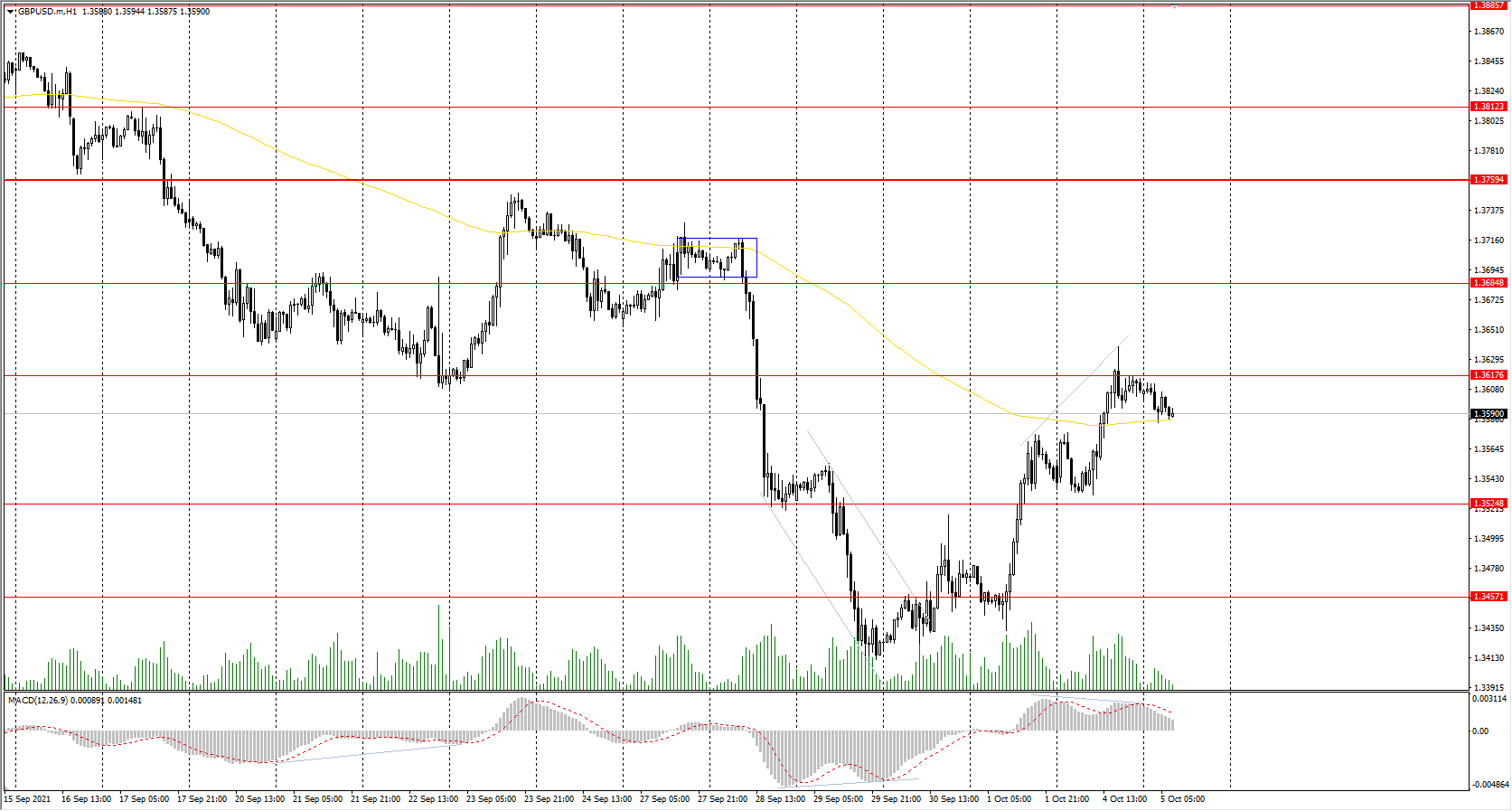
Support levels: 1.3525, 1.3457, 1.3360, 1.3282
Resistance levels: 1.3617, 1.3685, 1.3759, 1.3812, 1.3886
On the hourly time frame, the GBP/USD trend is bearish. But the British currency keeps getting stronger due to oil prices growth. The MACD indicator has become positive, but there are already signs of divergence. Buy trades should be considered only throughout the day and only with short targets from the support levels after the buyer’s initiative. Sell trades can be found at the resistance levels near the moving average line.
Alternative scenario: if the price breaks out through the 1.3759 resistance level and consolidates above, the bullish scenario will likely resume.
News feed for 2021.10.05:
- UK Services PMI (m/m) at 11:30 (GMT+3).
The USD/JPY currency pair
Technical indicators of the currency pair:
Prev Open: 110.86
Prev Close: 111.91
% chg. over the last day: +0.04%
Tokyo's consumer price index is declining. It’s a sign of slowing inflation in Japan's capital. The newly elected prime minister Fumio Kishida says he will dissolve the lower house of parliament next week in preparation for the October 31 elections as he seeks a new mandate to deal with the coronavirus pandemic, a decline in economics, and security threats from China and North Korea.
Trading recommendations
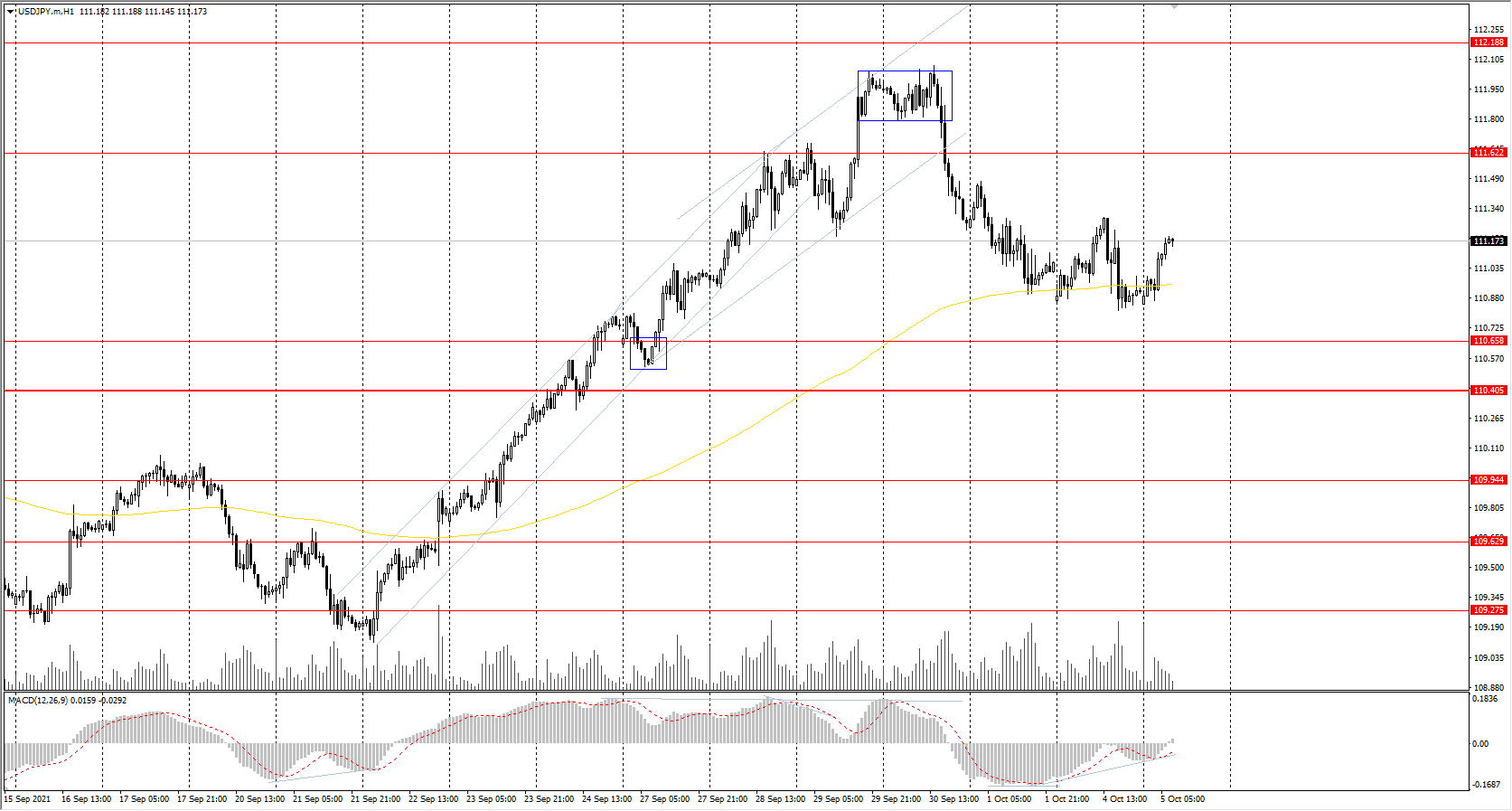
Support levels: 110.65, 110.40, 109.95, 109.63, 109.27
Resistance levels: 111.62, 112.19
The main trend of the USD/JPY currency pair is bullish. The MACD indicator became positive, and there are signs of buyer’s initiative. Under such market conditions, it’s better to look for buy positions from the support levels near the moving average. Sell positions should be considered only throughout the day from the resistance levels, given there is sellers' initiative.
Alternative scenario: if the price falls below 110.45, the uptrend is likely to be broken.
News feed for 2021.10.05:
- Japan Tokyo Core Consumer Price Index at 02:30 (GMT+3).
The USD/CAD currency pair
Technical indicators of the currency pair:
Prev Open: 1.2639
Prev Close: 1.2587
% chg. over the last day: -0.41%
The Canadian dollar is a commodity currency, so USD/CAD is highly dependent on the dynamics of the dollar index and oil prices. The dollar index slightly decreased yesterday while the oil prices jumped. As a result, the USD/CAD quotes sharply decreased due to the strengthening of the Canadian currency.
Trading recommendations
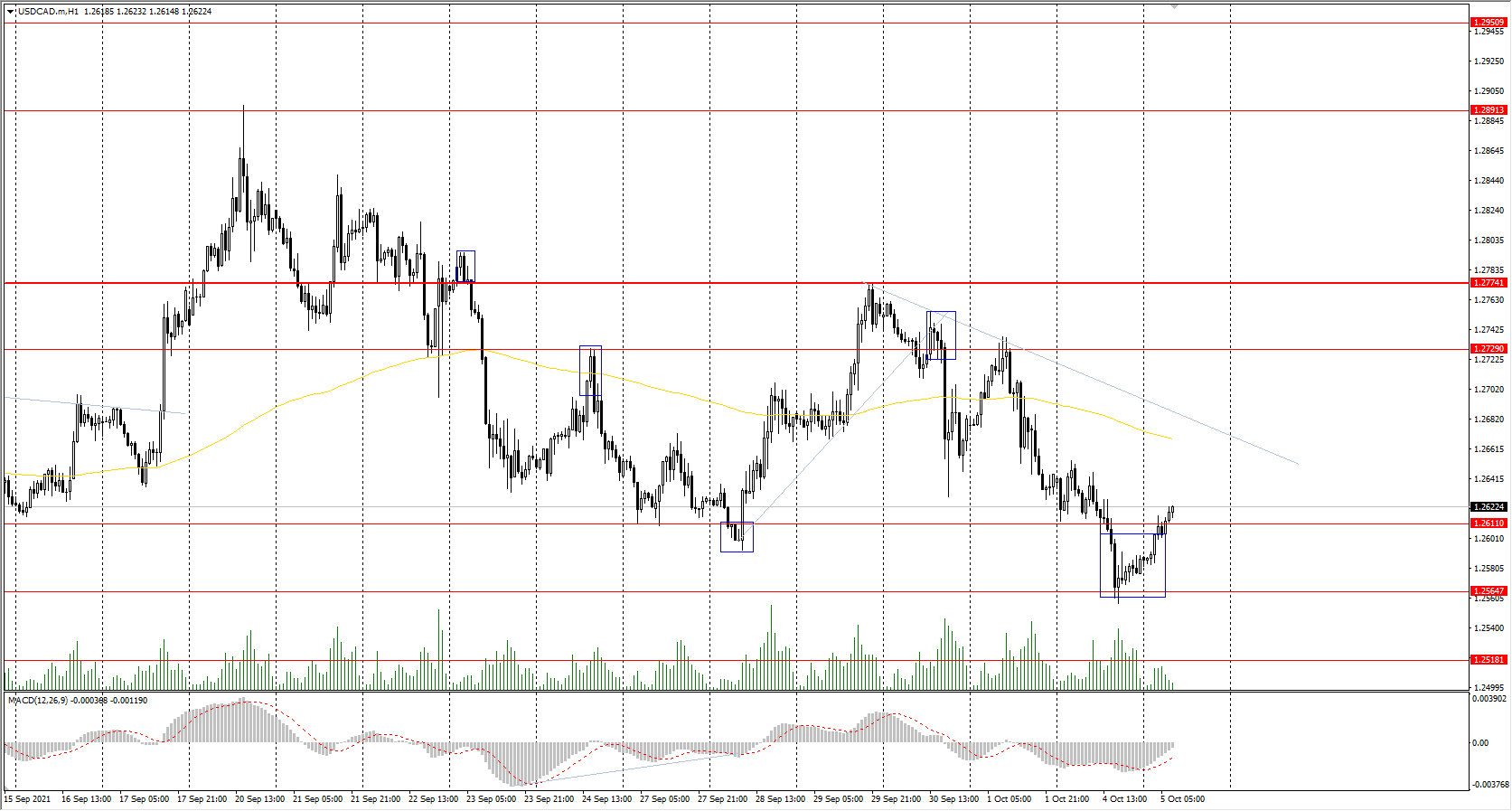
Support levels: 1.2611, 1.2565, 1.2518, 1.2425
Resistance levels: 1.2729, 1.2774, 1.2891
From the technical point of view, the trend of the USD/CAD currency pair is bearish. The MACD indicator has become inactive. Yesterday, the price broke down through the support level but came back above the level at the Asian session, forming a false breakdown zone below. Under such market conditions, it is better to look for sell deals from the resistance levels near the moving average. Buy deals should be considered from the false breakdown zone but with short targets.
Alternative scenario: if the price breaks out through the 1.2774 resistance level and fixes above, the uptrend will likely resume.
USD/JPY Bears Are Still In Control
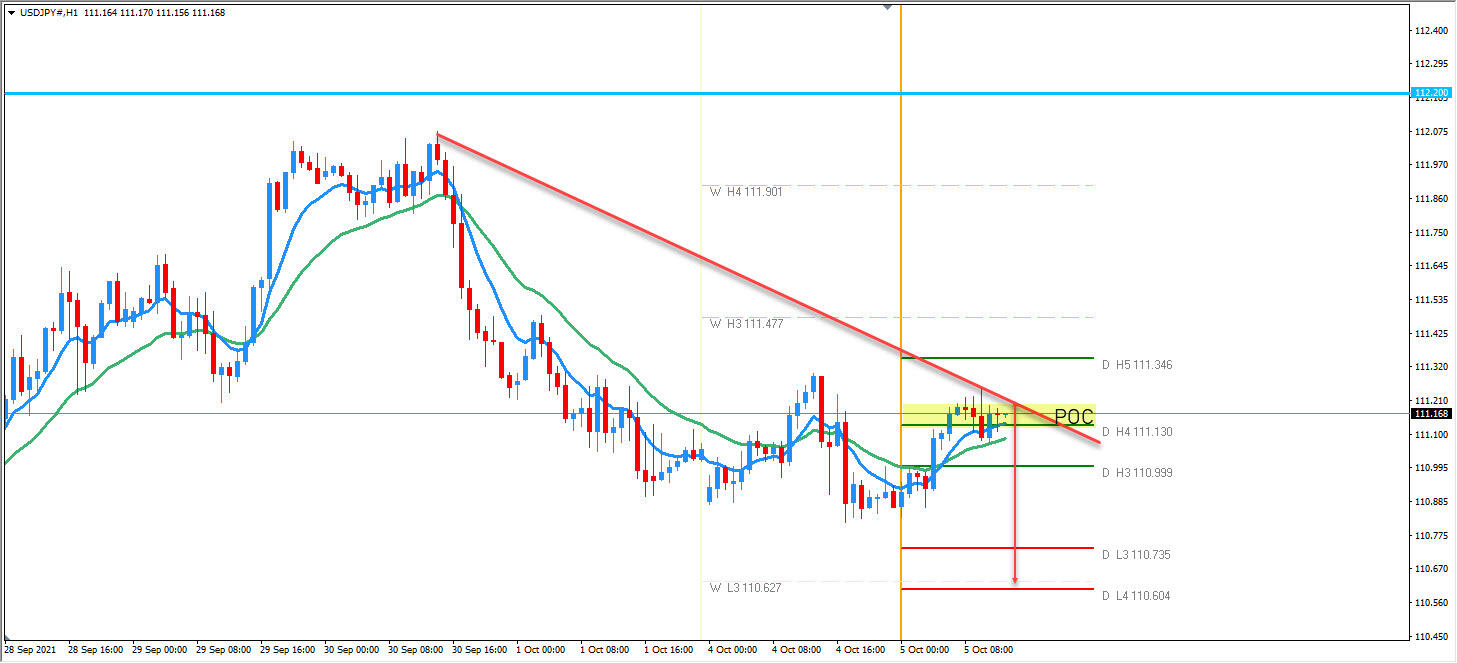
The USD/JPY has reached the confluence zone and we might see a drop.
The 111.20 zone has been hit and the price is hesitant to move further up. At this point we could see the move down which might become more potent during the US session. Yesterday, equities were bearish and that also reflected in the USD/JPY move. Yen up, equities down. Targets are 110.73 and 110.60. This is an intraday setup.
Risk Appetite Trying To Recover With Focus Continuing To Be On Energy Costs
Notes/Observations
Major European PMI Services data remained robust but continued slow compared to the prior peaks seen earlier this year (Beats: France, Germany, Euro Zone, UK; Misses: Spain, Italy).
- French Aug production data showed sector on the uptrend and paints a picture of a sustained rebound.
Asia
- RBA left Cash Rate Target unchanged at 0.10% and maintained 3-year Yield Target at 0.10% (as expected). Reiterated forward guidance that conditions for rate increase would not be met prior to 2024 at the earliest.
- Australia Aug Trade Balance: A$15.1B v A$10.0Be; Exports M/M: +4% v -3%e; Imports M/M: -1% v +1%e.
- Australia Sept Final PMI Services: 45.5 v 44.9 prelim (confirmed 3rd month of contraction).
- Japan Sept Tokyo CPI Y/Y: +0.3% v -0.1%e; CPI Ex-Fresh Food Y/Y: 0.1% v 0.2%e.
- Japan Econ Min Yamagiwa stated that the economy remained severely affected by coronavirus and sought to unveil new economic package before end of year. Too early to comment on size and timing of economic package.
- Japan Fin Min Suzuki: Affirms goal of primary balance surplus by FY25. Important to keep fiscal discipline regardless of doing what’s needed.
Europe
- Eurogroup President Donohoe noted that energy prices entailed a wide ranging aspect of consequences, inflation should start to fall again in 2022. Received a new text regarding corporate tax reform from OECD and making progress on issue but there was need for further talks.
Americas
- White House spokesperson noted Biden to have talks with progressive House members and tell them the reconciliation bill would be smaller than they like.
- President Biden said to have told House progressives that spending package needed to be between $1.9-$2.2T‘; Biden felt that this could be the range that would be acceptable to Sens. Manchin (D-VW) and Sinema (D-AZ).
- Senate Parliamentarian ruled standalone debt ceiling bill could be voted on under reconciliation procedure, which would allow 50-vote majority to pass debt limit increase.
- Senate majority Schumer will try again on Wednesday (Oct 6th) to put through a debt-ceiling suspension bill which will likely fail unless 10 Republicans break rank.
- Mexico Central Bank (Banxico) Dep Gov Heath: Cycle of rate hikes is not over; We could see one or two more rate increases.
Energy
- OPEC+ ministers agreed to maintain existing policy of increasing production by 400K bpd in Nov, in line with the JMMC recommendation (Note: oil hit 7-year high afterwards).
- White House Press Sec Psaki: US will use all tools to keep gas prices down.
Speakers/Fixed income/FX/Commodities/Erratum
Equities
- Indices [Stoxx600 +0.58% at 453.36, FTSE +0.57% at 7,050.75, DAX +0.36% at 15,090.35, CAC-40 +0.67% at 6,520.86, IBEX-35 +0.53% at 8,838.50 , FTSE MIB +0.88% at 25,686.00, SMI +0.06% at 11,589.83, S&P 500 Futures +0.31%].
- Market Focal Points/Key Themes: European indices open generally higher and remained in the green as the session progressed; better-performing sectors inclue conusmer discretionary and technology; while industrials and real estate sectors among the laggards; technology sector supported by better results from Infineon; reportedly AB Inbev looking to sell its German beer business; focus on Lagarde speech later in the day; earnings expected in the upcoming US session include PepsiCo.
Equities
- Consumer discretionary: Greggs [GRG.UK] +5% (trading update), Shop Apotheke [SAE.DE] +8% (prelim results).
- Healthcare: AstraZeneca [AZN.UK] +1% (EUA filing).
- Industrials: GN Store Nord [GN.DK] -7% (cuts outlook), Melrose [MRO.UK] -2% (trading update).
- Technology: Infineon [IFX.DE] +1.5% (CMD; outlook).
Speakers
- UK PM Johnson stated that wanted to see wage and productivity growth to continue.
- EU Commission President Von Der Leyen stated that needed to aim reaching energy independence. Glad to see Norway stepping up gas production.
- EU Economic Commissioner Gentiloni (Italy) reiterated Eurogroup view that discussions on global tax agreement were progressing.
- Spain govt said to be planning 2% wage increase for civil servants.
- Japan Fin Min Suzuki stated that the new PM has instructed him to be flexible on policy; would seek a new type of capitalism and peruse fiscal health and growth at the same time. Instructed to make use of low interest rate environment and stick to bold monetary easing to put a decisive end to deflation. Size of economic package to depend on debate and necessity.
Currencies/Fixed income
- USD was mixed in the session but participants still seemed leaning towards risk-averse and safe haven flows if given the opportunity.
- EUR/USD steady at 1.16 area while GBP/USD regained a foothold above the 1.36 level.
- Euro zone bond yields drifted from recent three-month highs as oil prices soar after OPEC+ kept its planned Nov production increase steady at 400K bpd.
Economic data
- (RU) Russia Sept PMI Services: 50.5 v 50.3e Moved back into expansion); PMI Composite: 50.5 v 48.2 prior.
- (SE) Sweden Sept PMI Services: 69.6 v 64.7 prior (16th month of expansion); PMI Composite: 68.2 v 63.4 prior.
- (FR) France Aug Industrial Production M/M: 1.0% v 0.4%e; Y/Y: 3.9% v 3.3%e.
- (FR) France Aug Manufacturing Production M/M: 1.1% v 0.7% prior; Y/Y: 4.3% v 3.8% prior.
- (ES) Spain Sept Services PMI: 56.9 v 58.1e (6th month of expansion); Composite PMI: 57.0 v 58.5e.
- (ZA) South Africa Sept PMI (whole economy): 50.7 v 50.1e (1st expansion in 3 months).
- (IT) Italy Sept Services PMI: 55.5 v 56.5e (5th month of expansion); Composite PMI: 56.6 v 57.7e.
- (FR) France Sept Final PMI Services: 56.2 v 56.0e (confirmed 5th straight expansion); PMI Composite: 55.3 v 55.1e.
- (DE) Germany Sept Final PMI Services: 56.2 v 56.0e (confirmed 5th month of expansion); PMI Composite: 55.5 v 55.3e.
- (EU) Euro Zone Sept Final PMI Services: # v56.3e (confirmed 6th month of expansion); PMI Composite: # v 56.1e.
- (IT) Italy Q2 YTD Budget Deficit to GDP: 10.2% v 13.0% prior.
- (UK) Sept New Car Registrations Y/Y: -34.4% v -22.0% prior.
- (CZ) Czech Sept Unemployment Rate: 3.5% v 3.6% prior.
- (TW) Taiwan Sept Foreign Reserves: $544.9B v $543.6B prior.
- (UK) Sept Final PMI Services: 55.4 v 54.6e (confirms 7th month of expansion); PMI Composite: 54.9 v 54.1e.
- (UK) Sept Official Reserves Changes: -$0.9B v -$0.6B prior.
- (EU) Euro Zone Aug PPI M/M: 1.1% v 1.3%e; Y/Y: 13.4% v 13.5%e.
Fixed income issuance
- (ID) Indonesia sold total IDR5.0T vs. IDR5.0T target in Islamic bills and bonds (sukuk).
- (ES) Spain Debt Agency (Tesoro) sold total €4.995B vs. €4.5-5.5B indicated range in 6-month and 12-month Bills.
- (UK) DMO sold £3.0B in 0.25% Jan 2025 Gilts; Avg Yield: 0.491% v 0.250% prior; bid-to-cover: 2.51x v 2.81x prior; Tail: 0.3bps v 0.2bps prior.
- (AT) Austria Debt Agency (AFFA) sold total €1.265B vs. €1.265B indicated in 2025 and 2031 RAGB bonds.
Looking ahead
- (RO) Romania Central Bank (NBR) Interest Rate Decision: Expected to leave Interest Rates unchanged at 1.25%.
- (UR) Ukraine Sept Official Reserve Assets: No est v $31.6B prior.
- (MX) Citibanamex Survey of Economists.
- 05:15 (CH) Switzerland to sell 3-month Bills.
- 05:25 (EU) Daily ECB Liquidity Stats.
- 05:30 (HU) Hungary Debt Agency (AKK) to sell 3-Month Bills.
- 05:30 (DE) Germany to sell combined €400M in 2033 and 2046 inflation-linked Bonds (Bundei).
- 05:30 (BE) Belgium Debt Agency (BDA) to sell 3-month bills.
- 05:30 (EU) ECB allotment in 7-Day Main Refinancing Tender (MRO).
- 05:30 (ZA) South Africa to sell combined ZAR3.9B in 2030, 2035 and 2044 bonds.
- 06:00 (IL) Israel July Manufacturing Production M/M: No est v 4.0% prior.
- 06:30 (EU) ESM to sell €1.5B in 3-month Bills.
- 06:30 (UK) DMO to sell £2.25B in 1.125% Jan 2039 Gilt.
- 06:45 (US) Daily Libor Fixing.
- 07:00 (TR) Turkey to sell 3% I/L 2031 Bonds.
- 07:00 (CA) Canada Sept CFIB Business Barometer: No est v 67.1 prior.
- 07:00 (EU) Euro Zone Finance Ministers (EcoFin).
- 07:30 (TR) Turkey Sept Real Effective Exchange Rate (REER) : No est v 62.89 prior.
- 08:00 (BR) Brazil Aug Industrial Production M/M: -0.4%e v -1.3% prior; Y/Y: 0.0%e v 1.2% prior.
- 08:00 (UK) Daily Baltic Dry Bulk Index.
- 08:30 (US) Aug Trade Balance: -$70.5Be v -$70.1B prior.
- 08:30 (CA) Canada Aug Int'l Merchandise Trade (CAD): No est v 0.8B prior.
- 08:55 (US) Weekly Redbook LFL Sales data.
- 09:00 (BR) Brazil Sept PMI Services: No est v 55.1 prior; PMI Composite: No est v 54.6 prior.
- 09:00 (EU) Weekly ECB Forex Reserves.
- 09:00 (RU) Russia announcement on upcoming OFZ bond issuance (held on Wed).
- 09:00 (EU) ECB weekly QE bond buying update.
- 09:45 (UK) BOE to buy £1.47B in APF Gilt purchase operation (20+ years).
- 09:45 (US) Sept Final Markit PMI Services: 54.4e v 54.4 prelim; PMI Composite: No est v 54.5 prelim.
- 10:00 (US) Sept ISM Services Index: 59.9e v 61.7 prior.
- 10:00 (MX) Mexico Weekly International Reserves.
- 11:00 (EU) ECB chief Lagarde.
- 16:30 (US) Weekly API Oil Inventories.
- 19:00 (KR) South Korea Sept CPI M/M: No est v 0.6% prior; Y/Y: 2.3%e v 2.6% prior; CPI Core Y/Y: No est v 1.8% prior.
- 20:00 (CO) Colombia Sept CPI M/M: 0.3%e v 0.5% prior; Y/Y: 4.4%e v 4.4% prior.
- 20:00 (CO) Colombia Sept CPI Core M/M: No est v 0.3% prior; Y/Y: No est v 3.1% prior.
- 20:30 (HK) Hong Kong Sept PMI (whole economy): No est v 53.3 prior.
- 21:00 (NZ) Reserve bank of New Zealand (RBNZ) Interest Rate Decision: Expected to raise Official Cash Rate (OCR) by 25bps to 0.50%.
Oil Climbs On OPEC+, Gold Directionless
OPEC+ sends oil higher
OPEC+ held fast to their 400,000 bpd per month production increase schedule at their meeting yesterday with various excuses, official and unofficial promulgated, including a Covid 4th wave, seasonal factors, natural gas distorting oil prices and giving “certainty” by not responding to short-term market inputs. Whichever and whatever you chose to accept, the net result sent Brent crude to 3-year highs.
Brent crude surged higher by 2.75% to USD 81.30, and WTI charged 2.50% higher to USD 77.60 a barrel. With mainland China still away, trading has been muted in Asia. Both contracts have made modest gains, Brent rising 0.30% to USD 81.60 and WTI rising 0.25% to USD 77.80 a barrel. Natural gas prices have risen by 1.0% in Asia this morning, and with weather-related coal production disruptions likely in India and China, it is hard to construct a bearish case for oil. In all likelihood, buyers will be lining up on dips now, meaning any sell-offs, no matter how violent, will be short-lived in duration. Winter is coming.
Brent crude will find plenty of support on dips to USD 79.00 and USD 76.00 a barrel and after clearing the overnight high around USD 82.00, should have the 2018 high around USD 87.00 a barrel in its sights. WTI will be well supported on dips to USD 75.00 a barrel, with resistance at USD 78.50. The charts suggest that a rally to USD 84.00 a barrel is not out of the question once USD 78.50 is convincingly overcome.
The only caveat on further immediate rallies is that the relative strength indexes (RSIs) on both contracts have entered overnight territory. That may signal some daily pullbacks this week but does not change the underlying bullish case for oil.
Gold struggles for direction
Gold rose 0.45% to USD 1769.50 overnight as the US dollar weakened. However, a rising US dollar in Asia has seen gold give back all those gains, falling by 0. 62% to USD 1758.50 an ounce. It is clear that now, gold remains mostly an inverse US dollar play, with a dollop of risk-hedging buying providing occasional support.
I am expecting gold to find support on dips to USD 1750.00 this week, as investor inflation and US fiscal fears increase. Ahead of the Non-Farms I am looking at a choppy USD 1750.00 to USD 1785.00 range. None of that will save gold if the US Non-Farm Payrolls are firm on Friday, putting the Fed taper, and higher US yields back in play.
Gold has support at USD 1750.00 followed by a double bottom at USD 1722.00 an ounce. Initial resistance is at USD 1780.00/1785.00 an ounce. Gold will face far more formidable resistance in the USD 1800.00 to USD 1808.00 an ounce zone, technical resistance and housing the 100 and 200-day moving averages.
The US Dollar Falls Overnight Once Again
US dollar dips despite rising uncertainty in markets
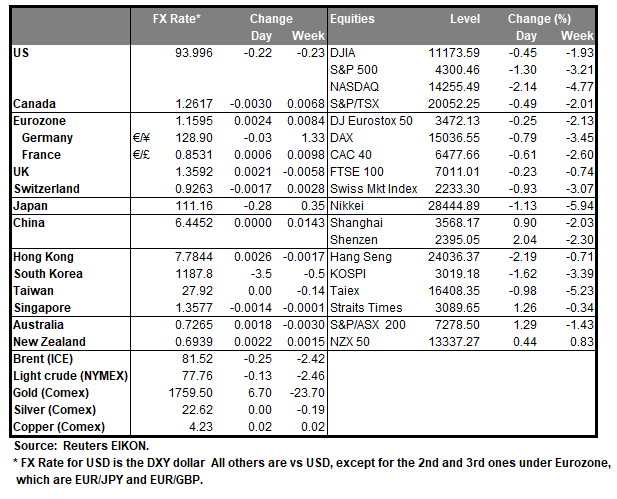
If anyone needed evidence that markets are chasing their tails at the moment, it would be currency markets. The US dollar fell once again overnight even as oil prices surged, and uncertainty increased on a number of fronts. Even more odd was that US yields actually edged higher overnight, a rare divergence these days. The US dollar index fell 0.30% to 93.80.
Normal service appears to be resuming though in Asia, with the dollar index surging 0.20% higher to 93.98. A weaker US dollar is inconsistent with heightened event fears in the markets, a Fed taper, or still surging energy prices, almost all of which are priced and transacted in US dollars. Asia seems to agree, and it is notable that energy-price-taking Asian currencies are mostly lower today.
Overnight EUR/USD failed ahead of resistance at 1.1650 and has sunk back to 1.1600 in Asian time. A noisy 1.1550 to 1.1650 range beckons until Friday. Similarly, GBP/USD failed ahead of critical resistance at 1.3610, retreating to 1.3595 in Asia. GBP/USD looks the more vulnerable of the two. With US yields only slightly higher overnight, USD/JPY did nothing, edging up 10 points to 111.10 today.
Rising fear sentiment in Asia has pushed AUD/USD and NZD/USD lower, unwinding some of their overnight gains. The RBA, as I write, has left rates unchanged with no notable deviations from the previous statement. AUD/USD has fallen 0.20% to 0.7270 and has failed numerous times to recapture 0.7325 over the past few days. NZD/USD is 0.40% lower today to 0.6940. With Covid-19 cases outside Auckland edging higher, and the government abandoning its Covid zero strategy, the kiwi remains vulnerable. If the RBNZ doesn’t come to the party tomorrow and hike, or if global risk sentiment worsens, NZD/USD could well retest 0.6850 and 0.6800 this week.
In contrast to US dollar weakness versus the major currencies, Asian currencies have spent overnight and today on the back foot. The deteriorating risk atmosphere in the US and surging oil prices were never likely to be Asia FX’s friend and notably, USD/INR rose 0.60% overnight, climbing 0.10% to 74.585 today. With a high exposure to energy prices across the board and thus a need to buy more dollars as they rise, the USD/INR remains on course for a retest of 75.000, especially if the RBI holds policy unchanged on Friday.
Elsewhere, USD/PHP continues to find mysterious resistance each time it nears 51.00 and I suspect the BSP is selling dollars up there. High domestic inflation, an economy in recession, a rising US dollar and energy prices will be no friend to the peso eventually. Offshore USD/CNH is also rising as is USD/KRW. Only the energy-associated MYR and IDR are showing some resilience, holding at 4.1800 and 14,250.00 for now. You get the feeling it is only a matter of time before both resume their sell-offs. As price-takers, Asia FX is vulnerable to energy price inflation and that’s the nub of it.
It is hard to reconcile a weaker US dollar with the goings-on in the world, and I expect that reality to reassert itself this week. A stronger US Non-Farm Payrolls will lock and load the Fed taper and be another tailwind for US dollar strength. The rest of the week, however, is likely to be characterised by no small amount of intra-day volatility as the street chases its tail on daily sentiment swings ahead of the Friday data.
Mounting Risks Send Asia Lower
Asian stock markets follow Wall Street south
A post-OPEC+ spike in oil prices, US fiscal fears, notably the debt ceiling, US political infighting, growth fears, inflation fears, rate fears; take your pick overnight as it sent Wall Street plummeting. Technology giants, in particular, took a beating, justified by their sensitivity to potentially higher US interest rates resulting from a Fed taper or a US government debt default. I am more in the camp that the introduction of more two-way pricing risks is a new reality for most investors after a rampant 18-month bull market pumped up unlimited free central bank money.
Whatever it was shaking Wall Street, the session was ugly with the S&P 500 tumbling by 1.30%, the tech-heavy Nasdaq slumping by 2.14%, and the Dow Jones falling a comparatively modest 0.93%. Some short-covering has lifted Nasdaq futures 0.25% higher in Asia, suggesting a lot of the selling overnight was fast-money speculators, while S&P and Dow futures remain unchanged.
The negative sentiment has spilled into Asia, especially Japan, whose stocks had been on an equally fiscal-stimulus-is-coming speculative bull market of late. The Nikkei 225 has been pummelled, falling by 2.40% today, while the South Korean Kospi is 1.70% lower. Mainland China markets are closed but the Hang Seng is showing surprising resilience, being only 0.05% lower. Hopes that more Evergrande asset sales are in the offing could be lifting sentiment temporarily there.
Regionally, Singapore has fallen by 0.90% with Taipei surprisingly, climbing 0.10% and Kuala Lumpur by 0.20%, likely supported by rising oil prices. Jakarta is 0.30% lower with Bangkok down 0.15% and Manila by 0.35%. Australian markets are lower also ahead of the RBA policy decision, the ASX 200 and All Ordinaries down 0.45% and 0.85% respectively.
As ever, the Asian markets subject to the most speculative zeal and with more tech-heavy makeups have taken the biggest hits today. The more resource and growth-centric ASEAN markets being relatively sheltered by comparison.
I am expecting global stock markets to wildly chase their tails this week, lost on the noise and swings of market sentiment until, hopefully, the US Non-Farm Payrolls restores some directional order on Friday. The game of blink surrounding the mid-month debt ceiling legislation deadline is introducing a heightened uncertainty. Although if a cliff is driven off, the Fed will surely be there to open the spigots once again, never bad for stock markets. I’m not sure when both major parties in the US decided their job was to deliberately sabotage each other’s efforts on every level, instead of being reasoned opponents, but there we have it.
I’ve called it before and been wrong each time, but the charts on the S&P 500, Nasdaq and Dow Jones have all made multi-day breakdown below their support lines that data back to March 2020. That doesn’t mean we are facing Armageddon, even 10-15% falls still leave all three in longer-term bull markets. And some two-way price action is long overdue, if only to remove the cancer of the meme stock. The breaks lower could well be false, and I for would prefer to see some weekly closes below the 200-day moving averages before really calling for deeper corrections. We are not there yet.
Mechanical Correlations Break Down
It looks like we are in for a bit of a chop-fest in financial markets for the rest of the week, until Friday’s US Non-Farm Payrolls gives the street some clarity on the Federal Reserve taper. Asian equity markets have followed US markets south today, with US fiscal policy encompassing the debt ceiling and the soon-to-be-trimmed USD 3.5 trillion spending plan fraying nerves, although oddly, US yields edged higher overnight. Non-transient inflation leading to interest rate rises bashed technology stocks overnight as well, although I’d argue the world being long to the gunnels of them since March 2020 is probably the underlying driver.
OPEC+ was probably the biggest cause of volatility, as the grouping refused to bow to pressure from the likes of the United States and India to pump more oil. OPEC+ left their 400,000 bpd per month increases unchanged. Various reasons were promulgated including fears of fourth wave shutdown, a valid point, the rise in prices being a natural gas and coal issue, not oil. Again, a valid point. And that seasonal factors in Q4 usually temper oil consumption anyway, a marginal point that unsurprisingly, came from Russia.
Whichever way you cut it; it was bullish for oil which surged to seven-year highs. Rains in China and India appear to be affecting coal mining there deepening the supply woes of both giants and there just isn’t enough natural gas on the spot market to satisfy demand. Europe could probably alleviate its situation if it bowed to Russian requests and got on with certifying Nord Stream 2. But with winter on the horizon in the northern hemisphere, long-term weather forecasts are going to get a lot of attention this year.
Assuming the energy squeeze is the new normal, it is hard to see transient inflation being as transient as the world’s central bankers are forecasting/hoping it will be. The effect will be felt throughout the world’s supply chains. Tightening monetary policy in response to inflation not being as transient as hoped isn’t really an option for most countries. This isn’t a wage/price spiral. It is extraneous inputs to which monetary policy will have limited impact. The best solution to high prices is high prices, although citizens going cold due a combination of poor government planning/incompetence/stubbornness/strategic naivety/ intellectual arrogance/political stupidity/scare-mongering media, is inexcusable.
That doesn’t mean that central banks will do nothing and perhaps the most likely response will be tapering quantitative easing. That might explain why the US dollar headed lower overnight, despite risk sentiment rising, energy prices rising, US yields rising and stock markets tumbling. Notably, the Eurozone and Britain could do just that while leaving interest rates at zero. Even Japan could, wait, please pause momentarily while I Japan-slap myself back to reality. Realistically, though, it is the Federal Reserve that is on the taper track to start tapering in December, as long as the US Non-Farm Payrolls this Friday play the game and print at 500,000 or above.
Given the combination of US fiscal uncertainty, shaky stock markets, ballooning commodity prices, QE tapering by the Fed pushing up US yields, and the fact that the world’s energy markets are mostly priced and transacted in US Dollars, the retreat of the greenback is odd indeed and I believe temporary. That trend appears to be reasserting itself already in Asia today.
RBA, RBNZ in spotlight
One central bank that won’t be moving rates today is the Reserve Bank of Australia. The RBA announcement later this morning should be a non-event leaving rates at record lows while retaining the right to fence-sit on adjusting monetary policy depending on how the game plays out. The Reserve Bank of New Zealand tomorrow will almost certainly raise rates by 0.25%, but it will be the statement that matters. Against the background of Covid-19 jumping the fence and a government swing to “living with it,” will this be a dovish hike or a hawkish hike. The RBNZ has itchy trigger fingers, but I don’t rule out some RBA-style fence-sitting which will take the edge of any NZD rallies.
Mainland China remains on holiday today but another smaller China developer, the ironically named Fantasia missed repaying a USD 205.7 million bond yesterday. Thankfully, the counterparty is another China property giant, Country Garden, so the fallout should be limited. It probably isn’t what was envisaged when economists and sustainability gnomes talked about the circular economy though. Evergrande shares, to my best knowledge, remain suspended in Hong Kong ahead of an announcement of a pending sale of another part of the carcass. For today though, China’s property nerves have been subsumed in the noise from the US and the post-OPEC+ disappointment.
Similarly, that same noise has drowned out any response in Japanese markets to Economy Minister Yamagiwa’s announcement that he is preparing an economic package before the year-end. Some sort of box of fiscal goodies was expected and had been priced into the Nikkei 225 after former Prime Minister Suga announcement of his intention to step down. After 20+ years of such sequels, it could be that viewer fatigue is also setting in.
Finally, RBA aside, the data calendar remains mostly second-tier today. Sentiment is driving markets, as it will until Friday. The calendar is littered with European Services and Composite PMIs, but it is the US ISM Services PMI and associated sub-indexes that will garner the most attention. A number above or below 54.50 will elicit the usual short-term taper/no-taper market reactions.
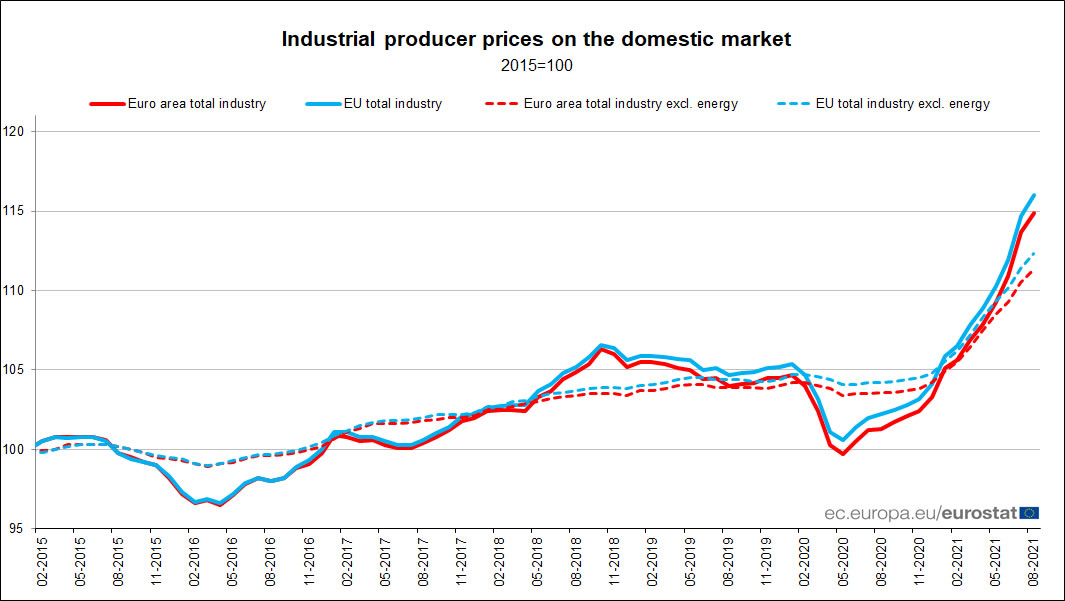
Eurozone PPI rose 1.1% mom, 13.4% yoy in Aug
Eurozone PPI rose 1.1% mom, 13.4% yoy in August. Industrial producer prices increased by 2.0% mom in the energy sector, by 1.4% mom for intermediate goods, by 0.5% mom for capital goods, by 0.3% mom for durable consumer goods and by 0.2% mom for non-durable consumer goods. Prices in total industry excluding energy increased by 0.7% mom.
EU PPI rose 1.1% mom, 13.5% yoy. The highest monthly increases in industrial producer prices were recorded in Bulgaria (+4.2%), Denmark (+3.1%) and Latvia (+2.6%), while decreases were observed only in Ireland (-4.1%) and Malta (-0.1%).
Facebook Drops 4% On Outage, Hate Speech Issues
Facebook’s (#FB) share price dived over 4% lower yesterday as its services including Instagram, WhatsApp, Messenger and Oculus experienced an outage, with the downtime being reported as over six hours causing considerable turmoil for its users. According to Facebook the outage was caused by a configuration issue and the company believes that no user data were affected by it. It should be noted that the social media company faces renewed issues about hateful content after a whistleblower revealed that Facebook did not deal with such content in an adequate manner. Yet the company stated that “to suggest we encourage bad content and do nothing is just not true”. We would like to see how the situation plays out for Facebook, yet we note that other mega-cap tech shares like Apple (#AAPL), Amazon (#AMZN), and Alphabet (#GOOG) seem to be on the retreat, practically dragging Nasdaq lower as well.
Facebook’s (#FB) share price plunged yesterday bouncing on the 322.50 (S1) support line. We tend to maintain a bearish outlook for the share’s price as long as it remains below the downward trendline incepted since the 19th of September. It should be noted that the RSI indicator below our 4-hour chart has dropped below the reading of 30, confirming the dominance of the bears, yet at the same time may imply that the share is oversold and a correction higher could come into play. Should the bears actually maintain control over the share’s price, we may see it breaking the 322.50 (S1) support line and aim for the 315.70 (S2) level. Should a correction higher be performed and the bulls take over, we may see the share’s price actually breaking the 329.15 (R1) resistance line, the prementioned downward trendline and aim for the 338.00 (R2).
RBNZ to hike rates
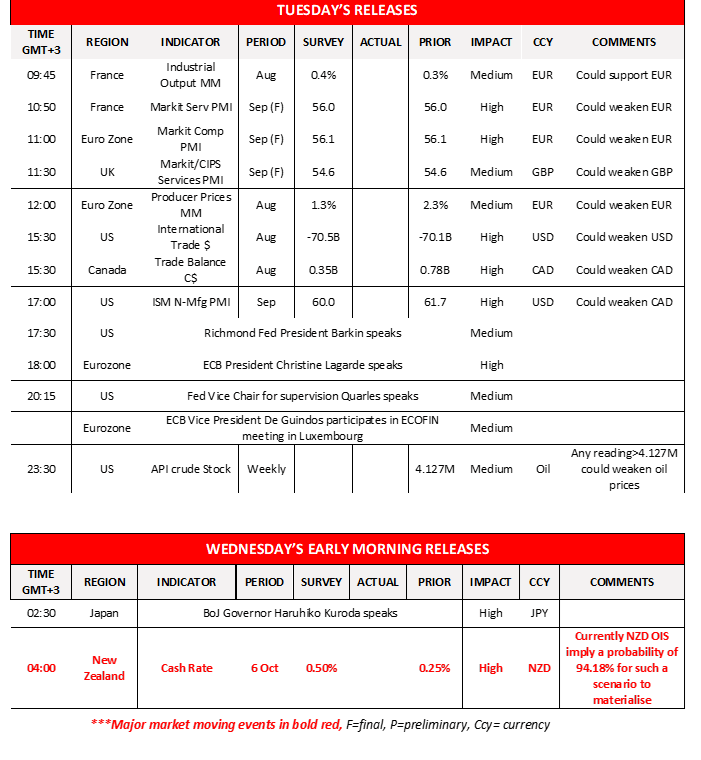
Tomorrow during the Asian session, we get RBNZs’ interest rate decision, and the bank is widely expected to hike rates by 25 basis points. It’s characteristic that NZD OIS imply a probability of 94% for the bank to raise rates from current 0.25% to 0.50%. But given that that scenario was also expected at their last meeting, end of August and failed to materialize, we remain rather cautious. Worries about Auckland’s current lockdown seem to continue, yet there are some signs of a possible easing from Wednesday on. Should the bank not hike rates, which could surprise the markets, we may see NZD weakening considerably, as it did at the bank’s last meeting. Should on the other hand the bank actually hike rates as expected, NZD could gain yet attention may also be placed to the accompanying statement. Should RBNZ Governor Adrian Orr, imply that given the uncertainty of the situation regarding Covid in New Zealand, a measured approach to future rate hikes should be adopted, we may see the Kiwi’s strengthening being capped and that is expected to be our base line scenario. On the other hand, should the statement’s tone allow for a more aggressive approach regarding future rate hikes, we may see the NZD rallying.
NZD/USD dropped yesterday after failing to reach the 0.6985 (R1) resistance line. Given that in its drop the pair broke the upward trendline guiding it since the 30th of September, we switch our bullish outlook in favour of a bias for a sideways movement, for the time being. However RBNZ’s interest rate decision could alter the pair’s movement to either direction. Should the correction lower be transformed to a selling interest, we may see the pair breaking the 0.6935 (S1) support line and aim for the 0.6860 (S2) level. Should buyers take over, we may see the pair aiming if not breaking the 0.6985 (R1) resistance level.
Today’s events and expectations
Today among a number of releases we note the US and Canada’s trade balance for August and the US ISM non manufacturing PMI for September. As for speakers we note ECB President Lagarde in the American session and BoJ Governor Kuroda in tomorrow’s Asian session.
#FB H4 Chart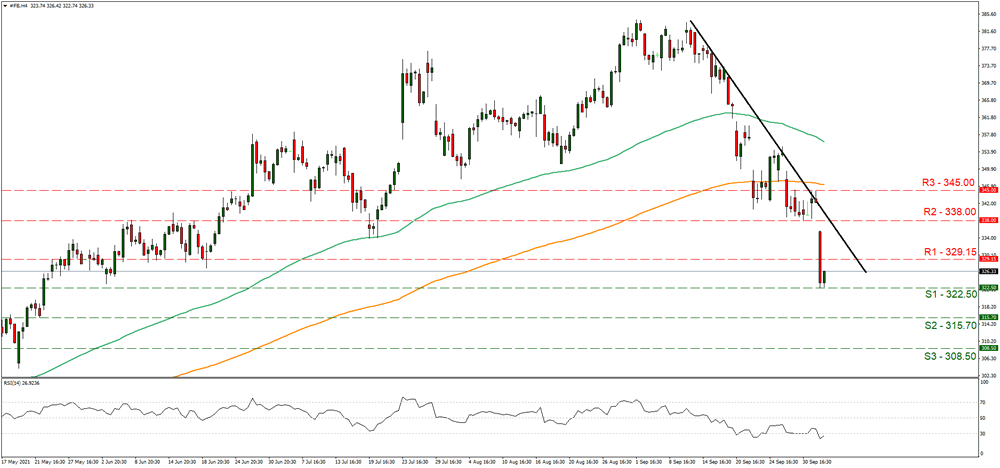
Support: 322.50 (S1), 315.70 (S2), 308.50 (S3)
Resistance: 329.15 (R1), 338.00 (R2), 345.00 (R3)
NZD/USD H4 Chart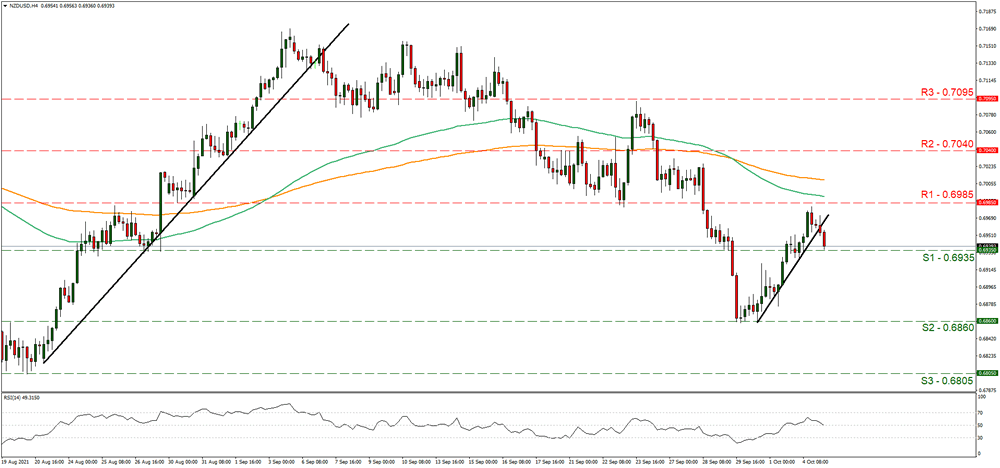
Support: 0.6935 (S1), 0.6860 (S2), 0.6805 (S3)
Resistance: 0.6985 (R1), 0.7040 (R2), 0.7095 (R3)
Markets Gripped By Inflation Concerns
Asian shares were painted red on Tuesday following a broad selloff on Wall Street overnight, as surging oil prices stoked concerns about global inflation. King dollar drew strength from the risk- off mood while gold prices snapped a three-day uptrend, trading below $1760 as of writing. Interestingly, European markets have opened on a positive note despite the losses witnessed in Asia with US futures inching higher, suggesting Wall Street could claw back losses this afternoon.
Nevertheless, growing worries about inflation are likely to foster a sense of unease and caution across financial markets. Given how consumer prices are already at multi-year highs, persistent signs of rising inflationary pressures may force central banks to tighten policy sooner than expected.
Oil soars as OPEC+ stick to their plan
Oil bulls were on a tear yesterday, pushing prices to levels not seen in three years after OPEC+ decided not to increase their output by more than previously agreed.
This decision was made despite calls from world leaders to bring additional production to the market amid the growing global energy crunch. While the jump in oil prices may be a welcome development for OPEC+, the cartel's actions threaten to raise tensions between major energy consumers, especially those who are dealing with high inflation.
Regarding the technical picture, oil remains firmly bullish on the daily charts with indicators pointing to further upside. Brent is currently trading around $81.50 with the October 2018 high at $86.71, while WTI is lingering around $78.00 with $80.00 acting as the first level of interest.
Commodity spotlight – Gold
Gold has stumbled into Tuesday’s session under pressure and failing to draw strength from the inflation fears or market caution.
An appreciating dollar is acting as a headwind ahead of the heavily anticipated US jobs report on Friday. Given how gold remains sensitive to taper expectations, we should expect to see increased volatility through the non-farm payrolls data. Friday’s outcome could set the tone for the precious metal this month.
Looking at the technical picture, prices are trading below the 50, 100, and 200-day Simple Moving Average while the MACD trades below zero. A solid daily close below $1750 could signal a decline back towards recent lows at $1721. Should $1750 prove to be reliable support, a move towards $1780 and $1800 could be on the cards.