

Sample Category Title
EUR/USD Analysis: Finds Support In 1.1800
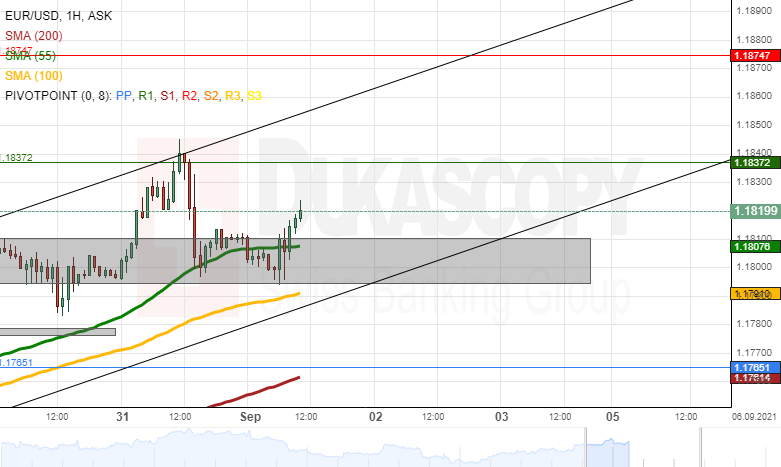
After reaching the 1.1840 level on Tuesday, the EUR/USD began a decline. The decline eventually reached the support of the 1.1800 level before recovering. Meanwhile, take into account that the pair had shortly fluctuated below the 1.1800 mark.
In general, the zone around the 1.1800 mark appears to be one where reversals have been happening throughout August 2021. It has been marked on the chart.
In the meantime, it was spotted that the rate has been trading in a channel up pattern since August 19. The most recent bounce off from the 1.1840 mark was consistent with the pattern.
If the rate continues to surge, it could once again find resistance in the 1.1840 level and the weekly R1 simple pivot point at 1.1837. Above these levels, the 1.1875 level, where the weekly R2 simple pivot point is located at, might provide resistance.
On the other hand, a potential decline of the currency exchange pair would look for support in the 1.1795/1.1810 zone, the 55 and 100-hour simple moving averages and the lower trend line of the mentioned channel up pattern.
GBP/USD Analysis: Respects Pattern
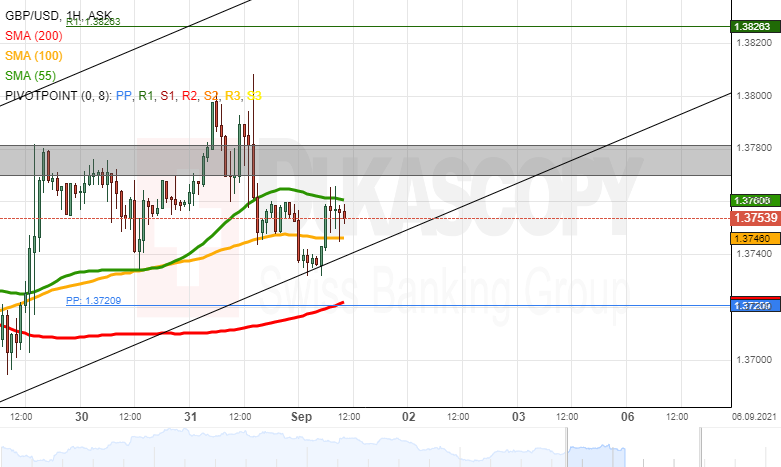
The rate's two attempts to pass the 1.3800 mark failed and a decline followed. On Wednesday morning, the GBP/USD currency exchange rate found support in the lower trend line of the channel up pattern, which has guided the pair since August 19.
If the rate continues to recover from the lower trend line of the channel up pattern, the GBP/USD would face technical resistance. The 55-hour simple moving average at 1.3760 and the 1.3800 previous high level are expected to provide resistance. Above these levels, the weekly R1 simple pivot point at 1.3826 could provide additional resistance to a possible surge.
However, in the case that the rate decline, it would look for support in the 100-hour simple moving average at 1.3746 before reaching the lower trend line of the channel up pattern at 1.3740. Below these levels, the weekly simple pivot point at 1.3720 together with the 200-hour simple moving average could keep the pair from declining.
USD/JPY Analysis: Aims At 110.50
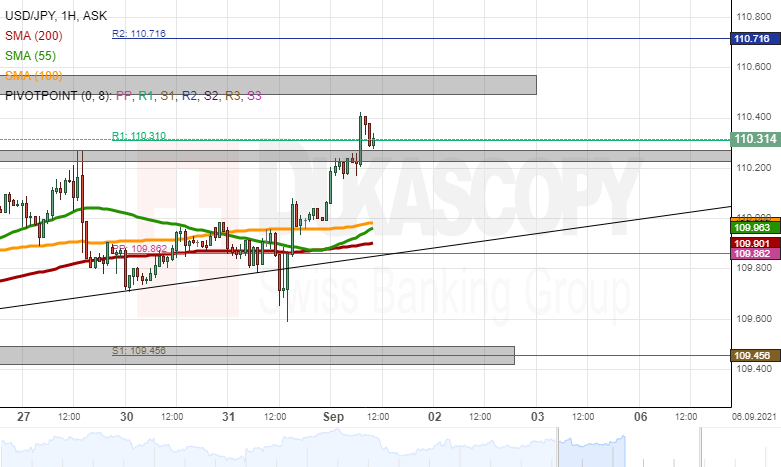
Despite piercing the supporting trend line, the USD/JPY did not decline. The rate found support in the 109.60 level and surged. By the middle of Wednesday's GMT trading hours, the pair had reached the 110.40 level.
In the near term future the pair could reach for the resistance of the zone that is located above the 110.50 mark. Above the 110.50, the rate might encounter resistance in the weekly R2 at 110.72.
On the other hand, a potential decline could look for support in the weekly R1 simple pivot point at 110.31 and the previous week's high level zone near 110.25. Afterwards, a decline might find support in the 55, 100 and 200-hour simple moving averages near 110.00.
Gold Analysis: Finds Support In SMA
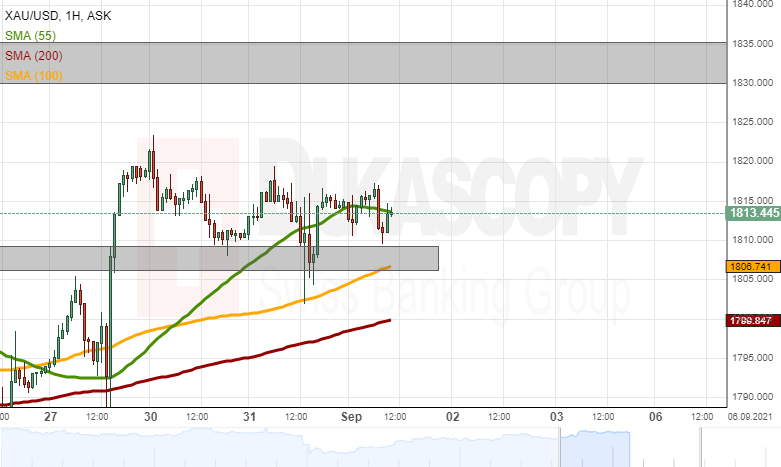
On Tuesday, the yellow metal dipped below the support zone of 1,810.00 level. However, the price almost immediately found support in the 100-hour simple moving average near 1,802.00. On Wednesday, the price had recovered and traded sideways around the 1,815.00 level.
If the 100-hour simple moving average catches up with the price, the metal could surge. A potential surge could reach first for the resistance of the 1,820.00 level and afterwards the August high levels in the 1,830.00/1,835.00 zone.
On the other hand, a decline of the metal's value could result in a test of the support of the 1,810.00 level, the 100-hour simple moving average at 108.75 and the 200-hour simple moving average near 1,800.00.
Asia Equities Shrug Off Weak PMIs
Caixin Manufacturing PMI disappoints
Asian equities are broadly higher today, with even China markets quickly shrugging off the soft Caixin PMI. Being the first day of the month, some mechanical institutional money could be deploying as monthly savers restock fund manager’s coffers. Or it could be that the soft PMI data across much of Asia has investors pricing in ultra-low rates for longer.
The US had an almost unchanged finish overnight despite all the noise surrounding the consumer confidence data. The S&P 500 finished just 0.14% lower while the Nasdaq edged 0.04% down while the Dow Jones was just 0.12% lower at the close. The rally in Asia has lifted futures on all three by around 0.30% today.
Today, Japan’s Nikkei 225 has leapt 1.15% after PM Suga suggested an election could not be held while Japan battled Covid-19. A lowering of election uncertainty played out well with investors and was helped further when the BOJ’s Wakatabe suggested the BOJ could “do more” if the economy worsened; read more easing. The Kospi was quiet comparatively, rising by just 0.15%.
China markets have also rallied strongly after dipping on the low-ball Caixin PMI release. It seems again that hopes of stimulus are lifting stocks, with the Shanghai Composite rising by 0.50% and the narrower Shanghai 50 leaping 1.95%. The CSI 300 has rallied an impressive 1.15%, while the Hang Seng is 0.60% higher.
The story is similar in Singapore, now 1.0% higher today, although Taipei is unchanged. The poor regional PMIs seem to be weighing on ASEAN, though, with Jakarta down 0.75%, Bangkok down 0.35%, Manila down 0.25% and Kuala Lumpur down 0.65%. India could enjoy a decent start to the day after last night’s GDP release showed an impressive rebound even considering YoY baseline effects. Australian markets are slightly lower on the day after softer Q2 GDP, and its continuing Covid-19 battle introduced a dose of reality to domestic markets. The ASX 200 has fallen by 0.35%, while the All Ordinaries has edged 0.15% lower.
Given the first day of the month buying evident among the heavyweights of North Asia, it is not unreasonable to expect European markets to open higher this after along with London. Tonight in the US, volatility will be driven by the ISM Manufacturing data and the ADP Employment. Although poorly correlated lately, the ADP data will be used to adjust expectations for this Friday’s Non-Farm’s release.
Lots Of Noise, Not Much Substance
The overnight session was a noisy one. The heads of the Netherlands and Austrian central banks wrung their hands about runaway European inflation, briefly lifting the euro. US Consumer Confidence fell. However, S&P/Case Shiller Home Prices rose to 19.10% YoY for June. Delta nerves and supply chain bottlenecks are impacting some data, but the unlimited zero per cent central bank money continues to pump up asset prices. In other words, business as usual.
The net result made for a noisy session, particularly in the currency and equity space, but ultimately, prices closed not too far from where they started. We can expect more of the same for the rest of the week ahead of Friday’s US Non-Farm payroll data, which is really the only game in town ex-Asia.
Turning to Asia, the first day of the month saw pan-Asia manufacturing PMIs released across the region. The ASEAN 10 came in at an average of 44.50, highlighting the impact of the groupings’ Covid-19 battle. With perhaps the exception of Singapore, I expect those effects to linger well into Q4 of this year. If the Non-Farm Payrolls prints above 1 million jobs this Friday, the taper trade will return, and many of those recent Asia FX currency gains will be reversed. If both the US and Europe move to taper in Q4 as I expect, the divergence in monetary policy (ASEAN is in no position to hike rock bottom rates right now) means I expect ASEAN FX to underperform for the rest of the year.
The North/South divide in Asia was also stark. South Korea, Japan and Taiwan Manufacturing PMIs remained firmly in expansionary territory. That is a continuation of a trend that has been well entrenched since the pandemic’s beginnings, with Northern Asia making a lot more of what the rest of the world wants, in contrast with the legacy sector-dominated ASEAN.
China PMIs continues to fall
The elephant in the room for the long North Asia, Short ASEAN view is China. This morning, the Caixin Manufacturing PMI followed yesterday’s official number south, falling under 50.00 to 49.20, contractionary territory. That rounds out a grim week for China’s PMIs as Covid-19 lockdowns and the same supply chain challenges the rest of the world is experiencing erode economic performance. Whether some of those are transitory or not, like the transitory inflation question, is just about impossible to predict. We will just have to wait and see how it plays out; it is unlikely to be good for mainland equities, though.
We would expect China to open the stimulus spigots at this point based on their past playbook. In all likelihood, they will. However, President Xi’s “Common Prosperity” drive, which involves so many sector clampdowns or “investigations,” I can’t keep up, complicates the picture. China’s government doesn’t enact policy for a few months and then drop it; when they do something, they keep doing it. Thus, any stimulus transmission this time around may have a lesser impact than previously.
The nuances of capitalism don’t appear to be high on President Xi’s agenda, although I am super happy President Xi is cutting kids’ online game time to zero. Hopefully, they start reading books instead of having their brains turned to digital mush. Slower China growth will have implications for the rest of Asia as well, and I am sure the downward revaluation exercise for China equities is not yet done.
Between the delta variant and China’s pivot to wealth inclusivity and redistribution, my view that ASEAN would be the value trade of Q4 is now in the dustbin. Asia will recover, but I expect it will be a laggard except Singapore, where the vaccination triumph and a powerful financial and high-tech manufacturing centre leave it well placed to jump ahead of the crowd.
The Manufacturing PMIs dominate the economic calendar across Europe and the Americas today. In Europe, they should be supportive, although with some ECB members becoming very vocally hawkish, further rhetoric from that quarter will dominate investors’ minds. The ECB meeting next week could be frisky. A low print by the US ISM PMI may spark some temporary selling in the greenback and lift equities as taper fears recede, but any directional moves will be temporary ahead of Friday’s jobs data.
ECB Stournaras: Recent jump in inflation is due to temporary factors
ECB Governing Council member, Bank of Greece Governor, Yannis Stournaras told Bloomberg, "according to most estimates, the recent jump in inflation is due to temporary factors related to various supply-side bottlenecks caused by the pandemic."
"Wage developments and unit labor costs which determine the core of inflation do not show the same volatility as headline inflation," he added. "On this evidence, I would advise caution regarding the course of inflation relative to our medium-term target."
EURJPY Expands Bullish Run To One-Month High
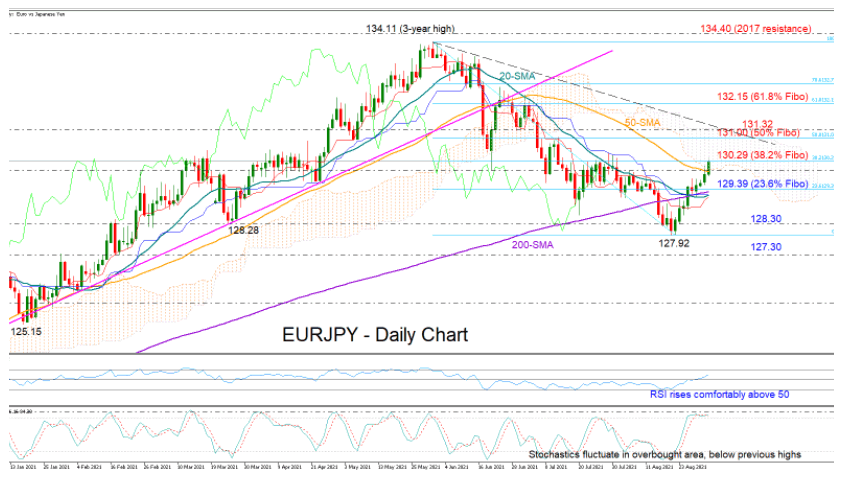
EURJPY started the new month on positive note, propelling its three-day bullish run above the restrictive 50-day simple moving average (SMA) and to one-month high of 130.34.
The steep upside move in the RSI, which is fluctuating comfortably above the 50 neutral mark, is promoting more progress in the near term. However, the recent bullish pressures in the price were not firm enough to push the red Tenkan-sen line above the blue Kijun-sen, while the Stochastics is also signaling some caution as the indicator is already within the overbought area and marginally below its previous highs.
The 38.2% Fibonacci retracement of the 134.11 – 127.92 down leg is currently under the spotlight around 130.29. A decisive close above this bar could see a continuation towards the 50.0% Fibonacci of 131.00, while a break above the Ichimoku cloud at 131.32, which overlaps with the dashed tentative descending trendline, may open the door for the 61.8% Fibonacci of 132.15.
If the price pulls below the 130.00 number and the 50-day SMA, the 23.6% Fibonacci of 129.39 could immediately add some footing. The presence of the 20- and 200-day SMAs in the region, which have recently bearishly intersected each other, questioning the case of a trend improvement in the market, is suggesting that any violation at this point could develop into a sharper decline. If true, the sell-off could ramp up towards the 128.30 – 127.92 zone. Beneath that, the pair could create a new lower low at 127.30.
Summarizing, EURJPY is trading bullish in the short-term picture, but its recent upside correction is still looking fragile as the price is flirting with a key barrier. A sustainable move above the 130.00 level could limit fears of a downside reversal.
Risk Appetite Continues To Percolate
Notes/Observations
- Market participants continue to believe bet the global economic rebound would persist even as central banks prepared to scale back support.
- Major European PMI Manufacturing data continued to show recovery (Beats: UK, France, Italy, Spain; Misses: Euro Zone, Germany).
- Oil higher ahead of OPEC+ meeting in Vienna.
Asia
- South Korea Aug Trade Balance: $1.7B v $1.5Be.
- Australia Q2 GDP Q/Q: 0.7% v 0.4%e; Y/Y: 9.6% v 9.2%e.
- China Aug Caixin PMI Manufacturing registered its 1st contraction since Apr 2020) (49.2 v 50.1e).
- Japan Aug Final PMI Manufacturing confirmed its 7th straight month of expansion (52.7 v 52.4 prelim).
- BOJ Deputy Gov Wakatabe noted that inflation expectations were moving sideways with some signs up it picking up but more improvement needed to reach target. Stressed that even if Fed entered tightening cycle it did not mean BOJ would follow.
Europe
- SNB Vice Chairman Zurbruegg stated that he expected that global low interest rate environment would remain unchanged for some time to come.
Energy
- Weekly API Crude Oil Inventories: -4.0M v -1.6M prior.
- OPEC+ Joint Technical Committee to maintain 2021 oil demand growth steady at 6M bpd; JMMC saw 2022 oil market in 2.5M bpd surplus (Note: OPEC experts said to see oil supply deficit at 1M bpd by Sept and dropping to 0.4M by Dec. JMMC saw OECD oil inventories under 2015-2019 average until Jan 2022 and then saw stocks exceeding the average from Feb-Dec 2022.
Speakers/Fixed income/FX/Commodities/Erratum
Equities
- Indices [Stoxx600 +0.77% at 474.52, FTSE +0.91% at 7,184.55, DAX +0.60% at 15,930.05, CAC-40 +1.31% at 6,768.79 , IBEX-35 +2.17% at 9,039.00, FTSE MIB +1.24% at 26,332.50, SMI +0.33% at 12,452.48, S&P 500 Futures +0.37%].
- Market Focal Points/Key Themes: European indices open higher across the board and remained in the greeen as the session p; better performing sectors include financials and consumer discretionary; materials and industrials sectors among underperformers; travel subsector supported on commentary from airline/hotel outlook including SAS and WH Smith; oil and gas subsector supported by higher crude prices; Fluidra acquires SR Smith; focus on upcoming OPEC meeting later in the day; corporate events in the upcoming US session include Autodesk investor day and earnings from Capbell Soup and Brown-Forman.
Equities
- Consumer discretionary: Pernod-Ricard [RI.FR] +3% (earnings), 888 Holdings [888.UK] +2% (earnings), Carrefour [CA.FR] -4% (placement).
- Financials: Commerzbank [CBK.DE] +3% (analyst action).
- Healthcare: bioMerieux [BIM.FR] +5% (earnings).
- Industrials: Fluidra [FDR.ES] +4% (acquisition; raises outlook).
Speakers:
- ECB’s De Guindos (Spain) noted that future monetary policy decisions to be data dependent. Decision would essentially depend on how economy and inflation developed in the coming months. To have to decided volume of bond purchases for Q4 at Sept meeting. Reiterated Council stance that expects inflation to continue to pick up this year but decline in 2022.
- Spain PM Sanchez stated that govt sought an immediate increase to minimum wage and supported continued stimulus efforts.
- Sweden Fin Min Andersson announced SEK10B in tax cuts and stressed that was important to continue stimulus and not repeat mistakes from the financial crisis from over a decade ago.
- OPEC+ said to still focus on monthly oil production increases of 400K bpd despite upward 2022 demand revision.
- OPEC+ JMMC ministerial committee said to have raised its 2022 oil demand growth from 3.3M bpd to 4.2M bpd (**Reminder: On Aug 31st JMMC was said to have maintained the 2021 oil demand growth at 6.0M bpd).
Currencies/Fixed income
- USD consolidated near 3-week lows due to the recent Fed inspired losses which pushed back expectations on interest rate hikes. Dealers also were concerned that the Delta coronavirus variant could impact the economy.
- EUR/USD steady near 1-month highs around the 1.18 area. Euro received some momentum after Tuesday’s CPI reading of 3.0% coupled with more hawkish ECB speak.
- GBP/USD faced some headwinds as dealer chatter circulated Brexit tension could resurface in the weeks ahead.
Economic data
- (DE) Germany July Retail Sales M/M: -5.1% v -1.0%e; Y/Y: -0.3% v +3.6%e.
- (UK) Aug Nationwide House Price Index M/M: 2.1% v 0.1%e; Y/Y: 11.0% v 8.6%e.
- (RU) Russia Aug PMI Manufacturing: 46.5 v 49.2e (3rd straight contraction).
- (NO) Norway Jun AKU Unemployment Rate: 4.8%.
- (NO) Norway Q2 Current Account Balance (NOK): 93.2B v 92.1B prior.
- (AU) Australia Aug Commodity Index: 137.9 v 144.5 prior.
- (SE) Sweden Aug PMI Manufacturing: 60.1 v 64.5 prior (15th month of expansion).
- (NL) Netherlands Aug Manufacturing PMI: 65.8 v 67.4 prior (13th straight expansion).
- (HU) Hungary Aug Manufacturing PMI: 55.9 v 55.8 prior (5th straight expansion).
- (PL) Poland Aug PMI Manufacturing: 56.0 v 56.7e (13th straight expansion).
- (TR) Turkey Aug PMI Manufacturing: 54.1 v 54.0 prior (3rd straight expansion).
- (TR) Turkey Q2 GDP Q/Q: 0.9% v 1.0%e; Y/Y: 21.7% v 21.0%e.
- (HU) Hungary Q2 Final GDP Q/Q: 2.7% v 2.7% prelim; Y/Y:17.9 % v 17.9%e.
- (HU) Hungary Jun Final Trade Balance: €0.6B v €0.7B prelim.
- (ES) Spain Aug Manufacturing PMI: 59.5 v 59.0e (7th month of expansion).
- (CH) Swiss Aug PMI Manufacturing: 67.7 v 68.0e (13th straight expansion).
- (CZ) Czech Republic Aug PMI Manufacturing: 61.0 v 60.5e (12th straight expansion).
- (TH) Thailand Aug Business Sentiment Index: 40.0 v 41.4 prior.
- (IT) Italy Aug Manufacturing PMI: 60.9 v 60.1e (14th month of expansion).
- (FR) France Aug Final Manufacturing PMI: 57.5 v 57.3e (confirmed 9th month of expansion but lowest reading since Feb 2021).
- (DE) Germany Aug Final Manufacturing PMI: 62.6 v 62.7e (confirmed 14th month of expansion).
- (EU) Euro Zone Aug Final Manufacturing PMI: 61.4 v 61.5e (confirmed 14th month of expansion but lowest since Feb).
- (GR) Greece Aug Manufacturing PMI: 59.3 v 57.4 prior (6th month of expansion).
- (NO) Norway Aug PMI Manufacturing: 62.2 v 63.2 prior (12thmonth of expansion).
- (IT) Italy July Unemployment Rate: 9.3% v 9.6%e.
- (DE) Germany Aug CPI Brandenburg M/M: 0.2% v 1.0% prior; Y/Y: 5.0% v 4.3% prior.
- (UK) Aug Final Manufacturing PMI: 60.3 v 60.1e (confirmed 15th straight expansion).
- (NG) Nigeria Aug PMI: 52.2 v 55.4 prior.
- (EU) Euro Zone July Unemployment Rate: 7.6% v 7.6%e.
- (BE) Belgium July Unemployment Rate: 5.9% v 6.2% prior.
- (DK) Denmark Aug PMI Survey: 67.3 v 69.7 prior (6th straight expansion).
- (ZA) South Africa Aug Manufacturing PMI: 57.9 v 48.0e (moves back into expansion).
Fixed income issuance
- (IN) India sold total INR170B vs. INR170B indicated in 3-month, 6-month and 12-month bills.
- (DE) Germany opened its book to sell EUR-denominated 30-year bond via syndicate; guidance seen +4bps to Bunds.
- (GR) Greece Debt Agency (PDMA) opened its book to sell EUR-denominated 2026 and 2052 bond via syndicate.
- To sell 0% Feb 2026 bond; guidance seen +43bps to mid-swaps.
- To sell 1.875% Jan 2052 bond; guidance seen +145bps to mid-swaps.
- (DK) Denmark sold total DKK5.83B in 2024, 2031 and 2052 DGB bonds.
- (SE) Sweden sells SEK5.0B vs. SEK5.0B indicated in 12-month bills; Avg Yield: -0.1920% v -0.1970% prior; bid-to-cover: 2.51x v 2.45x prior.
- (UK) DMO sold £2.5B in new Jan 2029 Gilts; Avg Yield: 0.% v 0.531% prior; bid-to-cover: x v 2.20x prior; Tail: bps v 0.1bps prior.
Looking ahead
- OPEC+ meeting.
- (ZA) South Africa Aug Naamsa Vehicle Sales Y/Y: No est v 1.7% prior.
- (RO) Romania Aug International Reserves: No est v $44.1B prior.
- (US) Aug Total Vehicle Sales data in session.
- 05:25 (EU) Daily ECB Liquidity Stats.
- 05:30 (DE) Germany to sell €4.0B in 0% Oct 2026 BOBL.
- 05:30 (HU) Hungary Debt Agency (AKK) to sell debt.
- 06:00 (IE) Ireland Aug Unemployment Rate: No est v 7.4% prior.
- 06:00 (RU) Russia to sell 2031 and 2041 OFZ Bonds.
- 06:45 (US) Daily Libor Fixing.
- 07:00 (US) MBA Mortgage Applications w/e Aug 27th: No est v 1.6% prior.
- 08:00 (CZ) Czech Aug Budget Balance (CZK) No est v -279.4B prior.
- 08:00 (BR) Brazil Q2 GDP Q/Q: 0.2%e v 1.2% prior; Y/Y: 12.7%e v 1.0% prior; GDP 4-quarters Accumulated: +1.8%e v -3.8% prior.
- 08:00 (UK) Daily Baltic Dry Bulk Index.
- 08:00 (DE) ECB’s Weidmann (Germany) at Bundesbank symposium.
- 08:15 (US) Aug ADP Employment Change: +638Ke v +330K prior.
- 08:30 (CA) Canada July MLI Leading Indicator M/M: No est v 1.6% prior.
- 08:30 (CL) Chile July Economic Activity Index (Monthly GDP) M/M: 1.4%e v 2.1% prior; Y/Y: 17.7%e v 20.1% prior.
- 09:00 (BR) Brazil Aug PMI Manufacturing: No est v 56.7 prior.
- 09:30 (CA) Canada Aug Manufacturing PMI: No est v 56.2 prior.
- 09:45 (US) Aug Final Markit Manufacturing PMI: 61.2e v 61.2 prelim.
- 09:45 (UK) BOE to buy £1.147B in APF Gilt purchase operation (7-20 years).
- 10:00 (US) Aug ISM Manufacturing: 58.5e v 59.5 prior; Prices Paid: 83.8e v 87.5 prior.
- 10:00 (US) July Construction Spending M/M: 0.2%e v 0.1% prior.
- 10:00 (MX) Mexico July Total Remittances: $4.4Be v $4.4B prior.
- 10:00 (MX) Mexico Central Bank Economist Survey.
- 10:30 (US) Weekly DOE Oil Inventories.
- 10:30 (MX) Mexico Aug PMI Manufacturing: No est v 49.6 prior.
- 11:00 (CO) Colombia Aug PMI Manufacturing: No est v 54.2 prior.
- 11:00 (PE) Peru Aug CPI M/M: No est v 1.0% prior; Y/Y: No est v 3.8% prior.
- (IT) Italy Aug Budget Balance: No est v €5.7B prior.
- 12:00 (IT) Italy Aug New Car Registrations Y/Y: No est v -19.4% prior.
- 12:00 (RU) Russia July Unemployment Rate: 4.8%e v 4.8% prior.
- 12:00 (RU) Russia Jun Real Wages Y/Y: 2.9%e v 3.3% prior.
- 12:00 (RU) Russia July Real Retail Sales Y/Y: 5.0%e v 10.9% prior.
- 12:00 (US) Fed’s Bostic.
- 12:00 (CA) Canada to sell 30-year inflation-linked bonds.
- 13:00 (MX) Mexico Aug IMEF Manufacturing Index: No est v 52.2 prior; Non-Manufacturing Index: No est v 52.9 prior.
- 14:00 (BR) Brazil Aug Trade Balance: $7.5Be v $7.4B prior; Total Exports: $27.1Be v $25.5B prior; Total Imports: $19.3Be v $18.1B prior.
- (AR) Argentina Aug Government Tax Revenue (ARS): No est v 933.2B prior.
- 18:45 (NZ) New Zealand Q2 Terms of Trade Index Q/Q: No est v 0.1% prior.
- 19:00 (KR) South Korea Q2 Final GDP Q/Q: 0.7%e v 0.7% prelim; Y/Y: 5.9%e v 5.9% prelim.
- 19:00 (KR) South Korea Aug CPI M/M: 0.4%e v 0.2% prior; Y/Y: 2.4%e v 2.6% prior; CPI Core Y/Y: 1.6%e v 1.7% prior.
- 19:50 (JP) Japan end-Aug Monetary Base: No est v ¥660.9T.
- 21:30 (AU) Australia July Trade Balance: A$10.0Be v A$10.5B prior; Exports M/M: 3%e v 4% prior; Imports Y/Y: 2%e v 1% prior.
- 21:30 (AU) Australia July Home Loans Value M/M: -0.2%e v -1.6% prior.
- 23:35 (JP) Japan to sell 10-Year JGB Bonds.
GBP/USD Outlook: The Pair Made An Attempt To Clear The 1.3800 Resistance Zone, But It Struggled
The British Pound started a recovery wave above the 1.3750 resistance against the US Dollar. The GBP/USD pair made an attempt to clear the 1.3800 resistance zone, but it struggled.
A high was formed near 1.3807 and it started a fresh decline. There was a break below a key bullish trend line with support near 1.3770 on the hourly chart. It even broke the 1.3750 level and the 50 hourly simple moving average.
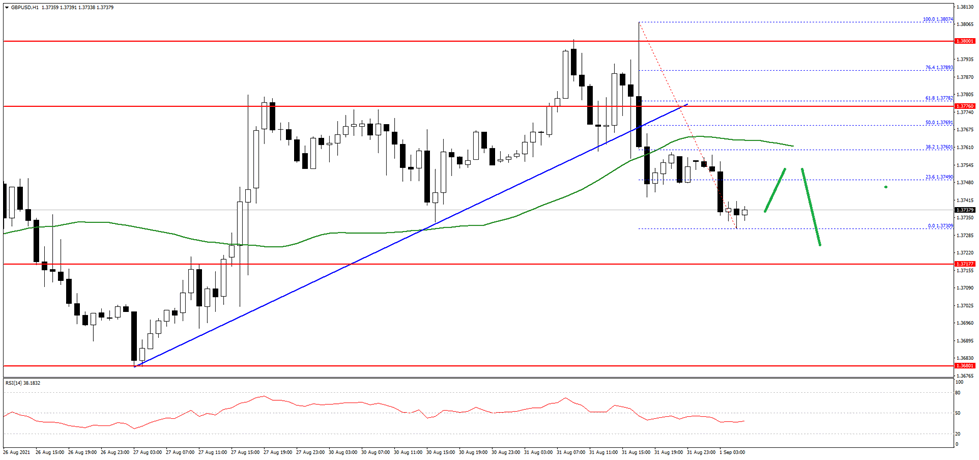
It is now consolidating near 1.3740 and it is facing resistance near 1.3750 on FXOpen. The next key resistance is near the 1.3760 level and the 50 hourly simple moving average. If there is a clear break above the 1.3750 and 1.3760 resistance levels, the pair could revisit 1.3800.
On the downside, an initial support is near the 1.3720 level. A break below the 1.3730 and 1.3720 support levels could lead the pair back towards 1.3680.