

Sample Category Title
GBP/USD Outlook: The Pair Made An Attempt To Clear The 1.3800 Resistance Zone, But It Struggled
The British Pound started a recovery wave above the 1.3750 resistance against the US Dollar. The GBP/USD pair made an attempt to clear the 1.3800 resistance zone, but it struggled.
A high was formed near 1.3807 and it started a fresh decline. There was a break below a key bullish trend line with support near 1.3770 on the hourly chart. It even broke the 1.3750 level and the 50 hourly simple moving average.
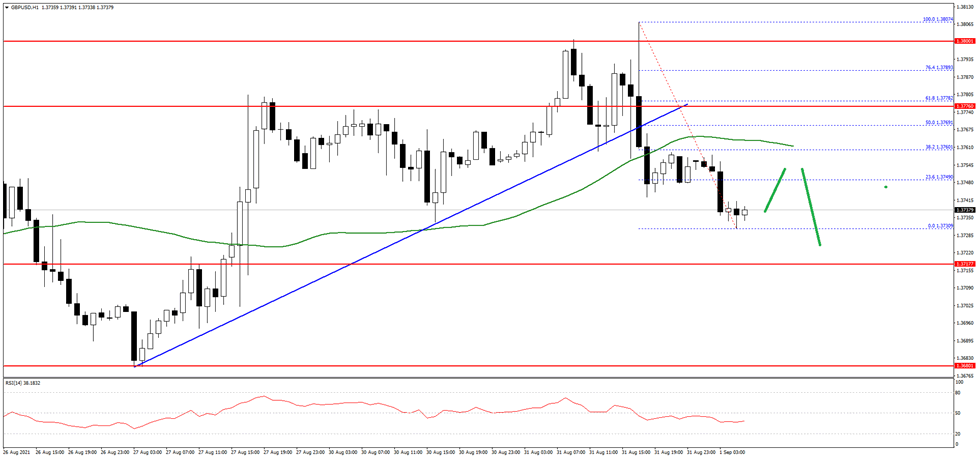
It is now consolidating near 1.3740 and it is facing resistance near 1.3750 on FXOpen. The next key resistance is near the 1.3760 level and the 50 hourly simple moving average. If there is a clear break above the 1.3750 and 1.3760 resistance levels, the pair could revisit 1.3800.
On the downside, an initial support is near the 1.3720 level. A break below the 1.3730 and 1.3720 support levels could lead the pair back towards 1.3680.
The Analytical Overview Of The Main Currency Pairs
The EUR/USD currency pair
Technical indicators of the currency pair:
Prev Open: 1.1796
Prev Close: 1.1808
% chg. over the last day: +0.10%
The inflation rate in Europe increased to 3% on a year-on-year basis, which is much higher than the target indicator of the European Central Bank of 2%. The new ECB program implies some deviation from the target, but what kind of deviation is acceptable and what is not – it’s all up to the officials. Therefore, a 50% jump in prices might cause some concern for investors as the central bank might start taking action to suppress inflation.
Trading recommendations
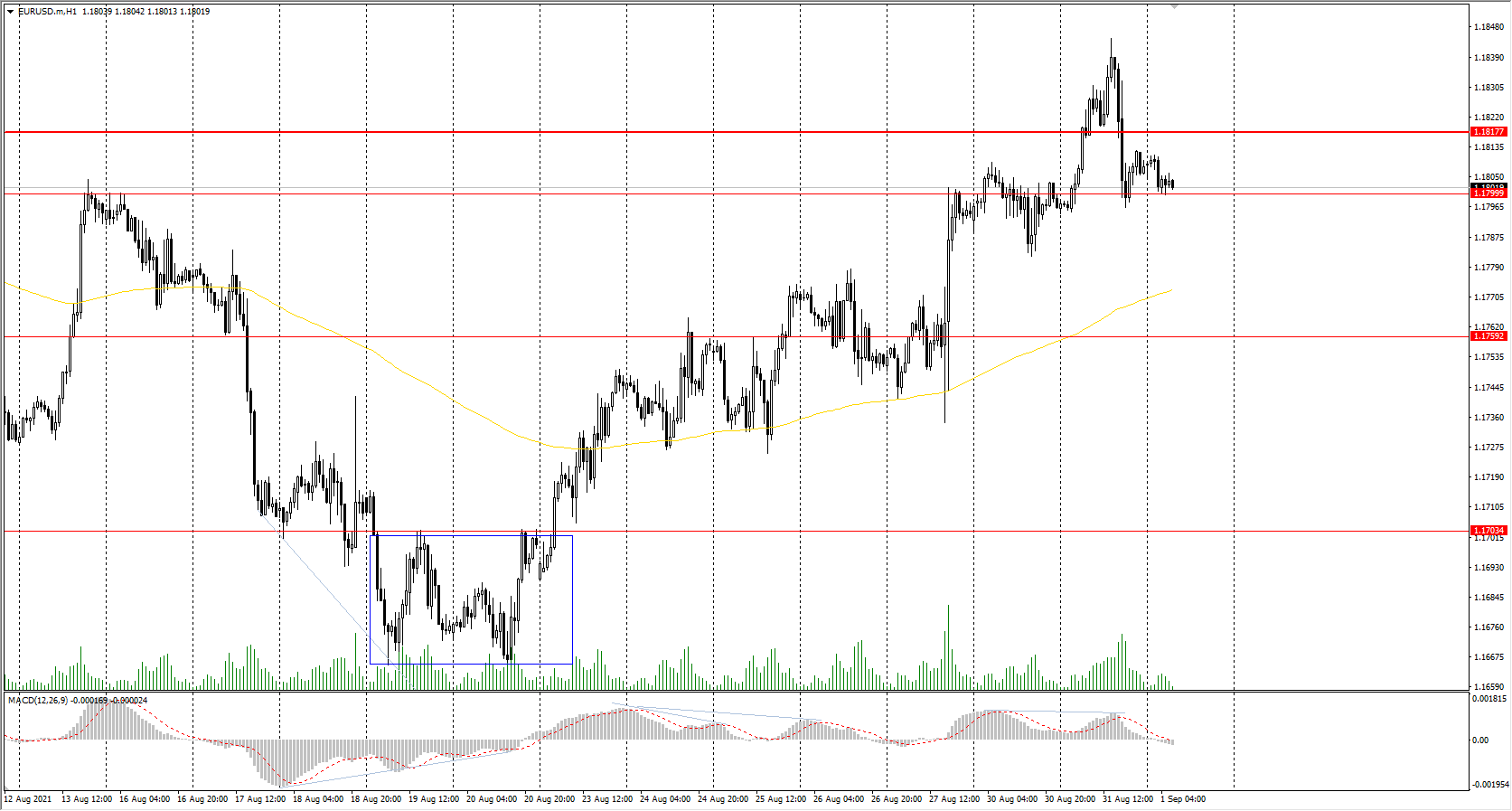
Support levels: 1.1799, 1.1759, 1.1704, 1.1620
Resistance levels: 1.1817, 1.1854, 1.1894, 1.1934, 1.1969
From a technical point of view, the general trend of the EUR/USD currency pair is bearish. But the price is trading above the moving average and tried to break through the priority change level, but failed to consolidate higher. The MACD is signaling a divergence in the opposite direction. Under such market conditions, it is best to look for sell trades from the resistance levels, where sellers show initiative. Buy trades can be considered only after a pullback or after a breakthrough of the priority change level.
Alternative scenario: if the price breaks through the 1.1817 resistance level and fixes above, the mid-term uptrend will likely resume.
News feed for 2021.09.01:
- Germany Manufacturing PMI (m/m) at 10:55 (GMT+3);
- Eurozone Manufacturing PMI (m/m) at 11:00 (GMT+3);
- Eurozone Unemployment Rate (m/m) at 12:00 (GMT+3);
- US ADP Non-Farm Employment Change (m/m) at 15:15 (GMT+3);
- US ISM Manufacturing PMI (m/m) at 17:00 (GMT+3).
The GBP/USD currency pair
Technical indicators of the currency pair:
Prev Open: 1.3759
Prev Close: 1.3755
% chg. over the last day: -0.03%
In July, The UK consumer credit did not increase for the first time since February, indicating a slowing recovery from the crisis. Business confidence reached a four-year high, but companies expressed concerns about staff shortages, which could eventually lead to wage increases in the coming months.
Trading recommendations
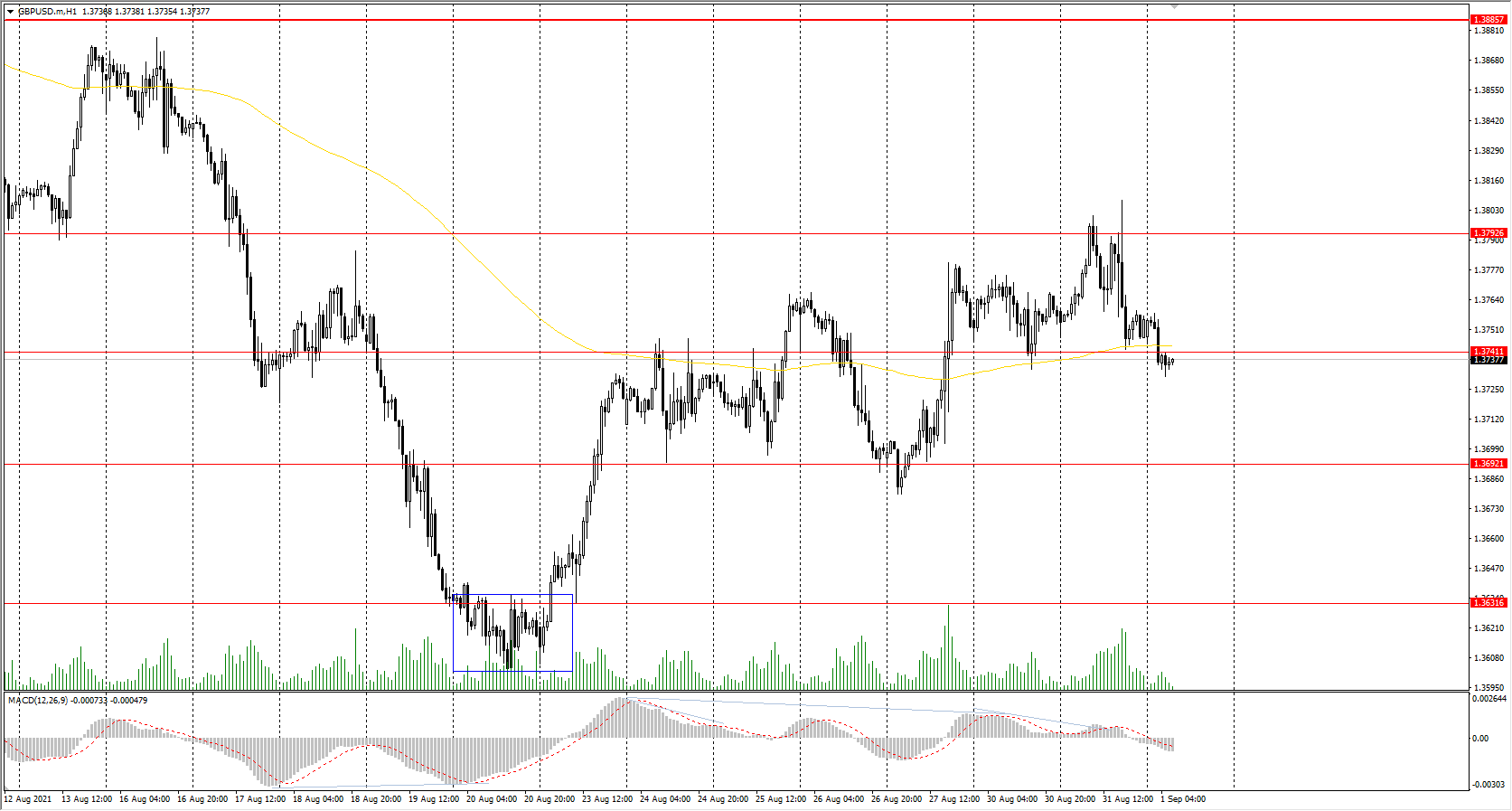
Support levels: 1.3741, 1.3692, 1.3632, 1.3614, 1.3525
Resistance levels: 1.3793, 1.3772, 1.3886, 1.3935, 1.4002
On the hourly time frame, the GBP/USD trend is bearish. The MACD indicator became negative. Under such market conditions, it is better to look for sell trades from the resistance level, where sellers show initiative. Buy positions can be considered only with short targets throughout the day.
Alternative scenario: if the price breaks through the 1.3885 resistance level and consolidates above, the bullish scenario will likely resume.
News feed for 2021.09.01:
- UK Manufacturing PMI (m/m) at 11:30 (GMT+3).
The USD/JPY currency pair
Technical indicators of the currency pair:
Prev Open: 109.92
Prev Close: 109.98
% chg. over the last day: +0.05%
Japan is still struggling with an outbreak of infection. Many regions have suspended vaccination because of the problems with the Moderna vaccine. Moreover, a group of Japanese researchers have discovered a new mutation of the Delta strain. Japan’s economic situation is complicated before the election of a new prime minister.
Trading recommendations
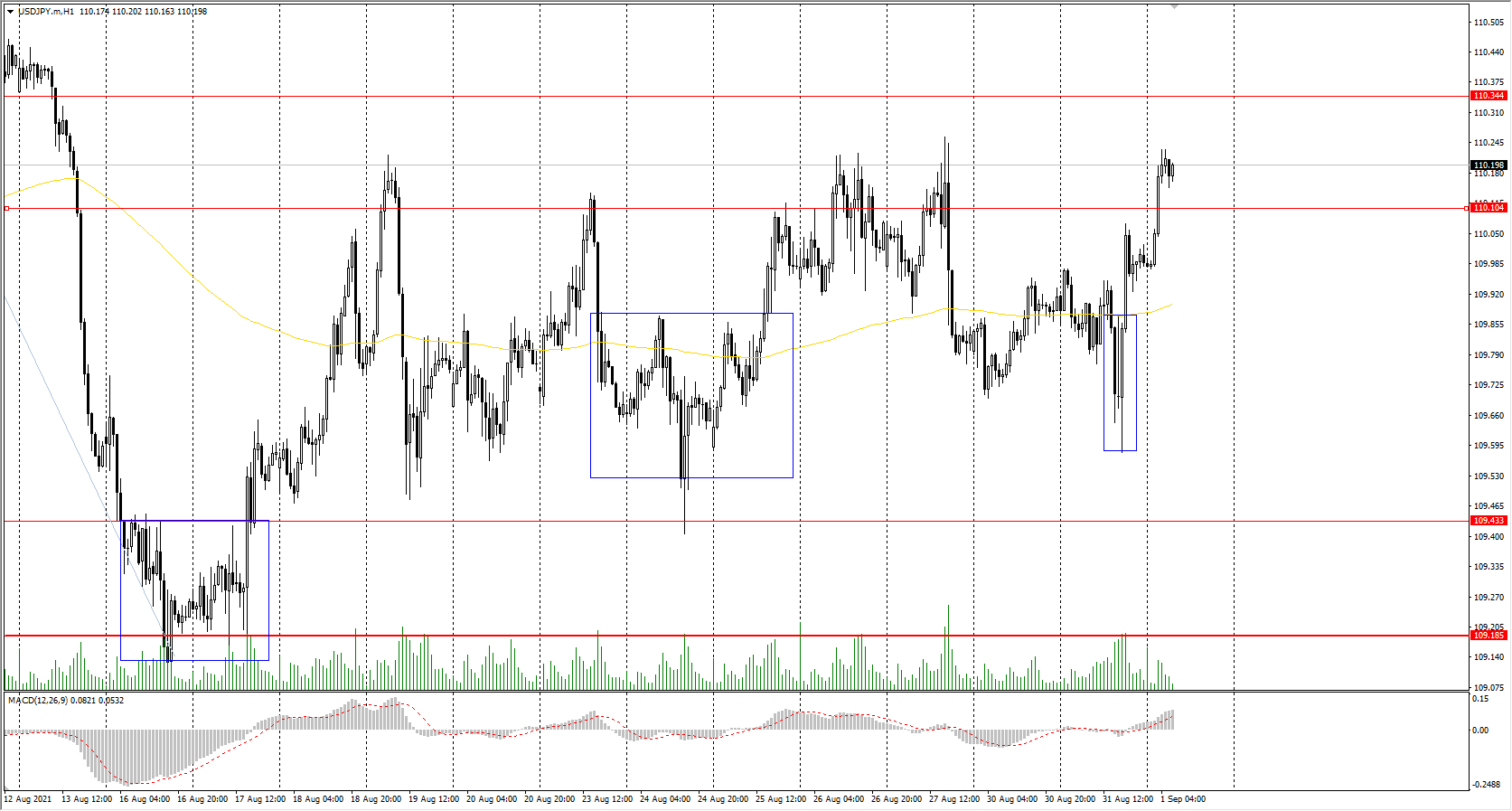
Support levels: 110.11, 109.43, 109.19, 108.65
Resistance levels: 110.34, 110.66, 110.95, 111.48
The main trend of the USD/JPY currency pair is bullish. Due to the strengthening of the dollar index, the price managed to break above the flat structures yesterday. The MACD indicator has become positive. Under such market conditions, traders should look for buy trades from the support level, where the buyers show initiative. Sell positions should be considered only on the lower time frames from the resistance levels with short targets.
Alternative scenario: if the price falls below 109.18, the uptrend is likely to be broken.
The USD/CAD currency pair
Technical indicators of the currency pair:
Prev Open: 1.2601
Prev Close: 1.2612
% chg. over the last day: +0.09%
Canada's growth indicators data turned out to be disappointing: GDP unexpectedly decreased by 0.3% in the last quarter. The Canadian dollar is a commodity currency, so the USD/CAD currency pair is highly dependent on the dynamics of the dollar index and oil prices. Yesterday, the dollar index slightly strengthened, while oil remained at the same level. As a result, the USD/CAD currency pair restored it’s position.
Trading recommendations
Support levels: 1.2602, 1.2554
Resistance levels: 1.2656, 1.2713, 1.2812, 1.2891, 1.2951
In terms of technical analysis, the USD/CAD trend is still bullish. The price was testing the priority change level yesterday. But it couldn't break through the level, and failed to consolidate below. A false breakdown zone was formed. It is better to look for buy positions from the priority change level where buyers show initiative. Sell positions can be considered from the resistance levels, or after the breakthrough of the 1.2602 support level.
Alternative scenario: if the price breaks through the 1.2602 support level and fixes below, the uptrend will likely be broken.

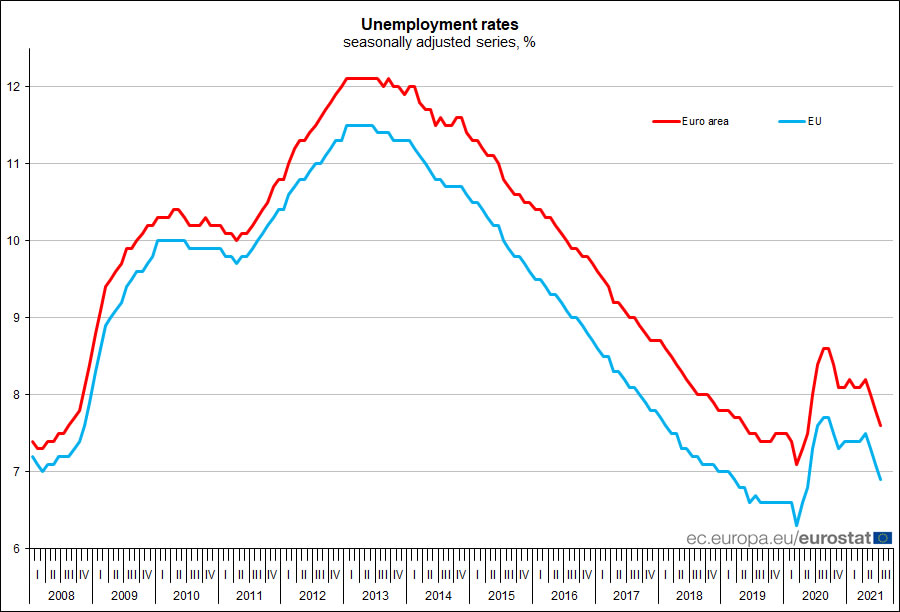
Eurozone unemployment rate dropped to 7.6% in July, EU down to 6.9%
Eurozone unemployment rate dropped to 7.6% in July, down from 7.8%, matched expectations. EU unemployment rate dropped to 6.9%, down from 7.1%.
Compared with June 2021, the number of persons unemployed decreased by 430 000 in the EU and by 350 000 in the euro area.
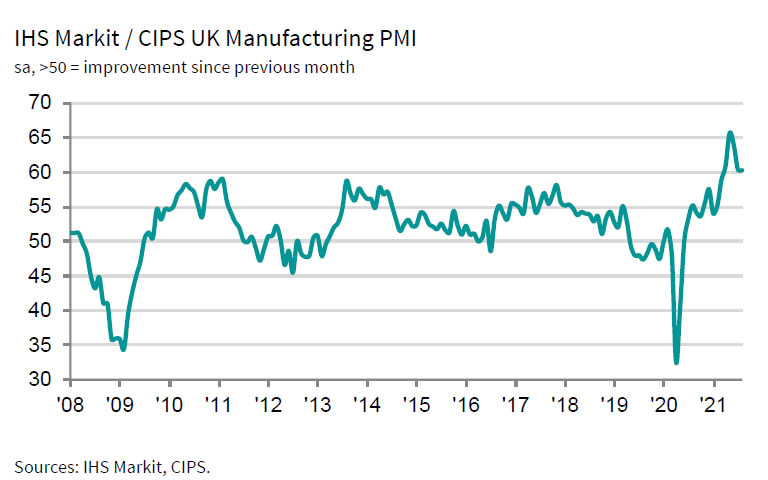
UK PMI manufacturing finalized at 60.3 in Aug, severe disruptions and material shortages eroded momentum
UK PMI Manufacturing was finalized at 60.3 in August, a tick down from July's 60.4. Market said output growth slowdown exacerbated by input supply issues. Input cost and selling price inflation remained close to survey records.
Rob Dobson, Director at IHS Markit, said: "Severe disruptions to supply chains and raw material shortages eroded the growth momentum of UK manufacturing in August.... With all of these factors likely to persist for the foreseeable future, manufacturing could well see a further growth slowdown in the coming months.... The impact of supply issues is also feeding through to rapid price inflation... Business confidence remained elevated despite the widespread shortages as firms focused on the longer-term outlook and brought back furloughed workers."
OPEC+ Expected To Persist With Supply Hikes
- US stocks set to kick off new month with gains.
- OPEC+ to increase output by 400k bbls/d as previously agreed.
- Upcoming US nonfarm payrolls an important barometer in Fed policy outlook.
- Risk assets to stay bid as long as policy normalisation remains distant.
Oil prices could be in for some volatility should there be any surprises out of today’s OPEC+ meeting, the EIA data or the assessment of Hurricane Ida’s impact on US output.
Although OPEC+ is widely expected to press ahead with its intended output increase of 400k barrels per day, it remains to be seen how the alliance would address the downside demand risks stemming from the Delta variant. An OPEC+ supply hike should also help keep key members of the alliance onside, placing a lid on the political dramas that have plagued key meetings in the recent past.
Oil prices should find enough support from continuously tightening global market conditions through year-end. However, any upside in prices may be limited, barring a halt to OPEC+ output hikes, with the group’s own projections reportedly pointing to a return to surplus in 2022. From a technical perspective, the 50-day simple moving average remains the immediate resistance level for WTI futures, while offering immediate support for Brent.
Going forward, the trajectory for oil benchmarks will be mostly dictated by pandemic-related developments and their impact on the recovery in global demand.
Global stocks still on course for new highs
Asian stocks are mostly in the green while US and European futures point to a positive start to September. Global stocks are set to continue churning out near-term gains given the longer runway for equity bulls accorded by a dovish Fed Chair who’s in no rush to raise US interest rates.
Risk assets are operating on the idea that, despite the stubborn nature of the pandemic and the enduring concerns over the Delta variant, such developments will not warrant a return to the total lockdowns across broad swathes of the developed world. As such, the global economic recovery should continue chugging along with major central banks wanting to make sure it isn’t derailed by ill-timed policy adjustments.
However, the recent deterioration in US consumer confidence as well as China’s official non-manufacturing and Caixin manufacturing PMIs show that a healthy dose of caution is still warranted in the markets. Risk appetite should be able to move past signals of a decelerating global economic recovery as long as calls to wind down pandemic-era stimulus aren’t ramped up, despite some ECB officials now apparently joining the hawkish fray.
US Nonfarm Payrolls report key to Fed mandate
This Friday’s US jobs report will serve as the next important marker on how soon the Fed will tighten monetary policy. A headline payrolls print that’s significantly higher than the Wall Street forecast of 748k, and one that restores more of the six million jobs lost since the pandemic, will force dollar bulls to defy Fed Chair Jerome Powell’s patient stance. On the other hand, risk assets are likely to revel in signs of a cooling US jobs market which would push back the thought of a sooner-than-expected US rate hike.
Ultimately, as long as market sentiment can move past concerns stemming from downside risks, abundant central bank liquidity should still translate into fresh record highs for global stocks over the near-term.
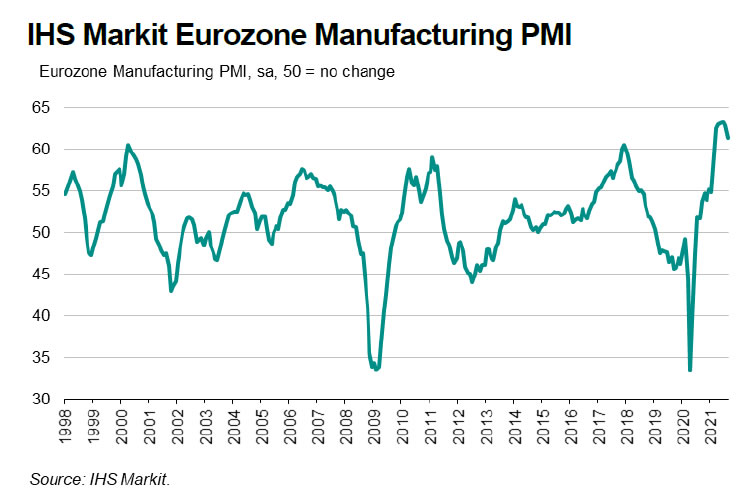
Eurozone PMI manufacturing finalized at 61.4 in Aug, another month of buoyant production
Eurozone PMI Manufacturing was finalized at 61.4 in August, down from July's 62.8. Markit said output and new orders sub-indices fell further from survey highs in March. Inflationary pressures eased, but remained substantial.
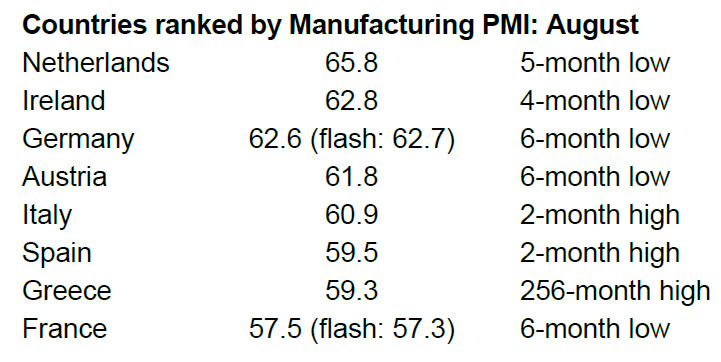
Looking at the member states, readings remained generally strong: Netherlands (65.8), Ireland (62.8), Germany (62.6), Austria (61.8), Italy (60.9), Spain (59.5), Greece (59.3), France (57.5).
Chris Williamson, Chief Business Economist at IHS Markit said: "Eurozone manufacturers reported another month of buoyant production in August, continuing the growth spurt into its fourteenth successive month. The overriding issue was again a lack of components, however, with suppliers either unable to produce enough parts or are facing a lack of shipping capacity to meet logistics demand.
"These supply issues were the primary cause of a shortfall of manufacturing production relative to orders of a magnitude not previously recorded by the survey, surpassing the 24-year record deficit seen in July."
Inflation In The Eurzone Increased To A Ten-Year High
Amid a temporary strengthening of the dollar index, major US stock indices declined yesterday. The Dow Jones index decreased by 0.11%, the S&P 500 index decreased by 0.13%, and the NASDAQ index lost 0.04% at the close of trading. 7 of the 11 sectors closed in the red zone. The technology and energy sectors declined most. But despite that, the S&P 500 index added almost 3% at the end of the month. It is the seventh month of growth in a row. And while the Fed is in no hurry to tighten its monetary policy, the rally is likely to continue. Investors' attention is now focused on labor market data, which will be released later this week. The Federal Reserve relies on employment reports, so very good figures may provoke investors to start selling.
Amid the return of millions of employees from remote work to offices, shares of video conferencing service Zoom fell by more than 15% after the company signaled an earlier-than-expected decline in demand. Investors now expect the Q3 report period will not be so profitable as the previous ones.
European stock indices also showed negative dynamics on the last day of summer. The British FTSE 100 decreased by 0.4%, German DAX lost 0.3%, French CAC 40 decreased by 0.1%, Italian FTSE MIB and Spanish IBEX 35 decreased by 0.06% and 0.2% respectively. On the other hand, the FTSE 100 index showed its best month since April, while the European Stoxx 600 index grew for the seventh month in a row. The UK energy regulator has established a £450 million fund for innovative projects that will help the country reach its net-zero climate goals. Ryanair plans to transport more passengers this fall than it did in the summer, raising its plan for the next three months after restoring traffic. The inflation rate in Europe increased to 3% year-over-year, which is much higher than the target indicator of the European Central Bank of 2%. The new ECB program implies some deviation from the target, but what kind of deviation is acceptable and what is not is all at the discretion of officials.
It took nearly a month for gold to recover from a sharp drop in prices that had occurred at the beginning of August. At the end of the month, the price closed at +0.3%. And as far as the Fed puts off the cutting of the QE program, growth is likely to continue.
Aluminum reached its highest level in a decade due to high demand and concerns that China may cut production in an effort to reduce energy consumption and emissions.
According to the American Petroleum Institute, oil inventories fell by 4.045 million barrels last week, which was higher than analysts expected. Today, the OPEC+ meeting will be held, and the crude oil reserves data will be released. Volatility in oil prices will jump. Yesterday, Kuwait's oil minister suggested that OPEC+ might decide to postpone plans of increasing production by 400,000 barrels per day. However, most analysts and refiners expect OPEC+ to stick to its plans to increase oil production gradually.
China's recovery has slowed. The corporate growth has almost stopped, and the service sector is contracting. It is negatively affecting the dynamics of major Asian indices. Australia's GDP increased by 0.7%, but economists are confident that we will witness more consequences of COVID-19 restrictions.
Main market quotes:
- S&P 500 (F) 4,522.68 −6.11 (−0.13%)
- Dow Jones 35,360.73 −39.11 (−0.11%)
- DAX 15,835.09 −52.22 (−0.33%)
- FTSE 100 7,119.70 −28.31 (−0.40%)
- USD Index 92.66 +0.11 (+0.12%)
Important events for today:
- Australia GDP (q/q) at 04:30 (GMT+3);
- Germany Manufacturing PMI (m/m) at 10:55 (GMT+3);
- Eurozone Manufacturing PMI (m/m) at 11:00 (GMT+3);
- UK Manufacturing PMI (m/m) at 11:30 (GMT+3);
- Eurozone Unemployment Rate (m/m) at 12:00 (GMT+3);
- US ADP Non-Farm Employment Change (m/m) at 15:15 (GMT+3);
- Canada Manufacturing PMI (m/m) at 16:30 (GMT+3);
- US ISM Manufacturing PMI (m/m) at 17:00 (GMT+3);
- US Crude Oil Reserves (w/w) at 17:30 (GMT+3);
- OPEC+ Meetings (All day).
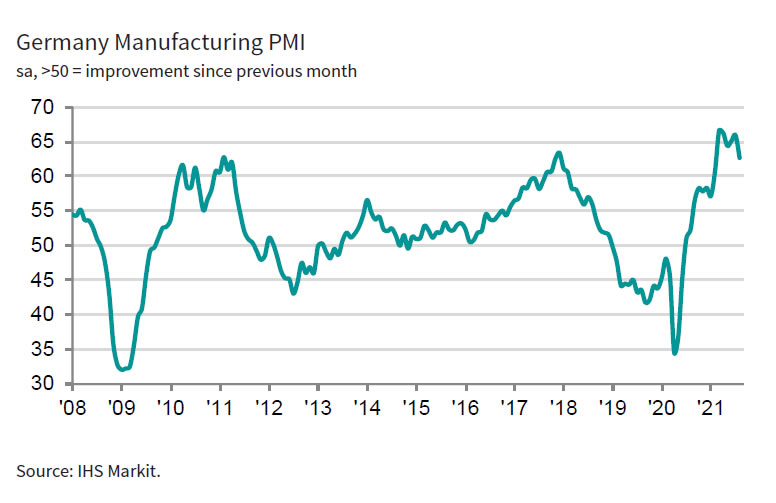
Germany PMI manufacturing finalized at 62.6 in Aug, strong demand
Germany PMI Manufacturing was finalized at 62.6 in August, down from July's 65.9. Markit said suvery's output index fell to its lowest level since August 2020. New orders continued to rise sharply, albeit also at a slower pace. Cost pressures remained historically elevated.
Phil Smith, Associate Economics Director at IHS Markit, said:
"While we continue to see strong demand for German goods, with growth in new orders still among the highest on record, production levels are being constrained as manufacturers grapple with supply chain problems. According to August's data, growth in output has now fallen behind that of new orders to an extent previously unseen in over 25 years of data collection.
"Supply-demand imbalances continue to push up costs at a historically elevated rate, and concerns that higher prices could discourage customers is one of the factors that has seen manufacturers' expectations for future output fade to the lowest since last October.
"Still, many goods producers are hopeful that conditions will have improved come next summer, and a further steep rise in employment levels shows that efforts are still being made to expand capacity and prepare for higher output in the future."
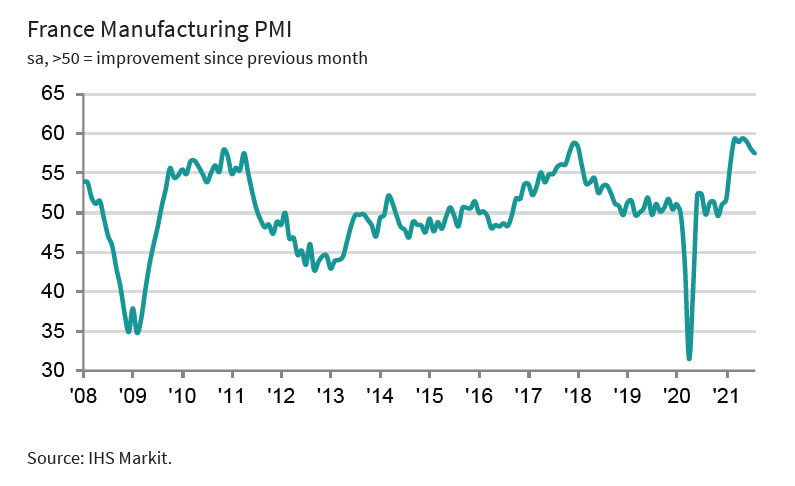
France PMI manufacturing finalized at 57.5 in Aug, remains strong
France PMI Manufacturing was finalized at 57.5 in August, down slightly from July's 58.0. Markit said growth momentum eased as supply chain issues persisted. New orders rose at softest rate since January. Business confidence slides amid concerns about cost inflation.
Joe Hayes, Senior Economist at IHS Markit, said:
"Economic conditions in France's manufacturing sector remain strong as we head towards the end of the third quarter, although further slowdowns in the rate of output and new order growth suggest we're well past the peak.
"Given the immense supply-side challenges being thrown at goods producers too, we can hardly be surprised to see production growth slowing, although during this time we've also seen backlogs of work accumulate at some pretty hefty rates. It's likely that firms have sufficient work in the wings to keep producing at a decent rate. They're certainly gearing for it, as employment growth is strong and accelerated in August, and purchasing activity continues to rise.
"Fears are however starting to mount as to when the material shortages, delivery delays and intense price pressures will take their toll. Surveyed businesses cited all of these as threats to the outlook and business confidence subsequently slipped to a nine-month low."
ECB Hawks Talk Tapering, Euro Unimpressed
- Euro barely gains despite inflation overshoot and ECB talk
- Dollar stages late session comeback, stocks hover near records
- Crucial US data and OPEC+ meeting on the agenda today
Euro brushes positive news aside
The notion that the European Central Bank will slow down its asset purchases soon is gaining traction. Officials from Austria and the Netherlands threw their weight behind this yesterday, highlighting the positive economic surprises lately, something that was soon echoed by ECB vice chief Luis de Guindos.
Their hawkish remarks were reinforced by an upside surprise in the Eurozone's inflation rate, which jumped to 3% in August to reach a decade high as supply chain disruptions continued to rage and summer demand kicked in. Another encouraging element is the elevated vaccination rate across Europe, which minimizes virus risks.
That said, all this talk about slashing asset purchases is mostly technical shenanigans, not a real taper. The ECB essentially has two QE programs in place right now, the crisis-era and the regular asset purchases. Policymakers want to slow their crisis-era interventions, but the total envelope of that program wouldn't change. It was always fixed in size.
In other words, the ECB is about to tweak the speed, but not the total size of its crisis-fighting asset purchases. And there's a strong chance that regular purchases are beefed up once that envelope is exhausted. Therefore, this wouldn't be a real normalization of monetary policy, like the Fed is about to execute.
The Eurozone economy is doing better but there's a risk this is mostly a reopening boom, as Germany's disappointing retail sales suggested today. And the Recovery Fund is too small to make a real difference. Interest rate increases are not on the horizon, so the euro could struggle as the ECB is left behind in the central bank normalization race.
Dollar fights back, stocks hang on
In the broader market, it was a relatively quiet session as August came to a close. The dollar battled through some early adversity to close almost unchanged, drawing power from a rebound in US Treasury yields.
Markets are still grappling with when the Fed will push the taper button. The consensus seems to have settled around a November announcement, although that could be brought forward if Friday's jobs report is sensational. We'll get a taste of what to expect today when the ADP employment report and the ISM manufacturing PMI for August are released.
Meanwhile, Wall Street ended a volatile session marginally lower. That said, the major indices remained just a shade away from record highs, as hopes for a super-slow Fed normalization and more fiscal juice from Congress eclipsed concerns that consumer spending may be cooling down. Indeed, the American consumer has gone on such a rampage this past year that some deceleration now is more than natural.
OPEC meeting in the spotlight
Beyond the US data releases today, markets will also keep a close eye on the OPEC+ meeting. The question is whether the cartel will stick to its plans to steadily raise production through the end of the year or whether the damage the Delta outbreak has inflicted on global demand will be enough to put those plans on ice.
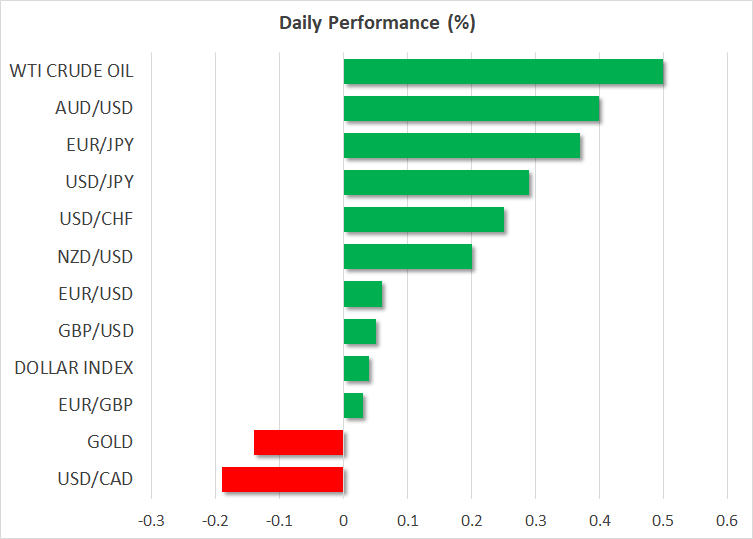
It's a close call, but ‘sources' suggest OPEC and its allies will forge ahead with output increases. In this case, oil prices could come back under pressure as markets price in a less favorable supply/demand balance in the coming months. That could also hit the oil-sensitive Canadian dollar.
Of course, any negative reaction in both oil prices and the loonie may be relatively minor as this is the market's base-case scenario already. The surprise would be if the producers shelved their plans to raise output, in which case the upside reaction in oil could be much bigger.