

Sample Category Title
GBP/JPY Daily Outlook
Daily Pivots: (S1) 151.04; (P) 151.32; (R1) 151.56; More...
Further rise is mildly in favor in GBP/JPY with 150.43 minor support intact. Rebound from 149.16 would target 153.42 resistance first. Break there will argue that whole corrective pattern from 156.05 has completed, and bring retest of this high. On the downside, however, below 150.43 minor support will turn bias back to the downside for 149.16 support and below.
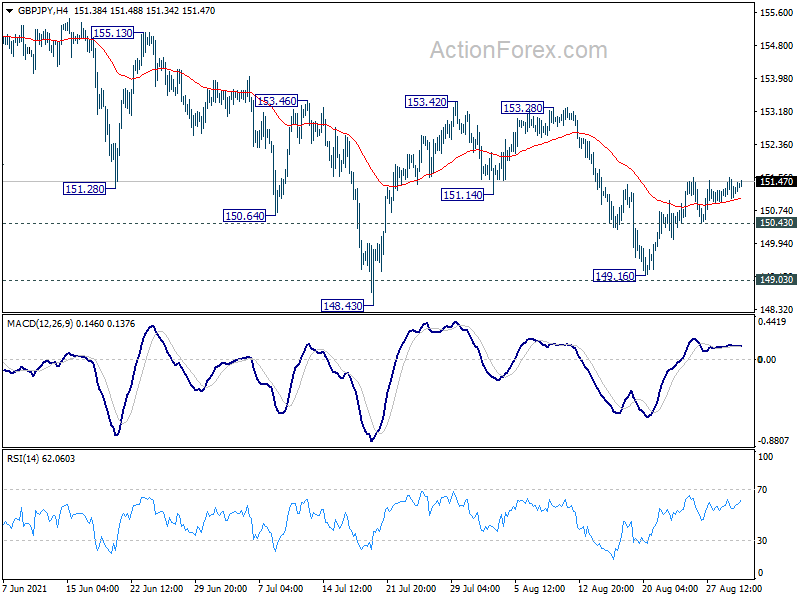
In the bigger picture, rise from 123.94 is seen as the third leg of the pattern from 122.75 (2016 low). As long as 149.03 support holds, such rise would still resume at a later stage. However, sustained break of 149.03 support will indicate rejection by 156.59. Fall from 156.05 would be at least correcting the whole rise from 123.94. Deeper fall would be seen back 38.2% retracement of 123.94 to 156.05 at 143.78 first.
AUDUSD In Tight Range After Strong Australian GDP Data
EURUSD price declined slightly after weak US consumer confidence numbers. According to the Conference Board, the US consumer confidence dropped to a six-month low of 113 from the previous 125. The numbers showed that the Delta variant and reports of breakthrough cases are affecting American’s sentiment about the economy. Therefore, there are concerns that less confident consumers will spend less money, which will have a negative impact on the economy. Later today, the pair will react to the EU and US PMI data and the labour market estimate by ADP.
AUDUSD remained in a tight range during the Asian market after mixed economic data from Australia and China. In Australia, data by Markit and the Australia Industry Group (AIG) showed that the manufacturing PMI declined to 51.6 and 52.0, respectively. This decline was a sign that companies are struggling amid controversial new lockdowns in states like Victoria and New South Wales. Similarly, in China, the PMI declined from 50.3 to 49.2. This was the first time in months that China’s business activity contracted in several months. Meanwhile, the Australian Bureau of Statistics (ABS) published strong GDP numbers. The data revealed that the country’s economy bounced back by 9.6% in the second quarter. The Aussie reacted mildly to this data because economic conditions have changed substantially in the past few weeks.
The economic calendar will have some key events as the new month starts. In the UK, Nationwide will publish the latest house price index (HPI), which are an important gauge of the housing market. House prices are expected to have declined from 10.5% to 8.6%. In the Eurozone, Eurostat will release the region’s unemployment rate number. At the same time, OPEC+ members will hold their September virtual meeting. Analysts expect the team to maintain their current supply after oil prices had their worst monthly performance in 6 months.
AUDUSD
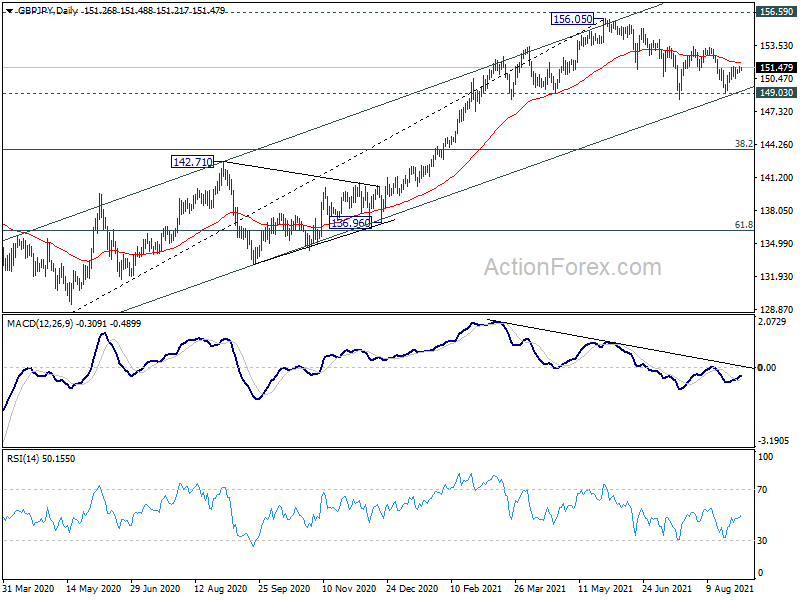
AUDUSD was little changed after the latest Australia GDP and PMI data. It is trading at 0.7318, which is substantially higher than last month’s low of 0.7108. On the four-hour chart, the pair has moved above the 25-day and 15-day exponential moving averages while the Relative Strength Index (RSI) has been on an upward trend. The pair is also forming an inverse cup and handle pattern. Therefore, the pair will likely keep rising as bulls target the key resistance at 0.7400.
EURUSD
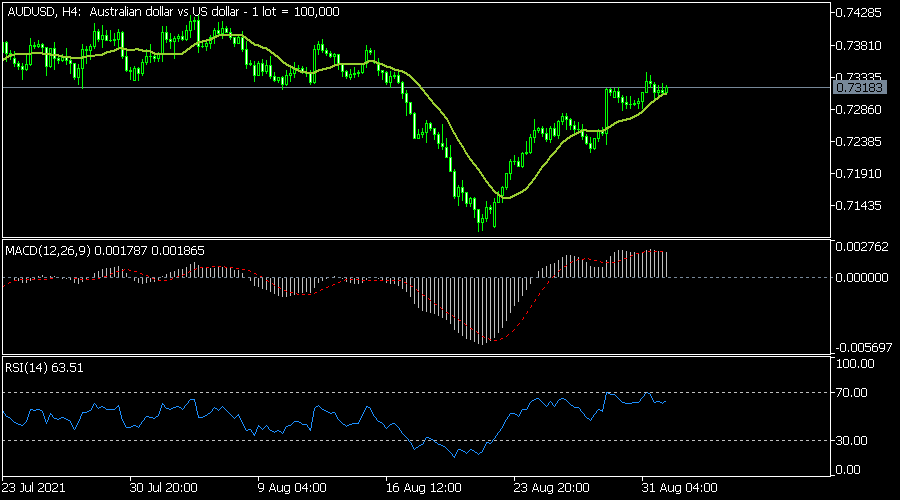
EURUSD price declined to 1.1800 after the latest American consumer confidence data. On the four-hour chart, the pair has formed an inverse head and shoulders pattern. It has also found support at the 25-day EMA while the RSI has tilted lower from the overbought section of 70. The current price is also along the highest point on August 13. Therefore, the pair will likely break out higher as bulls eye the key resistance at 1.1905.
EURGBP
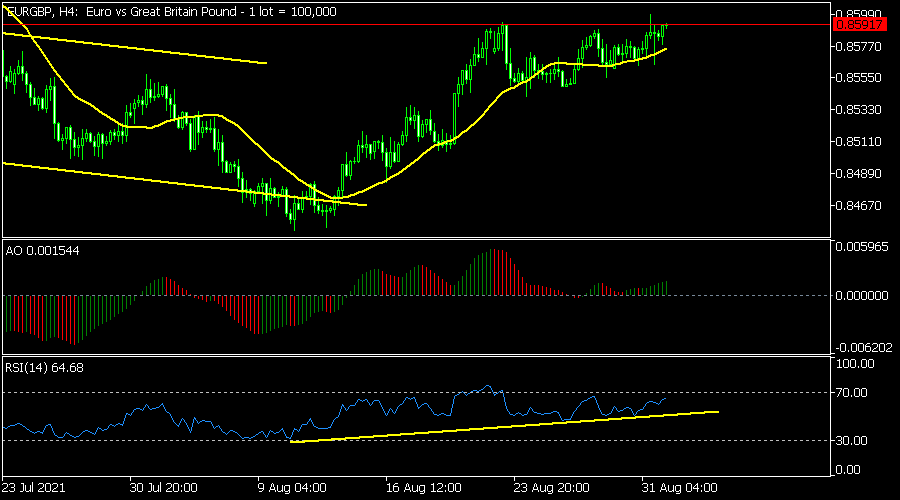
EURGBP is stuck at the key resistance level at 0.8590, which was the highest level since August 25. On the 4 hour chart, the pair has moved above the 25-day moving average. The RSI has formed a bullish divergence pattern while the awesome oscillator is slightly above the neutral level. The pair will likely break out higher as bulls attempt to move above the key resistance at 0.8600.
XAUUSD Is Possibly Bearish
Technical analysis
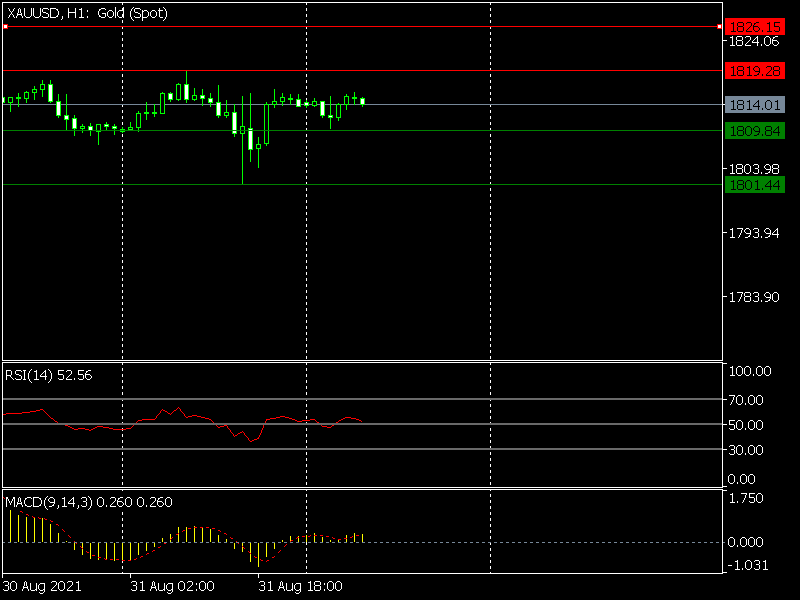
The MACD indicator line is slightly above 0, staying neutral
The RSI is slightly above 50.
What the possible outcomes are
The U.S. dollar started gaining power after days of weakness, so did the Treasury yields. In this situation, XAUUSD may decline.
If the price passes the initial support level of 1,809.84, it could test the next lower at 1,801.44.
Alternatively, if the price reverses, then it could reach the first resistance level of 1,819.28.
A pass above the first level can move the price up higher towards 1,826.15.
Key levels
Support 1,809.84 1,801.44
Resistance 1,819.28 1,826.15
China Markets Rebound Amid Surprise Manufacturing PMI Contraction
General trend
- Equity markets are generally off of the lows, modest moves have been seen thus far.
- Shanghai Composite ended morning trading higher despite the flat open [Banks and Property indices rise amid report related to loan quota increase].
- Hang Seng has also gained after opening flat [TECH and Financials trade generally higher; Property names also rise]; NetEase rose after earnings report; Huarong International drops over 20% after being resumed for trading; Aug Macau Casino Revs beat ests.
- Nikkei has extended gain with USD/JPY above 110 [Topix Banks index supported by higher bond yields; Electric Appliances, Information & Communication and Air Transportation indices also rise; Marine Transportation and Iron & Steel indices lag].
- S&P ASX 200 has lagged [Metcash weighs on Consumer Staples index; Financials rebound amid higher bond yields; Energy index rises].
Headlines/Economic Data
Australia/New Zealand
- ASX 200 opened -0.1%.
- (AU) AUSTRALIA Q2 GDP Q/Q: 0.7% V 0.5%E; Y/Y: 9.6% V 9.2%E.
- (AU) Australia Treasurer Frydenberg: Economy will bounce back once restrictions ease; Q2 GDP was solid, confident that COVID restrictions will be lifted in Q4.
- (AU) Victoria (Australia) Premier: Unlikely to ease lockdown until Sept 23rd (Mon); cannot ease COVID restrictions today due to reporting its highest number of new cases in over a year.
- (AU) Australia Aug Final PMI Manufacturing: 52.0 v 51.7 prior (confirms 15th month of expansion).
- MTS.AU Reports first 16 weeks of FY22 sales continue to be elevated, levels well above pre-COVID levels; first 16 weeks of FY22 Supermarket Sales -1.8% y/y, total food sales -7.4% y/y – AGM.
- (AU) Australia sells A$1.0B v A$1.0B indicated in 1.00% Nov 2031 bonds, avg yield: 1.2319%, bid to cover 5.1x.
Japan
- Nikkei 225 opened +0.3%.
- (JP) JAPAN Q2 CAPITAL SPENDING (CAPEX) Y/Y: 5.3% V 3.5%E; CAPITAL SPENDING EX-SOFTWARE: 3.6% V 3.0%E.
- (JP) Bank of Japan (BOJ) Deputy Gov Wakatabe: inflation expectations moving sideways with some signs up pick up, more improvement needed to reach target, economy is sustaining recovery trend and will become clearer as pandemic impact eases.
- (JP) Analysts note that the decline in Japan July industrial production is an indication of supply chain issues not a weakness in global demand – press.
- (JP) Japan govt reportedly plans to spend ¥119.5B for offshore wind power purposes – Nikkei.
- (JP) Japan PM Suga: Can't dissolve parliament amid severe COVID situation, dealing with that is priority over general elections.
Korea
- Kospi opened -0.1%.
- 005930.KR Renault Samsung have reached tentative wage agreement with union, base pay freeze for 2020 and 2021 with lump sum bonus.
- (KR) South Korea Aug PMI Manufacturing: 51.2 v 53.0 prior (lowest since Oct 2020).
China/Hong Kong
- Hang Seng opened 0.0%; Shanghai Composite opened 0.0%.
- (CN) CHINA AUG CAIXIN PMI MANUFACTURING: 49.2 V 50.1E (1st contraction since Apr 2020).
- (CN) China issues plan on deepening medical service pricing reform: to curb overly fast growth in medicine expenses - press.
- (CN) China Ambassador Qin Gang: US and China should maintain dialogue.
- (HK) Macau Aug Casino Rev (MOP): 4.44B v 8.4B prior; Y/Y: 234% v 176%e.
- (CN) China PBOC to implement new rules that will require nonbank payment apps to report new products and stock market listings to authorities, effective today.
- (CN) China President Xi to speak at China International Fair for Trade and Services Sept 2nd.
- (CN) China PBOC sets Yuan reference rate: 6.4680 v 6.4679 prior.
- (CN) China PBOC Open Market Operation (OMO): Injects CNY10B in 7-day reverse repos v CNY50B in 7-day reverse repos prior; Net drain CNY40B v Net Inject CNY40B prior.
Other
- (CL) CHILE CENTRAL BANK (BCCH) RAISES OVERNIGHT RATE TARGET BY 75BPS TO 1.50%; MORE-THAN-EXPECTED (largest hike in 20 years).
- Spot prices for DRAM decline, cites forecast of weaker demand - Yonhap.
North America
- (US) Weekly API Crude Oil Inventories: -4M v -1.6M prior.
- INTU Said to be in talks to acquire marketing, email platform, MailChimp for >$10B.
Europe
- (FR) France Aug New Car Registrations 87.7K, -15.4% y/y – CCFA.
- (UK) Japan Econ Min Nishimura: CPTPP member countries agreed to hold 1st meeting with UK on its inclusion into the CPTPP in 1 month, entry of the UK is very significant in building free and fair economic order.
Levels as of 01:15ET
- Hang Seng +0.5%; Shanghai Composite +0.9%; Kospi +0.1%; Nikkei225 +1.1%; ASX 200 -0.3%.
- Equity Futures: S&P500 +0.3%; Nasdaq100 +0.2%, Dax +0.2%; FTSE100 +0.4%.
- EUR 1.1812-1.1796; JPY 110.25-109.99 ;AUD 0.7324-0.7308; NZD 0.7056-0.7036.
- Commodity Futures: Gold -0.1% at $1,816/oz; Crude Oil +0.7% at $68.98/brl; Copper -0.9% at $4.32/lb.
Hawkish ECB Comments Weigh On European Bond Markets
Market movers today
- Today is big PMI-day with a range of PMIs out across Europe including the Nordics, see more below.
- In the US, we get ISM manufacturing, which will likely continue to reflect bottlenecks in the manufacturing sector.
- OPEC+ is expected to meet later today.
The 60 second overview
Hawkish ECB comments: Yesterday's market sentiment was dominated by a better than expected inflation print in the euro area as well as hawkish comments from Knot and Holzmann. While both governing council members called for slowing the bond purchases, something that has turned out to be market baseline, the notable highlight from both interventions is that both caution against applying the same flexibility to the APP that has been applied to the PEPP. This will be the main discussion point along with QE calibration this year, where we expect the big battle only to come at the December meeting. 10y German yields rose 6bp yesterday with BTP-Bund spread widening 4bp.
Euro area inflation: The euro area flash HICP rose to 3.0% in August, highest since November 2011 (from 2.2% in July). The energy price inflation remained elevated but the biggest pro-inflationary factor this month was the jump in core inflation to 1.6% (from 0.71% in July). German VAT base effects played an important role, but the broad-based increase in both services and goods price inflation suggests that underlying inflation pressures are also gaining momentum (likely helped by cost-push pressures on supply chains and increased demand for travel and recreational services during the summer). The high print fuels the ECB hawks argument to push for an end to crisis fighting tools sooner rather than later.
China PMI: The private Caixin PMI survey in China declined to the sub-50 territory for the first time since the start of last year, pointing to a contraction in the manufacturing sector. While this is also a result of lockdowns due to earlier virus cases, this is also part of a general manufacturing peak that is behind us.
Equities: No major moves in equities yesterday as investors are waiting for the next driver to appear. Styles and sectors very tightly bunched and very few areas sticking out yesterday. Equity investors are so far ignoring disappointing key figures but their confidence will probably be tested again today as more heavyweight numbers are due. In US yesterday Dow -0.1%, S&P 500 -0.1%, Nasdaq -0.04% and Russell 2000 +0.3%. Asian markets are higher this morning lifted by upbeat tone in Japan. European futures starting September roughly 0.5% higher while US ones are only slightly higher this morning.
FI: A perfect storm hit bond markets yesterday. With a higher than expected inflation print in the euro area, fuelled by hawkish comments from Knot and Holzmann plus a 30y syndication from Germany, on top of European rates already trading heavy after the UK bank holiday from the start of the day, the result was Bunds almost 6bp higher and BTPs-Bund spreads 4bp wider compared to Monday close. Core European bonds underperformed US treasuries by 3bp, amid a curve steepening move. Cash bonds underperformed swaps, with e.g. Bund ASW tightened 2bp to 37.5bp.
FX: In a session generally characterised by USD weakness and EM performance PLN, CZK and ZAR were the primary outperformers yesterday. Normally, this would be a beneficial environment for NOK, yet the Norwegian currency was the biggest underperformer in FX majors space with EUR/NOK back in the mid 10.20s. EUR/SEK edged modestly higher but closed just below 10.20.
Credit: The mood remained decent in credit markets yesterday where iTraxx Xover tightened 0.8bp (closing in 227.9bp) and Main 0.5bp (to 44.8bp). HY bonds tightened 1bp and IG closed around ½bp wider.
Nordic macro
In Norway, the manufacturing PMI should drop well below 60 (no consensus) as the global manufacturing cycle clearly has peaked. As always, the July and August data are volatile, as the number of respondents tends to be small, so we put less emphasis than usual on the figure.
EUR/JPY Daily Outlook
Daily Pivots: (S1) 129.61; (P) 129.89; (R1) 130.19; More....
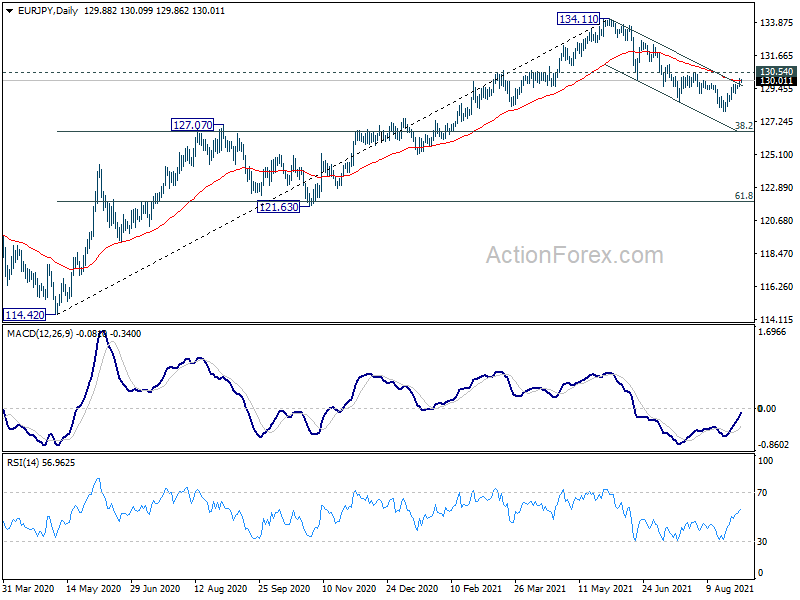
Intraday bias in EUR/JPY remains on the upside for the moment. Rebound from 127.91 short term bottom is in progress for 130.54 resistance. Sustained break there will argue that whole correction from 134.11 has completed and turn near term outlook bullish. Nevertheless, on the downside, below 129.14 minor support will turn bias back to the downside for retesting 127.91 low instead.
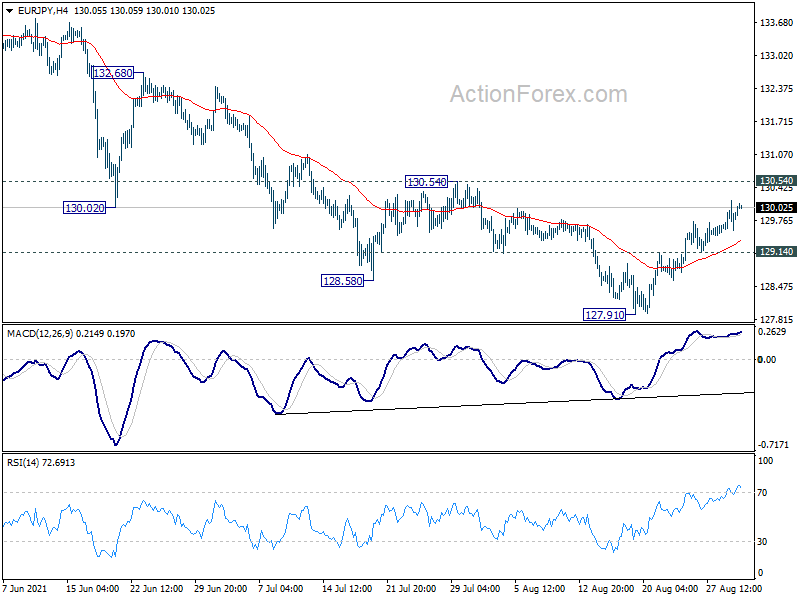
In the bigger picture, rise from 114.42 is seen as a medium term rising leg inside a long term sideway pattern. As long as 127.07 resistance turned support holds, further rise is still expected to retest 137.49 (2018 high). However, firm break of 127.07 will argue that the medium term trend has reversed, deeper fall would be seen to 61.8% retracement of 114.42 to 134.11 at 121.94.
Markets Calm Ahead Of ADP And OPEC
Big news of the day is the S&P500 and Nasdaq didn’t renew record yesterday. But the US equities still recorded their seventh straight monthly advance in August, which is the strongest winning streak since January 2018, and the S&P500 beat its 53rd record at Monday’s close: not bad at all given that we don’t only have good news on the wire.
Corporate results are strong, but the Covid crisis is not over, the world and the US is dealing with the new delta variant, global inflation spikes, there is a worsening chip and other material shortages which will at some point affect companies’ businesses and the high inflation is now driving the Federal Reserve (Fed) toward the exit of the cheap money era. Add that to the tragedy in Afghanistan, storms and forest fires: the world is not doing well.
But the markets are on path for more gains. Nobody can tell how healthy the actual trend is, where it will end, or how it will end. It is sure that we may well see a 10 to 20% drop in equity prices from the actual levels, and there would be plenty of reason to justify such move. But for now, the overall market holds on to its gains and no one dares saying ‘the king is naked’.
Activity in DAX and FTSE futures hint at a positive start in Europe, as US index futures are in the green ahead of the ADP data release.
The US is expected to have added some 613K private jobs in August. That’s more than the 330K added a month earlier. But remember, we had a big miss on the ADP front last month, and that didn’t prevent the NFP from printing a surprise strong figure near a million job additions. Therefore, the data will be taken with a pinch of salt. Still, a softer than expected figure could encourage some more profit taking across the US equities, while a good figure could send the indices to record highs, yet again.
And in all cases, the bulls will probably read what they want to read and hear what they want to hear in data. And even if it’s not the case, they will probably rapidly get over any unpleasant news to carry the rally higher, because a misstep could have dramatic consequences.
In commodities, gold consolidates above the $1800 per oz as US crude is still knocking at the door of the $70pb. Oil bulls could find an opportunity to drill above the $70pb today on the back of OPEC announcement today.
OPEC is expected to stick to the production revival plan, as even with OPEC adding 400’000 barrels each day to the end of this year, the fuel stockpiles will decline by more than 800’000 barrels in average. That’s good news for the oil bulls. However, the market will get back to surplus starting from 2022 and remain oversupplied through next year. So that to me is a strong hint that we don’t have much upside potential above the $70pb in US crude, unless we see a surprise action taken by OPEC one of these days. But probably not today. OPEC is widely expected to maintain its output policy unchanged this month, so that’s 400K more barrels per day for the next several months. But Saudis already warned that OPEC could well pause or reverse their unwinding of output curbs in the coming year, but it may not be a smooth action, as many other members may not agree to return to output restrictive regime so soon. So, I still believe that $75/78 area should act as a solid ceiling to any further rally in oil prices.
Dollar Losing Downside Momentum, Sellers Turn to Yen and Franc
Dollar recovers broadly today, as the near term decline lost momentum. Selling focus is turned to Yen and Swiss Franc instead. Traders are now awaiting key economic indicators from the US, while would start with ADP employment and ISM manufacturing today, to be completed with non-farm payrolls and ISM non-manufacturing on Friday. These data have the potential to trigger some wild volatility, given that Fed's timing for tapering would be heavily dependent on them, in particular the job market performance.
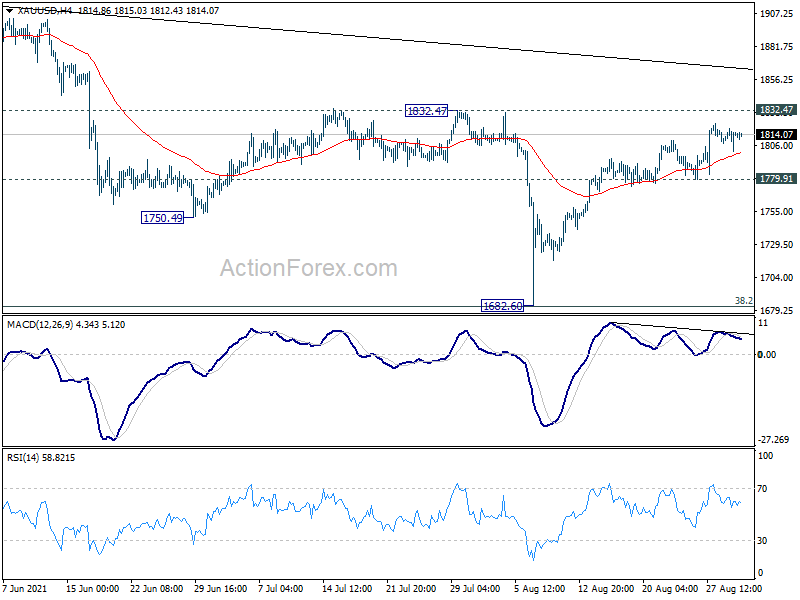
Technically, the loss of downside momentum in Dollar is reflected in Gold too, which stalled ahead of 1832.47 resistance. Bullish bias is maintained as it stands in tight range above 1800 handle, as well as 4 hour 55 EMA. We'd continue to use gold to double confirm the movement in the greenback in ahead. Break of 1832.47 resistance should indicate underlying selling in Dollar. However, break of 1779.91 support will indicate completion of rebound from 1682.60, and suggest that Dollar is striking a comeback elsewhere.
In Asia, at the time of writing, Nikkei is up 1.13%. Hong Kong HSI is up 0.47%. China Shanghai SSE is up 0.44%. Singapore Strait Times is up 0.99%. Japan 10-year JGB yield is up 0.0084 at 0.035. Overnight, DOW dropped -0.11%. S&P 500 dropped -0.13%. NASDAQ dropped -0.04%. 10-year yield rose 0.019 to 1.304.
ECB de Guindos: Better economic performance to be reflected in new projections
ECB Vice President Luis de Guindos told a Spanish newspaper, "the economy is performing better in 2021 than we expected, and this will be reflected in the projections that will be published in the coming days."
"If inflation and the economy recover, then there will logically be a gradual normalization of monetary policy, and of fiscal policy too," he added.
Australia GDP grew 0.7% qoq in Q2 better than expectation
Australia GDP grew 0.7% qoq in Q2, above expectation of 0.5% qoq. Over 2020-21, the economy grew 1.4%. Head of National Accounts at the ABS, Michael Smedes said: "Domestic demand drove growth of 0.7 per cent this quarter which saw continued growth across household spending, private investment and public sector expenditure. Lockdowns had minimal impact on domestic demand, with fewer lockdown days and the prolonged stay at home orders in NSW only commencing later in the quarter".
Australia AiG manufacturing dropped sharply to 51.6 on lockdowns
Australia AiG Performance of Manufacturing dropped sharply from 60.8 to 51.6 in August. Looking at some more details, production dropped from -11.6 pts to 50.2. Employment dropped -9.4 to 51.4. New orders dropped -5.4 to 57.1. Supplier deliveries dropped -18.3 to 41.3. Exports dropped -8.5 to 45.1.
Ai Group Chief Executive Innes Willox said: "August saw a steep retreat from the healthy expansion in manufacturing performance that has characterised most of this year. Lockdowns across the country, particularly in NSW and Victoria were the major detractor from performance with ongoing strength outside of these states sufficiently strong to maintain the national performance in positive territory (although by a slim margin).
BoJ Wakatabe: Economic recovery is expected to become clear with vaccination progress
BoJ Deputy Governor Masazumi Wakatabe said in a speech, the Japan economy has remained in a "severe state". But the bank judged that "pick-up trend in the economy as a whole has been maintained, supported by positive developments in the corporate sector on the back of a firm recovery in overseas economies".
"Positive developments are likely to spread from the corporate sector to the household sector as the impact of COVID-19 wanes gradually, mainly due to progress with vaccinations," he added. "The economic recovery is expected to become clear."
The key to realizing the positive outlook is "whether a virtuous cycle operates firmly". That is, "whether an increase in domestic and overseas demand expands household income and corporate profits, and in turn leads to a further rise in spending".
Japan PMI manufacturing finalized at 52.7 in Aug, sustained expansion
Japan PMI Manufacturing was finalized at 52.7 in August, just slightly down from July's 53.0. Markit said output and new orders increased and slower rates. Export orders declined for the first time in seven months. Lead times lengthened to greatest extent in a decade amid ongoing disruption.
Usamah Bhatti, Economist at IHS Markit, said: "Latest PMI data pointed to a sustained expansion in the Japanese manufacturing sector midway through the third quarter.... A sharp rise COVID-19 cases in South East Asia was among the key factors listed by Japanese manufacturers for the easing in demand, both domestically and externally... Concurrently, severe supply chain disruption partly caused by pandemic restrictions and raw material shortages remained a dampener on production and orders."
China Caixin PMI manufacturing dropped to 49.2, Covid-19 resurgence a severe challenge
China Caixin PMI Manufacturing dropped to 49.2 in August, down from 50.3, below expectation of 50.2. That's the first contraction reading since April 2020. Caixin said output and new orders both declined modestly. Supply chain delays worsened amid uptick on COVID-19 cases. Companies trimmed purchasing activity and stagging levels.
Wang Zhe, Senior Economist at Caixin Insight Group said: "The latest Covid-19 resurgence has posed a severe challenge to the economic normalization that began in the second quarter of last year... Official economic indicators for July were worse than the market expected, indicating mounting downward pressure on economic growth. Authorities need to take a holistic view and balance containing Covid-19, stabilizing the job market, and maintaining stability in supply and prices."
Looking ahead
Swiss PMI manufacturing, Eurozone PMI manufacturing final and UK PMI manufacturing final will be released in European session. Later in the day, US will release ADP employment, ISM manufacturing and construction spending.
EUR/JPY Daily Outlook
Daily Pivots: (S1) 129.61; (P) 129.89; (R1) 130.19; More....
Intraday bias in EUR/JPY remains on the upside for the moment. Rebound from 127.91 short term bottom is in progress for 130.54 resistance. Sustained break there will argue that whole correction from 134.11 has completed and turn near term outlook bullish. Nevertheless, on the downside, below 129.14 minor support will turn bias back to the downside for retesting 127.91 low instead.
In the bigger picture, rise from 114.42 is seen as a medium term rising leg inside a long term sideway pattern. As long as 127.07 resistance turned support holds, further rise is still expected to retest 137.49 (2018 high). However, firm break of 127.07 will argue that the medium term trend has reversed, deeper fall would be seen to 61.8% retracement of 114.42 to 134.11 at 121.94.
Economic Indicators Update
| GMT | Ccy | Events | Actual | Forecast | Previous | Revised |
|---|---|---|---|---|---|---|
| 22:30 | AUD | AiG Performance of Manufacturing Index Aug | 51.6 | 60.8 | ||
| 23:01 | GBP | BRC Shop Price Index Y/Y Jul | -0.80% | -1.20% | ||
| 23:50 | JPY | Capital Spending Q2 | 5.30% | 3.90% | -7.80% | |
| 00:30 | JPY | Manufacturing PMI Aug F | 52.7 | 52.4 | 52.4 | |
| 01:30 | AUD | GDP Q/Q Q2 | 0.70% | 0.50% | 1.80% | 1.90% |
| 01:45 | CNY | Caixin Manufacturing PMI Aug | 49.2 | 50.2 | 50.3 | |
| 06:00 | GBP | Nationwide Housing Prices M/M Aug | 0.10% | -0.50% | ||
| 06:00 | EUR | Germany Retail Sales M/M Jul | -0.90% | 4.20% | ||
| 07:30 | CHF | SVME PMI Aug | 67.5 | 71.1 | ||
| 07:45 | EUR | Italy Manufacturing PMI Aug | 60 | 60.3 | ||
| 07:50 | EUR | France Manufacturing PMI Aug F | 57.3 | 57.3 | ||
| 07:55 | EUR | Germany Manufacturing PMI Aug F | 62.7 | 62.7 | ||
| 08:00 | EUR | Italy Unemployment Jul F | 10.40% | 9.70% | ||
| 08:00 | EUR | Eurozone Manufacturing PMI Aug F | 61.5 | 61.5 | ||
| 08:30 | GBP | Manufacturing PMI Aug | 60.1 | 60.1 | ||
| 09:00 | EUR | Eurozone Unemployment Rate Jul | 7.60% | 7.70% | ||
| 12:15 | USD | ADP Employment Change Aug | 650K | 330K | ||
| 13:30 | CAD | Manufacturing PMI Aug | 56.4 | 56.2 | ||
| 13:45 | USD | Manufacturing PMI Aug F | 61.2 | 61.2 | ||
| 14:00 | USD | ISM Manufacturing PMI Aug | 58.6 | 59.5 | ||
| 14:00 | USD | ISM Manufacturing Prices Paid Aug | 84.2 | 85.7 | ||
| 14:00 | USD | ISM Manufacturing Employment Index Aug | 51.4 | 52.9 | ||
| 14:00 | USD | Construction Spending M/M Jul | 0.20% | 0.10% | ||
| 14:30 | USD | Crude Oil Inventories | -2.5M | -3.0M |
ECB de Guindos: Better economic performance to be reflected in new projections
ECB Vice President Luis de Guindos told a Spanish newspaper, "the economy is performing better in 2021 than we expected, and this will be reflected in the projections that will be published in the coming days."
"If inflation and the economy recover, then there will logically be a gradual normalization of monetary policy, and of fiscal policy too," he added.
Australian Q2 GDP: Strong Demand, But Hit from Exports & Inventories. Ahead of a Sharp Fall in Q3, on...
Australian national accounts, June quarter. Strong demand, but hit from exports & inventories. Ahead of a sharp fall in Q3, on latest lockdowns. Q2 real GDP: 0.7%qtr, 9.6% yr. Q2 domestic demand: 1.7%qtr, 12.2% yr.
Read full report 'Australia Q2 national accounts' (PDF 293KB)
The Australian economy expanded by 0.7% in the June quarter, above market consensus of 0.4%. Annual growth lifted to 9.6% and activity is 1.6% above pre covid levels at the end of 2019.
There was a genuine risk that the expenditure measure of GDP could have printed a negative for the quarter. Together, private non-farm inventories and net exports subtracted a formidable 1.7ppts from growth in the quarter.
However, public inventories (0.35ppts) and farm inventories (0.15ppts) added a much needed 0.5ppts to growth (partly reflecting a stock piling of vaccines) ensuring that expenditure printed growth of 0.4%.
The other measures of GDP – Income (0.6%) and Production (0.9%) meant that the average growth rate surprised to the upside at 0.7%.
Avoiding the negative was important for confidence.
With the September quarter certain to print a negative under the weight of Lock Downs in both NSW and Victoria the announcement, in December, of two consecutive negatives would have signalled that Australia had fallen back into recession.
While the distortions of inventories and net exports (affected by disruptions to export shipments) threatened the overall growth number the real story of the June quarter was one of the growth momentum that had built up in the previous three quarters being sustained.
The ABS noted, “Lockdowns had minimal impact on activity overall, with fewer lockdown days and the more prolonged stay-at-home orders in NSW only commencing in the last week of June.”
Private final demand contributed 1.1ppt to GDP growth. That was highlighted by a 1.1% increase in household expenditure, including an increase of 1.3% in spending on services and 0.9% increase in goods spending. Business investment increased by 2.3% including a solid 2.4% increase in spending on machinery and equipment.
The household savings rate fell from 11.6% to 9.7% reflecting a 0.3% fall in gross disposable income as social benefit payments declined although this was partly offset by a 1.2% rise in compensation through increased employment and hours worked.
This relatively high savings rate is set to lift sharply in the September quarter as households receive a significant lift in social benefits while being constrained in their spending opportunities. In turn that savings buffer will be important in boosting spending when the NSW and Victorian economies reopen.
In short, today’s report captures the Australian economy in the rear vision mirror.
Westpac’s current forecast for GDP growth in the September quarter is for a contraction of 2.6%, although that number is set for review once the outlook for policy in Victoria is clearer. In turn we expect a bounce back of 2.6% in the December quarter as Australia reaches the 80% national average vaccination rate and NSW and Victoria reopen.
But there is an unusually high degree of uncertainty around the timing and shape of the recovery, not only due to the unpredictability of state government policies but also the behaviours of a largely fully vaccinated population dealing with high numbers of infections in the community.
While we have avoided the unwelcome prospect of a technical recession the near-term outlook is bleak compounded by unusual uncertainty in the medium term.
The Reserve Bank Board meets on September 7. When it last met on August 3 it was advised that the contraction in the September quarter would be “at least 1%”; Sydney was likely to reopen end September; cases in Sydney were holding at around 200 and Melbourne was not in Lock Down.
Even under those circumstances it was surprising that the Board confirmed its earlier commitment to begin tapering bond purchases from early September. A policy to reduce stimulus in the face of an economic contraction seemed curious. To maintain that policy next week when the depth and extension of the contraction is going to be much greater than expected in August seems unlikely.
Such a decision will also be made in the context of the increased uncertainty about the recovery. It seems that a delay of the taper would be prudent.
But a better decision would be to recognise the current crisis and lift the level of support using the only flexible instrument still available – bond purchases.
A sensible option would be to increase purchases from $5 billion to $6 billion per week subject to a review at the November Board meeting when the state and prospects for the economy would be much clearer than is the case today.
Read full report 'Australia Q2 national accounts' (PDF 293KB)