

Sample Category Title
Today, All Investors’ Attention Is Focused On The Jerome Powel’s Speech On The Results Of The Symposium In Jackson...
The number of initial jobless claims in the US slightly increased to 353,000 from 349,000 last week. But these figures are still at pre-crisis levels, indicating a stable labor market situation. US GDP year-on-year increased to 6.6% (previous 6.5%), although this is below economists' expectations of 6.7%. The head of the Fed, Jerome Powell, will give a speech today following the symposium in Jackson Hole. This verbal intervention may increase the volatility in the financial markets. If nothing will be mentioned about the reduction of the QE program or if Mr. Powell will indicate that it is too early to speak about it and better labor market numbers are needed, the dollar index will rally down, and stock indices will jump. And vice versa, if Mr. Powell says that the QE program reduction is scheduled to start this year, in this case, the dollar index will jump sharply, while the stock indices will go down. Analysts believe that the central bank will seek to begin reducing monthly bond purchases this year to avoid having to catch up with the market later and risk more aggressive steps to curb inflation.
Investors were cautious in the stock markets yesterday, with some investors starting to trim their portfolios, which caused a short-term decline in indices. As a result, the S&P 500 decreased by 0.58%, the Dow Jones lost 0.54%, and the Nasdaq fell by 0.6%.
Thursday's US military losses were the first in Afghanistan since February 2020 and represented the deadliest day for US troops in a decade. Some critics blamed Joe Biden for the hasty evacuation that threatened the lives of Americans in Afghanistan providing security at the Kabul airport.
Ahead of Mr. Powell's speech, European stock indexes also decreased yesterday. The Stoxx Europe 600 composite index of the region's largest companies lost 0.32%. The British FTSE 100 index decreased by 0.35%, German DAX lost 0.16%, French CAC 40 fell by 0.42%. Spanish IBEX 35 and Italian FTSE MIB fell by 0.94% and 0.76%, respectively. Deutsche Bank shares decreased by 2.3% on news of an inspection of the bank's unit by the US Securities and Exchange Commission (SEC) on information that the bank exaggerated its use of ESG criteria in investing. The EU is considering reintroducing restrictions for US tourists visiting European countries. On the back of this news, stocks of European tourist companies fell yesterday.
Oil rising in price and finishing the week with a steady increase. The Chinese authorities were able to contain the wave of delta strain, and analysts at Goldman Sachs and UBS still expect oil prices to rise until the end of 2021, as the supply on the market will be insufficient.
Gold added 0.15% yesterday, hitting $1,793.60 per troy ounce. Gold and silver price dynamics are highly dependent on the dynamics of the dollar index and US Treasury bond yields. If the Fed keeps its soft monetary policy, gold prices will continue to rise. On the contrary, if the Fed announces cuts to its QE program this year, gold could see large sales.
Retail sales in Australia fell in July due to the spread of the delta strain. The New Zealand dollar slightly decreased after the country's prime minister announced a quarantine in Auckland, the country's largest city, which is likely to remain in place for another two weeks.
Main market quotes:
- S&P 500 (F) 4,470.00 -26.19 (-0.58%)
- Dow Jones 35,213.12 -192.38 (-0.54%)
- DAX 15,793.62 -67.04 (-0.42%)
- FTSE 100 7,124.98 -25.14 (-0.35%)
- USD Index 93.05 +0.22 (+0.24%)
Important events for today:
- Jackson Hole Symposium (Day 2);
- Australia Retail Sales (m/m) at 04:30 (GMT+3);
- US PCE price index (m/m) at 15:30 (GMT+3);
- US Fed Chair Jerome Powell’s speech at 17:00 (GMT+3);
- US Michigan Consumer Sentiment (m/m) at 17:00 (GMT+3).
The Analytical Overview Of The Main Currency Pairs
The EUR/USD currency pair
Technical indicators of the currency pair:
Prev Open: 1.1771
Prev Close: 1.1754
% chg. over the last day: -0.14%
According to the ECB monetary policy meeting minutes, some supporters of the European Central Bank's Governing Council disagree with its new guidance on the future course of the policy. They fear it is underestimating the risk of rising inflation. Policymakers are concerned that the new formulation implies constant exceeding the limit and the "promise to maintain interest rates at the current or lower level for a very long period of time without explicit reservation."
Trading recommendations
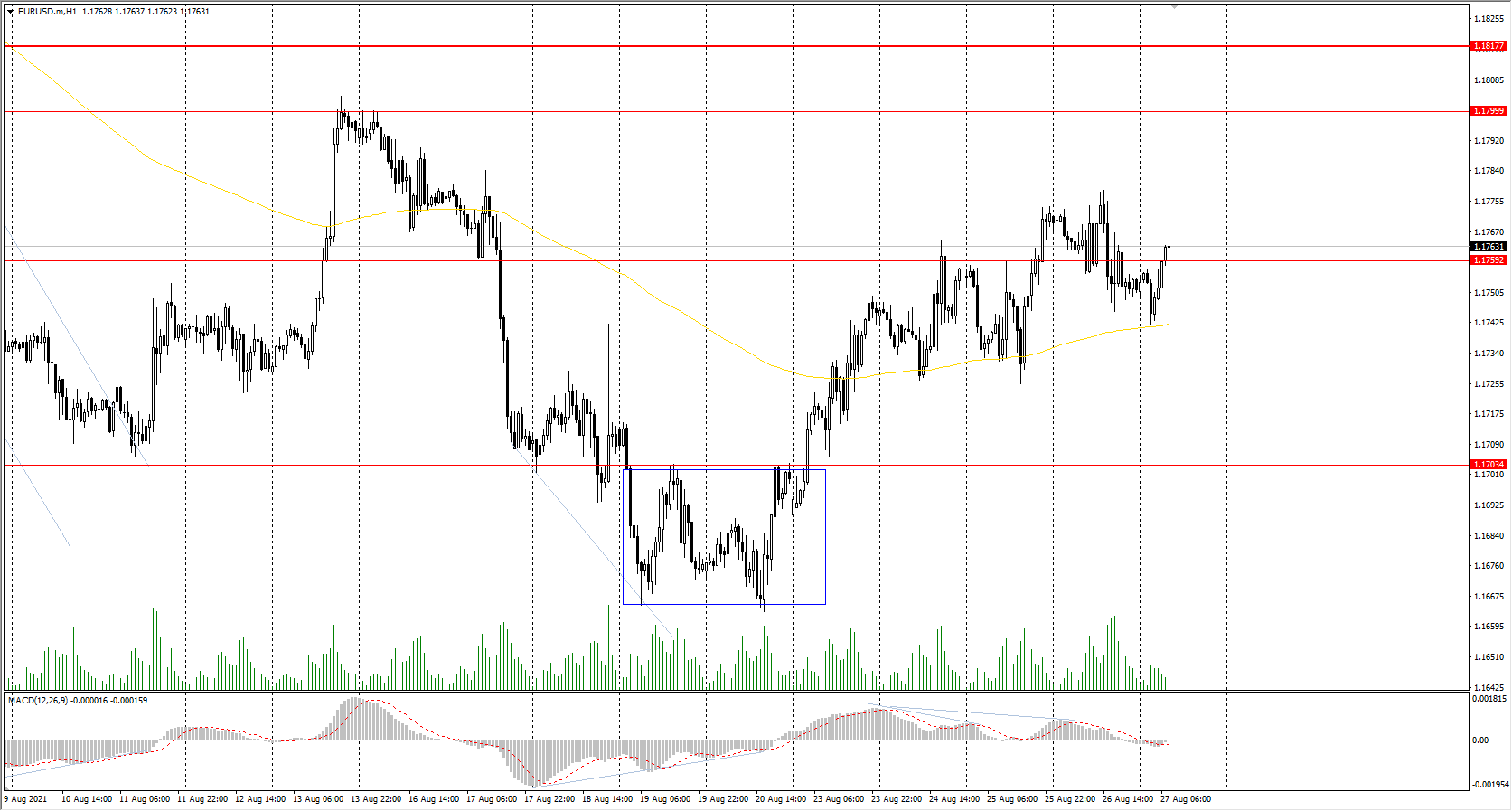
Support levels: 1.1759, 1.1704, 1.1620
Resistance levels: 1.1799, 1.1817, 1.1854, 1.1894, 1.1934, 1.1969
From a technical point of view, the general trend of the EUR/USD currency pair is bearish. But the price is trading above the moving average, and the local trend is upward now. The MACD indicator started signaling a divergence in the opposite direction. Under such market conditions, it is best to look for sell trades from the resistance levels, where sellers showed the initiative. Buy trades can only be considered intraday from the support levels where the buyers have shown the initiative. It is better to buy from the false breakdown zone around the 1.1703 level.
Alternative scenario: if the price breaks out through the 1.1817 resistance level and fixes above, the mid-term uptrend will likely resume.
News feed for 2021.08.27:
- Jackson Hole Symposium (Day 2);
- US PCE price index (m/m) at 15:30 (GMT+3);
- US Fed Chair Jerome Powell’s speech at 17:00 (GMT+3);
- US Michigan Consumer Sentiment (m/m) at 17:00 (GMT+3).
The GBP/USD currency pair
Technical indicators of the currency pair:
Prev Open: 1.3760
Prev Close: 1.3698
% chg. over the last day: -0.45%
The British pound slightly lost its position. The price decreased by 0.45% yesterday. A lot will depend on what Jerome Powell will say in his speech today. If nothing will be mentioned about the reduction of the QE program or if Mr. Powell will indicate that it is too early to speak about it, the dollar index will rally down, which will play in favor of the growth of the quotes against the dollar, including the pound.
Trading recommendations
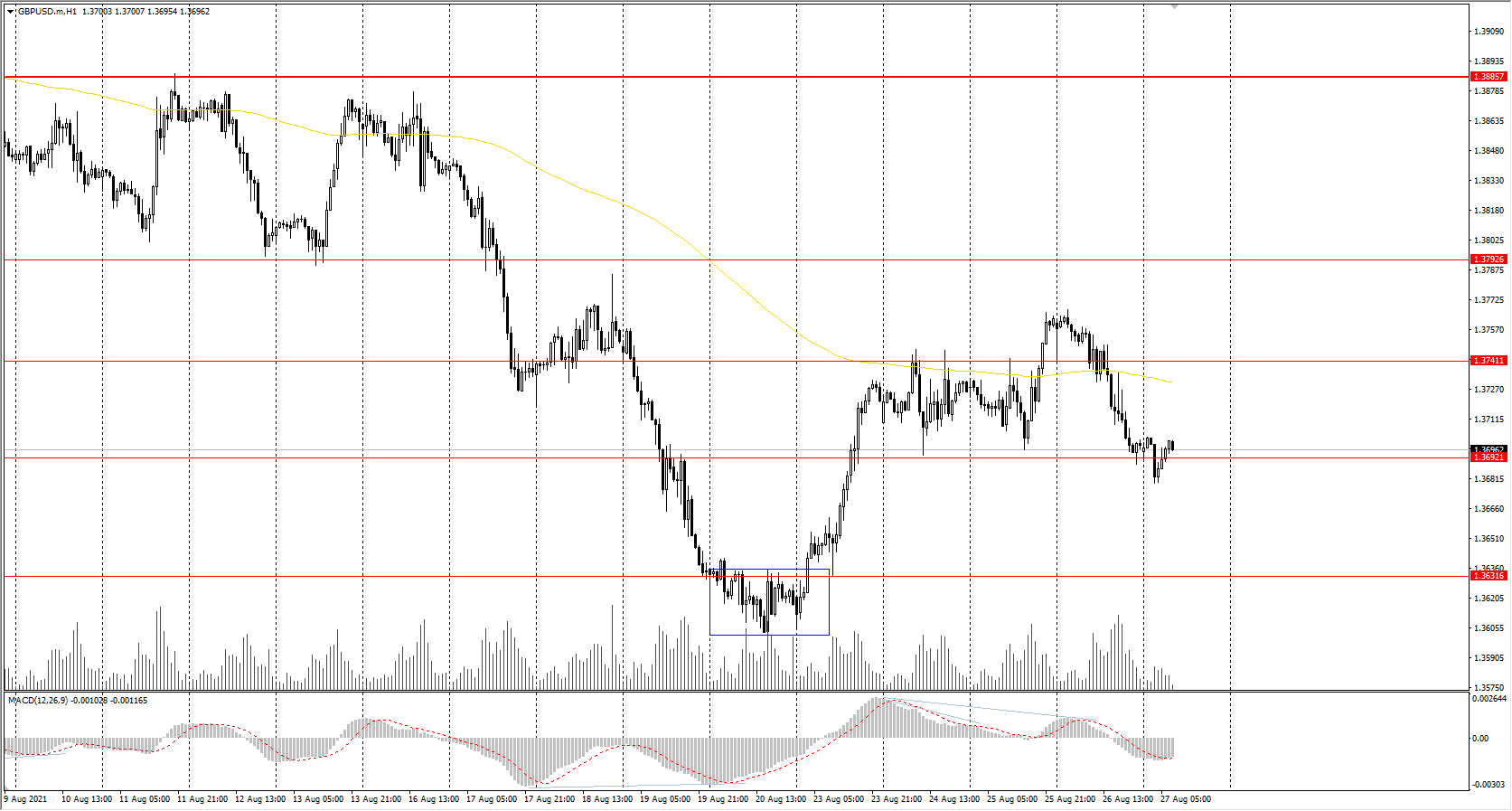
Support levels: 1.3692, 1.3632, 1.3614, 1.3525
Resistance levels: 1.3741, 1.3793, 1.3772, 1.3886, 1.3935, 1.4002
On the hourly time frame, the GBP/USD trend is bearish. The price has consolidated above the support level and formed a false breakdown zone below. But now, the price fell below the moving average again, and the MACD indicator has become negative. Under such market conditions, it is better to look for sell trades from the resistance level, where sellers have shown initiative. Buy positions can be considered only within the day and only with short targets.
Alternative scenario: if the price breaks out through the 1.3885 resistance level and consolidates above, the bullish scenario will likely resume.
News feed for 2021.08.27:
- US Fed Chair Jerome Powell’s speech at 17:00 (GMT+3).
The USD/JPY currency pair
Technical indicators of the currency pair:
Prev Open: 109.95
Prev Close: 110.02
% chg. over the last day: +0.06%
Japan continues to struggle with the delta strain. The fundamental picture is not in favor of JPY strengthening, but the Japanese currency is also highly dependent on the dollar index. That's why if the USD goes down today after Mr. Powell's speech, the USD/JPY will also go down and vice versa.
Trading recommendations
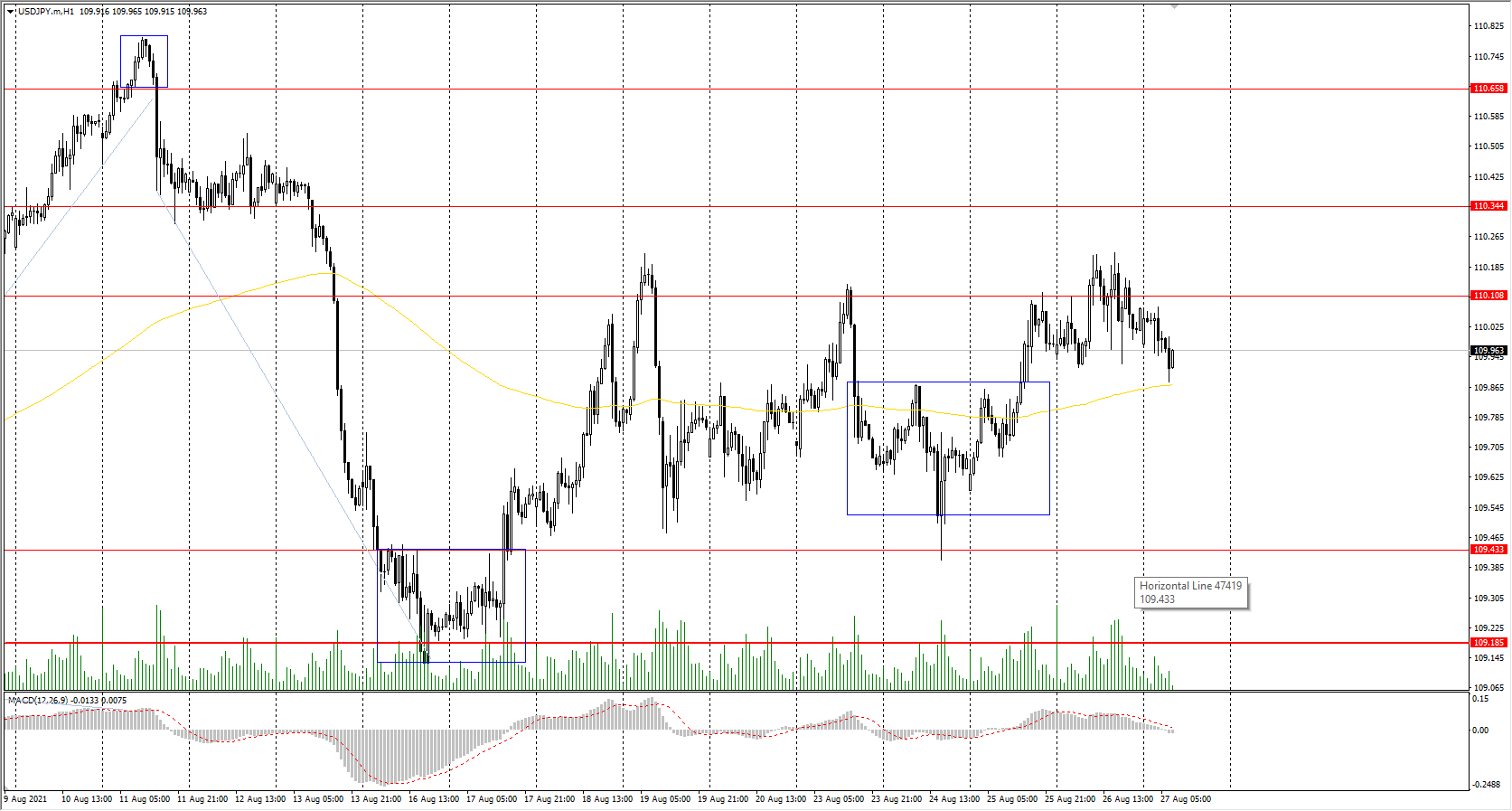
Support levels: 109.43, 109.19, 108.65
Resistance levels: 110.11, 110.34, 110.66, 110.95, 111.48
The main trend of the USD/JPY currency pair is bullish. The fall of the dollar index compensated for the negative impacts of the news. As a result, the USD/JPY currency pair is trading flat. The MACD indicator is inactive. Under such market conditions, traders should look for buy trades from the support level, where the buyers have shown initiative. Sell positions should be considered only on lower time frames from the resistance levels and only with short targets.
Alternative scenario: if the price falls below 109.18, the uptrend is likely to be broken.
News feed for 2021.08.27:
- US Fed Chair Jerome Powell’s speech at 17:00 (GMT+3).
The USD/CAD currency pair
Technical indicators of the currency pair:
Prev Open: 1.2588
Prev Close: 1.2685
% chg. over the last day: +0.77%
The Canadian dollar is a commodity currency, so the USD/CAD currency pair is highly dependent on the dynamics of the dollar index and oil prices. Yesterday the dollar index slightly increased, while oil prices remained at the same level. As a result, the USD/CAD currency pair broke out of the trading range upwards.
Trading recommendations
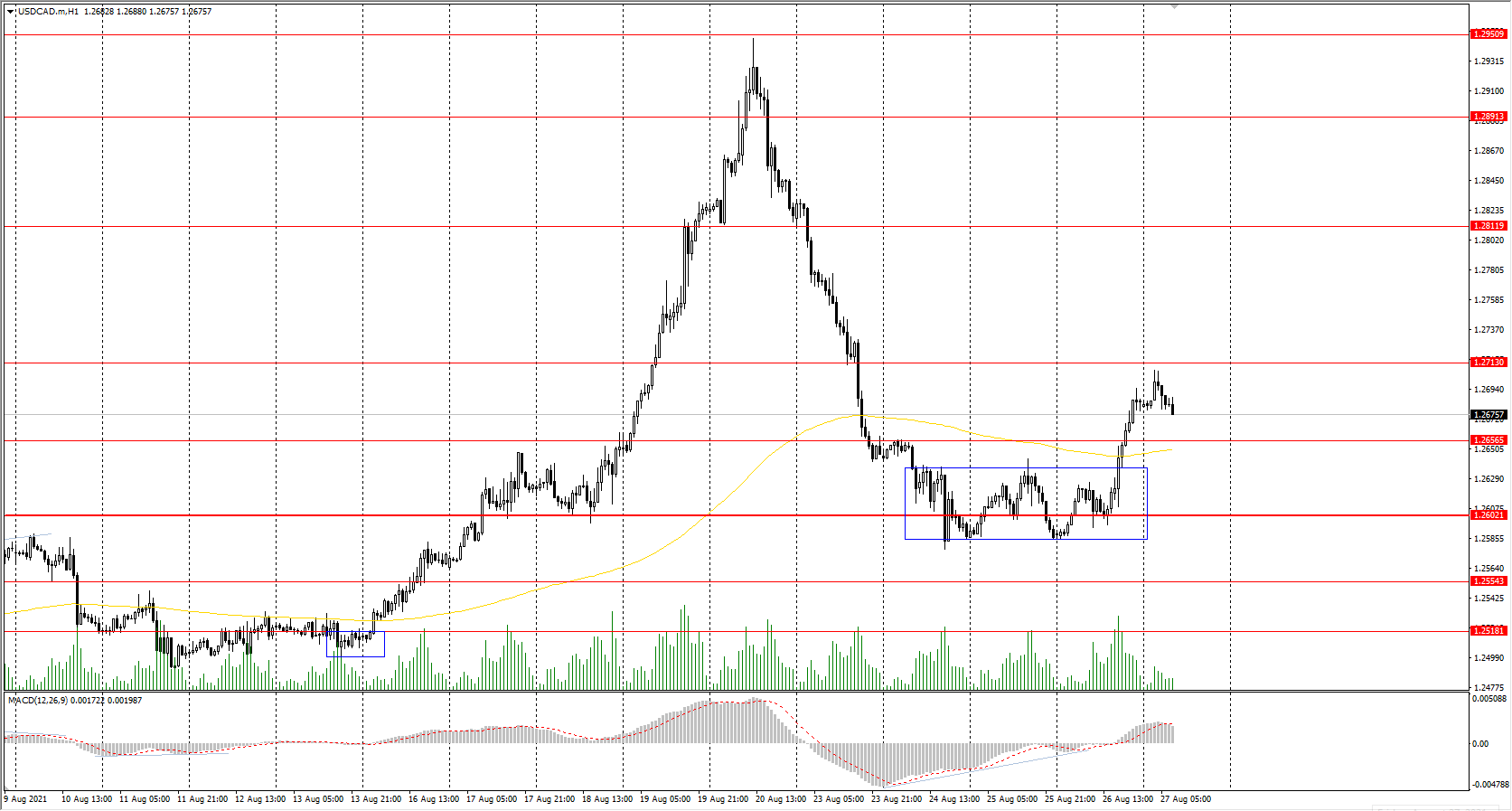
Support levels: 1.2656, 1.2602, 1.2554
Resistance levels: 1.2713, 1.2812, 1.2891, 1.2951
In terms of technical analysis, the USD/CAD trend is still bullish. The priority change level has survived this time. The MACD indicator has become positive, and the divergence worked as it should be. It is better to look for buy positions from the priority change level, where the buyers have shown initiative. Sell positions can be considered from the resistance levels, but only within the day and with short targets.
Alternative scenario: if the price breaks down through the 1.2602 support level and fixes below, the uptrend will likely be broken.
USDCAD Gains On Trendline Support
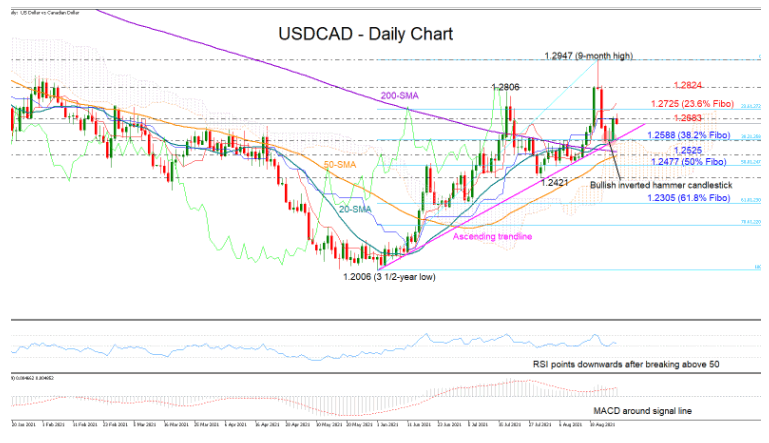
USDCAD stepped decisively on the ascending trendline, which has been supporting the market since the drop to a 3 ½-year low of 1.2006 in May, and drifted northwards to hit resistance within the 1.2680 – 1.2700 zone.
The cheerful upside correction in the price was not strong enough to drive the MACD above its red signal line, while the rebound in the RSI seems fragile as the indicator is currently pointing to the downside again. That said, the inverted hammer candlestick which preceded yesterday’s rebound could be a warning that buying pressures may remain in play, even if some weakness occurs.
In trend signals, the fresh bullish cross between the 20- and 200-day simple moving averages (SMAs) raised confidence in the ongoing uptrend, and a potential intersection between the 50- and 200-day SMAs could further boost optimism that the upward trajectory might hold on for longer.
If selling pressures resurface, the ascending trendline may come to the rescue once again, helping the price to find its feet near the 38.2% Fibonacci retracement of the 1.2006 – 1.2947 upleg at 1.2588. This is also where the surface of the Ichimoku cloud is currently positioned. Hence, unless the 1.2525 – 1.2470 territory, which encapsulates the 50- and 200-day SMAs and the 50% Fibonacci, blocks the way down, the price could dive towards its previous low of 1.2421.A step lower would invalidate the upward pattern.
In the bullish scenario, where the pair advances above the 1.2680 – 1.2700 wall, breaking the 23.6% Fibonacci of 1.2725 too, the bulls will push for a close above the tough 1.2824 resistance. If efforts prove successful, the door will open for the nine-month high of 1.2947, where any violation would attract new buying interest, upgrading the positive outlook.
Summarizing, USDCAD is currently holding a neutral-to-bullish bias. A clear close above 1.2725 could confirm additional gains, while a break below 1.2588 could shift the bias to bearish
EUR/USD Outlook: Near-Term Directionless Mode Extends
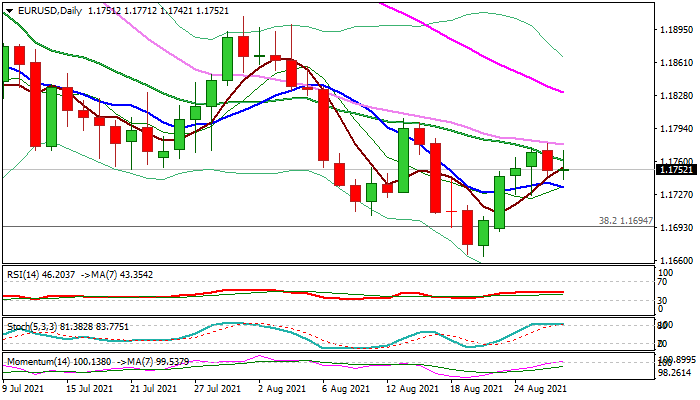
The Euro is slightly bid in early Friday but lack of firmer signals keeps near-term action directionless for the third straight day.
All eyes are on the speech of Fed Chair Powell, due later today, as traders look for hints for timing of the start of tapering and central bank’s next steps regarding interest rates, although economists think it’s unlikely that Powell will provide any concrete signal.
Mixed daily studies (the action is ranging between 10 and 30DMA’s, momentum is breaking into positive territory, stochastic is about to reverse from overbought zone) do not provide direction signal, but initial positive signal is developing on weekly chart.
The pair is on track for the second consecutive weekly rejection at pivotal Fibo support at 1.1694 (38.2% of 1.0635/1.2349 ascend) and 100/200WMA’s converged and about to form bull-cross that would support the action.
However, fresh bulls need break above 1.1800 resistance zone to generate initial signal and expose next key barriers at 1.1838 (daily cloud base) and 1.1905 (July 30 high), violation of which would signal stronger correction.
On the other side, larger downtrend remains intact and failure under pivotal resistances would increase risk of recovery stall and fresh weakness, as safe-have dollar remains supported by worsened situation in Afghanistan, with more dovish than expected tone from Powell, to add to negative signals for the single currency.
Res: 1.1778, 1.1804, 1.1838, 1.1850.
Sup: 1.1734, 1.1694, 1.1664, 1.1600.
EURUSD Is Possibly Bullish
Technical analysis
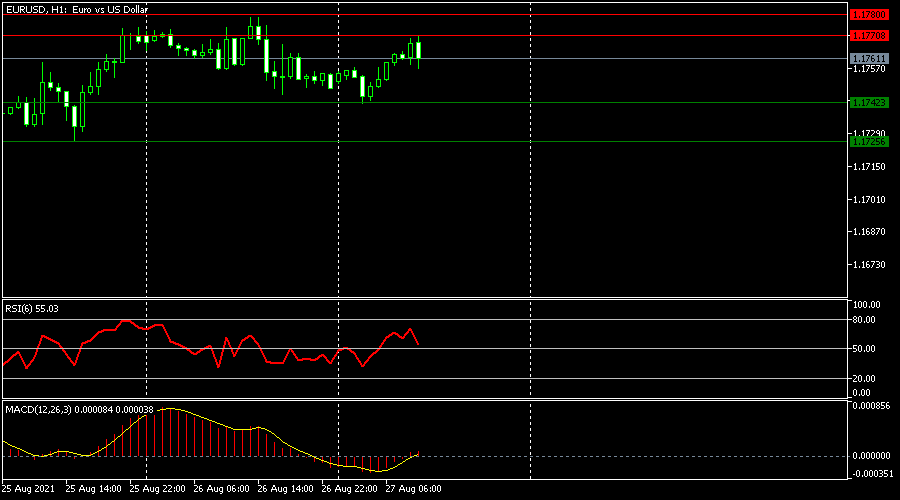
The RSI is above 50.
The MACD is at 0 with an uprising indicator.
What the possible outcomes are
Jerome Powell's speech today might help EURUSD continue benefiting from the upside momentum.
In our most likely scenario, the pair may experience a rise towards the first resistance level of 1.17708.
If the price passes the first resistance level, we can expect a continued uptrend towards the second resistance level of 1.17800.
Conversely, it's possible to see the pair decline towards the first support level of 1.17423.
If the pair surpasses the first support level, we should expect a continued fall towards the second support of 1.17256.
Key levels
Support 1.17423 1.17256
Resistance 1.17708 1.17800
US 30 Recoups Previous Losses
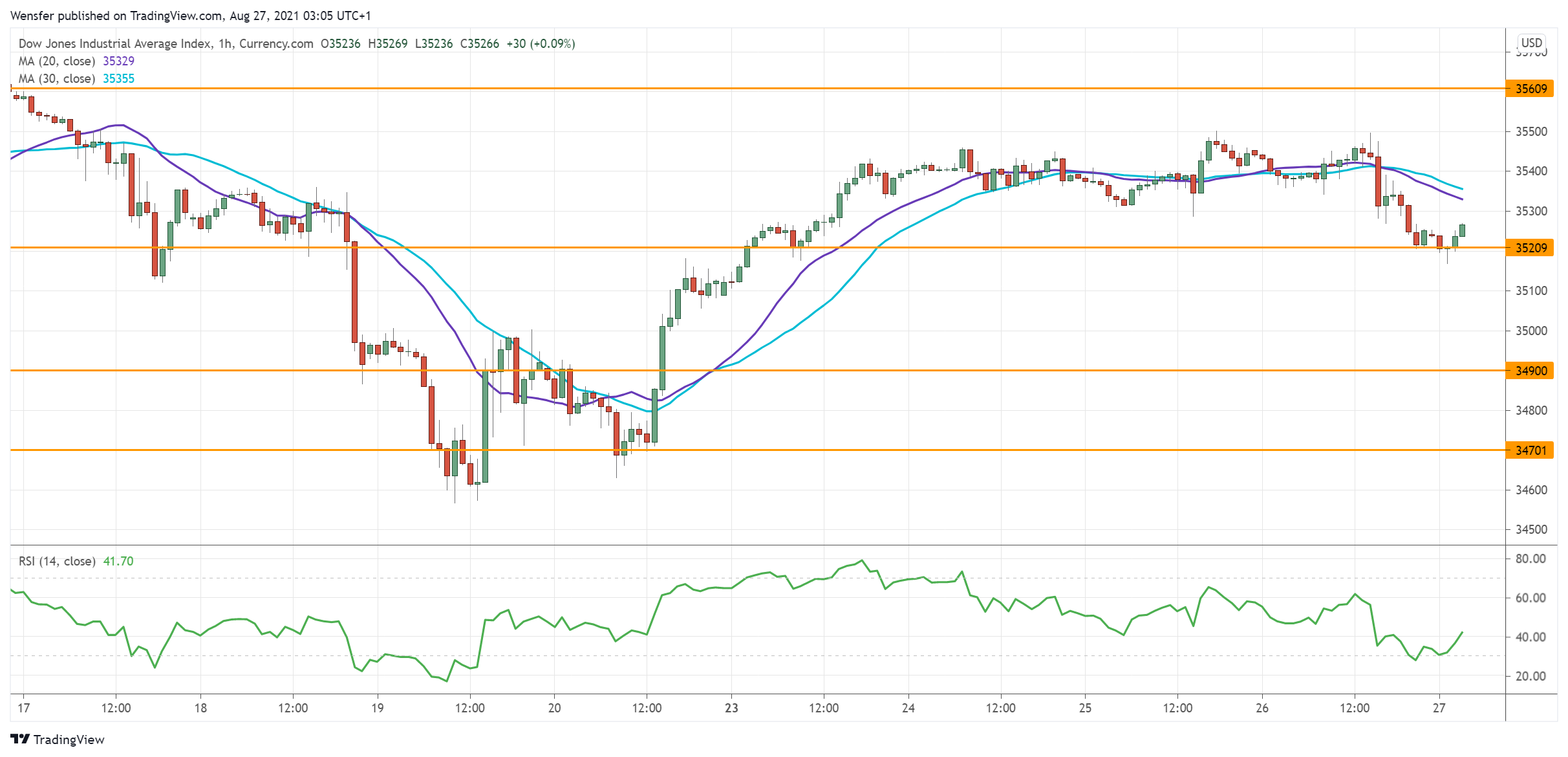
The Dow Jones index pulls back as traders await updates from the Fed’s Jackson Hole meeting.
Price action’s V-shaped rebound is typical of buying-the-dips from the demand zone near 34600. By lifting offers around 35450 the bulls have signaled their commitment to maintaining the uptrend in the medium-term.
The index is seeking support after it erased losses from last week. 35200 is the first support as the RSI dips into the oversold territory.
A break above the peak at 35600 would extend the rally to new all-time highs.
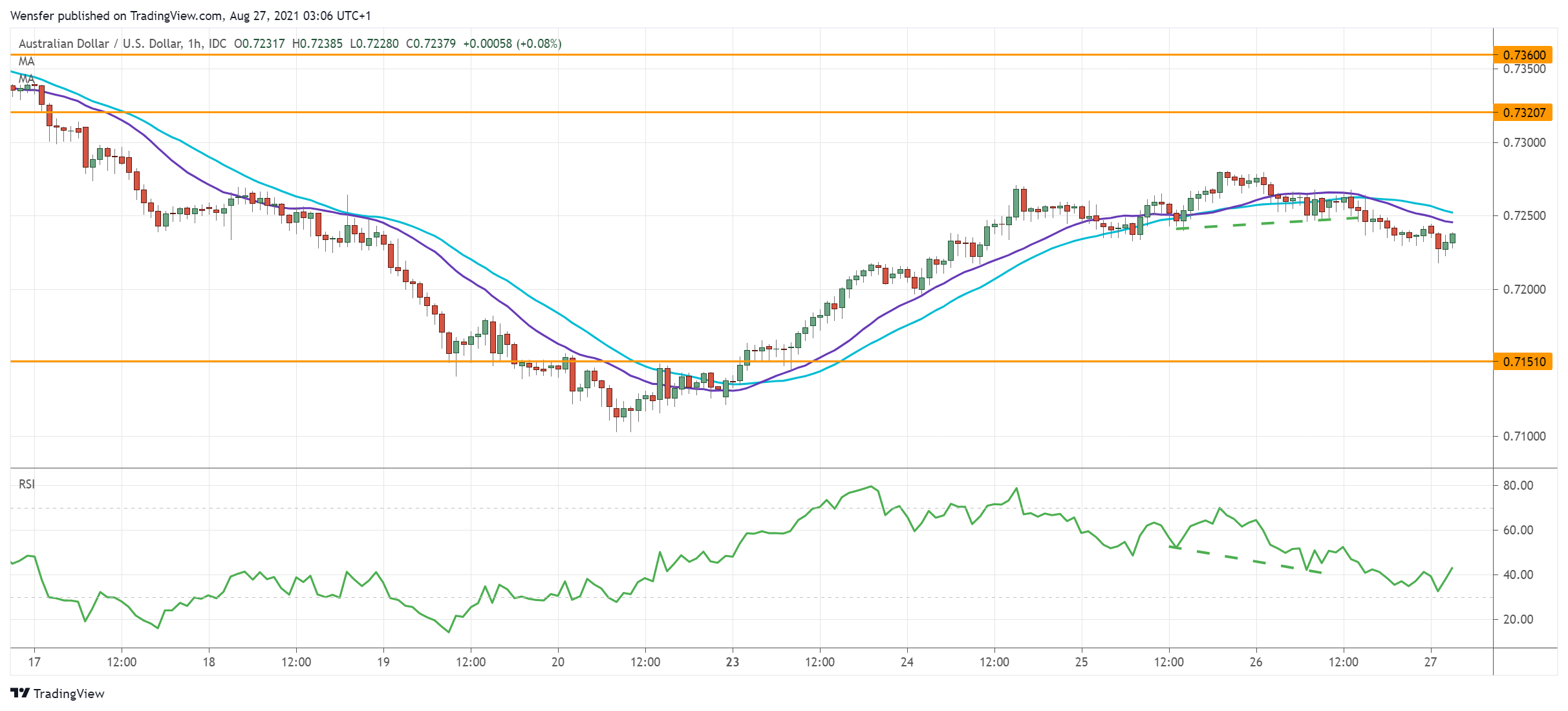
AUD/USD Rebound Cools Off
The Australian dollar fell back after a drop in July’s retail sales numbers.
A close above 0.7270 has forced sellers to cover their bets. The pair is recovering towards the 30-day moving average on the daily chart which coincides with the support-turned-resistance at 0.7320.
However, the rebound is likely to be choppy. After a double top in the overbought area, the RSI’s divergence indicates a loss in the rebound momentum.
A drop below 0.7235 would lead to a deeper correction to 0.7150.
USD/JPY About To Test Resistance
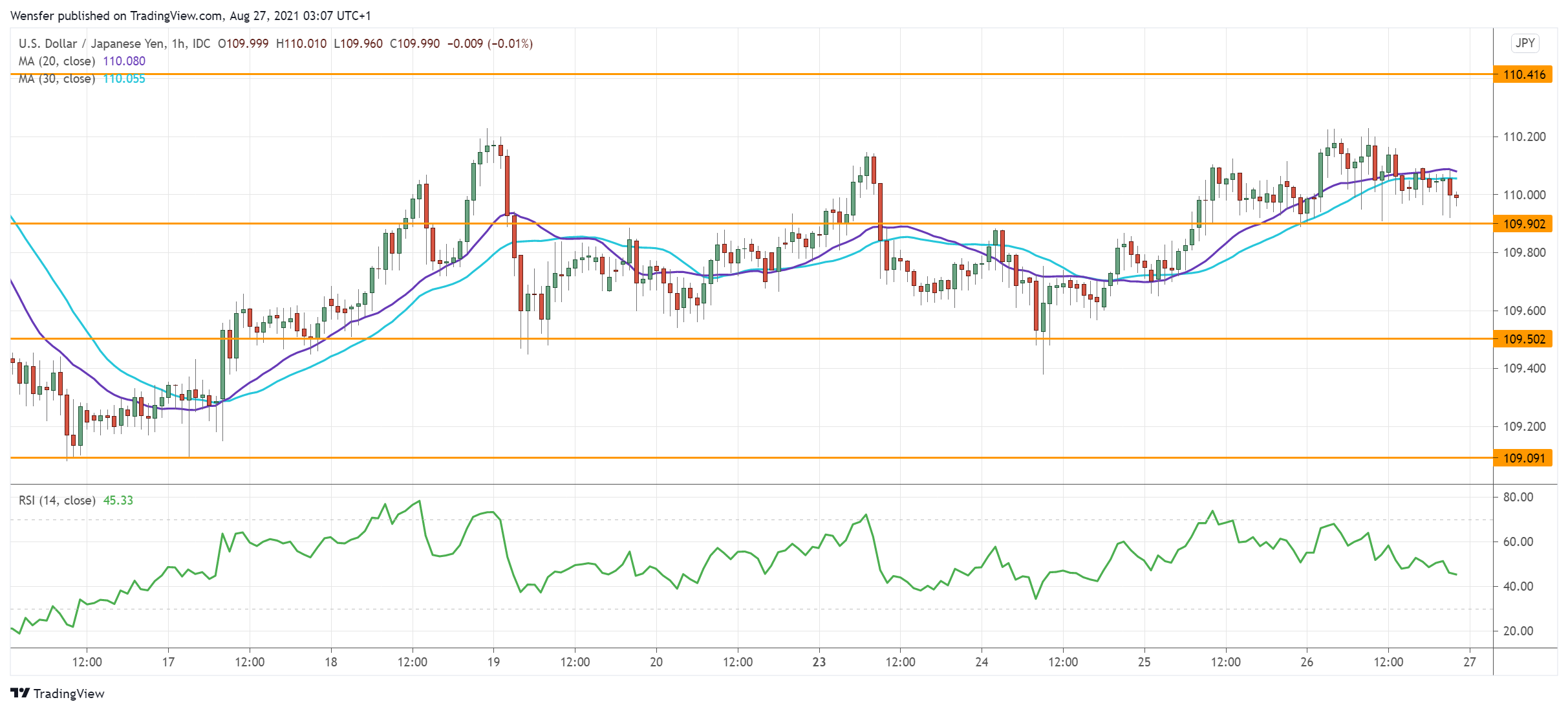
The Japanese yen weakened after a lower-than-expected Tokyo CPI in August. The US dollar is grinding its way back up after the mid-month correction.
A double test at 109.50 suggests strong buying interest. Layers of support indicate buyers’ willingness to pay up, the freshest one is at 109.90.
Momentum has slowed down as the price approaches the major supply area around 110.40. A bullish breakout would tip the balance to the long side again and open up the path to the psychological price tag of 111.00.
Inflation Is On The Rise
Markets
Yesterday’s ECB meeting minutes showed a very lengthy discussion on dotting the i’s and crossing the t’s about the formulation of the bank’s new interest rate forward guidance. The debate on PEPP and quantitative easing in general (under APP) was limited and there were no real hints on its near-term future. That differed from the Fed. According to Kansas City Fed governor George, it is time to begin adjusting accommodation given the strong economy. She cited delta as a risk but that should not delay the process. George sees “good arguments” for faster tapering than last time. Her comments were followed by Bullard from the St. Louis Fed. He voiced similar views, adding that they are getting more inflation than expected. The Fed should get the tapering started to finish it by the end of 2022Q1 to provide optionality with respect to raising policy rates. This brings us straight to this week’s main event: the Jackson Hole Symposium. It has served as a forum to announce or at least lay the groundwork for a policy shift in the past. The highly-anticipated reunion was turned into a virtual one last-minute amid the coronavirus (deltavariant) raging in the US. It immediately highlights the uncertain environment the Fed has to operate in as it seeks to gradually withdraw unprecedented monetary policy support. We admit that it is by far the biggest risk for chair Powell to kick the can further down the road. However, as one of our favorite FT writers put it this morning: “Clock’s ticking, Jay”. Inflation is on the rise and there are few signs of it to ease anytime soon. According to the last Fed meeting minutes, a majority even agrees enough progress has been made towards the symmetric 2% goal. There was more disagreement on the labour market but the very strong July labour report surely convinced a few more doubters. Furthermore, alternative indicators such as the unemployment to job openings ratio are just shy of reaching the spectacular levels seen in 2018/2019. QE has done more than its part in supporting demand. It is time for the Fed and Powell to acknowledge this and at least lay the foundation for tapering when he speeches at 4pm today. The actual timetable is probably not going to be announced before September 22. The $120bn question then is: how much is discounted by markets? We assume investors are firmly aware of the normalization sequence: first tapering, then hiking. With a first rate hike priced in at the turn of the year, implicitly some form of tapering is thus expected. We see this for example in US real rates (10y), which rebounded 20 bps from the historical lows (-1.20%) since August. Should Powell go ahead and offer a blueprint, there’s more scope for (real) yields to rise further as part of the market still needs to be convinced. Nominal yields might be countered by topping/falling inflation expectations in such a case however. The dollar has been frontrunning as well, perhaps even more than US yields did. EUR/USD tested key support in the 1.17 area last week in the wake of the Fed minutes before a technical rebound kicked in. That zone could quickly come under renewed pressure if our base scenario unfolds. A sustained break lower paves the way towards 1.1603/12.
News headlines
According to the National Bureau of Statistics, profit growth at Chinese industrial firms decelerated further in July for the fifth consecutive month to 16.4% Y/Y from 20.0% Y/Y in the previous month. YTD profits still rose 57.3% Y/Y. Profits are said to be pressured by sporadic coronavirus cases and floods, while elevated commodity prices are also mentioned as squeezing margins. On the positive side, profit growth in the mining and materials industry improved and this was also the case for pharmaceutical manufacturing. The slowdown in China activity raised expectations for additional policy support. In a statement on Thursday, the People’s Bank of China said it will use monetary tools including the reserve ratio. Additional support might take the form of a (targeted) reduction in the RRR. The yuan this morning is losing marginal ground with USD/CNY trading near 6.4840.
Retail sales in Australia in July declined 2.7%, a faster pace than expected due to the lockdowns to address the new wave of the coronavirus. Sales in June also declined -1.8%, indicating that the economy might contract substantially in Q3 especially as a further decline might occur this month. The Aussie dollar is trading little changed at AUD/USD 0.7240.
Jackson Hole Will Determine The Fate Of The Dollar And Markets
It is not an exaggeration to say that the future of the markets is now tied to Powell's Jackson Hole speech. Much more so in the currency market, which is often influenced by interest rate trends and expectations.
The Fed chairman will be speaking shortly after the start of the New York session today. On Thursday, there were three speeches from the Fed hawks – Bullard, Kaplan, and George. Their comments were quite specific, pointing to the pace of reduction in purchases (15 billion a month) and the desired date for completion of these purchases (end of the first to second quarters of 2022) to have room to raise rates as early as next year.
These estimates are noticeably more hawkish and decisive than the market anticipated and put into expectations. Nevertheless, the reaction has been relatively muted, with the dollar index adding 0.3% by the end of the day but losing more than half that today; the S&P500 was down 0.7% by Asian session open but is now up 0.35% from those lows.
Investors have heard one camp and expect to listen to a much softer stance from the chairman of the US Central Bank. He is expected to advocate a less specific view on timing and emphasise that FOMC decisions at the end of September will be based on the data and forecasts available at the time. Simply put, Powell will surely leave the door open for a later tapering.
By and large, the markets fear that Powell will repeat the hawkish position or come very close to it. This can cause a severe spike in volatility in the stock markets, potentially triggering a noticeably deeper correction, above 5% or even 10%.
Don't get set up for a bear market started in stocks, as tapering is a smooth reduction in support in an economy that is already on a de facto path of self-sustaining growth. Experience with previous tapers in the US and Europe suggests no threat of a bear market in the next few years, aside from some increased frequency of corrective pullbacks.
The story with dollar dynamics is a bit more complicated. The US is often the flagship of monetary policy, and other central banks join in with some lag so that we might see an acceleration of the Dollar's rising trend.
Technically, the US currency has completed phases of declines and consolidation in a sideways range. Still, the markets are waiting for a wave from Powell or the Fed, giving the start of a DXY rally.
There is also a slight possibility of negative surprises for the Dollar if Powell takes an extreme dovish stance. In that case, the stock markets would continue to storm to highs (nothing new here), and the Dollar would turn sharply lower. In that case, the DXY could quickly return to the lows of the year, near multi-year lows.