

Sample Category Title
Weekly Economic & Financial Commentary: Powell Keeps an Open Mind to Tapering
Summary
United States: Output Continues to Ramp Up as COVID Surges Higher
- Output continues to ramp up across the U.S., even as the resurgence in COVID cases is leading to some pullback in consumer engagement. The need to rebuild inventories should keep production rising, even if consumer spending moderates a bit further. Housing is already beginning to move into better balance, with rising inventories of existing homes beginning to moderate soaring home prices. Inventories of new homes have also increased, although most of the gain is in developed lots and homes under construction.
- Next week: Construction Spending (Wed), ISM Manufacturing (Wed), Employment (Fri)
International: Eurozone Economy Still Showing Solid Momentum
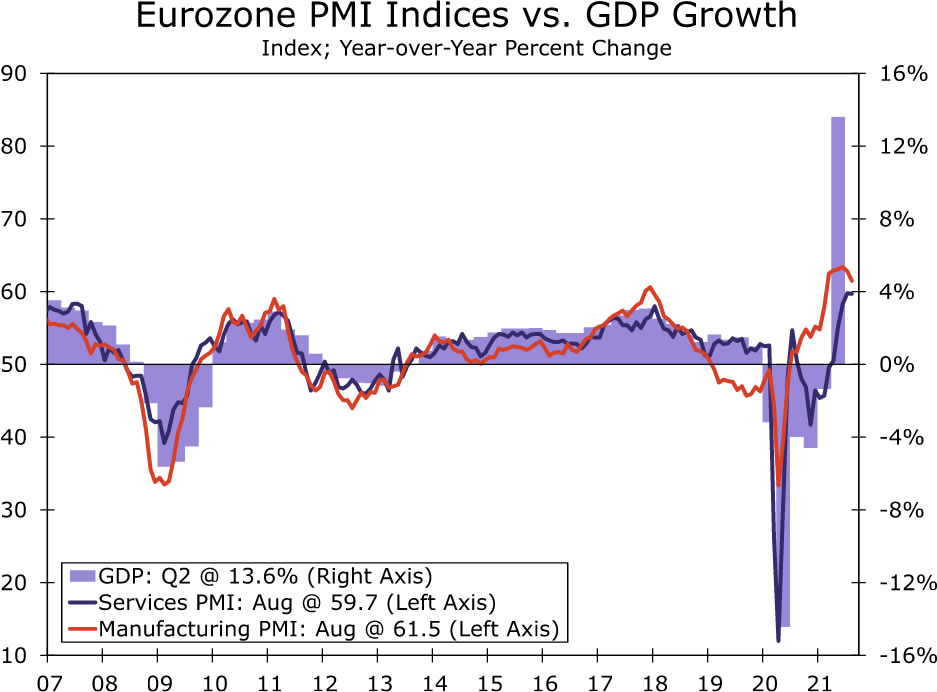
- After the Eurozone economy enjoyed solid growth in Q2, August PMI data indicate that momentum has carried into Q3. The services PMI was virtually unchanged at 59.7, still a historically elevated level, while the manufacturing PMI fell to 61.5. We expect Eurozone Q3 GDP to rise 2.5% quarter-over-quarter, even stronger than the Q2 gain.
- Next week: China PMIs (Tues), Eurozone CPI (Tues), Canada GDP (Tues)
Interest Rate Watch: Powell Keeps an Open Mind to Tapering
- It does not seem that the Fed chair has made up his mind yet about when to taper, and he will continue to watch incoming data. The labor market report for August, which is slated for release on Friday, September 3, will be an important marker for the beginning of tapering.
Credit Market Insights: Red-Hot CLO Market
- This past year has been a banner year for fundraising and deal activity, with demand booming for collateralized loan obligations (CLOs). The low interest rate environment has supported record-breaking deal flow as firms have been able to borrow cheaply coming out of the pandemic.
Topic of the Week: The Economics of College Football: Season III
- We are again publishing our series on college football this year. Each week of the season, we will be highlighting a key matchup, covering the history behind each university's football program, local economy and school community, and of course, giving predictions about the upcoming game.
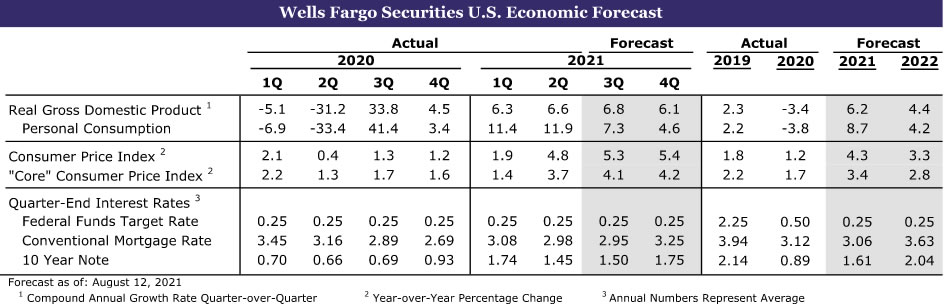
U.S. Review
Moving Back into Balance
Shortages, supply-chain bottlenecks and higher prices have been a hallmark of this economic recovery, with some of the most notable shortages and price hikes occurring in housing and motor vehicles. This week's economic data provide some hints that the economy is moving toward some sense of better balance, with the rise in COVID infections causing consumers to tap the brakes and allow production to catch up with consumption. Many forecasters have slashed their estimates for third quarter economic growth due to the recent slide in consumer sentiment and some moderation in the high-frequency data that focus on consumer spending and economic engagement. Real GDP measures the production of goods and services, however, which appears to be less affected by the resurgence in COVID infections. The revised Q2 GDP data also show that inventories fell even more than previously reported, which likely sets up an even larger swing back in Q3.
Consumers took a breather in July, with today's personal income and spending data showing a 0.1% drop in real personal consumption outlays for the month. Real outlays for durable goods fell 2.6%. Spending on motor vehicles and parts fell 3.7%, largely due to the lack of cars and SUVs available for sale. Dealer lots are nearly empty, with several dealerships down to just a handful of cars on their lots. New cars are also selling at a premium. Consumers certainly have the ability to continue spending. Personal income rose 1.1% in July, with wages and salaries climbing 1.0%. With income rising faster than outlays, the saving rate rose 0.8 percentage point to 9.6%. Consumers are also still sitting on a mountain of savings built up during the pandemic, estimated around $2.3 trillion above where it would have been under its pre-pandemic trend. Consumer sentiment for the month of August affirmed the 11-point plunge reported in the preliminary report earlier in the month. The final Consumer Sentiment index for August rose 0.1 from its preliminary level and shows essentially the same large, nearly 14-point drop in consumer expectations, likely reflecting concerns about the rising number of COVID infections tied to the particularly contagious Delta variant.
The moderation in consumer spending on goods should allow for production to begin to catch up with consumption. While headline advance orders for capital goods fell 0.1%, the core nondefense capital goods orders, excluding aircraft, were flat, while orders for motor vehicles and parts surged 5.8%. Core shipments of capital goods, which is a good proxy for business fixed investment, rose a solid 1.0% in July and are up at a solid 13% annual rate. Inventories also increased, climbing 0.6% in July.
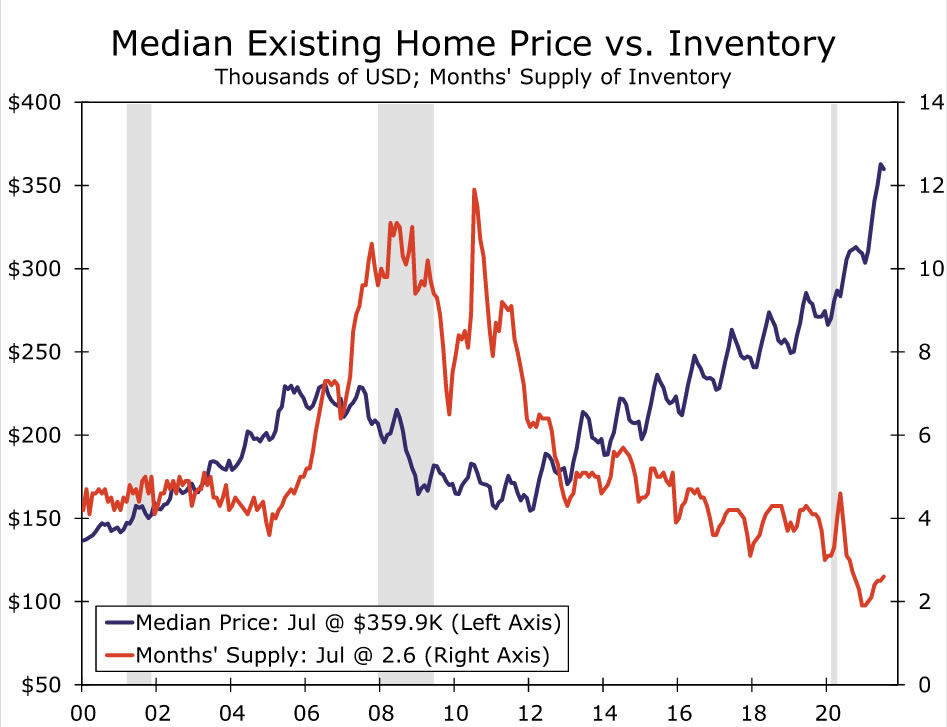
This past month's housing data suggest the market is beginning to move back into balance. To be certain, inventories of existing homes are still exceptionally low and homes are selling quickly and often above asking price. The earlier surge in home prices has brought out more sellers, however. The inventory of existing homes has been gradually trending higher since February and now sits at a 2.6-month supply. A 5.5-month supply has typically been considered the norm, although innovations in mortgage finance and the rise of cash buyers have probably reduced that by a month or two. Sales of existing homes slightly topped consensus expectations this past month, rising 2% to a 5.99-million unit pace. Sales of single-family homes rose 2.7% and accounted for all the overall gain. The median price of an existing home declined slightly from the prior month, on a non-seasonally adjusted basis, to $359,900. That still leaves the median price 17.8% above its year ago level. The pace of price appreciation appears to have peaked in May at 23.6%.
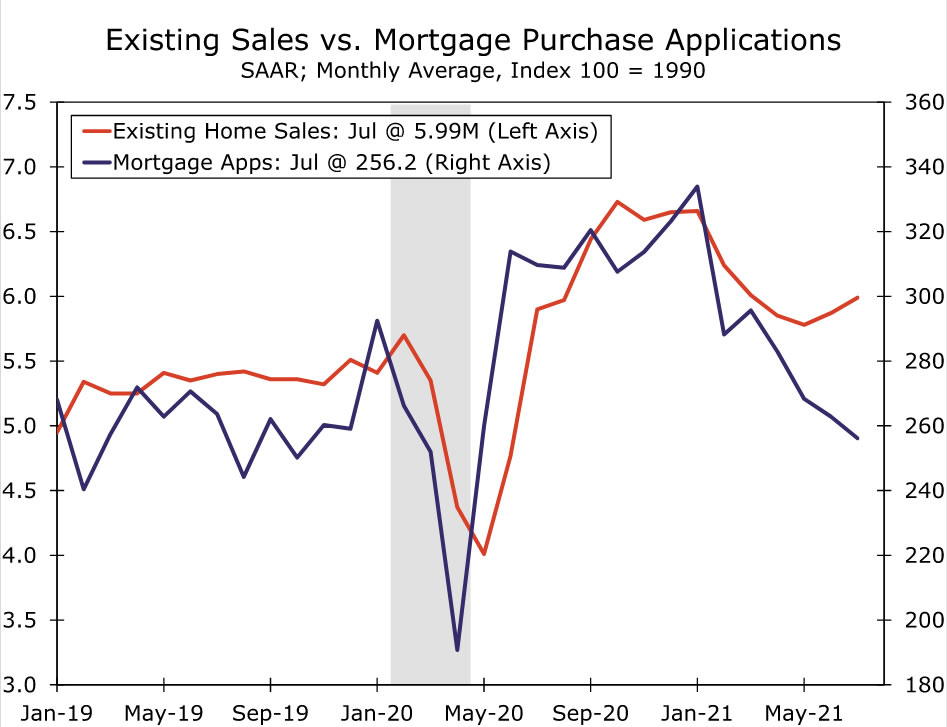
Sales of new homes rose 1.0% to a 708,000-unit pace, ending a three-month string of declines. Home buying activity has cooled off in recent months alongside soaring prices and shrinking inventories. Sales in June were also revised slightly higher and now show a 2.6% drop, compared to a 6.6% drop reported earlier. Low inventories and the rapid run-up in prices have led prospective buyers to put their home-buying plans on hold, which explains a softer pace of sales in recent months. The pullback also makes sense considering the extremely low inventories of completed homes available for sale and continuing supply chain disruptions that have led to project delays. Sales of homes where construction has not started rose 19% during July, while sales of homes under construction fell 13% to the lowest level since May 2020.
The inventory picture appears to be improving slightly. The number of new homes for sale rose 5.5% to 367,000 in July. At the current sales pace, all the current inventory on the market would be sold in 6.2 months, up from six months in June and 3.6 months in July 2020. While the number of homes for sale rose at every stage of construction, most of the recent improvement in inventories has been for homes that have not yet started construction.
U.S. Outlook
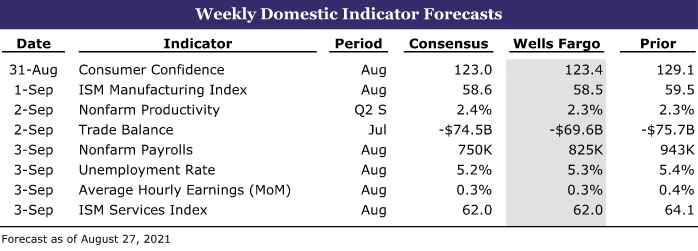
Construction Spending • Wednesday
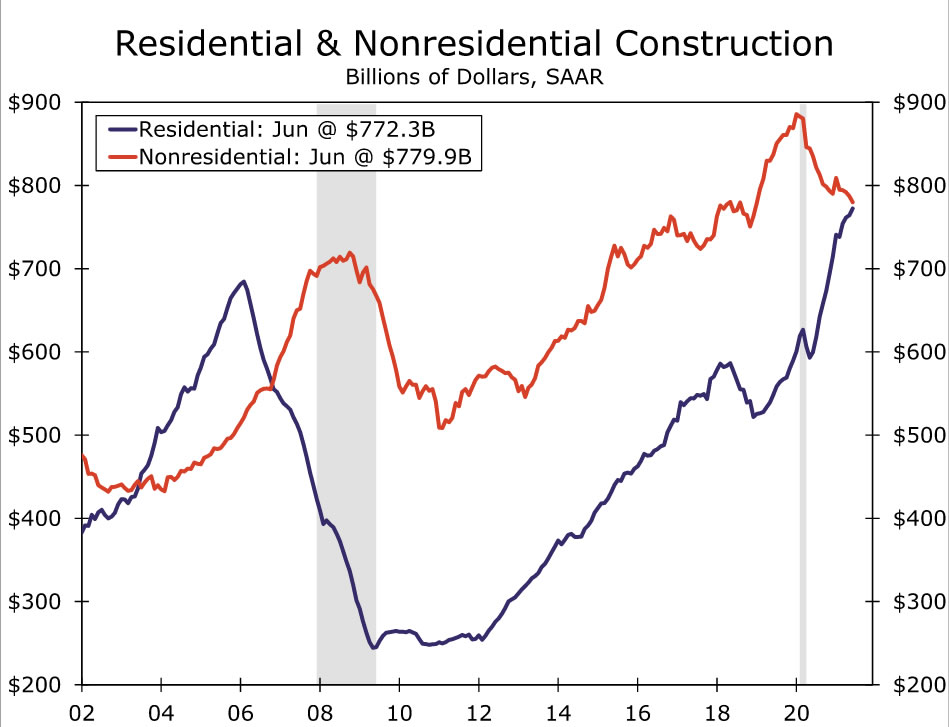
During June, total construction spending edged up 0.1%. Again, nearly all of the gain occurred in the residential sector, which rose 1.1% during the month. More time spent at home throughout the pandemic has induced a need for more space, which has bolstered single family and home improvement spending. By contrast, nonresidential outlays declined 0.9% during June, which reflects the seismic impact COVID continues to have on office, hotel and education construction projects.
Residential's momentum has been slowing over the past few months alongside sky-rocketing home prices and building material scarcities. Housing starts declined sharply during July, which adds to the evidence that home building has hit a near-term ceiling, in part due to supply constraints. Retail sales at building material stores also have pulled back recently, suggesting fast-rising input prices are also a headwind for home improvement spending. In terms of nonresidential spending, both the Architectural Billings Index and Dodge Momentum Index fell back during July as the Delta wave of COVID reintroduced uncertainty surrounding prospective tenant demand. We look for another modest gain for overall construction spending during July.
ISM Manufacturing • Wednesday
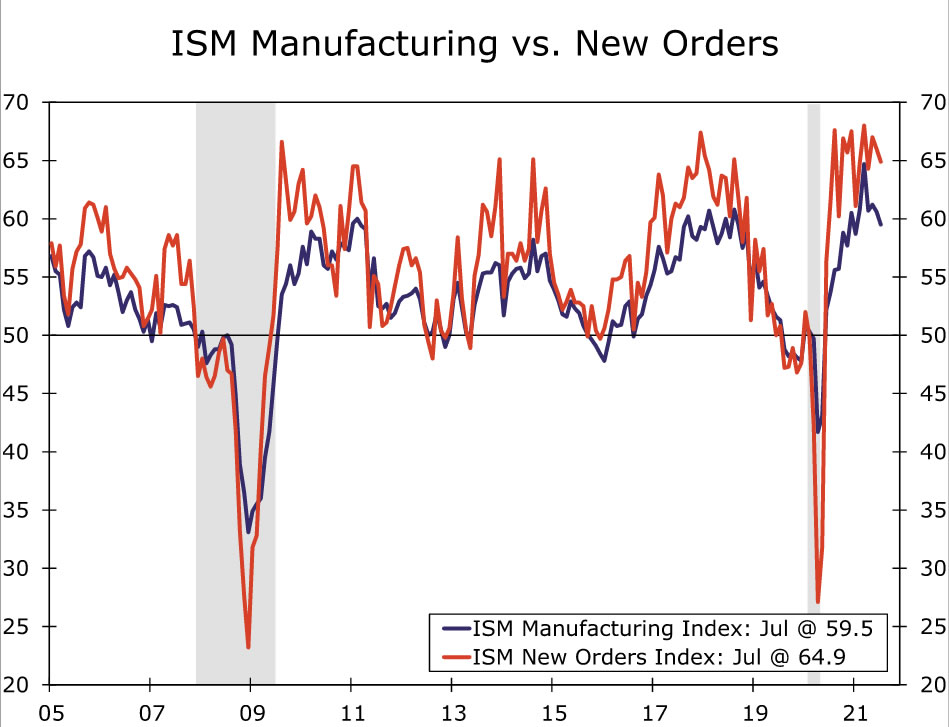
Pervasive supply chain bottlenecks continue to hamper otherwise strong activity in the factory sector. The ISM manufacturing index came in below expectations and slipped to 59.5 during July, the first reading below 60 since the start of the year. Most sub-components of the headline index deteriorated during the month, notably new orders, production and inventories. There were a few signs that procuring parts and labor was becoming less of an issue. The employment index crossed back into expansion territory, while the prices paid index fell back from the highly elevated levels seen recently. The supplier delivery index also fell to a five-month low of 72.5. These improvements no doubt come as welcome news to the manufacturing industry, which has been the epicenter of the supply chain dislocations affecting the entire economy. However, smooth functioning value chains still appear to be some ways off, as many indicators of global supply bottlenecks (as encapsulated by our “Pressure Gauge”)remain heightened. Bearing this in mind, as well as the softer-than-expected results from most of the Fed's regional survey's of manufacturing activity, we expect another modest decline in the manufacturing ISM during August.
Employment • Friday
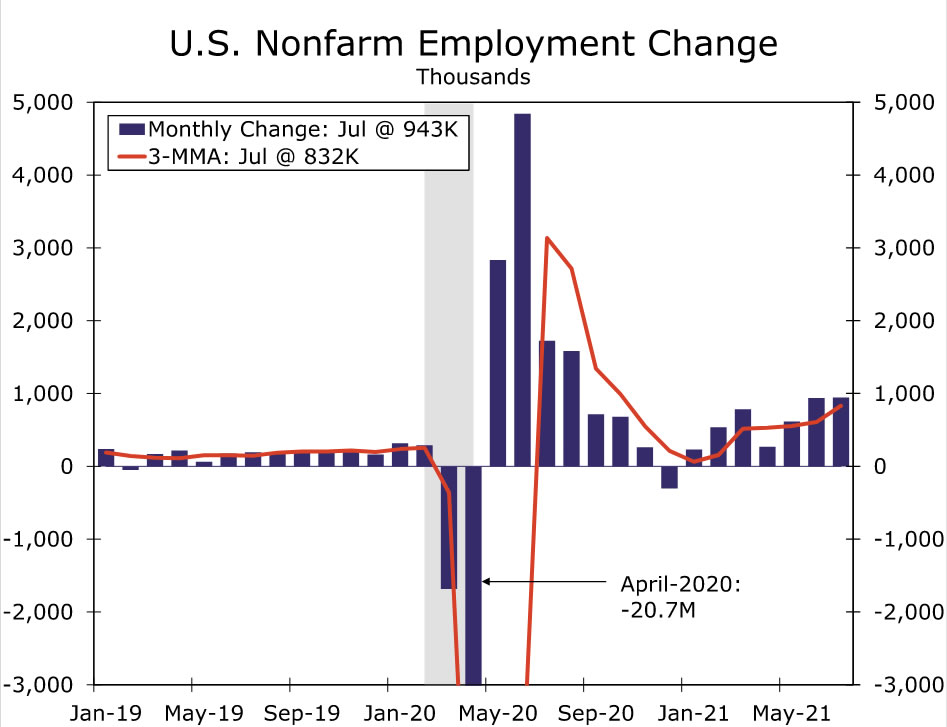
The labor market recovery appears to be gaining speed. Employers added 943K jobs during July, bringing the three-month moving average to 832K, the fastest pace since October of last year. Meanwhile, the unemployment rate fell sharply to 5.4% from 5.9%. Employers still appear to be having trouble staffing open positions, which is keeping pressure on wage growth. Average hourly earnings rose 0.4% during July, bringing the three-month annualized pace to 5.0%.
We expect another robust gain in payrolls for August. That said, the increase may fall slightly short of July's enormous addition. For one, payrolls in July were flattered by a 221K gain in local government education jobs, a result that was likely overstated by the seasonal adjustment process, which has been flummoxed by the unusual hiring patterns in public education following the onset of the pandemic. On the other hand, the leisure & hospitality sector posted a solid gain in July, which demonstrates that labor supply constraints are beginning to ease. Many states have now exited the federal pandemic unemployment benefit program, which could help add to the labor supply in the months ahead. That said, the surge in COVID cases driven by the highly transmissible Delta variant presents some downside risk, as fear of catching the virus is one factor keeping workers on the sidelines. Related to that, the FOMC is likely to again consider deteriorating public health conditions as a detriment to "substantial further progress," which removes some heft from the August employment report when it comes to determining the timing of potential tapering.
International Review
Eurozone Economy Still Showing Solid Momentum
After the Eurozone economy enjoyed a sizable 2.0% quarter-over-quarter gain in Q2, the August PMI figures indicated that sturdy momentum has carried into the third quarter. Of particular note, the services PMI was virtually unchanged at 59.7, still a historically elevated level, while the manufacturing PMI eased a bit, to 61.5. The details of the report showed only a mild softening of new orders and incoming new business. Overall, we expect Eurozone Q3 GDP growth of 2.5% quarter-over-quarter, even stronger than the gain in Q2. Meanwhile, the input and output price components of the PMI survey also remained at relatively high levels, indicative of inflation pressures, although these pressures have yet to show through in the Eurozone CPI to any meaningful extent.
Separately, Germany's August IFO business confidence also shows reasonable momentum for the Eurozone's largest economy, though possibly hinting at some slowing by late this year. The headline business climate index fell to 99.4. The current assessment component actually increased to 101.4, but the expectations component showed a perceptible decline, to 97.5.
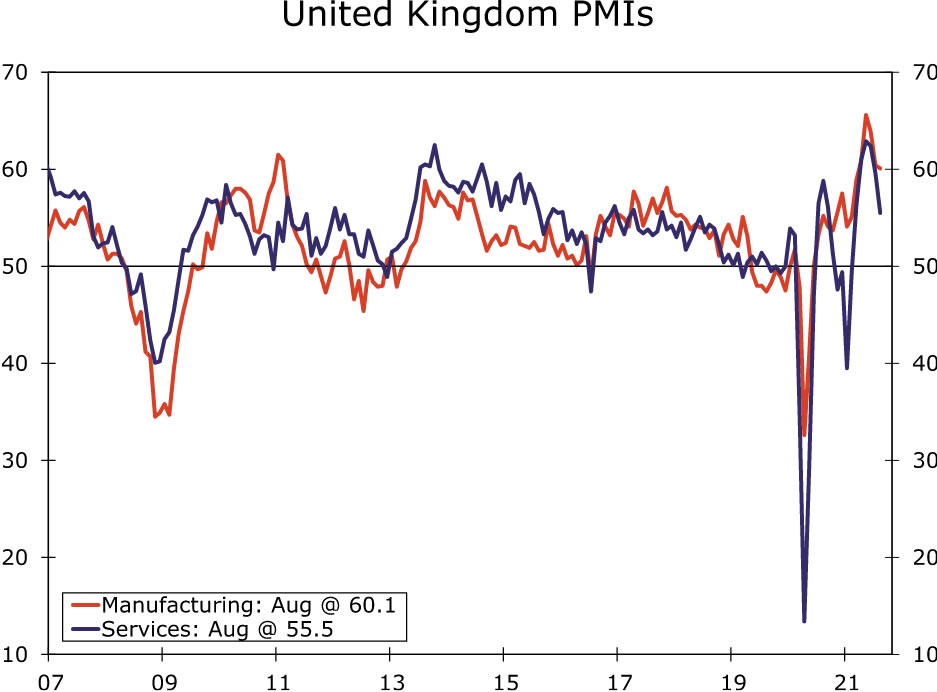
In contrast to the Eurozone, the August PMI surveys for the United Kingdom showed a more notable slowdown, although that was perhaps always to be expected after the U.K. economy enjoyed supercharged growth of 4.8% quarter-over-quarter in Q2. The August services PMI dropped to 55.5, the lowest level since February, while the manufacturing PMI eased to 60.1. The survey comes after a reported decline in July retail sales and suggests that while the service sector will likely continue to grow in Q3, it will probably be at a much slower pace than in Q2. As a result, we also expect slower growth in U.K. Q3 GDP, with our forecast 2.5% quarter-over-quarter gain only around half of the increase seen in Q2.
Finally, the Bank of Korea delivered a somewhat "dovish rate hike" at its monetary policy announcement this week. The Bank of Korea raised its policy rate 25 bps to 0.75%, surprising the (slight) majority of analysts who had expected the central bank to hold rates steady. The decision to raise interest rates was not unanimous, with one policymaker voting to hold interest rates steady. The Bank of Korea also will “gradually adjust” the degree of support for the economy, taking into account COVID developments and financial imbalances, among other factors. Meanwhile, the Bank of Korea kept its GDP forecasts unchanged, while raising its CPI inflation forecasts. Still, Central Bank Governor Lee described interest rates as still accommodative after the move, and the majority of economists expect one more rate hike before he steps down as central bank governor in March.
International Outlook
China PMIs • Tuesday
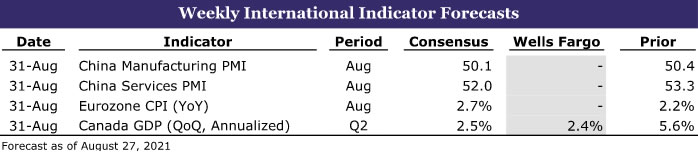
China's economy has slowed recent months, in part due to COVID-related restrictions and regulatory changes. Localized outbreaks of COVID cases have seen some restrictions on tourist events and sites, and have affected air travel. Meanwhile, regulatory changes, including measures to curb pollution, are potentially affecting industrial activity.
Against this backdrop, the consensus forecast is for a further decline in China's official PMIs for August. The manufacturing PMI is expected to ease to 50.2 while, more notably, the services PMI is expected to fall to 52.0. The Caixin PMIs, also due next week, are expected to show a dip in the manufacturing PMI to 50.1 and a decline in the services PMI to 52.0. While we have downgraded our 2021 GDP growth forecast for China over the course of this year, the risks around that forecast are likely still tilted to the downside.
Eurozone CPI • Tuesday
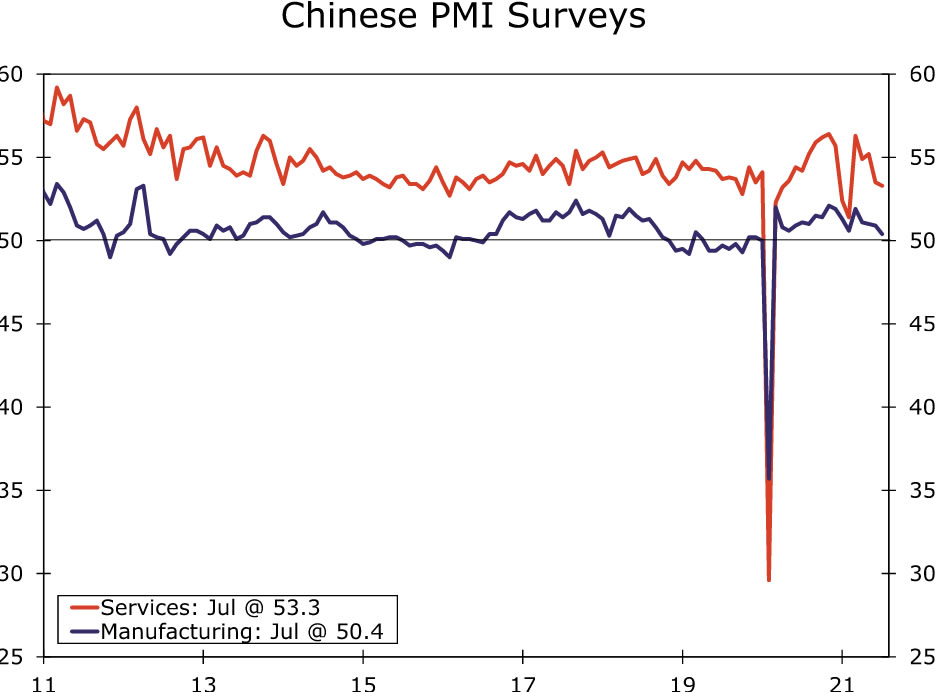
Next week's August CPI figures for the Eurozone are expected to show some acceleration of inflation. While some of that might reflect some firming in underlying price pressures, base effects are also expected to contribute to faster inflation.
There are some nascent inflation pressures, most clearly reflected in the Eurozone PMI surveys, where the input and output price components are at historically elevated levels. That said, the pass-through to the CPI has been limited so far. For August, the headline CPI is expected to quicken to 2.7% year-over-year, from 2.2% in July. Core CPI inflation is expected to double to 1.4% in August, from 0.7% in July.
However, much of that pickup of inflation stems from price declines, and temporary VAT tax reductions, that took place in Germany in the middle of last year. For example, focusing on the core CPI and adjusting the series for seasonal influences, the consensus forecast of 1.4% for August would equate to an annualized pace of core CPI inflation over the past six months of around just 0.4%. That is, we would not view a spike in August inflation as a harbinger of inflationary pressures to come, and we doubt the European Central Bank would either.
Canada GDP • Tuesday
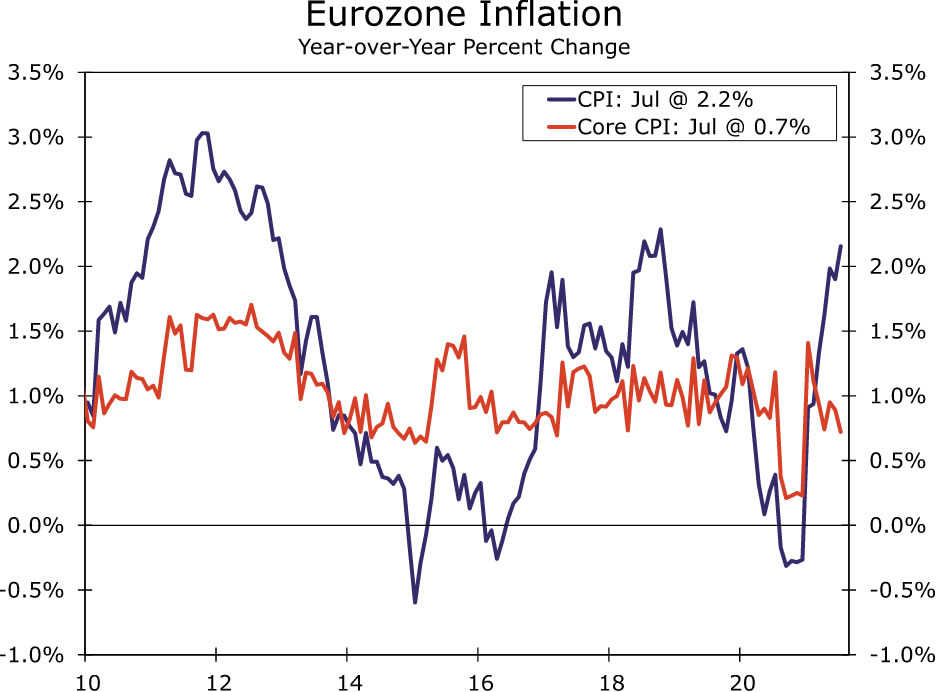
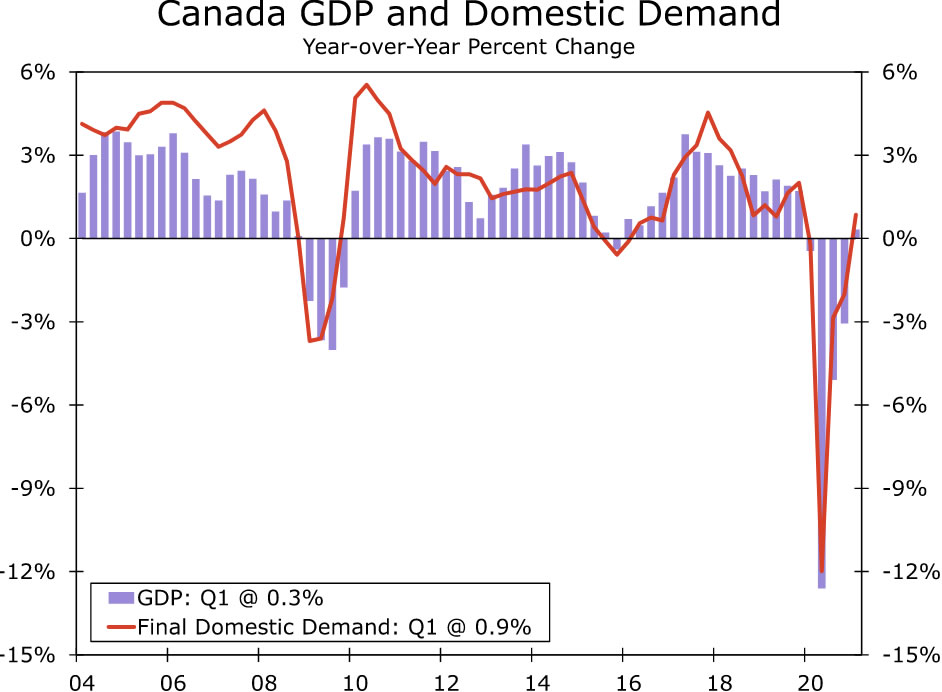
Canada's GDP data are released next week and should show slower, but still respectable, growth for the economy in Q2. We forecast Q2 GDP growth of 2.4% quarter-over-quarter annualized, very close to the consensus forecast of 2.5%, but well below the 5.6% growth seen in Q1.
Still, given the renewed spread of COVID cases and associated restrictions, that would still represent a decent pace of growth for the Q2. For example, the early part of the quarter saw significant declines in employment and retail sales, before some recovery in June. As a result, we suspect growth in final domestic demand for Q2 might not be quite as strong as the headline GDP. That said, with the economy proving resilient in the face of COVID restrictions, we expect the Bank of Canada to view the growth slowdown as temporary, and we believe the central bank will continue along the path of less accommodative monetary policy in the months and quarters ahead.
Interest Rate Watch
Powell Keeps an Open Mind to Tapering
The topic of "tapering" by the Federal Reserve has been very much front and center in financial markets in recent weeks. In an effort to provide monetary accommodation to the economy, the Fed has been making monthly purchases that total $80 billion of Treasury securities and $40 billion of mortgage-backed securities (MBS) for more than a year. The minutes of the past two FOMC meetings show that the committee has been discussing the conditions under which the Federal Reserve would pare back (i.e., "taper") its extraordinary pace of asset purchases, and a number of FOMC members have been saying publicly that the Fed should start to taper soon. So all eyes were on Fed Chairman Powell when he addressed the Jackson Hole Economic Policy Symposium today.
In our view, Chair Powell did not signal that tapering is imminent. He did acknowledge that he was of the view at the July 28 FOMC meeting, as were most of the other committee members, that "if the economy evolved broadly as anticipated, it could be appropriate to start reducing the pace of asset purchases this year." However, the intervening month has brought mixed news. The good news is that employment growth was strong in July. On the other hand, risks to the economic outlook have risen due to the spread of the Delta variant. Powell stressed the benefits of strong levels of employment, and he continued to articulate his view that the sharp increase in inflation this year will be transitory. In short, it does not seem that the Fed Chair has made up his mind yet about when to taper, and he will continue to watch incoming data. The labor market report for August, which is slated for release on Friday, September 3, will be an important marker for the beginning of tapering.
Even when tapering commences, financial conditions will remain accommodative. The Fed will continue to buy Treasury securities and MBS, just at a slower pace. So a sharp backup in long-term interest rates does not seem likely in the foreseeable future, unless economic growth turns out to be stronger and/or inflation comes in higher than most market participants currently expect. Once the Federal Reserve completes its tapering process, focus will then turn to the first rate hikes. In our view, the FOMC will maintain the federal funds rate in its current target range of 0.00% to 0.25% through at least the end of 2022.
Credit Market Insights
Red-Hot CLO Market
This past year has been a banner year for fundraising and deal activity. The low interest rate environment has supported record-breaking deal flow as firms have been able to borrow cheaply to reposition themselves coming out of the pandemic. Booming demand for collateralized loan obligations (CLOs) in particular has been a standout. CLO sales have fully recovered from last year's trough and are rising at a record clip in the United States, according to S&P Global Market Intelligence. Globally, the market for CLOs recently surpassed $1 trillion.
CLOs are securities typically backed by pools of low-rated corporate loans. With a CLO, the investor gets scheduled debt payments from the underlying loans, assuming most of the risk in the event that borrowers default. In exchange for taking on the default risk, investors are offered the potential for higher-than-average returns. The CLO market is often used as a conduit for large institutional investors to lend to non-investment grade borrowers. Greater CLO issuance typically means more dry powder to support debt financing for private equity buyouts and M&A deals.
CLOs have historically offered a yield premium over other corporate credit instruments of an equivalent rating. That said, the market's structure and volatility tamed investor interest following the financial crisis. After the crash, many investors steered clear of credit derivative products after having to repay loans on securities for which value had fallen. Over the past few years, however, investors have become more comfortable with CLOs, and issuance has improved. New interest from insurance companies and pension funds have also helped to deepen the market's institutional buyer base. With many buyouts currently under way, the record pace of CLO formation should support financing in the months ahead.
Topic of the Week
The Economics of College Football: Season III
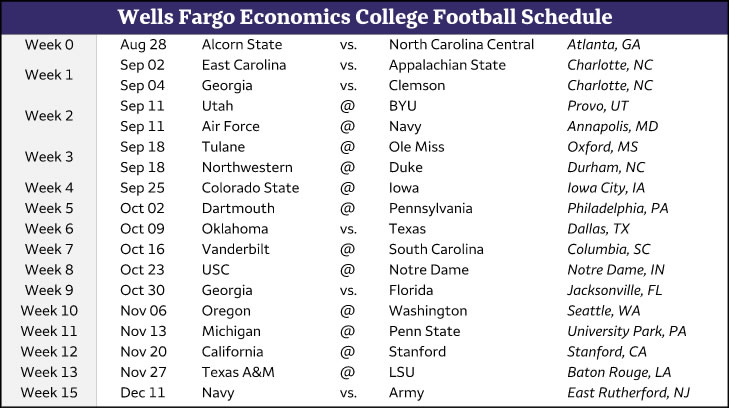
With the summer winding down and schools reopening to in-person instruction, college football games are rapidly approaching. Each week of the season, we will release one or two reports highlighting a key matchup, covering some of the history behind each university's football program, local economy and/or school community, and of course, some predictions about the upcoming game.
The biggest changes in college football this year deal with financial issues. After a series of moves by state legislatures and a major Supreme Court decision, the NCAA has changed its rules to allow college athletes to earn money by selling the rights to their name, image and likeness (NIL). The impact is likely to be greatest for athletes at major schools who play in nationally televised games. Schools that are close to major media markets would also appear to have a greater competitive advantage, which may make schools like UCLA and USC more popular destinations for top talent. Major media centers like Atlanta, Miami, Dallas and Nashville would also like to further cement the competitive position for the SEC, while the Big Ten should have plenty of access to the media in Chicago.
Securing a steady stream of big games and TV deals is believed to be the driving force behind the other major off-season changes, including the move by the University of Texas and the University of Oklahoma out of the Big 12 and into the SEC. Texas and Oklahoma are not scheduled to move until after the 2024 season, which is when the Big 12's current television contact runs out. The prospect of even more must-see SEC college football games has raised concerns about the SEC's growing clout. An alliance between the Big Ten, Pac-12 and ACC was announced this past week. Few details are available so far, but the agreement appears to be an attempt to gain some leverage in negotiating television deals and might also result in some marquee inter-conference matchups.
While one of the purposes behind the recent alliance between the ACC, Big Ten and Pac-12 is to eliminate any poaching of each other's teams, we doubt we have seen the end of conference realignment. The growing importance of media rights, which account for 30% of Division 1 football program revenues, will likely drive more up-and-coming programs to seek membership in one of the Power Five conferences. Schools from rapidly growing markets will be of particular interest and conferences will likely be interested in broadening their geographic reach to include large new media markets where it makes sense. This would make more conference games attractive to the major networks.
We have an aggressive schedule of games that we plan to feature in our weekly college football economic outlook series. The reports are a fun way to discuss state and local economies and provide some perspective of college football. The start of this year's college football season is being met with a bit more trepidation than most. College football is unique, because most teams can only afford one slip up, at most, if they hope to compete for the national title. This makes almost every game a big game for most teams. COVID also continues to hang over the sport. Will fans return to stadiums in full force? We will find out soon, as the season begins this Saturday and a full slate of games is scheduled for the extended Labor Day weekend, beginning on Thursday, September 2.
The Weekly Bottom Line: Delta Variant Dims The Outlook
U.S. Highlights
- Markets had to wait until Friday for the main event, Fed Chair Powell’s Jackson Hole remarks. In his speech, he provided a clear signal that as long as the economy continues to make progress, the Fed will begin tapering asset purchases before the end of this year.
- Economic data this week was supportive of economic resilience in the face of the Delta-driven surge in Covid-19 cases. Demand for housing solidified, and personal income growth picked up.
- Should consumer caution see spending trends deteriorate further in the coming months, we could see slower growth in outlays in the fourth quarter, but we expect the lull to be temporary.
Canadian Highlights
- This was a relatively quiet week in Canada, but the data flow is expected to pick up next week with June’s GDP report on the docket. It is expected to show economic activity bouncing back strongly as restrictions began to ease.
- How long the good times will roll depends on the virus. New cases are rising, while more provinces and businesses are implementing measures such as vaccine passports and mandatory vaccination requirements in order to avoid lockdowns.
- Ongoing supply chain disruptions and labour shortages are weighing on businesses’ ability to scale up sales and production. This week’s CFIB business barometer survey showed that both of these issues intensified in August.
U.S. - Powell Ready to Taper QE by Year-End
In a relatively quiet week for economic data, markets had to be patient until Friday for the main event: Fed Chair Powell’s remarks from the Jackson Hole symposium. The event itself has been impacted by the rise in Delta variant cases, going online at the last minute. Powell’s remarks provided a clear signal that as long as the economy continues to make progress in the coming months, as we expect, the Fed will begin tapering its asset purchases before year-end.
The economic backdrop to the speech has been pretty good. Existing home sales rose 2% in July, showing that underlying demand for housing is solid, and that the pullback in sales from the post-lockdown surge has run its course. The second release of the GDP data showed that the U.S. economy was very slightly stronger in the second quarter than previously reported. Sitting more than halfway through the third quarter though, the real question is how well spending will hold up against the Delta wave.
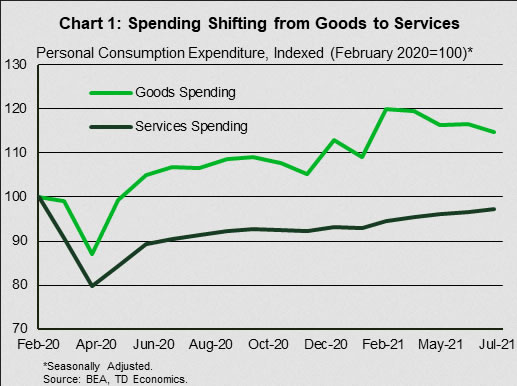
There weren’t too many signs of Delta-related caution in the July spending data. Spending on close contact services grew about 1% month-on-month in July, matching June’s pace. Since the initial re-opening stage in 2020, goods spending has surged (and durable goods specifically), supported by generous government supports and restrictions on services spending (Chart 1). But there are only so many iPads and TVs people need. Spending on these durable goods has been declining since March, while services spending is making steady gains. This correction in goods spending is expected to hold consumer spending below 2% in the third quarter, even before caution related to the Delta variant is incorporated in the forecast.
If we do see slowing in these close-contact services through August and September, consumer spending growth could slow further. Still, we don’t expect it to be derailed for a few reasons. For starters, U.S. households have amassed over $2.5 trillion in excess savings over the course of the pandemic. Even if unevenly distributed, this provides a substantial cushion against a temporary slowing in momentum. Second, labor shortages, which appear relatively widespread across regions and industries, may lead employers to hold on to workers, rather than lay them off due to a temporary lull in demand, helping to keep the labor market resilient.
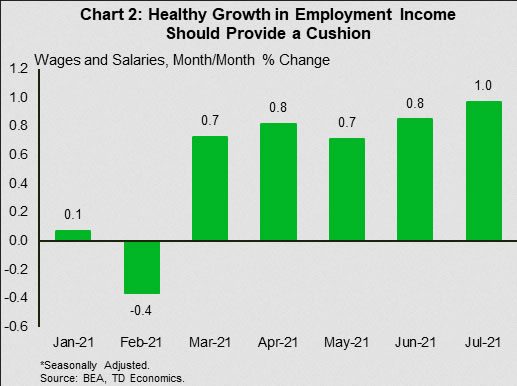
Finally, while headline personal income growth is being buffeted by swings in government support programs, underlying growth in wages and salaries has been solid (Chart 2). Indeed, wages and salaries rose 1% in July alone, and are up 10.6% annualized pace over the past three months. Solid income gains should support consumer spending in the months ahead.
Powell’s remarks took a deep dive on recent inflation trends, and defended his view that much of the recent surge in inflation is transitory. He highlighted the clear improvement in the labor market, while acknowledging the risks posed by the Delta variant. Overall, his remarks were consistent with our view that asset purchases will be tapered this year, given the economy’s expected resilience to the Delta wave.
Canada - Delta Variant Dims The Outlook
It was a quiet week in terms of economic data. The federal election continued to make headlines as parties released details of their election platforms. In a nice reversal to last week's sell-off, equity markets were upbeat, more than recovering last week's losses. Ditto for the WTI oil price, which rebounded on the week, giving a lift to the Canadian dollar vis-à-vis the greenback.
The economic data flow will pick up next week, with June's GDP report expected to show economic activity bouncing back strongly as restrictions began to ease. This should provide a solid handoff for the third quarter, when further easing of containment measures over the summer is expected to usher a strong bounce back in real GDP growth.
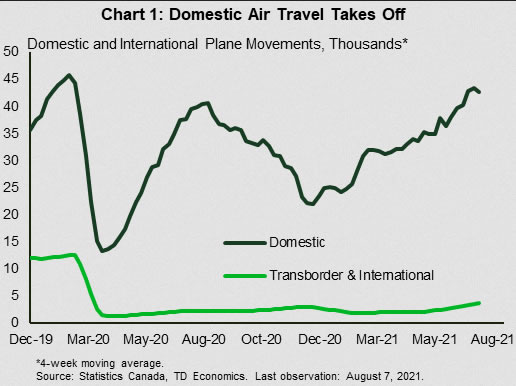
Indeed, economic activity continued to broaden and gather pace during the summer months, allowing the labour market recovery to gain momentum. Spending has picked up in areas most directly impacted by the pandemic such as travel, dining out and recreation. While international tourism remains challenged by the pandemic, Canadians have embraced domestic travel. Data shows that in July, domestic plane traffic was nearly on par with pre-pandemic level (Chart 1). Restaurant reservations data from OpenTable show similar progress.
How long the good times will roll will depend on the virus. As we note this week in our updated COVID-19 Economic Tracker, cases are on the rise across most developed countries. Canada too has witnessed an uptick in COVID-19 cases in all regions in recent weeks, led by Western provinces. Canada’s vaccination rate is among the highest in the world with over 74% of its adults fully vaccinated, which gives some hope that strict containment measures will be avoided. Canada's already-high vaccination rate could be boosted further still. A number of provinces (QC, BC, PEI, MB) have introduced vaccine passports, and a growing list of companies are announcing mandatory vaccination for in-person working arrangements. This could spur more people to get vaccinated.
So far, the high vaccination rate has kept hospitalization and death rates low relative to cases. Still, cases and hospitalization are rising swiftly among the non-vaccinated population, and there are breakthrough cases among the vaccinated. Past waves have shown that Canada has a much lower tolerance toward hospitalization thresholds relative to other countries. This poses a downside risk to the outlook, as the pace of reopening might be paused or scaled back.
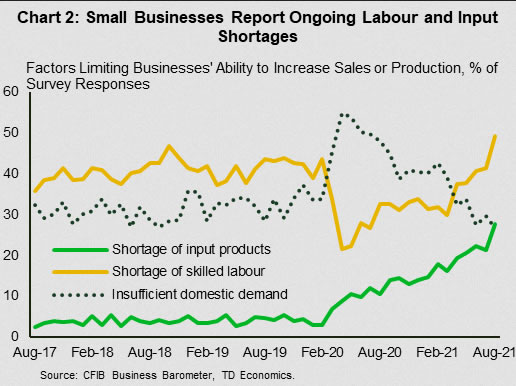
Economic growth could also be restrained by ongoing supply chain disruptions, and labour shortages. Responses from this week's CFIB Business Barometer Survey showed these issues intensified in August (Chart 2). Nearly half of respondents cited a shortage of skilled labour and a record 27.6% of firms reported shortage of input products as an impediment to growth in sales or production. Given that many emerging economies, where many of the goods are being manufactured, are dealing with Delta outbreaks of their own, these supply chain bottlenecks are unlikely to ease in the near term.
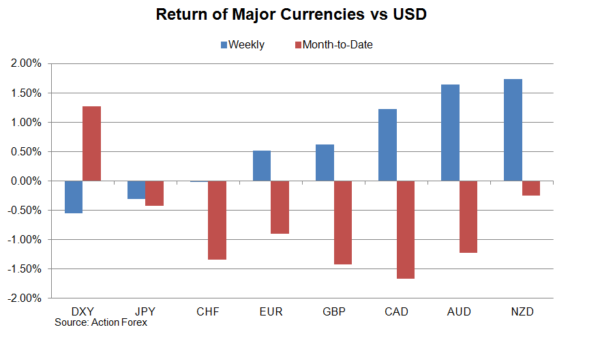
Explaining JPY’s Resilience Amidst Fed’s Taper Talks
Japanese yen has been rather stable over the past weeks despite volatility in other major currencies. It's resilient performance over the past few days despite heightened FOMC tapering talks is no accident. We summarize three major drivers of this.
Funding Currency Firms on Risk Aversion
A key theme of USD’s strength over the past weeks is Fed’s early tapering, as well as risk aversion amidst resurgence of the pandemic. Although the greenback has stolen the show Japanese yen should not perform too poorly as a traditional safe-haven currency. JPY’s resilience is helped by its traditional role as a funding currency in carry trade. The persistent low yield in Japanese asset has made JPY an attractive funding currency in carry trade, in which investors borrow yen at a lower interest rate and buy another currency at a higher interest rate. Investors take profit from carry trade at times of financial turmoil and return the JPY borrowed, sending the currency higher.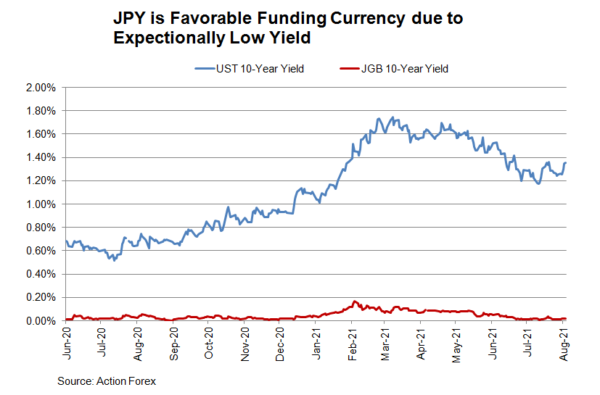
Net Short Positions in 2 Year High
As CFTC’s Commitments of Traders report shows, net short for JPY futures has remaned ample, hovering at around the highest level in 2 years. With speculators already running short JPY positions since March this year, we see limited room for further short selling positions. Meanwhile, the effective JPY index has slumped about -12% from the high in March 2020, traders could find the current price level attractive.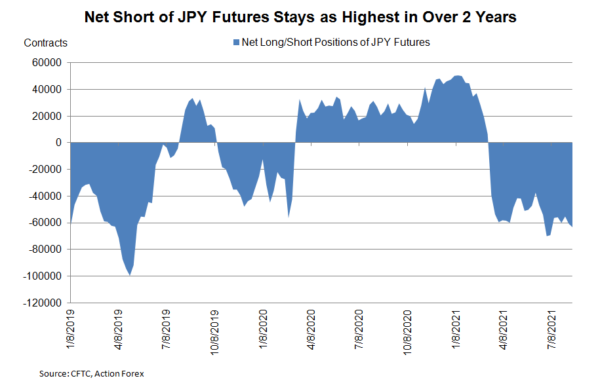
Weak Economy Already Priced In
Japan’s economic situation remains fragile. Earlier this week, economy minister, Yasutoshi Nishimura, maintained a downbeat tone on the outlook and warned of the impact of rapid virus spread in Asia on the Japanese firms' supply chains. On inflation, Tokyo's core CPI (excl. fresh food) was flat in August, betting than consensus of -0.1% and July's -0.3%. The core-core reading (excl. fresh food and energy) slipped -0.1% y/y in August, also better than consensus of -0.1% and July's -0.4%. Yet, the improvement was mainly driven by low base effect and government's Go To Travel campaign. It's still too early to note that the country's inflation is going to improve further. On a positive note, preliminary data showed that the country’s GDP expanded an +1.3% q/ in 2Q21, following a -3.7% contraction a quarter ago. This came in stronger than consensus of +0.7%. We believe that the worst of Japan’s economy has already been priced in the Japanese yen’s performance. Upside surprise in economic data should lend support to yen.
Powell More Upbeat about Job Market and Inflation, Stopped Short of Hinting about the Timing of Tapering
The closely-awaited Jackson Hole speech by Fed chair Powell reaffirmed that QE tapering would begin later this year. While being more upbeat about the progress of employment and inflation, Powell warned of the downside risks posed by the rapid spread of the delta variant. He also attempted to de-link taper and rate hike, causing instant decline in Treasury yields after his speech.
The speech clearly delivered an optimistic tone about economic developments. Powell acknowledged that the month since the July FOMC meeting “brought more progress in the form of a strong employment report for July” and that there has been “clear progress toward maximum employment”. The chairman also noted that inflation has already met the “substantial further progress” test, though reiterating the transitory nature of inflation. Meanwhile, he reiterated the stance at the July meeting that “if the economy evolved broadly as anticipated, it could be appropriate to start reducing the pace of asset purchases this year”. These comments signal that the hurdles to reduce monetary stimulus have largely been overcome.
Yet, Powell also warned that “the further spread of the Delta variant” would warrant policymakers to “carefully assessing incoming data and the evolving risks” in the upcoming meeting in September. He added that the members “expect to see continued strong job creation. And we will be learning more about the Delta variant’s effects”. He noted that “for now, I believe that policy is well positioned; as always, we are prepared to adjust”. Besides demonstrating an open mind to adding or reducing stimulus, the chair also assured the market that "even after our asset purchases end, our elevated holdings of longer-term securities will continue to support accommodative financial conditions". This appears to water down the probability for a rate hike earlier than what was projected in June. Recall that the median dot plot in June projected at least two rate increases in 2023.
The speech does not altered our view that the Fed would make formal announcement about tapering in November. Yet, whether such announcement would be made earlier *(i.e.: in September) hinges on the August employment report (due next Friday) and the development of the pandemic. The market currently anticipates a +665K addition in non-far payrolls, following a strong +943K increase in July. The unemployment rate is expected to drop -0.2 ppt to 5.2%.
Week Ahead – Action Packed End to Summer
Country
US
Now that Jackson Hole is over, the focus shifts back onto the economic recovery. Investors will pay close attention to every data point that can give possible insights into the labour market recovery and if pricing pressures continue to heat up. A quicker trajectory towards substantial progress in the labour market could trigger a quicker tapering of asset purchases. The August nonfarm payroll report is expected to deliver a robust 787,000 jobs, which would be less than the prior month’s 943,000 reading, but still complementing the path towards formally announcing tapering.
Inflationistas will keep a close eye on Wednesday’s ISM report, which could show input costs remain at elevated levels, while inventories continue to contract. The ISM Manufacturing headline is expected to soften from 59.5 to 58.7.
EU
The euro area economy is ticking along nicely. Common challenges remain, notably delta and supply issues, but many countries in the bloc are now among those with the highest vaccine rollouts which positions them well going into the final months of the year.
Next week offers a broad selection of data, most notably flash CPI and unemployment. Final manufacturing and services PMIs will also be released. The ECB minutes this week confirmed the divide in the ECB that we all knew was there but didn’t offer much on what it means going forward on asset purchases, most notably PEPP which is due to run until the end of March next year.
UK
Data from the UK this week showed that, despite all restrictions being lifted, the economy continues to face headwinds because of supply and labour shortages. There has been rising Covid cases in the UK but hospitalisations and fatalities remain very low by past standards.
Next week consists of tier two and three data, notably the final manufacturing services PMIs.
Emerging Markets
Russia
Next week sees the release of unemployment and PMIs for manufacturing and services.
The central bank previously raised rates to 6.5% and warned that more may follow.
South Africa
A mixed week that saw unemployment surprisingly rise to 34.4% from 32.6% in Q2. The data could deteriorate further in the third quarter as a result of new Covid restrictions.
On a more positive note, the economy is 11% bigger than previously estimated following a change in the way it’s calculated. That means the deficit and debt as a share of GDP will be lower, with the latter now expected to remain below 80% over the next few years when it was previously projected to reach 87.3% in 2024.
Next week offers a few tier-three releases.
Turkey
Plenty of data released next week including Q2 GDP on Wednesday, which is expected to show the country grew more than 21% compared to a year ago when the country faced severe restrictions.
Inflation data on Friday will attract a lot of attention given the pressure on the CBRT Governor not to raise interest rates. Forecasts are for it to fall slightly to 18.7%, in line with the central bank’s thoughts.
If we see a surprise rise above the central bank rate, it could be extremely problematic for Governor Şahap Kavcıoğlu. Does he stand by his word and prioritise retaining confidence in the markets at the expense of risking the sack, or go back on it and risk the wrath of the markets.
Asia Pacific
China
China has announced that the latest outbreak of the Covid Delta variation has been completely contained, saying that Covid cases had been brought down to zero. The impact of the outbreak on China’s economy should be most evident in the next Non-Manufacturing PMI. The manufacturing sector is expected to see only limited damage, as external demand remains robust.
Manufacturing and Services PMIs for August will be released early next week. Manufacturing activity is expected to be stagnant, with a consensus of 50.2 for both the Manufacturing PMI and Caixin Manufacturing PMI. The Services sector is forecast to show slight expansion, with estimates of 52.0 for the Non-Manufacturing PMI and 51.3 for the Caixin Services PMI.
The China Securities Journal reports that the PBoC plans to soon boost the credit supply and increase the amount of money that supports small businesses and the real economy. The move follows a decrease in credit and economic growth in July.
India
India has seen a surge in Covid cases, which is being attributed to a harvest celebration in southern India. On Thursday, India recorded 46 thousand cases, the highest daily count in over a month. Only 10% of India’s population has been fully vaccinated against Covid, which means that the number of new cases of the Covid Delta variation could skyrocket. India’s GDP for Q2 (YoY) is expected at 20.9%.
Australia & New Zealand
The government has imposed strict lockdowns, but Covid cases continue to surge. On Thursday, Australia reported over 1,000 new cases, the highest total since the pandemic began in 2020. There are growing concerns that the economy could fall into a recession if Covid numbers continue to rise.
Australia’s economy showed solid expansion in the first quarter, with a gain of 1.8% (QoQ). However, there are concerns that growth may have slowed to below 1% in Q2. Australia will release GDP for Q2 on Tuesday.
The recent outbreak of the Covid Delta variant has led to a lockdown of the entire country. The government has announced that the lockdown will be eased in all areas except in Auckland. ANZ Business Confidence, which came in at -3.8 in July, will be released on Monday.
Japan
Japan continues to struggle with an upsurge in Covid cases, and the state of emergencies will hamper economic growth. Early next week, Japan releases the unemployment rate and Industrial Production for July. Both indicators are expected to have worsened compared to June.
Key Economic Events
Sunday, Aug. 29
- Debate amongst candidates vying to become Germany’s next chancellor
Monday, Aug. 30
- President Biden meets Ukrainian President Volodymyr Zelenskiy at the White House
Economic Data/Events
- US pending home sales
- Eurozone economic/consumer confidence
- Germany CPI
- Japan Retail sales
- South Africa monthly budget balance
Tuesday, Aug. 31
- Today is the tentative deadline for the US evacuation in Afghanistan
- ECB Governing Council members Robert Holzmann and Klaas Knot, Denmark central bank Deputy Governor Per Callesen and Croatia central bank Governor Boris Vujcic speak at a conference in Alpbach, Austria.
- IMF’s Jonathan Ostry delivers South Africa’s Mapungubwe Institute for Strategic Reflection annual lecture, on the theme of “Will Covid-19 Raise Inequality? Evidence from Past Pandemics and Crises.”
- The Center for Strategic & International Studies holds an event, “A Mission to Mars: A Conversation with Her Excellency Sarah Al Amiri, UAE Minister of State for Advanced Technology.”
Economic Data/Events
- US FHFA house price index, Chicago PMI, Conference Board consumer confidence
- Canada GDP
- Czech Republic GDP
- Finland GDP, CPI
- France GDP
- India GDP
- Italy GDP, CPI
- Denmark GDP
- Poland GDP, CPI
- Germany Unemployment
- Russia Unemployment
- Eurozone CPI
- Thailand trade, BoP
- Australia BoP current account balance, building approvals
- Hong Kong retail sales, money supply, budget balance
- Singapore bank loans, money supply
- New Zealand building permits, ANZ business confidence
- Japan industrial production, housing starts, Unemployment
- Mexico central bank quarterly inflation report
- UK mortgage approvals, money supply
- South Africa trade balance, money supply
Wednesday, Sept. 1
- BOJ Deputy Governor Wakatabe speaks in Hiroshima.
- ECB Governing Council members Holzman and Knot, and Bundesbank President Weidmann speak at a Bundesbank symposium.
- Mexican President Andres Manuel Lopez Obrador delivers third state-of-the-union address.
Economic Data/Events
- US Aug ISM manufacturing: 58.7e v 59.5 prior, ADP employment change: 650Ke v 330K prior, Markit Manufacturing PMI, construction spending
- OPEC+ meeting on output
- Hungary GDP
- Turkey GDP
- Australia GDP
- Eurozone Unemployment
- Eurozone Manufacturing PMIs (Germany France, Italy Spain)
- India Manufacturing PMI
- UK Manufacturing PMI
- Australia Manufacturing PMI
- Thailand Manufacturing PMI
- South Africa Manufacturing PMI
- Hungary Manufacturing PMI
- China Caixin manufacturing PMI
- Japan capital spending, vehicle sales, manufacturing PMI
- Australia commodity index
- Thailand business sentiment index
- EIA Crude Oil Inventory Report
Thursday, Sept. 2
- Eastern Economic Forum held in Vladivostok.
- BOJ board member Kataoka gives a speech online to business leaders in Nagasaki, Japan.
Economic Data/Events
- US factory orders, durable goods, trade balance, initial jobless claims
- Australia trade balance
- Japan monetary base
- Singapore PMI, electronics sector
- New Zealand terms of trade index
- Canada building permits
- Eurozone PPI
- Spain unemployment change
- Switzerland GDP, CPI
Friday, Sept. 3
- The European House-Ambrosetti annual forum takes place in Cernobbio, Italy
Economic Data/Events
- US Aug Change in nonfarm payrolls: 787Ke v 943K prior; Unemployment Rate: 5.2%e v 5.4% prior
- Eurozone retail sales, Markit services PMI
- UK Services PMI
- Australia Services PMI
- India Services PMI
- Singapore Markit PMI
- China Caixin services PMI
- Japan Bank services PMI
- Thailand foreign reserves, forward contracts
- Singapore retail sales
- South Africa PMI
Fed Chair Powell on the Economy and Tapering
At the Federal Reserve Bank of Kansas City's Jackson Hole Symposium, Federal Reserve Chair Jay Powell gave a much anticipated speech titled, Monetary Policy in the Time of Covid. Markets were looking for a signal that a tapering of the Fed's $120 billion a month Quantitative Easing (QE) program is forthcoming.
In typical style befit of an economist, Chair Powell hedged his bets, stating that:
- On one hand "the pace of the recovery has exceeded expectations, with output surpassing its previous peak after only four quarters, less than half the time required following the Great Recession. As is typically the case, the recovery in employment has lagged that in output; nonetheless, employment gains have also come faster than expected."
- On the other hand, "the unevenness of the recovery can further be seen through the lens of the sectoral shift of spending into goods…and away from services… Even today, with overall gross domestic product and consumption spending more than fully recovered, services spending remains about 7 percent below trend. Total employment is now 6 million below its February 2020 level, and 5 million of that shortfall is in the still-depressed service sector."
Given the unevenness, Powell focused on the goals of maximum employment and price stability. He stated, "the unemployment rate has declined to 5.4 percent, a post-pandemic low, but is still much too high, and the reported rate understates the amount of labor market slack." On inflation, Powell is concerned about the current high rate of price growth, but notes that "the spike in inflation is so far largely the product of a relatively narrow group of goods and services that have been directly affected by the pandemic and the reopening of the economy…and are likely to prove transitory."
On a potential taper to the QE program, Powell stated that he "was of the view, as were most participants, that if the economy evolved broadly as anticipated, it could be appropriate to start reducing the pace of asset purchases this year," but that the Fed will be "carefully assessing incoming data and the evolving risks."
Key Implications
There you have it. Pencil in a taper of QE by year-end. This is consistent with the growing call from several Fed Presidents. With Chair Powell on board, it is even more likely. Though 'year-end' is a little vague, there will be hot debate on a potential taper at the Fed's September policy meeting. Adding fuel to the fire, Fed members will have to revise up their inflation forecasts. While elevated inflation is viewed as transitory, it is likely to last longer than the Fed has anticipated and telegraphed. St. Louis Federal Reserve President James Bullard is of the same view. Yesterday, he stated that because of current high inflation, he thinks the Fed should "get going on taper. Get the taper finished by the end of the first quarter next year…and then we can evaluate what the situation is and we’ll be able to see at that point whether inflation has moderated and if that’s the case we’ll be in great shape. If it hasn’t moderated, we’re going to have to be more aggressive to contain inflation.” Those are pretty strong words, but he is not alone.
Dallas Fed President Robert Kaplan agrees. Further supporting the argument for a taper, he noted how QE has created distortions and excess risk taking in financial markets. He stated, “it would continue to be my view that when we get to the September meeting, we would be well served to announce a plan for adjusting purchases and begin to execute that plan in October or shortly thereafter.”
Forward Guidance: Canada GDP to Show Recovery Accelerated in June ahead of Delta Wave
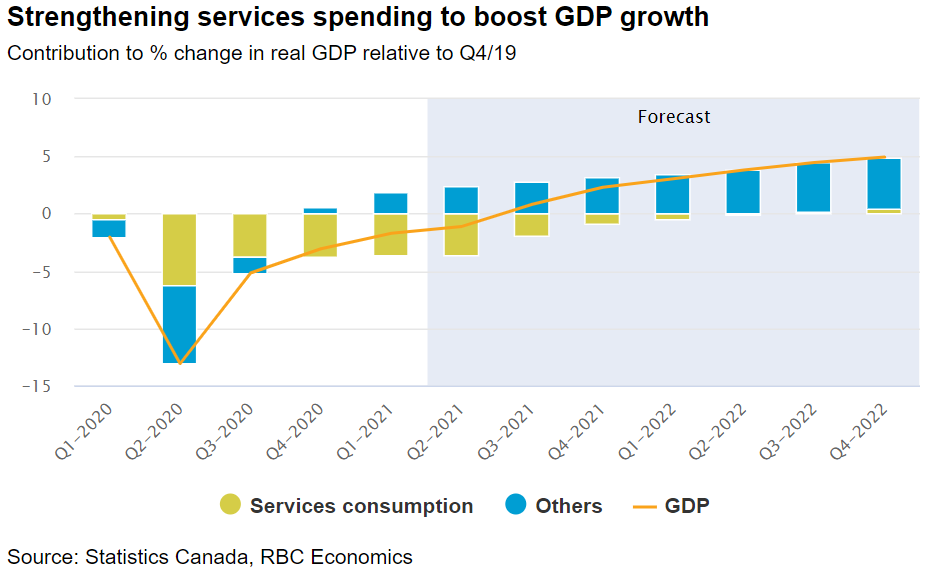
Economic activity bounced back in June from COVID’s spring wave, this week’s Canadian GDP data should confirm. We’re tracking a 0.8% increase in June GDP—slightly above Statistics Canada’s early estimate of 0.7%. That would retrace the declines posted in April and May, and would leave output up a relatively modest 2.5% (annualized) in the second quarter. But the re-opening of the economy has likely sparked another sizable gain in July. Activity in the manufacturing sector is still constrained by ongoing supply chain disruptions, and residential investment likely cooled as housing markets started to come off the boil in Q2. Still, consumer spending on services has strengthened, particularly in the travel and hospitality services industries hardest hit during the pandemic. Spending on food services jumped 20% in June, and our own tracking of card transactions suggests another sizeable gain in July–resembling a similar surge in the U.S. last spring that took food service sales quickly back above pre-pandemic levels.
How sustainable those gains are in the near-term depends heavily on the virus, which has continued to rise in most regions of Canada over the last week. Still, vaccination rates are relatively high, and that is expected to limit the extent of potential future containment measures. The virus spread has, at a minimum, trimmed some of the upside risk to the near-term outlook, but the drag on economic activity from the pandemic in the second half of 2021 is still expected to be significantly smaller than in the first.
Week ahead data watch:
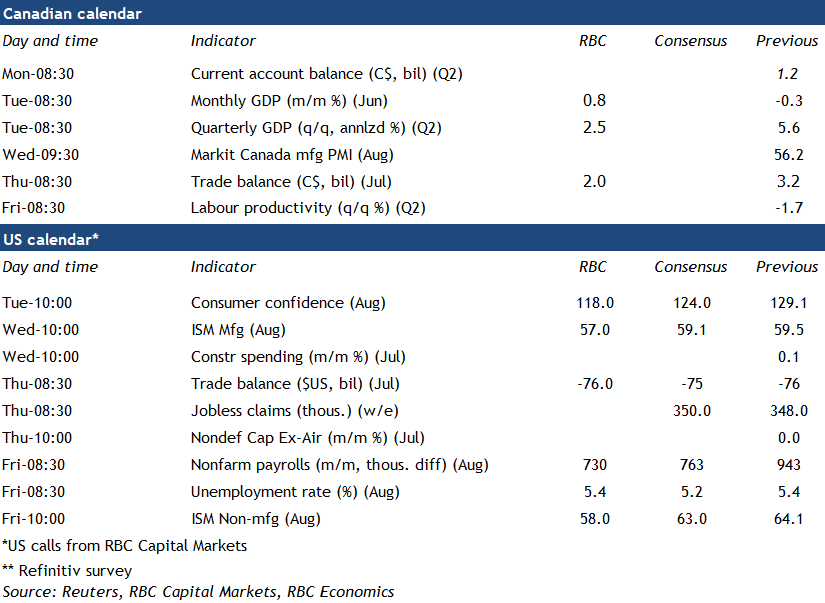
- We expect the Canadian trade surplus to ease to $2.0 billion from $3.2 billion in June. A drop in railcar traffic is foreshadowing a pullback in exports after a June surge and we expect imports to hold roughly steady after falling 1% in June.
- Weekly average COVID-19 case counts have increased to just under 3000/day, with daily counts rising in most parts of the country.
- The US labour market recovery is is expected to have continued in August with employment rising sharply once again after gains of just under a million jobs in each of June and July.
Week Ahead – The Calm Before Nonfarm Payrolls Storm
The calendar is void of any central bank meetings next week, so all eyes will be on the latest US employment report. It will be infinitely important in determining how soon the Fed pushes the taper button. Beyond that, there’s also a heavy dose of data releases from the Eurozone, Canada, and Australia.
Inflation, jobs, and the dollar
There’s been a lot of talk lately about the Delta outbreak hitting the US economy and slowing down the Fed’s normalization plans. Some early signs indeed suggest economic growth is losing steam. For instance, the latest composite Markit PMI fell in August thanks to worsening supply chain disruptions, while consumer confidence cratered as virus fears returned.
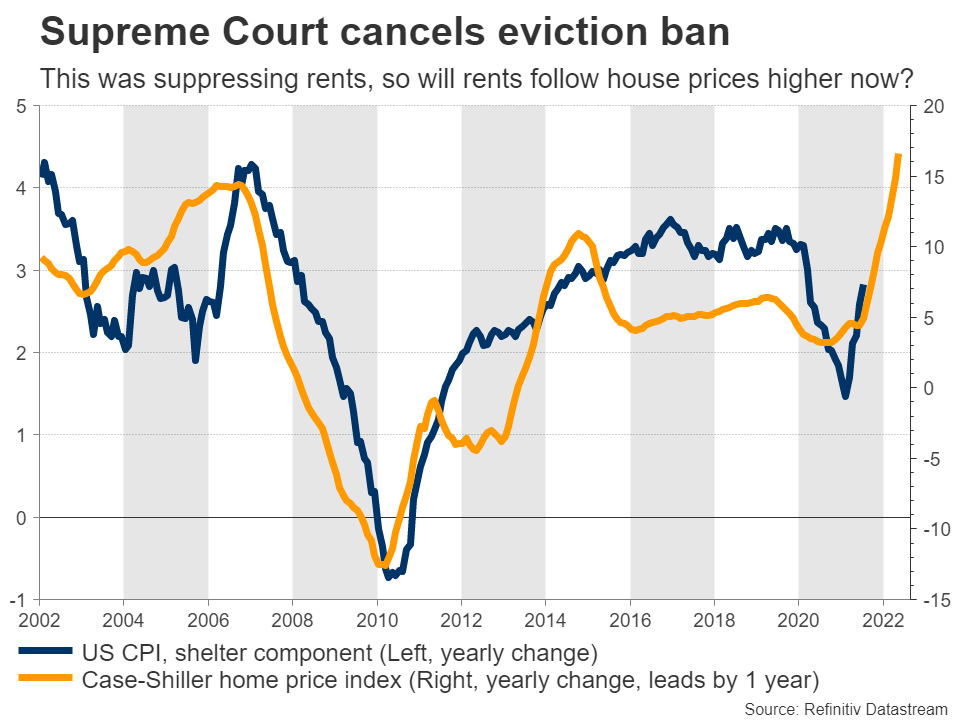
That said, the wheels are not coming off either. The economy is already larger than it was pre-crisis, the labor market is recovering at a stunning pace, and inflation is unlikely to cool anytime soon. The Supreme Court just canceled the ban on evictions, which means rents could now begin to spiral, feeding the inflation story. Best of all, Congress is pushing ahead with another massive round of infrastructure spending.
Hence, the Delta outbreak looks like a mere speed bump in the recovery road. Even in a worst-case scenario where it does hurt the economy, that would also put more pressure on the politicians to get something done quickly, increasing the chances for a gigantic spending package.
The Fed is clearly preparing the markets for a tapering decision this year. It’s not a question of whether they will taper, but rather when they will begin this process and how long it will last. Investors are still debating whether this will be announced in September, November, or even December.
The jobs report on Friday could go a long way in settling this debate. Nonfarm payrolls are expected at 763k in August, pushing the unemployment rate down two ticks to 5.2%. That would leave America some 5 million jobs shy of a full recovery. Subtract around 2.5 million people that retired early because of the pandemic, and we could be back to full employment by the turn of the year if this pace continues.
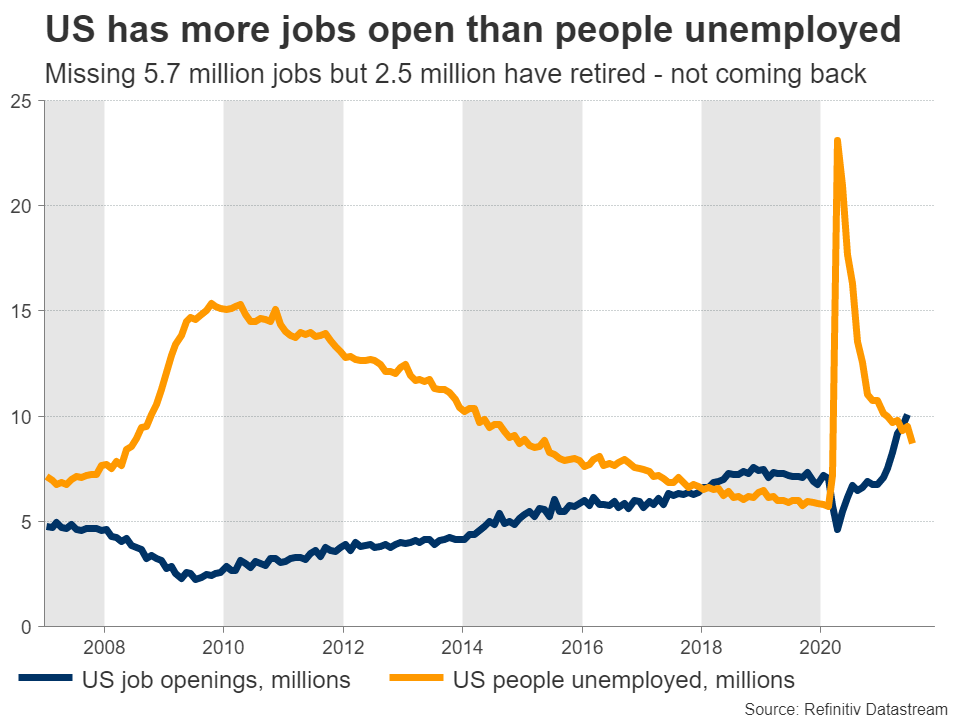
As for the dollar, the overall picture remains promising. Whether the Fed pulls the tapering trigger in September or November doesn’t matter much. It is still years ahead of the ECB and the BoJ in normalizing, which ultimately argues for the dollar to shine against the euro and yen as investors warm up to carry trades again.
Aside from the employment report, markets will also focus on the ISM manufacturing and services PMIs for August, due on Wednesday and Friday respectively.
Eurozone data barrage
Over in Europe, the ball will get rolling with preliminary German inflation numbers for August early on Monday. The Eurozone-wide inflation print will be released on Tuesday, ahead of unemployment figures for July on Wednesday. Then on Friday, the spotlight will fall on the latest edition of retail sales.
The Eurozone has come back to life lately as vaccinations went into overdrive and social restrictions were rolled back. Alas, the recovery pales in comparison to America’s, as the euro area economy is still much smaller than it was pre-crisis. And the risk is that this latest recovery phase was simply a reopening boom that fades soon.
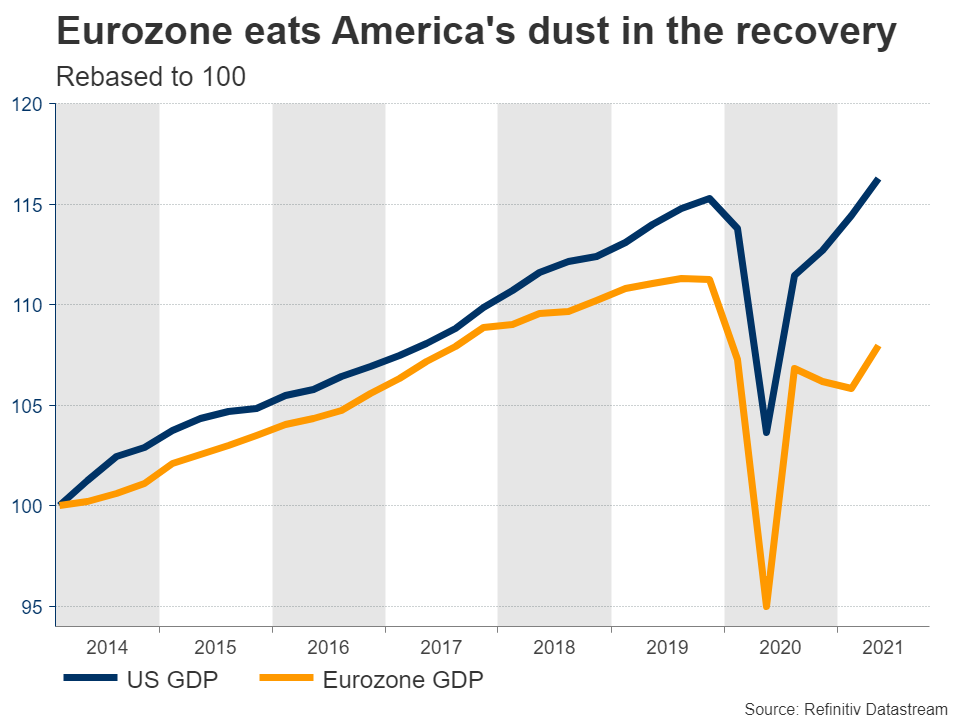
On the bright side, Europe has a very high vaccination rate. This means the Delta variant is less of a threat. Additionally, the Recovery Fund money is finally being rolled out, which will hopefully help struggling economies like Italy get back on their feet.
The problem is that this recovery package is way too small to make a real difference and there isn’t much political appetite for any more, especially with government debts ballooning already.
Long story short, the Eurozone is doing better but nothing impressive. The ECB is well aware of this, hence why it doubled down on its commitment not to raise rates over the coming years. That’s bad news for the euro, which could struggle against currencies whose central banks are moving towards higher rates.
Canadian and Australian GDP data
Moving to the commodity-linked currencies, Canada’s GDP stats for Q2 are out Tuesday. The Canadian economy continues to hum along nicely, enjoying the benefits of a very high vaccination rate and elevated oil prices, allowing the central bank to roll back its asset purchases.
As for the loonie, the currency has been at the hands of risk sentiment lately, swinging wildly alongside stock markets and oil prices. The big picture remains bright thanks to the Bank of Canada’s lead in normalizing policy, although a lot will also depend on how commodity prices fare. Beyond that, there’s also an election coming up next month.
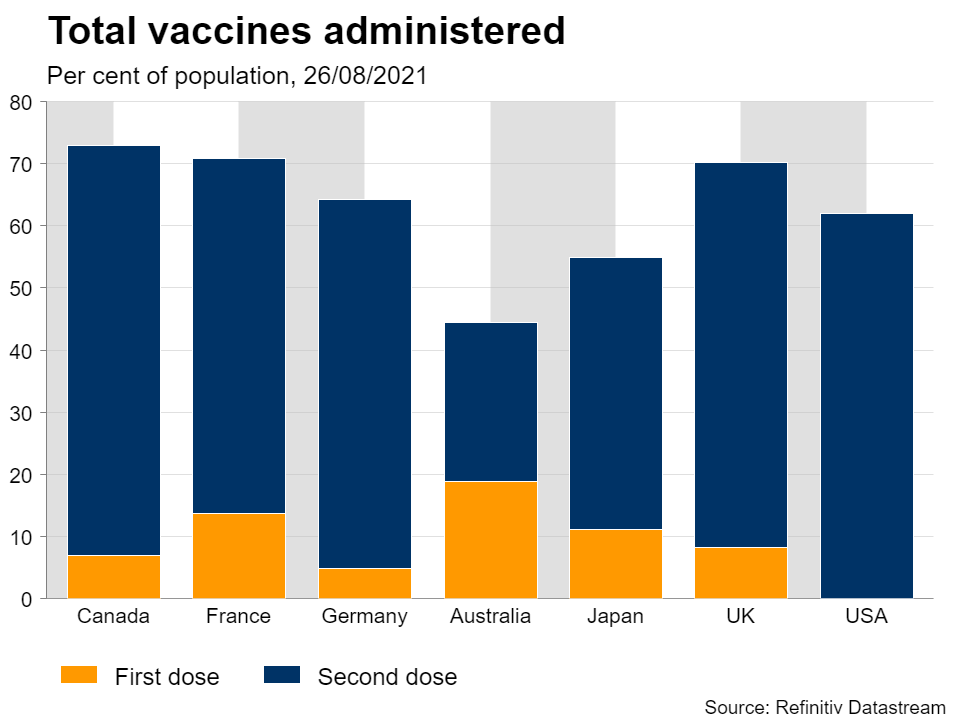
Over in Australia, things don’t look so good. Most of the country is trapped in a strict lockdown, with the government waiting for the nation’s vaccination rate to rise to around 70-80% before relaxing restrictions. This means several more weeks of lockdowns, which will inevitably hit the economy. Hence, the upcoming GDP data for Q2 on Wednesday are already outdated.
The RBA stuck to its guns lately, signaling it will go ahead with reducing its asset purchases soon despite the onslaught of negative news, but there is a strong chance it abandons those plans at its next meeting. As for the aussie, it has been demolished lately and the pain train could continue as long as the lockdowns rage, especially with China losing steam too.
Speaking of China, the nation’s PMI business surveys for August will also hit the markets on Tuesday.
Weekly Focus – Risk Back On
Risk has been back on in markets this week with rising equities, VIX volatility back at normal levels after spikes last week and weaker safe haven currencies such as JPY. 10-year US treasury yields moved higher to the levels from two weeks ago and we see more upside ahead as we expect Fed will announce tapering at the September FOMC meeting, see Yield Outlook US - Tapering and market impact, 26 August. 10-year Bunds also closed on one month highs of -40 bps.
Industrial metals have been heading higher in a week where PMIs showed a European manufacturing sector continuing with full speed ahead and still in great need of supplies. Brent crude oil also bounced back above USD70 per barrel. We expect to see PMI levels head lower in the coming months and this is also the indication we got from the German business expectations, declining sharply for a second consecutive month following a 10-year high in June.
On the COVID front, we continue to see a particularly hard hit South East Asia. Another two interesting studies confirm that the delta variant leads to lower protection and vaccine efficiency wanes significantly after three months. The combination of waning immunity and weaker protection against delta means that we may see bigger outbreaks in Europe and in the US during the colder autumn and winter months.
ECB minutes from the July meeting were marginally on the hawkish side with mentioning of upside risks to inflation. The new 2 per cent inflation target with no downward bias received 'broad consensus' in the governing council.
In Japan, the leadership election in the ruling Liberal Democratic Party (LDP) will take place on 29 September ahead of the next general election by the end of November. The sitting president PM Suga is favourite to secure another term, however public support for his cabinet has plummeted to historic lows. No matter who will lead the LDP in the upcoming general election, they will risk losing their majority. Last time that happened, it lead to a chaotic political period with four different PMs in as many years.
In China, industrial profits growth declined for a fifth straight month in July as the economy is slowing. From the People's Bank of China (PBoC) we got some quite dovish remarks with promises to boost credit support this week. We expect the PBoC will cut the reserve requirements ratio for all banks from the current 5% to stabilise credit growth.
Next week, China releases PMIs. It has declined more than expected in recent months and we look for a small further decline in August. It will keep focus on slowing growth and expected easing from PBoC and from fiscal policy. In the euro area, with the August print we get the last inflation release before the September ECB meeting. We expect a high print in the 2.6% area mainly due to base effects. In the US, we get the August jobs report where it will be interesting to see if we finally get more than a million new jobs or if the delta outbreak has hit the labour market recovery too hard. We expect a strong print but not necessarily above 1 million. We also get ISM indices, which will likely continue to reflect bottlenecks in the manufacturing sector.
Sunset Market Commentary
Key takeaways
Fed Chair Powell in his Jackson Hole speech says that substantial further progress has been made on the inflation front to start tapering. On top, inflation at the current levels is a cause for concern if it spreads more broadly to the economy. US CPI inflation printed three consecutive months above the 5% mark. Powell specified that the higher inflation can be narrowed down for the moment to a couple of categories with no evidence of wage push inflation yet. On the employment front he says that clear further progress has been made, but that the substantial target hasn’t been met yet. Employment gains have come faster than expected and the outlook for the labour market has brightened considerably, but it’s turbulent. So overall, the economy has advanced towards the goals, but we’re just not there yet, according to the Fed chair. In this respect, next Friday’s payrolls report could be the final cue for a tapering announcement at the September 22 FOMC meeting. Powell pointed out that the spread of the Delta variant is a near term risk.
The Fed Chair gave no guidance whatsoever on the start of the tapering process but says that the timing of tapering asset purchases is not a direct signal to the timing of rate hikes. Market consensus currently expects a gap of 6 months between ending net asset purchases and starting rate hikes. Tightening too early could be particularly harmful according to Powell with the bar to start tapering being much lower than the bar to start hiking.
Markets
In the run-up the Fed Powell’s Jackson Hole speech several of his colleagues indicated that the time was probably right to start reducing bond purchases in the near future. However, this ‘hint’ was only partially picked up by the Fed Chairman. US yields were little changed to marginally lower just before the headlines of Powell’s speech hit the screens. The US yield curve currently loses about 3/4 bps with the belly of the curve outperforming (5-10y). The dollar, which tried a comeback on this week’s correction earlier in the session is again testing the lowest levels of this week. The trade-weighted index hovers near 92.80/85. EUR/USD is currently nearing the ST top at 1.1805. USD/JPY is losing the 110 handle (109.90). Equity investors draw comfort from the idea that any Fed policy normalization will only develop at a very gradual pace. US indices are rising between 0.60% (Dow) and 0.90% (Nasdaq). The Nasdaq and the S&P are setting now all-time record levels. Spill-over effects from the US bond market to the European bond markets are limited. European yields decline marginally (up to 1 bp for the German 10-y yield).