

Sample Category Title
Powell: Fed will carefully assessing incoming data and the evolving risks
In the highly anticipated Jackson Hole speech, Fed chair Jerome Powell said "substantial further progress test has been "met for inflation". And there has also been "clear progress toward maximum employment".
At July's FOMC meeting, he view was that if the economy "evolved broadly as anticipated", it could be "appropriate to start" tapering this year. However, "the intervening month has brought more progress in the form of a strong employment report for July, but also the further spread of the Delta variant."
He added that Fed will be "carefully assessing incoming data and the evolving risks", without giving any hint of the timing and pace of tapering
Fed Chair Powell speech live stream
https://www.youtube.com/watch?v=PAhve7Y_KyI
Fed Mester comfortable with tapering some time this year
Cleveland Fed President Loretta Mester said she's "comfortable with tapering some time this year". She wanted it "completed by the middle of next year". She added that there is "no need" for the kind of accommodation as "at the height of the crisis".
Mester said she is watching "if one-off price increases become embedded in inflation expectations." She is "very watchful" on the inflation side and she now thinks "it will be more prolonged".
EUR/USD Mid-Day Outlook
Daily Pivots: (S1) 1.1739; (P) 1.1759; (R1) 1.1772; More...
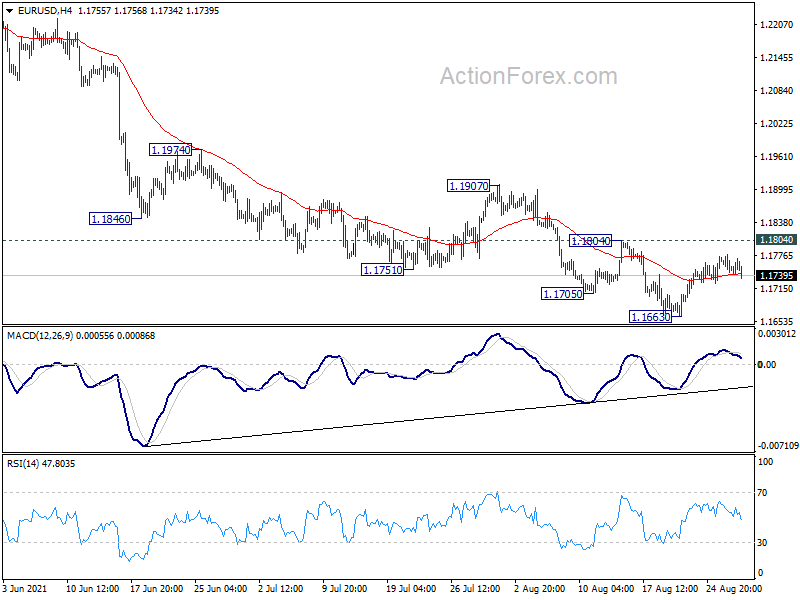
Intraday bias in EUR/USD remains neutral as range trading continues. Another fall cannot be ruled out. But we'd continue to look for strong support from 1.1602/1703 key support zone to bring rebound. On the upside, above 1.1804 resistance will turn bias back to the upside for 1.1907 resistance first. However, sustained break of 1.1602/1703 will carry larger bearish implication and pave the way to 1.1289 fibonacci support.
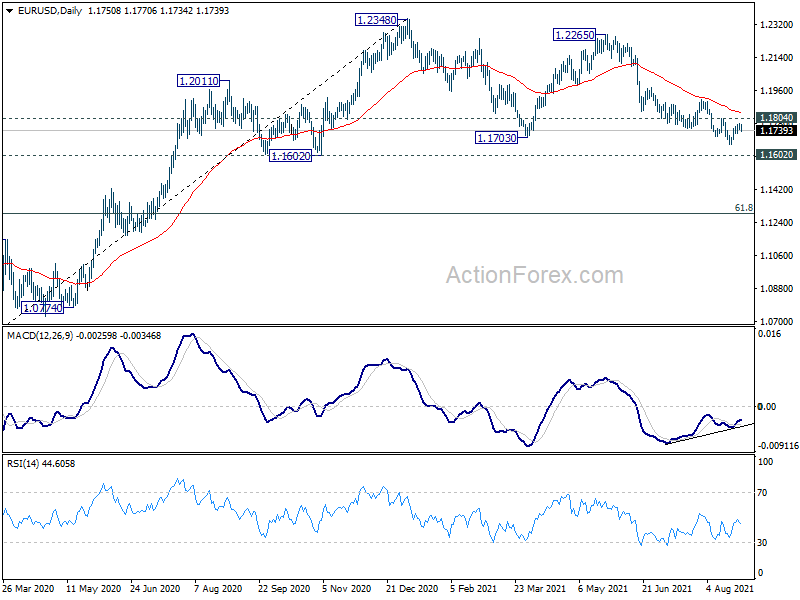
In the bigger picture, rise from 1.0635 is seen as the third leg of the pattern from 1.0339 (2017 low). Further rally remains in favors long as 1.1602 support holds, to cluster resistance at 1.2555 next, (38.2% retracement of 1.6039 to 1.0339 at 1.2516). However sustained break of 1.1602 will argue that the rise from 1.0635 is over, and turn medium term outlook bearish again. Deeper fall would be seen to 61.8% retracement of 1.0635 to 1.2348 at 1.1289 and below.
GBP/USD Mid-Day Outlook
Daily Pivots: (S1) 1.3671; (P) 1.3720; (R1) 1.3749; More...
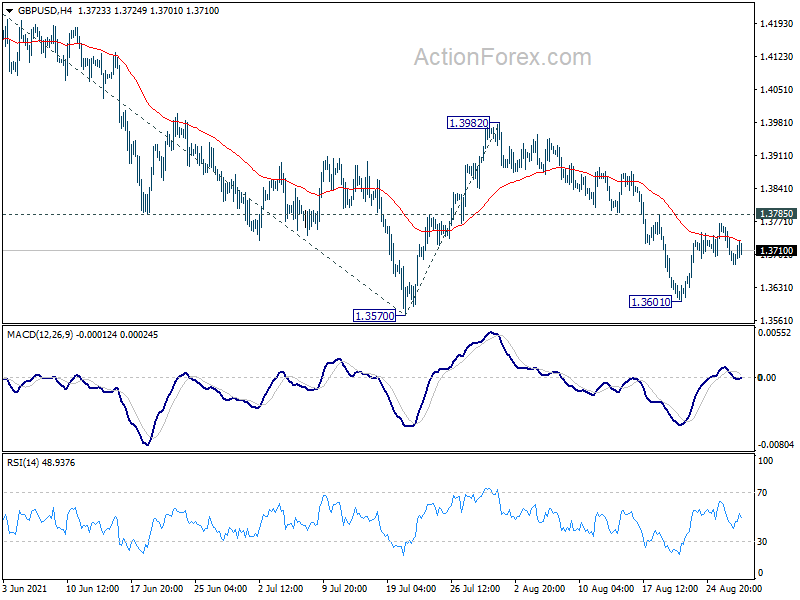
Range trading continues in GBP/USD and intraday bias remains neutral. Another fall is in favor with 1.3785 minor resistance intact. On the downside, firm break of 1.3570 will resume larger fall from 1.4248 to 1.3482 resistance turned support next. Break there will target 100% projection of 1.4248 to 1.3570 from 1.3982 at 1.3304. However, on the upside, break of 1.3785 will turn bias back to the upside for 1.3982 resistance intact.
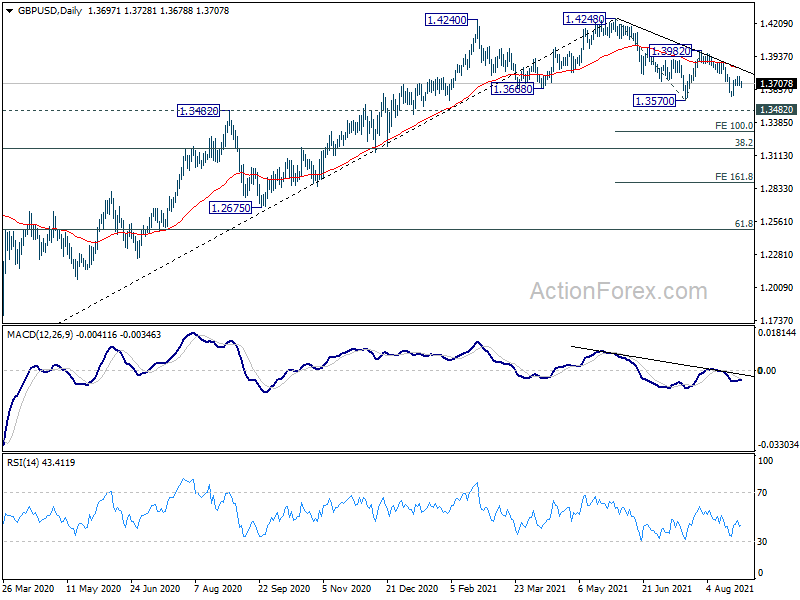
In the bigger picture, current development argues that rise from 1.1409 (2020 low) has completed at 1.4248, after failing 1.4376 resistance. Fall from there could either be correcting the rise form 1.1409, or starting another falling leg inside long term sideway pattern. In either case, sustained break of 1.3482 resistance turned support will target 38.2% retracement of 1.1409 to 1.4248 at 1.3164 first. Break there will pave the way to 61.8% retracement at 1.2493.
USD/CHF Mid-Day Outlook
Daily Pivots: (S1) 0.9141; (P) 0.9167; (R1) 0.9205; More....
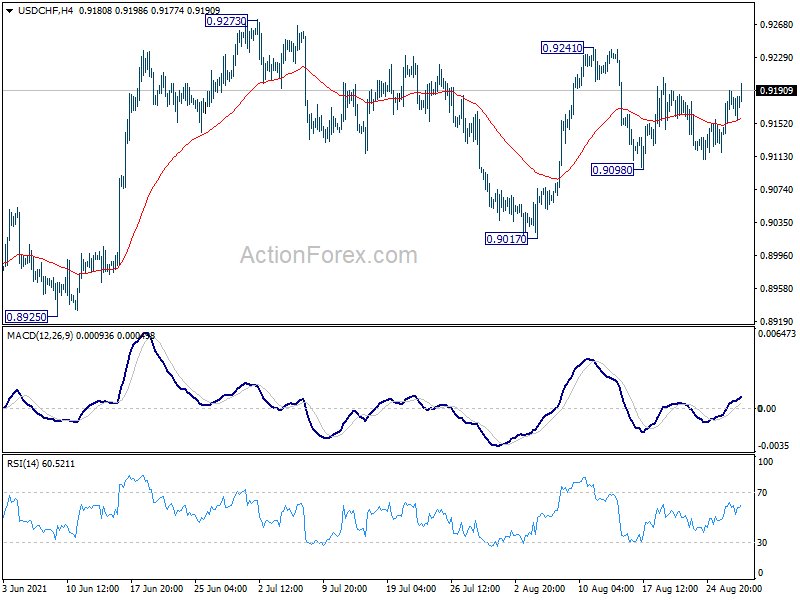
USD/CHF rises mildly in early US session, but stays in range of 0.9098/9241. Intraday bias remains neutral first. On the upside, break of 0.9241 resistance should resume the rise from 0.8925 through 0.9273. On the downside, break of 0.9098 will target 0.9017 support first. Further break there will likely resume the decline from 0.9471 through 0.8925 low.
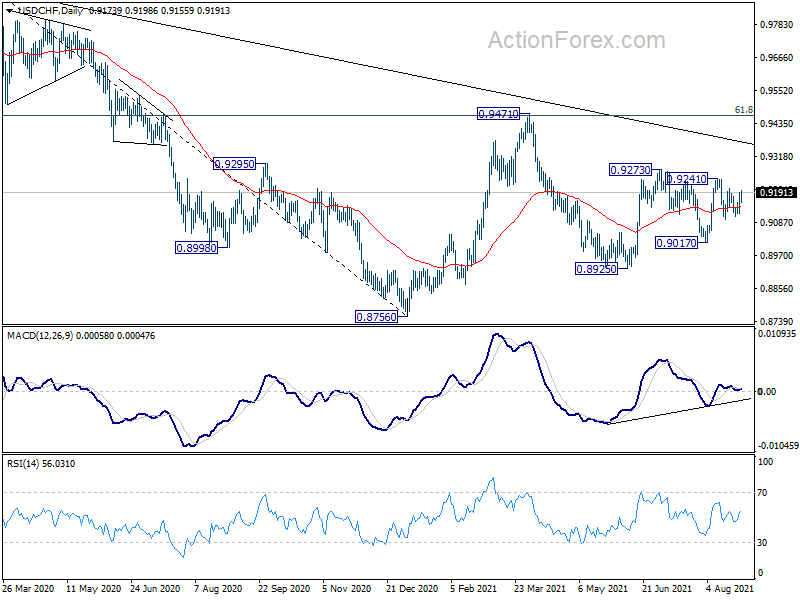
In the bigger picture, the failure to sustain above 55 week EMA (now at 0.9180) retains medium term bearishness in USD/CHF. Break of 0.8925 support should resume the whole decline form 1.0342 (2016 high) through 0.8756 low. However, break of 0.9273 resistance and sustained trading above 55 week EMA will be an early sign of bullish trend reversal. Focus will then turn to 0.9471 resistance for confirmation.
Canadian Dollar Flat ahead of Powell
It has been a volatile week for the Canadian dollar, but the currency is as quiet as a mouse on Friday. Currently, USD/CAD is trading at 1.2683, up 0.02% on the day.
On the economic calendar, Canada’s Raw Materials Price Index (RMPI), rose 2.2%, marking a tenth consecutive monthly increase.
Powell under the big (virtual) lights
Jackson Hole, Wyoming is usually a beehive of activity in late August, as it plays host to central bankers and other key officials. This year, however, Covid-19 has rained on the party. The event has been scaled down from two days to just one, and the meeting will be virtual in order to comply with health restrictions. Still, the event is being closely watched, with the spotlight on Fed Chair Jerome Powell, who will deliver a crucial speech today which could well be a market-mover. Investors remain cautious ahead of the speech, as US data has become softer and the surge in Covid is threatening to derail the nascent global recovery.
Ahead of Powell’s speech, three FOMC members urged the central bank to speed up its plans to taper its bond purchases. The three members, Robert Kaplan, James Bullard and Esther George are on the hawkish side of the Fed and are non-voting FOMC members in 2021, so their choreographed TV interviews did not have much effect on the markets.
The Fed Chair is expected to be more dovish than the threesome and could opt to focus his remarks on the economy and not say much about tapering. This would allow the Fed to assess economic data ahead of the next policy meeting. Whatever Powell says or doesn’t say today, it’s a sure bet that investors will be circling September 22nd, the date of the Fed’s next policy meeting.
USD/CAD Technical
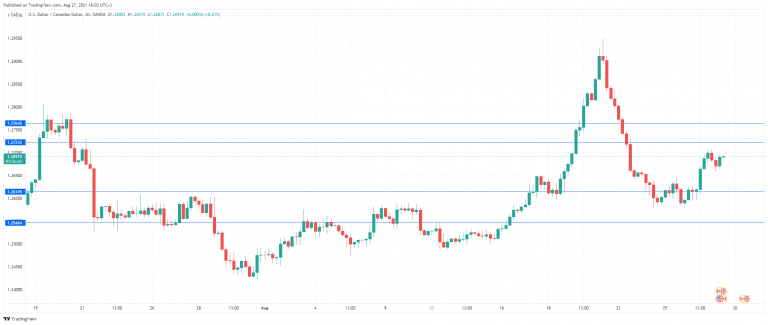
- There is weak resistance at 1.2723. Above, there is resistance at 1.2764
- The next support levels are at 1.2614 and 1.2546
US: Income Up But Real Spending Pulls Back in July
Personal income grew by 1.1% m/m in July, well above the consensus estimate for 0.2% growth. The expanded child tax credit helped lift government transfer receipts (+2.9% m/m) – the highest contributor to growth this month. Compensation of employees (+0.9%) was also robust, as hiring gained momentum in July.
Excluding price changes and taxes, real personal disposable income increased by 0.7% m/m.
Nominal spending rose by 0.3% m/m, a tick lower than 0.4% anticipated by the consensus, but on the back of an upwardly revised June reading of 1.1% (from 1.0% originally). Households continue to rebalance their consumption basket with spending on services improving by 1.0% m/m and spending on goods falling by 1.1% m/m (with a reading of -2.3% m/m for durables and -0.4% for non-durables).
Removing price increases, real spending edged lower by 0.1% m/m, with real services gaining 0.6%, but goods falling 1.6% m/m. Real spending on services remains 2.7% below its pre-pandemic level (while in nominal terms it recovered fully in June).
Prices continued to grow at an above-trend rate in July. The headline PCE deflator rose by 0.4% m/m and 4.2% year-on-year (y/y), while the core PCE deflator – the key metric on the Fed's dashboard – rose 0.3% m/m and held steady at 3.6% y/y.
The personal saving rate rose to 9.6%, remaining well above its pre-pandemic average of 7.5%. Over $2.5 trillion in excess saving, accumulated over the course of the pandemic should push this rate lower as the economy recovers.
Key Implications
The decline in good spending was already telegraphed by this month's downswing in retail sales, leaving the speed of growth in services consumption the only source of uncertainty. Despite an uptick in COVID cases at the end of the month, services spending remained healthy in July, starting off the third quarter in line with our estimates. Still, the strength in spending will remain the focal point of the coming months as the rise in cases and hospitalizations continue to threaten the most vulnerable sector of the economy.
Strict restrictions, comparable to those imposed in the winter, are unlikely. Still, the spread of the Delta variant could still damage the economy: consumers may grow reluctant to spend on still-depressed high-touch services, while workers on the sidelines may feel less compelled to seek employment. In the meantime, the expiration of the pandemic UI benefits on September 4th may add to the injury: according to a recent study, unemployed workers in states that ended emergency UI reduced their weekly spending by 20%.
All eyes now turn to the symposium at Jackson Hole. In his keynote address at 10am, Fed Chair Powell is expected to provide clarity on the Fed's strategy for tapering. Elevated inflation and solid economic momentum make the case for withdrawing emergency-level monetary measures, but uncertainty on the economic outlook may yet stay the Fed's hand.
USD/JPY Mid-Day Outlook
Daily Pivots: (S1) 109.93; (P) 110.08; (R1) 110.23; More...
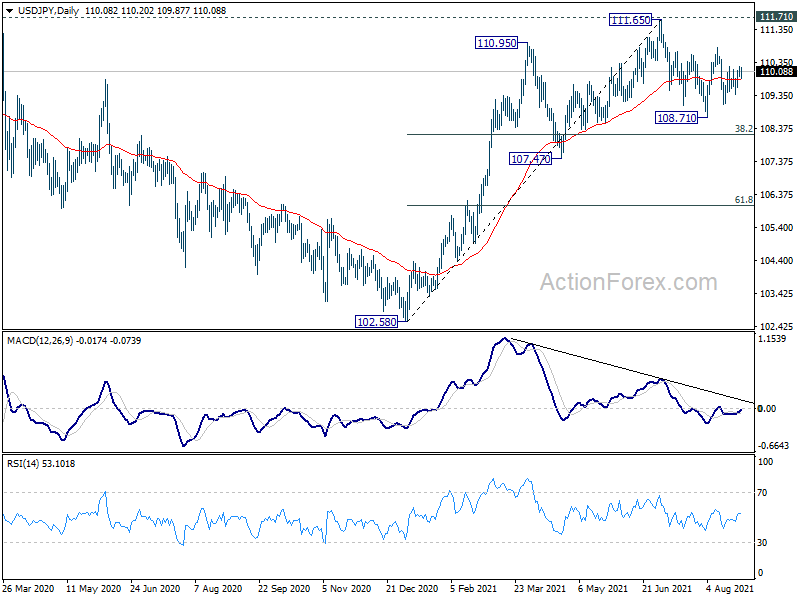
Intraday bias in USD/JPY remains neutral at this point. It's still bounded in sideway trading between 109.10/110.79. On the upside, break of 110.79 will resume the rebound from 108.71 to retest 111.65 high. On the downside, break of 109.10 will target 108.71 support first. Firm break there will resume the decline from 111.65 and target 38.2% retracement of 102.58 to 111.65 at 108.18 next.
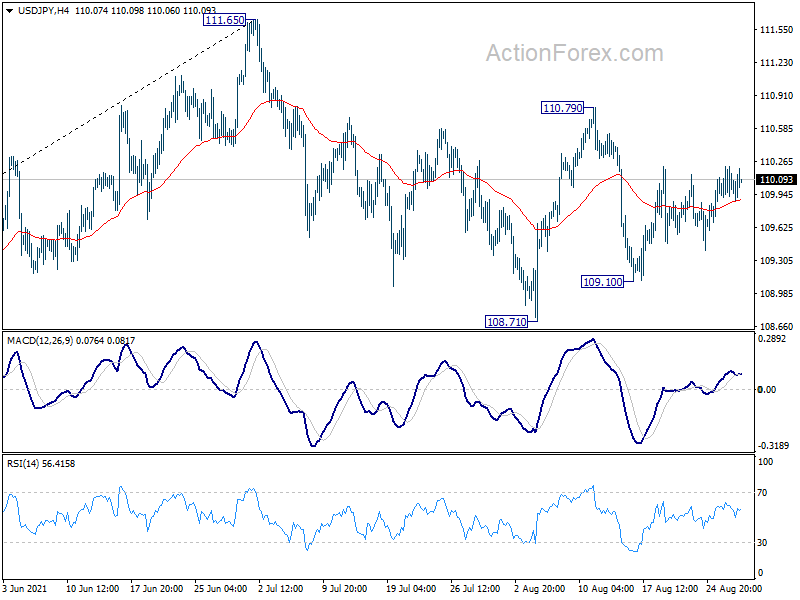
In the bigger picture, medium term outlook is staying neutral with 111.71 resistance intact. The pattern from 101.18 could still extend with another falling leg. Sustained trading below 55 day EMA will bring deeper fall to 107.47 support and below. Nevertheless, strong break of 111.71 resistance will confirm completion of the corrective decline from 118.65 (2016 high). Further rise should then be seen to 114.54 and then 118.65 resistance.
Markets Treading Water Despite Strong PCE Inflation, Powell Next
The overall markets continue to tread water in early US session. Two Fed officials expressed their support for tapering, but investors are probably still waiting for Chair Jerome Powell's Jackson Hole speech to take action. There is also little reaction to stronger than expected PCE inflation data. Commodity currencies are still the strongest ones for the week while Yen, Swiss Franc and Dollar are the weakest. We'll see if the positions change in the final hours.
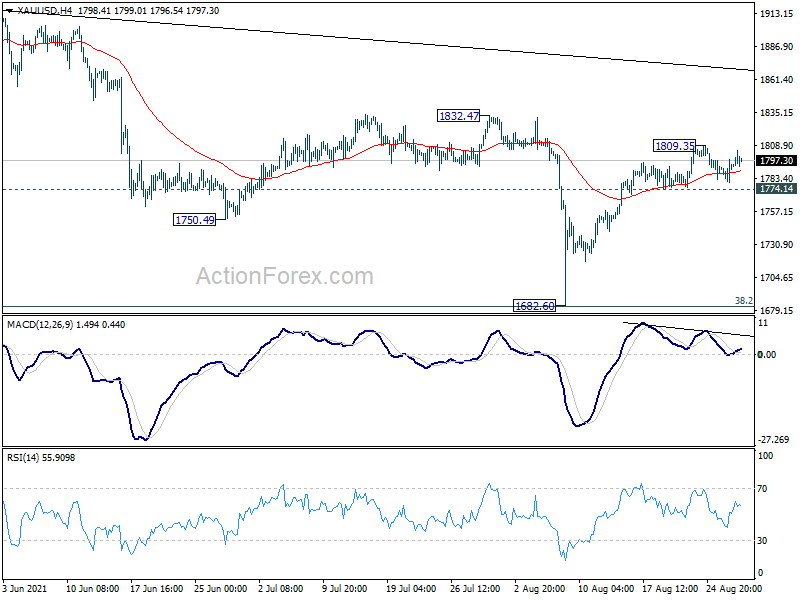
Technically, we'll keep an eye on Gold to double confirm Dollar's next move. The retreat from 1809.35 was contained comfortably above 1744.14 minor support, maintaining mild near term bullishness. Break of 1809.35 will target 1832.47 resistance. Firm break there would be a strong sign of near term bullish reversal and target 1916.30 resistance that. That could affirm Dollar selloff if happens.
In Europe, at the time of writing, FTSE is down -0.09%. DAX is down -0.06%. CAC is down -0.22%. Germany 10-year yield is down -0.0081 at -0.414, still not power through -0.4 handle. Earlier in Asia, Nikkei dropped -0.36%. Hong Kong HSI dropped -0.03%. China Shanghai SSE rose 0.59%. Singapore Strait Times dropped -0.92%.
Fed Bostic comfortable with Oct timeline for tapering
Boston Fed President Raphael Bostic he's "comfortable with an October timeline" for starting tapering if August job growth could match the near 1m number as with the previous two months. Also, once the tapering starts, he was "definitely looking to get this done as quickly as possible", and put a full end to the asset purchases "toward the end of Q1" of 2022.
He also said that the spread of the Delta variant had not changed his economic outlook in any fundamental way. "What I have seen is some suggestion that things are slowing down, but they are still just slowing from extremely high levels. I have not seen big changes in the underlying dynamic," Bostic added.
Fed Harker still supportive of moving the taper along
Philadelphia Fed President Patrick Harker said he's "still supportive of moving the taper along", because he didn't think asset purchase is "doing a whole lot right now". He added that Fed should finish tapering before considering raising interest rates.
He said the Fed has achieved "substantial further progress on inflation" already. There is "some evidence that inflationary pressure "may not be so transitory". Meanwhile, the job market is changing the people's thinking about what a job is has changed too.
US PCE inflation accelerated to 4.2% yoy in Jul, core PCE unchanged at 3.6% yoy
US personal income rose 1.1% or USD 225.9B in July, well above expectation of 0.2%. Spending rose 0.3% or USD 42.2B, slightly below expectation of 0.4%.
Headline PCE accelerated to 4.2% yoy, up from 4.0% yoy, above expectation of 3.5% yoy. Core PCE was unchanged at 3.6% yoy, matched expectations. Energy increased 23.6% yoy while food prices rose 2.4% yoy.
Also released, goods trade deficit narrowed to USD -86.4B in Jul, below expectation of USD -90.8B.
Australia retail sales dropped -2.7% mom in Jul, NSW down -8.9% on lockdown
Australia retail sales dropped -2.7% mom in July, slightly better than expectation of -2.9% mom. Comparing to a year ago, sales also dropped 3.1% yoy.
Ben James, Director of Quarterly Economy Wide Surveys, said: "Lockdowns and stay-at-home orders in many parts of Australia continued to impact retail trade in July, with many non-essential retail businesses closing their physical stores. In particular, the first full month of lockdown in New South Wales, following the Delta outbreak in June, saw retail turnover in the state fall 8.9 per cent. This was the largest fall of any state and territory since August 2020."
USD/JPY Mid-Day Outlook
Daily Pivots: (S1) 109.93; (P) 110.08; (R1) 110.23; More...
Intraday bias in USD/JPY remains neutral at this point. It's still bounded in sideway trading between 109.10/110.79. On the upside, break of 110.79 will resume the rebound from 108.71 to retest 111.65 high. On the downside, break of 109.10 will target 108.71 support first. Firm break there will resume the decline from 111.65 and target 38.2% retracement of 102.58 to 111.65 at 108.18 next.
In the bigger picture, medium term outlook is staying neutral with 111.71 resistance intact. The pattern from 101.18 could still extend with another falling leg. Sustained trading below 55 day EMA will bring deeper fall to 107.47 support and below. Nevertheless, strong break of 111.71 resistance will confirm completion of the corrective decline from 118.65 (2016 high). Further rise should then be seen to 114.54 and then 118.65 resistance.
Economic Indicators Update
| GMT | Ccy | Events | Actual | Forecast | Previous | Revised |
|---|---|---|---|---|---|---|
| 23:30 | JPY | Tokyo CPI Core Y/Y Aug | 0.00% | -0.10% | 0.10% | |
| 01:30 | AUD | Retail Sales M/M Jul | -2.70% | -2.90% | -1.80% | |
| 12:30 | CAD | Industrial Product Price M/M Jul | -0.40% | 1.40% | 0.00% | |
| 12:30 | CAD | Raw Material Price Index M/M Jul | 2.20% | 2.70% | 3.90% | |
| 12:30 | USD | Personal Income Jul | 1.10% | 0.20% | 0.10% | 0.20% |
| 12:30 | USD | Personal Spending Jul | 0.30% | 1.10% | 1.00% | 1.10% |
| 12:30 | USD | PCE Price Index M/M Jul | 0.40% | 0.20% | 0.50% | |
| 12:30 | USD | PCE Price Index Y/Y Jul | 4.20% | 3.50% | 4.00% | |
| 12:30 | USD | Core PCE Price Index M/M Jul | 0.30% | 0.40% | 0.40% | 0.50% |
| 12:30 | USD | Core PCE Price Index Y/Y Jul | 3.60% | 3.60% | 3.50% | 3.60% |
| 12:30 | USD | Wholesale Inventories Jul P | 0.60% | 1.00% | 1.10% | 1.20% |
| 12:30 | USD | Goods Trade Balance (USD) Jul P | -86.4B | -90.8B | -91.2B | -93.2B |
| 14:00 | USD | Michigan Consumer Sentiment Aug F | 71.5 | 70.2 |