Sample Category Title
Loonie’s Outlook Remains Hinged on Crude Oil Price
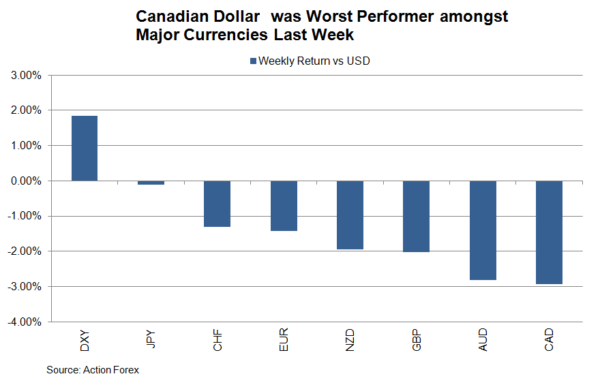
Commodity currencies suffered last week but Canadian dollar was the worst performer. Loonie declined -2.93% in the past week, making it the weakest amongst major currency pairs. Other than the broad-based strength in US dollar amidst speculations of early taper by the Fed, the sharp selloff in crude oil price was the ultimate reason driving loonie lower (its rebound yesterday was also in line with that of crude oil prices). For the months ahead, renewed uncertainty of the pandemic, concerns over global economic recovery and weakness in Chinese oil demand are expected to weigh on crude oil price. This should have important implications on the outlook of USDCAD.
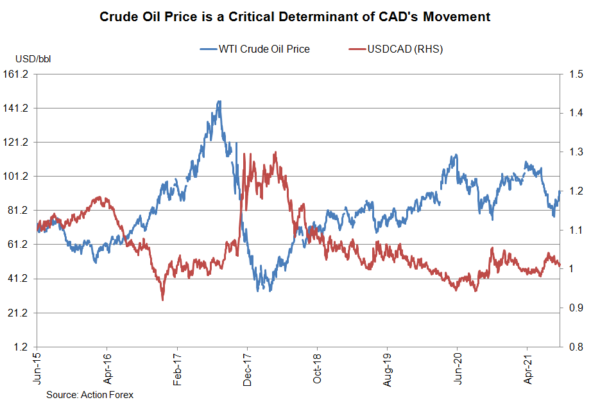
Crude Oil Price as Key Driver of USDCAD
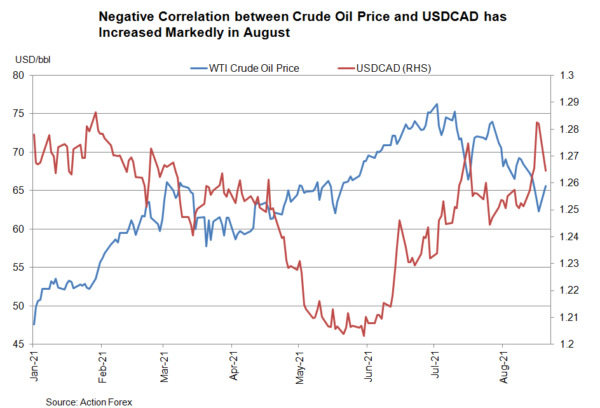
The charts below show that the negative correlation between crude oil price and USDCAD is strong. Indeed, the correlation in the first 3 weeks of August jumped to -0.92, compared with -0.83 quarter-to-date and 0.54 year-to-date. As the correlation coefficient between two variables ranges from -1 to +1, -0.92 indicates a very strong relationship. The outlook of crude oil price thus has important indication on the loonie. Oil’s rebound these 2 days is more of bargain-hunting after the sharp selloff in the previous week than improvement of the fundamentals. Lessened hope that Fed Chair Jerome Powell would deliver something new in his Jackson Hole speech and a weaker-than-expect US PMI have trimmed tapering speculations, thus dampening USD strength and lifting risk assets. In the months ahead, the world would remain haunted by the delta variant and the economic impacts of resurgence of the pandemic. China reported no new locally transmitted symptomatic coronavirus cases on Monday, the first time since July. However, the lockdown and restrictive measures imposed over the past month, together with the massive flood, would have prolonged impacts on the country’s recovery. We believe these would affect the country’s oil demand in the second half of the year.
 Yield Differential's Influence Still Moderately Strong
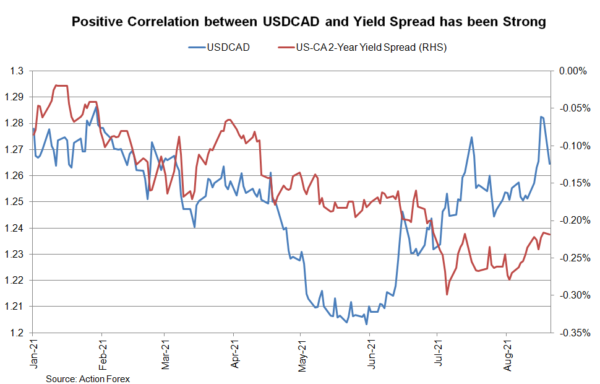
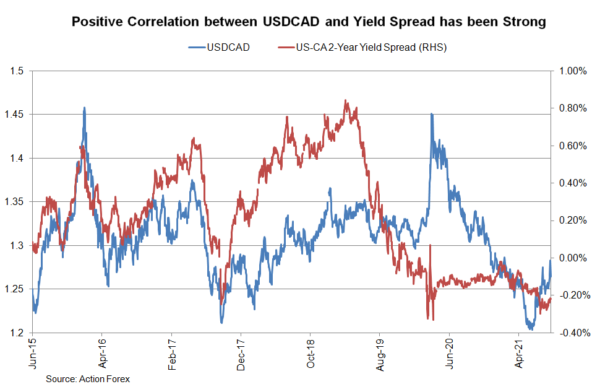
Another driver of USDCAD is yield differential. Correlation between US-Canada 2-year Treasury yield differential and USDCAD stood at a moderately-strong level of +0.69, compared with +0.21 quarter-to-date and +0.37 year-to-date. US-Canada 2-year Treasury yield differential apparently rose in August amidst hopes of Fed’s tightening. This helped support USDCAD. After the Jackson Hole symposium, the next key events that could affect yield differential are BOC meeting on September 8 and FOMC meeting on September 21-22.
The market was slightly disappointed by the BOC for not pushing forward the first rate hike. While continuing to reduce the target pace of weekly asset purchases to CAD2B, policymakers retained the projection that the first rate hike would be in 2H22. Yet, the BOC significantly upgraded both GDP growth and inflation forecasts. The economy was expected to expand by an annualized +2% q/q in 2Q21 and +7.3% in 3Q21. GDP growth for 4Q22 was upgraded by +1.1 ppt to +4.2%. Inflation was projected to improve to +3% y/y and +2.4% in 2021 and 2022 respectively. While maintaining the view that strong inflation was transitory, policymakers noted that the “persistence and magnitude” of the transitory factors pushing up inflation were “uncertain” and would be “monitored closely”.
Concerning the Fed, the July minutes revealed that “most” members judged that it could be appropriate to start reducing the pace of asset purchases “this year”, raising hopes that a formal announcement of QE tapering could be made in November, and the entire QE program would end in September 2022. This should be followed by the first Fed funds rate hike.
With monetary policy adjustment unlikely, the focus of the September meetings for both central bank would be the forward guidance on the future monetary policy outlook and economic assessments in light of the widespread delta variant.
What Will the Fed Signal at Jackson Hole?
The Federal Reserve’s annual economic symposium will come to a crescendo when Chairman Powell speaks on Friday at 14:00 GMT. There was a lot of buzz that the Fed would use this event to warn it will dial back its asset purchases soon, but markets are thinking otherwise now thanks to the raging Delta outbreak. Despite the delay, it’s only a matter of time until the Fed tapers, which is what matters most for the dollar.
Going virtual
The US economic machine is starting to heat up. Consumption has been impressive, inflation is scorching hot, and lost jobs are coming back at an incredible pace. In fact, the American economy is already bigger than it was before the crisis hit and Congress is about to unleash another massive round of spending.
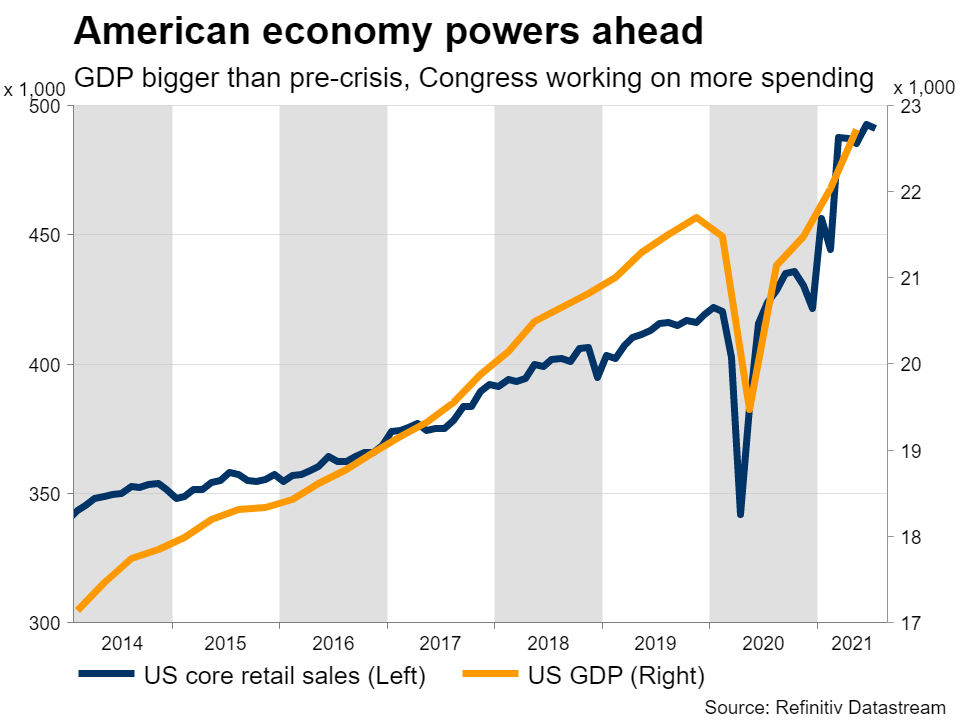
And yet, markets seem to have concluded Chairman Powell will play it slow this week, postponing any real decisions on tapering until the next Fed meeting in September. Powell recently downplayed the Delta outbreak as being a major economic risk, but infections have soared since then, forcing the Fed to take its Jackson Hole symposium virtual.
This was seen as a signal in itself. If policymakers can’t even attend their own summer camp in person, that highlights the various risks, lowering the chances of an immediate taper.
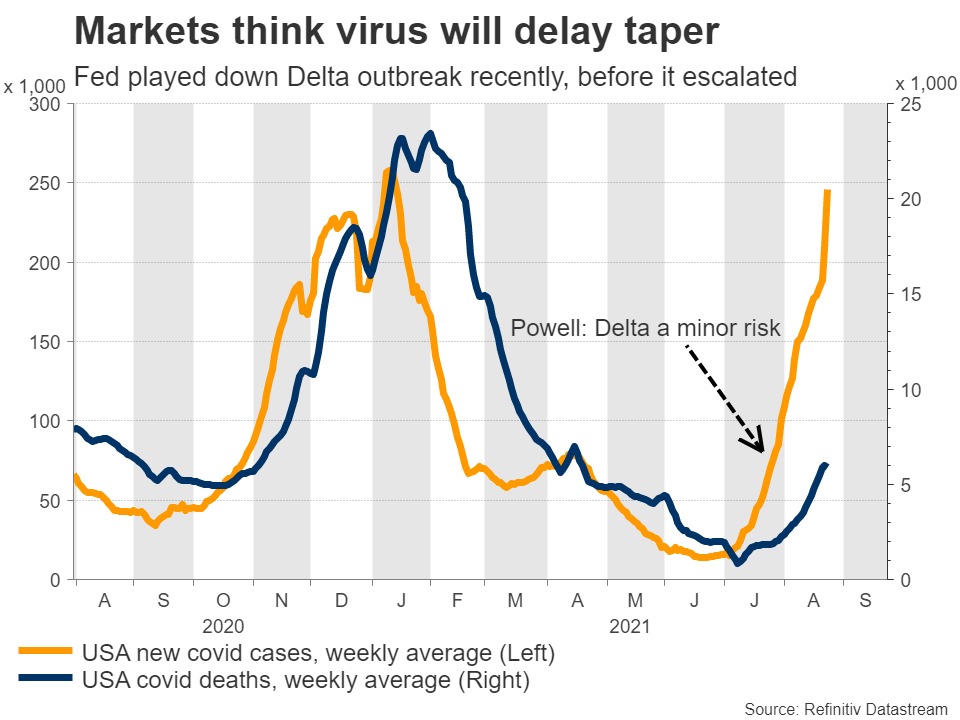
Echoing this view recently was the Fed’s Kaplan. He’s been the biggest advocate of announcing tapering in September, but even he put water in his wine last week, saying he could adjust his views if the Delta outbreak hits economic growth.
Stalling
Therefore, it looks like Powell won’t be committing to anything this week. The most likely scenario is that he hedges his bets, indicating that the normalization process could begin later this year, although that will depend on the evolution of the Delta outbreak.
There are also some early signs that the US economy is losing momentum, with the latest composite Markit PMI for instance falling sharply in August as supply chain disruptions worsened and consumers turned more defensive.
That said, the wheels are not coming off either. A minor economic slowdown is only natural now that some of the earlier government support programs are rolling off, especially with the virus flaring up. It’s only a speed bump, so far.
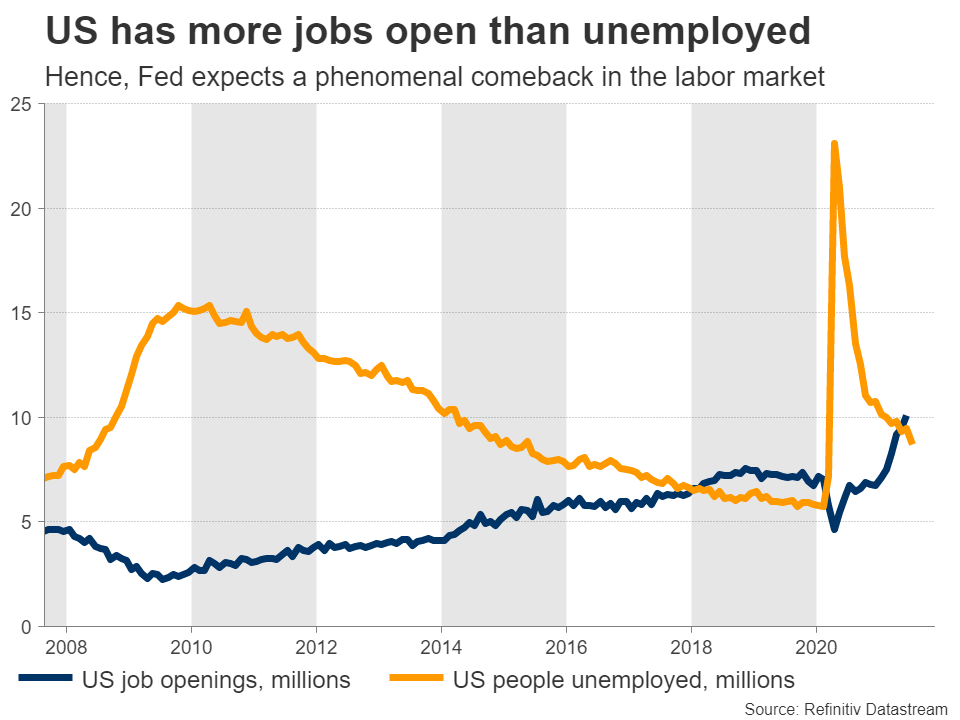
It now looks like September might be a little too early for the Fed to push the taper button, unless the next jobs report is absolutely sensational. But November is still very much in play. We’ll have a good sense of whether the Delta wave has kneecapped economic activity by then, and Congress may have already delivered more fiscal juice to boost growth.
Divergence
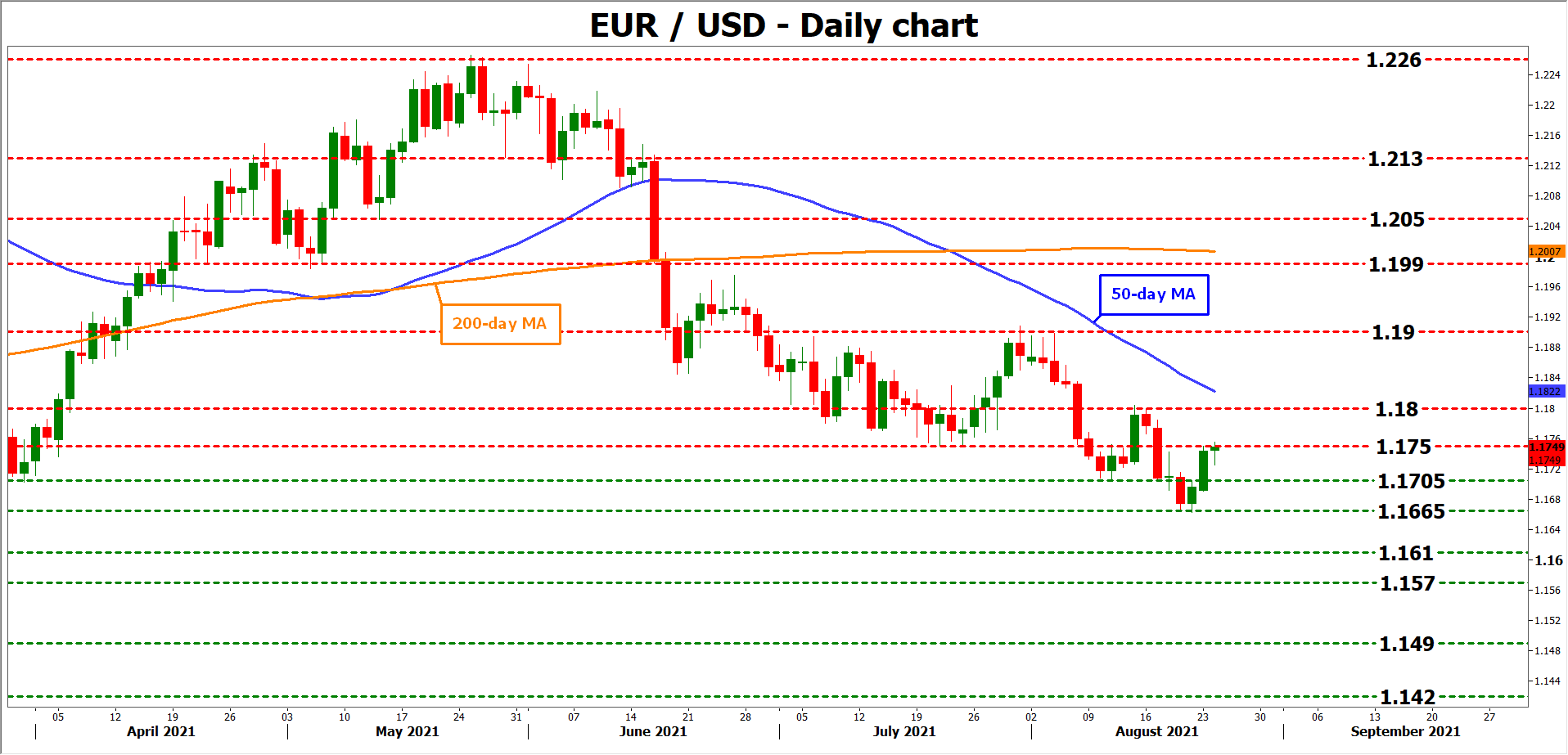
Turning to the markets, if Powell doesn’t signal anything is coming in September, the dollar will likely take a hit. However, any weakness could be minor, as investors seem to expect that much already. In this case, euro/dollar could pierce above the 1.1750 zone and head towards the 1.1800 region.
In the bigger picture, it doesn’t really matter whether tapering is announced in September, November, or even December. It’s only a matter of time.
The crucial part is that the Fed is years ahead of the European Central Bank and the Bank of Japan in the normalization race. Over time, this could allow US yields to rise faster, making the dollar more attractive against the euro and yen as rate differentials widen to its benefit and investors rediscover carry trades.
This could ultimately push euro/dollar below 1.1705, and turn the spotlight to the recent low of 1.1665.
Finally, there’s also a barrage of US data releases coming up. Durable goods orders for July are out on Wednesday, before the second estimate of GDP for Q2 on Thursday. Personal income and consumption numbers, alongside the Fed’s favorite inflation metric for July, will hit the markets before Powell speaks on Friday.
Aussie Finds Some Love ahead of Q2 Data but Lockdown Pain Not Over
The Australian dollar has started the week on a positive footing, ending a five-session losing streak. As the market turmoil from the Delta variant eases somewhat, there might be additional support in store for the aussie from the upcoming economic releases for the second quarter over the coming days. However, investors are unlikely to be able to hide away from all the gloom for too long as Australia’s lockdowns look set to last for some time.
RBA tapering not derailed by lockdowns…yet
It will be a busy end to August and an anxious start to September in Australia as a raft of Q2 indicators are on the way. Not so long ago, the data might have been seen as holding some significance for the Reserve Bank of Australia’s forthcoming policy meeting on September 7. However, following the dramatic worsening of the virus situation, the data are now almost certainly outdated.
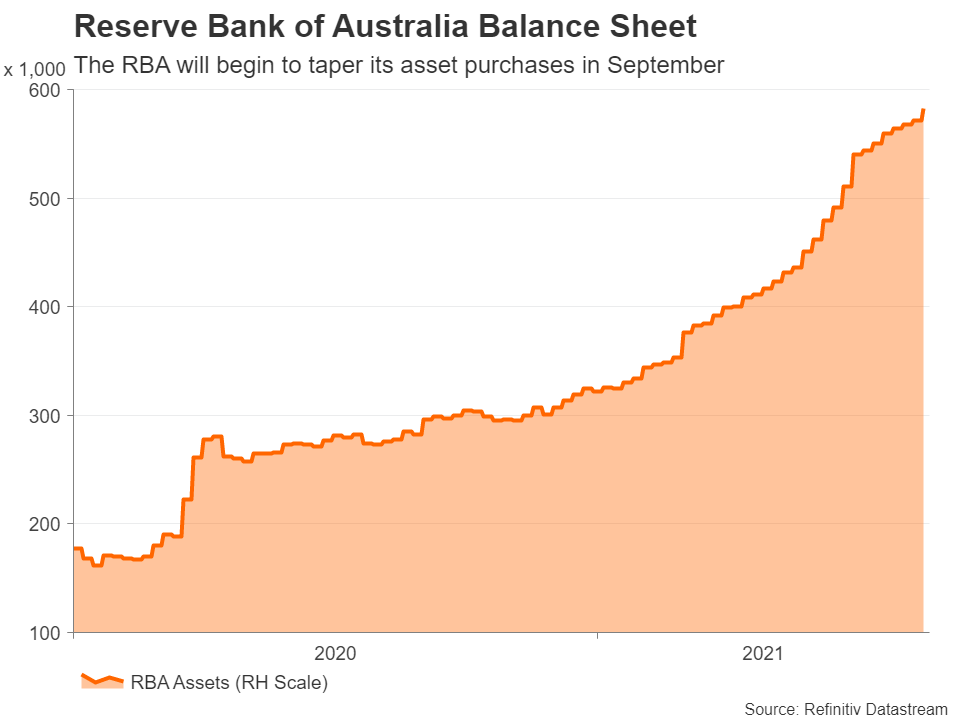
At its August meeting, the RBA had signalled it won’t be putting its tapering plans on hold even as the Delta outbreak unfolded and will go ahead and reduce its bond purchases to A$4 billion a week in September. But the minutes of that meeting published last week were slightly less hawkish than the statement, suggesting that further tapering in November when the QE pace will next be reviewed is looking less likely.
Vaccines seen as best hope of beating Delta variant
The way things are headed right now, policymakers could even ramp their bond purchases back up again in November. Australia’s prime minister, Scott Morrison, made it clear on Monday that lockdowns won’t be eased until the country’s vaccination rate reaches 70%. With just over 50% currently having received at least one dose, it could take several more weeks if not months before hitting that target, dampening the prospect of a strong economic rebound in Q4.
Nevertheless, with policymakers mostly relying on business surveys for up-to-date readings on the economy and the hard data so far not being particularly dire, the Q2 numbers might help stave off a notable dovish tilt at the September meeting. In the July jobs report, employment rose slightly, defying expectations for a large drop.
Flurry of Q2 data on the way but will they matter?
There’s not likely to be much evidence of lockdowns hurting the economy in Thursday’s data either. Capital expenditure figures due at 01:30 GMT are expected to show business spending growing by 2.5% during the second quarter, levelling off from a post-pandemic surge of 6.3% in the previous period. The following Tuesday, attention will turn to net exports contribution before the Q2 GDP print comes out on Wednesday, September 1.
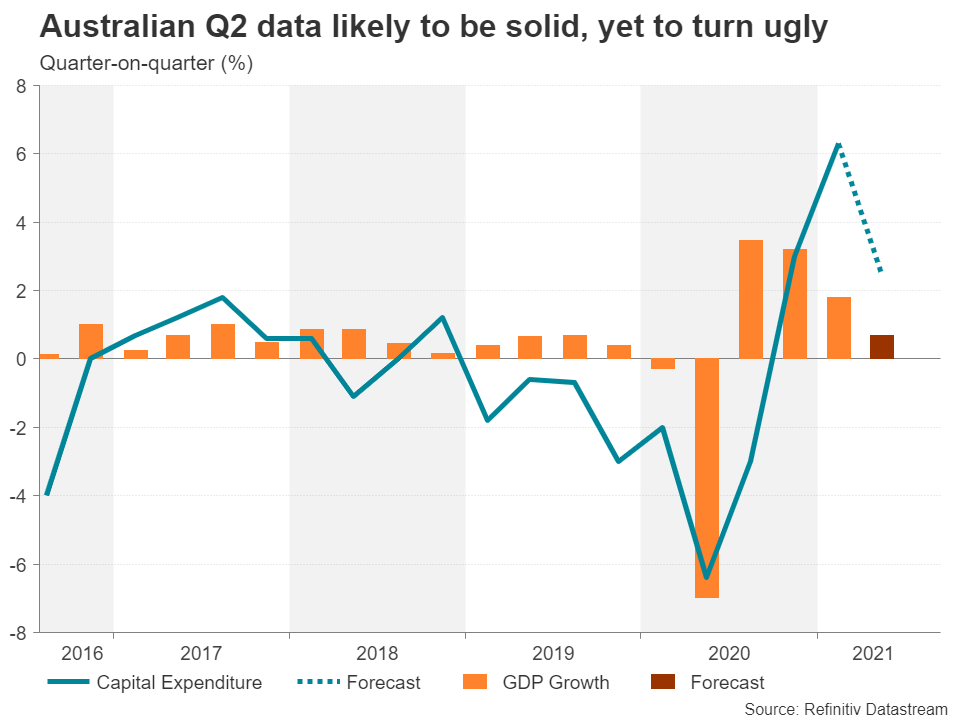
Australia’s economy is projected to have expanded by 0.7% quarter-on-quarter in the three months to June. While this wouldn’t be as strong as in prior quarters when the economy was still recovering from the 2020 lockdowns, it’s a solid rate by pre-pandemic standards. If growth surprises to the upside, this might help the RBA buy some time before being forced to make a complete U-turn on its tapering plans.
Aussie bounces back but downside risks persist
It could also provide some much needed support to aussie/dollar, which plummeted to a 9½-month low of $0.7104 last Friday. The pair is currently testing the 78.6% Fibonacci retracement of the November 2020 – February 2021 upleg at $0.7208. A convincing break above it would turn the spotlight on the highly congested region of the 61.8% Fibonacci of $0.7378.
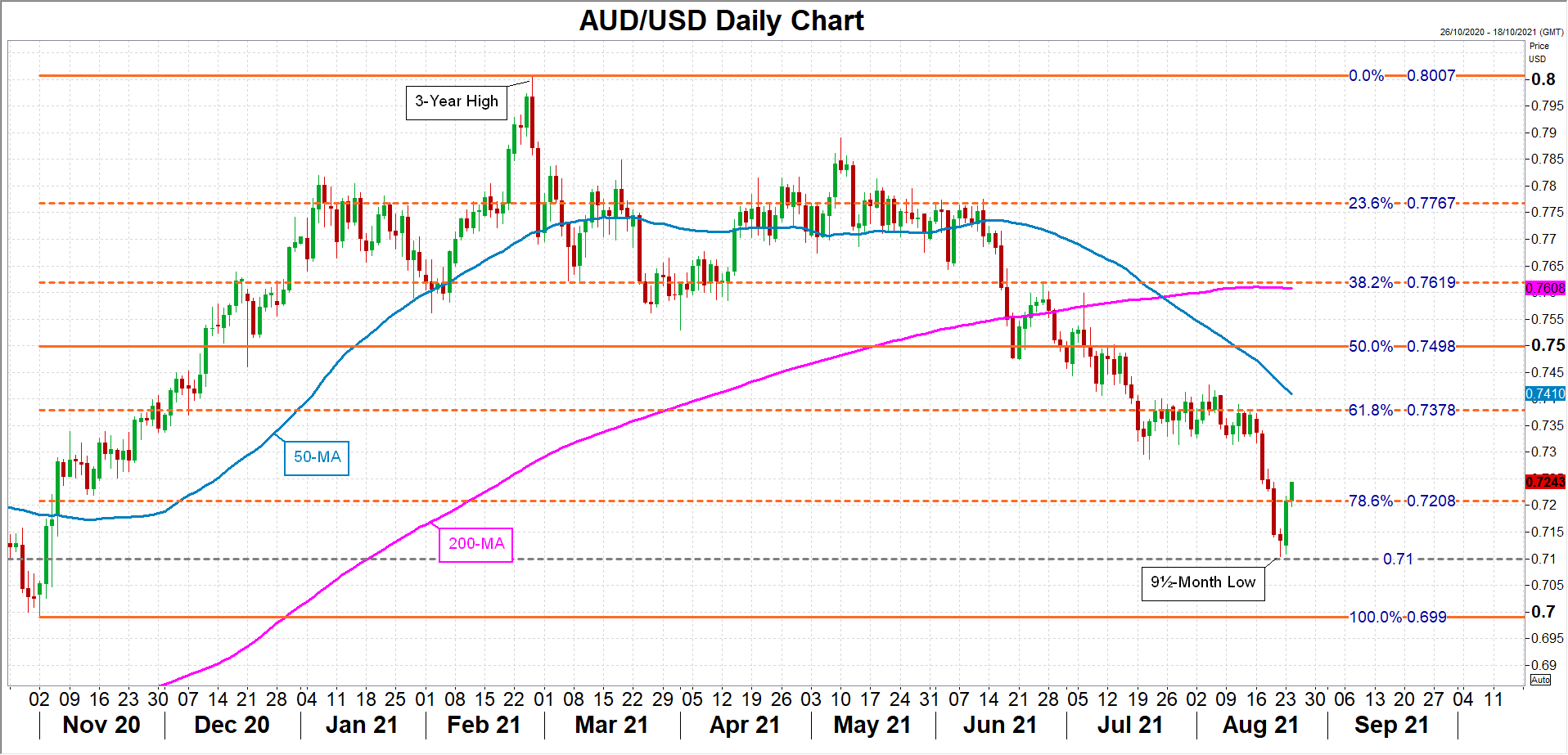
However, steeper gains would be difficult unless the virus picture improves substantially, or the US dollar suffers a major wobble of its own. Otherwise, it could only be a matter of time before the aussie slips below the $0.71 level, risking a revisit of the November trough of $0.6990.
GBP/USD: Recovery Started to Lose Traction after Hitting Correction Target
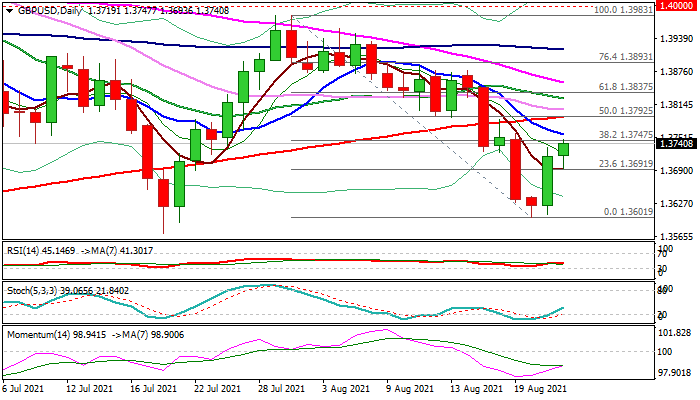
Last Friday’s hammer candle and Monday’s strong rebound (0.7% for the day) completed a reversal pattern on daily chart, but fresh gains started to show a signs of fatigue after hitting correction target at 1.3747 (Fibo 38.2% of 1.3983/1.3601 descend) on Tuesday.
Tuesday’s action is so far holding within a 50-pips range and shaped in a Doji candle, signaling indecision.
Daily studies are mixed as MA’s remain in full bearish setup while stochastic and momentum are in steep ascend, though the latter is still deeply in the negative territory.
Clear break of 1.3747 pivot would generate initial signal of recovery extension which would require a confirmation on break through significant barriers at 1.3792/96 (200DMA / base of falling thick daily cloud) to spark stronger correction.
Conversely, failure to clear 1.3745 Fibo barrier would keep the downside vulnerable and keep in play risk of retesting Aug low (1.3601).
Res: 1.3747; 1.3757; 1.3792; 1.3825
Sup: 1.3691; 1.3640; 1.3601; 1.3571
Australian Dollar Bounces Back, Breaks Past 72
Australian dollar rebounds after slide
The Australian dollar has shown strong volatility of late. Last week, the Aussie fell 3.1%, as weak risk appetite and hawkish FOMC minutes propelled the US dollar sharply higher, especially against risk currencies like the Australian dollar. However, the greenback rally has run out of steam and AUD/USD has bounced back with gains of 1.45% this week, recovering about half of last week’s losses. The Australian dollar has benefited from an improvement in risk appetite this week, as China has successfully contained the latest Covid outbreak.
The week started with Australian PMIs for August, and the results were underwhelming. Manufacturing PMI slowed to 51.8, down sharply from 56.8 a month earlier. This is just above the neutral 50-level and points to very weak expansion. The services sector is in worse shape, with two successive readings in contraction territory. The August read fell to 43.3, down from 44.2 points. The downbeat PMI reports are a result of the lockdowns which have been imposed across much of Australia due to a spike in Covid infections. The outbreak has centered around the state of New South Wales, which prompted the state government to extend the lockdown in Sydney to the end of September. The move could push Australia’s weak economy into recession, which in turn would sour sentiment towards the Australian dollar.
The Australian dollar has managed to move higher this week, despite the weak PMIs. However, if upcoming economic data underperforms, these gains could be short-lived. The RBA will have little reason to tighten its bond purchase programme, let alone contemplate rate hikes, until the economy shows significant improvement.
AUD/USD Technical
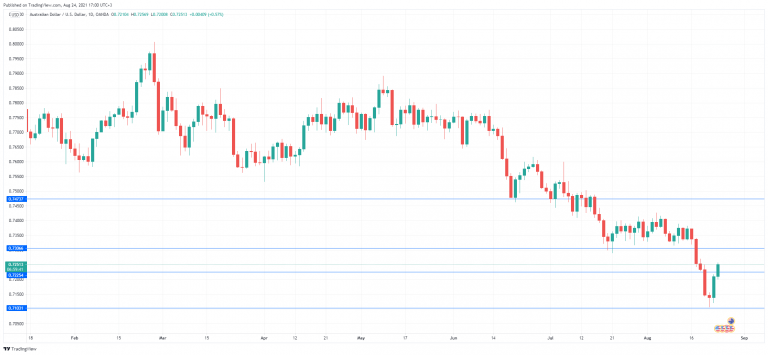
- AUD is testing resistance at 0.7225. Above, there is resistance at 0.7306
- On the downside, the next line of support is at 0.7103.
Sunset Market Commentary
Markets
A vibrant performance of Asian stock markets and an upward revision to German Q2 GDP data (1.6% Q/Q from 1.5% Q/Q) set the tone for higher EU equities and EU rates at the European opening bell. It turned out to be an illusion though that it would last throughout dealings. Opening moves were rapidly erased with main FI and stock markets switching sides afterwards. A near empty eco calendar and lack of central bank rhetoric obviously didn’t impact intraday trading dynamics. European stock markets trade around 0.5% weaker at the time of writing. US Treasuries underperform in the run-up to tonight’s start of the US Treasury’s end-of-month refinancing operation ($60bn 2-yr Note). The US yield curve bear steepened with yields adding 0.4 bps (2-yr) to 2.8 bps (30-yr). German yields are slightly higher with the belly of the curve slightly underperforming. The SPD for the first time polled stronger than the CDU/CSU bloc, but it didn’t draw markets’ attention even as national elections are only one month away (September 26). Too many factors have potential market disturbing potential in between, including Powell’s Jackson Hole speech (Aug 27), EMU CPI (Aug 31), US payrolls (Sep 3), the ECB meeting (Sep 9) and the Fed meeting (Sep 22). Commodity markets did manage to add to yesterday’s rebound with iron ore (+2%) and Brent crude (+1.5%) amongst the outperformers. Brent prices briefly ticked $70/b, erasing last week’s sudden slide towards $65/b. Commodity currencies extend a similar U-turn with EUR/NOK trading back below 10.40 (compared to 10.60 weekly close) or NZD/USD back at 0.6950 (from 0.68). Hawkish comments from RNBZ member Hawkesby (I kid you not) add to RBNZ strength. He said that a 50 bps rate hike was discussed at this month’s RBNZ meeting where the central bank for communication rather than economic reasons decided to opt for delaying the tightening cycle instead. The single currency retained the upper hand over USD and GBP. EUR/USD changes hands around 1.1750 with EUR/GBP at 0.8570. As mentioned above, the waiting game continues…
News Headlines
The Czech Finance Ministry published new economic forecasts. Growth was upwardly revised for this and next year to respectively 3.2% and 4.2%, up from 3.1% and 3.7% at is previous forecast in April. The expansion is expected to be mainly driven by domestic demand/consumption. This also translates in better public finance data. The Government budget deficit is now expected at 7.7% in 2021 (from 8.8%) and at 5.9% in 2022 (from 5.0%). Even so, the general government debt remains on an upward trajectory rising from 43.5 this year, to 46.2% next year and 49.2% in 2023, but debt levels are also downwardly revised from the April forecast. The Ministry also sees higher average CPI inflation at 3.2% this year (from 2.5%), at 3.5% next year and at 2.4% in 2023. The Czech koruna intraday strengthen temporary below EUR/CZK 25.50 on a constructive risk sentiment but failed to hold on to its gains despite the positive government outlook (currently EUR/CZK 25.52).
The national bank of Hungary as expected raised its base rate by 0.30% to 1.50%. The overnight deposit rate (0.55%) and the collateralized lending rate (2.45%) were raised by a similar amount. In light of the September Inflation Report, the MPC will perform a comprehensive assessment of the results achieved by the cycle of interest rate hikes, and will identify risks to the inflation outlook. The Monetary Council also decided to gradually begin withdrawing the government securities purchase programme. In the future, the Monetary Council will not set a revision limit applicable to the entire stock purchased under the programme. Instead, the Council will set a target amount for weekly purchases. As a first step, the MNB’s purchases will decrease from a weekly amount of HUF 60 billion to HUF 50 billion. The forint extended gains after the policy decision. EUR/HUF currently trades in the 348.70 area.
Rebound Stalls ahead of Jackson Hole
The week got off to a strong start on Monday but momentum is already waning, with European stocks a little flat and US futures only marginally higher.
Investors were keen to buy dips at the start of the week and capitalise on last weeks sell-off, as China successfully contained the virus outbreak and the FDA gave full approval to the Pfizer-BioNTech vaccine. Chinese growth fears had weighed on risk appetite in recent weeks but it seems the draconian approach is paying off once more.
This provided some relief yesterday, particularly in commodity markets which soared on the back of the news. While a very positive development, other countries are taking a much less strict approach and cases are surging which will likely weigh on growth into the end of the year.
Vaccine efforts should ensure full lockdowns are a thing of the past for many of these countries but the recovery will no doubt slow, regardless, as some restrictions are imposed and behaviours change.
It will be interesting to see whether the Pfizer-BioNTech vaccine getting full FDA approval will significantly boost vaccine rates, with some that were previously sceptical perhaps feeling more comfortable accepting it. It's become such a polarized issue in many countries now, it will still likely not be enough to convince some people but any gains will aid the fight against the virus.
As far as today is concerned, it's likely to remain quiet, with the economic calendar looking very thin and lacking any major releases.
Stock markets may get another helping hand from Jerome Powell this week when he appears at the annual Jackson Hole event. Until recently, this looked the perfect platform to lay the groundwork for a September taper announcement but some concerning economic releases and a surge in delta cases in the US may see the Fed adopt a more cautious stance for now.
Any suggestion from Powell that a taper may not happen this year could give these markets another boost, with it having until recently looked almost guaranteed. The more cautious approach is likely to be adopted by many central banks in the coming months.
Oil buoyed by China virus containment
Oil prices are making gains once more after a fantastic start to the week. WTI is 1.5% higher after jumping around 6% on Monday as China reported no new Covid cases. Prices have been crushed in recent weeks as a result of the uncertain growth outlook for the worlds largest crude importer so Monday's news was naturally very bullish.
WTI remains around 11% off its July highs so there's still plenty of ground to make up. Of course, the global outlook has probably become more uncertain in that time as a result of numerous delta surges, including in the US. So we may not see it fully recoup those losses in the near term.
But there is still room to add to the promising start to the week. It's seeing some resistance around $67 today and we may see similar around $68. The big test will come around $70, a break of which could be very bullish.
Powell holds the key to gold fortunes
Gold's resurgence has stalled on Tuesday after it was caught up in the commodity surge at the start of the week. A softer dollar gave commodities a helping hand as risk appetite improved significantly. Gold has found support around $1,800 this morning which is encouraging although bigger challenges lie ahead.
While it's arguably come as a surprise to see gold recapture $1,800, the big test will be $1,833 where it failed on a few occasions in July and early August. A move above this level would be very bullish and may suggest taper expectations have been pared back. Powell may offer more insight later in the week and any suggestion that it's less likely this year, particularly in September, could be the catalyst for a breakout.
If gold does break through its recent ceiling, further resistance could lie around $1,860, with the summer highs above $1,900 then getting a lot of attention.
Bitcoin struggles to gather momentum after breakout
Bitcoin is back below $50,000, shortly after the breakout got crypto bulls very excited. Interestingly, the breakout failed to generate renewed momentum which may suggest the rally is running on fumes. That's no bad thing in the longer run, with there being a lot of optimism out there about cryptos. But it may again suggest a correction is coming.
The key resistance level appears to be $51,000 - the 61.8% retracement of the June highs to August lows. A move above here could see momentum shift back in bitcoins favour, at which point talk of new highs will be inevitable. As will the hopeful predictions of how high it can reach this time.
EUR/USD Mid-Day Outlook
Daily Pivots: (S1) 1.1709; (P) 1.1729; (R1) 1.1766; More...
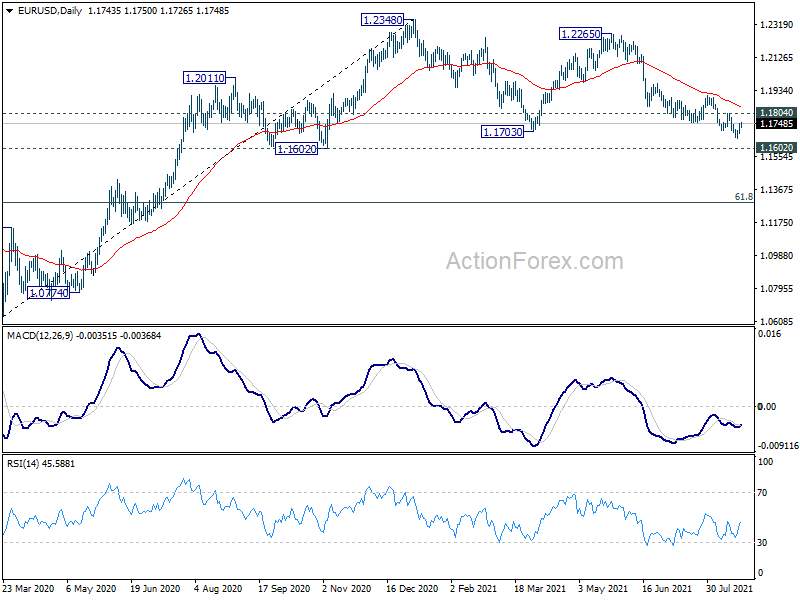
Intraday bias in EUR/USD stays neutral and outlook is unchanged. Another fall cannot be ruled out yet. But we'd continue to look for strong support from 1.1602/1703 key support zone to bring rebound. On the upside, above 1.1804 resistance will turn bias back to the upside for 1.1907 resistance first. However, sustained break of 1.1602/1703 will carry larger bearish implication and pave the way to 1.1289 fibonacci support.
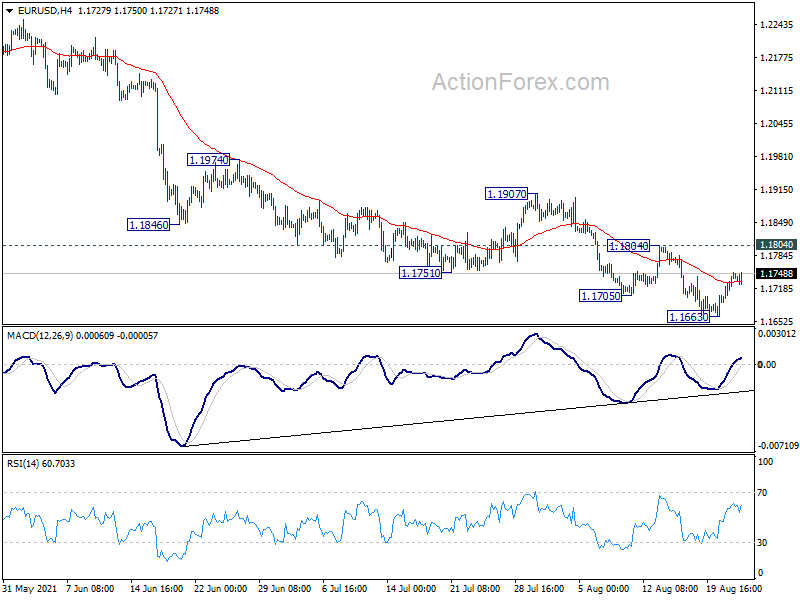
In the bigger picture, rise from 1.0635 is seen as the third leg of the pattern from 1.0339 (2017 low). Further rally remains in favors long as 1.1602 support holds, to cluster resistance at 1.2555 next, (38.2% retracement of 1.6039 to 1.0339 at 1.2516). However sustained break of 1.1602 will argue that the rise from 1.0635 is over, and turn medium term outlook bearish again. Deeper fall would be seen to 61.8% retracement of 1.0635 to 1.2348 at 1.1289 and below.
GBP/USD Mid-Day Outlook
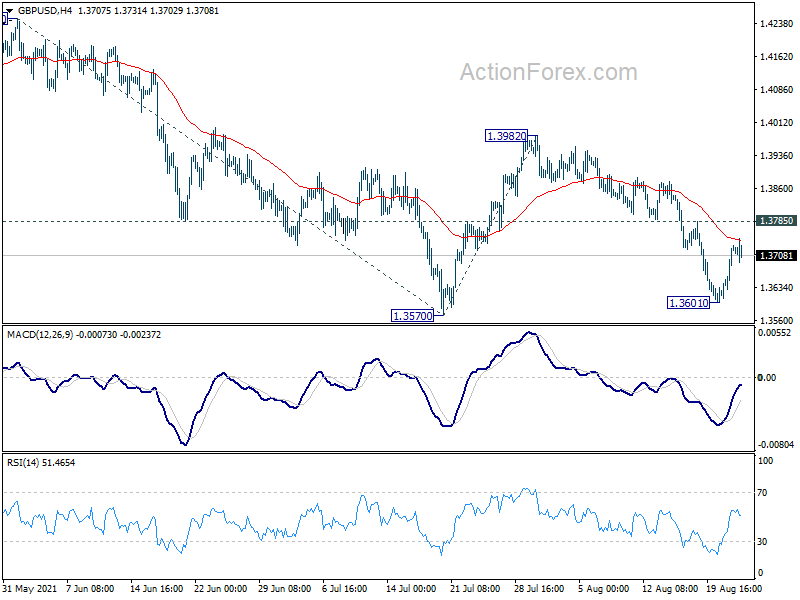
Daily Pivots: (S1) 1.3648; (P) 1.3690; (R1) 1.3766; More...
Intraday bias in GBP/USD remains neutral and outlook is unchanged. Another fall is in favor with 1.3785 minor resistance intact. On the downside, firm break of 1.3570 will resume larger fall from 1.4248 to 1.3482 resistance turned support next. Break there will target 100% projection of 1.4248 to 1.3570 from 1.3982 at 1.3304. However, on the upside, break of 1.3785 will turn bias back to the upside for 1.3982 resistance intact.
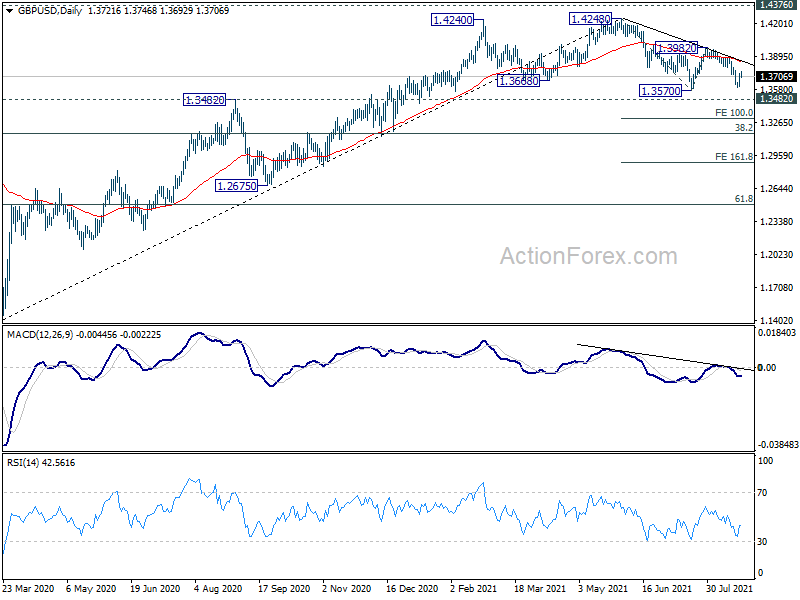
In the bigger picture, current development argues that rise from 1.1409 (2020 low) has completed at 1.4248, after failing 1.4376 resistance. Fall from there could either be correcting the rise form 1.1409, or starting another falling leg inside long term sideway pattern. In either case, sustained break of 1.3482 resistance turned support will target 38.2% retracement of 1.1409 to 1.4248 at 1.3164 first. Break there will pave the way to 61.8% retracement at 1.2493.
USD/JPY Mid-Day Outlook
Daily Pivots: (S1) 109.51; (P) 109.83; (R1) 110.01; More...
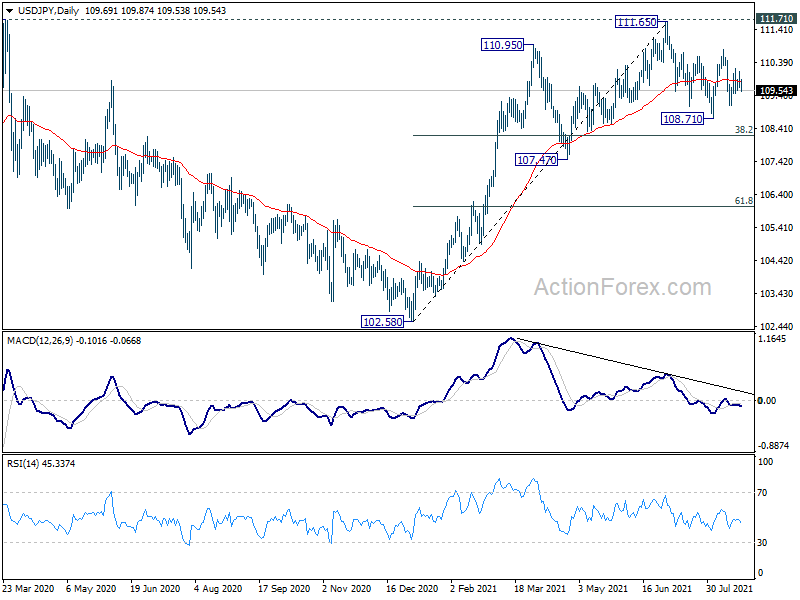
USD/JPY is still bounded in familiar range and intraday bias remains neutral first. On the upside, break of 110.79 will resume the rebound from 108.71 to retest 111.65 high. On the downside, break of 109.10 will target 108.71 support first. Firm break there will resume the decline from 111.65 and target 38.2% retracement of 102.58 to 111.65 at 108.18 next.
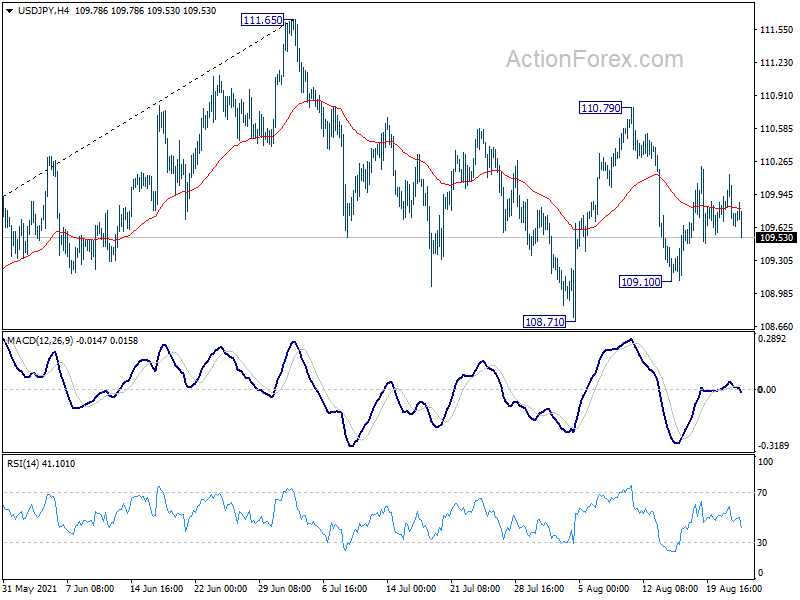
In the bigger picture, medium term outlook is staying neutral with 111.71 resistance intact. The pattern from 101.18 could still extend with another falling leg. Sustained trading below 55 day EMA will bring deeper fall to 107.47 support and below. Nevertheless, strong break of 111.71 resistance will confirm completion of the corrective decline from 118.65 (2016 high). Further rise should then be seen to 114.54 and then 118.65 resistance.