Sample Category Title
(FED) Minutes of the Federal Open Market Committee, July 27-28
A joint meeting of the Federal Open Market Committee and the Board of Governors of the Federal Reserve System was held by videoconference on Tuesday, July 27, 2021, at 9:00 a.m. and continued on Wednesday, July 28, 2021, at 9:00 a.m.1
PRESENT:
Jerome H. Powell, Chair
John C. Williams, Vice Chair
Thomas I. Barkin
Raphael W. Bostic
Michelle W. Bowman
Lael Brainard
Richard H. Clarida
Mary C. Daly
Charles L. Evans
Randal K. Quarles
Christopher J. Waller
James Bullard, Esther L. George, Naureen Hassan, Loretta J. Mester, and Eric Rosengren, Alternate Members of the Committee
Patrick Harker, Robert S. Kaplan, and Neel Kashkari, Presidents of the Federal Reserve Banks of Philadelphia, Dallas, and Minneapolis, respectively
James A. Clouse, Secretary
Matthew M. Luecke, Deputy Secretary
Michelle A. Smith, Assistant Secretary
Mark E. Van Der Weide, General Counsel
Michael Held, Deputy General Counsel
Trevor A. Reeve, Economist
Stacey Tevlin, Economist
Beth Anne Wilson, Economist
Shaghil Ahmed, Kartik B. Athreya, Brian M. Doyle, Rochelle M. Edge, Beverly Hirtle, and William Wascher, Associate Economists
Lorie K. Logan, Manager, System Open Market Account
Patricia Zobel, Deputy Manager, System Open Market Account
Ann E. Misback, Secretary, Office of the Secretary, Board
Matthew J. Eichner,2 Director, Division of Reserve Bank Operations and Payment Systems, Board; Michael S. Gibson, Director, Division of Supervision and Regulation, Board; Andreas Lehnert, Director, Division of Financial Stability, Board
Jon Faust3 and Joshua Gallin, Senior Special Advisers to the Chair, Division of Board Members, Board
William F. Bassett, Antulio N. Bomfim, Burcu Duygan-Bump, Jane E. Ihrig, Kurt F. Lewis, Chiara Scotti, and Nitish R. Sinha, Special Advisers to the Board, Division of Board Members, Board
Elizabeth Klee, Senior Associate Director, Division of Financial Stability, Board; David E. Lebow, Michael G. Palumbo, and John J. Stevens, Senior Associate Directors, Division of Research and Statistics, Board; Min Wei, Senior Associate Director, Division of Monetary Affairs, Board
Brett Berger,2 Senior Adviser, Division of International Finance, Board; Ellen E. Meade and Edward Nelson, Senior Advisers, Division of Monetary Affairs, Board
Christopher J. Gust, Associate Director, Division of Monetary Affairs, Board; Paul R. Wood, Associate Director, Division of International Finance, Board
Stephanie E. Curcuru2 and Andrea Raffo, Deputy Associate Directors, Division of International Finance, Board; Laura Lipscomb2 and Zeynep Senyuz, Deputy Associate Directors, Division of Monetary Affairs, Board; Norman J. Morin and Karen M. Pence, Deputy Associate Directors, Division of Research and Statistics, Board; Jeffrey D. Walker,2 Deputy Associate Director, Division of Reserve Bank Operations and Payment Systems, Board
Jennifer Gallagher, Special Assistant to the Board, Division of Board Members, Board
Brian J. Bonis and Etienne Gagnon,2 Assistant Directors, Division of Monetary Affairs, Board
Alyssa G. Anderson2 and Andrew Meldrum,2 Section Chiefs, Division of Monetary Affairs, Board; Penelope A. Beattie,4 Section Chief, Office of the Secretary, Board
Mark A. Carlson, Senior Economic Project Manager, Division of Monetary Affairs, Board
David H. Small, Project Manager, Division of Monetary Affairs, Board
Erin E. Ferris2 and Andrei Zlate, Principal Economists, Division of Monetary Affairs, Board
Randall A. Williams, Lead Information Manager, Division of Monetary Affairs, Board
Isabel Cairó, Senior Economist, Division of Monetary Affairs, Board
James M. Trevino,2 Senior Economic Modeler, Division of Monetary Affairs, Board
Isaiah C. Ahn, Senior Staff Assistant, Division of Monetary Affairs, Board
Kathleen O. Paese, First Vice President, Federal Reserve Bank of St. Louis
Michael Dotsey, Joseph W. Gruber, and Ellis W. Tallman, Executive Vice Presidents, Federal Reserve Banks of Philadelphia, Kansas City, and Cleveland, respectively
Anne Baum, Spencer Krane, David C. Wheelock, Mark L.J. Wright, and Nathaniel Wuerffel,2 Senior Vice Presidents, Federal Reserve Banks of New York, Chicago, St. Louis, Minneapolis, and New York, respectively
Dina Marchioni,2 Thomas Mertens, Jon Willis, and Mark A. Wynne, Vice Presidents, Federal Reserve Banks of New York, San Francisco, Atlanta, and Dallas, respectively
Jeffrey Moore2 and Brett Rose,2 Assistant Vice Presidents, Federal Reserve Bank of New York
Daniel Cooper, Senior Economist and Policy Advisor, Federal Reserve Bank of Boston
Ellen Correia-Golay2 and Brian Greene,2 Markets Officers, Federal Reserve Bank of New York
Developments in Financial Markets and Open Market Operations
The manager turned first to a discussion of developments in financial markets. Although there were notable moves in some asset prices over the intermeeting period, overall financial conditions ended the period little changed at historically accommodative levels. Market participants seemed to interpret communications associated with the June FOMC meeting as signaling a less accommodative path of monetary policy than had been anticipated. Implied rates on interest rate futures initially rose following the meeting but subsequently retraced, and expectations regarding the path of the target federal funds rate over the next few years ended the period only modestly changed.
Longer-term yields fell notably over the period, with the declines concentrated in far-forward rates. A significant portion of these movements seemed to reflect changes in term premiums. Market participants pointed to a number of factors as driving the movement in longer-term yields, most prominently including Federal Reserve policy communications, investor positioning, and changes in expectations regarding the course of the pandemic.
With respect to the path of net asset purchases, respondents to the Open Market Desk's surveys of primary dealers and market participants expected communications on asset purchases to evolve gradually, with signals anticipated over coming months regarding both the Committee's assessment of conditions constituting "substantial further progress" and details on tapering plans. Almost 60 percent of respondents anticipated the first reduction in the pace of net asset purchases to come in January, though, on average, respondents placed somewhat more weight than in the June surveys on the possibility of tapering beginning somewhat earlier. With respect to the pace of tapering, respondents continued to anticipate that the Committee would take a gradual approach. While market participants discussed the possibility of an earlier or faster-than-proportional reduction in the pace of net purchases of agency mortgage-backed securities (MBS), most survey respondents appeared to expect the timing and pace of tapering of net purchases of agency MBS and Treasury securities to be similar.
The manager turned next to a discussion of developments in operations and money markets over the period. Following the June meeting, overnight rates rose in line with the technical adjustment in administered rates and were relatively stable for the remainder of the period. Overnight reverse repurchase agreement (ON RRP) take-up jumped by over $200 billion after the technical adjustment took effect, as government-sponsored enterprises moved balances held in unremunerated Federal Reserve deposit accounts into the higher-yielding ON RRP investments. Government money market funds also increased their participation in the facility amid a continued decline in Treasury bills outstanding and downward pressure on overnight rates. Overall, market participants reported that the technical adjustment went smoothly and that, with overnight rates having moved further away from zero, concerns about the functioning of short-term funding markets had diminished.
Looking ahead, market participants were beginning to focus on the potential effects of changes in the Treasury General Account at the Federal Reserve and Treasury bill issuance over coming months in connection with the debt ceiling. The manager noted that, if a number of counterparties reached the per-counterparty limit on their ON RRP investments and downward pressure on overnight rates emerged, it may become appropriate to lift the limit.
Establishment of Standing Repurchase Agreement Facilities
Finally, the manager summarized the proposed terms for the standing repurchase agreement (repo) facility (SRF) and the Foreign and International Monetary Authorities (FIMA) Repo Facility. In questions and comments following the manager's briefing, participants expressed broad support for the establishment of the SRF and FIMA Repo Facility. The vast majority of participants supported the proposed terms, although a few participants raised questions, including whether the proposed aggregate cap of $500 billion was necessary, whether the collateral eligible in SRF operations should be limited to Treasury securities only, and how the setting of the minimum bid rate in SRF operations would be expected to evolve over time relative to the primary credit rate and the interest on reserve balances rate. In general, participants viewed the SRF and FIMA Repo Facility as important new tools, serving in backstop roles, that would support effective policy implementation and smooth market functioning. Participants anticipated that the Committee would learn more about how these facilities operate over time and noted that it could adjust some parameters of the facilities on the basis of that experience.
The Committee voted unanimously to approve the establishment of the SRF. All but one member of the Committee voted to approve the FIMA Repo Facility. Governor Bowman abstained from voting on the FIMA Repo Facility and noted that she would have preferred that the liquidity arrangements accessible to foreign official institutions be maintained only during periods of extraordinary financial market stress rather than through a standing facility.
Standing Repurchase Agreement Facility Resolution
The Federal Open Market Committee (the "Committee") authorizes and directs the Open Market Desk at the Federal Reserve Bank of New York (the "Selected Bank"), for the System Open Market Account ("SOMA"), to conduct operations in which it offers to purchase securities, subject to an agreement to resell ("repurchase agreement transactions"). The repurchase agreement transactions hereby authorized and directed shall (i) include only U.S. Treasury securities, agency debt securities, and agency mortgage-backed securities; (ii) be conducted as open market operations with primary dealers and depository institutions as participants; (iii) be conducted with a minimum bid rate of 0.25 percent; (iv) be offered on an overnight basis (except that the Open Market Desk at the Selected Bank may extend the term for longer than an overnight term to accommodate weekend, holiday, and similar trading conventions); and (v) be subject to an aggregate operation limit of $500 billion. The aggregate operation limit can be temporarily increased at the discretion of the Chair. These operations shall be conducted by the Open Market Desk at the Selected Bank until otherwise directed by the Committee.
Standing FIMA Repurchase Agreement Resolution
The Federal Open Market Committee (the "Committee") authorizes and directs the Open Market Desk at the Federal Reserve Bank of New York (the "Selected Bank"), for the System Open Market Account ("SOMA"), to offer to purchase U.S. Treasury securities subject to an agreement to resell ("repurchase agreement transactions") with foreign central bank and international accounts maintained at a Federal Reserve Bank (the "Foreign Accounts"). The repurchase agreement transactions hereby authorized and directed shall (i) include only U.S. Treasury securities; (ii) be conducted with Foreign Accounts approved in advance by the Foreign Currency Subcommittee (the "Subcommittee"); (iii) be conducted at an offering rate of 0.25 percent; (iv) be offered on an overnight basis (except that the Open Market Desk at the Selected Bank may extend the term for longer than an overnight term to accommodate weekend, holiday, and similar trading conventions); and (v) be subject to a per-counterparty limit of $60 billion per day. The Subcommittee may approve changes in the offering rate, the maturity of the transactions, eligible Foreign Accounts counterparties (either by approving or removing account access), and the counterparty limit; and the Subcommittee shall keep the Committee informed of any such changes. These transactions shall be undertaken by the Open Market Desk at the Selected Bank until otherwise directed by the Committee. The Open Market Desk at the Selected Bank will also report at least annually to the Committee on facility usage and the list of approved account holders.
By unanimous vote, the Committee ratified the Desk's domestic transactions over the intermeeting period. There were no intervention operations in foreign currencies for the System's account during the intermeeting period.
Discussion of Asset Purchases
Participants discussed aspects of the Federal Reserve's asset purchases, including progress made toward the Committee's maximum-employment and price-stability goals since the adoption of the asset purchase guidance in December 2020. They also considered the question of how asset purchases might be adjusted once economic conditions met the standards of that guidance. Participants agreed that their discussion at this meeting would be helpful background for the Committee's future decisions about modifying asset purchases. No decisions regarding future adjustments to asset purchases were made at this meeting.
The participants' discussion was preceded by staff presentations that reviewed the principal channels through which asset purchases exert effects on financial conditions and the economy, with a focus on the implications of these channels for the Committee's deliberations regarding future adjustments to the Federal Reserve's asset purchases. The presentations noted that, in the staff's standard empirical modeling framework, the effect of asset purchases on financial and economic conditions occurred primarily via their influence on the expected path of private-sector holdings of longer-term assets. In that framework, larger Federal Reserve holdings of these assets reduced private-sector holdings, exerting downward pressure on term premiums and, consequently, keeping longer-term interest rates and overall financial conditions more accommodative than they otherwise would be. The staff noted that, because plausible alternative approaches to the tapering of asset purchases would likely not lead to significant differences in the expected path of the Federal Reserve's balance sheet, these approaches would have similar financial and economic effects in the staff's standard framework. The presentations highlighted, however, that alternative tapering approaches could have significant financial and economic effects not fully captured in the staff's standard empirical framework. In particular, changes in asset purchases could be interpreted by the public as signaling a shift in the Committee's view of the economic outlook or in its overall policy strategy, with implications for the expected path of the federal funds rate. Changes in the flow of asset purchases could also influence yields, but this influence would likely be modest outside of periods of stressed financial market conditions.
In their discussion of considerations related to asset purchases, various participants noted that these purchases were an important part of the monetary policy toolkit and a critical aspect of the Federal Reserve's response to the economic effects of the pandemic, supporting smooth financial market functioning and accommodative financial conditions, which aided the flow of credit to households and businesses and supported the recovery. Participants discussed a broad range of labor market and inflation indicators. All participants assessed that the economy had made progress toward the Committee's maximum-employment and price-stability goals since the adoption of the guidance on asset purchases in December. Most participants judged that the Committee's standard of "substantial further progress" toward the maximum-employment goal had not yet been met. At the same time, most participants remarked that this standard had been achieved with respect to the price-stability goal. A few participants noted, however, that the transitory nature of this year's rise in inflation, as well as the recent declines in longer-term yields and in market-based measures of inflation compensation, cast doubt on the degree of progress that had been made toward the price-stability goal since December. Looking ahead, most participants noted that, provided that the economy were to evolve broadly as they anticipated, they judged that it could be appropriate to start reducing the pace of asset purchases this year because they saw the Committee's "substantial further progress" criterion as satisfied with respect to the price-stability goal and as close to being satisfied with respect to the maximum-employment goal. Various participants commented that economic and financial conditions would likely warrant a reduction in coming months. Several others indicated, however, that a reduction in the pace of asset purchases was more likely to become appropriate early next year because they saw prevailing conditions in the labor market as not being close to meeting the Committee's "substantial further progress" standard or because of uncertainty about the degree of progress toward the price-stability goal. Participants agreed that the Committee would provide advance notice before making changes to its balance sheet policy.
Participants expressed a range of views on the appropriate pace of tapering asset purchases once economic conditions satisfied the criterion laid out in the Committee's guidance. Many participants saw potential benefits in a pace of tapering that would end net asset purchases before the conditions currently specified in the Committee's forward guidance on the federal funds rate were likely to be met. At the same time, participants indicated that the standards for raising the target range for the federal funds rate were distinct from those associated with tapering asset purchases and remarked that the timing of those actions would depend on the course of the economy. Several participants noted that an earlier start to tapering could be accompanied by more gradual reductions in the purchase pace and that such a combination could mitigate the risk of an excessive tightening in financial conditions in response to a tapering announcement.
Participants exchanged views on what the composition of asset purchases should be during the tapering process. Most participants remarked that they saw benefits in reducing the pace of net purchases of Treasury securities and agency MBS proportionally in order to end both sets of purchases at the same time. These participants observed that such an approach would be consistent with the Committee's understanding that purchases of Treasury securities and agency MBS had similar effects on broader financial conditions and played similar roles in the transmission of monetary policy, or that these purchases were not intended as credit allocation. Some of these participants remarked, however, that they welcomed further discussion of the appropriate composition of asset purchases during the tapering process. Several participants commented on the benefits that they saw in reducing agency MBS purchases more quickly than Treasury securities purchases, noting that the housing sector was exceptionally strong and did not need either actual or perceived support from the Federal Reserve in the form of agency MBS purchases or that such purchases could be interpreted as a type of credit allocation.
Participants commented on other factors that were relevant for their consideration of future adjustments to the pace of asset purchases. Many participants noted that, when a reduction in the pace of asset purchases became appropriate, it would be important that the Committee clearly reaffirm the absence of any mechanical link between the timing of tapering and that of an eventual increase in the target range for the federal funds rate. A few participants suggested that the Committee would need to be mindful of the risk that a tapering announcement that was perceived to be premature could bring into question the Committee's commitment to its new monetary policy framework. With respect to the effects of the pandemic, several participants indicated that they would adjust their views on the appropriate path of asset purchases if the economic effects of new strains of the virus turned out to be notably worse than currently anticipated and significantly hindered progress toward the Committee's goals.
Staff Review of the Economic Situation
The information available at the time of the July 27–28 meeting suggested that U.S. real gross domestic product (GDP) had increased in the second quarter at a faster pace than in the first quarter of the year. Indicators of labor market conditions were mixed in June, though labor demand remained strong. Consumer price inflation through May—as measured by the 12-month percentage change in the personal consumption expenditures (PCE) price index—had picked up notably, largely reflecting transitory factors.
Total nonfarm payroll employment rose sharply in June, with job gains widespread across industries and especially strong job growth in the leisure and hospitality sector. As of June, total payroll employment had retraced more than two-thirds of the losses seen at the onset of the pandemic. The unemployment rate edged higher and stood at 5.9 percent in June, and the unemployment rates for African Americans and Hispanics remained well above the national average. The labor force participation rate and employment-to-population ratio were unchanged in June. May private-sector job openings, as measured by the Job Openings and Labor Turnover Survey, remained at the highest recorded level since the survey's inception in 2000. Initial claims for regular state unemployment insurance were little changed, on net, since mid-June. Weekly estimates of private-sector payrolls constructed by Federal Reserve Board staff using data provided by the payroll processor ADP that were available through the first part of July suggested that the pace of private employment gains had remained strong.
Average hourly earnings for all employees rose further in June. Recent monthly increases in average hourly earnings appeared to reflect a combination of strong labor demand and increased difficulties in hiring that had more than offset the downward pressure on average earnings from disproportionately large employment gains in lower-wage industries. Information from compensation measures that were judged to be less affected by shifts in the composition of the workforce was mixed: A staff measure of the 12-month change in the median wage derived from the ADP data had stepped up noticeably in June relative to earlier in the year; by contrast, the Wage Growth Tracker measure constructed by the Federal Reserve Bank of Atlanta had not shown a similar pickup.
Recent 12-month change measures of inflation, using either PCE prices or the consumer price index (CPI), had been boosted by base effects as the extremely low inflation readings from the spring of 2020 rolled out of the calculation. In addition, a surge in demand as the economy reopened further, combined with production bottlenecks and supply constraints, had pushed up recent monthly price increases. Total PCE price inflation was 3.9 percent over the 12 months ending in May, and core PCE price inflation, which excludes changes in consumer energy prices and many consumer food prices, was 3.4 percent over the 12 months ending in May. In contrast, the trimmed mean measure of 12-month PCE inflation constructed by the Federal Reserve Bank of Dallas was 1.9 percent in May. In June, the 12-month change in the CPI was 5.4 percent, while the core CPI rose 4.5 percent over the same period. In the second quarter of 2021, the staff's common inflation expectations index, which combines information from many indicators of inflation expectations and inflation compensation, had more than reversed the moderate decline recorded in the middle of last year and had returned to the level that prevailed in 2014, when actual inflation was relatively modest.
Real PCE appeared to have risen in the second quarter at a pace similar to that seen in the first quarter, supported by previous rounds of federal stimulus payments and reductions in social distancing. Even so, consumer spending appeared to have been held back some as producers struggled to meet demand. Similarly, despite very strong demand for housing, incoming data suggested that residential investment spending had declined in the second quarter as materials shortages and limited stocks of homes for sale temporarily restrained activity in that sector.
Available indicators suggested that growth in business fixed investment had slowed sharply in the second quarter, reflecting disruptions to motor vehicle production and aircraft deliveries and a faster rate of decline in nonresidential structures investment.
Growth in manufacturing output had picked up modestly in the second quarter. Although production in the chemicals industry had rebounded from the weather-related disruptions earlier in the year, the supply chain issues faced by a number of other industries, particularly the motor vehicle industry, continued to weigh on overall factory output.
Total real government purchases appeared to have moved lower in the second quarter after having risen in the first quarter. Available data suggested that federal nondefense purchases had dropped following a first-quarter surge in pandemic-related expenditures and that defense purchases were little changed. However, indicators of real state and local purchases pointed to a modest second-quarter increase in this component of government spending.
The nominal U.S. international trade deficit remained high in May. Real goods imports in May retraced only a bit of their April decline, but they were still at the second-highest level on record. Real goods exports edged down in May and remained below pre-COVID-19 levels. Bottlenecks in the global semiconductor industry continued to weigh on exports and imports of automotive products, and shipping congestion likely continued to restrain trade overall. Although international travel recovered further in May, exports and imports of services remained depressed relative to pre-pandemic levels.
Incoming data suggested that, after a weak start to the year, foreign economic activity accelerated in the second quarter. The improvements were concentrated in the advanced foreign economies and China, supported by vaccine rollouts, the unwinding of public health restrictions, economic adaptation to the virus, and the reopening of the services sector. The situation was quite different in some emerging market economies (EMEs) whose low vaccination rates left them vulnerable to new waves of infections. Although new COVID-19 cases fell dramatically in India after the surge in May and June, the situation deteriorated markedly in several Southeast Asian countries, whose cases and deaths rose to all-time highs. In addition, the increased prevalence of new virus variants, particularly the Delta variant, underscored the continued uncertainty about the foreign outlook. Inflation rose further in most foreign economies, reflecting a reversal of price declines seen in the spring of 2020, higher energy and commodity prices, and supply bottlenecks.
Staff Review of the Financial Situation
Over the intermeeting period, fluctuations in financial markets appeared to be driven by less-accommodative-than-expected June FOMC communications, a reduction in investor perceptions of the risk of persistently high inflation, increased concerns about the rapid spread of the Delta variant, and stronger-than-anticipated inflation data. Longer-dated Treasury yields fell, largely reflecting declines in real yields, while longer-horizon forward measures of inflation compensation also declined. Domestic equity prices rose moderately, and corporate bond spreads remained near the low end of their historical ranges. Short-term funding markets were stable, while participation in the ON RRP facility increased further, to its highest level since the facility was put in place. Market-based financing conditions were accommodative, and bank lending standards eased for most loan categories.
The Treasury yield curve flattened, on net, with the 2‑year yield about unchanged, the 5-year yield declining a bit, and the 10- and 30-year yields each decreasing about 30 basis points. The decline in longer-term Treasury yields was associated with a drop in real yields implied by Treasury Inflation-Protected Securities (TIPS), with the 10-year real yield down about 25 basis points. Meanwhile, shorter-horizon measures of inflation compensation ended the period modestly higher, but longer-term forward measures fell notably. On net, the market-implied path of the policy rate was little changed for horizons up to late 2023, while it shifted lower beyond those horizons.
Broad stock market prices rose moderately over the intermeeting period, supported in part by some strong second-quarter earnings reports that bolstered investor risk sentiment. However, some prices declined for stocks that historically have moved more closely with economic conditions—such as stocks for smaller companies and for firms in cyclical industries—as did stock prices for firms in sectors such as airlines and hotels that were negatively affected by the pandemic. Bank stock prices also fell. One-month option-implied volatility on the S&P 500—the VIX—spiked to reach a two-month high. For the intermeeting period as a whole, however, the VIX was little changed, on net, and remained somewhat above its average pre-pandemic levels. Spreads of yields on corporate bonds over those on comparable-maturity Treasury securities were little changed, and spreads of benchmark municipal bond indexes increased moderately, although both remained below their pre-pandemic levels.
Short-term funding markets were stable over the intermeeting period. Following the actions at the June FOMC meeting to increase both the interest rate on excess reserves and the ON RRP rate by 5 basis points, the effective federal funds rate rose 4 basis points, reaching 10 basis points, while the Secured Overnight Financing Rate rose 4 basis points, reaching 5 basis points. These funding rates remained at these levels for most of the period. Participation in the Federal Reserve's ON RRP operations continued to increase to its highest level since the facility was put in place, from an average of $340 billion in the previous intermeeting period to an average of around $800 billion over the current intermeeting period, and reached almost $1 trillion on the June quarter-end. The increase in participation was driven in part by larger investments from money market funds, as ongoing reductions in net Treasury bill issuance contributed to downward pressure on yields of other investment options available to these funds.
Concerns about the worldwide spread of the Delta variant weighed somewhat on risk sentiment in global financial markets over the intermeeting period. The dollar broadly appreciated, longer-term yields in major advanced foreign economies decreased notably, and most major foreign equity indexes declined moderately. Equity markets in China and Hong Kong underperformed notably amid increased regulatory uncertainty in China. In addition, EME sovereign credit spreads widened slightly, but capital flows into dedicated EME funds remained modestly positive.
Several foreign central banks scaled back their asset purchase programs. The Bank of Canada and the Reserve Bank of Australia reduced the pace of their asset purchases, and the Reserve Bank of New Zealand unexpectedly announced that it would halt its asset purchases in July. In emerging markets, the central banks of Brazil and Mexico raised rates in order to reduce inflationary pressures. In contrast, the People's Bank of China cut the broad reserve requirement ratio for banks to support economic growth. The European Central Bank completed its strategy review, adopting a 2 percent symmetric inflation target, and revised forward guidance on its policy rate.
Financing conditions faced by nonfinancial firms in capital markets continued to be broadly accommodative over the intermeeting period, as corporate bond spreads remained near the low end of their historical distributions. Gross issuance of corporate bonds slowed from its brisk pace in May but remained solid, and gross issuance of leveraged loans was also robust. Equity raised through traditional initial public offerings rebounded noticeably, while equity raised through seasoned equity offerings continued to be moderate in June. Meanwhile, equity issuance through special purpose acquisition companies remained subdued.
Commercial and industrial (C&I) loans outstanding at banks continued to decline in June, with forgiveness of Paycheck Protection Program loans more than offsetting the volumes of new loan originations. In the July Senior Loan Officer Opinion Survey on Bank Lending Practices (SLOOS), banks reported easing standards and nearly all terms, on net, for C&I loans over the second quarter. The July SLOOS also indicated that the level of standards on C&I loans returned to the easier end of the range that had prevailed since 2005. Banks surveyed in the July SLOOS reported that demand for C&I loans had improved over the second quarter; however, market commentary suggested that demand was still generally weak.
The credit quality of large nonfinancial corporations remained stable over the intermeeting period. The volume of credit rating upgrades for nonfinancial corporate bonds and leveraged loans moderately outpaced downgrades in June. Corporate bond and leveraged loan defaults also remained low.
Financing conditions in the municipal bond market remained accommodative over the intermeeting period, with municipal bond yields edging down to record lows. Issuance of municipal bonds was solid in the case of higher-rated bonds, while it was still below pre-pandemic levels for speculative-grade and unrated securities. The credit quality of municipal debt appeared stable, although pandemic-related risks to state and local government finances remained.
Financing conditions facing small businesses remained relatively tight, and their loan demand was generally weak. Although the July SLOOS banks reported, on net, easier lending standards for C&I loans to small firms over the second quarter, industry commentary suggested that the lending standards of community banks and of other lenders not included in the SLOOS remained relatively tight. Furthermore, the results of a separate survey suggested that the share of firms that did not want to borrow remained near its all-time high. Meanwhile, loan performance for small businesses continued to improve, with delinquency rates continuing to decline in May.
For commercial real estate (CRE) financed through capital markets, financing conditions remained accommodative. Spreads of agency and non-agency commercial mortgage-backed securities (CMBS) were generally at or below pre-pandemic levels. Issuance of agency CMBS remained robust and issuance of non-agency CMBS strengthened notably in June. Delinquency rates on mortgages in CMBS pools were little changed but continued to be elevated on hotel and retail mortgages. Meanwhile, bank-based financing conditions for CRE remained relatively tight. CRE loan growth at banks remained weak in the second quarter in comparison with pre-pandemic levels. In the July SLOOS, banks reported that, despite some easing over the second quarter, the levels of CRE lending standards were still tight relative to the midpoint of the range of standards that had prevailed since 2005.
Financing conditions in the residential real estate market remained accommodative. This was particularly true for stronger borrowers who met standard conforming loan criteria. In addition, according to the July SLOOS, bank lending standards for jumbo loans eased over the second quarter to near their pre-pandemic levels. However, although broad financing conditions for lower-score Federal Housing Administration borrowers also continued to ease, their credit standards remained tighter than before the pandemic. Mortgage rates ticked down over the intermeeting period, in line with rates on MBS and 10‑year Treasury securities. Furthermore, the spread of mortgage rates to MBS yields was close to pre-pandemic levels after having widened significantly at the start of the pandemic. Mortgage originations for home purchases and refinancing were fairly robust through June.
Financing conditions for consumer credit remained accommodative. Consumer credit jumped in May and remained strong in June, reflecting a rebound in credit card balances and continued robust growth in auto loans. Banks in the July SLOOS reported stronger demand and easier standards for both credit cards and auto loans over the second quarter.
The staff provided an update on its assessments of the stability of the financial system and, on balance, characterized the financial vulnerabilities of the U.S. financial system as notable. The staff judged that asset valuation pressures were elevated. In particular, the forward price-to-earnings ratio for the S&P 500 index stood at the upper end of its historical distribution; high-yield corporate bond spreads tightened further and were near the low end of their historical range; and house prices continued to increase rapidly, leaving valuation measures stretched. That said, the staff did not see signs of loose mortgage underwriting standards or excessive credit growth that could potentially amplify a shock arising from falling house prices. The staff assessed vulnerabilities associated with nonfinancial leverage as lower than in January but still notable. For households, the mortgage debt-to-income ratio was moderate, and mortgage borrowing was concentrated among prime borrowers, though some uncertainty remained regarding the outlook for mortgages in non-payment status. While measures of corporate-sector leverage fell since January, particularly at the most levered firms, the debt of firms that had relatively low earnings-to-interest payment ratios remained high. The staff judged that vulnerabilities arising from financial leverage were moderate. The aggregate common equity tier 1 capital ratio of the largest banks significantly exceeded regulatory requirements. However, some available measures of hedge fund leverage were elevated, and significant data gaps continued to obscure risks at hedge funds and other nonbank financial institutions. Vulnerabilities associated with funding risks were characterized as moderate. Domestic banks held significant quantities of high-quality liquid assets and had only limited reliance on short-term wholesale funding. Nonetheless, significant structural vulnerabilities remained at entities such as prime money funds, and new financial arrangements such as stablecoins appeared to have the same structural maturity and liquidity transformation vulnerabilities but with less transparency and an underdeveloped regulatory framework.
Staff Economic Outlook
The projection for U.S. economic activity prepared by the staff for the July FOMC meeting was little changed, on balance, from the June forecast. In the second half of 2021, an easing of the surge in demand seen over the first part of the year was expected to be largely offset by a reduction in the effects of supply constraints on production, thereby allowing real GDP growth to continue at a rapid pace. For the year as a whole, therefore, real GDP was projected to post a substantial increase, with a correspondingly large decline in the unemployment rate. With the boost to spending growth from continued reductions in social distancing assumed to fade after 2021 and with a further unwinding of the effects of fiscal stimulus, GDP growth was expected to step down in 2022 and 2023. However, with monetary policy assumed to remain highly accommodative, the staff continued to anticipate that real GDP growth would outpace growth in potential output over most of this period, leading to a decline in the unemployment rate to historically low levels.
The staff's near-term outlook for inflation was revised up further in response to incoming data, but the staff continued to expect that this year's rise in inflation would prove to be transitory. The 12-month change in total and core PCE prices was well above 2 percent in May, and available data suggested that PCE price inflation would remain high in June. The staff continued to judge that the surge in demand that had resulted as the economy reopened further had combined with production bottlenecks and supply constraints to boost recent monthly inflation rates. The staff expected the 12‑month change in PCE prices to move down gradually over the second part of 2021, reflecting an anticipated moderation in monthly inflation rates and the waning of base effects; even so, PCE price inflation was projected to be running well above 2 percent at the end of the year. Over the following year, the boost to consumer prices caused by supply issues was expected to partly reverse, and import prices were expected to decelerate sharply; as a result, PCE price inflation was expected to step down to a little below 2 percent in 2022 before additional increases in resource utilization raised it to 2 percent in 2023.
The staff continued to judge that the risks to the baseline projection for economic activity were skewed to the downside and that the uncertainty around the forecast was elevated. In particular, the probability that the course of the pandemic would turn out to be more adverse than the staff's baseline assumption was viewed to be higher than the probability that a more favorable outcome would occur. However, the staff judged that the risks around the inflation projection were now tilted to the upside, as recent data pointed to a greater risk that the upward pressure on inflation that had resulted from supply-related issues would unwind more slowly than the staff's baseline projection assumed.
Participants' Views on Current Economic Conditions and the Economic Outlook
In their discussion of current conditions, participants noted that, with progress on vaccinations and strong policy support, indicators of economic activity and employment had continued to strengthen. The sectors most adversely affected by the pandemic had shown improvement but had not fully recovered. Inflation had risen, largely reflecting transitory factors. Overall financial conditions remained accommodative, in part reflecting policy measures to support the economy and the flow of credit to U.S. households and businesses. Participants noted that the path of the economy would continue to depend on the course of the virus. Progress on vaccinations would likely continue to reduce the effects of the public health crisis on the economy, but risks to the economic outlook remained.
Participants observed that economic activity continued to expand at a rapid pace through the middle of the year even though capacity constraints were restraining the increase in output in some sectors. Economic growth was expected to remain strong over the second half of the year, supported by the further reopening of the economy, accommodative financial conditions, and easing of supply constraints. Nevertheless, participants generally saw supply disruptions and labor shortages as likely to persist over the second half of the year.
In their discussion of the household sector, participants remarked that consumer spending had continued to increase at a very rapid pace, supported by the ongoing reopening of the economy along with the accommodation provided by fiscal policy and monetary policy. In addition, the accumulated stock of savings and further progress on vaccination were cited as important factors lifting household spending. Some participants noted that they expected consumer spending to continue to be bolstered by these factors. Participants generally expected housing demand to remain strong but noted that construction had been restrained by shortages of materials and other inputs and that home sales had been held back by limited supplies of available homes.
With respect to the business sector, participants observed that activity in the service industries most adversely affected by the pandemic, such as in the leisure and hospitality sector, was rebounding as the economy reopened further but had not fully recovered. Participants noted that growth in manufacturing activity continued to be solid but was restrained by production bottlenecks and supply constraints, particularly in the motor vehicle sector. Citing reports received from contacts in a broad range of industries, participants indicated that shortages of materials and labor as well as supply chain challenges remained widespread and continued to limit the ability of firms to keep up with strong demand. Even though their outlook for demand had improved further, many business contacts had expressed uncertainty and pessimism over prospects regarding the easing of supply constraints over the near term.
Participants commented on the continued improvement in labor market conditions in recent months driven by strong demand for workers. The monthly pace of job gains had picked up, with employment expanding 850,000 in June and with notable increases in the leisure and hospitality sector. Nevertheless, the household survey showed that the unemployment rate remained elevated at 5.9 percent in June, and the labor force participation rate and employment-to-population ratio were little changed in recent months. Participants indicated that the economy had not yet achieved the Committee's broad-based and inclusive maximum-employment goal. Several participants remarked that the labor market recovery continued to be uneven across demographic and income groups and across sectors. Participants generally noted that supply-side factors related to the pandemic—such as caregiving needs, ongoing fears of the virus, increased retirements, and expanded unemployment insurance payments—continued to weigh on labor force participation and employment growth. A majority of participants anticipated that most of these factors would ease in the coming months. They also noted, however, that the spread of the Delta variant may temporarily delay the full reopening of the economy and restrain hiring and labor supply.
Participants observed that recent wage increases had been moderate on average. However, District contacts had continued to report having trouble hiring workers and had indicated that this difficulty was putting upward pressure on wages in some sectors or leading employers to provide additional incentives to attract and retain workers. Several participants noted that their District contacts expected that difficulties finding workers would likely extend into the fall.
In their discussion of inflation, participants observed that the inflation rate had increased notably and expected that it would likely remain elevated in coming months before moderating. Participants remarked that inflation had increased generally more than expected this year and attributed this increase to supply constraints in product and labor markets and a surge in consumer demand as the economy reopened. They noted that many of their District contacts had reported that higher input costs were also putting upward pressure on prices. Many participants pointed out that the largest contributors to recent increases in measures of inflation were a handful of sectors most affected by temporary supply bottlenecks or sectors in which price levels were rebounding from depressed levels as the economy continued to reopen. Looking ahead, while participants generally expected inflation pressures to ease as the effect of these transitory factors dissipated, several participants remarked that larger-than-anticipated supply chain disruptions and increases in input costs could sustain upward pressure on prices into 2022. In their comments on inflation expectations, some participants noted that measures of longer-term inflation expectations had remained in ranges that were viewed as broadly consistent with the Committee's longer-run inflation goal. Several participants indicated that the recent increases in survey-based measures signaled a risk that longer-term inflation expectations might be moving up above levels consistent with the Committee's goals. Other participants pointed to the substantial decline in TIPS-based longer-term inflation compensation since June as suggesting that investors perceived reduced risks that inflation could run persistently above the Committee's 2 percent goal. A couple of participants noted that recent readings on forward inflation compensation could be read as suggesting investor concern that inflation over the longer term could run persistently below the Committee's 2 percent inflation goal.
In discussing the uncertainty and risks associated with the economic outlook, many participants remarked that uncertainty was quite high, with slowing in progress on vaccinations and developments surrounding the Delta variant posing downside risks to the economic outlook. A number of participants judged that the effects of supply chain disruptions and labor shortages would likely complicate the task of interpreting the incoming data and assessing the speed at which these supply-side factors would dissipate. Some participants noted that there were upside risks to inflation associated with concerns that supply disruptions and labor shortages might linger for longer than currently anticipated and might have larger or more persistent effects on prices and wages than they currently assumed.
Participants who commented on financial stability emphasized the risks associated with elevated valuations across many asset classes. A few participants highlighted scenarios in which a prolonged period of low interest rates and broadly elevated asset valuations could generate imbalances, which could increase financial stability risks. Some participants commented on the housing market and noted that ongoing rapid house price increases reflected both demand and supply factors. Several participants noted that the lack of evidence of deteriorating mortgage underwriting standards could mitigate risks associated with high housing valuations; a couple of other participants, however, expressed concern that a home price reversal could pose risks to financial stability. Some participants cited various potential risks to financial stability including the risks associated with expanded use of cryptocurrencies or the risks associated with collateral liquidity at central counterparties during episodes of market stress. In connection with the former set of risks, a few of these participants highlighted the fragility and the general lack of transparency associated with stablecoins, the importance of monitoring them closely, and the need to develop an appropriate regulatory framework to address any risks to financial stability associated with such products.
In their consideration of the stance of monetary policy, participants reaffirmed the Federal Reserve's commitment to using its full range of tools to support the U.S. economy during this challenging time, thereby promoting the Committee's statutory goals of maximum employment and price stability. Participants judged that the current stance of monetary policy remained appropriate to promote maximum employment as well as to achieve inflation that averages 2 percent over time and longer-term inflation expectations that are well anchored at 2 percent. Participants also reiterated that the existing outcome-based guidance implied that the paths of the federal funds rate and the balance sheet would depend on actual progress toward reaching the Committee's maximum-employment and inflation goals.
Participants discussed the progress toward the Committee's goals since December 2020, when the Committee adopted its guidance for asset purchases. They generally judged that the Committee's standard of "substantial further progress" toward the maximum-employment and inflation goals had not yet been met, particularly with respect to labor market conditions, and that risks to the economic outlook remained. Most participants anticipated that the economy would continue to make progress toward those goals and, provided that the economy evolved broadly as they anticipated, they judged that the standard set out in the Committee's guidance regarding asset purchases could be reached this year. With regard to the labor market, participants noted that the demand for workers had been strong in recent months, while the level of employment had been constrained by labor supply shortages and hiring difficulties. Several participants emphasized that employment remained well below its pre-pandemic level and that a robust labor market, supported by a continuation of accommodative monetary policy, would allow further progress toward the Committee's broad and inclusive maximum-employment goal and a return over time to labor market conditions as strong as those prevailing before the pandemic. A few other participants judged that monetary policy had limited ability to address the labor supply shortages and hiring difficulties currently constraining the level of employment. Several participants also commented that the pandemic might have caused longer-lasting changes in the labor market and that the pre-pandemic labor market conditions may not be the right benchmark against which the Committee should assess the progress toward its maximum-employment objective.
With regard to inflation, participants commented that recent inflation readings had been boosted by the effects of supply bottlenecks and labor shortages and were likely to be transitory. A few participants noted that, while the specific results depended on the period used in the calculation, some measures of average inflation were already moving above, or would soon move above, the Committee's 2 percent goal, supported by strong demand, a tight labor market, and firming inflation expectations. Some other participants emphasized that recent high inflation readings had largely been driven by price increases in a handful of categories. These participants pointed out that there was no evidence of broad-based price pressures or of inappropriately high longer-term inflation expectations. Several participants also commented that price increases concentrated in a small number of categories were unlikely to change underlying inflation dynamics sufficiently to overcome the possibility of a persistent downward bias in inflation, as might be associated with the effective lower bound on the policy rate.
Many participants remarked upon risk-management considerations when contemplating how and when to make changes to the Committee's pace of asset purchases. Some participants suggested that it would be prudent for the Committee to prepare for starting to reduce its pace of asset purchases relatively soon, in light of the risk that the recent high inflation readings could prove to be more persistent than they had anticipated and because an earlier start to reducing asset purchases would most likely enable additions to securities holdings to be concluded before the Committee judged it appropriate to raise the federal funds rate. A few participants expressed concerns that maintaining highly accommodative financial conditions might contribute to a further buildup in risk to the financial system that could impede the attainment of the Committee's dual-mandate goals. In contrast, a few other participants suggested that preparations for reducing the pace of asset purchases should encompass the possibility that the reductions might not occur for some time and highlighted the risks that rising COVID-19 cases associated with the spread of the Delta variant could cause delays in returning to work and school and so damp the economic recovery. Several participants also remained concerned about the medium-term outlook for inflation and the possibility of the reemergence of significant downward pressure on inflation, especially in light of the recent decline in longer-term inflation compensation. In addition, several participants emphasized that there was considerable uncertainty about the likely resolution of the labor market shortages and supply bottlenecks and about the influence of pandemic-related developments on longer-run labor market and inflation dynamics. Those participants stressed that the Committee should be patient in assessing progress toward its goals and in announcing changes to its plans on asset purchases.
Some participants emphasized that a decision to reduce the Committee's pace of asset purchases once the "substantial further progress" benchmark had been achieved would be fully consistent with the Committee's new monetary policy framework and would help foster the achievement of the Committee's longer-run objectives over time. A couple of participants also noted that a tapering of asset purchases did not amount to a tightening of the stance of monetary policy and instead only implied that additional monetary accommodation would be provided at a slower rate. Several participants emphasized that an announcement of a reduction in the Committee's pace of asset purchases should not be interpreted as the beginning of a predetermined course for raising the federal funds rate from its current level. Those participants stressed that the Committee's assessment regarding the appropriate timing of an increase in the target range for the federal funds rate was separate from its current deliberations on asset purchases and would be subject to the higher standard, as laid out in the Committee's outcome-based guidance on the federal funds rate. Nonetheless, a couple of participants cautioned that it could be challenging for the public to disentangle deliberations about the two tools and that any decisions the Committee made on its asset purchases would likely influence the public's understanding of the Committee's other policy intentions, including with regard to future decisions concerning the target range for the federal funds rate.
Committee Policy Action
In their discussion of monetary policy for this meeting, members agreed that with progress on vaccinations and strong policy support, indicators of economic activity and employment had continued to strengthen. They noted that the sectors most adversely affected by the pandemic had shown improvement but had not fully recovered. Inflation had risen, largely reflecting transitory factors. Overall financial conditions remained accommodative, in part reflecting policy measures to support the economy and the flow of credit to U.S. households and businesses. Members also acknowledged that the path of the economy continued to depend on the course of the virus. Progress on vaccinations would likely continue to reduce the effects of the public health crisis on the economy, but risks to the economic outlook remained.
Members agreed that the Federal Reserve was committed to using its full range of tools to support the U.S. economy in this challenging time, thereby promoting its maximum-employment and price-stability goals. All members reaffirmed that, in accordance with the Committee's goals to achieve maximum employment and inflation at the rate of 2 percent over the longer run and with inflation having run persistently below this longer-run goal, they would aim to achieve inflation moderately above 2 percent for some time so that inflation averages 2 percent over time and longer-term inflation expectations remain well anchored at 2 percent. Members expected to maintain an accommodative stance of monetary policy until those outcomes were achieved.
All members agreed to keep the target range for the federal funds rate at 0 to 1/4 percent, and they expected that it would be appropriate to maintain this target range until labor market conditions had reached levels consistent with the Committee's assessments of maximum employment and inflation had risen to 2 percent and was on track to moderately exceed 2 percent for some time. Last December, the Committee indicated that it would continue to increase its holdings of Treasury securities by at least $80 billion per month and agency mortgage-backed securities by at least $40 billion per month until substantial further progress had been made toward its maximum-employment and price-stability goals. The members commented that, since then, the economy had made progress toward these goals, and they agreed to continue to assess progress in coming meetings. They judged that these asset purchases would help foster smooth market functioning and accommodative financial conditions, thereby supporting the flow of credit to households and businesses.
Members agreed that, in assessing the appropriate stance of monetary policy, they would continue to monitor the implications of incoming information for the economic outlook and that they would be prepared to adjust the stance of monetary policy as appropriate in the event that risks emerged that could impede the attainment of the Committee's goals. Members also concurred that, in assessing the appropriate stance of monetary policy, they would take into account a wide range of information, including readings on public health, labor market conditions, inflation pressures and inflation expectations, and financial and international developments.
Members agreed that the postmeeting statement should acknowledge the economy's continued recovery as well as its progress toward the Committee's maximum-employment and price-stability goals set forth in the Committee's asset purchase guidance in December. In light of these developments, members decided to remove the characterization of sectors most adversely affected by the pandemic as being in a "weak" condition and to replace it with the judgment that those sectors "have not fully recovered." They also agreed to remove the word "significantly" when characterizing the dependence of the path of the economy on the course of the virus. In addition, members agreed to insert the assessment that "the economy has made progress" toward the Committee's longer-run goals since the guidance on asset purchases was first issued in December and to indicate that the assessment of progress would continue in coming meetings. Members agreed that the addition of this language was appropriate to acknowledge the Committee's ongoing deliberations in assessing the economy's progress toward the Committee's goals and the implications for the pace of asset purchases.
At the conclusion of the discussion, the Committee voted to authorize and direct the Federal Reserve Bank of New York, until instructed otherwise, to execute transactions in the SOMA in accordance with the following domestic policy directive, for release at 2:00 p.m.:
"Effective July 29, 2021, the Federal Open Market Committee directs the Desk to:
- Undertake open market operations as necessary to maintain the federal funds rate in a target range of 0 to 1/4 percent.
- Increase the System Open Market Account holdings of Treasury securities by $80 billion per month and of agency mortgage-backed securities (MBS) by $40 billion per month.
- Increase holdings of Treasury securities and agency MBS by additional amounts and purchase agency commercial mortgage-backed securities (CMBS) as needed to sustain smooth functioning of markets for these securities.
- Conduct overnight repurchase agreement operations with a minimum bid rate of 0.25 percent and with an aggregate operation limit of $500 billion; the aggregate operation limit can be temporarily increased at the discretion of the Chair.
- Conduct overnight reverse repurchase agreement operations at an offering rate of 0.05 percent and with a per-counterparty limit of $80 billion per day; the per-counterparty limit can be temporarily increased at the discretion of the Chair.
- Roll over at auction all principal payments from the Federal Reserve's holdings of Treasury securities and reinvest all principal payments from the Federal Reserve's holdings of agency debt and agency MBS in agency MBS.
- Allow modest deviations from stated amounts for purchases and reinvestments, if needed for operational reasons.
- Engage in dollar roll and coupon swap transactions as necessary to facilitate settlement of the Federal Reserve's agency MBS transactions.
The vote also encompassed approval of the statement below for release at 2:00 p.m.:
"The Federal Reserve is committed to using its full range of tools to support the U.S. economy in this challenging time, thereby promoting its maximum employment and price stability goals.
With progress on vaccinations and strong policy support, indicators of economic activity and employment have continued to strengthen. The sectors most adversely affected by the pandemic have shown improvement but have not fully recovered. Inflation has risen, largely reflecting transitory factors. Overall financial conditions remain accommodative, in part reflecting policy measures to support the economy and the flow of credit to U.S. households and businesses.
The path of the economy continues to depend on the course of the virus. Progress on vaccinations will likely continue to reduce the effects of the public health crisis on the economy, but risks to the economic outlook remain.
The Committee seeks to achieve maximum employment and inflation at the rate of 2 percent over the longer run. With inflation having run persistently below this longer-run goal, the Committee will aim to achieve inflation moderately above 2 percent for some time so that inflation averages 2 percent over time and longer‑term inflation expectations remain well anchored at 2 percent. The Committee expects to maintain an accommodative stance of monetary policy until these outcomes are achieved. The Committee decided to keep the target range for the federal funds rate at 0 to 1/4 percent and expects it will be appropriate to maintain this target range until labor market conditions have reached levels consistent with the Committee's assessments of maximum employment and inflation has risen to 2 percent and is on track to moderately exceed 2 percent for some time. Last December, the Committee indicated that it would continue to increase its holdings of Treasury securities by at least $80 billion per month and of agency mortgage‑backed securities by at least $40 billion per month until substantial further progress has been made toward its maximum employment and price stability goals. Since then, the economy has made progress toward these goals, and the Committee will continue to assess progress in coming meetings. These asset purchases help foster smooth market functioning and accommodative financial conditions, thereby supporting the flow of credit to households and businesses.
In assessing the appropriate stance of monetary policy, the Committee will continue to monitor the implications of incoming information for the economic outlook. The Committee would be prepared to adjust the stance of monetary policy as appropriate if risks emerge that could impede the attainment of the Committee's goals. The Committee's assessments will take into account a wide range of information, including readings on public health, labor market conditions, inflation pressures and inflation expectations, and financial and international developments."
Voting for this action: Jerome H. Powell, John C. Williams, Thomas I. Barkin, Raphael W. Bostic, Michelle W. Bowman, Lael Brainard, Richard H. Clarida, Mary C. Daly, Charles L. Evans, Randal K. Quarles, and Christopher J. Waller.
Voting against this action: None.
Consistent with the Committee's decision to leave the target range for the federal funds rate unchanged, the Board voted unanimously to establish the interest rate paid on reserve balances at 0.15 percent, effective July 29, 2021.5 The Board also voted unanimously to approve establishment of the primary credit rate at the existing level of 0.25 percent, effective July 29, 2021.
It was agreed that the next meeting of the Committee would be held on Tuesday–Wednesday, September 21–22, 2021. The meeting adjourned at 10:35 a.m. on July 28, 2021.
Notation Vote
By notation vote completed on July 6, 2021, the Committee unanimously approved the minutes of the Committee meeting held on June 15–16, 2021.
_______________________
James A. Clouse
Secretary
1. In these minutes, the Federal Open Market Committee is referenced as the "FOMC" and the "Committee"; the Board of Governors of the Federal Reserve System is referenced as the "Board." Return to text
2. Attended through the discussion of asset purchases. Return to text
3. Attended Wednesday's session only. Return to text
4. Attended through the discussion of economic developments and the outlook. Return to text
5. As announced on June 2, 2021, the Board approved a final rule, effective July 29, amending Regulation D to eliminate references to an interest on required reserves (IORR) rate and to an interest on excess reserves (IOER) rate and replace them with a single interest on reserve balances (IORB) rate. Therefore, the Board voted on one rate, the IORB rate, at this meeting and will continue to do so going forward. The Federal Register notice, "Regulation D: Reserve Requirements of Depository Institutions," is available at www.federalregister.gov/documents/2021/06/04/2021-11758/regulation-d-reserve-requirements-of-depository-institutions Return to text
Eco Data 8/19/21
[php_everywhere instance="1"]
Caution ahead of Fed Minutes
A day of caution in the markets, with Europe a mixed bag and the US opening marginally lower as we await FOMC minutes later in the session.
Given how much Fed commentary we've had over the last couple of weeks, I struggle to see the minutes offering much of value for the markets. Even the most dovish members of the Fed have come around to the idea of tapering this year, with Neel Kashkari even accepting it's coming either the end of this year or early next.
If that's the extreme view then a September announcement looks almost nailed on. The only thing that could stand in its way would be a surge in Covid cases and restrictions weighing on activity in the coming months, leading to a sluggish recovery, as Kashkari warned.
But given the strength of the data, barring occasional blips, that's unlikely to happen in time for the September meeting. The Jackson Hole meeting next week is what everyone is more concerned with now though. There was no reference to monetary policy during Jerome Powell's online Town Hall event on Tuesday, with the Chairman saving those for next week when all eyes are on him.
UK inflation decline changes nothing
The UK inflation data fell short of expectations on Wednesday, rising only 2% y/y, compared with forecasts of 2.3% and down from 2.5%. Despite what the headline number suggests, this is not a sign of price pressures in the UK normalising, rather a temporary blip that will reverse course in the coming months.
The primary cause of the drop was base effects, with July last year seeing a spike in inflation as the economy reopened. Inflationary pressures are expected to build in the months ahead which the MPC will likely overlook due to the transitory nature of them.
There hasn't been much of a response to the data this morning, despite the significant miss; a sign that traders don't view this as a substantial or sustainable shift that will have any influence on interest rates.
Oil gives up earlier gains, EIA reports higher draw
Oil prices are flat on the day after giving up earlier gains and continue to trade not far from their summer lows. Even a larger than expected draw in inventories, reported by EIA, has done little to lift prices. Brent ran into resistance earlier in the day around $70 and has been on a downward spiral since.
Crude prices continue to look vulnerable around those mid to late summer support levels - $65 in WTI and $67 in Brent. Slower growth in China as it imposes further restrictions in response to rising Covid cases and some weakness in a few US data points this past week has driven the softness in oil prices.
Whether that's enough to drive it below such a key support level is another thing. A move below $65 in WTI, for example, could see prices drop back into Q2 trading ranges between $57 and $65. This would be quite a drop from the levels we've seen the last couple of months and surely reflect growing concerns about the spread of delta and the implications for fourth quarter growth.
Gold sees profit taking after resurgence
Gold prices are pulling back from this weeks highs after falling just short of $1,800. This is a big psychological barrier for the yellow metal, not to mention a key support level for most of July and the 50% retracement level for the June highs to August lows. It's no wonder we've seen profit taking kicking in.
The question is whether that's all we're seeing or can we expect more from the yellow metal, having looked down and out only a week or so ago. Further significant resistance lies just above here, with the 200-day SMA falling not far from the July highs, a break of which would be very bullish, indeed.
Bitcoin could see larger correction
Bitcoin is making small gains today after finding some support around $44,000. This is roughtly a 38.2% retracement of the August lows and highs and falls around the mid-August lows which could make it a key area of support once more. A move below here could signal a sharper correction, with $42,500 and $41,000 key below.
The medium-term outlook still looks promising for bitcoin but the near-term could see profit taking continue and major prior resistance levels re-tested from above.
New Zealand Dollar Stabilizes at 69
The New Zealand dollar is steady on Wednesday, after sustaining massive losses a day earlier. NZD/USD is currently trading at 0.6906, down 0.20% on the day.
RBNZ balks at rate cut, for now
The RBNZ had signalled that it would hike interest rates at its policy meeting on Tuesday, but an outbreak of Covid in New Zealand triggered a country-wide lockdown. This caused the central bank to backtrack on its hike, which would have marked the first such increase by a major central bank since the Covid pandemic hit in 2020. The policy decision sent the New Zealand dollar 1.44% lower on Tuesday. The currency dipped further on Wednesday, falling to its lowest level since November.
The kiwi’s dive was pronounced but short-lived, as the RBNZ statement and the OCR projections were hawkish. The Covid breakout and lockdown disrupted the RBNZ’s carefully laid-out plans, but this should prove to be no more than a short delay, as the Bank will raise rates once the Covid situation clears up. This means that we are likely see at least one rate hike before the end of the year.
The OCR projections indicate a tightening cycle through the end of 2022, which will bring rates to rise above 2.0%. With the current rate at just 0.25%, this is an aggressive tightening schedule that should provide support to the New Zealand dollar.
After the drama from the RBNZ, attention will now shift to the Federal Reserve, which releases the FOMC minutes
later in the day. Investors will be looking for signs that a majority of members are on board for a taper sooner rather than later. If this is the case, the US dollar should be able to extend this week’s rally. On Tuesday, Minneapolis Federal Reserve President Neel Kashkari, who is a dove, said that it was reasonable to expect tapering around the end of the year.
NZD/USD Technical
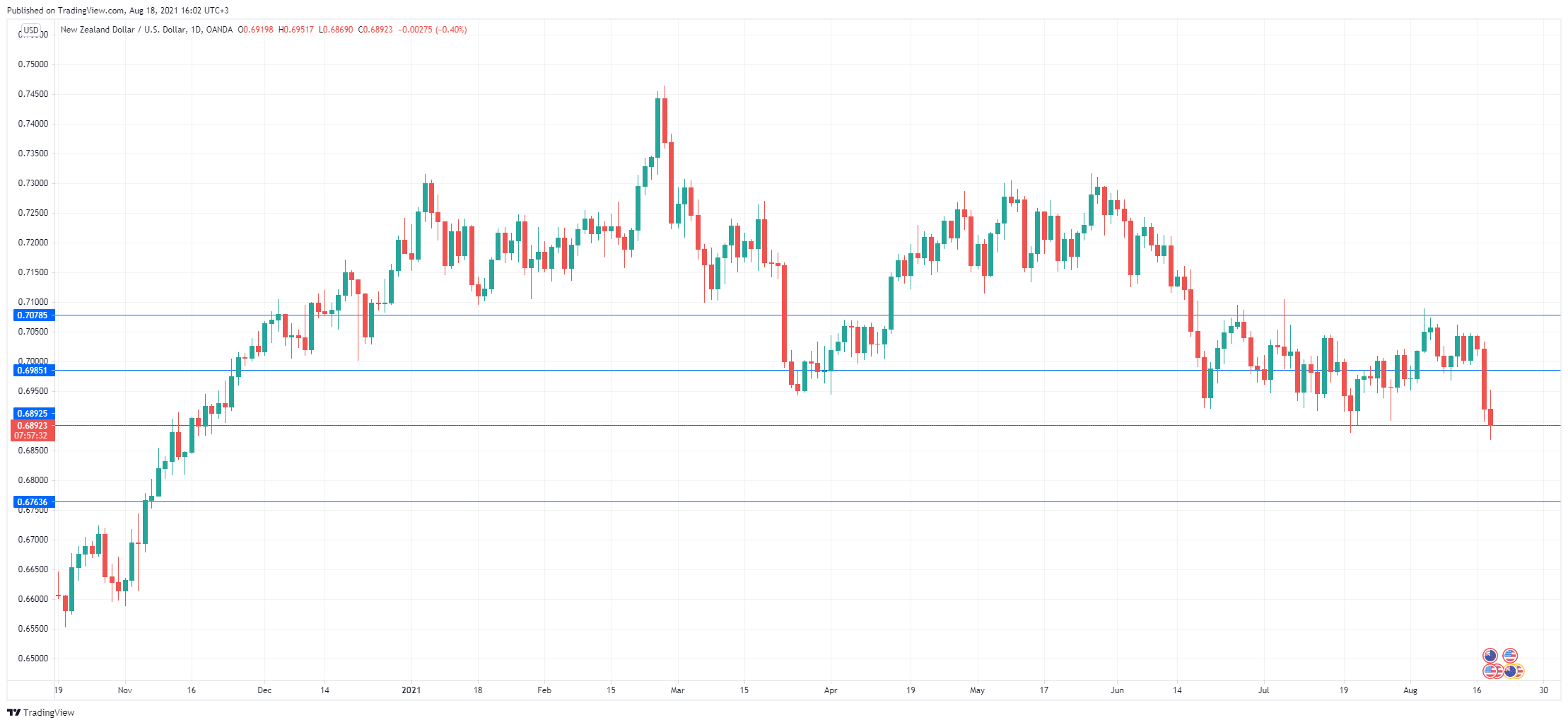
- There is resistance at 0.6985. This is followed closely by a 21-day moving average at 0.6994. Above, we find resistance at 0.7078
- On the downside, 0.6892 is fluid. Next is 0.6763, a monthly support line.
Battered Australian Dollar Looks to Jobs Data
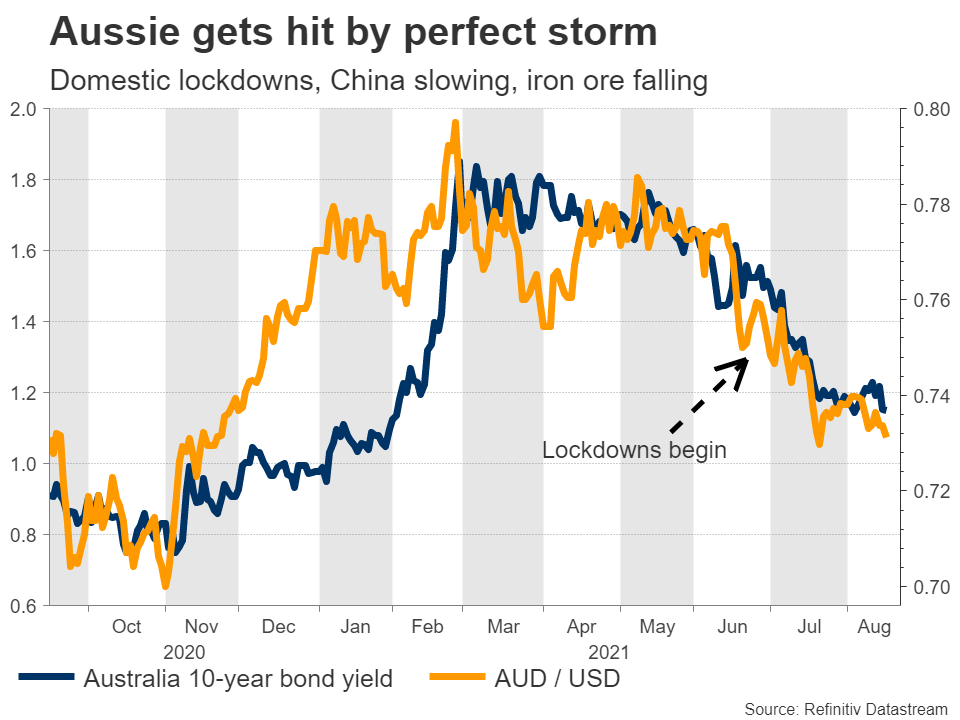
It’s a busy week in Australia. The nation’s wage data for Q2 will be released at 01:30 GMT Wednesday before the jobs numbers for July hit the markets at the same time on Thursday. As for the aussie, it has been pulverized lately by a perfect storm of domestic lockdowns, China slowing down, and falling iron ore prices. The currency’s suffering could continue until something drastic changes.
Zero tolerance
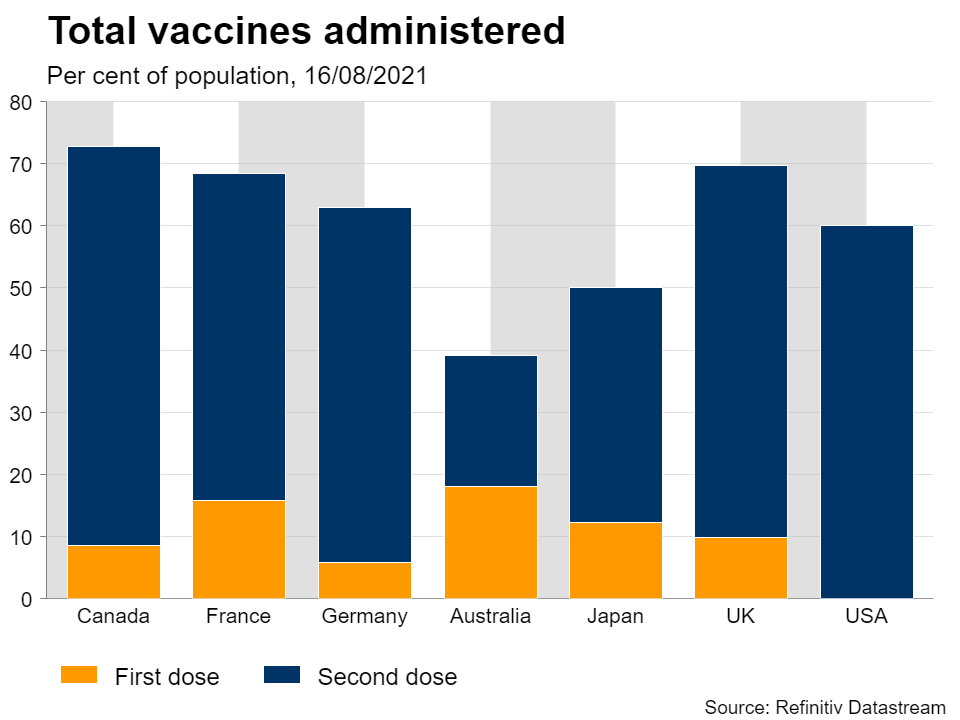
It has been a dreadful couple of months for Australia. Most of the country is trapped in a strict lockdown even though virus cases aren’t particularly high. The government is essentially trying to vaccinate around 70-80% of the population before relaxing any restrictions.
That could take months as only 39% of the population has received at least one vaccination dose so far. In the meantime, it is trying to enforce a zero tolerance policy for covid. Even the army has been deployed in some states to ensure people are following the rules.
This will almost certainly kneecap the economic recovery. Consumers being locked at home is grave news for businesses and growth, and that’s without even considering what’s happening abroad. The Chinese economy is also slowing down. Since China is Australia’s biggest customer for its raw materials, this could be a double whammy as exports take a hit too.
Jobs and wages
The upcoming wage numbers probably won’t reflect this pain as the data refer to the second quarter, which is before the lockdowns really started. Wage growth is expected to have accelerated to 1.9% in yearly terms from 1.5% previously, but this dataset will likely be seen as ‘outdated’ by the markets.
Instead, the spotlight will fall on the employment figures for July, which will likely capture the early impact of the shutdowns. Forecasts suggest the economy lost 46k jobs during the month, pushing the unemployment rate up one tick to 5.0%.
This doesn’t sound like much, but then again, the lockdowns only went into full force during the month. The August data will probably provide a much clearer picture of where the labor market and the economy stand.
Can the aussie heal its wounds?
Overall, the Australian dollar doesn’t look attractive at this stage. There’s no telling how quickly the domestic health situation will improve, the economic weakness will probably lead the Reserve Bank to freeze its plans to normalize policy, and the nation’s biggest trading partner is also slowing down.
Indeed, if economic data truly starts to deteriorate, the central bank could even add more stimulus. At the very least, it won’t be raising interest rates next year, like other major central banks are planning.
Add everything up and the pain train for the aussie could continue, at least until the lockdowns are lifted or the global environment improves dramatically. The chart tells a similar story, with aussie/dollar currently carving out new lows for the year.
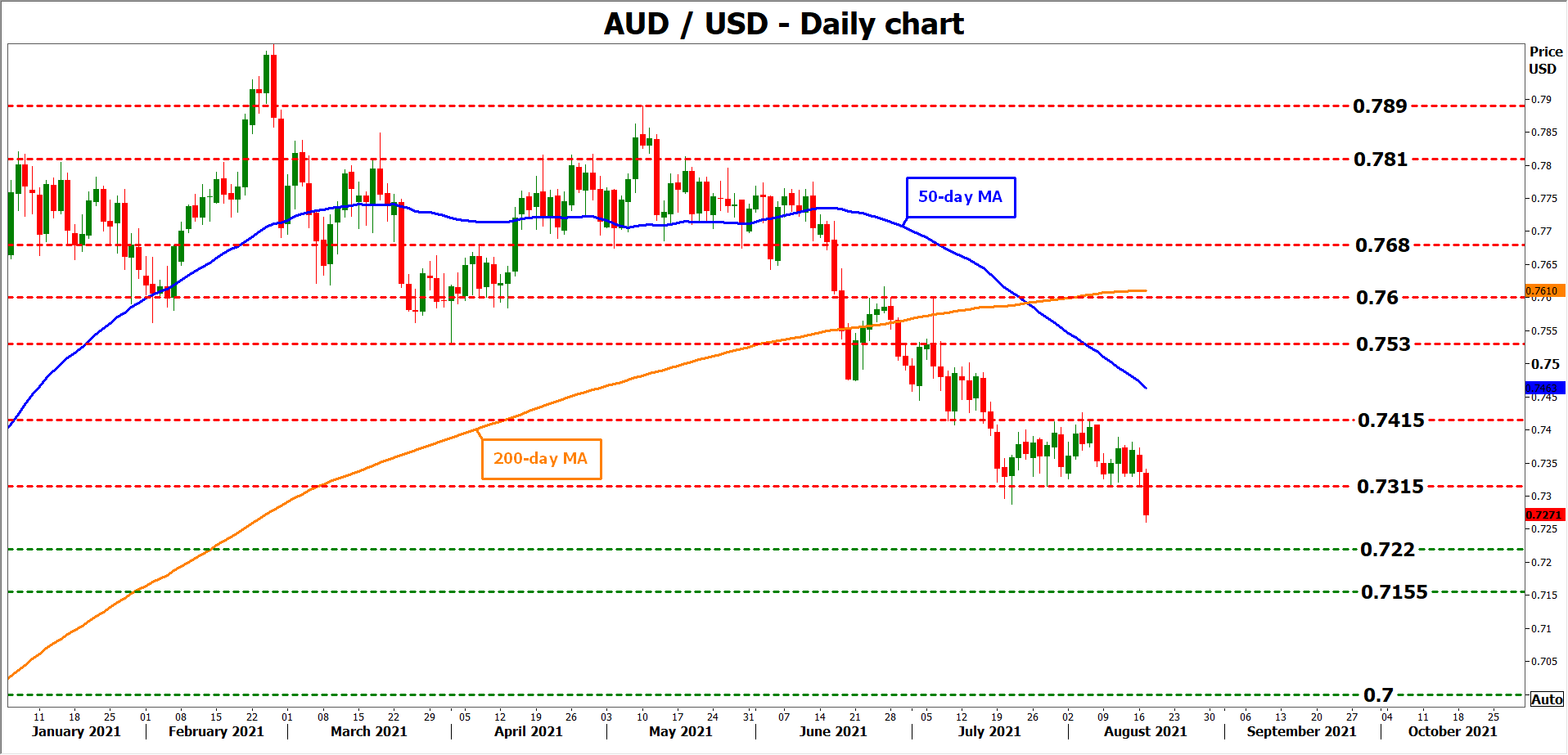
Taking a technical look at the pair, support to any further declines could emerge from the 0.7220 region. A violation would turn the focus towards the 0.7155 zone.
On the upside, a rebound might encounter resistance around the 0.7315 area. If the bulls manage to overcome it, all eyes would then turn towards 0.7415.
Sunset Market Commentary
Markets
Will EUR/USD succumb to gravity and give up on 1.17? After yesterday’s slump, driven by dollar strength even as US retail sales disappointed, all eyes are on that specific support area. From a technical point of view, it’s the last hurdle to intermediate support in the low 1.16 before returning to 1.15 (March 2020 high, 50% Fibonacci retracement March 2020 low - 2021 high). Parallel (resistance) levels in the trade-weighted DXY situate at the low-to-mid 93 zone followed by 94.47/65. Both EUR/USD and DXY again came dangerously close already during early dealings but managed to avoid a break for now. The subsequent (technical) trip north (in EUR/USD) is all but convincing though. The dollar is thus pretty resilient going into the Fed meeting minutes later today. The minutes’ importance shouldn’t be underestimated given the looming Jackson Hole symposium and recent Fed speeches. An increasing number of governors over the past few weeks agreed monetary stimulus should be pared back sooner rather than later. We’re keen to find out how big of a voice they had in the last policy meeting and whether or not it resulted in clues with respect to the Fed laying the groundwork for tapering. Judging by both the dollar and USTs markets at least don’t dismiss chances of that happening. USTs underperform the Bund today with the yield curve bear steepening amidst (admittedly mild) risk-off. Yields rise about 1.2 bps at the 10y and 30y tenor. The German curve on the other hand is bull flattening once again. Changes vary from -1.2 bps (5y) to -1.7 bps (30y). Diverging underlying yield dynamics caught our eye though. Real yields plummeted in recent days to below -2% while inflation expectations is creeping to post-pandemic highs of around 1.54%. This compares with broadly stable inflation expectations in the US around 2.33% and a rebound from real yields in August from -1.20% to -1.06%. This suggest the sluggish EUR/USD performance is not only a dollar move but also follows a weak(ish) euro. Peripheral spreads barely budge.
After a close-to-consensus labour report, UK inflation disappointed this morning. The headline figure slowed to 2% y/y vs 2.3% expected while core measures eased from 2.3% to 1.8% (2% was the bar). Sterling isn’t too worried about it though and is, given circumstances, actually doing not that bad today. EUR/GBP declines marginally from 0.852 to 0.851. Friday’s retail sales mark the end of this data-heavy week for the UK.
News Headlines
Canadian inflation rose by 3.7% Y/Y, the fastest rate since 2011, up from 3.1% Y/Y in June. On a monthly basis, the CPI rose 0.6% in July, the highest pace since January this year. Statistics Canada reported that prices rose at a faster degree Y/Y in six of the eight major components in July, with shelter prices contributing the most to the all-items increase. Conversely, prices for clothing and footwear as well as alcoholic beverages, tobacco products and recreational cannabis slowed. The Bank of Canada’s preferred inflation metric (CPI core – trimmed mean Y/Y) accelerated from 2.7% Y/Y to 3.1% Y/Y, outside the BoC’s inflation-control target range of 1% to 3% and warranting the central bank’s gradual reduction of asset purchases. The Canadian dollar briefly tried to rise on the CPI data, but the move lacked dash. USD/CAD trades just north of 1.26.
Czech National Bank governor Rusnok said that latest inflation data do not change anything about the central bank’s monetary policy and the board’s approach to raising interest rates. Czech inflation unexpectedly surged from 2.8% Y/Y to 3.4% Y/Y in July. Rusnok added though that he is among board members who got closer to considering a 50 bps instead of a 25 bps rate hike at the Sept 30 meeting. At the previous two meetings, the CNB delivered consecutive 25 bps rate increases (to 0.75%) though some already considered a 50 bps move in August. CZK is unnerved by the comments, trading just below 25.50.
Canada: Inflation Heats Up in July
- Canadian inflation rose to the highest rate in almost a decade, with the consumer price index rising 3.7% year-on-year in July, up from 3.1% in June and above the median analyst estimate of 3.4%.
- The acceleration in price growth was widespread with six of eight major categories seeing faster year-on-year growth. Shelter prices (+4.8%) contributed the most to the increase. Only clothing & footwear and alcohol, tobacco & cannabis saw price growth slow relative to a year ago.
- Seasonally adjusted price growth was up a robust 0.5% month-on-month, with similarly strong growth among most major categories.
- Two of three of the Bank of Canada's core inflation metrics moved higher in the month. The CPI-trim rose to 3.1% (from 2.7%) and CPI-Median to 2.6% (from 2.4%). The CPI-common measure was unchanged 1.7%. Taken together, the three measures averaged 2.5%, the highest level since February 2009.
Key Implications
- Price growth continues to surprise on the upside in Canada. At the same time, it is becoming more widespread across categories. The pandemic's effect on price growth is not only on the supply side, where production disruptions are adding to the cost of manufactured goods such as autos, but also on demand, where policy supports have driven robust spending on housing and durable goods items. We are also now starting to see the impact of faster price growth in re-opening services sectors such as restaurants.
- The staying power of inflation will ultimately depend on expectations and the response of monetary policy. The Bank of Canada may be willing to tolerate higher inflation while the economy is still re-opening and recovering from the health shock, but it will respond to more lasting price pressures by reducing monetary accommodation. In the near-term, asset purchases are likely to continue to be pared back, with rate hikes likely to follow late next year.
US: Housing Starts Retreat in July, But Trend Remains Healthy
- Housing starts fell 7% (or 116k) to 1.53 million units (annualized) in July. The headline number came in below expectations, which called for a more moderate pullback to 1.61 million. Upward revisions to the prior two months added 55k to the overall tally.
- Starts in the single-family segment fell 4.5% (or 52k) to 1.11 million, while starts in the multifamily segment fell 13.1% (or 64k) to 423k.
- Permitting activity recorded its first gain in three months, rising 2.6% to 1.64 million. The multifamily segment, where permits rose 11.2% to 587k was entirely responsible for the increase. Single-family permits, meanwhile, fell 1.7% to 1.05 million, retreating for the fourth consecutive month.
- Housing starts fell across most regions, with a continued improvement in the South (+2.1%) the only exception. Declines were led by the Northeast (-49.3%), followed by the West (-11.3%) and the Midwest (-6.9%).
Key Implications
- A pullback in housing starts in July was widely expected given that permitting activity (a leading indicator for starts) had fallen in each of the three months prior. Despite this, the overall pace of new homebuilding remains relatively healthy, with the six-month moving average still above the pre-pandemic trend at close to 1.59 million.
- The smaller multifamily market has contributed to the healthy pace of homebuilding, with starts in the segment generally trending higher over the last several months thanks to improving public health conditions and better prospects for dense urban living. The recent surge in multifamily permits suggests that the pullback in starts experienced in July may be short lived. But, the latest Delta-driven COVID-19 wave could still pose a near-term hurdle for the segment.
- Rising material costs and a shortage of qualified labor, coupled with buyers' affordability challenges add to concerns for builders. Builder sentiment in the larger single-family market has eased gradually in recent months. Nonetheless, the fundamentals for homebuilding remain solid, thanks to an improving labor market backdrop and still exceptionally low inventory levels. A recent easing in mortgage rates and a pullback in lumber prices (the latter have fallen sharply since peaking in mid-May and are now back to pre-pandemic levels) are also expected to provide support.
GBP/USD Potential Inverse Head and Shoulder Target 1.55
In the last Bank of England’s meeting, the central gave a signal for a potential interest rate hike in 2022. This would put it ahead of a number of other G10 central banks, including RBA, U.S Fed, BOJ, and ECB. The hawkish outlook by the central bank could potentially provide underlying support for Pound Sterling.
GBP/USD potential weekly inverse head and shoulder
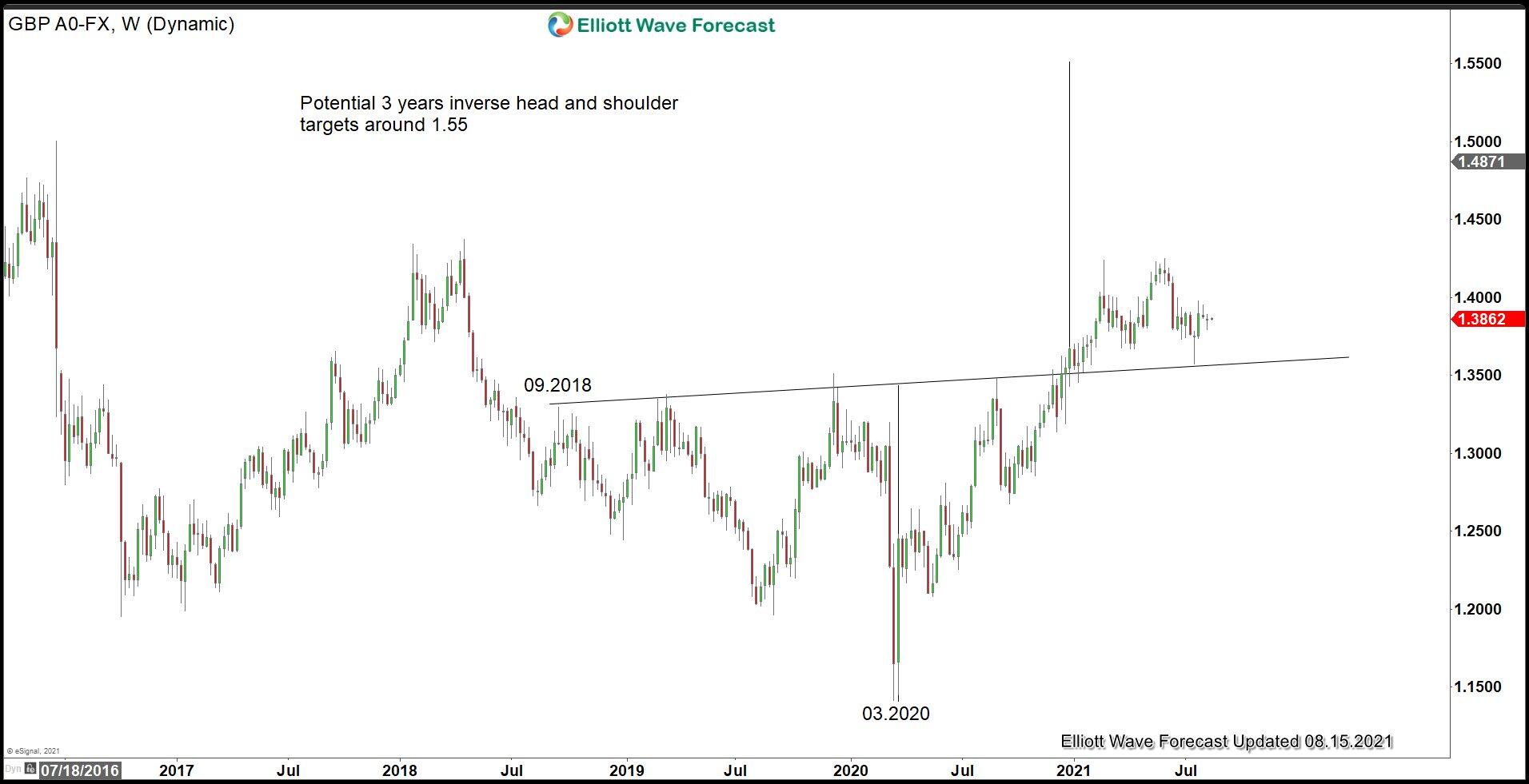
GBPUSD weekly chart above shows a potential 3 years inverse head and shoulder pattern. Pair has broken above the neckline of the inverse head and shoulder. Measuring the distance between the head and neckline, then projecting it from the point of the breakout yields a target towards 1.55.
GBP/USD weekly Elliott Wave view
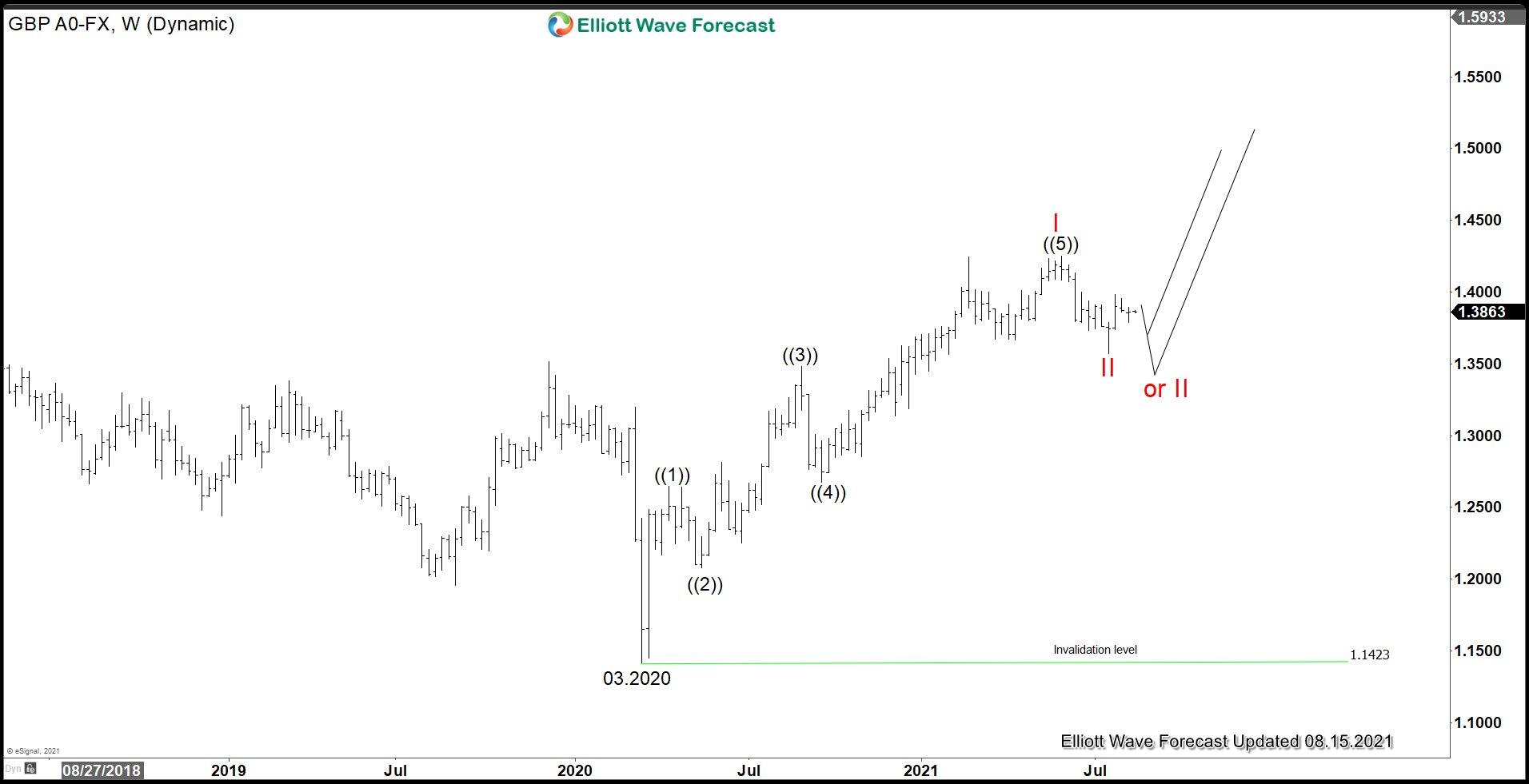
USD/JPY Mid-Day Outlook
Daily Pivots: (S1) 109.25; (P) 109.46; (R1) 109.79; More...
Intraday bias in USD/JPY remains neutral at this point, and risk stays on the downside with 110.79 resistance intact. On the downside, below 109.10 will target 108.71 support first. Firm break there will resume the decline from 111.65 and target 38.2% retracement of 102.58 to 111.65 at 108.18 next.
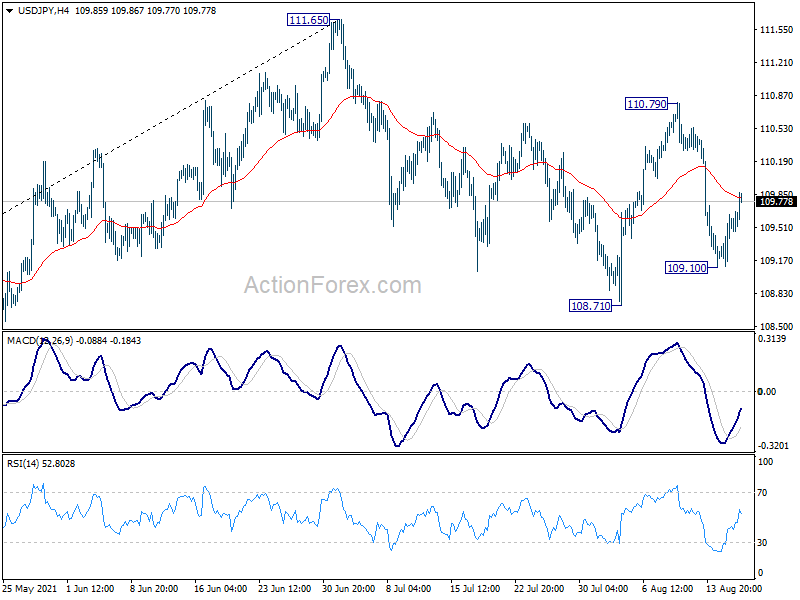
In the bigger picture, medium term outlook is staying neutral with 111.71 resistance intact. The pattern from 101.18 could still extend with another falling leg. Sustained trading below 55 day EMA will bring deeper fall to 107.47 support and below. Nevertheless, strong break of 111.71 resistance will confirm completion of the corrective decline from 118.65 (2016 high). Further rise should then be seen to 114.54 and then 118.65 resistance.