

Sample Category Title
USD/CHF Mid-Day Outlook
Daily Pivots: (S1) 0.9115; (P) 0.9134; (R1) 0.9167; More....
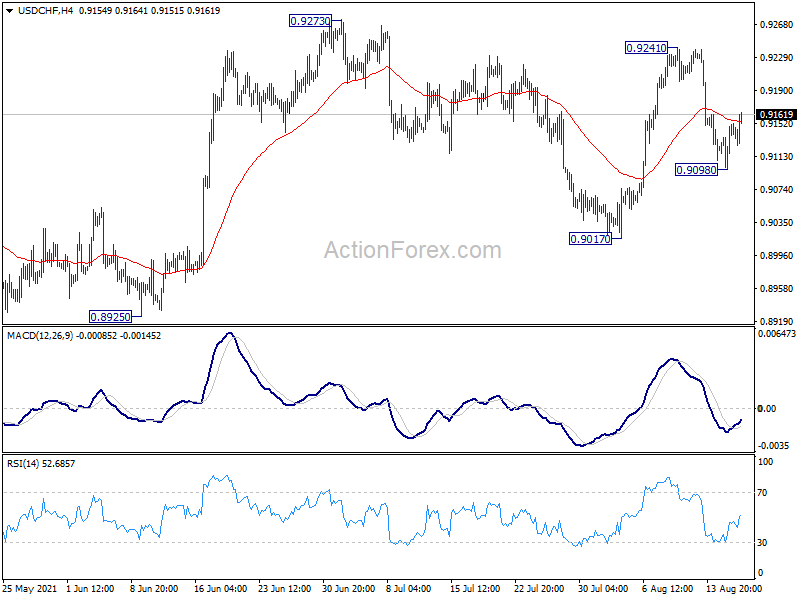
Intraday bias in USD/CHF stays neutral at this point, and near term outlook is mixed. On the downside, below 0.9098 will target 0.9017 support first. Further break there will likely resume the decline from 0.9471 through 0.8925 low. On the upside, though, break of 0.9241 should resume the rise from 0.8925 through 0.9273 resistance.
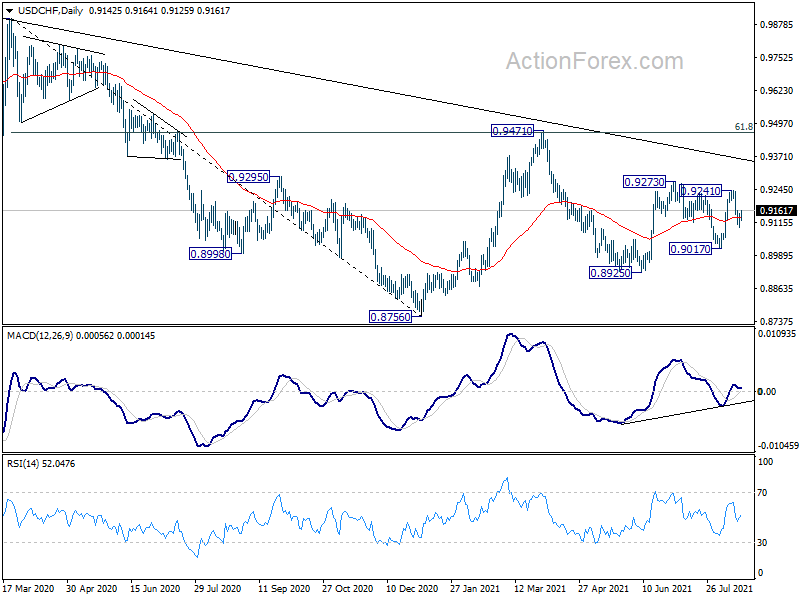
In the bigger picture, the failure to sustain above 55 week EMA (now at 0.9184) retains medium term bearish in USD/CHF. Break of 0.8925 support should resume the whole decline form 1.0342 (2016 high) through 0.8756 low. However, break of 0.9273 resistance and sustained trading above 55 week EMA will be an early sign of bullish trend reversal. Focus will then turn to 0.9471 resistance for confirmation.
EUR/USD Mid-Day Outlook
Daily Pivots: (S1) 1.1684; (P) 1.1734; (R1) 1.1760; More...
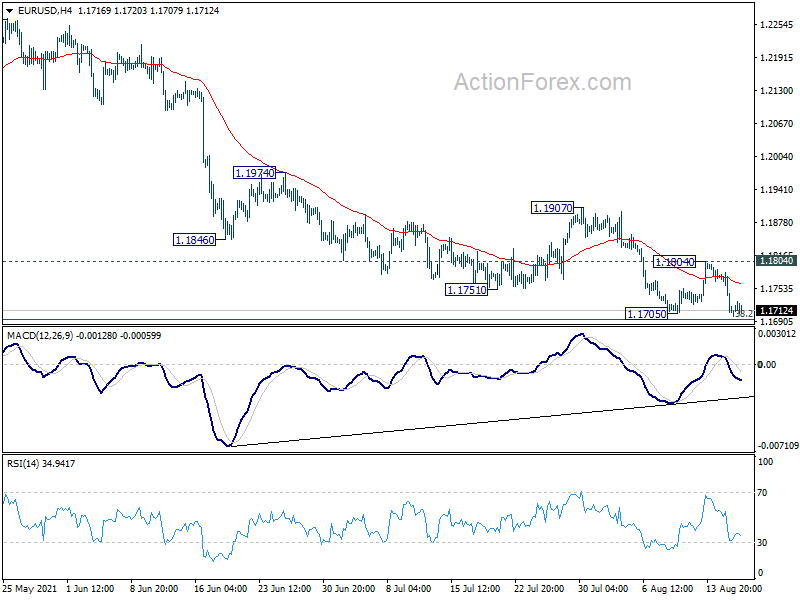
Deeper fall is in favor in EUR/USD with 1.1804 resistance intact. But we'd continue to look for strong support from 1.1602/1703 key support zone to bring rebound. On the upside, above 1.1804 resistance will turn bias back to the upside for 1.1907 resistance first. however, sustained break of 1.1602/1703 will carry larger bearish implication and pave the way to 1.1289 fibonacci support.
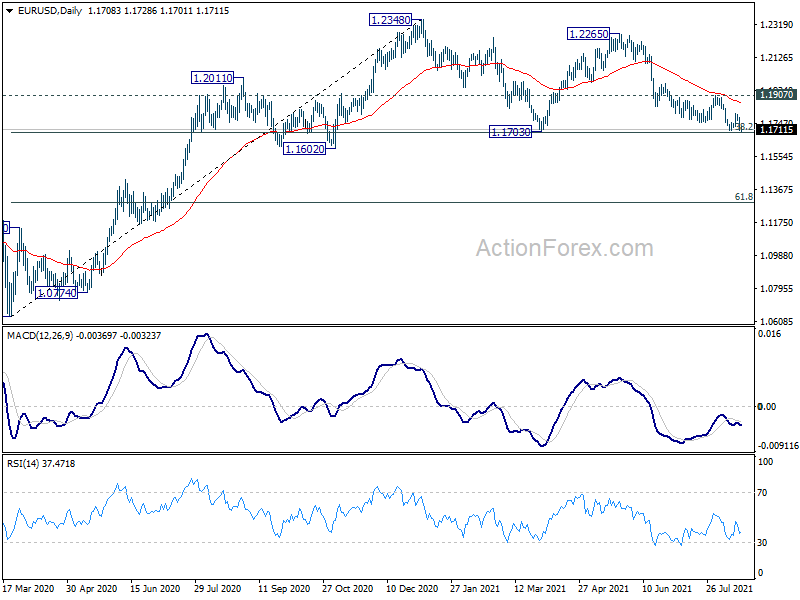
In the bigger picture, rise from 1.0635 is seen as the third leg of the pattern from 1.0339 (2017 low). Further rally remains in favors long as 1.1602 support holds, to cluster resistance at 1.2555 next, (38.2% retracement of 1.6039 to 1.0339 at 1.2516). Reaction from 1.2555 should reveal underlying long term momentum in the pair. However sustained break of 1.1602 will argue that the rise from 1.0635 is over, and turn medium term outlook bearish again. Deeper fall would be seen to 61.8% retracement of 1.0635 to 1.2348 at 1.1289 and below.
GBP/USD Mid-Day Outlook
Daily Pivots: (S1) 1.3695; (P) 1.3770; (R1) 1.3815; More...
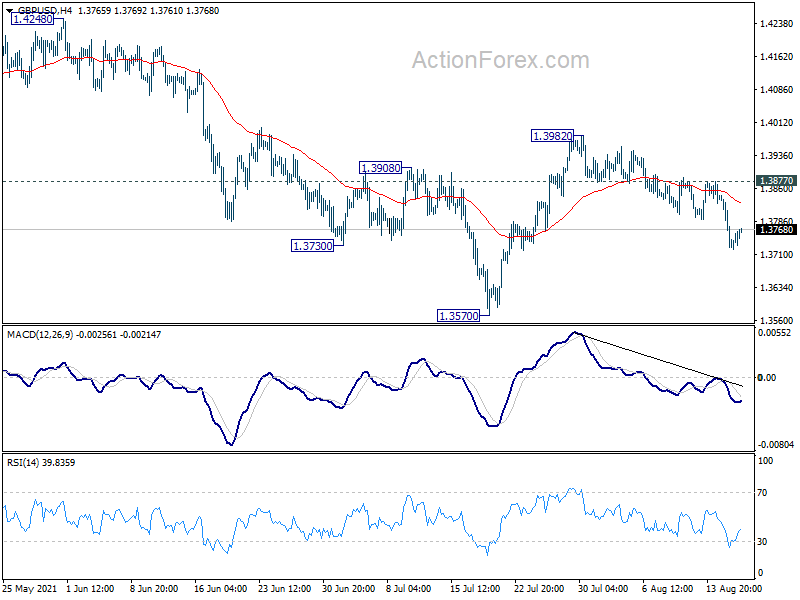
Intraday bias in GBP/USD remains mildly on the downside at this point. Rebound from 1.3570 should have completed at 1.3982, after the rejection by 55 day EMA. Deeper fall would be seen to retest 1.3570 first. Break will 1.3482 resistance turned support. On the upside, above 1.3877 minor resistance will turn bias back to the upside for 1.3982.
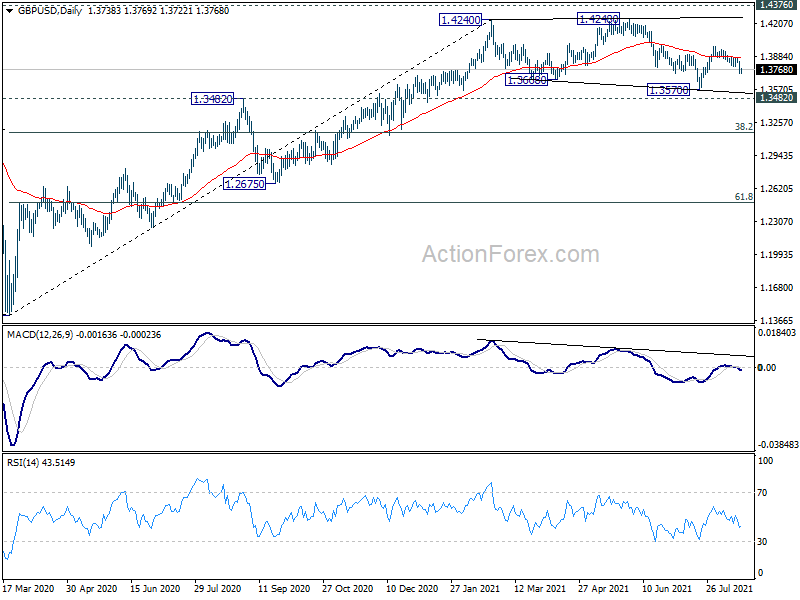
In the bigger picture, as long as 1.3482 resistance turned support holds, up trend from 1.1409 should still continue. Decisive break of 1.4376 resistance will carry larger bullish implications. However, firm break of 1.3482 support will argue that the rise from 1.1409 has completed. GBP/USD would then be seen as in another leg of long term range pattern between 1.1409 and 1.4376. Deeper fall could then be seen to 61.8% retracement of 1.1409 to 1.4248 at 1.2493, and even below.
Dollar Digests Gains, Canadian Dollar Recovers Mildly after CPI
Canadian Dollar rises mildly in early US session after stronger than expected consumer inflation reading. But strength of the Loonie is related limited. It remains one of the worst performing for the week, just next to Australian and New Zealand Dollar. Aussie continues to be weighed down by lockdowns while Kiwi is soft after RBNZ stood pat. Nevertheless, Swiss Franc, Yen and Dollar are just digesting this week's gains, awaiting the next move.
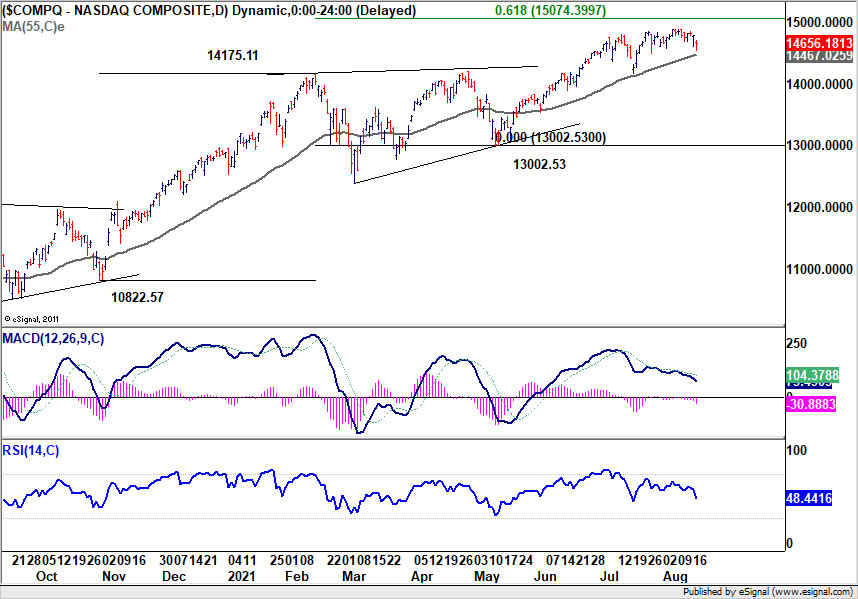
Technically, the next move in the forex markets could be triggered by development in stocks. NASDAQ would try to draw support from 55 day EMA (now at 14467.02) again, to resume long term up trend. In that case, Swiss Franc, Yen and Dollar could turn softer. However, sustained break of the EMA will be an early sign of larger reversal and put 14k handle at risk. We could then see buying of the three safe haven currencies come back.
In Europe, at the time of writing, FTSE is down -0.35%. DAX is flat. CAC is down -0.67%. Germany 10-year yield is down -0.014 at -0.482. Earlier in Asia, Nikkei rose 0.59%. Hong Kong HSI rose 0.47%. China Shanghai SSE rose 1.11%. Singapore Strait Times rose 0.41%. Japan 10-year JGB yield rose 0.0077 to 0.017.
Canada CPI accelerated to 3.7% yoy in Jul
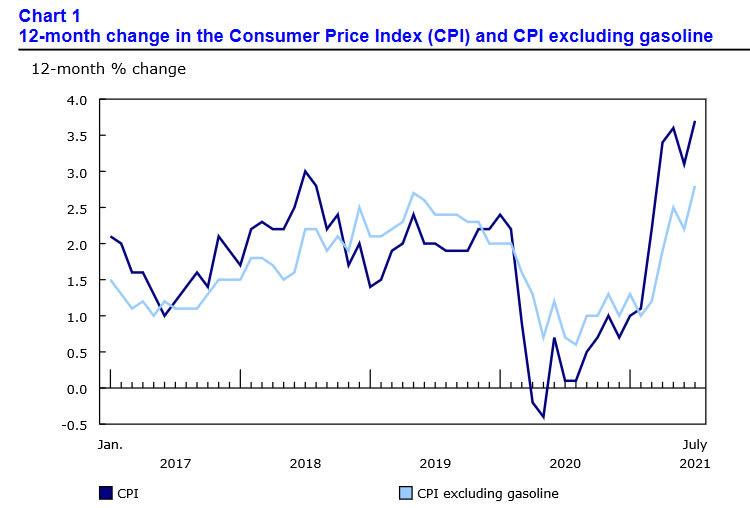
Canada CPI rose 0.6% mom in July, fastest pace since January. Annually, CPI accelerated to 3.7% yoy in July, up from June's 3.1% yoy, above expectation of 3.4% yoy. Prices rose at a faster pace year over year in six of the eight major components, with shelter prices contributing the most to the all-items increase.
CPI common was unchanged at 1.7% yoy, below expectation of 1.8% yoy. CPI median rose from 2.4% yoy to 2.6% yoy, above expectation of 2.4% yoy. CPI trimmed rose from 2.7% yoy to 3.1% yoy, above expectation of 2.5% yoy.
From the US, housing starts dropped to 1.53m annualized rate in July, versus expectation of 1.60m. Building permits rose to 1.64m, above expectation of 1.61m.
Eurozone CPI finalized at 2.2% yoy in Jul, core CPI at 0.7% yoy
Eurozone CPI was finalized at 2.2% yoy in July 2021, up from June's 1.9% yoy. Core CPI was finalized at 0.7% yoy. Highest contribution came from energy (+1.34%), followed by food, alcohol & tobacco (+0.35%), services (+0.31%) and non-energy industrial goods (+0.17%).
EU CPI was finalized at 2.5%, up from 2.2% in June. The lowest annual rates were registered in Malta (0.3%), Greece (0.7%) and Italy (1.0%). The highest annual rates were recorded in Estonia (4.9%), Poland and Hungary (both 4.7%). Compared with June, annual inflation fell in nine Member States, remained stable in two and rose in sixteen.
UK CPI slowed to 2.0% yoy in Jul, core CPI down to 1.8% yoy
UK CPI slowed to 2.0% yoy in July, down from 2.5% yoy, below expectation of 2.2% yoy. Core CPI slowed to 1.8% yoy, down from 2.3% yoy, below expectation of 2.2% yoy. RPI dropped to 3.8% yoy, down from 3.9% yoy, below expectation of 3.7% yoy.
PPI input came in at 0.8% mom, 9.9% yoy, versus expectation of 1.2% mom, 10.8% yoy. PPI output was at 0.6% mom, 4.9% yoy, versus expectation of 0.4% mom, 4.8% yoy. PPI core output was at 0.7% mom, 3.9% yoy.
RBNZ keeps rate unchanged on heightened uncertainty
RBNZ kept Official Cash Rate unchanged at 0.25% today, instead of raising it. The decision was "made in the context of the Government's imposition of Level 4 COVID restrictions on activity across New Zealand." Nevertheless, it reiterated that the "least regrets policy stance" was still to "further reduce the level of monetary stimulus". But the Committee agreed to stand pat at this meeting "given the heightened uncertainty with the country in a lockdown."
In the summary record, it's also noted that committee members "now had more confidence that rising capacity pressures will feed through into inflation, and that employment is at its maximum sustainable level." They concluded that "they could continue removing monetary stimulus", following haling the LSAP program in July.
Also from New Zealand, PPI input accelerated to 3.0% qoq in Q2, up from 2.1% qoq, well above expectation of 0.5% qoq. PPI output jumped to 2.6% qoq, up from 1.2% qoq, above expectation of 0.1% qoq.
Australia leading index dropped to 1.3 in Jul, still consistent with above trend growth
Australia Westpac-MI leading index dropped from 1.36% to 1.30% in July. The index is still consistent with above trend growth over the next 3 to 9 months. Nevertheless, Westpac also said, "no Leading Index can accurately predict the impact of sudden virus lockdowns, although the direct effects of measures will start to become more apparent in the August Index."
Also, with the deteriorating outlook in New South Wales and Melbourne due to lockdowns, West pact has revised down Q3 GDP forecast to a contraction of -2.6%, to be followed by 2.6% growth in Q4, and very strong growth of 5.0% in 2022.
Westpac added that RBA would likely to "take the same approach" as August in September meeting. That is, there would be no response to the current lockdown risks. However, it added, "we certainly cannot rule out a policy change in September especially if, as we assess, developments have raised some questions as to the vulnerability and timing of the expected recovery.
Also released, Wage price index rose 0.4% qoq in Q2, below expectation of 0.6% qoq.
Japan exports rose 37.0% yoy in Jul, imports rose 28.5% yoy
Japan export rose 37.0% yoy to JPY 7356B in July, slightly below expectation of 39.0% yoy. By region, exports to China rose 18.9% yoy, led by chip-making equipment and plastic. Exports to the US grew 26.8% yoy, led by exports of cars, car parts and motors. Imports rose 28.5% yoy to JPY 6915B, below expectation of 35.1% yoy. Trade balance came in at JPY 441B.
In seasonally adjusted term, exports was unchanged at JPY 7049B. Imports dropped -1.6% mom to 6997B. Trade balanced reported a surplus of JPY 52.7B.
Also from Japan, machinery orders dropped -1.6% mom in June, versus expectation of -2.8% mom.
GBP/USD Mid-Day Outlook
Daily Pivots: (S1) 1.3695; (P) 1.3770; (R1) 1.3815; More...
Intraday bias in GBP/USD remains mildly on the downside at this point. Rebound from 1.3570 should have completed at 1.3982, after the rejection by 55 day EMA. Deeper fall would be seen to retest 1.3570 first. Break will 1.3482 resistance turned support. On the upside, above 1.3877 minor resistance will turn bias back to the upside for 1.3982.
In the bigger picture, as long as 1.3482 resistance turned support holds, up trend from 1.1409 should still continue. Decisive break of 1.4376 resistance will carry larger bullish implications. However, firm break of 1.3482 support will argue that the rise from 1.1409 has completed. GBP/USD would then be seen as in another leg of long term range pattern between 1.1409 and 1.4376. Deeper fall could then be seen to 61.8% retracement of 1.1409 to 1.4248 at 1.2493, and even below.
Economic Indicators Update
| GMT | Ccy | Events | Actual | Forecast | Previous | Revised |
|---|---|---|---|---|---|---|
| 22:45 | NZD | PPI Input Q/Q Q2 | 3.00% | 0.50% | 2.10% | |
| 22:45 | NZD | PPI Output Q/Q Q2 | 2.60% | 0.10% | 1.20% | |
| 23:50 | JPY | Trade Balance (JPY) Jul | 0.05T | 0.12T | -0.09T | -0.06T |
| 23:50 | JPY | Machinery Orders M/M Jun | -1.50% | -2.80% | 7.80% | |
| 00:30 | AUD | Westpac Leading Index M/M Jul | -0.10% | -0.06% | ||
| 01:30 | AUD | Wage Price Index Q/Q Q2 | 0.40% | 0.60% | 0.60% | |
| 02:00 | NZD | RBNZ Rate Decision | 0.25% | 0.50% | 0.25% | |
| 03:00 | NZD | RBNZ Press Conference | ||||
| 06:00 | GBP | CPI M/M Jul | 0.00% | 0.30% | 0.50% | |
| 06:00 | GBP | CPI Y/Y Jul | 2.00% | 2.20% | 2.50% | |
| 06:00 | GBP | Core CPI Y/Y Jul | 1.80% | 2.20% | 2.30% | |
| 06:00 | GBP | RPI M/M Jul | 0.50% | 0.30% | 0.70% | |
| 06:00 | GBP | RPI Y/Y Jul | 3.80% | 3.70% | 3.90% | |
| 06:00 | GBP | PPI Input M/M Jul | 0.80% | 1.20% | -0.10% | 0.50% |
| 06:00 | GBP | PPI Input Y/Y Jul | 9.90% | 10.80% | 9.10% | 9.70% |
| 06:00 | GBP | PPI Output M/M Jul | 0.60% | 0.40% | 0.40% | 0.60% |
| 06:00 | GBP | PPI Output Y/Y Jul | 4.90% | 4.80% | 4.30% | 4.90% |
| 06:00 | GBP | PPI Core Output M/M Jul | 0.70% | 0.30% | 0.60% | |
| 06:00 | GBP | PPI Core Output Y/Y Jul | 3.90% | 2.70% | 3.70% | |
| 09:00 | EUR | Eurozone CPI Y/Y Jul F | 2.20% | 2.20% | 2.20% | |
| 09:00 | EUR | Eurozone CPI - Core Y/Y Jul F | 0.70% | 0.70% | 0.70% | |
| 12:30 | USD | Housing Starts Jul | 1.53M | 1.60M | 1.64M | 1.65M |
| 12:30 | USD | Building Permits Jul | 1.64M | 1.61M | 1.59M | 1.59M |
| 12:30 | CAD | CPI M/M Jul | 0.60% | 0.40% | 0.30% | |
| 12:30 | CAD | CPI Y/Y Jul | 3.70% | 3.40% | 3.10% | |
| 12:30 | CAD | CPI Common Y/Y Jul | 1.70% | 1.80% | 1.70% | |
| 12:30 | CAD | CPI Median Y/Y Jul | 2.60% | 2.40% | 2.40% | |
| 12:30 | CAD | CPI Trimmed Y/Y Jul | 3.10% | 2.50% | 2.60% | 2.70% |
| 14:30 | USD | Crude Oil Inventories | -1.5M | -0.4M | ||
| 18:00 | USD | FOMC Minutes |
Canada CPI accelerated to 3.7% yoy in Jul
Canada CPI rose 0.6% mom in July, fastest pace since January. Annually, CPI accelerated to 3.7% yoy in July, up from June's 3.1% yoy, above expectation of 3.4% yoy. Prices rose at a faster pace year over year in six of the eight major components, with shelter prices contributing the most to the all-items increase.
CPI common was unchanged at 1.7% yoy, below expectation of 1.8% yoy. CPI median rose from 2.4% yoy to 2.6% yoy, above expectation of 2.4% yoy. CPI trimmed rose from 2.7% yoy to 3.1% yoy, above expectation of 2.5% yoy.
Oil Under Pressure, Gold Rises
Oil continues to suffer recovery nerves
The weaker than expected US Retail Sales data and ensuing US dollar strength weighed further on oil prices overnight. Confidence is being weakened anyway by softer China data earlier in the week and ratcheting fears that the Covid-19 delta-variant will erode the pace of the global recovery, and thus, future oil demand. US API Crude Inventories dropped by 1.163 million barrels overnight, but that seemed only to stem the negative tide, not turn it. Nor has OPEC+’s refusal to head President Biden’s call to pump more to lower prices proved supportive.
Brent crude eased 0.66% lower to USD 69.10 a barrel overnight, while WTI retreated by 1.25% to USD 66.55 a barrel. Oil prices are steady this morning in Asia, being almost unchanged from overnight. Notably, both contracts remained below their 100-day moving averages (DMAs), while the relative strength indexes (RSIs) remain neutral, bearish technical developments.
Brent crude has resistance at USD 70.00 and then the 100-DMA at USD 70.50 a barrel. That is followed by USD 71.35 and USD 72.00 a barrel. It has support nearby at the overnight low of USD 68.85, followed by USD 68.20 and then USD 67.50 a barrel. Failure opens a test of triple bottom support at USD 64.60 a barrel.
WTI has resistance at the overnight high at USD 67.75, closely followed by the 100-DMA, located at USD 67.80 a barrel. We then have USD 69.60 and USD 70.00 a barrel. Support is nearby at the overnight low of USD 66.35, followed by USD 65.75, and then the more critical double bottom at USD 65.10 a barrel. Failure opens a chasm that could target USD 62.00 a barrel in the sessions ahead.
Both contracts rallied intra-session overnight, only to fail ahead of their respective 100-DMAs, reinforcing their near-term importance. Both contracts appear to be tracing out bearish pennant formations, suggesting prices could fall substantially from here. I will await tonight’s official US crude inventory data and the FOMC minutes before finalising my thoughts on that tomorrow.
Gold shows haven resilience
Gold appears to be finally trading off something that doesn’t resemble a mechanic inverse relationship to the US dollar. Despite the greenback recording substantial gains overnight, gold held onto all of its gains of the past few sessions, finishing only 0.06% lower at USD 1786.00 an ounce.
It looks like, for now, the safe-haven bid is back. Increasing nerves about the delta variant’s impact on the global recovery is finally starting to weigh on equity markets, with at least some of those funds parked in the yellow metal. At the periphery, concerns about the transition of power in Afghanistan and its implications for regional stability may also be strengthening gold’s hand. Weaker than expected, recent China data and the impact of partial port shutdowns there on global supply chains are another tailwind.
Nevertheless, gold will face more challenges to its rally if the US dollar keeps strengthening. More importantly, if US long-dated bond yields start to rise, I doubt gold’s upward momentum will be maintained.
Some risk aversion buying is evident in Asia today, as gold firms by 0.16% to USD 1789.00 an ounce. However, from a technical perspective, gold faces a series of formidable resistance levels from here on up. Gold has initial resistance at the overnight highs at USD 1797.00, which is also the 50-DMA. That is followed by USD 1800.00 an ounce and then the 100-DMA at USD 1807.50 an ounce, ahead of the 200-DMA at USD 1813.20 an ounce. After that comes before a series of daily highs, each side of USD 1834.00 an ounce.
Support resides at the overnight lows around USD 1780.00, followed by USD 1770.00 and then the important pivot region at USD 1750.00 an ounce. Failure of USD 1750.00 implies a deeper retreat to USD 1700.00 an ounce.
Although gold has maintained its risk-aversion bid overnight, the technical picture suggests it has a lot of wood to chop on the upside to sustain the rally’s momentum. I, therefore, maintain a cautious stance on further gold strength at these levels if the US dollar remains as firm as it is at the moment.
Investors Focus On Inflation Data In Europe And FOMC Minutes
US retail sales decreased by 1.1% in July, while the core retail sales index decreased by 0.4%. Both indicators did not meet economists’ expectations, but the dollar index increased by 0.54% despite that. The political instability in Afghanistan also increased the demand for US currency. According to Fed Chairman Jerome Powell, the central bank does not know how the outbreak of the Delta strain might affect the economy, so the central bank is just watching the situation. At the same time, major US stock indices decreased yesterday due to declines in the technology, financial, and consumer cyclical sectors. Dow Jones decreased by 0.79%, S&P 500 index fell 0.71%, NASDAQ index lost 0.93%. General Motors stock decreased by 2.5% after Warren Buffett's Berkshire Hathaway announced it was cutting its stake in the company. Sharp declines in auto sales in July also contributed to declines in Ford and Tesla stocks.
Pfizer and BioNTech SE submitted an application to US regulators to approve a third booster dose of the vaccine, which has higher levels of neutralizing antibodies against the original virus and against Beta and Delta variants. Pharma companies are confident that revaccination within a year after the second vaccine can help keep protection from COVID-19.
European stock indices traded without a single dynamic. Investors became less optimistic about Europe's economic growth prospects, despite GDP growth and active vaccination. The UK unemployment rate fell from 4.8% to 4.7%, and the number of employees in British companies approached pre-pandemic levels. Europe and the UK will report on the inflation rate today. This is important data that central banks consider when planning their monetary policy.
Oil demonstrates the decline for the fourth day in a row. The prospect of reducing the demand for travel and new restrictions in Asian countries continue to put pressure on quotes.
Chinese authorities continue to put pressure on the country's IT sector. Yesterday, the State Administration for Market Regulation (SAMR) presented a new draft of rules aimed at stopping unfair competition on the Internet. In turn, the head of the US Securities and Exchange Commission (SEC) appealed to investors with a warning of risks related to investments in Chinese companies in the US stock exchanges. The trade war between the two countries continues. There is a possible crisis associated with delays of shipping supplies from China ahead. China's newspaper, People's Daily, which is considered the mouthpiece of China's Communist Party, hints at the need to stimulate the economy. If China announces an easing of monetary policy, Asian stock indices could begin a bullish trend. The Reserve Bank of New Zealand announced it would keep its monetary policy unchanged, leaving the interest rate at 0.25%. Analysts had expected that New Zealand would become the first advanced economy to raise interest rates.
Main market quotes:
- S&P 500 (F) 4,448.08 -31.63 (-0.71%)
- Dow Jones 35,343.28 -282.12 (-0.79%)
- DAX 15,921.95 -3.78 (-0.02%)
- FTSE 100 7,181.11 +27.13 (+0.38%)
- USD Index 93.12 +0.50 (+0.54%)
Important events for today:
- New Zealand RBNZ Interest Rate Decision at 05:00 (GMT+3);
- New Zealand RBNZ Monetary Policy Statement at 05:00 (GMT+3);
- New Zealand RBNZ Rate Statement at 05:00 (GMT+3);
- New Zealand RBNZ Press Conference at 06:00 (GMT+3);
- UK Consumer Price Index (m/m) at 09:00 (GMT+3);
- Eurozone Consumer Price Index (m/m) at 12:00 (GMT+3);
- US Building Permits (m/m) at 15:30 (GMT+3);
- Canada Consumer Price Index (m/m) at 15:30 (GMT+3);
- US Crude Oil Inventories (w/w) at 17:30 (GMT+3);
- US FOMC Meeting Minutes at 21:00 (GMT+3).
Raised Bar For Risk Asset Gains
- Asian stocks, US futures tepid after recent declines.
- Delta variant poses significant risk to market sentiment.
- FOMC minutes could offer more insight into Fed’s tapering thinking.
Risk appetite is attempting to claw its way back after Tuesday’s selloff. Asian stocks are pushing higher while European bourses have opened modestly in the green and US equity futures are little changed. The growing apprehension towards taking on more risk remains palpable across financial markets, which has allowed gold prices to defy the dollar’s surge on Tuesday and move within touching distance of the psychological $1800 mark.
Markets are becoming more guarded against the looming risks. From a potential flare-up in geopolitical tensions to the Delta variant’s persistent menace to the global economic recovery, the bar appears to have been raised for risk assets to climb significantly higher over the near-term.
To use the same adjectives employed by RBNZ Governor Adrian Orr earlier today, one only has to consider the “unpredictable and disruptive” nature of the Delta variant to know that the global economy is not yet on solid ground. With New Zealand now joining Australia in lockdown, along with China’s moderating economic recovery, such episodes are testament to how even the most optimistic outlook can be dampened by negative developments in this protracted battle with the virus.
As the global population learns to live with Covid-19, so too must market participants with such uncertainties.
Fed tapering plans remain a key focus
As dark clouds gather on the horizon, the main driver of global market sentiment remains the Fed’s tapering timeline. The July FOMC meeting minutes due later today might help investors have a firmer grasp of policymakers’ thinking ahead of what could be a key announcement, perhaps to be made at either next week’s Jackson Hole symposium or next month’s policy meeting.
The Fed’s policy bias will be heavily influenced by the incoming economic data which has proven to be a mixed bag since the last FOMC meeting. A blockbuster July nonfarm payrolls print was followed up with disappointing consumer sentiment and headline retail sales figures.
Ultimately, Fed officials have highlighted their desire for one or two more robust monthly job reports before becoming comfortable with an official decision to taper. That announcement could then give the all-clear for a sustained rebound in Treasury yields, which should support more upside for the greenback while forcing bullion to unwind recent gains.
The eventual moving away from the stimulus punch bowl also suggests a limited runway for risks assets to march higher, having already enjoyed tremendous gains since the onset of the pandemic. As witnessed in the kiwi dollar this week, so much optimism has already been baked into risk assets that there now seems to be greater propensity for them to drop at the slightest risk-off touch rather than to continue running higher unabated.
EURJPY Testing Critical Support, Neutral Outlook Under Threat
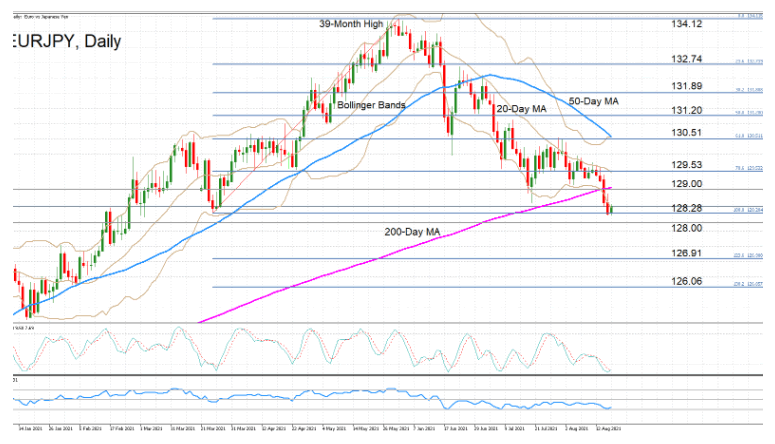
EURJPY is testing its March low of 128.28, slipping just below it on Tuesday and earlier today. The pair has now retraced the entire upleg between March and June, and although the long-term uptrend that’s been in progress since May 2020 remains intact, the recently turned neutral picture in the medium term is at risk of switching to bearish.
The latest selling phase has pushed the price below both its 50- and 200-day moving averages (MA), though more signals would ideally be needed to confirm a bearish shift, such as a daily close below the 128 handle. Momentum indicators are pointing to an upward correction in the near term. The %K line of the Stochastic Oscillator is in the process of crossing above the %D line, and both being deep in oversold territory further suggests the selling pressure is about to ease. The RSI is also reversing upwards, rebounding off the 30 level, while a breach of the price beneath the lower band of the Bollinger Bands is another indication that a correction is due.
Should the immediate support area of 128.28 hold and today’s positive momentum strengthens further, buyers are likely to be challenged at the 200-day MA just above the 129 level before meeting resistance at the 78.6% Fibonacci of the March-June climb at 129.53, where the 20-day MA is intersecting it. If EURJPY is able to stretch its advances until the 61.8% Fibonacci of 130.51, this would diminish the downside risks and reinforce the neutral outlook in the medium term.
The 61.8% Fibo is also a junction point with the 50-day MA and the upper Bollinger band so a break above it could significantly bolster the bulls.
However, if today’s bounce quickly loses steam and the price skids below the 128 level, the 123.6% and 138.2% Fibonacci extensions of 126.91 and 126.06, respectively, would be the main supports to watch.
To sum up, the negative bias in the short term could be easing with several indicators pointing to an oversold market. However, a recovery towards the 50-day MA would simply shore up the neutral medium-term outlook, while a drop below 128 would turn it bearish.
The US Dollar Soars On Risk Aversion
US dollar jumps on soft retail sales, Covid
The US dollar soared overnight after retail sales missed estimates, adding to investor concerns that the delta-variant is sapping the momentum of the global recovery. Although US bond yields were unchanged, the US dollar benefited from haven buying flows, sending the dollar index 0.56% higher to 93.13. That leaves the dollar index just shy of triple-top resistance at 93.20. A rise through 93.20 signals more US dollar strength targeting 83.50 and then 94.30. Support at 92.50 now looks like a line in the sand, and the greenback’s outlook remains positive as long as it holds.
Although the FOMC minutes will likely be a non-event tonight, yet another Fed President suggested tapering is much nearer, and notably, Mr Kashkari is a dove. Jackson Hole assumes greater importance, as does the September FOMC meeting. I do not expect a move at the meeting. Still, they may signal a December tapering start which will boost the US dollar once again, especially at the expense of Asian currencies whose monetary policy is not aligned. I am therefore expecting the US dollar to move higher through Q4.
Both the euro and sterling fell overnight to 1.1715 and 1.3740. EUR/USD looks to be eroding support near 1.1700 and could fall to 1.1600. However, sterling looks more vulnerable, having tumbled 0.73% overnight and closing below its 200-day moving average (DMA) at 1.3785, which now becomes technical resistance. More US dollar strength could see sterling testing support at 1.3570 in the days ahead, signalling a material retreat lower.
Asia was dominated by New Zealand dollar volatility after the arrival of Covid-19 in Auckland yesterday saw it plunge by 1.45% to 0.6920. After the RBNZ held rates unchanged, NZD/USD fell another 0.50% to 0.6870 before sharply reversing as the central bank signalled the virus had only delayed its hiking trajectory. NZD/USD rallied as high at 0.6950 before settling at 0.6930. New Zealand will likely face an extended lockdown of more than a week, looking at the movements of the original case. Therefore, resistance at 0.6950 should hold rallies, and after the short-squeeze has run its course, I expect kiwi to resume its drift lower.
The Australian dollar has been dragged around like their national rugby team by the All Blacks; I mean the New Zealand dollar. Falling and rising in sympathy yesterday and today. Overall, it continues to struggle as a proxy for markets negative risk-sentiment globally. The technical picture looks poor, despite kiwi’s moves after breaking out of an ascending wedge 0.7350 last week. AUD/USD is trading at 0.7260 and should find resistance at 0.7320. Failure of support at 0.7220 will signal a deeper fall targeting 0.7000.
Asian currencies continued to struggle overnight as the US dollar rallied and investors get more nervous about the delta-variant virus. The threat of a stalling global recovery would hit Asia very hard. One of the most notable losers has been the Korean won, with USD/KRW climbing to 1.05% to 1179.00 overnight. However, the Bank of Korea signalled they were watching the won’s fall “closely” today and fearing intervention, USD/KRW quickly retreated to 1169.00 this morning. USD/MYR continues to test resistance at 4.2400 as its political situation remains as unstable as ever. A close above 4.2400 will signal more losses to 4.3000 in the session ahead unless either the political or virus situation turns quickly to the better.
Overall, growth fears and the possibility of Federal Reserve tapering will continue to weigh on Asian currencies. I expect more interventions to slow the descents, but in the bigger picture, Asian FX faces a challenging landscape into Q4.