Sample Category Title
Risk Aversion Weighed On Stock Markets
Markets
Up until July US retail sales, yesterday’s trading resembled much of Monday’s action: risk aversion weighed on stock markets while generating a bid in core bonds and the US dollar. The market reaction on disappointing, declining, retail sales was telling: US Treasuries sold off while the dollar gathered additional momentum. EUR/USD even tested 1.1704/1.1695 support again while daily changes on the US yield curve ended narrowly mixed. It strengthens our view that last week’s post-CPI reverse action (lower USD & lower US yields) would be short-lived ahead of the Aug 26-28 Jackson Hole Symposium and the September 22 FOMC meeting. Tonight’s FOMC Minutes of the July deliberations could already be helpful in designing a roadmap out of extraordinary monetary stimulus. More and more Fed governors want to get rid of the US central bank’s net asset purchases which are currently running at $80bn/month for US Treasuries and at $40bn/month for mortgage-backed assets. They indicate that substantial further progress has been made in reaching the 2% average inflation goal while we’re only one or two (strong) labour market reports away from attaining the same with regard to robust employment. Another argument goes that the Fed’s bond-buying programme isn’t the right antidote to boost an economy suffering from supply issues rather than from a lack of demand. That’s especially true for the US housing market (and related MBS purchases). Drawing the parallel with the Fed’s previous process of tapering bond purchases, Fed governors conclude that the labour market currently is in better shape with inflation running way hotter. Therefore, they deem the previous 10 month taper process too slow and would rather prefer cutting net purchases towards zero over 6 to 8 month time horizon. Assuming the process will start in Autumn, this means ending net asset purchases by mid next year. We argued before that such faster than forecast cutback will imply a first Fed rate hike by end 2022 rather than in 2023 as the June FOMC Summary of Economic Projections suggested. Fed Chair Powell kept his cards close to his chest in a virtual event for students and teachers yesterday. He didn’t elaborate on monetary policy while repeating that it’s not yet clear whether the Delta strain will have important effects on the economy. At the July press conference, he did talk about a pattern where successive waves of Covid have tended to have a smaller economic impact. Today’s eco calendar is fairly thin apart from above-discussed FOMC Minutes with only a batch of US housing data and final EMU inflation numbers. Asian risk sentiment is much improved this morning (>+0.5%) compared to this week’s earlier sessions despite some weakness on WS yesterday evening.
News headlines
New Zealand’s first coronavirus case in six months discovered yesterday and the corresponding nationwide lockdown caused the Reserve Bank of New Zealand to refrain from what would have been the first rate hike since 2014. Despite retaining a generally optimistic economic view, the RBNZ said the re-introduction of restrictive measures “is a stark example of how unpredictable and disruptive the virus is proving to be”. The central bank still agreed though that, following the sudden halt of net bond buying in July, the level of monetary stimulus should be further reduced in the future. As such, it brought forward their own expectations of a first rate hike to Q4 this year. Markets adjusted their policy rate expectations yesterday, after news about the infection reached them, causing bond yields to slump more than 10 bps and the kiwi dollar to test support in the NZD/USD 0.69 area. The former initially dipped below that level in the wake of the RBNZ decision but is now trading a tad higher (0.694) compared to the open.
Japanese exports rose by 37% y/y in July, a significant slowdown from the 48.6% the month before. It’s the smallest gain since March and below the 39.4% consensus. Car exports in particular weighed on the headline figure. Imports also decelerated to a lower-than-expected 28.5% from 32.7%. The trade figures are seen suffering from widening restrictions to contain the (Delta) virus outbreak both in Japan and in its main trading partners.
A Tack On Tighten – Review Of The RBNZ Monetary Policy Statement
- The Reserve Bank left the OCR on hold at 0.25% today, but continued to signal interest rate hikes in the future.
- The RBNZ remains on a course towards removing monetary stimulus.
- But it has had to change tack in the face of the latest Covid lockdown restrictions.
- Demand in the domestic economy has been running hot, and is now running up against capacity constraints.
- The new lockdown will undermine demand in the near term. But this can and will be addressed through fiscal policy.
- We have pencilled in an OCR hike for November. But at this early stage it’s hard to give any clear guidance as to when the RBNZ might resume its previous course.
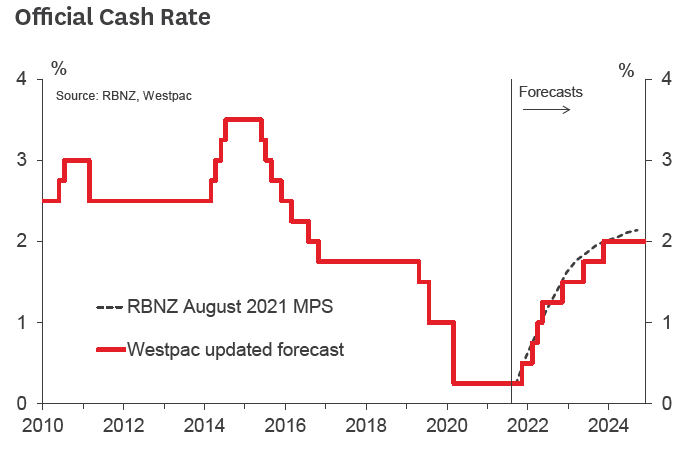
Today’s Monetary Policy Statement was very much in line with what we expected, and indeed was a very similar take on the economy to what we detailed in our recent Economic Overview. The Reserve Bank recognises that interest rates will need to rise in the coming years, and is clearly keen to get on with the job. But circumstances have intervened, in the form of a community outbreak of Covid-19 and a return to the strictest lockdown settings.
Prior to the outbreak, we had expected three OCR hikes of 25 basis points this year, starting with today’s review. Those hikes will be deferred, rather than cancelled. However, it’s too early to give any clear guidance on when the RBNZ might return to its previously intended path. There’s a wide range of possibilities as to when and how quickly the country is able to step down the Alert Level ladder. And within that range, most (but not all) of the possibilities would probably rule out the October OCR review as too soon, so for now we’ve pencilled in the first hike for November
From there, we expect further hikes in February, April and May next year. By that time, New Zealand’s vaccination programme will be well advanced, and hopefully we will no longer be reliant on lockdowns as a Covid management tool.
Details.
Like us, the Reserve Bank has become more alert to the strength of demand in the New Zealand economy over recent months. Up until now, our Covid-free streak has allowed the economy to build up momentum to a greater degree than we’ve seen in many other countries.
This strong demand is also running up against supply constraints, many of which relate to Covid-19 disruptions and the health response to it. The RBNZ noted the constraints in the labour market in particular, with the loss of access to migrant workers leading to a mismatch between the skills that employers need and those available in the local labour pool. That said, the RBNZ has conceded that employment is growing, rather than stalling (as we would expect to see if it were just about supply constraints). The RBNZ now expects the unemployment rate to drop below 4% over the next year.
The RBNZ expects annual inflation to peak at just over 4% by the end of this year. Some of that is unavoidable, as it reflects temporary price shocks that have already happened. But even after that, the RBNZ thinks that it will take some time for inflation to fully settle back at the 2% midpoint of its target range, even with the help of higher interest rates in the coming years.
Indeed, the RBNZ’s projections show the OCR rising to around 2.1% by late 2024. That is slightly above the RBNZ’s estimate of the ‘neutral’ level of the OCR, although not by a meaningful amount. Coming from a starting point of 0.25%, that means the RBNZ has quite a lot of work to do – it’s clear that current monetary policy settings are very stimulatory, more so than is needed for an economy running this hot.
However, the case for higher interest rates runs up against the greater risks posed by the Delta variant of Covid-19. Obviously the latest outbreak has crystallised those risks, but they were just as apparent a few months ago as they are today. Despite that, it’s notable that the RBNZ’s ‘least regrets’ approach to policy has shifted towards inflation as the greater threat over the last two reviews. In that respect, today’s statement was just as hawkish as the previous one in July.
The RBNZ correctly noted that easier monetary policy is not the right response to lockdown conditions. Instead, fiscal policy is the best way to provide support – and this is in fact happening, as the Government has reintroduced the measures that it used in previous lockdowns, such as the wage subsidy scheme.
Monetary policy is more useful for supporting the economy’s rebound as it emerges from a lockdown. But past experience suggests that even then its role is limited – activity tends to bounce back readily once restrictions are lifted. And when that does happen, the RBNZ will be faced with many of the same issues that it was before – an economy that is running up against capacity constraints, and is at risk of a more sustained period of inflation pressures
GBP/JPY Daily Outlook
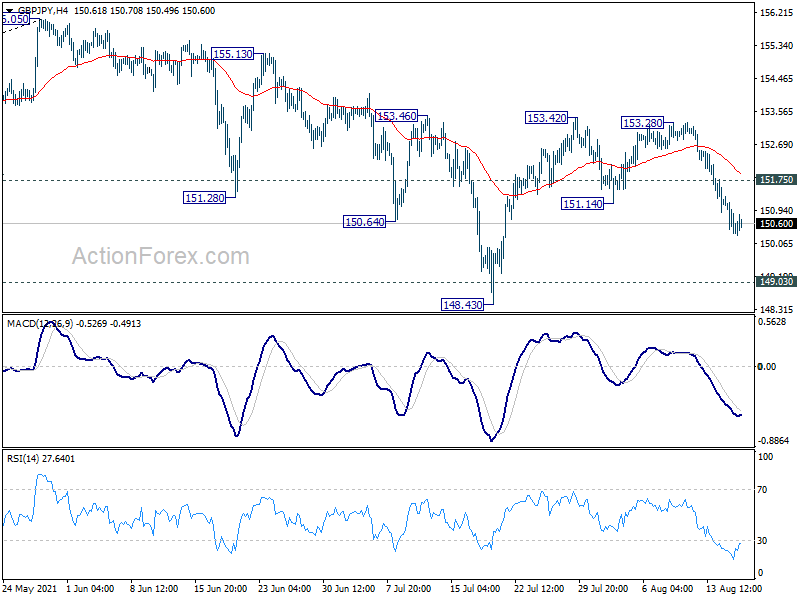
Daily Pivots: (S1) 150.17; (P) 150.75; (R1) 151.15; More...
Intraday bias in GBP/JPY stays on the downside for the moment. Rebound from 148.43 should have completed at 153.42 already. Deeper fall would be seen back to retest 148.43 support first. On the upside, above 151.75 minor resistance should turn intraday bias neutral first. But break of 153.28 resistance is now needed to indicate resumption of rebound from 148.43. Otherwise, risk will stay mildly on the downside in case of recovery.
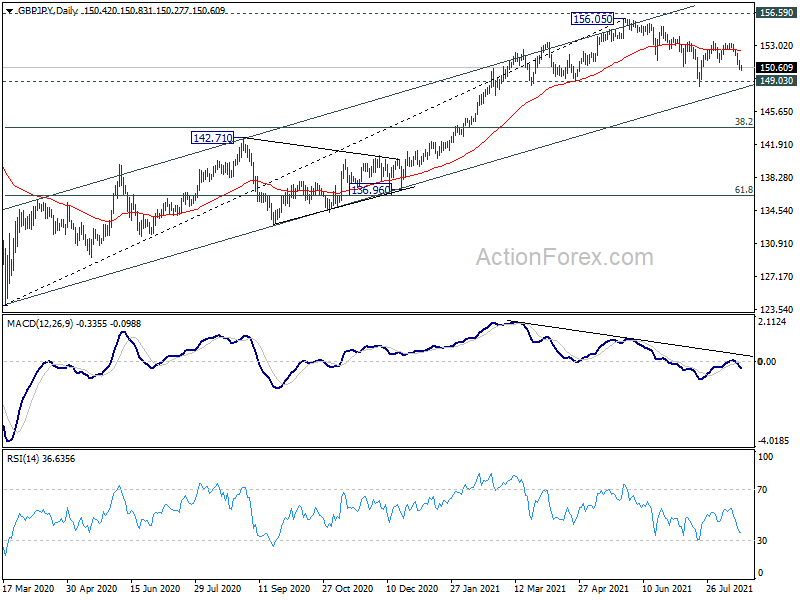
In the bigger picture, rise from 123.94 is seen as the third leg of the pattern from 122.75 (2016 low). Focus remains on 156.59 resistance (2018 high). Sustained break there should confirm long term bullish trend reversal. Next target is 61.8% retracement of 195.86 (2015 high) to 122.75 at 167.93. On the downside, sustained break of 149.03 support, however, will indicate rejection by 156.59. Fall from 156.05 would be at least correcting the whole rise from 123.94. Deeper fall would be seen back to 142.71 resistance turned support first.
It’s Not ‘Black Swan’, It’s Just The Fed
US stocks tumbled the most in a month after the US retail sales declined more than analysts expected in July, and the rising Covid worries and images from Afghanistan dented the global risk appetite.
But it's too early to call for a sustained market correction. The US equities doubled in value after the March 2020 plunge, and some profit-taking and a minor correction are only normal at this point.
Major US index futures steadied during the overnight trading session and may post gains again, today. There should be at least 2-3% daily losses that persist over a couple of sessions to ring the alarm bell.
It is not the case for now.
Activity on FTSE futures hint at a positive session in London, although the British big caps will likely swing between two opposite forces: cheaper pound will continue attract reflation trades to the bank and energy heavy FTSE, while softer energy and commodity prices should limit the upside potential above the 7200p mark.
The FOMC minutes is the major event on today's economic calendar. Investors will be hunting for hints about the upcoming Federal Reserve (Fed) QE tapering. Yesterday, Fed Chair Jerome Powell said that the monetary policy has its limits. Yes, it's called inflation: the major side-effect of boundless money injection.
Currently, the US equity markets are overdosed with cheap liquidity and keep posting new highs despite a sticky global pandemic, repeated lockdown measures, shattered economies, lost jobs, hammered lives and escalating inflation.
Strong earnings and the post-pandemic boom in activity explain a part of the equity bullishness, but the major bullish driver is the cheap Fed money and the FOMO - the fear of missing out the rally on cheap liquidity.
Therefore, any hint on QE tapering could have a meaningful impact on the market sentiment as we are talking about a change in one of the major pillars of the US equity rally, not to say THE major pillar. Naturally, the Fed pulling away support will feel like they are pulling the rug from under the market's feet. But no stress.
While in 2013 we saw a bad market reaction to the tapering announcement, it will certainly be different this time. First, the market well survived the post-subprime QE tapering, and second the Fed officials have been preparing investors for the upcoming pullback in bond purchases. And the fact that the interest rates will remain near zero at least until 2023 is a good consolation for investors, which won't settle for less than the equity returns for at least another year. The US 10-year yield remains comfortably low.
Yet some start taking their precautions. According to the latest news, Palantir is now buying gold and will even accept payments in gold as a preparation to a ‘black swan' event, although a ‘black swan' event is a rare and unexpected occurrence that have severe consequences, while a market selloff is well feared and anticipated risk by investors.
Gold, which remained mostly unresponsive to rising inflation expectations and low yields could get a breath of fresh air in case of a market turmoil. But for now, the equity space remains the major money-maker, and gold continues seeing a decent resistance near the $1800 area. I expect gold to remain under pressure as long as the equity markets drive north. Buying gold as a bad-day hedge is good, but costly in a market where equities post abnormally high returns and banks call for further gains.
But maybe, it's just about time to position against the mass market, as it is generally when everyone calls for more gains that a downside correction happens.
EUR/JPY Daily Outlook
Daily Pivots: (S1) 128.10; (P) 128.49; (R1) 128.72; More....
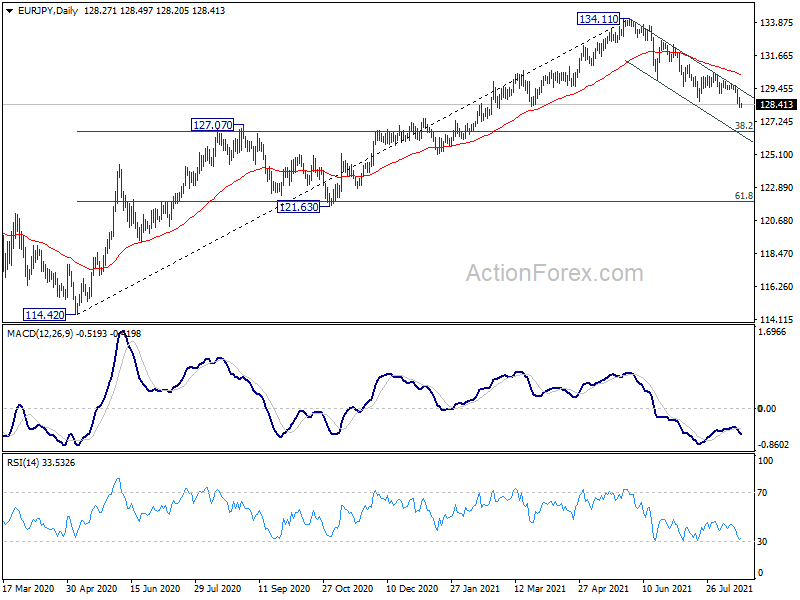
Intraday bias in EUR/JPY remains on the downside as fall from 134.11 is in progress. Deeper fall should be seen to 127.07 resistance turned support next. That is close to 38.2% retracement of 114.42 to 134.11 at 126.58. On the upside, above 129.12 minor resistance will turn intraday bias neutral first.
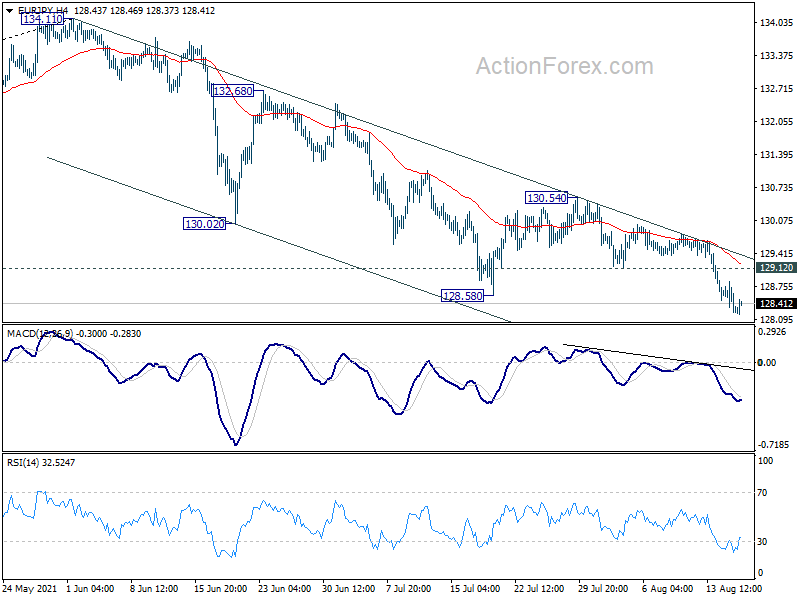
In the bigger picture, rise from 114.42 is seen as a medium term rising leg inside a long term sideway pattern. As long as 127.07 resistance turned support holds, further rise is still expected to retest 137.49 (2018 high). However, firm break of 127.07 will argue that the medium term trend has reversed, and open up the case for retesting 114.42.
Central Bankers Strike A Cautious Tone Amid COVID-19 Outbreak
Market movers today
- The final Eurozone CPI July numbers are due including core inflation. Consensus is expecting core inflation to remain roughly unchanged at 0.7% y/y while headline inflation is expected to edge slightly higher.
- The minutes from the Fed meeting in July is due today, where Fed members' discussion of the need to start tapering will be in focus together with their assessment of inflation pressures.
- COVID-19 developments are starting to affect markets sentiment as the outbreak in the US and Asia gains momentum. In the US, hospital systems in hard-hit states such as Oregon, Mississippi and to some extent Florida are reaching their limits. In Europe, the infection numbers are stable to falling. And this morning, the Covid outbreak prevented the New Zealand central bank from hiking.
The 60 second overview
Weaker-than-expected retail sales in the US: US retail sales for July dropped more than expected yesterday, driven by shortage of goods (new cars), shifting demand to services while the impact of the spread of the delta variant may be too early to gauge. Markets reacted negatively to the print fearing that the important US consumers are hitting the breaks, which could create headwinds for the continued rebound in the US economy. Meanwhile, industrial production expanded solidly by almost 1% in July, more than expected by market consensus.
Fed speakers draw a cautious tone: In his speech yesterday Fed Chair Jerome Powell did not touch on monetary policy but said that the COVID pandemic continues to cast shadows on the economic activity while Minneapolis's governor Kashkari warned that a rate hike could be a "few years away" given the virus resurgence's broader economic implications.
New Zealand's central bank keeps rates unchanged amid COVID outbreak: The Reserve Bank of New Zealand held monetary policy unchanged at its meeting overnight. While a full hike was priced in until Monday, the decision was not a huge surprise following yesterday's announcement of strict lockdown measures after a single locally transmitted Covid-case was identified in NZ. This morning, 6 new cases have been recorded. RBNZ made it clear that conditions for a rate hike would have otherwise been met given the strong domestic economic developments and housing market. Despite no rate hike, NZD has recovered slightly against USD following the decision given that RBNZ clearly revised their rate path higher, expecting the first hike in late 2021 and four additional hikes in 2022.
Equities: Global equities were mostly lower yesterday but the big story being investors seeking towards defensive sectors with healthcare as the big outperformer. Defensives outperformed for the fourth consecutive day as gold rose for the fourth day in a row just like oil fell for the fourth day in a row. This would make perfect sense if yields were lower but they were not. To be fair, they were lower at some point yesterday. These inconclusive moves between asset classes reflect the situation we are in currently where both macro and monetary policy is changing after 16 months of continuous tailwind for risky assets. Equity sentiment is positive again this morning with Asian markets broadly higher and European and US futures the same.
FI: 10Y Treasuries continue to range trade around 1.25% after a mixed set of US economic data yesterday. Tonight we will get more information on the discussion within the Federal Reserve regarding tapering given the release of the minutes from the latest FOMC meeting.
FX: The release of US retail sales reinforced weakness in equity markets and hence supported dollar yesterday. We expect EUR/SEK to stay close to 10.20, our August/Q3 target.
Credit: CDS indices remained under pressure with iTraxx Xover widening 2.2bp (to 236bp) and Main widened 0.4bp (to 46½bp). Cash bonds were more resilient and HY widened less than ½bp while IG was unchanged.
EUR/GBP Daily Outlook
Daily Pivots: (S1) 0.8507; (P) 0.8522; (R1) 0.8537; More...
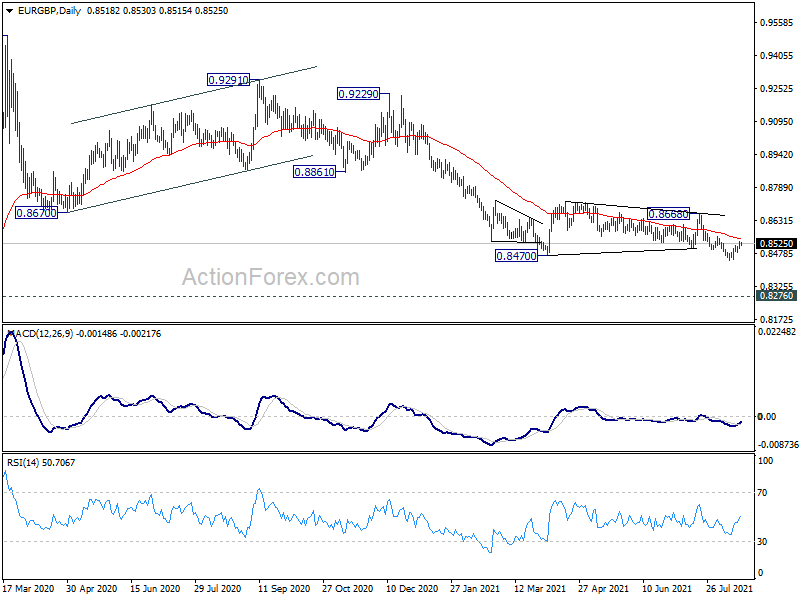
Intraday bias in EUR/GBP stays neutral and outlook remains mildly bearish with 0.8556 resistance intact. On the downside, break of 0.8448 will resume the whole decline from 0.9799, to retest 0.8276 key long term support level. However, break of 0.8556 will bring stronger rebound back to 0.8668 resistance.
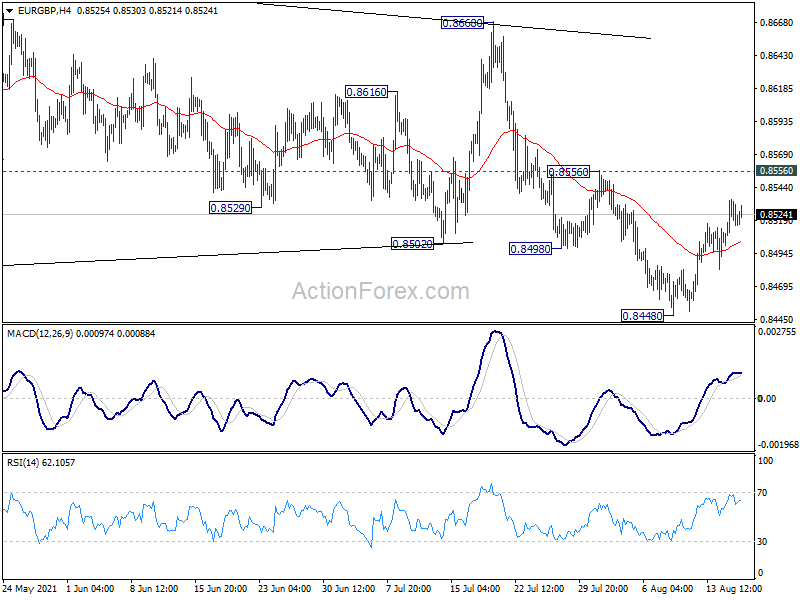
In the bigger picture, price actions from 0.9499 (2020 high) are still seen as developing into a corrective pattern. Deeper fall could be seen as long as 0.8718 resistance holds, towards long term support at 0.8276. However, firm break of 0.8668 resistance would argue that a medium term bottom was already formed. Stronger rise would be seen to 0.8861 support turned resistance to confirm completion of the corrective pattern.
Equity Markets Generally Rebound, NZD Pares Loss Amid RBNZ
General trend
- Nikkei has risen after the flat open [Topix Information Communication index outperforms, Marine Transportation index lags].
- Shanghai Composite ended morning trading higher [Financials rise on Huarong news].
- Hang Seng has extended modest gains [Financials trade generally higher]; Geely reported earnings; Tencent is due to report after the HK close.
- S&P ASX 200 reversed opening decline [Financial, Energy and Consumer Staples indices rise; BHP and OZ Minerals weigh on Resources index].
Headlines/Economic data
Australia/New Zealand
- ASX 200 opened -0.4%.
- (NZ) NEW ZEALAND CENTRAL BANK (RBNZ) LEAVES OFFICIAL CASH RATE (OCR) UNCHANGED AT 0.25%; NOT EXPECTED.
- (NZ) Reserve Bank of New Zealand (RBNZ) Gov Orr: Keeping rates at 0.25% for now; Employment 'at or above' maximum sustainable level ; Clear direction is to lift the cash rate, Neutral OCR at 2.0% - post rate decision press conference.
- (NZ) New Zealand Fin Min Robertson: Clear RBNZ has a direction of travel on rates; Will make no assumptions on what RBNZ will do.
- (AU) Australia PM Morrison: Expectation is that economy will recover strongly.
- BHP.AU Reports FY21 Underlying Net $17.1B v $9.1B y/y, Underlying EBITDA $37.4B v $22.1B y/y, Rev $60.8B v $42.9B y/y; Confirms to intend unifying dual listing structure with primary listing on ASX (yesterday after the close).
- WPL.AU Reports H1 Underlying Net $354M v $303M y/y, Net $317M v -$4.07B y/y; Rev $2.50B v $1.91B y/y, Cuts FY production guidance.
- Reports FY21 (A$) Net (cont ops, non-IFRS) 1.01B v 951M y/y; Rev (non-IFRS) 38.9B v 37.4B y/y.
- (NZ) New Zealand reports 7 COVID cases (up from 1 yesterday).
- (AU) AUSTRALIA Q2 WAGE PRICE INDEX Q/Q: 0.4% V 0.6%E; Y/Y: 1.7% V 1.9%E.
Japan
- Nikkei 225 opened 0.0%.
- (JP) JAPAN JUN CORE MACHINE ORDERS M/M: -1.5% V -2.8%E; Y/Y: 18.6% V 15.6%E.
- 7203.JP Reportedly Toyota to increase global production plan by 5% for 2021 – press.
- (JP) Speculation that Japan PM Suga will not dissolve lower house in early Sept as planned due to extended lockdown, talk that election could be pushed to after party presidential vote on Sept 30th - Japan press.
- (JP) Japan July Trade Balance: ¥441.0B v ¥196.4Be; Adj Trade Balance: ¥52.7B v +¥125.1Be.
Korea
- Kospi opened -0.0%.
- (KR) South Korea FX Authority: Cautiously watching possible overshoot in USD/KRW.
- (KR) South Korea Democratic Party (ruling party) said to be discussing 2022 budget based on expansionary stance - financial press.
- (KR) According to Korea Economic Research Institute (KERI), South Korea's potential growth rate has been on a steady decline for more than 2 decades due to decreased labor productivity, capital stock and working hours – Yonhap.
China/Hong Kong
- Hang Seng opened +0.2%; Shanghai Composite opened +0.1%.
- (CN) China PBOC sets Yuan reference rate: 6.4915 v 6.4765 prior.
- (CN) Shenzhen branch of PBOC said to have ordered clean up of certain 11 companies that are said to be linked to cryptocurrency.
- (CN) China PBOC Open Market Operation (OMO): Injects CNY10B in 7-day reverse repos v CNY10B in 7-day reverse repos prior; Net CNY0B v Net CNY0B prior.
- (CN) China Daily: PBOC May be cautious on cutting rates, cites analysts.
- (CN) Alashankou Port said to be 'completely shut down' due to COVID cases [timing uncertain] - Chinese press.
- (CN) China said to be seeking to increase rural consumption up to CNY10T - press.
North America
- (US) Fed's Kashkari (dove, non-voter): Last jobs report was very strong report - PNWER Annual Summit.
- (US) Fed's Rosengren: Massive Bond purchases ill-suited for US; Would support beginning tapering in Sept - FT.
- (US) Weekly API Crude Oil Inventories: -1.2M v -0.8M prior.
- A Reports Q3 $1.10 v $0.99e, Rev $1.59B v $1.53Be; Raises guidance - + momentum in all markets & regions.
- (US) Fed Chair Powell: Covid is still with us and will likely be for a while; Not clear yet if the Delta strain will have important effects on the economy.
Europe
- (UK) Cabinet ministers are advising PM Johnson to temporarily change the long held tradition of 7% increase to state pensions, as currently would not be affordable - UK press.
Levels as of 01:15ET
- Hang Seng +0.9%; Shanghai Composite +1.0%; Kospi +0.9%; Nikkei225 +0.7%; ASX 200 +0.1%.
- Equity Futures: S&P500 +0.1%; Nasdaq100 +0.1%, Dax +0.4%; FTSE100 +0.4%.
- EUR 1.1723-1.1702; JPY 109.68-109.47; AUD 0.7270-0.7239; NZD 0.6951-0.6870.
- Commodity Futures: Gold +0.2% at $1,791/oz; Crude Oil +0.4% at $66.58/brl; Copper +0.5% at $4.24/lb.
EUR/AUD Daily Outlook
Daily Pivots: (S1) 1.6069; (P) 1.6118; (R1) 1.6192; More...
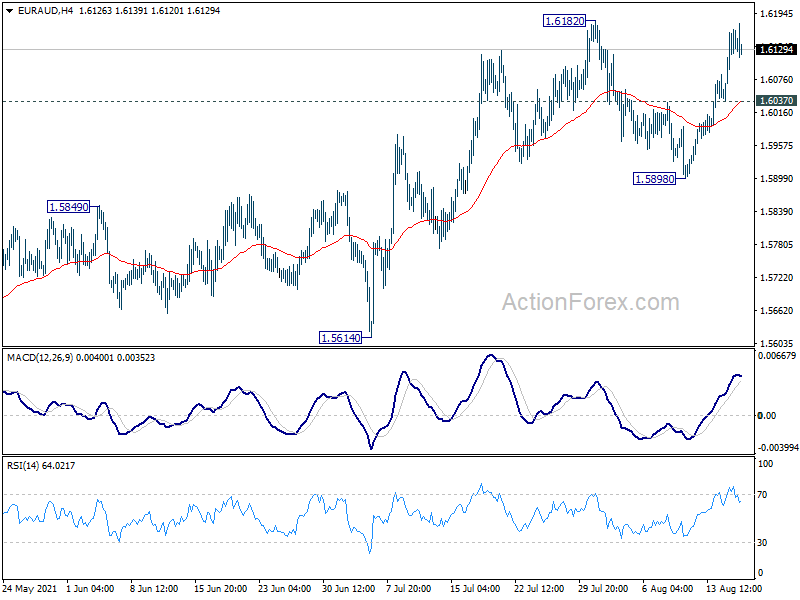
Intraday bias in EUR/AUD stays on the upside with focus on 1.6182 resistance. Decisive break there will resume the choppy rise from 1.5250 towards 1.6827 resistance next. On the downside, below 1.6037 minor support will turn intraday bias remains neutral first. Further sustained break of 55 day EMA will argue that choppy corrective rebound from 1.5250 has completed. Deeper fall would be seen to 1.5614 structural support for confirmation.
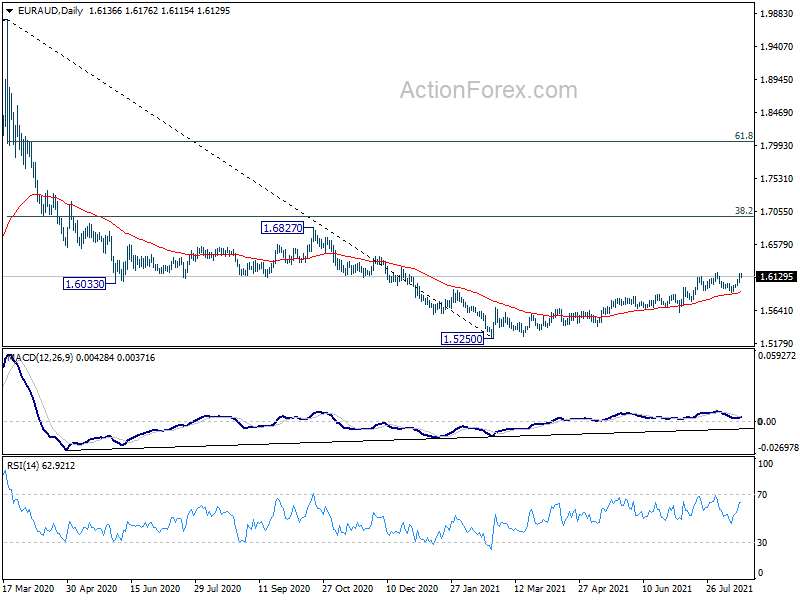
In the bigger picture, rise from 1.5250 medium term bottom is currently seen as a correction to the down trend from 1.9799 first. Stronger rise would be seen to 38.2% retracement of 1.9799 to 1.5250 at 1.6988 next. We'd tentatively expect strong resistance from there to limit upside, at least on first attempt. Meanwhile, break of 1.5614 support will indicate that the rebound has completed and bring retest of 1.5250 low.
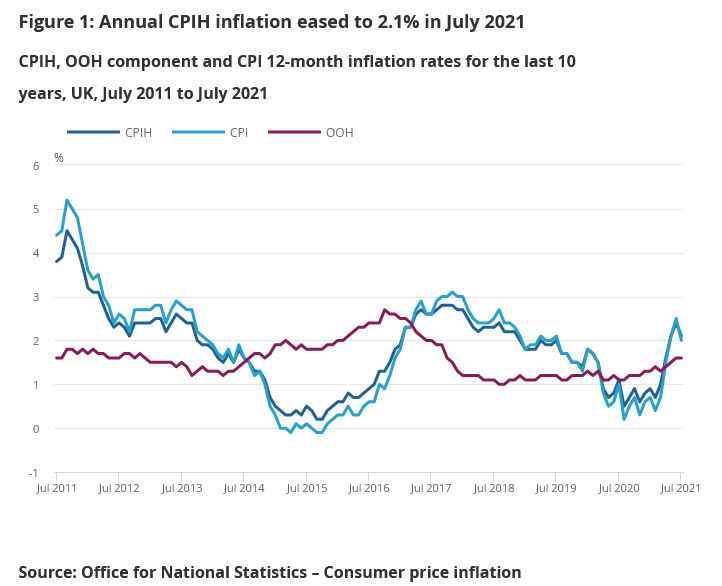
UK CPI slowed to 2.0% yoy in Jul, core CPI down to 1.8% yoy
UK CPI slowed to 2.0% yoy in July, down from 2.5% yoy, below expectation of 2.2% yoy. Core CPI slowed to 1.8% yoy, down from 2.3% yoy, below expectation of 2.2% yoy. RPI dropped to 3.8% yoy, down from 3.9% yoy, below expectation of 3.7% yoy.
PPI input came in at 0.8% mom, 9.9% yoy, versus expectation of 1.2% mom, 10.8% yoy. PPI output was at 0.6% mom, 4.9% yoy, versus expectation of 0.4% mom, 4.8% yoy. PPI core output was at 0.7% mom, 3.9% yoy.