

Sample Category Title
Elliott Wave View: Oil (CL) Has Scope To Extend Lower
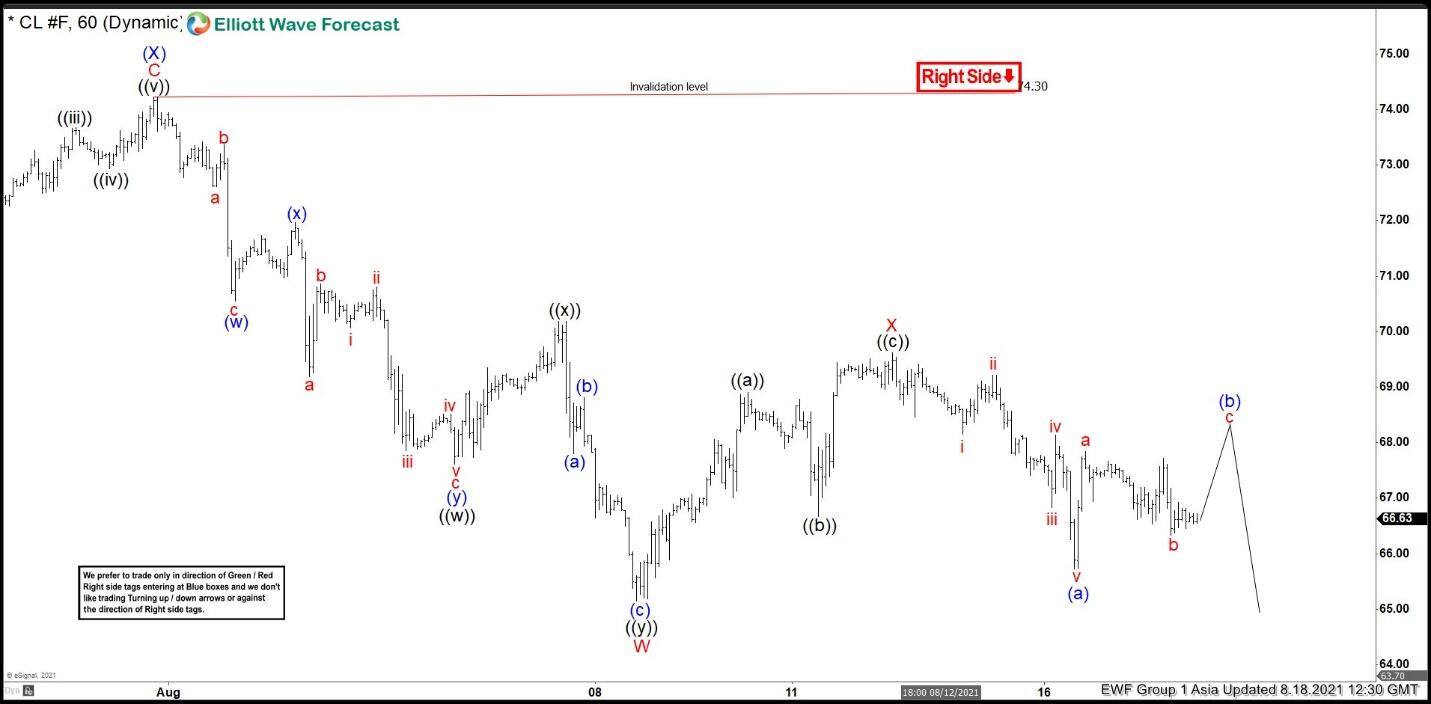
Short-term Elliott wave view in Oil (CL) suggests that cycle from July 6 peak is unfolding as a double three Elliott Wave structure. Down from July 6 high, wave (W) ended at 65.01 and rally to 74.30 ended wave (X). Wave (Y) lower is in progress now with internal subdivision as another double three in lesser degree. Down from wave (X), wave ((w)) ended at 67.61 and rally to 70.18 ended wave ((x)). Oil then resumes lower in wave ((y)) towards 65.15 and this completed wave W.
Wave X bounce ended at 69.62 with internal subdivision as a zigzag Elliott Wave structure. Up from wave W, wave ((a)) ended at 68.90 and pullback in wave ((b)) ended at 66.67. Rally in wave ((c)) ended at 69.62. This completed wave X in higher degree. Near term, while rally fails below wave X at 69.62, and more importantly below July 31 high at 74.30, expect Oil to resume lower. As far as pivot at 74.30 high stays intact, rally should fail in 3, 7, or 11 swing for further downside. Potential target lower is 100% – 161.8% fibonacci extension from July 6 peak towards 56.3 – 63.1.
Oil (CL) 45 Minutes Elliott Wave Chart
Market Morning Briefing: Dollar Index Has Risen Sharply After The Release Of The US Retail sales
STOCKS
The Dow and Dax trade lower while Asian indices look strong. Dow and Dax could rise while supports at 35250 and 15800 holds respectively. Nikkei and shanghai have risen well and could continue to rise in the near term towards 28000 and 3500 in the near to medium term. Nifty and Sensex are trading strong too but could see a short corrective dip before resuming the uptrend.
Dow (35343.28, -282.12, -0.79%) has fallen sharply after the release of the US retail sales data yesterday. Immediate support is seen at 35250 which if hold could produce a bounce again in the near term. Failure to hold above 35250 can rag the index lower towards 34750.
DAX (15921.95, -3.78, -0.024%) has immediate support near 15800 which if holds can produce a bounce back towards 16000-16200 in the medium term. For now, we may expect some range movements above 15800.
Nikkei (27579.84, +155.37, +0.57%) has risen today and is heading towards 28000. While the support at 27250 holds we can see a test of 28000 in the coming sessions. A strong break above 28000 will be needed to be bullish towards 29000 and negate the view of seeing a dip towards 27000-26500.
Shanghai (3467, +20.02, +0.58%) has risen back again after seeing a fall towards 3438.12. While above 3400 the view is bullish to see a test of 3500 and eventually 3600 in the coming days.
Nifty (16614.60, +51.55, +0.31%) rose sharply yesterday and needs to sustain above 16600 to move up towards 16700/800 eventually. Failure to rise from current levels could lead to a corrective dip which can be limited to 16400/350 on the downside.
Sensex (55792.27, +209.69, +0.38%) is heading towards 56000. Any corrective dip, if seen could be limited to 54500.
COMMODITIES
Commodities have dipped slightly due to fall in US retail sales data released yesterday. Brent and WTI look bearish towards $65 while Gold and Silver have dipped from interim resistances near 1800 and 24 respectively. A range of 1810-1750 and 24.50-23 looks likely for the medium term. Copper needs to bounce from immediate support at 4.20 else could be vulnerable for a fall towards 4.0-3.8.
Brent (68.99) and WTI (66.33) continue to trade lower and can fall to test $65 in the near term.
Gold (1791.60) has come down slightly as expected after testing 1800 on the upside. Immediate resistance is seen near 1800-1810 which is likely to hold and produce a deeper fall towards 1780/60 in the coming sessions. While above 1760/40, uptrend remains intact.
Silver (23.75) tested 24 before coming off from there. Resistance is seen at 24 and higher at 24.50 which may hold for the near term to produce a fall towards 23.
Copper (4.2335) fell sharply to test 4.20 as expected and if it manages a bounce today, it can rise towards 4.30/40 again else could be vulnerable to a sharp fall in the near term towards 4.0-3.80. Watch price action near 4.20 for now.
FOREX
Dollar Index has bounced well dragging Euro down to 1.17. We need to see if the Dollar Index can manage to rise above 93.30 or come off from there back to 92.50 and lower. This would be important. Euro can turn bullish again only on a rise above 1.1750. Aussie, Pound and EURJPY have risen from respective lows and need to sustain the bounce in order to keep the upmove intact else the bounce could be corrective and could lead to a fall again in the medium term.
Dollar Index (93.047) has risen sharply after the release of the US Retail sales. We need to see if the index manages to rise above 93.30 again or fall from there. A rise above 93.30 if seen can be bearish for Euro and most other currencies.
Euro (1.1720) tested 1.17 and bounced back well from there. A rise to 1.1750 looks possible in the near term. A break above 1.1750 is needed for Euro to turn bullish again.
EURJPY (128.41) has bounced slightly from 128.22 and if the bounce sustains, we may expect a rise to 129 initially and slowly towards 130.50.
Dollar-Yen (109.56) has bounced back well from interim support at 109 in line with our expectations and could again head towards 110-110.50 before reversing from there.
Aussie (0.7312) has broken below the mentioned support at 0.7325. While the fall sustains, Aussie can extend towards 0.7290-0.7250 soon before bouncing back.
Pound (1.3754) has bounced from 1.3726 but could be limited to 1.38 on the upside before again falling lower. Immediate view is bullish within a downtrend.
USDCNY (6.4836) tested 6.4868 before slightly coming off from there. The pair may fall towards 6.47 again before attempting to bounce back.
USDINR (74.37) has held above 74.20 yesterday to bounce higher and while that continues, we may expect a rise to 74.50 on the upside or even towards 74.80 in the coming sessions. Note that above 74.40/50, the next important resistance to look at will be 74.80.
INTEREST RATES
The US Treasury yields remain lower and stable and keep alive the chances of a further fall from here. The 10Yr has to rise above 1.35% and the 30Yr above 2% to avoid the above mentioned fall. The German yields continue to hover above their key supports. We expect them to see a corrective rally in the coming weeks before resuming the broader downtrend again. The 5Yr GoI has declined below 5.7% and is now bearish to test 5.66% in the near-term.
The US 2Yr (0.21%), 5Yr (0.77%), 10Yr (1.26%) and the 30Yr (1.92%) Treasury yields continue to remain lower. We retain our view of seeing a test of 1.18% on the 10Yr while below 1.35% and 1.85%-1.8% on the 30Yr on a fall below 1.9%. As mentioned yesterday, the 30Yr has to rise sharply above 2% and the 10Yr above 1.35% (revised higher from 1.3% mentioned yesterday) to bring back the chances of seeing 1.4%-1.45% (10Yr) and 2.1%-2.2% (30Yr) on the upside.
The German 2Yr (-0.75%), 5Yr (-0.73%), 10Yr (-0.47%) and 30Yr (-0.03%) yields remain stable and lower. The view remains the same. -0.45%/-0.50% (10Yr) and -0.05% (30Yr) are the key supports which we expect to hold and produce a corrective rally to -0.30%/-0.25% (10Yr) and 0.10% (30Yr) in the coming weeks. Thereafter the broader downtrend can resume again.
The 5Yr GOI (5.6948%) broke below 5.7% yesterday contrary to our expectation to remain in the range of 5.7%-5.8%. While below 5.72%, the outlook will now be bearish to test 5.66% and even 5.64%-5.62% in the coming days.
EUR/CHF Daily Outlook
Daily Pivots: (S1) 1.0692; (P) 1.0722; (R1) 1.0744; More....
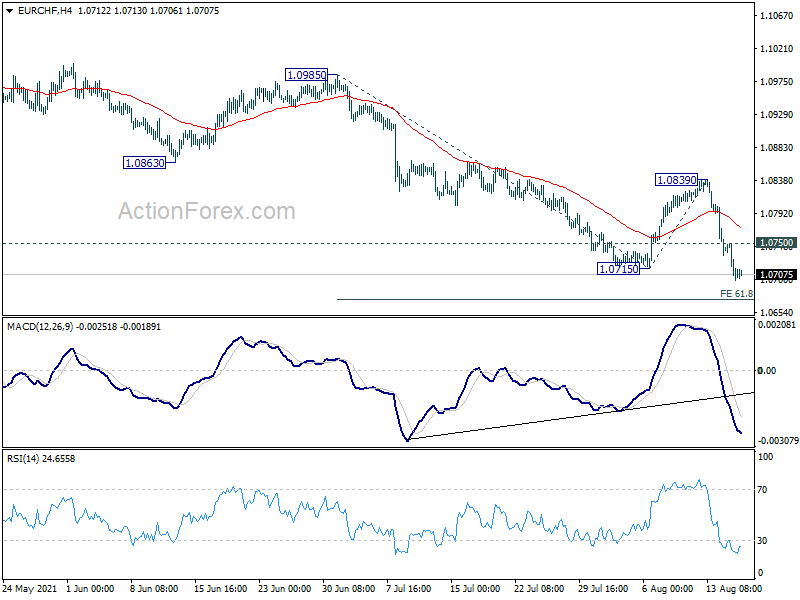
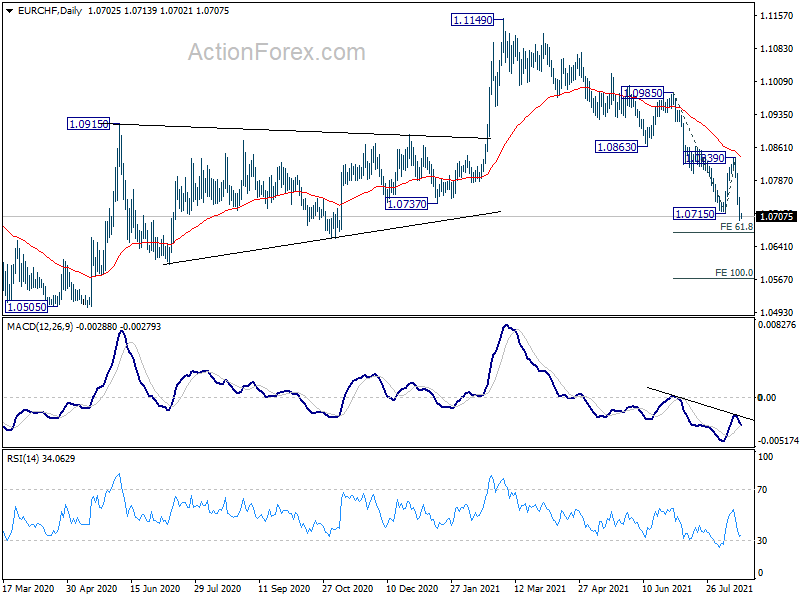
EUR/CHF's break of 1.0715 support suggests resumption of fall from 1.1149. Intraday bias is back on the downside for 61.8% projection of 1.0985 to 1.0715 from 1.0839 at 1.0672 first. Break will target 100% projection at 1.0569 next. On the upside, break of 1.0750 minor resistance will turn intraday bias neutral and bring consolidations. But outlook will stay bearish as long as 1.0839 resistance holds.
In the bigger picture, rebound from 1.0505 (2020 low) should have completed at 1.1149 already. The three-wave corrective structure argues that the downtrend from 1.2004 (2018 high) is not over yet. Medium term outlook will now stay bearish as long as 55 week EMA (now at 1.0865) holds. Break of 1.0505 low would be seen at a later stage.
Kiwi Jitters after RBNZ Stands Pat, Euro Weakening
Commodity currencies recover mildly in Asian session but remain the worst performing ones for the week. Markets seemed to have priced in RBNZ standing pat well already. New Zealand Dollar recovered very quickly after initial spike following the announcement. On the other hand, Swiss Franc, Yen and to a lesser extent are still the strongest ones, digesting this week's gains. Focus will now turn to inflation data from UK and Canada, and then FOMC minutes.
Technically, EUR/CHF has broken 1.0715 support while EUR/JPY also took out 128.58 support. Both developments suggest resumption of recent decline. EUR/USD also showed some weakness by breaching 1.1705 support. Sustained trading below there could spark downside acceleration, which would be reflected in EUR/CHF and EUR/JPY too.
In Asia, at the time of writing, Nikkei is up 0.57%. Hong Kong HSI is up 0.63%. China Shanghai SSE is up 0.40%. Singapore Strait Times is up 1.00%. Japan 10-year JGB yield is up 0.002 at 0.011. Overnight, DOW dropped -0.79%. S&P 500 dropped -0.71%. NASDAQ dropped -0.93%. 10-year yield rose 0.001 to 1.258.
RBNZ keeps rate unchanged on heightened uncertainty. NZD spikes lower and recovered
RBNZ kept Official Cash Rate unchanged at 0.25% today, instead of raising it. The decision was "made in the context of the Government's imposition of Level 4 COVID restrictions on activity across New Zealand." Nevertheless, it reiterated that the "least regrets policy stance" was still to "further reduce the level of monetary stimulus". But the Committee agreed to stand pat at this meeting "given the heightened uncertainty with the country in a lockdown."
In the summary record, it's also noted that committee members "now had more confidence that rising capacity pressures will feed through into inflation, and that employment is at its maximum sustainable level." They concluded that "they could continue removing monetary stimulus", following haling the LSAP program in July.
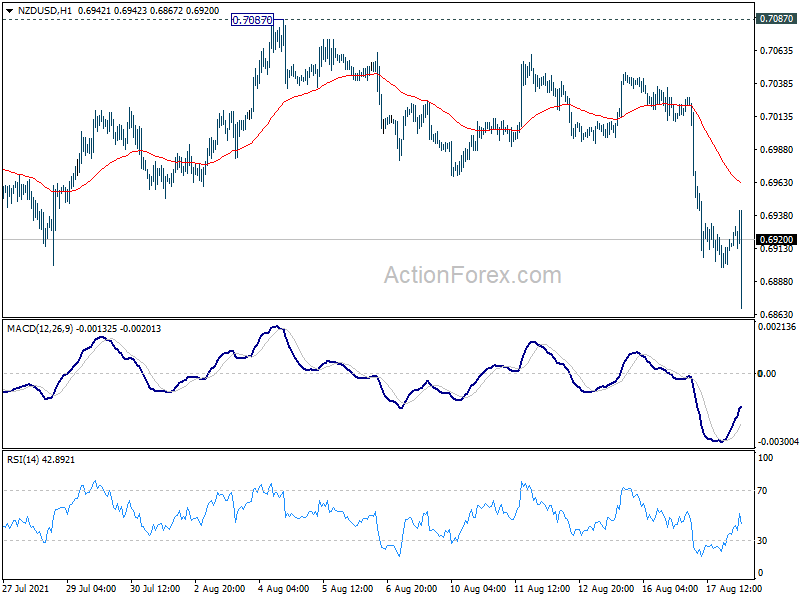
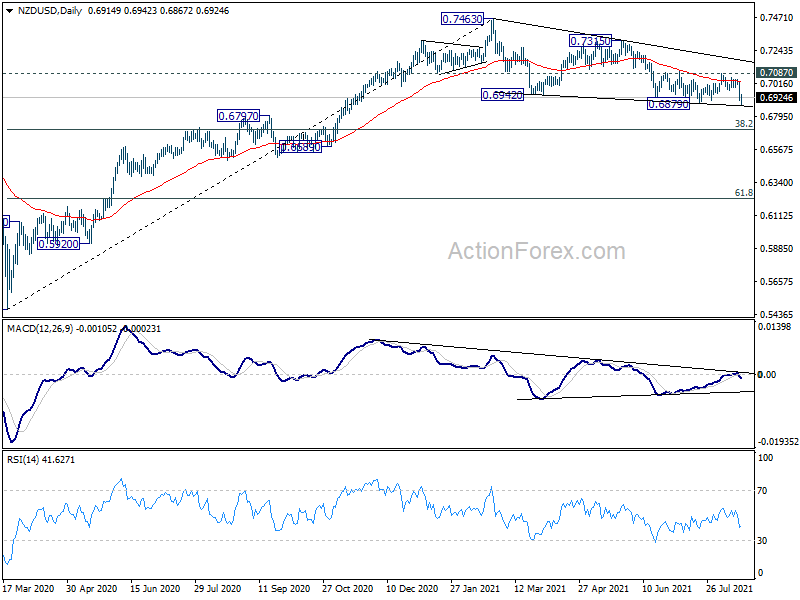
NZD/USD spiked lower to 0.6867 after the announcement but quickly recovered. Outlook stays bearish as long as 0.7087 resistance holds. Sustained break of 0.6879 support will extend the fall from 0.7463 to 38.2% retracement of 0.5467 to 0.7463 at 0.6701.
Also from New Zealand, PPI input accelerated to 3.0% qoq in Q2, up from 2.1% qoq, well above expectation of 0.5% qoq. PPI output jumped to 2.6% qoq, up from 1.2% qoq, above expectation of 0.1% qoq.
Australia leading index dropped to 1.3 in Jul, still consistent with above trend growth
Australia Westpac-MI leading index dropped from 1.36% to 1.30% in July. The index is still consistent with above trend growth over the next 3 to 9 months. Nevertheless, Westpac also said, "no Leading Index can accurately predict the impact of sudden virus lockdowns, although the direct effects of measures will start to become more apparent in the August Index."
Also, with the deteriorating outlook in New South Wales and Melbourne due to lockdowns, West pact has revised down Q3 GDP forecast to a contraction of -2.6%, to be followed by 2.6% growth in Q4, and very strong growth of 5.0% in 2022.
Westpac added that RBA would likely to "take the same approach" as August in September meeting. That is, there would be no response to the current lockdown risks. However, it added, "we certainly cannot rule out a policy change in September especially if, as we assess, developments have raised some questions as to the vulnerability and timing of the expected recovery.
Also released, Wage price index rose 0.4% qoq in Q2, below expectation of 0.6% qoq.
Japan exports rose 37.0% yoy in Jul, imports rose 28.5% yoy
Japan export rose 37.0% yoy to JPY 7356B in July, slightly below expectation of 39.0% yoy. By region, exports to China rose 18.9% yoy, led by chip-making equipment and plastic. Exports to the US grew 26.8% yoy, led by exports of cars, car parts and motors. Imports rose 28.5% yoy to JPY 6915B, below expectation of 35.1% yoy. Trade balance came in at JPY 441B.
In seasonally adjusted term, exports was unchanged at JPY 7049B. Imports dropped -1.6% mom to 6997B. Trade balanced reported a surplus of JPY 52.7B.
Also from Japan, machinery orders dropped -1.6% mom in June, versus expectation of -2.8% mom.
Fed Powell: People and businesses have improvised and learned to adapt to COVID
Fed Chair Jerome Powell said yesterday that "it's not yet clear whether the Delta strain will have important effects on the economy; we'll have to see about that." While COVID is "still with us," he said, "people and businesses have improvised and learned to adapt."
The pandemic is "still casting a shadow on economic activity. We cannot declare victory yet," Powell said. But "many companies ... have adapted their business models to the new world,"
Separately, Minneapolis Fed President Neel Kashkari said it's "reasonable" to start tapering later this year. "There's a lot of public discussion about, will it be at the end of this year, will it be the beginning of next year: Those seem like reasonable ranges of deliberation, but ultimately it will be driven by the data," he added.
Looking ahead
UK CPI and PPI will be a main focus in European session while Eurozone will release CPI final. Later in the day, Canada will also release CPI. US will release housing starts and building permits, as well as FOMC minutes.
EUR/CHF Daily Outlook
Daily Pivots: (S1) 1.0692; (P) 1.0722; (R1) 1.0744; More....
EUR/CHF's break of 1.0715 support suggests resumption of fall from 1.1149. Intraday bias is back on the downside for 61.8% projection of 1.0985 to 1.0715 from 1.0839 at 1.0672 first. Break will target 100% projection at 1.0569 next. On the upside, break of 1.0750 minor resistance will turn intraday bias neutral and bring consolidations. But outlook will stay bearish as long as 1.0839 resistance holds.
In the bigger picture, rebound from 1.0505 (2020 low) should have completed at 1.1149 already. The three-wave corrective structure argues that the downtrend from 1.2004 (2018 high) is not over yet. Medium term outlook will now stay bearish as long as 55 week EMA (now at 1.0865) holds. Break of 1.0505 low would be seen at a later stage.
Economic Indicators Update
| GMT | Ccy | Events | Actual | Forecast | Previous | Revised |
|---|---|---|---|---|---|---|
| 22:45 | NZD | PPI Input Q/Q Q2 | 3.00% | 0.50% | 2.10% | |
| 22:45 | NZD | PPI Output Q/Q Q2 | 2.60% | 0.10% | 1.20% | |
| 23:50 | JPY | Trade Balance (JPY) Jul | 0.05T | 0.12T | -0.09T | -0.06T |
| 23:50 | JPY | Machinery Orders M/M Jun | -1.50% | -2.80% | 7.80% | |
| 00:30 | AUD | Westpac Leading Index M/M Jul | -0.10% | -0.06% | ||
| 01:30 | AUD | Wage Price Index Q/Q Q2 | 0.40% | 0.60% | 0.60% | |
| 02:00 | NZD | RBNZ Rate Decision | 0.25% | 0.50% | 0.25% | |
| 03:00 | NZD | RBNZ Press Conference | ||||
| 06:00 | GBP | CPI M/M Jul | 0.30% | 0.50% | ||
| 06:00 | GBP | CPI Y/Y Jul | 2.20% | 2.50% | ||
| 06:00 | GBP | Core CPI Y/Y Jul | 2.20% | 2.30% | ||
| 06:00 | GBP | RPI M/M Jul | 0.30% | 0.70% | ||
| 06:00 | GBP | RPI Y/Y Jul | 3.70% | 3.90% | ||
| 06:00 | GBP | PPI Input M/M Jul | 1.20% | -0.10% | ||
| 06:00 | GBP | PPI Input Y/Y Jul | 10.80% | 9.10% | ||
| 06:00 | GBP | PPI Output M/M Jul | 0.40% | 0.40% | ||
| 06:00 | GBP | PPI Output Y/Y Jul | 4.80% | 4.30% | ||
| 06:00 | GBP | PPI Core Output M/M Jul | 0.30% | |||
| 06:00 | GBP | PPI Core Output Y/Y Jul | 2.70% | |||
| 09:00 | EUR | Eurozone CPI Y/Y Jul F | 2.20% | 2.20% | ||
| 09:00 | EUR | Eurozone CPI - Core Y/Y Jul F | 0.70% | 0.70% | ||
| 12:30 | USD | Housing Starts Jul | 1.60M | 1.64M | ||
| 12:30 | USD | Building Permits Jul | 1.61M | 1.59M | ||
| 12:30 | CAD | CPI M/M Jul | 0.40% | 0.30% | ||
| 12:30 | CAD | CPI Y/Y Jul | 3.40% | 3.10% | ||
| 12:30 | CAD | CPI Common Y/Y Jul | 1.80% | 1.70% | ||
| 12:30 | CAD | CPI Median Y/Y Jul | 2.40% | 2.40% | ||
| 12:30 | CAD | CPI Trimmed Y/Y Jul | 2.50% | 2.60% | ||
| 14:30 | USD | Crude Oil Inventories | -1.5M | -0.4M | ||
| 18:00 | USD | FOMC Minutes |
Fed Powell: People and businesses have improvised and learned to adapt to COVID
Fed Chair Jerome Powell said yesterday that "it's not yet clear whether the Delta strain will have important effects on the economy; we'll have to see about that." While COVID is "still with us," he said, "people and businesses have improvised and learned to adapt."
The pandemic is "still casting a shadow on economic activity. We cannot declare victory yet," Powell said. But "many companies ... have adapted their business models to the new world,"
Separately, Minneapolis Fed President Neel Kashkari said it's "reasonable" to start tapering later this year. "There's a lot of public discussion about, will it be at the end of this year, will it be the beginning of next year: Those seem like reasonable ranges of deliberation, but ultimately it will be driven by the data," he added.
Japan exports rose 37.0% yoy in Jul, imports rose 28.5% yoy
Japan export rose 37.0% yoy to JPY 7356B in July, slightly below expectation of 39.0% yoy. By region, exports to China rose 18.9% yoy, led by chip-making equipment and plastic. Exports to the US grew 26.8% yoy, led by exports of cars, car parts and motors. Imports rose 28.5% yoy to JPY 6915B, below expectation of 35.1% yoy. Trade balance came in at JPY 441B.
In seasonally adjusted term, exports was unchanged at JPY 7049B. Imports dropped -1.6% mom to 6997B. Trade balanced reported a surplus of JPY 52.7B.
Also from Japan, machinery orders dropped -1.6% mom in June, versus expectation of -2.8% mom.
Australia leading index dropped to 1.3 in Jul, still consistent with above trend growth
Australia Westpac-MI leading index dropped from 1.36% to 1.30% in July. The index is still consistent with above trend growth over the next 3 to 9 months. Nevertheless, Westpac also said, "no Leading Index can accurately predict the impact of sudden virus lockdowns, although the direct effects of measures will start to become more apparent in the August Index."
Also, with the deteriorating outlook in New South Wales and Melbourne due to lockdowns, West pact has revised down Q3 GDP forecast to a contraction of -2.6%, to be followed by 2.6% growth in Q4, and very strong growth of 5.0% in 2022.
Westpac added that RBA would likely to "take the same approach" as August in September meeting. That is, there would be no response to the current lockdown risks. However, it added, "we certainly cannot rule out a policy change in September especially if, as we assess, developments have raised some questions as to the vulnerability and timing of the expected recovery.
USD/CAD Starts Fresh Increase, Canada’s CPI Next
Key Highlights
- USD/CAD started a fresh increase above the 1.2500 resistance zone.
- It broke a major bearish trend line at 1.2540 on the 4-hours chart.
- EUR/USD started a fresh decline after it failed to surpass 1.1800.
- Canada's CPI could increase 3.4% in July 2021 (YoY), up from 3.1%.
USD/CAD Technical Analysis
The US Dollar formed a support base above 1.2420 against the Canadian Dollar. As a result, USD/CAD started a fresh increase above the 1.2500 resistance.
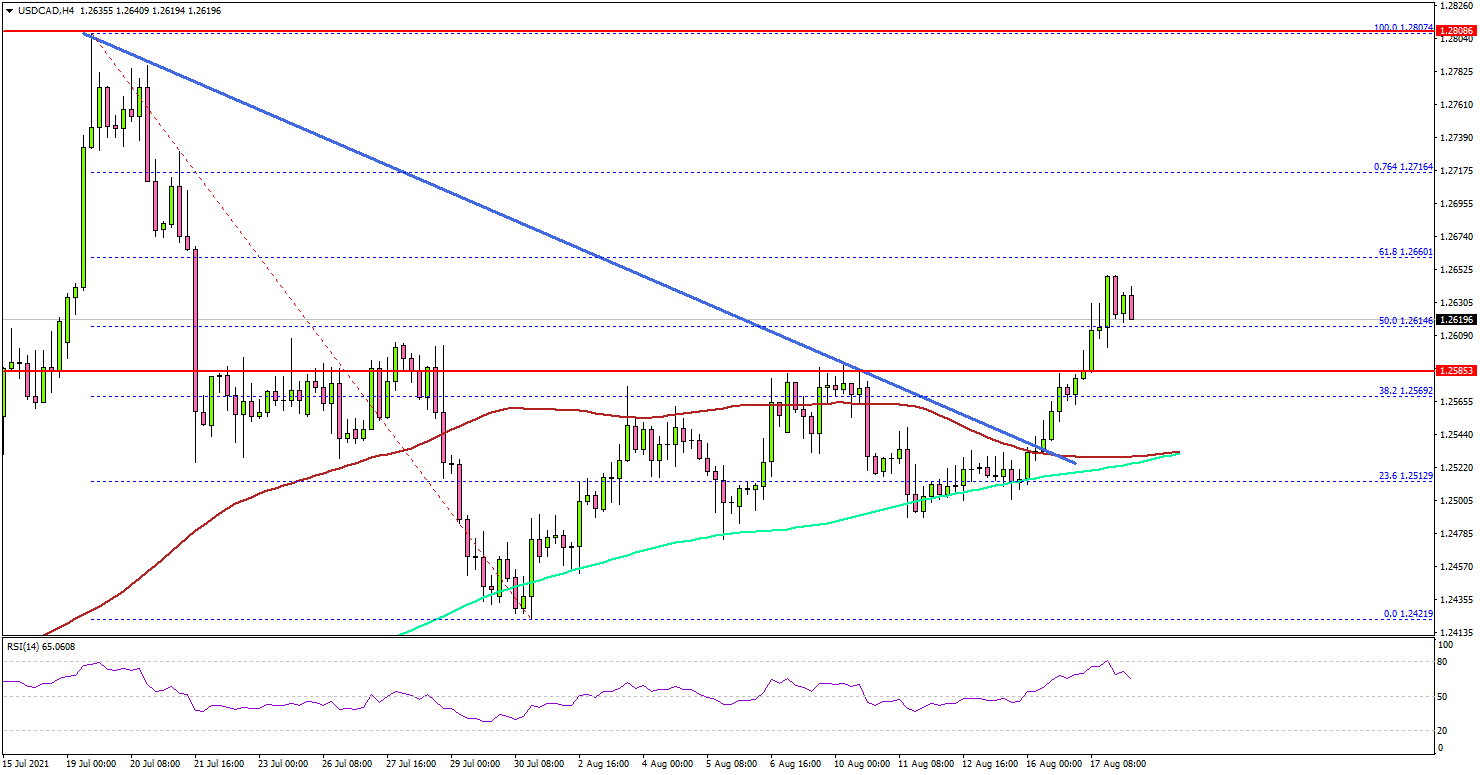
Looking at the 4-hours chart, the pair gained pace after it cleared the 1.2500 resistance zone, the 100 simple moving average (red, 4-hours), and the 200 simple moving average (green, 4-hours).
There was also a break above a major bearish trend line at 1.2540. The pair tested the 50% Fib retracement level of the key decline from the 1.2807 high to 1.2421 low.
On the upside, an initial resistance is near the 1.2660 level. It is close to the 61.8% Fib retracement level of the key decline from the 1.2807 high to 1.2421 low. Any more gains could open the doors for a move towards the 1.2750 level.
If there is a downside correction, the pair might to remain stable above 1.2580. The main support is now forming near the 1.2540 level, the 100 simple moving average (red, 4-hours), and the 200 simple moving average (green, 4-hours).
Looking at EUR/USD, the pair started a fresh decline after it failed to clear the 1.1800-1.1810 resistance zone. Similarly, GBP/USD is showing bearish signs below 1.3800.
Economic Releases
- UK Consumer Price Index for July 2021 (YoY) – Forecast +2.2%, versus +2.5% previous.
- UK Core Consumer Price Index for July 2021 (YoY) – Forecast +2.2%, versus +2.3% previous.
- Euro Zone CPI for July 2021 (YoY) - Forecast +2.2%, versus +2.2% previous.
- Euro Zone CPI for July 2021 (MoM) - Forecast -0.1%, versus +0.3% previous.
- Canadian Consumer Price Index for July 2021 (MoM) – Forecast +0.3%, versus +0.3% previous.
- Canadian Consumer Price Index for July 2021 (YoY) – Forecast +3.4%, versus +3.1% previous.
RBNZ keeps rate unchanged on heightened uncertainty, NZD spikes lower and recovered
RBNZ kept Official Cash Rate unchanged at 0.25% today, instead of raising it. The decision was "made in the context of the Government's imposition of Level 4 COVID restrictions on activity across New Zealand." Nevertheless, it reiterated that the "least regrets policy stance" was still to "further reduce the level of monetary stimulus". But the Committee agreed to stand pat at this meeting "given the heightened uncertainty with the country in a lockdown."
In the summary record, it's also noted that committee members "now had more confidence that rising capacity pressures will feed through into inflation, and that employment is at its maximum sustainable level." They concluded that "they could continue removing monetary stimulus", following haling the LSAP program in July.
NZD/USD spiked lower to 0.6867 after the announcement but quickly recovered. Outlook stays bearish as long as 0.7087 resistance holds. Sustained break of 0.6879 support will extend the fall from 0.7463 to 38.2% retracement of 0.5467 to 0.7463 at 0.6701.
(RBNZ) Official Cash Rate on hold at 0.25 percent
The Monetary Policy Committee agreed to retain the current stimulatory level of monetary settings, keeping the Official Cash Rate (OCR) at 0.25 per cent for now. Today's decision was made in the context of the Government's imposition of Level 4 COVID restrictions on activity across New Zealand.
The Committee will assess the inflation and employment outlook on an ongoing basis, with a view to continue to reduce the level of monetary stimulus over time so as to best meet their policy remit. This follows the recent halting of additional government bond purchases under the Large Scale Asset Purchase (LSAP) programme in July.
Global monetary and fiscal settings remain at accommodative levels, supporting international spending and investment. Rising vaccination rates across many countries have provided economic impetus. The rise in activity has continued to support demand and prices for New Zealand's export commodities.
However, the need to reinstate COVID-19 containment measures in some regions highlights the serious health and economic risks posed by the virus. Persistent and elevated health risks are promoting ongoing global supply chain disruptions, and are acting to constrain productive capacity and prolong inflationary pressures. Today's re-introduction of Level 4 restrictions to activity across New Zealand is a stark example of how unpredictable and disruptive the virus is proving to be.
The Committee noted that the New Zealand economy had rebounded more strongly than most countries, with less domestic disruption caused by COVID-19 to date. Employment is currently at or above its maximum sustainable level, and consumer price inflation expectations remain anchored near 2 percent, the midpoint of the target range.
Recent data for the New Zealand economy suggest demand is robust and the economic recovery has broadened, despite some weakness persisting in the sectors most exposed to international tourism. Household spending and construction activity are at high levels and continue to grow, and business investment is responding to increased demand.
Capacity pressures are now evident in the economy, particularly in the labour market where job vacancies remain high despite the recent decline in unemployment and underemployment. Wages are rising consistent with the tight labour market conditions.
Broader inflation pressures are being accentuated in the near-term by one-off price rises such as higher oil prices, and temporary factors such as supply shortfalls and higher transport costs. Near-term consumer price inflation is expected to rise above the Committee's target range before returning towards the 2 percent midpoint around mid-2022.
The Committee agreed they are confident of meeting their inflation and employment remit with less need for the existing level of monetary stimulus. However, the Committee remains alert to the supply disruptions that COVID-19 can create, and the dampening effect this can have on confidence. House prices are also above their sustainable level, heightening the risk of a price correction as supply increases.
The Committee agreed that their least regrets policy stance is to further reduce the level of monetary stimulus so as to anchor inflation expectations and continue to contribute to maximum sustainable employment. They agreed, however, to keep the OCR unchanged at this meeting given the heightened uncertainty with the country in a lockdown.
Summary Record of Meeting
The Monetary Policy Committee discussed economic developments since the May Statement. The Committee noted that the global economy has continued to recover, supported by rising vaccination rates in many countries, a gradual relaxation of mobility restrictions, and continued monetary and fiscal support.
The Committee noted the considerable uncertainty that exists regarding the longer-run impacts of COVID-19, particularly with the emergence of new variants. Globally, periods of health-related mobility restriction are likely to continue for some time, creating ongoing short-term economic disruptions, supply cost pressures, and lower productive capacity.
The Committee agreed that in New Zealand the recent economic data suggest domestic demand is robust and that the economic recovery has broadened in recent months. While weakness still persists in sectors most heavily exposed to international tourism, activity in most industries now exceeds pre-COVID levels.
Domestic economic activity has been underpinned by strong household spending, high levels of construction, and strong demand for New Zealand's commodity exports. Recent data has also shown a pick-up in business investment, which broadens the base of aggregate demand and suggests businesses are responding to emerging capacity constraints.
The Committee noted uncertainty related to the emergence of new cases of COVID-19 in the community and the move back into Alert Level 4. The reinstatement of the Government Wage Subsidy Scheme and COVID-19 Resurgence Support Payments is expected to significantly buffer the loss of income associated with the lockdown.
The Committee agreed that capacity constraints were building in the economy. Pressures are particularly acute in the labour market, where job vacancies remain high alongside declines in unemployment. Falling underemployment provides a greater level of confidence that spare capacity is being absorbed. Employment is assessed as being at or above its maximum sustainable level in the current environment.
Wage inflation has increased in line with the tightening in the labour market, but the Committee expressed uncertainty about whether higher wage growth will be sustained.
The Committee noted that capacity constraints are contributing to rising headline inflation. Mirroring global developments, inflationary pressure in New Zealand has been accentuated in the near term by one-off factors such as higher oil prices, and temporary factors such as supply shortfalls and rising transport costs. This is expected to push inflation above 4 percent in the near-term, before returning towards the 2 percent midpoint of the target band from mid-2022. Medium and long-term inflation expectations remain anchored at 2 percent.
The Committee reflected that experience over the past 12 months has provided more confidence about the resilience of domestic demand in the face of health-related restrictions. The Government Wage Subsidy proved effective in supporting domestic incomes and providing job security through periods of lockdown, which has enabled a rapid recovery in consumer spending. This scheme has been rapidly reinstated in light of the current lockdown. While some households suffered income losses and accumulated debt, many households retain a larger buffer of savings, which could provide ongoing support to consumption.
The Committee acknowledged that restrictions on the movement of people across the New Zealand border will only be removed gradually, and subject to ongoing health-related uncertainty. However, they also agreed that, to date, increased domestic spending has provided a significant offset to the loss of international tourism earnings. The closure of the border has also reduced international labour mobility, creating capacity shortages in some industries that have traditionally been reliant on migrant labour.
In light of this experience, members expressed caution about the level of remaining supply capacity in the New Zealand economy. The economic disruption caused by the ongoing global health issues has increased skill mismatches, which has likely reduced maximum sustainable employment in the near term. The Committee discussed the risk that the productive capacity of the economy is lagging domestic demand, which could lead to more persistent inflation pressure.
The Committee discussed the current, and risk of future, outbreaks of COVID-19 in New Zealand, and how monetary policy should respond. The Committee agreed that fiscal policy (government spending and transfer payments) has proved to be a very effective tool to respond to any immediate reduction in demand in the event of outbreaks. A monetary policy response may be required if a health-related lockdown has a more enduring impact on inflation and employment.
As required by their Remit, members assessed the impact of monetary policy on the Government's objective to support more sustainable house prices. The Committee noted the Reserve Bank's assessment that the level of house prices is currently unsustainable. Members noted that the Reserve Bank is currently consulting on further bank lending restrictions to help mitigate the financial stability risks associated with unsustainable house prices.
The Committee noted that a number of factors are expected to weigh on house prices over the medium term. These include strong house building, slower population growth, changes to tax settings, and the ongoing impacts of tighter bank lending rules. Rising mortgage interest rates, as monetary stimulus is reduced, would also constrain house prices to a more sustainable level. Members expressed uncertainty about how quickly momentum in the housing market will recede and noted a risk that any continued near-term price growth could lead to sharper falls in house prices in the future.
The Committee reiterated that the OCR is currently the preferred tool to adjust the level of stimulus in the economy. The principles governing the suite of monetary policy tools will continue to guide their use. In line with those principles, the Funding for Lending Programme (FLP) will remain in place under its current terms until the drawdown window expires next year. The Committee directed staff to develop an operational strategy to help inform decisions regarding the management of Government and Local Government Funding Agency (LGFA) bonds purchased under the Large Scale Asset Purchase (LSAP) programme, consistent with the Committee's desired stance of policy and supporting the functioning of markets.
The Committee discussed the stance of monetary policy. Members noted that they now had more confidence that rising capacity pressures will feed through into inflation, and that employment is at its maximum sustainable level. Members concluded that they could continue removing monetary stimulus, following their decision to halt additional purchases of Government bonds under the LSAP programme at their July meeting.
The Committee discussed the merits of an increase in the OCR at this meeting and considered the implications of alternative sequencing of OCR changes over time. The Committee agreed that their least regrets policy stance is to further reduce monetary policy stimulus to reduce the risk that inflation expectations become unanchored. However in light of the current Level 4 lockdown and health uncertainty the Committee agreed to leave the OCR unchanged at this meeting.
On Wednesday 18 August, the Committee reached a consensus to:
- Maintain the OCR at 0.25 percent;
- Direct staff to develop an operational strategy to inform decisions on the management of Government and LGFA bonds purchased under theLSAP programme; and
- Maintain the existing Funding for Lending Programme conditions.