

Sample Category Title
Eco Data 8/18/21
[php_everywhere instance="1"]
OPEC+ Shuns US Request, Gold Eyes $1,800
Oil under pressure even as OPEC+ shuns US request
Oil prices coming under further pressure on Tuesday after rebounding off its lows once more at the start of the week.
This came after OPEC+ sources claimed the group sees no need to ramp up production faster, following comments from the White House last week.
In much the same way that the market slipped following the comments last week before quickly recovering, the short-term burst on Monday is proving short-lived. We’re unsurprisingly back where we started, with OPEC+ responding to market forces not political pressure.
That leaves crude prices looking vulnerable as we continue to see $65 support in WTI but less forceful rebounds that see sellers pour in earlier.
A move below here would be a significant technical breakout and surely reflect serious concerns about growth in the coming months as delta causes increasing restrictions around the world. New Zealand overnight became the latest to go back into lockdown following a single community case.
Gold running into big resistance
Gold prices are continuing to perform quite well following a really strong rebound from last week’s flash crash.
US yields have continued to soften this week which is giving the yellow metal a much-needed boost. It’s now closing in on $1,800 where is could run into significant resistance.
This marks a 50% retracement of the June highs to August lows and could be a big psychological test for gold. That said, $1,815-1,825 is arguably more signficiant with it falling around the 61.8 fib level, prior highs and 200 day moving average. A move above here may come as a surprise to many and send a very bullish signal to the market.
USD/CAD Mid-Day Outlook
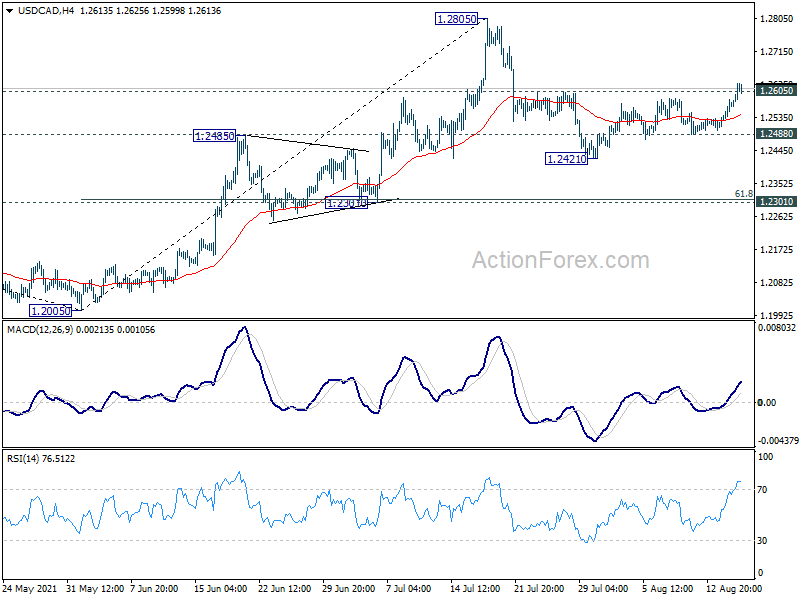
Daily Pivots: (S1) 1.2531; (P) 1.2557; (R1) 1.2603; More...
USD/CAD's break of 1.2605 resistance indicates that pull back from 1.2805 has completed at 1.2421. Intraday bias is turned back to the upside for retesting 1.2805 resistance. Break there will resume whole rise from 1.2005 for 1.3022 fibonacci level next. On the downside, break of 1.2488 minor support will turn bias back to the downside for 1.2421 support and below.
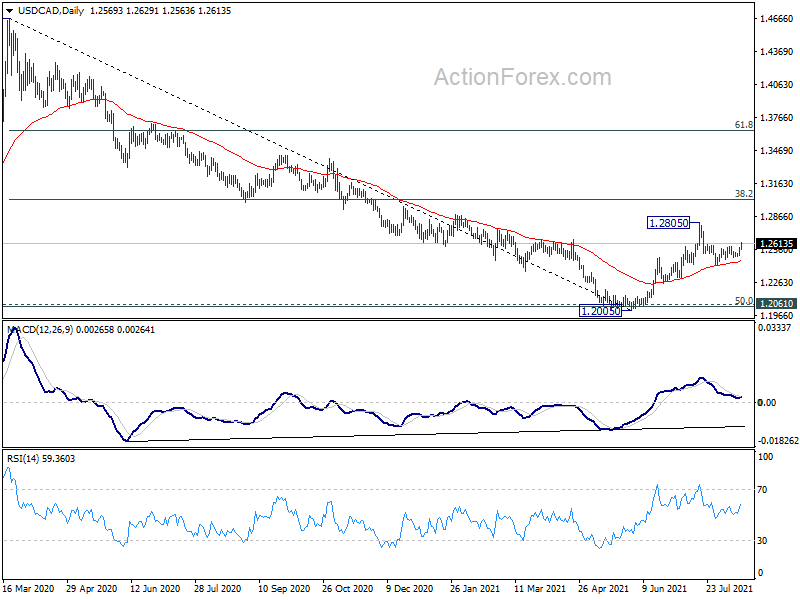
In the bigger picture, fall from 1.4667 is seen as the third leg of the corrective pattern from 1.4689 (2016 high). It should have completed after hitting 1.2061 (2017 low) and 50% retracement of 0.9406 to 1.4689 at 1.2048. Sustained break of 38.2% retracement of 1.4667 to 1.2005 at 1.3022 will pave the way to 61.8% retracement at 1.3650 and above. Overall, medium term outlook remains neutral at worst with 1.2048/61 support zone intact.
AUD/USD Mid-Day Report
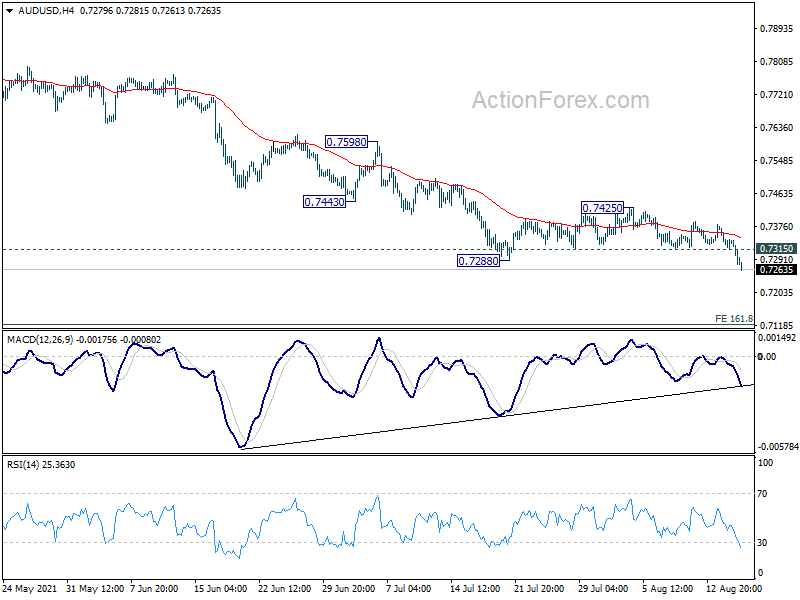
Daily Pivots: (S1) 0.7312; (P) 0.7343; (R1) 0.7365; More...
AUD/USD's break of 0.7288 support indicate resumption of whole decline from 0.8006. Intraday bias is back on the downside. Next target is 161.8% projection of 0.8006 to 0.7530 from 0.7890 at 0.7120. On the upside, above 0.7315 minor support will turn intraday bias neutral first. But outlook will stay bearish as long as 0.7425 resistance holds, in case of recovery.
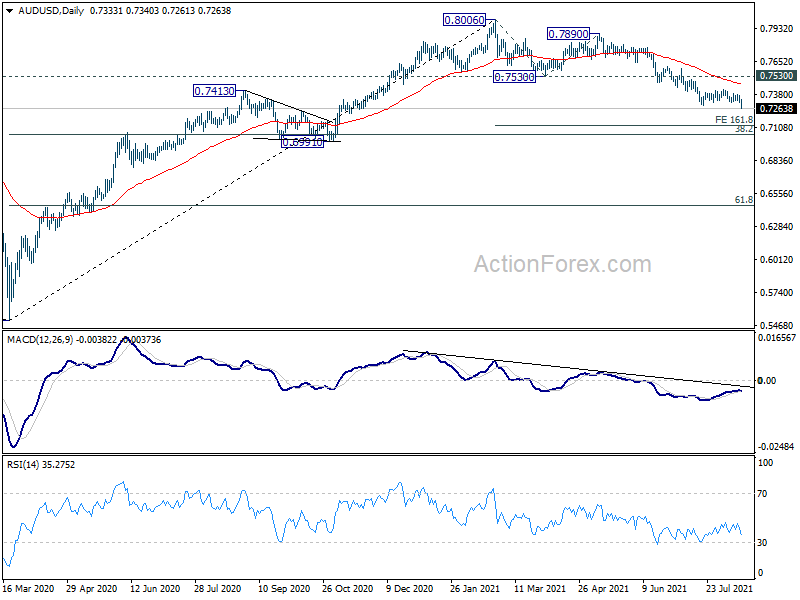
In the bigger picture, rise from 0.5506 medium term bottom could have completed at 0.8006, after failing 0.8135 key resistance. Correction from there could target 0.6991 cluster support (38.2% retracement of 0.5506 to 0.8006 at 0.7051). We'd look for strong support from there to bring rebound. However, sustained break of this level would argue that the whole medium term trend has indeed reversed.
US: Retail Sales Decline in July as Consumers Shift from Goods to Services
- Retail sales declined by 1.1% m/m in July, well below the consensus forecast for a decline of -0.3%. June's data was revised up to a stronger +0.7% m/m (from +0.6%).
- The volatile categories were mostly in the red in July. Supply-chain constraints that are constraining auto production continue to affect the motor vehicles and parts category, where sales declined for the third month in a row (-3.9% m/m) and accounted for roughly two thirds of the slowdown in July. Demand for building materials and garden equipment seemed to have levelled off since the spring as evident by another month of decline (-1.2% m/m), while food and beverage stores (-0.7% m/m) saw a reversal of the four-month growth streak. Meantime, growth in gasoline stations (+2.4% m/m) reflected the consumers' preferences for travelling in the summer.
- Retail sales in the "control group," which exclude the above categories, dropped by 1.0% m/m. But June's gain was revised up to +1.4%, from +1.1% in the advance estimate. This suggests that personal consumption expenditures may have slowed in July.
- It wasn’t all bad news. Miscellaneous stores retailers (+3.5% m/m), food services & drinking places (+1.7% m/m), and health & personal care (+0.1% m/m) grew in July, albeit at a slower rate than in June.
Key Implications
- The decline in retail sales in July reflects largely the waning power of stimulus payments and the shift in consumer spending away from goods and towards services. The recent weakness in auto sales made a notable dent in the headline reading and, judging by the scarcity of supply, will continue to weigh on retail sales in the coming months.
- It is likely a bit early to say that the upswing in the Delta variant impacted spending in July. However some high-frequency indicators are showing a loss of momentum that is likely to show up in August consumption. Overall consumer spending growth is expected to slow to a lower single-digit pace in Q3 from its stimulus-driven near 12% annualized pace in Q1. Still, the outlook for economic activity is not as dire as during the past outbreaks. According to the Institute for Health Metrics and Evaluation, an expected increase in cases, hospitalizations and deaths should peak and decline by some point in September, while its magnitude should remain short of the winter surge thanks to vaccine efficacy. This points a more limited setback in spending than what we've seen in the past.
Sunset Market Commentary
Markets
Today was virtually a copy paste of yesterday: risk aversion with the whole shebang. Equities declined and core bonds enjoyed a safe haven bid. US yields at some point shed about 5bps while Germany saw yields evaporate up to 3 bps. July US retail sales marked a turning point, though somewhat counterintuitively. All gauges disappointed. Headline turnover fell 1.1% m/m (vs -0.3 expected) with 8 out of 13 categories declining. Excluding cars and gas, sales fell 0.7% m/m (vs -0.1%). A super-core measure, the control group which additionally excludes building-materials retailers, office supply stores, mobile homes and tobacco, printed at -1% m/m (vs -0.2%). The sub-consensus reading does not bode well for the future, having last week’s August Michigan consumer confidence in mind. That indicator tanked to levels below the 2020 pandemic trough with US consumers flagging the coronavirus and stubbornly high inflation eating into their disposable income, thus possibly affecting spending. Despite all that, US yields strangely enough recovered after the data release. The 10y yield returned from 1.22% to 1.25% at the time of writing, thereby limiting daily losses to less than 1bp. The 30y variant faces a similar decline. Other yield changes are negligible. German yields were caught in the US slipstream. The curve, now flat, fully erased an initial bull flattening move.
Before turning to the dollar, let’s highlight the notable depreciation of both the Aussie (lost ST support at AUD/USD 0.729) and the kiwi dollar (NZD/USD 0.69 area) first. Both are related to the recent coronavirus developments and what it could mean for monetary policy going forward (see also headline below). The dollar in general is well bid. Its performance even improved after the poor retail sales. The trade-weighted DXY has its eyes set at recent highs around 93. EUR/USD retreats from 1.178 to 1.173. So much for the pair’s Friday comeback. Markets also again embrace the Swiss Franc (EUR/CHF nearing 1.07!). Sterling on the other hand is suffering from the risk context. This morning’s labour market report wasn’t bad at all and even justified the BoE’s hawkish turn earlier this month. But an unemployment rate easing to 4.7%, 95k employment change in the three months to June and weekly earnings soaring to a three-month average of 7.4% just didn’t do the trick. EUR/GBP rose north of 0.85(3). GBP/USD loses a full big figure to 1.375.
News Headlines
New Zealand PM Ardern announced a nationwide three-day lockdown after an Auckland man tested positive for Covid-19, the first community spread since February. Schools, offices and businesses will have to close. Auckland and the Coromandel Peninsula will probably face a tougher seven-day lockdown. “Going hard and early has worked for us before”, Ardern stressed. The infection potentially throws a spanner in the works of the Reserve Bank of New Zealand. Markets discounted the start of the tightening cycle at tomorrow’s policy meeting. Some investors pulled some chips off the table though. NZD/USD fell from 0.7020 towards the low 0.69 support zone. A backtracking RBNZ, which isn’t our preferred scenario, could trigger a drop below 0.6881. Next support stands at 0.6703 (68% retracement on 2020 rally). The NZD swap curve bull flattened with yields ceding 14.3 bps (2-yr) to 9 bps (30-yr).
The flash estimate of Hungarian GDP numbers revealed a 2.7% Q/Q rise, outpacing 1.4% Q/Q consensus and coming from 2% Q/Q in Q1. Non-seasonally adjusted Y/Y growth rose to 17.9%. A detailed reading will only be available on September 1st, but the Hungarian central statistical office mentioned industry as main contributor to growth. Hungarian GDP is now 2.2% larger in absolute terms compared to Q2 2019. The data warrant the Hungarian central bank’s (MNB) hawkish stance and suggest that they could deliver a third consecutive 30 bps rate hike at next week’s policy meeting (Aug 24). Hungarian inflation is still running outside the MNB’s tolerance zone (+1%) around the central bank’s 3% inflation target. EUR/HUF declined marginally today to 351, the strongest HUF-level since early July.
USD/JPY Mid-Day Outlook
Daily Pivots: (S1) 109.00; (P) 109.38; (R1) 109.64; More...
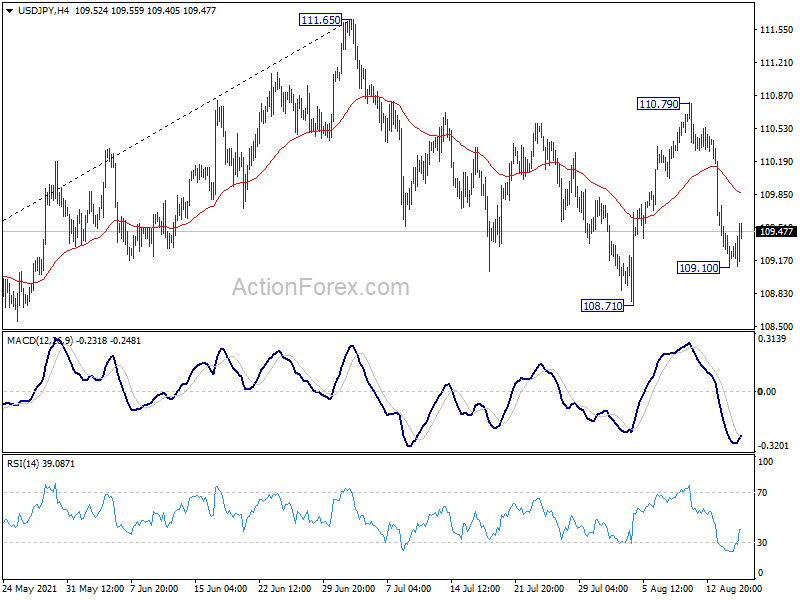
Intraday bias in USD/JPY is turned neutral with current recovery. Risk will stay on the downside as long as 110.79 resistance holds. On the downside, below 109.10 will target 108.71 support first. Firm break there will resume the decline from 111.65 and target 38.2% retracement of 102.58 to 111.65 at 108.18 next.
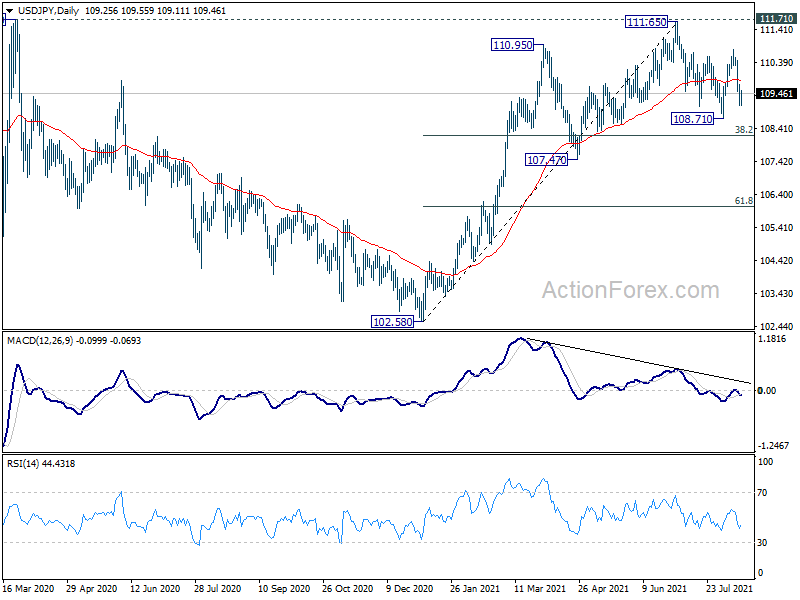
In the bigger picture, medium term outlook is staying neutral with 111.71 resistance intact. The pattern from 101.18 could still extend with another falling leg. Sustained trading below 55 day EMA will bring deeper fall to 107.47 support and below. Nevertheless, strong break of 111.71 resistance will confirm completion of the corrective decline from 118.65 (2016 high). Further rise should then be seen to 114.54 and then 118.65 resistance.
USD/CHF Mid-Day Outlook
Daily Pivots: (S1) 0.9123; (P) 0.9181; (R1) 0.9211; More....
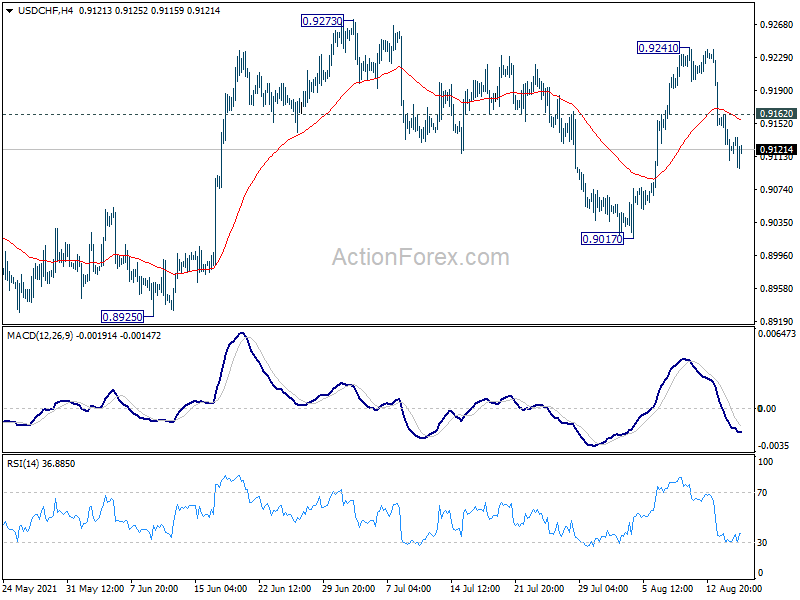
Intraday bias in USD/CHF remains mildly on the downside at this point. Fall from 0.9241 is in progress for retesting 0.9017 support. Break there will likely resume the decline from 0.9471 through 0.8925 low. On the upside, above 0.9162 minor resistance will mix up the near term outlook and turns intraday bias neutral first.
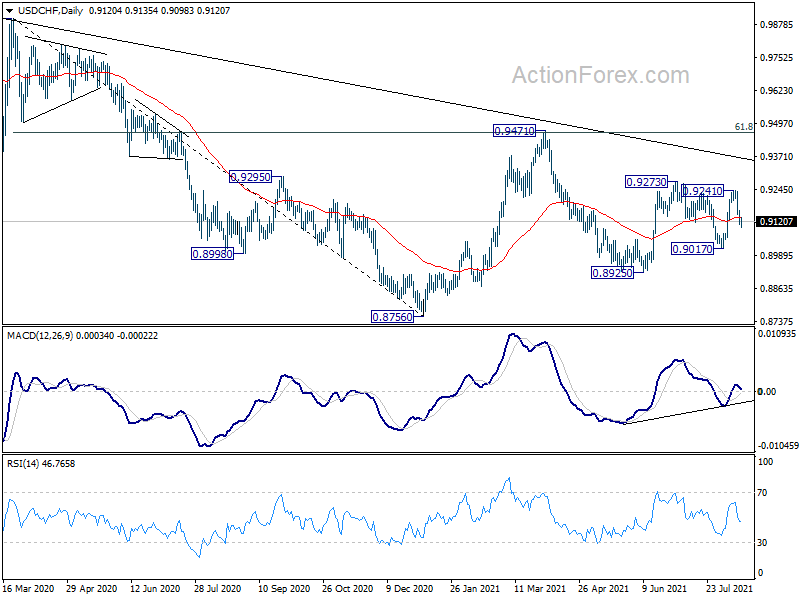
In the bigger picture, the failure to sustain above 55 week EMA (now at 0.9184) retains medium term bearish in USD/CHF. Break of 0.8925 support should resume the whole decline form 1.0342 (2016 high) through 0.8756 low. However, break of 0.9273 resistance and sustained trading above 55 week EMA will be an early sign of bullish trend reversal. Focus will then turn to 0.9471 resistance for confirmation.
GBP/USD Mid-Day Outlook
Daily Pivots: (S1) 1.3820; (P) 1.3849; (R1) 1.3870; More...
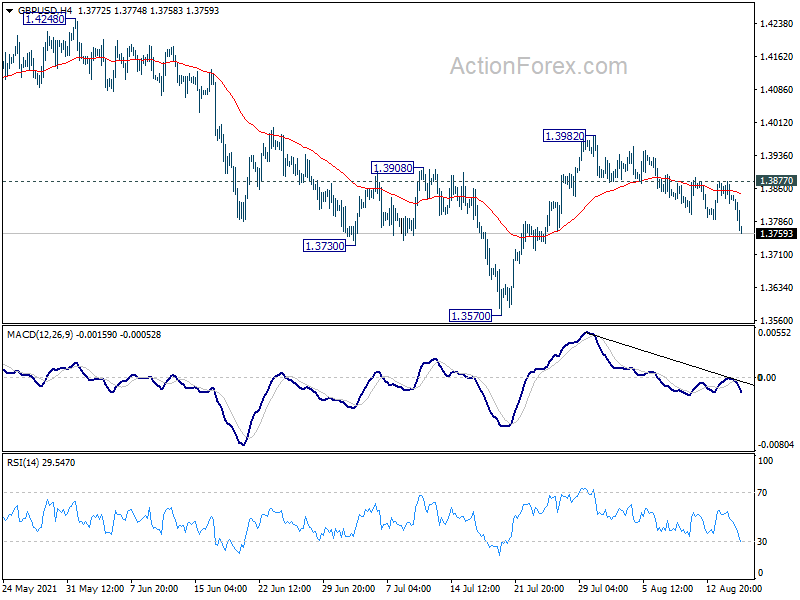
GBP/USD's break of 1.3766 support suggests that rebound from 1.3570 has completed at 1.3982. Intraday bias is back on the downside for retesting 1.3570 first. The rejection by 55 day EMA affirms near term bearishness. Break of 1.3570 will target 1.3482 resistance turned support. On the upside, above 1.3877 minor resistance will turn bias back to the upside for 1.3982.
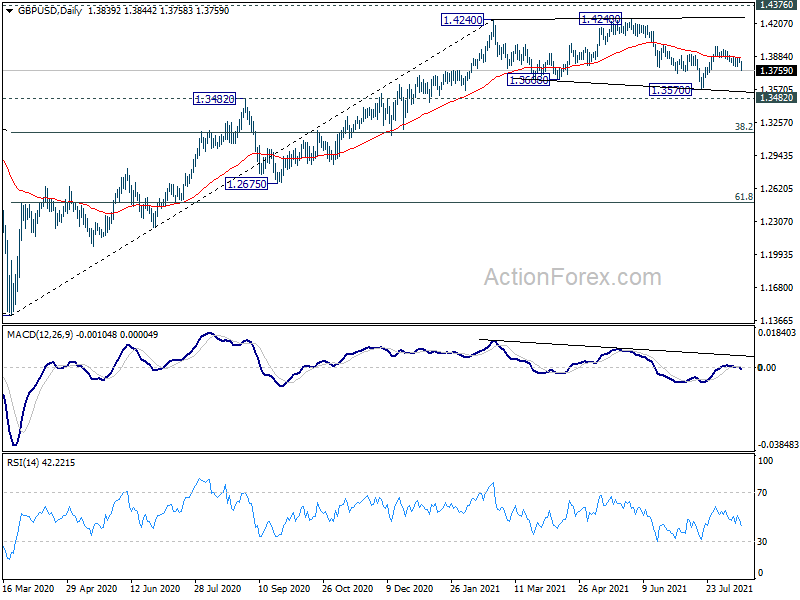
In the bigger picture, as long as 1.3482 resistance turned support holds, up trend from 1.1409 should still continue. Decisive break of 1.4376 resistance will carry larger bullish implications. However, firm break of 1.3482 support will argue that the rise from 1.1409 has completed. GBP/USD would then be seen as in another leg of long term range pattern between 1.1409 and 1.4376. Deeper fall could then be seen to 61.8% retracement of 1.1409 to 1.4248 at 1.2493, and even below.
Stocks Back in the Red, Bitcoin Struggling
More profit taking as we await Powell speech and US data
Stock markets are back in the red on Tuesday, continuing to give back some of the gains from the last couple of weeks.
There has been no shortage of optimism in the markets recently as they’ve slowly but surely hit new record highs. I don’t think much has fundamentally changed, rather we’re just seeing a little profit taking during a relatively quiet period.
There is still concern about the spread of delta, particularly in China, where a tech crackdown once again hit shares overnight. But European and US markets have overlooked these issues to a great extent in recent weeks so I don’t think it’s having much of an impact now.
We’re essentially in a bit of a holding period ahead of Jackson Hole later in the month. While there is a fair amount of data releases this week, some of which may carry a little more weight than others, it’s all about the Fed in these markets at the minute and that’s unlikely to change unless the delta situation gets dramatically worse.
We’ll hear from Jerome Powell today as he speaks at an online town hall event. While his comments will no doubt be picked apart for any Jackson Hole giveaways, I struggle to see him saying anything of substance that deviates from anything we’ve heard previously.
The US retail sales release will likely be more notable, especially following the shocking UoM consumer sentiment reading on Friday. Obviously, retail sales covers last month and the survey is forward looking, but it’s also far more significant. And should it throw some weight behind the sentiment reading, it could trigger further profit taking.
Bitcoin still struggling for momentum
Bitcoin is continuing to struggle on approach to $50,000, with rallies increasingly happening on lower momentum and failing quite quickly. While momentum can shift in a heartbeat, particularly in the crypto market, it does seem that bitcoin may struggle to break $50,000-51,000 resistance at the first time of asking.
A correction wouldn’t be the end of the world though and it’s still in a very healthy position going into the final months of the year. A corrective move back towards $41,000 would be really interesting, with it marking a key fib region but also being such a major area of resistance between May and August. It’s probably a little premature to be discussing those kinds of levels though.