

Sample Category Title
German ZEW Misses Consensus With Expectation Survey Falling For The 3rd Straight Month
Notes/Observations
- German ZEW Survey misses consensus over concerns of the 4th wave or slowdown in global growth.
- Fed taper talk; focus on Wed’s release of US CPI data.
Asia
- Japan July Current Account Balance: ¥905.1B v ¥855.0B; Trade Balance (BOP basis): ¥640.6B v ¥639.0Be.
- Japan Fin Min Aso stated that no new stimulus package or extra budget being put together (again refutes press reports); lots of funds for COVID still unspent.
- China might need to fine-tune macro policy to lend more support to economic growth due to downside risks from the Delta variant and mild inflation prospects offer room for further easing.
Coronavirus
- EU said not to reintroduce restrictions on non-essential travel from the US despite US virus cases being over the EU’s threshold of 75 cases per 100K , the situation to be closely watched over next few weeks.
Europe
- UK July BRC LFL Sales register its weakest growth in 5 months as post-lockdown rebound fades (Y/Y: 4.7% v 5.0%e).
Americas
- Fed's Rosengren: Fed should announce in Sept that it will begin tapering purchases of Treasuries and mortgage bonds.
- Fed's Barkin (FOMC voter, hawk) noted inflation expectations were near target and supported the idea that recent inflation rates were temporary. Fed had made substantial further progress towards taper benchmark, comfortable basing forward guidance on outcomes.
- US Senator Majority Leader Schumer (D-NY) stated that had an agreement for final passage of infrastructure bill with Senate to vote on bill at 11:00 ET (15:00 GMT) on Tuesday (Aug 10th). Follow Up: Agenda to focus of Senate Democrats now shifts to the social change package.
- US senate rejected bipartisan compromise on crypto tax bill within the infrastructure bill following objection filed by Sen Shelby (R-AL).
Speakers/Fixed income/FX/Commodities/Erratum
Equities
- Indices [Stoxx600 +0.23% at 471.76, FTSE -0.12% at 7,123.65, DAX +0.08% at 15,758.40 , CAC-40 +0.05% at 6,816.47, IBEX-35 -0.04% at 8,862.00, FTSE MIB +0.13% at 26,172.50, SMI +0.18% at 12,333.03, S&P 500 Futures -0.01%].
- Market Focal Points/Key Themes: European indices open modestly higher and stayed in the green through the session (FTSE 100 and PSI20 notable exceptions); sectors among those trending higher are consumer discretionary and technology; while underperformers include financials and telecom; travel subsector boosted by IAG, Dufry results and outlook; reportedly Reliance looking to buy Deutche Telekom’s Netherlands unit; Vectura receives improved offer from Philip Morris; Marlowe desists from Restore offer; Derwent announces three acquisitions; focus on US CPI data later in the day; earnings expected during the upcoming US session include Sysco, CF Industries and Chesapeake Energy.
Equities
- Consumer discretionary: IWG [IWG.UK] +1% (earnings), Home24 [H24.DE] +15% (earnings), Dufry [DUFN.CH] -2% (earnings), InterContinental Hotels Group [IHG.UK] -3% (earnings).
- Financials: Munich Re [MUV2.DE] +1% (earnings; raises outlook).
- Technology: Auto1 [AG1.DE] -4% (placement).
Speakers
- German ZEW Economists commented that the decline in expectation survey pointed to increasing risks for economy from a possible 4th wave of pandemic or slowdown in Chinese growth.
- India Finance Ministry Monthly Economic Report (DEA) saw signs of economic rejuvenation; inflation likely to smooth out over coming months.
Currencies/Fixed Income
- USD holding on to its recent strength after more Fed officials (Barkin, Bostic and Rosengren) noted of discussions about how and when to taper their asset purchases.Dealers noted that tapering could begin as early as September if jobs data continued to signal that the economy was heating up.
- EUR/USD tested 4-month lows below 1.1730 in the session and faced headwinds following the miss in German ZEW data.
Economic data
- (SE) Sweden Jun Maklarstatistik Housing Prices Y/Y: 18% v 20% prior; Apartment Prices Y/Y: 12 % v 13% prior.
- (NL) Netherlands Jun Manufacturing Production M/M: 4.4% v 1.2% prior; Y/Y: 17.9% v 16.4% prior; Industrial Sales Y/Y: 21.3% v 19.1% prior.
- (FI) Finland Jun Industrial Production M/M: -2.0% v +2.0% prior; Y/Y: 4.1% v 7.9% prior.
- (NO) Norway July CPI M/M: 0.9% v 0.8%e; Y/Y: 3.0% v 2.9%e(7th straight month above target).
- (NO) Norway July CPI Underlying M/M:0.6 % v 0.4% prior; Y/Y: 1.1% v 1.1%e.
- (NO) Norway July PPI (including oil) M/M: % v 4.6% prior; Y/Y: 43.4% v 37.1% prior.
- (DK) Denmark July CPI M/M: 0.7% v 0.1% prior; Y/Y: 1.6% v 1.7% prior.
- (DK) Denmark July CPI EU Harmonized M/M: 0.8% v 0.1% prior; Y/Y: 1.7% v 1.9% prior.
- (AT) Austria Jun Industrial Production M/M: -1.8% v 0.0% prior; Y/Y: 11.3% v 23.4% prior.
- (HU) Hungary July CPI M/M: 0.5% v 0.6%e; Y/Y: 4.6% v 4.7%e.
- (TR) Turkey Jun Unemployment Rate: 10.6% v 13.1% prior.
- (CZ) Czech July CPI M/M: 1.0% v 0.5%e; Y/Y: 3.4% v 2.9%e.
- (CZ) Czech Jun Export Price Index Y/Y: 3.4% v 1.0% prior; Import Price Index Y/Y: 5.1% v 1.5% prior.
- (SE) Sweden Jun Private Sector Production M/M: 0.8% v 0.1% prior; Y/Y: 10.5% v 10.6% prior.
- (SE) Sweden Jun Industrial Orders M/M: 1.1% v 6.3% prior; Y/Y: 24.4% v 33.1% prior.
- (SE) Sweden Jun Industry Production Value Y/Y: 16.7% v 23.3% prior; Service Production Value Y/Y: 10.1% v 9.7% prior.
- (SE) Sweden Jun Household Consumption M/M: 0.5% v 2.6% prior; Y/Y: 7.3% v 8.8% prior.
- (IT) Bank of Italy (BOI) Banks and Money Monthly Statistics: Jun Gross Non-performing Loans (NPLs): €48.5B vs. €50.5B prior.
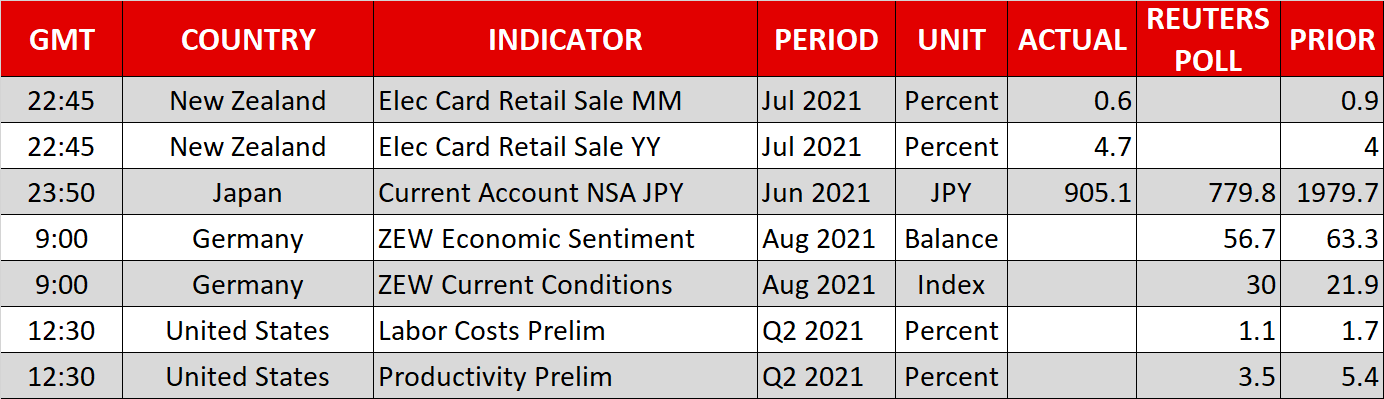
- (DE) Germany Aug ZEW Current Situation Survey: 29,3 v 31.0e; Expectations Survey: 40.4 v 55.0e.
- (EU) Euro Zone Aug ZEW Expectations Survey: 42.7 v 61.2 prior.
Fixed income Issuance
- (ID) Indonesia sold total IDR11.0T vs. IDR12.0T target in Islamic bills and bonds (sukuk).
- (ES) Spain Debt Agency (Tesoro) sold total €5.13B vs. €4.5-5,5B indicated range in 6-month and 12-month bills.
- (UK) DMO sold £2.75B in 0.25% July 2031 Gilts; Avg Yield: 0.664% v 0.819% prior; bid-to-cover: 2.72x v 2.68x prior; Tails: 0.1bps v 0.1bps prior.
Looking Ahead
- (MX) Mexico July ANTAD Same-Store Sales Y/Y: No est v 21.1% prior.
- (MX) Mexico July Nominal Wages: No est v 5.0% prior.
- 05:15 (CH) Switzerland to sell 3-month Bills.
- 05:25 (EU) Daily ECB Liquidity Stats.
- 05:30 (HU) Hungary Debt Agency (AKK) to sell 3-Month Bills.
- 05:30 (BE) Belgium Debt Agency (BDA) to sell €1.8-2.2B in 3-month and 12-month bills.
- 05:30 (EU) ECB allotment in 7-Day Main Refinancing Tender (MRO).
- 05:30 (ZA) South Africa to sell combined ZAR3.9B in 2031, 2032 and 2037 bonds.
- 06:00 (IL) Israel July Consumer Confidence: No est v 137 prior.
- 06:00 (US) July NFIB Small Business Optimism Index: 102.0e v 102.5 prior.
- 06:30 (EU) ESM to sell €1.1B in 12-month Bills; Avg Yield: % v -.063% prior; Bid-to-cover: x v 8.4x prior (July 13th).
- 06:45 (US) Daily Libor Fixing.
- 07:00 (ZA) South Africa Jun Manufacturing Production M/M: +0.5%e v -2.6% prior; Y/Y: 14.7%e v 35.3% prior.
- 07:00 (CZ) Czech Central Bank on July CPI data.
- 08:00 (IS) Iceland Jun Unemployment Rate: No est v 10.0% prior.
- 08:00 (BR) Brazil July IBGE Inflation IPCA M/M: 0.9%e v 0.5% prior; Y/Y: 9.0%e v 8.4% prior.
- 08:00 (UK) Daily Baltic Dry Bulk Index.
- 08:00 (RU) Russia announcement on upcoming OFZ bond issuance (held on Wed).
- 08:30 (US) Q2 Preliminary Nonfarm Productivity: 3.2%e v 5.4% prior; Unit Labor Costs: 1.0%e v 1.7% prior.
- 08:30 (CL) Chile Central Bank Economist Survey.
- 08:55 (US) Weekly Redbook LFL Sales data.
- 09:00 (EU) Weekly ECB Forex Reserves.
- 09:45 (UK) BOE to buy £1.147B in APF Gilt purchase operation (20+ years).
- 10:00 (MX) Mexico Weekly International Reserve data.
- 10:00 (US) Fed’s Mester discusses inflation risks.
- 11:00 (US) Senate vote on an infrastructure bill.
- 11:30 (US) Treasury to sell 52-week bills.
- 13:00 (US) Treasury to sell 3-Year Notes.
- 16:30 (US) Weekly API Oil Inventories.
- 19:00 (KR) South Korea July Unemployment Rate: 3.8%e v 3.7% prior.
- 19:50 (JP) Japan July M2 Money Supply Y/Y: 5.4%e v 5.9% prior; M3 Money Supply Y/Y: 4.7%e v 5.2% prior.
- 20:00 (SG) Singapore Q2 Final GDP Q/Q: -2.0%e v -2.0% prelim; Y/Y: 14.3%e v 14.3% prelim.
- 20:30 (AU) Australia Aug Consumer Confidence Index: No est v 108.8 prior.
- 23:00 (KR) South Korea July Total Bank Lending To Household (KRW): No est v 1030.4t prior.
- 23:00 (CN) China to sell 2-year and 5-year Upsize Bonds.
- 23:35 (JP) Japan to sell 30-Year JGB Bonds.
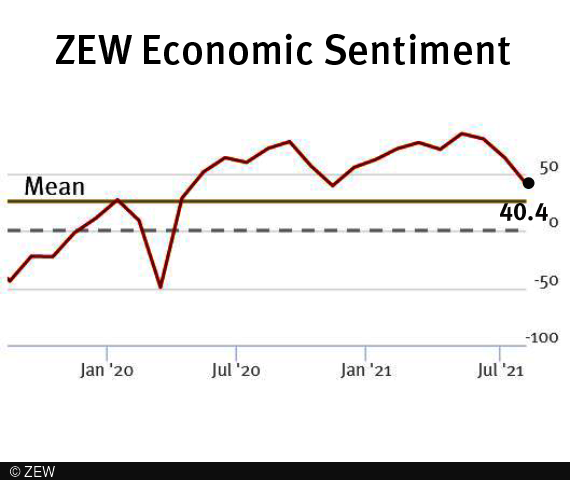
German ZEW dropped sharply to 40.4, increasing risks for the economy
Germany ZEW Economic Sentiment dropped sharply from 63.3 to 40.4 in August, well below expectation of 57.0. Germany Current Situation rose from 21.9 to 29.3, below expectation of 30.0. Eurozone ZEW Economic Sentiment dropped sharply from 61.2 to 42.7, well below expectation of 72.0. Eurozone Current Situation rose 8.6 pts to 14.6.
"Expectations have declined for the third time in a row. This points to increasing risks for the German economy, such as from a possible fourth COVID-19 wave starting in autumn or a slowdown in growth in China. The clear improvement in the assessment of the economic situation, which has been ongoing for months, shows that expectations are also weakening due to the higher growth already achieved," comments ZEW President Professor Achim Wambach on current expectations.
The Analytical Overview Of The Main Currency Pairs
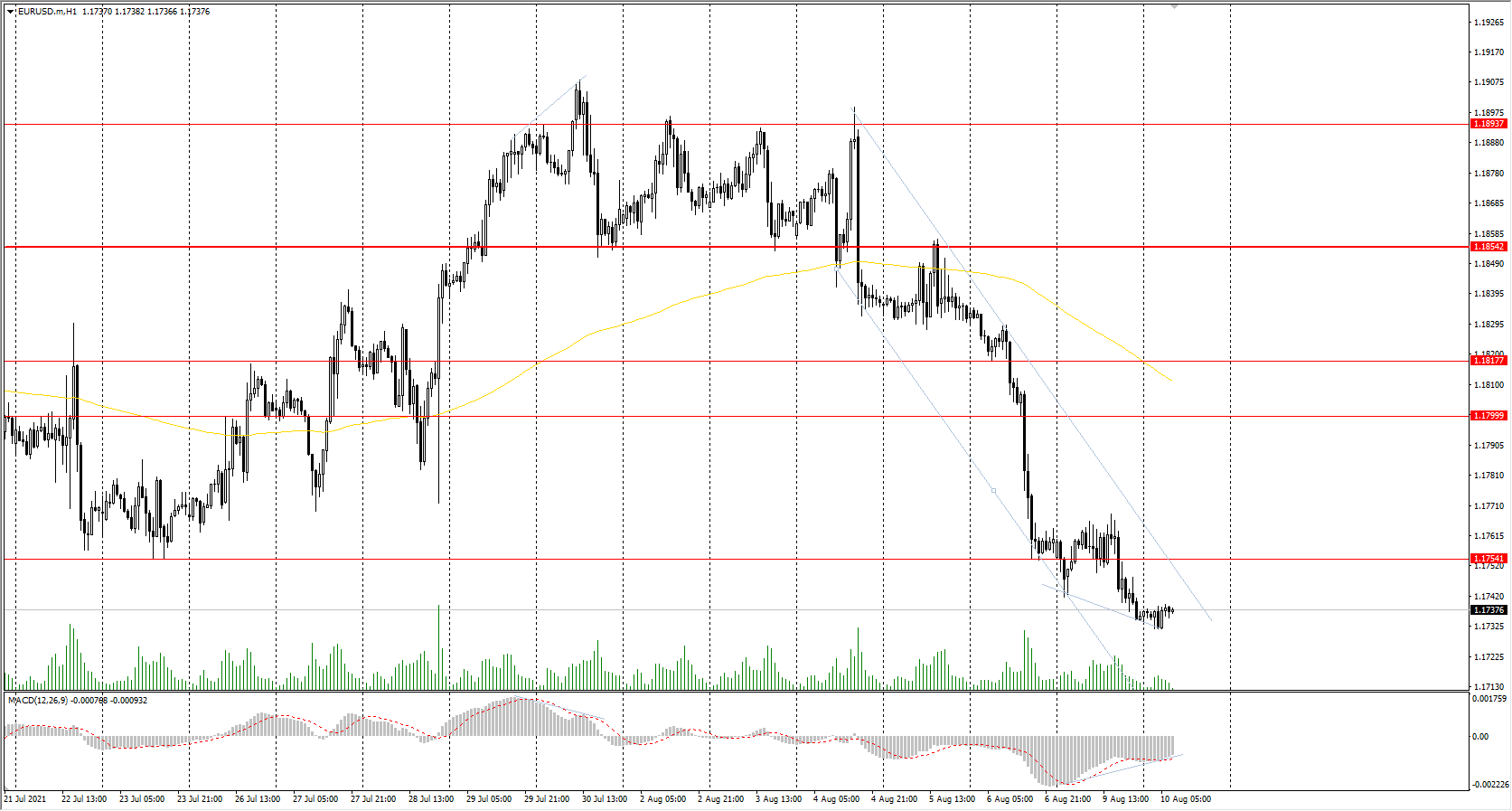
The EUR/USD currency pair
Technical indicators of the currency pair:
Prev Open: 1.1755
Prev Close: 1.1736
% chg. over the last day: -0.16%
There are no important events scheduled in Europe until the end of August (vacation season), so it’s the US policy that will mainly influence the European currency. At the moment, the dollar index is growing, which has a negative impact on the euro.
Trading recommendations
Support levels: 1.1609
Resistance levels: 1.1754, 1.1799, 1.1817, 1.1854, 1.1894, 1.1934, 1.1969
From a technical point of view, the general trend on the EUR/USD currency pair is bearish. The price went below the moving average; the MACD indicator is in the oversold zone, but there are signs of a reversal in the form of divergence. Under such market conditions, it is better to look for sell trades from the resistance levels, but after a slight upward correction since the price has deviated strongly from the middle line. Buy trades can only be considered throughout the day and only with confirmation in the form of a bullish initiative.
Alternative scenario: if the price breaks through the 1.1854 resistance level and fixes above, the mid-term uptrend is likely to resume.
News feed for 2021.08.10:
- Germany ZEW Economic Sentiment (m/m) at 12:00 (GMT+3)
- Eurozone ZEW Economic Sentiment (m/m) at 12:00 (GMT+3).
The GBP/USD currency pair
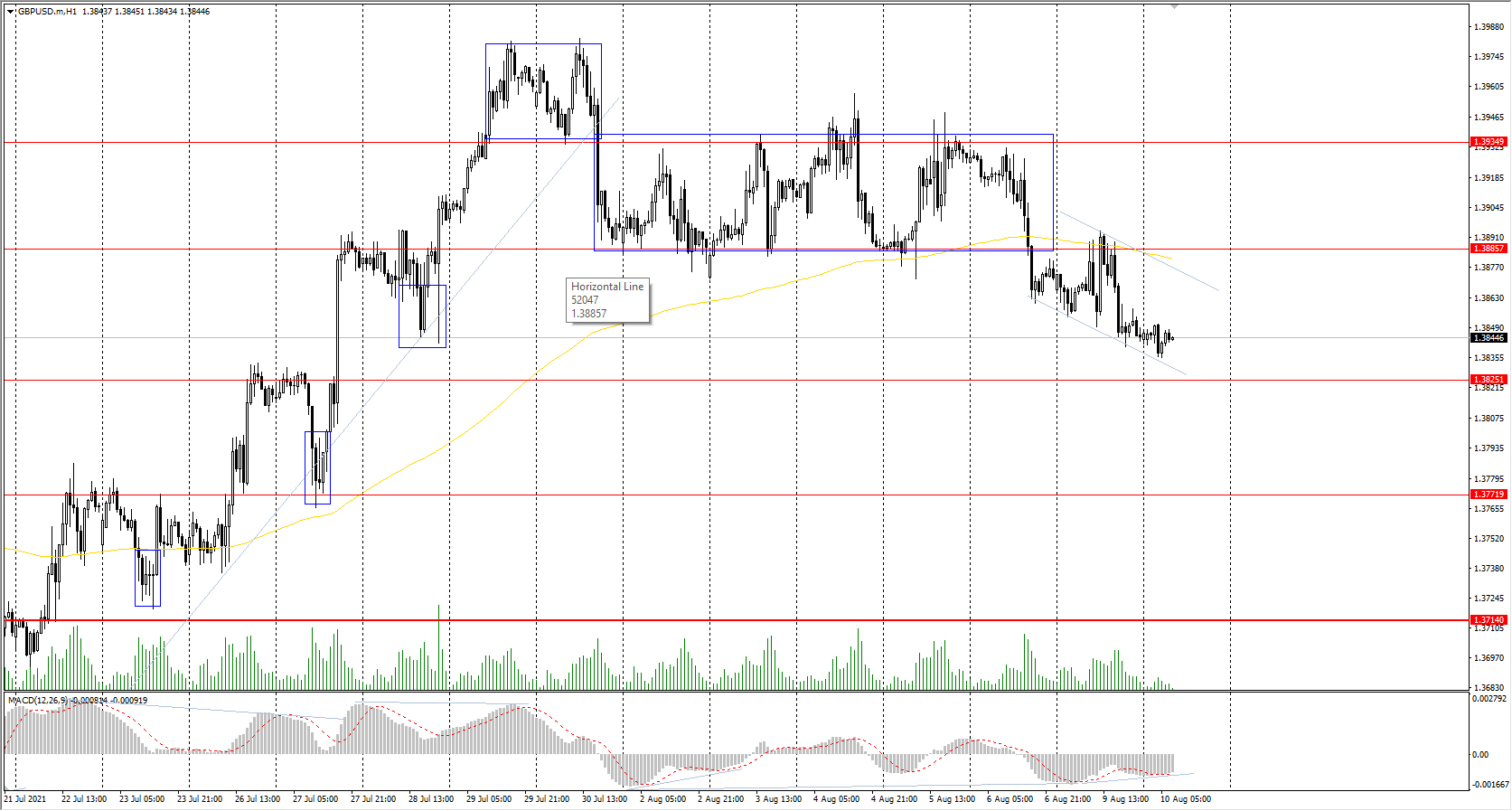
Technical indicators of the currency pair:
Prev Open: 1.3867
Prev Close: 1.3845
% chg. over the last day: -0.16%
The situation on the GBP/USD currency pair has not changed. Despite the decline, the British pound has gained a more confident position than the euro. The fundamental picture of the UK is now positive, so with any weakness in the dollar index, the British currency will continue to strengthen.
Trading recommendations
Support levels: 1.3825, 1.3772, 1.3714, 1.3676 ,1.3641, 1.3614, 1.3525
Resistance levels: 1.3886, 1.3935, 1.4002, 1.4075, 1.4101
On the hour timeframe, the trend of the GBP/USD currency pair is bullish. The price left the trading range in a downward direction, but if it returns to the indicated corridor, the price will immediately head to the 1.3935 resistance level. The MACD indicator went into the negative zone, but there are signs of a hidden divergence. Under such market conditions, traders are better to look for buy trades after breaking the resistance level of 1.3885. Sell positions can be considered from the resistance levels within the local downward movement.
Alternative scenario: if the price breaks through the 1.3714 support level and consolidates below, the bearish scenario is likely to resume.
The USD/JPY currency pair
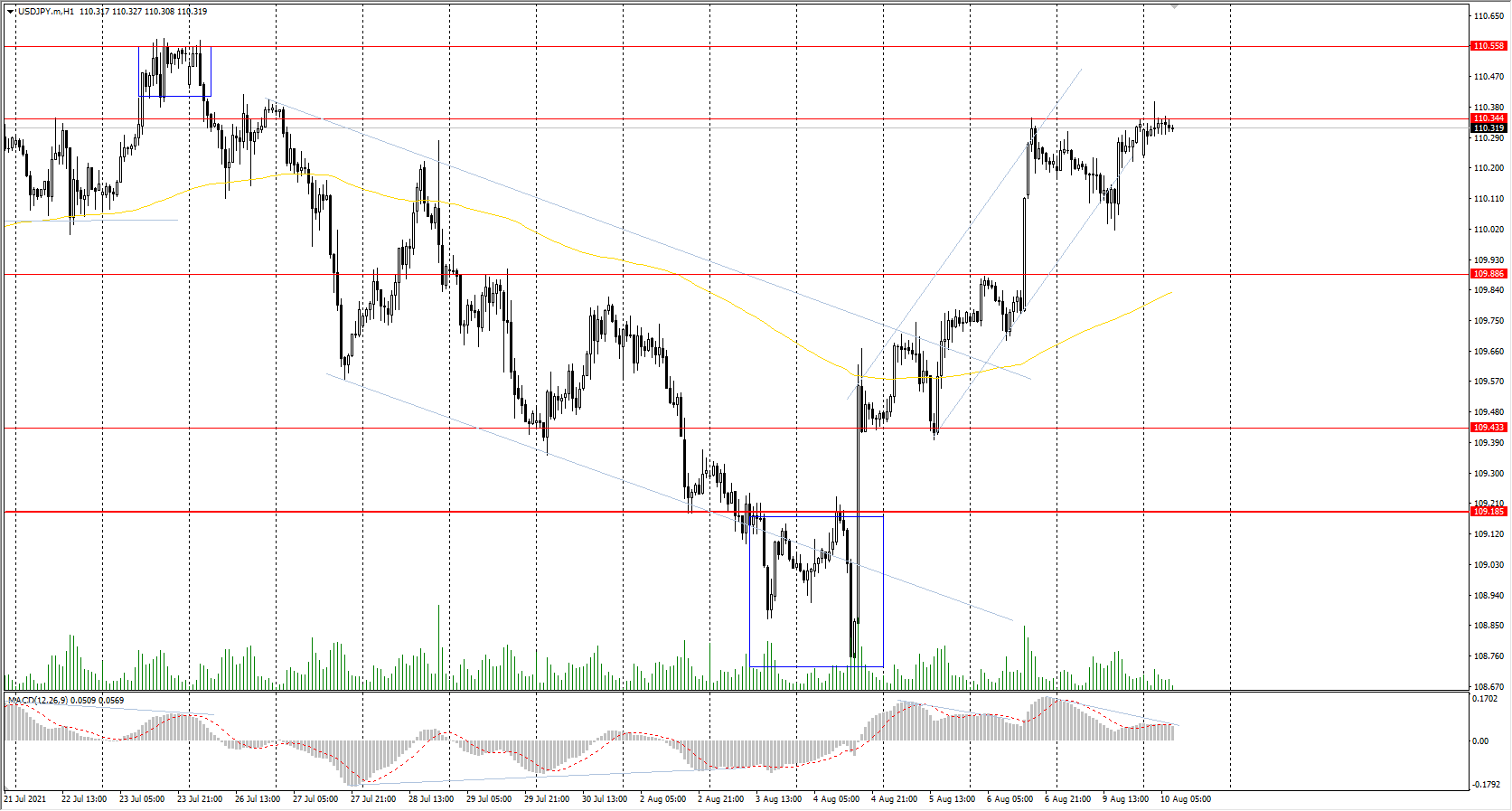
Technical indicators of the currency pair:
Prev Open: 110.22
Prev Close: 110.33
% chg. over the last day: +0.10%
The Japanese yen has stabilized, but its position is still weak. Against the background of the dollar index growth, the USD/JPY currency pair is growing. The USD/JPY quotes are strongly correlated with the dollar index now.
Trading recommendations
Support levels: 109.88, 109.43, 109.19, 108.65
Resistance levels: 110.34, 110.56
The main trend on the USD/JPY currency pair has changed to bullish. The MACD indicator is in the oversold zone, but there are signs of a reversal. Under such market conditions, it is better to look for buy positions after a small pullback downwards because the price has strongly deviated from the moving average. Sell positions should be considered only on the lower timeframes from the resistance level and only with short targets.
Alternative scenario: if the price falls below 109.19, the uptrend is likely to be broken.
The USD/CAD currency pair
Technical indicators of the currency pair:
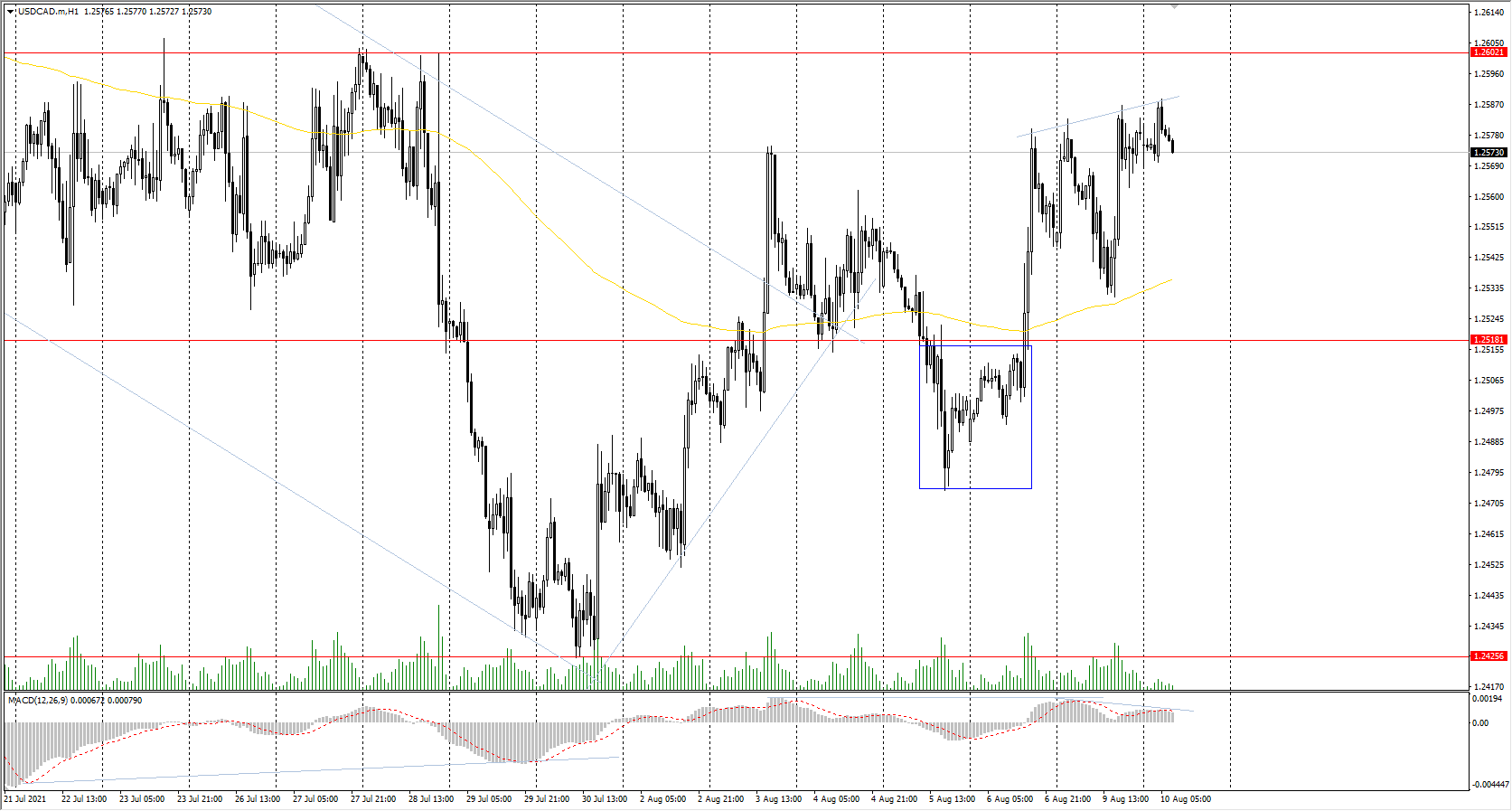
Prev Open: 1.2547
Prev Close: 1.2579
% chg. over the last day: +0.26%
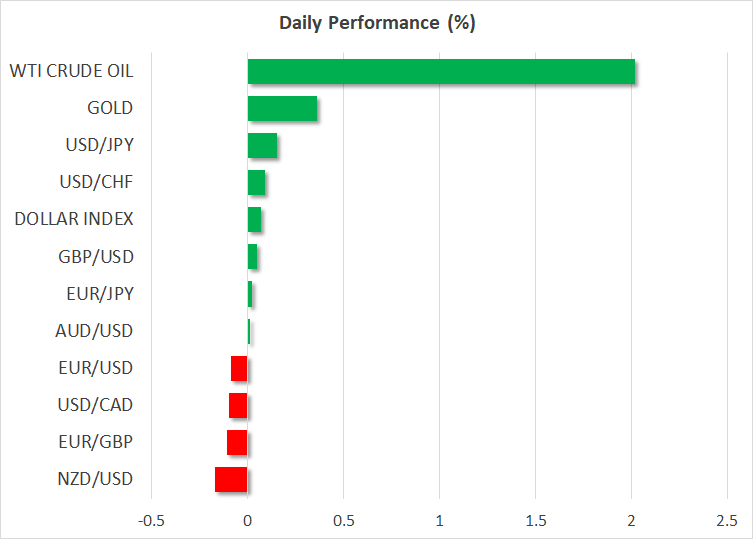
The Canadian dollar is highly dependent on the dollar index and the oil price dynamics. The dollar index is rising, while oil prices also increased yesterday. As a result, the USD/CAD currency pair started to consolidate.
Trading recommendations
Support levels: 1.2518, 1.2471, 1.2425, 1.2370, 1.2312
Resistance levels: 1.2602, 1.2671, 1.2787, 1.2951
Considering technical analysis, the USD/CAD trend is bearish. The price is above the moving average, the MACD indicator is positive, but there are signs of divergence. Under such market conditions, traders should look for sell positions from the resistance levels after sellers show initiative. Traders should consider buy positions from the support levels and only on intraday timeframes.
Alternative scenario: if the price breaks through the 1.2671 resistance level and fixes above, the uptrend is likely to be resumed.
Fed Taper Talk Approaching Fever Pitch, Dollar Edges Up Again
- Fed officials heighten taper speculation, flag a decision is nearing; dollar stands tall
- Optimism keeps stocks afloat even as yields rise, Delta concerns linger
- Commodities on steadier footing but Fed tapering, demand uncertainty still weight
Fed leaves little doubt tapering is coming soon
The first response by Fed policymakers to last week’s stellar jobs report left investors in no doubt that the US central bank is closing in on its criteria of achieving “substantial further progress” towards its goals. The presidents of the Atlanta Fed Raphael Bostic and the Boston Fed Eric Rosengren both hinted that the Fed could announce it will start tapering its $120 billion in monthly asset purchases as early as September. Richmond Fed President Tom Barkin seemed to think inflation is now sustainably back at 2% but was less certain about how much progress has been made towards the Fed’s employment goal.
Their comments could be paving the way for a more formal communication at this year’s Jackson Hole symposium due to take place at the end of the month. However, it’s likely that policymakers will want to wait for at least one more strong NFP print before deciding anything so investors might be kept in the dark through summer.
Yesterday’s better-than-expected numbers on job openings, which set a new record high in June, underscored the view that the US labour market is well and truly on the mend. However, policymakers have yet to reach a consensus on how progress in the jobs market should be measured.
Nevertheless, all the indications are that the Fed will begin to withdraw some of its stimulus later this year, whether that’s in September, November or December, and the moves in the bond market reflect the growing expectations of a taper announcement at one of those meetings.
Dollar on a roll as yields climb
Treasury yields spiked up again on Monday following the fresh Fed remarks, extending the rebound from last week’s lows. The 10-year yield is now back above 1.30%, recovering sharply from a 6-month low of 1.1270% and significantly boosting the US dollar.
The dollar index was flirting with the 93 level on Tuesday for the first time since July 23 before the latest selloff took hold. The euro appears to be the worst hit from the greenback’s resurgence, tumbling to a fresh 4-month low of $1.1724 today. The ECB’s recently reinforced dovish stance is weighing heavily on the euro, not just against the dollar but against all the majors.
The pound brushed a 17-month high versus the euro on Monday and was edging marginally higher against the dollar. The loonie was also slightly firmer as oil prices stabilized somewhat along with other commodities. This helped the Australian dollar too, which was flat and offset a large drop in business confidence in July according to a NAB survey.
However, the New Zealand dollar remained unusually weak even though the RBNZ is widely expected to hike interest rates next week.
Commodity selloff eases, for now
Metal prices such as copper bounced off their lows to head higher on Tuesday and oil prices were sharply up too. WTI futures jumped 2% to test the $68.00/barrel level, while Brent futures climbed back above $70/barrel.
However, gold was struggling to hold onto earlier gains and was last hovering around $1,730/oz to stand barely up on the day. With the end of ultra-loose monetary policy now in sight in some countries, the non-yielding bullion is not as appealing as it was at the height of the pandemic. And although the Covid threat is far from over and the Delta variant continues to spark panic, most recently in China, there doesn’t seem to be much safe-haven flow coming in gold’s way.
Stocks maintain positive tone
In equities, European stocks followed Asian markets higher, though US futures were lacking direction. Overall, the reaction on Wall Street to the latest taper signals has been surprisingly benign.
The exceptional earnings season could be bolstering US shares even as the Fed moves closer to removing some of the cheap money, while expectations that the Senate will approve a $1 trillion infrastructure package in a vote due later today could also be supporting sentiment.
If the bill goes through, the Democrats plan to follow it up with a $3.5 trillion spending plan so perhaps this new fiscal boost, which at one point was looking very uncertain, is easing the pain from the soon-to-be reduced monetary stimulus.
The Rapid Spread Of The Delta Strain Puts Strong Pressure On Commodity Markets
Despite positive JOLTs Job Openings data, US main stock indices slightly decreased on Monday. The US must overcome the economic crisis caused by the epidemic before the central bank begins to raise interest rates, according to Federal Reserve official Rafael Bostic. Most likely, the US stock market situation will not change significantly, and indices will continue to rise slowly until the annual symposium in Jackson Hole later this month.
European stock indices closed the day without a single dynamic. British stock index FTSE 100 increased by 0.13%, while German DAX decreased by 0.1%. Today, the ZEW institute will publish the economic forecasts for the European countries.
The situation with gold remains unchanged. It is important for traders to keep an eye on the dollar index and US government bond yields now, as gold has an inverse correlation to these instruments. The fall in gold prices is also a sign of strong sell-offs by investors and hedge funds, so many analysts are beginning to think that the Federal Reserve will begin reducing the QE program soon.
The situation in the oil market has not changed either. Oil prices slightly increased yesterday. However, the growth of quotes is still limited due to concerns about the rise of COVID-19 cases in Asian countries and the USA. Traders fear that introducing new restrictive measures to curb the spread of the Delta strain will weaken the global economy and decrease demand for fuel.
Persistent fears about the rapid spread of the Delta strain have undermined investor sentiment in Asia as well, making major stock indices decline. The broadest index of Asia-Pacific stocks outside Japan, the MSCI, decreased by 0.4% in opening trading today, while China's CSI 300 blue-chip index decreased by 0.33%. Analysts at Goldman Sachs presented a more pessimistic forecast for Chinese economic growth as Chinese authorities were forced to impose quarantine restrictions to contain a new wave of Delta. According to the new forecast, China's GDP will increase by 2.3% (previous forecast 5.8%) in the third quarter of this year and 8.3% (previous forecast 8.6%) at the end of the year.
Main market quotes:
- S&P 500 (F) 4,432.35 -4.17 (-0.09%)
- Dow Jones 35,101.85 -106.66 (-0.30%)
- DAX 15,745.41 -16.04 (-0.10%)
- FTSE 100 7,132.30 +9.35 (+0.13%)
- USD Index 92.28 +0.68 (+0.70%)
Important events for today:
- Australia NAB Business Confidence (m/m) at 04:30 (GMT+3);
- Germany ZEW Economic Sentiment (m/m) at 12:00 (GMT+3);
- Eurozone ZEW Economic Sentiment (m/m) at 12:00 (GMT+3).
Gold Prices Recover, But Don’t Be Flash-Crash Fooled
Gold recovered most of its early Monday morning flash crash losses but still finished the day down 1.90% at $1729.50 an ounce. Gold has traced out some anaemic gains in Asia, rising 0.25% to $1733.50 an ounce as Singapore and Japan investors returned from holiday. However, gold closed well below its $1750.00 an ounce breakout, leaving the technical picture looking grim.
A firmer US Dollar and US yield curve ensued that gold would never make it back to $1750.00 an ounce overnight, as the flash-crash left bullish gold traders traumatised anyway. That said, gold will probably consolidate ahead of the US CPI tomorrow as its Relative Strength Index (RSI) remains in oversold territory. I am anticipating a $1720.00 to $1750.00 an ounce range ahead of that data.
In months past, I often mentioned structural support in the form of the 61.80% Fibonacci retracement of the March 2020 rally, which lies around the $1680.00 to $1685.00 an ounce region, depending on how thick the lines are you draw on your charts. Being over 50 now (I covet Harley Davidsons) and wearing glasses, I chose the “broader” lines. The flash crash yesterday bottomed around this region (according to my charts), emphasising its longer-term importance.
Accordingly, although I expect gold to range between $1720.00 and $1750.00 over the next 36 hours, a daily close below the Fibonacci support at $1680.00 to $1685.00-ish is a powerful signal that gold is set for a deeper correction, initially targeting $1550.00 and then $1500.00 an ounce. It seems that gold inflation-hedging abilities in the modern age are confined to hyper-inflation and not bog-standard “normal” inflation, transitory or otherwise. Gold's fate hinges on tomorrow night's US CPI data.
Oil Markets Sag Under ‘Delta Hedging’
Asset classes are going their own ways now regarding their assessment of the risks of the delta-variant. Oil markets continued falling overnight as energy markets fret about future consumption patterns caused by delta-variant restrictions, actual or threatened, just as OPEC+ starts ramping up monthly production. The cases cropping up in China are a genuine concern. If they spike markedly, resulting in inevitable firm action from the government, we can expect oil prices to reflect that reality.
Brent crude closed below its 100-day moving average (DMA) overnight at $69.80 a barrel, finishing 1.50% lower at $69.20. WTI closed below its 100-DMA at $67.30 a barrel, falling 1.70% to $68.00 a barrel. Today’s return of Japan and Singapore markets has seen some bargain hunting occurring from physical buyers, which has lifted Brent crude and WTI by 0.65%, respectively, to $69.65 and $67.25 a barrel. Today’s rally is much weaker in scope compared to the falls overnight, and oil’s technical picture remains fragile.
Overnight, both contracts fell quite a bit further intra-day than the daily closes suggest. Notably, Brent crude and WTI traced out double bottoms on the daily charts at $67.50 and $65.00 a barrel, respectively. These levels form the first critical support line for both contracts, with failure $65.00 for Brent crude and $62.50 a barrel for WTI.
Resistance lies at the respective 100-DMAs, which today are at $69.90 for Brent crude and $67.30 a barrel for WTI. Whilst delta concerns remain elevated; further gains will likely be limited to $72.00 and $71.00 a barrel.
With sentiment fragile, tonight’s US API Crude Inventories could negatively affect prices if inventories rise sharply. The API data is often ignored by markets in favour of the official numbers that come out tomorrow night NYT. But when the data is running with the market sentiment wind behind it, it can often blow the boat onto the rocks.
The US Dollar Rally Continues
The US Dollar rose overnight once again, propelled higher by rising US yields, hawkish Fed-speak and perhaps some delta-variant risk-hedging flows. The dollar index rose by 0.20% to 92.97 overnight, with a resistance test at 93.20 seemingly inevitable. That will open further gains to 93.50 and then 94.30. Only a fall through 92.60 changes the narrative.
The Australian Dollar fell through the bottom of its rising wedge overnight, reflecting rising risk sentiment from the virus and higher US interest rates. The fall through 0.7360 sees AUD/USD at 0.7320 this morning with an initial target of 0.7250, and if the US CPI outperforms tomorrow, it could fall to 0.7000 in the week ahead.
USD/JPY rose to 110.35 overnight, where it remains in Asia. A rally through 110.60 signals further gains to 111.60 initially. As a purely US/Japan yield differential play these days, the US CPI tomorrow night will be critical in signalling its next directional move. Both the Euro and especially the Swiss Franc look vulnerable to further losses for the same reasons. EUR/USD could test support at 1.1700. USD/CHF has gained 1.50% over the last two sessions to 0.9200. A high US CPI print should see the pair test 0.9270.
The US Dollar rally resumed in earnest versus Asian currencies yesterday, China aside. My fragile four of India, Indonesia, Malaysia, and Thailand could well be joined by the Philippines in the coming days, with the Peso retreating heavily over the last couple of days. Tapering by the Us Federal Reserve starting in Q4 will be a game-changer, as none of these countries is in any position to even think about tightening monetary policy in response. The relief valve will inevitably be weaker currencies unless they choose to burn through their admittedly impressive foreign currency reserves. Delta lingers in the background of all of them limiting gains anyway, but a firm US Cpi print tomorrow night sets up Asian FX fr another bout of weakness.
Another Mixed Day For Asian Equities
Wall Street had a mixed session, torn between delta concerns and Fed tapering following a jump in the JOLTS job opening above 10 million and hawkish comments from Fed officials. In the end, Wall Street chose delta hedging, rotating modestly out of growth and back to their technology happy place. The S&P 500 eased 0.09%, the Nasdaq edged 0.16% higher, while the Down Jones fell by 0.31%. In Asia, US futures have continued to sag, all three indices down by around 0.15%.
With no firm direction from New York, Asian markets have gone their own way. The Nikkei 225 is just 0.10% higher, while an unimpressive IPO debut by Krafton has dragged the Kospi down 0.65%. Regulatory risk and further cases of the delta-variant in Mainland China continues to unnerve markets there. The Shanghai Composite is 0.15% lower, but the CSI 300 has fallen by 0.40%. Hong Kong has managed to eke out a modest 0.15% gain.
Reopening day (for those vaccinated) has lifted Singapore by 0.55% as markets price in a light at the end of the tunnel. Malaysia is on holiday while Taipei has fallen by 0.80% on China concerns, Manilla has retreated 0.40%, and Jakarta is down 0.90%. Bangkok has bucked the regional trend, rising 0.25%. Australian markets are trading sideways, with the ASX 200 and ALl Ordinaries edging 0.15% higher.
Except for Singapore, most of Asia appears to be virus watch and nervous about Fed tapering, with investors reducing exposures into the US CPI data tomorrow night. Europe is likely to follow the same cautious path and open slightly lower this afternoon. I anticipate equity markets continuing this pattern with a very light data calendar until the US CPI data. As previously stated, a higher than forecast US CPI print tomorrow will negatively impact Asian equities as the threat of divergence in monetary policy paths combine with delta worries.
As Markets Underestimate Fed’s Hawkishness, The Dollar Is Set To Rise
Markets continue to reassess the outlook for US monetary policy. It is a long process affecting capital worth trillions of dollars, and it is not a simultaneous process for all markets, so it is important to look for signal points in several assets.
Debt markets have also been reassessing the outlook since last week. Long-term US government bond yields have reached 1.31% compared with lows of 1.12% last week. Previously, 10-year yields were falling from May to the end of July, hardly business as usual amid a booming economy and accelerating inflation.
The 1.2% yield for UST10 acts as a kind of line on the sand. In February, a rise above this level accelerated the EURUSD decline and sent S&P500 into a 6% correction.
The equity index is avoiding a correction these days, but it has lost its upside momentum despite solid data. This could be an early sign of the market's altitude sickness, struggling to move further from current levels.
Another such instrument is the performance of the EURUSD, the most famous pair in FX, representing the regions with the largest economies.
EURUSD today is near a 4-month low at 1.1730, less than 30 pips above the lows of late March. The 1.16-1.17 area has repeatedly acted as support in the pair over the past 13 months.
Over the past year, there has not been a significant reversal. The USA's economy and its labor market are often hit hardest initially by recessions, but they are the first to recover. So, the USA could be among the first majors to roll back its crisis measures.
Moreover, Fed officials continue to signal that this could happen more quickly than the market suggests and increasingly talk about it. This is an essential point, as markets have the only experience when the Fed and other central banks have repeatedly extended easing and growth forecasts have been downgraded time after time.
This time is different (at least so far), but it is as if the stock markets do not notice it too much, continuing to buy up the slightest dips in shares. However, investors should take the signals of the debt and currency markets, the "smartest" and liquid markets, seriously. These markets can take a long time to change course and gain momentum, but betting against them is like picking pennies in front of a steam roller when it picks up speed.