

Sample Category Title
RBA maintains tapering plan, left rate unchanged
RBA maintained cash rate target unchanged at 0.10%. Also, target for April 2024 government bond yield was also kept at 0.10%. More importantly, it maintained the tapering plan unchanged. Weekly purchases will be lowered from AUD 5B to AUD 4B starting early September, until at least mid-November.
RBA also pledged to "maintain its flexible approach to the rate of bond purchases". The conditions for rate hike is not expected to be met before 2024.
The central bank said the outlook for the coming months is "uncertain" and depends up on the "evolution of the health situation and the containment measures". Then, the central scenario is for the economy to grow by "a little over 4 per cent over 2022 and around 2½ per cent over 2023."
Unemployment is expected to trend lower to 4.50% at the end of 2022, and then 4.0% at the end of 2023. Inflation is expected to be at 1.75% over 2022 and than 2.25% over 2023.
(RBA) Statement by Philip Lowe, Governor: Monetary Policy Decision
At its meeting today, the Board decided to:
- maintain the cash rate target at 10 basis points and the interest rate on Exchange Settlement balances of zero per cent
- maintain the target of 10 basis points for the April 2024 Australian Government bond
- continue to purchase government securities at the rate of $5 billion a week until early September and then $4 billion a week until at least mid November.
The economic recovery in Australia has been stronger than was earlier expected. The recent outbreaks of the virus are, however, interrupting the recovery and GDP is expected to decline in the September quarter. The experience to date has been that once virus outbreaks are contained, the economy bounces back quickly. Prior to the current virus outbreaks, the Australian economy had considerable momentum and it is still expected to grow strongly again next year. The economy is benefiting from significant additional policy support and the vaccination program will also assist with the recovery.
The economic outlook for the coming months is uncertain and depends upon the evolution of the health situation and the containment measures. Beyond that, the Bank's central scenario is for the economy to grow by a little over 4 per cent over 2022 and by around 2½ per cent over 2023. This scenario is based on a significant share of the population being vaccinated by the end of this year and a gradual opening up of the international border from the middle of 2022. The Board also considered a range of other scenarios, with the main source of uncertainty being the health situation.
The labour market has recovered faster than expected, with the unemployment rate declining further to 4.9 per cent in June. Job vacancies have remained at a high level and there are reports of labour shortages in parts of the economy. Some increase in the unemployment rate is expected in the near term due to the current lockdowns, but most of the adjustment in the labour market is likely to take place through a reduction in hours worked and in participation. In the central scenario, the unemployment rate continues to trend lower next year, to be around 4¼ per cent at the end of 2022 and 4 per cent at the end of 2023.
The CPI inflation rate spiked to 3.8 per cent for the year to the June quarter, largely reflecting the unwinding of some earlier COVID-19-related price declines. In underlying terms, inflation remains low, at around 1¾ per cent.
Looking forward, a pick-up in both wages growth and underlying inflation is expected, but this pick-up is likely to be only gradual. In the Bank's central scenario, it takes some years for the stronger economy to feed through into wage and price increases that are consistent with the inflation target. In underlying terms, inflation is expected to be 1¾ per cent over 2022 and 2¼ per cent over 2023. One source of uncertainty is the behaviour of wages and prices at the low levels of forecast unemployment, including because it is some decades since Australia has sustained an unemployment rate around 4 per cent.
Housing markets have continued to strengthen, with prices rising in all major markets. Housing credit growth has picked up, with strong demand from owner-occupiers, including first-home buyers. There has also been increased borrowing by investors. Given the environment of rising housing prices and low interest rates, the Bank is monitoring trends in housing borrowing carefully and it is important that lending standards are maintained.
Domestic financial conditions remain very accommodative, sovereign bond yields have declined and the exchange rate has depreciated to around its lowest level this year, despite elevated levels of commodity prices. The recent fiscal responses by the Australian Government and the state and territory governments are also providing welcome support to the economy at a time of significant short-term disruption.
The Board remains committed to maintaining highly accommodative monetary conditions to support a return to full employment in Australia and inflation consistent with the target. Together, the low level of the cash rate, the bond purchase program, the yield target and the ongoing funding that has been provided under the Term Funding Facility are providing substantial support to the Australian economy in the face of lockdowns in parts of the country and the expected resumption of the economic expansion.
The Board will maintain its flexible approach to the rate of bond purchases. The program will continue to be reviewed in light of economic conditions and the health situation, and their implications for the expected progress towards full employment and the inflation target. The Board will not increase the cash rate until actual inflation is sustainably within the 2 to 3 per cent target range. The central scenario for the economy is that this condition will not be met before 2024. Meeting this condition will require the labour market to be tight enough to generate wages growth that is materially higher than it is currently.
Market Morning Briefing: Pound Has Bounced A Bit From 1.3873
STOCKS
Equities look mixed within their broad sideways range. As mentioned yesterday, a fresh trigger looks likely to be needed to see an upside breakout of the range that we have been expecting. Else a fall within the range is possible in the coming days. Dow is struggling to breach 35000 decisively and can fall to 34250-34000 within its 33000-35250 range. DAX looks mixed and has equal chances of moving either side within the 15200-15800 range. Nikkei has to break above 28000 to move up towards the upper end of its 27000-29500 range. Else there is a danger of breaking below 27000. Shanghai has room to move up towards 3500 on a break above 3460. Sensex and Nifty are moving up within their 52000-53200 and 15600-15900/16000 range and need to see if they can break the range on the upside from here itself.
Dow (34838.16, −97.31, -0.28%) seems to be struggling to rise past 35000 decisively. This increases the chances of seeing a fall to 34250-34000 in the near-term within the broad 33000-35250 range. A strong rise past 35250 is needed to become bullish to see 36000 on the upside.
DAX (15568.73, +24.34, +0.16%) continues to oscillate in the middle of its 15200-15800 range. The near-term outlook is mixed with equal chances of seeing either a rise to 15800 or a fall to 15200 with the range from here. While above 15200, the broader view is bullish to see a break above 15800 and a rise to 16000-16200 eventually.
Nikkei (27546.45, −234.57, -0.84%) has come-off again today. The 27000-29500 range remains intact for now. But Nikkei has to rise past 28000 to move up towards 29500 and also to negate the danger of breaking below 27000 and seeing a fall to 26000.
Shanghai (3452.73, −11.55, -0.33%) has risen back sharply and is testing the 3450-3460 resistance zone. A break above 3460 and a subsequent rise past 3500 will only negate the bearish view of seeing 3200 on the downside and in turn will bring back the earlier bullish view of seeing 3700-3800 on the upside. The price action in the coming days will need a close watch.
Sensex (52950.63, +363.79, +0.69%) is moving up within its 52000-53200 range. It will have to be seen if it can rise past 53200 which is needed to move further up to 54000 and higher levels. Else the sideways range can continue for some more time. From a bigger picture, the broader outlook is bullish with strong supports at 52000 and 51000.
Nifty (15885.15, +122.10, +0.77%) has come up to the upper end of its 15600-15900 range. A strong break above 15900 and a subsequent rise past 16000 will be needed to become bullish for a test of 16200 from here itself. While below 16000, the sideways consolidation can continue for some more time. The broader bias remains bullish while the Nifty remains above its key supports at 15600 and 15500.
COMMODITIES
Crude prices have fallen slightly but may remain in a broad range for the near term. Gold is likely to trade below 1840/20 and could test 1800-1780 before moving up again. Silver and Copper too are stuck within 24.50-26 and 4.40-4.60 region. Overall we may expect near term to be stable for the commodities as a whole before any clear direction is seen for the longer run. Respective supports and resistances seem to be holding well for now.
Brent (73.02) and WTI (71.44) have bounced from 72.86 and 71.22 respectively. Brent tested 72.31 yesterday and has bounced from there and we re-iterate that while Brent sustains below 74, it can head towards 70 slowly. WTI on the other hand can fall towards70 while below 75.
Gold (1814.80) looks stable just now and could trade above 1800 for the near term, trying to re-attempt a rise towards 1840. Support region of 1800-1780 is very crucial and would decide the longer term direction for Gold. Unless a sustained break above 1840/60 is seen, we may continue to see movement in the broad 1780-1840 region for the next 1-2 weeks.
Silver (25.39) can test 25.0-24.50 before bouncing back from there. A broad range of 26-24.50 can hold for now.
Copper (4.4265) continues to trade in a narrow sideways range. A break on either side of 4.60-4.40 range is needed to get clarity on medium term direction. Looking at the longer term charts, a fall looks more likely while resistance at 4.60 holds.
FOREX
Dollar Index looks bearish but will gain momentum on a break below 91.75. Euro may slowly rise towards 1.19-1.1950 in the medium term. EURJPY is stable within 130.50-129.50 while Aussie and Pound are ranged too. Pound is bearish while below 1.40. Dollar-Yen is heading towards 109. A break below that if seen will be further bearish towards 108.50-108. USDINR needs to break on either side of 74.20-74.60 to see a sharp movement soon preferably on the downside. USDCNY is ranged within 6.45-6.49.
Dollar Index (92.088) did rise above 92.17 within the 91.75-92.25 range mentioned yesterday. But the index seems to be coming down again today. View would turn bearish on a fall below 91.75.
Euro (1.1872) has bounced from 1.1859 yesterday and while Euro trades above 1.1850, view is bullish for a re-test of 1.19-1.1950 in the near term.
EURJPY (129.69) is highly fluctuation within 130.50-129.50 region and may continue so for some more time. Downside is likely to be extended to 129. Unless a break above 130.50 is seen and sustained, view is sideways to bearish for EURJPY.
Dollar-Yen (109.21) has come down to test 109 as expected and looks strongly bearish for now. A break below 109 would indicate a fall towards 108.50-108 soon. The fall could get some boost if Dollar Index too falls sharply back towards 91-90.
Aussie (0.7365) may continue to trade within a range of 0.74-0.73 for the near term.
Pound (1.3891) has bounced a bit from 1.3873 and if the bounce holds, it can continue its upmove towards 1.40 again. Else, if today’s rise is a corrective move then we may have to allow for a further fall to 1.38 before any reversal is seen. Watch price action near current levels.
USDCNY (6.4658) has bounced from 6.46 and while the rise continues, we may expect the pair to head towards 6.48/49. A range of 6.45-6.49 may hold for now.
USDINR (74.3450) is spending some time in a very narrow range and could be preparing for a sharp move soon. We continue to expect 74.20-74.60 region to hold for now but soon see a break below 74.20. We wait and watch for early signals of a break below 74.20 which could then be bearish towards 74-73.80 initially.
INTEREST RATES
The US Treasury yields have declined sharply especially at the far-end. There is room for further fall to test their key supports in the coming days. We expect the yields to see a corrective bounce from their supports and then see a fresh fall to resume their broader downtrend. The German yields are poised just above their key intermediate supports. A corrective rally is possible in the coming weeks and then the broader downtrend can resume. The 10Yr GoI has to sustain above 6.2% to move up amid muted trading while the 5Yr has resistance ahead which has to be broken in order to rise sharply from here.
The US 2Yr (0.18%) Treasury yield remains stable while the 5Yr (0.66%), 10Yr (1.19%) and the 30Yr (1.86%) have declined sharply. The 10Yr and 30Yr are likely to head down towards 1.1% and 1.8% respectively in the coming days within their broader downtrend. Thereafter we expect the yields to see a corrective bounce towards 1.45%-1.5% (10Yr) and 2.1%-2.2% (30Yr) before the overall downtrend resumes again.
The German 2Yr (-0.78%), 5Yr (-0.76%), 10Yr (-0.49%) and 30Yr (-0.02%) yields have dipped across tenors. The 10Yr and 30Yr are poised just above their respective key support levels of -0.5% and-0.05%. We expect these supports to hold on its first test and produce a corrective bounce to -0.30%/-0.25% (10Yr) and 0.10% (30Yr) in the coming weeks. Thereafter the broader downtrend can resume again.
The 10Yr GoI (6.2129%)has come down sharply and the trading remains muted. A fall below 6.2% will negate the chances of seeing 6.3%-6.32% on the upside that we have been mentioning for some time. Such a fall can drag the 10Yr down to 6.1% again. The 5Yr (5.7310%) has resistance at 5.76% which has to be broken in order to move up further. While below 5.76%, a fall-back to 5.68%-5.66% cannot be ruled out in the near-term.
GBP/USD Gains Traction, Chances Of More Upsides
Key Highlights
- EUR/USD started a fresh increase above the 1.3900 resistance zone.
- It broke a crucial bearish trend line at 1.3825 on the 4-hours chart.
- EUR/USD is facing an uphill task near the 1.1900 resistance zone.
- USD/JPY is declining and it could extend losses below 109.00.
GBP/USD Technical Analysis
The British Pound started a strong increase above the 1.3820 resistance against the US Dollar. GBP/USD surpassed the 1.3920 resistance to move further into a bullish zone.
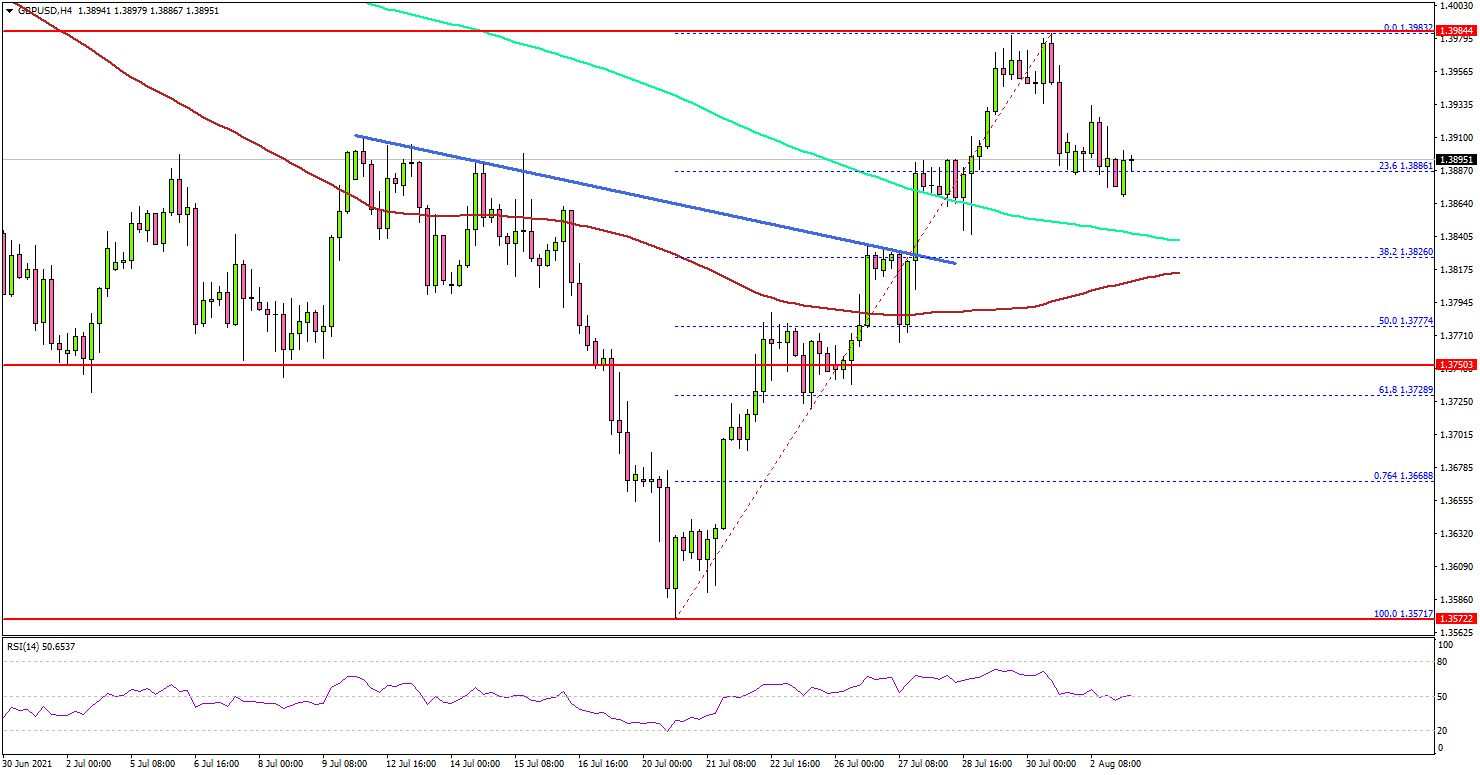
Looking at the 4-hours chart, the pair even broke the 1.3950 level. It settled nicely above the 1.3900 zone, the 100 simple moving average (red, 4-hours), and the 200 simple moving average (green, 4-hours).
A high was formed near 1.3983 before there was a downside correction. The pair tested the 23.6% Fib retracement level of the upward move from the 1.3571 swing low to 1.3983 high.
The first major support on the downside is near the 1.3840 level and the 200 simple moving average (green, 4-hours). The main support is forming near 1.3800 and the 100 simple moving average (red, 4-hours).
It is close to the 50% Fib retracement level of the upward move from the 1.3571 swing low to 1.3983 high. Any more losses might call for a move towards the 1.3620 support.
On the upside, the pair is likely to face a strong resistance near 1.3980 and 1.4000. Any more gains could open the doors for a move towards the 1.4200 zone.
Looking at EUR/USD, the pair is showing positive signs, but it must clear 1.1900 to continue higher in the coming sessions.
Economic Releases
- Canada’s Manufacturing PMI for July 2021 - Forecast 56.4, versus 56.5 previous.
- US Factory Orders for June 2021 (MoM) - Forecast +1.0%, versus +1.7% previous.
US 10-year yield tumbled on delta concerns
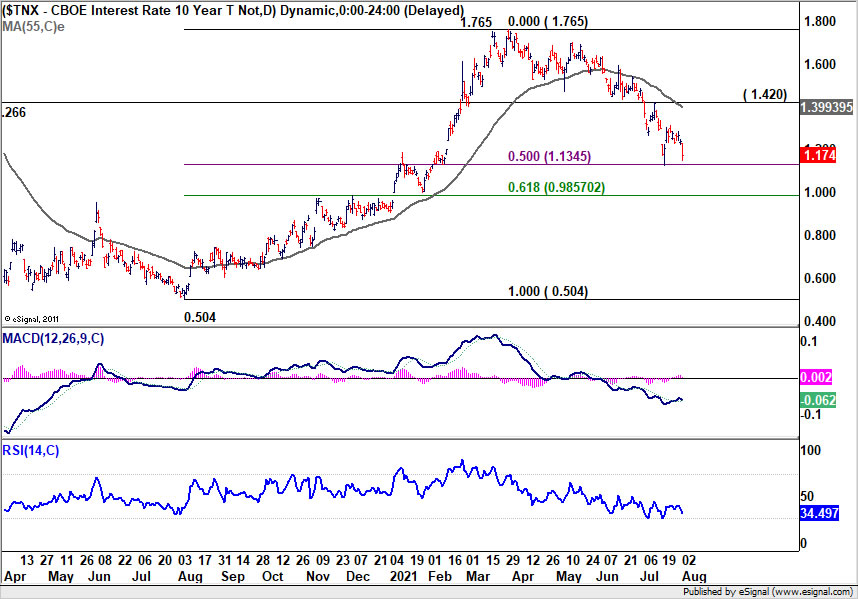
US benchmark treasury yields dropped sharply overnight on concern of the spread of delta variant in the country. According to latest CDC data, There were more than 72k new COVID cases a day on average in the US in the last seven days. That's a level not seen since February. The fall in treasury yield lifted Yen generally higher, in particular against Dollar.
10-year yield dropped -0.065 to close at 1.174, after dipping to as low as 1.151. The development suggests that corrective fall from 1.765 is probably resume to resume through 1.128 low. Still, we'd continue to expect strong support between 0.985/1.134 (50% and 61.8% retracement of 0.504 to 1.765) to contain downside to finish off the correction eventually.
Fed Waller: Depending on job growth, could be ready to announce tapering in Sep
Fed Governor Governor Christopher Waller told CNBC that if August and September jobs report show growth in 800k range, that would be "substantial progress". Fed could then be "ready to do an announcement in September" on tapering asset purchases.
"That depends on what the next two job reports do," he added. "If they come in as strong as the last one, then I think you've made the progress you need. If they don't, then you're probably going to have to push things back a couple months."
"In my view, with tapering we should go early and go fast in order to make sure we're in position to raise rates in 2022 if we have to," he said. "I'm not saying we would, but if we wanted to, we need to have some policy space by the end of the year."
Waller also expected inflation to return to normal once the impacts of the pandemic wane. "My concern is just anecdotal evidence I'm hearing from business contacts, who are saying they're able to pass prices through. They fully intend to. They've got pricing power for the first time in a decade," he said. "Those are the sorts of issues that make you concerned that this may not be transitory."
Eco Data 8/3/21
[php_everywhere instance="1"]
RBA Could Put off Tapering Decision and Expose Aussie to More Declines
Four weeks ago, the Reserve Bank of Australia (RBA) claimed that the economy is in a good shape, and it would proceed with its bond tapering schedule as soon as September, despite the Covid uncertainty. On Tuesday, however, the Bank is expected to awkwardly postpone its tapering pledge and show commitment to support the economy as new lockdown measures threaten the recovery phase. The policy announcement will be published at 01:30 GMT.
From success to failure
Australia has been an example of success of how to suppress Covid infection cases during the worst times of the pandemic, forcing immediate lockdowns, screening visitors and shutting borders to the outside world to provide a Covid-free environment inside the country. Almost a year after though, the country is looking to go from success to failure as its slow vaccination program, which has so far injected only 15.4% of the population with the two doses, and is still lagging many other developed economies, suggests a larger exposure to the dangerous delta variant and a prolonged period of lockdowns until the country achieves a much higher vaccination coverage.
RBA could put off September's bond tapering plans
The above is now creating some questions whether the Reserve Bank of Australia will be able to keep its word over its September’s bond tapering plans when it concludes its policy meeting tomorrow. During July’s gathering, the central bank left its benchmark interest rate steady at a record low of 0.1% and its yield curve control unchanged but introduced plans to reduce the size of its weekly government bond purchases to A$4 billion from the current level of A$5 billion at the completion of the program early in September, as policymakers saw the economy performing better than expected.
Given the negative consequences the latest restrictions in Sydney and Melbourne could have on the labor market, and hence on economic growth in the coming months, monetary tightening actions during the start of a new wave of infections would not be a wise move to make, although CPI inflation has surged above the 2-3% target to peak at 3.8% y/y in Q2 and the unemployment rate inched down to 4.9% in June. As regards inflation, the RBA will probably insist that the breakout from the target range is transitory and headline CPI could return below 2.0% in the next years.
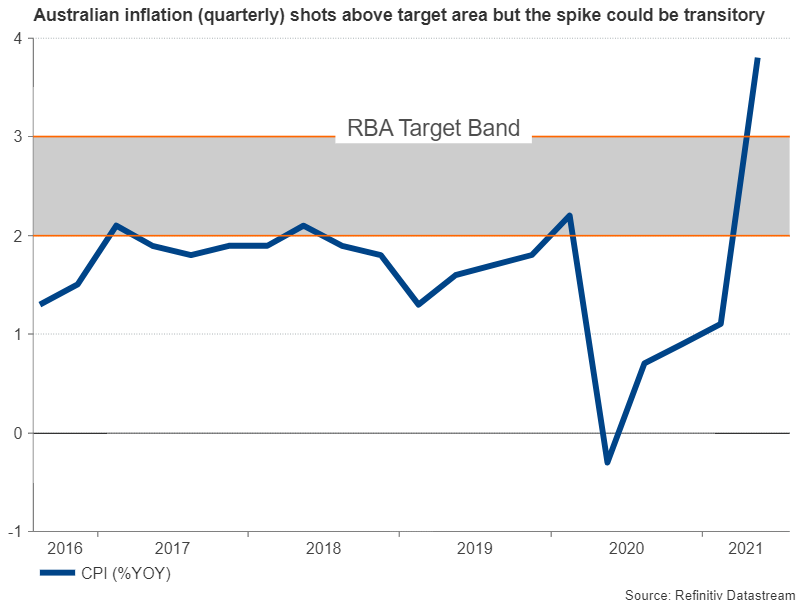
On the other hand, postponing the tapering phase and adopting a wait-and-see mode would not be politically inconsistent since the RBA’s governor has already telegraphed that weekly bond purchases will be adjusted, up or down, according to economic circumstances. Hence, a pause in those plans or even an increase to A$6 billion in weekly bond purchases as some investors price in, as well as an extension of the yield curve control to November 2024, which was previously avoided, would not make the Bank less credible amid the gloomy Covid situation.
Reaction in the aussie
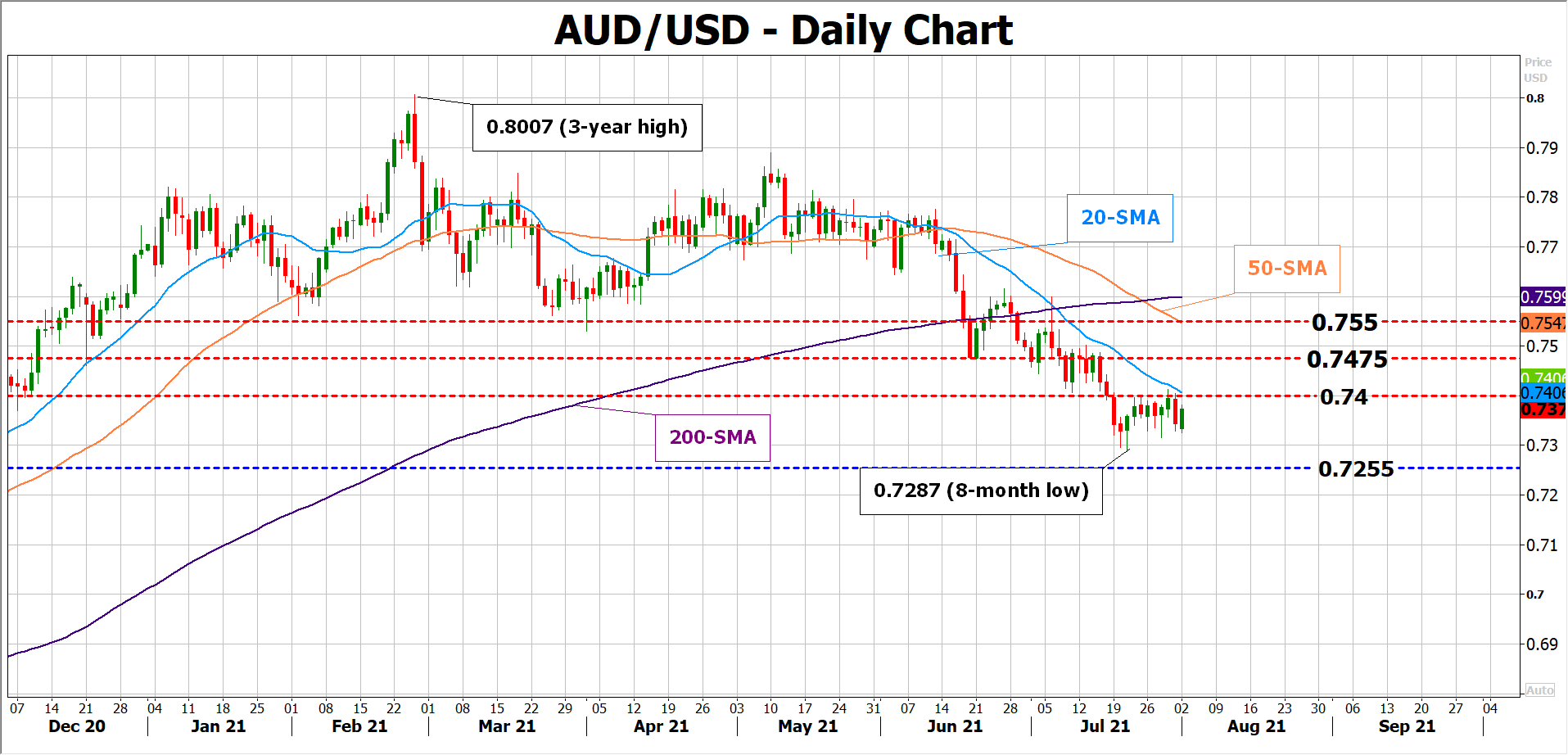
Still, any kind of delay could hammer the aussie, especially if the RBA also delivers a dovish speech to highlight the risks surrounding the export-oriented Australian economy and perhaps to justify any potential increases in the weekly bond engagement to support the economy. In this case, aussie/dollar could drift lower to retest the eight-month low of 0.7288, a break of which could stretch the ongoing downtrend towards the 0.7255 – 0.7230 support region.
Alternatively, if the Bank maintains its current policy settings intact, delivering an encouraging message that the economy has the ability to bounce back quickly as it did in the previous lockdown periods, aussie/dollar could push for a close above the 0.7400 resistance territory and the 20-day simple moving average (SMA).
Overall, however, the larger the policy divergence with other key central banks is, such as the Reserve Bank of New Zealand, the Bank of Canada and the Fed, the heavier the downside pressures on the aussie could be in the coming months.
AUDUSD Consolidates Below 0.74 But Buyers Intensify
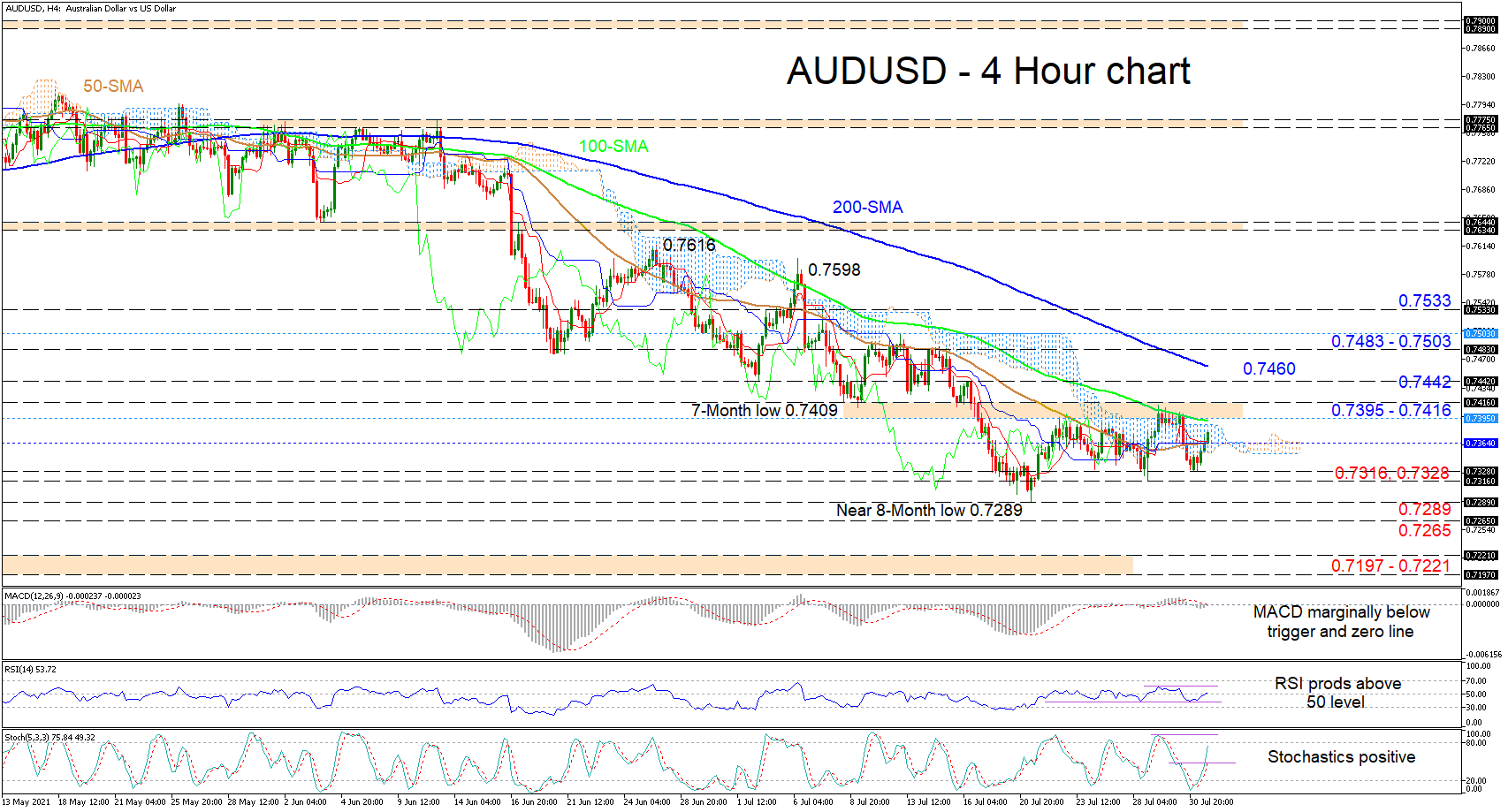
AUDUSD is currently pushing above the 50-period simple moving averages (SMAs) and the flattening Ichimoku lines at 0.7364. The falling 200- and 100-period SMAs are endorsing a negative price trajectory, while the slight uptick in the 50-period SMA is reflecting buyers’ efforts to fight back.
The Ichimoku lines are signalling dried up directional momentum, while the short-term oscillators are conveying weak and mixed signals as a clear price course has yet to evolve or begin to gain a lead. The MACD is a tad beneath its red trigger and zero lines, while the upward pointing RSI has nudged into the bullish territory. The positive charge in the stochastic oscillator is also promoting price improvements in the pair.
Clearly overstepping the 50-period SMA at 0.7364, the bulls may encounter a tough resistance border from the 100-period SMA, which is glued underneath the 0.7395 barrier, up until the 0.7416 obstacle. Should they conquer this, they may then drive the price of the pair towards the July 16 high of 0.7442 before facing the 200-period SMA at 0.7460. From here, a persistent upbeat mood could encourage buyers to break above the 0.7483-0.7503 resistance zone, and pilot the pair towards the July 7 high of 0.7533.
To the downside, preliminary support could arise from the 0.7328 and the 0.7316 congested lows. Should sellers retain the upper hand, they may target the near 8-month low of 0.7289 before dipping for the 0.7265 boundary. If negative pressures continue to grow, the price may sink towards the support region, formed between the 0.7221 trough and the inside swing high of 0.7197, both identified in November 2020.
Summarizing, AUDUSD is currently edging sideways just above 8-month lows of 0.7289. A break above 0.7416 or below 0.7289 could establish a short-term price course.
Aussie Rebounds on Solid PMI, RBA Next
Manufacturing continues to expand
The Australian dollar has bounced back on Monday and posted strong gains, after posting losing sessions every day last week. AUD/USD is currently trading at 0.7379, up 0.50% on the day.
The week started on a positive note, as Australian Manufacturing PMI for July indicated strong expansion. The PMI decelerated from 63.2 to 60.8, but investors didn’t seem to mind as the PMI has showed expansion for a tenth straight month and the June read was a record high. The strong reading is all the more impressive, given that the government imposed widespread lockdowns which included Melbourne and Sydney.
The RBA holds a policy meeting on Tuesday, and the markets may be treated to the central bank having to postpone a taper of its bond purchase programme. The RBA announced in early July that it would scale back QE from AUD 5 billion to 4 billion dollars each week as of September. However, the upsurge in Covid cases in Australia in recent weeks has triggered lockdowns and quickly soured the economic outlook. The taper would have had a limited impact, but its cancellation sends a loud dovish message to the markets, which could sour sentiment towards the Australian dollar. The RBA will also be in focus later in the week, as RBA Governor Lowe testifies before lawmakers on Thursday and the RBA releases quarterly economic forecasts on Friday.
The most recent lockdowns and the cancellation of the taper mean that the RBA is unlikely to raise interest rates before 2024. The RBA has hit the pause button, but once Covid eases and the lockdowns are lifted, bank members will again be looking a modest taper.
AUD/USD Technical
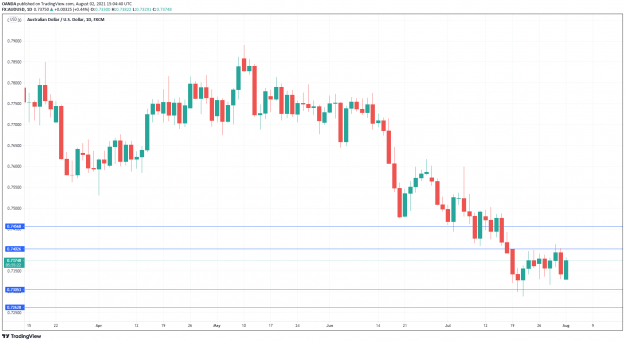
- AUD/USD has support at 0.7297. Below, there is support at 0.7231
- There is resistance at 0.7422, followed by resistance at 0.7481