Sample Category Title
Asian Markets In Green Territory
Asian equities in buy-the-dip mode
Asia’s heavyweight markets have started the week on a very positive note, after China initially dipped on weak PMI data. China’s Shanghai Composite, CSI 300 and Hang Seng all dropped in early trade with the mainland exchanges, abruptly reversing course as foreign investors pumped nearly a billion dollars down the Hong Kong to Shanghai/Shenzhen Connect. That has seen a stunning reversal as regulatory risk has been forgotten. The Shanghai Composite is 2.10% higher, the CSI 300 has leapt by 2.50%, and the Hang Seng is 0.90% to the positive.
Wall Street finished on a soggy note on Friday after US inflation data disappointed. That pushed US yields down, but equities could not rally as fears of peak-recovery led market heavyweights like Amazon lower. The S&P 500 fell by 0.54%, the Nasdaq by 0.71% and the Dow Jones by 0.42%. I suspect some month-end rebalancing of portfolios by institutional investors played its part as well.
With no significant event risk emerging over the weekend, however, investors could not resist piling into buy-the-dip in Asia as the week started. US index futures on the S&P 500, Nasdaq and Dow Jones are up over 0.50%, reversing all of Friday’s losses. In Asia, the Nikkei 225 has leapt by 1.60%; the Kospi is 0.55% higher, with Taipei climbing by 1.10%. Australian markets have also roared higher after Square announced it would buy Australia’s Afterpay. The ASX 200 is 1.25% higher, while the All Ordinaries has climbed 1.35%, with the Sydney bank holiday and the spread of state lockdowns to Queensland all but forgotten.
Regional Asia has fared less well, with investors’ attention seemingly focused on the worst performers of last week being the best performers this week. That has left regional Asia markets out in the cold, with investors focused on delta-variant nerves and a deteriorating political situation to boot in Malaysia’s case. The government is rapidly running out of Teflon to slip a no-confidence vote over its handling of the economy and the pandemic.
All of that sees Singapore falling 0.65%, with Kuala Lumpur 0.35% lower with Jakarta just 0.15% higher today, as Covid-19 cases fall (its due to lower testing), and restrictions appear to have been eased. Bangkok is unchanged.
European markets are likely to look at the performance of the US futures and the Asian heavyweights today and move straight into buy-the-dip mode themselves, in a classic case of Euro-FOMO. With so much heavyweight data out, we are indeed in for another volatile week ahead. But if today teaches us nothing else, it is that there is still an ocean of capital looking for a home in a zero per cent world. Therefore, any material dips in asset prices, such as equities, will inevitably be short-lived.
EUR/JPY Bearish Hints At Resistance
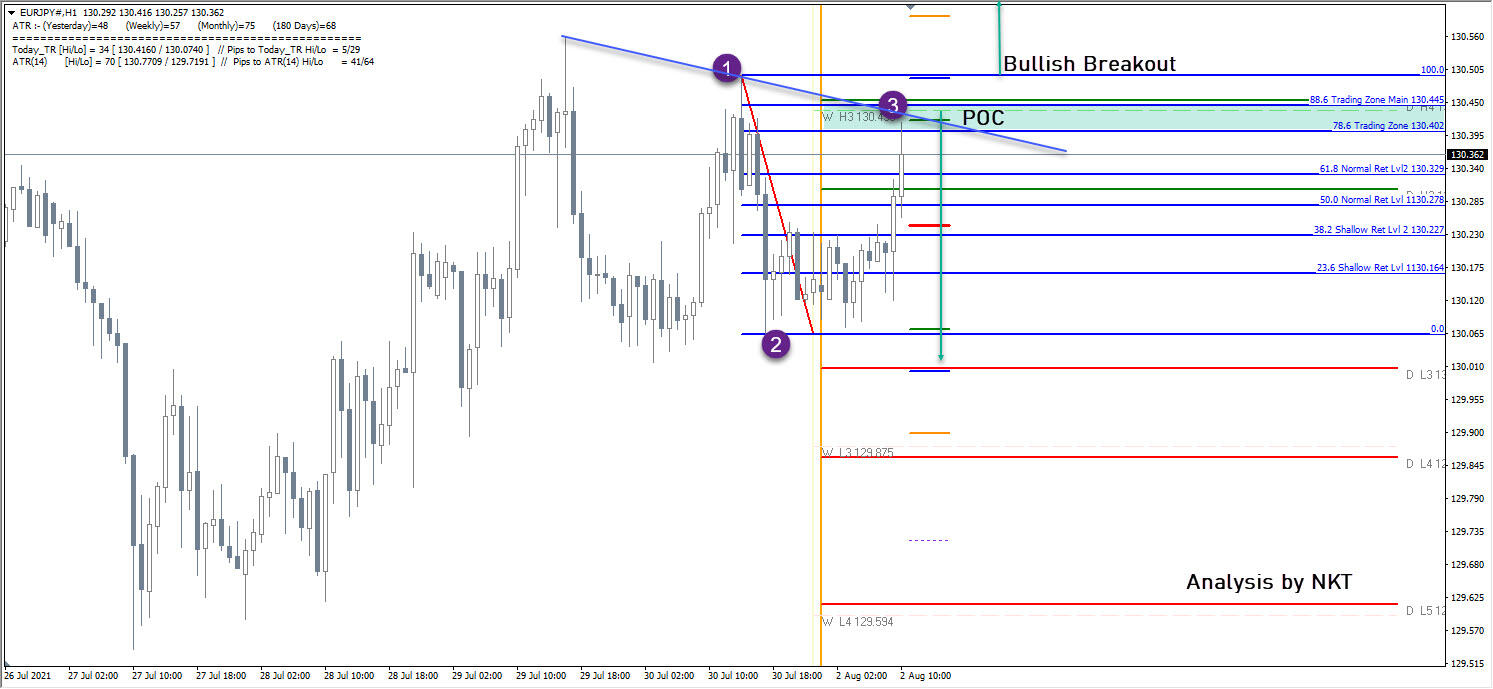
The EUR/JPY has formed a 1-2-3 pattern at resistance. We could see a drop soon if the point 1 holds.
EUR/JPY is trying to push higher but 1-2-3 is holding it. the 130.45 zone could move the price lower towards 130.27 and 130.05. However if the price moves above 130.55, a bullish breakout might occur going towards 130.80 and 131.00. Watch the price action at the POC zone for further cues.
GBP/USD Outlook: Bulls Face Headwinds At 1.40 Zone
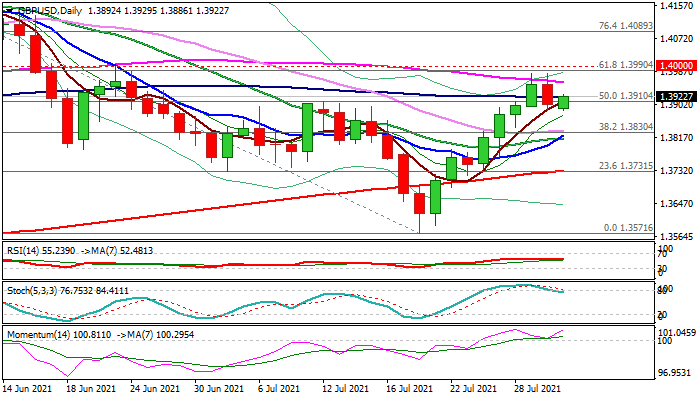
Cable regained traction after Friday’s drop and close in red, as bulls faced strong headwinds on approach to key 1.40 resistance zone.
Fresh recovery in early Monday’s trading keeps in play hopes for renewed attempt at 1.40 pivot, as larger uptrend from 1.3571 (July 20 low) remains intact after shallow pullback.
Daily moving averages (10/20/30) in bullish setup and rising positive momentum support the action, with today’s daily cloud twist attracting bulls.
On the other side, Friday’s drop and close below 1.3910 (broken Fibo 50% of 1.4249/1.3571) generated initial negative signal, with stochastic reversing from overbought territory and weighing on near-term action.
Extended consolidation within 1.3880/1.4000 range is seen as likely near-term scenario, as traders focus on this week’s key event - BoE monetary policy meeting on Thursday.
Look for direction signals on clear break of either 1.3900 support or 1.4000 resistance.
Res: 1.3960. 1.3990. 1.4000. 1.4089.
Sup: 1.3885. 1.3830. 1.3816. 1.3787.
Daily Tecnical Analysis
EUR/USD
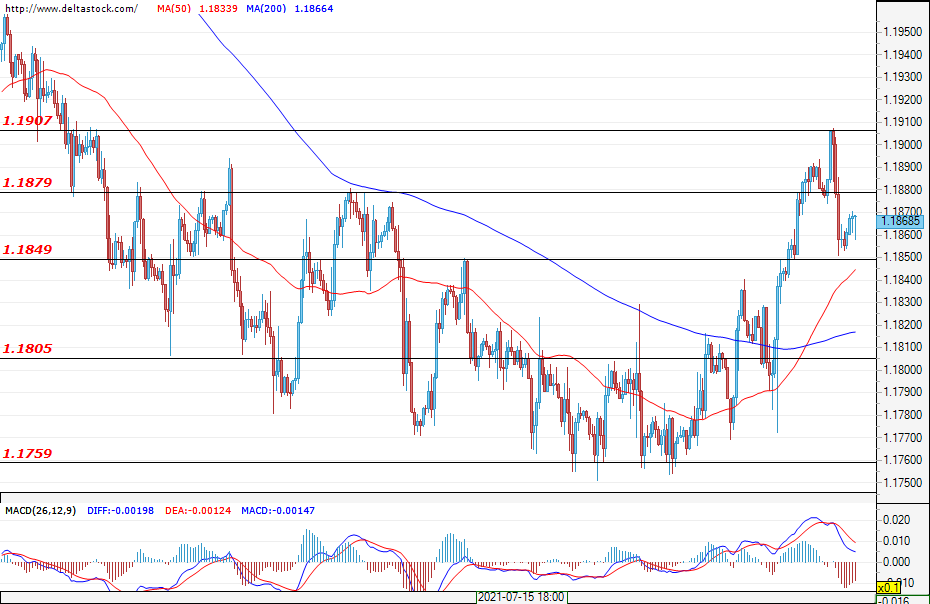
Current level - 1.1868
The upward move of the single European currency against the U.S. dollar since the end of last week was limited to the resistance level at 1.1907. The subsequent depreciation can be considered as a corrective move in order to find better levels for market entry. The forecast is rather positive – for another attack on the resistance level at 1.1907. The most important economic news scheduled for this week will happen near its end, when the non-farm payrolls change data for the U.S. will be announced (Friday; 12:30 GMT), as well as the data on the unemployment rate for the U.S. (Friday; 12:30 GMT).
| Resistance | Support | ||
| intraday | intraweek | intraday | intraweek |
| 1.1880 | 1.1970 | 1.1849 | 1.1759 |
| 1.1945 | 1.2070 | 1.1805 | 1.1700 |
USD/JPY
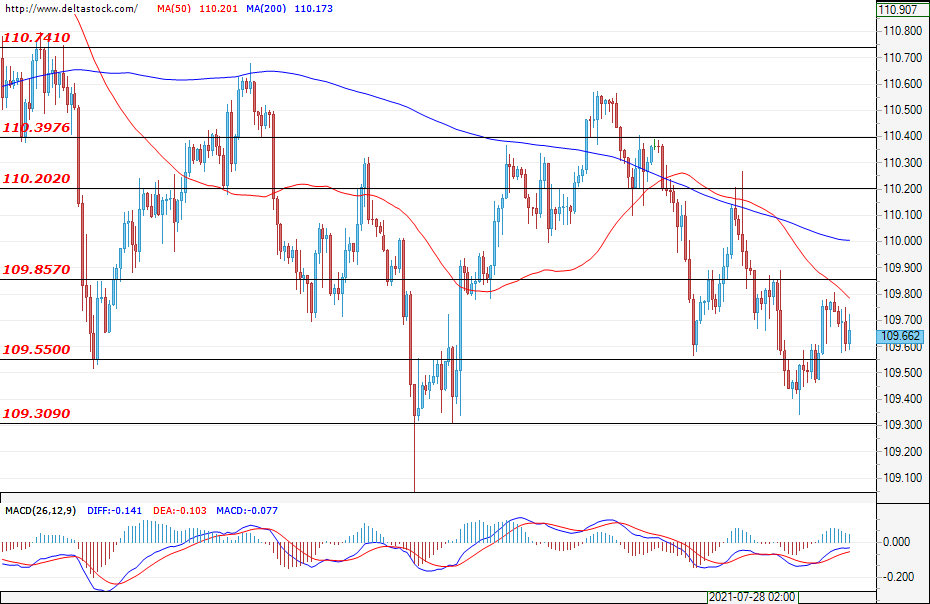
Current level - 109.66
The U.S. dollar continues to lose ground against the Japanese yen after the upward move from the end of last week was limited to just below the resistance level at 109.85. A successful breach of the support at 109.55 could boost the sell-off and pave the way for the currency pair towards a test of the next significant support zone at around 109.00. A consolidation of the range movement between 109.00 - 110.75, coming from the higher time frames, is also not excluded.
| Resistance | Support | ||
| intraday | intraweek | intraday | intraweek |
| 109.85 | 110.39 | 109.55 | 108.55 |
| 110.20 | 110.70 | 109.30 | 108.10 |
GBP/USD
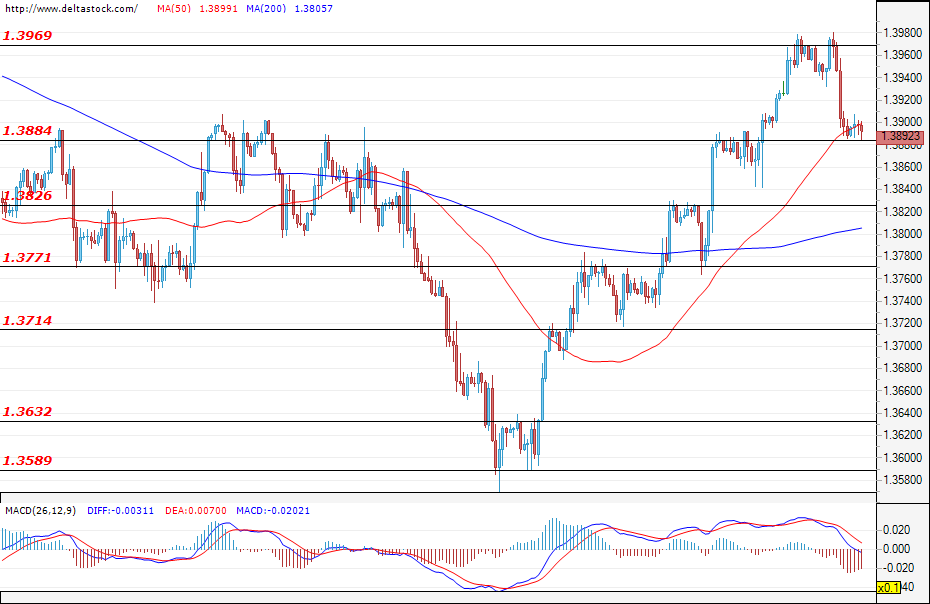
Current level - 1.3892
The depreciation of the sterling against the U.S. dollar began during the last trading session of last week and, at the time of writing the analysis, the currency pair is facing a test of the support zone at 1.3884. The predictions that the bulls will be restrained by the resistance level at 1.3970 rang true and a breach of the current support zone at 1.3884 could boost the sell-off and send the currency pair towards a test of the next more significant support area at 1.3770.
| Resistance | Support | ||
| intraday | intraweek | intraday | intraweek |
| 1.3970 | 1.4060 | 1.3884 | 1.3771 |
| 1.4000 | 1.4115 | 1.3826 | 1.3630 |
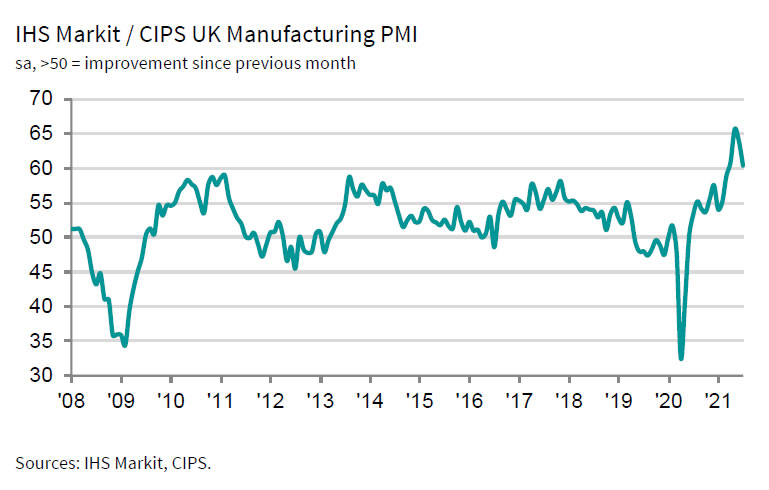
UK PMI manufacturing finalized at 60.4, stretched supply chains led to sharp rise in costs
UK PMI Manufacturing was finalized at 60.4 in July, down from June's 63.9. Markit said output and new order growth eased to four-month lows. Stretched supply chains led to sharp rise in costs.
Rob Dobson, Director at IHS Markit, said: "Although July saw UK manufacturers report a further month of solid growth, scarcities of inputs, transport and labour are stifling many businesses. On one hand, manufacturers are benefiting from reopening economies.... On the other, the recent surge in global manufacturing growth has led to another month of near-record supply chain delays, exacerbated by factories and their customers building up safety stocks....
"Demand outstripping supply is also driving up prices. Input costs again rose at a near survey-record pace, leading to a near-record increase in manufacturers' selling prices. Amid growing indications that many supply chain disruptions and raw material shortages are unlikely to be fully resolved until 2022, the outlook remains one of constrained growth combined with high inflation for the foreseeable future."
Eurozone PMI manufacturing finalized at 62.8, inflows of new orders outstripping production to unprecedented extent
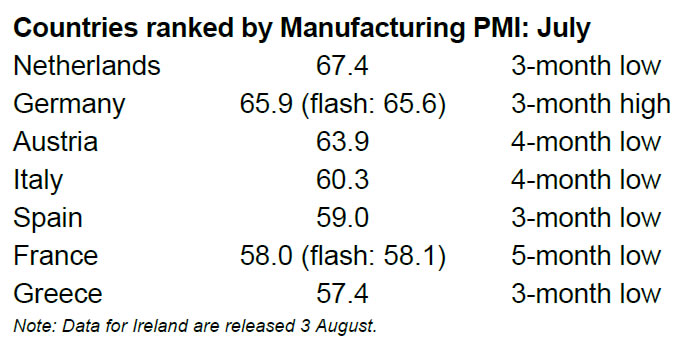
Eurozone PMI Manufacturing was finalized at 62.8 in July, down from June's 63.4. Markit said output and order growth rates slowed, but employment rose at survey-record pace. Inflation rates hit new highs as supply chain disruptions continue.
The readings for most member states except Germany declined, but remained strong: Netherlands (67.4), Germany (65.9), Austria (63.9), Italy (60.3), Spain (58.0), France (58.0), Greece (57.4).
Chris Williamson, Chief Business Economist at IHS Markit said: "July survey showed inflows of new orders outstripping production to an extent unprecedented in the survey's 24-year history. Capacity constraint indicators continue to flash red. Input shortages worsened again in July at a near record rate and July saw another near-record rise in backlogs of work.... Prices pressures meanwhile show no sign of abating, with July seeing another record increase in both input costs and prices charged for goods as demand exceeds supply, and concerns over future supply availability flare up again."
PMI Data Underwhelms But It Doesn’t Matter
China Manufacturing PMI misses target
China's Manufacturing PMI data has disappointed today, clinging to expansionary territory but increasing fears that Asia's powerhouse is slowing. On Saturday, official Manufacturing PMI fell to 50.4, well below the 50.8 expected, while today's Caixin Manufacturing PMI for July tumbled to 50.3, well below the 51.0 expected. Notably, in this morning's Caixin number, the new export orders sub-index plunged to 47.7.
Across the rest of Asia, Manufacturing PMIs were very much a mixed bag. Australian, Japan, South Korea and Taiwan's Manufacturing PMIs remained solidly expansive, but regional Asia sagged well into contractionary territory, with Thailand falling to 45.7, Vietnam to 45.1, Malaysia to 40.1 and Indonesia collapsing to 40.1 also. Supply chain woes are affecting everybody to some extent, especially China with semiconductors, and magnified by the US entity list. But in regional Asia, It appears that the delta-variant gripping the region is making its presence felt in the data.
That had led to an interesting divergence in the morning session, with US index futures, the Nikkei and Australia performing strongly, after Wall Street finished Friday on a soggy note, while China markets sank. The PMI data and the emergence of 98 new cases of Covid-19 on the mainland weighing on sentiment. However, much as investors started the week elsewhere in the inevitable buy-the-dip mode, so it became for China markets which have rallied strongly with a heavy flow of funds down the Stock Connect pipeline from international investors.
Sentiment may also have been helped by the unveiling of the bi-partisan US infrastructure bill at a special Sunday sitting of the US Senate. Totalling around USD 1 trillion, it contains USD 550 billion of new spending over five years.
Being the first week of the month, the data calendar is heavy internationally, culminating in this Friday's US Non-Farm Payrolls. Pan-Asia inflation data is released tomorrow. Although it is likely to show supply-chain-driven upward price pressures, concern over the delta-variant engulfing the region will likely offset that data. With lockdowns spreading in Australia, with no end in sight for Sydney, the RBA policy decision should be a non-event tomorrow, with Covid-19 delta-variant giving the RBA all the excuses it needs to stay firmly in the uber-dovish corner.
In contrast, New Zealand releases employment data tomorrow. A strong result will make a rate hike by the RBNZ at its next policy meeting a certainty in the minds of most analysts. The New Zealand dollar is likely to rally powerfully versus the Australian and US dollars if employment data is robust.
Similarly, South Korean trade data released over the weekend show a significant jump in imports, hinting that domestic demand continues to recover. That will keep the Bank of Korea on track to hike in Q4, although the won will stay under pressure in the shorter term as the US dollar remains strong and the PMI data across Asia suffers delta-wobbles.
The delta-variant is likely to stay the hands of both the Reserve Bank of India and Bank of Thailand this week as well. Realistically, only the RBI was an outside chance to hike, given that inflation remains stubbornly above its target range, something that ever-higher oil prices will complicate. Thailand remains in a virus-induced slow down anyway, but the RBI is more likely to focus on supporting a post-second-wave recovery, than worrying about inflation right now.
The Bank of England will also hold fire; as news emerges today, Britain is preparing a mass third shot booster programme later in the year. However, Brazil will likely buck the trend, hiking by anywhere between 75 and 100 basis points later in the week. Wednesday will see the release of pan-Europe plus US Manufacturing and Services PMIs, and Thursday a swath of Asian CPIs.
There is plenty of data interspersed as well; however, I believe the week will be dominated by three themes. First, the trajectory of the Covid delta-variant, especially if cases rapidly increase in mainland China. That could cause another bout of virus-fright in global stock markets. The passage of the now released US Infrastructure Bill, which should be a positive for US markets, particularly Dow Jones and Russel 2000 inhabitants. And finally, all roads will lead to the US Non-Farm Payrolls on Friday, with preliminary estimates hovering around the 750,000 mark. That will probably change quite a bit as the week progresses, and after so much promise of 1 million+ number earlier this year, which never happened, the risks are skewed towards a lower number. US market will likely take severe fright if it comes in under 500,000 jobs added.
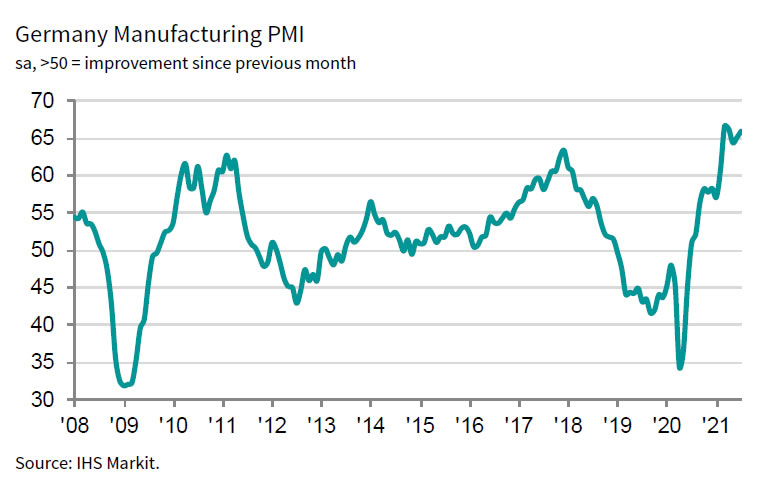
Germany PMI manufacturing finalized at 65.9, record employment and prices
Germany PMI Manufacturing was finalized at 65.9 in July, up from June's 65.1. The future was the third-highest since the survey began in 1996. There was survey-record increase in employment. Also, both price indices reached new record highs.
Trevor Balchin, Economics Director at IHS Markit, said: "Faster growth of new orders and employment boosted the German manufacturing sector in July... the latest survey results provided further evidence that output growth is being constrained by supply shortages....with overall demand for raw materials strengthening, input price inflation accelerated to a new survey record high. Consequently, the rate of output price inflation hit a new peak for the fifth month running."
EUR/USD Potential Target At 1.1789
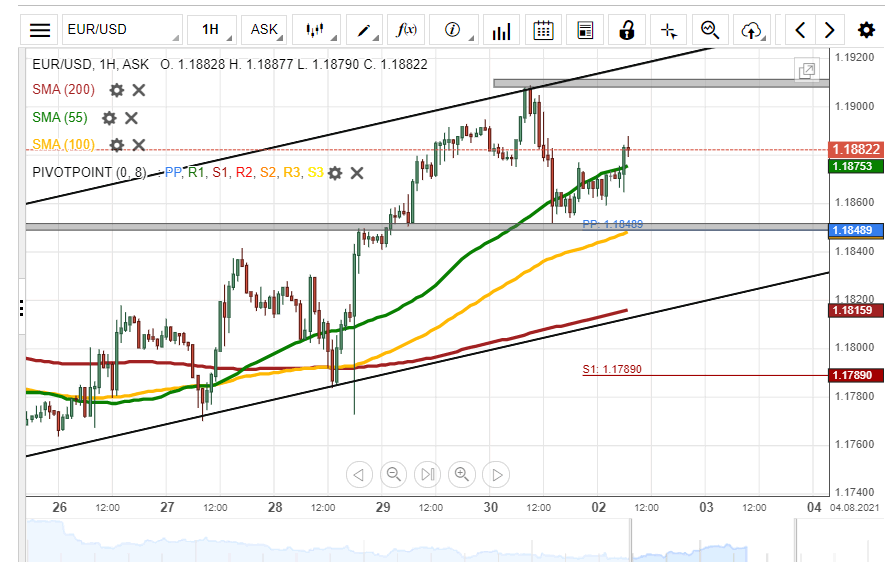
On Friday, the Eurozone single currency plunged by 54 pips or 0.45% against the US Dollar. The decline was stopped by the 50– hour simple moving average during Friday's trading session.
All things being equal, the exchange rate could continue to edge lower during the following trading session. The potential target for the EUR/USD pair will be near the 200– hour SMA at 1.1789.
However, sellers are likely to encounter a support cluster formed by the weekly pivot point and the 100– hour moving average at 1.1848 within this session.
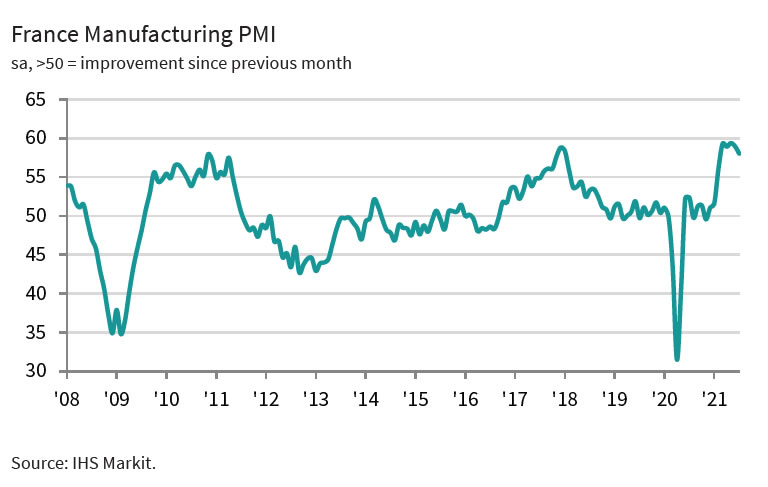
France PMI manufacturing finalized at 58.0, strong growth despite supply-side challenges
France PMI Manufacturing was finalized at 58.0 in July, down from June's 59.0. Markit said production growth remained strong, but slowed. Supplier performance continued to deteriorate substantially. Input prices rose at fastest rate since March 2011.
Joe Hayes, Senior Economist at IHS Markit, said: "Despite some strong supply-side challenges for goods producers, the France Manufacturing PMI survey showed strong growth in output during July. France has now enjoyed an unchecked period of production growth that began in February, but the survey raises a number of things to remain wary over...
"Firms are currently dealing with rapidly deteriorating supplier performance and intense input price inflation.... higher prices firms are paying to secure inputs is being passed on to output charges, which rose at a record rate...
"Firms don't seem to have such a problem paying more for their inputs because demand is so strong and they can pass this through to their clients. These are the perfect conditions for rising consumer price inflation and could soon make uncomfortable viewing for policymakers."