

Sample Category Title
Gold Eases Back Toward 1,800 After Advances Curbed
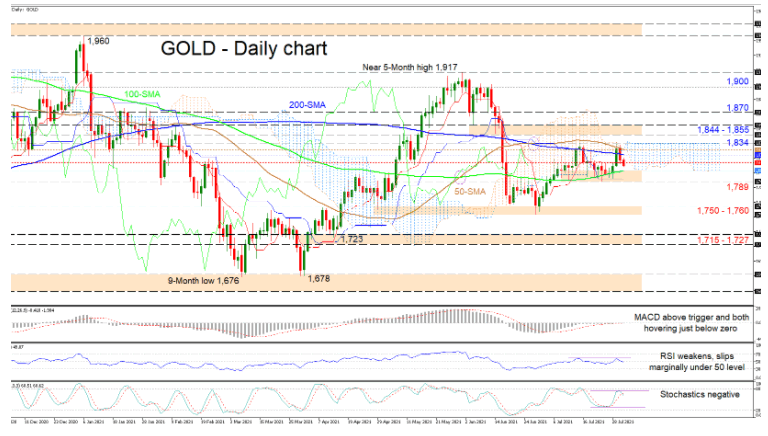
Gold is currently at the red Tenkan-sen line at 1,811 looking set to continue the road to the 1,800 mark, after positive developments were halted by the 50-day simple moving average (SMA) and the July 15 high of 1,834. The converging SMAs are not conveying any definitive price bearing and thus are feeding a sideways trajectory.
Furthermore, the horizontal Ichimoku lines are indicating that directional impetus is lacking, while the short-term oscillators are endorsing the commodity’s attempt to push lower. The MACD and the red trigger line are drifting ever so slightly beneath the zero threshold, while the RSI has just pierced below the 50 level. The fresh negative charge of the stochastic oscillator is promoting the bearish tone in the precious metal.
To the downside, if the price pushes clearly under the red Tenkan-sen line at 1,811, a tough support zone could arise from the 100-day SMA at 1,802 until the 1,789 obstacle. Should sellers manage to steer below this region, which encompasses multiple lows, the yellow metal may then dive to challenge the base of 1,750-1,760, formed by the troughs on April 29, as well as June 18 and 29. In the event downward pressures gain significant power, the support border of 1,715-1,727 could then come into play.
If buyers re-emerge and nudge the price back above the red Tenkan-sen line, a durable resistance section from the 200-day SMA at 1,820 up until the 1,834 high could suppress freshly materialized upward forces. However, if buyers successfully conquer the Ichimoku cloud’s upper surface around 1,834, they may then meet the nearby 1,844-1,855 resistance border, moulded by inside swing lows formed in the first half of June. Overstepping this aforementioned boundary and the neighbouring 1,870 barrier too may bolster the bulls’ beliefs into lifting the commodity back to the 1,900 frontier.
In conclusion, gold is currently consolidating in the near-term. For a stronger price direction to evolve, the price would need to thrust either below 1,789 or above 1,834.
Various Euro Area PMI Manufacturing Remain In Expansion But Losing Momentum
Notes/Observations
- Euro Area July PMI Manufacturing mixed in session but firmly in expansion territory (Beats: Euro Zone, Germany; Misses: France, Italy, Spain; In-line: UK).
- Germany Jun Retail Sales data beat consensus.
- Focus nonfarm payrolls report on Friday.
Asia
- China July Manufacturing PMI (govt official) registered its 16th month of expansion but lowest since Feb 2020 (50.4 v 50.8e).
- China July Caixin PMI Manufacturing registered its 15th consecutive expansion but lowest since Apr 2020 (50.3 v 51.0e).
- Japan July Final PMI Manufacturing confirmed its 6th month in expansion (53.0 v 52.2 prelim).
- Australia July Final PMI Manufacturing confirmed 14th month of expansion (56.9 v 56.8 prior).
- Japan Government Pension Fund (GPIF) said to have cut its US government bonds and bills from 47% to 35% of its foreign holdings.
Coronavirus
- Florida reported 21,683 new coronavirus cases on Friday, the state’s highest one-day total since the start of the pandemic.
Europe
- UK Chancellor of the Exchequer Sunak (Fin Min) said to has written to PM Johnson calling for the urgent easing of travel restrictions to save summer holidays.
- Italian Government said to request a motion of confidence to ratify the judicial reform of Draghi.
- Russia Central Bank (CBR) Gov Nabiullina said to have warned that inflation is here to stay.
Americas
- Fed’s Brainard (FOMC voter, dove) stated that woould be more confident in assessing progress in September; As of today employment goal had some ways to go.
- Senator Schumer (D-NY) stated that Senators had finish the text of their legislation and could wrap up work on the bill in a matter of days.
- The US debt ceiling officially expired on Sunday after a 2 year suspension with pressure now on Congress to find another solution that allows the govt to carry on borrowing.
Speakers/Fixed income/FX/Commodities/Erratum
Equities
- Indices [Stoxx600 +0.65% at 464.72, FTSE +0.93% at 7,097.75, DAX +0.31% at 15,591.90, CAC-40 +0.77% at 6,663.57, IBEX-35 +1.39% at 8,796.00, FTSE MIB +0.92% at 25,595.50, SMI +0.46% at 12,172.02, S&P 500 Futures +0.60%].
- Market Focal Points/Key Themes: European indices open broadly higher and continued to advance as the session progressed; M&A major theme of the day; sectors leading to the upside include technology and consumer discretionary; while health care and financials sectors underperforming; financials sector dragged by Allianz being subject to DOJ probe; Kungsleden receives takeover offer from Castellum; Sanne receives potential competing bid from Apax; Meggitt to be acquired by Parker-Hannifin; SSE divests stake in Scotia Gas; Naturgy receives impoved offer from IFM; reportedly Holcim to divest assets in Brazil; earnings expected during the upcoming US session include Loews, Timken, Global Payments and Ferrari.
Equities
- Consumer discretionary: Heineken [HEIA.NL] +1% (earnings; inflation comments).
- Financials: Sanne [SNN.UK] +8% (receives increased offer), HSBC [HSBA.UK] +1% (earnings), Axa [CS.FR] +4% (earnings).
- Industrials: Meggitt [MGGT.UK] +57% (to be acquired by Parker-Hannifin).
- Technology: flatexDEGIRO [FTK.DE] -14% (prelim earnings).
Speakers
- Poland Central Bank's Hardt wrote an op-ed piece that noted the jump in inflation required monetary reaction.
- Hungary Fin Min Varga stated that 2021 GDP growth could be close to 6.5%; faster inflation was a threat and govt to give decisive response to any CPI risk.
Currencies/Fixed Income
- USD at 1-month lows against most major pairs with focus on Friday’s US non-farm payroll report. Dealers believe that the Fed was in no hurry to tighten policy. Dealers await the until the Fed's Jackson hole summit layer in Aug where many believe it may signal the timing to start winding down stimulus.
- Aug usually bring a slowdown in Euro Zone debt issuance due to summer seasonal factors.
Economic data
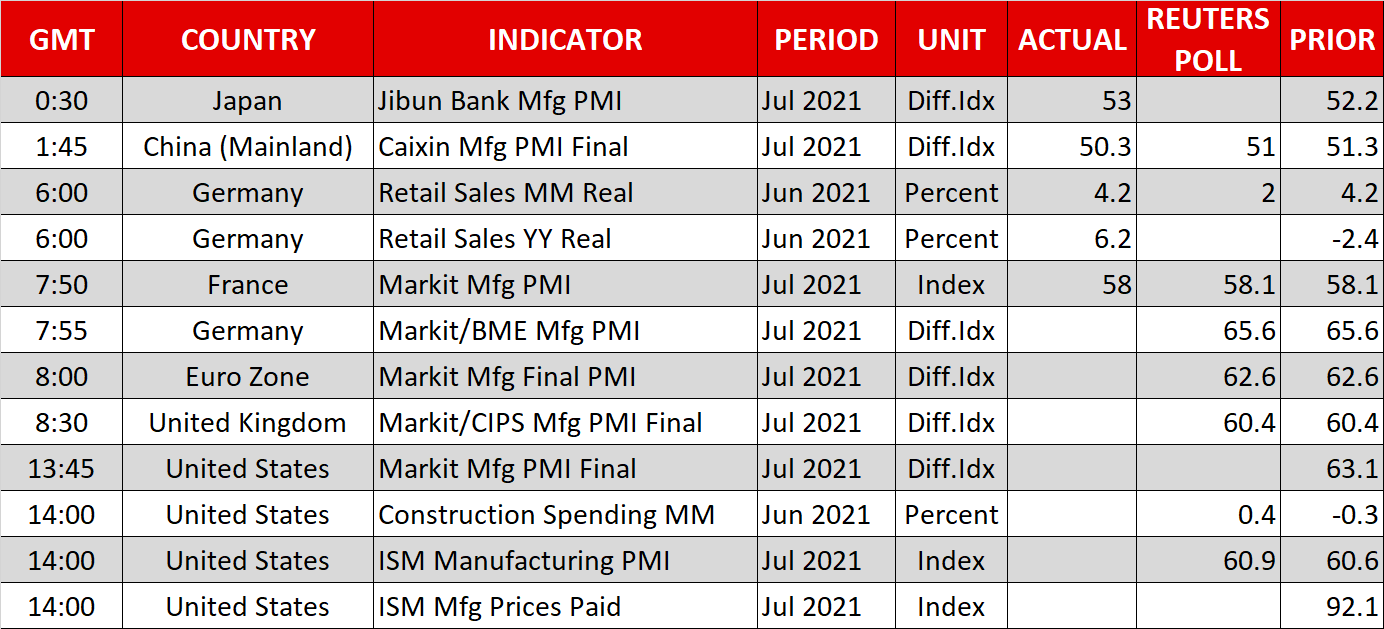
- (DE) Germany Jun Retail Sales M/M: 4.2% v 2.0%e; Y/Y: 6.2% v 3.0%e.
- (RU) Russia July PMI Manufacturing: 47.5 v 50.4e (2nd straight contraction).
- (SE) Sweden July PMI Manufacturing: 65.3 v 65.4 prior.
- (CH) Swiss July CPI M/M: -0.1% v -0.1%e; Y/Y: 0.7% v 0.7%e; CPI Core Y/Y: 0.2% v 0.3%e.
- (CH) Swiss July CPI EU Harmonized M/M: 0.1% v 0.0% prior; Y/Y: 0.5% v 0.5% prior.
- (CH) Swiss Jun Real Retail Sales Y/Y: 0.1% v 2.8% prior.
- (NL) Netherlands July Manufacturing PMI: 67.4 v 68.8 prior (12th straight expansion).
- (HU) Hungary July Manufacturing PMI: 55.6 v 56.0e (4th straight expansion).
- (PL) Poland July PMI Manufacturing: 57.6 v 59.0e (12th straight expansion).
- (TR) Turkey July PMI Manufacturing: 54.0 v 51.3 prior (2nd straight expansion).
- (HU) Hungary Jun PPI M/M: +1.0% v -0.2% prior; Y/Y: 11.6% v 11.2% prior.
- (ES) Spain July Manufacturing PMI: 59.0 v 59.5e (6th month of expansion).
- (CH) Swiss July PMI Manufacturing: 71.1 v 66.0e (12th straight expansion).
- (CZ) Czech Republic July Manufacturing PMI: 62.0 v 61.6e (11th straight expansion).
- (TH) Thailand July Business Sentiment Index: 41.4 v 46.5 prior.
- (IT) Italy July Manufacturing PMI: 60.3 v 61.5e (13th month of expansion).
- (FR) France July Final Manufacturing PMI: 58.0 v 58.1e (confirmed the 8th straight expansion).
- (DE) Germany July Final Manufacturing PMI: 65.9 v 65.6e (confirmed 13th month of expansion).
- (EU) Euro Zone July Final Manufacturing PMI: 62.8 v 62.6e (confirmed 13th month of expansion).
- (GR) Greece July Manufacturing PMI: 57.4 v 58.6 prior (5th month of expansion).
- (NO) Norway July PMI Manufacturing: 63.3 v 61.3 prior (11th month of expansion).
- (CH) Swiss weekly Total Sight Deposits (CHF): 712.0B v 712.1B prior; Domestic Sight Deposits: 636.4B v 635.5B prior.
- (UK) July Final PMI Manufacturing: 60.4 v 60.4e (confirmed 14th straight expansion).
- (HK) Hong Kong Jun Retail Sales Value Y/Y: 5.8% v 10.4% prior; Retail Sales Volume Y/Y: 2.8% v 7.7% prior.
- (NG) Nigeria July Manufacturing PMI: 55.4 v 53.6 prior.
- (DK) Denmark July Danish PMI Survey: 69.8 v 65.5 prior (5th straight expansion).
- (ZA) South Africa July Manufacturing PMI: 43.5 v 54.0e (1st contraction in 16 months).
Fixed income issuance
- None seen.
Looking ahead
- (ZA) South Africa July Naamsa Vehicle Sales Y/Y: 10.5%e v 20.2% prior.
- (UR) Ukraine Central Bank (NBU) July Minutes.
- (RO) Romania July International Reserves: No est v $41.8B prior.
- 05:25 (EU) Daily ECB Liquidity Stats.
- 05:30 ((DE) Germany to sell combined €6.0B in 3-month and 9-month BuBills.
- 05:30 (NL) Netherlands Debt Agency (DSTA) to sell €3.0-5.0B in 3-month and 6-month bills.
- 05:30 (ZA) South Africa announces details of upcoming I/L bond sale (held on Fridays).
- 06:00 (PT) Portugal Jun Industrial Production M/M: No est v -4.5% prior; Y/Y: No est v 27.1% prior.
- 06:00 (IL) Israel to sell combined ILS1.45B in 2024, 2026, 2030, 2031 and 2051 bonds.
- 06:00 (RO) Romania to sell RON400M in 4.15% 2030 Bonds.
- 06:45 (US) Daily Libor Fixing.
- 07:25 (BR) Brazil Central Bank Weekly Economists Survey.
- 08:00 (CZ) Czech July Budget Balance (CZK): No est v -265.1B prior.
- 08:00 (UK) Daily Baltic Dry Bulk Index.
- 08:00 (ES) Spain Debt Agency (Tesoro) announces size of upcoming issuance.
- 08:00 (IN) India announces details of upcoming bond sale (held on Fridays).
- 08:30 (CL) Chile Jun Economic Activity Index (Monthly GDP) M/M: 0.6%e v 2.6% priorY/Y: 18.0%e v 18.1% prior.
- 09:00 (FR) France Debt Agency (AFT) to sell €4.8-6.0B in 3-month, 6-month and 12-month bills.
- 09:00 (SG) Singapore July Purchasing Managers Index: No est v 50.8 prior; Electronics Sector Index: No est v 50.6 prior.
- 09:00 (BR) Brazil July PMI Manufacturing: No est v 56.4 prior.
- 09:45 (US) July Final Markit Manufacturing PMI: 63.1e v 63.1 prelim.
- 09:45 (EU) ECB weekly QE bond buying update.
- 09:45 (UK) BOE to buy £1.147B in APF Gilt purchase operation (3-7 years).
- 10:00 (US) July ISM Manufacturing: 60.9e v 60.6 prior; Prices Paid: 88.0e v 92.1 prior.
- 10:00 (US) Jun Construction Spending M/M: +0.5%e v -0.3% prior.
- 10:00 (MX) Mexico Jun Total Remittances: $4.4Be v $4.5B prior.
- 10:00 (MX) Mexico Central Bank Economist Survey.
- 10:30 (MX) Mexico July PMI Manufacturing: No est v 48.8 prior.
- 11:00 (CO) Colombia July PMI Manufacturing: No est v 48.3 prior.
- 11:00 (CO) Colombia Jun Exports: $3.2Be v $3.1B prior.
- (IT) Italy July Budget Balance: No est v -€15.8B prior.
- (RU) Russia Central Bank Monetary Policy Report.
- 11:30 (US) Treasury to sell 13-Week and 26-Week Bills.
- 12:00 (IT) Italy July New Car Registrations Y/Y: No est v 12.6% prior.
- 13:00 (MX) Mexico July IMEF Manufacturing Index: No est v 52.4 prior; Non-Manufacturing Index: No est v 53.8 prior.
- 14:00 (BR) Brazil July Trade Balance: $8.9Be v $10.4B prior; Total Exports: $26.5Be v $28.1B prior; Total Imports: $17.5Be v $17.8B prior.
- (AR) Argentina July Government Tax Revenue (ARS): No est v 922.9B prior.
- 16:00 (US) Weekly Crop Progress Report.
- 19:00 (KR) South Korea July CPI M/M: No est v -0.1% prior; Y/Y: 2.4%e v 2.4% prior; CPI Core Y/Y: No est v 1.5% prior.
- 19:30 (AU) Australia ANZ Roy Morgan Weekly Consumer Confidence Index: No est v 100.7 prior.
- 19:30 (JP) Japan July Tokyo CPI Y/Y: 0.0%e v 0.0% prior; CPI (ex-fresh food) Y/Y: 0.0%e v 0.0% prior; CPI (ex-fresh food/energy) Y/Y: 0.0%e v 0.0% prior.
- 19:50 (JP) Japan End-July Monetary Base: No est v ¥659.5T prior.
- 20:01 (IE) Ireland July PMI Manufacturing: No est v 64.0 prior.
- 21:00 (PH) Philippines Jun Unemployment Rate: No est v 7.7% prior.
- 21:30 (AU) Australia Jun Building Approvals M/M: -4.5%e v -7.1% prior.
- 23:00 (TH) Thailand Central Bank to sell combined THD110B in bills (2 tranches).
- 23:30 (HK) Hong Kong to sell 3-month, 6-month and 12-month Bills.
- 22:35 (JP) Japan to sell 10-year JGB bonds.
China Loosens Grip, Markets Still Leaning On Consumers
Markets start the week with a predominantly positive sentiment, which can be attributed more to capital inflows than stronger macroeconomic indicators.
There is some concern about China, where manufacturing PMI fell to a 15-month low of 50.3 in July, clinging to growth territory above 50 as one indication of a slower credit impulse in recent months.
But that hasn't stopped China's markets from finding buying support after July's decline. On Friday, the SEC upset markets by suspending Chinese IPOs on US exchanges, but it clarified that Chinese companies would be able to list in the US, citing risks of government interference in business in the documents. And the Politburo meeting confirmed its intention not to ban foreign listings.
On balance, we see more facts that China has overreacted in previous months, fearing economic overheating. The authorities are becoming increasingly aware of the need to loosen the screws and soften the rhetoric. At least Politburo is not willing to completely squeeze capital from the free markets.
In addition, investors can still rely on consumers who continue to accumulate capital. Taiwan has announced its intention to start distributing e-coupons to the public. And in Hong Kong, such coupons for $645 have been distributed from August 1st.
American consumers also have no visible problems with spending. They were up 1% in June, with income up 0.1%. But don't be daunted by these numbers. Last month, 9.4% of income was put aside for savings, still well above the average of 7.8% in the year before the pandemic, having saved $1.8 trillion in the last 16 months.
The savings built up and the continued higher savings rate make it possible to look optimistically into the near future without fearing a sharp drop in spending. Spending is growing faster than income, but there is still considerable room for an increase.
This week's focus is on reports from the US, with ISM manufacturing coming out today and services on Wednesday. On Friday, the July employment report is expected to show a 900K increase in employment, reducing the pandemic employment fall to 6.7M.
Oil Drops On China, Gold Extends Losses
Oil falls on weak China PMIs
Oil prices edged lower on Friday as investors reduced risk into the weekend, and upward momentum continued waning. Nagging doubts over the delta variants impact on world growth and a stronger US dollar weighed on Brent crude prices. Brent crude fell 0.90% to USD 75.15 a barrel, while WTI finished just 0.30% higher at USD 73.60 a barrel.
In Asia today, weak China and regional Asian Manufacturing PMIs increasing virus cases on the China mainland and expanding lockdowns in Australia have weighed on prices. Reports that OPEC+ compliance had eased to 115%, not helping matters either. Brent crude and WTI are around 0.60% lower at USD 74.70 and USD 73.30 a barrel, respectively.
In the bigger picture, the price action continues to look consolidative after oil recovered all of its panic “delta-dip” the week before last. Last week saw the rebound consolidate, and after a week of range-trading, unsurprisingly, upside momentum has begun to wane. That leaves both rant and WTI vulnerable to a corrective move lower to wash out stale longs. However, I am not expecting anything like the “delta-dip”, and any material fall in prices is likely to be met by an equally fast rebound.
Brent crude has resistance at USD 67.00 a barrel with support at USD 74.00 a barrel. Failure targets a fast return to USD 72.00 a barrel before recovering. WTI has resistance above USD 74.00 a barrel with interim support at USD 73.00, followed by USD 72.00. Failure could see a quick spike to retest USD 70.00 a barrel before recovery occurs.
Gold is back in its range
Bullish gold traders would have been disappointed with the price action at the back end of last week. Gold has traced a triple top between USD 1830.00 and USD 1834.00 an ounce and fell heavily on Friday. US dollar strength saw gold fall 0.75% to USD 1814.00 an ounce. In Asia today, an unwinding of weekend risk hedges, with more than a few disappointed longs out there, sees gold fall by 0.35% to USD 1808.00 an ounce.
The fall by gold has moved it back into its broader July range of USD 1790.00 to USD 1820.00 an ounce. The failure of gold to hold gains in the face of even modest US dollar strength and ever falling US yields is disappointing, but as long USD 1790.00 an ounce holds on a closing basis, gold’s medium-term perspective still looks constructive. Interim support and resistance are found at its 100 and 200-DMAs at USD 1802.00 and USD 1820.00 an ounce.
If support at USD 1790.00 fails, gold could return to USD 1750.00 an ounce, potentially quite quickly. The US Non-Farm Payrolls should answer some questions regarding the US dollar’s direction on Friday. In the meantime, patience and playing the range are probably the best strategy.
The Analytical Overview Of The Main Currency Pairs
The EUR/USD currency pair
Technical indicators of the currency pair:
Prev Open: 1.1887
Prev Close: 1.1867
% chg. over the last day: -0.17%
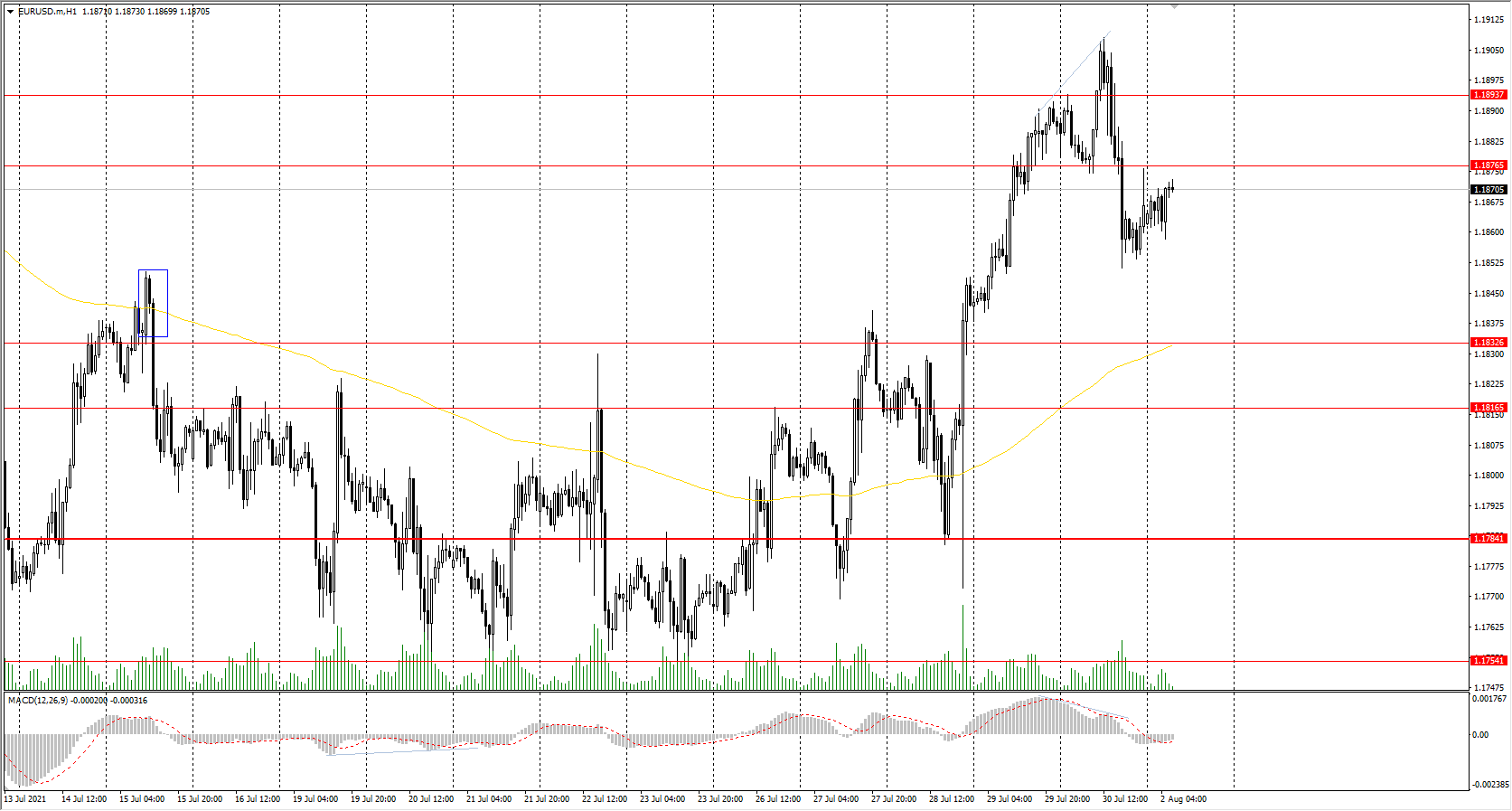
Europe's inflation rate increased to 2.2% in annual terms (previous 1.9%, ECB's target 2.0%), but second-quarter GDP and unemployment data were better than economists' expectations. The rise in annual inflation is mainly triggered by higher energy prices. The EU unemployment rate decreased from 8% to 7.7%, while GDP added 1.9%. Eurostat said the GDP growth was mainly due to the progress of COVID-19 vaccination and the gradual lifting of restrictions in many countries.
Trading recommendations
Support levels: 1.1833, 1.1817, 1.1784, 1.1754, 1.1609
Resistance levels: 1.1876, 1.1894, 1.1934, 1.1969
From the technical point of view, the general trend of the EUR/USD currency pair has changed to bullish, but the price slightly corrected lower on Friday. The price is trading above the moving average; the MACD indicator has become inactive. Under such market conditions, it is best to trade intraday. Buy positions should be considered only after a pullback to the support level. Sell deals should be considered from the resistance levels, but only with short targets.
Alternative scenario: if the price breaks down through the 1.1784 support level and fixes below, the mid-term uptrend is likely to be broken.
News feed for 2021.08.02:
- German Manufacturing PMI (m/m) at 10:55 (GMT+3);
- Eurozone Manufacturing PMI (m/m) at 11:00 (GMT+3);
- US ISM Manufacturing PMI (m/m) at 17:00 (GMT+3).
The GBP/USD currency pair
Technical indicators of the currency pair:
Prev Open: 1.3951
Prev Close: 1.3896
% chg. over the last day: -0.39%
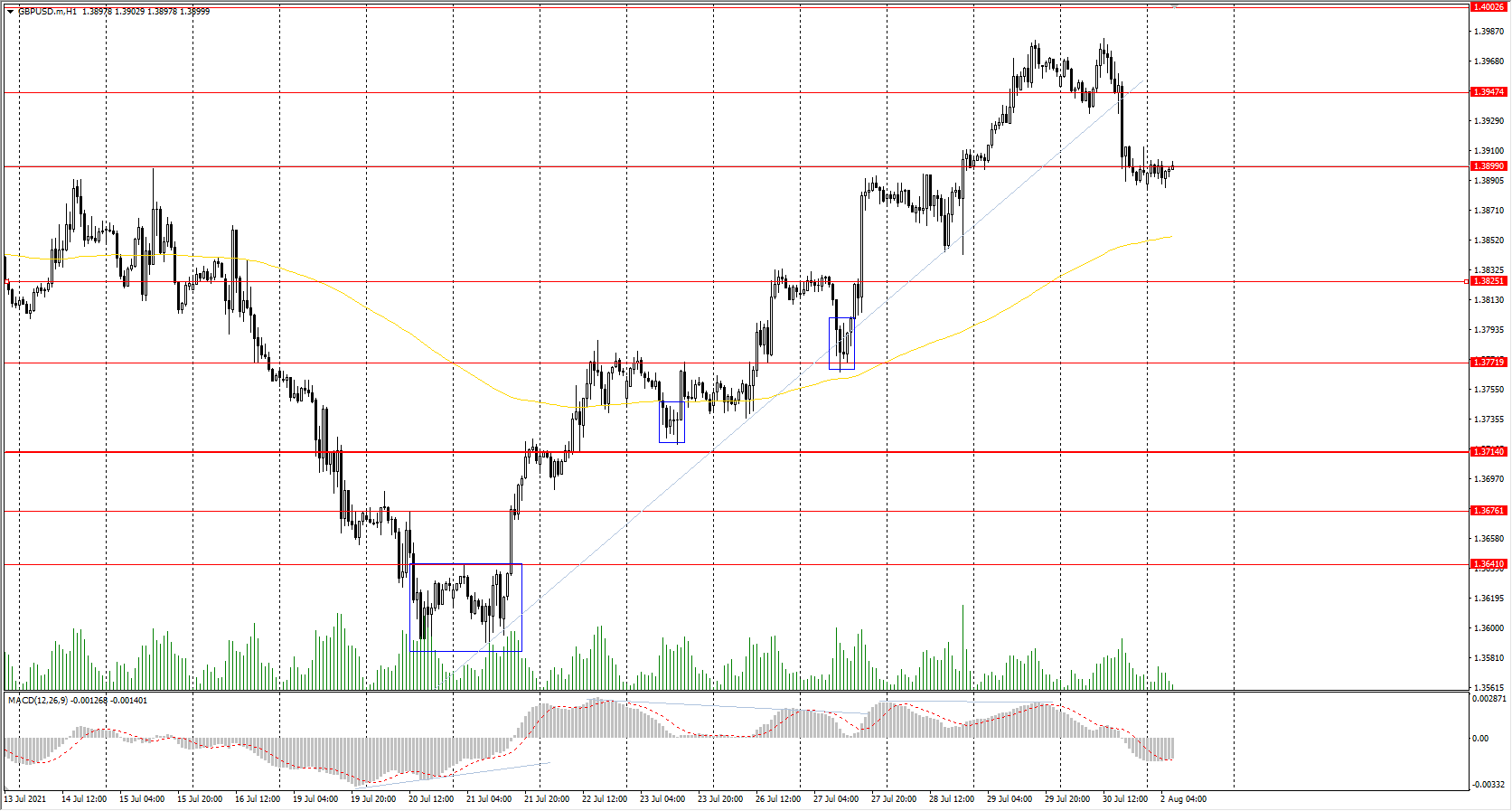
The British pound showed stronger growth than the euro last week. However, against the background of the dollar index growth, the British pound decreased by 0.39% on Friday and broke the trend line. It means that the growth dynamics of the quotes have slowed down. But the MACD indicator began to signal the divergence and warned that a correction move would soon begin.
Trading recommendations
Support levels: 1.3900, 1.3825, 1.3772, 1.3714, 1.3676 ,1.3641, 1.3614, 1.3525
Resistance levels: 1.3947, 1.4002, 1.4075, 1.4101
The GBP/USD currency pair trend is bullish on the H1 timeframe. The MACD indicator went into the negative zone. Under such market conditions, traders can look for buy positions after the price pulls back to the support level. There are no optimal points for sell positions right now. Traders can search for intraday sell entries from the resistance level with short targets, but they should understand that it will be trading against the main trend.
Alternative scenario: if the price breaks down through the 1.3714 support level and consolidates below, the bearish scenario is likely to resume.
News feed for 2021.08.02:
- UK Manufacturing PMI (m/m) at 11:30 (GMT+3).
The USD/JPY currency pair
Technical indicators of the currency pair:
Prev Open: 109.45
Prev Close: 109.68
% chg. over the last day: +0.21%
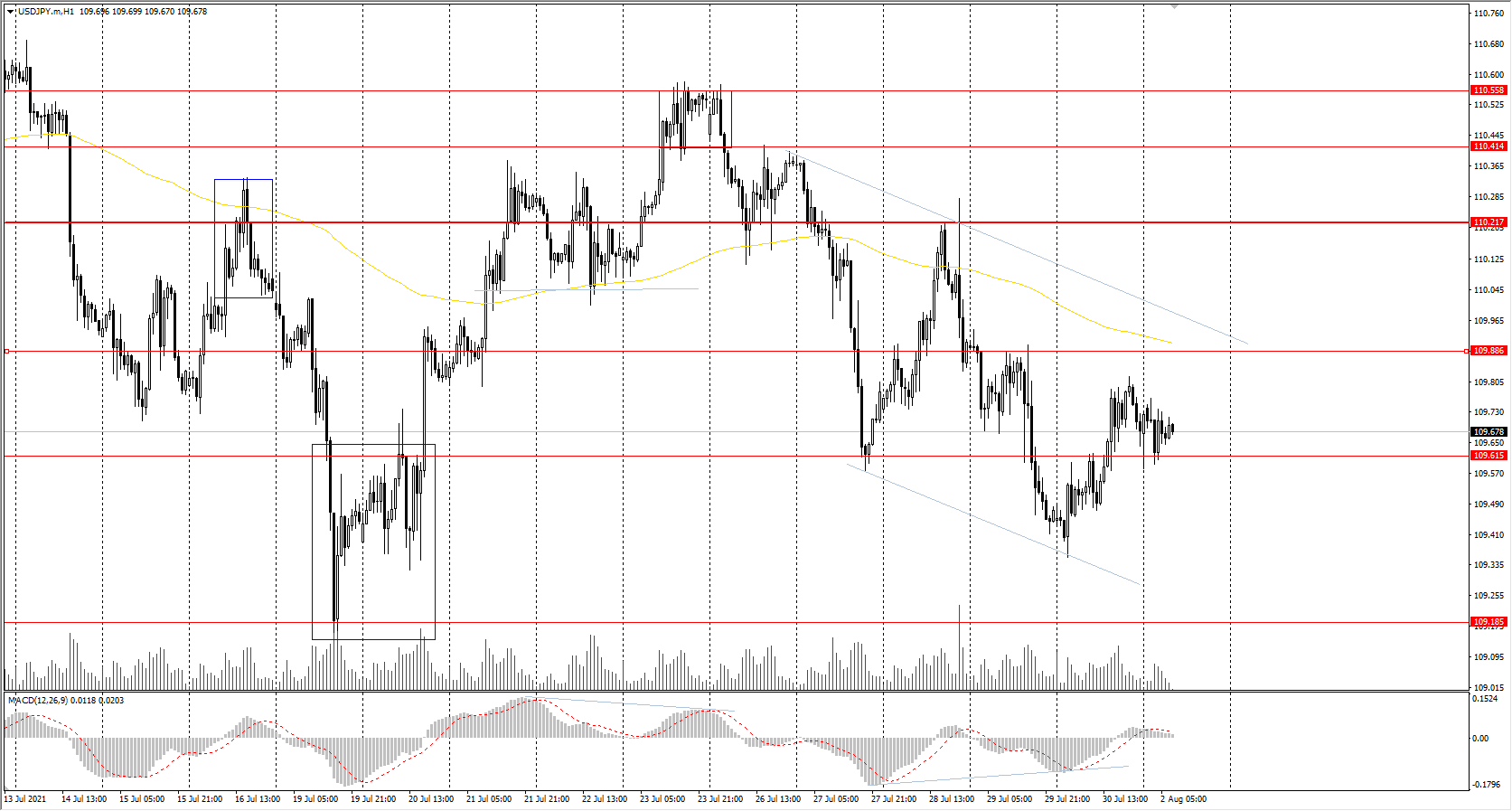
The USD/JPY currency pair increased by 0.21% on Friday. Japanese government data showed that Japan's unemployment rate fell to 2.9% (previously 3.0%) in June, and manufacturing activity increased. However, the Japanese Prime Minister's advisor said that the economic losses from the Tokyo Olympics without fans would be huge. The absence of spectators could cost Japan's economy 146.8 billion yen ($1.3 billion), and Japanese companies could see an estimated 10% increase in sales if fans were allowed. Economists expect Japan's Q3 data to be weak.
Trading recommendations
Support levels: 109.61, 109.19, 108.65
Resistance levels: 109.88, 110.22, 110.41, 110.56
The main trend of the USD/JPY currency pair is bearish. The price is trading below the moving average. The MACD indicator has become inactive. Under such market conditions, it is best to look for sell positions from the resistance levels. Buy positions can be considered only intraday and only with short targets.
Alternative scenario: if the price rises above 110.22, the uptrend is likely to be resumed.
The USD/CAD currency pair
Technical indicators of the currency pair:
Prev Open: 1.2437
Prev Close: 1.2468
% chg. over the last day: +0.25%
Statistics Canada reported that Canadian GDP decreased by 0.3% as most of the country remained under economic restrictions to contain the third wave of COVID-19. But the forecast for June suggests GDP growth of 0.7%. Lower oil prices and a rise in the dollar index contributed to the USD/CAD quotes on Friday.
Trading recommendations
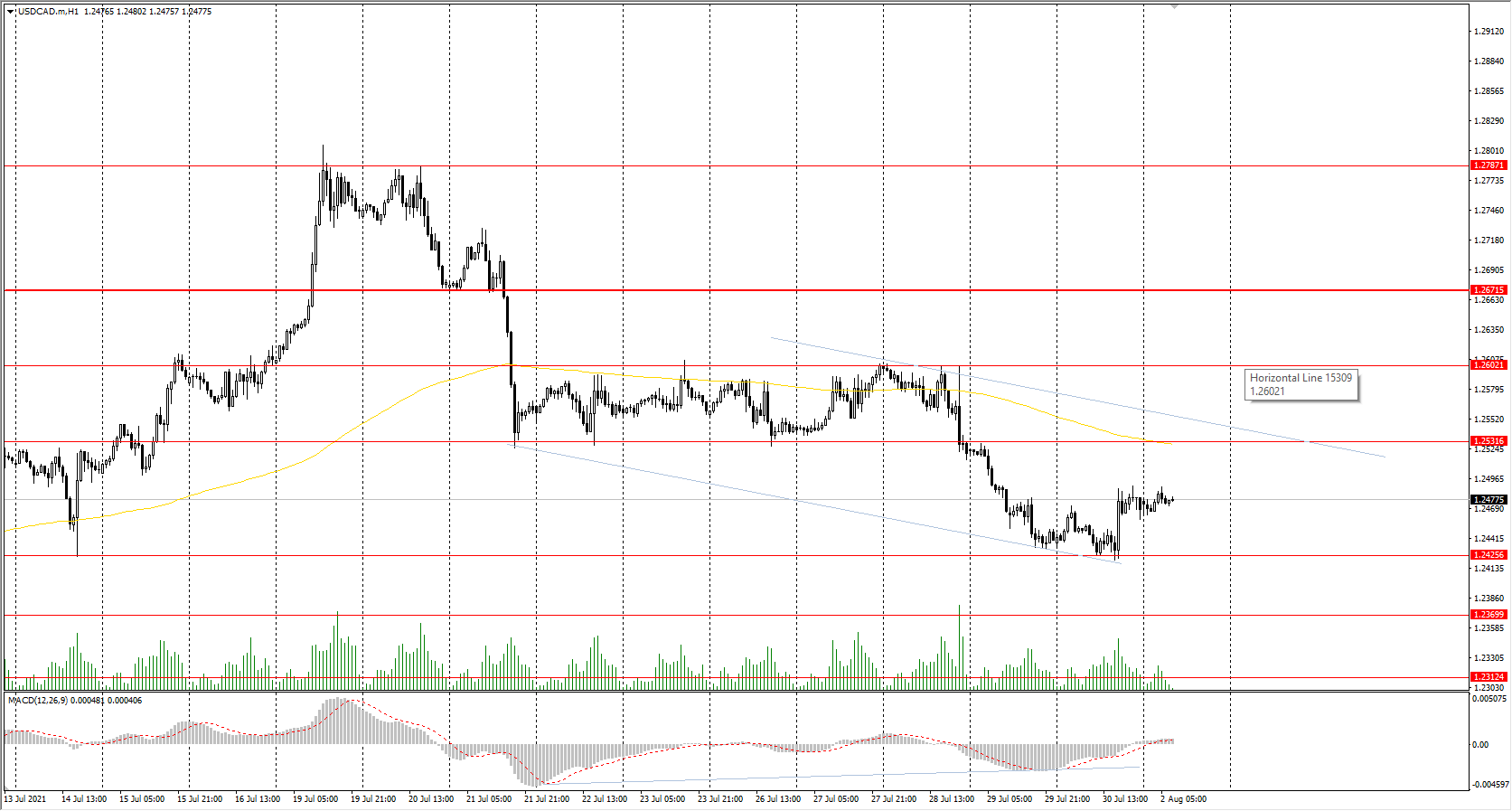
Support levels: 1.2425, 1.2370, 1.2312
Resistance levels: 1.2531, 1.2602, 1.2671, 1.2787, 1,2951
From the point of view of technical analysis, the USD/CAD trend is bearish. The MACD indicator has become inactive. Under such market conditions, traders should look for sell positions from the resistance levels after a small pullback. Buy positions can be considered only intraday and only with short targets.
Alternative scenario: if the price breaks out through the 1.2671 resistance level and fixes above, the uptrend is likely to be resumed.
RBA Preview – Delaying Taper and Downgrading Near-Term Growth Forecasts
We expect the RBA to postpone the tapering policy announced last month. It will also downgrade GDP growth forecast for this year and revise the unemployment rate higher. All the above changes are driven by the unexpected lockdown in New South Wales, Australia's largest state economy accounting for around a third of the nation's economic output.
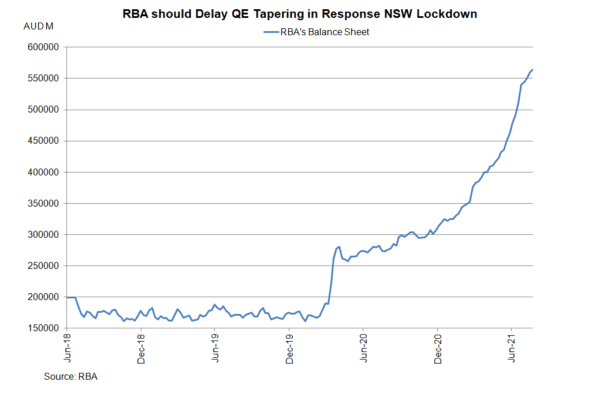
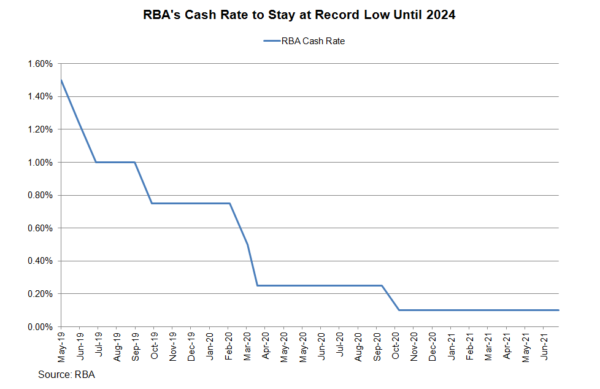
Recall that in July, the central bank announced to begin tapering its asset purchases in early September. The size of purchases would reduce to AUD 4B from AUD5B. The extended lockdown measures and the potential damage to the economy likely trigger a delay of the tapering. We expect policymakers to announce this week that the size of asset purchases will remain at AUD5B until at least the next review in November. Indeed, the central bank favors more flexibility. As noted in the minutes, “Given the high degree of uncertainty about the economic outlook members agreed that there should be flexibility to increase or reduce weekly bond purchases in the future, as warranted by the state of the economy at the time, rather than a commitment to a specific rate of purchases over an extended period”.
On the economic outlook, despite policymakers’ hopes to upgrade economic projections in August, the opposite will come true. The RBA currently forecast the economic to expand by +4.75% this year. We expect a sharp contraction to be projected for 3Q21 would trim the full year GDP growth. The unemployment rate estimate will also increase.
Nevertheless, just like what we experienced last year, a sharp economic contraction driven by the pandemic is usually followed by strong rebound, thanks to fiscal and monetary stimulus. Last week, the government announced additional financial supports for workers affected by the lockdown or public health order. COVID-19 Disaster Payments will increase to AUD750 and AUD450 a week, depending on hours of work lost, up AUD150 and AUD 75 respectively. The new arrangements would cost the federal government about AUD750M a week. Depending on the policy responses and the duration of the lockdown, we expect the damage to Australia's economy would be temporary. The longer-term economic recovery stays intact.
US Will Not Introduce Restritions To Curb The New Covid-19 Wave, Congress Introduces Infrastructure
After months of work, US senators finally presented a large bipartisan infrastructure development plan of $1 trillion (investing in roads, railroads, bridges, ports, high-speed Internet, electric car charging stations, water pipe replacement, and other infrastructure) that will certainly impact economic growth and labor market. It is a five-year plan. But on the other hand, Democrats want to offset the social spendings with tax increases for corporations and wealthy Americans earning more than $400,000 a year.
With Beijing tightening requirements for Chinese companies planning to list abroad, the Securities and Exchange Commission (SEC) has begun requiring additional disclosures from Chinese companies.
The US stock market ended Friday's trading with a drop. At the end of trading on the New York Stock Exchange, Dow Jones decreased by 0.42%, S&P 500 index decreased by 0.54%, and NASDAQ lost 0.71%. About 90% of the last&300 reports in the US beat analysts' estimates. Earnings are expected to reach 89.8% in the second quarter compared to expectations of 65.4% in early July. But the indices are no longer showing the strong gains seen in previous months. More and more analysts are starting to lean towards the option that many hedge funds are using the current report period to cut their positions on the eve of the impending correction.
European stock indexes closed in the red zone on Friday. The Stoxx Europe 600 composite index of the region's largest companies fell by 0.45%, the British FTSE 100 index decreased by 0.65%, the German DAX lost 0.61%, and the French CAC 40 decreased by 0.32%. Europe's inflation rate increased to 2.2% in annual terms (previous 1.9%, ECB target 2.0%), but second-quarter GDP and unemployment data were better than economists' expectations. The rise in annual inflation is mainly triggered by higher energy prices. The EU unemployment rate fell from 8% to 7.7%, while GDP increased by 1.9%.
Oil prices corrected slightly on Friday and Monday due to negative manufacturing PMI data from China, the world's second largest oil consumer. It should be noted that OPEC+ countries are increasing oil production on a daily basis, which is driving oil prices lower as demand begins to catch up with supply. In other news, the United States and Britain said Sunday that they believe Iran attacked an Israeli-operated oil tanker off the coast of Oman on Thursday and promised to respond to the event.
Despite the rise in precious metal prices over the past month, it is impossible to single out any of the top four precious metals (gold, silver, platinum, and palladium). As long as the Fed keeps its monetary policy soft, fundamentally, precious metal prices will rise gradually. But any hint of QE program cutting may trigger a strong sell-off. But before August 27, there is a high probability that there will be no change.
Asian businesses had a tough period in July as rising raw material costs and a new wave of coronavirus infections are seriously slowing down the region's recovery. Manufacturing activity picked up in Japan and South Korea, but companies suffered supply chain disruptions and a lack of raw materials, which led to an increase in costs. However, the growth of industrial activity in July has fallen sharply in China. Housing prices in Australia continue to grow despite the restrictions. The International Monetary Fund lowered its growth forecast for developing Asian countries for this year.
Main market quotes:
- S&P 500 (F) 4,395.26 -23.89 (-0.54%)
- Dow Jones 34,935.47 -149.06 (-0.42%)
- DAX 15,544.39 -96.08 (-0.61%)
- FTSE 100 7,032.30 -46.12 (-0.65%)
- USD Index 92.09 +0.23 (+0.25%)
Important events for today:
- China Manufacturing PMI (m/m) at 04:45 (GMT+3);
- Germany Manufacturing PMI (m/m) at 10:55 (GMT+3);
- Eurozone Manufacturing PMI (m/m) at 11:00 (GMT+3);
- UK Manufacturing PMI (m/m) at 11:30 (GMT+3);
- US ISM Manufacturing PMI (m/m) at 17:00 (GMT+3).
Dollar Stabilizes, Stocks Recover Ahead Of Busy Week
- Dollar trades quietly as traders brace for nonfarm payrolls week
- Wall Street powers higher, oil takes a hit after soft Chinese PMI
- ISM manufacturing index and RBA rate decision coming up

Dollar stabilizes as Fed aftershocks fade
The world’s reserve currency took a hit last week after the Fed chief reassured investors that rate increases were still far away and that the labor market still hasn’t recovered properly. Markets interpreted Powell’s patient tone as diminishing the chances for a tapering announcement in August, with real US yields melting down to new record lows in the aftermath.
That said, the overall message wasn’t as dovish as the market reaction would lead someone to believe. The Fed highlighted that the economy has made progress towards its goals and Powell even said that “we are clearly on a path to a very strong labor market”. He also played down the Delta variant as being a major risk.
The bottom line is that August may be too early for a tapering announcement but the Fed is still on track to deliver that shift soon, perhaps by September. By then, the central bank will be able to examine another two employment reports and Congress could deliver a new round of infrastructure spending.
This narrative will be put to the test this week, when the latest US jobs numbers hit the markets Friday.
US back to full employment this year?
The US economy is missing some 6.7 million jobs for a full recovery but almost 3 million people have retired because of the pandemic by some estimates. Those are probably not coming back, so in reality, the American labor market might only be missing around 4 million jobs for a complete recovery.
Almost one million of those jobs are expected to have returned in July as the generous unemployment benefits started to roll off. Therefore, if this incredible pace of gains persists for a few months, the US could be back to full employment by the end of the year! Of course, that would argue for a more fearless Fed and a mightier dollar. It’s all about jobs now.
Wall Street storms higher, RBA in focus
The FX market is trading quietly on Monday, with most major pairs confined to narrow ranges. Fortunately, things are more exciting in the equity arena. Wall Street is set for a higher open that would bring the S&P 500 just a shade away from its record highs.
The stars have aligned for stock markets, with a stellar earnings season being complemented by record-low real yields and hopes that Congress will deliver more fiscal juice soon. Senators have finally introduced the bipartisan bill on ‘hard’ infrastructure, which entails around half a trillion dollars in new spending.
Oil prices were not so cheerful though, with a disappointing manufacturing survey out of China overnight sapping confidence in the demand outlook. Even some renewed tensions with Iran in the Middle East were unable to lift crude.
The main release today will be the US ISM manufacturing index for July. Beyond that, all eyes will turn to the RBA rate decision early on Tuesday. The Australian economy is being plagued by prolonged virus-fighting lockdowns, which will likely hamper the recovery. It therefore seems that the RBA will abandon its recent tapering plans, which is bad news for the Australian dollar.
Aside from the RBA and the US employment report this week, there's also a Bank of England policy meeting on Thursday to keep traders busy.
USD/JPY Outlook: Bulls Regained Traction But Lack Momentum For Stronger Recovery
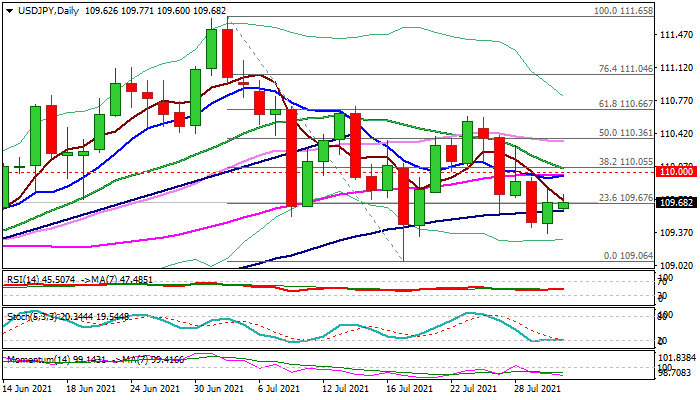
The USDJPY remains constructive in early Monday after last week's fall stalled on approach to daily cloud base and Friday's bullish close, but recovery is still fragile and needs more evidence to confirm reversal.
Last week's large bearish candle (the pair was down 0.7% for the week) weighs on recovery, along with bearishly aligned daily studies that keeps key 110 resistance zone (psychological, daily cloud top, converging 10/55/20 DMA's) out of reach for now.
Daily cloud base (109.29) and July 19 spike low (109.06) offer solid supports, loss of which would risk deeper correction of 2021 uptrend (102.59/111.65).
Res: 109.82, 110.12, 110.36, 110.59.
Sup: 109.60, 109.29, 109.06, 108.56.
US Dollar Gains Ground
The US dollar rallies on month-end flows
US inflation data disappointed on Friday, sending US yields lower once again. It was, therefore, surprising to see the US dollar actually rally instead, the greenback fishing the week on a firm note versus both developed and emerging market currencies. I put the US dollar strength down to two processes. Month-end investor portfolio rebalancing flows and haven buying to hedge weekend event risk.
The dollar index rose 0.30% to 92.09 on Friday, edging slightly lower to 92.05 in a non-descript Asian session. The dollar index is now mid-point between its breakout lower at 92.60 and structural support at 91.50, and also home to its 100 and 50-day moving averages. Versus the majors, another week of choppy range trading looms with a break of either 91.50 or 92.60, signalling the next big directional move.
EUR/USD faded at 1.1900 on Friday, with the single currency moving lower to close around 1.1875, where it remains today. A daily close above 1.1900 would signal a further rally targeting 1.2000. In the meantime, it looks supported on dips towards 1.1850. GBP/USD traced out a triple top at 1.3985 on Friday as it faded to finish at 1.3905. A fall through 1.3880 could see more of last week’s gains unwound; otherwise, resistance between 1.3985 and 1.4000 now looks formidable.
Both the Australian and New Zealand dollars fell by 0.60% on Friday as investors reduced risk exposure into the weekend. As a proxy for risk sentiment, which seems rather more cautious among currency markets than equity markets, both are likely to start the week in the middle of their one-week ranges between 0.7300 and 0.7400, and 0.6900 and 0.7000, respectively. The worsening Covid-19 situation is likely to keep the Australian dollar offered this week. However, if New Zealand employment data is robust tomorrow, the kiwi could potentially jump to near 0.7100 and outperform the AUD as traders’ pencil in imminent RBNZ rate hikes.
The PBOC set a neutral USD/CNY fixing this morning, leaving it trading unchanged today at 6.4640, comfortably within its recent 6.4500 to 6.4900 range. However, regional Asian currencies remain under pressure, notably my fragile four, the Indonesian Rupiah, Malaysian Ringgit, Thai Baht, and Indian Rupee. The Indian Rupee will find support from investor inflows to the equity market and low dollar purchases from oil importers. Of the remaining three, the Ringgit looks the most vulnerable.
Malaysia’s deepening Covid-19 and political crisis, with the government’s latest trick to shut down Parliament because of Covid-19 infection fears, both laughable and sparking protests in Kuala Lumpur. USD/MYR should retest 4.2400 this week and could potentially fall to 4.2800 if the political impasse deepens and the Malaysian King gets involved once again.