

Sample Category Title
Dollar Slips As US Numbers Miss Target
US dollar falls on US data
The retreat by the US dollar continued overnight, as US GDP and Initial Jobless Claims reinforced transitory inflation sentiment, flattening the US yield curve. The dollar index fell by 0.45% to 91.88, although delta-variant nerves in Asia has lifted it slightly higher to 91.96 this morning. Rallies should now be limited to 92.20, and the index will be eyeing its critical medium term pivot level at 91.50 next week. That is a clearly denoted support line and also the 50 and 100-day moving averages (DMAs). Failure will signal further directional losses targeting 89.50.
EUR/USD continued to rally overnight, the single currency powering through resistance at 1.1850 on its way to a 0.40% gain to 1.1887. The 1.1850 zones should limit losses now, and EUR/USD should test 1.1900 by the end of the week and target further increases to 1.975, the 100-DMA, early next week. GBP/USD broke through its 100-DMA at 1.3925 as it rose 0.40% to 1.3960 overnight with a close above the 1.4000 level, signalling further gains next week.
USD/JPY continues to wilt, falling to 109.50 overnight as the US yield curve flattens. USD/JPY remains a US/Japan yield differential play, and until US rates start to move higher, USD/JPY will struggle to hold onto gains above 110.00. A loss of 109.00 targets 108.20.
The weakness of the US dollar overnight saw the Chinese yuan fixed substantially stronger today, although that was in line with movements in the basket. USD/CNY was fixed 350 points lower at 6.4602 this morning, leaving USD/CNY near the bottom of its recent 6.4500 to 6.4900 range. Notably, that has not translated into strength across regional Asian currencies, with US dollar strength confined to the major currencies and the yuan. USD/THB, USD/IDR and USD/KRW fell overnight modestly but have swiftly risen to near recent highs this morning, with only the Singapore dollar continuing to hold onto its recent gains.
With Singapore’s vaccination programme racing at breakneck speed, it seems that the delta-discount remains firmly applied to its regional peers. Until Asia as a whole gets on top of Covid-19, Asian regional currencies will remain under pressure. On that note, the Malaysian ringgit heads into the weekend, looking particularly vulnerable. USD/MYR is near its recent highs, trading at 4.2340 this morning. The disastrous Covid-19 situation continues to lurch from bad to worse. The picture for the ringgit has got cloudier still after the Malaysian King rebuked the Prime Minister yesterday, raising the spectre that the government or the PM will fall over the weekend. USD/MYR could strengthen to 4.2800 next week as the country’s political and virus crisis deepens, with no solace being found from higher oil prices.
The Analytical Overview Of The Main Currency Pairs
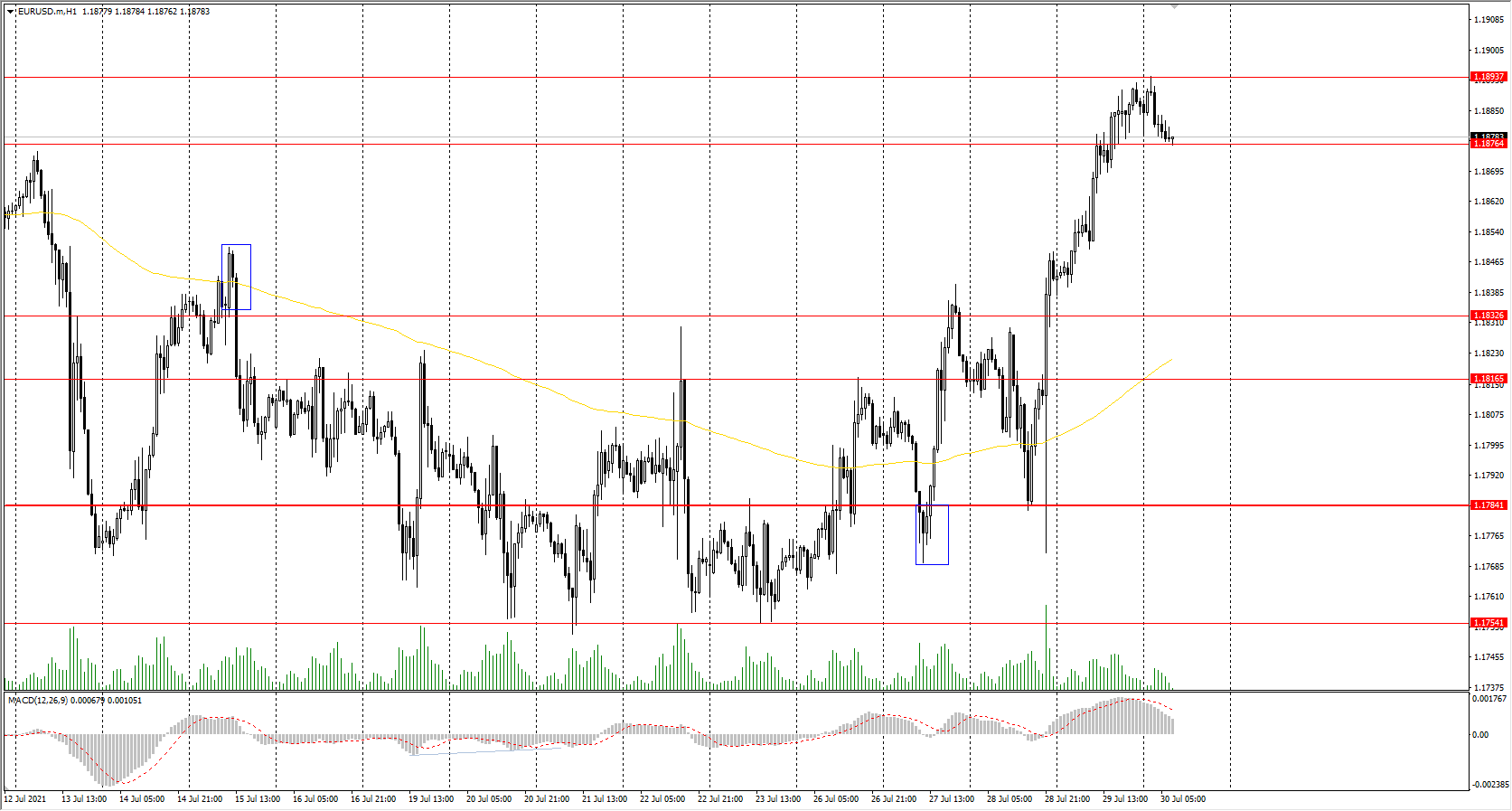
The EUR/USD currency pair
Technical indicators of the currency pair:
Prev Open: 1.1842
Prev Close: 1.1886
% chg. over the last day: +0.37%
As the dollar index fell, the European currency strengthened by 0.37%, despite the rising inflation in Germany to 3.8% in July, the highest level since 2008. The rise in inflation is primarily triggered by higher energy prices and a reduction in VAT (Valued Added Tax), which Angela Merkel's government had introduced to mitigate the effects of the pandemic. At the same time, Germany's unemployment rate decreased to 5.7% (from 5.9%).
Trading recommendations
Support levels: 1.1876, 1.1833, 1.1817, 1.1784, 1.1754, 1.1609
Resistance levels: 1.1894, 1.1934, 1.1969
From the technical point of view, the general trend of the EURUSD currency pair has changed to bullish as the price broke through the priority change level. The price is trading above the moving average; the MACD indicator is in the positive zone with no signs of divergence. Under such market conditions, it is best to trade intraday. Buy positions should be considered only after a pullback to the support level, as the price has strongly deviated from the moving average. Sell deals should be considered from the resistance levels, but that would be trading against the mid-term trend.
Alternative scenario: if the price breaks down through the 1.1784 support level and fixes below, the mid-term uptrend is likely to be broke
News feed for 2021.07.30:
- Germany GDP (q/q) at 11:00 (GMT+3);
- Eurozone Consumer Price Index (m/m) at 12:00 (GMT+3);
- Eurozone GDP (q/q) at 12:00 (GMT+3);
- Eurozone Unemployment Rate (m/m) at 12:00 (GMT+3);
- US PCE price index (m/m) at 15:30 (GMT+3);
- US Chicago PMI (m/m) at 16:45 (GMT+3).
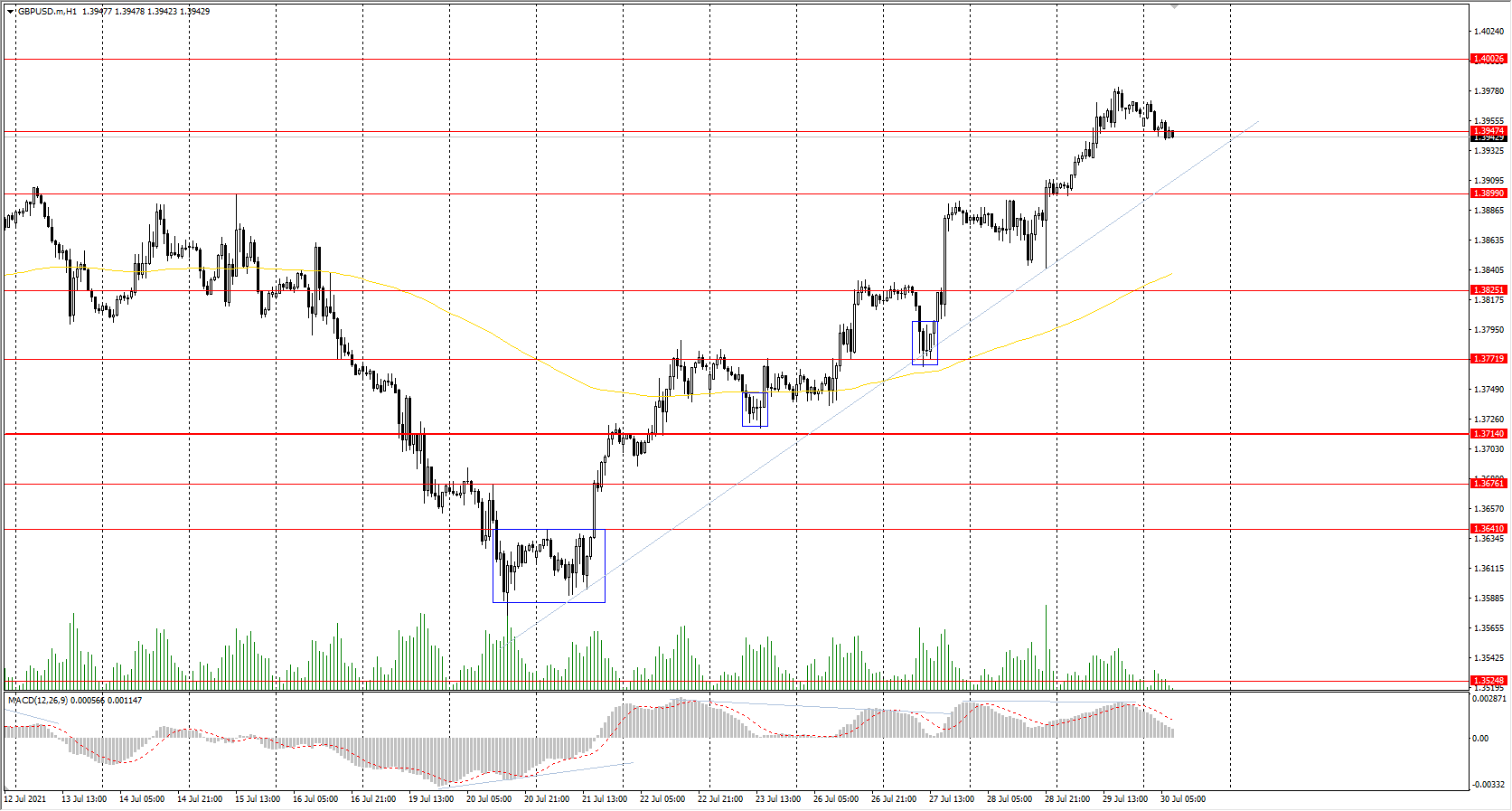
The GBP/USD currency pair
Technical indicators of the currency pair:
Prev Open: 1.3900
Prev Close: 1.3961
% chg. over the last day: +0.43%
Against the background of the dollar index fall, the British pound gained another 0.43%. According to the International Monetary Fund (IMF) report, the UK economy will recover the fastest among all European countries. It should be noted, though, that the UK has suffered most of the coronavirus epidemic among the G7 countries.
Trading recommendations
Support levels: 1.3900, 1.3825, 1.3772, 1.3714, 1.3676 ,1.3641, 1.3614, 1.3525
Resistance levels: 1.3947, 1.4002, 1.4075, 1.4101
The GBP/USD currency pair trend is bullish on the H1 timeframe. The MACD indicator is in the positive zone but with signs of divergence. Under such market conditions, traders are better to look for buy positions after the price pulls back to the support level. There are no optimal points for sell positions right now. Traders can search for intraday sell entries from the resistance level with short targets, but they should understand that it will be trading against the main trend.
Alternative scenario: if the price breaks down through the 1.3714 support level and consolidates below, the bearish scenario is likely to resume.
The USD/JPY currency pair
Technical indicators of the currency pair:
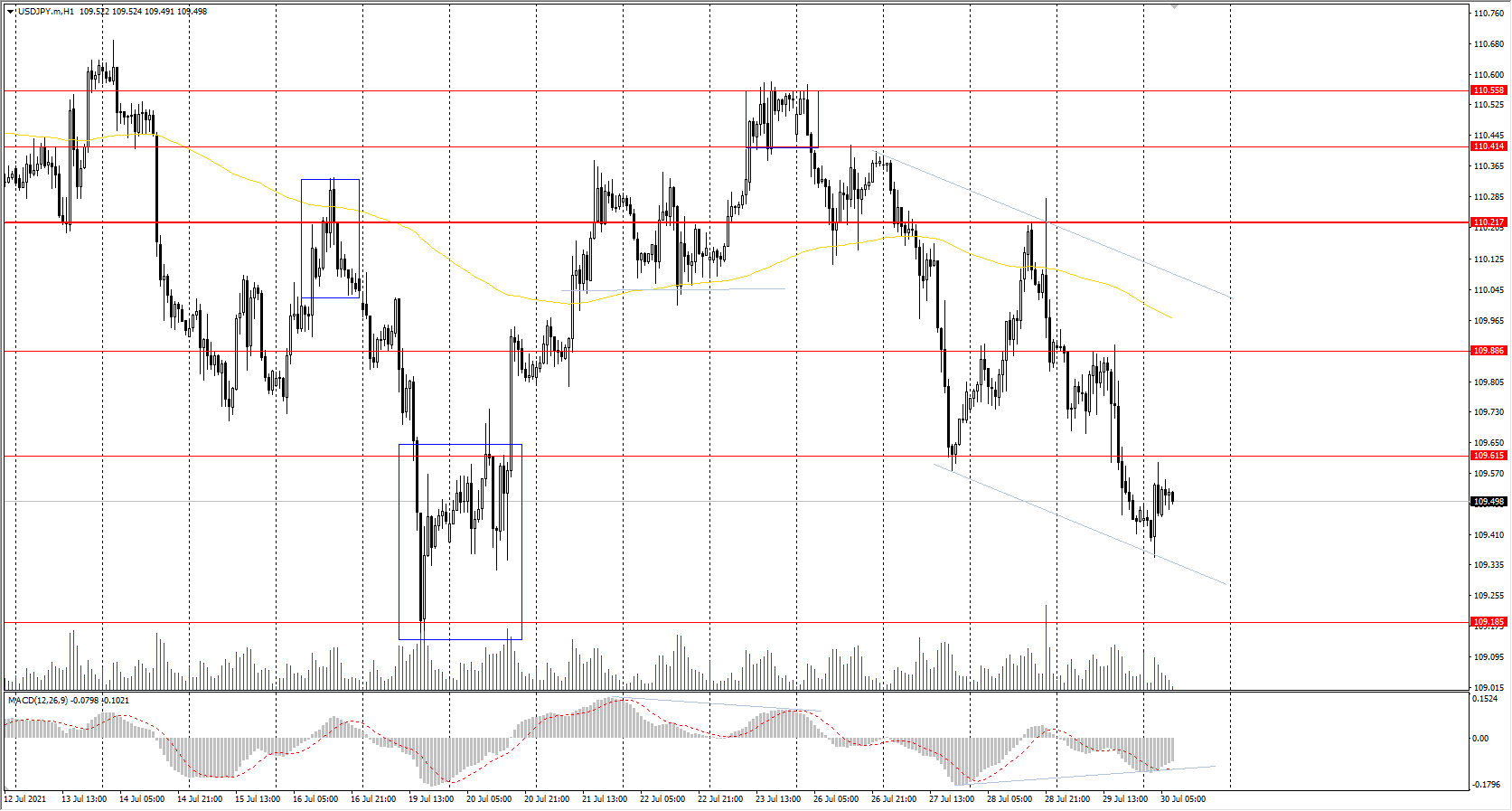
Prev Open: 109.86
Prev Close: 109.48
% chg. over the last day: -0.35%
The USD/JPY currency pair decreased by 0.35% amid the background of the dollar index fall, breaking through the priority change level. Japan's unemployment rate decreased to 2.9% (previous 3.0%), while the job availability ratio increased (113 job openings for every 100 job seekers). Japan's economy is now slowly but surely recovering, which also adds strength to the national currency.
Trading recommendations
Support levels: 109.19, 108.65
Resistance levels: 109.61, 109.88, 110.22, 110.41, 110.56
The main trend of the USD/JPY currency pair has changed to bullish again. The price is trading below the moving average, with the MACD indicator in the oversold zone with signs of divergence. Under such market conditions, it is best to look for sell positions from the resistance levels, but after a small pullback, as the price has strongly deviated from the moving average. Buy positions can be considered only intraday and only with short targets.
Alternative scenario: if the price rises above 110.22, the uptrend is likely to be resumed.
News feed for 2021.07.30:
- Japan Unemployment Rate (m/m) at 02:30 (GMT+3).
The USD/CAD currency pair
Technical indicators of the currency pair:
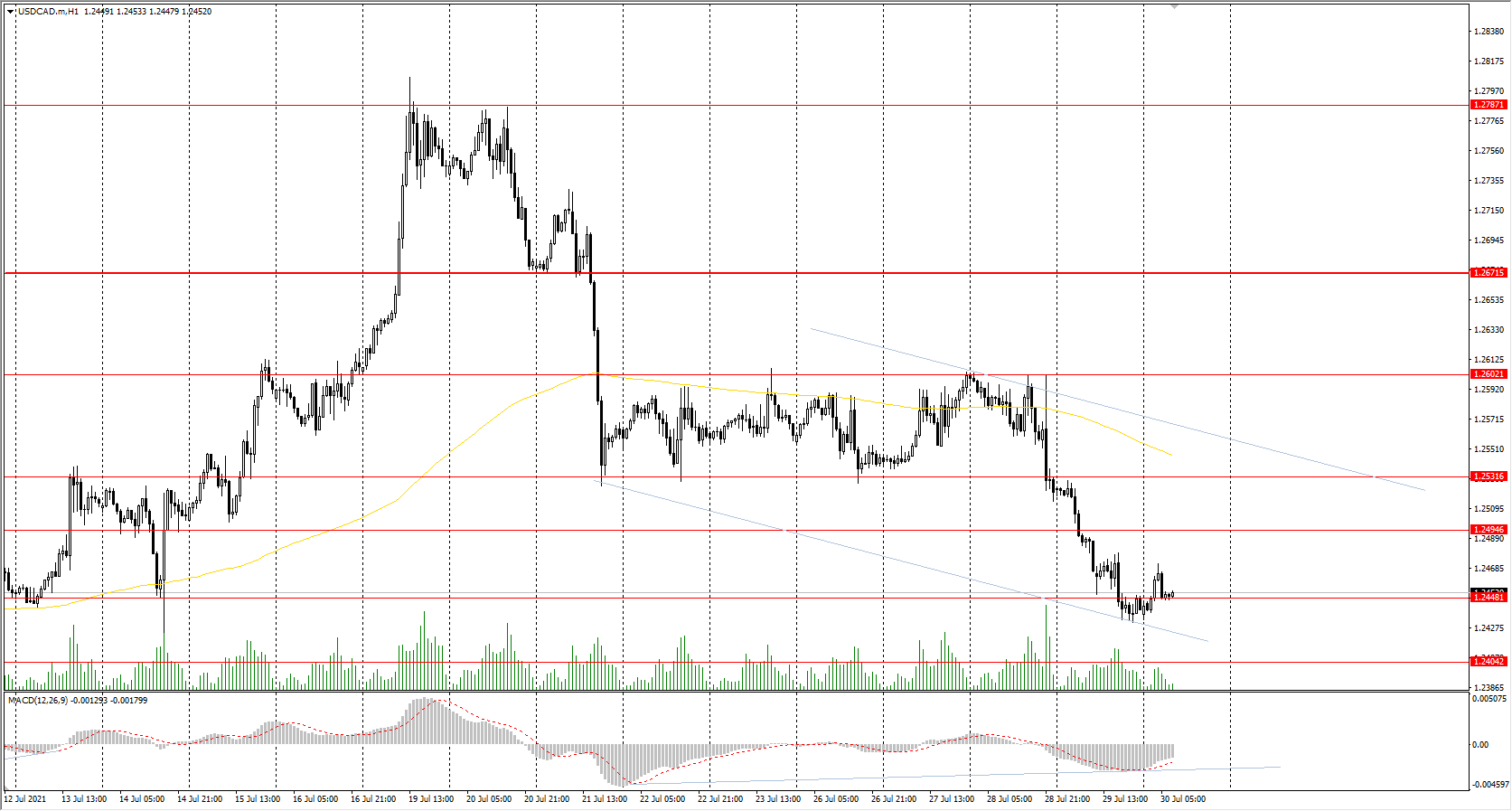
Prev Open: 1.2523
Prev Close: 1.2440
% chg. over the last day: -0.67%
Against the background of rising oil prices, and taking into account the fall of the dollar index, the Canadian dollar futures strengthened sharply yesterday, which led to a drop in USD/CAD quotes (inverse correlation). The economic situation in Canada looks better than in the US as Canada has seen a slowdown in inflation and improving labor market indicators.
Trading recommendations
Support levels: 1.2448, 1.2404, 1.2347, 1.2312
Resistance levels: 1.2495, 1.2531, 1.2602, 1.2671, 1.2787, 1,2951
From the point of view of technical analysis, the USD/CAD trend is bearish. The MACD indicator is in the negative zone, but there are the first signs of divergence on the higher timeframe. Under such market conditions, it is best for traders to look for sell positions from the resistance levels after a small pullback. Buy positions can be considered only intraday and only with short targets.
Alternative scenario: if the price breaks out through the 1.2671 resistance level and fixes above, the uptrend is likely to be resumed.
News feed for 2021.07.30:
- Canada GDP (m/m, q/q) at 15:30 (GMT+3).
Eurozone CPI rose to 2.2% yoy in Jul
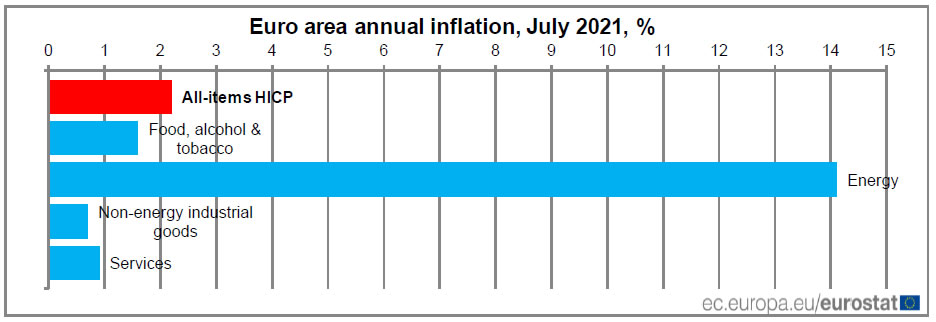
Eurozone CPI rose to 2.2% yoy in July, up from 1.9% yoy, above expectation of 2.0% yoy. Energy is expected to have the highest annual rate in July (14.1%, up from 12.6%), followed by food, alcohol & tobacco (1.6%, up from 0.5%), services (0.9%, up from 0.7%) and non-energy industrial goods (0.7%, down from 1.2%).
Eurozone unemployment rate dropped to 7.7% in Jun, EU dropped to 7.1%
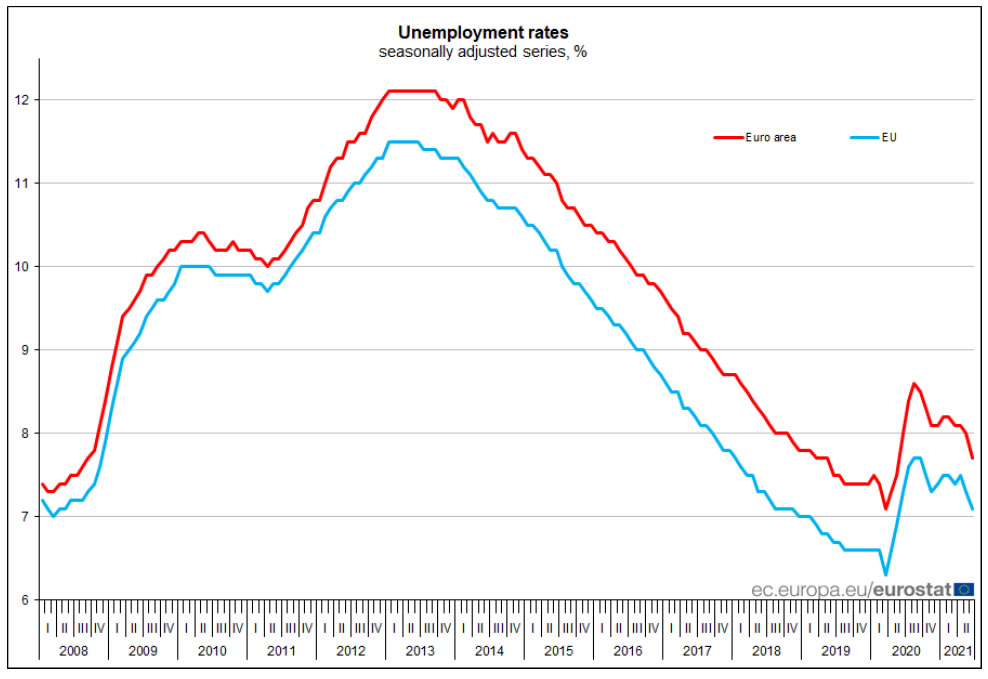
Eurozone unemployment rate dropped to 7.7% in June, down from 8.0%, better than expectation of 7.9%. EU Unemployment rate dropped to 7.1%, down from 7.3%.
Eurostat estimated that 14.916m people were unemployment in EU, of whole 12.517m in the Eurozone.
Amazon Pulled Down The Technology Sector
Last quarter, US GDP increased to 6.5% (previous 6.4%) in annual terms, significantly lower than 8.5% expected by economists. Weekly jobless claims fell to 400,000 (previous 424,000), but also below expectations of 382,000. Against the background of this data, the dollar index fell to a monthly minimum, but it did not prevent the US stock market from closing in the green zone. The major indices increased due to a strengthening of the consumer goods sector as well as the oil and gas sector. At the close of the New York Stock Exchange, the Dow Jones increased by 0.44%, the S&P 500 increased by 0.42%, and the Nasdaq technology index added 0.11%. But after the market closed, AMZN reported for the previous quarter. The company's revenue was up but below expectations. Also, the online giant lowered its forecast for the third quarter, which led to a sharp drop in prices by more than 7%. Such a drop undoubtedly affected the Nasdaq index as well, which fell sharply by more than 1%. It suggests that AMZN is the driver of the Nasdaq index. Despite the positive report, Facebook's stock price also decreased yesterday. However, Ford Motors stock, on the other hand, increased by 3.8%. The US automaker recorded a net profit in 2Q2021, although the figure is half as much as a year earlier.
European stock indexes increased yesterday. The Stoxx Europe 600 composite index of the region's largest companies increased by 0.46%, the British FTSE 100 index added 0.88%, the German DAX increased by 0.45%, and the French CAC 40 gained 0.37%. Royal Dutch Shell Plc (+3.8%), Nokia Corp (+4.6%), and Volkswagen AG (+1.7%) were the biggest gainers. Inflation in Germany increased to 3.8% in July, the highest level since 2008. The rise in inflation is primarily due to higher energy prices and a reduction in VAT (Valued Added Tax), which Angela Merkel's government introduced to mitigate the effects of the pandemic. At the same time, Germany's unemployment rate decreased to 5.7% (previous 5.9%). According to the International Monetary Fund (IMF) report, the UK economy will recover the fastest among all European countries. It should be noted that the UK has suffered most of the coronavirus epidemic among the G7 countries. Today, the eurozone will report on the level of inflation and the status of the labor market.
Gold prices continue to rise. Gold is highly correlated to the dollar index and US Treasury bond yields. Fundamentally, as long as the Fed maintains the soft monetary policy, precious metal prices will tend to rise. But over the long term, gold has lost its lead as a defensive asset.
Oil prices continue to rise slowly. The fundamental picture is now in favor of rising prices. But don't count on a sharp rise in prices, as OPEC+ is increasing daily oil production to compensate for the high demand in summer. On the other hand, it is worth paying attention to natural gas, which has been rising steadily since May and still has room for further growth.
The Chinese authorities managed to calm the panic sell-off in technology and education stocks. China has said it will continue to allow companies to IPO in the US if they meet all listing requirements. But despite this, the Asian stock market demonstrated its biggest monthly drop since last March. Japan's unemployment rate decreased to 2.9% (previous 3.0%), while the job availability ratio increased (113 job openings for every 100 job seekers). But Japan's Nikkei index fell by 1.71%, recording its 11th consecutive month of declines. Australia's ASX 200 index decreased by 0.08%. The country's producer price index rose by 2.2% annually and by 0.7% quarter-over-quarter in the second half of 2021. There is a decline in the delta variant cases of COVID-19 in Sydney.
Main market quotes:
- S&P 500 (F) 4,419.15 +18.51 (+0.42%)
- Dow Jones 35,084.53 +153.60 (+0.44%)
- DAX 15,640.47 +70.11 (+0.45%)
- FTSE 100 7,078.42 +61.79 (+0.88%)
- USD Index 91.90 -0.42 (-0.45%)
Important events for today:
- Japan Unemployment Rate (m/m) at 02:30 (GMT+3);
- Germany GDP (q/q) at 11:00 (GMT+3);
- Eurozone Consumer Price Index (m/m) at 12:00 (GMT+3);
- Eurozone GDP (q/q) at 12:00 (GMT+3);
- Eurozone Unemployment Rate (m/m) at 12:00 (GMT+3);
- Canada GDP (m/m, q/q) at 15:30 (GMT+3);
- US PCE price index (m/m) at 15:30 (GMT+3);
- US Chicago PMI (m/m) at 16:45 (GMT+3).
Stocks Falter Again, Bruised Dollar Seeks To End Losing Streak
- Market mood sours again as China crackdowns, mixed earnings and Delta fears all weigh
- Dollar halts slide but struggles to regain positive footing after dovish Fed and soft data
- Pound sets sights on $1.40 as others lag, gold battles to reclaim $1,830/oz
Mixed week for stocks as risks mount
Regulatory crackdowns in China, ongoing concerns about the Delta variant and warnings of slower earnings growth ahead all came to a head this week when it was meant to be all about the Fed. Instead, the Fed’s snail-paced approach to debating QE withdrawal has put taper fears on the back burner, while new risks have emerged.
Stocks in China were back in the red on Friday as the damage inflicted on investor confidence by the recent clampdowns on private enterprises by Chinese authorities appears to run a bit deeper than initially feared. Regulators had managed to temporarily calm the market panic yesterday, but it seems that their reassurances that the crackdowns were a one-off and won’t be widened to further industries didn’t go far enough.
The CSI 300 index was last trading 0.8% lower, on track for losses of more than 5% for the week. Most other Asian indices were down too, while the major European bourses started the day 1% lower as US stock futures slid.
Amazon.com reported revenue that was less than expected on Thursday, and even though earnings per share beat the estimates, its warning that sales growth would slow in the third quarter hit sentiment in broader equities. Nasdaq futures were last down 1.3%.
Although the earnings season isn’t over yet, the fact that two of Wall Street’s tech juggernauts (the other being Facebook) have said they are not anticipating revenue growth to keep pace with recent quarters doesn’t bode well for the rally. For many investors, this was the proof they needed that we’ve reached peak growth, and with virus cases still rising in many countries, including the US, the second half could be a more challenging time for equities.
Dollar steadies, pound, euro and loonie are week’s winners
The stock market jitters helped the US dollar steady somewhat, though its index against a basket of currencies was slipping again after rising slightly in overnight trade. Both the Japanese yen and Swiss franc were on the backfoot, however, which suggested that in the currency markets at least, the tone was improving as the week draws to a close.
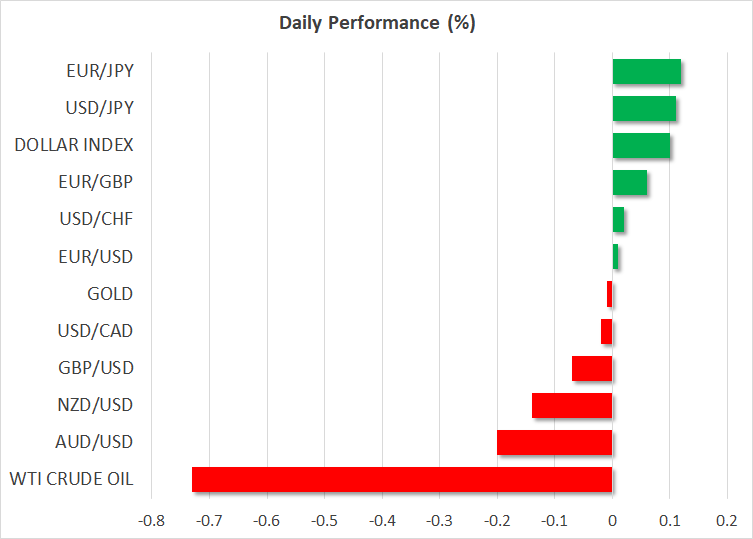
The British pound was aiming for a fifth straight day of gains, reaching a one month high of $1.3975 and setting its sights on the $1.40 level for its next target. The euro has also had an impressive run this week and is flirting with the $1.19 level after both French and Italian Q2 GDP numbers surpassed expectations. German growth fell somewhat short of estimates but overall, the Eurozone does not appear to be in much worse position than America.
The US economy expanded by a solid annualized rate of 6.5% in Q2, but analysts were expecting a more robust rate of 8.5%. Weekly jobless claims and pending home sales also disappointed, and the data together underlined the Fed’s caution on moving very slowly with any tapering plans.
This could weigh on the dollar against currencies such as the pound, loonie and euro where the domestic data has been comparable or even better lately. However, in countries where the previously rosy outlook is now at risk because of the Delta variant such as Australia and New Zealand, the dollar could continue to stand tall against its aussie and kiwi peers.
Gold gets stuck near $1,830, oil shrugs off market jitters
In commodities, gold held onto its post-Fed gains but appears to have met resistance around $1,830, which is a two-week high for the precious metal. If the dollar’s losses deepen in the coming days and Treasury yields remain subdued, the prospect for a break above this resistance is strong.
Meanwhile, the latest growth scares and stock market volatility have only had a mild dampening effect in oil as investors are still betting that demand will outstrip supply in the medium term. The evidence so far suggests that vaccines are effective in keeping hospitalizations low even as the Delta variant is causing a surge in infections in highly vaccinated populations. So markets are not at this point anticipating the lockdowns to spread to Europe and America, meaning a limited impact on oil demand from the increased virus curbs in Asia.
WTI and Brent crude futures were slightly down on Friday but on course for healthy weekly gains.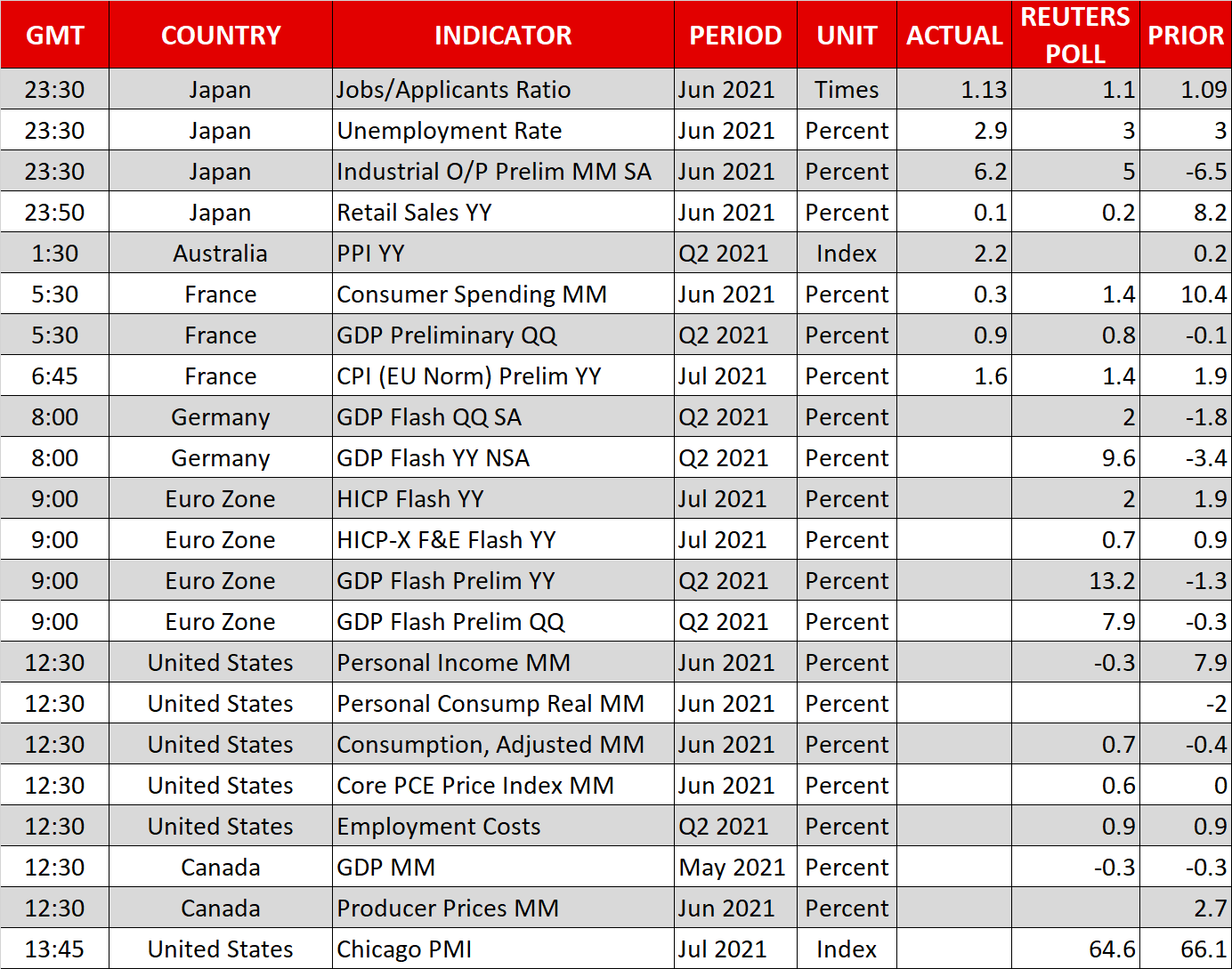
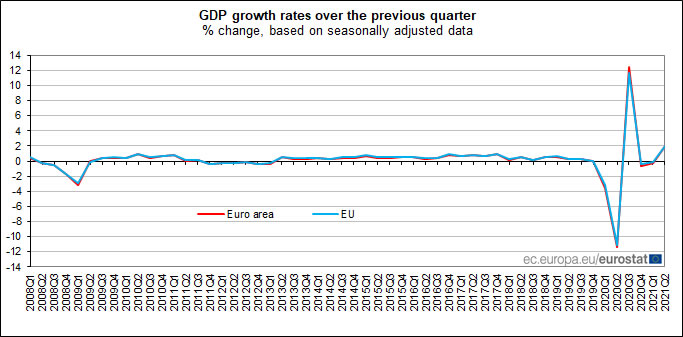
Eurozone GDP grew 2.0% qoq in Q2, EU up 1.9% qoq
Eurozone GDP grew 2.0% qoq in Q2, well above expectation of 1.5% qoq. EU GDP grew 1.9% qoq. Among the Member States for which data are available for the second quarter 2021, Portugal (+4.9%) recorded the highest increase compared to the previous quarter, followed by Austria (+4.3%) and Latvia (+3.7%), while Lithuania (+0.4%) and Czechia (+0.6%) recorded the lowest increase. The year on year growth rates were positive for all countries.
Asian Markets In Red Territory
Asian equities fall for no apparent reason
Asia equity markets have mostly fallen today, with North Asian markets leading the charge lower. This is in strong contrast to North America, where strong earnings and benign inflation expectations saw the leading indices rise once again to record highs. The S&P 500 rose by 0.42%, while the Nasdaq was weighed down by Amazon’s results but still finished 0.11% higher, and the Dow Jones climbed by 0.43%. All three indexes are wobbling in Asia, though, with futures on the Nasdaq plummeting by 1.30% in sympathy with China, while the S&P 500 futures have fallen 0.75% and the Dow Jones futures are 0.32% lower.
Meanwhile, the Nikkei 225 has slumped by 1.60%, with the Kospi falling 0.80%. In China, the Shanghai Composite is 0.35% lower, but the CSI 300 has tumbled by 1.30%, with Hong Kong plummeting by nearly 2.0%. Singapore has risen by 0.20%, but Kuala Lumpur, falling into more political and Covid disarray, has declined 0.40%, while Taipei is 0.20% down. Jakarta and Ho Chi Minh are higher by 0.45%, with Manila 0.10% higher, and Bangkok has risen by 0.20%. Australian markets are slightly lower, with the ASX 200 and All Ordinaries down by 0.20%.
The North Asia to ASEAN divergence is intriguing. The fact the tech-heavy Nasdaq futures have led US index futures lower suggests that they, and China, Japan, and South Korean markets are suffering a dose of pre-weekend China regulatory risk jitters. Notably, there is likely to be a lot of Covid bad news priced into ASEAN markets. With delta-variant nerves rising in North Asia, the combined China and delta risk may be causing some rotation into ASEAN markets as a defensive position.
A strong rally by the Sensex this afternoon in India would suggest that investors are rotating out of China, but unwilling to leave the Asian story, are looking for pastures new in other parts of the region. Going forward, depending on how the regulatory risk landscape evolves vis-a-vis China, ASEAN and India equity markets may find more friends from the international investor community than they have of late.
North Asia Catches A Friday Flu
North Asian equity heavyweights have deviated from the price action on Wall Street overnight, heading directly South this morning. Mainland China, Hong Kong, Japan and South Korean stock markets are all well and truly in the red, despite Wall Street shrugging of uninspiring US GDP and finishing higher overnight.
I cannot see any particular headlines driving the fall this morning in Asia and can only speculate that a combination of factors may be driving investor sentiment. A Friday “delta-dip” is undoubtedly one factor, with Covid-19 cases rising in Japan, South Korea and appearing in three provinces in China. China also releases official Manufacturing and Non-Manufacturing PMIs this weekend. After some middling GDP and Jobless Claims data from the US overnight, that suggests the recovery remains on course, but at a slower pace, investors may be concerned the China PMIs could signal something similar.
Finally, with mainland and Hong Kong markets enduring a torrid week on Chinese government clampdowns and restrictions, the assurances from the central government that such measures are targeted and not broad, maybe falling on deaf ears with investors pondering weekend event risk. All in all, it looks like investors are taking risks of the table over the weekend. With sentiment remaining fragile, despite some stabilisation yesterday, the fast-money herds don’t need much to spook them.
US Advance GDP underperforms
Overnight, the US GDP printed at 6.50%, impressive but well below forecasts of 8.0%+, with a fall in inventories and those inevitable supply chain bottlenecks taking the edge of the numbers. Initial Jobless Claims rose to 394,500, which was disappointing, while Core PCE Prices rose by 6.10%. None of that was enough to shake off the transitory inflation espoused by Jerome Powell the day before post-FOMC. The US yield curve flattened once again as inflation lethargy deepened, which saw the US dollar drop and gold rally.
In Asia today, South Korean Industrial Production rose 2.20% for June, higher than expected, but Retail Sales only grew by 1.60%. Similarly, Japan Industrial Production MoM for June increased by 6.20%, above expectations; but Retails Sales MoM for June rose by 3.10%, recovering from their May slump. The data shows that both countries’ manufacturing and export engines continue to fire on all cylinders, with Japan officials noting the chip shortage is easing. However, the mixed domestic retail sales data, which will have taken a Covid git in July, suggests that the ongoing pandemic and slow vaccination rates will delay a full recovery by Asian economies ex-China over the coming months. It was clearly not enough to overcome weekend risk nerves for both stock markets.
German and Eurozone GDPs will be the highlights of the European session, along with Eurozone Inflation. German flash GDP should rebound by 2.0% for Q2, with Eurozone GDP rising 1.50%. Eurozone Inflation for July is expected to come in at 2.0%, right on the ECB’s target. The Euro’s recovery accelerated overnight, and strong reading from the data could see the single currency stage another powerful rally into the end of the week.
US Personal Spending is expected to rise 0.70% this evening, with Personal Income falling -0.30%. Core PCE Prices, a favourite Fed measure, are expected to increase by 0.60% MoM. With nothing seemingly able to shake US bonds markets out of their low inflation stupor, the weak side into the end of the week seems to be the downside. If the US data comes in higher, the US dollar, stocks and bonds are unlikely to react. However, if the data comes in lower, the US dollar is likely to take another fall, bond yields will move lower again, and the FOMO gnomes of Wall Street will buy everything.
Don’t discount delta, though. The US CDC published some scary data about infectiousness overnight, and US daily cases rose to just shy of 100,000. Countries such as Israel, meanwhile, are offering their over 60’s third Pfizer shots. A weekend delta discount is being applied in Asia today, and I don’t discount the discounting continuing into the US session close.
EUR/USD Pair Is Now Consolidating Losses Near The 1.1880 Support
The Euro found support near the 1.1770 zone and formed a support base against the US Dollar. The EUR/USD pair started a decent upward move above the 1.1800 resistance.
It surpassed the 1.1820 resistance level and settled above the 50 hourly simple moving average. There was also a break above a contracting triangle with resistance near 1.1822 on the hourly chart.
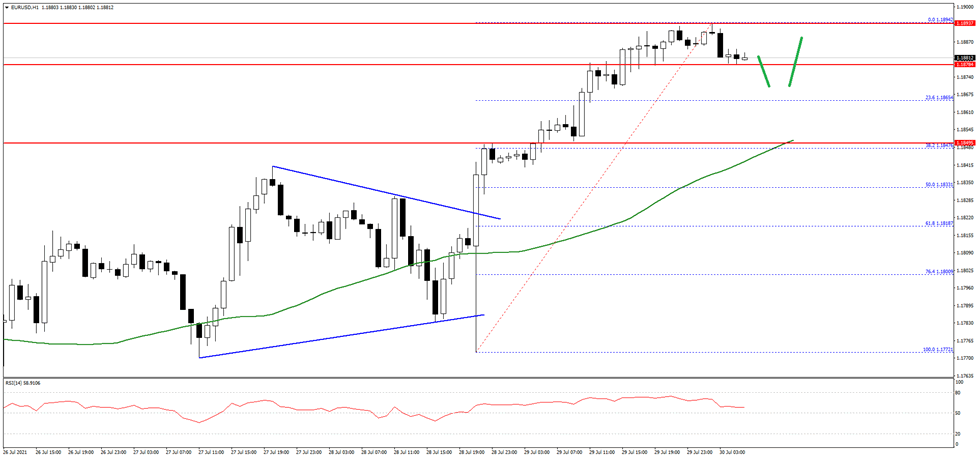
The pair climbed above 1.1850 and traded as high as 1.1894 on FXOpen. It is now consolidating losses near the 1.1880 support. An initial support is near the 1.1850 level, below which the pair could dive towards the 1.1800 level.
On the upside, an initial resistance is near the 1.1895 level. The first key resistance is near the 1.1900 level, above which the pair could rise steadily towards the 1.1950 level in the near term.