

Sample Category Title
Canada: GDP Declines for Second Straight Month in May
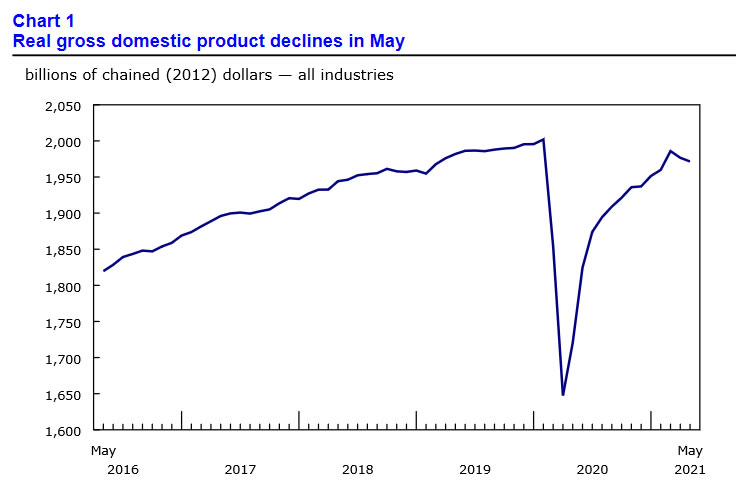
- The Canadian economy declined for the second straight month in May, contracting by 0.3%, in line with Statistic's Canada's preliminary estimate. This left GDP 1.5% below its pre-pandemic (February 2020) level.
- Along with May GDP data, Statistics Canada produced an advance estimate for June, which showed a 0.7% rise in GDP, coinciding with the lifting of restrictions across the country.
- By industry, both the goods (-0.4%) and services (-0.2%) sectors observed declines in May. On the goods side, construction (-2.3%) was especially weak as residential (-4.2%) and repair (-3.7%) construction took a tumble during the month. Manufacturing also dropped in May with output declining by 0.8%. The global microchip shortage continued to weigh on production in this sector.
- In terms of services, ongoing public health restrictions contributed to declines in the retail (-2.7%), accommodation and food (-2.4%), and arts, entertainment, and recreation (-2.5%) industries. The real estate and rental and leasing sector (-0.4%) also slipped, contracting for the second straight month. This was the first time this occurred since March-April 2020.
Key Implications
- May was another bleak month for the Canadian economy. The third wave of the pandemic and related restrictions weighed on activity, but this was compounded by the cooling residential sector. As housing sales and construction levels gradually return to more sustainable levels, this area of the economy could be a drag on growth in coming months.
- Looking ahead, the economy's two-month losing streak will end in June. Statistics Canada has indicated that output will probably see a significant improvement on the month as reopening took place across the country. Consumers returned to spending on high-contact services including in-person dining, recreation activities, and travel that had long been restricted to them. Indeed, high-frequency debit and credit card spending data suggests exactly this in June and early July.
- It may not be smooth sailing for the rest of the recovery. Economic gains are still very much tied to the whims of COVID-19. The Delta variant is wreaking havoc around the world, leading to a re-tightening of restrictions in some countries. Canada has so far avoided the worst of this virus, but cases are rising in some provinces. A fourth wave could lead to another stalling in the recovery though with relatively high rates of vaccination a full reversal appears less likely.
USD/JPY Mid-Day Outlook
Daily Pivots: (S1) 109.29; (P) 109.62; (R1) 109.82; More...
USD/JPY recovers mildly in early US session but stays well inside range of 109.05 and 110.58. Intraday bias remains neutral at this point. On the downside, break of 109.05 will resume the decline from 111.65. Next target is 38.2% retracement of 102.58 to 111.65 at 108.18. On the upside, break of 110.58 will resume the rebound from 109.05, for retesting 111.65 high.
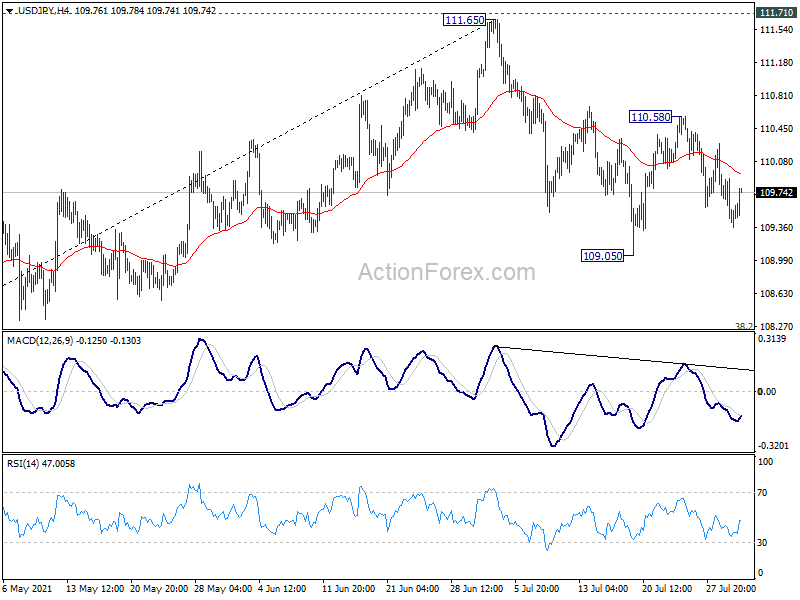
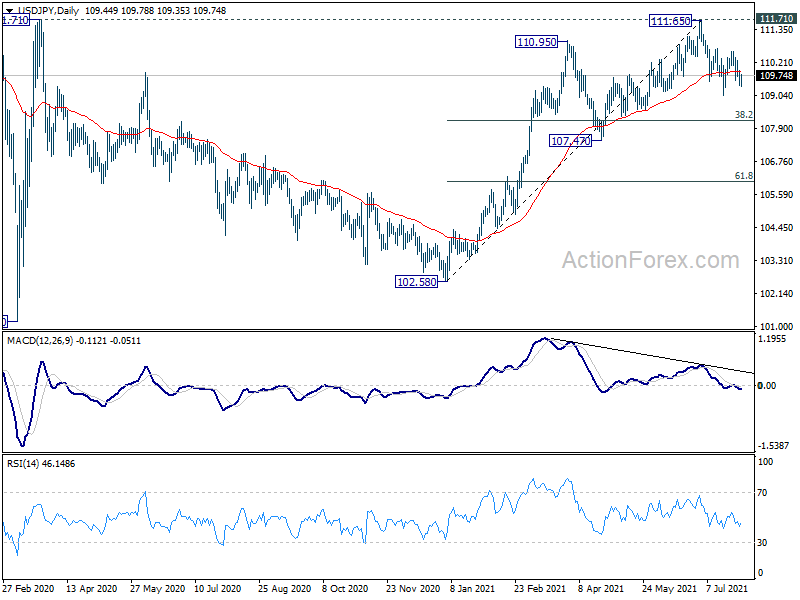
In the bigger picture, medium term outlook is staying neutral with 111.71 resistance intact. The pattern from 101.18 could still extend with another falling leg. Sustained trading below 55 day EMA will bring deeper fall to 107.47 support and below. For now, outlook won't turn bullish as long as 111.71 resistance holds, even in case of strong rebound.
Dollar Recovers after Personal Income and Spending, But Still the Worst Performer
Dollar recovers mildly in early US session, following slight weakness in risk sentiments. Additionally, stronger than expected personal income and spending are providing some support too. Still, the greenback remains the worst performing one for the week. There is prospect of Yen, Aussie or Kiwi overtaking Dollar as biggest loser, but we'll see. Meanwhile, Sterling is staying as the strongest one, followed by Swiss Franc.
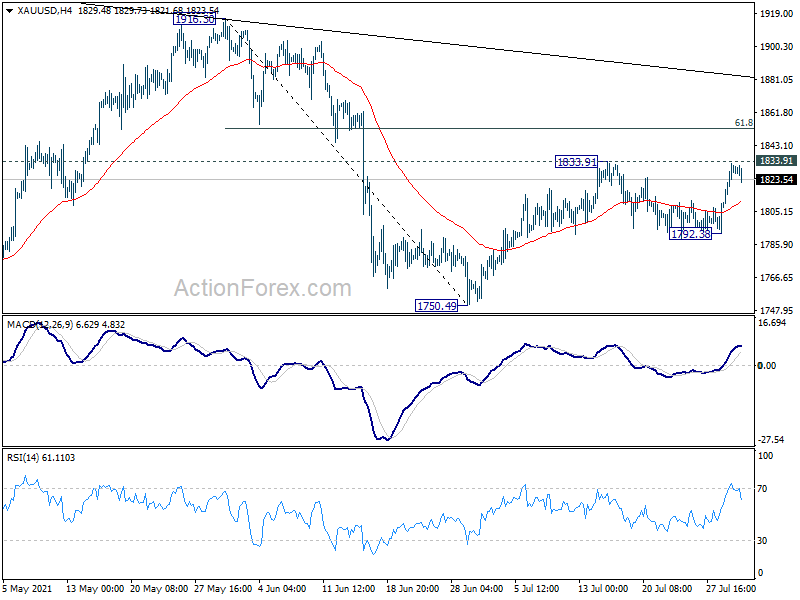
Technically, the rally is EUR/USD is a bit disappointing as it still couldn't get rid of 1.1880 resistance cleanly. At the same time, Gold also appears to rejected by 1833.91 resistance too, as it fails to resume rise from 1750.49. The greenback sellers might retreat for now and wait for another chance next week.
In Europe, at the time of writing, FTSE is down -0.72%. DAX is down -0.68%. CAC is up 0.02%. Germany 10-year yield rose 0.0035 to -0.443. Earlier in Asia, Nikkei dropped -1.80%. Hong Kong HSI dropped -1.35%. China Shanghai SSE dropped -0.42%. Singapore Strait Times dropped -0.43%. Japan 10-year JGB yield dropped -0.0018 to 0.020.
US PCE price index unchanged at 4% yoy in Jun, core PCE rose to 3.5% yoy
US personal income rose 0.1%, or USD 26.1B in June, better than expectation of -0.4% contraction. Personal spending rose 1.0%, or USD 155.4B, above expectation of 0.7%.
Headline PCE price index was unchanged at 4.0% yoy. Core PCE price index accelerated to 3.5% yoy, up from 3.4% yoy, but missed expectation of 3.7% yoy.
Canada GDP contracted -0.3% mom in May, to recover 0.7% in Jun
Canada GDP contracted -0.3% mom in May, matched expectations. Total economic activity remained approximately -2% below prepandemic level in February 2020. Overall, 12 of 20 industrial sectors contracted, with services-producing down -0.2% and goods-producing down -0.4%. Preliminary information indices that GDP would grow 0.7% in June, and 0.6% in Q2.
Eurozone GDP grew 2.0% qoq in Q2, EU up 1.9% qoq
Eurozone GDP grew 2.0% qoq in Q2, well above expectation of 1.5% qoq. EU GDP grew 1.9% qoq. Among the Member States for which data are available for the second quarter 2021, Portugal (+4.9%) recorded the highest increase compared to the previous quarter, followed by Austria (+4.3%) and Latvia (+3.7%), while Lithuania (+0.4%) and Czechia (+0.6%) recorded the lowest increase. The year on year growth rates were positive for all countries.
Eurozone unemployment rate dropped to 7.7% in June, down from 8.0%, better than expectation of 7.9%. EU Unemployment rate dropped to 7.1%, down from 7.3%. Eurostat estimated that 14.916m people were unemployment in EU, of whole 12.517m in the Eurozone.
Eurozone CPI rose to 2.2% yoy in July, up from 1.9% yoy, above expectation of 2.0% yoy. Energy is expected to have the highest annual rate in July (14.1%, up from 12.6%), followed by food, alcohol & tobacco (1.6%, up from 0.5%), services (0.9%, up from 0.7%) and non-energy industrial goods (0.7%, down from 1.2%).
Germany GDP grew 1.5% qoq in Q2, France GDP grew 0.9% qoq
Germany GDP grew 1.5% qoq in Q2, below expectation of 2.0% qoq. Comparing to Q2 2020, GDP was up a price-adjusted 9.6% and a a price- and calendar-adjusted 9.2%. GDP was still -3.4% lower compared to Q2 2019, before the pandemic.
France GDP grew 0.9% qoq in Q2, slightly above expectation of 0.8% qoq. GDP still stood -3.3% below the level of Q4 2019, before the pandemic.
Swiss KOF economic barometer dropped to 129.8, economy still on a strong expansion path
Swiss KOF economic barometer dropped from 133.3 to 129.8 in July. But the indicate is still clearly above the long-term average. KOF added, "the economy is still on a strong expansion path, although the high pace of recent months may not to be sustained."
"The outlook for manufacturing, foreign demand, construction, financial and insurance services as well as private consumption remains favourable but is not quite as positive as in the previous month. In contrast, the outlook for accommodation and food service activities and for other services is improving," KOF said.
Japan industrial production rose 6.2% mom in Jun
Japan industrial production rose 6.2% mom in June, above expectation of 5.0% mom. Output also revised much of the -6.5% mom decline in May. Manufacturers expected production to fall -1.1% mom in July and then rise 1.7% in August.
Also released, unemployment rate ticked down to 2.9% in June, down from 3.0%. Retail sales rose 0.1% yoy in May, slightly below expectation of 0.2% yoy. Housing starts rose 7.3% yoy in June versus expectation of 7.2% yoy.
USD/JPY Mid-Day Outlook
Daily Pivots: (S1) 109.29; (P) 109.62; (R1) 109.82; More...
USD/JPY recovers mildly in early US session but stays well inside range of 109.05 and 110.58. Intraday bias remains neutral at this point. On the downside, break of 109.05 will resume the decline from 111.65. Next target is 38.2% retracement of 102.58 to 111.65 at 108.18. On the upside, break of 110.58 will resume the rebound from 109.05, for retesting 111.65 high.
In the bigger picture, medium term outlook is staying neutral with 111.71 resistance intact. The pattern from 101.18 could still extend with another falling leg. Sustained trading below 55 day EMA will bring deeper fall to 107.47 support and below. For now, outlook won't turn bullish as long as 111.71 resistance holds, even in case of strong rebound.
Economic Indicators Update
| GMT | Ccy | Events | Actual | Forecast | Previous | Revised |
|---|---|---|---|---|---|---|
| 22:45 | NZD | Building Permits M/M Jun | 3.80% | -2.80% | -2.40% | |
| 23:30 | JPY | Unemployment Rate Jun | 2.90% | 3.00% | 3.00% | |
| 23:50 | JPY | Industrial Production M/M Jun P | 6.20% | 5.00% | -6.50% | |
| 23:50 | JPY | Retail Trade Y/Y May | 0.10% | 0.20% | 8.30% | |
| 01:30 | AUD | Private Sector Credit M/M Jun | 0.90% | 0.40% | 0.40% | 0.50% |
| 01:30 | AUD | PPI Q/Q Q2 | 0.70% | 0.50% | 0.40% | |
| 01:30 | AUD | PPI Y/Y Q2 | 2.20% | 0.20% | ||
| 05:00 | JPY | Housing Starts Y/Y Jun | 7.30% | 7.20% | 9.90% | |
| 05:30 | EUR | France Consumer Spending M/M Jun | 0.30% | 1.80% | 10.40% | 10.60% |
| 05:30 | EUR | France GDP Q/Q Q2 P | 0.90% | 0.80% | -0.10% | |
| 07:00 | CHF | KOF Leading Indicator Jul | 129.8 | 133.4 | 133.3 | |
| 08:00 | EUR | Germany GDP Q/Q Q2 P | 1.50% | 2.00% | -1.80% | |
| 08:00 | EUR | Italy GDP Q/Q Q2 P | 2.70% | 1.40% | 0.10% | 0.20% |
| 09:00 | EUR | Eurozone GDP Q/Q Q2 P | 2.00% | 1.50% | -0.30% | |
| 09:00 | EUR | Eurozone Unemployment Rate Jun | 7.70% | 7.90% | 7.90% | 8.00% |
| 09:00 | EUR | Eurozone CPI Y/Y Jul P | 2.20% | 2.00% | 1.90% | |
| 09:00 | EUR | Eurozone CPI Core Y/Y Jul P | 0.70% | 0.80% | 0.90% | |
| 12:30 | CAD | GDP M/M May | -0.30% | -0.30% | -0.30% | -0.50% |
| 12:30 | CAD | Industrial Product Price M/M Jun | 0.00% | -0.50% | 2.70% | |
| 12:30 | CAD | Raw Material Price Index Jun | 3.90% | 1.50% | 3.20% | |
| 12:30 | USD | Personal Income M/M Jun | 0.10% | -0.40% | -2.00% | -2.20% |
| 12:30 | USD | Personal Spending Jun | 1.00% | 0.70% | 0.00% | -0.10% |
| 12:30 | USD | PCE Price Index M/M Jun | 0.50% | 0.40% | 0.50% | |
| 12:30 | USD | PCE Price Index Y/Y Jun | 4.00% | 3.90% | 4.00% | |
| 12:30 | USD | Core PCE Price Index M/M Jun | 0.40% | 0.60% | 0.50% | |
| 12:30 | USD | Core PCE Price Index Y/Y Jun | 3.50% | 3.70% | 3.40% | |
| 12:30 | USD | Employment Cost Index Q2 | 0.70% | 1.00% | 0.90% | |
| 13:45 | USD | Chicago PMI Jul | 64 | 66.1 | ||
| 14:00 | USD | Michigan Consumer Sentiment Index Jul F | 80.5 | 80.8 |
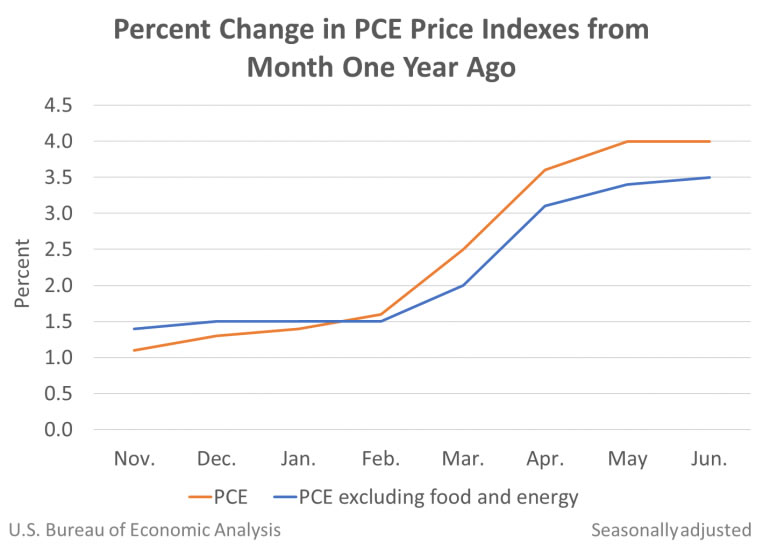
US PCE price index unchanged at 4% yoy in Jun, core PCE rose to 3.5% yoy
US personal income rose 0.1%, or USD 26.1B in June, better than expectation of -0.4% contraction. Personal spending rose 1.0%, or USD 155.4B, above expectation of 0.7%.
Headline PCE price index was unchanged at 4.0% yoy. Core PCE price index accelerated to 3.5% yoy, up from 3.4% yoy, but missed expectation of 3.7% yoy.
Canada GDP contracted -0.3% mom in May, to recover 0.7% in Jun
Canada GDP contracted -0.3% mom in May, matched expectations. Total economic activity remained approximately -2% below prepandemic level in February 2020. Overall, 12 of 20 industrial sectors contracted, with services-producing down -0.2% and goods-producing down -0.4%. Preliminary information indices that GDP would grow 0.7% in June, and 0.6% in Q2.
Will GDP Rain On Canadian Dollar’s Parade?
The Canadian dollar has enjoyed an excellent week, with gains of 1.0%. With key events on both sides of the border as we wrap up the week, we could see some strong movement from USD/CAD in the North American session.
The US dollar remains under pressure after the dovish FOMC meeting. Jerome Powell has stayed consistent with his message that the surge in US inflation is transitory. Powell was non-committal about a taper, saying that nonfarm payrolls would have to show substantial improvement before a September taper could be considered.
There are two key events later today which could have a significant impact on the movement of USD/CAD. Canada releases the GDP report for May. The consensus stands at -0.3%, a repeat of the April reading. This points to a lack of economic growth, as Covid continues to weigh on the economy. Over in the US, we'll get a look at the Fed's preferred inflation indicator, Core PCE Prices. A gain of 0.6% MoM is expected in June, up slightly from the previous reading of 0.4%.
US GDP, unemployment claim miss forecast
US data was a disappointment, and the major haves jumped on the greenback and sent it broadly lower. Advanced GDP for the second quarter rose 6.5%. This is certainly a sharp gain, but well short of the consensus of 8.5%. Unemployment claims also missed the consensus, as both initial and continuing claims were slightly higher than anticipated. The soft data dovetails with the Fed stance that there is no danger of the economy overheating and that monetary stimulus is required given the current economic conditions.
USD/CAD Technical
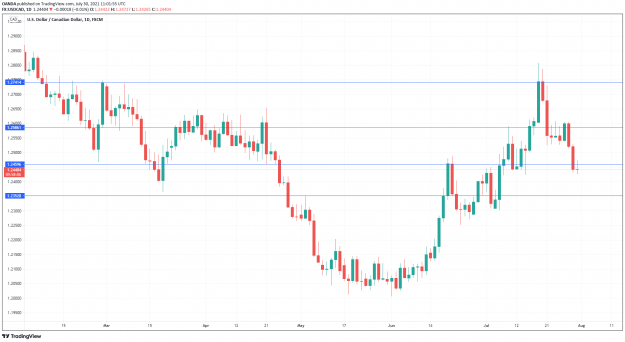
- USD/CAD faces a monthly resistance line at 1.2586. Above, there is resistance at 1.2741
- On the downside, the pair continues to test support at 1.2459. Below, there is support at 1.2352
Euro Unchanged On Mixed GDP Data
The euro is in green territory for a fifth successive day as the dollar continues to show broad weakness. EUR/USD is up 1.1% this week and is poised to record its best week since May.
German CPI outperforms target
The markets are being treated to a data dump in Europe, highlighted by inflation and GDP reports. Eurozone inflation for July came in at 2.2% YoY, above the consensus of 2.0%, which is the new ECB target. This comes on the heels of German Preliminary CPI, which also was stronger than forecast. CPI rose 3.8%, above the estimate of 3.3%. If inflation continues to rise, the ECB will have to give more thought to tightening policy in order to curb inflation. As has been in the case in recent months with the Federal Reserve and Bank of England, inflation in eurozone has emerged as a market-mover, after years of weak inflation was all but ignored by the markets.
German and eurozone GDP reports (QoQ) rebounded in the second quarter. Germany’s economy grew by 1.5%, shy of the consensus of 2%, but a welcome improvement from the Q1 reading of -1.5%. Eurozone GDP rose 2.0%, above the estimate of 1.5% and ahead of the previous read of -0.3%.
The US dollar remains under pressure after the dovish FOMC meeting. The markets have bought into Jerome Powell’s consistent message that higher inflation is transitory. Powell stated at the meeting that a September taper would be dependent on the employment sector showing substantial improvement. In the US, GDP and unemployment claims missed their targets, which has dovetailed nicely with the Fed’s stance that inflation will ease and the economy is still in need of substantial monetary stimulus.
EUR/USD Technical
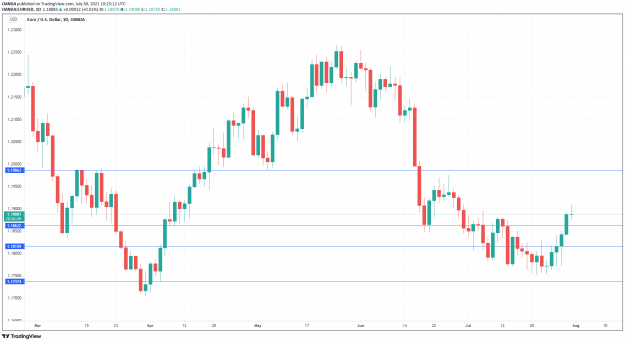
- EUR/USD is testing resistance at 1.1862. Above, there is a monthly resistance at 1.1986, which is protecting the symbolic 1.20 line
- On the downside, there are support lines at 1.1815 and 1.1737
EUR/CHF At The Strong Support
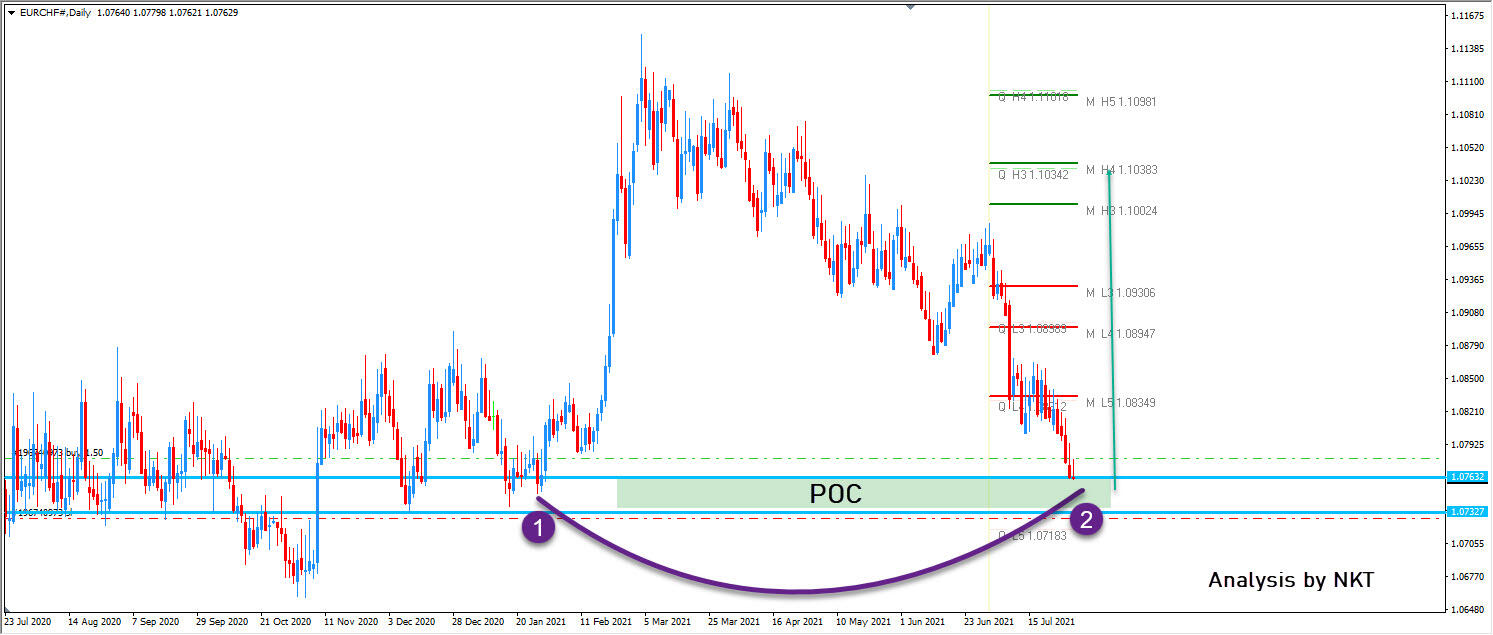
The EUR/CHF has had a big drop but its at an important support zone now. Buying the support might be a good option.
We have two distinctive points for a velly for buyers. Historical and present support are close together. 1.0732-1.0765 is the zone. This market is slow so it will take some time to kick in. Pay attention to all these M Pivots - monthly pivots at the chart because they are all potential TP levels. If the zone holds we will go up.
Euro Region Returns To Growth In Q2
Notes/Observations
- Various EU GDP data showed a rebound in economic activity and was expected to continue.
- German economy returned to growth in Q2 but bounced back less strongly than expected.
- Risk aversion sentiment from Amazon’s warning and a fresh China selloff spilled over into EU trading session.
Asia
- Japan Jun Jobless Rate: 2.9% v 3.0%e.
- Japan Jun Preliminary Industrial Production M/M: 6.2% v 5.0%; Y/Y: 22.6% v 20.7%e.
- Japan Jun Retail Sales M/M: 3.1% v 2.7%e ; Y/Y: 0.1% v 0.2%e.
- BOJ Noguchi stated that might be able to begin debate on strategy for hitting price target around end 2021. BOJ must ease if economy suffered a severe downturn.
Europe
- ECB's De Guindos (Spain) noted that the normalization of monetary policy, and equally of fiscal policy, followed the normalization of the economy.
- Speculation that Chancellor of the Exchequer Sunak (Fin Min) might delay of the 2022 budget was said to be gaining traction after he instructed the OBR to publish new forecasts without announcing an accompanying fiscal event.
Speakers/Fixed income/FX/Commodities/Erratum
Equities
- Indices [Stoxx600 -0.48% at 461.60, FTSE -0.73% at 7,027.05, DAX -0.80% at 15,515.60, CAC-40 -0.10% at 6,627.42, IBEX-35 -0.69% at 8,726.00, FTSE MIB -0.36% at 25,424.50, SMI -0.10% at 12,074.38, S&P 500 Futures -0.65%].
- Market Focal Points/Key Themes: European indices open generally lower but moderated losses as the session progressed; the only sector starting the day in the green was financials; while materials and health care sectors lead to the downside; Unicredit looking to acquire Monte Dei Paschi; focus on European bank stress test results after end of trading day; Heineken takes controlling interest in United Breweries; Neil to take larger stake of Illiad; earnings expected in the upcoming US session include Aon, Huntsman, Linde and Caterpillar.
Equities
- Consumer discretionary: International Consolidated Airlines [IAG.UK] -3% (earnings).
- Financials: BNP Paribas [BNP.FR] +1% (earnings), Unicredit [UCG.IT] +5% (earnings).
- Industrials: Renault [RNO.FR] +2.5% (earnings), Leonardo [LDO.IT] +2% (earnings), Vinci [DG.FR] +1% (earnings), Babcock International Group [BAB.UK] -12% (earnings).
- Technology: AMS [AMS.CH] +1% (earnings).
- Telecom: Iliad [ILD.FR] +60% (offer; earnings).
Speakers
- France Fin Min Le Maire maintained its 2021 GDP growth forecast at 6.0%. To spend 70% of stimulus plan by end-2021.
- South Africa Central Bank (SARB) Gov Kganyago: Upcoming harvest should help to offset food price inflation.
- Japan PM Suga formally announced the extension of the State of Emergency for Tokyo until end of Aug (as anticipated); added 4 more prefectures to emergency declaration.
- Thailand Central Bank reiterated stance to curb excessive FX volatility; to closely monitor to ensure stability.
- China Fin Min Liu Kun stated that there would be no sharp turn in fiscal policy; to keep policy continuous, stable and sustainable.
- China Banking and Insurance Regulatory Commission (CBIRC) stated that it would curb illegal financial activities and prevent illegal funds from flowing to property market.
- China Politburo stated that its economic recovery was not solid yet; pledged to stabilize commodity prices. To improve overseas listing supervisory system. To increase the autonomy of macro policy and support faster development of EV sector. To speed up resolution of bottleneck issues. Pledged to stabilize commodity prices and secure supply.
Currencies/Fixed income
- Weaker equity markets failed to provide any safe-haven flows into the USD. The greenback languished near a one-month low on Friday and was set for its worst weekly performance since May.
- EUR/USD firmer and edging towards the 1.19area for 1-month highs as various EU GDP data showed a rebound in economic activity and was expected to continue.
Economic data
- (NL) Netherlands Jun Retail Sales Y/Y: 7.2% v 7.8% prior.
- (FI) Finland Jun House Price Index M/M: -0.4% v 0.8% prior; Y/Y: 5.0% v 4.7% prior.
- (FR) France Q2 Preliminary GDP Q/Q: 0.9% v 0.8%e; Y/Y: 18.7% v 17.5%e.
- (FR) France Jun Consumer Spending M/M: 0.3% v 0.7%e; Y/Y: -2.4% v -2.1%e.
- (DK) Denmark Jun Gross Unemployment Rate: 3.8% v 4.0% prior; Unemployment Rate (seasonally adj): 3.3% v 3.5% prior.
- (FI) Finland May Final Trade Balance: -€0.2B v -€0.2B prelim.
- (FR) France July Preliminary CPI M/M: +0.1% v -0.1%e; Y/Y: 1.2% v 1.0%e.
- (FR) France July Preliminary CPI EU Harmonized M/M: +0.1% v -0.1%e; Y/Y: 1.6% v 1.4%e.
- (ES) Spain Q2 Preliminary GDP Q/Q: 2.8% v 2.1%e; Y/Y: 19.8% v 18.9%e.
- (ES) Spain Jun Adjusted Retail Sales Y/Y: 1.4% v 10.0%e; Retail Sales (unadj) Y/Y: 1.8% v 18.9% prior.
- (CH) Swiss July KOF Leading Indicator: 129.8 v 129.5e.
- (IT) Italy Jun Preliminary Unemployment Rate: 9.7% v 10.6%e.
- (AT) Austria Q2 GDP Q/Q: +4.3% v -1.1% prior; Y/Y: +11.4% v -4.5% prior.
- (AT) Austria July Preliminary CPI M/M: 0.1% v 0.5% prior; Y/Y: 2.7% v 2.8% prior.
- (AT) Austria Jun PPI M/M: 1.0% v 0.9% prior; Y/Y: 6.9% v 6.0% prior.
- (TR) Turkey Jun Trade Balance: -$2.9B v -$2.9Be.
- (CZ) Czech Q2 Advance GDP Q/Q: 0.6% v 2.0%e; Y/Y: 7.8% v 9.2%e.
- (HU) Hungary May Average Gross Wages Y/Y: 8.2% v 9.3%e.
- (HU) Hungary May Final Trade Balance: €0.1B v €0.1B prelim.
- (TH) Thailand Jun Current Account Balance: --$1.3B v $2.0Be; Overall Trade Balance: -$1.5B v -$1.6B prior; Trade Account Balance: $3.9B v $3.4B prior; Exports Y/Y: 46.1% v 44.4% prior; Imports Y/Y: 45.8% v 56.6% prior.
- (CN) Weekly Shanghai copper inventories (SHFE): 94.1K v 96.1K tons prior.
- (TW) Taiwan Q2 Advance GDP Y/Y: 7.5% v 6.7%e.
- (DE) Germany Q2 Preliminary GDP Q/Q: 1.5% v 2.0%e; Y/Y: 9.6% v 9.6%e; GDP WDA (unadj) Y/Y: 9.2% v 9.6%e.
- (IT) Italy Q2 Preliminary GDP Q/Q: 2.7% v 1.3%e; Y/Y: 17.3% v 15.6%e.
- (NO) Norway Central Bank (Norges) Aug Bank Daily FX Purchases (NOK): -1.7B v -1.7B prior.
- (NO) Norway July Unemployment Rate: 3.1% v 2.9% prior.
- (RU) Russia Narrow Money Supply w/e July 23rd (RUB): 14.21T v 14.25T prior.
- (PL) Poland July Preliminary CPI M/M: 0.4% v 0.1%e; Y/Y: 5.0% v 4.7%e.
- (CZ) Czech Jun M2 Money Supply Y/Y: 10.7% v 10.7% prior.
- (TR) Turkey Jun Foreign Tourist Arrivals Y/Y: 853.4% v 3,038.8% prior.
- (ES) Spain May Current Account Balance: €0.9B v €0.4B prior.
- (PT) Portugal Q2 GDP Q/Q: 4.9% v 3.8%e; Y/Y: +15.5% v -5.3% prior.
- (PT) Portugal July Preliminary CPI M/M: -0.3% v +0.2% prior; Y/Y: 1.5% v 0.5% prior.
- (PT) Portugal July Preliminary CPI EU Harmonized M/M: -0.3% v +0.2% prior; Y/Y: +1.1% v -0.6% prior.
- (HK) Hong Kong Q2 Advance GDP Q/Q: -1.0% v -0.8%e; Y/Y: 7.5% v 7.8%e.
- (EU) Euro Zone Q2 Advance GDP (1st reading) Q/Q: 2.0% v 1.5%e; Y/Y: 13.7% v 13.2%e.
- (EU) Euro Zone Jun Unemployment Rate: 7.7% v 7.9%e.
- (EU) Euro Zone July Advance CPI Estimate Y/Y: 2.2% v 2.0%e; CPI Core Y/Y: 0.7% v 0.7%e; CPI M/M: -0.1% v -0.3%e.
- (BE) Belgium Jun Unemployment Rate: 6.2% v 6.5% prior.
- (IT) Italy July Preliminary CPI M/M: 0.3% v 0.1%e; Y/Y: 1.8% v 1.6%e.
- (IT) Italy July Preliminary CPI EU Harmonized M/M: -1.1% v -1.1%e; Y/Y: 0.9% v 1.0%e.
- (GR) Greece May Retail Sales Value Y/Y: 15.3% v 39.1% prior; Retail Sales Volume Y/Y: 15.0% v 38.8% prior.
- (IS) Iceland Jun Final Trade Balance (ISK): -30.2B v -30.2B prelim.
Fixed income issuance
- None seen.
Looking ahead
- 05:25 (EU) Daily ECB Liquidity Stats.
- 05:30 (SL) Sri Lanka July CPI Y/Y: 5.4%e v 5.2% prior.
- 05:30 (IN) India to sell combined INR320B in 2026, 2033, 2035 and 2050 bonds.
- 05:30 (ZA) South Africa to sell combined ZAR1.2B in I/L 2025, 2038 and 2046 Bonds.
- 06:00 (PT) Portugal Jun Industrial Production M/M: No est v -4.5% prior; Y/Y: No est v 27.1% prior.
- 06:00 (UK) DMO to sell £3.0B in 1-month, 3-month and 6-month bills (£0.5B, £1.0B and £1.5B respectively).
- 06:30 (IN) India Jun Fiscal Deficit (INR): No est v 444.8B prior.
- 06:45 (US) Daily Libor Fixing.
- 07:00 (IN) India announces upcoming bill issuance (held on Wed).
- 07:00 (MX) Mexico Q2 Preliminary GDP Q/Q: 1.8%e v 0.8% prior; Y/Y: +19.8%e v -3.6% prior.
- 07:30 (IN) India Weekly Forex Reserve w/e July 23rd: No est v $612.7B prior.
- 07:30 (IS) Iceland to sell 2022 and 2024 RIKB Bonds.
- 08:00 (IN) India Jun Eight Infrastructure (key) Industries: No est v16.8% prior.
- 08:00 (ZA) South Africa Jun Trade Balance (ZAR) 54.0Be v 54.6B prior.
- 08:00 (ZA) South Africa Jun Monthly Budget Balance (ZAR) +65.0Be v -5.4B prior.
- 08:00 (BR) Brazil May National Unemployment Rate: 14.5%e v 14.7% prior.
- 08:00 (ES) Spain Debt Agency (Tesoro) announces upcoming bond issuance.
- 08:30 (US) Jun Personal Income: -0.3%e v -2.0% prior; Personal Spending: 0.7%e v 0.0% prior; Real Personal Spending (PCE): +0.3%e v -0.4% prior.
- 08:30 (US) Jun PCE Deflator M/M: 0.6%e v 0.4% prior; Y/Y: 4.0%e v 3.9% prior.
- 08:30 (US) Jun PCE Core Deflator M/M: 0.6%e v 0.5% prior; Y/Y: 3.7%e v 3.4% prior.
- 08:30 (US) Q2 Employment Cost Index (ECI): 0.9%e v 0.9% prior.
- 08:30 (CA) Canada May GDP M/M: -0.3%e v -0.3% prior; Y/Y: 14.8%e v 20.0% prior.
- 08:30 (CA) Canada Jun Industrial Product Price Index M/M: -0.4%e v +2.7% prior; Raw Materials Price Index M/M: No est v 3.2% prior.
- 08:30 (BR) Brazil Jun Primary Budget Balance (BRL): -70.1Be v-15.5 B prior; Nominal Budget Balance: -74.5Be v -37.4B prior; Net Debt to GDP Ratio: 60.3%e v 59.7% prior.
- 08:30 (CL) Chile Central bank July Minutes.
- 09:00 (CL) Chile Jun Unemployment Rate: 10.0%e v 10.0% prior.
- 09:00 (CL) Chile Jun Retail Sales Y/Y: 67.0%e v72.1 % prior; Commercial Activity Y/Y: No est v 47.6% prior.
- 09:00 (CL) Chile Jun Manufacturing Production Y/Y: 8.4%e v 8.9% prior; Industrial Production Y/Y: No est v 3.5% prior; Total Copper Production: No est v 493.4K tons prior.
- 09:45 (US) July Chicago Purchase Managers Index: 64.1e v 66.1 prior.
- 10:00 (US) July Final University of Michigan Confidence: 80.8e v 80.8 prelim.
- 10:00 (MX) Mexico Jun Net Outstanding Loans (MXN): No est v 4.589T prior.
- 11:00 (CO) Colombia Jun National Unemployment Rate: No est v 15.6% prior; Urban Unemployment Rate: 16.0%e v 16.0% prior.
- 11:00 (EU) Potential sovereign ratings after European close.
- 13:00 (US) Weekly Baker Hughes Rig Count.
- 14:00 (CO) Colombia Central Bank Interest Rate Decision: Expected to leave Overnight Lending Rate unchanged at 1.75%.
- 15:00 (AR) Argentina May Wages M/M: No est v 3.2% prior.
- 21:00 (CN) China July Manufacturing PMI: 50.8 v 50.9 prior; Non-manufacturing PMI: 53.3e v 53.5 prior; Composite PMI: No est v 52.9 prior.
Oil Bounces Back, Gold Rallies
Oil prices rebound in delayed inventory reaction
Oil prices rallied strongly overnight in what appears to be a delayed reaction to the substantial US official crude inventory falls by crude and gasoline stockpiles the night before. From my perspective, it seems that the inventory numbers were lost in the noise of the FOMC outcome, which arrived at roughly the same time. The fall in the US dollar overnight has refocused investor attention, pushing oil higher.
Brent crude rose by 1.50% to USD 75.85 a barrel, and WTI rose by 1.40% to USD 73.40 a barrel. In Asia, both contracts have retreated by 0.35%, with the price action on equity markets suggesting that delta-variant nerves, and their potential effect on Asia’s recovery, have acted to push prices slightly lower.
Despite the retreat this morning, oil’s price action looks construction and barring any weekend shocks, both contracts looked poised for more gains next week. Only a sudden escalation in delta-variant nerves like last Monday week would change that narrative, and once again, I expect any sharp drops to be short-lived. The global recovery remains on track, and by association, oil consumption Even if that recovery will be much more geographically uneven than previously expected.
Brent crude broke higher through resistance at USD 75.00 overnight, and dips should be limited to this area. It has resistance at USD 76.10 and USD 76.70 a barrel, and I expect a USD 75.00 to USD 78.00 a barrel trading range next week. WTI has resistance at USD 73.60, with support at USD 72.50 a barrel. I expect WTI to trade in a firmer USD 73.00 to USD 75.00 a barrel range next week.
Lower US dollar sparks gold rally
The retreat of the US dollar overnight sparked gold into life as the US yield curve continued flattening once again. Gold rallied by 1.20%, or 21 dollars, to USD 1828.00 an ounce. It has edged slightly lower in Asia, with no evidence of risk hedging flows, with regional investors seemingly reluctant to chase prices at these levels.
Gold broke through significant resistance at the $1821.00 an ounce, the 200-DMA, overnight, and this should now limit losses into the end of the week. Gold is flirting with its 50-DMA at $1828.00 this morning, and its next technical target is $1835.00, followed by $1860.00 an ounce.
With the relative strength index (RSI) is in neutral territory, gold has plenty of headroom from a momentum perspective. That suggests that $1860.00 is not out of the question next week, especially if the US Dollar continues to trade on the weak side, as I expect. Of course, we have a heavy data calendar to negotiate to start the month, and another delta-variant scare could see US dollar strength temporarily return. Overall, though, gold’s technical picture looks very constructive.