

Sample Category Title
Week Ahead – Nonfarm Payrolls Highlight a Huge Week
Global markets will go into overdrive next week, with two central bank meetings and a landslide of data coming up. The RBA will probably reverse its tapering plans amid extended lockdowns in Australia, whereas the Bank of England might strike a slightly more optimistic tone. Of course, the main event will be the US jobs report, which will determine how quickly the Fed dials back stimulus.
Dollar braces for payrolls
Fears that the Federal Reserve might announce a slowdown of its massive asset purchases in August subsided this week after Chairman Powell stressed that the labor market still hasn’t recovered properly. The dollar moved lower in the aftermath as real US yields fell to new record lows, with the markets clearly pricing out the risk of an imminent taper.
That said, the overall message wasn’t so dovish. The Fed highlighted that the economy has made progress towards its goals and Powell even said “we are clearly on a path to a very strong labor market”. He also dismissed the Delta variant as being a major risk and suggested that inflation might head even higher in the near term, before cooling later on.
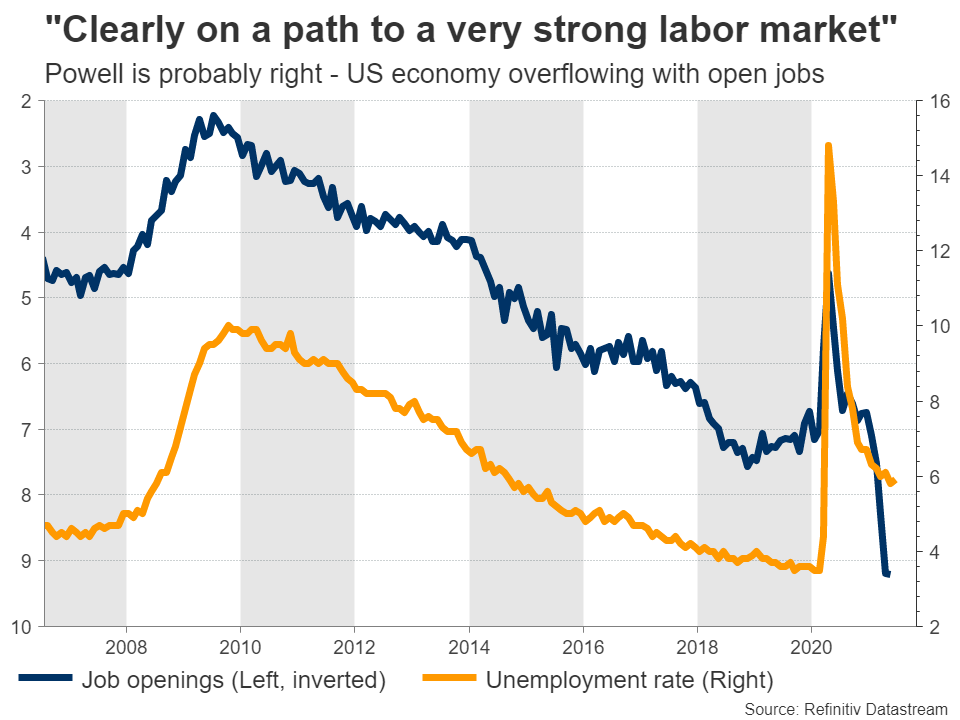
The bottom line is that August may be too early for a tapering announcement, but September is still in play. The Fed can examine another two employment reports by then to make sure the labor market is strong and Congress could deliver another round of spending on infrastructure. Ultimately, this argues for a stronger dollar, especially against the euro and yen as neither the ECB nor the BoJ will follow the Fed anytime soon.
Considering all this, the upcoming US employment report on Friday will be absolutely critical for how the dollar performs. Nonfarm payrolls are expected to clock in at 926k in July, pushing the unemployment rate down two clicks to 5.7%. It seems like many people are returning to the jobs market now that the generous unemployment benefits have started to expire.
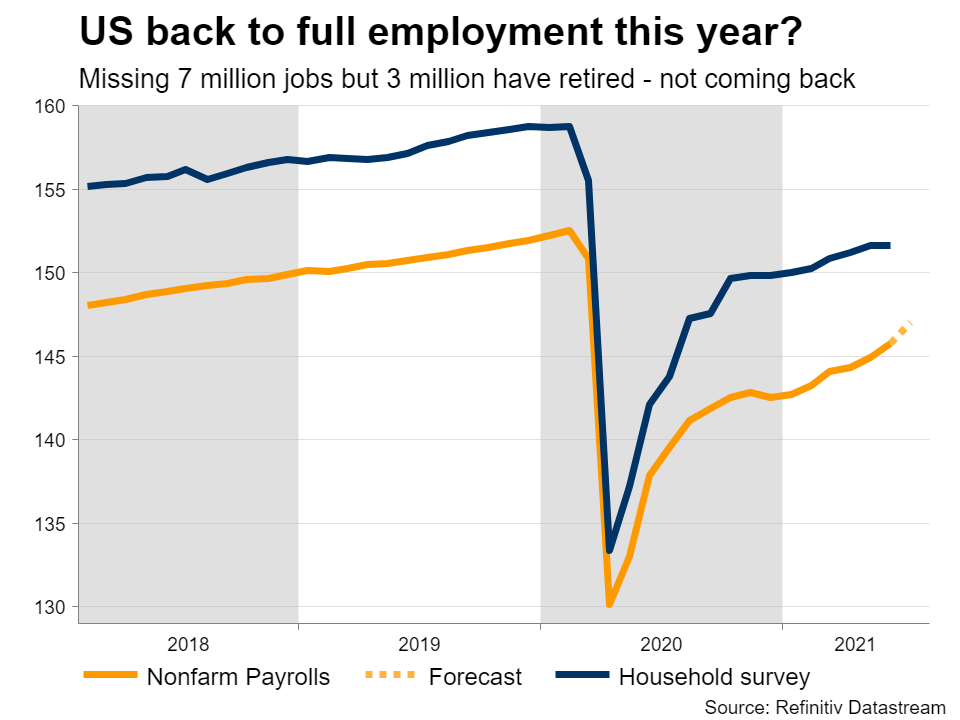
The US economy is still missing some 6.7 million jobs to recover completely. However, many people decided to retire once the pandemic hit, around 3 million by some estimates. Therefore, America might only be missing around 4 million jobs for a full recovery, which means we might be back at full employment by the end of the year at this pace!
Ahead of Friday’s jobs numbers, the ISM manufacturing PMI will hit the markets on Monday, before the services index is released Wednesday.
RBA to put tapering plans on ice
The Reserve Bank of Australia meets on Tuesday and it might be forced to abandon its plans to trim asset purchases. Just four weeks ago, the RBA said it would slow down its purchases of government bonds as the economy was much stronger than it had expected.
Things have changed dramatically since then, with much of Australia trapped in a lockdown to fight the Delta variant. The economy is headed for a contraction this quarter that will cost many jobs, canceling out much of the earlier progress in the recovery.
Hence, the RBA will probably strike a very cautious tone next week. Policymakers have stressed that bond purchases can always be increased again if the economy weakens, and now would be a great time to demonstrate this flexibility.
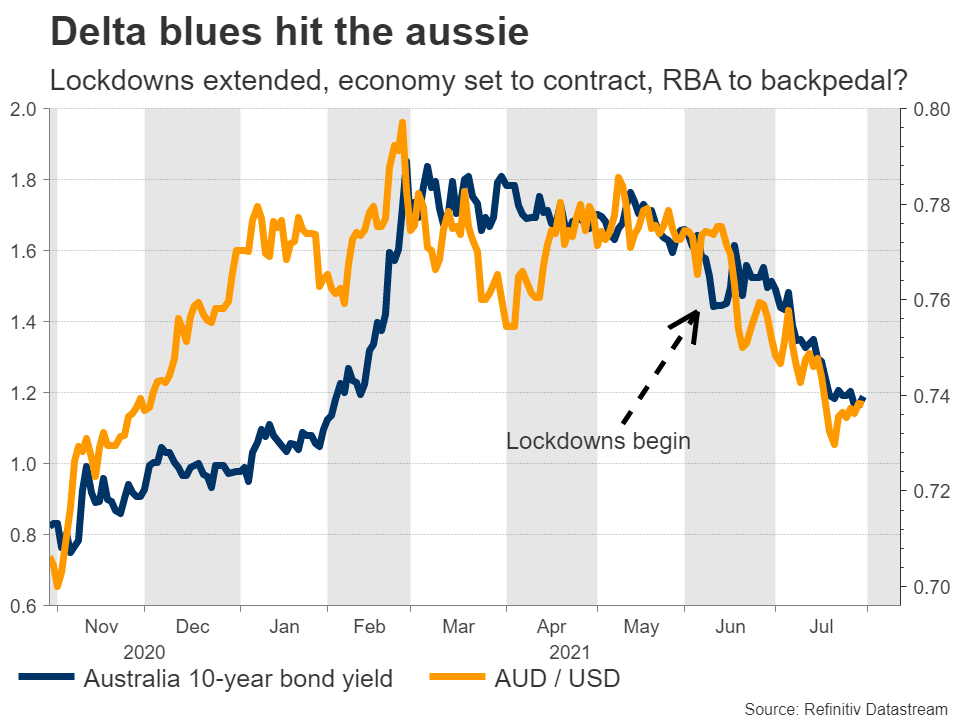
If the central bank indeed abandons its taper plans and signals that bond purchases won’t slow down after all, that could hammer the aussie lower.
BoE: Neutral, with an optimistic flavor
On Thursday, the central bank torch will pass to the Bank of England. A couple of BoE officials made headlines recently after they called for withdrawing some stimulus.
Inflation is already running hot and they fear that unless the Bank takes its foot off the accelerator soon, this could start to infect inflation expectations and become more permanent. If enough people expect higher inflation moving forward, then it becomes a self-fulfilling prophecy because people take actions based on that.
However, the rest of the Committee doesn’t really share this view. Most members have been adamant that withdrawing stimulus too early would be an even bigger risk as it could hurt the recovery, especially now that the government is phasing out its job-supporting programs.
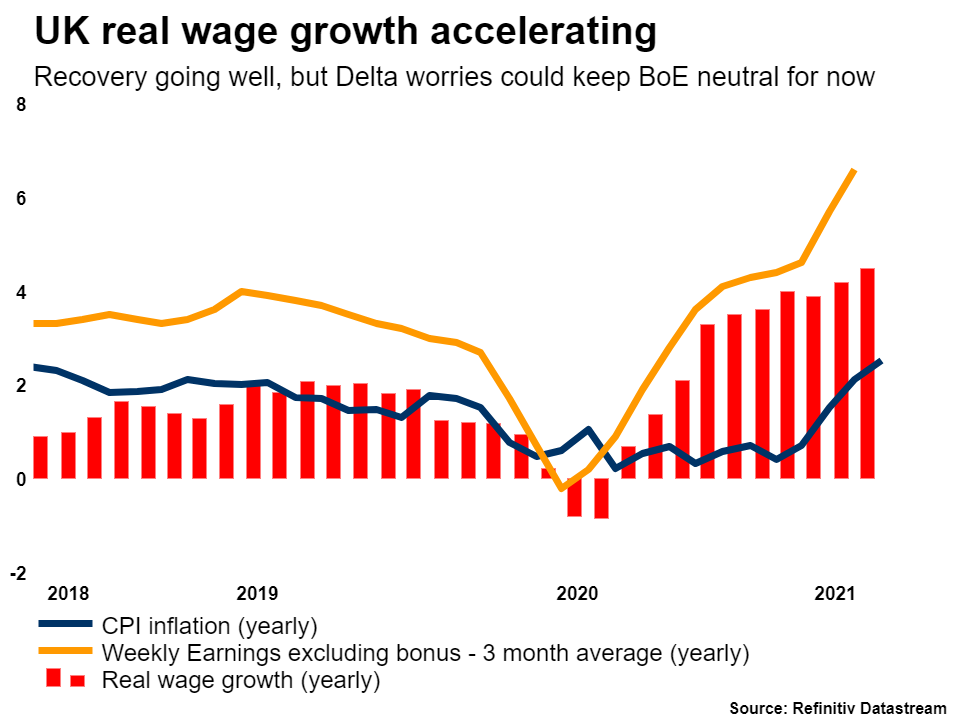
As such, the most likely conclusion is the BoE signaling that the economy is doing better, but that it is too early to withdraw any stimulus for now. Saunders and Ramsden might dissent, calling for an immediate withdrawal.
The pound has staged a phenomenal comeback in recent days and the outlook remains bright. The UK enjoys one of the highest vaccination rates globally and the BoE will probably be among the first central banks to raise interest rates this cycle. Markets are currently pricing in a 15bps rate increase for June next year, which seems reasonable.
Loonie and kiwi turn to jobs data
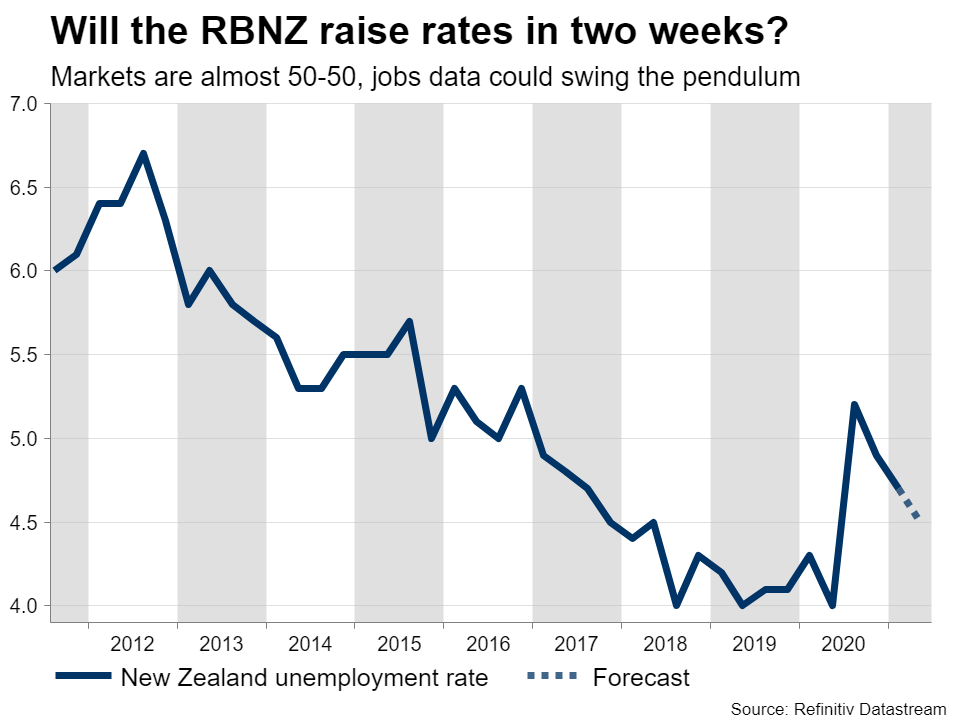
Beyond America, employment data will also be released in New Zealand and Canada. This will be the last major data point before the Reserve Bank of New Zealand meets in mid-August, where markets are pricing in a 55% probability for a rate increase.
Hence, this dataset will shape market expectations ahead of this meeting, driving the kiwi as traders position accordingly. Forecasts point to a solid report, with the unemployment rate set to fall further. If that’s the case, markets could become more confident about an immediate rate hike, breathing some life back into the kiwi.
In Canada, jobs numbers for July will hit the markets on Friday. The Bank of Canada trimmed its asset purchases once again at its last meeting, encouraged by a strong economy and widespread vaccinations. The Bank remains on track to end its QE program completely by year-end. Coupled with high oil prices, the outlook for the loonie seems bright.
Chinese PMIs and ECB minutes
Over in China, the manufacturing and services PMIs for July will be in the spotlight on Monday and Wednesday, respectively. The economy seems to be losing steam, so these will be closely watched.
Finally in Europe, it’s a relatively quiet week. Retail sales for June are out on Wednesday, before the minutes of the latest ECB meeting on Thursday. Markets don’t pay much attention to either, but the minutes could be interesting as this was the meeting when the ECB committed to negative rates for longer.
EUR/USD Outlook: Bulls Lose Traction but Still on Course for Nearly 1% Weekly Advance
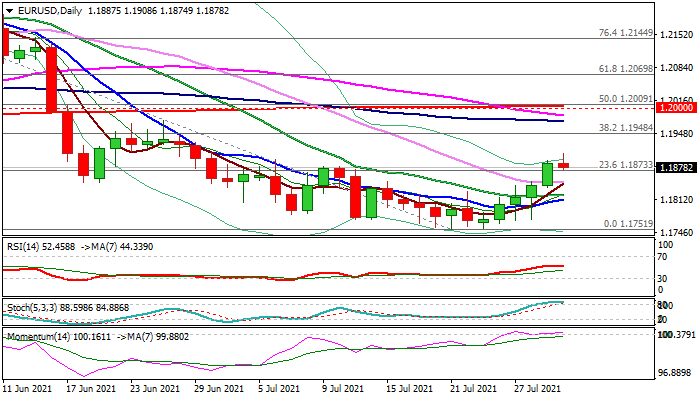
The Euro eases from one-month high on Friday, as bulls run out of steam following nearly 1% advance this week.
US consumer spending rose above expectations in June and inflation accelerated further above Fed’s 2% target that boosted the dollar on Friday and slowed euro’s rally.
Daily indicators generate initial negative signal on RSI diverging from price action and turning south and overbought stochastic, but signal would need further verification.
Today’s close will be significant, with bearish daily candle after five straight green candles, to add to negative signals.
Sideways-moving 30DMA offer initial support at 1.1846, which is required to hold dips and keep bulls intact
Conversely, break here would weaken near-term structure and signal reversal.
Res: 1.1908; 1.1948; 1.1975; 1.2000.
Sup: 1.1873; 1.1845; 1.1821; 1.1800.
Sunset Market Commentary
Markets
Sentiment on global markets improved further today as Chinese authorities took steps to ease market fears after recent regulatory overhaul. The Fed’s commitment to keep a supportive policy stance, at least for now, also helped to push uncertainty on growth to the background. Aside for the overall sentiment, there were also plenty of interesting economic data today. The German CPI data were a first eye-catcher. HCPI jumped to 0.5% M/M to 3.1% Y/Y, the highest level since August 2008. Base effects due to a corona-induces sales tax reduction last year are in play. However, still the figure was higher than expected. HCPI inflation in Spain was also reported to have risen to 2.9%. Earlier today, German labour data were strong. Unemployment declined much faster than expected (-91 k), lowering the unemployment rate to 5.7% from 5.9%. Economic sentiment the Euro area also rose to the highest level since the start of the series in 1985. Still this combination of higher inflation and good activity data only caused a modest rise in European yields. The German yields curve steepens with the 2-y yield gaining 0.5 bp. Yields for the 10/30-y sector are 1.5 bp higher. In the US, the first estimate of the Q2 GDP failed to meet expectations printing at 6.5% Q/Q annualized while a gain of 8.4% was expected. Consumer spending (11.8%) was stronger than expected, but a negative contribution from inventories and slowdown in housing investment prevented a bigger growth. The core PCE price deflator jumped from 2.7% Q/Q to 6.1%. Weekly jobless claims declined from 424k to 400K. Mixed US data and a constructive risk sentiment also supported a cautious bottoming in US yields. Yields are rising between 0.4% bp and 3.5 bp (10-y) . Even so, the 10-y yield stays well below the 1.30% (1.26%). The 10-y real yield (-1.16%) is holding near the all time low. Later today, the US Treasury will conclude this week’s refinancing operation with the sale of $62 bln of 7-y bonds.
The combination of higher EMU inflation and solid activity data maybe was a slightly supportive for the single currency. However most of the EUR/USD rebound was due to USD weakness in the wake of yesterday’s soft Fed narrative and a further decline in the USD real yield. EUR/USD is testing the 1.1881 resistance. USD/JPY is losing modestly (109.75). The TW DXY index has returned to the 92.00 level. Sterling is holding strong, but the EUR/GBP 0.85 level currently caps further sterling gains against the single currency, with the 0.8472 year low also within reach. Most smaller/more risk sensitive currencies are mostly well bid and this also applies to the CE currencies. The zloty rebounds after recent decline (EUR/PLN 4.5775). Also the forint (EUR/HUF 358) and the Czech Koruna are extending gains. (EUR/CZK 25.53).
News Headlines
According to the flesh estimate as published by the National Bank of Belgium, the Belgian economy in the second quarter grew 1.4% Q/Q to be up 14.5% compared to the same period last year. Value added on a quarterly basis was up 1.1% in industry, 0.5% in construction and 1.4% in services. Even so, activity in the Belgian economy was still 2.5% below the level in the further quarter of 2019. In another release, the Belgian Statistics office reported that inflation in July accelerated to 0.85% M/M and 2.27% y/y (from 1.63% in June), the highest level since March 2019. Core inflation (excluding energy and unprocessed food prices) rose to 1.43% from 1.10%.
The Central Bank of Turkey at the publication of its quarter inflation report upwardly revised the forecast for inflation at the end of this year from 12.2% to 14.1%. At the end of 2022, the CBRT sees at 7.8% from 7.5%. In June CPI inflation was 17.53%. However, CBTR governor Kavcioglu indicated that inflation could fall significantly in the fourth quarter. If so, this might revive the debate on an interest rate cut at that time or at the start of next year. The CBTR policy rate currently stands at 19%. The Turkish Lira today gains modest ground, with EUR/TRY declining to 10.115.
Research UK – Economic Recovery is Set to Continue
Key takeaways
- The UK economy was one of the hardest hit by the pandemic but we think the economic outlook looks bright. The relationship between new cases and hospitalisations have weakened significantly and the economy is fully re-opened. Consumer and business confidence are high.
- We expect GDP growth of 7.5% this year and 6.4% next year.
- We expect the unemployment rate will be back below 4% by the end of 2022.
- We expect CPI inflation to move higher, peaking in early 2022 and then ease to around 2% in H2 22.
- Brexit uncertainties have declined but remain high. EU-UK trade has recovered somewhat but not fully since the implementation of the new free trade agreement in January. Brexit has moved to the background as a market theme but risks remain due to discussions over the implementation of the Northern Ireland Protocol.
- Bank of England is moving gradually in a more hawkish direction. We expect the Bank of England will end QE this year (perhaps even prematurely) but not hike until H2 22.
Yen Edges Lower on Mixed Japanese Data
The Japanese yen has reversed directions on Friday and is slightly lower. Currently, USD/JPY is trading at 109.70, up 0.22% on the day.
Fed Chair Jerome Powell performed masterfully at this week’s FOMC meeting, and the markets took the Fed’s rather dovish message in stride. Powell stuck to his well-worn script that the surge in inflation is transitory, and offered the markets a bone by stating that a taper in September was a possibility. However, Powell qualified a September move by stating that the Fed would first have to see a substantial improvement in employment, namely nonfarm payroll reports.
This gives the Fed some breathing room, with a couple of inflation and employment reports to be released before policymakers have to make a taper decision at the September policy meeting. The Fed has not ruled out a September taper, but could decide to wait until the fourth quarter (0r even later) before tightening policy.
This week’s key US events, which missed the consensus, reinforces the Fed’s dovish stance and insistence that the US economy, although clearly in recovery mode, still requires monetary stimulus. Advance GDP for the second quarter and unemployment claims both fell short of the forecast.
In Japan, today’s data was positive. Industrial Production for June (YoY) rebounded with a strong gain of 6.2%, above the forecast of 5.0% and up sharply from the May read of -6.5%. Retail Sales for May (MoM) posted a gain of 3.1%, bouncing back from the previous read of -0.4%.
IMF downgrades Japan
Covid remains a significant problem in Japan, as the country continues to struggle to contain the pandemic, The Olympic Games in Tokyo could aggravate the situation, with thousands of foreigners competing in the games. Earlier this week, the International Monetary Fund projected that Japan’s economy will expand 2.8% in 2021 (YoY), which is down from 3.3% in the April forecast. The report noted that Japan was facing a “further downside risk” to the economy due to the state of emergency in Tokyo.
USD/JPY Technical
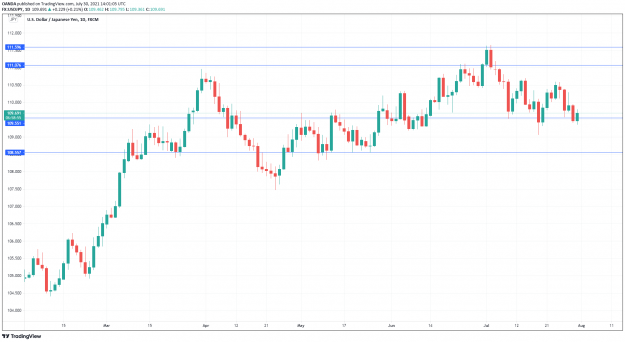
- USD/JPY faces resistance at 111.07. Next, there is resistance at 111.59
- On the downside, the pair is testing support at 109.55. Below, we find support at 108.55
Eurozone Enjoying an Economic Recovery Sweet Spot
Summary
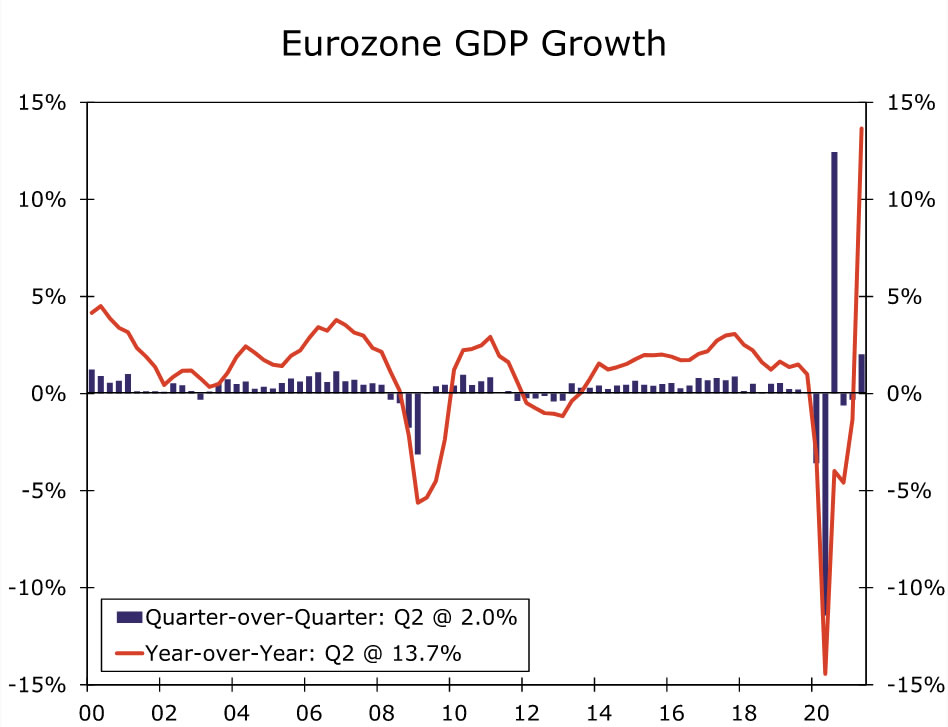
- Eurozone Q2 GDP grew a stronger-than-expected 2.0% quarter-over-quarter, with particularly strong gains reported for Italy and Spain. July inflation remained contained overall, as the headline CPI quickened only slightly to 2.2% year-over-year.
- Confidence surveys and PMI data suggest that economic momentum continued into at least the early part of the third quarter, although the recent renewed rise in COVID cases means some caution remains regarding growth prospects.
- Given this favorable growth and inflation mix we expect the European Central Bank to maintain its accommodative monetary policy and, indeed, ease policy further in December by announcing a further increase in its bond purchase program.
Eurozone GDP Jumps in Q2, July Inflation Remains Contained Overall
The latest batch Eurozone data showed the region's economic recovery back on course, with a favorable mix of activity and inflation data. Eurozone Q2 GDP rose 2.0% quarter-over-quarter and jumped 13.7% year-over-year (Figure 1), the latter boosted by base effects. Not only was the outcome stronger than expected, but the sequential quarterly increase represented a return to growth after two straight quarters of contraction. Economic growth was also fairly broad-based across the region. With respect to the region's larger economies, German GDP rose 1.5% quarter-over-quarter, French GDP was up 0.9%, Italian GDP rose 2.7% and Spanish GDP increased 2.8%. In terms of the countries that released details on the breakdown of growth, France saw Q2 household consumption rise 0.9% quarter-over-quarter, while Spain's Q2 household consumption surged 6.6%.
In addition to the confirmation of strong growth in Q2, survey data suggest that activity remained firm at least during the early part of the third quarter. Eurozone July economic confidence rose more than expected to 119.0, a record high since the series began in 1985. Among the details, both services confidence and industrial confidence rose, to 19.3 and 14.6 respectively. While the strong confidence surveys (along with last week's PMIs) are encouraging for the Q3 growth outlook, some caution still remains regarding growth prospects given the recent renewed spread of COVID cases across the region. Accordingly, confidence surveys will continue to be watched closely in the months ahead for any hints of whether the latest wave of COVID cases is weighing on activity.
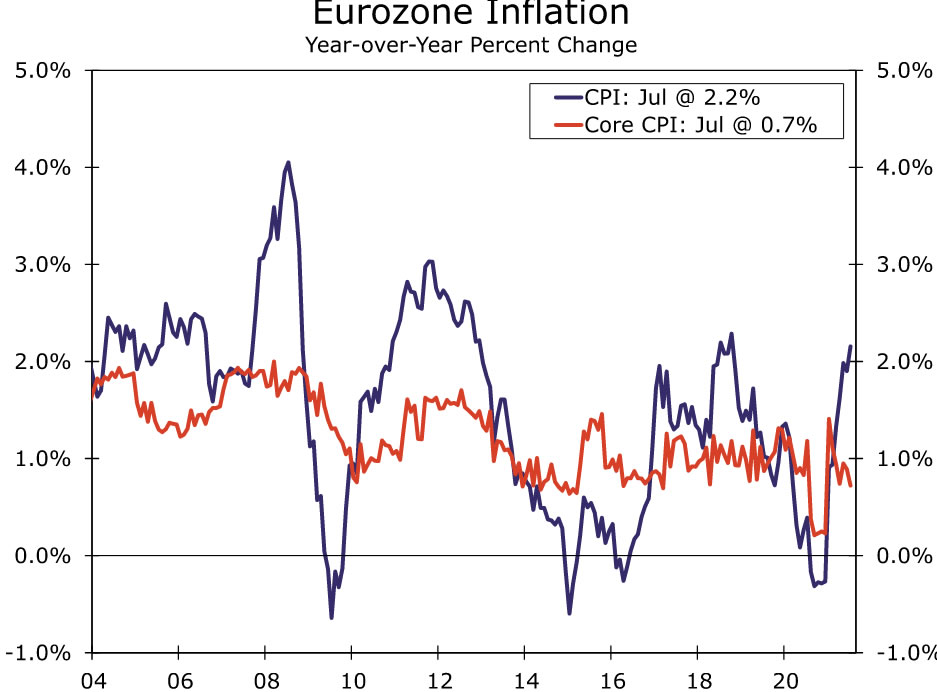
So far, stronger growth in the Eurozone has not been accompanied by significantly faster inflation, in contrast to the sharp uptick of inflation seen in the United States. The Eurozone July CPI firmed moderately to 2.2% year-over-year, while the core CPI slowed to 0.7% (Figure 2). Services inflation quickened slightly to 0.9% year-over-year, while inflation for non-energy industrial goods decelerated to 0.7%.
What are the potential implications of this growth and inflation mix for European Central Bank (ECB) monetary policy? The ECB will certainly welcome the improvement in growth, while the moderate inflation trends means there is no need for the central bank to move to less accommodative monetary policy any time soon. That is reinforced by recent changes by the ECB to its policy strategy that included a shift to a symmetric 2% inflation target, and the dovish policy guidance from the ECB following its July monetary policy meeting. Indeed, given the latest COVID developments have added some element of near-term uncertainty, we now expect the ECB to refrain from tapering its bond purchases in September, and instead signal that Q4 buying for the Pandemic Emergency Purchase Program (PEPP) will continue to be conducted at a significantly higher pace than during the early months of this year.
In addition, if recent COVID developments do eventually have some influence on confidence and activity, and more importantly should underlying inflation trends fail to move meaningfully higher, we expect the ECB to announce a further increase in bond purchases. Our base case for the European Central Bank's December monetary policy announcement is for the central bank to announce a further €500 billion increase in PEPP purchases, taking the size of that program to €2.350 trillion, with purchases under the PEPP program to continue until at least September 2022.
EUR/USD Mid-Day Outlook
Daily Pivots: (S1) 1.1853; (P) 1.1873; (R1) 1.1905; More...
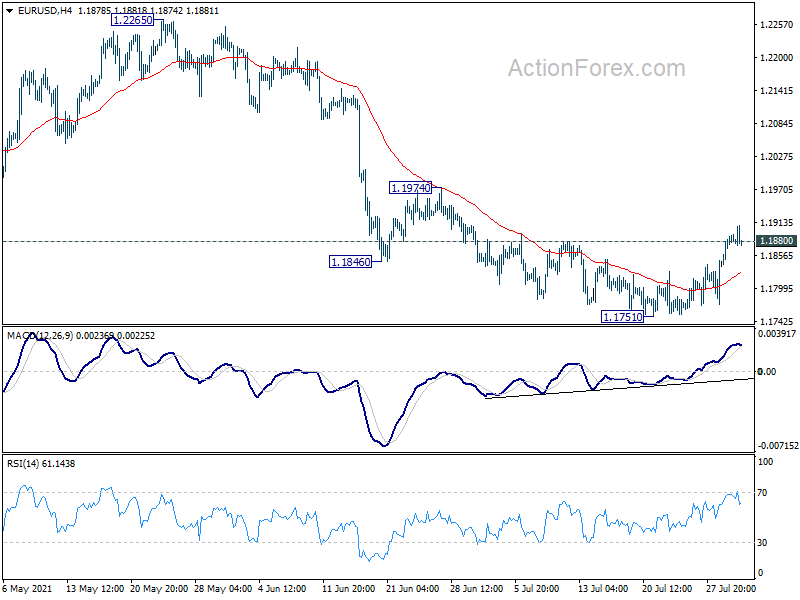
No change in EUR/USD's outlook and focus stays on 1.1880 resistance. Firm break there will firstly indicate short term bottoming at 1.1751, on bullish convergence condition in 4 hour MACD. Intraday bias will be turned back to the upside for 1.1974 resistance first. Sustained break there will argue that whole corrective pattern from 1.2348 has completed, and bring stronger rise back to 1.2265/2348 resistance zone. On the downside, break of 1.1751 will resume the fall from 1.2265, as the third leg of correction from 1.2348, to 1.1703 support.
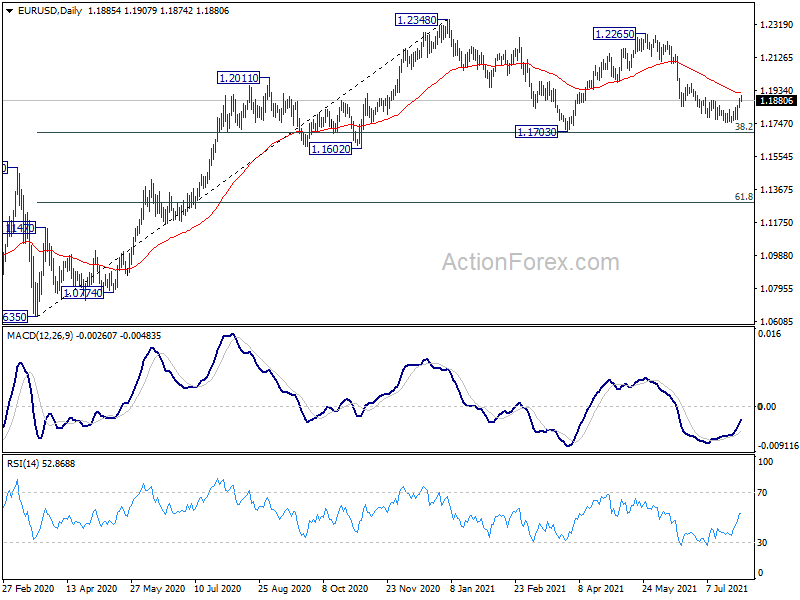
In the bigger picture, rise from 1.0635 is seen as the third leg of the pattern from 1.0339 (2017 low). Further rally could be seen to cluster resistance at 1.2555 next, (38.2% retracement of 1.6039 to 1.0339 at 1.2516). This will remain the favored case as long as 1.1602 support holds. Reaction from 1.2555 should reveal underlying long term momentum in the pair. However sustained break of 1.1602 will argue that the rise from 1.0635 is over, and turn medium term outlook bearish again.
GBP/USD Mid-Day Outlook
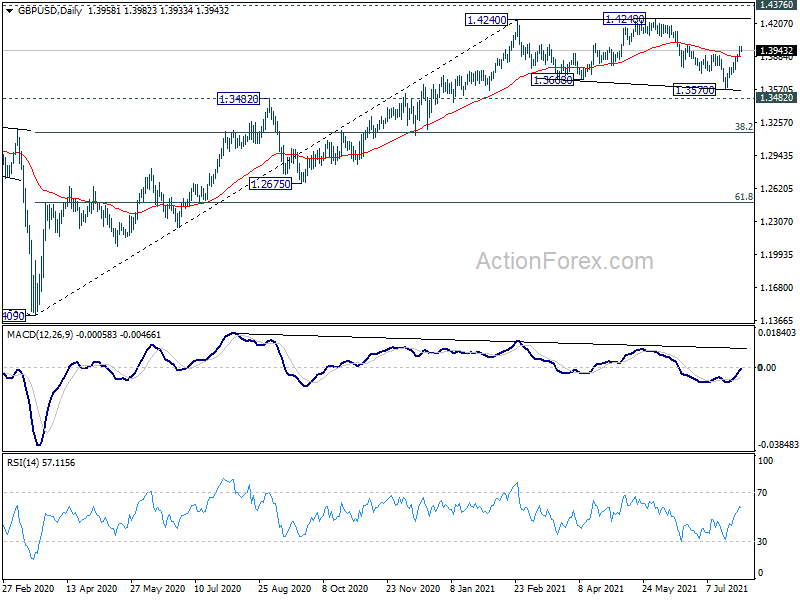
Daily Pivots: (S1) 1.3912; (P) 1.3947; (R1) 1.3996; More....
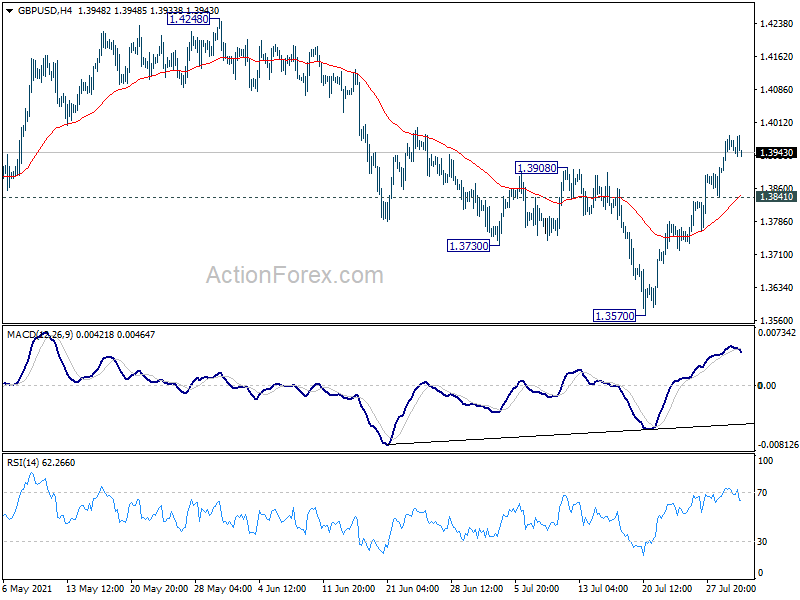
Intraday bias in GBP/USD stays on the upside at this point. Consolidation pattern from 1.4240 could have completed with three waves to 1.3570 already. Further rise should be seen to retest 1.4248 high next. On the downside, below 1.3841 minor support will turn intraday bias neutral and bring retreat first, before staging another rally.
In the bigger picture, as long as 1.3482 resistance turned support holds, up trend from 1.1409 should still continue. Decisive break of 1.4376 resistance will carry larger bullish implications. However, firm break of 1.3482 support will argue that the rise from 1.1409 has completed. GBP/USD would then be seen in another leg of long term range pattern between 1.1409 and 1.4376. Deeper fall could then be seen to 61.8% retracement of 1.1409 to 1.4248 at 1.2493, and even below.
USD/CHF Mid-Day Outlook
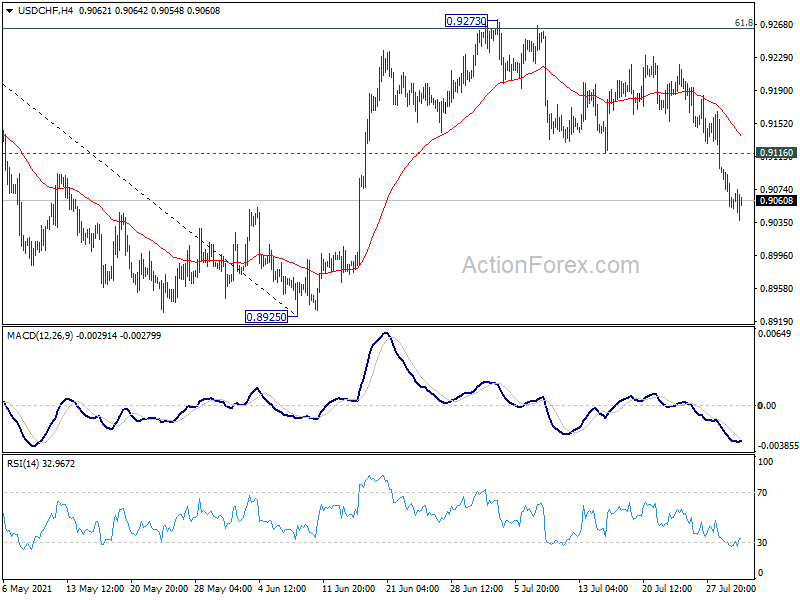
Daily Pivots: (S1) 0.9044; (P) 0.9073; (R1) 0.9090; More....
Intraday bias in USD/CHF remains on the downside at this point. Fall from 0.9273 is on track to retest 0.8925 low. On the upside, above 0.9116 support turned resistance will mix up the near term outlook and turn intraday bias neutral first.
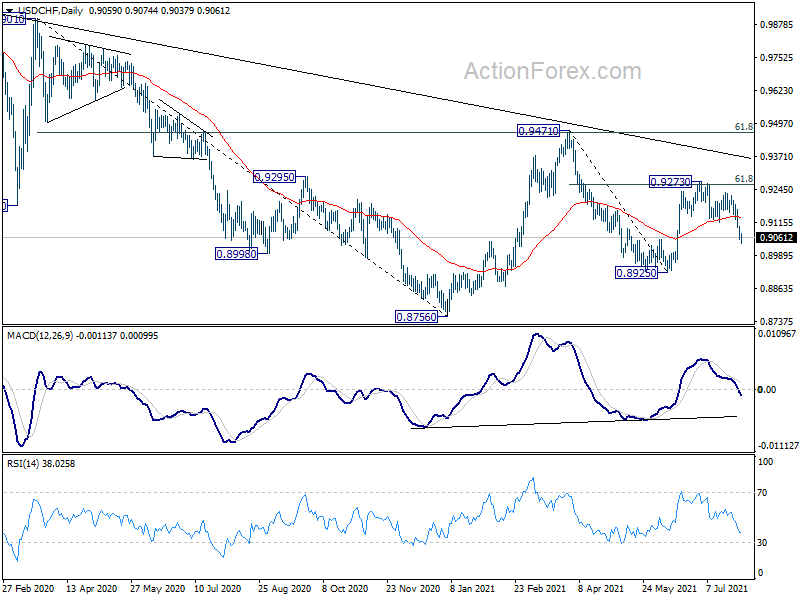
In the bigger picture, medium term outlook is currently neutral with focus on 0.9471 resistance. Sustained break there will indicate completion of whole decline from 1.0342 (2016 high). Medium term outlook will be turned bullish for a test on 1.0342 high. But, rejection by 0.9471 again will revive bearishness for another fall through 0.8756 low.
US: Spending Bounces Back in June, Led by Services
- Personal income edged up 0.1% in June, even as economic impact payments continued to pull back in the month, beating expectations for a fall of 0.3%. Wages and salaries increased by solid 0.7%. The rise was smaller than the increase in prices in the month. Controlling for inflation and taxes, real personal disposable income fell 0.5% in June.
- Personal consumption bounced back from its decline in May, rising by 1.0% and coming in ahead of the consensus forecast for 0.7%. In real terms, spending was up 0.5%, led by non-durable goods, up 1.2%, and services, which rose 0.8%. Real spending on durable goods fell for a third straight month, falling 2.5% in June.
- The personal saving rate fell 0.9 percentage points to 9.4% in the month.
- Inflation as measured in the personal consumption deflator was unchanged at 4.0% year-over-year, in line with the consensus forecast, while core PCE inflation (excluding food & energy) rose to 3.5% (from 3.4%), a smaller acceleration than expected (median estimate was 3.7%).
Key Implications
- After yesterday’s advance GDP report, today’s monthly data offered up details on the evolution of spending through the second quarter of the year. On average, monthly spending growth slowed considerably from the pace in the first quarter when the bulk of stimulus payments went out, but ended on a high note in June, setting up the third quarter for decent, albeit slower spending growth than the double digit pace in the first quarter.
- The transition away from robust goods spending toward services continued in June. The acceleration in services spending in June is a welcome sign and consistent with ongoing business reopening and consumers returning to activities restricted during past lockdowns. While the health crisis is not totally in the rear view mirror, restrictions of the kind seen earlier in the crisis are unlikely. Still, concerns around health may lead to prolonged labor shortages that prevent the economy from returning to normal and keep upward pressure on prices.