Sample Category Title
Oil Steady, Gold Edges Higher Ahead Of FOMC
Oil treads water
Oil prices ranged overnight, with an early sell-off reversed after US API Crude Inventories fell by 4.728 million barrels, somewhat higher than expected. The net result left both Brent crude and WTI near unchanged at the end of the session. Brent crude finishing at USD 74.70 a barrel and WTI at USD 71.90 a barrel.
Asia has been equally quiet, with both contracts edging 20 cents higher in modest pre-FOMC trade. Official US Crude Inventory data is more likely to move prices this evening than the FOMC unless the taper word is mentioned. Official inventories are expected to fall by 2.9 million barrels, with gasoline stocks also falling. A more significant than expected fall could be enough to shake Brent and WTI out of their ranges and test the upside.
I am not expecting any fireworks until after the FOMC conclusion. For now, I stick with my previous assertions that the USD 74.00 region for Brent crude, and USD 72.00 for WTI, look like equilibrium levels. Brent should trade in a USD 73.00 to USD 75.00 a barrel range, and WTI should remain in a broader USD 71.00 to USD 73.00 a barrel range.
Gold rises pre-FOMC in Asia
Gold continued to range quietly overnight, finishing barely changed at USD 1799.00 an ounce. Some pre-FOMC risk hedging is evident in Asia, though, no doubt assisted by the ructions in China’s stock markets, which is also supporting digital currencies today. Gold has risen by 0.40% to USD 1806.40 an ounce.
Support at the overnight low and the 100-DMA at USD 1799.00 an ounce is unlikely to be tested in Asia and should hold easily pre-FOMC. Assuming no change in the language of the FOMC statement, gold should look to test resistance at USD 1812.00 an ounce, followed by the 200-DMA at USD 1822.00 an ounce.
Any change in tone from the FOMC to the tapering side of the equation is likely to see support at the 100-DMA at USD 1799.00 an ounce broken, followed by a test of USD 1790.00. A daily close below the latter will signal a deeper correction targeting the USD 1750.00 an ounce region in the days ahead. However, this is not my base case, and I expect gold to remain locked into a USD 1790.00 to USD 1820.00 an ounce range for the rest of the week.
The US Dollar Falls With US Yields
FOMC meeting looms
US long-dated yields eased once again overnight, possibly driven by the US Senate bi-partisan infrastructure impasse. More likely, position adjustments ahead of the FOMC outcome this evening drove the realignment, with euro and sterling strength, once again, leading US dollar weakness. Notably, regional Asian currencies and the antipodeans show only very modest gains versus the US dollar, suggesting that delta-variant and China nerves remain very much front and centre for investors in Asia.
The dollar index fell 0.17% to 92.31 overnight, breaching technical support at 92.55. A suitably dovish FOMC this evening should see the index continue lower, potentially testing support at 92.00. Support at 91.50, which is also the 100-day moving average (DMA), remains the index’s medium-term pivot level.
EUR/USD has now traced out firm support at 1.1750, and its overnight rally to 1.1830 leaves it in sight of resistance at 1.1850. A close above 1.1850 targeting 1.1975. Sterling continues to outperform, receiving a boost by a suspension of hostilities with the EU over Northern Ireland and its intention to start accepting fully vaccinated tourists from the US and Europe without quarantine. Sterling rose 0.45% to 1.3880 overnight, not far from resistance at 1.3910, also its 100-DMA. A close above 1.3910 will signal a further rally to test the much more important 1.4000 regions.
The ructions in the China stock markets saw the Chinese yuan fall quite rapidly yesterday, USD/CNY rising 0.44% to 6.5100, finally breaking out of the near two-month 6.4500 to 6.4900 range. USD/CNY has fallen to 6.5050 this morning as local media reports stabilise stock markets, but the cross has now made a substantial technical break above 4.4900, which should limit any pullbacks for now. That is quite some distance above today’s USD/CNY fixing at 6.4929 and reflects investors’ opinion that CNY outflows will increase due to the ever-expanding government clampdowns on various sectors.
The fall of the yuan overnight will keep the pressure up on ASEAN currencies as well, which are also contending with the delta-variant discount. I expect currency markets to range ahead of the FOMC as traders reduce risk into the meeting outcome tonight. All things remaining the same with the FOMC, US dollar weakness versus the major currencies should resume, but Asia’s own issue will keep up the pressure on local currencies.
Asian Equities Markets Dip Ahead Of FOMC
Asia stock markets fall pre-FOMC, China stabilises
US markets finished the overnight session lower despite blockbuster US tech results, as buy-the-rumour, sell-the-fact, and some pre-FOMC risk trimming took the wind out of Wall Street’s sails. The S&P 500 fell 0.47%, the Nasdaq retreated 1.21%, and the Dow Jones eased by 0.29%. US futures on all three are unchanged in slow Asian trade.
Most of Asia has contented itself to slavishly follow the US pre-FOMC risk reduction path, notably Japan, where the Nikkei 225 has fallen by 1.05%, while the Kospi is unchanged. China markets are bucking the trend after some torrid sessions this week, showing signs of stabilising today after reports emerged this morning that the central government might introduce some new fiscal stimulus in Q3. The Shanghai Composite is 0.40% lower, but the CSI 300 has risen 0.15%, and the Hang Seng has rallied by 1.0%.
Across the region, Singapore is down 0.20%, with Kuala Lumpur down 0.10%, while Taipei has fallen 1.40% as Apple signalled chip shortages with key products in their quarterly earnings release. Jakarta is unchanged, while Bangkok has declined 0.60%. Australian markets have followed Wall Street south, not helped by a 4-week extension of the Sydney lockdowns. The ASX 200 and All Ordinaries have both fallen 0.55%.
All eyes remain on China markets, with today’s slight recovery driven by the previously mentioned stimulus hopes and the China Securities Journal stating investors shouldn’t be worried about further stock price drops. Taken in totality, it implies that China’s “national team” may be getting ready to “stabilise” markets. It is doubtful, though, that the repricing of China equities for government regulatory risk has run its course, and the rally today should be approached with caution. However, the worst of the sell-off may be past markets for now.
Along with the rest of Asia, China markets will now be on hold for the FOMC tonight. If they stay on message and remain dovish, Asian equities, including China, could see a further recovery into the end of the week. However, the Hang Seng and CSI 300 will remain up by the stairs, down by the 5th-floor window market for some time.
Over To You Jerome
Wait-and-see ahead of FOMC meeting
Asian markets are likely to spend the day in wait-and-see mode with a slight downward bias today, as the street moves into a pre-FOMC holding pattern. Although I am not expecting any change in the statement’s language this time around, the FOMC surprised me last time, so I won’t say never say never. Markets appear to be similarly inclined and guarded against the outside chance that Mr Powell and friends may indicate they are starting to think about starting to talk about the possibility that they may start pondering tapering. September’s meeting remains my favourite for that kick-off, but hey, it’s 2021.
A few winds are blowing against a tapering statement this evening, not least the delta variant sweeping the Asia Pacific with an inevitable knock-on to its recovery. You can pencil in parts of the US as well. The bi-partisan US infrastructure negotiations also seem to have hit an impasse and dropped out of the news, never a good sign. Additionally, and equally forgotten, the US federal debt ceiling limit is looming and will we, or will we not, have another government shutdown.
Overnight, Apple and Microsoft delivered strong quarterly earnings but got marked down on chip shortages and peak cloud. Alphabet blew expectations out of the water and rallied while investors woke up and smelt the coffee with Starbucks, who signalled falling sales in China. We have Facebook to come today and Amazon this week as well, but it is clear that an enormous amount of good news is built into US big-tech prices, and nothing short of an Alphabet level result will stop the profit-takers. Still, any dips in big-tech remain there to be snaffled.
The China regulatory crackdown show continued delivering yesterday, with the Hang Seng enduring another torrid day. I expect today to be a better one as stories are emerging from mainland news journals that more fiscal stimulus is on the way from the central government in Q3. That should sate the wolves for now, but I suspect the repricing of China regulatory risk has some way to run yet. Eventually, the discount in stock prices will balance out the perceived risk for investors, such is the beauty of the market, but I can’t tell you when that will be.
US bond yields continued to sag overnight and finally dragged the US dollar down with them and showing no pre-FOMC nerves compared to other asset classes. I am beginning t think the bond rally is a giant short squeeze. However, I acknowledge that the persistence of Covid-19 and slowing vaccination rates could temper the recovery exuberance from a US perspective. Interestingly, the IMF upgraded the GDP of developed economies overnight while downgrading developing ones. That highlights the reality of the K-shaped recovery globally, with the vaccine, haves having, and the have-nots (the rest of us) not having.
Sitting in Jakarta, which like much of ASEAN, is in a world of Covid-19 pain right now, talk of booster shots in the US and Europe against a background of vaccinating apathy does make the heart sink. It means the rest of us will be waiting in the queue for longer while the Northern Hemisphere enjoys summer holidays and an assertion of their individual rights. On a personal level, it is infuriating; on a macro level, it inevitably means that the rollout of tier-one vaccines to the rest of the world will be later and longer, widening the K-shaped recovery. As one learned politician here in Indonesia said (yes, we do have some), “no one is safe until we are all safe.”
Data releases in Asia this morning have been thin on the ground. The Bank of Japan summary of opinions stated that the BOJ would not tighten monetary policy prematurely. I’m pretty sure that line has been unchanged for the last 20 years. RBA Inflation YoY for Q2 came in slightly higher at 0.80%, with the weighted and trimmed means on expectation. More attention was given to the 4-week extension of movement restrictions in Sydney, which again seems to have been well priced in. We can now assume that any thoughts of tightening by the RBA are off the table for now, and hopefully, the anti-restriction bogans stay at home as well. Come to Jakarta to see your future if you don’t; it’s not pretty.
Malaysia’s Balance of Trade is likely to see the effects of the movement control orders in the data, and the surplus could fall to around MYR 10 billion. Despite the recovery in oil prices, the ringgit remains near recent lows versus the US dollar as its Covid-19 situation and political fragility lurch from worse to worse. Even a spike in oil prices is unlikely to change that narrative for now or the other members of my Asian fragile five. Thailand’s Industrial Production will likely tell a similar story.
The European and US calendars are thin and second-tier today, with Facebook earnings and the FOMC rate decision and statement set to steal the headlines. If all goes to plan, equity markets should move higher on an unchanged FOMC, the US dollar will ease, and US bond yields will continue to grind lower. Over to you, Jerome.
GBP/JPY Daily Outlook
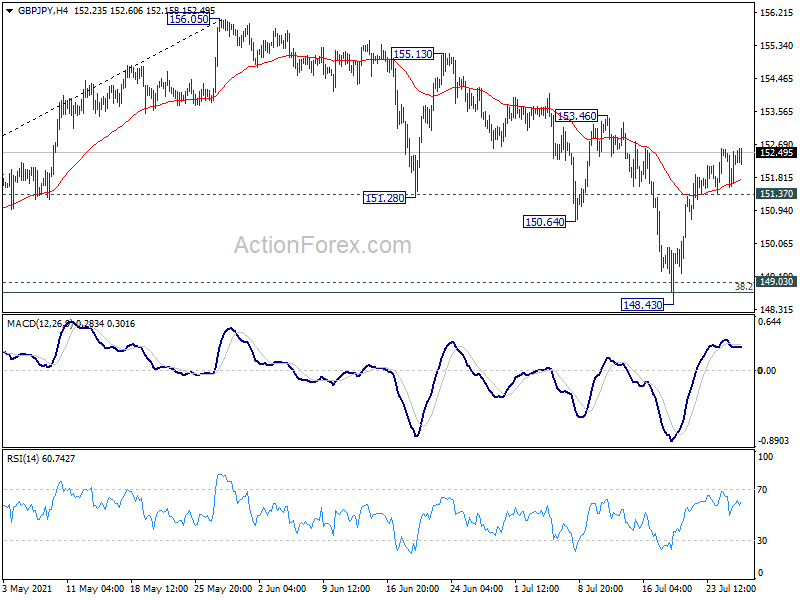
Daily Pivots: (S1) 151.79; (P) 152.20; (R1) 152.83; More...
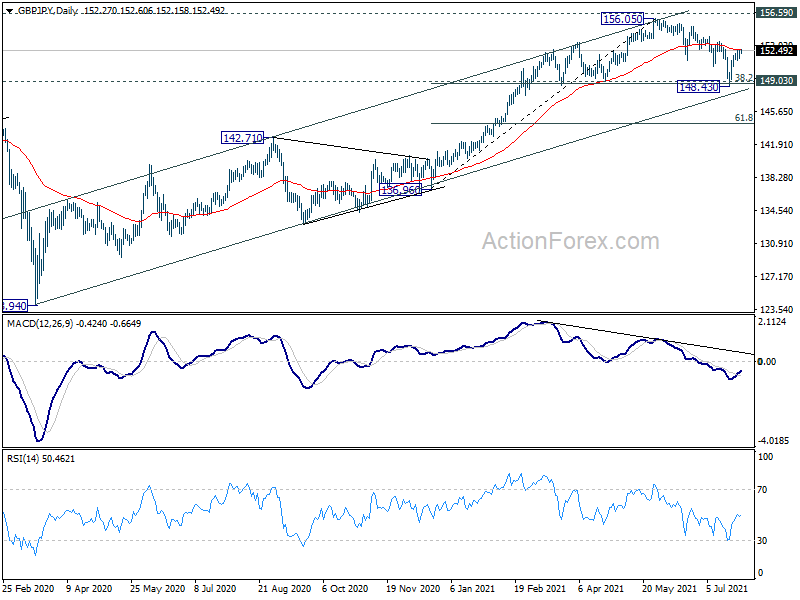
Intraday bias in GBP/JPY remains mildly on the upside as rebound from 148.43 is in progress for 153.46 resistance. Decisive break there will pave the way to retest 156.05 high. On the downside, however, break of 151.37 minor support will turn bias back to the downside for retesting 148.43 again.
In the bigger picture, rise from 123.94 is seen as the third leg of the pattern from 122.75 (2016 low). Focus remains on 156.59 resistance (2018 high). Sustained break there should confirm long term bullish trend reversal. Next target is 61.8% retracement of 195.86 (2015 high) to 122.75 at 167.93. On the downside, sustained break of 149.03 support, however, will argue that rise from 123.94 has completed. Further break of 142.71 would open up the bearish case for retesting 122.75 low.
US Oil Tests Fresh Support
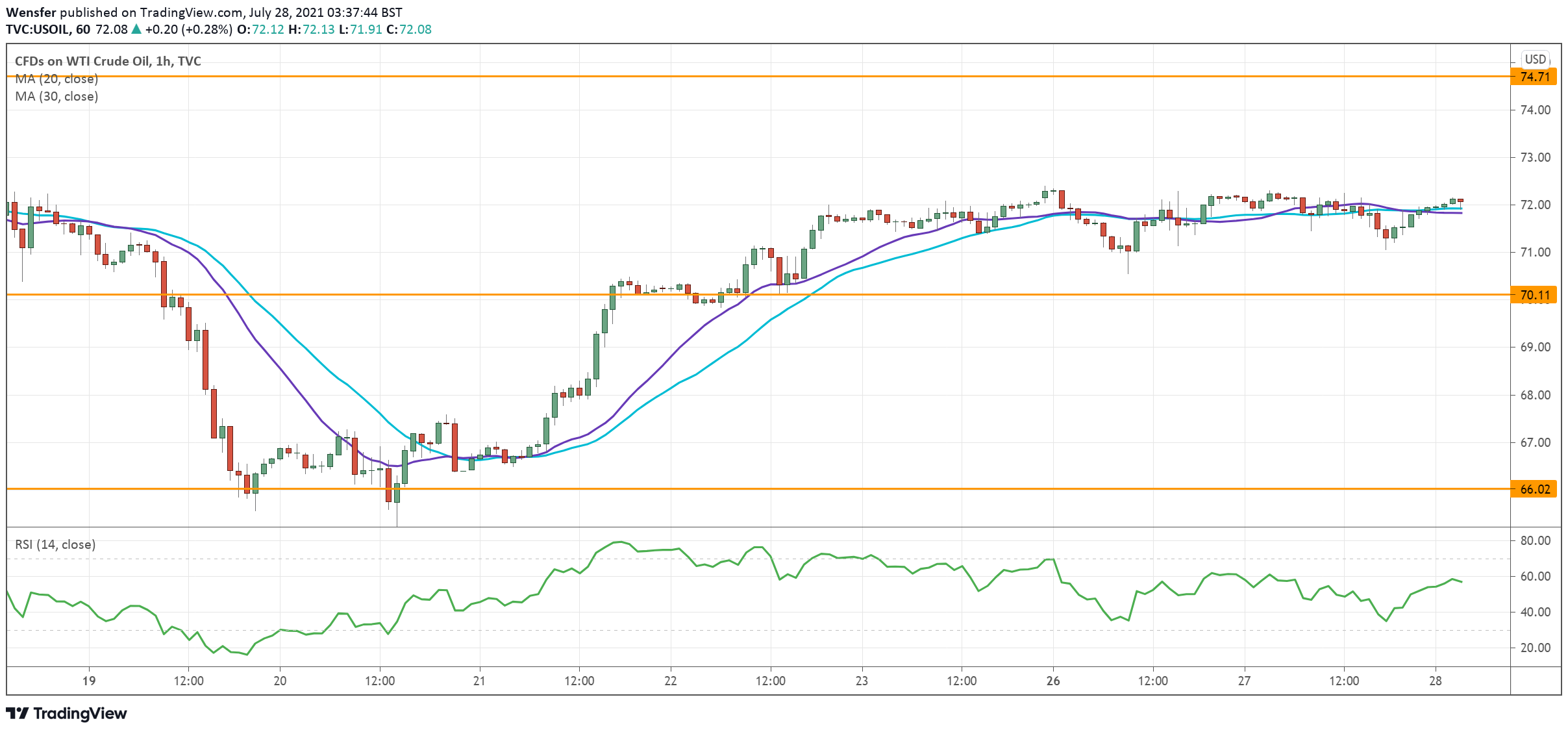
Oil prices continue to recoup previous losses as traders bet on tightening supply.
WTI’s swift recovery above 71.10 is an encouraging sign that buyers are still hanging around. Following the breakout, 70.10 has established itself as fresh support.
The RSI has dropped back to the neutrality area and the bulls may have the last word if the support holds tight. Otherwise, price action could be seeing 66.00 sooner than expected.
On the upside, 74.70 is the key resistance to clear before the bullish trend could carry on.
AUD/USD Consolidates Post-Breakout
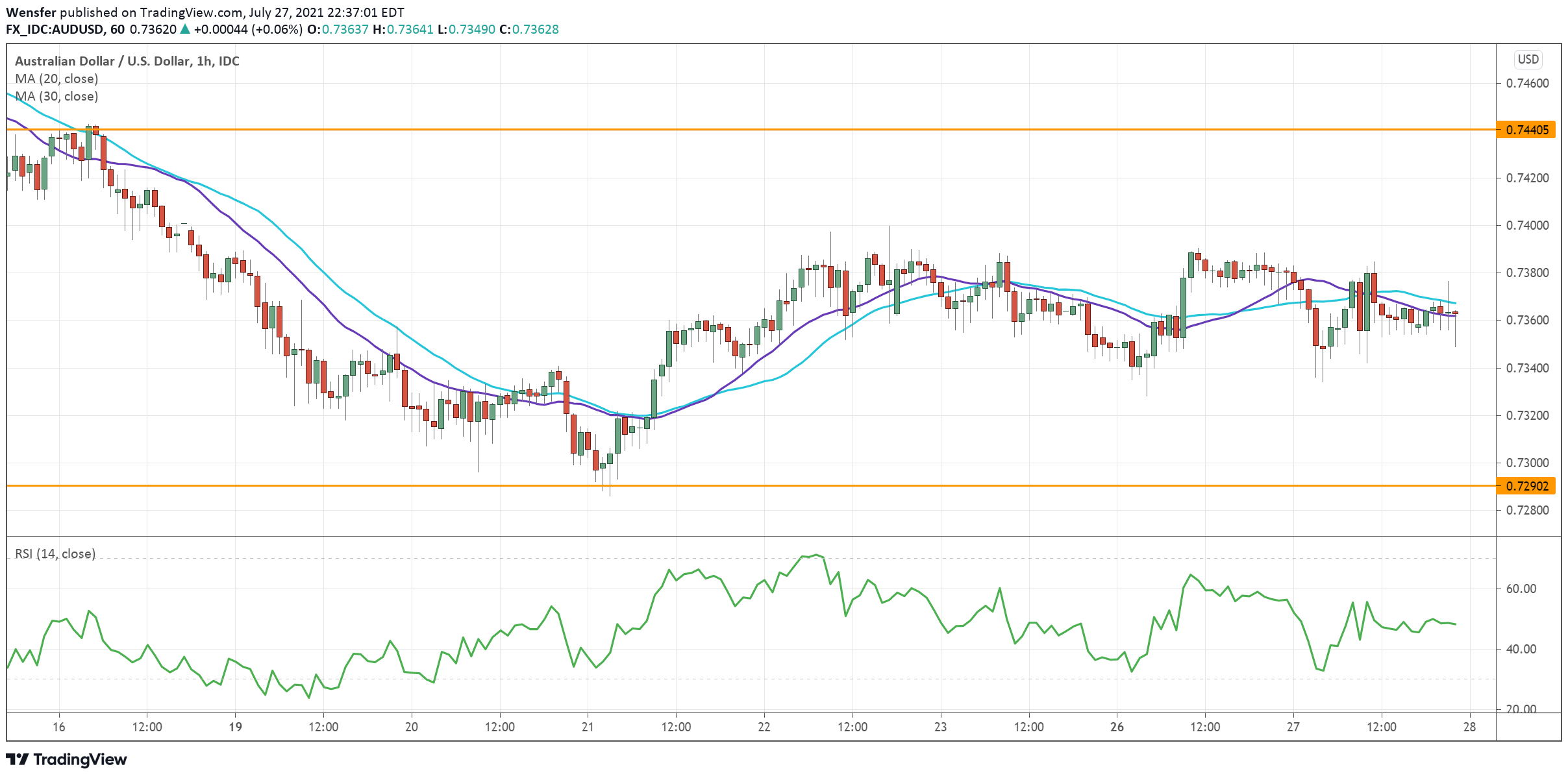
The Australian dollar inched higher, supported by upbeat CPI, in Q2. Though price action struggles to bounce back after it broke below 0.7410, support from the previous timid rebound.
Sentiment has grown increasingly bearish and sellers are eager to offer at higher prices. 0.7440 has turned from a demand into a supply zone.
If buyers fail to push above this threshold, 0.7290 would be the path of least resistance. A bearish breakout could trigger a new round of sell-off to last November’s lows around 0.7130.
EUR/JPY Daily Outlook
Daily Pivots: (S1) 129.43; (P) 129.87; (R1) 130.19; More....
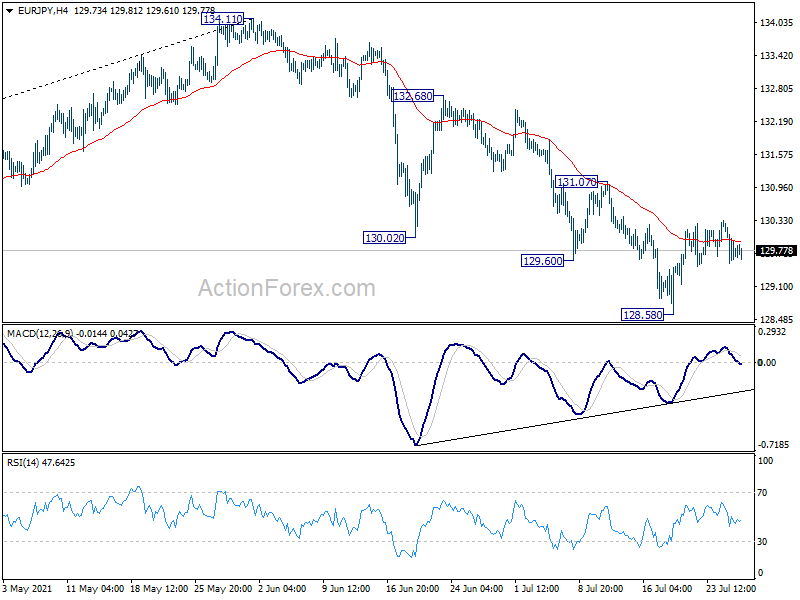
EUR/JPY is staying in consolidation from 128.58 and intraday bias remains neutral at this point. Near term outlook stays bearish as long as 131.07 resistance holds. On the downside, break of 128.58 will resume the fall from 134.11, and target 127.07 resistance turned support next.
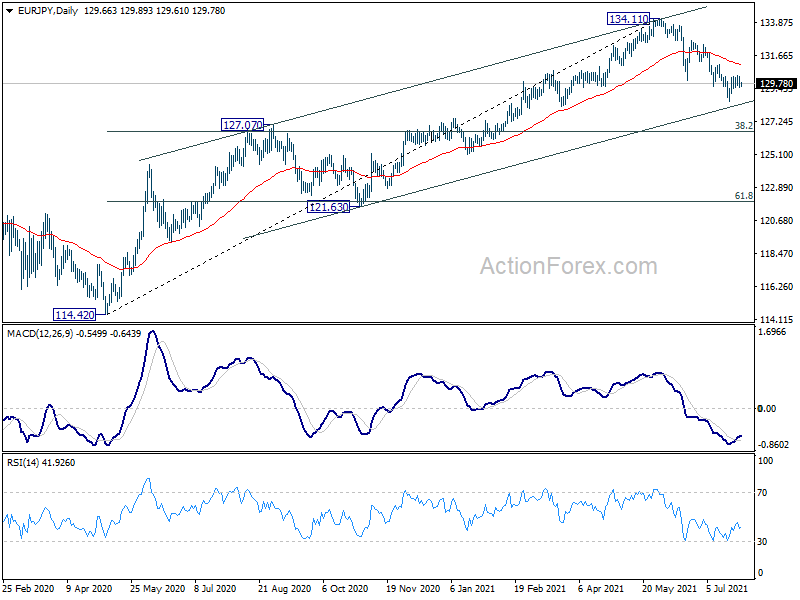
In the bigger picture, rise from 114.42 is seen as a medium term rising leg inside a long term sideway pattern. As long as 127.07 resistance turned support holds, further rise is still expected to retest 137.49 (2018 high). However, firm break of 127.07 will argue that the medium term trend has reversed, and open up the case for retesting 114.42.
XAU/USD Seeks Support
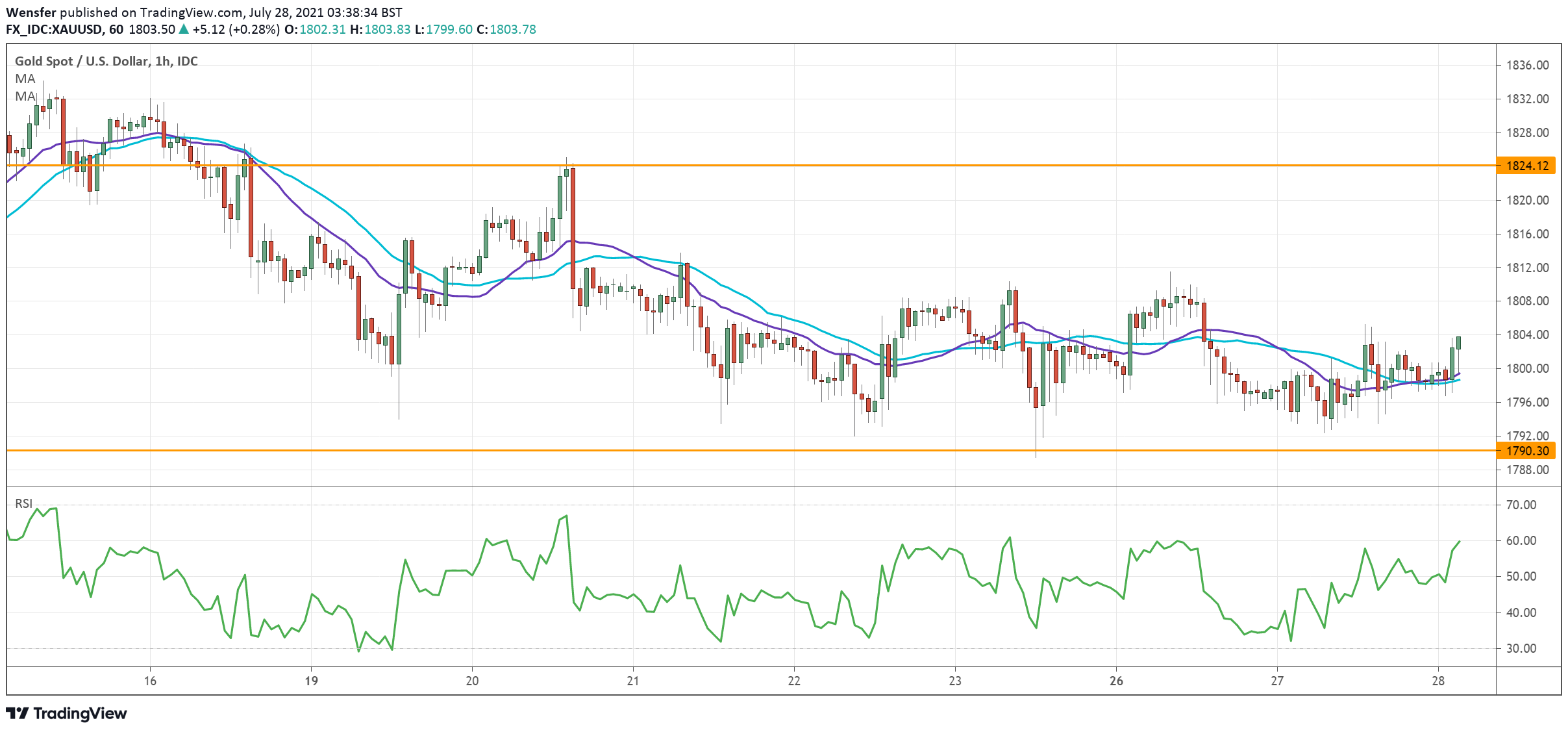
Gold bounces back as the US dollar retreats ahead of the Fed meeting later today.
The price has been treading water above 1790 as the bulls struggle to save the rebound. The dip below the psychological level of 1800 has shaken out weak hands.
The current consolidation is a sign of indecision ahead of a catalyst-driven breakout. 1824 is a major hurdle and its breach would heighten momentum and resume the stalled rally.
Below the support, the bears may push gold towards 1755 and threaten the rebound.
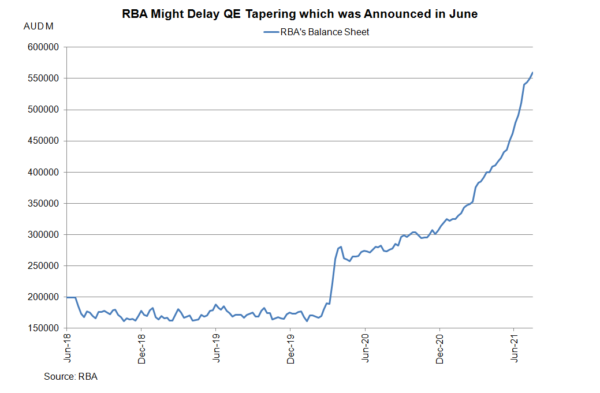
Aussie to Stay Weak in Near-term as Lockdown Measures to Weigh On Third Quarter Growth. RBA could Delay Tapering
AUDUSD is prone to be the weakest performer among majors in July. The selloff accelerated 2 weeks ago as the resurgence of coronavirus has triggered lockdown in New South Wales, Victoria and South Australia. In the near-term, sentiment over the currency pair could remain weak as state governments would likely extend the lockdown to prevent further rapid rise in new cases. These could hamper the country’s economy for 3Q21, triggering accommodative measures from the government and the RBA.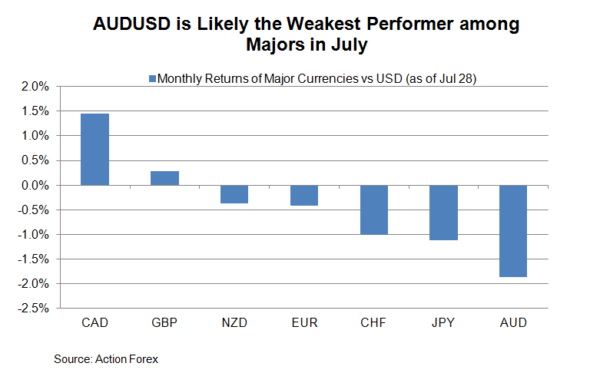
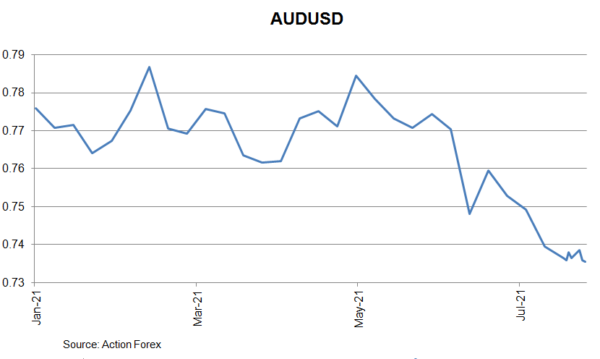 The rapid spread of delta variant sent many parts of the country back to lockdown and tightened restrictive measures. While restrictions in Victoria and South Australia have been eased this week, the NSW government has extended the lockdown in the state for 4 more weeks. Worse still, the vaccine rollout is relatively slow, with only 31% of the population receiving one dose and 13% both doses as of July 26.
The country’s economy will likely record contraction in 3Q21, compared with growth expected previously. However, the weakness will be temporary, thanks to easing measures by the government and the central bank. Strong growth is expected to be seen in the fourth quarter.
Fiscal support from the government is essential. Prime Minister Morrison announced on July 13 that the federal government would deploy a program to assist New South Wales, estimated to cost AUD500M per week. More are expected to be in the pipeline in order to support the unemployed and workers on reduced hours.
At the July meeting, the RBA announced to begin tapering its asset purchases in early September. The size of purchases would reduce to AUD 4B from AUD5B. The extended lockdown measures and the potential detriment on the economy could trigger the central bank to postpone tapering. Such announcement could be made in as soon as the August meeting. Indeed, the decision to tapering is not irreversible. Governor Philip Lowe noted that the RBA is “not locked into any particular path and bond purchases could be scaled up again if economic conditions warranted it”.