Sample Category Title
Eco Data 7/29/21
[php_everywhere instance="1"]
FOMC Review: Economy Moving Toward Inflation and Employment Goals. FOMC Minutes and Jackson Holes in Focus
The Fed sounded cautiously optimistic at the July meeting. The members acknowledged continued improvements in economic activities and that “the economy has made progress toward" the "maximum employment and price stability goals". While leaving all monetary policy measures unchanged, Chair Jerome Powell affirmed the the ongoing discussions over tapering. We expect to hear more comments from Fed officials for preparation of an eventual announcement in December.
On economic developments, the Fed acknowledged that, “with progress on vaccinations and strong policy support”, indicators of “economic activity and employment have continued to strengthen”. It also noted that sectors most adversely affected by the pandemic “have shown improvement but have not fully recovered”. This is compared with June’s statement that these sectors “remain weak but have shown improvement”.
The central bank also appeared less concerned about the impacts of the pandemic, despite the resurgence in new cases due to the delta variant. As noted in the statement, “the path of the economy continues to depend on the course of the virus”. In June, it indicted that the path would “depend significantly on the course of the virus”. Indeed, in the press conference, Powell sounded cautiously optimistic, suggesting that the “economic implications have tended to be lessening” through successive waves of the pandemic.
On inflation, policymakers retained the view that the current strength has been driven by transitory factors. Yet, a subtle change in the statement language reveals that policymakers are increasingly convinced that strong inflation could be more persistent than previously anticipated. On the forward guidance of QE, the Fed reaffirmed that the size of asset purchase would stay at US$120B per month “until substantial further progress has been made toward its maximum employment and price stability goals”. It added this month that “the economy has made progress toward these goals”.
The focus of the meeting is members’ discussions over tapering. Powell noted that the Fed discussed the pace and composition of tapering but did not make any final decisions. Powell also noted that here is “little support” for tapering MBS purchases first, and that participants have mixed views on tapering MBS purchases faster. This appeared similar to what had happened in the past month. We would look into the minutes, which will be released in 3 weeks’ time, for the debates about the issue.
Overall, the meeting reveals that policymakers are cautiously optimistic about the economic recovery. The policy stance should less likely be altered by the resurgence of the pandemic. For the coming weeks to months, we expect to hear more Fed officials sharing their views over tapering. Key events leading to the September meeting are the July meeting minutes and Jackson Hole symposium in late August. We also expect more detailed information about tapering will be released in September, alongside updated economic projections and median dot plots. A formal tapering announcement will then be made in December.
Fed said economy has made progress towards its goals, full FOMC statement
FOMC keeps monetary policy unchanged as widely expected. In the accompany statement it said that "the economy has made progress" toward the the goals of maximum employment and price stability". It added that the Committee will "continue to assess progress in coming meetings"
Full statement below.
Federal Reserve Issues FOMC Statement
The Federal Reserve is committed to using its full range of tools to support the U.S. economy in this challenging time, thereby promoting its maximum employment and price stability goals.
With progress on vaccinations and strong policy support, indicators of economic activity and employment have continued to strengthen. The sectors most adversely affected by the pandemic have shown improvement but have not fully recovered. Inflation has risen, largely reflecting transitory factors. Overall financial conditions remain accommodative, in part reflecting policy measures to support the economy and the flow of credit to U.S. households and businesses.
The path of the economy continues to depend on the course of the virus. Progress on vaccinations will likely continue to reduce the effects of the public health crisis on the economy, but risks to the economic outlook remain.
The Committee seeks to achieve maximum employment and inflation at the rate of 2 percent over the longer run. With inflation having run persistently below this longer-run goal, the Committee will aim to achieve inflation moderately above 2 percent for some time so that inflation averages 2 percent over time and longerterm inflation expectations remain well anchored at 2 percent. The Committee expects to maintain an accommodative stance of monetary policy until these outcomes are achieved. The Committee decided to keep the target range for the federal funds rate at 0 to 1/4 percent and expects it will be appropriate to maintain this target range until labor market conditions have reached levels consistent with the Committee's assessments of maximum employment and inflation has risen to 2 percent and is on track to moderately exceed 2 percent for some time. Last December, the Committee indicated that it would continue to increase its holdings of Treasury securities by at least $80 billion per month and of agency mortgagebacked securities by at least $40 billion per month until substantial further progress has been made toward its maximum employment and price stability goals. Since then, the economy has made progress toward these goals, and the Committee will continue to assess progress in coming meetings. These asset purchases help foster smooth market functioning and accommodative financial conditions, thereby supporting the flow of credit to households and businesses.
In assessing the appropriate stance of monetary policy, the Committee will continue to monitor the implications of incoming information for the economic outlook. The Committee would be prepared to adjust the stance of monetary policy as appropriate if risks emerge that could impede the attainment of the Committee's goals. The Committee's assessments will take into account a wide range of information, including readings on public health, labor market conditions, inflation pressures and inflation expectations, and financial and international developments.
Voting for the monetary policy action were Jerome H. Powell, Chair; John C. Williams, Vice Chair; Thomas I. Barkin; Raphael W. Bostic; Michelle W. Bowman; Lael Brainard; Richard H. Clarida; Mary C. Daly; Charles L. Evans; Randal K. Quarles; and Christopher J. Waller.
(FED) Federal Reserve Issues FOMC Statement
The Federal Reserve is committed to using its full range of tools to support the U.S. economy in this challenging time, thereby promoting its maximum employment and price stability goals.
With progress on vaccinations and strong policy support, indicators of economic activity and employment have continued to strengthen. The sectors most adversely affected by the pandemic have shown improvement but have not fully recovered. Inflation has risen, largely reflecting transitory factors. Overall financial conditions remain accommodative, in part reflecting policy measures to support the economy and the flow of credit to U.S. households and businesses.
The path of the economy continues to depend on the course of the virus. Progress on vaccinations will likely continue to reduce the effects of the public health crisis on the economy, but risks to the economic outlook remain.
The Committee seeks to achieve maximum employment and inflation at the rate of 2 percent over the longer run. With inflation having run persistently below this longer-run goal, the Committee will aim to achieve inflation moderately above 2 percent for some time so that inflation averages 2 percent over time and longer‑term inflation expectations remain well anchored at 2 percent. The Committee expects to maintain an accommodative stance of monetary policy until these outcomes are achieved. The Committee decided to keep the target range for the federal funds rate at 0 to 1/4 percent and expects it will be appropriate to maintain this target range until labor market conditions have reached levels consistent with the Committee's assessments of maximum employment and inflation has risen to 2 percent and is on track to moderately exceed 2 percent for some time. Last December, the Committee indicated that it would continue to increase its holdings of Treasury securities by at least $80 billion per month and of agency mortgage‑backed securities by at least $40 billion per month until substantial further progress has been made toward its maximum employment and price stability goals. Since then, the economy has made progress toward these goals, and the Committee will continue to assess progress in coming meetings. These asset purchases help foster smooth market functioning and accommodative financial conditions, thereby supporting the flow of credit to households and businesses.
In assessing the appropriate stance of monetary policy, the Committee will continue to monitor the implications of incoming information for the economic outlook. The Committee would be prepared to adjust the stance of monetary policy as appropriate if risks emerge that could impede the attainment of the Committee's goals. The Committee's assessments will take into account a wide range of information, including readings on public health, labor market conditions, inflation pressures and inflation expectations, and financial and international developments.
Voting for the monetary policy action were Jerome H. Powell, Chair; John C. Williams, Vice Chair; Thomas I. Barkin; Raphael W. Bostic; Michelle W. Bowman; Lael Brainard; Richard H. Clarida; Mary C. Daly; Charles L. Evans; Randal K. Quarles; and Christopher J. Waller.
EURGBP tests 0.85 lower border of trading range
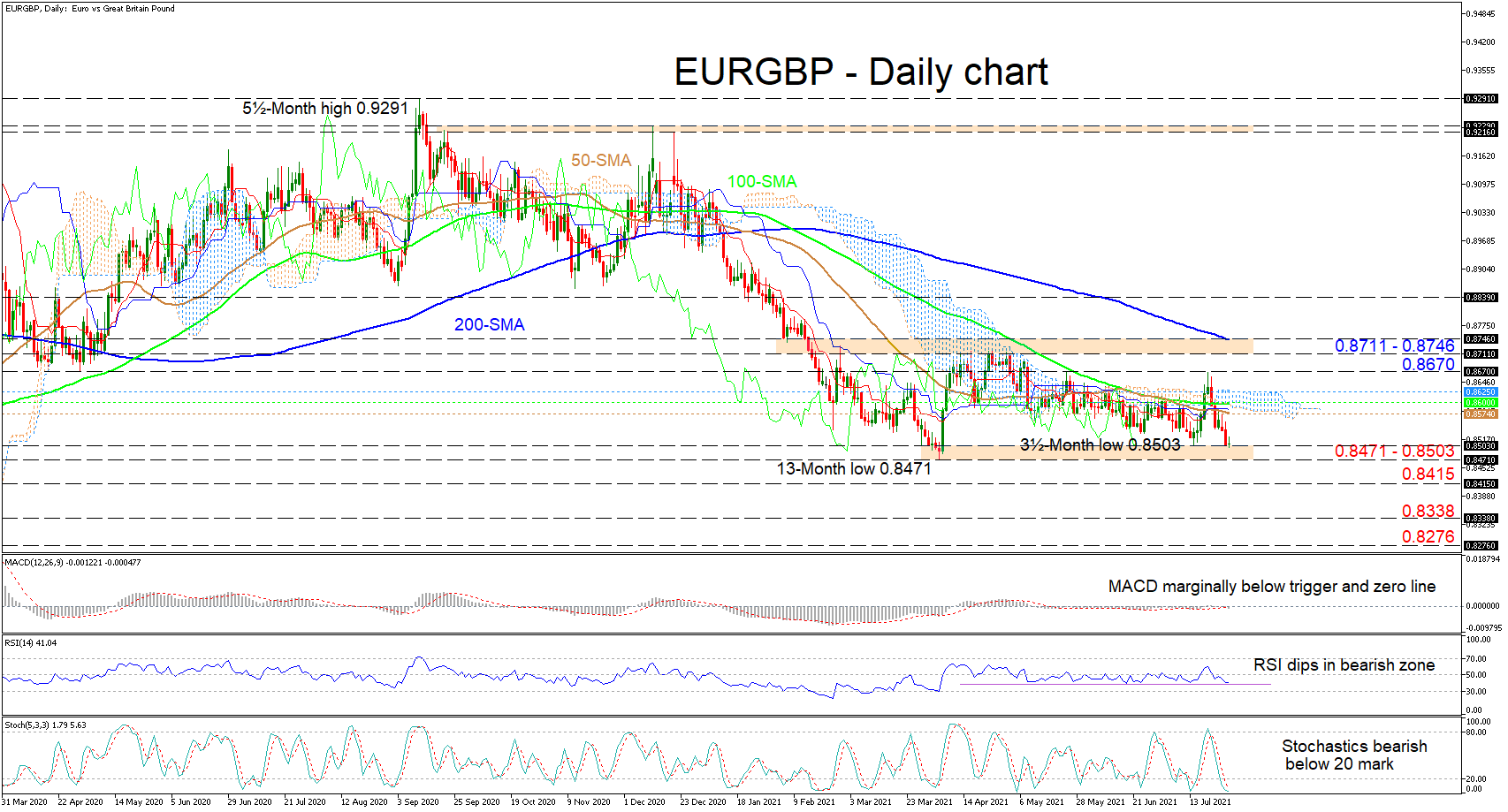
EURGBP is in the vicinity of the base of the 3½-month sideways market after having surrendered its recent gains up to 0.8670. The 100- and the 200-day simple moving averages (SMAs) are weighing on the pair, keeping downside pressures alive, while the 50-day SMA is promoting a more neutral bias.
The Ichimoku lines are indicating that sturdy directional momentum is largely absent, while the short-term oscillators are exhibiting a slight tilt to the downside. The MACD is showing that momentum has dried up for some time now and is only just below its red trigger and zero lines. The RSI has shoved lower beneath its 50 level but has yet to signal negative pressures are strengthening, while the negatively charged stochastic oscillator is endorsing bearish price pressures.
In the negative scenario, immediate downside constraints could commence from the support foundation of the range of 0.8471-0.8503. In the event sellers break underneath this key border, the price may dive for the 0.8415 inside swing high obstacle. Should selling interest increase, the pair could then target the critical trough of 0.8338 from February 25 of last year. Sinking further, the 0.8276 barrier, identified in December 2019 could come into the spotlight.
Otherwise, if the price bounces off the 0.8503 upper frontier of the floor of the consolidation, buyers could face a durable resistance section from the 50-day SMA at 0.8574 until the Ichimoku cloud’s upper surface at 0.8625. If the bulls manage to float above the cloud, the price could then hit the 0.8670 high before challenging the ceiling of the range of 0.8711-0.8746, reinforced by the 200-day SMA.
Summarizing, EURGBP is sustaining a neutral-to-bearish demeanour in the short-term timeframe. A break either below 0.8471-0.8503 or above 0.8711-0.8746 could reveal a more convincing price direction in the pair.
Euro Edges Lower ahead of FOMC
It’s been a quiet day on the currency markets, ahead of the key event of the week, the FOMC policy meeting (18:00 GMT). Investors are displaying caution in the hours ahead of the meeting, and the currency markets are in a wait-and-see mode.
Will the Fed discuss a taper?
Today’s FOMC meeting, the last meeting before the Jackson Hole symposium next month and the September policy meeting. The Fed is unlikely to announce a taper, but analysts will be combing through the rate statement, looking for any subtle changes in language as well as any hints of the ‘T’ word. Any changes in the rate statement’s language could shake up the US dollar.
There are some important factors that would lend support to the view that the Fed will balk and not provide any hints about plans to taper asset purchases. The resurgence of the delta variant, particularly in the Asian Pacific region, continues to raise worries about the impact on the global economy. Closer to home, the Biden administration’s infrastructure proposal has hit a dead-end in Congress, at least for the time being. If the Fed decides to kick the taper ball down the road, the US dollar, which has retreated this week, could lose more ground.
Over in Europe, consumers remain sour in Germany, the largest economy in the eurozone and a bellwether of economic conditions for the rest of the bloc. The GfK Consumer Climate hasn’t managed to post a gain since March 2020, just before Covid caused an economic meltdown. The reading of -0.3 indicated stagnation, and was a bit below the consensus of +0.9 points. Consumer spending is a key driver of the economy, but consumers are unlikely to feel much confidence until health restrictions are eased and Covid is firmly under control.
EUR/USD Technical
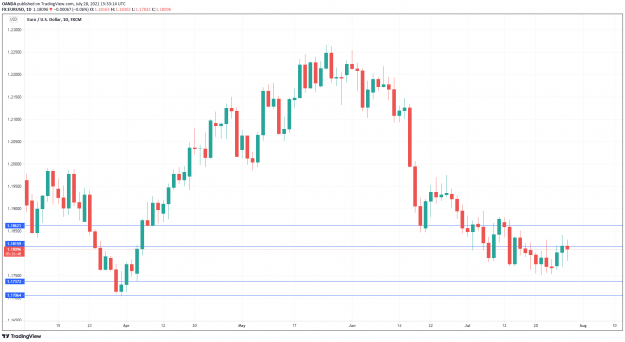
- On the downside, there is support at 1.1737. Close by, there is support at 1.1706
- EUR/USD is testing resistance at 1.1815. Above, there is resistance at 1.1862
Sunset Market Commentary
Markets
Today, the ‘China-induced’ turmoil that spooked US and European markets earlier this week finally subsided. Eco data were mostly second tier. The US June Merchandise trade deficit rose to the second widest on record at $91.2 bln as imports (1.5%) rose more than exports (0.3%). However, with the focus on growth and on inflation, the market currently isn’t occupied with this deficit issue. In technical trading ahead of the Fed policy decision, the US yield curve slightly steepens with the 30-j rising up to and 2.5 bp. Still the technical picture remains fragile as the 10-y yield (1.265%) is holding in the 1.20/30% corridor. This fragile underlying sentiment was also visible in German bunds with yields declining marginally (<1 bp) except for the 30-y yield. At -0.44%, the Germain 10-y yield is even testing the lowest level since February. European equities gain about 0.75% on average. US indices struggle to stay in green. The dollar gains marginally, but also in FX there is no clear directional drive as investors await the Fed policy decision and press conference later today. EUR/USD hovers around the 1.18 barrier. USD/JPY tries to regain the 110 pivot. Sterling remains well bid, as EUR/GBP nears the lower bound of the 085 big figure. Investors apparently are growing more confident that the reopening of the economy can avoid a material setback.
The key market event evidently still has to take place with the Fed policy decision and press conference of Fed Chair Powell later today. No Fed policy change is expected. The Fed will probably acknowledge the continuation of the recovery even as risks (delta variant) persist and as the labour market has a long way to go to reach the Fed’s full employment target. Inflation will likely still be labelled as temporary, but we look out for subtle changes in tone or a stronger reconfirmation that the Fed will take action ‘if necessary’. The process of ‘thinking about thinking about tapering’ will continue, but more concrete guidance is only expected in August (Jackson Hole) or at the September meeting (with new forecasts). Interesting insights maybe have to come for the press conference rather than from the official statement. Any specification on what the Fed sees as ’temporary/transitory’ (on inflation) would be interesting. We’re also keen to hear Powell’s view on the developments in the (bond) market. Low long-term yields can be seen as ‘favourable financing conditions’ supporting the recovery. However can a central banker be happy with the aggressive flattening of the yield curve and historically low real yields at this point in the economic cycle? A steeper curve might give more comfort on markets’ (and other economic agents’) confidence in the economic recovery. In any case, it won’t be easy for Powell to commit on supporting growth and maintain its credibility on inflation at the same time. From a technical point of view 1.12% and -0.47% are next support levels on the charts for the US and German 10-y yield respectively. The dollar recently took a pause, but no important support has been broken yet. Powell’s tone on whether or not the Fed will give more weight on inflation is important. No change in the ‘temporary inflation narrative’ cause some further USD easing EUR/USD 1.1881/1895 (currently 1.1820) and DXY 92.00 (currently 92.50) are first technical reference on the charts.
News Headlines
In an interview with Bloomberg, Deputy governor Thomas Nidetzky of the Czech National Bank (CNB) advocated the CNB should keep lifting policy rates at a swift pace as the economy is rebounding significantly faster than the bank had forecasted. Despite the continued risks of uncertainties, the CNB wants to send a signal that it won’t tolerate elevated inflation. In this respect, Nidetzky said that an important topic that sets the Czech Republic apart from other countries is that the country’s ‘labour market hasn’t cooled down and is in fact back where it was before the pandemic’. In this context, he supports an additional rate hike at next week’s meeting, and said he can imagine rate hikes at each subsequent meeting until new factors are in play. In a milder risk context, the krona rebounded today with EUR/CZK trading near 25.63.
Canada: Inflation Slows in June, But Still Elevated
- The Consumer Price Index (CPI) rose 3.1% year-over-year in June, down from 3.6% in May and a touch below the median forecast of 3.2%.
- Gasoline prices, were again considerably higher than what they were a year ago (+32%), but were down from May (+43.4%) due to the recovery in prices in 2020. Food price inflation edged down to 1.3% (from 1.5% in May) as prices for fresh vegetables continued to trend lower. Excluding food and energy, inflation was 2.2% in June, down from 2.4% in May.
- Of the major components, shelter (+4.4%) and transportation (+5.6%) made the largest contribution to June's price gains. Shelter costs were driven up by homeowners' replacement costs which was up 12.9%. Meanwhile, the mortgage interest cost index fell 8.6% due to low interest rates. This was the steepest decline on record. Clothing and footwear also saw a significant slowdown in price growth in June, weakening to 1.1% from 3.9% in May. This comes as a result of lower prices for women's clothing.
- On a seasonally adjusted basis, CPI increase 0.1% in June, slowing from the 0.4% gain in May.
- The Bank of Canada's core inflation measures were broadly unchanged last month. CPI-Trim remained at 2.6%, CPI-Median edged up to 2.4% from 2.3%, and CPI-Common ticked down to 1.7% from 1.8%.
Key Implications
- Despite the cooling in June, price pressures are likely to rise in the months ahead. Further reopening of the economy is likely to fuel gains in categories that had seen muted inflation throughout the last year. At the same time, strains to the supply chain have not been fully alleviated and will continue to exert upward pressure on price growth. Firms have indicated an increased willingness to pass on higher input costs to consumers and with consumers able to absorb them, there is good reason to expect them to do so.
- As consumers settle into more stable spending-saving patterns and supply chain constraints are ironed out, price pressures should moderate. That said, there is a non-negligible risk that supply constraints prove longer lasting and demand runs hotter than expected. In that case, inflation expectations could rise meaningfully, presenting greater upside risk to the inflation outlook. The Bank of Canada will be monitoring signs on this front closely as it charts next steps for monetary policy.
EUR/USD Mid-Day Outlook
Daily Pivots: (S1) 1.1777; (P) 1.1809; (R1) 1.1848; More...
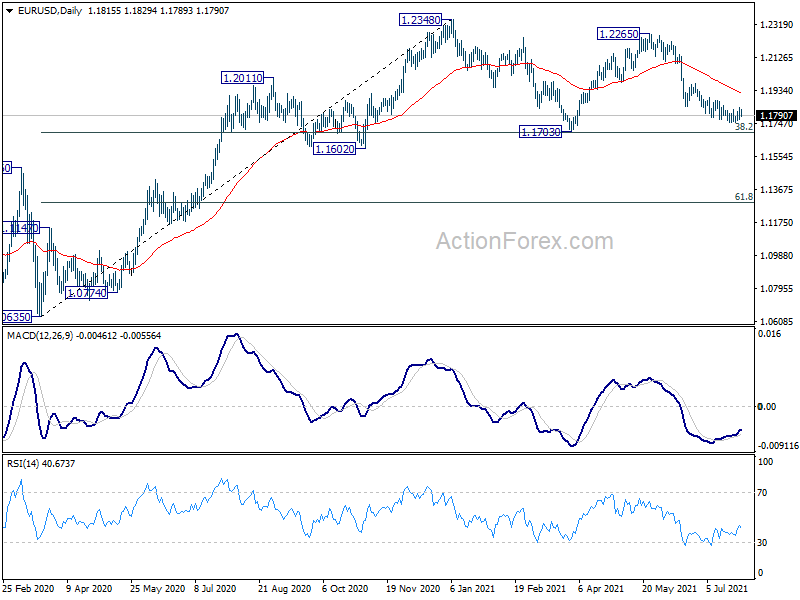
Intraday bias in EUR/USD stays neutral for the moment. Another fall is still mildly in favor with 1.1880 resistance intact. On the downside, break of 1.1751 will resume the fall from 1.2265, as the third leg of correction from 1.2348, to 1.1703 support. However, on the upside, break of 1.1880 resistance will indicate short term bottoming and turn bias back to the upside, for stronger rebound to 1.1974 resistance first.
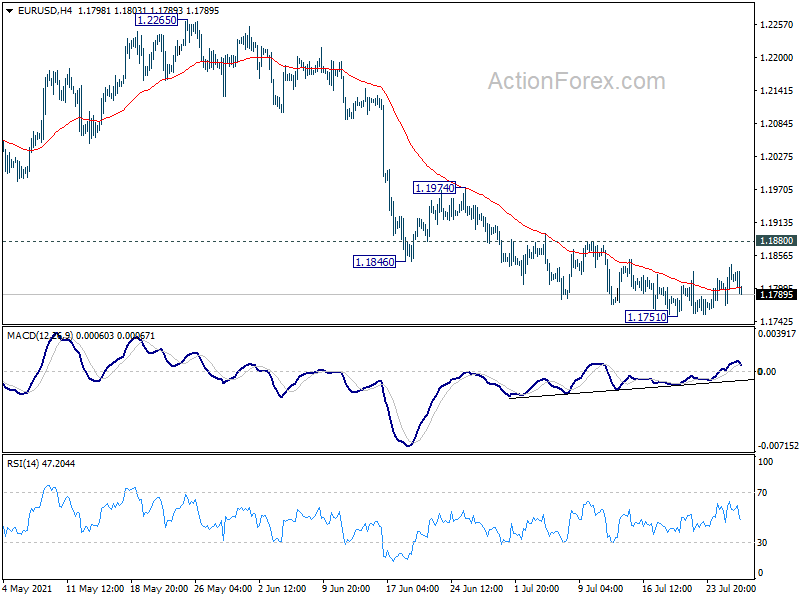
In the bigger picture, rise from 1.0635 is seen as the third leg of the pattern from 1.0339 (2017 low). Further rally could be seen to cluster resistance at 1.2555 next, (38.2% retracement of 1.6039 to 1.0339 at 1.2516). This will remain the favored case as long as 1.1602 support holds. Reaction from 1.2555 should reveal underlying long term momentum in the pair. However sustained break of 1.1602 will argue that the rise from 1.0635 is over, and turn medium term outlook bearish again.
USD/CHF Mid-Day Outlook
Daily Pivots: (S1) 0.9122; (P) 0.9154; (R1) 0.9180; More....
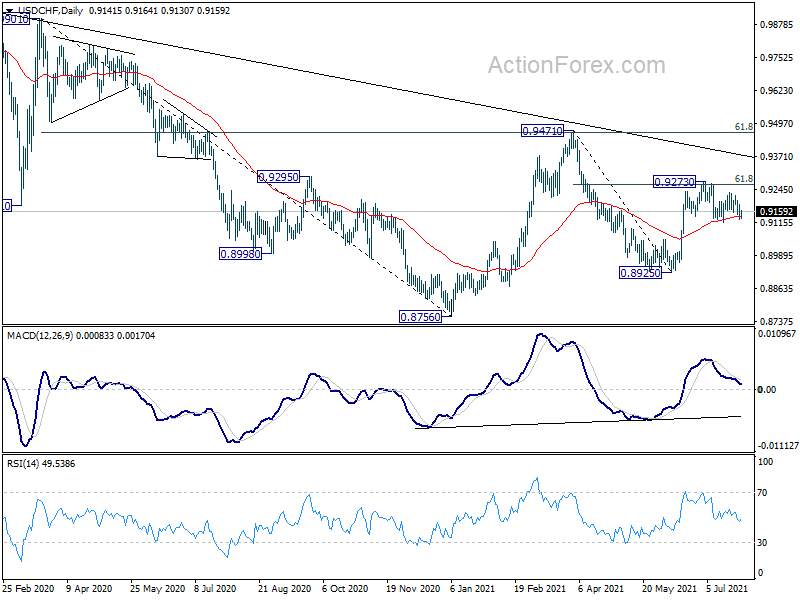
Intraday bias in USD/CHF remains neutral at this point. On the downside, break of 0.9116 support will affirm the case that rebound from 0.8925 has completed at 0.9273. Deeper fall would then be seen back to retest 0.8925 low. On the upside, however, break of 0.9273 and sustained trading above 61.8% retracement of 0.9471 to 0.8925 at 0.9262 will target 0.9471 resistance next.
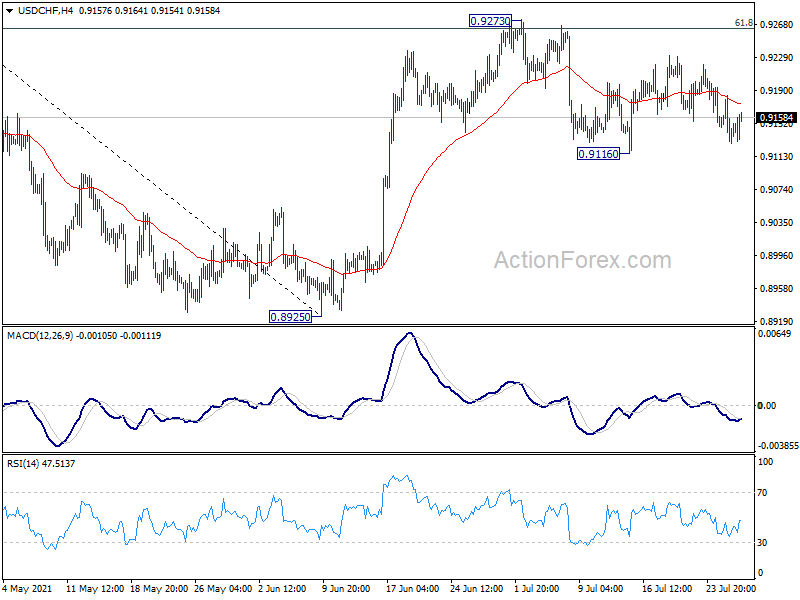
In the bigger picture, medium term outlook is currently neutral with focus on 0.9471 resistance. Sustained break there will indicate completion of whole decline from 1.0342 (2016 high). Medium term outlook will be turned bullish for a test on 1.0342 high. But, rejection by 0.9471 again will revive bearishness for another fall through 0.8756 low.