

Sample Category Title
USD/CHF Daily Outlook
Daily Pivots: (S1) 0.9078; (P) 0.9123; (R1) 0.9145; More....
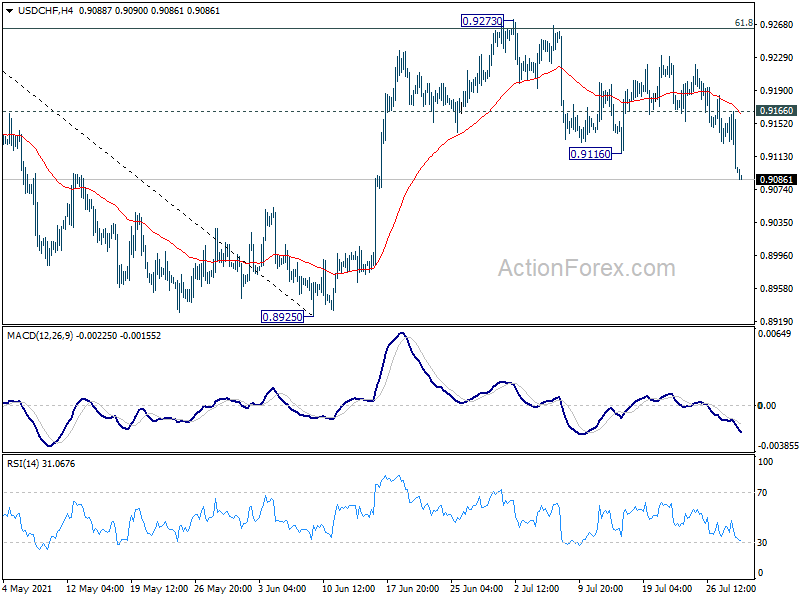
USD/CHF's break of 0.9116 support suggests resumption of fall from 0.9273. It also affirms the case that rebound from 0.8925 has completed. Intraday bias is back on the downside for retesting 0.8925 support next. On the upside, above 0.9166 minor resistance will mix up the near term outlook and turn intraday bias neutral first.
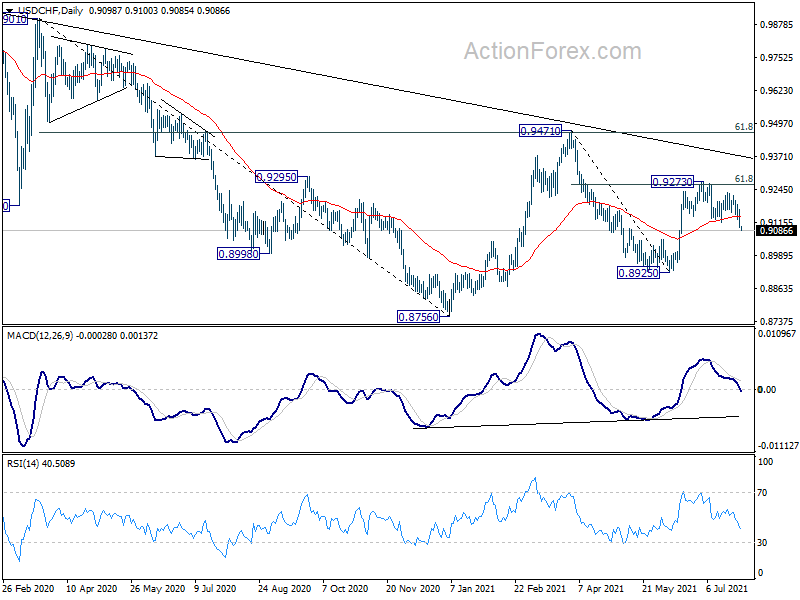
In the bigger picture, medium term outlook is currently neutral with focus on 0.9471 resistance. Sustained break there will indicate completion of whole decline from 1.0342 (2016 high). Medium term outlook will be turned bullish for a test on 1.0342 high. But, rejection by 0.9471 again will revive bearishness for another fall through 0.8756 low.
EUR/USD Daily Outlook
Daily Pivots: (S1) 1.1795; (P) 1.1823; (R1) 1.1871; More...
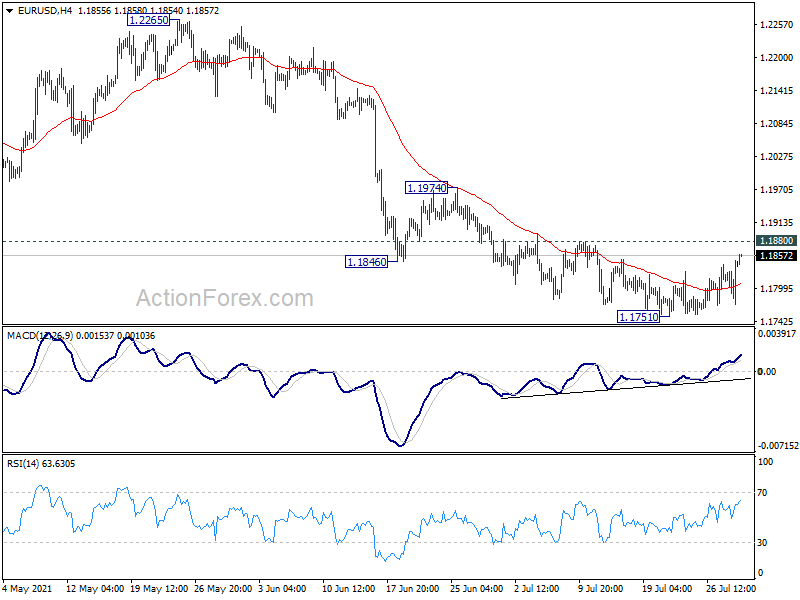
EUR/USD is still bounded in range of 1.1751/1880 and intraday bias remains neutral first. On the upside, firm break of 1.1880 will indicate short term bottoming. Intraday bias will be turned back to the upside for 1.1974 resistance first. On the downside, break of 1.1751 will resume the fall from 1.2265, as the third leg of correction from 1.2348, to 1.1703 support.
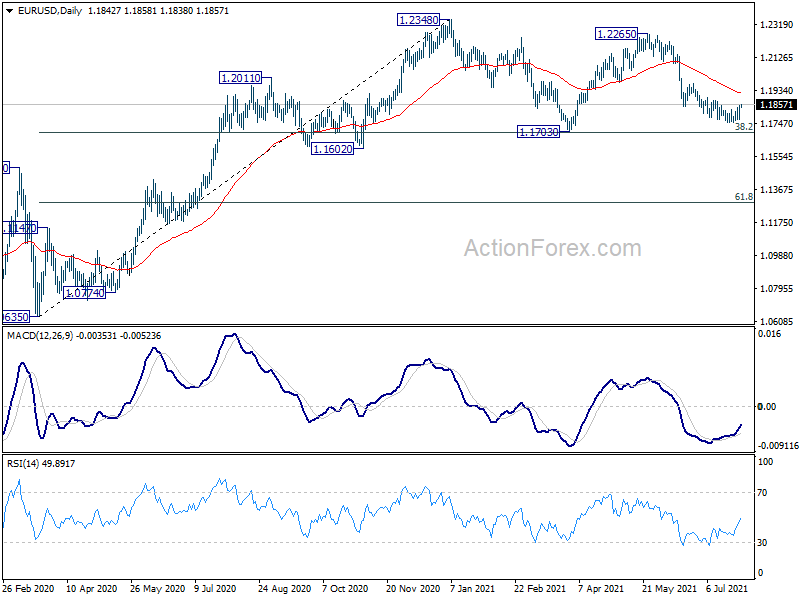
In the bigger picture, rise from 1.0635 is seen as the third leg of the pattern from 1.0339 (2017 low). Further rally could be seen to cluster resistance at 1.2555 next, (38.2% retracement of 1.6039 to 1.0339 at 1.2516). This will remain the favored case as long as 1.1602 support holds. Reaction from 1.2555 should reveal underlying long term momentum in the pair. However sustained break of 1.1602 will argue that the rise from 1.0635 is over, and turn medium term outlook bearish again.
GBP/USD Daily Outlook
Daily Pivots: (S1) 1.3862; (P) 1.3887; (R1) 1.3929; More....
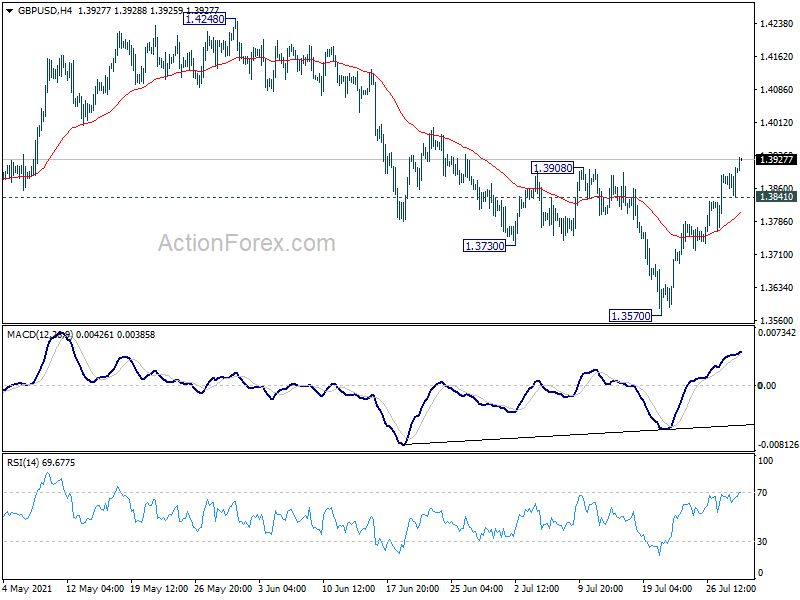
GBP/USD's break of 1.3908 suggests that fall from 1.4248 has completed at 1.3570 already. Corrective pattern from 1.4240 might have finished too. Intraday bias is back on the upside for retesting 1.4248 high next. On the downside, below 1.3841 minor support will turn intraday bias neutral and bring retreat first, before staging another rally.
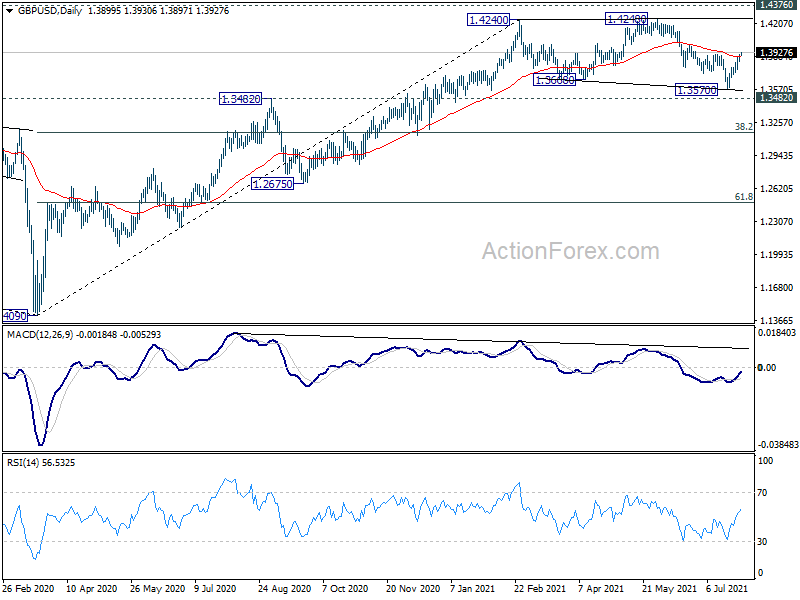
In the bigger picture, as long as 1.3482 resistance turned support holds, up trend from 1.1409 should still continue. Decisive break of 1.4376 resistance will carry larger bullish implications. However, firm break of 1.3482 support will argue that the rise from 1.1409 has completed. GBP/USD would then be seen in another leg of long term range pattern between 1.1409 and 1.4376. Deeper fall could then be seen to 61.8% retracement of 1.1409 to 1.4248 at 1.2493, and even below.
Dollar Falls Broadly after Fed, Q2 GDP Next
Dollar drops broadly overnight and stays weak, even though Fed acknowledged that progress has already been made in the economy. Uncertainty in the risk markets is keeping Aussie soft too. But Canadian Dollar is apparently rebounding with resilience in oil prices. Sterling is also strong with Swiss Franc while Euro under performs them. Focus will now turn to US GDP report.
Technically, GBP/USD's break of 1.3908 resistance suggests completion of recent fall from 1.4248. USD/CHF's break of 0.9116 also affirms that rebound from 0.8925 has completed at 0.9273 already. A major focus is now on the relatively weak Euro. Break of 1.1880 resistance in EUR/USD should also confirm short term bottoming at 1.1751. That would solidify the case of more Dollar selling for the near term at least.
In Asia, at the time of writing, Nikkei is up 0.76%. Hong Kong HSI is up 2.74%. China Shanghai SSE is up 1.04%. Singapore Strait Times is up 0.50%. Japan 10-year JGB yield is up 0.0049 at 0.021. Overnight, DOW dropped -0.36%. S&P 500 dropped -0.02%. NASDAQ rose 0.70%. 10-year yield rose 0.027 to 1.261.
Fed acknowledged that progress has been made
FOMC acknowledged in the statement that "the economy has made progress toward" the "maximum employment and price stability goals". Chair Jerome Powell noted that Fed discussed the pace and composition of tapering but did not make any final decisions. Powell also noted that here is "little support" for tapering MBS purchases first, and that participants have mixed views on tapering MBS purchases faster. Next focus is the minutes which will be released in 3 weeks' time.
In the mean time, Fed officials would likely share more of their view over tapering ahead. Key events leading to the September meeting are the July meeting minutes and Jackson Hole symposium in late August. We also expect more detailed information about tapering will be released in September, alongside updated economic projections and median dot plots. A formal tapering announcement will then be made in December.
Suggested readings:
- FOMC: "Progress" Made but Is It Enough to Taper?
- July's Meeting Suggests the FOMC is Readying for Policy Normalisation
- FOMC Meeting Recap: 'Progress' Toward Taper, But Not 'Substantial' Yet
Gold back about 1800, following Dollar selloff
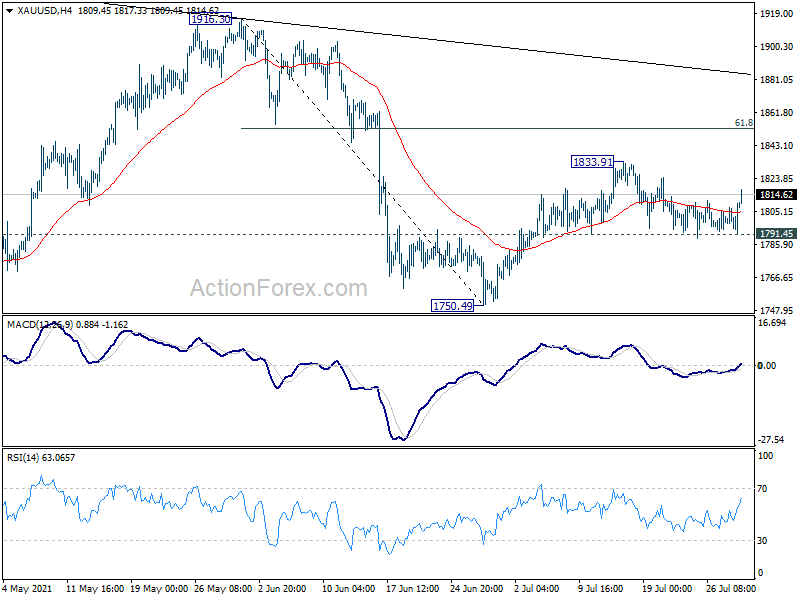
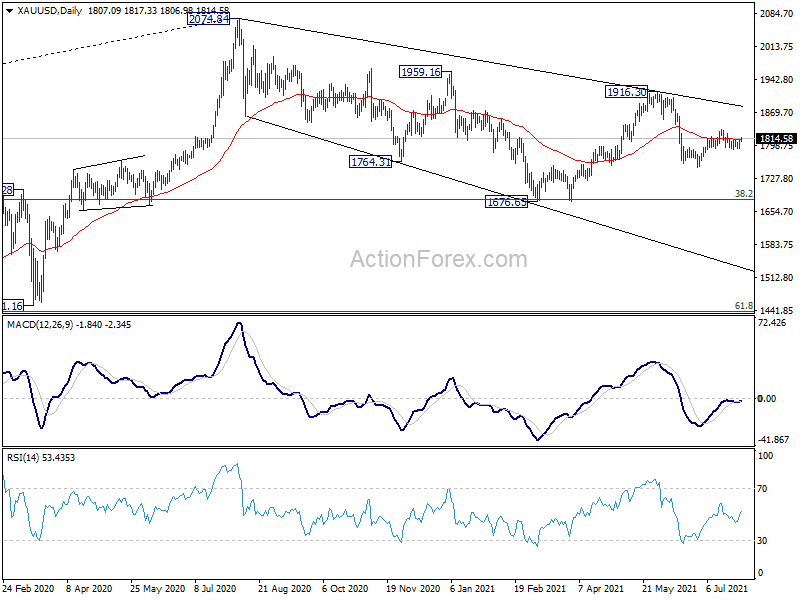
Gold rebounded notably and reclaimed 1800 handle, following Dollar's post FOMC selloff. The development suggests that 1791.45 support could have been defended well, keeping the rise from 1750.49 alive. Focus is now back on 1833.91 resistance. Break there will target 61.8% retracement of 1916.30 to 1750.49 at 1852.96 next.
Overall, we'd need to see Gold breaking 1916.30 resistance firmly, to give us more confidence that the corrective pattern from 2074.84 has completed. Otherwise, outlook will stay neutral for now.
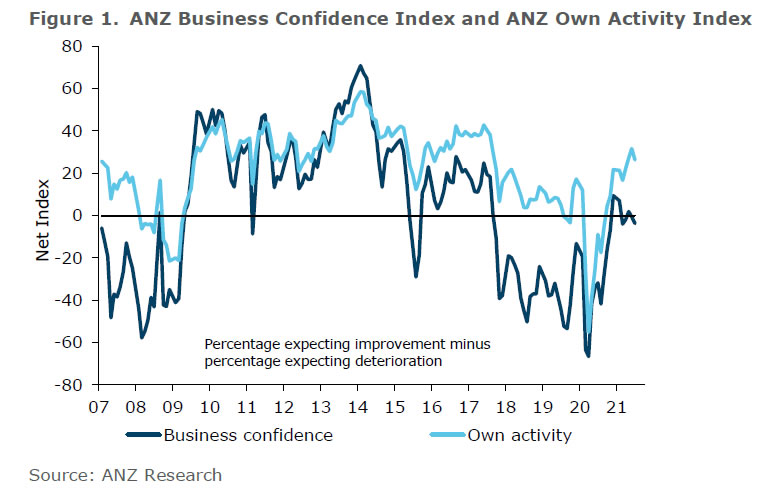
New Zealand ANZ business confidence dropped to -3.8, time to start normalizing monetary conditions
New Zealand ANZ business confidence dropped from -0.6 to -3.8 in July. Own activity outlook also dropped from 31.6 to 26.3. Looking at some more details, expect intentions dropped from 13.4 to 7.6. Investment intentions dropped from 25.5 to 17.4. Employment intentions rose from 19.7 to 21.4. Cost expectations rose from 86.2 to 88.2. Pricing intentions dropped slightly from 62.8 to 61.3. Inflation expectations rebounded from 2.41 to 2.70.
ANZ said, "the combination of clear upside for the activity and inflation starting point, but downside risks in the (quite possibly not far off) future, do, on the face of it, present a conundrum for the Reserve Bank... "If they raise rates now, the odds are indeed uncomfortably high that they'll end up reversing course before long... Inflation pressures provide an excellent reason to raise interest rates now, despite downside risks... inaction comes with risks too. It's time to start normalising monetary conditions, even if trouble might lie closer ahead than we hope."
Looking ahead
Germany unemployment and CPI flash, Eurozone economic sentiment, UK M4 money supply will be released in European session. US GDP will take center stage later in the day, with jobless claims and pending home sales.
GBP/USD Daily Outlook
Daily Pivots: (S1) 1.3862; (P) 1.3887; (R1) 1.3929; More....
GBP/USD's break of 1.3908 suggests that fall from 1.4248 has completed at 1.3570 already. Corrective pattern from 1.4240 might have finished too. Intraday bias is back on the upside for retesting 1.4248 high next. On the downside, below 1.3841 minor support will turn intraday bias neutral and bring retreat first, before staging another rally.
In the bigger picture, as long as 1.3482 resistance turned support holds, up trend from 1.1409 should still continue. Decisive break of 1.4376 resistance will carry larger bullish implications. However, firm break of 1.3482 support will argue that the rise from 1.1409 has completed. GBP/USD would then be seen in another leg of long term range pattern between 1.1409 and 1.4376. Deeper fall could then be seen to 61.8% retracement of 1.1409 to 1.4248 at 1.2493, and even below.
Economic Indicators Update
| GMT | Ccy | Events | Actual | Forecast | Previous | Revised |
|---|---|---|---|---|---|---|
| 1:00 | NZD | ANZ Business Confidence Jul | -3.8 | -0.6 | ||
| 1:30 | AUD | Import Price Index Q/Q Q2 | 1.90% | 0.20% | 0.20% | |
| 7:55 | EUR | Germany Unemployment Rate Jul | 5.80% | 5.90% | ||
| 7:55 | EUR | Germany Unemployment Change Jul | -25K | -38K | ||
| 8:30 | GBP | Net Lending to Individuals (GBP) Jun | 6.8B | 6.9B | ||
| 8:30 | GBP | Mortgage Approvals Jun | 85K | 88K | ||
| 8:30 | GBP | M4 Money Supply M/M Jun | 0.30% | 0.40% | ||
| 9:00 | EUR | Eurozone Economic Sentiment Indicator Jul | 118.8 | 117.9 | ||
| 9:00 | EUR | Eurozone Services Sentiment Jul | 19.5 | 17.9 | ||
| 9:00 | EUR | Eurozone Industrial Confidence Jul | 13 | 12.7 | ||
| 9:00 | EUR | Eurozone Consumer Confidence Jul F | -4.4 | -4.4 | ||
| 9:00 | EUR | Eurozone Business Climate Jul | 1.71 | |||
| 12:00 | EUR | Germany CPI M/M Jul P | 0.50% | 0.40% | ||
| 12:00 | EUR | Germany CPI Y/Y Jul P | 3.20% | 2.30% | ||
| 12:30 | USD | Initial Jobless Claims (Jul 23) | 365K | 419K | ||
| 12:30 | USD | GDP Annualized Q2 P | 8.20% | 6.40% | ||
| 12:30 | USD | GDP Price Index Q2 P | 5.40% | 4.30% | ||
| 14:00 | USD | Pending Home Sales M/M Jun | 0.80% | 8.00% | ||
| 14:30 | USD | Natural Gas Storage | 49B |
FOMC: “Progress” Made but Is It Enough to Taper?
Summary
- As widely expected, the FOMC did not make any major policy changes at today's meeting. The decisions to keep the target range for the fed funds rate unchanged as well as the pace of asset purchases was unanimously supported by all 11 voting members of the Committee.
- The FOMC acknowledged that "progress" has been made toward reaching the Committee's goals of maximum employment and price stability. But probably not enough progress yet to warrant a near-term commencement of tapering asset purchases.
- We continue to forecast that the FOMC will keep its target range for the fed funds rate unchanged through at least the end of next year.
- We look for Fed officials to begin dropping hints in the next month or two about an eventual tapering of asset purchases. We look for a formal announcement to be made at the December FOMC meeting, with the actual process of winding down the purchases to begin early next year.
The FOMC Made No Major Policy Changes at Today's Meeting
As widely expected, the Federal Open Market Committee (FOMC) announced no major policy changes at the conclusion of its two-day meeting today. The FOMC left its target range for the federal funds rate at 0.00% to 0.25%, where it has been maintained since March 2020. The Committee also decided to maintain its monthly purchase rate of Treasury securities and mortgage-backed securities (MBS) at $80 billion and $40 billion, respectively. Both decisions were unanimously supported by all 11 voting members of the Committee.
As is typical for the fifth FOMC meeting of the year, the Committee did not release its quarterly Summary of Economic Projections (SEP), which contains the FOMC's macroeconomic forecasts. So there is no way of knowing how the Committee's outlook has evolved since its June 16 meeting, when the last SEP was published. The June SEP showed that all 18 committee members thought the target range for the fed funds rate would remain unchanged through the end of the year, and that a majority of members (11) thought that it would remain unchanged through the end of 2022. These projections are similar to our own forecast of an unchanged fed funds rate through at least the end of next year.
The statement that was released at the conclusion of today's meeting gives us no reason to change that forecast. The Committee stated that "indicators of economic activity and employment have continued to strengthen." The statement went on to say that "the sectors most adversely affected by the pandemic have shown improvement," but it also noted that they "have not fully recovered." Furthermore, the FOMC continued to note that "risks to the economic outlook remain," due largely to the lingering pandemic. A rate hike simply does not seem likely as long as the economic outlook remains clouded by uncertainty.
When Will Tapering Begin?
The FOMC has been stating that "substantial further progress" needs to be made toward the Committee's twin goals of maximum employment and price stability before a tapering of asset purchases would be warranted. The statement that was released today said that "the economy has made progress toward these goals," and that the FOMC "will continue to assess progress in coming months." In other words, progress has been made, but not quite enough yet to warrant a near-term commencement of "tapering." Note the reference to "coming months." It does not seem that the FOMC is in any hurry to taper, although the Committee does seem to acknowledge that the time is drawing nearer.
As we discussed in our recent July Flashlight for the FOMC Blackout Period, we look for the FOMC to make a formal announcement regarding the tapering of its asset purchases at the December 14-15 meeting, and we expect that the Fed will begin the process of winding down its purchases early next year. But before that formal announcement is made, we expect that Fed officials will hint that tapering will be forthcoming. Today's statement suggests that Chair Powell could potentially drop an explicit hint in his speech at the Jackson Hole Symposium at the end of August, or at the conclusion of the September 22 FOMC meeting.
But as we also acknowledged in our Flashlight report, the commencement of any tapering of asset purchases will depend crucially on the evolution of the economy in coming weeks and months. Stronger-than-expected economic growth and/or higher-than-expected inflation could induce the Committee to begin the process of dialing back the Fed's purchases of Treasury securities and MBS earlier than we currently anticipate. Conversely, marked deceleration in economic activity and/or significant easing of inflationary pressures could lead the FOMC to conclude that continued asset purchases are warranted. In that regard, the recent resurgence in COVID cases represents a notable downside risk to the economic outlook.
The minutes of today's meeting are scheduled to be published on August 18. We will be reading those minutes closely for any explicit references to the timing of tapering.
Gold back about 1800, following Dollar selloff
Gold rebounded notably and reclaimed 1800 handle, following Dollar's post FOMC selloff. The development suggests that 1791.45 support could have been defended well, keeping the rise from 1750.49 alive. Focus is now back on 1833.91 resistance. Break there will target 61.8% retracement of 1916.30 to 1750.49 at 1852.96 next.
Overall, we'd need to see Gold breaking 1916.30 resistance firmly, to give us more confidence that the corrective pattern from 2074.84 has completed. Otherwise, outlook will stay neutral for now.
New Zealand ANZ business confidence dropped to -3.8, time to start normalizing monetary conditions
New Zealand ANZ business confidence dropped from -0.6 to -3.8 in July. Own activity outlook also dropped from 31.6 to 26.3. Looking at some more details, expect intentions dropped from 13.4 to 7.6. Investment intentions dropped from 25.5 to 17.4. Employment intentions rose from 19.7 to 21.4. Cost expectations rose from 86.2 to 88.2. Pricing intentions dropped slightly from 62.8 to 61.3. Inflation expectations rebounded from 2.41 to 2.70.
ANZ said, "the combination of clear upside for the activity and inflation starting point, but downside risks in the (quite possibly not far off) future, do, on the face of it, present a conundrum for the Reserve Bank... "If they raise rates now, the odds are indeed uncomfortably high that they'll end up reversing course before long... Inflation pressures provide an excellent reason to raise interest rates now, despite downside risks... inaction comes with risks too. It's time to start normalising monetary conditions, even if trouble might lie closer ahead than we hope."
July’s Meeting Suggests the FOMC is Readying for Policy Normalisation
While there is no urgency, progress towards the FOMC’s targets continues to be made.
The July FOMC meeting communications kept to the themes and expectations of the June meeting. The Committee’s wording and tone suggests headway towards their maximum employment and price stability goals continues to be made; but, as put by Chair Powell in the press conference, there is “some ground to cover” before “substantial further progress” is achieved.
On the pursuit of full employment, indicators of “employment have continued to strengthen”, with the “sectors most adversely affected by the pandemic hav[ing] shown improvement”. Speaking on wages during the press conference, Chair Powell ascribed most of the wage gains to firms’ need to attract new hires in a supply-constrained environment, a temporary phenomenon, particularly in low-income professions. These observations re-enforce that full employment is not yet near and there is little-to-no enduring risk to inflation from pursuing further strong employment gains.
The inflation commentary in the statement was unchanged in July, with transitory factors seen as the driver of the recent above-target inflation outcomes. Chair Powell re-enforced this view in the press conference, making clear that the continuing overshoot on inflation has a re-opening narrative attached to it and is therefore transitory. He went on to make clear that, while he sees near-term inflation risks as skewed to the upside, into the medium-term those risks are expected to dissipate.
The above comments present the outlook in a positive light. While there is no urgency, it is apparent the FOMC is getting ready to announce a taper.
The statement clearly puts the decision on the current purchase pace in the past with the addition of “Last December, the Committee indicated that it would” to the sentence on the Treasury/MBS purchase programs. They also added, “Since then, the economy has made progress toward these goals, and the Committee will continue to assess progress in coming meetings”.
Discussions on the form of the taper were also had at this meeting, specifically whether it was appropriate to taper MBS purchases before Treasury securities and/or to reduce MBS purchases at a faster pace given the strength of the US housing market.
Chair Powell has a similar view on this question to Westpac. He noted in the press conference that the effect of both purchase programs on financial conditions was more-or-less the same, making it appropriate to taper the programs together. However, some room was left to discuss further whether a faster taper pace was appropriate for MBS.
Chair Powell did not give anything away on the subject matter of his upcoming August speech at the Jackson Hole Symposium. It seems likely it will include a further exploration of the specifics of the taper process as well as how risks are to be assessed and responded to as policy is normalised. Arguably the FOMC will want to do all they can to avoid a protracted, uncertain tightening cycle.
Westpac continues to expect a taper announcement at the September FOMC meeting, with the process itself to begin in January 2022 and last for six months. All going well, rate hikes will commence in December 2022 and continue in 2023 and 2024, taking the fed funds rate to a peak of 1.625%. Throughout this process, GDP growth is anticipated to remain above trend, settling near that benchmark at the end of the period.
Market Morning Briefing: Aussie Looks Stable Below 0.74
STOCKS
The outcome of the US Federal Reserve meeting yesterday has failed to provide any trigger for a strong rise/breakout in equities. The Fed left both the interest rates and the asset purchases unchanged and gave no hint on tapering the stimulus. As such the sideways consolidation in equities can continue for some more time. Our bias continues to remain bullish to see an upside breakout of this consolidation eventually going forward. Dow has dipped below 35000 and can move down within its 33000-35100 range. DAX remains mixed within its 15200-15800 range. Nikkei is likely to retain its 27000-29500 range and move up within it in the coming days. Shanghai continues to remain under pressure and can consolidate between 3300-3450 for some time. Sensex and Nifty have risen back well after a sharp intraday fall yesterday. They are likely to retain their 51000/52000-53000 and 15500/600-15900 range for some more time.
Dow (34930.93, −127.59, -0.36%) has dipped below 35000 and may come down to 34500-34000 again while it remains below 35000. The rise to 36000 breaking above 35100 is getting delayed further. For now the broader 33000-35100 range is still intact. Our bias however continues to remain bullish to see an upside break of this range eventually.
DAX (15570.36, +51.23, +0.33%) looks mixed within the 15200-15800 range. We expect DAX to move up towards the upper end of its range in the near-term. The bias is bullish to see an upside break above this range and a rise to 16000-16200 going forward.
Nikkei (27677.43, +95.77, +0.35%) is getting intermediate support at 27500. We expect it to retain the 27000-29500 range for some more time and move up within this range now. Bias is bullish to see a break above 29500 and a rise to 31000 and higher levels. The view will turn bearish only on a break below 27000 to test 26000 on the downside.
Shanghai (3391.51, +29.93, +0.89%) has opened with a wide gap-up today after tumbling to a low of 3312.72 yesterday. We expect it to consolidate between 3300 and 3450 for some time. A strong rise past 3450 is needed to turn the sentiment positive. While below 3450, the chances of seeing 3200 on the downside cannot be ruled out.
Sensex (52443.71, −135.05, -0.26%) had recovered sharply from the low of 51802.73. Inability to sustain the break below 52000 strengthens our bullish view of seeing a break above 53200 and a rise to 54000 and higher levels going forward. 52000 and 51000 are strong supports while above which the outlook is bullish.
Nifty (15709.40, −37.05, -0.24%) has risen back sharply from the low of 15513.45. The support at 15500 is holding well as expected. While above 15500, the outlook I bullish to see 16000-16200 on the upside. A break above 15900 can trigger this rally.
COMMODITIES
US Dollar weakened after the FOMC meeting pulling up Gold and Silver sharply. While the rise sustains, Gold can head towards 1840/60 while Silver can rise to 25.80-26. Crude prices have risen too and we may expect Brent to test $77-78 while WTI can rise to $75 before any reversal is seen. On Brent we look at a maximum rise to $80. Copper has fallen and could test 4.40 before bouncing back. A range of 4.40-4.60 may hold for the near term.
Brent (75.07) and WTI (72.69) have risen sharply. Brent can re-test $77-78 levels or even $80 on a break above $75/76 before facing rejection from there. A maximum upside of $80 looks possible on the upside before a sharp fall sets in, WTI on the other hand has crucial resistance at $75 which is likely to hold in the near term.
Gold (1819.90) has risen well on Dollar weakness after the FOMC meeting. A break above 1820 will take it higher towards 1840/60 in the medium term. Watch if it sustains above 1820 in the near term.
Silver (25.27) has risen contrary to our expectation of a fall towards 24-23. The rise if sustains can take it back towards 25.80-26.0 on the upside. Watch price action while above 25.
Copper (4.4905) has dipped today. While below 4.60, we may expect a fall towards 4.40 before again rising back to higher levels. A range of 4.40-4.60 may hold for now.
FOREX
FED kept rates unchanged and continues to buy bonds. Dollar Index has come down but we would wait to see if it manages to test 92 and break lower or bounces back to re-rise again towards 93 in the medium term. Euro looks bullish for a rise to 1.19 as it trades above 1.1850, the first hurdle. Pound looks strongly bullish towards 1.40 while Aussie and Dollar Yen seems to be ranged within 0.73-0.74 and 109.00/50-110.80 respectively. USDCNY has come down sharply from 6.51 and could fall towards 6.45 before showing any bounce again. USDINR needs to break below 74.40/30 in order to head towards 74.20/00. Else a sharp rise above 74.50 will change the outlook for a possible test of 74.60/70 (looks less likely)
Dollar Index (92.214) trades lower and needs to see if it can test 92 and break lower or bounces back to re-test 93 on the upside. A break below 92, if seen and sustained would bring in bearishness for the medium term opening up chances of re-testing lower supports of 90-89. Watch price action near 92.
Euro (1.1857) looks bullish as it rises past 1.1850. It needs to sustain in order to move up to 1.19 and higher eventually. We wait to see if the rise sustains over today and tomorrow. On the weekly candles, it seems to have risen well from very near term trend support. Scope of rising towards 1.19 is high.
EURJPY (130.13) trades in the upper end of the 130.50-129 region and the cross needs to break above 130.50 in order to signal a fresh bullish move in the medium term. Till then we may continue to look at 130.50 as a decent resistance that may produce a rejection back towards 129.50-129.00.
Dollar-Yen (109.80) came off sharply from 110.28 and trades lower for now. We continue to look at a range of 110.80-109.50/00 to hold for now unless a break on either side is seen.
Aussie (0.7371) looks stable below 0.74, unable to move sharply either ways. On the downside the range has been limited to 0.73. Unless a break on either side of the 0.73-0.74 region is seen, we continue to look for ranged sideways movement in Aussie.
Pound (1.3925) continues to rise and looks strongly bullish towards 1.3950-1.40 in the coming sessions before facing rejection from 1.40 over this week or the next. For now, view is bullish.
USDCNY (6.4787) came off sharply , unable to sustain above 6.50. We may expect the fall to extend towards 6.46/45 before a reversal is seen.
USDINR (74.38) needs to break below 74.30 in order to move down further towards 74.20-4.00. A strong Euro and Chinese Yuan is in favor of Rupee strength but we need to see if the important support near 74.30/40 will break on the downside or not.
INTEREST RATES
The US Treasury yields have dipped and may have room to move down further before a bounce is seen. The US Federal Reserve left the rates and bond purchases unchanged yesterday. The central bank did not give any hint on tapering the stimulus. This could keep the yields lower for some time. As such, the expected corrective bounce in the US yields may now get delayed. The German yields have come up to their key supports within their broader downtrend and could see a corrective bounce in the coming weeks. The 5Yr GoI retains the narrow range of 5.66%-5.7% for now. The bias is bullish to see an upside break of this range.
The US 2Yr (0.20%) and 5Yr (0.71%) Treasury yields continue to trade stable while the 10Yr (1.23%) and 30Yr (1.88%) have dipped slightly. The 30Yr has declined below 1.9% and can move down to test 1.8% before reversing higher. The 10Yr on the other hand has room to test 1.2% and even 1.1% on the downside and then can reverse higher. For now the corrective bounce to 2.1%-2.2% (30Yr) and 1.45%-1.5% (10Yr) is getting delayed.
The German 2Yr (-0.76%), 5Yr (-0.74%), 10Yr (-0.45%) and 30Yr (0.03%) yields remain lower. The 10Yr is at the -0.45%/-0.5% support zone and the 30Yr is coming closer to its 0%/-0.05% support zone. We expect these supports to hold and to see a corrective bounce to -0.30%/-0.25% (10Yr) and 0.10% (30Yr) in the coming weeks. Thereafter the broader downtrend can resume again.
The 5Yr GOI (5.6878%) continues to remain stuck inside the narrow 5.66%-5.7% range. While above 5.66%, the bias is bullish to break this range on the upside and see a rise to 5.76%.
USD/CAD Could Extend Losses, US GDP Next
Key Highlights
- USD/CAD started a fresh decline from well above 1.2750.
- It traded below a key bullish trend line with support near 1.2560 on the 4-hours chart.
- EUR/USD is attempting a decent recovery above the 1.1820 resistance.
- GBP/USD climbed above 1.3900, gold price is showing bullish signs above $1,800.
USD/CAD Technical Analysis
The US Dollar topped near the 1.2800 zone against the Canadian Dollar. USD/CAD started a fresh decline and it broke a couple of key supports near 1.2700.
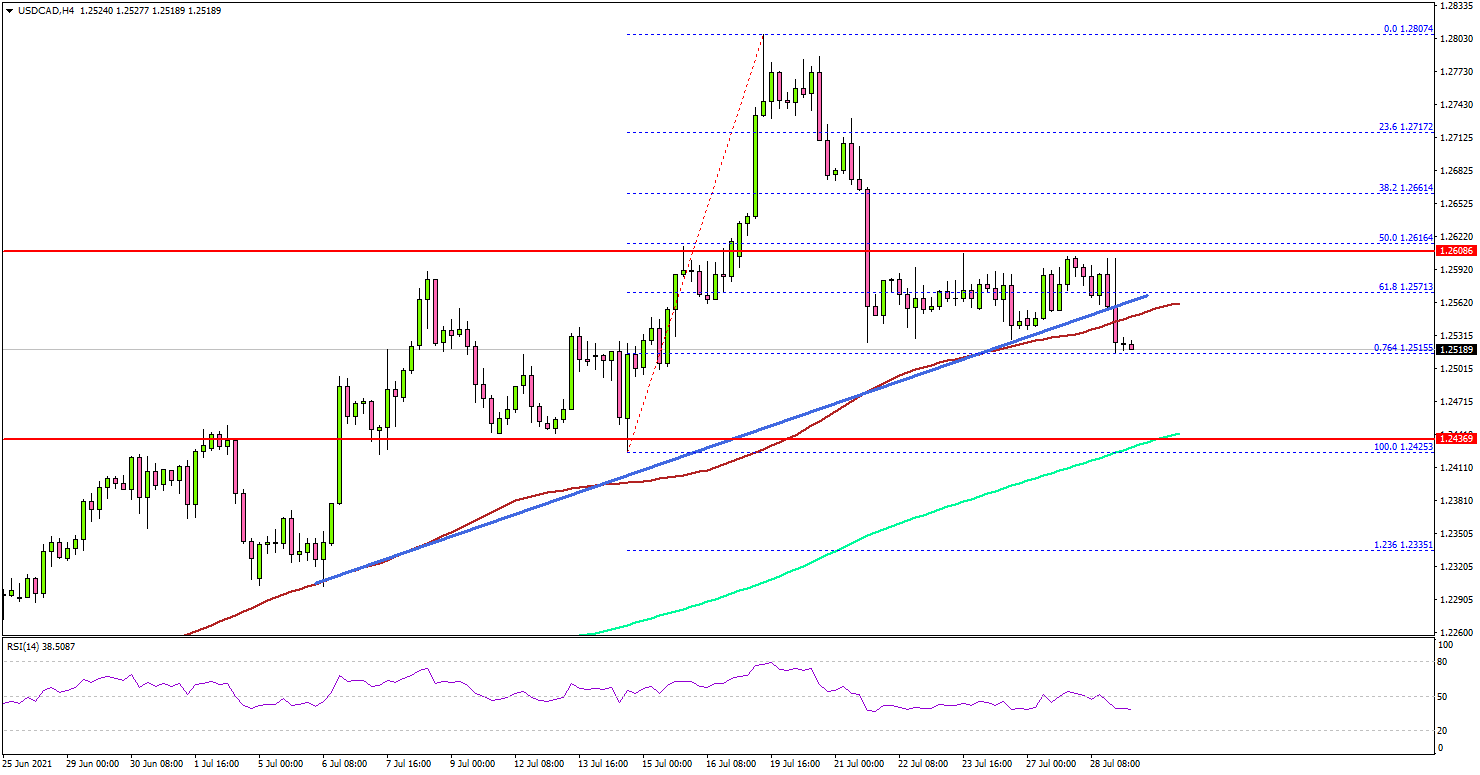
Looking at the 4-hours chart, the pair even broke the 1.2680 support zone. It settled below the 1.2620 pivot level and the 100 simple moving average (red, 4-hours). The bears were able to push the pair below the 50% Fib retracement level of the upward move from the 1.2453 swing low to 1.2807 high.
There was also a break below a key bullish trend line with support near 1.2560. The pair is now consolidating near the 1.2515 support.
The 76.4% Fib retracement level of the upward move from the 1.2453 swing low to 1.2807 high is also near the 1.2515 level. Any more downsides could set the pace for a larger decline in the coming sessions. The next major supports sits near 1.2450.
On the upside, the previous support at 1.2600 and 1.2620 could stop upsides. A close above 1.2620 might start a fresh increase towards 1.2700.
Looking at EUR/USD, the pair is attempting a fresh increase and it might clear 1.1850. Besides, GBP/USD is gaining pace above 1.3900.
Economic Releases
- US Initial Jobless Claims - Forecast 380K, versus 419K previous.
- US Gross Domestic Product Q2 2021 (Preliminary) – Forecast 8.6% versus previous 6.4%.