Sample Category Title
GBP/USD Mid-Day Outlook
Daily Pivots: (S1) 1.3799; (P) 1.3847; (R1) 1.3926; More....
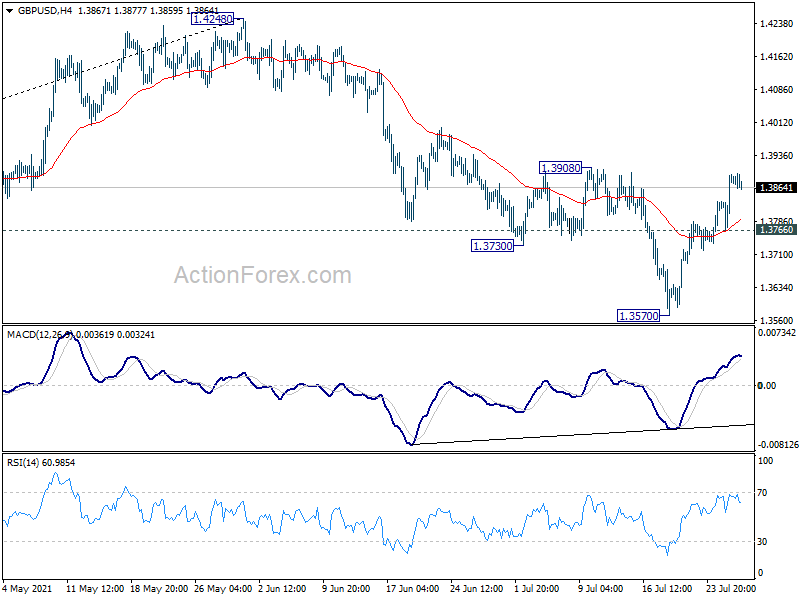
Outlook in GBP/USD remains neutral as focus stays on 1.3908 resistance. Decisive break there will indicate that fall from 1.4248 has completed. Intraday bias will be turned back to the upside for retesting this high. On the downside, below 1.3766 minor support will turn bias to the downside for 1.3570. Break there will resume the fall from 1.4248 to 1.3482 resistance turned support.
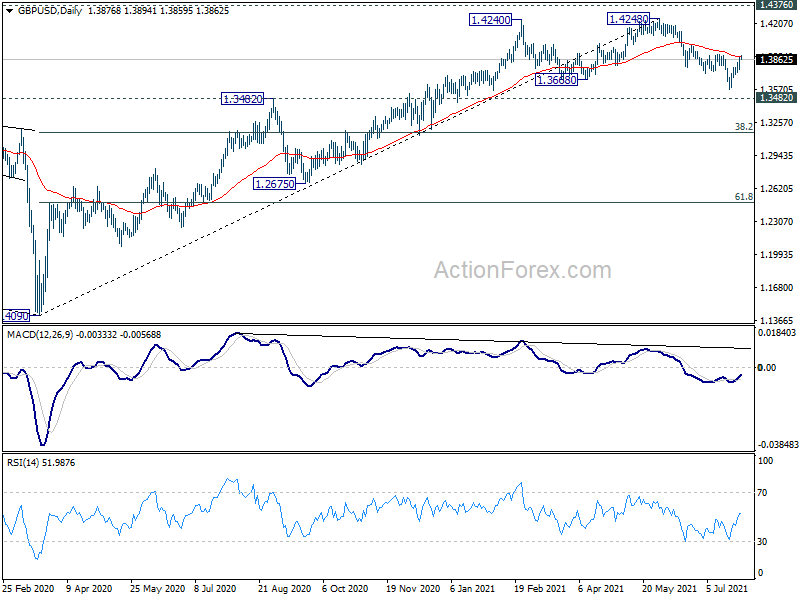
In the bigger picture, as long as 1.3482 resistance turned support holds, up trend from 1.1409 should still continue. Decisive break of 1.4376 resistance will carry larger bullish implications. However, firm break of 1.3482 support will argue that the rise from 1.1409 has completed. GBP/USD would then be seen in another leg of long term range pattern between 1.1409 and 1.4376. Deeper fall could then be seen to 61.8% retracement of 1.1409 to 1.4248 at 1.2493, and even below.
USD/JPY Mid-Day Outlook
Daily Pivots: (S1) 109.47; (P) 109.93; (R1) 110.28; More...
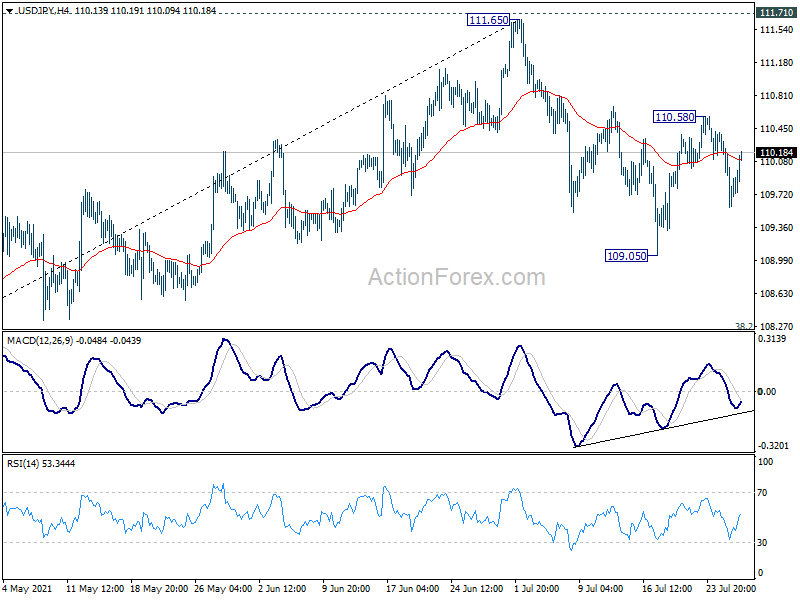
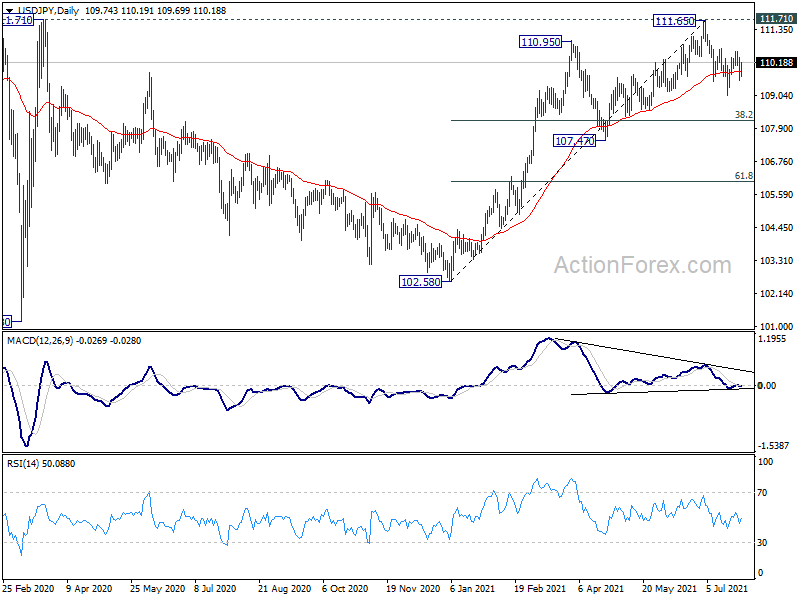
Intraday bias in USD/JPY is turned neutral again with today's recovery. On the upside, break of 110.58 will resume the rebound from 109.05, for retesting 111.65 high. On the downside, break of 109.05 will resume the fall from 111.65 to 38.2% retracement of 102.58 to 111.65 at 108.18.
In the bigger picture, medium term outlook is staying neutral with 111.71 resistance intact. The pattern from 101.18 could still extend with another falling leg. Sustained trading below 55 day EMA will bring deeper fall to 107.47 support and below. For now, outlook won't turn bullish as long as 111.71 resistance holds, even in case of strong rebound.
Dollar Trying to Recover ahead of FOMC, Market Sentiments Steady
Dollar is trying to recover in early US session but upside is limited so far. Overall market sentiments stabilized as US stocks might have regained footing for another take on new records. Also, traders are turning a little bit more cautious ahead of FOMC statement and press conference. Overall picture for the week is unchanged for now, as European majors and Yen are the better performers while commodity currencies are the weaker ones.
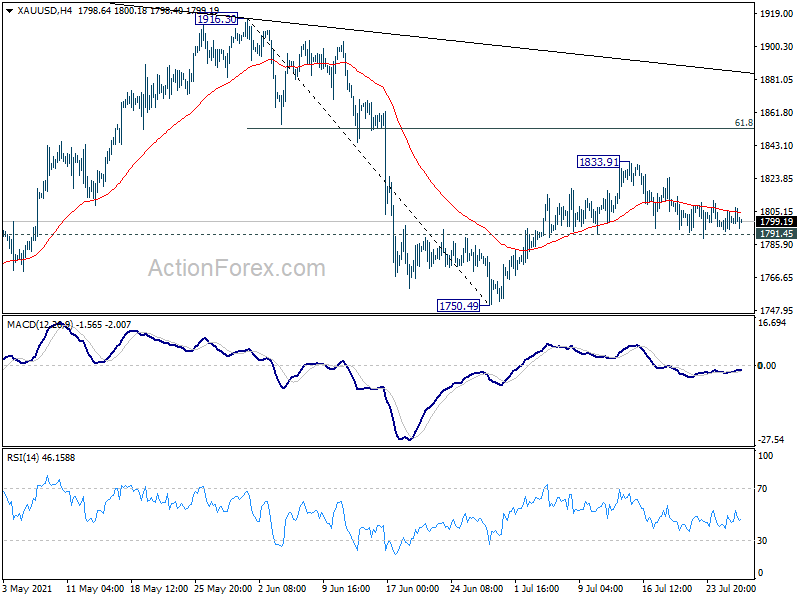
Technically, we'd pay much attention to Dollar pairs' development to gauge the reaction to FOMC. For Dollar weakness, GBP/USD will need to break through 1.3908 resistance while EUR/USD should break 1.1880 resistance too. As for Dollar strength, USD/JPY will need to break 110.58 resistance while EUR/USD should break 1.1751 low. Gold is also a gauge as it needs to break through 1791.45 support firmly to indicate Dollar buying.
In Europe, at the time of writing, FTSE is up 0.11%. DAX is up 0.20%. CAC is up 0.76%. Germany 10-year yield is up 0.0005 at -0.439. Earlier in Asia, Nikkei dropped -1.39%. Hong Kong HSI rose 1.54%. China Shanghai SSE dropped -0.58%. Singapore Strait Times rose 0.09%. Japan 10-year JGB yield dropped -0.0039 to 0.016.
Fed to hold the cards of tapering to chest
FOMC is widely expected to keep monetary policy unchanged today. Without new economic projections, the focus will be on the policy statement and press conference. In particular, Fed Chari Jerome Powell would likely just reiterate that the Committee is in talks of QE tapering. Yet, it is premature to make any conclusion.
Also, more information about policy changes will be revealed at the Jackson Hole symposium in late August, followed by the September meeting. The formal announcement of tapering could indeed be made in December.
Some suggested readings on Fed:
- FOMC Preview – Policy Stance to Stay Intact Despite Surging Inflation
- FOMC Meeting Preview: Taper So Close, Yet So Far Away
- Fed Meeting: Slowly Getting the Taper Ball Rolling
- July Flashlight for the FOMC Blackout Period
US goods trade deficit widened to USD -91.2B in Jun
US International goods trade deficit was at USD -91.2B in June, widened from USD -88.2B, larger than expectation of USD -88.0B. Export of goods rose USD 0.5B to USD 145.5B. Import of goods rose USD 3.5B to USD 236.7B. Wholesale inventories rose 0.8% mom to USD 715B.
Canada CPI slowed to 3.1% yoy in Jun
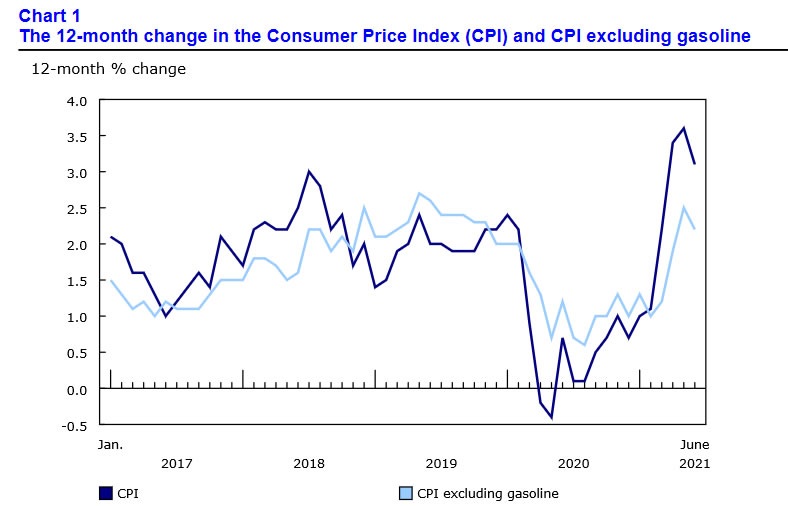
Canada CPI slowed to 3.1% yoy in June, down from May's 3.6% yoy, below expectation of 3.5% yoy. Excluding gasoline, CPI rose 2.2% yoy. CPI common dropped to 1.7% yoy, down from 1.8% yoy, below expectation of 1.9% yoy. CPI median was unchanged at 2.4% yoy, above expectation of 2.3% yoy. CPI trimmed slowed to 2.6% yoy, down from 2.7% yoy, matched expectations.
Germany Gfk consumer sentiment unchanged at -0.3, slowing vaccinations limit improvement
Germany GFk consumer sentiment for August was unchanged at -0.3. In July, economic expectations dropped from 58.4 to 54.6. Income expectations dropped from 34.1 to 29.0. Propensity to buy rose from 13.4 to 14.8. .
Rolf Bürkl, a GfK consumer expert commented on this observation: "The phase where the decrease of COVID-19 incidence of infection has come to an end and those figures are again on the rise. In addition, the momentum for vaccination has recently slowed down considerably, despite there being sufficient quantities of the vaccine available. This is currently preventing any further significant increase as it pertains to consumer sentiment."
Also released, Swiss ZEW expectation dropped to 42.8 in July, down from 51.3.
BoJ opinions: Important not to tighten prematurely
In the Summary of Opinions of July 15-16 meeting, BoJ noted that it should "continue to support financing, mainly of firms, and maintain stability in financial markets by conducting monetary easing through the three measures"
Even though core CPI is likely to increase on the back of rise in commodity prices, there is "a long way to go" to achieve target in a stable manner. Hence, it is "important not to tighten monetary policy prematurely". Also, the "deflationary mindset is strongly entrenched in Japan".
Australia CPI rose 0.8% qoq, 3.8% yoy in Q2
Australia CPI rose 0.8% in Q2, slightly above expectation of 0.7% qoq. Annual rate accelerated to 3.8% yoy, up from 1.1% yoy, matched expectations. RBA trimmed mean CPI came in at 0.5% qoq, 1.6% yoy. RBA weighted mean CPI was at 0.5% qoq, 1.7% yoy.
Head of Prices Statistics at the ABS, Michelle Marquardt said: "Rising fuel prices accounted for much of the increase in the June quarter CPI, with prices surpassing pre-pandemic levels".
"The annual CPI movement was significantly influenced by COVID-19 related price changes from this time last year... These 'base effects' led to a sharp increase in the annual CPI movement", she added. "In situations such as this, it is useful to consider underlying inflation measures such as the trimmed mean, which are designed to remove large, one-off price impacts".
USD/JPY Mid-Day Outlook
Daily Pivots: (S1) 109.47; (P) 109.93; (R1) 110.28; More...
Intraday bias in USD/JPY is turned neutral again with today's recovery. On the upside, break of 110.58 will resume the rebound from 109.05, for retesting 111.65 high. On the downside, break of 109.05 will resume the fall from 111.65 to 38.2% retracement of 102.58 to 111.65 at 108.18.
In the bigger picture, medium term outlook is staying neutral with 111.71 resistance intact. The pattern from 101.18 could still extend with another falling leg. Sustained trading below 55 day EMA will bring deeper fall to 107.47 support and below. For now, outlook won't turn bullish as long as 111.71 resistance holds, even in case of strong rebound.
Economic Indicators Update
| GMT | Ccy | Events | Actual | Forecast | Previous | Revised |
|---|---|---|---|---|---|---|
| 23:01 | GBP | BRC Shop Price Index Y/Y Jun | -1.20% | -0.70% | ||
| 23:50 | JPY | BoJ Summary of Opinions | ||||
| 01:30 | AUD | CPI Q/Q Q2 | 0.80% | 0.70% | 0.60% | |
| 01:30 | AUD | CPI Y/Y Q2 | 3.80% | 3.80% | 1.10% | |
| 01:30 | AUD | RBA Trimmed Mean CPI Q/Q Q2 | 0.50% | 0.50% | 0.30% | 0.40% |
| 01:30 | AUD | RBA Trimmed Mean CPI Y/Y Q2 | 1.60% | 1.60% | 1.10% | |
| 06:00 | EUR | Germany Gfk Consumer Confidence Aug | -0.3 | 0.9 | -0.3 | |
| 08:00 | CHF | ZEW Expectations Jul | 42.8 | 51.3 | ||
| 12:30 | USD | Goods Trade Balance (USD) Jun P | -91.2B | -88.0B | -88.1B | |
| 12:30 | USD | Wholesale Inventories Jun P | 0.80% | 1.20% | 1.30% | |
| 12:30 | CAD | CPI M/M Jun | 0.30% | 0.40% | 0.50% | |
| 12:30 | CAD | CPI Y/Y Jun | 3.10% | 3.50% | 3.60% | |
| 12:30 | CAD | CPI Common Y/Y Jun | 1.70% | 1.90% | 1.80% | |
| 12:30 | CAD | CPI Median Y/Y Jun | 2.40% | 2.30% | 2.40% | |
| 12:30 | CAD | CPI Trimmed Y/Y Jun | 2.60% | 2.60% | 2.70% | |
| 14:30 | USD | Crude Oil Inventories | -2.6M | 2.1M | ||
| 18:00 | USD | Fed Rate Decision | 0.25% | 0.25% | ||
| 18:30 | USD | FOMC Press Conference |
Fed Day is Upon Us
The week's headline event is almost upon us and stock markets are waiting anxiously for the outcome, with the Fed decision just hours away.
It all seems very dramatic, arguably overly so. We had a slew of earnings reports on Tuesday with Apple, Microsoft and Alphabet among them, and yet we're still seeing extreme caution in the markets ahead of the proceedings later on today.
It's being hyped up so much, I can't help but feel it's going to be a huge anticlimax. Given how the data is performing - talk of peak recovery - the believed transitory nature of the inflation numbers and the surge in Covid cases as the next wave takes hold, it seems highly likely that the Fed is going to kick the can down the road.
Unless policy makers are starting to question the transitory nature of the inflation data we're seeing, there seems little reason to risk a taper tantrum in the markets when solid progress is being made. Clearly it's coming soon but the Fed can afford to act with caution. The question is whether they will signal when it is likely, if not in the coming months and how investors will take it.
Knockout earnings from big tech
As it turns out, the Fed announcement is somewhat overshadowing earnings season. We saw some incredible numbers once again from the big tech names on Tuesday, and while Alphabet is getting some love pre-market, the reaction hasn't been what it arguably should be. Maybe that's the Fed, perhaps we've just come to expect so much that blowing away estimates is the norm now.
The global chip shortage that has hampered many companies may be part of the reason behind Apple and Microsofts muted response to earnings. That will pose a challenge in the current quarter, while economic reopenings and the return to work may also make life more challenging for the companies than it's been this last year.
Facebook, Paypal and Pfizer among those reporting today so there's still plenty of action to come.
Oil creeps higher after API report
Oil prices are edging higher but just like other risk assets, moves are fairly muted and have been for days. The API on Tuesday reported a larger draw than expected from the EIA release which will further put at ease any concerns at all around last week's build, not that there really was any. But another build this week may have got people asking questions. Should EIA report along the same lines today, prices should remain well supported.
Ultimately though, it will probably all come down to Powell and his colleagues. If they pass the dovish test, we could see further gains in crude prices. Taper talk will take the wind out of the sails and could trigger some profit taking.
Gold awaiting Fed catalyst
No instrument needs the Fed decision more than gold. It's been in consolidation since the start of the blackout period, floating around $1,800 and waiting patiently for the next catalyst. Even if the Fed turns out to be a massive anticlimax, we should get some movement in gold again.
A dovish Fed and lower yields could see gold heading for the recent highs around $1,833, at which point it will face the same 50 fib test it failed before (June highs to lows). A move above here would draw attention to the 61.8 fib which falls around $1,850. A break of this would be very bullish.
Should the Fed not perform, then those June lows could come into focus before too long. Immediate support comes around $1,790 but given that it's hovered around these levels for the last week and a half, it may not take much for that to collapse.
To the moon?
Bitcoin is back above $40,000 and crypto bulls clearly couldn't care less about Amazon's denial of the stories that were "leaked" earlier this week. We've seen this so many times before. When sentiment shifts in the crypto space, good news and rumours gets a big response and no one cares about the rest.
Cryptos have had a hard time since the heights they reached in April but something tells me that's changed. Elon saved the day, disclosing things that almost everyone would have assumed to be true anyway and now the floor at $30,000 looks more solid than ever. If bitcoin can break the late May/mid June highs, it could take off once more.
Canada CPI slowed to 3.1% yoy in Jun
Canada CPI slowed to 3.1% yoy in June, down from May's 3.6% yoy, below expectation of 3.5% yoy. Excluding gasoline, CPI rose 2.2% yoy. CPI common dropped to 1.7% yoy, down from 1.8% yoy, below expectation of 1.9% yoy. CPI median was unchanged at 2.4% yoy, above expectation of 2.3% yoy. CPI trimmed slowed to 2.6% yoy, down from 2.7% yoy, matched expectations.
US goods trade deficit widened to USD -91.2B in Jun
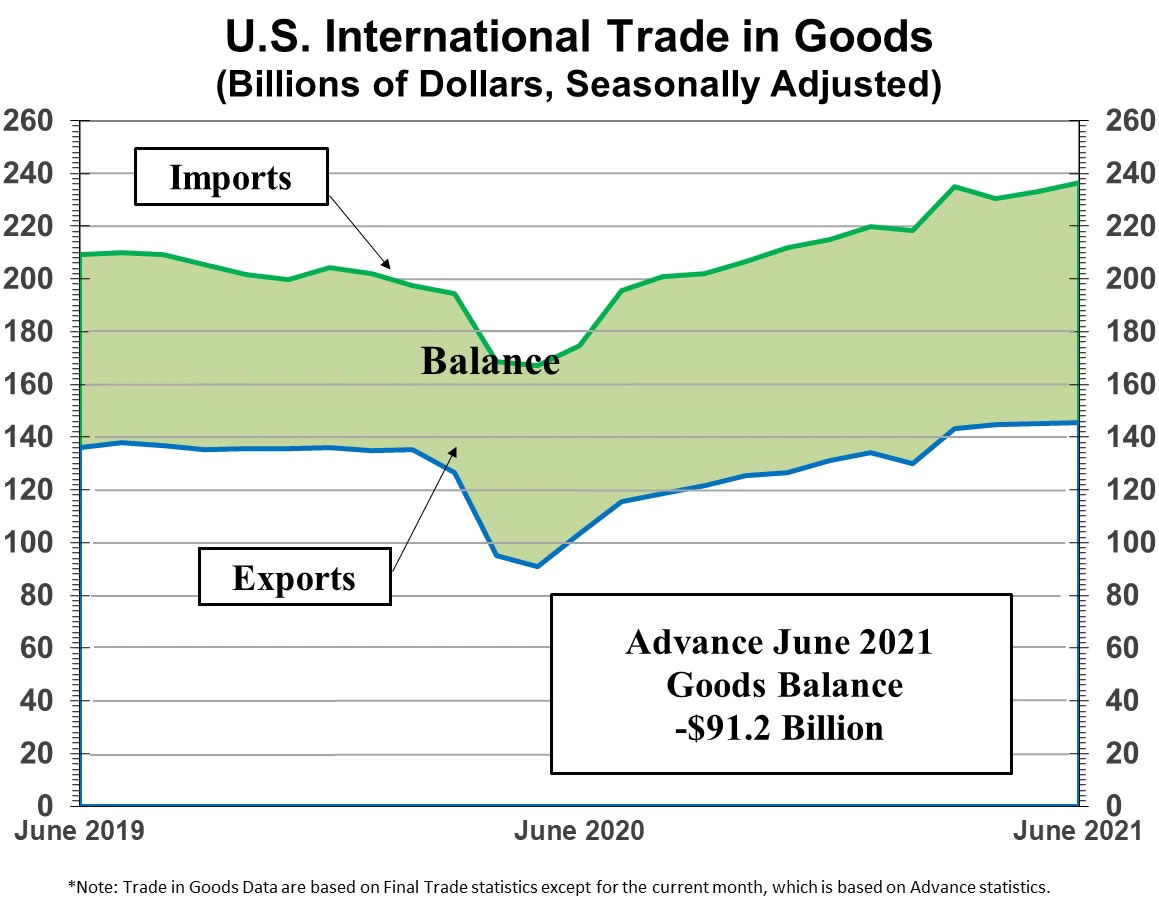
US International goods trade deficit was at USD -91.2B in June, widened from USD -88.2B, larger than expectation of USD -88.0B. Export of goods rose USD 0.5B to USD 145.5B. Import of goods rose USD 3.5B to USD 236.7B. Wholesale inventories rose 0.8% mom to USD 715B.
USD/CAD – Markets Eye CPI, FOMC Meeting
All eyes on Canada CPI
Forget about a quiet and calm Wednesday. The markets will be treated to two key events today. Canada releases consumer inflation for June (12:30 GMT, followed by the FOMC policy meeting (18:00 GMT). Either event could have a significant impact on USD/CAD, which is trading quietly at 1.2577.
Will the Canadian dollar get a boost today? The currency has been sluggish, as USD/CAD has jumped 4.3% since June 1. Inflation has been the buzzword in the US for months, with the Fed insisting that inflation is transitory, despite a sharp jump in CPI. In Canada, CPI came in at 3.6% in May, and the markets are keeping a close eye on the June release. The consensus is for a reading of 3.2%, but anything higher will raise speculation that the Bank of Canada may have to ditch its script that inflation is transitory, a message that the Fed has adhered to with success even with a surge in US inflation.
The BoC recently scaled back its asset purchases, but it has remained dovish on interest rate policy, saying that it will maintain ultra-low rates of 0.25% until at least the second half of 2022. However, if inflation remains at levels well above the Bank’s target of 2%, policymakers will have to consider raising rates ahead of schedule in order to curb inflation. Consumer inflation expectations are above 3%, and this is an important indicator since inflation expectations can translate into actual inflation figures.
After Canada’s CPI release, the market focus will shift to the FOMC policy meeting, the last meeting before the Jackson Hole symposium and the September policy meeting. The Fed is unlikely to announce a taper, but analysts will be combing through the rate statement, looking for any subtle changes in language as well as any hints of the ‘T’ word. Any changes in the rate statement’s language could shake up the US dollar. Ahead of the FOMC meeting, though, the markets are likely to remain cautious and in a wait-and-see mode.
USD/CAD Technical
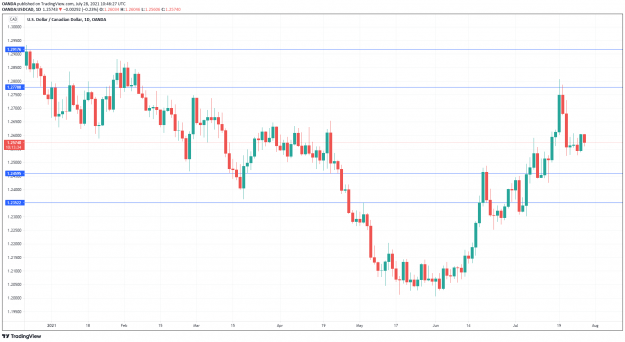
- USD/CAD faces resistance at 1.2777. Above, there is resistance at 1.2916
- On the downside, there is support at 1.2459. Below, there is support at 1.2352
USD/JPY Pair Is Now Correcting Higher From The 109.58 Low
The US Dollar started a decline from well above the 110.20 level against the Japanese Yen. The USD/JPY pair broke the key 110.00 support zone to move into a bearish zone.
The pair even broke the 109.80 support and settled well below the 50 hourly simple moving average. A low is formed near 109.58 and the pair is now correcting higher. An immediate resistance is near the 109.95 level.
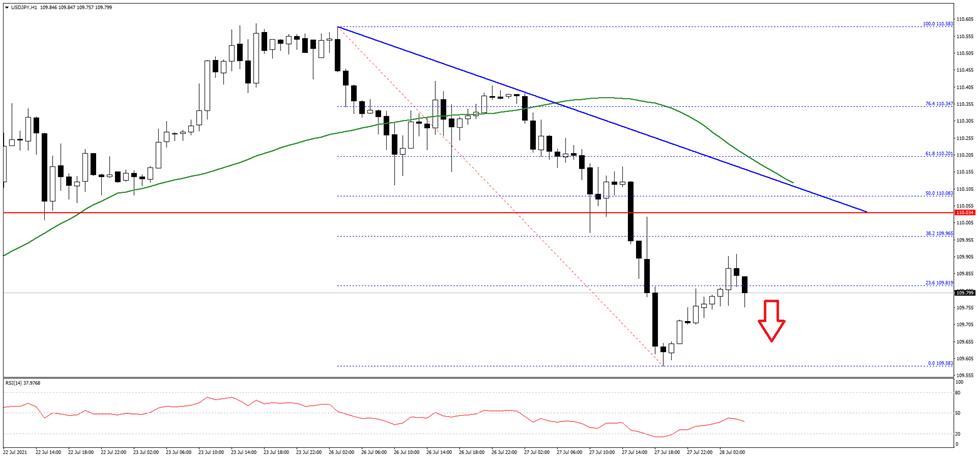
The first major resistance is near 110.00 on FXOpen. There is also a major bearish trend line forming with resistance near 110.00 on the hourly chart. The next major resistance is near the 110.50 level.
An initial support on the downside is near the 109.65 level, below which USD/JPY might drop towards the 109.50 support zone. The next major support sits near the 109.20 level.
Aussie Yawns As CPI Beats Forecast
Australian CPI overshoots consensus
Australia released consumer inflation for the second quarter. At first glance, the annualized CPI release of 3.8% sounded alarmingly high, compared to the Q1 reading of 1.1%. Yet the Australian dollar’s reaction was muted. The reason? The reading was just a notch above the forecast of 3.7%. Most of the gain in the annualized figure was due to base effects, as CPI in Q2 of 2020 declined by 1.9%. As well, Trimmed Means CPI, which removes the most volatile items in CPI, showed a more modest increase of 1.6% YoY, up from 1.1% in the first quarter.
The reaction of RBA policymakers to these inflation numbers will be of interest to the markets. Granted, inflation is heading higher, with headline inflation slightly above the upper range of the RBA’s inflation target of 2-3%. Still, the RBA does not appear all that concerned and can be expected to say that the rise in inflation is transitory, taking a page from the Federal Reserve’s script. The markets have accepted the “transitory” argument in the US, where inflation is much higher, so it’s reasonable to assume that Australia’s inflation won’t scare investors either. In addition, with Sydney announcing a 4-week extension of a lockdown, the RBA has one more reason to be dovish, as extended lockdowns weigh on economic growth.
All eyes will be on the FOMC policy meeting today (18:00 GMT). The US dollar has been under pressure this week, and unless the Fed hints at a taper of its asset purchases, the greenback could face further headwinds after the meeting. Any changes in the rate statement’s language could shake up the US dollar. Ahead of the FOMC meeting though, I would expect little movement in the currency markets, as investors adopt a wait-and-see position.
AUD/USD Technical
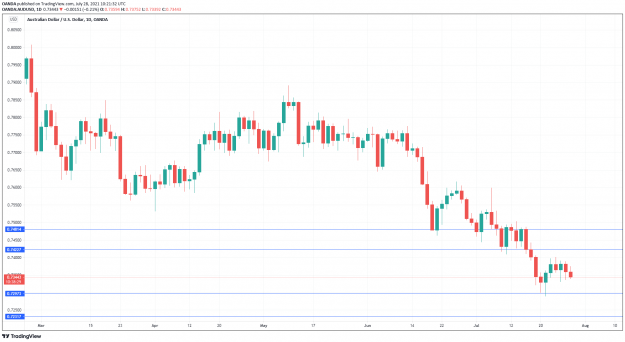
- AUD/USD has support at 0.7297. Below, there is support at 0.7231
- There is resistance at 0.7422, followed by resistance at 0.7481
Gold Analysis: Remains Above 1,795.00
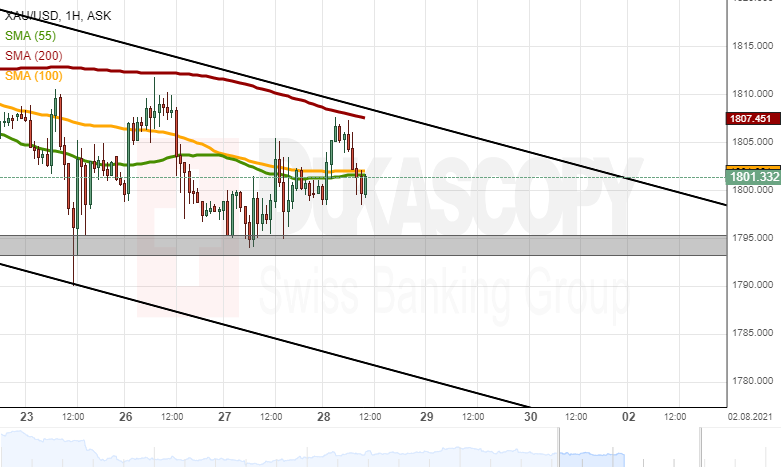
The support of the 1,795.00 price level held on Tuesday. Afterwards, the bullion surged to the resistance of the 200-hour simple moving average near 1,807.00 On Wednesday, the rate had bounced off the SMA and declined to the 1,800.00 level.
If the decline continues, the commodity price would first test the support of the 1,795.00 level. Afterwards, other round price levels could provide support.
On the other hand, a potential surge most likely would test the resistance of the 200-hour simple moving average and the upper trend line of the late-July channel down pattern.