Sample Category Title
USD/JPY Analysis: Reaches 109.60 Level
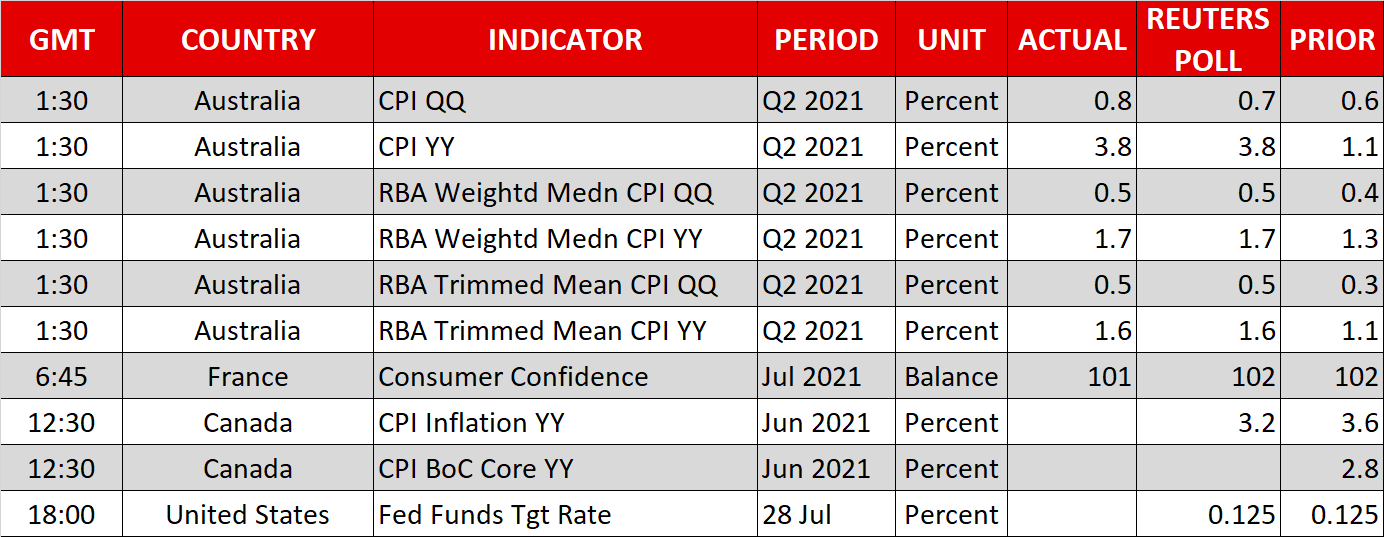
The USD/JPY declined on Tuesday. The decline reached down to the 109.60 level and the weekly S1 simple pivot point at 109.58. Afterwards, a recovery started, which by the middle of Wednesday's trading had reached the resistance of the 110.00 mark.
In the case that the rate passes the resistance of the 110.00 level, it would face a cluster of technical resistance from 110.04 to 110.19. The cluster consists of 55, 100 and 200-hour simple moving averages and the weekly simple pivot point. Above these levels, the July high at 110.60 could be the next target.
On the other hand, a bounce off from the resistance levels would once again look for support in the 109.60 level and the weekly S1 simple pivot point at 109.58.
GBP/USD Analysis: Reaches 1.3900 Level
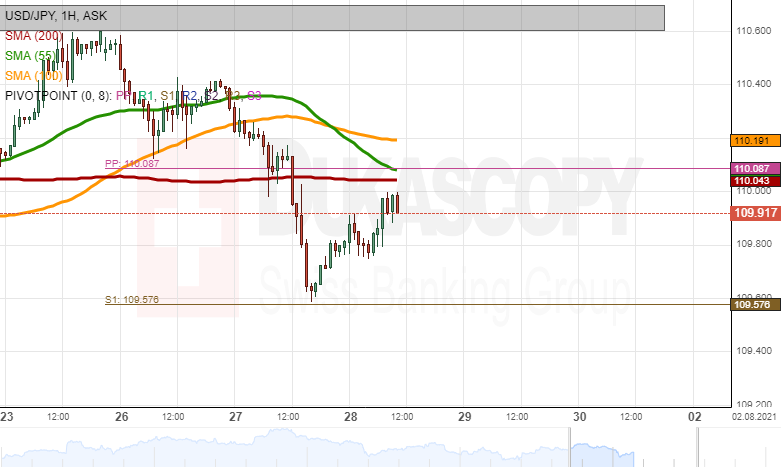
The GBP/USD currency exchange rate managed to pass the resistance of the weekly R1 simple pivot point at 1.3835 due to the support of the 55-hour simple moving average. By the middle of Wednesday's European trading hours, the currency exchange rate had reached the 1.3900 mark. The 1.3900 has been keeping the rate down throughout July.
If the rate once again bounces off the July high level at 1.3900, a potential decline could first look for support in the weekly R1 simple pivot point and the 55-hour simple moving average at 1.3835. If these levels are passed, the rate might find support in the 100 and 200-hour simple moving averages.
Meanwhile, a potential surge above the 1.3900 mark would immediately find resistance in the weekly R2 simple pivot point at 1.3919. Above this level, the 1.3950 and the 1.4000 levels could provide resistance.
EUR/USD Analysis: Finds Support In SMA
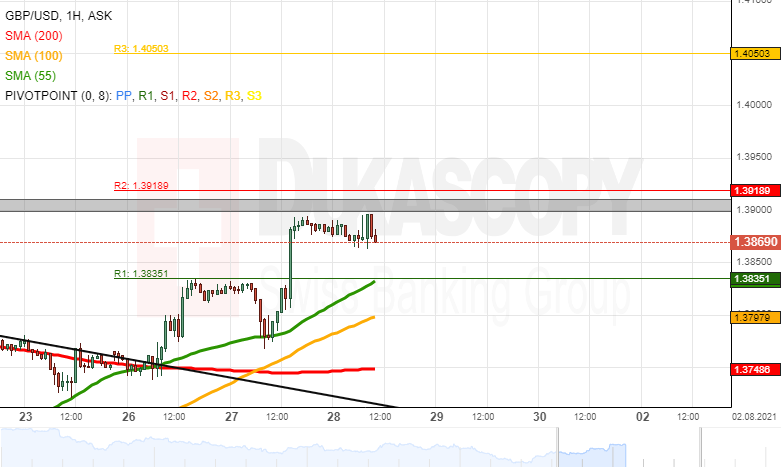
On Tuesday, the EUR/USD not only managed to pass the resistance of the weekly R1 and the late July high levels, but also reached the 1.1840 level. The 1.1840 provided enough resistance for the rate to decline. On Wednesday morning, the rate's decline found support in the 55-hour simple moving average.
In the near term future, the rate was expected to resume its surge. A potential surge would once again have to test the resistance of the 1.1840 level before aiming at the weekly R2 simple pivot point at 1.1864.
On the other hand, the 1.1840 mark could hold and the rate might trade sideways until the support of the 55, 100 and 200-hour simple moving averages push the pair up.
Awaiting The FOMC Rate Decision
Notes/Observations
- Markets await FOMC decision.
- French and German confidence data miss consensus as new lockdowns fears that curbs might be needed to contain the spread of the Delta variant.
Asia
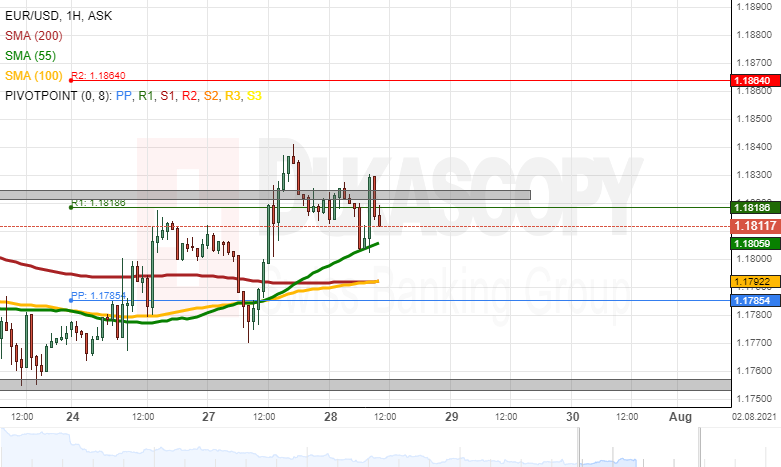
- Australia Q2 CPI moved above target and registered its highest level since 2008 (Q/Q: 0.8% v 0.7%e; Y/Y: 3.8% v 3.7%e) Analysts noted that far tamer reading for core inflation suggested the spike would be fleeting.
- BOJ July Summary of Opinions reiterated its overall assessment that the domestic economy had picked up as a trend, although it had remained in a severe situation due to the impact of COVID.
- China Sec Journal noted that investors should not be pessimistic due to stock price drops. There would not be a systemic risk in the China A-share market as a whole. Loose monetary environment would support equity assets.
Coronavirus
- US CDC noted that due to the rapid spread of the Delta variant that vaccinated people in areas with substantial levels of Covid-19 start wearing masks again.
- Lockdown in Sydney to be extended by 4-weeks through August 28th (as expected).
- Japan Prefectures Kanagawa, Saitama, and Chiba confirmed seeking coronavirus state of emergency from Federal Govt.
Europe
- ECB’s de Cos (Spain) stated that ECB's new guidance was the first example of ECB resolve to act; Wanted to keep bond-buying flexible post-pandemic.
- EU Commission said to not move to the next step of its legal action against Britain for unilaterally changing trading arrangements for Northern Ireland (Note: Move-in in response to Britain's request for a "standstill").
Americas
- White House Press Sec Psaki noted that President Biden felt optimistic about the path forward on infrastructure.
Energy
- Weekly API Crude Oil Inventories: -4.7M v +0.8M prior.
Speakers/Fixed income/FX/Commodities/Erratum
Equities
- Indices [Stoxx600 +0.39% at 460.42, FTSE +0.16% at 7,007.55, DAX +0.24% at 15,556.40, CAC-40 +0.72% at 6,578.75, IBEX-35 +0.73% at 8,763.00, FTSE MIB +0.59% at 25,234.50, SMI +0.33% at 12,061.30, S&P 500 Futures +0.19%].
- Market Focal Points/Key Themes: European indices open generally higher and advanced into the green as the session progressed; better-performing sectors include consumer discretionary and technology; materials and industrials among the underperforming sectors; Adecco to acquire AKKA, Europcar confirms is in takeover discussions from a consortium led by Volkswagen; focus on the conclusion of FOMC meeting later in the day; earnings expected during the upcoming US session include Owens Corning, Thermo Fisher, Humana, and Avery Dennison.
Equities
- Consumer discretionary: Aston Martin Lagonda [AML.UK] +2% (earnings), Wizz Air [WIZZ.UK] +5% (earnings).
- Consumer staples: British American Tobacco [BATS.UK] -1% (earnings).
- Financials: Barclays [BARC.UK] +5% (earnings), Deutsche Bank [DBK.DE] +1% (earnings), Banco Santander [SAN.ES] -1% (earnings).
- Industrials: BASF [BAS.DE] -2% (final earnings), Equinor [EQNR.NO] -1.5% (earnings).
- Technology: AKKA Technologies [AKA.FR] +90% (to be acquired by Adecco), Capgemini [CAP.FR] +4% (earnings; raises outlook).
- Materials: Rio Tinto [RIO.UK] -1% (earnings; special dividend).
Speakers
- PM Johnson stated in a media interview that the UK would have a steady economic recovery after COVID-19 but could see some economic bumps on the road.
- Spain Econ Min Calvino stated that it would issue its first green bond in Sept.
- Czech Central Bank Dep Gov Nidetzky stated in a press interview that he favored relatively fast rate hikes and would back another rate hike at the Aug policy meeting.
- South Korea govt said to refute press reports that was in discussions for a summit with North Korea.
Currencies/Fixed Income
- Markets await the FOMC rate decision. Overall today’s outcome is likely to be a nonevent but Fed could acknowledge above-trend inflation and growth and keep speculation of a more hawkish turn at the Aug Jackson Hole Symposium.
- USD was slightly weaker by mid-session.
- EUR/USD holding above 1.18 level while USD/JPY drifted below 110.
Economic data
- (DE) Germany Aug GfK Consumer Confidence: -0.3 v +1.0e (17th straight decline).
- (DE) Germany Jun Import Price Index M/M: 1.6% v 1.5%e; Y/Y: 12.9% v 12.6%e (highest annual pace since Oct 1981).
- (UK) July Nationwide House Price Index M/M: -0.5% v +0.3%e; Y/Y: 10.5% v 11.9%e.
- (NO) Norway Jun Retail Sales (includes auto/fuel) M/M: -0.1% v +5.8% prior.
- (FR) France July Consumer Confidence: 101 v 102e.
- (HU) Hungary Jun Unemployment Rate: 4.0% v 3.7%e.
- (SE) Sweden Jun Retail Sales M/M: -0.3% v +2.3% prior; Y/Y: 8.5% v 10.3% prior.
- (IT) Italy July Consumer Confidence Index: 116.6 v 115.5e; Manufacturing Confidence: 115.7 v 115.3e; Economic Sentiment: 116.3 v 112.8 prior.
- (CH) Swiss July Expectations Survey: 42.8 v 51.3 prior.
- (AT) Austria July Manufacturing PMI: 63.9 v 67.0 prior (13th month of expansion).
Fixed income Issuance
- (IN) India sold a total of INR170B vs. INR170B indicated in 3-month, 6-month, and 12-month bills.
- (IT) Italy Debt Agency (Tesoro) sold €7.0B vs. €7.0B indicated in 6-month Bills; Avg Yield: -0.524% v -0.521% prior; Bid-to-cover: 1.29x v 1.35x prior.
Looking Ahead
- 05:25 (EU) Daily ECB Liquidity Stats.
- 05:30 (DE) Germany to sell €2.5B in 0% May 2036 Bunds.
- 05:30 (GR) Greece Debt Agency (PDMA) to sell 26-week Bills;.
- 05:30 (EU) ECB allotment in 3-month LTRO tender.
- 05:30 (ZA) South Africa announces details of the next bond auction (held on Tuesdays).
- 06:00 (IE) Ireland Jun Retail Sales M/M: No est v 1.8% prior; Y/Y: No est v 44.0% prior.
- 06:45 (US) Daily Libor Fixing.
- 07:00 (RU) Russia to sell 2029 and 2036 OFZ Bonds.
- To sell Mar 2029 OFZ bonds.
- To sell July 2036 OFZ bonds.
- 07:00 (US) MBA Mortgage Applications w/e July 23rd: No est v -4.0% prior.
- 07:00 (UK) Weekly PM Question time in House.
- 08:00 (BR) Brazil Jun PPI Manufacturing M/M: No est v 1.1% prior; Y/Y: No est v 32.5% prior.
- 08:30 (US) Jun Advance Goods Trade Balance: -$88.0Be v -$88.2B prior (revised from -$88.1B).
- 08:30 (US) Jun Preliminary Wholesale Inventories M/M: 1.1%e v 1.3% prior; Retail Inventories M/M: -0.3%e v -0.8% prior.
- 08:30 (CA) Canada Jun CPI M/M: 0.4%e v 0.5% prior; Y/Y: 3.2%e v 3.6% prior; Consumer Price Index: 141.6e v 141.0 prior.
- 08:30 (BR) Brazil Jun Total Outstanding Loans (BRL): 4.212Te v 4.178T prior; M/M: 1.1%e v 1.2% prior; Personal Loan Default Rate: No est v 4.1% prior.
- 09:45 (UK) BOE buys £1.147B in APF Gilt purchase operation.
- 10:30 (US) Weekly DOE Oil Inventories.
- 12:00 (RU) Russia Jun Unemployment Rate: 4.8%e v 4.9% prior.
- 12:00 (RU) Russia Jun Real Retail Sales Y/Y: 11.9%e v 27.2% prior.
- 13:00 (US) Treasury to sell 2-Year FRN.
- 13:30 (BR) Brazil Jun Total Federal Debt (BRL): No est v 5.171T prior.
- 14:00 (US) FOMC Interest Rate Decision: Expected to leave Interest Rate on Excess Reserves (IOER) unchanged between 0.00-0.25% range.
- 14:30 (US) Fed Chair Powell post rate decision press conference.
- 21:00 (NZ) New Zealand July Business Confidence: No est v -0.6 prior; Activity Outlook: No est v 31.6 prior.
- 21:30 (AU) Australia Q2 Import Price Index Q/Q: 1.0%e v 0.2% prior; Export Price Index Q/Q: 9.9%e v 11.2% prior.
- 23:35 (JP) Japan to sell 2-Year JGB Bonds.
The Analytical Overview Of The Main Currency Pairs
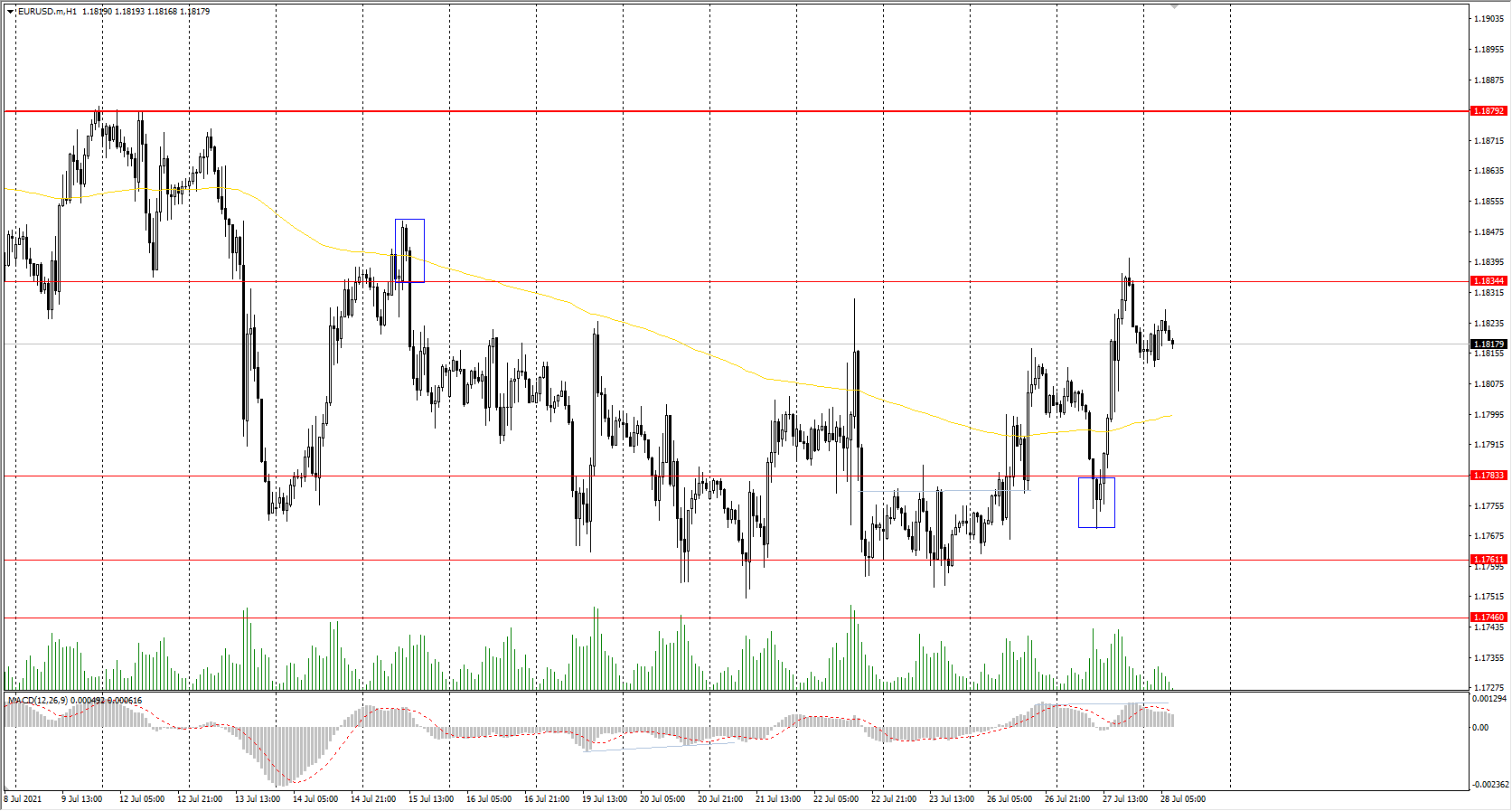
The EUR/USD currency pair
Technical indicators of the currency pair:
Prev Open: 1.1802
Prev Close: 1.1816
% chg. over the last day: +0.12%
The fall of the dollar index led to an increase in the EUR/USD quotes. Moreover, the quotes were falling during the European session, but at the American session, the price sharply increased. The Federal Reserve will make a statement about its future monetary policy plans today. There are no interest rate changes planned, but there are concerns about the possible start of cutting the quantitative easing program. Investors should be extremely cautious as volatility will be high.
Trading recommendations
Support levels: 1.1783, 1.1761, 1.1746, 1.1609
Resistance levels: 1.1834, 1.1879, 1.1934, 1.1969
From the technical point of view, the general trend is still bearish, but the local trend is bullish. Now the price is trading above the moving average within a wide price range of 1.1761-1.1834. The negative situation with the European currency remains unchanged, but the probability of a decline in the dollar index is also high. Under such market conditions, it is better for traders to consider intraday trading. Buy positions should be considered only from the support levels. Traders should look for sell deals at the resistance levels.
Alternative scenario: if the price breaks through the 1.1879 resistance level and fixes above, the general uptrend is likely to be resumed.
News feed for 2021.07.28:
- US FOMC Statement at 21:00 (GMT+3);
- US Fed Interest Rate Decision at 21:00 (GMT+3);
- US FOMC Press Conference at 21:30 (GMT+3).
The GBP/USD currency pair
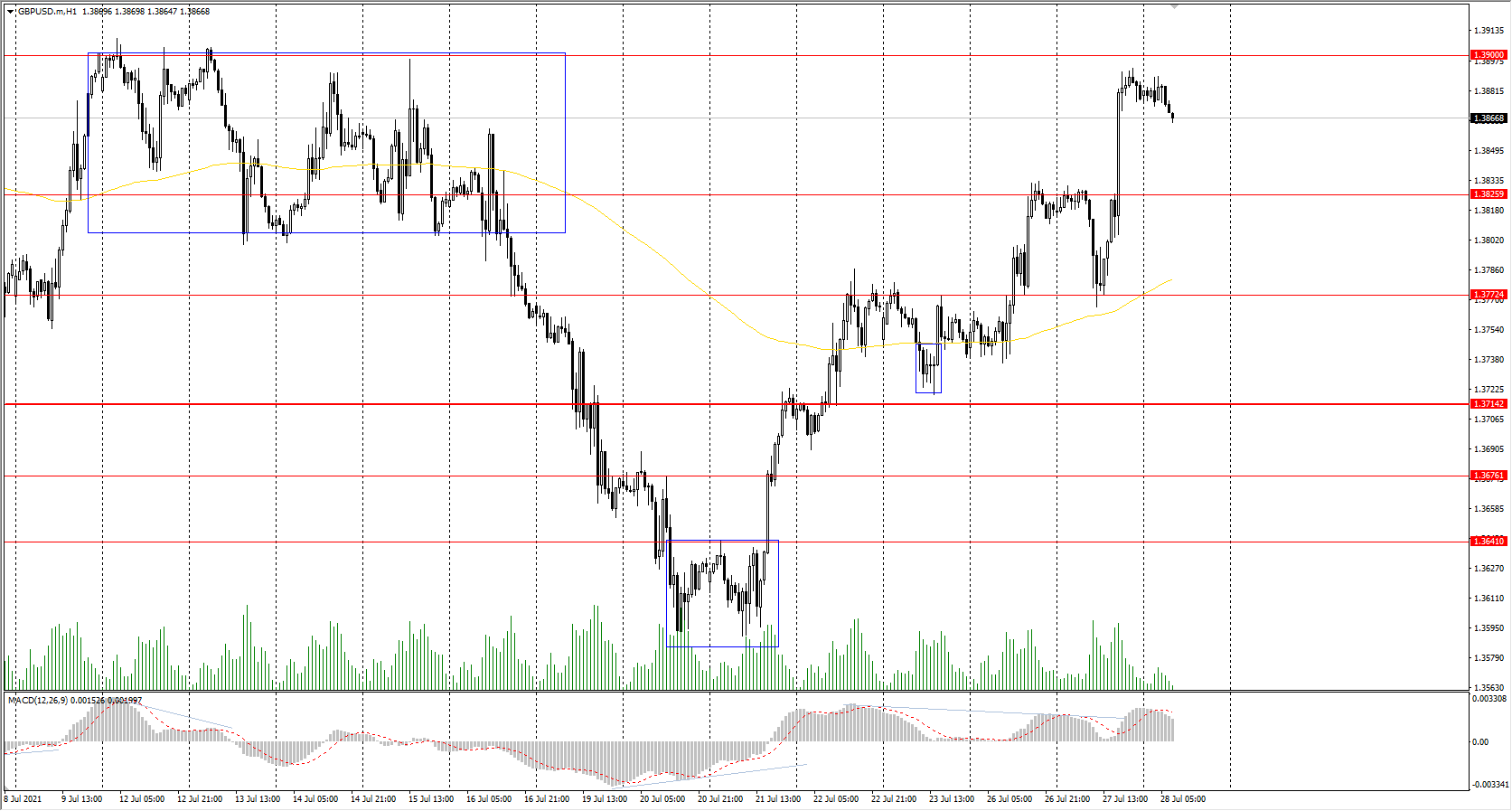
Technical indicators of the currency pair:
Prev Open: 1.3817
Prev Close: 1.3877
% chg. over the last day: +0.43%
Against the background of the dollar index decline, the British pound increased by 0.43% and managed to break through the priority change level. The breakthrough occurred during the impulse movement with consolidation above, which indicates a change in the medium-term trend.
Trading recommendations
Support levels: 1.3825, 1.3772, 1.3714, 1.3676 ,1.3641, 1.3614, 1.3525
Resistance levels: 1.3900, 1.3923, 1.4002, 1.4075, 1.4101
The trend on the GBP/USD currency pair has changed to bullish on the H1 timeframe. The MACD indicator is in the positive zone but with signs of divergence. Under such market conditions, traders are better to look for buy positions after the price pulls back to the support level. There are no optimal points for sell positions right now. Traders can search for intraday sales from the resistance level with short targets, but they should understand that it will be trading against the main trend.
Alternative scenario: if the price breaks through the 1.3714 support level and consolidates below, the bearish scenario is likely to resume.
News feed for 2021.07.28:
- US FOMC Statement at 21:00 (GMT+3);
- US Fed Interest Rate Decision at 21:00 (GMT+3);
- US FOMC Press Conference at 21:30 (GMT+3).
The USD/JPY currency pair
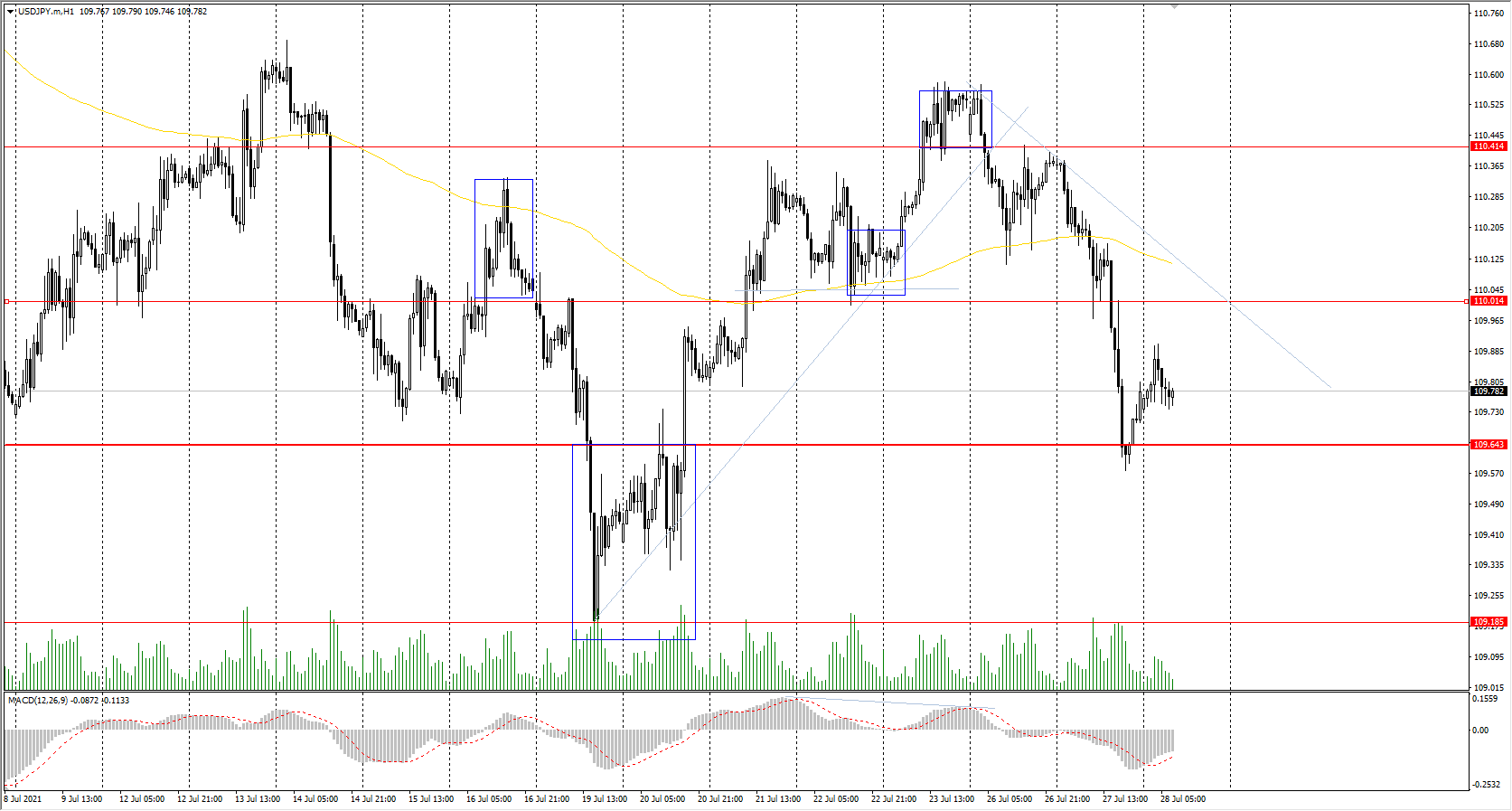
Technical indicators of the currency pair:
Prev Open: 110.37
Prev Close: 109.78
% chg. over the last day: -0.53%
Yesterday, Bank of Japan (BoJ) Governor Haruhiko Kuroda said that inflation targeting 2% has resulted in a situation where Japan is no longer experiencing deflation, and that indicates the success of the current monetary policy. The BoJ also intends to help companies and regional banks combat climate change and start using green technologies.
Trading recommendations
Support levels: 109.64, 109.19, 108.65
Resistance levels: 110.01, 110.41, 110.73, 111.06, 111.48, 110.73, 112.18
Against the background of the fall of the dollar index, as well as positive news from the governor of the Bank of Japan, the Japanese yen significantly strengthened yesterday. The price reached the priority change level and is close to breaking the upward trend. But the buyers managed to defend their positions at the support level of 109.64. The local trend is bearish, so traders should look for sell positions from the resistance levels. It is not recommended to buy, but traders should do it only on intraday timeframes from the priority change level and only with short targets.
Alternative scenario: if the price falls below 109.70, the downtrend is likely to be resumed.
News feed for 2021.07.28:
- US FOMC Statement at 21:0 (GMT+3);
- US Fed Interest Rate Decision at 21:0 (GMT+3);
- US FOMC Press Conference at 21:30 (GMT+3).
The USD/CAD currency pair
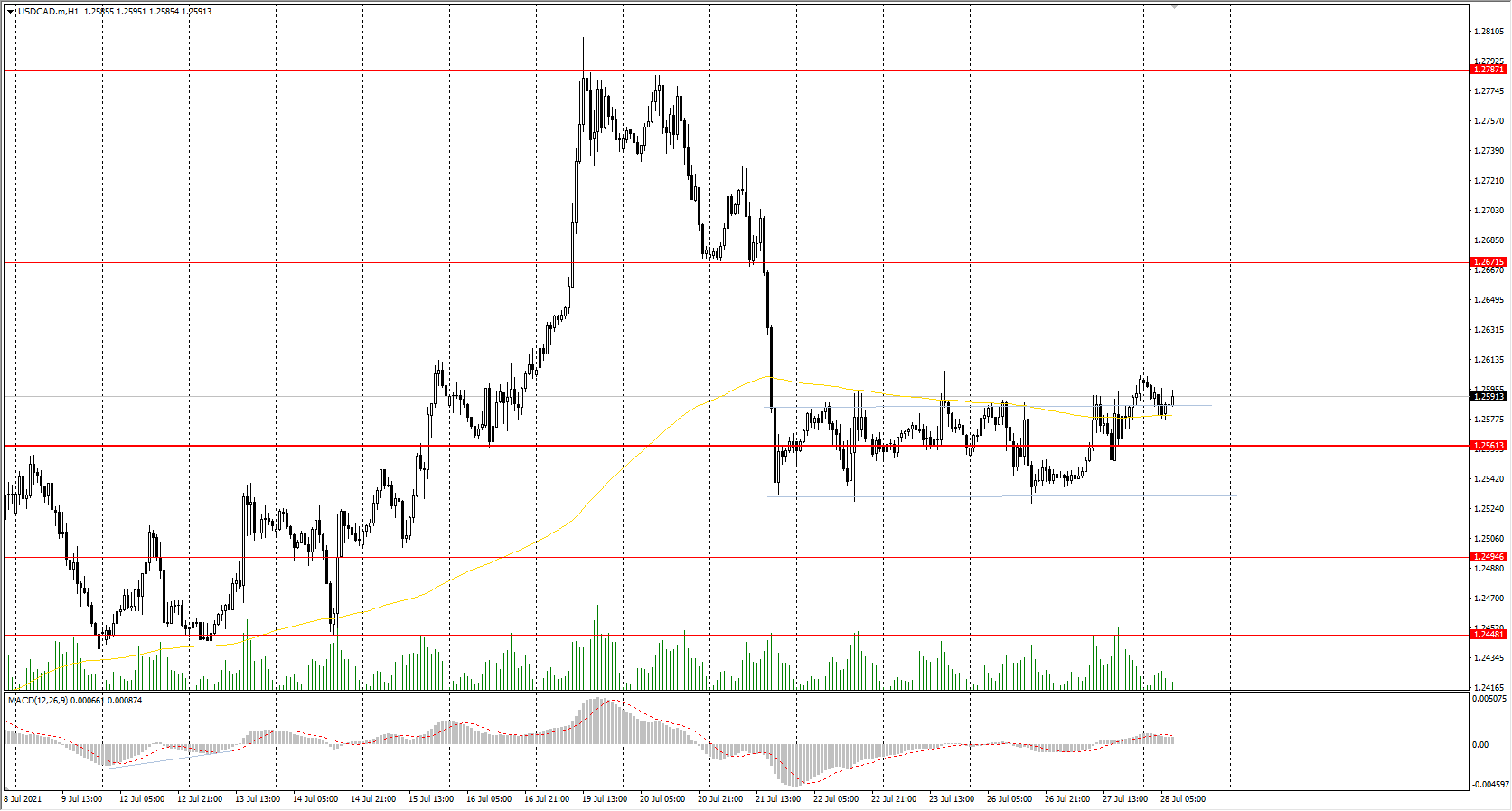
Technical indicators of the currency pair:
Prev Open: 1.2556
Prev Close: 1.2545
% chg. over the last day: -0.09%
The Canadian dollar is still trading in a narrow price range but aims to the breakthrough upwards. A lot will depend on where oil goes during today’s Crude Oil Reserves news release. If oil starts to rise, the USD/CAD will fall and vice versa. Today, the release of the inflation data may affect the situation.
Trading recommendations
Support levels: 1.2561, 1.2519, 1.2448, 1.2404, 1.2347, 1.2312
Resistance levels: 1.2671, 1.2787, 1,2951
Technically, the trend remains bullish. But the price is trading right at the priority change level. The MACD indicator is inactive. Traders are better to play it safe and take action only after the price moves to one side of the narrow price range.
Alternative scenario: if the price breaks through the 1.2561 support level and fixes below, the downtrend is likely to be resumed.
News feed for 2021.07.28:
- Canada Consumer Price Index (m/m) at 15:30 (GMT+3);
- US Crude Oil Reserves (w/w) at 17:30 (GMT+3).
- US FOMC Statement at 21:00 (GMT+3);
- US Fed Interest Rate Decision at 21:00 (GMT+3);
- US FOMC Press Conference at 21:30 (GMT+3).
The Focus Is On The Federal Reserve Meeting, Where Further Monetary Policy Plans Will Be Announced
US stock markets closed in the red zone yesterday. The biggest drop was in the Nasdaq technology index, which fell by 1.21%, while the fall at that moment was about 1,400 points (-2.3%). The Dow Jones index was more stable and decreased by 0.24%. The S&P 500 Index lost 0.47%.
Shares of United Parcel Service decreased by 7%, while the world's largest express delivery service increased its net income by more than 50% in the 2nd quarter. JetBlue Airways shares fell by 6.9%, while net income increased 7 times in the 2nd quarter. After the market closed, Alphabet, Apple, and Microsoft reported their quarterly results. Shares of all three companies decreased by 0.9-1.6% before the reports were released, but the reaction to the reports was different. Alphabet increased and closed above its opening price. Microsoft increased to its opening point for the day. Apple fell even lower, losing more than 3% on the day.
Amid a global shortage of semiconductor products, almost all of the major manufacturers are beginning to expand their businesses. Intel Corp. said its factories would start producing Qualcomm chips and outlined the development plan for the new foundry business, which should help by 2025 to catch up with such competitors as Taiwan Semiconductor and Samsung Electronics.
The focus today is on the Federal Reserve meeting, where further monetary policy plans will be announced. Any signs of a cutting of the QE program may send markets into a deep correction.
European stock indices also closed lower. The Stoxx Europe 600 index decreased by 0.54%, and the British FTSE 100 index decreased by 0.42%, German DAX dropped by 0.64%. The pressure on the European market is given by the concerns of the possible new restrictions due to the growth of the Delta strain and the slowdown of the economic recovery in the region.
The situation in the oil market remains the same. Oil prices have stabilized and are trading around $71-72 per barrel of WTI. On the one hand, oil markets remain in deficit on the back of increased demand over the summer, which is also supported by the growing pace of vaccination. On the other hand, OPEC+ countries are gradually increasing oil production, and supply is beginning to meet demand gradually. Crude oil inventory data will be released today. Analysts are expected to reduce fuel reserves.
Panic sell-offs hit China's stock market and Chinese companies listed in the US. According to the results of the last three trading sessions, shares of Chinese companies quoted in the USA showed the strongest fall since 2008. Investors are rushing to get rid of many companies as China's broader regulatory restrictions target many technology companies as well as out-of-school education companies. Hong Kong's Hang Seng Index decreased by 4.4%, and its technology index fell by 6.7% to its lowest level in more than a year. Shanghai Shenzhen CSI 300 index decreased by 3.5%, to its lowest level since October. Meanwhile, the "national team," which usually intervenes to stabilize market volatility, was unresponsive this time. Australia's consumer price index increased by 0.2% (to 0.8%), compared to the previous quarter. Annual inflation rate increased to 3.8% in the second quarter, which is much higher than the Reserve Bank of Australia's (RBA) target. The Australian ASX 200 Index decreased by 0.55% on the news.
Main market quotes:
- S&P 500 (F) 4,401.46 -20.84 (-0.47%)
- Dow Jones 35,058.52 -85.79 (-0.24%)
- DAX 15,519.13 -99.85 (-0.64%)
- FTSE 100 6,996.08 -29.35 (-0.42%)
- USD Index 92.46 -0.19 (-0.20%)
Important events for today:
- Australia Consumer Price Index (m/m) at 04:30 (GMT+3);
- Canada Consumer Price Index (m/m) at 15:30 (GMT+3);
- US Crude Oil Reserves (w/w) at 17:30 (GMT+3);
- US FOMC Statement at 21:00 (GMT+3);
- US Fed Interest Rate Decision at 21:00 (GMT+3);
- US FOMC Press Conference at 21:30 (GMT+3).
All Lights On The Fed
Today the market’s focus is expected to be on the release of the Fed’s interest rate decision and the bank is widely expected to remain on hold. Hence the main point of interest for traders turns towards what the bank’s intentions are about tapering its massive QE program. Practically the bank seems to be facing a dilemma between curtailing its asset purchases in order to curb inflationary pressures in a recovering US economy and continuing to keep the program unchanged to support the economy, given the uncertainty created by the Delta variant of the pandemic. Should the bank decide to adopt a dovish tone, we may see the USD as well as US treasury yields retreating, while on the contrary, should the bank decide to adopt a hawkish tone, signalling that it will start tapering its QE program rather sooner than later, we may see the USD and US yields gaining thus undermining also gold’s prices and the US stockmarkets. It should be noted that the bank may decide to postpone any announcements regarding a shift in the current supportive policy for the Jackson Hole Summit near the end of August, thus disappointing traders, or start paving the way towards some tightening of its monetary policy. In every case the event should be kept under close watch by traders, as it could create considerable volatility for the USD, while Powell’s press conference later on, could prolong any possible fluctuation of prices.
USD Index retreated yesterday testing the 92.30 (S1) support line, before recovering some of the losses. Given the index’s stabilisation we tend to maintain a sideways bias currently, yet the Fed’s interest rate decision could alter the index’s direction to either side. It should be noted that the RSI indicator is between the readings of 50 and 30, implying a slight advantage for the bears. Should the bears actually take control, we may see the Dollar index breaking the 92.30 (S1) support line and aim for the 91.75 (S2) level. Should the bulls take over, we may see the index breaking the 92.75 (R1) resistance line and aim for the 93.40 (R2) level.
CAD weakens as sentiment weighs
The Looney weakened against the greenback yesterday as market sentiment tended to weigh especially given that the Chinese crackdown on companies also weighed on Chinese stocks, worrying investors and reducing the risk on sentiment of the market. Oil prices remained rather stable yesterday despite a slight drop and despite the API weekly crude oil inventories figure showing a considerable drawdown which tended to imply that conditions are rather tight in the US oil market. We expect CAD traders to continue to be influenced by the general market sentiment as well as oil prices, yet also keep an eye out for Canada’s CPI rates for June which are due out today.
USD/CAD edged higher despite the USD index retreating, adding some distance between its price action and the 1.2560 (S1) support line. Despite the rise we tend to maintain a bias for a sideways motion near the 1.2560 for the time being albeit the Fed’s interest rate decision and the release of Canada’s CPI rates could alter the pair’s direction. It should be noted that the pair’s RSI indicator below our 4-hour chart is at the reading of 50 also implying a rather indecisive market. Should buyers be in charge of the pair’s direction, we may see the pair aiming if not breaking the 1.2650 (R1) resistance line, aiming for higher grounds. Should a selling interest be displayed by the market we may see the pair breaking the 1.2560 (S1) support line and aim for the 1.2470 (S2) support level.
Other economic highlights today and the following Asian session:
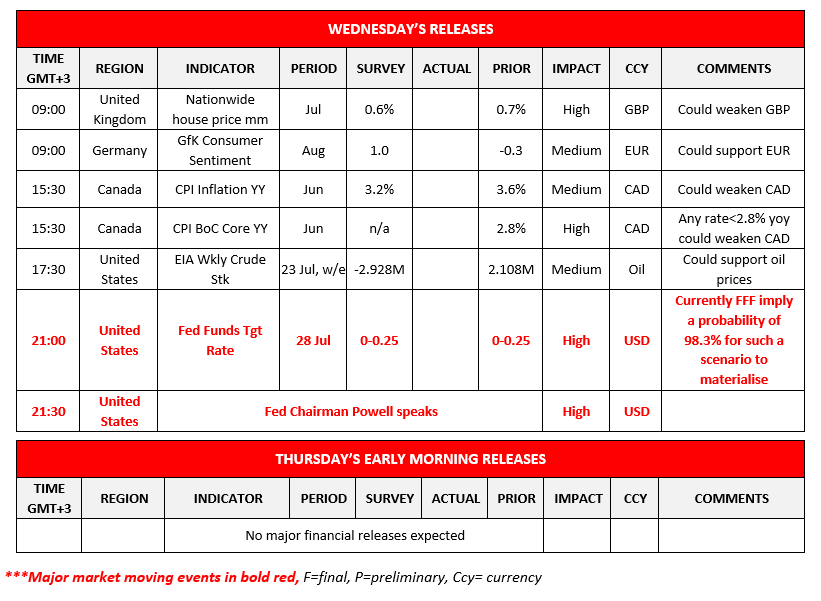
Today during the European session, we get UK’s nationwide house prices for July and Germany’s GfK consumer sentiment for August. In the American session we note the release of Canada’s CPI rates for June and later the weekly EIA crude oil inventories figure.
USD Index H4 Chart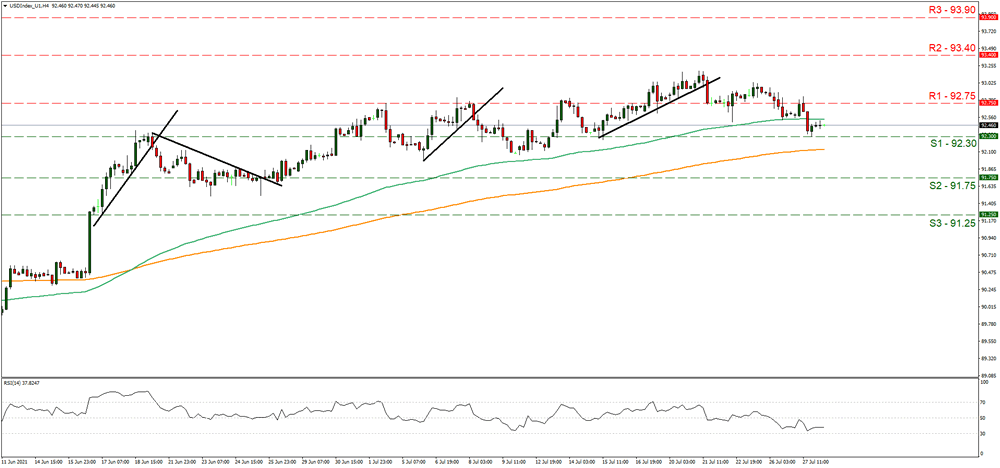
Support: 92.30 (S1), 91.75 (S2), 91.25 (S3)
Resistance: 92.75 (R1), 93.40 (R2), 93.90 (R3)
USD/CAD H4 Chart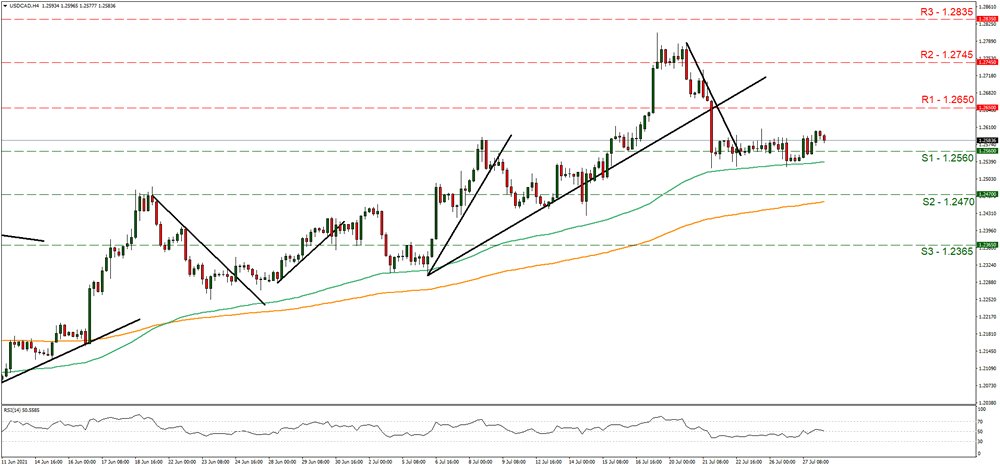
Support: 1.2560 (S1), 1.2470 (S2), 1.2365 (S3)
Resistance: 1.2650 (R1), 1.2745 (R2), 1.2835 (R3)
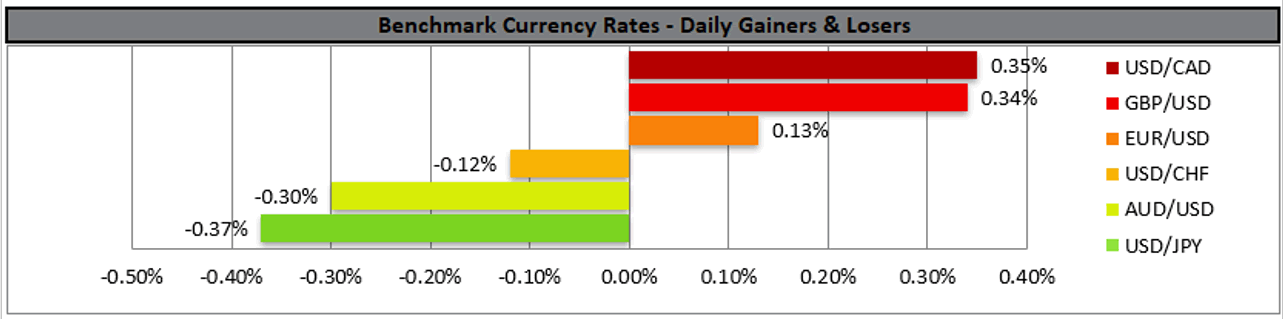
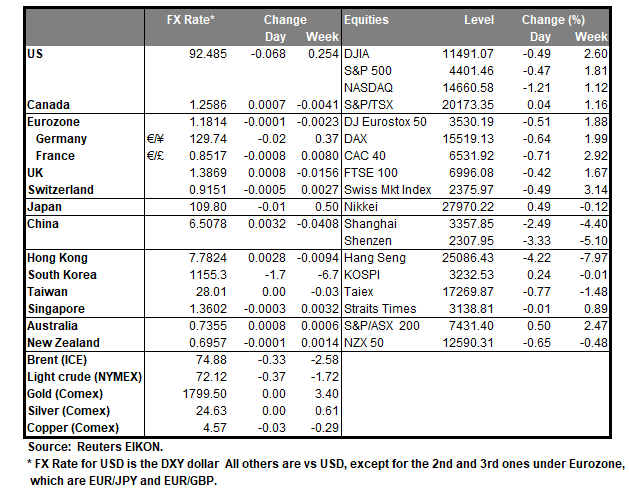
GBP/USD V-Shape Reversal In Play
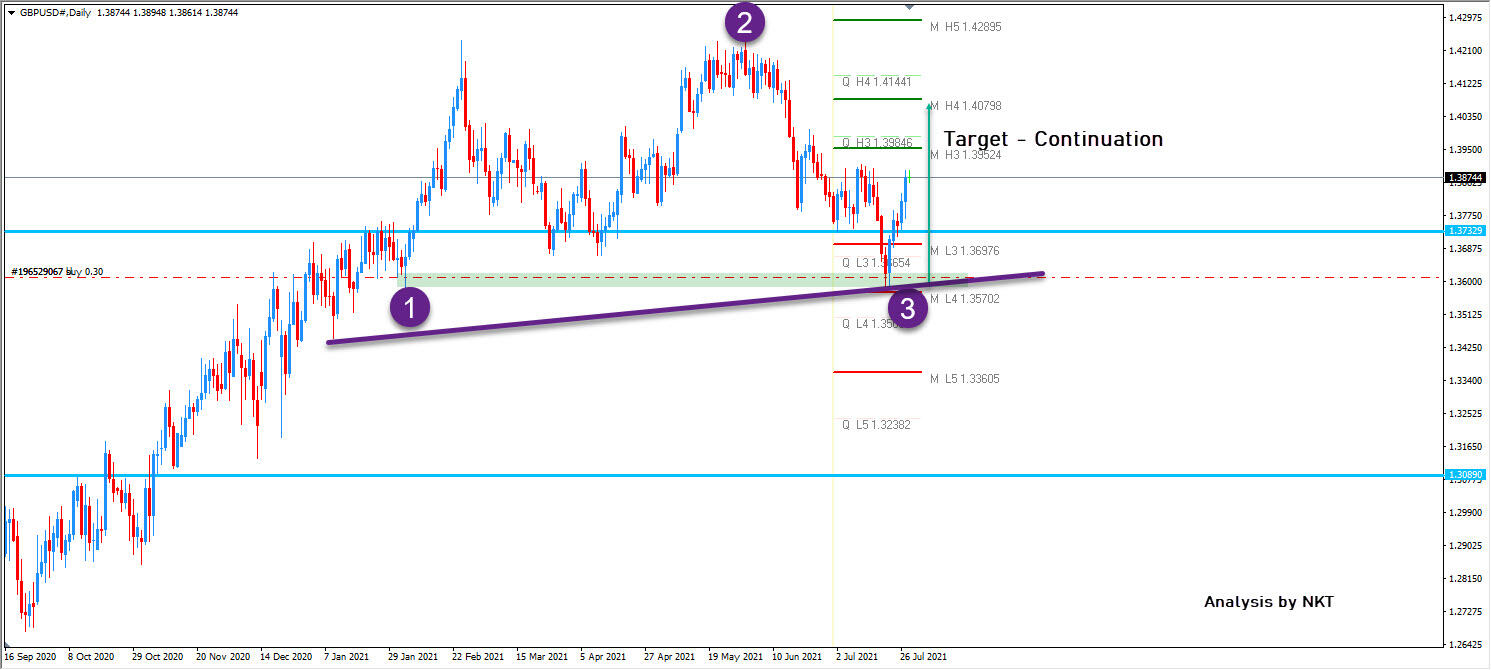
The GBP/USD is in the process of a V-Shaped reversal trade. I am looking to continue holding the trade as already covered in previous articles.
The 1-2-3 pattern is making a rejection at the lows. We should see a move to the upside as price is slowly crawling to the resistance zone. If the market closes above 1.3900, the next level is 1.3950. A move above 1.3950 will pave a way towards 1.4080. The GBP/USD is bullish despite the USD strength and I will be buying the dips again.
Euro Likely To Be Unfazed By Eurozone GDP And Inflation Data
It's proving to be a tough summer for the euro as a stronger US dollar and a more dovish ECB are overshadowing the Eurozone's improving economic prospects. Aside from a growing monetary policy divergence with the United States, worries about the Delta variant are causing additional pain for the euro. Can Friday's preliminary data on second quarter GDP growth and July inflation (both due at 09:00 GMT) provide any relief to the single currency?
Annual GDP growth to hit double digits in Q2
Economic pointers for the euro area have been heading higher in recent weeks as a quickening vaccine rollout and the gradual lifting of virus restrictions have turbocharged the recovery, which stalled in Q4/Q1 when the economy went into a double-dip recession. Eurozone GDP is expected to have rebounded by 1.5% over the quarter to June, more than recovering from the 0.3% dip of the first quarter.
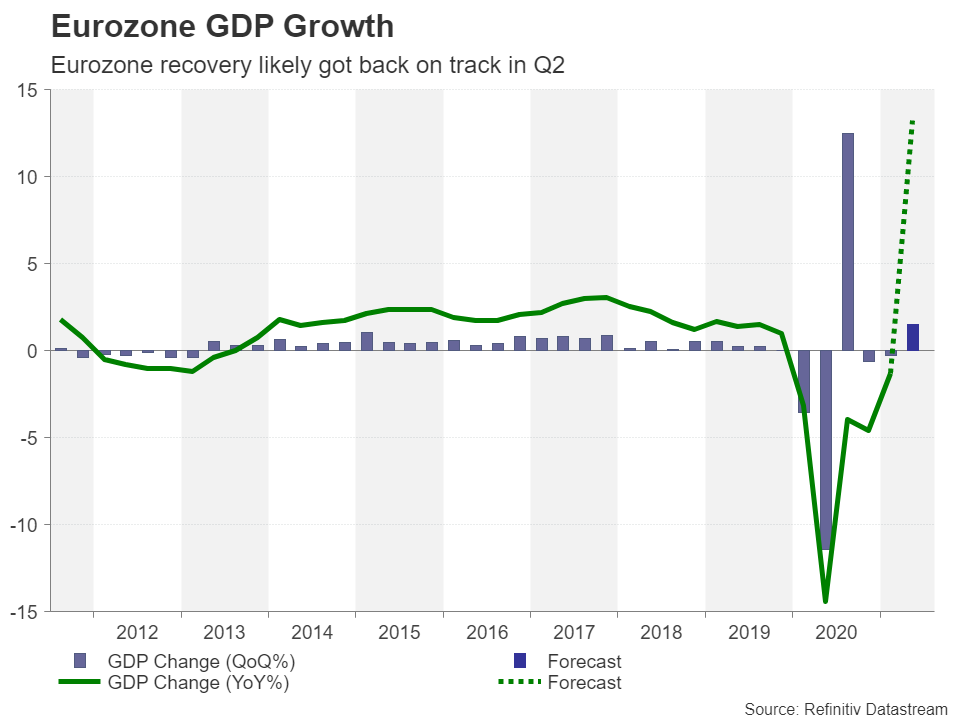
On a yearly basis, GDP is projected to stand 13.2% higher, boosted by the low base effect when economic output came to a standstill in Q2 2020. Looking at the flash PMI estimates for July, the positive growth momentum doesn't seem to be ending anytime soon; IHS Markit's composite PMI surged to the highest in 21 years.
Can the Delta variant scupper the recovery?
However, with virus curbs only just being relaxed again, there are already fears of another wave as the Delta variant is spreading rampantly in several countries across Europe. Cases have spiked sharply in Spain and the Netherlands and are on the rise in France and Italy too. The unwelcome development has already caught the attention of policymakers at the European Central Bank who no doubt will be keeping a close eye on whether the reopening of Eurozone economies is rolled back if the situation worsens.
But is the cloudier outlook the reason why the euro has had a dismal couple of months? Not quite. Virus woes have certainly been weighing on the euro lately, but the main source of the euro's renewed weakness is the expectation that the monetary policy paths of the Fed and ECB will diverge even further in the coming years.
ECB gets serious about 2% inflation
After the Fed's June policy meeting, investors brought forward the timeline of when they think rates in the US will begin to rise. But the divergence didn't end there. When the ECB completed its monetary policy strategy review earlier this month, it doubled down on its commitment to achieving 2% inflation, which was followed up with a revamp of the forward guidance at the July meeting.
With inflation in the euro area running below target for most of the last decade and yet to explode higher from transitory factors like in the US, markets don't see the ECB hiking rates for years to come. Preliminary readings for the Eurozone's harmonised index of consumer prices for July are due on Friday and are expected to show headline inflation ticking back up to 2.0% year-on-year from 1.9% in May. That figure will likely rise further in the coming months. 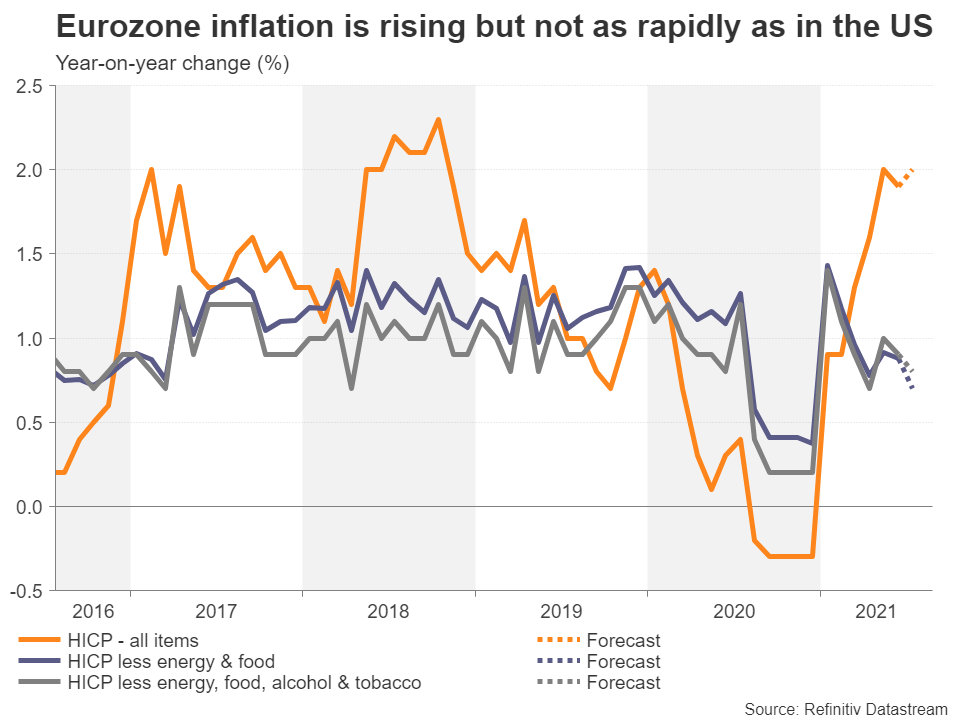
Eurozone rate hike disappears into the horizon
But that may not be enough for the ECB, which has gone a step further with its policy overhaul and incorporated underlying inflation into its forward guidance. Policymakers now want to see underlying inflation to be “sufficiently advanced to be consistent with inflation stabilising at two per cent over the medium term”. At the moment, the two measures of core inflation stand at 0.9% y/y and are forecast to edge even lower in July.
This gives an idea as to how much progress is still needed on the inflation front as far as the ECB is concerned, in stark contrast to the Fed, which could begin tapering later this year and raise rates by the end of 2023.
EUR/USD struck by Death Cross Thus, it's hard to see the euro being able to climb back towards its January and May peaks versus the dollar anytime soon. The recent bearish crossover of the 50- and 200-day moving averages underscores the negative shift in the pair's medium-term outlook. 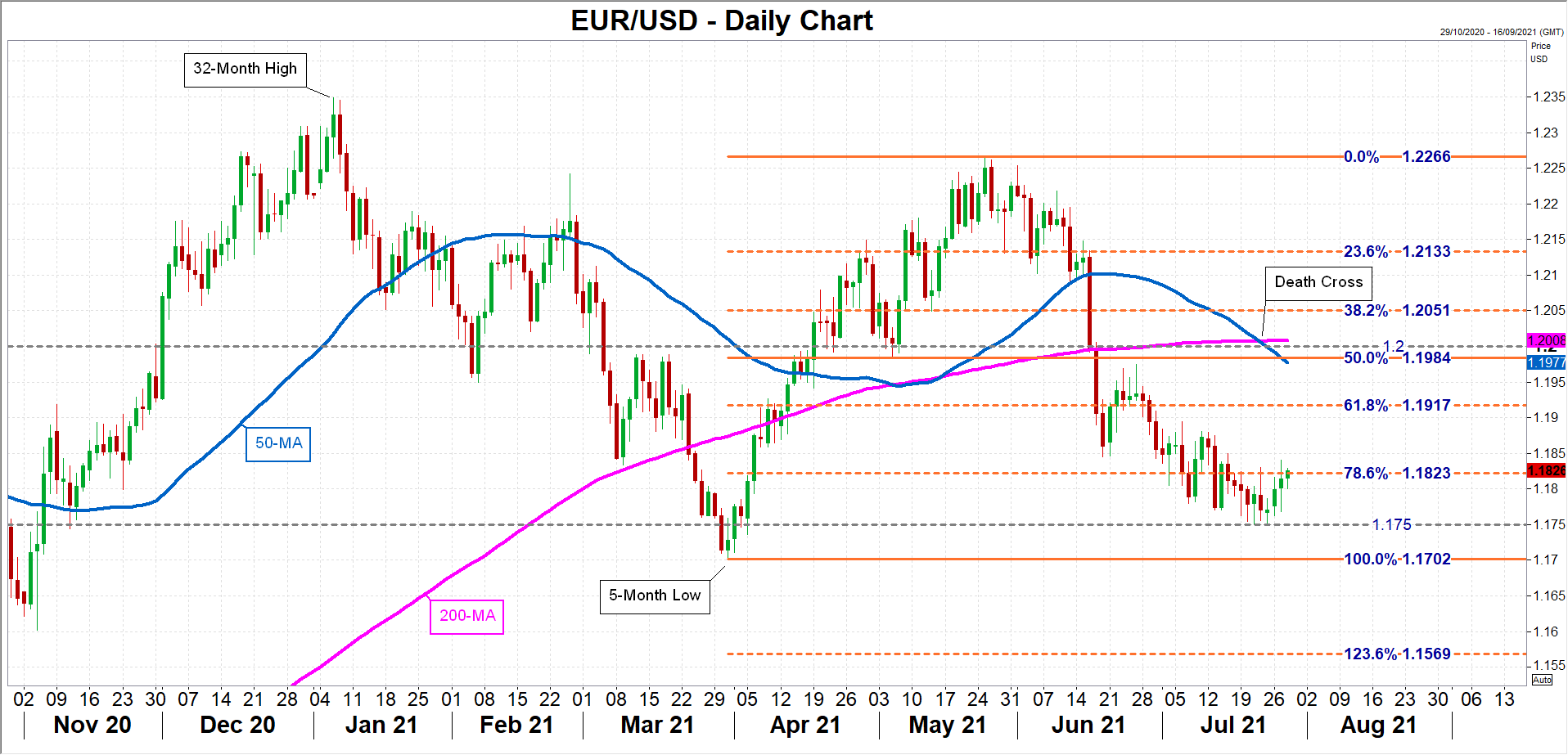
Any temporary boosts, either from stronger-than-expected data or a slump in the dollar could drive the pair towards the $1.1880 resistance, followed by the 50% Fibonacci retracement of April-May upleg just below the $1.20 handle. However, steeper gains would be difficult against the current backdrop.
To the downside, the $1.1750 and $1.1700 levels are the key supports that stand in the way of the latest downtrend becoming more permanent.
China Selloff Steadies But Wall Street Wobbles, Dollar Eyes Fed
- China jitters spread to global equities but rebound may already be underway
- US shares slip despite stellar earnings amid China and peak growth concerns
- Will the Fed heighten or soothe market nerves?
- Dollar inches higher ahead of Fed decision despite subdued yields
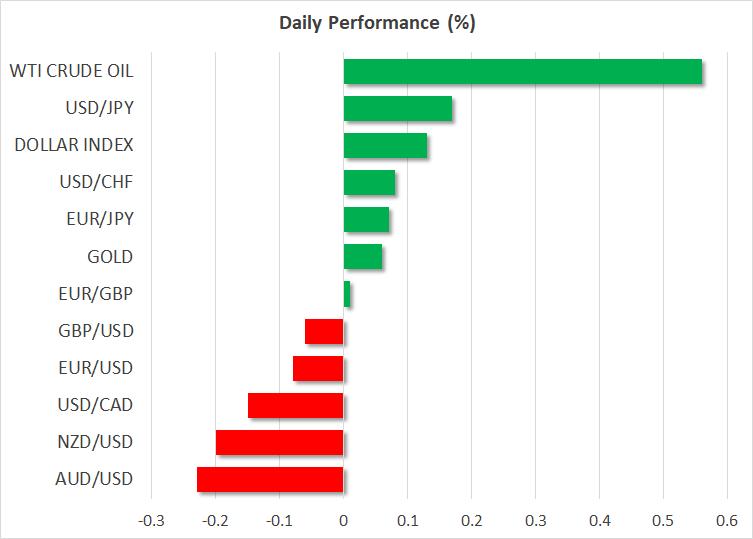
Somewhat calmer day for equities after Asian tumult
Stocks in China were attempting to break their losing streak on Wednesday following three days of carnage triggered by regulatory tightening that targeted domestic tech giants and for-profit education firms. China’s blue chip CSI 300 index was in positive territory in late session, while the SSE Composite index had trimmed more than half the day’s losses.
But other Asian indices struggled following a lower close on Wall Street yesterday. Japanese shares were the worst performers amid a record number of Covid cases reported in Tokyo on Tuesday as the Olympic Games got into full swing. Australia’s S&P/ASX 200 index also underperformed after Sydney’s lockdown was extended by four weeks.
Regional tech stocks were the worst hit, coming under pressure from yesterday’s mini-selloff of America’s tech juggernauts.
No earnings boost for Wall Street
US earnings results continued to confound analysts’ expectations, with Apple, Microsoft and Google all beating their revenue and EPS estimates. However, their stocks ended the day lower prior to the upbeat announcements that came after the market close as investors fretted about the possibility that the incredible first half growth in earnings won’t be repeated in the second half.
Fears about economic and corporate earnings growth peaking already have been dogging Wall Street for a while now and the recent worsening of the virus picture has only reinforced those views. Health officials in the US updated their mask guidance on Tuesday, advising all vaccinated people to start wearing masks again in indoor public spaces.
The revised guidance was a reminder that even highly vaccinated populations are at risk from the Delta variant, which continues to spread rampantly in many parts of the world, dashing hopes of a quick end to the pandemic.
However, there was some good news out of the US as a closely watched consumer confidence gauge climbed to a 17-month high in July. Nevertheless, all three leading US indices ended Tuesday down, with the Nasdaq Composite sliding 1.2%. E-mini futures remained in the red in early European trading, though they were off their lows, but European stocks opened higher. Facebook, Qualcomm, Boeing and Ford are among the highlights of today’s earnings schedule.
Fed could set the tone as dollar and yields firm
More strong earnings could help buoy the market mood as the latest jitters may have been overdone by long-overdue profit taking for US shares. But slightly detracting attention away from earnings today is the FOMC decision that’s due at 18:00 GMT, followed by Fed Chair Powell’s press conference 30 minutes later.
The Fed is not expected to deviate from the script today but Powell may reveal a bit more about how far tapering discussions have come in his press briefing. The odds of a hawkish surprise have diminished after the recent Delta scare, but that makes depressed Treasury yields even more susceptible to upside shocks should Powell demonstrate little concern about rising virus cases.
The 10-year Treasury yield edged slightly higher today, helping the greenback recoup some of yesterday’s losses. The pound has been benefiting the most from the US dollar’s latest retreat, surging past the $1.38 barrier. It was last trading marginally lower at $1.3863. Falling UK virus cases could be bolstering sterling because the riskier antipodean pairs have not been able to achieve much of a rebound from last week’s lows.
Even a big jump in Australian inflation has been unable to lift the aussie as prolonged lockdowns are weighing heavily on the RBA policy outlook.
The euro, meanwhile, was trying to hold above the $1.18 level and the Japanese yen was broadly weaker, underlining the slight improvement in the risk tone.