

Sample Category Title
US 500 Index Stretches to Fresh Record High of 4,415
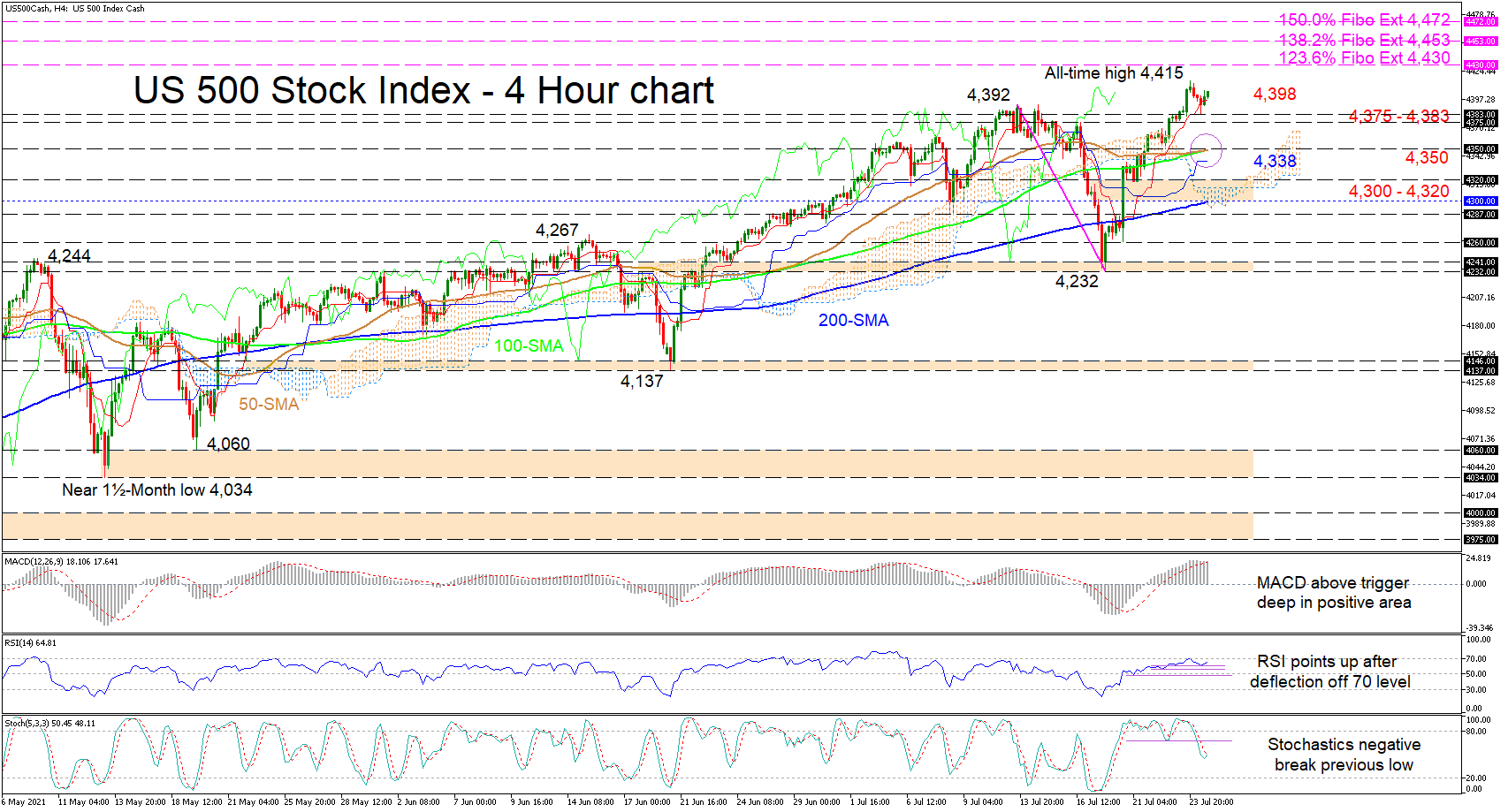
The US 500 stock index (Cash) is ticking back up after a minor pullback from its recently reached all-time high of 4,415. The positively charged 100- and 200-period simple moving averages (SMAs), along with the recouped elevation in the 50-period SMA’s slope, are endorsing upside momentum.
The bullish Ichimoku lines are reflecting a pause in positive price action, while the short-term oscillators are transmitting mixed signals in directional impetus. The MACD far above zero is dwindling towards its red trigger line, while the RSI is trying to improve in the bullish region. The stochastic oscillator’s negative charge seems to be abating somewhat, suggesting that upside forces are on the rise.
If the index regains buoyancy, initial resistance could arise around the fresh all-time high of 4,415. In the event the index navigates once again into uncharted waters, the ascent could falter around the 4,430 barrier, which happens to be the 123.6% Fibonacci extension of the corrective wave from 4,392-4,232. However, should buying orders intensify, the price may then challenge the 138.2% Fibo extension of 4,453 before piloting for the 150.0% Fibo extension of 4,472.
Alternatively, if sellers manage to dip the price below the red Tenkan-sen line at 4,398, preliminary support could develop at the 4,375-4,383 nearby boundary. However should the index slide beneath this obstacle, the price may target the 4,350 vital low, reinforced by the converged 50-and 100-period SMAs. From here, if negative pressures persist, the price could overshoot the blue Kijun-sen line at 4,338 and target the crucial support section of 4,300-4,320.
Summarizing, for the US 500 index to sustain a positive bearing, the price would need to persist above the SMAs and the 4,232 trough. That said, a close below the cloud and the 200-period SMA could suggest downside forces are growing.
Yen Edges Higher ahead of BoJ Report
The Japanese yen has started the week in positive territory. In the European session, USD/JPY is trading at 110.38, down 0.17% on the day.
BoJ inflation outlook eyed
Inflation has become a buzzword across the globe, as countries reopen their economies, to varying degrees. The Federal Reserve has held fast to its script that inflation is transitory, even with a surge in inflation in recent months. Although many investors and even some Fed presidents feel that the Fed should be more hawkish and tighten policy, Jerome Powell has not changed his stance, insisting that inflation will ease.
In Japan, domestic wholesale inflation has risen, as commodities and raw material prices have increased. In the case of consumer inflation, however, companies have been reluctant to pass on higher costs to the consumer. Wages in Japan have shown little growth, and the government has been unable to remove the ‘deflationary mindset’ despite years of zero interest rates and stimulus. BoJ Core CPI, the Bank’s preferred inflation gauge, came in at a negligible 0.1% in May, up from a zero reading in April.
The BOJ minutes from the June meeting, which were released last week, indicated that bank members were divided on whether CPI would rise in the coming months. One view was that CPI will rise as consumer demand recovers from Covid, while other members argued that wage growth would dampen any inflationary pressures. If the central bank isn’t clear on the direction of consumer inflation, then it’s no wonder that the market has no idea what to expect on the inflation front.
Will the BoJ Summary of Opinions shed some light on this issue? This report, which will be released on Tuesday, will focus on the views of bank policymakers that were expressed at the July meeting. Investors will be particularly interested in the BOJ’s inflation projection.
USD/JPY Technical
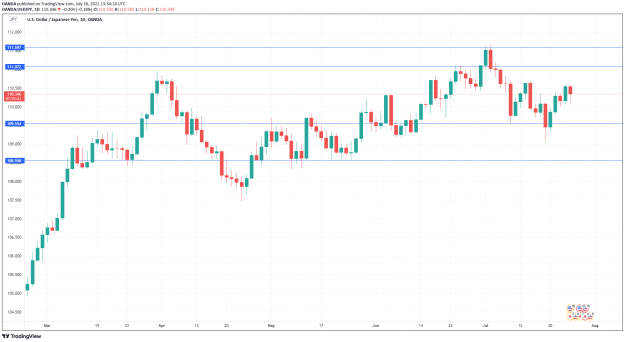
- USD/JPY faces resistance at 111.07. Next, there is resistance at 111.59
- On the downside, there is support at 109.55. Below, we find support at 108.55
EURUSD Testing Significant Support
This week’s key highlight will be the US Federal Reserve meeting and it might well be that sellers break important support at 1.1755 on expectations of the above-mentioned event. Despite being very concerned about a new coronavirus strain and possible lockdowns all around the world, financial markets continue pushing the American regulator to make it tighten its monetary policy. Inflation is high and may force the American regulator to be more aggressive. Also, there are risks of seeing a reduction in liquidity on behalf of the Fed, while the European Central Bank is expanding its money printing press capacity. Taken together, these factors are in favour of further USD strengthening.
The statistics published today showed that the German Ifo Business Climate dropped to 100.8 points. It means that the German businesses are predisposed more negatively than before as there are serious delivery issues, which, in their turn, put significant pressure on both industrial and retail sectors of the economy. It was said that over 60% of the companies reported a shortage of raw materials required for manufacturing, as well as an upsurge in raw material prices. In this light, the German industry can not operate at its normal pace. Unfortunately for the European currency, it is happening at a time when the USA is experiencing a relatively powerful economic recovery and this will put additional pressure on the major currency pair.
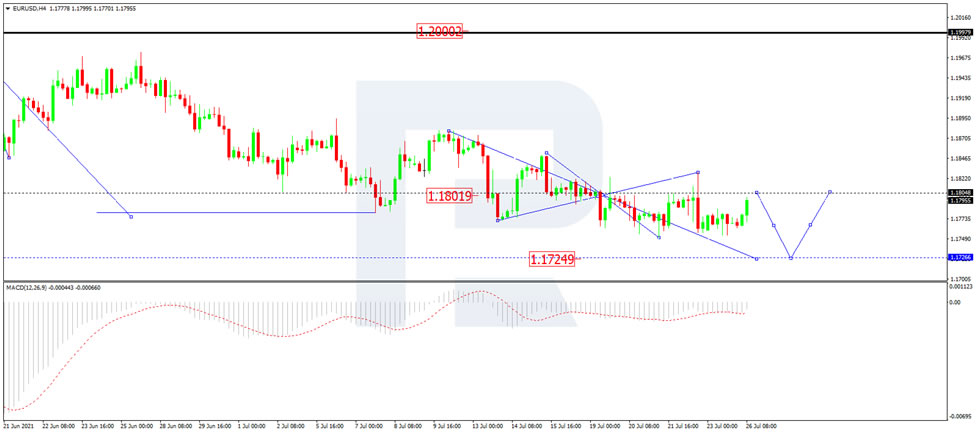
In the H4 chart, EUR/USD is falling towards 1.1725 and may later correct to reach 1.1800. After that, the instrument may resume trading downwards with the target at 1.1690. From the technical point of view, this scenario is confirmed by MACD Oscillator: its signal line is trading below 0, thus confirming a further downtrend on the price chart.
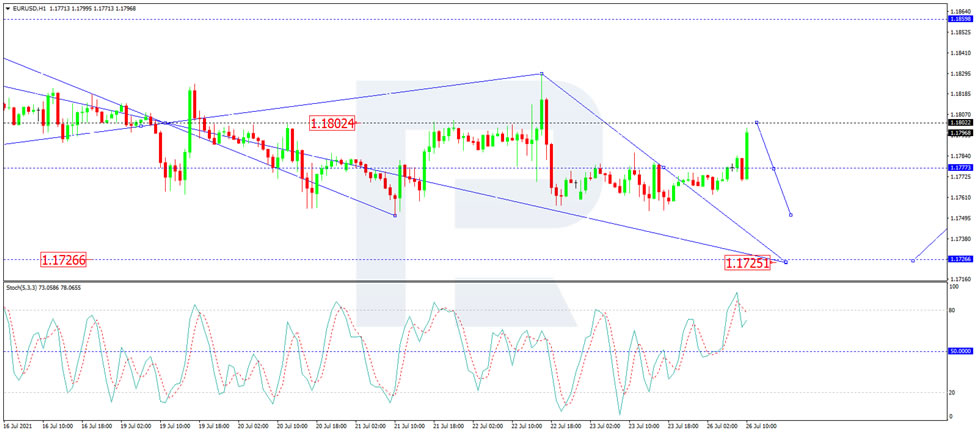
As we can see in the H1 chart, after falling and reaching 1.1755, EUR/USD has completed the ascending correctional impulse at 1.1800. Possibly, the pair may rebound from the latter level and resume trading within the downtrend with the short-term target at 1.1725. From the technical point of view, this scenario is confirmed by the Stochastic Oscillator: after rebounding from 80, its signal line is steadily moving downwards to reach 50. Later, the line may break 50 and continue falling towards 20.
USD/JPY Mid-Day Outlook
Daily Pivots: (S1) 110.23; (P) 110.41; (R1) 110.73; More...
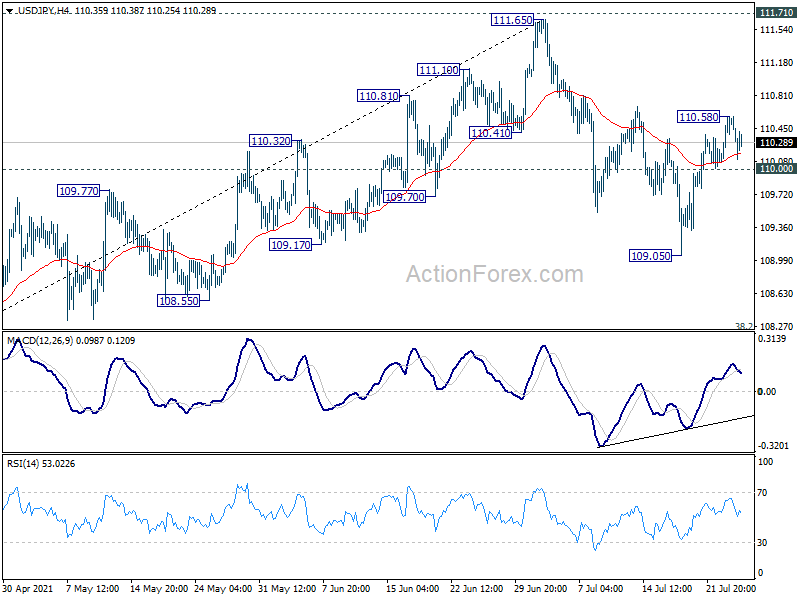
Intraday bias in USD/JPY remains neutral at this point. Another rise is in favor as long as 110.00 minor support holds. Above 110.58 will resume the rebound from 109.05 to retest 111.65 high. However, on the downside, break of 110.00 will turn bias back to the downside for 109.05. Break will resume the fall from 111.65 to 38.2% retracement of 102.58 to 111.65 at 108.18.
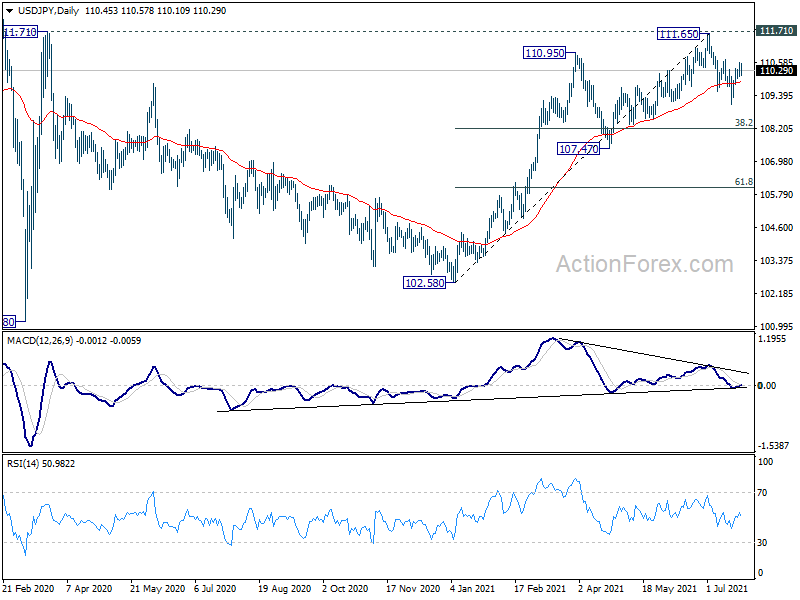
In the bigger picture, medium term outlook is staying neutral with 111.71 resistance intact. The pattern from 101.18 could still extend with another falling leg. Sustained trading below 55 day EMA will bring deeper fall to 107.47 support and below. For now, outlook won't turn bullish as long as 111.71 resistance holds, even in case of strong rebound.
USD/CHF Mid-Day Outlook
Daily Pivots: (S1) 0.9182; (P) 0.9202; (R1) 0.9217; More....
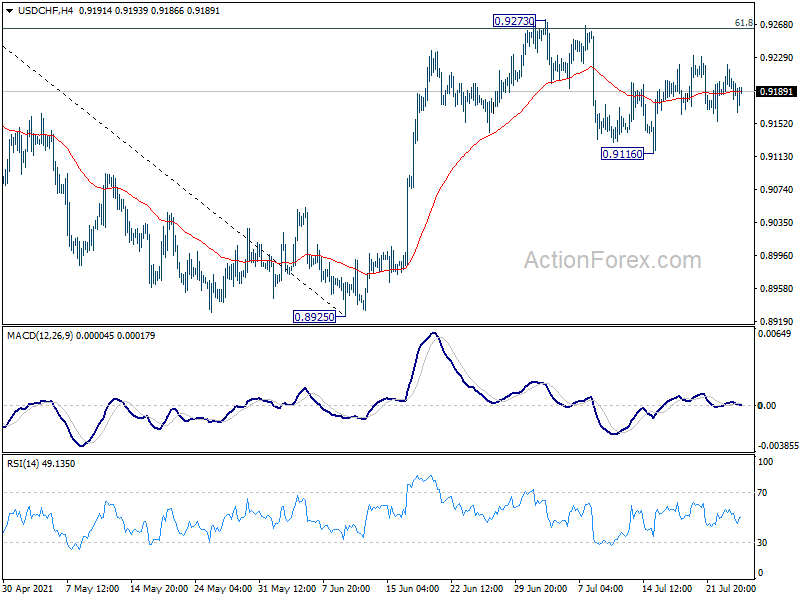
Intraday bias in USD/CHF remains neutral as range trading continues inside 0.9116/9273. On the downside, break of 0.9116 support will affirm the case that rebound from 0.8925 has completed at 0.9273. Deeper fall would then be seen back to retest 0.8925 low. On the upside, however, break of 0.9273 and sustained trading above 61.8% retracement of 0.9471 to 0.8925 at 0.9262 will target 0.9471 resistance next.
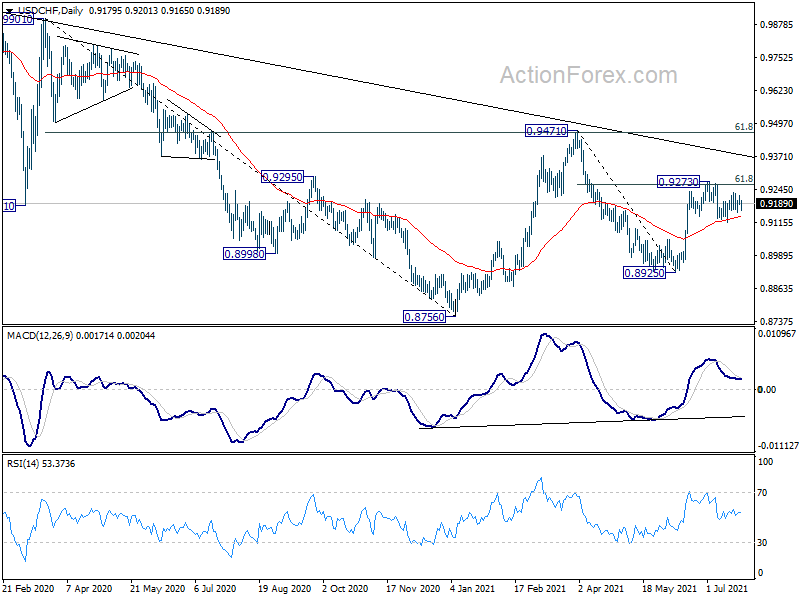
In the bigger picture, medium term outlook is currently neutral with focus on 0.9471 resistance. Sustained break there will indicate completion of whole decline from 1.0342 (2016 high). Medium term outlook will be turned bullish for a test on 1.0342 high. But, rejection by 0.9471 again will revive bearishness for another fall through 0.8756 low.
EUR/USD Mid-Day Outlook
Daily Pivots: (S1) 1.1754; (P) 1.1770; (R1) 1.1786; More...
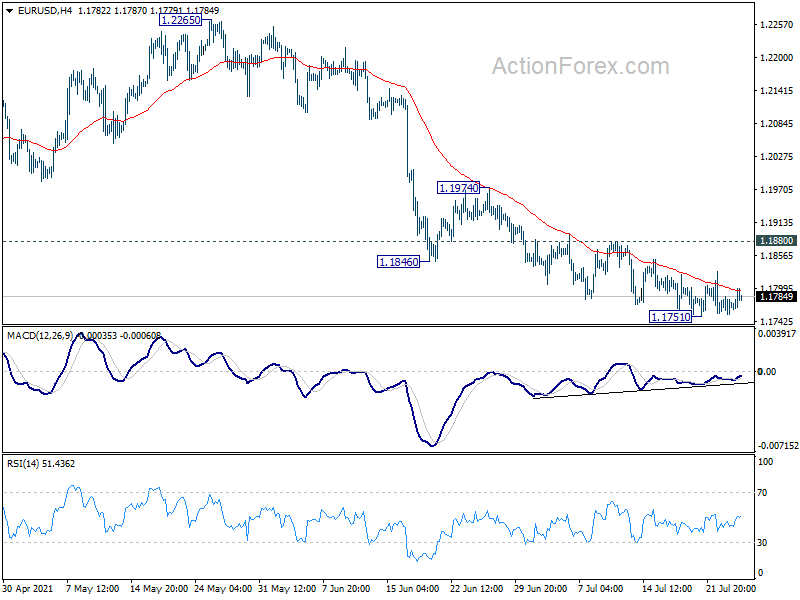
EUR/USD is still staying in consolidation form 1.1751 and intraday bias remains neutral at this point. On the downside, break of 1.1751 will resume the fall from 1.2265, as the third leg of correction from 1.2348, to 1.1703 support. However, on the upside, break of 1.1880 resistance will indicate short term bottoming and turn bias back to the upside, for stronger rebound to 1.1974 resistance first.
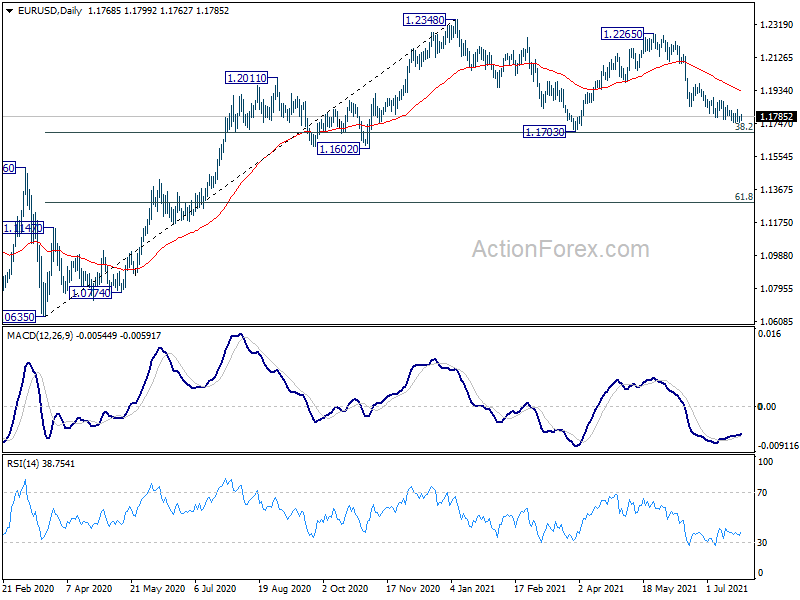
In the bigger picture, rise from 1.0635 is seen as the third leg of the pattern from 1.0339 (2017 low). Further rally could be seen to cluster resistance at 1.2555 next, (38.2% retracement of 1.6039 to 1.0339 at 1.2516). This will remain the favored case as long as 1.1602 support holds. Reaction from 1.2555 should reveal underlying long term momentum in the pair. However sustained break of 1.1602 will argue that the rise from 1.0635 is over, and turn medium term outlook bearish again.
GBP/USD Mid-Day Outlook
Daily Pivots: (S1) 1.3718; (P) 1.3749; (R1) 1.3778; More....
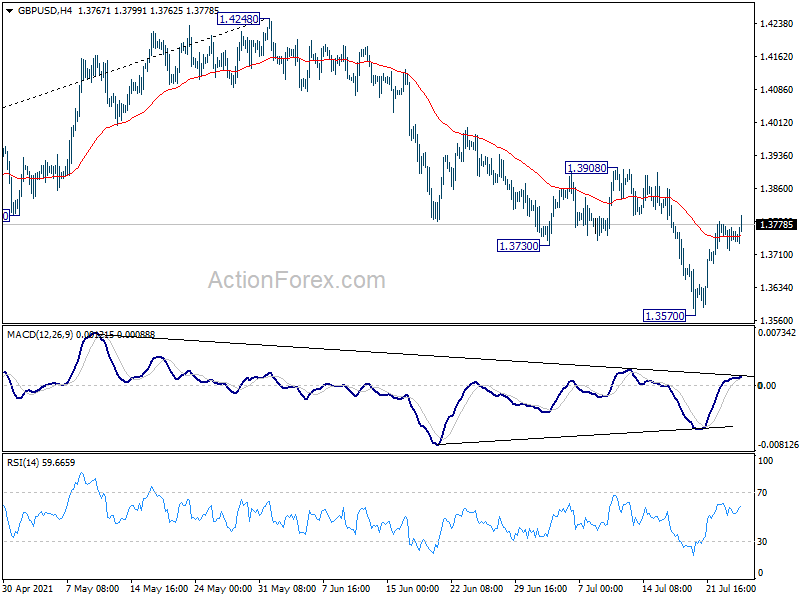
GBP/USD's rebound from 1.3570 resumes today but stays below 1.3908 resistance. Intraday bias remains neutral first. As long as 1.3908 holds, another decline is still in favor. On the downside, break of 1.3570 will resume the fall from 1.4248 to 1.3482 resistance turned support first. Decisive break there will target 38.2% retracement of 1.1409 to 1.4248 at 1.3164. On the upside, break of 1.3908 resistance will turn bias back to the upside for retesting 1.4248 high instead.
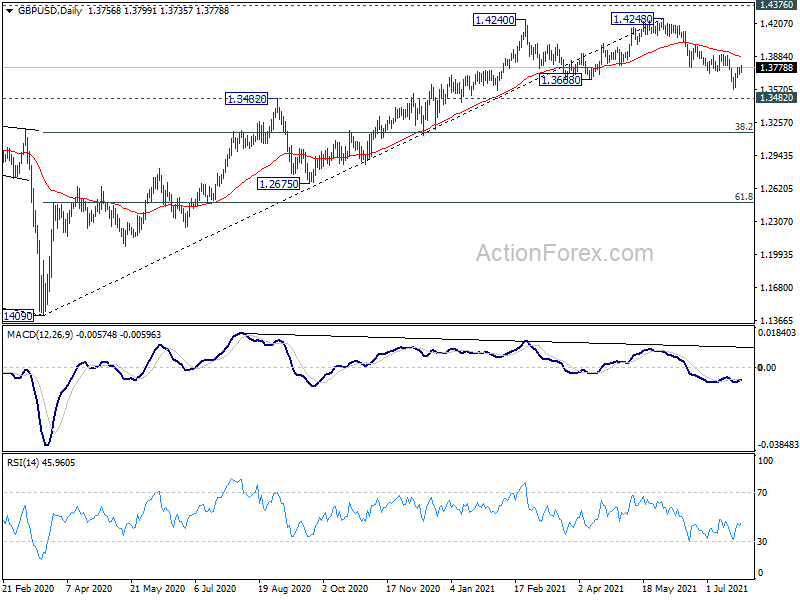
In the bigger picture, as long as 1.3482 resistance turned support holds, up trend from 1.1409 should still continue. Decisive break of 1.4376 resistance will carry larger bullish implications. However, firm break of 1.3482 support will argue that the rise from 1.1409 has completed. GBP/USD would then be seen in another leg of long term range pattern between 1.1409 and 1.4376. Deeper fall could then be seen to 61.8% retracement of 1.1409 to 1.4248 at 1.2493, and even below.
Sterling Rises on Falling Delta Infections, Dollar Softens
Sterling rises broadly today despite dovish comments from a BoE policymaker. Sentiment towards the Pound is likely support by declining trend in delta variant infections. Other European majors are also firm together with Yen. On the other hand. Dollar is currently the weakest one, followed by commodity currencies. Traders are turning more cautious on the greenback ahead of FOMC meeting later in the week. Aussie and Kiwi are weighed down by heavy selloff in China stocks.
Technically, GBP/JPY's rebound from 148.43 resumed after brief retreat and it's heading back to 153.46 resistance. Similarly GBP/USD's rebound has resumed and could be heading back to 1.3908 resistance. Break there will argue that whole decline from 1.4248 has completed at 1.3570 and pave the way to retest 1.4248 high. We'll see if Sterling could sustain current upside momentum.
In Europe, at the time of writing, FTSE is down -0.03%. DAX is down -0.23%. CAC is up 0.07%. Germany 10-year yield is up 0.004 at -0.414. Earlier in Asia, Nikkei rose 1.04%. Hong Kong HSI dropped -4.13%. China Shanghai SSE dropped -2.34%> Singapore Strait Times dropped -0.57%. Japan 10-year JGB yield rose 0.0009 to 0.017.
BoE Vlieghe: Appropriate to keep current stimulus in place for several quarters at least
BoE MPC member Gertjan Vlieghe reiterated in a speech that the current inflation peak is "likely to be temporary". The supply bottlenecks and base effects are "set to wane next year".
Also, the UK is "not out of the woods yet" in terms of the virus and the impact of the economy. He added that most recent data indicated that economy remains "an average recession away from full employment". The delta variant is "still causing health and economic damage".
Also, various government support schemes are "coming to an end", he said, "I would want to see how the economy copes with that, before adding monetary tightening on top of fiscal tightening".
Hence, he said, "it will remain appropriate to keep the current monetary stimulus in place for several quarters at least, and probably longer". "When tightening does become appropriate, I suspect not much of it will be needed, given the low level of the neutral rate."
Germany Ifo dropped to 100.8, supply bottlenecks and infections weigh
Germany Ifo Business Climate dropped to 100.8 pts in July, down slightly from 101.7, below expectation of 102.1. Current Assessment index rose to 100.4, up from 99.7. Expectations index dropped to 101.2, down from 103.7.
Looking at some details, manufacturing index dropped from 28.5 to 27.4. Services dropped from 28.5 to 27.4. Trade dropped from 17.8 to 15.8. Construction rose from 4.2 to 5.7.
Ifo said: "Companies evaluated their current business situations as somewhat better, but their expectations for the coming months were significantly less optimistic. Supply bottlenecks and concerns over newly rising infection numbers are weighing on the German economy."
Japan PMI manufacturing dropped to 52.2, services dropped to 46.4
Japan PMI Manufacturing dropped slightly from 52.4 to 52.2 in July, below expectation of 53.1. PMI Services dropped from 48.0 to 46.4. PMI Composite dropped from 48.9 to 47.7.
Usamah Bhatti, Economist at IHS Markit, said: "Flash PMI data indicated that Japanese private sector businesses saw a faster reduction in activity during July. Output fell at the quickest pace for six months, while the contraction in new business inflows was the fastest since February. Survey members attributed the deterioration in business conditions to persistent rises in COVID-19 cases and state of emergency measures which dampened activity and demand."
New Zealand goods exports rose 17% yoy in June, imports rose 24% yoy
New Zealand goods exports rose 17% yoy to NZD 6.0B in June. Goods imports rose 24% yoy to NZD 5.7B. Monthly trade balance reported NZD 261m surplus, slightly below expectation of NZD 297m.
Exports to all top trading partners were up, including China (40%), EU (21%), Australia (9.5%), Japan (13%) and US (2.9%). Imports from all top trading partners were up too, including EU (51%), China (17%), Japan (69%), USA (52%) and AU (18%).
GBP/USD Mid-Day Outlook
Daily Pivots: (S1) 1.3718; (P) 1.3749; (R1) 1.3778; More....
GBP/USD's rebound from 1.3570 resumes today but stays below 1.3908 resistance. Intraday bias remains neutral first. As long as 1.3908 holds, another decline is still in favor. On the downside, break of 1.3570 will resume the fall from 1.4248 to 1.3482 resistance turned support first. Decisive break there will target 38.2% retracement of 1.1409 to 1.4248 at 1.3164. On the upside, break of 1.3908 resistance will turn bias back to the upside for retesting 1.4248 high instead.
In the bigger picture, as long as 1.3482 resistance turned support holds, up trend from 1.1409 should still continue. Decisive break of 1.4376 resistance will carry larger bullish implications. However, firm break of 1.3482 support will argue that the rise from 1.1409 has completed. GBP/USD would then be seen in another leg of long term range pattern between 1.1409 and 1.4376. Deeper fall could then be seen to 61.8% retracement of 1.1409 to 1.4248 at 1.2493, and even below.
Economic Indicators Update
| GMT | Ccy | Events | Actual | Forecast | Previous | Revised |
|---|---|---|---|---|---|---|
| 22:45 | NZD | Trade Balance (NZD) Jun | 261M | 469M | 489M | |
| 0:30 | JPY | Manufacturing PMI Jul P | 52.2 | 53.1 | 52.4 | |
| 8:00 | EUR | Germany IFO Business Climate Jul | 100.8 | 102.1 | 101.8 | 101.7 |
| 8:00 | EUR | Germany IFO Current Assessment Jul | 100.4 | 101.6 | 99.6 | 99.7 |
| 8:00 | EUR | Germany IFO Expectations Jul | 101.2 | 103.3 | 104 | 103.7 |
| 14:00 | USD | New Home Sales Jun | 800K | 769K |
Oil And Gold Drifting At Start Of Week
Oil watches from the sidelines
Having staged the mother of all “delta-dips,” followed by the mother of all FOMO buy-the-dip rallies last week, oil now finds itself roughly where it was post-OPEC+ the previous week. Brent crude on Friday was hardly changed, closing at USD 74.15 a barrel, while WTI finished barely moved at USD 72.05 a barrel.
Although not directly impacting oil consumption patterns, the nerves sweeping China markets have been enough to see investors mark oil down in Asian trading. Fears growing that the government clampdowns will impact growth. Both Brent crude and WTI have retreated by 0.75% to USD 73.60 and USD 71.50 a barrel, respectively.
The USD 74.00 region for Brent crude, and USD 72.00 for WTI, look like equilibrium levels. Both contracts should continue to consolidate their gains, with volatility much reduced from last week. As such, I am not expecting any fireworks until after the FOMC conclusion. Brent should trade in a USD 73.00 to USD 75.00 a barrel range, and WTI should remain in a broader USD 71.00 to USD 73.00 a barrel range.
Gold catches a modest haven bid
Gold once again tested support at USD 1790.00 an ounce on Friday, only to rally back to USD 1800.00 an ounce in another positive technical development. Today, the travails in China’s stock markets have seen both digital currencies and gold receive some haven inflows. Gold has risen 0.30% to USD 1807.00 an ounce.
Gold remains mostly off investors’ radars, with most of the action occurring in other asset classes. It remains confined in a broader range bounded by its 100 and 200-DMAs at USD 1797.00 and USD 1823.00 an ounce, respectively. Gold has also traced out clearly denoted support at v1790.00 an ounce, while it has interim resistance at USD 1810.00 an ounce.
A daily close below USD 1790.00 an ounce would suggest that a deeper correction to the critical support at USD 1750.00 an ounce is happening. However, the charts indicate that gold is, in fact, quietly consolidating at these levels in preparation for a resumption of the longer-term uptrend. A close above the 200-DMA would signal this has started. In the meantime, playing the range and patience are the orders of the day.
The US Dollar Remains Firm
Investors flock to safety of US dollar
The US dollar remains near 5-month highs versus the majors, with the dollar index closing 92.90 on Friday, not far from its 93.20 high last Monday on the “delta-dip.” The persistent strength of the US dollar, even as US bond yields continue to ease, likely reflect flows into the bond market and a continual haven bid from emerging markets that are battling the delta-variant globally, notably in Asia.
Markets are vulnerable to more US dollar upside surprises this week, given that the overall environment, when looking at US yields, should not support US dollar strength. Especially with no infrastructure agreement in the Senate and a looming US debt ceiling. If the FOMC surprises with a change of language this week, we can expect another surge in the US dollar, particularly versus the low low forever euro, and emerging market currencies.
EUR/USD is trading sideways at 1.1775 today and appears to be slowing, forming decent support at 1.1750. However, its rallies have been shallow, and 1.1800 has mostly been contained. EUR/USD needs to close above 1.1800 a couple of times this week to change the bearish narrative; otherwise, the risk remains of a deeper selloff to sub-1.1600.
GBP/USD looks more constructive, helped along by “freedom week”, passing mostly without incident by British standards. GBP/USD closed the week above the 200-DMA at 1.3710, and a rally above 1.3800 would signal further gains targeting 1.4000. A stabilisation of the US 10-year yield has seen bids creeping back into USD/JPY, which has risen to 110.35. A rally through 110.70 targets a retest of the 111.60 May highs, although we may have to wait for the FOMC outcome first.
USD/CNY has shied away from resistance at 6.4900 since the start of June. A daily close above 6.4900 likely signals that authorities are happy with another bout of yuan weakness, having put a floor under the appreciation trend in early June. The turmoil in the China stock market and the ongoing clampdowns by the government across multiple sectors means USD/CNY is unlikely to fall very far this week.
The Australian and New Zealand dollars are trying to trace bottoming formations at the moment, but the rallies are shallow. With their high correlation to risk sentiment in Asia, sustained rallies will be hard to come by, especially with the Indonesian rupiah, Malaysian ringgit, Thai baht and other ASEAN currencies suffering deep delta-discounts. On that note, regional ASEAN currencies will trade nervously into the FOMC. Any change to the language will see them suffer additional selling, being highly sensitive to US interest rate trajectories at the best of times.