Sample Category Title
USD/JPY Daily Outlook
Daily Pivots: (S1) 110.23; (P) 110.41; (R1) 110.73; More...
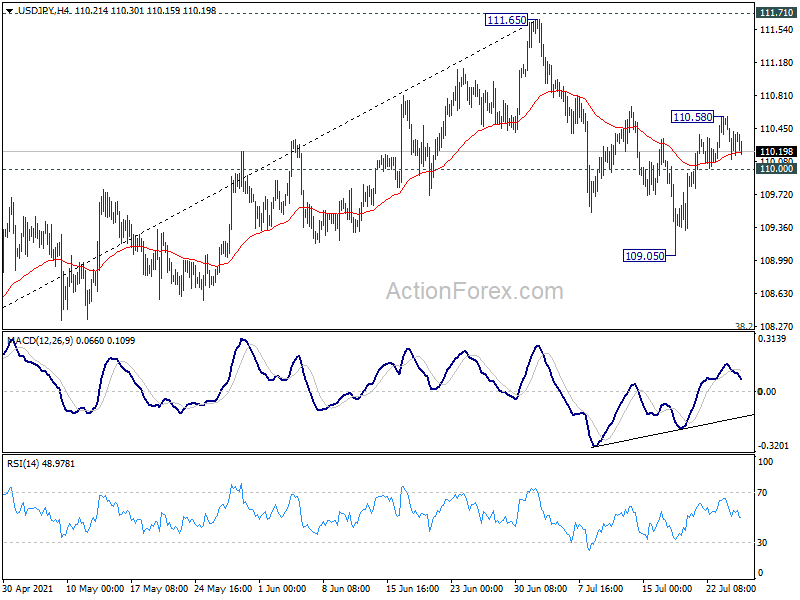
Intraday bias in USD/JPY remains neutral for the moment and outlook is unchanged. Another rise is in favor as long as 110.00 minor support holds. Above 110.58 will resume the rebound from 109.05 to retest 111.65 high. However, on the downside, break of 110.00 will turn bias back to the downside for 109.05. Break will resume the fall from 111.65 to 38.2% retracement of 102.58 to 111.65 at 108.18.
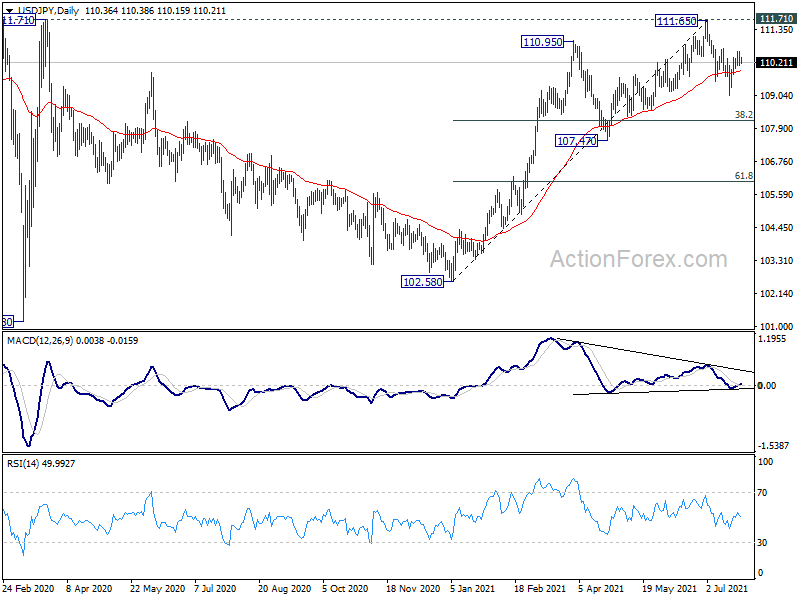
In the bigger picture, medium term outlook is staying neutral with 111.71 resistance intact. The pattern from 101.18 could still extend with another falling leg. Sustained trading below 55 day EMA will bring deeper fall to 107.47 support and below. For now, outlook won't turn bullish as long as 111.71 resistance holds, even in case of strong rebound.
Dollar Soft in Quiet Markets, European Majors in Control
The forex markets are rather quiet in Asia, with major pairs and crosses stuck inside yesterday's tight range. Risk sentiments are mixed. While US indexes extended the record runs overnight, Asian index are struggling, as dragged down by extended selloff in Hong Kong. Overall, European majors are generally firmer together with Yen. On the other hand, Dollar and commodity currencies are soft.
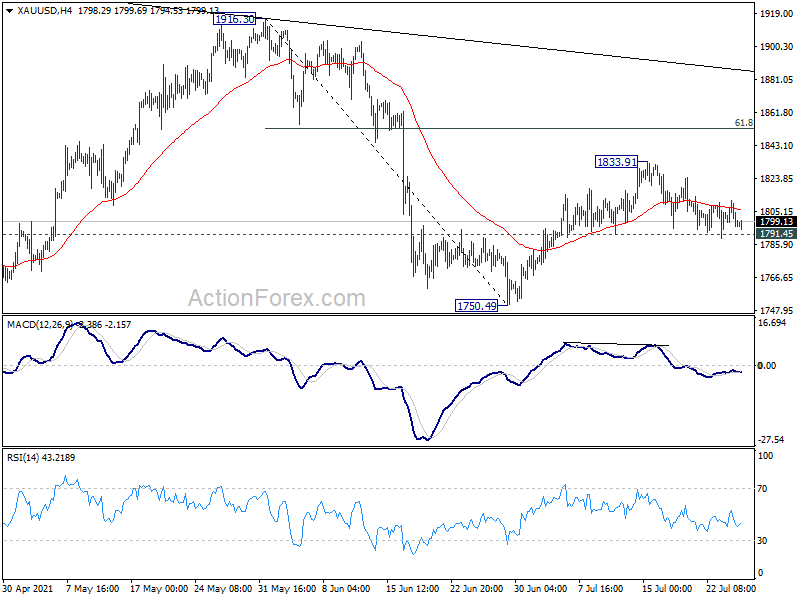
Technically, we'd pay attention to whether Dollar would turn weaker leading up to FOMC policy decision. In particular, break of 110.00 minor support in USD/JPY would suggest completion of rebound from 109.05. Break of 1.1880 resistance in EUR/USD would also indicate short term bottoming. At the same time, Gold is holding on to 1791.45 support with some resilience. Break of 1833.91 resistance will resume the rebound from 1750.49.
In Asia, at the time of writing, Nikkei is up 0.50%. Hong Kong HSI is down -1.03%. China Shanghai SSE is up 0.14%. Singapore Strait Times is up 0.53%. Japan 10-year JGB yield is up 0.0051 at 0.022. Overnight, DOW rose 0.24%. S&P 500 rose 0.24%. NASDAQ rose 0.03. 10-year yield dropped -0.010 to 1.276.
EUR/CHF breaking to downside, EUR/GBP soft
Euro has been trading as the relatively weaker European majors since ECB reaffirmed it dovish stance last week. The new forward guidance indicated that inflation must projected to be on target 12-18 months away before consideration of rate hike. At the same time, there is no sign of tapering the PEPP program yet and it's going to last until March next year anyway.
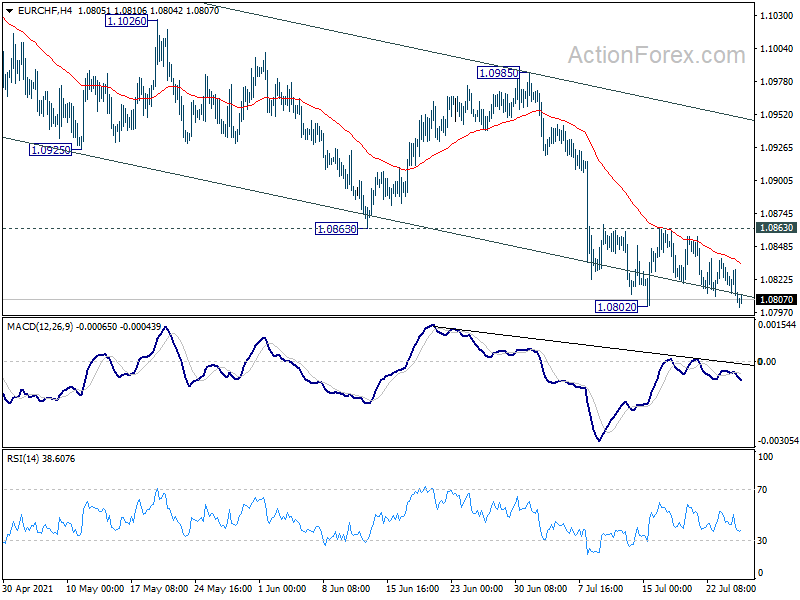
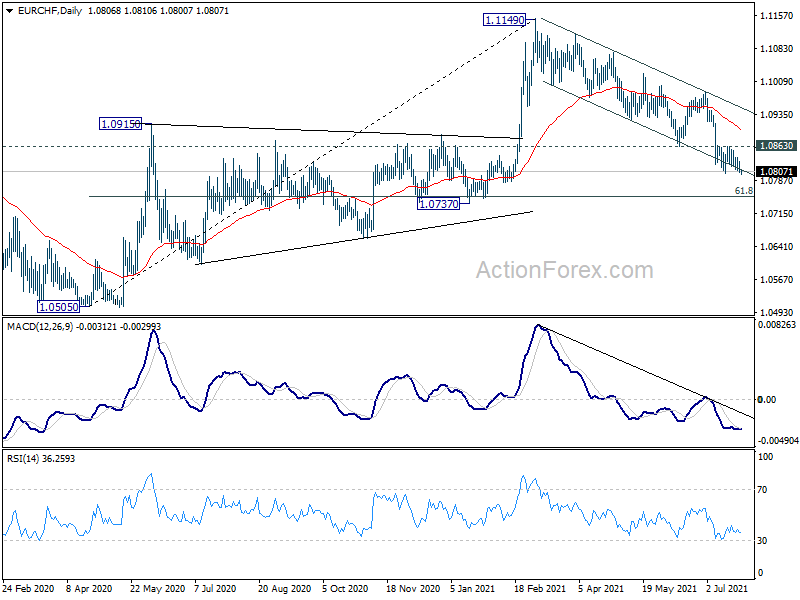
EUR/CHF's breach of 1.0802 temporary low suggests that recent decline is resuming. Rejection by 4 hour 55 EMA affirms near term bearishness too. Fall from 1.1149 is on track to 1.0737 cluster support (61.8% retracement of 1.0505 to 1.1149 at 1.0751). Downside momentum is so far capped by the medium term channel support. We'll see if EUR/CHF could accelerate further. below the channel.
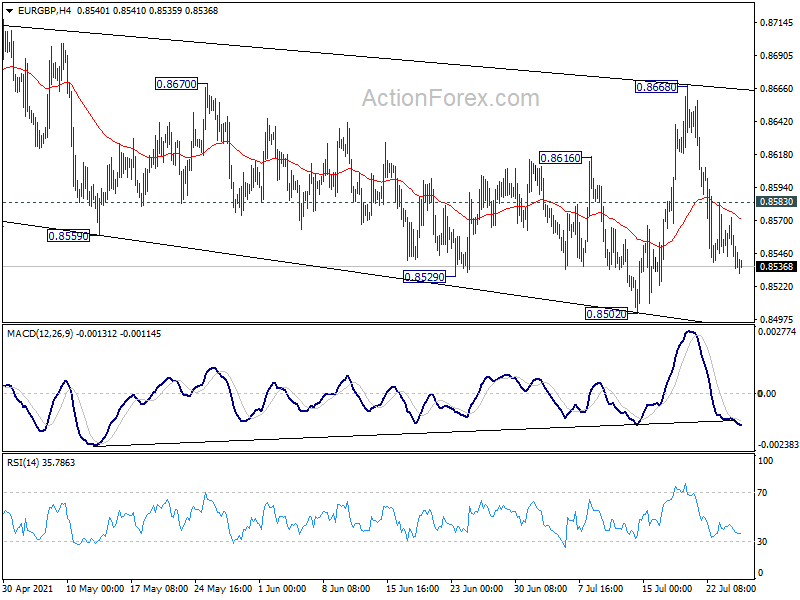
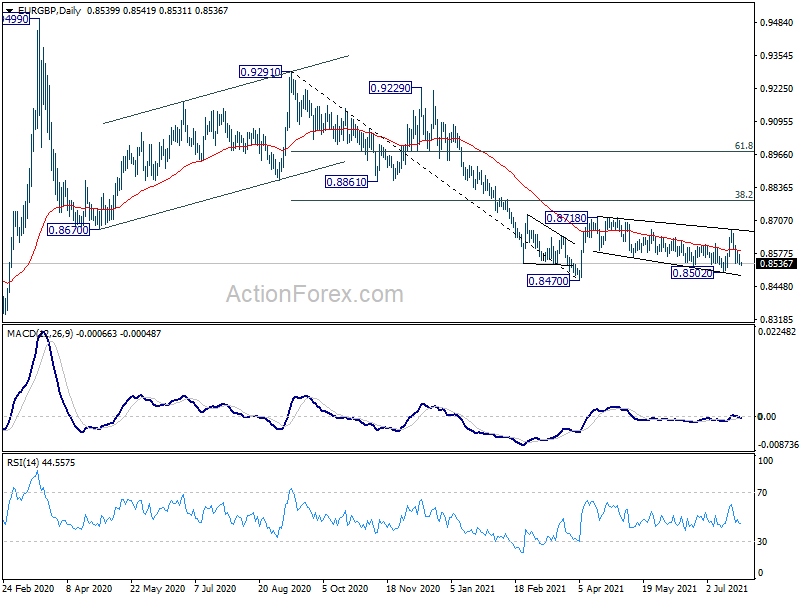
EUR/GBP also staged a sharp reversal after spiking to 0.8668 last week. The lack of deterioration in coronavirus infections and deaths was a good sign for the UK, after the so called "Freedom Day". It's now possible that corrective pattern from 0.8718 would take another take through 0.8502 support before completion. That is, Euro could continue to underperform Sterling for a little while.
AUD continues to under-perform NZD and CAD
Australian Dollar is continuing to under-perform New Zealand and Canadian Dollar. While Victoria's lockdown is set to be eased by mid-night, it's uncertain what the New South Wales government could do on restrictions after the end of the month as delta variant is still spreading quickly in the community. Whether RBA would taper asset purchase beyond September is now is question as renewed lockdowns are derailing recovery.
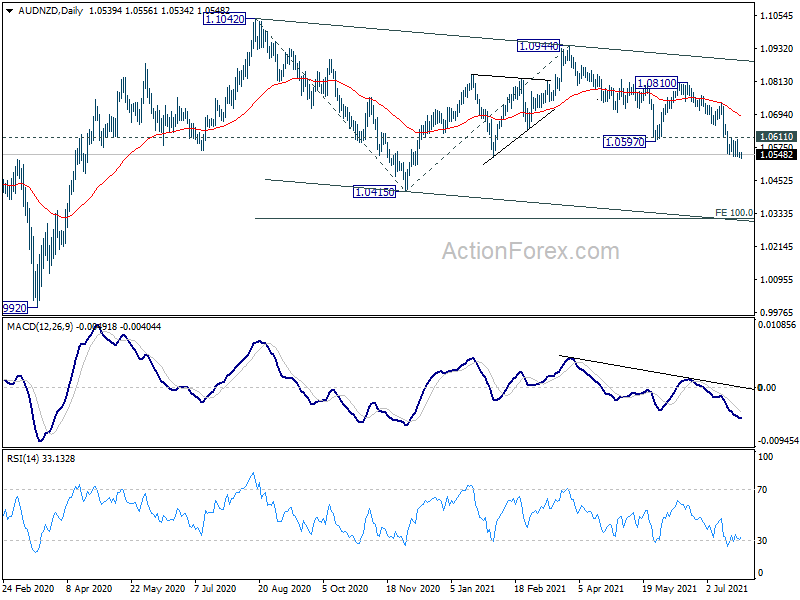
AUD/NZD edged lower today as fall from 1.0944 is still in force. Downside momentum weakened a little on oversold condition in daily RIS. But there is no sign of bottoming yet. With 1.0611 resistance intact, AUD/NZD is on track to 1.0415 support next.
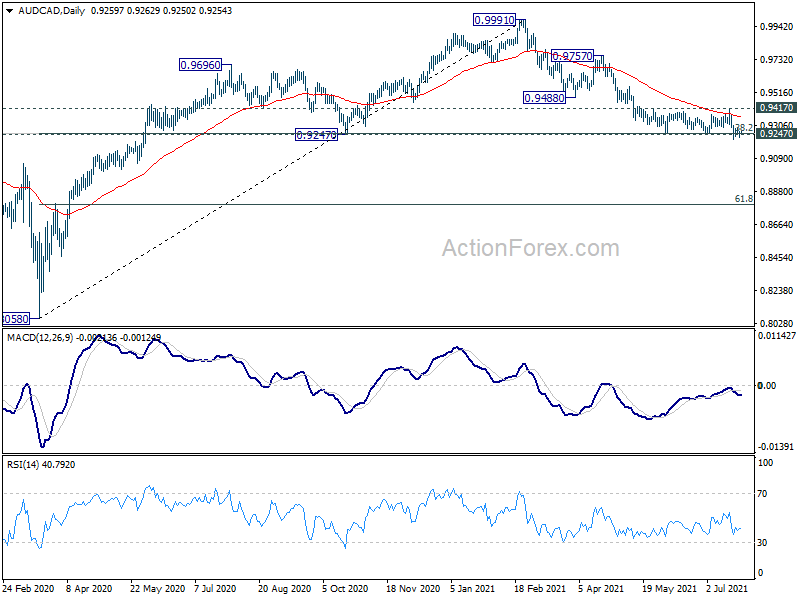
AUD/CAD's decline from 0.9991 resumed after failing to sustain above 55 day EMA. It's still trying to draw support from 0.9247 key support level but firm break of 0.9417 resistance is needed to indicate short term bottoming. Sustained trading below 0.9247 would open up further fall towards 61.8% retracement of 0.8058 to 0.9991 at 0.8796.
On the data front
Japan corporate service price rose 1.4% yoy in June, above expectation of 1.3% yoy. Eurozone M3 money supply will be released in European session. Later in the day, US will release durable goods orders, house price index and consumer confidence.
USD/JPY Daily Outlook
Daily Pivots: (S1) 110.23; (P) 110.41; (R1) 110.73; More...
Intraday bias in USD/JPY remains neutral for the moment and outlook is unchanged. Another rise is in favor as long as 110.00 minor support holds. Above 110.58 will resume the rebound from 109.05 to retest 111.65 high. However, on the downside, break of 110.00 will turn bias back to the downside for 109.05. Break will resume the fall from 111.65 to 38.2% retracement of 102.58 to 111.65 at 108.18.
In the bigger picture, medium term outlook is staying neutral with 111.71 resistance intact. The pattern from 101.18 could still extend with another falling leg. Sustained trading below 55 day EMA will bring deeper fall to 107.47 support and below. For now, outlook won't turn bullish as long as 111.71 resistance holds, even in case of strong rebound.
Economic Indicators Update
| GMT | Ccy | Events | Actual | Forecast | Previous | Revised |
|---|---|---|---|---|---|---|
| 23:50 | JPY | Corporate Service Price Index Y/Y Jun | 1.40% | 1.30% | 1.50% | |
| 08:00 | EUR | Eurozone M3 Money Supply Y/Y Jun | 8.20% | 8.40% | ||
| 12:30 | USD | Durable Goods Orders Jun | 2.10% | 2.30% | ||
| 12:30 | USD | Durable Goods Orders ex Transportation Jun | 0.80% | 0.30% | ||
| 13:00 | USD | S&P/Case-Shiller Home Price Indices Y/Y May | 15.40% | 14.90% | ||
| 13:00 | USD | Housing Price Index M/M May | 1.80% | 1.80% | ||
| 14:00 | USD | Consumer Confidence Jul | 125.3 | 127.3 |
AUD continues to under-perform NZD and CAD
Australian Dollar is continuing to under-perform New Zealand and Canadian Dollar. While Victoria's lockdown is set to be eased by mid-night, it's uncertain what the New South Wales government could do on restrictions after the end of the month as delta variant is still spreading quickly in the community. Whether RBA would taper asset purchase beyond September is now is question as renewed lockdowns are derailing recovery.
AUD/NZD edged lower today as fall from 1.0944 is still in force. Downside momentum weakened a little on oversold condition in daily RIS. But there is no sign of bottoming yet. With 1.0611 resistance intact, AUD/NZD is on track to 1.0415 support next.
AUD/CAD's decline from 0.9991 resumed after failing to sustain above 55 day EMA. It's still trying to draw support from 0.9247 key support level but firm break of 0.9417 resistance is needed to indicate short term bottoming. Sustained trading below 0.9247 would open up further fall towards 61.8% retracement of 0.8058 to 0.9991 at 0.8796.
EUR/CHF breaking to downside, EUR/GBP soft
Euro has been trading as the relatively weaker European majors since ECB reaffirmed it dovish stance last week. The new forward guidance indicated that inflation must projected to be on target 12-18 months away before consideration of rate hike. At the same time, there is no sign of tapering the PEPP program yet and it's going to last until March next year anyway.
EUR/CHF's breach of 1.0802 temporary low suggests that recent decline is resuming. Rejection by 4 hour 55 EMA affirms near term bearishness too. Fall from 1.1149 is on track to 1.0737 cluster support (61.8% retracement of 1.0505 to 1.1149 at 1.0751). Downside momentum is so far capped by the medium term channel support. We'll see if EUR/CHF could accelerate further. below the channel.
EUR/GBP also staged a sharp reversal after spiking to 0.8668 last week. The lack of deterioration in coronavirus infections and deaths was a good sign for the UK, after the so called "Freedom Day". It's now possible that corrective pattern from 0.8718 would take another take through 0.8502 support before completion. That is, Euro could continue to underperform Sterling for a little while.
Eco Data 7/27/21
[php_everywhere instance="1"]
Fed Meeting: Slowly Getting the Taper Ball Rolling
The Fed will conclude its latest meeting at 18:00 GMT Wednesday. It will be a tricky one, as Chairman Powell will need to balance a strong US economy against fears of a sharp slowdown in emerging markets. As for the dollar, the big picture remains positive in an environment where America continues to out-recover other regions and the Fed ends asset purchases relatively soon.
Stalling
Don’t expect much from the Fed this week. No policy changes are on the cards and there won’t be any updated economic forecasts either. This meeting will probably be used to buy time.
The US economy is booming. Inflation is running hot, consumption is strong, and the labor market is healing its wounds. Meanwhile, vaccination rates are high in most states and Congress is working on another massive round of infrastructure spending.
Normally, all this would argue for the Fed to start normalizing. But there are other elements to consider. Firstly, the Fed’s leadership believes this inflation episode will fade soon. Most of the overshoot in inflation comes down to the reopening of sectors like air travel and hotels, as well as supply chain disruptions in the car industry.
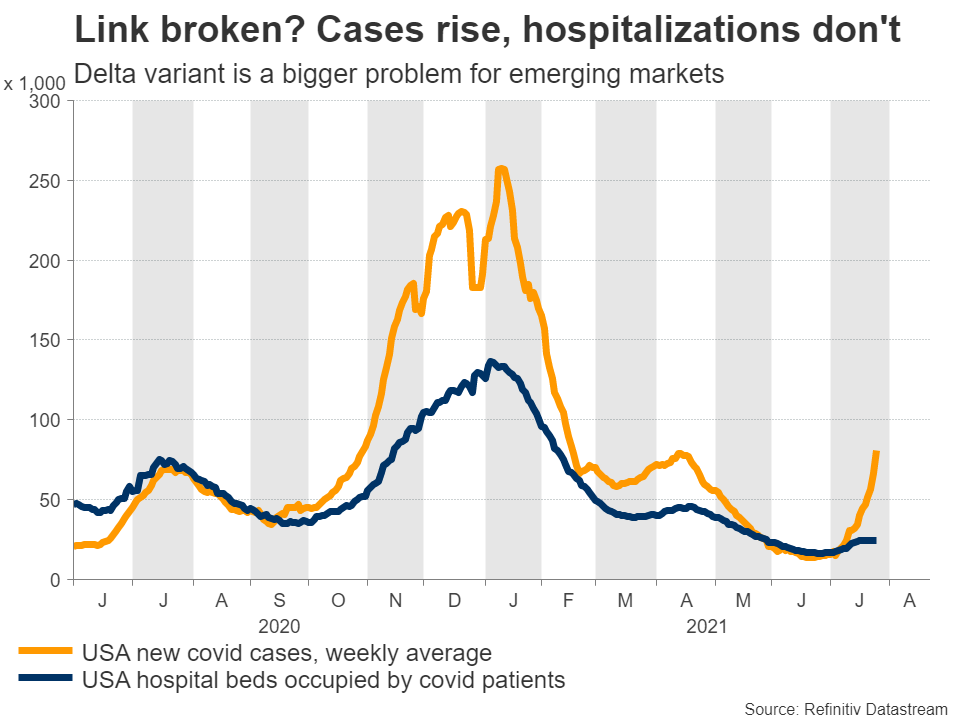 The other element that’s likely to keep the Fed cautious is the Delta variant that’s rampaging the world. This is admittedly a bigger problem for developing economies with low vaccination rates, but if those economies get hit hard enough, that could also hold back US growth.
No commitments
The bottom line is that the Fed won’t commit to anything for now. Waiting until September to make the real decisions gives policymakers more time to assess how virus and inflation risks evolve, and allows them to examine more employment reports.
The market reaction this week will depend on the policy statement and Chairman Powell’s tone during the press conference. Specifically, will the Fed remove the word ‘substantial’ from its forward guidance that “substantial further progress” in the economy is needed before stimulus is dialed back?
If that word is removed, it would signal the Fed is moving closer to tapering its massive asset purchase program, setting the stage for an announcement in September. That would likely boost the dollar.
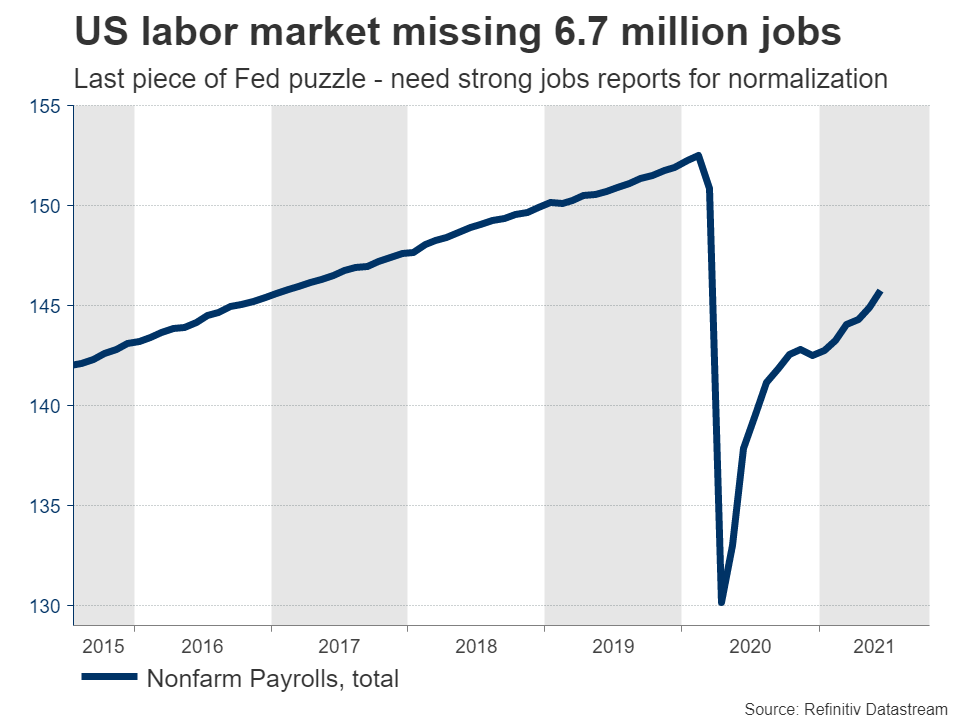
Otherwise, if that phrase is left intact, the dollar could take a minor hit as those looking for hawkish changes are left disappointed.
Dollar looks good here
In the bigger picture, the outlook for the dollar seems promising. There is no question that the Fed will taper its asset purchases. The question is when. Ultimately, it doesn’t really matter whether it’s September or December.
What matters is that the Fed is years ahead of the European Central Bank and the Bank of Japan in the normalization game. Over time, this could allow real US yields to rise from depressed levels, making the dollar more attractive as interest rate differentials widen to its benefit.
And if the health situation in emerging economies deteriorates, that could also boost the dollar as investors look for defensive assets. It’s a win-win situation, with the greenback benefiting both from US economic outperformance and safe-haven flows.
The main risk around this view is the US labor market. Everyone expects the next few employment reports to be sizzling hot as the generous unemployment benefits expire and millions of workers return to the labor force. If that doesn’t happen, the Fed could slow down its normalization plans, hitting the dollar.
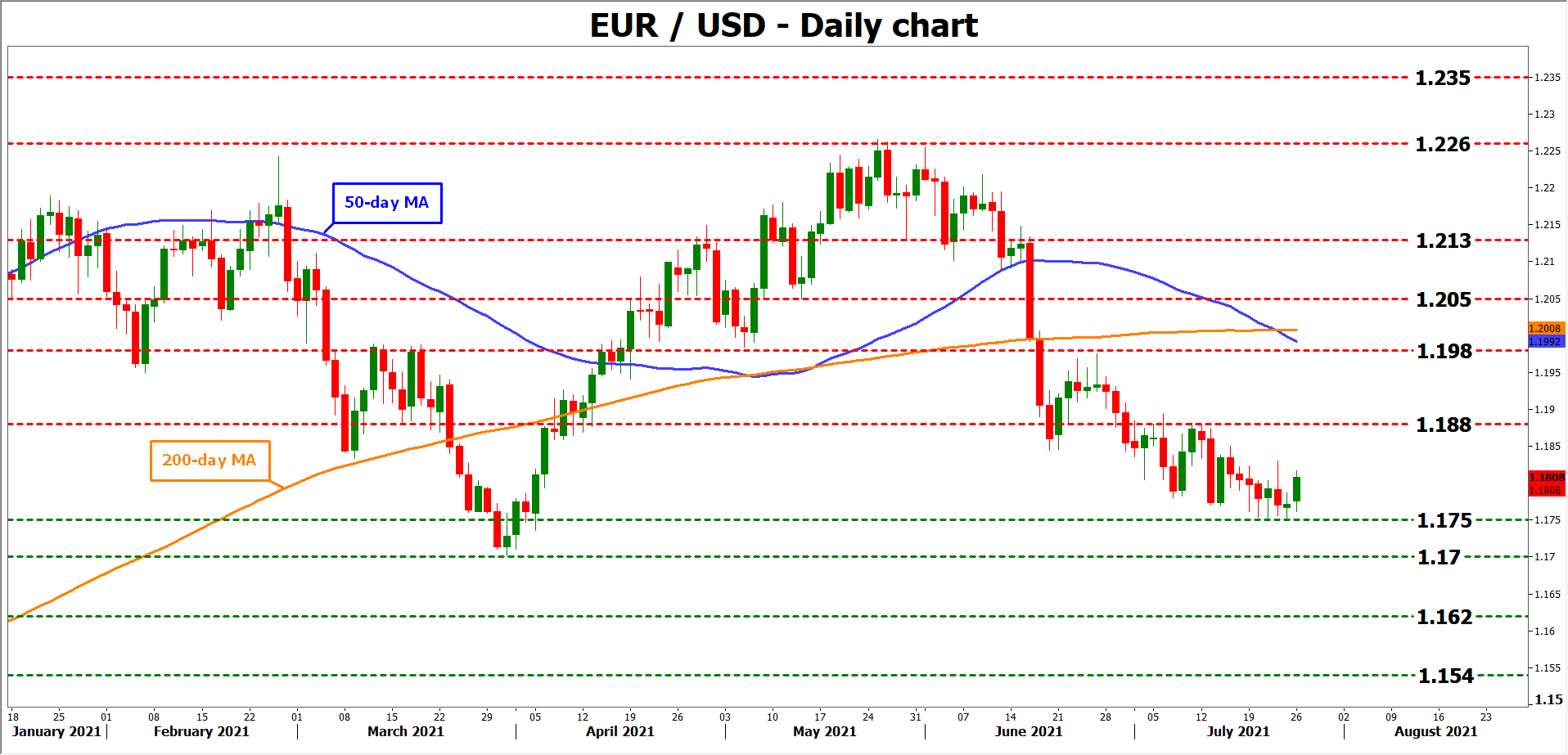
Taking a technical look at euro/dollar, initial support to declines could be found near the recent 1.1750 low, a break of which would turn the focus towards 1.1700.
On the upside, the 1.1880 zone would be the first test for buyers. If they pierce through, the next target would be around the 1.1980 region, which also encompasses the 50- and 200-day moving averages.
Beyond the Fed, there’s also the first reading of US GDP for the second quarter coming up on Friday to shake the dollar.
Pound Punches Past 1.38
The British pound has started the new trading week with strong gains. Currently, GBP/USD is trading at 1.3824, down 0.60% on the day. It was a roller-coaster week for the pound, which fell into 1.35-territory early in the week, but managed to recover these losses and ended the week almost unchanged.
The UK releases CBI Realized Sales for July on Tuesday (10:00 GMT). This important gauge of the retail sector has rebounded strongly – after a reading of -45 in March, the index came in at +25 in June. Another strong reading is expected, with a consensus of +21 points.
Last week ended on a sour note, as UK PMIs slowed considerably in July. Services PMI fell to 57.8, down from 62.4, while Manufacturing PMI came in at 60.4, down from 63.9. Both PMIs slipped to 4-month lows and were short of the consensus. Still, the pound’s reaction to the PMI reports was muted, as investors took the softer figures in stride. Both manufacturing and services are performing well, as the PMIs remain well into expansionary territory. The neutral 50-level separates contraction from expansion.
The ‘Freedom Day’ experiment
The world is watching as the UK takes part in Boris Johnson’s great Covid experiment. Last week’s decision to lift health restrictions on bars and restaurants was admittedly a risky one, but the Johnson government insists that with a majority of adults immunized, Covid levels can be kept under control in a reopened economy. The British Medical Association has rejected this view, saying that the unfettered reopening of the economy has “potentially devastating consequences”. Any rise in Covid cases due to the removal of the restrictions could result in severe restrictions being reimposed, which would curb economic growth.
GBP/USD Technical Analysis
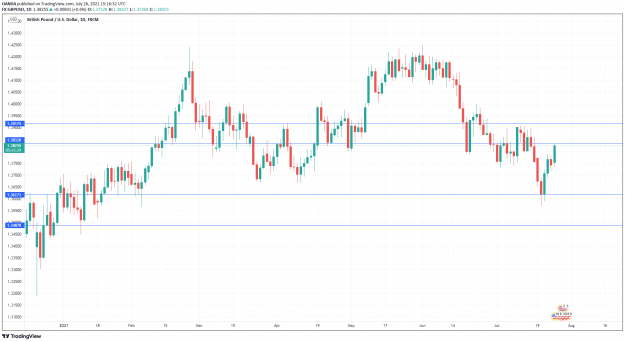
- GBP/USD is testing resistance at 1.3832. Above, there is resistance at 1.3917
- On the downside, 1.3617 is the first line of support. This is followed by support at 1.3487
WTI Oil: Expectations for Tight Supply Supports Oil Prices but Rise in New Virus Cases Clouds the Outlook
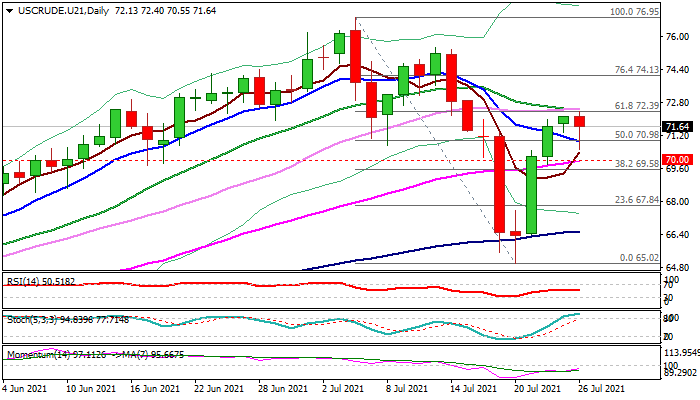
WTI oil remains steady on Monday, following strong rebound in past three days (up 8.5%), but the action faces headwinds from strong resistances at $72.39/50 (Fibo 61.8% of $76.95/$65.02 pullback / converged 20/30DMA’s).
Signals that crude supply is set to be tight for the rest of the year, support oil prices, but fresh spread of coronavirus Delta variant clouds the outlook.
Rise of virus cases prompted many countries to extend lockdown measures, with focus on China, world’s largest oil importer, which registered a rise in new virus cases that boost fears about possible drop in global demand.
On the other side, US demand remains strong that inflated oil prices in past few sessions along with expectations of tight supplies.
Technical studies on daily chart improved after strong bounce but still lacking firmer bullish signals.
Momentum is heading north but remains in the negative territory, while stochastic is overbought and both warn of recovery stall if bulls fail to clear pivotal barriers at $72.39/50.
Weekly hammer candle that was left last week was positive signal, but recovery needs sustained break above $72.39/50 to boost recovery.
Fundamentals are expected to be oil’s main driver and the price action may hold within $71.00/$72.39 range for extended consolidation, while awaiting fresh signals.
Return below $71 handle (10DMA) would weaken near-term structure, but loss of $70 support (psychological / 55DMA) would signal an end of recovery phase and shift near-term focus lower.
Res: 72.39; 72.50; 72.93; 74.13
Sup: 71.00; 70.55; 70.00; 69.58
Sunset Market Commentary
Markets
Markets took a shaky start for the new trading week. A tightening of regulation on (education) tech companies in China overthrew the constructive sentiment at the end of last week with US indices setting new all-time record levels on Friday. Chinese equities closed with losses of 4.13% (Hang Seng) to 3.22% (CSI 300). Harsh comments at the start of high level talks between US and Chinese officials on the stalemate in their relationship also didn’t help. Selling spilled over into European trading. Things started to look even worse mid-morning, as the German IFO business confidence unexpectedly declined (cf infra). The German 10-yield set a minor 5 month low close to -0.45%. However, from that point European yields and equities succeeded a remarkable comeback. The German yield curve currently even slightly steepens with the 10 and 30-y rising about 2 bp. We didn’t see an specific trigger for this improvement in sentiment. The jury is still out, but German/EMU yields rebounding despite negative news might be an indication that quite a big portion of bad news is discounted. The 0.42%/0.47% support area for the 10-y yield is tested extensively, but doesn’t give away that easily. 10-y intra-EMU spreads versus Germany are little changed with Greece slightly outperforming. US interest rates show a similar intraday pattern as did Europe, but Treasuries still outperform Bunds. LT Yields are little changed after declining up to 5bp+ earlier today. The US 10-y real yield intraday touched an all-time low below -1.12%. Later today, the US Treasury will sell $ 60 bln of 2-year notes.
Moves in the major USD cross rates initially were limited, but the dollar finally underperforms. The trade-weighted USD (DXY) drops to 92.60. The yen slightly outperforms on equity volatility and tentatively lower US (real) yields (USD/JPY 110.30). EUR/USD traded erratically in the high 1.17 area but currently tries to regain the 1.18 barrier. The 1.1750 intermediate support still survives. In speech, BoE’s Vlieghe joined the doves. He advocated not to reduce policy stimulus anytime soon as he sees inflation as mainly temporary and as he wants to assess the impact of the government reducing its pandemic support. Even at the point when tightening will become appropriate Vlieghe assumes not much will be needed given the low level of the neutral rate. Sterling hardly reacted to Vlieghe’s comments, maybe as he will step down from the MPC end August. EUR/GBP currently hovers in the 0.8550 area. Among the smaller currencies a solid performance of the Swedish krone did catch the eye (EUR/SEK 10.20). In Centrale Europe, the zloty (EUR/PLN 4.60) and the forint (EUR/HUF 361.50) stay in the defensive. The Hungarian central bank (MNB) will hold a policy meeting tomorrow. The market is divided on a 15 bp or a 30 bp rate hike.
News Headlines
The German Business Climate index of the IFO institute unexpectedly declined in July. The headline index eased from 101.7 to 100.8. The assessment of the current situation improved from 99.7 to 100.4, but the gain was more modest than expected. The expectations subindex declined substantially from 103.7 to 101.2.This combined pattern of ongoing constructive sentiment on the current developments but less optimistic expectations was visible in manufacturing, services and trade. Construction was the exception to the rule with both current conditions and expectations improving. On manufacturing , Ifo mentions the ‘the scarcity of intermediate products is becoming more critical, and more and more companies complain of a lack of skilled workers. More companies in trade are reporting supply bottlenecks’.
The National Bank of Belgium today also published its monthly business survey. The Business barometer stabilizes near the all-time high reached last month (10.1 from 9.8). However NBB indicates that this stability conceals contrasting trends between branches of activity. The business climate is improving in the manufacturing industry and even more strongly in the trade sector, but confidence has dropped back in business-related services and most notably in the building industry. ”.
FOMC Preview – Policy Stance to Stay Intact Despite Surging Inflation
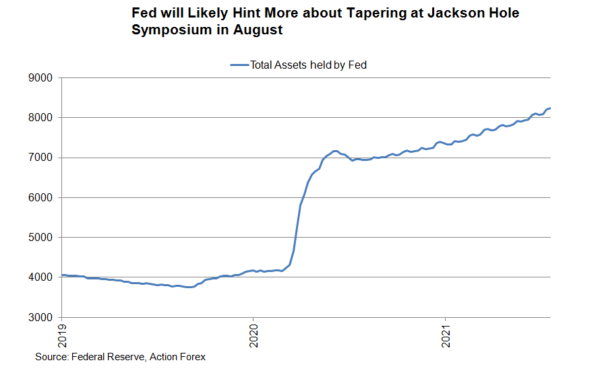
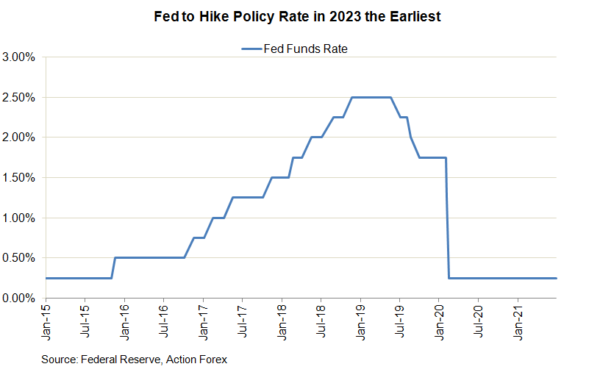
With no updates on median dot plots and economic projections, the focus of this week’s FOMC meeting would be the policy statement and the press conference. Since the June meeting, inflation has continued to accelerate. Market optimism was, however, overshadowed by the spread of Delta variant. Policymakers should likely acknowledge the strong economic developments but retain the view that the sharp rise in the price level is temporary. At the press conference, we expect Chair Jerome Powell to reiterate that the Committee is in talks of QE tapering. Yet, it is premature to make any conclusion. More information about policy changes will be revealed at the Jackson Hole symposium in late August, followed by the September meeting. We expect a formal announcement of QE tapering would be delivered in December. All monetary policy measures will stay unchanged. The Fed funds rate target will stay at 0-0.25% while the asset purchases program would also remain unchanged at US$120B per month.
Economic Developments
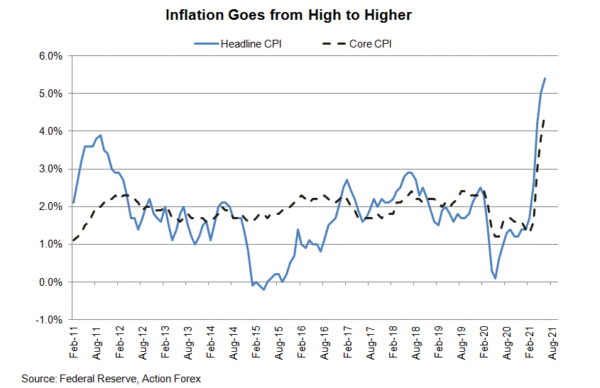
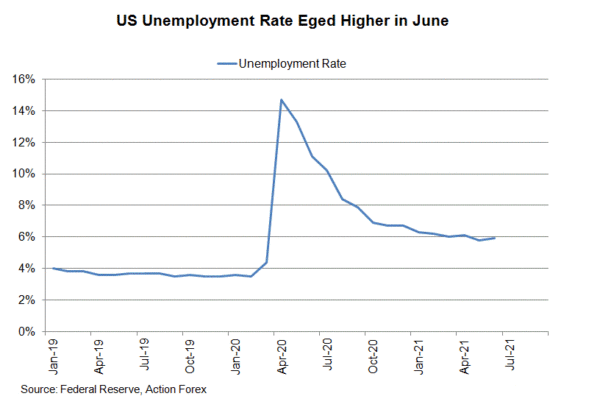
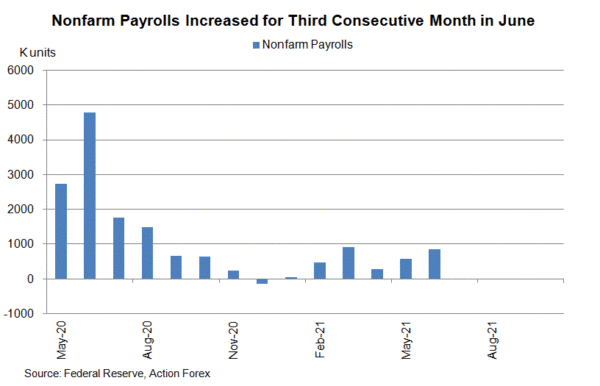
Upside surprise on inflation has again been seen since the June meeting. Headline CPI accelerated to +5.4% y/y in June, from +5% a month ago. The market had anticipated a slight moderation to +4.9%. Core CPI jumped +0.7 ppt to +4.5% y/y, exceeding consensus of +4%, in the month. Meanwhile, the New York Fed’s Survey of Consumer Expectations revealed that median inflation expectations over the next 12 months increased to a record level of +4.8% in June, from May’s +4%. The outlook for the next 3 years stayed unchanged at +3.6%, compared with Fed’s +2% target. The job market remains resilient despite a pick up in the unemployment rate in June. The unemployment rate edged higher, by +0.1 ppt to 5.9%, compared with consensus of 5.7%. Yet, the number of payrolls soared +850K, beating May’s +583K and consensus of +700K.
Strong inflation and inflation expectations should not alter the Fed’s judgment. Powell reaffirmed at the Congressional testimony that inflation pressures are largely transitory. As he suggested, “we’re experiencing a big uptick in inflation, bigger than many expected … and we’re trying to understand whether it’s something that will pass through fairly quickly or whether, in fact, we need to act”. He added that the economy is “not going to be going into a period of high inflation for a long period of time … we have tools to address that”.
Monetary Policy
At the Congressional testimony, Powell noted that "substantial further progress" toward Fed's employment and inflation goals "is still a ways off". This indicates that the Fed would unlikely deliver any hints about QE tapering in July. Raising the possibility of introducing an asymmetric policy stance, Powell also noted that the Fed “saw signs that the path of inflation or longer-term inflation expectations was moving materially and persistently beyond levels consistent with our goal”. Such stance suggests that more overshoot of inflation would be tolerated before action.
The rapid spread of the Delta variant has contributed to the recent uptick of new coronavirus cases. Market aversion was exemplified in the decline in Treasury yields. Its implication on Fed’s tapering debate is mixed, though. On the one hand, worsened sentiment suggests that stimulus should be in place for longer. On the other hand, the decline in Treasury yields as a kind of easing would probably unnerve the hawks who might urge for tapering earlier.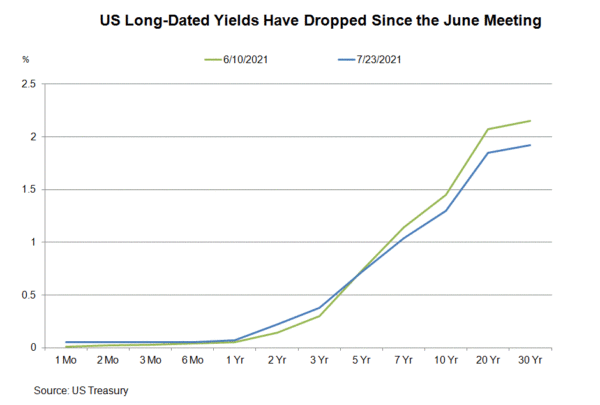
Overall, we expect the Fed to leave the monetary policy unchanged this week. Powell will affirm that while discussions over tapering have started, a consensus is far from being reached.