Sample Category Title
Government Restrictions In China Weugh On Financial Markets
Against the background of the continuing season of corporate reporting in the United States, major stock indices closed trading at record highs on Friday, with the Dow Jones Industrial Average breaking the 35,000 mark for the first time ever. According to the results of the week, the Dow Jones added 1.1%, the S&P 500 increased by 2%, and the Nasdaq - by 2.8%. The upcoming week is expected to be more intense with the Fed meeting and many important economic statistics. But most analysts expect the Fed to give a clearer picture of its plans to reduce the quantitative easing (QE) program at its annual conference in Jackson Hole in late August. Also, in the coming week, financial reports of a number of technology giants will be published, including Tesla Inc., Apple Inc., Alphabet Inc., Microsoft Corp., and Amazon Inc.
Eurozone stock indices closed in the green zone on Friday. The Stoxx Europe 600 overall index increased by 1.1%, Britain's FTSE 100 added 0.9% and Germany's DAX 30 increased by 1.0%. Friday's data on business activity (PMI) showed a positive trend and an acceleration in the pace of recovery in the EU. However, the new wave of the coronavirus pandemic could be a major challenge to maintain the current pace of recovery. More people in the UK are being forced to self-isolate under government regulations, but due to growing shortages in supermarkets, food retail staff won’t be quarantined for ten days. The European airline Ryanair raised its annual traffic forecast amid strong summer bookings.
The 10-year Treasury bond yield added 2.2 basis points on Friday but remained 1.4 basis points lower at the end of the week. Government bond yields and gold prices are moving in opposite directions.
The situation in the oil market remains the same. The global rise of COVID-19 cases makes the outlook for fuel demand worse. But thanks to an increase in demand for fuel in the summer, oil prices remain within the $70 a barrel range.
Asian stock indices are falling as fears of stricter regulation by Chinese authorities led to the fall of many Chinese stocks. China is tightening control over hidden local authority debt. China's blue-chip index, the CSI 300, decreased by 2.4% to its lowest level in 10 weeks as the education, real estate, and technology sectors are concerned about stricter government regulations. There is also a fall of Chinese companies observed on the US stock market. But many analysts are confident that delisting of Chinese companies is technically impossible, so there is no need to worry about it. Relations between the US and China remain tense as talks between the US Undersecretary of State Wendy Sherman and Chinese Foreign Minister Wang Yi have reached an impasse. Meanwhile, curfews are planned to be imposed in Thailand and Vietnam due to the growing number of Delta strain cases.
Main market quotes:
- S&P 500 (F) 4,411.79 +44.31 (+1.01%)
- Dow Jones 35,061.55 +238.20 (+0.68%)
- DAX 15,669.29 +154.75 (+1.00%)
- FTSE 100 7,027.58 +59.28 (+0.85%)
- USD Index 92.91 +0.08 (+0.09%)
Important events for today:
- Germany Ifo Business Climate Index (m/m) at 11:00 (GMT+3);
- US New Home Sales (m/m) at 17:00 (GMT+3).
China Equities Get Crushed
The plunge in China equities dominated Asian markets after the government further tightened its crackdown on Tencent and completely torpedoed the multi-billion student tuition sector over the weekend. Although Wall Street closed at record highs on Friday, lifting early trading in Asia, regional markets turned south after China opened.
Only the Nikkei 225 has risen today, climbing 1.05% and seemingly piggybacking the robust New York close, with the uneventful start to the Olympics lifting sentiment. The Kospi, meanwhile, has fallen by 0.50%, with Taipei dropping by 0.65%.
China markets are under siege, with the Shanghai Composite plunging 2.20% and the CSI 300 2.30%. Hong Kong, replete with China tech listings, has plunged by 2.90%, with talk of tightening local government financing adding to the credit concerns in Hong Kong-listed property developers as well. With China’s government seemingly ambivalent to stock market ructions, something that surprise precisely nobody, mainland China and Hong Kong markets are set to suffer a repricing by investors globally of their risk premia this week.
One beneficiary of today’s China turmoil appears to be Bitcoin and Ethereum. Bitcoin is 8.35% higher at USD 38,400, and it appears that some defensive rotation, probably from mainland investors, is occurring.
Across Asia, Singapore has fallen 0.55%, with Kuala Lumpur down 0.30% and Manila down 1.10%. Jakarta has bucked the trend to be up 0.30%, while Bangkok markets are closed today. Australian markets are treading water between China concerns and a resplendent Wall Street. The ASX 200 and All Ordinaries are unchanged for the day.
US index futures are also lower this morning, notably the Dow Jones, with its higher beta to world growth. China nerves have sent it 0.40% lower, while the S&P and Nasdaq futures are 0.20% lower. European stocks are likely to open cautiously this afternoon, notably countries such as Germany, with high exposure to the China growth story. However, US markets are set to remain insulated, with US tech earnings and the FOMC the main points of influence on Wall Street this week.
EUR/USD Outlook: Upticks To Remain Below 1.19 And Provide Better Selling Opportunities
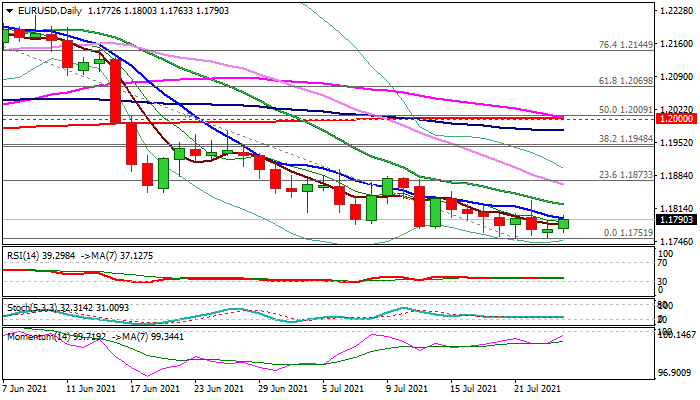
The Euro maintains positive near-term tone with immediate negative impact from weaker than expected German data (July Ifo business climate 100.8 vs 102.1 f/c and 101.7 in June) being minor.
Recovery attempts from new 3 –1/2 month lows probe through initial barriers at 1.1800 zone (falling 10DMA/psychological), but extension and close above descending 20DMA (1.1822) is needed to ease downside pressure and allow for stronger correction.
Larger downtrend remains fully in play, with extended corrective upticks expected to stall under 1.1900 zone and provide better selling opportunities.
Key resistances lay at 1.1975/1.2000 and only break here would neutralize bears and signal reversal.
Market awaits the decision from Fed two-day policy meeting for fresh direction signals.
Res: 1.1822, 1.1850, 1.1881, 1.1900.
Sup: 1.1751, 1.1737, 1.1704, 1.1694.
German IFO Misses Consensus As Shortages And Virus Concerns Hamper Optimism
Notes/Observations
- German IFO business climate unexpectedly fell in July for its 1st decline in 2021 due to shortages of materials and virus concerns.
- China govt regulatory crackdown on sectors dented sentiment toward risk assets.
- Corporate earning seasons continues. Companies due to report during the NY morning include Check Point Software, Hasbro, Lennox International, Lockheed Martin, Otis Worldwide, PetMed Express, RPM International.
Asia
- Japan July Preliminary PMI Manufacturing registered its 6th month of expansion (52.2 v 52.4 prior).
- China Industry Ministry (MIIT): To begin a crackdown on illegal internet activities (such as behaviors that violate user rights and endanger data security).
- China Vice Foreign Min Feng stated that had a willingness to deal with US on equal footing; Relationship with the US was in a 'stalemate', now faced difficulties. Wanted to seek common ground, and shelve differences with US. Reiterated stance that US should choose to meet China 'Halfway'. Urged US to correct extremely wrong mindset and extremely dangerous China policy (Reminder: US Deputy Sec of State Sherman to meet with China's Wang Yi with talks expected to be held on Sun and Mon (Jul 25-26th).
- US Dep Sec of State Sherman said to make clear to Chinese officials in upcoming talks that the US welcomed competition with China but wanted a level playing field, guard rails and parameters in their relationship. US officials said that US/China needed responsible ways to manage competition.
Coronavirus
- Total global cases 194.8M (+0.7% vs. Fri); total deaths: 4.18M (+0.6% vs. Fri).
- Tokyo infections top 1,000 for sixth straight day.
- France parliament approved bill aimed at tackling 4th wave of COVID, approved law that requires special virus passes for all restaurants and domestic travel and mandated vaccinations for all health workers.
- German govt said to be considering possible tough restrictions for the unvaccinated or even compulsory shots as the Delta variant spreads in Europe.
Europe
- ECB's Weidmann (Germany) stated that he agrees in principle expansive monetary policy was currently appropriate; Possible over-extension of ECB's low interest rate environment went too far for him.
Americas
- Democrats might remove $20B in funding for a new infrastructure bank after Republicans opposed a provision aimed at boosting workers' wages.
- Senate negotiators said to be finalizing how to pay for the $579B bipartisan infrastructure package. Core group of negotiators planning to present a final version of the deal.
Speakers/Fixed income/FX/Commodities/Erratum
Equities
- Indices [Stoxx600 -0.45% at 459.46, FTSE -0.36% at 7,002.45, DAX -0.60% at 15,575.30, CAC-40 -0.53% at 6,534.21, IBEX-35 -0.58% at 8,667.00, FTSE MIB -0.30% at 25,050.50, SMI -0.65% at 12,051.95, S&P 500 Futures -0.36%].
- Market Focal Points/Key Themes: European indices open generally lower and remained in the red as the session wore on; better performing sectors include materials and consumer discretionary; while sectors leading to the downside include industrials and technology; further restrictions by Chinese officials on Tencent weigh on tech sector; financials sector supported after ECB declines to extend dividend ban; Vonovia offer for Deutche Wohnen didn’t reach threshold; NewRiver divests Hawthorn; Meyer Burger looking in options to enforce Oxford PV deal; earnings expected during the upcoming US session includes Tesla, Michelin, Lockheed Martin and LVMH.
Equities
- Consumer discretionary: Ryanair [RYA.UK] +3% (earnings; outlook), Science Group [SAG.UK] +10% (earnings).
- Industrials: Koninklijke Philips [PHIA.NL] -3% (earnings; buyback), Faurecia [EO.FR] -4% (earnings).
- Technology: Prosus [PRX.NL] -8% (China's crackdown of Tencent), Meyer Burger Technology [MBTH] -13% (considering legal options to enforce related to Oxford PV).
Speakers
- German IFO Economists: noted that supply problems were weighing on domestic economy in both industry and retail and noted that industry could not produce as much as they would like. Over 60% of industrial companies were reporting shortages; over 40% in retail. Companies were searching for more staff. It forecasted Q2 GDP at 1.3% and Q3 GDP growth at 3.6%.
- Italy Business Lobby Confindustria stated that the domestic economy had a strong rebound in Q2.
- Poland Central Bank's Lon stated that he favored a wait and see approach in monetary policy.
- China Vice Foreign Min Feng stated that he asked US to remove visa restrictions from Communist party members.
Currencies/Fixed income
- USD was steady as equity markets drifted lower in a quiet session. China govt regulatory crackdown on sectors dented risk appetite sentiment. Dealer noted USD near-term outlook might hinge on Fed Chairman Powell's views on the economic outlook mid-week.
- EUR/USD remained below the 1.18 area. German IFO business climate unexpectedly fell in July for its 1st decline in 2021 due to shortages of materials and virus concerns.
- Dealers noted that ECB strategy review remained bullish for sovereign spreads and saw yield moving lower in the session. German 10-year Bund was lower by 3bps to test -0.45%.
Economic data
- (FI) Finland Jun PPI M/M:1.6 % v 2.3% prior; Y/Y: 11.0% v 11.2% prior.
- (ES) Spain Jun PPI M/M: 2.2% v 1.6% prior; Y/Y: 15.4% v 15.2% prior.
- (CZ) Czech July Consumer Confidence Index: -5.3 -2.0 prior; Business Confidence: 11.8 v 16.8 prior; Composite Confidence (Consumer & Business Confidence): 8.4 v 13.0 prior.
- (TR) Turkey July Capacity Utilization: # v 76.6% prior.
- (TR) Turkey July Real Sector Confidence (seasonally adj): 112.1 v 109.8 prior; Real Sector Confidence NSA (unadj): 114.8 v 113.0 prior.
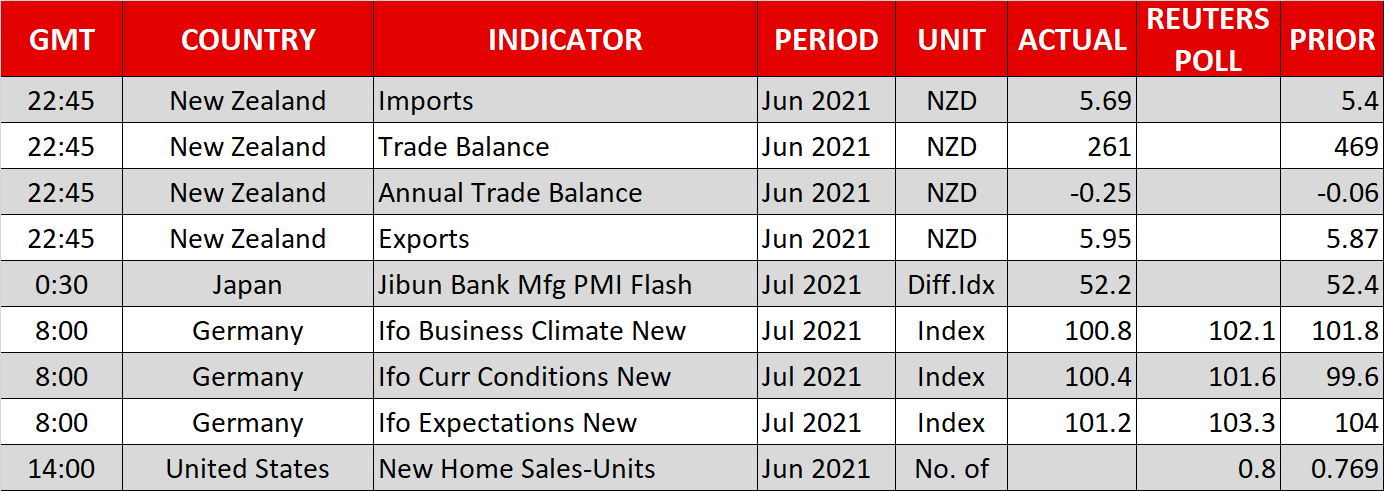
- (DE) Germany July IFO Business Climate: 100.8 v 102.5e; Current Assessment: 100.4 v 101.8e; Expectations Survey: 101.2 v 103.6e.
- (CH) Swiss weekly Total Sight Deposits (CHF): 712.1B v 711.9B prior; Domestic Sight Deposits: 635.5B v 636.5B prior.
- (HK) Hong Kong Jun Trade Balance (HKD): -40.5B v -40.5Be; Exports Y/Y: 33.0% v 26.0%e; Imports Y/Y: 31.9% v 26.1%e.
Fixed income issuance
- None seen.
Looking ahead
- 05:25 (EU) Daily ECB Liquidity Stats.
- 05:30 ((DE) Germany to sell €4.0B in 12-month BuBills.
- 06:00 (IL) Israel Jun Unemployment: No est v 5.5% prior; Unemployment Rate (including Covid): No est v 9.8% prior.
- 06:00 (BE) Belgium Debt Agency (BDA) to sell €2.7-3.1B in 2031, 2034 and 2040 OLO bonds.
- 06:00 (IL) Israel to sell bonds.
- 06:45 (US) Daily Libor Fixing.
- 07:00 (MX) Mexico Jun Unemployment Rate (unadj): No est v 4.0% prior.
- 07:00 (BR) Brazil July FGV Consumer Confidence: No est v 80.9 prior.
- 07:25 (BR) Brazil Central Bank Weekly Economists Survey.
- 08:00 (UK) Daily Baltic Dry Bulk Index.
- 08:00 (IN) India announces details of upcoming bond sale (held on Fridays).
- 09:00 (BE) Belgium July Business Confidence: No est v 9.8 prior.
- 09:00 (FR) France Debt Agency (AFT) to sell €4.8-6.0B in 3-month, 6-month and 12-month bills.
- 09:45 (EU) ECB weekly QE bond buying update.
- 10:00 (US) Jun New Home Sales: 800Ke v 769K prior.
- 10:30 (US) July Dallas Fed Manufacturing Activity Index: 32.3e v 31.1 prior.
- 11:30 (US) Treasury to sell 13-Week and 26-Week Bills.
- 13:00 (US) Treasury to sell 2-Year Notes.
- 15:00 (AR) Argentina May Shop Center Sales Y/Y: No est v 2,513.5% prior; Supermarket Sales Y/Y: No est v 1.2% prior.
- 16:00 (US) Weekly Crop Progress Report.
- 19:00 (KR) South Korea Q2 Preliminary GDP Q/Q: 0.9%e v 1.7% prior; Y/Y: 6.1%e v 1.9% prior.
- 19:30 (AU) Australia ANZ Roy Morgan Weekly Consumer Confidence Index: No est v 104.3 prior.
- 19:50 (JP) Japan Jun PPI Services Y/Y: 1.3%e v 1.5% prior.
- 21:30 (CN) China Jun Industrial Profits Y/Y: No est v 36.4% prior.
- 23:30 (HK) Hong Kong to sell 3-month and 6-month Bills.
- 22:35 (JP) Japan to sell 40-year JGB bonds.
China Crackdown Sinks Asia
New Chinese restrictions sends Asia lower
The weekend was dominated by China’s announcements of a crackdown on Tencent Music, and more importantly, its intention to all but end China’s multi-billion-dollar student tuition industry as we know it. Although early Asian markets followed Wall Street higher, once mainland exchanges opened and stocks there entered a free-fall, regional markets have mostly followed suit.
Reuters is also reporting a China Securities Times story that suggests the central government is stepping up restrictions on local government financing vehicles. Given that the China tech crackdown has already frayed investors nerves along with credit concerns, particularly in the property development sector, the last moves by the central government in the education sector, which threaten to wipe out billions of dollars by overseas investors, is another ratchet higher in the regulatory risk landscape in China.
Perversely, one beneficially of China’s trampling of domestic and international investors across a broad battlefront could be US equities markets. Although investors have been prepared to sell their souls for rock and roll to get a piece of China action, the risk/reward skew now means that the path of least resistance could be Wall Street, where the FOMO gnomes ignored mixed PMI data on Friday to send the major indexes to record closes.
Although fellow North Asia heavyweights, Japan, South Korea, and Taiwan are likely to suffer less, with their high beta to the global recovery as a whole, ASEAN markets are also expected to underperform by association. Regional markets will be further weighed down by the remorseless rise of the delta-variant virus in the troubled trio of Indonesia, Thailand and Malaysia. Don’t be fooled by the falling cases in Indonesia over the weekend; testing also fell hugely with President Jokowi extending PPKM restrictions.
There was no bipartisan agreement on a US infrastructure package over the weekend, with voting scheduled to commence tomorrow in the Senate meaningfully. It, along with the looming federal debt ceiling, is being almost entirely ignored by US markets which, this week, will be myopically focused on US big-tech earnings releases, a veritable FAANGSta’s paradise, and the Federal Reserve FOMC meeting.
Big tech earnings are likely to have a more significant impact in that so much good news is baked into prices that earnings that undershoot or come in just on target will likely see some harsh short-term punishment to stocks prices. What the FOMO gnomes of Wall Street giveth, the FOMO gnomes can take away. Any dips should be temporary, assuming no surprises from the FOMC and that the monetary taps remain fully open.
Turning to this week’s FOMC, it should theoretically be a non-event, with the August Jackson Hole Symposium and September’s FOMC meeting more “live.” Making assumptions hasn’t treated me well of late, though, and last month’s FOMC dot-plot caught me by surprise. Six million fewer American’s are still in work than pre-pandemic, and I suspect this needle will have to move a lot more to taper the Fed, especially given Mr Powell’s vehement defence that inflation is transitory.
Although I suspect much of the rally is being driven by Europeans looking for the least ugly horse in the glue factory, the US bond market certainly agrees. Their own central bank is condemning them to Japanification, so 1.25% on a 10-year Treasury looks better than paying Germany, Italy or Greece to own their debt. The Fed’s USD120 billion per month of buying is undoubtedly playing its part as well.
Still, if the FOMC “tweaks” the language to imply that they’re now really starting to begin to really seriously think about starting to talk about tapering, that could shake the bond market from its malaise and push yields and the US dollar higher. I wouldn’t bet on it, though. Still, if big-tech earnings only meet expectations, and the FOMC changes the statement wording, US equities could be in for a beating at the end of the week.
China and the US FOMC are likely to drown out any impact from the data calendar in Asia this week. China Industrial Profits tomorrow can add to the dark clouds over local equities if it underperforms. But South Korean Q2 GDP, Malaysia’s June Trade Balance, Australian Q2 CPI and South Korean June Industrial Output are all old news. The trajectory of the delta-variant virus across Indonesia, Thailand, Malaysia, and Australia, the fragile four, will have a more immediate impact.
As galling as readers know, it is for me to say this, one beneficiary of today’s China turmoil looks to be bitcoin and ethereum. Bitcoin is 8.35% higher at USD38,400 of fiat US currency this morning, and it appears that some defensive rotation, probably from mainland investors, is occurring. CNBC is also running a story from Friday that Amazon may be preparing to accept digital coins as payment. Goldman Sachs is apparently clearing some institutional client’s trades in bitcoin. The Vampire Squids and bitcoin is always worth a few per cent gains, but all in all, the combination of stories is all meat and three vegs to the “bitcoin as a mainstream asset” army.
The price action has led to some very interesting developments of the bitcoin technical picture. Bitcoin has broken out of its three-month descending triangle at USD 34,300.00 and suggests we could have another USD 17,000 of gains, taking us to USD 51,000.00, or thereabouts. It must overcome resistance at the 100 and 200-day moving averages, at USD 40,800.00 and USD 44,700.00 first, though. I guess I will have to put up with the “institutional experts” re-emerging as well to say bitcoin is a hedge against inflation and deflations, that Goldman’s means it is becoming a mainstream asset, and that it is a hedge against equity market and China volatility. Someone will probably say it can cure Covid-19 as well, but for me, the technical break in isolation is huge, and should be respected. I still believe the entire sector and un-stable coins are complete nonsense that will lose small investors billions, but the people have spoken, and the digital Dutch tulips look ripe for a large rally in the short term.
US Equities Shine Ahead Of Fed But Caution Prevails Elsewhere
- Wall Street rallies on strong earnings even as US Covid hospitalizations surge
- Caution is the order of the day elsewhere as Delta and growth fears linger
- Dollar starts Fed week on steady note but yen and gold inch higher, yields slip again
US stocks ride high; can anything spoil the fun?
Wall Street ended Friday in a euphoric mood as Q2 earnings continued to beat expectations, but trading has gotten off to a much more cautious start on Monday, with the Fed meeting high on investors’ agenda. All three leading indices finished the week in record territory, with the Dow Jones closing up 35,000 for the first time, while the S&P 500 shot above the 4,400 level.
The earnings season continues in earnest this week as all the Big Tech names are due to report, starting with Tesla today, followed by Apple, Microsoft and Alphabet tomorrow.
Nasdaq futures were outperforming on Monday, standing flat in early European trading amid strong optimism about tech earnings. But Dow Jones and S&P 500 futures were tracking the broader markets lower.
Worries about rising virus cases around the world and the subsequent toll on economic growth were heightened on Monday. Even the United States is seeing a fresh spike not just in infections but in hospitalizations as well, as the vaccination pace has ground to a halt lately.
Further roiling markets today are more signs of regulatory crackdown in China on locally listed tech companies, with Tencent becoming the latest victim after authorities’ recent assault on Didi. But the intervention is now widening to the education and property sectors, sending shares in Hong Kong and China into a spin, dragging the rest of Asia lower as well, with the exception of Tokyo.
Markets hoping for a dovish but optimistic Fed
The question now is whether the worsening outbreak of the Delta variant will eventually catch up with Wall Street. Throughout the pandemic, ‘buy the dip’ mantra has always generated a quick rebound from any panic selling, though US tech giants’ newfound status as defensive stocks has ensured that the dips haven’t been very steep. But lately, the appeal of non-tech US equities has also been growing, attracting funds from emerging markets in particular as, apart from stellar earnings, the American economy is increasingly being seen as the most resilient to further virus crises.
Whether the Fed is feeling quite as upbeat could be crucial as to how well the positive sentiment holds up. The Federal Open Market Committee (FOMC) meets on Tuesday and Wednesday to deliberate how soon the $120 a month in bond purchases should be dialled back. Although it’s unlikely policymakers will explicitly flag a tapering decision just yet, investors will be anxious to see how much further progress the Fed thinks has been achieved since the last meeting and whether the rampant spread of the Delta variant has affected the outlook.
Judging by which way Treasury yields were headed on Monday, the market doesn’t seem to be betting on a hawkish surprise.
Safe havens up, riskier currencies underperform
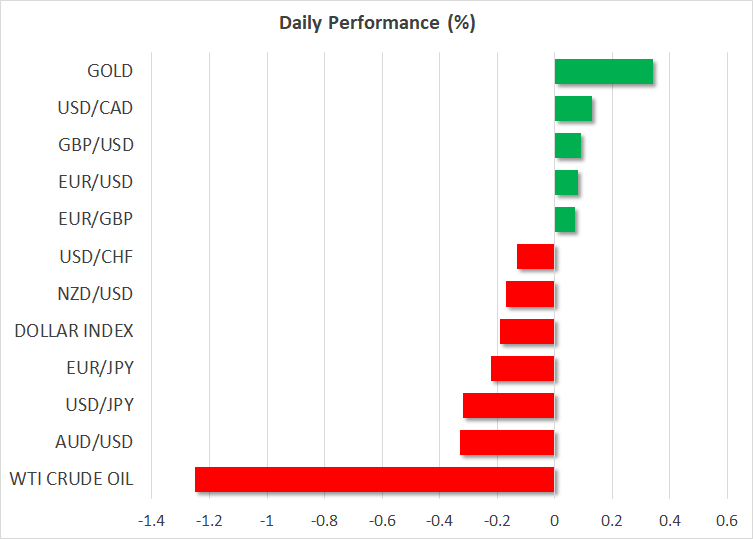
The downside reversal in yields lifted gold, which is advancing above the $1,800/oz level. Aside from the surge in virus cases, concerns about the growth outlook have been exacerbated by the recent extreme rainfall in China and Europe, adding to safe haven flows. But there are geopolitical concerns at play too amid brewing Sino-US tensions over Taiwan.
The dampened outlook weighed on oil prices but boosted the Japanese yen, and to a lesser extent the Swiss franc. The US dollar, however, was marginally down on the day on a firmer euro and pound.
But the commodity-linked dollars were all weaker on Monday, led by the aussie.
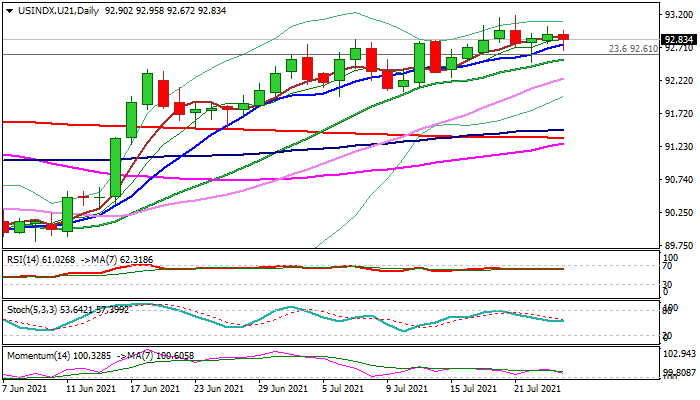
US Dollar Index Outlook: Bulls Are Taking A Breather Ahead Of This Week’s Key Events
The dollar index eases in early Monday's trading, pressured by rise in riskier currencies, but remains near its 3 –1/2 month high, posted last week.
Larger uptrend is intact, with extended sideways mode ahead of this week's Fed policy meeting and US GDP data, seen as likely scenario.
Market expects hawkish stance from Fed and possible change in rhetoric that would signal a start of gradual removal of monetary support, which is expected as early as this year.
The greenback was also supported by accelerating US economic recovery that would also contribute to Fed's decision.
The economy has likely grew 8.6% in the second quarter, compared to 6.4% growth in Q1.
Investors also await earnings reports from a number of S&P 500 companies this week. Which could impact market sentiment.
Technical studies remain bullish on daily and weekly charts, supporting the uptrend for final attack at key barrier at 93.45 (Mar 31 high), violation of which would complete bullish failure swing pattern on weekly chart and signal further rise of the index price.
Short-term action is tracked by rising 20DMA (currently at 92.53) during the past 1 –1/2 month, with dips expected to be limited by this indicator to keep bullish bias.
Res: 93.02, 93.18, 93.45, 94.00.
Sup: 92.75, 92.53, 92.25, 92.06.
EURUSD Reflects Weakening Bearish Bias, Eyes On 20-SMA
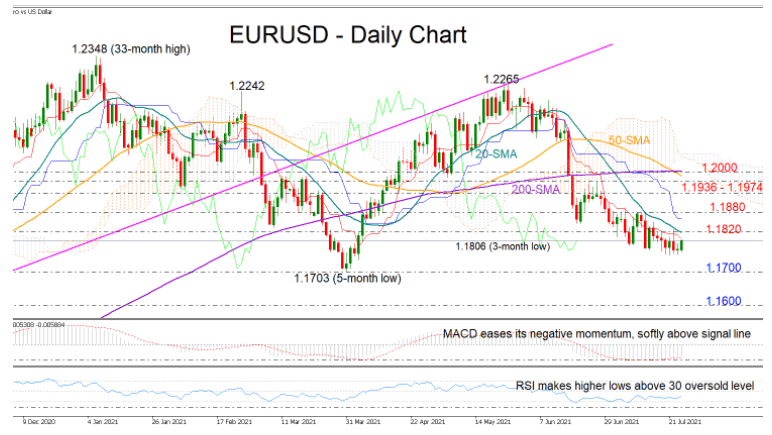
EURUSD kicked off the week with soft performance and barely above last week’s low of 1.1751, maintaining a downward direction below the 20-day simple moving average (SMA).
While the gentle upward trajectory in the RSI and the MACD, which coincides with a weakening price action, reminds of a bullish divergence, and hence raises some optimism that an upside reversal could soon take place, some caution is still required as the former continues to trade below its 50 neutral mark and the latter has yet to grow in the positive area. The negative slope in the red Tenkan-sen line is another discouraging signal.
A sustainable break above the 20-day SMA at 1.1820 could ease precautionary thinking, helping the price to revisit its previous resistance territory of 1.1880. Running higher, the 1.1936 – 1.1974 zone may add stronger downside pressures, deterring any move towards the crucial 1.2000 level, where the 200-day SMA is currently placed.
Alternatively, the pair could head for the March low of 1.1703, a break of which may cause a more aggressive sell-off towards the 1.1600 level and an outlook deterioration in the medium-term picture. Lower, the door would open for the former resistance area of 1.1455.
In brief, EURUSD seems to be facing a weakening bearish bias in the short-term picture. A decisive close above the 20-day SMA and the 1.1820 number is expected to trigger the next bullish wave.
Germany Ifo dropped to 100.8, supply bottlenecks and infections weigh
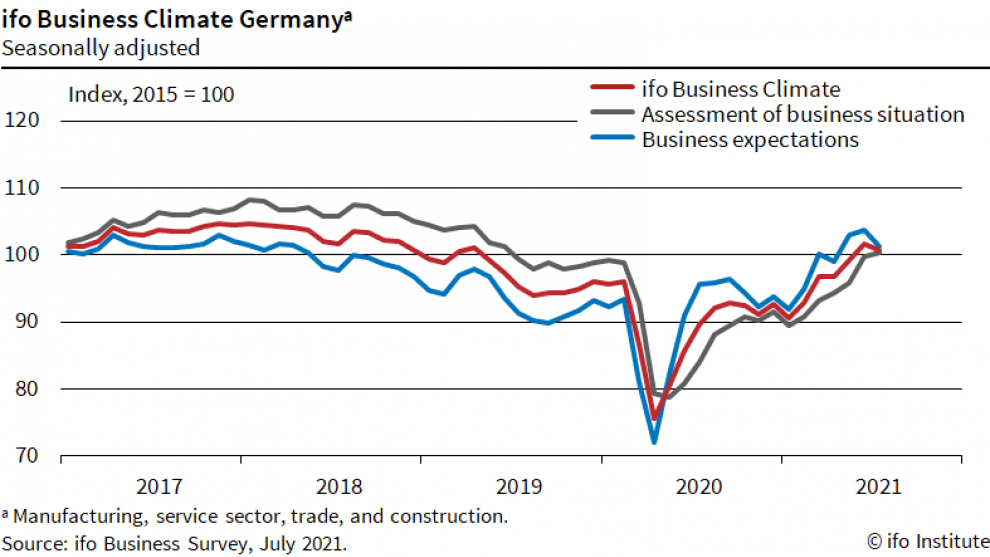
Germany Ifo Business Climate dropped to 100.8 pts in July, down slightly from 101.7, below expectation of 102.1. Current Assessment index rose to 100.4, up from 99.7. Expectations index dropped to 101.2, down from 103.7.
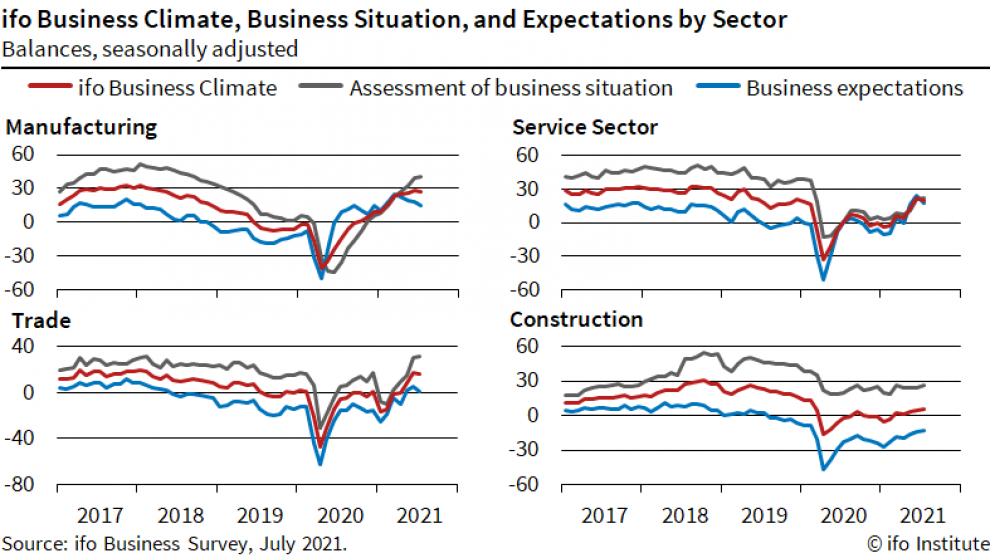
Looking at some details, manufacturing index dropped from 28.5 to 27.4. Services dropped from 28.5 to 27.4. Trade dropped from 17.8 to 15.8. Construction rose from 4.2 to 5.7.
Ifo said: "Companies evaluated their current business situations as somewhat better, but their expectations for the coming months were significantly less optimistic. Supply bottlenecks and concerns over newly rising infection numbers are weighing on the German economy."
USD/CAD Remains Below 200- Hour SMA
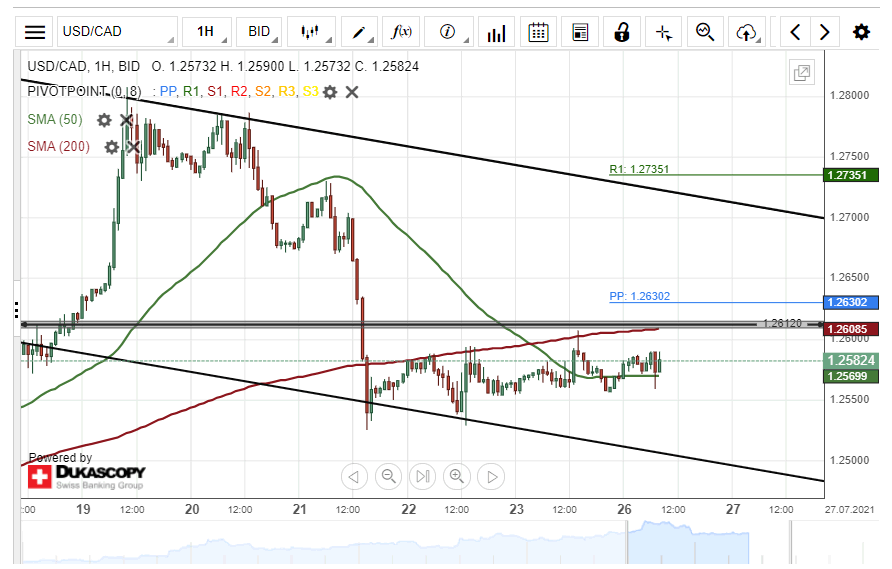
The US Dollar declined by 35 pips or 0.28% against the Canadian Dollar on Friday. The currency pair breached the 50– hour simple moving average during Friday's trading session.
The exchange rate was trading below the 200– hour SMA during the Asian session on Monday. Most likely, the USD/CAD pair could continue to decline within the following trading hours.
However, a support line formed by the 50– hour moving average at 1.2568 might provide support for the currency exchange rate in the shorter term.