

Sample Category Title
AUD/USD Weekly Outlook
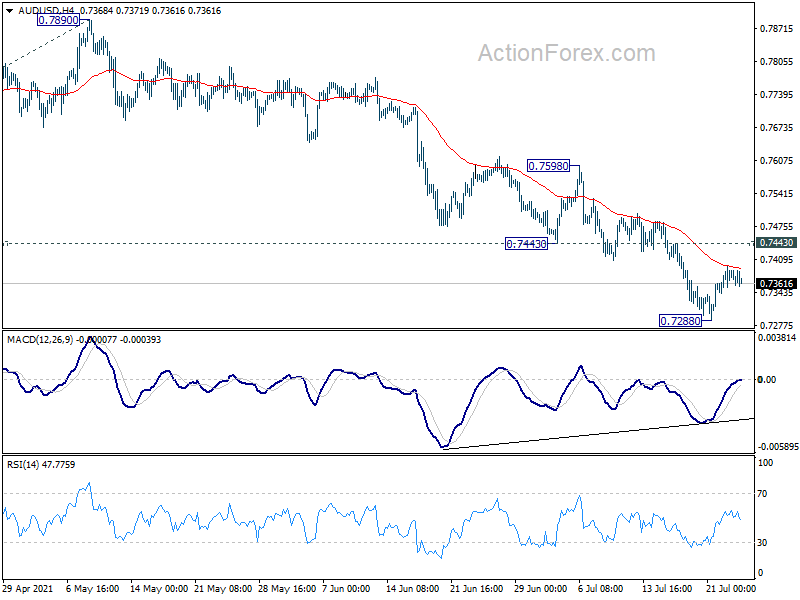
AUD/USD dropped further to as low as 0.7288 last week but formed a temporary low there and recovered. Initial bias remains neutral this week first and some consolidations could be seen. But outlook will stay bearish as long as 0.7443 support turned resistance holds. Break of 0.7288 will resume the whole decline from 0.8006 to 161.8% projection of 0.8006 to 0.7530 from 0.7890 at 0.7120 next. However, break of 0.7443 will bring stronger rebound to 0.7530 support turned resistance instead.
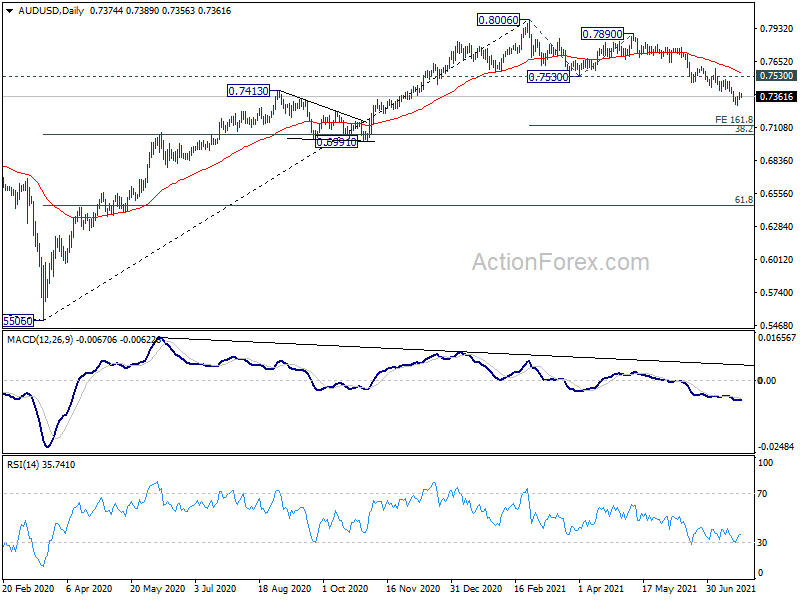
In the bigger picture, rise from 0.5506 medium term bottom could have completed at 0.8006, after failing 0.8135 key resistance. Correction from there could target 0.6991 cluster support (38.2% retracement of 0.5506 to 0.8006 at 0.7051). We'd look for strong support from there to bring rebound. However, sustained break of this level would argue that the whole medium term trend has indeed reversed.
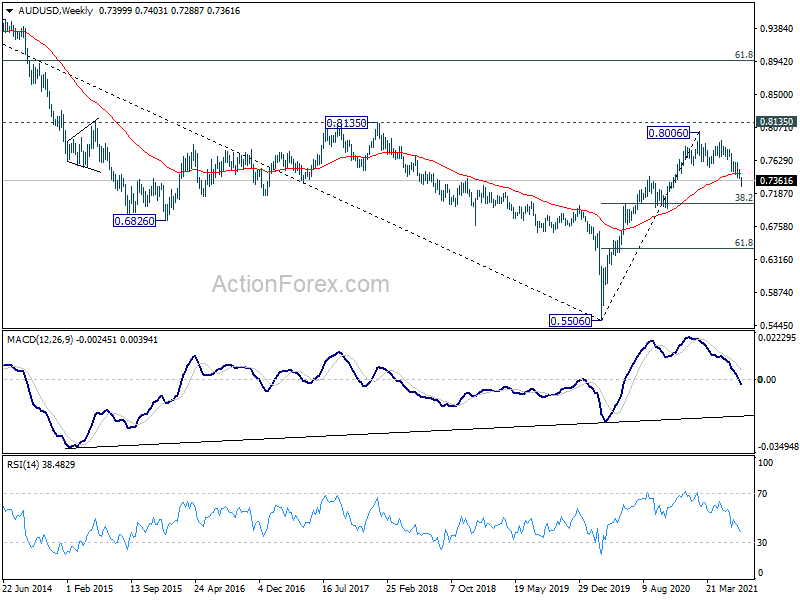
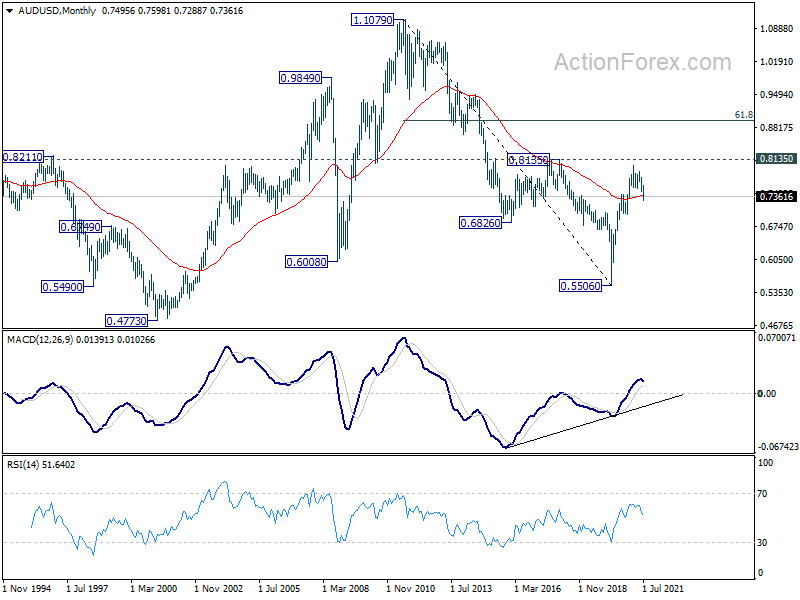
In the longer term picture, rise from 0.5506 could have completed at 0.8006. But subsequent fall is now seen as a correction only. As long as 0.6991 structural support holds, we'd expect another rise through 0.8006 at a later stage. However, sustained break of 0.6991 would argue that the trend has reversed and put 0.5506 low back into radar.
USD/CAD Weekly Outlook
USD/CAD surged to as high as 1.2805 last week but retreated sharply since then. Initial bias stays neutral this week for some consolidations first. But further rally is expected as long as 1.2485 resistance turned support holds. On the upside, break of 1.2805 will extend the rise from 1.2005 to 1.3022 medium term fibonacci level next. On the downside, however, break of 1.2485 will bring deeper fall back to next cluster support at 1.2301 (61.8% retracement of 1.2005 to 1.2805 at 1.2311).
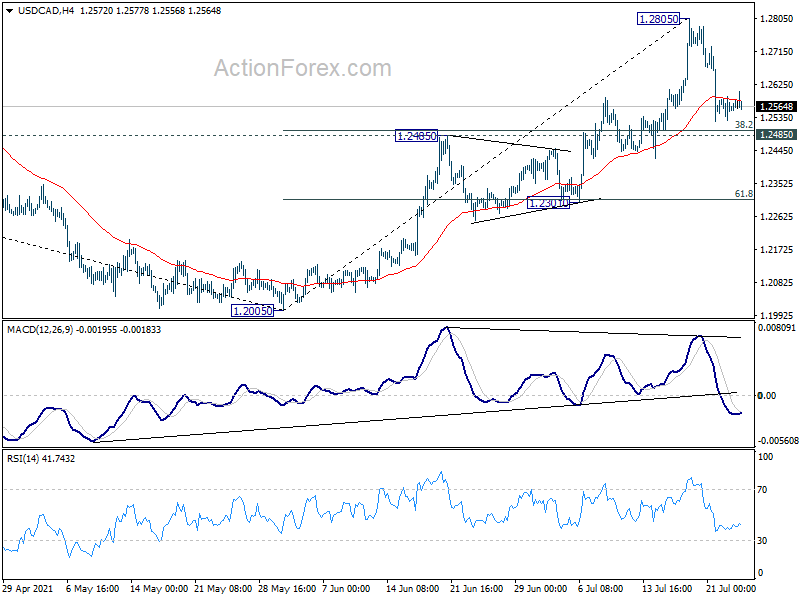
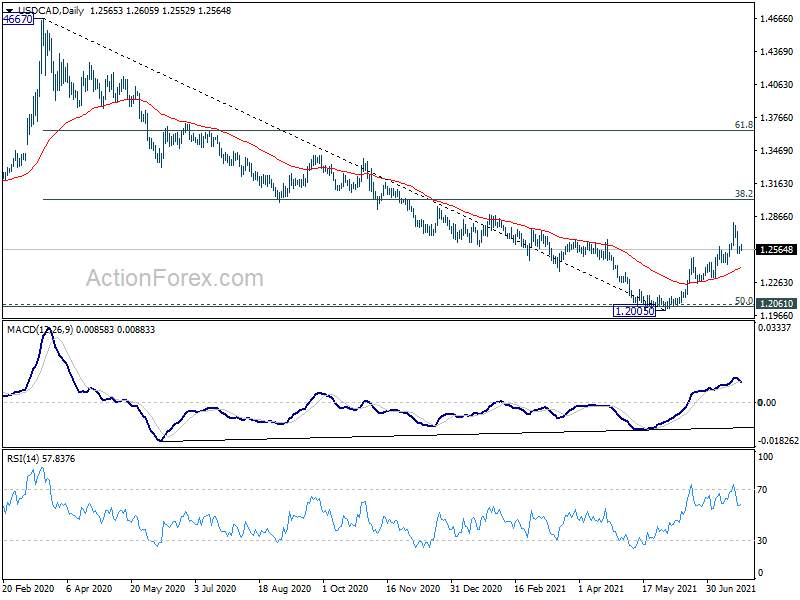
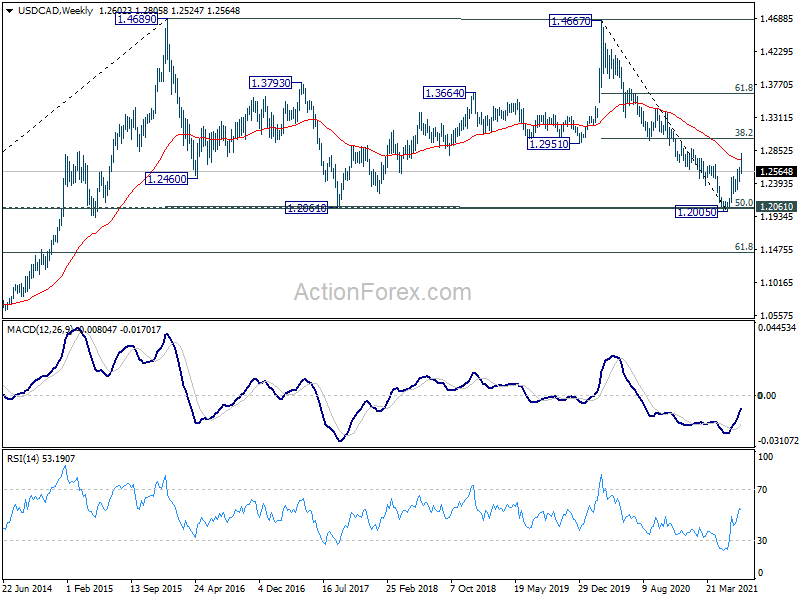
In the bigger picture, fall from 1.4667 is seen as the third leg of the corrective pattern from 1.4689 (2016 high). It should have completed after hitting 1.2061 (2017 low) and 50% retracement of 0.9406 to 1.4689 at 1.2048. Sustained break of 38.2% retracement of 1.4667 to 1.2005 at 1.3022 will pave the way to 61.8% retracement at 1.3650 and above. Overall, medium term outlook remains neutral at worst with 1.2048/61 support zone intact.
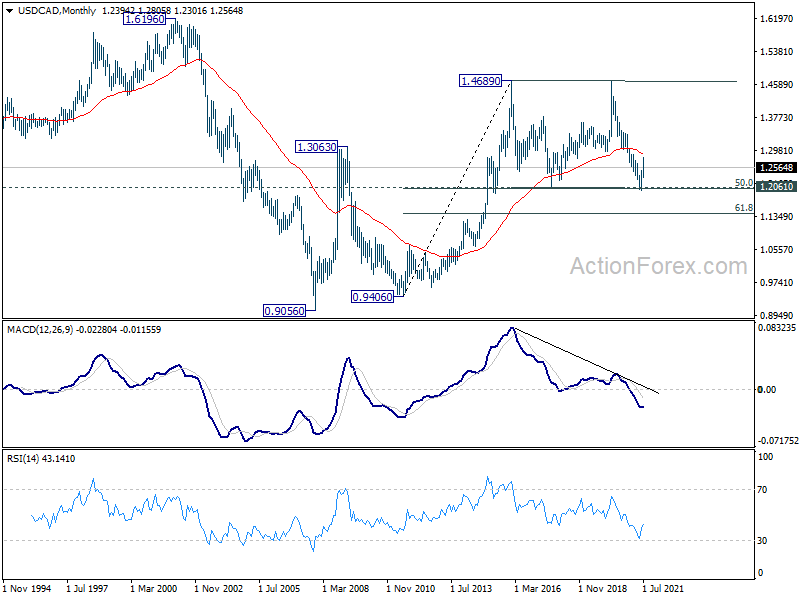
In the longer term picture, we're viewing price actions from 1.4689 as a consolidation pattern. Thus, up trend from 0.9506 (2007 low) is still expected to resume at a later stage. This will remain the favored case as long as 1.2061 support holds, which is close to 50% retracement of 0.9406 to 1.4689 at 1.2048. However, sustained break of 1.2061 will be a sign of long term bearishness. Deeper fall would be seen to 61.8% retracement at 1.1424 and below.
GBP/JPY Weekly Outlook
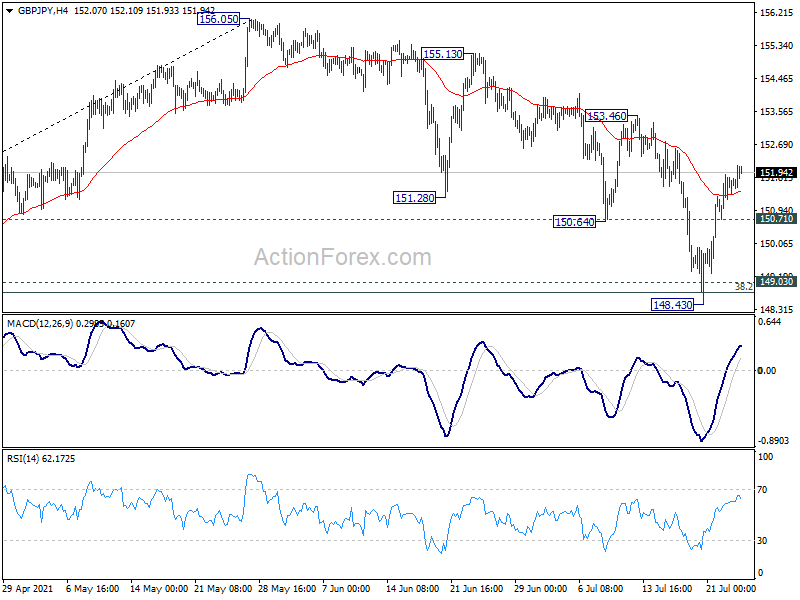
GBP/JPY dived to 148.43 last week but rebound strongly, after drawing support from 149.03 support. Corrective fall from 156.05 might have completed already. Initial bias stays mildly on the upside for 153.46 resistance first. Firm break there will pave the way to retest 156.05 high. On the downside, however, break of 150.71 minor support will turn bias back to the downside for 148.43 again.
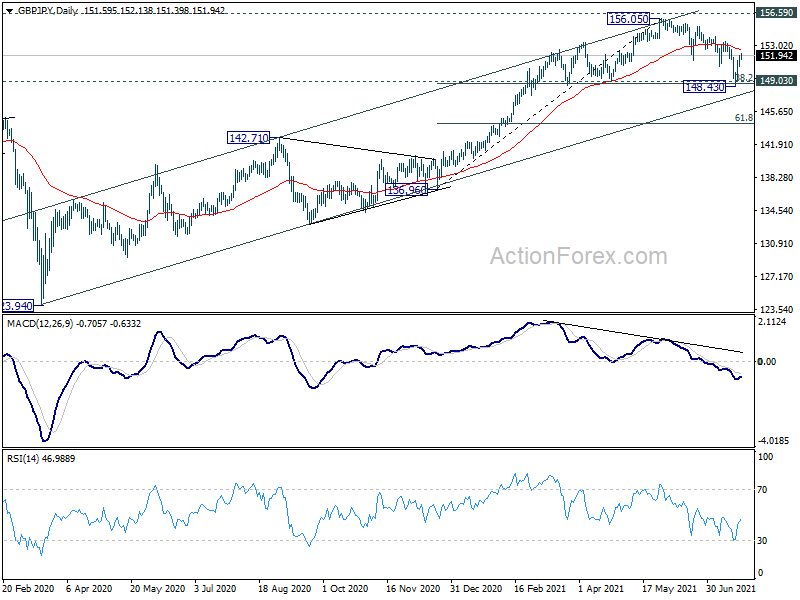
In the bigger picture, rise from 123.94 is seen as the third leg of the pattern from 122.75 (2016 low). Focus remains on 156.59 resistance (2018 high). Sustained break there should confirm long term bullish trend reversal. Next target is 61.8% retracement of 195.86 (2015 high) to 122.75 at 167.93. On the downside, sustained break of 149.03 support, however, will argue that rise from 123.94 has completed. Further break of 142.71 would open up the bearish case for retesting 122.75 low.
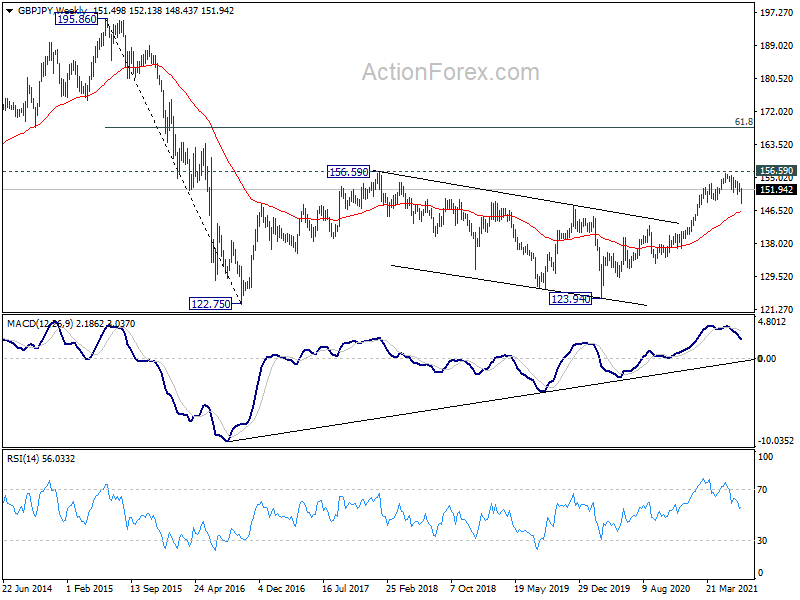
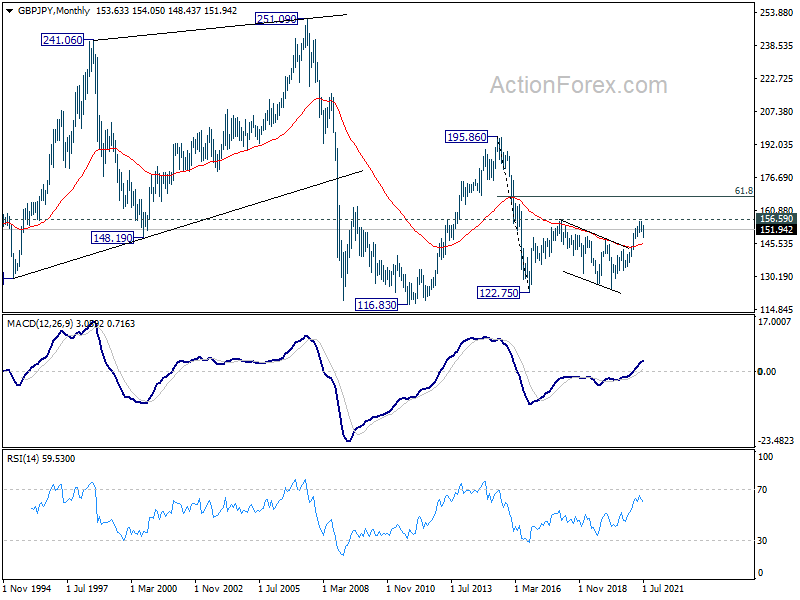
In the longer term picture, the strong break of 55 months EMA was an early sign of long term bullish reversal. Firm break of 156.69 resistance should now confirm the start of an up trend for 195.86 (2015 high).
EUR/JPY Weekly Outlook
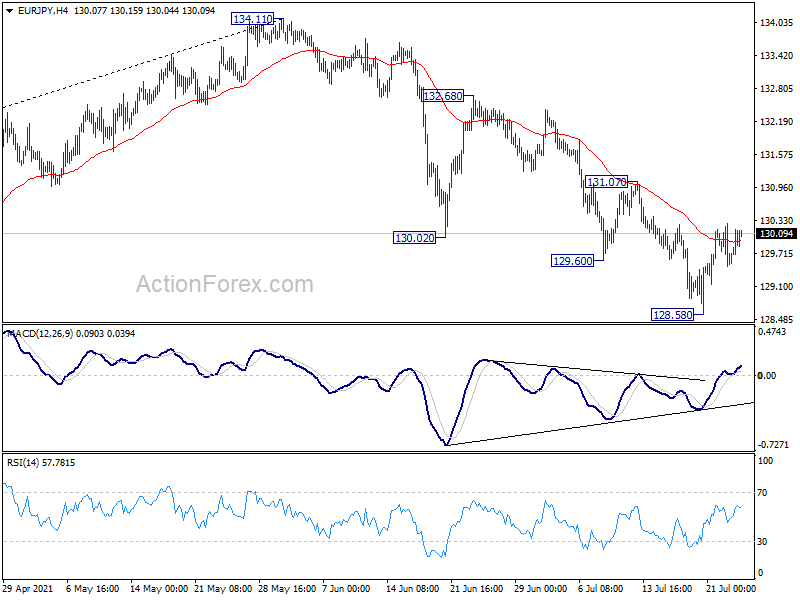
EUR/JPY's fall from 134.11 extended to as low as 128.58 last week but recovered since then. Initial bias remains neutral this week first, and some more consolidations could be seen. But near term outlook stays bearish as long as 131.07 resistance holds. Break of 128.58 will target 127.07 resistance turned support next.
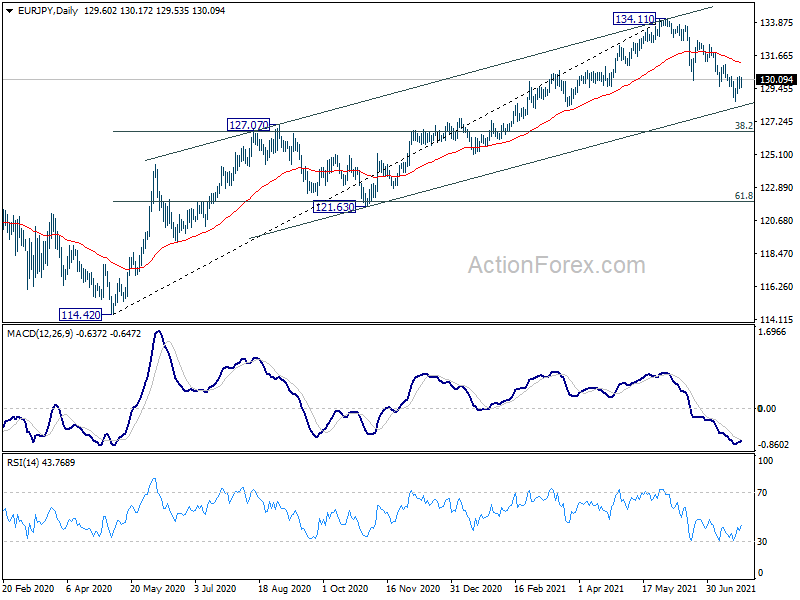
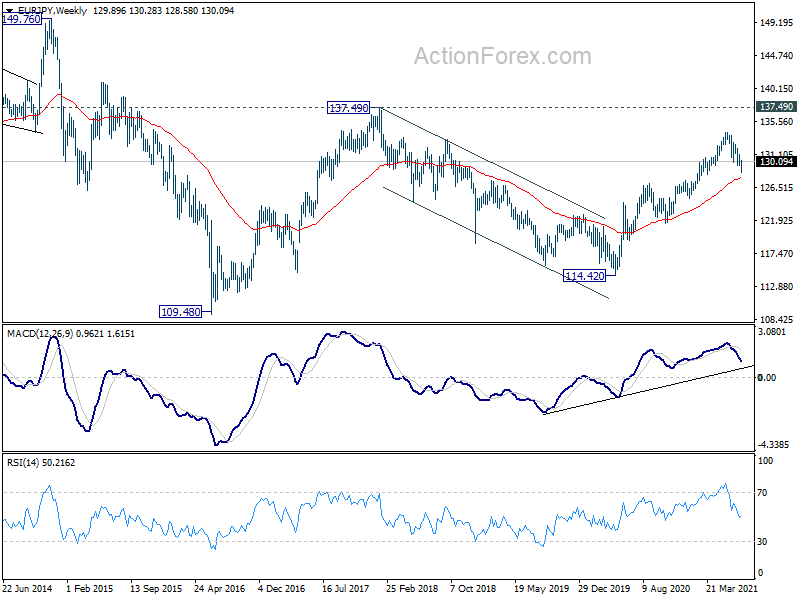
In the bigger picture, rise from 114.42 is seen as a medium term rising leg inside a long term sideway pattern. As long as 127.07 resistance turned support holds, further rise is still expected to retest 137.49 (2018 high). However, firm break of 127.07 will argue that the medium term trend has reversed, and open up the case for retesting 114.42.
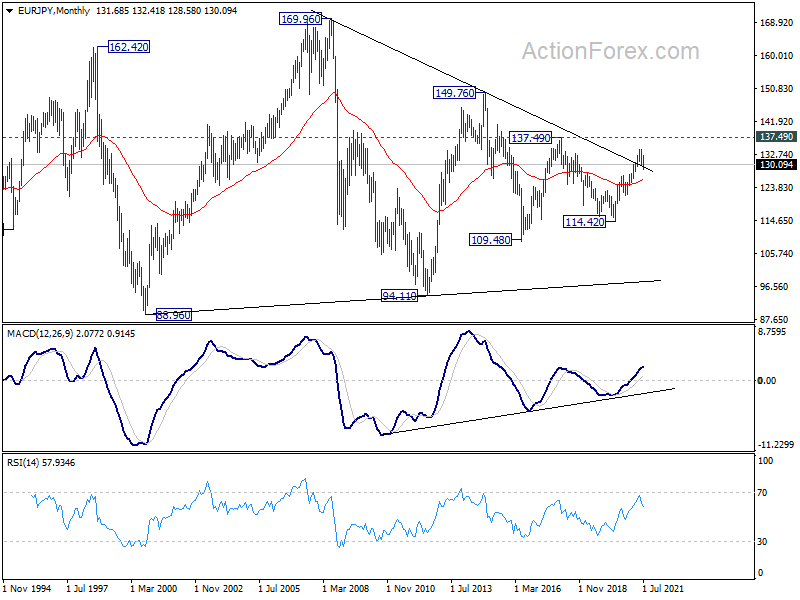
In the long term picture, EUR/JPY is staying in long term sideway pattern, established since 2000. Another rising leg in progress for 137.49 resistance and above.
EUR/GBP Weekly Outlook
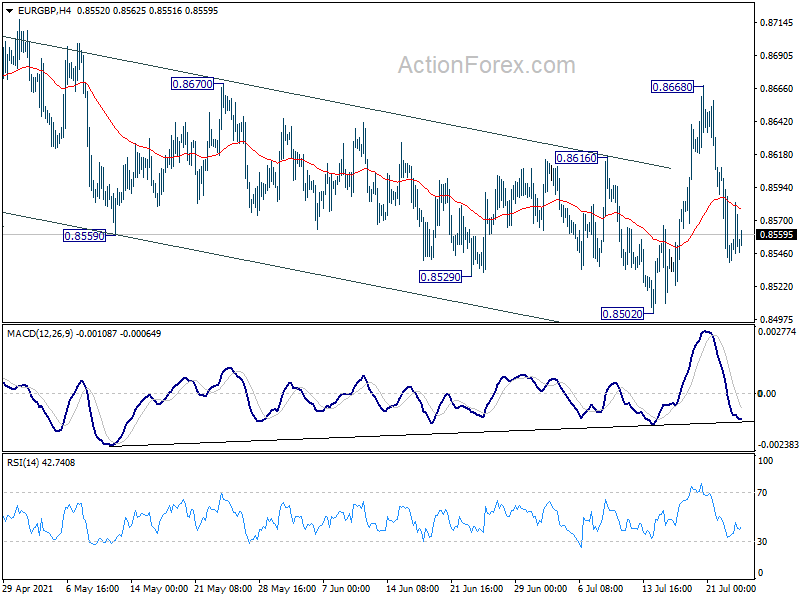
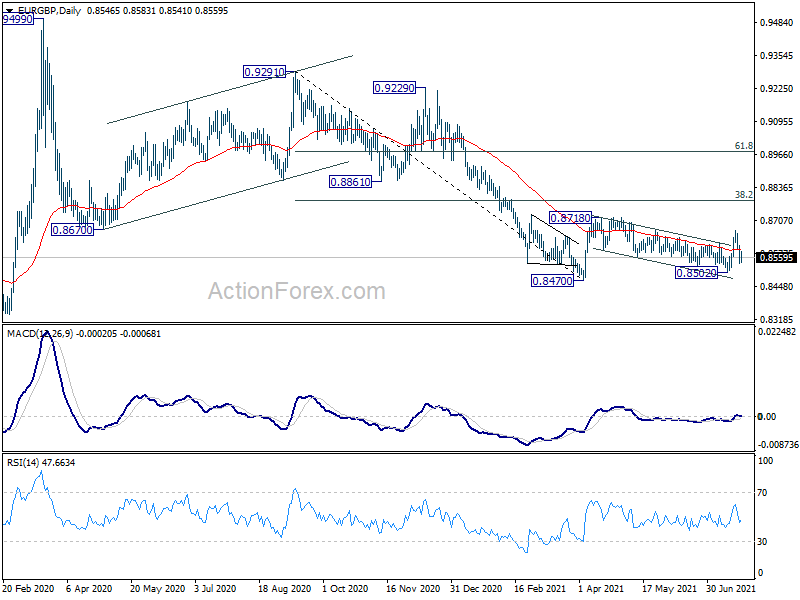
EUR/GBP surged to 0.8668 last week but dropped sharply since then. The development mixed up the near term outlook and initial bias remains neutral this week first. On the upside, firm break of 0.8670 resistance will revive that case that rebound from 0.8470 is resuming. Intraday bias will be turned back to the upside for 0.8718 resistance first. However, break of 0.8502 will resume the choppy corrective fall from 0.8718 towards 0.8470 low.
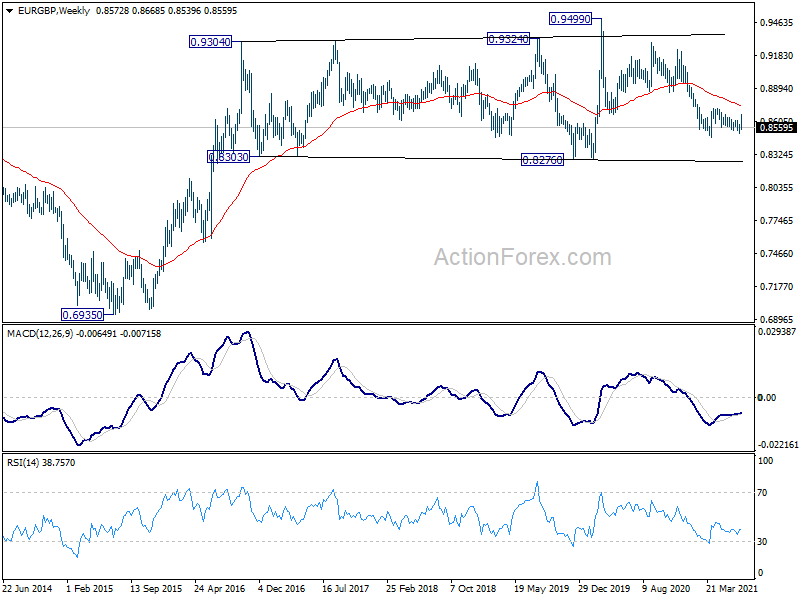
In the bigger picture, price actions from 0.9499 are still seen as developing into a corrective pattern. That is, up trend from 0.6935 (2015 low) would resume at a later stage. This will remain the favored case as long as 0.8276 support holds. However, firm break of 0.8276 support will suggest that rise from 0.6935 has completed and turn medium term outlook bearish.
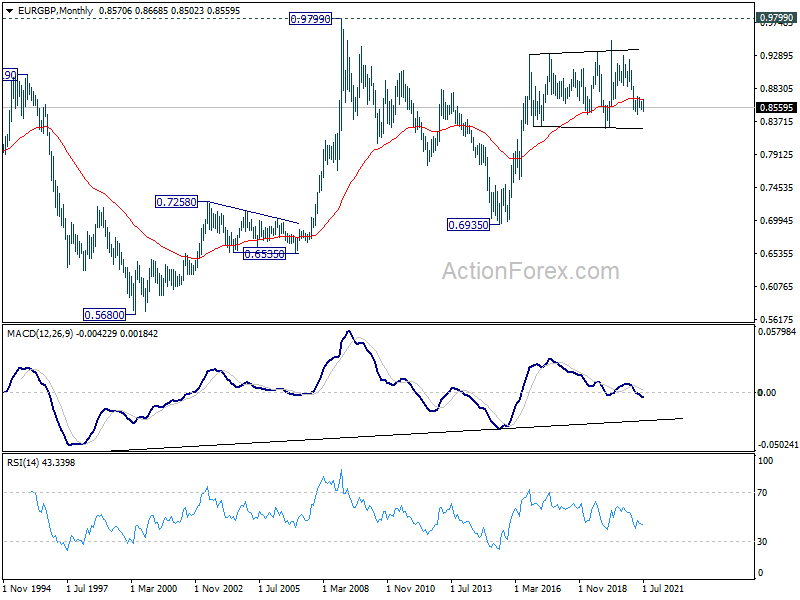
In the long term picture, rise from 0.6935 (2015 low) is still in progress. It could be resuming long term up trend from 0.5680 (2000 low). Break of 0.9799 (2008 high) is expected down the road, as long as 0.8276 support holds.
EUR/AUD Weekly Outlook
EUR/AUD surged further to 1.6128 last week but retreated since then. Initial bias remains neutral this week for some consolidations first. Overall, near term outlook stays bullish as long as 1.5773 support holds. On the upside, break of 1.6128 will resume the rise from 1.5250, as a correction to fall from 1.9799, to 1.6827 resistance next.
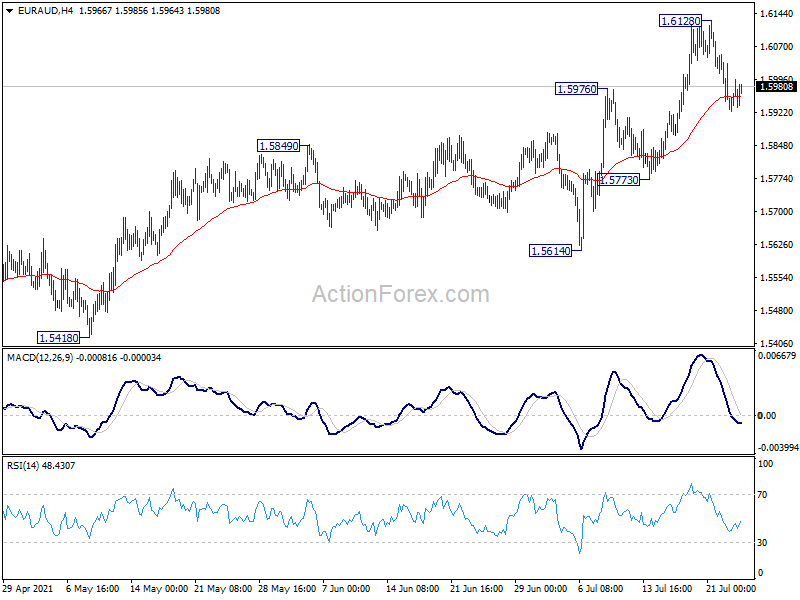
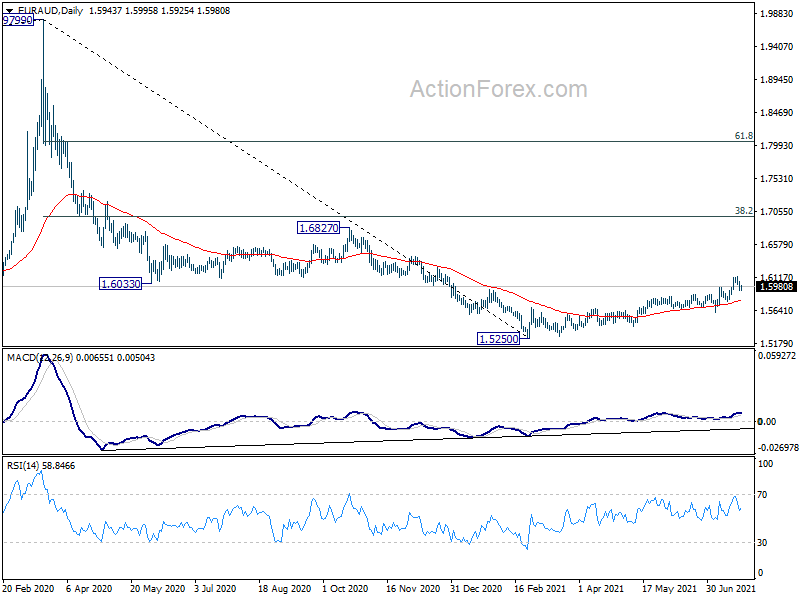
In the bigger picture, current development argues that a medium term bottom is formed at 1.5250, on bullish convergence condition in daily MACD. Rise from 1.5250 is seen as a correction to the down trend from 1.9799 first. Stronger rise would be seen to 38.2% retracement of 1.9799 to 1.5250 at 1.6988 next. This will remain the favored case for now, as long as 1.5614 support holds.
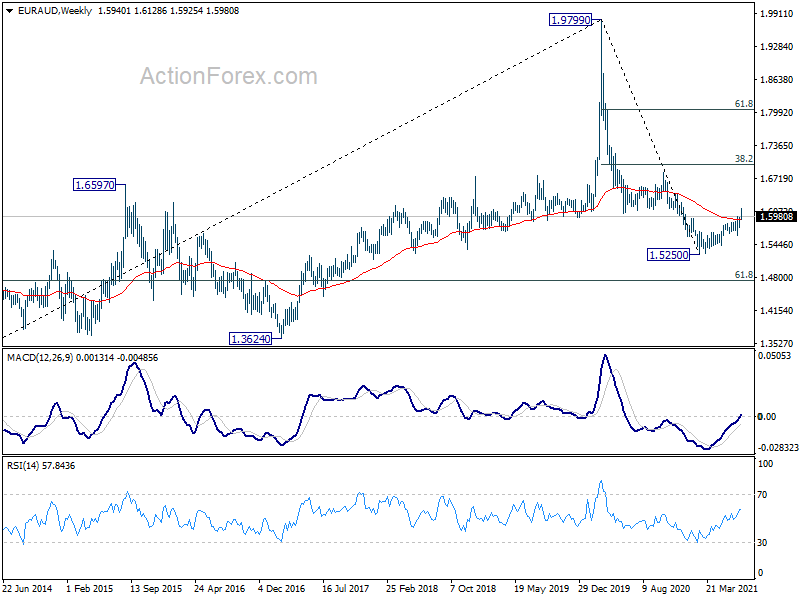
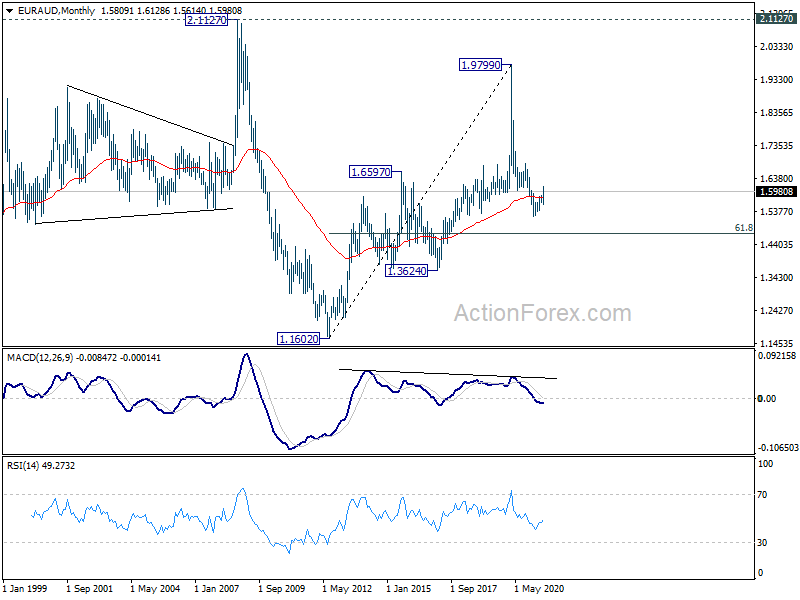
In the longer term picture, rise from 1.1602 (2012 low) should have already completed with three waves up to 1.9799 (2020 high). Fall from there is seen as a medium term to long term down leg as a long term down trend, or a sideway pattern. We'll assess the odds again at a later stage.
EUR/CHF Weekly Outlook
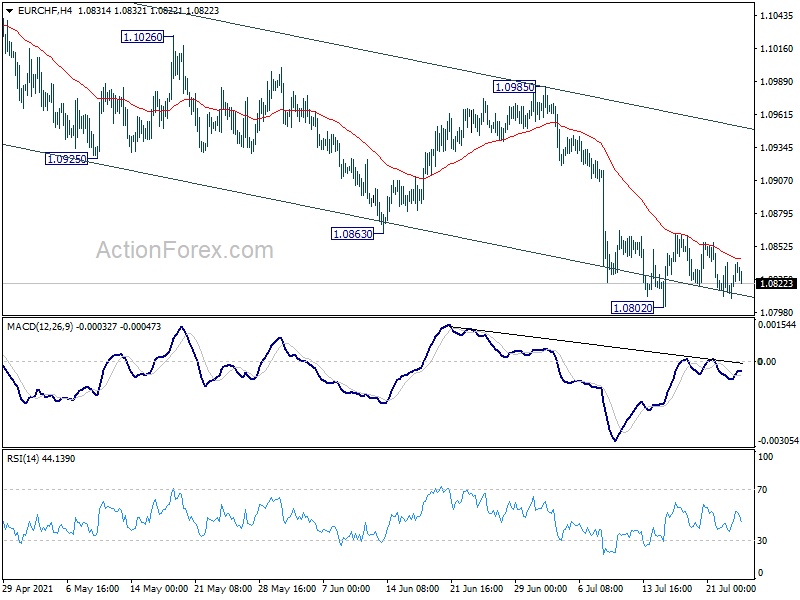
EUR/CHF stayed in consolidation above 1.0802 support last week and outlook is unchanged. Initial bias remains neutral this week for some more consolidations. Near term outlook will remain bearish as long as 1.0985 resistance holds, even in case of strong rebound. On the downside, break of 1.0802 will resume the decline from 1.1149 to 1.0737 cluster support next.
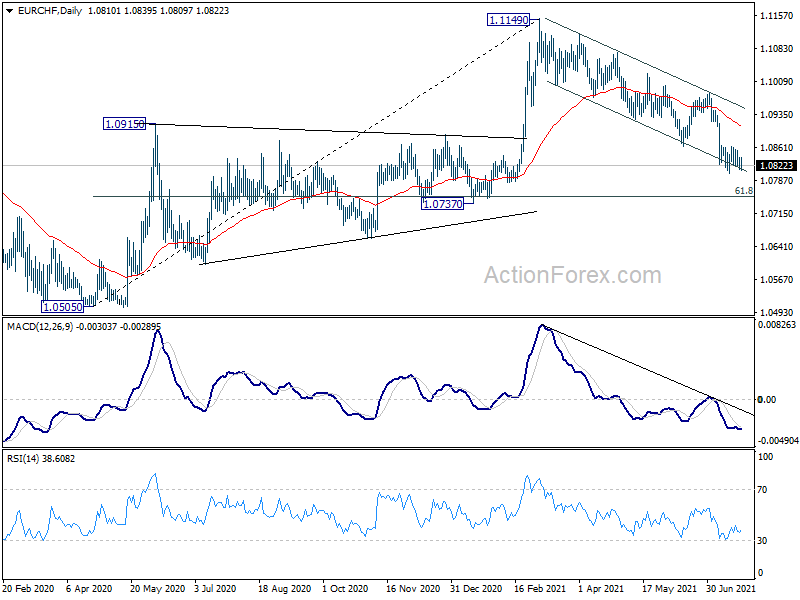
In the bigger picture, current development argues that rebound from 1.0505 (2020 low) might be completed with three waves up to 1.1149 already, after hitting 1.1078 long term fibonacci level. On the downside, sustained trading below 55 week EMA (now at 1.0880) will affirm this bearish case. Further break of 1.0737 cluster support (61.8% retracement of 1.0505 to 1.1149 at 1.0751) will bring retest of 1.0505 low.
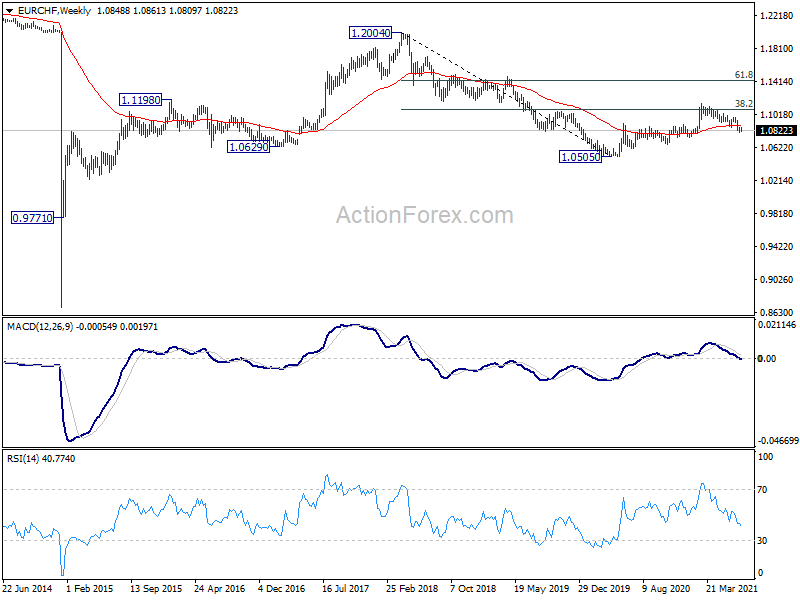
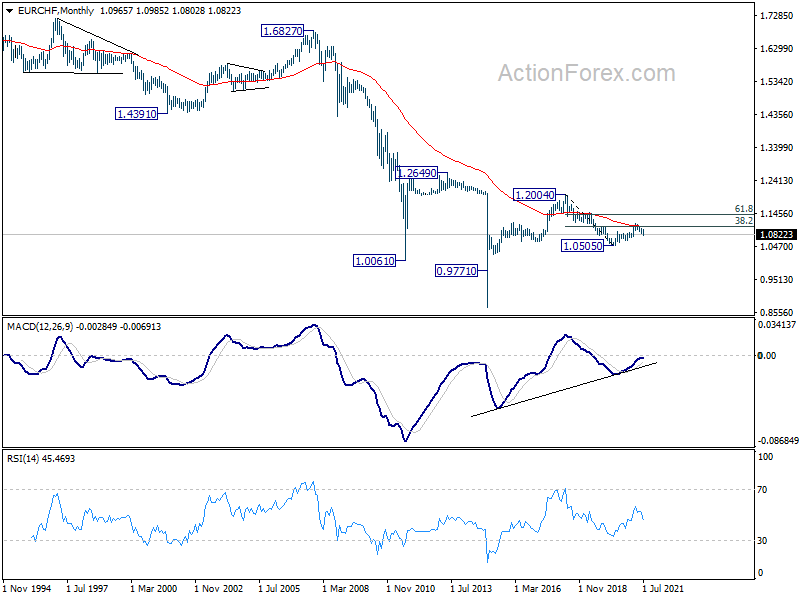
In the long term picture, price actions from 1.0505 are currently seen as a correction to down trend from 1.2004 (2018 high). only. The failure to sustain above 38.2% retracement of 1.2004 to 1.0505 at 1.1078 retains long term bearishness. This is also affirmed by rejection by 55 month EMA. Another fall through 1.0505 is mildly in favor for now.
Stocks Closed at Records as Delta Worries Receded, Dollar Index Holding On to Weak Rally
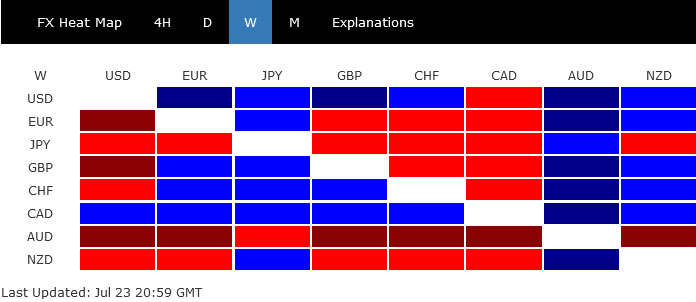
It has been a very volatile week as risk markets were initial knocked down by fear of the infectious delta variant. But sentiment made an about-turn then, even with US indexes closing at record highs. Still, despite late recovery, Australian Dollar ended as the weakest one. Yen was surprisingly the second worst performing, given that it was the early star in the week.
Canadian Dollar ended as strongest but we'd doubt if it's strong could sustain. Dollar maintain a second place after all the moves. Euro was mixed with little reaction to ECB's new forward guidance. Sterling was also mixed, but seemed to be getting out of the clouds over the "freedom day".
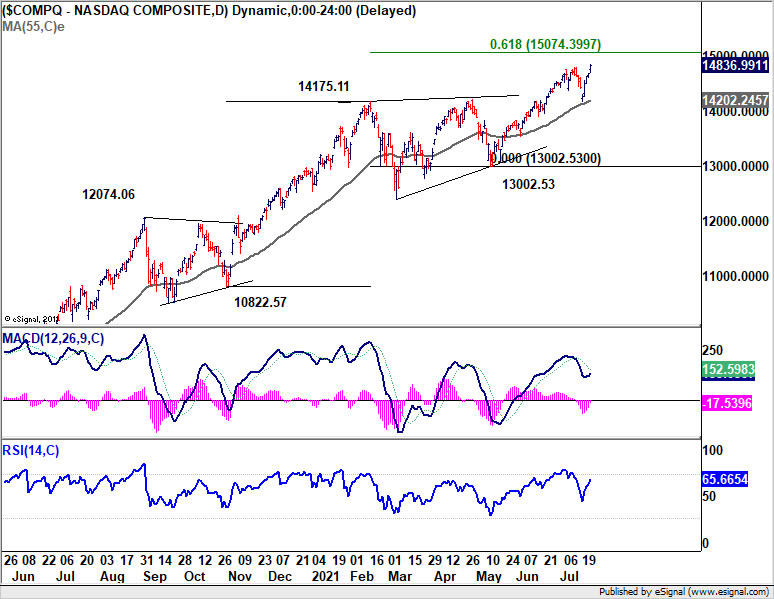
Delta worries short-lived as NASDAQ closed at record
Overall, the financial markets ended the week on a strong note despite initial deep risk selloff. Solid earning reports of US companies certainly helped sentiments. But more importantly, the worries that the spread of delta variant of COVID-19 would derail economic recovery were not that persistent.
Infections in the US, UK, and some European countries like Spain and France did surge over the past seven days. Yet death tolls remained relatively low, without much significant rise. That development suggested that, thanks to vaccinations, these advanced countries are still on the right track to stay with reopening. But of course, situation in some countries like Indonesia is still worrying.
NASDAQ's correction proved to be relatively brief as it soared to close at new record high at 14836.99. The notable support from 55 day EMA also affirmed near term bullishness. It's still on track to next target of 61.8% projection of 10822.57 to 14175.11 from 13002.53 at 15074.39.
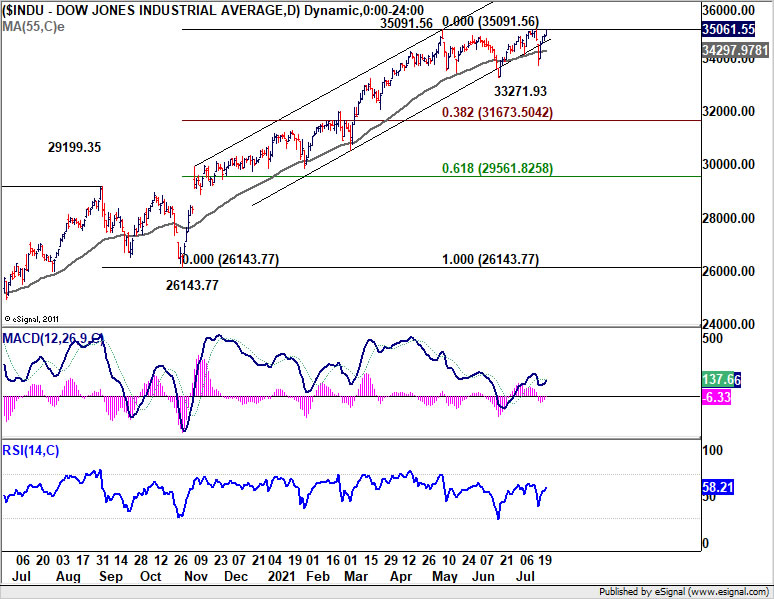
Even the under performing DOW also closed above 35k handle for the first time ever, after reversing initial selloff. We'd still be cautious on another rejection by 35091.56 resistance to start another falling leg to the corrective pattern from there. But it looks like the resilience in both S&P 500 and NASDAQ could give overall sentiment, and DOW, a floor.
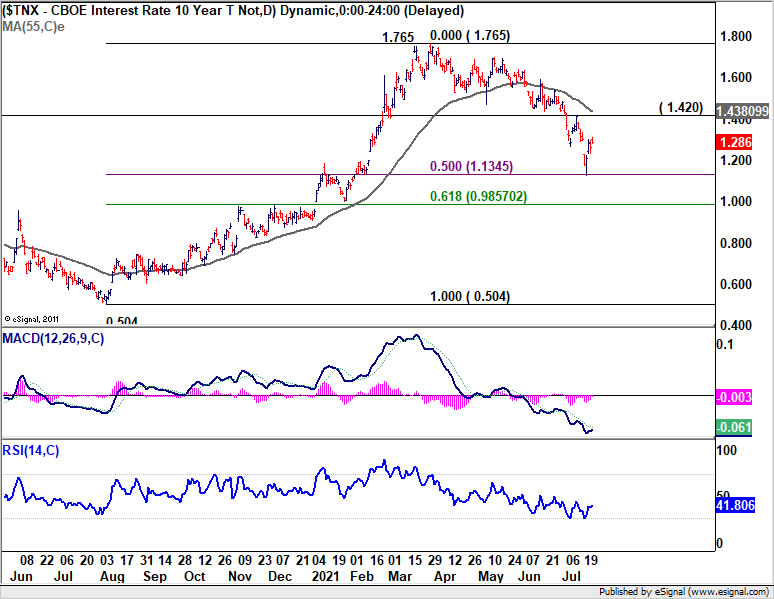
Another fall in 10-year yield still possible despite rebound
10-year yield also staged a strong rebound after hitting as low as 1.128, and closed at 1.286. Yet, it's kept well below structural resistance at 1.420, as well as 55 day EMA. Hence, another fall cannot be ruled out, considering that stock markets could remain jittering. But it's becoming more likely that strong support would be seen between 50% retracement at 1.134 and 61.8% retracement at 0.985 to form a bottom. Ideally, after that, yields and stocks would realign into synchronized up trend as the we finally exit the impact of the pandemic totally.
Dollar index continued to crawl higher with weak momentum
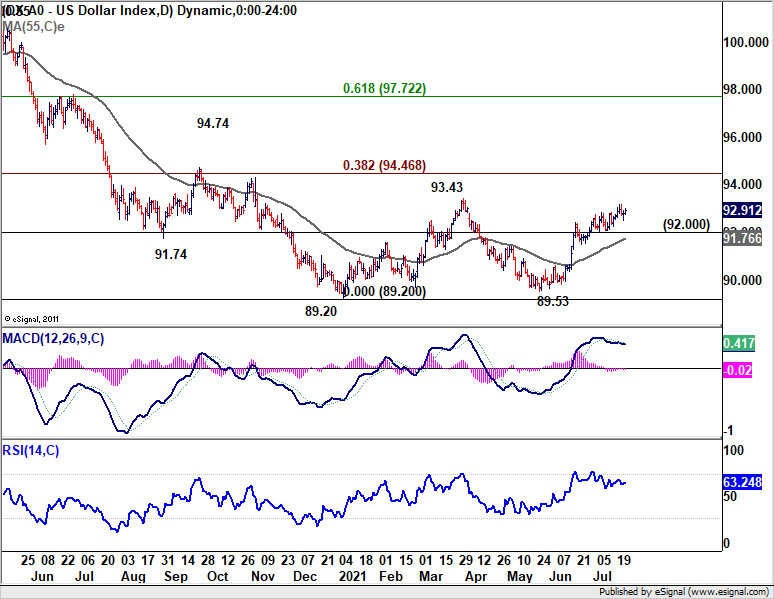
There was no special development in the Dollar index last week, as it continued to crawl higher with weak momentum. We'd stay cautious on topping around current level to complete the third leg of the corrective pattern from 89.20. Break of 92.00 support will bring deeper fall back to retest 89.20 low. However, before that, DXY could still have another rise through 93.43 resistance before completing the consolidation pattern.
Canadian Dollar's rebound with oil might not last long
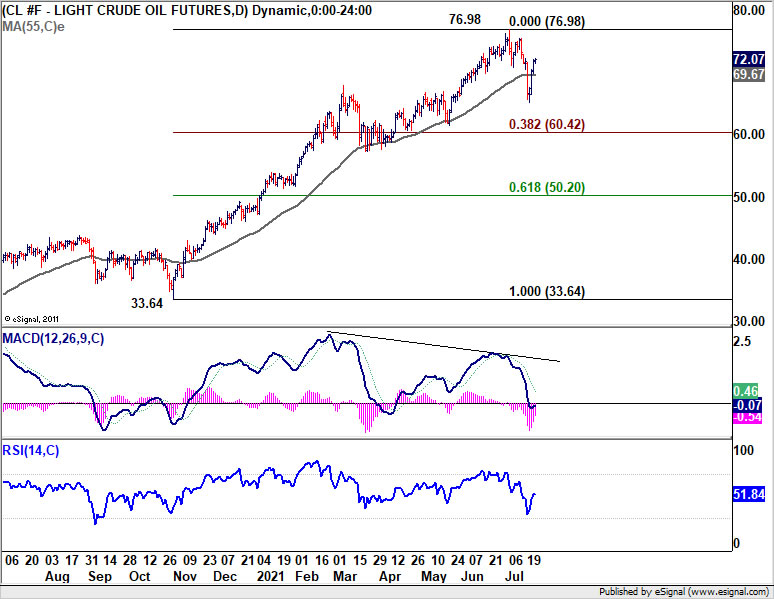
Canadian Dollar's rebound last week was very much in tandem with oil prices. Yet, we doubt if the strength in both could persist. 76.98 should be a medium term top considering bearish divergence condition in daily MACD. Thus, a break of 76.98 is not expected for the near term. Another falling leg should be seen before the corrective pattern from 76.98 completes. Though, at this point, even in case of another rise, there should be strong support from 38.2% retracement of 33.64 to 76.98 at 60.42, which is close to 60 handle, to contain downside.
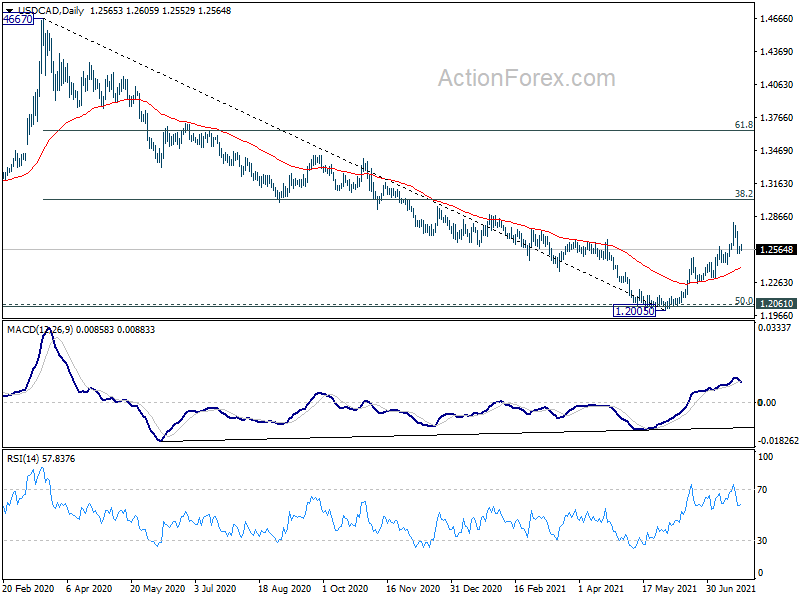
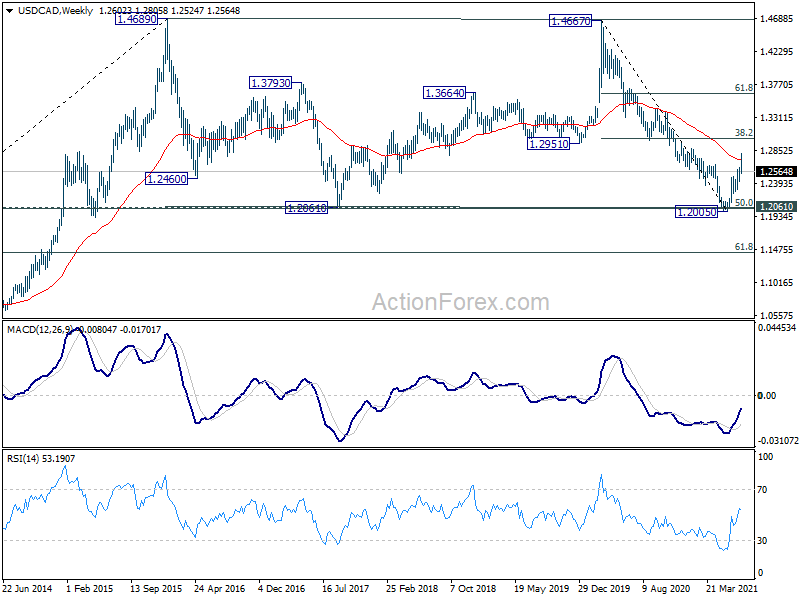
Meanwhile, USD/CAD should at least be correcting the decline from 1.4667, and another rise is still in favor to 38.2% retracement of 1.4667 to 1.2005 at 1.3022. There is prospect that 1.2005 is indeed a medium term bottom, as consolation pattern from 1.4689 completed after another take on 1.2 handle. In such case, rise form 1.2005 should develop into a near term up trend itself. But of course, rejection by 55 week EMA will revive medium term bearishness instead.
AUD/USD Weekly Outlook
AUD/USD dropped further to as low as 0.7288 last week but formed a temporary low there and recovered. Initial bias remains neutral this week first and some consolidations could be seen. But outlook will stay bearish as long as 0.7443 support turned resistance holds. Break of 0.7288 will resume the whole decline from 0.8006 to 161.8% projection of 0.8006 to 0.7530 from 0.7890 at 0.7120 next. However, break of 0.7443 will bring stronger rebound to 0.7530 support turned resistance instead.
In the bigger picture, rise from 0.5506 medium term bottom could have completed at 0.8006, after failing 0.8135 key resistance. Correction from there could target 0.6991 cluster support (38.2% retracement of 0.5506 to 0.8006 at 0.7051). We'd look for strong support from there to bring rebound. However, sustained break of this level would argue that the whole medium term trend has indeed reversed.
In the longer term picture, rise from 0.5506 could have completed at 0.8006. But subsequent fall is now seen as a correction only. As long as 0.6991 structural support holds, we'd expect another rise through 0.8006 at a later stage. However, sustained break of 0.6991 would argue that the trend has reversed and put 0.5506 low back into radar.
Summary 7/26 – 7/30
Monday, Jul 26, 2021
[php_everywhere instance="1"]
Tuesday, Jul 27, 2021
[php_everywhere instance="2"]
Wednesday, Jul 28, 2021
[php_everywhere instance="3"]
Thursday, Jul 29, 2021
[php_everywhere instance="4"]
Friday, Jul 30, 2021
[php_everywhere instance="5"]
Week Ahead – Fed and Earnings Eyed
Major week for US markets
All eyes on the US next week as the Fed meets and we head into peak earnings season. The central bank will discuss its exit strategy from emergency era stimulus and investors will be looking for any hints on the timing and execution.
Earnings season is off to a very strong start and it will step up a notch next week with a number of big tech companies reporting. There’ll also be a raft of economic releases which will grab the attention of investors.
Europe also offers a wide range of economic data which, coming shortly after the ECB announced a tweak to its mandate, will be very closely monitored.
Country
US
This will be a huge week on Wall Street as the Fed will be providing some clarity over taper timing and how they will reduce asset purchases, monster earnings from big-tech, and the first look at second quarter GDP, personal consumption, and core PCE, the Fed’s preferred inflation index. Financial markets are waiting to see if the latest global growth concerns will be enough reason for the Fed to hold off on discussing potential strategies for tapering their monthly purchases of $80 billion in Treasury securities and $40 billion in mortgage securities.
This is peak earnings season and many traders will closely watch to see if mega-cap stocks, Apple, Alphabet, Facebook, Microsoft, and Amazon can crush second quarter expectations and signal the growth story is not moderating too quickly.
US economic growth is expected to accelerate from 6.4% to 8.4%, with a wide consensus range from 6.0% to 11.9%. Economists are upbeat for a robust summer of economic activity given every American who is eligible to get vaccinated has had an opportunity to do so. Pent up consumer demand, reopening of businesses, and lots of cash to spend suggests we could see some upside surprises.
It is crunch time for infrastructure negotiations and while Democrats are pushing to get a vote done early next week, we could see some Republican resistance brew over the weekend.
EU
The ECB is in no rush to pare back it’s package of measures aimed at lifting inflation to its new target of 2%. At the meeting on Thursday, the central bank made clear that it is committed to the new target, following the strategy review, and that it would briefly tolerate a slight overshoot in order to achieve it.
While all of this sounds encouraging, it’s worth remembering that this is the same central bank that has seriously struggled to even come close to its old target of below but close to 2%. With that in mind, barring a dramatic shift in its policy response in the upcoming meetings, it doesn’t really feel like an enormous amount has changed.
A broad selection of data from the euro area next week, with the big hitters coming on Friday in the shape of the flash CPI numbers, GDP and unemployment.
UK
With restrictions fully lifted, Prime Minister Boris Johnson will be hoping for a bumper summer for the UK economy after an extremely challenging 16 months. But with no restrictions comes high Covid case loads and the UK is seeing a severe surge which preceded Freedom Day.
At this stage, that’s only coming with a modest increase in hospitalisations and a much lower number of fatalities compared with previous surges. The next couple of weeks will be a huge test of whether the country is ready for a life with no restrictions.
Emerging Markets
Russia
The central bank raised interest rates by 100 basis points to 6.5% on Friday, in line with expectations. The currency was relatively stable as a result.
Next week sees the release of retail sales and unemployment data on Wednesday.
South Africa
The South African Reserve Bank kept interest rates unchanged at 3.50%, as expected this week. The central bank pushed back expectations for a rate hike until later in the year, although some think it may not come until 2022.
Next week brings a selection of tier two and three data releases including PPI and trade balance.
Asia Pacific
China
China markets have been immune to the delta-variant volatility sweeping the world this week and are likely to remain so next week with Industrial Profits on Tuesday, the week’s only major data release. Official and Caixin PMI are released next weekend meaning the first day of August should see some volatility.
Most volatility will be driven by the China government and its official crackdown on big-tech China. Officials are allegedly preparing major penalties on Didi Global Inc. Meanwhile, debt worries continue to escalate in the property developer sector, led by Evergrande whose stock and bond endured a torrid week. Most of this volatility will be reflected in Hong Kong where the major tech and property companies from the Mainland are listed.
A default by a major developer next week, or gruesome penalties for Didi, could send Hong Kong markets sharply lower.
India
India’s COVID-19 cases were appearing to be on the right track but a recent increase in cases has many worried that a third wave could be coming. The Rupee has recovered some recent losses this past week although the rapid recovery in oil prices means importers will need to keep buying US Dollars as India demand recovers, pressuring the currency.
No significant data this week, with India and ASEAN currencies to be dominated by their internal trajectories of the delta-variant Covid-19. The Rupee remains vulnerable to more US Dollar strength.
Australia & New Zealand
Australian stock markets are trading sideways, with nearly half the country now under some sort of movement restrictions, and the lockdown in Sydney being extended as cases continue climbing. The rapid recovery in overseas sentiment has balanced out the domestic risks leaving both the currency and equities treading water. The AUD, though, remains especially vulnerable to a sudden sharp deterioration in risk sentiment, especially in Asia, where the AUD is used as a correlation trade.
Australia releases inflation data and PPI this week, but the focus is going to remain on the virus situation domestically, and sentiment internationally.
No significant data from New Zealand and no market reaction to the suspension of the Australia/New Zealand travel bubble, as this was well telegraphed already.
Japan
Japanese stocks are gyrating wildly on swings in risk sentiment internationally, reflecting the heavy presence of retail fast money inthe Japan market. We expect this volatility to continue with only PMI releases to start the week. Japan releases Unemployment, Retail Sales and Industrial Production on Friday with domestic consumption set to ease as Covid restrictions continue.
USD/JPY has dissolved into a purely US/Japan interest rate differential play for now, and we expect that to continue next week, with USD/JPY remaining in a wider 109.50 to 111.00 range.
Key Economic Events
Sunday, July 25
- US Deputy Secretary of State Sherman meets with Chinese State Councilor and Foreign Minister Wang Yi in Tianjin, China
- Russian President Putin attends the annual Navy parade in St. Petersburg.
Monday, July 26
- Iraqi Prime Minister al-Kadhimi meets US President Biden
- EU finance ministers review the implementation of the Recovery and Resilience Facility, before assessing the European Commission’s new anti-money laundering package.
Economic Data/Events
- US new home sales
- New Zealand trade
- Japan PMI
- Germany IFO business climate/expectations
- Mexico Unemployment rate
- Singapore industrial production
- Turkey capacity utilization
- Belgium business confidence
- Tesla Earnings (could provide guidance on Bitcoin action)
Tuesday, July 27
- RBA Deputy Governor Debelle, speaks at an online US foreign-exchange conference.
- US Secretary of State Blinken.to meet India’s Prime Minister Modi, National Security Advisor Doval and Foreign Minister Jaishankar
- IMF releases its World Economic Outlook Update.
Economic Data/Events
- Apple and Alphabet report after the close
- Japan PPI services
- China industrial profits
- Hungary Rate decisions: Expected to raise rates 15 bps to 1.05%
- U.S. durable goods, Conf. Board consumer confidence, FHFA house price index
- Denmark retail sales
- Sweden trade balance, household lending
Wednesday, July 28
- US Defense Secretary Austin to meet Vietnamese Minister of National Defense Phan Van Giang.
- IMF Managing Director Georgieva and Banco de México Governor León speak at the annual Michel Camdessus Central Banking Lecture.
Economic Data/Events
- US FOMC rate decision: No changes to monetary policy expected; Taper deliberations to intensify
- US Wholesale Inventories
- Canada CPI
- Australia CPI
- Russia CPI
- Germany Consumer confidence
- France Consumer confidence
- Italy Consumer confidence
- Japan leading index, coincident index
- Sweden Retail sales
- European Bank Earnings from Deutsche Bank and Barclays
- Facebook reports after the US close
- EIA Crude Oil Inventory Report
Thursday, July 29
Economic Data/Events
- US Q2 Advance GDP Q/Q: 8.3%e v 6.4% prior; Personal Consumption: 10.7%e v 11.4% prior; Core PCE Q/Q: 6.0%e v 2.5% prior, initial jobless claims
- Eurozone economic/consumer confidence
- Germany Unemployment CPI
- Spain CPI
- France PPI
- Italy PPI
- Australia import-export price indexes
- Singapore Unemployment
- New Zealand ANZ business confidence, activity outlook
- Russia gold and forex reserves
- South Africa money supply, private sector credit, PPI
- U.K. mortgage approvals
- Belgium GDP
- Portugal retail sales
- Amazon reports after the US close
Friday, July 30
Economic Data/Events
- US personal income/spending, University of Michigan sentiment, Chicago PMI
- Germany GDP
- Eurozone GDP, Unemployment Rate, CPI
- Russia Unemployment Rate
- Denmark Unemployment Rate
- Norway Unemployment Rate
- Japan industrial production, retail sales, dept. store/supermarket sales, housing starts, jobless rate
- Czech Republic GDP
- France GDP, CPI
- Mexico GDP
- Italy GDP, CPI
- Spain GDP
- Canada GDP
- Poland CPI
- Australia
- Thailand trade, BoP current account balance, foreign reserves, forward contracts
- New Zealand building permits, ANZ consumer confidence
- South Korea industrial production, business survey
- South Africa trade balance, budget balance
- Russia retail sales, real wages
- Turkey trade balance, foreign tourist arrivals
- Hungary trade balance
- Spain Retail sales
Sovereign Rating Updates
- Hungary (Fitch)
- Ireland (Fitch)
- (S&P) Germany (Moody’s)
- Austria (DBRS)