Sample Category Title
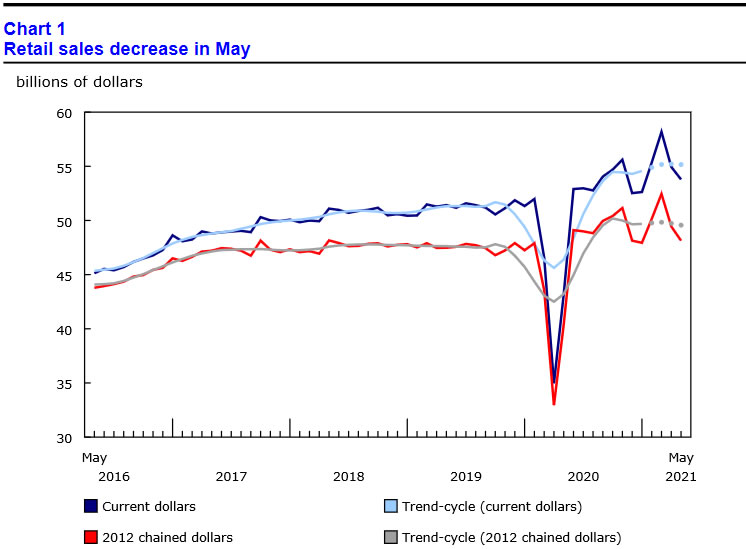
Canada retail dales dropped -2.1% in May, more contraction expected in June
Canada retail sales dropped -2.1% mom to CAD 53.8B in May, better than expectation of -3.0% mom decline. The largest declines occurred at building material and garden equipment and supplies dealers (-11.3%) and motor vehicle and parts dealers (-2.4%). Sales decreased in 8 of 11 subsectors, representing 65.6% of retail trade. Advance estimate showed further -4.4% mom contraction in retail sales in June.
ECB dissenter Wunsch not comfortable taking a commitment for five or six years
ECB Governing Council member Pierre Wunsch confirmed to CNBC that he voted against the central bank's new forward guidance. But he urged that "my dissent shouldn't be dramatized," as "we all agree we want to be supportive in this phase of the recovery, we all actually want to go to 2%".
"The most important conclusion of the retreat actually, and our new strategy, is what I would call a 'no regret' conclusion, in that we all agree that what we have been doing in the last few years was necessary and proportional," Wunsch said.
"The question is whether this proportionality test that we are going to have to make in the future — whether we can remain proportional in what we do and take commitments over a long period of time, like five or six years in the future."
"We might be faced with issues of fiscal dominance, issues of financial dominance, and I just, at the end of the day, did not feel comfortable taking a commitment for five or six years."
Euro Yawns After ECB Meeting
It has been a very quiet day for the euro. In North American trade, EUR/USD is trading at 1.1772, up 0.01% on the day.
ECB changes forward guidance
On Thursday, the ECB met for the first time since releasing its strategy review. The markets were buzzing ahead of the policy meeting, as ECB President Christine Lagarde had telegraphed to the markets that the central bank would align its forward guidance with the review.
As promised by Lagarde, the ECB did shift the language in its forward guidance. The new inflation target was revised upwards to 2%, compared to the previous “below, but close to 2%”. The second change was more controversial. The previous guidance stated that the Bank would maintain current interest rates until it was satisfied that inflation was approaching the target. The new guidance states that the ECB will not raise rates until inflation reaches the 2% target “well ahead of its projection horizon and durably” – clearly, this new language is more dovish. Some members objected to this language, but in the end, Lagarde won the day.
These changes to the forward guidance are significant because the ECB’s stance has become that much more dovish. The ECB is not showing any intent to taper QE and is not concerned about very low levels of inflation. This stance could have soured investors and sent the euro lower, but it seems that the markets priced in this dovish position and the euro’s reaction was muted.
With interest rate hikes now less likely than before the meeting, the euro will find itself under even more pressure. The euro was basking above 1.22 at the beginning of June, and the prolonged downturn could well continue.
German and eurozone PMIs continued to impress in July, with readings above the 60-level. This indicates strong expansion in the manufacturing and services sectors, both of which are critical drivers of economic growth. German Manufacturing PMI was particularly sharp with a read of 65.6, up from 65.1 points.
EUR/USD Technical
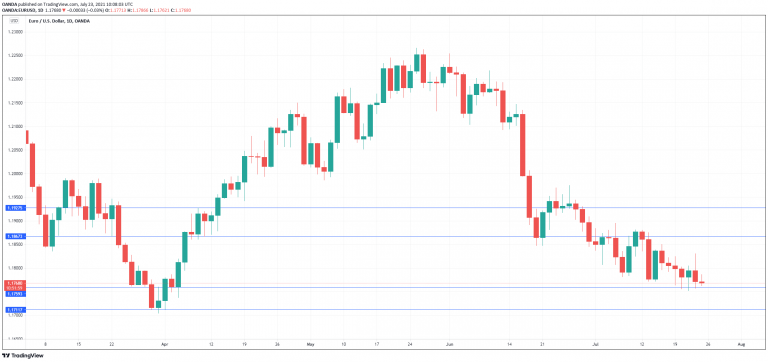
- On the downside, 1.1759 remains under pressure. Below, there is support at 1.1711
- There is resistance at 1.1867 and 1.1927
EU Data Mixed In Session As Post-Lockdown Euphoria Was Starting To Ease
Notes/Observations
- Major European PMI readings mixed in session (Beats: Euro Zone, Germany; Misses: France, UK); Survey suggests post-lockdown euphoria was starting to ease.
- UK retail sales data rose aided by temporary boost to food spending from the Euro 2020 soccer tournament.
- ECB forecasters raised their inflation outlook across the horizon but remaining below the ECB’s 2% symmetrical target.
Asia
- Australia July Preliminary PMI Manufacturing registered its 14th month of expansion (56.8 v 58.6 prior).
- Deputy Sec of State Sherman (#2 at State Dept) to meet with China's Wang Yi on Sun, July 25th.
Coronavirus
- Total global cases 193.4M (+0.3% d/d);total deaths: 4.15M (+0.2% d/d).
- Australia New South Wales (NSW) Premier: Coronavirus situation in parts of Sydney considered national emergency; Would not be able to lift restrictions in Sydney by July 30th.
Europe
- ECB's Weidmann (Germany) and Wunsch (Belgium) were said to oppose the ECB's new rate guidance. Several more members had voiced some objection to the length of commitment to loose monetary policy and lack of clarity. ECB held lengthy discussion on whether inflation overshoot would be intentional or incidental.
- Italy PM Draghi: Domestic economy is doing well, outperforming growth of some EU peers.
Americas
- White House Press Sec Psaki stated that there was clear momentum on infrastructure bill.
Speakers/Fixed income/FX/Commodities/Erratum
Equities
- Indices [Stoxx600 +0.64% at 459.46, FTSE +0.69% at 7,016.45, DAX +0.58% at 15,604.65, CAC-40 +0.76% at 6,530.79, IBEX-35 +0.64% at 8,677.00, FTSE MIB +0.79% at 25,000.50, SMI +0.84% at 12,077.37, S&P 500 Futures +0.41%].
- Market Focal Points/Key Themes: European indices open modestly higher across the board; better performing sectors lead by materials and industrials; while underperformers include technology and health care; improved risk sentiment attributed to a return of reflation trading; tech stocks weighed on following disappointing results from Intel; NatWest discloses terms of sale of Irish assets; Ultra Electronics receives offer from Cobham; earnings expected during the upcoming US session include Regions Financial, Honeywell and Slumberger.
Equities
- Consumer discretionary: Stockmann [STCBV.FI] +21% (earnings).
- Financials: Danske Bank [DANSKE.DK] -4% (earnings).
- Industrials: Thales [HO.FR] +1.5% (earnings), Skanska [SKAB.SE] +5% (earnings).
- Technology: Ultra Electronics [UKE.UK] +33% (offer).
- Telecom: Vodafone [VOD.UK] +3% (earnings).
Speakers
- ECB's Villeroy (France) state that the 2% CPI target needed to be 12-18 months away before rate hike. Justified to keep ECB accomodative policy. Would look again at the ECB's asset purchase program this autumn. ECB has three more meetings in 2021.
- ECB's Wunsch (Belgium) noted that dissent on forward guidance should not be dramatized, confirmed he was not comfortable making rate commitment for such a long time.
- ECB Survey of Professional Forecasters raised its inflation and GDP forecasts. Raised its 2021 HICP (EU Harmonized CPI) from 1.6% to 1.9% and 2022 HICP forecast from 1.3% to 1.5%. Raised its 2021 GDP growth from 4.2% to 4.7% (**Note: ECB Jun Staff Forecast is 4.6%) and also raised its 2022 GDP growth outlook from 4.1% to 4.6%.
- EU commented on vaccine passports and that talks with UK were at advance stage. It hoped for vaccine passport with Canada by September and added that discussion with US were not progressing.
- China Foreign Ministry spokesman Zhao Lijian confirmed that US's Sherman to meet with Wang Li.
- China FX Regulator SAFE reiterated stance to keep CNY currency (Yuan) basically stable in 2021. It noted that fX fluctuations reflected uncertainty. Risks were controllable from Fed policy. Expected export growth to slow down in H2 and normalize.
Currencies/ Fixed income
- USD was steady despite a rise in risk appetite. Focus turning to next week’s FOMC rate decision.
- EUR/USD stayed below the 1.18 level as dealers continued to digest the ECB decision. The forward guidance released on Thursday meant that interest rates would stay lower for longer.
- GBP/USD inched higher to test 2-week highs aided by recent data which confirmed the economic recovery was progressing after volatile lockdown month. However, the PMI reading suggested that UK post-lockdown euphoria was starting to ease.
Economic data
- (UK) Jun Retail Sales (ex-auto/fuel) M/M: 0.3% v 0.1%e; Y/Y: 7.4% v 7.6%e.
- (UK) Jun Retail Sales (including auto/fuel) M/M: +0.5% v -0.1%e; Y/Y: 9.7% v 9.5%e.
- (ES) Spain May Total Mortgage Lending Y/Y: 39.5% v 38.7% prior; House Mortgage Approvals Y/Y: 37.4% v 32.1% prior.
- (MY) Malaysia mid-July Foreign Reserves: $111.1B v $111.1B prior.
- (FR) France July Preliminary PMI Manufacturing: 58.1 v 58.3e (8th month of expansion); PMI Services: 57.0 v 58.8e; PMI Composite: 56.8 v 58.4e.
- (DE) Germany July Preliminary PMI Manufacturing: 65.6 v 64.1e (13th month of expansion); PMI Services: 62.2 v 59.5e; PMI Composite: 62.5 v 60.7e.
- (SE) Sweden Jun PPI M/M: 1.5% v 1.3% prior; Y/Y: 9.6% v 7.9% prior.
- (CN) Weekly Shanghai copper inventories (SHFE): 96.1K v 113.6K tons prior.
- (EU) Euro Zone July Preliminary PMI Manufacturing: 62.6 v 62.5e (13th month of expansion); PMI Services: 60.4 v 59.3e; PMI Composite: 60.6 v 60.0e.
- (PL) Poland Jun Unemployment Rate: 5.9% v 6.0%e.
- (RU) Russia Narrow Money Supply w/e July 16th (RUB): 14.25T v 14.15T prior.
- (TW) Taiwan Jun Industrial Production Y/Y: 18.4% v 12.5%e.
- (TW) Taiwan Jun M1 Money Supply Y/Y: 17.4% v 17.4% prior; M2 Money Supply Y/Y: 9.2% v 9.2% prior.
- (UK) July Preliminary PMI Manufacturing: 60.4 v 62.4e(14th straight expansion); PMI Services: 57.8 v 62.0e; PMI Composite: 57.7 v 61.5e.
- (IS) Iceland July CPI M/M: 0.2% v 0.3% prior; Y/Y: 4.3% v 4.3% prior.
Fixed income issuance
- None seen.
Looking ahead
- 05:25 (EU) Daily ECB Liquidity Stats.
- 05:30 (ZA) South Africa to sell combined ZAR1.2B in I/L 2029, 2038 and 2050 Bonds.
- 05:30 (IN) India to sell combined INR260B in 2023, 2031 and 2061 bonds.
- 06:00 (UK) DMO to sell £3.0B in 1-month, 3-month and 6-month bills (£0.5B, £1.0B and £1.5B respectively).
- 06:30 (RU) Russia Central Bank (CBR) Interest Rate Decision: Expected to raise 1-Week Key Auction Rate by 7100bps to 6.50%.
- 06:45 (US) Daily Libor Fixing.
- 07:00 (MX) Mexico May Retail Sales M/M: +0.5%e v -0.4% prior; Y/Y: 28.5%e v 30.1% prior.
- 07:00 (IN) India announces upcoming bill issuance (held on Wed).
- 07:30 (IN) India Weekly Forex Reserve w/e July 16th: No est v $611.9B prior.
- 08:00 (BR) Brazil Mid-July IBGE Inflation IPCA-15 M/M: 0.7%e v 0.8% prior; Y/Y: 8.5%e v 8.1% prior.
- 08:00 (UK) Daily Baltic Dry Bulk Index.
- 08:30 (CA) Canada May Retail Sales M/M: -3.0%e v -5.7% prior; Retail Sales (ex-auto) M/M: -1.5%e v -7.2% prior.
- 09:00 (CL) Chile Jun PPI M/M: No est v 6.3% prior.
- 09:45 (US) July Preliminary Markit PMI Manufacturing: 62.0e v 62.1 prior; PMI Services: 64.5e v 64.6 prior; PMI Composite: No est v 63.7 prior.
- 11:00 (EU) Potential sovereign ratings after European close.
- 13:00 (US) Weekly Baker Hughes Rig Count.
USD Edges A Bit Higher
The dollar seems about to end the week where it begun, maybe a bit higher after a roller coaster week where fluctuation was determined by market appetite which shifted from risk off to risk on while attention is now being placed on the Fed’s meeting next Wednesday. US stocks traded mixed given also that the initial jobless claims figure released for past week took the markets by surprise as it came out higher than expected nevertheless, big-cap tech stocks seem to continue to drive the markets higher. The price of gold showed little volatility rising a bit yesterday yet relenting most of the gains during today’s Asian session and seem about to end the week lower for the first time in five consecutive weeks being in the greens. We see the case for the markets to keep their eyes on today’s financial releases while fundamentals could still affect the markets.
Nasdaq continued to rise yesterday aiming for the 15000 (R1) resistance line, which marks an all time high level for the index. We maintain a bullish outlook for the index as long as it remains above the upward trendline incepted since the 19th of July. Please note that the RSI indicator below our 4-hour chart is at the reading of 70, which on the one hand confirms the bulls dominance, yet on the other hand it may imply that the index is oversold and a correction lower is possible. Should the bulls actually maintain control over the index, we may see it breaking the 15000 (R1) all time high level, with the next possible stop maybe on the 15175 (R2) level. Should a correction lower take place and the bears take over, we may see the index breaking the 14825 (S1) support line and aim for the 14650 (S2) support level.
After the ECB, EUR traders focus on July’s PMIs
The common currency slipped lower against the USD yesterday as it also did against the pound and the Japanese yen after ECB’s interest rate decision, which remained on hold, yet failed to impress EUR traders overall. The bank maintained a dovish tone as it tweaked its guidance in order to better reflect its recently slightly elevated inflation target and pledged to keep a “persistently accommodative” stance until its inflation target is met consistently. Today EUR traders could be focusing on the release of the area’s preliminary PMI figures for July with the heavy-point of interest being at Germany’s manufacturing PMI as it encapsulates the economic activity for the spearhead of Eurozone’s economy.
EUR/USD slipped yesterday, breaking below the 1.1785 (R1) support line, now turned to resistance. We tend to maintain a bias for a sideways motion as the pair’s price action seems to revolve around the 1.1785 (R1) level. Please note that the RSI indicator below our 1-hour chart is below the reading of 50, which may imply a slight advantage for the bears. Should the pair come under the selling interest of the market, we may see it breaking the 1.1695 (S1) support line and aim for lower grounds. Should buyers be in control of the pair’s direction, we may see EUR/USD breaking for the 1.1785 (R1) resistance line and aim for the 1.1885 (R2) resistance level.
Other economic highlights today and the following Asian session:
Today during the European session we get UK’s retail sales growth rate for June and the preliminary PMI readings of France, Germany, the Eurozone and the UK for the month of July. In the American session we get Canada’s retail sales for May, and from the US the preliminary PMI readings for July, while oil traders may be more interested in the release of the weekly Baker Hughes oil rig count. During Monday’s Asian session, we get New Zealand’s trade data for June and from Japan the preliminary Jibun bank manufacturing PMI for July.
US 100 Cash H1 Chart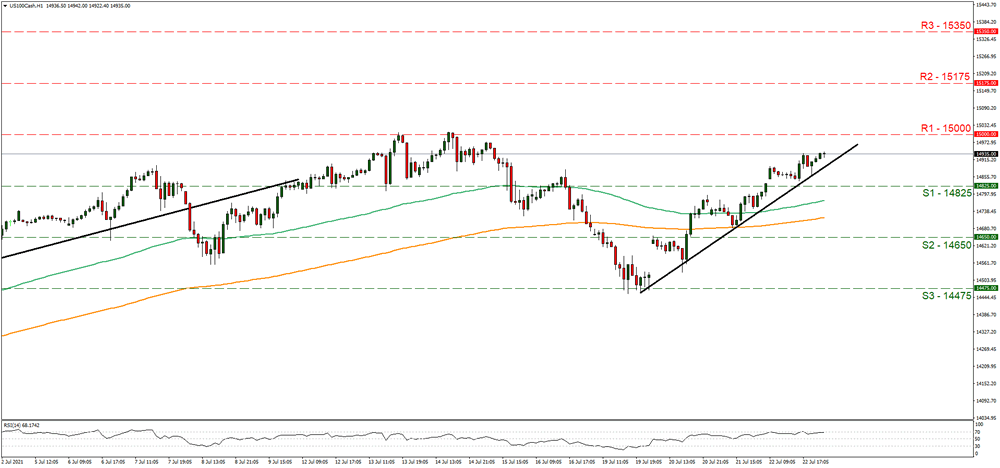
Support: 14825 (S1), 14650 (S2), 14475 (S3)
Resistance: 15000 (R1), 15175 (R2), 15350 (R3)
EUR/USD H4 Chart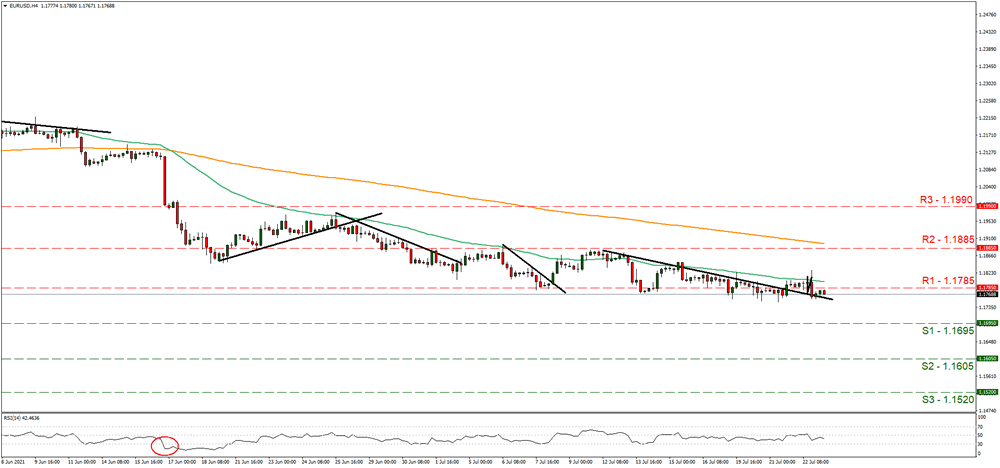
Support: 1.1695 (S1), 1.1605 (S2), 1.1520 (S3)
Resistance: 1.1785 (R1), 1.1885 (R2), 1.1990 (R3)
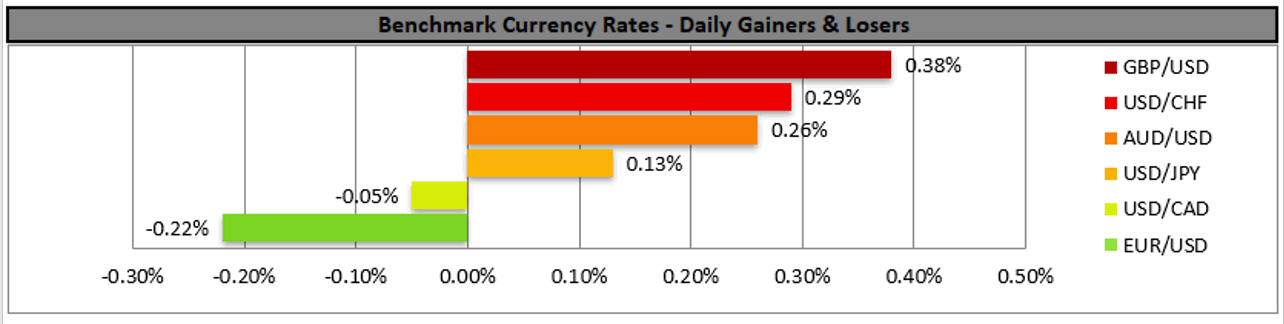
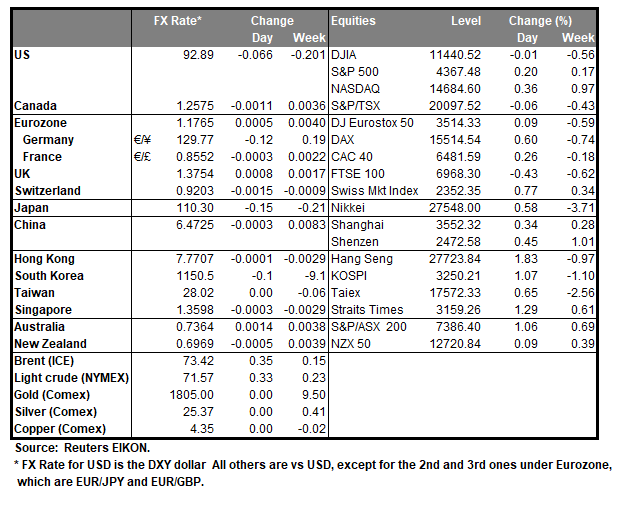
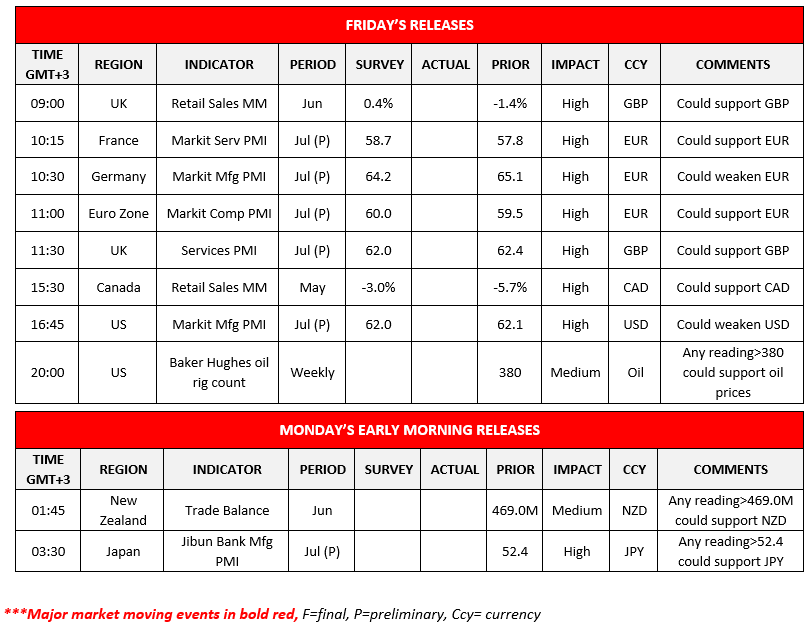
The Analytical Overview Of The Main Currency Pairs
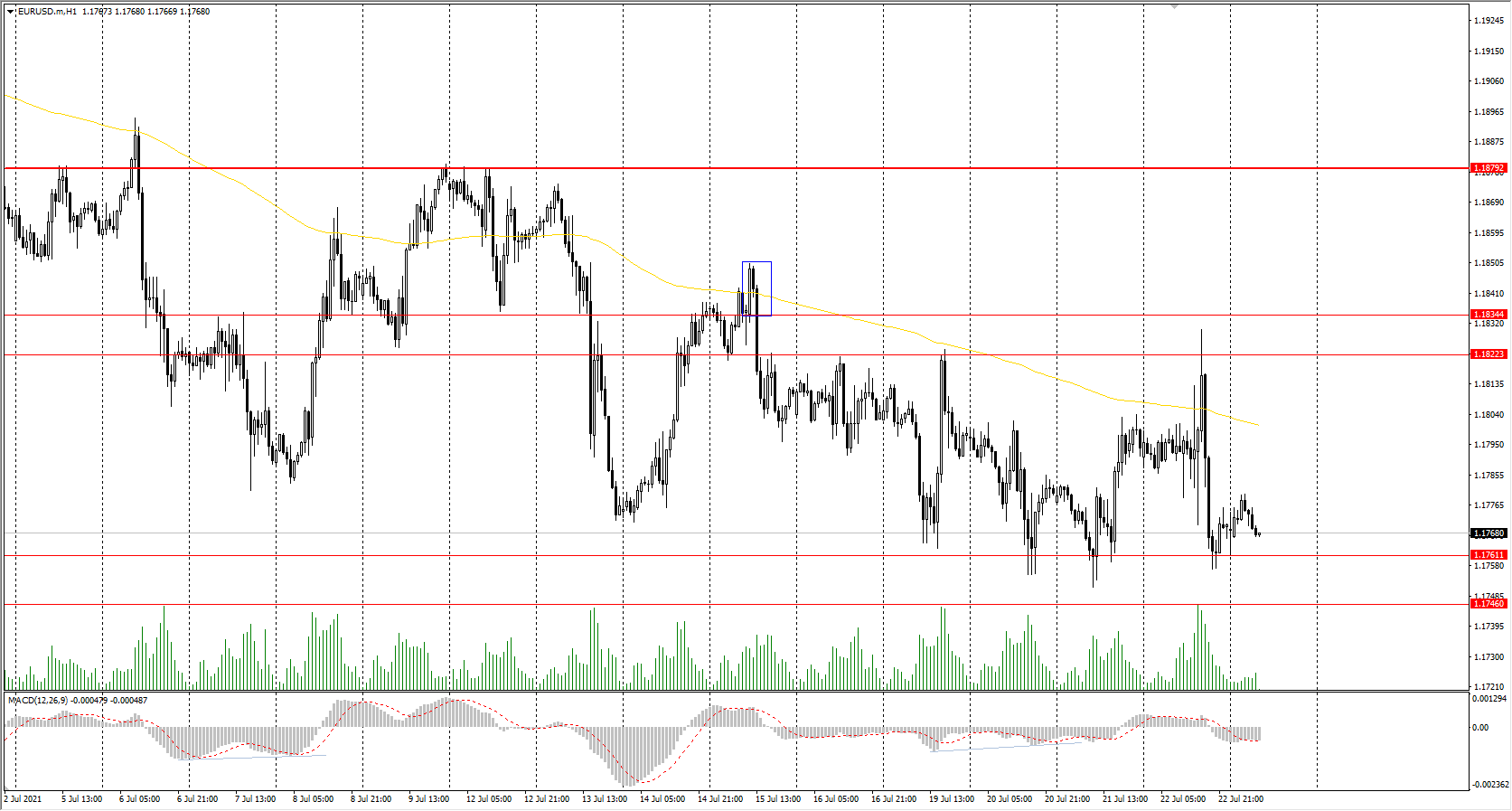
The EUR/USD currency pair
Technical indicators of the currency pair:
Prev Open: 1.1791
Prev Close: 1.1771
% chg. over the last day: -0.17%
The ECB is more tolerant of rising inflation. Also, the ECB assumes that there will be a "transitory period" of inflation when it may be moderately above the target level. But the seriousness and duration of this deviation is not specified. Many economists said that this policy has no teeth.
Trading recommendations
Support levels: 1.1761, 1.1746, 1.1609
Resistance levels: 1.1822, 1.1834, 1.1879, 1.1934, 1.1969
From the technical point of view, the trend is still bearish. There was a widening of the price range with the release of the ECB news, and the price decreased by 0.17% compared to yesterday. Investors evaluate the further policy of the ECB negatively, which will put pressure on the EUR/USD quotes. Under such market conditions, traders should look for sell positions from the resistance levels. It is better to put buy positions aside for a while or consider intraday trading with very short targets.
Alternative scenario: if the price breaks through the 1.1879 resistance level and fixes above, the general uptrend is likely to be resumed.
News feed for 2021.07.23:
- France Manufacturing PMI (m/m) at 10:15 (GMT+3);
- Germany Manufacturing PMI (m/m) at 10:30 (GMT+3);
- Eurozone Manufacturing PMI (m/m) at 11:00 (GMT+3);
- Eurozone Service PMI (m/m) at 11:00 (GMT+3);
- US Manufacturing PMI (m/m) at 16:45 (GMT+3);
- US Service PMI (m/m) at 16:45 (GMT+3).
The GBP/USD currency pair
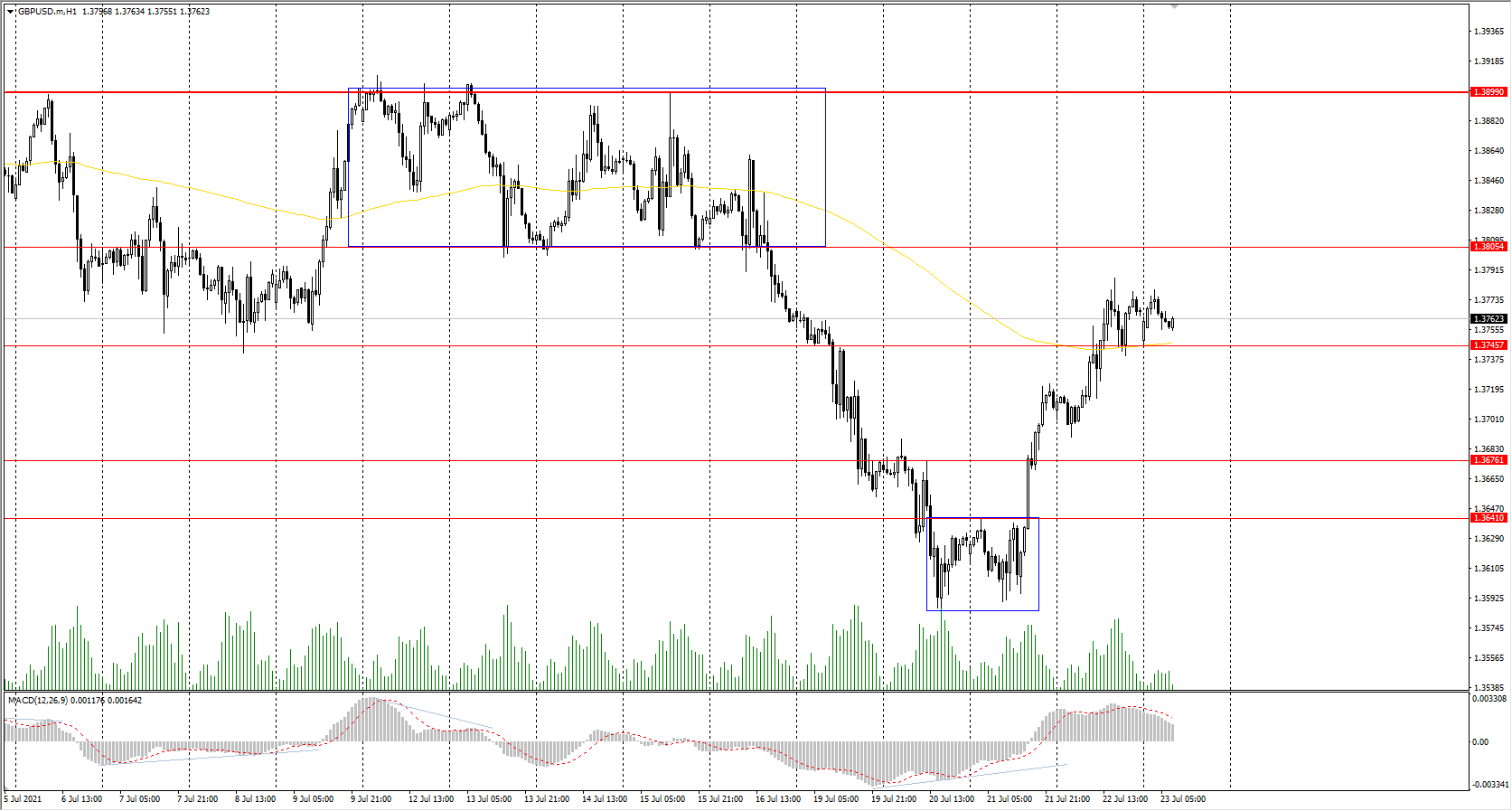
Technical indicators of the currency pair:
Prev Open: 1.3707
Prev Close: 1.3767
% chg. over the last day: +0.44%
The British pound gained more confidence than the euro. Because of the Brexit deal, relations between Britain and the EU are becoming more complicated from the economic and trading perspectives. This is especially true for Ireland, where many families from Britain live and which remains in the European Union.
Trading recommendations
Support levels: 1.3745, 1.3676 ,1.3641, 1.3614, 1.3525
Resistance levels: 1.3805, 1.3899, 1.3923, 1.4002, 1.4075, 1.4101
The trend on the GBP/USD currency pair is downward on the H1 timeframe. But the buyers have been showing initiative for the second day in a row and do not allow the price to roll back. The MACD indicator is in the positive zone, but with signs of weakness. Under such market conditions, traders are better to look for both sell deals from the resistance levels within the trend and buy deals from the support levels, but only on the intraday timeframes and with short targets.
Alternative scenario: if the price breaks through the 1.3839 resistance level and consolidates above, the bearish scenario is likely to be canceled.
News feed for 2021.07.23:
- UK Retail Sales (m/m) at 09:30 (GMT+3);
- UK Manufacturing PMI (m/m) at 11:30 (GMT+3);
- UK Service PMI (m/m) at 11:30 (GMT+3);
- UK Composite PMI (m/m) at 11:30 (GMT+3).
The USD/JPY currency pair
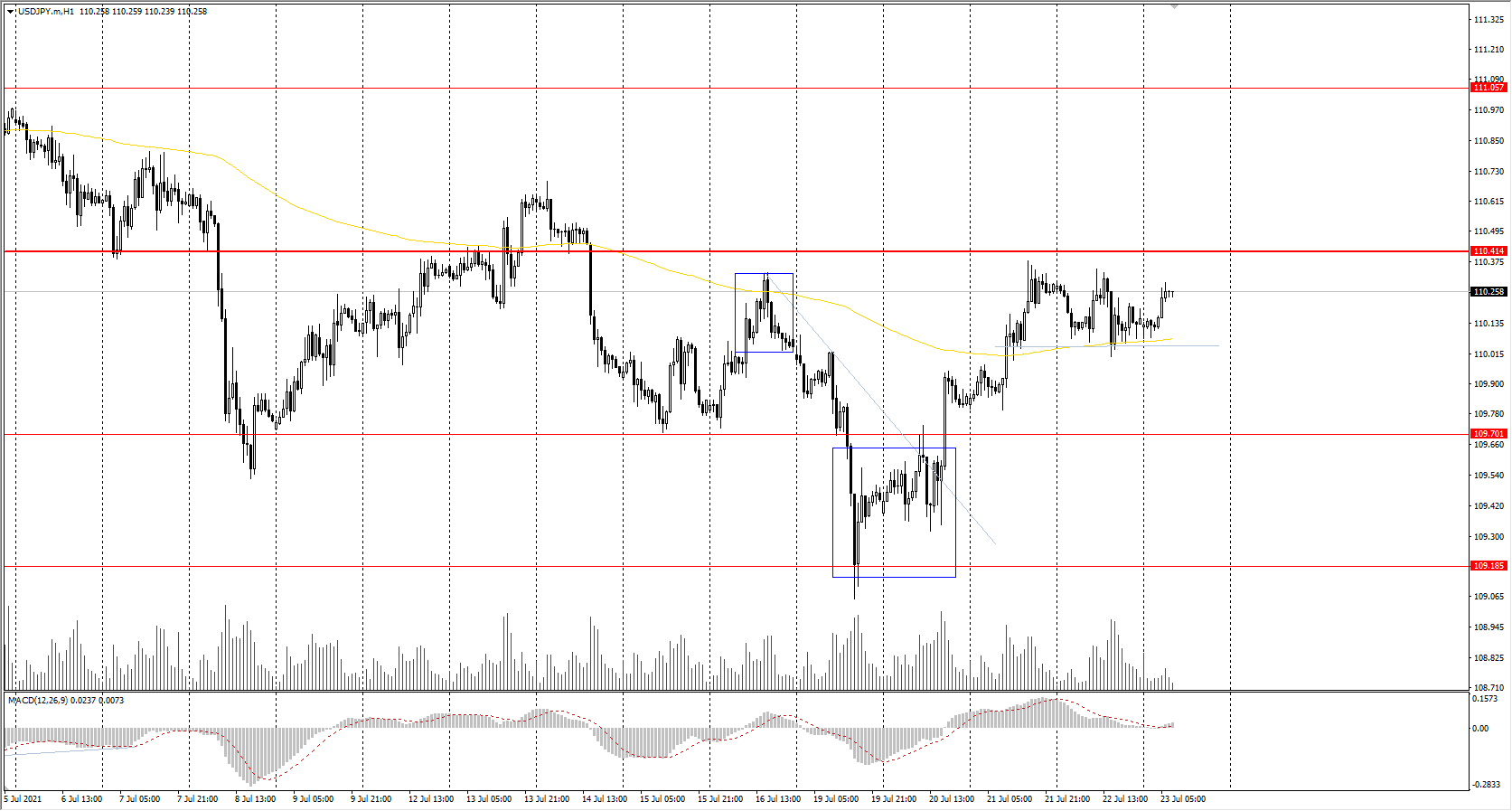
Technical indicators of the currency pair:
Prev Open: 110.26
Prev Close: 110.15
% chg. over the last day: -0.10%
The situation with the USD/JPYcurrency pair didn't change much. The price is accumulating near the priority change level now, which is one of the signs of the emerging breakthrough. It’s also a bank holiday in Japan today (Sports Day), so the movement will depend on the dollar index.
Trading recommendations
Support levels: 109.70, 109.19, 108.65
Resistance levels: 110.41, 110.73, 111.06, 111.48, 110.73, 112.18
From the point of view of technical analysis, the situation has not changed. There is a downward trend on the H1 timeframe, as the price is still trading below the priority change level. But the price managed to rise above the moving average, which indicates some buying pressure. The MACD indicator became inactive. Under such market conditions, traders can look for sell trades from the resistance levels. Buy positions should be considered from the support levels after a pullback below or after a breakthrough of 110.41 level.
Alternative scenario: if the price rises above 110.41, the uptrend is likely to be resumed.
The USD/CAD currency pair
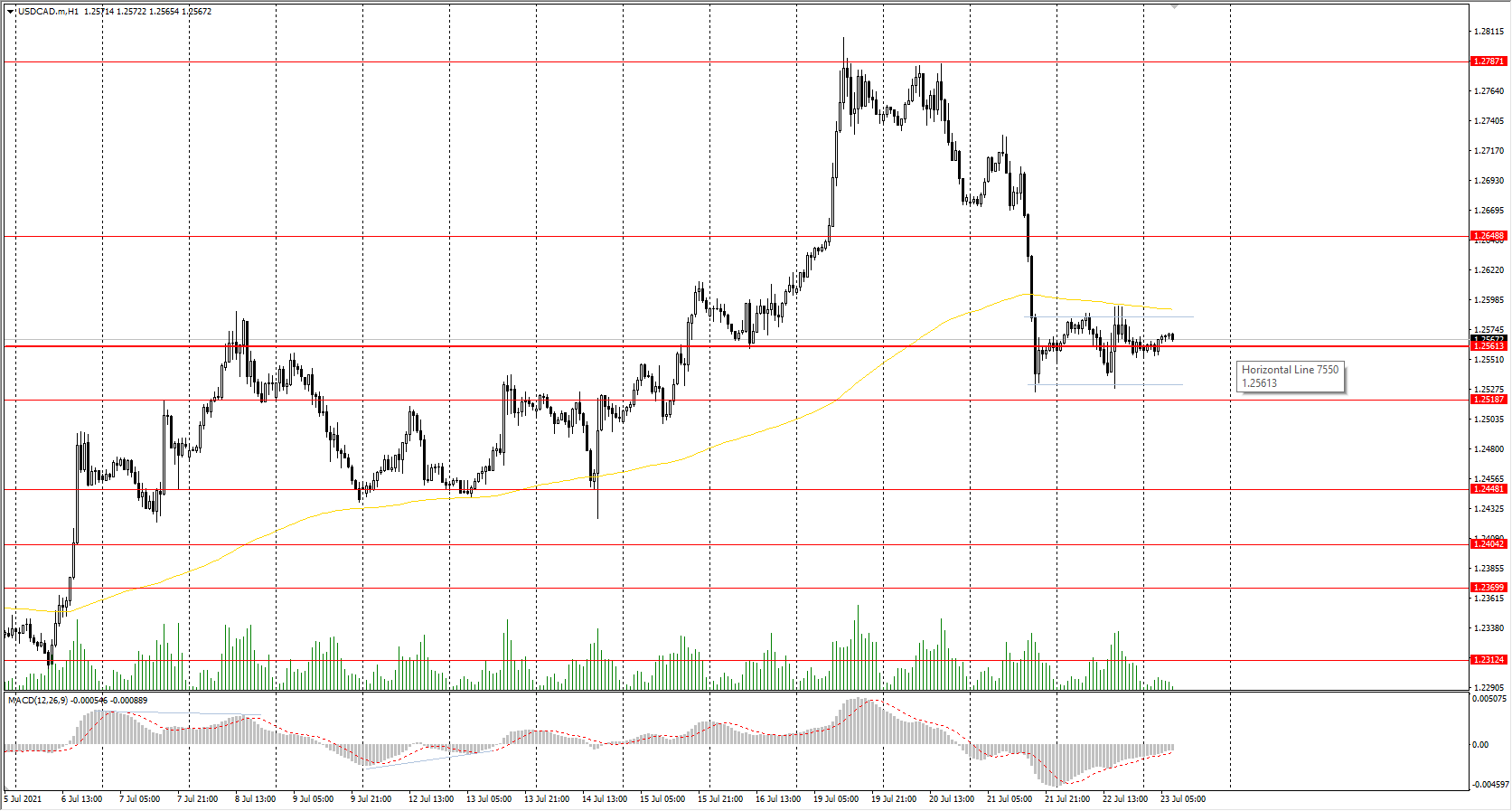
Technical indicators of the currency pair:
Prev Open: 1.2564
Prev Close: 1.2560
% chg. over the last day: -0.03%
The situation with the USD/CAD currency pair has not changed. The Canadian dollar is a commodity currency and is highly dependent on oil price movements. Oil price reached the resistance level yesterday, while the USD/CAD currency pair dropped to the support level, which is also the priority change level.
Trading recommendations
Support levels: 1.2561, 1.2519, 1.2448, 1.2404, 1.2347, 1.2312
Resistance levels: 1.2649, 1.2787, 1,2951
Technically, the trend remains bullish. But the price is trading right at the priority change level. This behavior often occurs before a breakthrough. But it is better for traders to play it safe and take action only after the price moves to one side of the narrow price range.
Alternative scenario: if the price breaks through the 1.2561 support level and fixes below, the downtrend is likely to be resumed.
News feed for 2021.07.23:
- Canada Retail Sales (m/m) at 15:30 (GMT+3).
The US Labor Market Recovery Is Slowing Down. The ECB Did Not Make Any Changes
Yesterday, the data from the US Labor Department showed that initial jobless claims increased by 51,000 to 419,000 last week, the highest level within the last 2 months. But the news didn’t affect the stock indices that much, as corporate earnings of reporting companies are pushing the indices up. But many analysts are sure that good company reports can't support the stock market all the time, and a severe correction may happen in the near future. August and September are statistically weak months for the indices, so according to Ryan Detrick, chief market strategist at LPL Financial, the next two months could be a serious test for the bullish trend, considering that the Federal Reserve will hold a monetary policy meeting next month. Any signs of QE cut could send the market into a 10% correction. In its turn, the websites of several major companies (Delta Air Lines, British Airways, Capital One, Vanguard, United Parcel Service, LastPass, AT&T, Costco) shut down due to a large-scale failure yesterday. The reasons for the failure will be specified later.
European indices closed Thursday’s trading in the green zone. The ECB expectedly kept the benchmark interest rate on loans at zero and the rate on deposits at -0.5%. The rate on marginal loans was left at 0.25%. These rates will remain in place until Eurozone inflation remains steadily above the 2% target. Pandemic Emergency Purchase Program (PEPP) asset purchases will continue at a significantly higher pace this quarter, which will have a negative impact on the European currency.
Oil prices returned to $70 a barrel. On Wednesday, the US crude supply data released by the EIA showed that inventories increased by just over 2 million barrels, ending an eight-week streak of declines. The EIA data also showed a 121.00 barrel drop in gasoline inventories, indicating that fuel demand remains strong during the summer season.
The US Treasury yields declined. Gold has an inverse correlation to government bond yields, so this picture plays in favor of rising gold and silver prices.
The Asian stock market closed yesterday without a single trend. The prospects for rapid recovery of Asian countries are reduced due to the low level of vaccination and the rapid spread of the Delta strain. New Zealand suspends its agreement with Australia to travel without any quarantine restrictions for at least eight weeks. Toyota announced new production shutdowns due to a shortage of components shipped from Southeast Asia. Analysts expect business activity in Asia to decline in the coming months.
Main market quotes:
- S&P 500 (F) 4,367.48 +8.79 (+0.20%)
- Dow Jones 34,823.35 +25.35 (+0.07%)
- DAX 15,514.54 +92.04 (+0.60%)
- FTSE 100 6,968.30 -29.98 (-0.43%)
- USD Index 92.86 +0.11 (+0.12%)
Important events for today:
- UK Retail Sales (m/m) at 09:30 (GMT+3);
- France Manufacturing PMI (m/m) at 10:15 (GMT+3);
- Germany Manufacturing PMI (m/m) at 10:30 (GMT+3);
- Eurozone Manufacturing PMI (m/m) at 11:00 (GMT+3);
- Eurozone Service PMI (m/m) at 11:00 (GMT+3);
- UK Manufacturing PMI (m/m) at 11:30 (GMT+3);
- UK Service PMI (m/m) at 11:30 (GMT+3);
- UK Composite PMI (m/m) at 11:30 (GMT+3);
- Canada Retail Sales (m/m) at 15:30 (GMT+3);
- US Manufacturing PMI (m/m) at 16:45 (GMT+3);
- US Service PMI (m/m) at 16:45 (GMT+3).
Stormy Week Ends With US Stocks At Record Highs
- Nasdaq 100 closes at new record as investors warm up to tech stocks
- Euro heads lower after ECB commits to negative rates for longer
- Global PMIs coming up to shed some light on recovery speed
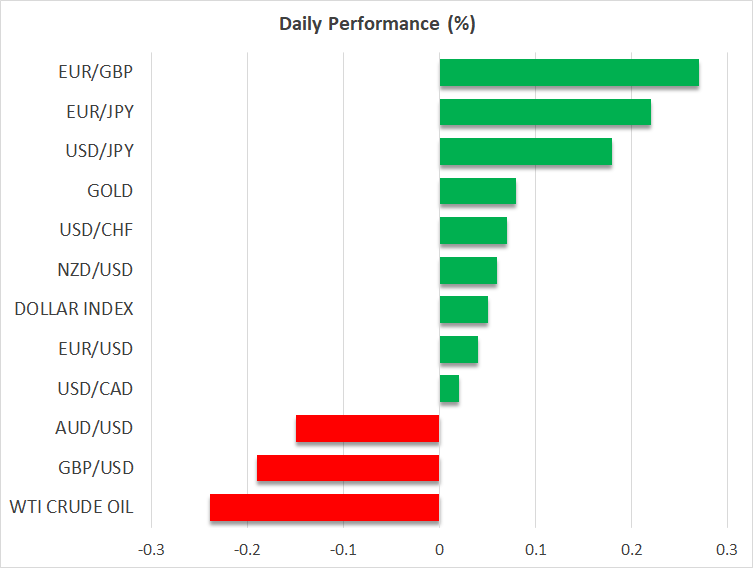
Delta blues fade
There was no shortage of volatility in financial markets this week. The week started with investors losing their cool over a slowdown in global growth as the rampaging Delta variant left its marks on several economies, but those worries soon faded into the rear-view mirror.
Markets seem to have concluded that this variant is a bigger problem for emerging economies with low vaccination rates, not so much for advanced countries. As such, US tech stocks came back in fashion as investors regained exposure to companies insulated from virus restrictions, pushing the Nasdaq 100 to a new record close yesterday.
Traders are working on the assumption that if the global health situation gets bad enough to hamstring US economic growth, then the Fed could keep the liquidity taps open for longer, limiting any downside in tech stocks especially. Monetary policy is essentially a free put option for equity investors, which helps explain the wild valuations many companies trade at.
Euro slides after ECB, stabilizes on PMIs
The European Central Bank moved towards a more dovish regime yesterday, committing not to raise interest rates for an even longer period of time. The underlying message was that the ECB will not join the tightening cycle that other major central banks like the Fed or the Bank of England might embark on over the next few years.
In the markets, the euro was little changed during the meeting but moved lower in the aftermath. It is now clear that the ECB along with the Bank of Japan will likely be the last central banks to normalize monetary policy this cycle, if they do at all. This implies that the dollar and the pound could outperform the euro and the yen moving forward as central bank divergence plays out.
That said, the euro found some solace in the Eurozone’s latest PMI surveys. Widespread vaccinations and the reopening boom continued to fuel economic activity in July, with the surveys suggesting growth is running at the fastest pace in two decades. The bad news is that businesses are becoming worried about the Delta variant and the risks it poses to the economy, hence the limited upside in the euro.
British and American PMIs coming up
We will also get a look at the latest PMIs from Britain and the US today. The story so far has been that everyone is recovering but America is at the tip of the spear. And with Congress getting ready to unleash another massive round of infrastructure spending in the coming years, the US economy could continue to outperform.
As for the dollar, the focus now turns to next week’s Fed meeting. The question is whether the central bank will plant the seeds for a tapering announcement at the Jackson Hole symposium in August, or whether it will play it slow and buy time to examine more employment data before making any decisions.
If markets sense that tapering is imminent, that could put the wind back into the dollar’s sails. Otherwise, any further dollar strength will likely have to wait until autumn.
The earnings season will also kick into full gear next week, with most of the tech titans reporting their quarterly results. Apple, Microsoft, Facebook, Google, Tesla, and many others will be under the microscope. These could decide whether the latest rally continues or cools down.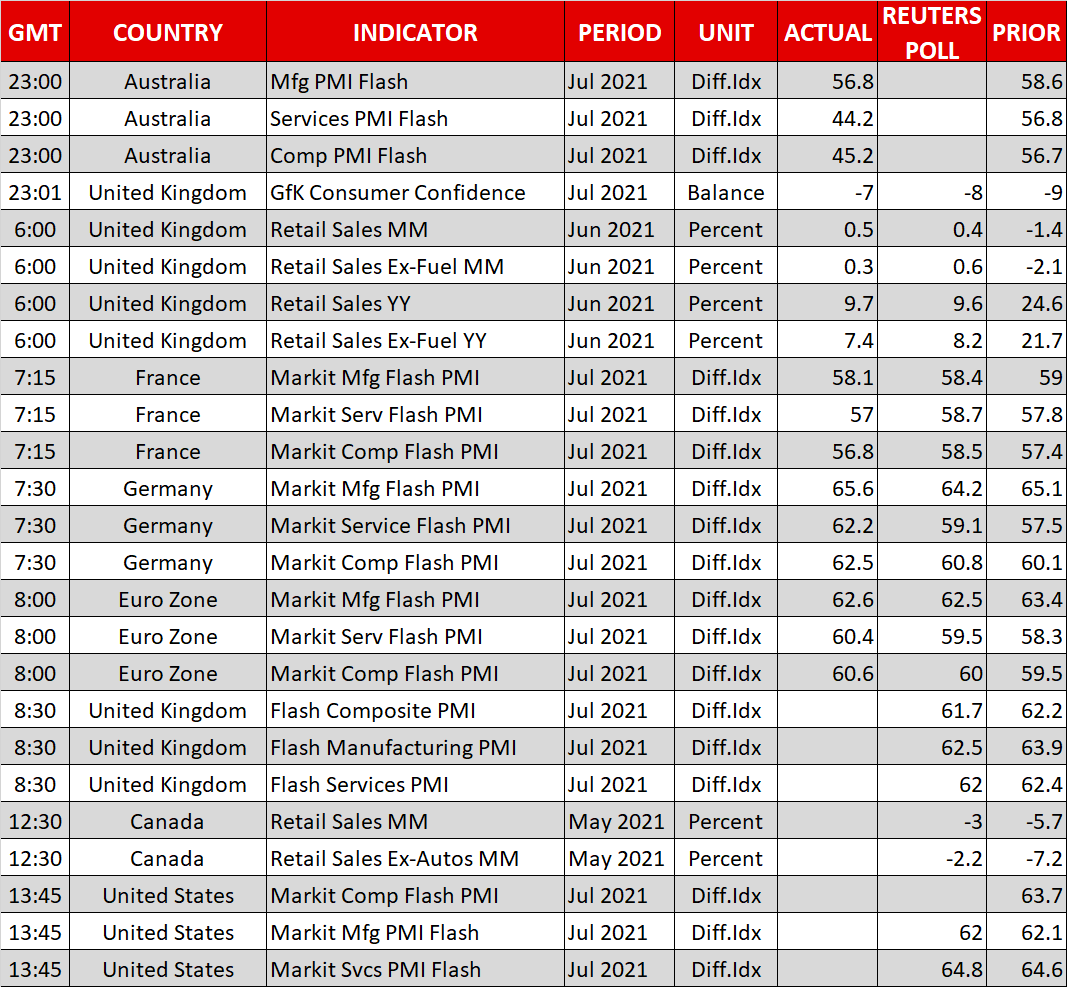
USDCAD Recoils Beneath 200-SMA But Upside Still Active
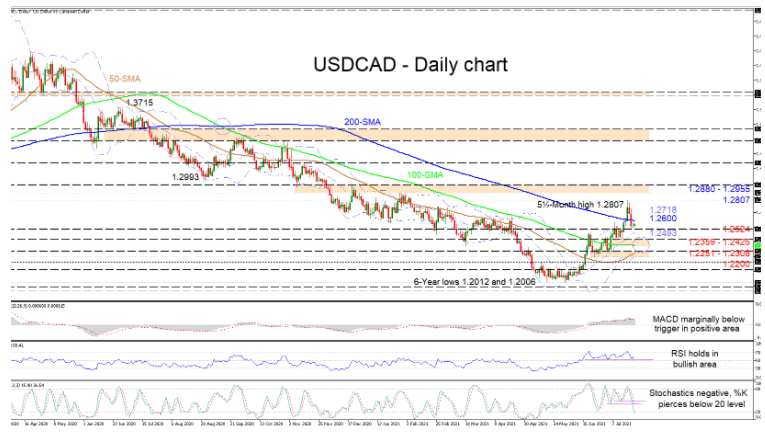
USDCAD’s seven-week uptrend from the 6-year lows remains structurally intact with shaped higher lows and highs, in spite of the fresh pullback from the peak of 1.2807. Upside sentiment appears to be growing, something also being indicated by the softened negative slopes of the 100- and 50-day simple moving averages (SMAs). Furthermore, the rising 50-day SMA is steering for a possible bullish crossover of the flattening 100-day SMA, which ultimately could confirm upside improvements should positive price action intensify.
The short-term oscillators are currently mixed however have yet to signal negative forces as the frontrunners. In bullish regions the MACD has slid a tad beneath its red trigger line, while the RSI is trying to sustain its pivot northward prior to reaching the 50 threshold. The negative charge of the stochastic oscillator has yet to show signs of slowing, signalling strong buying interest is still absent.
Trying to preserve the structure of the recent uptrend, buyers may face initial resistance from the capping 200-day SMA at 1.2600. If buyers gather adequate forces and beat the curbing 200-day SMA, they may then propel to test the upper Bollinger band at 1.2718 before revisiting the five-and-a-half-month high, which marginally overstepped the 1.2800 handle. Conquering the 1.2807 peak could reinforce upside tendencies bringing the resistance border of 1.2880-1.2955 quickly into play.
Otherwise, if sellers fuel another pullback, downside friction could commence from the immediate 1.2524 low and the rising mid-Bollinger band, approaching from below at 1.2493. Retracing further, the pair may then meet a support zone from the 1.2425 low until the 100-day SMA at 1.2359. Should this break down, the reinforced base of 1.2251-1.2308 could challenge the descent.
Summarizing, in order to safeguard the positive structure in USDCAD, the price would need to beat the 200-day SMA. Moreover, a push beyond 1.2807 could bolster buyers’ confidence, while a dip below the 1.2200 mark may reinstate power in the bigger bearish bias.
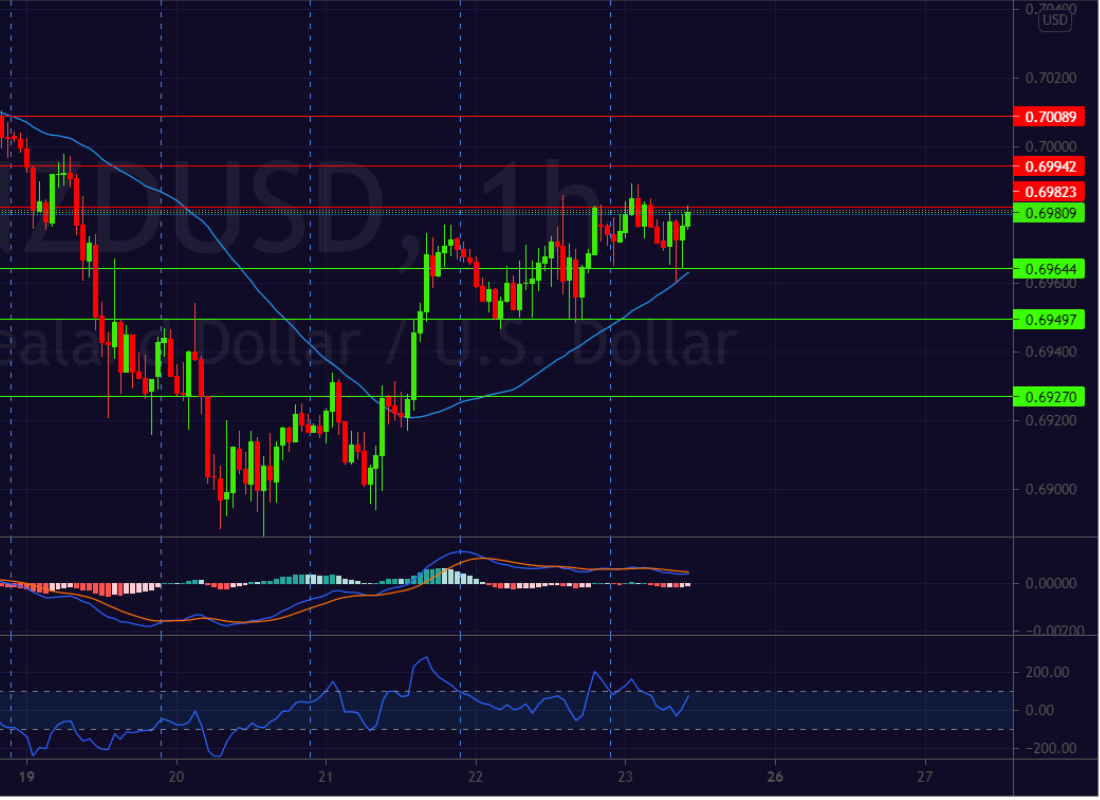
NZDUSD Is Possibly Bullish
Technical analysis
The CCI with the MACD indicates that the uptrend may prevail
The price is above MA(50), suggesting a possible movement upwards.
What the possible outcomes are
In our most likely scenario, the NZDUSD pair may attempt to break the first resistance level of 0.69823.
If the pair manages to surpass the first resistance level, we should expect a continued surge towards the second resistance level of 0.69942.
Contrarily, the pair may initially decline towards the first support level of 0.69644.
If the pair falls below the first support level, we can expect a continued downtrend towards the second support level of 0.69497.
Key levels
Support 0.69270 0.69497 0.69644
Resistance 0.69823 0.69942 0.70089