

Sample Category Title
Weekly Economic & Financial Commentary: ECB’s Easing Measures Going Nowhere Fast
United States: COVID Rise Jitters Financial Markets, while Housing Perks Up
- July's NAHB Housing Market Index slipped one point to 80. Housing starts beat expectations and rose 6.3% during June, although building permits fell 5.1%. Existing home sales climbed 1.4%. The Leading Economic Index (LEI) advanced 0.7% in June. Initial jobless claims rose to 419K for the week ended July 17.
- Next week: Durable Goods Orders (Tuesday), Q2 Real GDP (Thursday), Personal Income & Spending (Friday)
International: ECB's Easing Measures Going Nowhere Fast
- The European Central Bank made it clear at its monetary policy meeting this week that its main policy rates are unlikely to increase for the next few years amid a shift in its thinking about its inflation target. Eurozone PMI data for July were generally encouraging, but rising COVID cases present a downside risk.
- Next week: Canada CPI (Wednesday), Eurozone GDP (Friday)
Interest Rate Watch: Faster Growth and Inflation, Tapering Ahead, but Lower Rates?
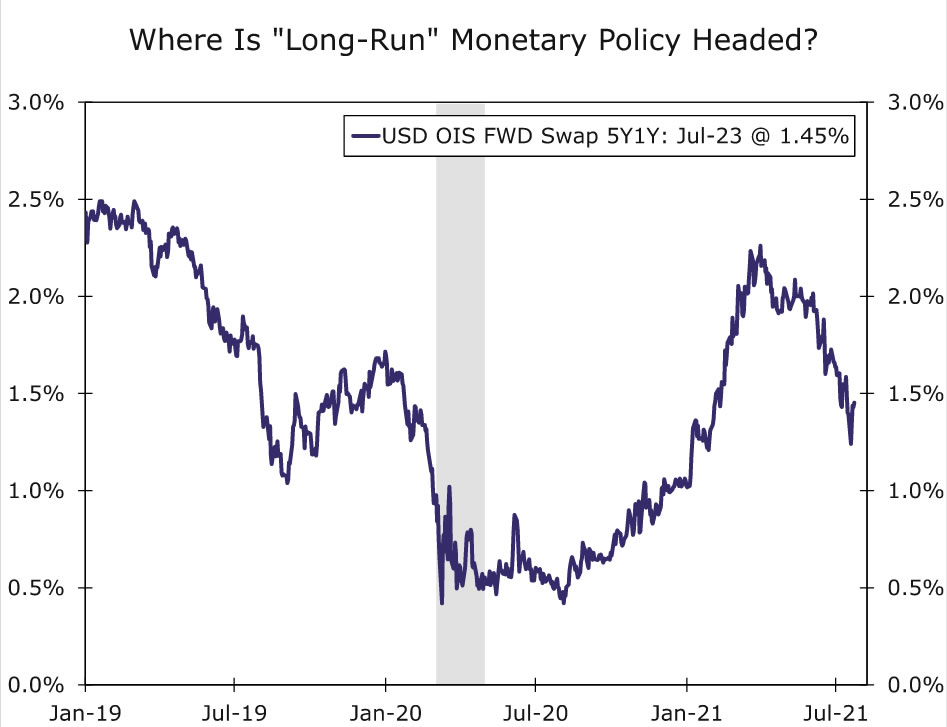
- When the 10-year Treasury yield peaked in late March, markets were pricing a fed funds rate of roughly 2.25% for that one-year period five years out, not too far from the FOMC's "long-run" dot of 2.50%. Fast-forward to today and market pricing has tumbled to less than 1.50% for roughly the same period.
Credit Market Insights: Will Canada’s Housing Market Sustain Its Frothiness?
- Around the world, house prices have been soaring, and Canada's housing market has emerged as one of the frothiest. While the Canadian economy is on track for a strong year in 2021, the lack of affordability and easing lending standards have raised some concerns.
Topic of the Week: Housing Is Moving Back into Balance
- While declining affordability and supply shortages have pressured housing activity in recent months, we believe the housing market is now beginning to come back into balance.
U.S. Review
COVID Rise Jitters Financial Markets, while Housing Perks Up
The week started off with a bang as an upturn in new COVID cases jittered financial markets. The Dow Jones Industrial Average fell almost 726 points on Monday, the sharpest one-day drop since last October. The yield on the 10-year Treasury note also fell nearly 10 bps to 1.18%. The drop was somewhat surprising, considering the spread of the Delta variant of the coronavirus is not necessarily breaking news. Cases have been climbing higher in Arkansas, Missouri, Louisiana and Florida for the past few weeks, mostly in areas with low vaccination rates. However, more recently, case counts in nearly every state have started to tick higher. Notably, Los Angeles County has seen an upturn in cases, which has prompted local officials to reimpose indoor mask mandates. Overall, case counts now moving in the opposite direction have raised the possibility that the economic recovery, which is still in its early innings, could be derailed if consumers head back indoors and more restrictions are imposed on businesses.
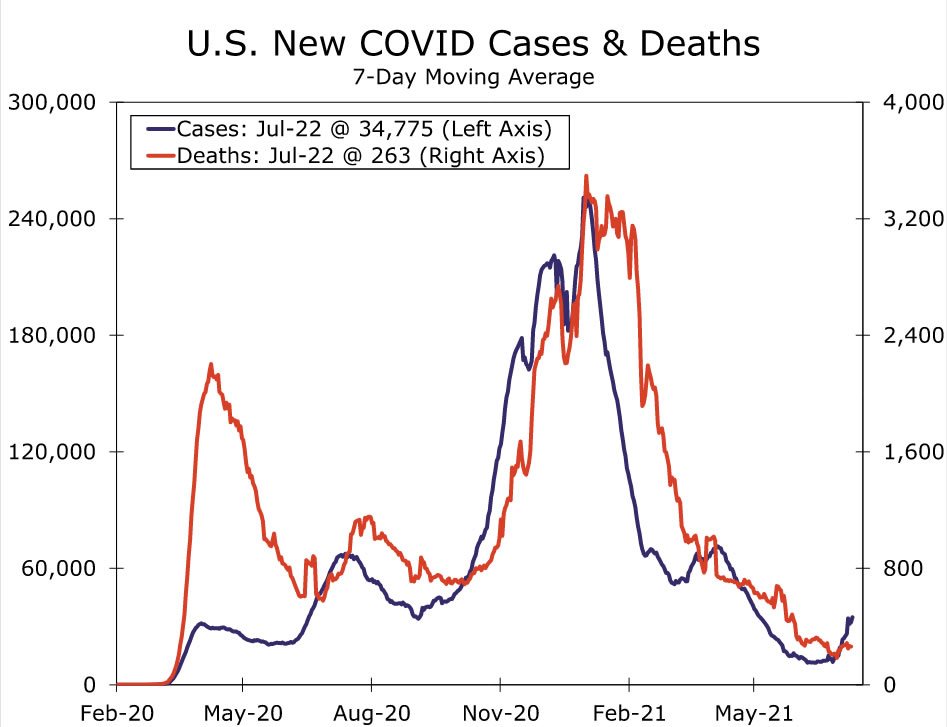
Financial markets mostly bounced back as the week moved on, as fears of a significant slowdown in economic growth were assuaged by better public health outcomes in Israel and the United Kingdom. Both countries have vaccinated a high percentage of their population and are currently battling a resurgence in cases. However, proportional rises in hospitalizations and deaths have not yet occurred, meaning vaccinations appear to be limiting the severe outcomes that would necessitate renewed restrictions. In the United Kingdom, officials pressed ahead with fully unwinding restrictions even with case counts ascending higher. For those reasons, at present, we do not anticipate a substantial slowdown in economic growth stemming from another COVID wave. That noted, we have recently adjusted our interest rate forecast to reflect the trend decline in longer-dated Treasury yields since the start of April. For more on the update to our interest rates forecast, please see the Interest Rate Watch.
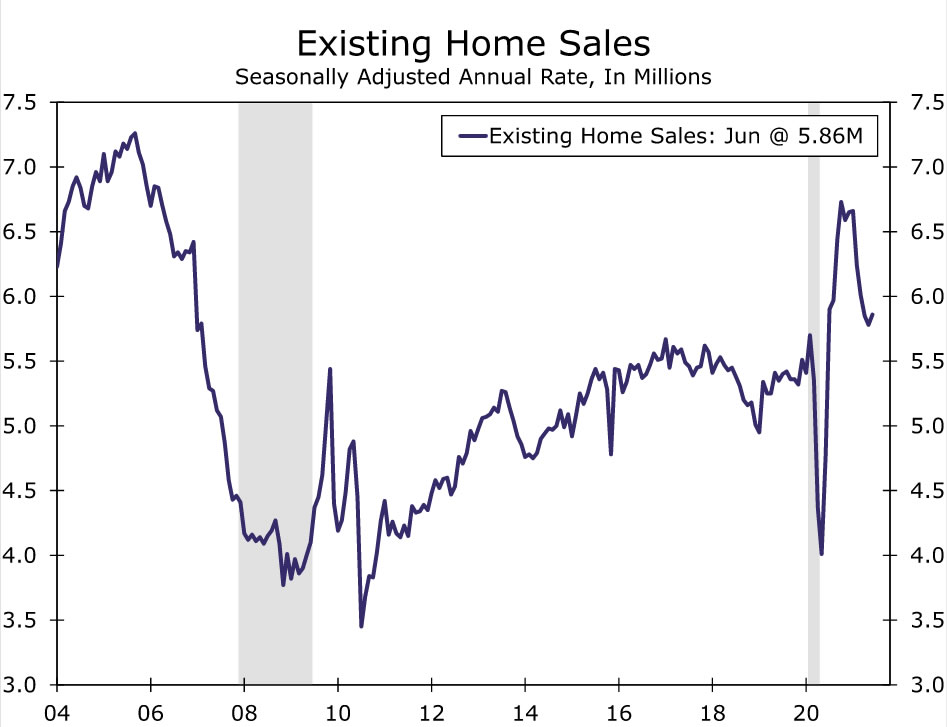
Elsewhere, housing activity appears to be stabilizing after slipping over the past few months. Existing home sales ended a four-month string of declines and rose 1.4% during June to a 5.86 million-unit pace. The turnaround is a reminder that, while home buying activity has cooled off this year alongside shrinking inventories and skyrocketing prices, underlying demand for homes remains strong. Home building also improved during June. Housing starts rose 6.3% during the month to a 1.643 million-unit pace, with both single-family and multifamily starts rising solidly. Building permits dropped for the third straight month. However, permitting has been running well ahead of starts, and some easing is not surprising, as home buying activity has cooled off a touch and building materials remain hard to come by. The increases in new home construction and apartment development are nevertheless encouraging signs that home builders are pushing through the headwinds of soaring material costs, qualified labor shortages and scarce buildable lots.
Home builders are not alone in facing supply-side challenges. Supply bottlenecks continue to constrain activity in most industries, which is holding back a stronger rebound in economic growth. The Leading Economic Index (LEI) improved 0.7% during June. The LEI arguably would have climbed even higher, however, were it not for the drop in building permits and a cutback in hours worked in the manufacturing industry, where supply chain disruptions have significantly curtailed activity. Still, most components of the index gained during the month. The improving labor market again boosted the overall index, as initial jobless claims declined throughout June. However, initial jobless claims, which rose to 419k for the week ended July 17, have been ticking higher so far in July. Considering that job openings remain near a record high, and as most industries continue to report difficulties staffing open positions, the upturn in claims is likely just residual noise surrounding the long Independence Day weekend as well as seasonal adjustment issues. Overall, the monthly rise in the LEI shows that the economic expansion, while showing signs of moderation due to supply constraints, is still fully intact.
U.S. Outlook
Durable Good Orders • Tuesday
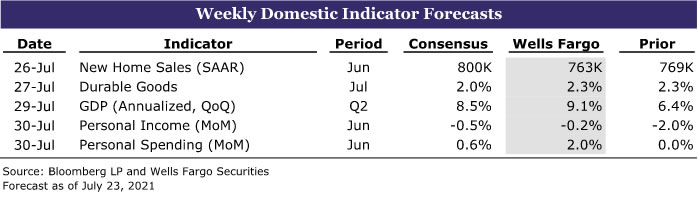
We suspect durable goods orders advanced 2.3% in June. The gain in orders should be led by a jump in aircraft, based on monthly orders data from Boeing. Excluding transportation, durable goods orders likely advanced a more modest 0.8% last month.
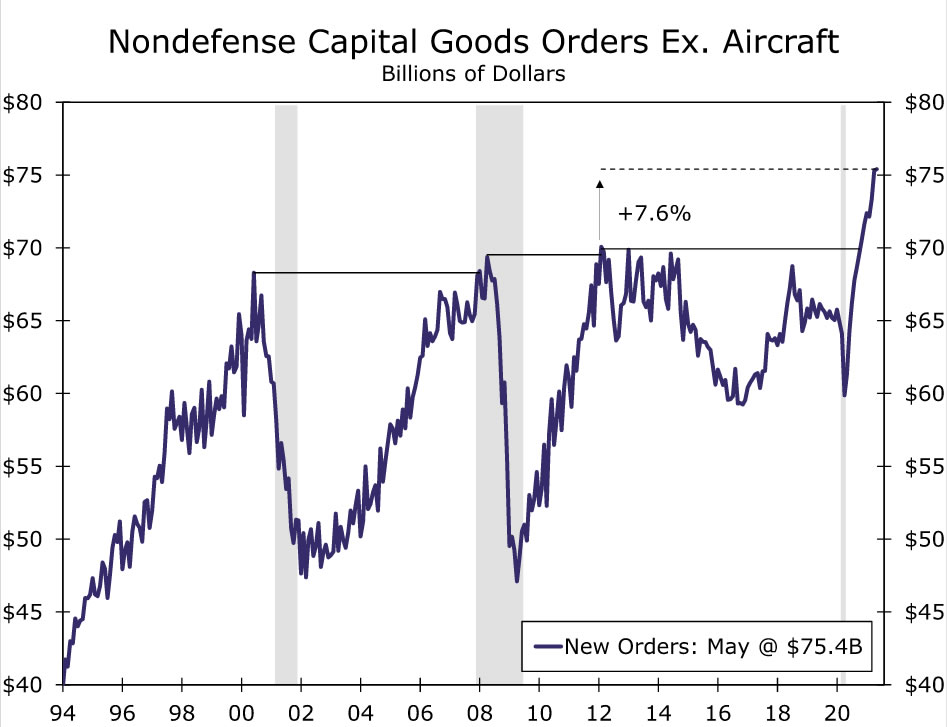
We'll be paying close attention to core capital goods orders, which exclude defense spending and aircraft orders. This measure reflects underlying business demand, and the trend has been impressive in recent months (see chart). We expect it to again indicate solid investment as businesses try to capture soaring demand, and it will be the final indication of Q2 capital investment before the official data for the quarter are released on Thursday.
If orders come in worse than expected for June, it could reflect caution among businesses, reflecting ongoing supply issues, bubbling price pressures and sagging demand. A better-than-expected outturn, however, would indicate that despite recent bottlenecks, demand remains solid heading into the third quarter.
Q2 Real GDP • Thursday
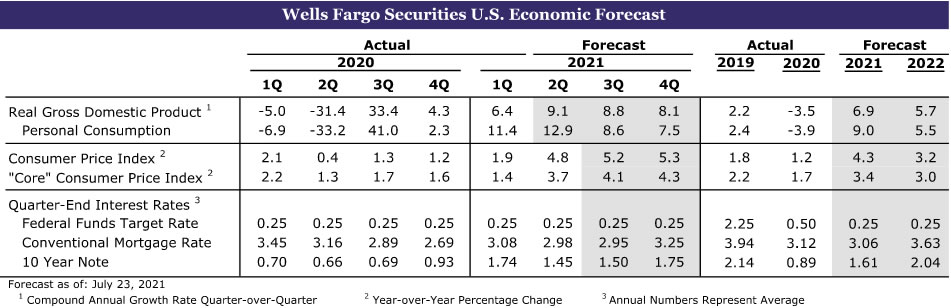
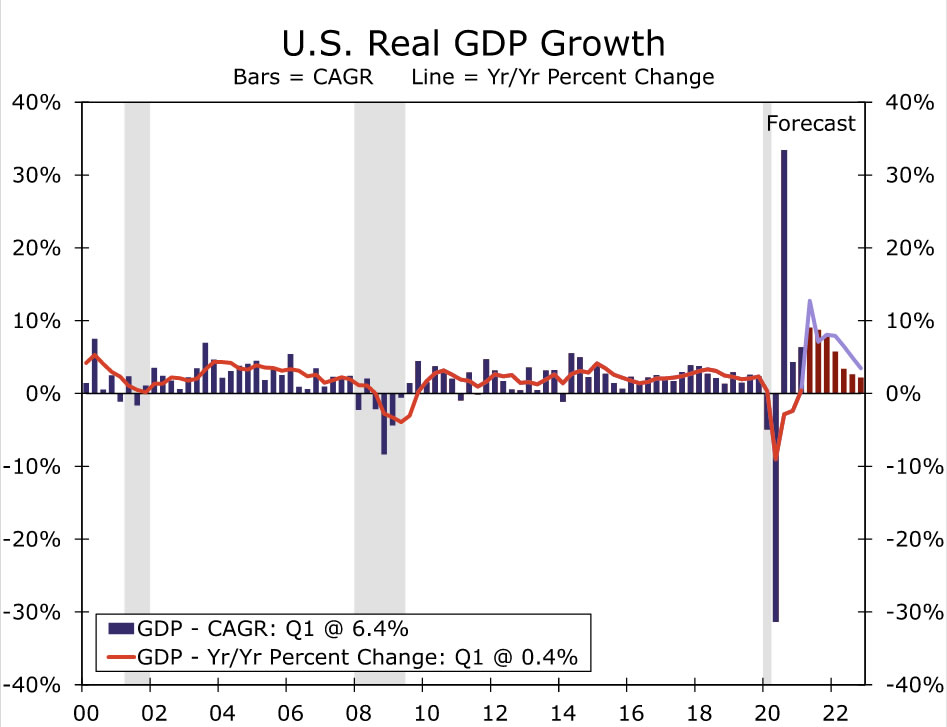
We forecast the U.S. economy expanded at a 9.1% annualized pace in the second quarter, which puts us above the Bloomberg consensus expectation for an 8.5% gain. The National Bureau of Economic Research (NBER), the official arbitrators of recession dating, announced this week that April 2020 marked the end of economic contraction. The pandemic-induced recession therefore lasted just two months, but left a gaping hole in output. Since the Q2 trough in activity, however, the U.S. economy has come roaring back. If our forecast is realized, the level of Q2 real GDP would crest 1.3% above its pre-pandemic Q4-2019 peak.
Overall, the second-quarter details should show a broadening recovery over the past three months. Consumer spending was likely a bright spot. Consumers are flush with cash, and the lifting of mask mandates in mid-May amid the broader reopening of the service sector has unleashed pent-up demand for many in-person services unable to be accessed during the pandemic. Business fixed investment spending should also be strong based on the recent trend in core capital goods orders. Furthermore, the combination of businesses' strong financial positions and struggles to meet current demand with existing capacity and staff will continue to support investment. Strained supply chains and insufficient shipping space remain as headwinds, however, and will likely lead to another decline in inventories and result in a pretty neutral force coming from net exports for the quarter. Despite the recent moderation in home sales, the housing sector appears to have had a pretty strong quarter of growth as well. The second quarter likely marks the peak rate of growth (see chart), but the drivers of recovery remain more or less intact and suggest growth should still remain strong into next year.
Personal Income & Spending • Friday
On Friday, personal income & spending data for the month of June will be released. We forecast personal income slipped 0.2%, while spending was up 2.0% compared to May.
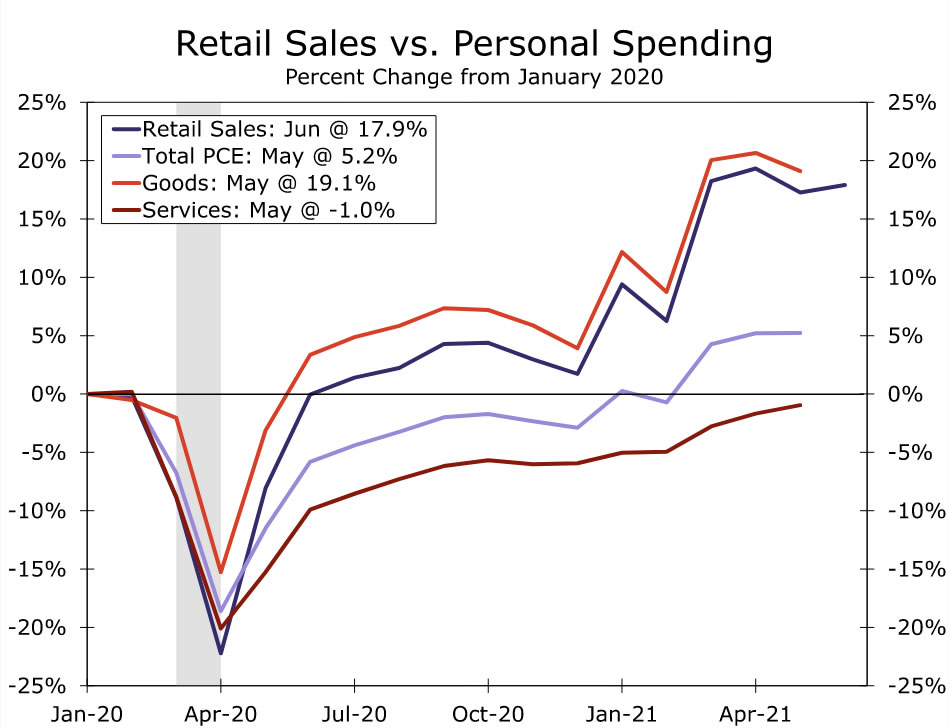
Income growth will again be held back by the effects of dwindling stimulus. Excluding transfer payments, personal income looks set to rise around 0.5%, boosted by continued growth in employee compensation amid the recent pickup in wage growth. Our focus will be on the spending side of the report. The better-than-expected 0.6% gain in June retail sales bodes well for the goods side of spending (see chart), and based on high-frequency data, we remain confident that consumers unleashed some pent-up demand for services last month, which should drive spending higher.
However, there is growing evidence rising prices may soon eat into consumers' purchasing power, and we'll also be paying close attention to the PCE deflator in next week's release. We forecast the core PCE deflator rose 0.5%, which would push the year-ago rate to 3.6%, the highest in 30 years. While it seems clear that inflation is here, it remains uncertain how high inflation will run and for how long. Transitory or not, consumers are certainly taking note of recent price gains and inflation appears to be taking a toll on consumer sentiment.
International Review
ECB's Easing Measures Going Nowhere Fast
In the United States, discussions have heated up about when the Federal Reserve will taper its asset purchases. Financial markets seem prepared for tapering to occur over the course of 2022, with the first rate hike fully priced into markets by roughly the spring of 2023. When monetary policymakers at the European Central Bank (ECB) met this week, they made clear monetary policy tightening is still a long ways off. The ECB reaffirmed that its pandemic-related bond buying (deemed "PEPP" or pandemic emergency purchase program) will continue until at least the end of March 2022. Separately, net purchases under the asset purchase program (APP) will continue at a monthly pace of €20 billion "as long as necessary to reinforce the accommodative impact of its policy rates."
Changes to the ECB's policy rates appear even more distant in light of the central bank's changes to its inflation target. The changes to the central bank's inflation framework are a mouthful, but in short, the ECB is treating the 2% mark as more of a symmetric target than it had been previously. The ECB pledged to keep rates at present levels or lower "until it sees inflation reaching two percent well ahead of the end of its projection horizon...and it judges that realized progress in underlying inflation is sufficiently advanced to be consistent with inflation stabilizing at two percent over the medium term."
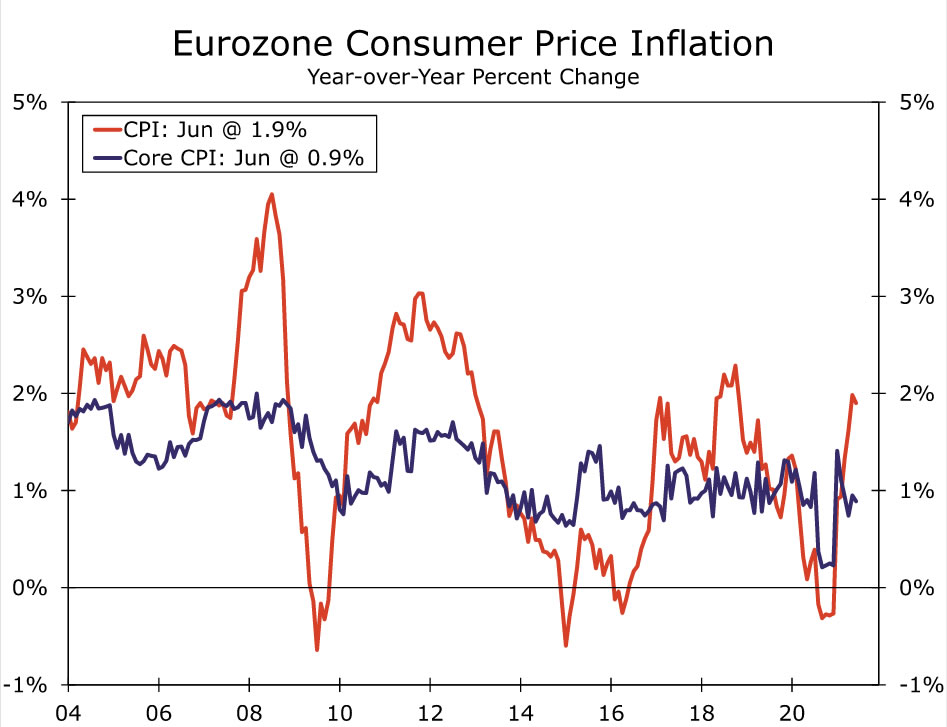
Pushing inflation up to 2% on a sustained basis in the Eurozone will likely be a real challenge. Core CPI inflation last registered 2.0% on a year-over-year basis in March 2008, and even then it was exactly 2.0%, and it only remained at that level for one month. So far, inflationary pressures from COVID reopenings have been much more muted in the Eurozone than in the United States, but perhaps this will change. The ECB's June projections have headline inflation peaking at 2.6% in Q4-2021 but then receding to 1.5% in 2022 and 1.4% in 2023. If these projections prove correct, and if the rules of the road are that rate hikes will not occur until inflation has hit 2% and stabilized, rate hikes are several years away for the ECB.
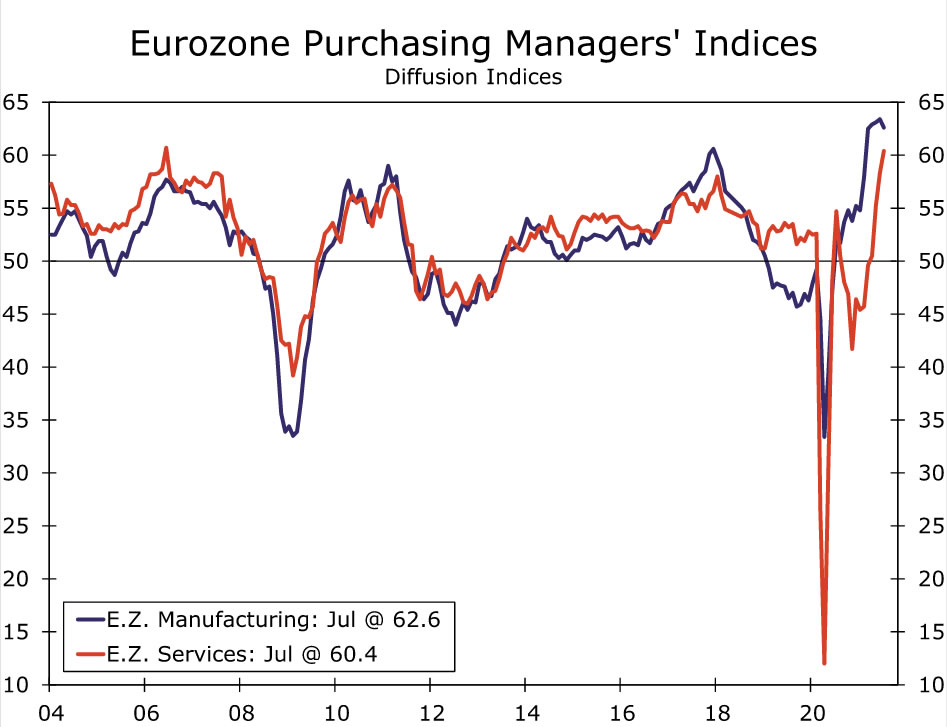
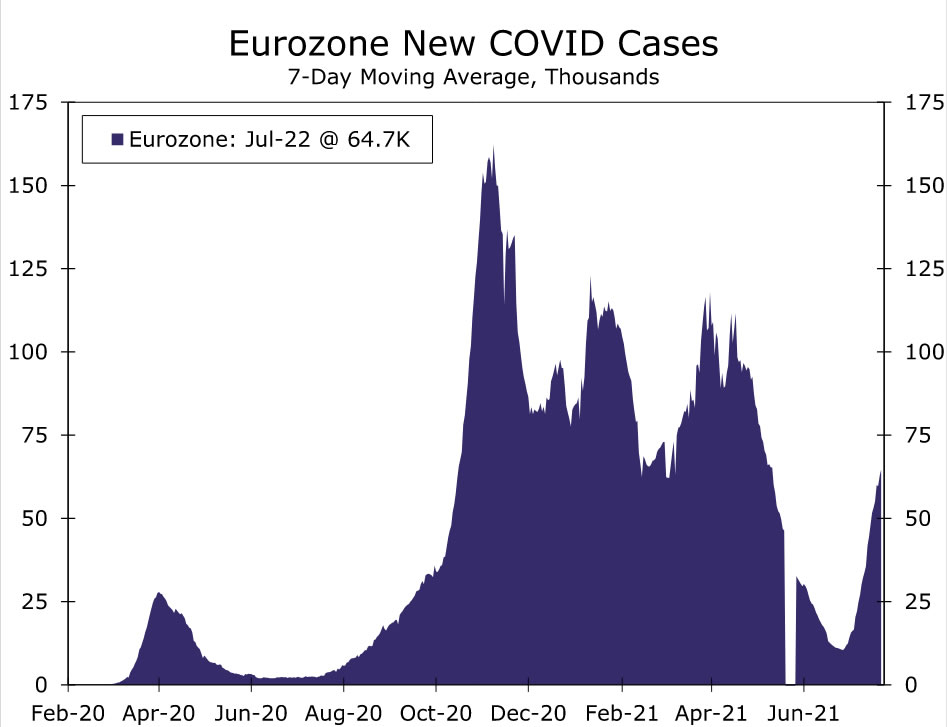
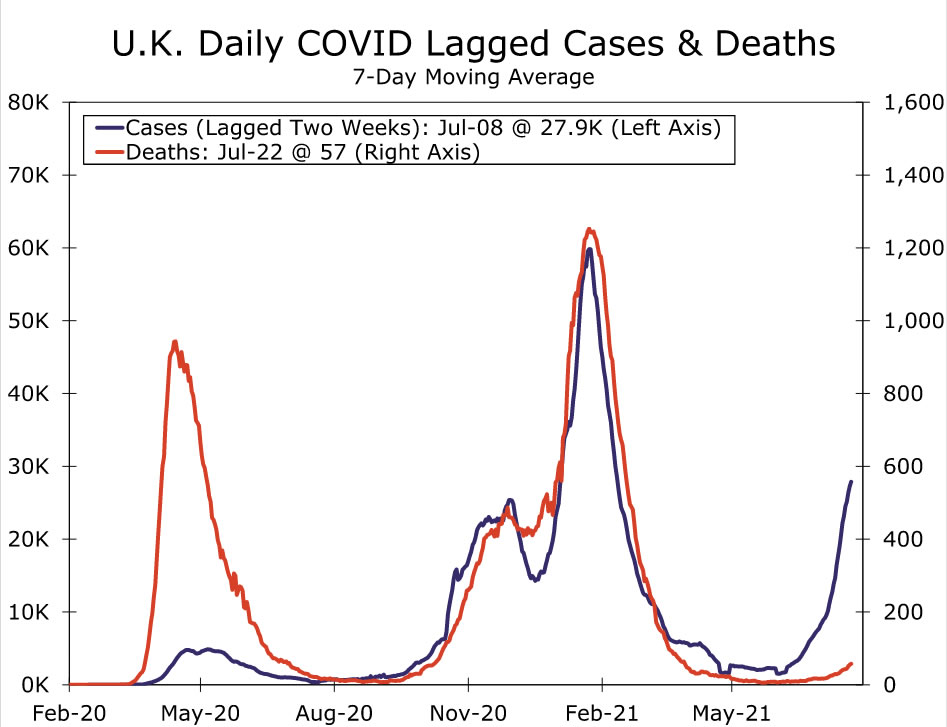
Fortunately, it is not all doom and gloom in Europe. The preliminary PMIs for the Eurozone were released this morning and showed that the manufacturing sector continues to boom. At 62.6, the manufacturing PMI remained above 60 for the fifth straight month. The services component was not quite as strong at 60.4, but it has increased every month of 2021 and remains well above the expansion/contraction demarcation line of 50. COVID cases are trending higher in the Eurozone and have spiked sharply in a handful of countries, such as Spain (see chart). Encouragingly, even though cases have also spiked in the United Kingdom, which was hit by the Delta variant early on, so far, deaths have remained low even after accounting for the lag between the two series (see chart). This provides some promising real world evidence that, even if the vaccines are imperfect against Delta variant infections, they remain robust at preventing serious cases of illness. This in turn bodes well for the ongoing recovery in the Eurozone and elsewhere.
International Outlook

Canada CPI • Wednesday
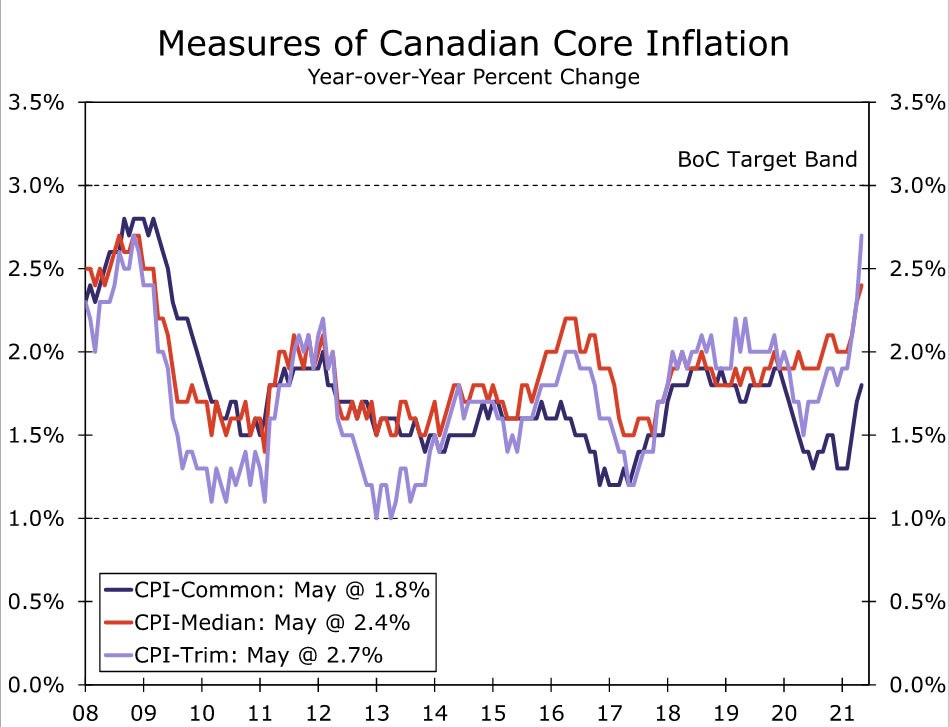
Like its southern neighbor, Canada has experienced consumer price acceleration over the past few months. CPI inflation was 3.6% year-over-year in May as base effects, higher gasoline prices and pandemic-related bottlenecks pushed inflation higher. Like the United States, Canadian monetary policymakers have taken a relatively benign stance on the faster pace of inflation. The July 14 statement from the Bank of Canada stated that "inflation is likely to remain above 3 percent through the second half of this year and ease back toward 2 percent in 2022, as short-run imbalances diminish and the considerable overall slack in the economy pulls inflation lower. The factors pushing up inflation are transitory, but their persistence and magnitude are uncertain and will be monitored closely."
Measures of "core" inflation in Canada vary methodologically with the most closely followed measures of core inflation in the United States. This in part explains why core inflation in Canada has not shown quite the same pick-up as it has in the United States. However, the BoC appears poised to move a bit sooner than the Federal Reserve. Markets are pricing in the first rate hike from the BoC for sometime in the first half of 2022, nearly a year before markets are priced for the first rate hike from the Federal Reserve.
Eurozone GDP • Friday
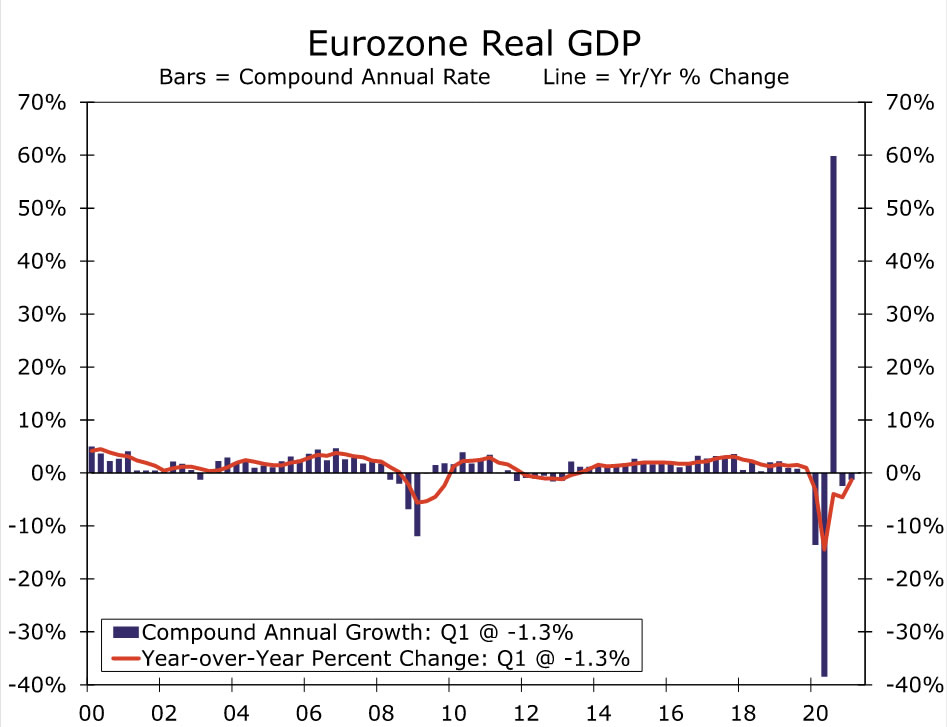
Next Friday, data is to be released for economic growth in the Eurozone for the second quarter. Q2 started slowly in Europe as many countries on the continent had to delay reopening plans amid persistently high COVID cases and a slow initial vaccine rollout. Later in the quarter, however, the Eurozone economy found its groove as vaccine access expanded and better weather emerged. Our expectation is that Q2 real GDP growth in the Eurozone will be about 6% on a quarter-over-quarter annualized basis.
We think real GDP in the Eurozone should accelerate further in Q3 now that vaccines are more widely available and restrictions have been largely lifted, although there are some risks to that view as we discussed in the international review. Still, the Eurozone recovery has a lot of ground to make up on the United States. If our Q2 GDP forecasts are approximately correct, U.S. real GDP will have surpassed its pre-pandemic high, while the Eurozone economy will still be about 3.5% smaller than its pre-COVID peak.
Interest Rate Watch
Faster Growth and Inflation, Tapering Ahead, but Lower Rates?
On March 31, the yield on the 10-year Treasury security finished the day around 1.75%, a sharp increase from roughly 0.90% at the start of the year. Since then, yields on longer-dated Treasury securities like the 10-year have fallen. At present, the yield on the 10-year Treasury is just 1.30%. Accordingly, we have reduced our year-end target for the 10-year Treasury yield from 2.00% to 1.75%. Identifying the culprit for this move lower in rates requires a bit of sleuthing. Since our mid-March forecast update, our projection for real GDP growth in 2021 has increased by 0.6 percentage points, while our forecast for economic growth in 2022 is more or less unchanged. Our forecasts for inflation in 2021 and 2022 have increased by about a percentage point over the same period.
More robust economic growth and inflation are not usually associated with lower yields, so perhaps a more dovish Federal Reserve is to blame. However, market pricing for the first rate hike has not changed much since March 31. If anything, the timing of the first hike has been pulled forward rather than pushed back. Expectations for the Federal Reserve to begin tapering around year-end have also been reasonably well-anchored for the past few months. So what gives?
One clue can be found in the decomposition of the nominal 10-year Treasury yield into its inflation component and its "real" component. Market-based inflation expectations for the next 10 years have declined only a little since March 31. If nominal yields have fallen and markets expect roughly the same pace of inflation as before, this implies inflation-adjusted or "real" yields have declined.
Perhaps the main driver of lower real yields is not near-term questions about the timing of tapering or the first rate hike, but rather deeper questions about the impending tightening cycle more broadly. A broad consensus seems to have formed that the Fed will taper its purchases for most of 2022 and then hike 1-3 times in 2023. But what comes next? A sustained, multiyear period of tightening up to the "long-run" dot of 2.50%? Or a much lower eventual endpoint to reflect the Federal Reserve's structural shift in how it thinks about its employment and inflation mandates?
The chart to the right illustrates roughly what markets have priced for the effective fed funds rate for the one-year period starting five years from now, or roughly mid-2026 through mid-2027. When the 10-year Treasury yield peaked in late March, markets were pricing a fed funds rate of roughly 2.25% for that one-year period five years out, not too far from the FOMC's "long-run" dot of 2.50%. Fast-forward to today and market pricing has tumbled to less than 1.50% for roughly the same period. Ultimately, we think 1.50% is a little too low for the nominal long-run rate, and we still think longer-term yields will head higher over the next year or so to better reflect this fact. However, the past few months illustrate that it will probably not be a linear path higher, and we have adjusted our rates forecast to reflect this reality.
Credit Market Insights
Will Canada’s Housing Market Sustain Its Frothiness?
Around the world, house prices have been soaring, primarily due to large discrepancies in home supply and demand. The supply chain issues created by the pandemic, which pushed up input costs dramatically, have coincided with increasing demand for space after more than a year at home. Canada has emerged as one of the frothiest housing markets in the world. The average price of an existing home in Canada is just over $529,000 (seasonally adjusted) as of this June, which is up 0.1% (seasonally adjusted) from May and a staggering 25.9% from a year ago. In addition, new home prices were up 0.6% from May and 11.9% from last year. This represents the largest year-over-year increase in new home prices since 2006, just before the housing bubble burst and the ensuing 2008 financial crisis. With its stronger regulations and more conservative lending practices, Canada experienced milder effects from the 2008 financial crisis than the U.S., and none of its major financial institutions failed. More recently, however, it seems that mortgage lending standards have softened.
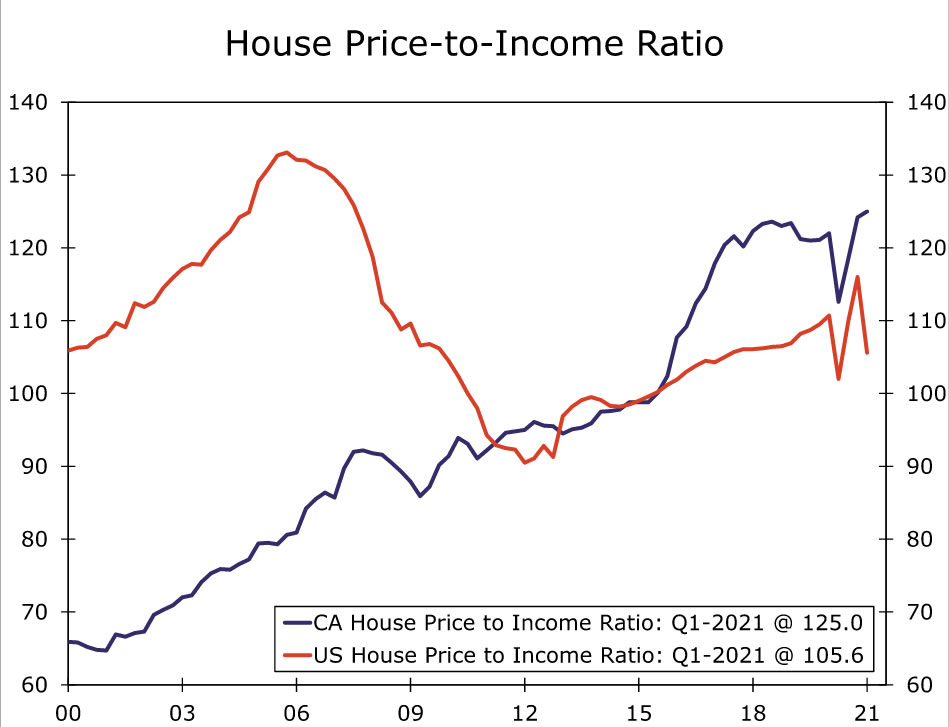
Rising home prices, particularly over the past year, have made it difficult for entry-level buyers to cover the standard 20% down payment. Canada’s house price-to-income ratio was at a two-decade high of 125 in Q1-2021, approaching the U.S. house price-to-income ratio of around 133 seen just before the housing bubble burst in Q4-2005. As housing has become less affordable, mortgage lending conditions have eased in each of the past three quarters, according to the Bank of Canada’s Senior Loan Officer Survey. In the fourth quarter of 2020, 17% of new home loans had a loan-to-income ratio greater than 4.5%, compared with 6.5% two years earlier. In addition, more Canadians are being approved for mortgages that don’t require them to put down any money at closing. Although zero-down loans make up a small percent of overall new home loans, it is clear that lending practices in Canada have loosened.
Despite the frothy housing market and riskier lending at the margins, as of Q1-2021, mortgage default rates are tied for a nine-year low at 0.25%. However, given that most Canadian mortgages reset rates every five years, borrowers could face higher mortgage costs in the coming years. With the economy recovering and inflation moving higher, up 3.6% in May from year ago, Canada’s Central Bank is already paring back its quantitative easing program, and we expect it to raise its benchmark rate next year. With mortgage rates moving higher, affordability concerns could become more acute. That said, we expect 2021 to be a strong year for the Canadian economy and continued income growth should help offset the increasing debt burden.
Topic of the Week
Housing Is Moving Back into Balance
Home sales and building activity had extraordinary momentum leading into this year. Low mortgage rates and shifting preferences toward more living space fueled demand amid a shortage of homes available for sale. With supply and demand so off-kilter, home prices have surged to record levels this year. Meanwhile, sharply rising material and labor costs have pushed home builders to tap the brakes on construction. While declining affordability and supply shortages have pressured housing activity in recent months, we believe the housing market is now beginning to come back into balance.
We look for a modest rise in home sales during the second half of this year and forecast existing and new home sales to rise 6.5% and 9.9%, respectively, in 2021. Our outlook is predicated on strong underlying demand despite rising affordability challenges. The housing market continues to enjoy a strong demographic tailwind, with a growing number of millennials reaching a point in their lives where they are marrying, having children and buying a home. Higher existing home prices are also bringing out more sellers, which is helping to improve the supply picture. With more homes on the market, bidding wars and price appreciation are set to moderate somewhat. Home prices will continue to rise solidly, however, and we look for the S&P CoreLogic Case-Shiller National Home Price Index to rise 12.6% this year, although the risk is tilted to the upside.
Moreover, mortgage rates are likely to remain low this year, which should help offset higher prices and reinforce strong demand from entry-level buyers. The 30-year fixed-rate mortgage rate has hovered around 3.0% over the past few weeks and appears to be drifting lower. Mortgage rates tend to follow 10-year Treasury yields, which we expect will finish 2021 around1.75%. Similarly, we look for mortgage rates to end the year at 3.25%.
Home construction is also set for a rebound. Builders have a growing backlog of projects that are slated to move forward once supply and labor shortages ease. Lumber prices have plummeted around 70% since early May and may drop further as more sawmills reopen and boost shipments. Price appreciation for other key materials is also starting to ease up slightly, although it may take some time to flow through to builders.
Despite these headwinds, home builders remain relatively upbeat. The NAHB/Wells Fargo Housing Market Index (HMI) fell one point to 80 in July, but remains elevated relative to its long-term average. The ongoing strength in the HMI suggests construction will remain robust this year. We are looking for single-family starts to rise 17% in 2021, with much of the gain coming from the South and parts of the West.
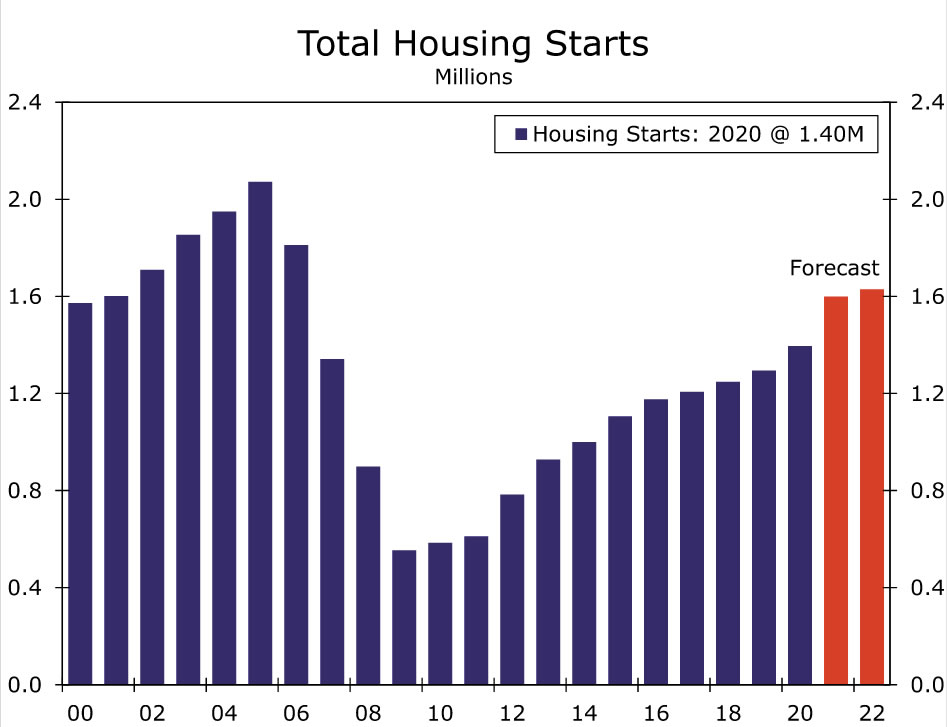
Multifamily development is expected to strengthen as well. Demand for apartments has improved across the country, especially in hard-hit urban markets. The long-awaited return to the office is now under way, which is providing a boost to construction in markets such as New York City, Austin and Seattle. Multifamily starts are expected to rise 8.2% this year to 425,000 units, most of which are rental apartments.
The resurgence of new COVID cases presents some risk to our housing forecast. The resurgence could delay the reopening of schools and the return to the jobsite. While consumer and building activity have not yet reacted in a meaningful way, we will be monitoring this risk closely. For more detail, please see our recently published Housing Chartbook.
The Weekly Bottom Line: Covid Lessons from the UK
U.S. Highlights
- It was a wild week for investors. Following a sharp sell off to start the week, risk sentiment rebounded, sending the S&P 500 back to a record high level.
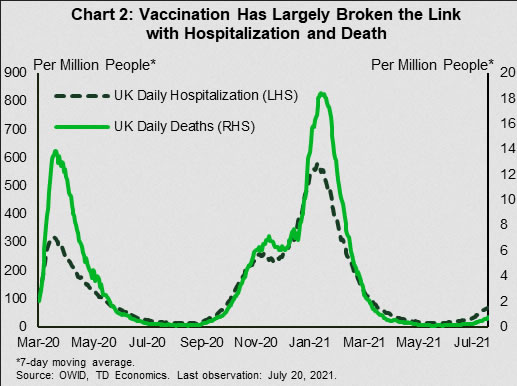
- The spreading Delta variant is cause for concern for both investors and economic forecasters. In the UK, the spread is approaching levels last seen at the start of the year. Fortunately, hospitalization and death rates are much lower.
- At this stage of the recovery, the ongoing pandemic is more of a supply than a demand challenge, likely to weigh on economic growth but not reverse it, and making elevated inflation less transitory.
Canadian Highlights
- The Canadian dollar and oil joined other risk assets in selling off on Monday, before rebounding thereafter. OPEC+ producers finalized an agreement to increase production starting in August and to extend their deal into December 2022.
- On the data front, a backward-looking release revealed a 2.1% decline in retail sales in May, but flash guidance pointed to a decent 4.4% increase in June, consistent with the reopening of provincial economies and ramped-up vaccinations.
- Statistics Canada updated its consumption weights for the CPI basket reflecting pandemic-induced changes in consumer spending patterns. These are likely to have a minor impact on CPI data reported next week.
U.S. - Covid Lessons from the UK
It was a wild week for investors. Concern over the spreading Delta variant sent equity markets into a tailspin to start the week and the 10-year Treasury yield to rally below 1.2% – its lowest level since February. Almost as quickly as they fell, stock markets recovered over the remainder of the week. Risk-on sentiment also sent yields back up. As of writing, the S&P 500 was up 1.5% relative to last Friday and the 10-year yield had nearly round tripped to just shy of 1.3%. There was no obvious data catalyst for the rebound in risk sentiment, though the reported rise in both housing starts and existing home sales was a positive signal.
Led by the Delta variant, Covid cases are rising in the United States, but from low levels (Chart 1). In the United Kingdom, by contrast, cases are already at the highest level since December of last year. Fortunately, a relatively successful vaccination campaign has weakened the relationship with hospitalization rates, which remain a fraction of past peaks (Chart 2). Still, hospital admissions are rising and nearing levels last associated with tightened restrictions on activity. Even without a reversal in public health measures (only recently loosened), it is causing headaches for the economic recovery. People who have come in contact with an infected person have to self-isolate, leading to worker shortages and in some cases causing businesses to have to shut down for lack of employees.
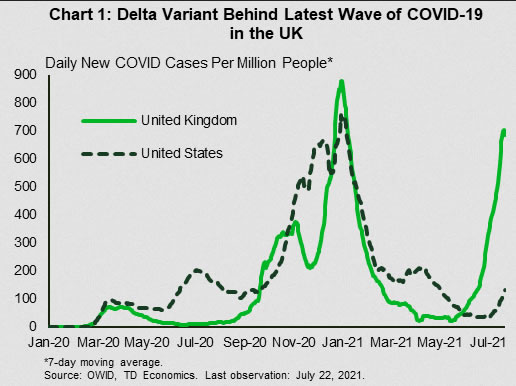
In the United States, cases are rising swiftest in southern states with the lowest vaccination rates. These are also states that were faster to remove public health measures and appear least likely to reimpose restrictions. Even so, labor supply issues, which are already an impediment to recovery, could worsen as a result of the spreading virus. Safety concerns are already contributing to worker shortages in high-contact industries such as leisure and hospitality.
The good news is that the American economy has shown its resilience to these challenges. Real GDP growth averaged 5% (annualized) over the fourth quarter of last year and first quarter of this one, as the last wave hit its peak.
Rather than reverse the economic recovery, the latest wave is likely slow what was otherwise expected to be a relatively rapid pace of growth. It has become increasingly evident that the main constraint on growth is not demand, but supply. Buoyant demand and slow supply explain the rise in inflation over the past several months. The bad news is that these constraints may last longer than they otherwise would have, making the run up in inflation less transitory.
The Federal Open Market Committee will certainly be pondering these speed bumps and their implications for inflation as it meets to set interest policy next week. Fed policy can do little to resolve supply constraints. While nervousness about the impact on demand is likely to keep monetary policy makers cautious as they debate normalization, the time to start talking about tapering is at hand. We expect Chair Powell to communicate as much during his press conference. As long as demand remains healthy, the pace of asset purchases is likely to slow before the end of this year.
Canada - Risk-Off Sentiment Quickly Dissipates
This week was light on economic data, but heavy on financial market developments. All eyes were on the bout of risk-off sentiment that extended from late last week into Monday. Though somewhat uncertain, this was likely driven by concerns around the delta variant, some recent negative economic data surprises, and in some economies, central bank policy uncertainty. Despite this, markets swiftly brushed off Monday's sell-off, with most risk assets rebounding quickly in the following days.
For Canada, the sell off included a downshift in the loonie and sizeable hit to oil prices (Chart 1). Both have since partially rebounded. While further volatility is always possible, we see little further sustained upside from current levels for either going forward. Last weekend saw OPEC+ producers reach agreement after a two-week long impasse. The group agreed to extend their deal until late 2022, and will start adding around 400k barrels per day (bpd) each month, starting in August. While markets are currently tight, this expected two million bpd increase in supply by year-end should cap any further sustained gains in prices.
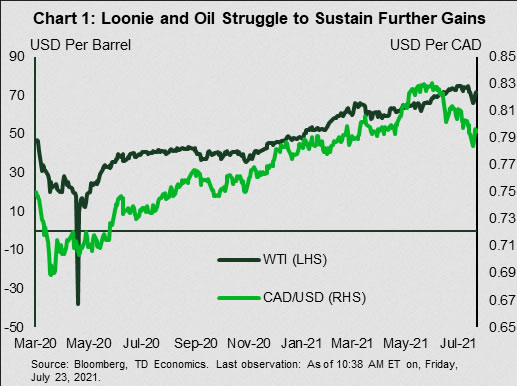
For the loonie, there are two factors at play. Several commodities had already peaked in the second quarter, with oil likely the latest to the party in the third. At the same time, the Bank of Canada has already begun tapering its asset purchase program and telegraphed a relatively more hawkish stance vis-a-vis the Fed. We suspect that the Federal Reserve will follow suit later in the year, lessening the likelihood of loonie outperformance based on expected interest rate differentials and central bank guidance.
On the economic data front, a backward-looking retail sales release revealed a 2.1% drop in May. Since then, restrictions have eased and vaccinations have ramped up. In turn, flash estimates for June point to a robust 4.4% rise in sales.
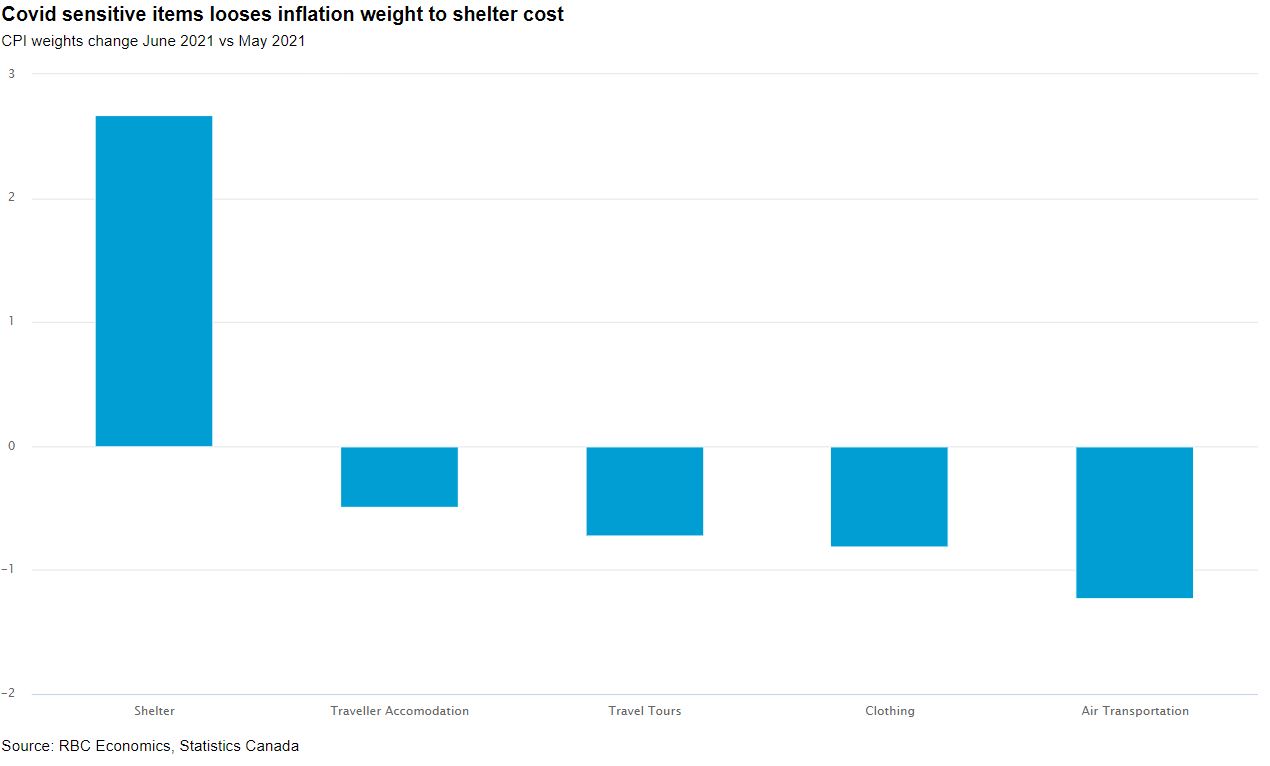
As is the case in most economies, inflation remains front and center, putting next week's Consumer Price Index (CPI) release in the spotlight. On this note, Statistics Canada released its updated CPI consumption basket weights (Chart 2). The release was closely watched given the sizeable impact COVID-19 had on consumption patterns. For instance, shelter saw its weight in the basket rise from 26.9% to 29.8%, and household operations/furnishings saw an increase from 13% to 15.2%. Meanwhile, transportation saw a sizeable drop in its weight from 19.7% to 15.3%. The lingering question is whether these changes will have lasting power. Statistics Canada will now update the basket annually. This lessens the likelihood of any mismatch between baskets and consumption patterns.
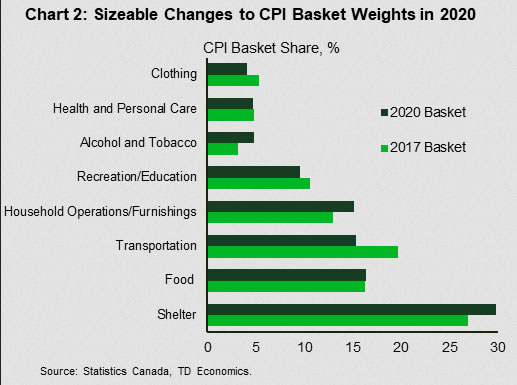
In terms of what it means for next week's release, Statistics Canada has been publishing an adjusted CPI measure to reflect changes in consumption patterns, with the measure only slightly higher than headline CPI. The new weights will start being applied to the headline measure in June's data. The resulting impact will likely be modest and will depend on offsetting forces of the categories witnessing the largest weight adjustments (transportation on the one hand, and shelter/furnishings on the other).
Forward Guidance: Canada’s Inflation Rate Remained above the BoC Target in June
We expect next week’s June consumer price inflation report to show the inflation rate held above the Bank of Canada’s 1% to 3% target range—for the third consecutive month. There was likely a slight moderation in the annual increase in June, to 3.4% from 3.6% in May. That was probably driven by gasoline price growth that slowed to 33% in June from 43% in May and 62% in April. Much of the surge in inflation reflects base effects, as prices (including energy) rebound after falling sharply during the initial pandemic shock in Q2 2020. Though supply chain bottlenecks continue to push prices up for things like car rentals and home building, we look for some price pressures to ease in coming months as real-estate markets cool, lumber price futures fall, and global chip makers work hard to boost production.
Still, even if the inflationary impact of near-term supply disruptions fades, consumer demand, particularly for services, is set to surge over the second half of 2021. Consumers are poised to spend more on travel and hospitality sectors as the economy reopens. A sharp strengthening in that demand could stoke a more broad-based inflation that would be difficult for central banks to dismiss. Statistics Canada’s reweighting of the CPI basket to reflect 2020 household spending patterns means that for some products, like airfare and travel tours, the shares were so small last year that prices were almost removed from the CPI altogether. As a result, any inflation generated as those hardest-hit sectors rebound will be significantly underrepresented in the consumer price index in the near term. It also means that headline CPI readings won’t necessarily reflect actual household spending patterns as the year progresses, making alternative inflation measures like the BoC’s preferred ‘core’ measures—which control (to varying degrees) for larger swings in prices for individual products—a better indication of price pressures.
Week ahead data watch:
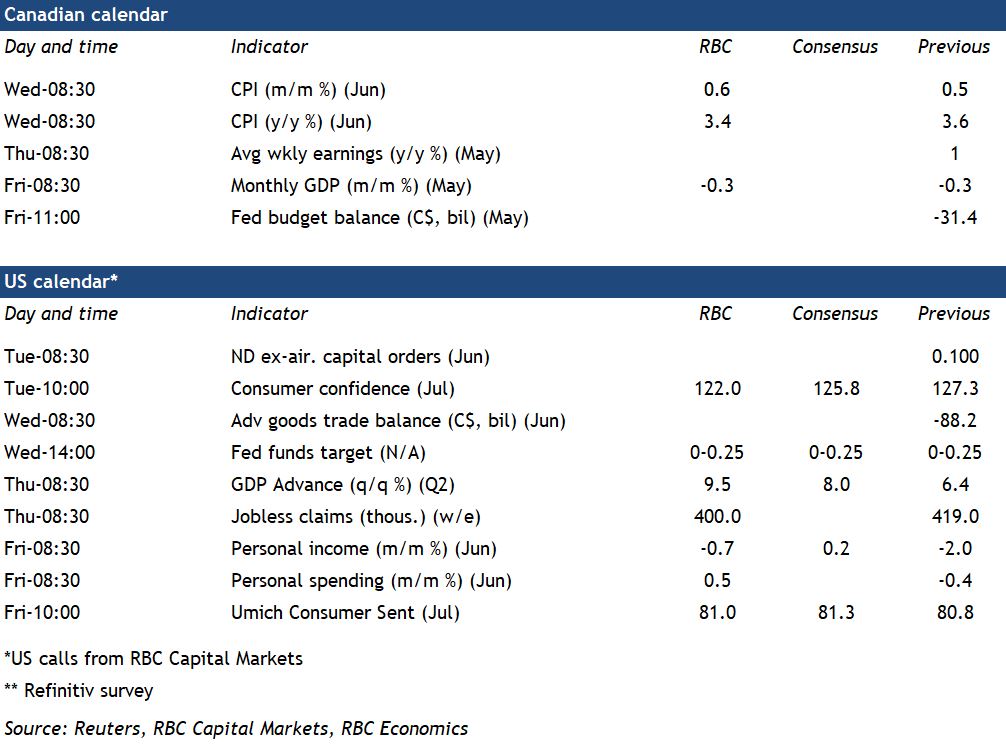
- We expect Friday’s May GDP report to confirm Statscan’s preliminary estimate of a second straight 0.3% drop, with the early read on June output likely to show an increase that retraced all of the decline in the two prior months.
- As the economic reopening gets going, we expect US GDP to grow by 9.5% in Q2 driven by exceptionally strong consumer spending for the quarter. We look for US personal income to fall by 0.7% in June following a combined 14.8% drop in the prior two months as pandemic-related assistance continues to taper off.
- The Federal Reserve will likely maintain its policy rate at next week’s meeting. Markets will watch for any hints about plans to taper their asset purchases program.
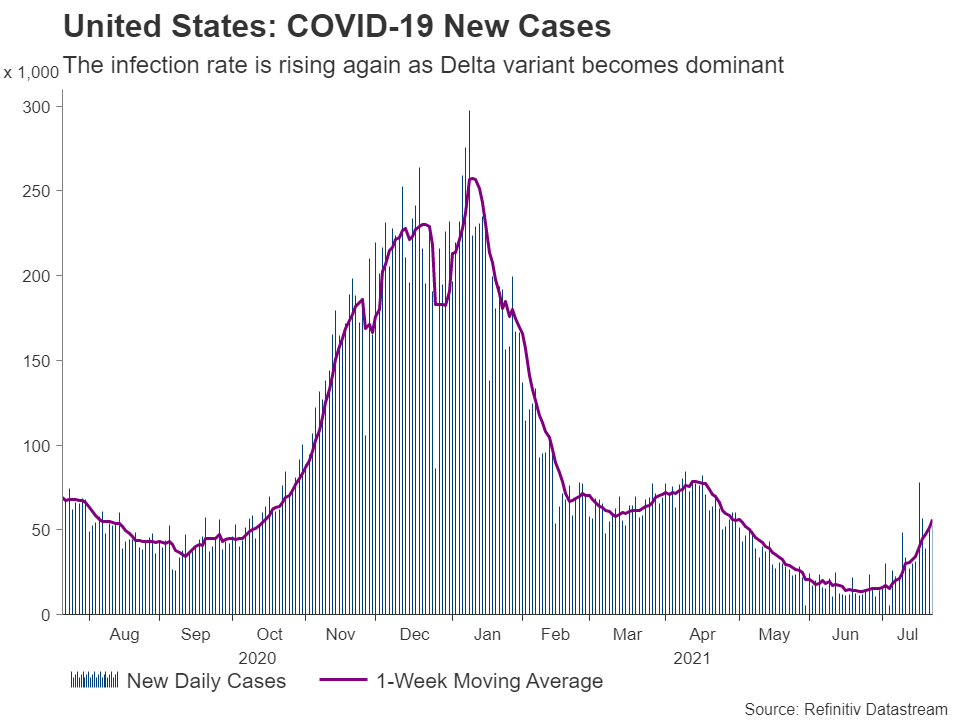
- Canada’s COVID case counts remain low but have edged higher, on balance, in recent days and infections are rising in several advanced countries. Canada continues to lead in the percentage of the population receiving one dose and the share of fully vaccinated Canadians now surpasses the US.
Week Ahead – Fed to Talk Taper but Stall on Action; Growth Data in Focus amid Recovery Doubts
The Federal Reserve is expected to provide more hints on tapering when it meets next week but may stop short of revealing a timeline. Amidst jitters about the Delta variant, markets could whipsaw if the Fed cites both progress and dangers ahead. Meanwhile, US and Eurozone GDP readings could further muddle the market mood as they will likely confirm the solid rebound in Q2 even as uncertainty about the outlook is increasing. If all that wasn’t enough for investors to digest, inflation numbers out of Australia, Canada and the US will come under the microscope.
The Fed’s search for “substantial further progress”
It goes without saying that the July 27-28 FOMC meeting will be next week’s highlight as it will be the Fed’s last chance to telegraph any potential tapering announcements either at the Jackson Hole symposium in August or the September policy meeting. But when it comes to the July gathering, it was always going to be a tricky one because policymakers clearly want to see more data before making up their minds on tapering but, at the same time, they need to get the ball rolling, at least on holding some preliminary discussions about the timing and pacing of any reduction in their asset purchases.
Complicating matters even more is the escalation in virus cases due to the highly contagious Delta variant of Covid-19, which has now become the dominant strain in the United States. Caution about the growth impact from the Delta variant could widen the divisions within the FOMC on how soon the $120 billion a month in QE needs to be pared back. However, those details will probably not be disclosed until the minutes and all we might get on Wednesday about a looming taper decision is how much closer the Fed is to achieving “substantial further progress”.
PCE inflation to headline busy data week
Should the Fed stick to the script and provide only subtle hints of tapering, the US dollar and Treasury yields may come under some downside pressure. But there should be support for the greenback from a barrage of indicators for the US economy.
New home sales will start the week on Monday and there will be more housing numbers on Tuesday and Thursday. America’s housing market is booming on the back of pent up demand and the pandemic-induced trend to move out of cities into larger suburban homes. However, housing construction has been hit not only by shortages in materials such as lumber but in labour as well. So the sector is being watched closely right now for signs on how long these issues will persist to get clues on the bigger question about whether higher inflation is transitory or not.
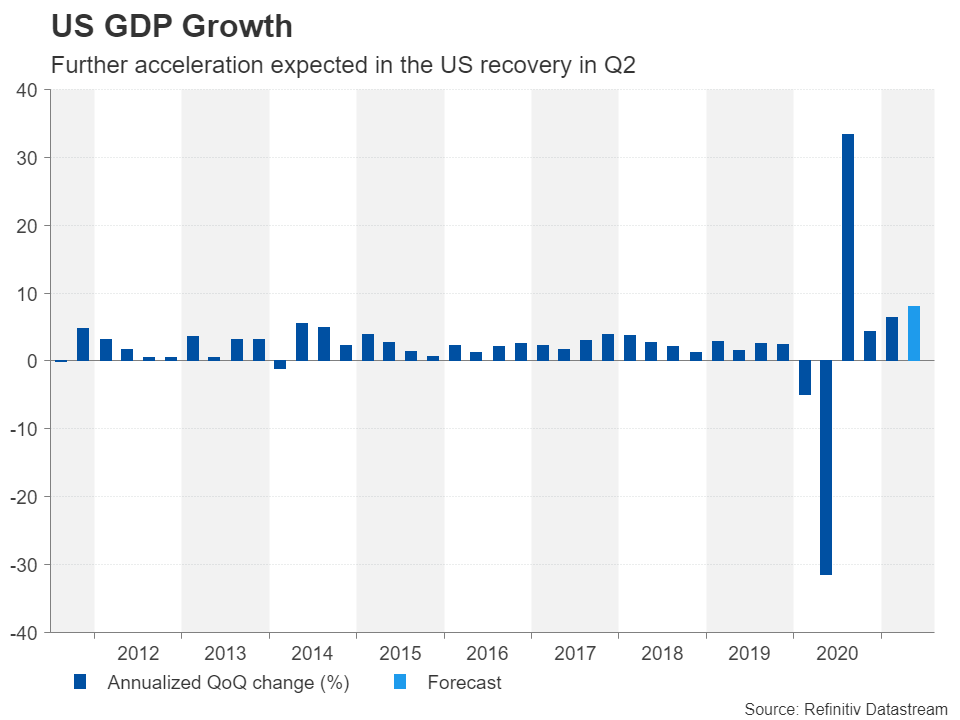
Other notable releases are Tuesday’s durable goods orders and consumer confidence index. But the more market moving data are likely to be the advance GDP report on Thursday and PCE inflation on Friday. The US economy is expected to have expanded by a staggering 8% annualized rate in the three months to June, surpassing the pre-pandemic peak in GDP.
But investors will also be keen to see how strongly growth fared at the end of the quarter by digging through Friday’s personal income and consumption figures for June. And finally, the core PCE price index could rock the markets at the end of the week, as the Fed’s favourite inflation metric is anticipated to have increased by a worrying 0.7% month-on-month rate.
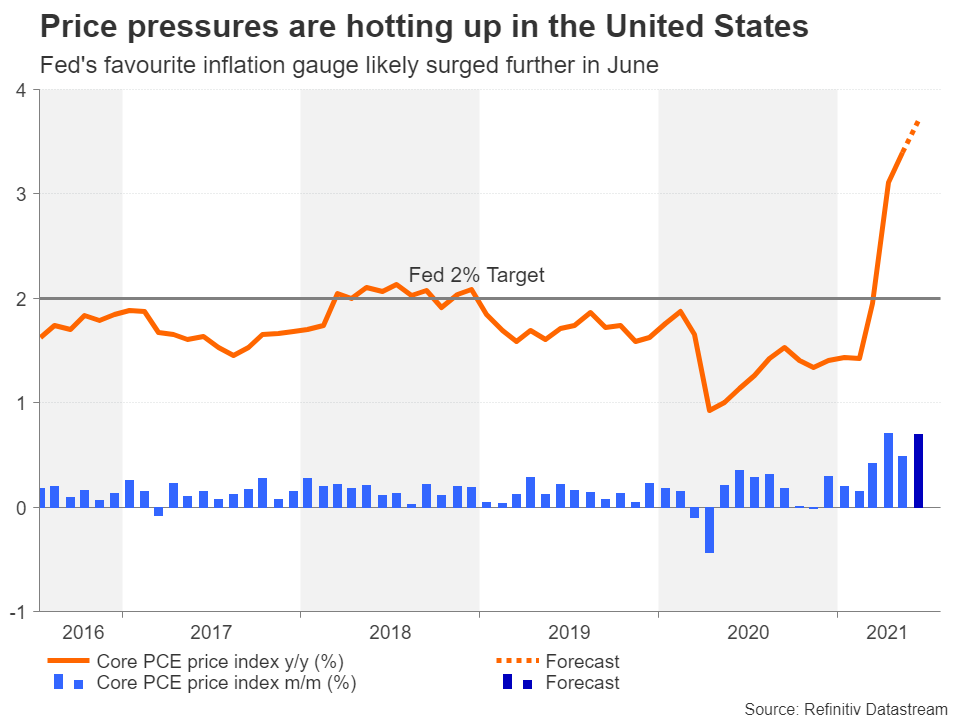
Will CPI data ease aussie’s and loonie’s pain?
Inflation will be scrutinized in Australia and Canada too next week but may not necessarily do much in terms of shaping the policy outlooks for neither the Reserve Bank of Australia nor the Bank of Canada in any way. Australia’s consumer price index stood at just 1.1% year-on-year in the first quarter but could shoot well above the RBA’s upper target band of 3% in Q2. Whilst that would certainly help build a stronger case for policymakers to wind down their QE programme sooner rather than later, the fact that swathes of Australia have been placed under fresh lockdowns recently means that the RBA is more likely than ever to overlook any temporary spikes in inflation.
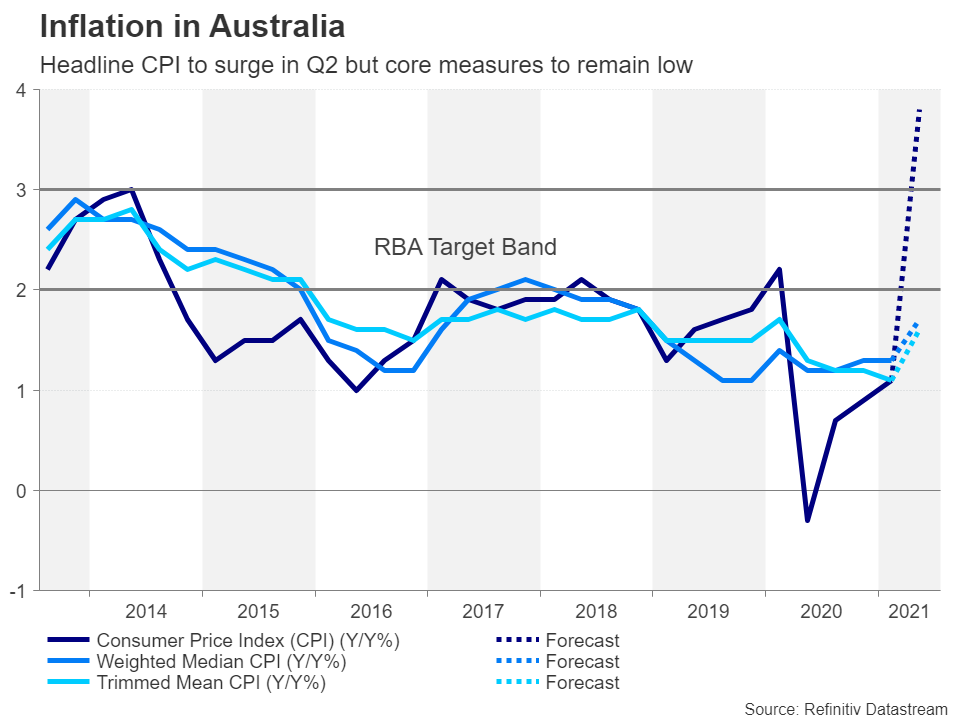
At best, stronger-than-expected CPI prints on Wednesday might defend the Australian dollar against the mighty greenback’s advances.
In Canada, the headline inflation rate has already surpassed 3% and the economic recovery is solidifying. Monthly GDP numbers on Friday should reaffirm this. However, with both the global virus trend and oil outlook worsening somewhat lately, it’s questionable whether the Bank of Canada would be swayed towards moving faster with its tapering plans even if domestic indicators, for the time being, continue to strengthen further. Hence, oil prices and risk sentiment will probably remain the Canadian dollar’s main drivers this summer.
Delta trouble brewing in Europe
In Britain, daily infection rates could have a hand in deciding which way the pound goes in an otherwise quiet week. There are some early signs that the latest virus wave in the UK is peaking and should there be more evidence supporting this in the coming days, sentiment for sterling could improve.
However, in the euro area, the Delta variant has only just started to become rampant in some member states while it’s started to fall in others, so it’s more difficult to get a full picture. Investors might therefore prefer to be guided by the upcoming business surveys to gauge how the economy is being impacted. Germany’s Ifo business climate index is out on Monday and the Eurozone’s economic sentiment indicator will follow on Thursday.
The week will draw to a close with the top-tier releases – the flash estimates of July inflation and Q2 GDP. The Eurozone’s harmonised index of consumer prices is expected to nudge back up to 2.0% y/y in July from 1.9% in June. That’s a pretty tamed figure compared to the 5.4% rate in the US. Underlying inflation remains even more subdued in the euro area, forecast at 0.9% y/y.
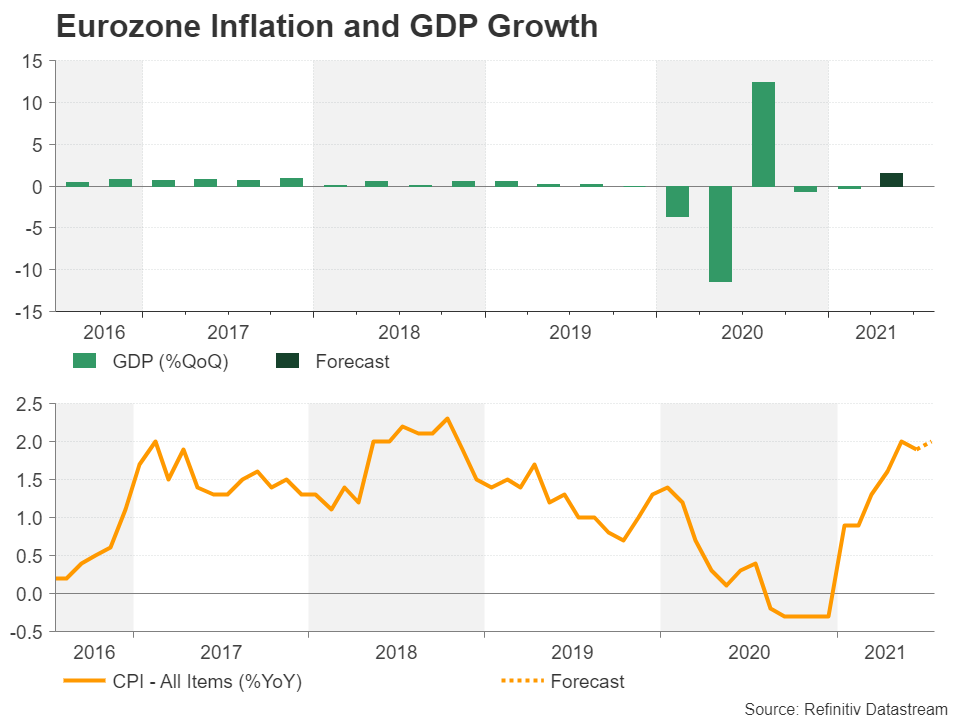
With the ECB doubling down on its pledge to lift inflation sustainably to 2%, the prospect for euro/dollar is looking a bit grim right now. There might be some cheer for the pair however, from the preliminary GDP readings for the second quarter. Eurozone growth likely bounced back by 1.5% over the quarter in Q2 after contracting by 1.3% in the previous quarter.
Tech earnings and spectator-free Olympics galore
In the broader markets, it could be another bumpy week for risk appetite. The earnings season should keep the positive tone in equities alive as all the big tech names, including Apple, Microsoft and Alphabet, are due to report. But if virus cases continue to spiral higher, it will be harder for investors to ignore the darkening clouds ahead. Still, this would be good news for the other safe-haven currencies such as the Japanese yen and Swiss franc. The yen came off its highs in recent sessions but its medium-term uptrend against its major peers remains intact.
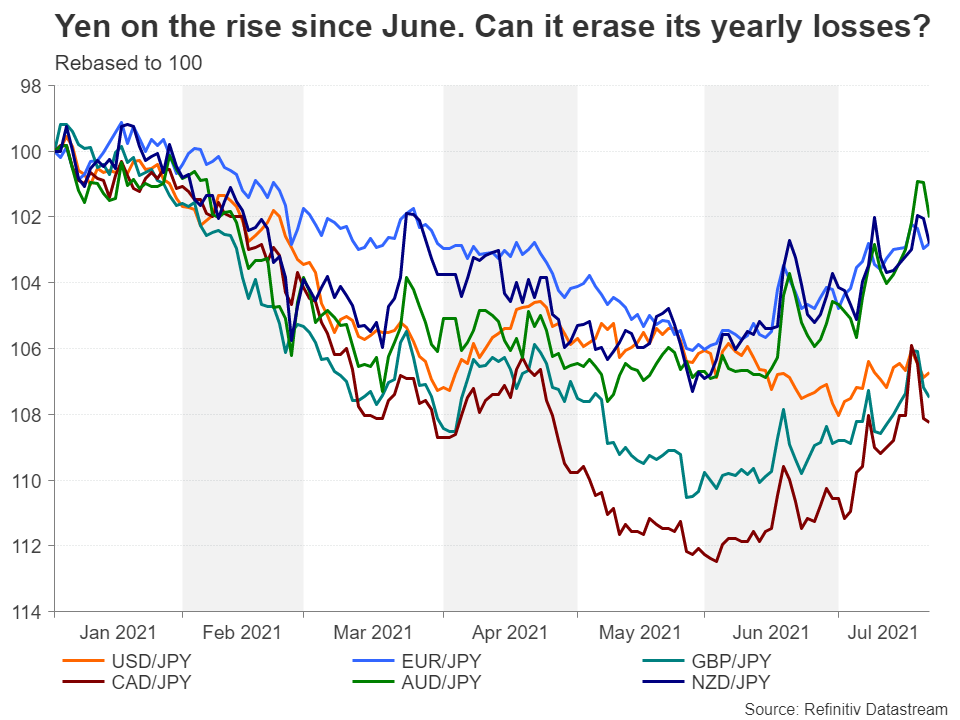
The summer Olympics will kick off this weekend in Tokyo, but the games are unlikely to deliver much economic benefit to the country as spectators have been banned due to rising infections. Retail sales data out on Friday are expected to show sales were almost flat over the year to June as virus curbs were tightened. Though, a rebound in industrial production during the same month might lessen the gloom.
CAD Shrugs Off Soft Retail Sales
The Canadian dollar has posted gains on Friday. Currently, USD/CAD is trading at 1.2595, up 0.30%.
Canada’s retail sales slip
It was a very light data calendar week, with only one Canadian release until today. Nevertheless, the Canadian dollar showed substantial volatility earlier in the week. On Friday, the focus has been on retail sales reports for May. The news was not great, as retail sales (MoM) posted a second straight decline. Headline retail sales declined by -2.1%, above the consensus of -3.0%. Core retail sales was down by -2.0%, slightly ahead of the -2.2% forecast. Still, the market reaction has been muted, as the readings were better than expected. Also, the May numbers were much better than the previous month (-5.7% for the headline reading and -7.2% for core retail sales).
What is the outlook for the Canadian dollar? Credit Agricole is of the opinion that the Canadian dollar remains undervalued. In a research note, Credit Agricole noted the discrepancy between hawkish expectations for a rate hike and the low value of the Canadian dollar represents a buying opportunity.
Earlier this year, the BoC was the first major central bank to taper its stimulus programme, and it’s a good bet that policymakers will look to further tighten policy if inflation and employment numbers rise and point to the recovery gaining more traction.
In the US, Flash PMIs reports for July were mixed. Manufacturing PMI accelerated to 63.1, up from 63.1 (62.0 est.), while Services PMI fell to 59.8, down sharply from 64.6 (64.6 est). I would not expect investors to wring hands over the slowdown in services, since the reading is comfortably above the 50-level, which separates expansion from contraction.
USD/CAD Technical
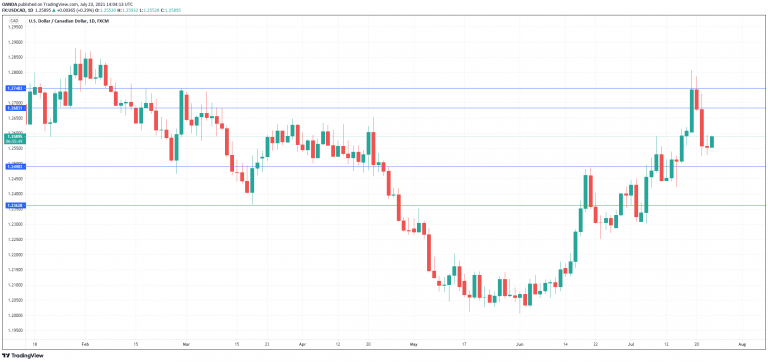
- USD/CAD faces resistance at 1.2683. Above, there is resistance at 1.2748
- On the downside, there is support at 1.2490. Below, there is support at 1.2362
Sunset Market Commentary
Markets
Hesitancy still was the underling feeling on global markets in the second half of this week, even as the heat of Monday’s and Tuesday’s ‘growth panic’ subsided. Economic data, even those that are supposed to be the most forward looking, are put in question as a viable precursor on the path of the economy later this year. This was also the fate of today’s EMU PMI’s. The July EMU IHS market Flash composite PMI printed at a 21 year high (60.6 from 59.5) as the restrictions are eased and the economy reopens. The manufacturing index eased slightly to 62.6 from 63.4. The services measure hit a 15-year peak rising from 58.3 to 60.4. Demand and orders remain strong both in services and manufacturing but are facing unprecedented capacity constraints even as firms step up hiring. Selling prices also continue to rise at a near record pace. So, for now apparently only good news about the EMU recovery. There is a ‘but’. Markit reports that expectations for the output in the year ahead slipped from a June peak back to the level of February. The delta variant not only poses a risk for demand, it might further disrupt global supply chains. This only illustrates recent market unease and explains the limited market reaction to a historic strong EMU PMI. The German yield curve steepens modestly with the 2-y easing 0.5 bp while longer yields are rising 1-2 bp (10 & 30y). Even this rise is more a catch up move with yesterday’s late session US rebound rather than a reaction to the PMI’s. At -0.41%, the German 10-y yield is still within reach of recent lows. Non-core EMU bonds stay well bid with 10-y spreads vs Germany easing up to 2/3 bp for the likes of Italy, Spain or Greece. Reuters reports that ‘sources’ close to the ECB indicated that a decision on the future of the PEPP program even isn’t likely at the September ECB meeting. US curve moves are immaterial after reversing earlier gains at longer maturities up to 1.5/2 bp (10 &30-y) following a soft US (services) PMI. Solid corporate earnings and, maybe recent easing in financing conditions, are giving renewed comfort to equity investors. European indices are gaining about 1%. For the Nasdaq and the S&P, even the all-time record levels are again within reach. This also applies for the CRB commodity index.
The improved risk sentiment for now doesn’t hurt the dollar much. The DXY trade-weighted index is trading little changed at 92.85. USD/JPY is extending gains north of 110 (110.40). EUR/USD hardly profits from the strong EMU PMI. At 1.177, the 1.1750 support area still is at risk. Sterling maintains most of yesterday’s gain against the euro (EUR/GBP 0.855) even as the UK PMI eased substantially more than expected (composite 57.7 from 62.2).
News Headlines
The Russian central bank came and hiked big: it raised its key policy rate with 100bps to 6.5%, extending a tightening cycle that started in March (+25bps) and continued in April and June (both 50bps). The central bank is struggling to contain inflation (expectations) with core measures reaching 6.6% in June, well above the 4% target and the Bank of Russia’s own forecasts. The bank estimates the neutral rate at 5-6%, meaning the policy stance is now tight. The Bank of Russia “will consider the necessity of further key rate increases at its upcoming meetings”, suggesting the cycle may still not be over as “risks remain significantly pro-inflationary”. New average rate forecasts in any case were lifted to 5.7% for 2021 and 6.5% for 2022. Growth and inflation for this year were also boosted to 4-4.5% (vs. 3-4%) and 5.7-6.2% (vs. 4.7-5.2%). Inflation is expected to ease towards target not before the end of 2022 (4-4.5%). The Russian rubble strengthened only slightly to USD/RUB 73.6 as the big move was by and large expected.
Not everyone agreed on the ECB’s new guidance, Lagarde admitted yesterday. Today it became clear that apart from Germany, Belgium also objected. NBB chair Wunsch together with Weidmann is concerned that the current wording is seen as making too much of a long-term commitment to loose policy according to people familiar. Looking at market expectations, Wunsch said, “we’re maybe talking about 5 to 6 years […] before we would hike”, adding that he “didn’t feel comfortable taking a commitment for such a long period”.
PBOC Likely to Ease Further, Adding to Renminbi’s Downside Bias
Renminbi has been range-bounded against the US dollar since June. Traders in the Chinese currency has turned cautious after People’s Bank of China (PBOC) surprisingly reduced the reserve requirement ratio earlier this month. The move was contrary to the broad theme of monetary policy normalization in major central banks (e.g. FOMC, BOE, BOC, etc). The slowdown in the second quarter GDP growth data suggests that PBOC's easing was warranted. It has also raised speculations of more cuts in 4Q21.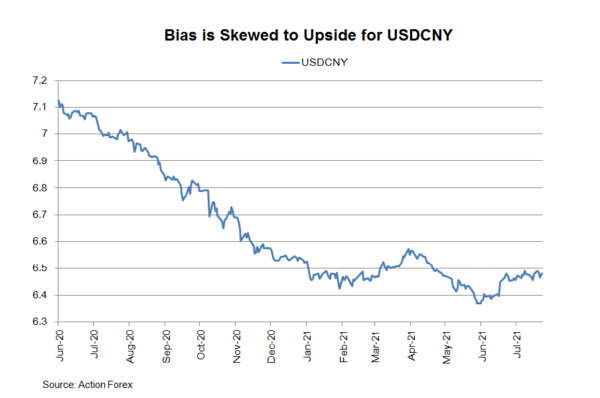
Earlier this month, PBOC cut the broad RRR by -50 bps, effective July 15. Expected to release around RMB 1 trillion liquidity, the central bank noted that the move aimed at helping small to medium sized firms. It affirmed the prudent and stable monetary policy stance. We believe this was an insurance cut to prevent deterioration in the country’s growth. We expect further RRR cut later in the year.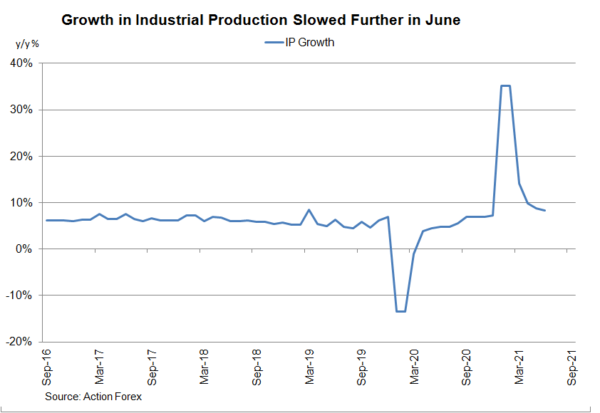
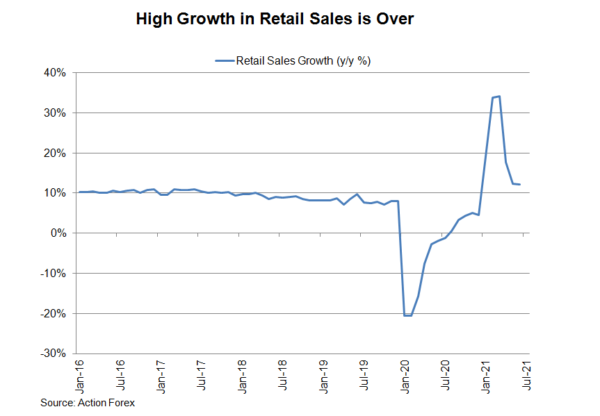
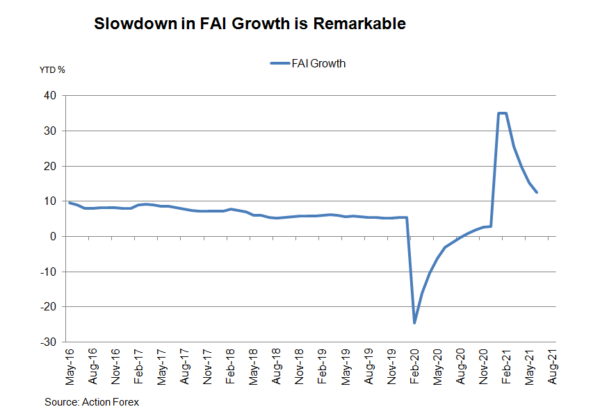
Weaker than expected economic data released a week after suggested that RRR cut was warranted. Recall that GDP growth eased to +7.9% y/y in 2Q21, from +18.3%. Notwithstanding the strong base, the growth actually missed consensus of +8.1%. Important monthly data all showed moderation in growth, although better than expectations. Industrial production expanded +8.3% y/y in June, easing from +8.8% a month ago. This, however, exceeded consensus of +7.8%. Retail sales grew +12.1 % y/y, easing slightly from +12.4% in May. The slowdown in fixed asset investments was the most remarkable. Growth eased to +12.6% y/y in the first half of the year, compared with +15.4% in the first 5 months.
Besides RRR, the loan prime rate (LPR) is PBOC's another policy tool. It, however, left the one-year LPR unchanged at 3.85% on July 20. This is neither surprising nor implies contradiction to the RRR cut policy. Unlike other major central banks, PBOC considers RRR as one of the most important tools to influence market liquidity. It usually adjusts RRR first as it seeks to tighten or loosen market liquidity.
The surprising RRR cut in July and the weaker-than-expected GDP growth data in 2Q21 have raised speculations that PBOC would ease further later this year. Slowdown in China's inflation has also given the central bank more room to add stimulus. This comes contrary to the theme of monetary policy normalization in other major central banks. In particular, the market expects the Fed to offer more clues about QE tapering at next week's meeting. As such, the outlook of USDCNY is tilted to the upside.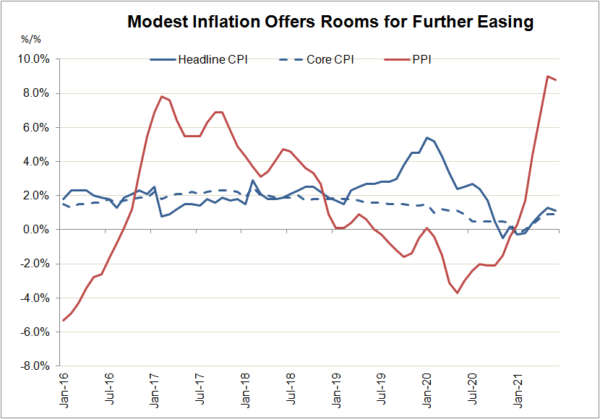
Pound Dips as PMIs Slow
The British pound has reversed directions on Friday and posted slight losses. Currently, GBP/USD is trading at 1.3729, down 0.28% on the day.
The global calendar was unusually light this week, but the UK did provide the markets with some key releases on Friday.
Retail sales for June kicked off the day, and registered a modest gain of 0.5%, just edging above the consensus of 0.4%. Still, the gain was welcome news after the -1.3% decline in May. The retail sector is in decent shape, with sales 9% above the pre-Covid level. Looking ahead, the reopening of the UK economy this week should be a significant boost for retail sales, as consumers will be looking to spend some savings that have accumulated during the lockdown periods.
At the same time, we are seeing a spike in delta variant cases in the UK, which could dampen the confidence of shoppers. The British Medical Association has sounded the alarm, warning that the lifting of restrictions could result in a massive resurgence of Covid. The reopening of the economy, along with the removal of almost all health restrictions, is a very risky experiment that is being watched around the world. Whether the gamble pays off or not will have profound implications on the public as well as the British economy.
The pound has lost ground as PMIs slowed considerably in July. Services PMI fell to 57.8, down from 62.4, while Manufacturing PMI came in at 60.4, down from 63.9. Both PMIs slipped to 4-month lows and were short of the consensus. Still, it should be remembered that both manufacturing and services are in good shape as the PMIs remain well into expansionary territory.
GBP/USD Technical Analysis
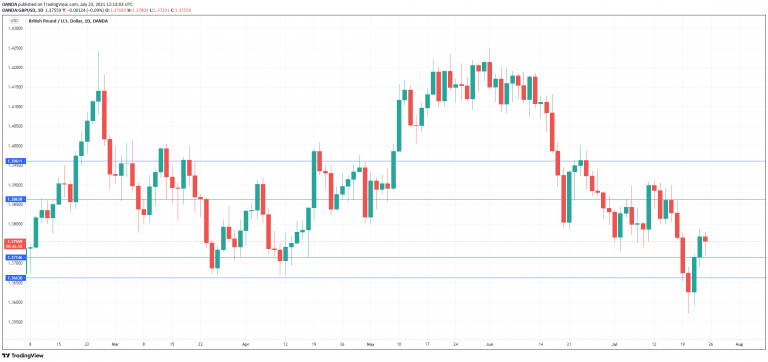
- There is resistance at 1.3863. Above, there is resistance at 1.3961
- On the downside, 1.3714 is the first line of support. This is followed by support at 1.3663
USD/JPY Mid-Day Outlook
Daily Pivots: (S1) 110.01; (P) 110.18; (R1) 110.36; More...
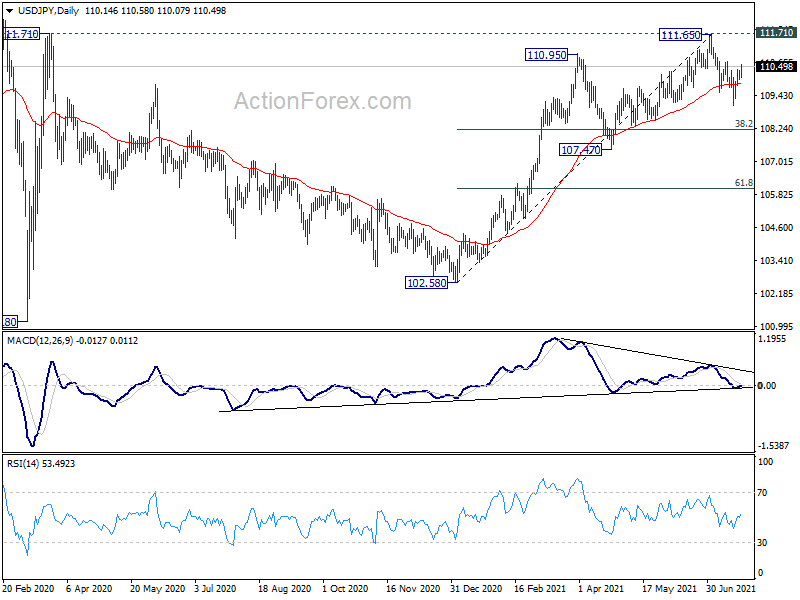
USD/JPY's break of 110.33 resistance argues that correction from 111.65 has completed at 109.50 already. Intraday bias is back on the upside for retesting 111.65 high. On the downside, though, break of 110.00 minor support will turn bias back to the downside for 109.05. Break will target 38.2% retracement of 102.58 to 111.65 at 108.18.
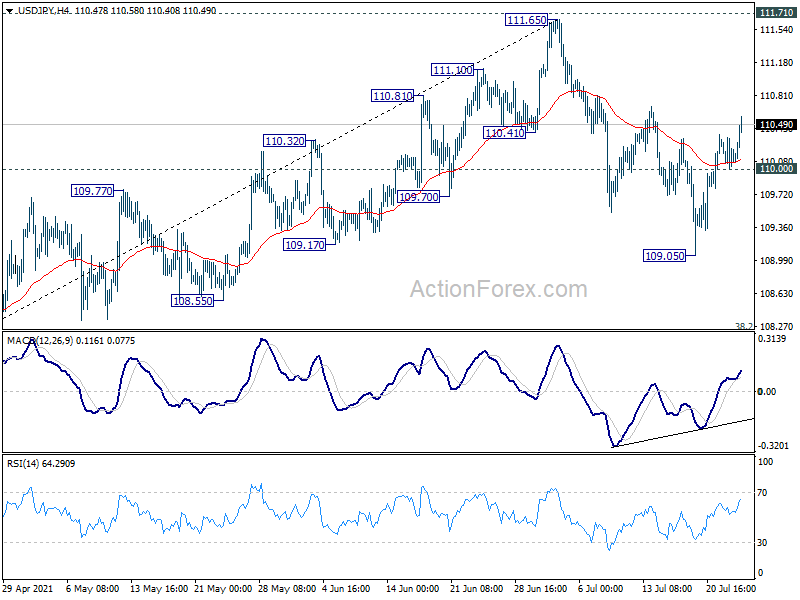
In the bigger picture, medium term outlook is staying neutral with 111.71 resistance intact. The pattern from 101.18 could still extend with another falling leg. Sustained trading below 55 day EMA will bring deeper fall to 107.47 support and below. For now, outlook won't turn bullish as long as 111.71 resistance holds, even in case of strong rebound.
Yen Lower Again as Risk Turned On, Loonie Shrugs Retail Sales
Yen drops broadly today as markets turn back into risk-on mode. It has indeed become the worst performing one for the week. Dollar is also staying to look a bit vulnerable against European majors and commodity currencies. Canadian Dollar is firm and shrug off retail sales data, which shows contraction. Question is now on whether S&P 500 and NASDAQ could make new record highs before weekly close.
Technically, USD/JPY's break of 110.33 resistance now suggests that correction from 111.65 has completed at 109.05 already. But that's more due to Yen's weakness then Dollar's strength. We'd now see if EUR/JPY and GBP/JPY could extend the rebound from 128.58 and 148.43 respectively.
In Europe, at the time of writing, FTSE is up 0.77%. DAX is up 0.96%. CAC is up 0.40%. Germany 10-year yield is up 0.023 at -0.400. Earlier in Asia, Hong Kong HSI dropped -1.45%. China Shanghai SSE dropped -0.68%. Singapore Strait Times dropped -0.07%. Japan was on holiday, as Olympics starts.
Canada retail dales dropped -2.1% in May, more contraction expected in June
Canada retail sales dropped -2.1% mom to CAD 53.8B in May, better than expectation of -3.0% mom decline. The largest declines occurred at building material and garden equipment and supplies dealers (-11.3%) and motor vehicle and parts dealers (-2.4%). Sales decreased in 8 of 11 subsectors, representing 65.6% of retail trade. Advance estimate showed further -4.4% mom contraction in retail sales in June.
ECB dissenter Wunsch not comfortable taking a commitment for five or six years
ECB Governing Council member Pierre Wunsch confirmed to CNBC that he voted against the central bank's new forward guidance. But he urged that "my dissent shouldn't be dramatized," as "we all agree we want to be supportive in this phase of the recovery, we all actually want to go to 2%".
"The most important conclusion of the retreat actually, and our new strategy, is what I would call a 'no regret' conclusion, in that we all agree that what we have been doing in the last few years was necessary and proportional," Wunsch said.
"The question is whether this proportionality test that we are going to have to make in the future — whether we can remain proportional in what we do and take commitments over a long period of time, like five or six years in the future."
"We might be faced with issues of fiscal dominance, issues of financial dominance, and I just, at the end of the day, did not feel comfortable taking a commitment for five or six years."
ECB SPF sees higher inflation and growth in 2021 and 2022
In the ECB Survey of Professional Forecasters (SPF) for Q3, inflation expectations for Eurozone were revised up for 2021 and 2022. Growth projections were upgraded across the horizon while unemployment forecasts were revised down.
Inflation forecast:
- For 2021 at 1.9% (revised up from Q2 forecast at 1.6%).
- For 2022 at 1.5%, (up from 1.3%).
- For 2023 % 1.5% (unchanged).
Real GDP growth forecast:
- For 2021 at 4.7% (up from 4.2%).
- For 2022 at 4.6% (up from 4.1%).
- For 2023 at 2.1% (up from 1.9%).
Unemployment rate forecast:
- For 2021 at 8.1% (down from 8.5%).
- For 2022 at 7.8% (down from 7.8%).
- For 2023 at 7.5% (down from 7.7%).
Eurozone PMI composite rose to 60.6, 21-yr high, enjoying a summer growth spurt
Eurozone PMI Manufacturing dropped from 63.4 to 62.6 in July, above expectation of 62.5. PMI Services rose from 58.3 to 60.4, above expectation of 59.6, a 181-month high. PMI Composite rose from 59.5 to 60.6, highest in 252 months.
Chris Williamson, Chief Business Economist at IHS Markit said: "The eurozone is enjoying a summer growth spurt as the loosening of virus-fighting restrictions in July has propelled growth to the fastest for 21 years. The services sector in particular is enjoying the freedom of loosened COVID-19 containment measures and improved vaccination rates, especially in relation to hospitality, travel and tourism."
Germany PMI composite rose to record 62.5, remains in the fast lane
Germany PMI Manufacturing rose from 65.1 to 65.6 in July, above expectation of 64.1. PMI Services rose from 57.5 to 62.2, above expectation of 59.5, record high since June 1997. PMI Composite rose from 60.1 to 62.5, record high since Jan 1998.
Phil Smith, Associate Director at IHS Markit said: "Germany's private sector economy remains in the fast lane to recovery, according to July's flash PMI survey. Buoyed by a resurgent service sector, the survey's headline index is now at a record high and signals that the recovery still possesses strong momentum at the start of the third quarter."
France PMI manufacturing dropped to 58.1, services dropped to 57.0
France PMI Manufacturing dropped from 59.0 to 58.1, below expectation of 58.3. PMI Services dropped form 57.8 to 57.0, below expectation of 59.0. PMI Composite dropped from 57.4 to 56.8.
Joe Hayes, Senior Economist at IHS Markit said: "It's perhaps slightly disappointing to see the headline composite output figure dip slightly in July, but as the French economy normalises to a state of looser lockdown restrictions, it is not so much of a surprise. Regardless, the PMI pointed to another strong month-on-month rate of output growth, with service providers outperforming their manufacturing counterparts once again."
UK PMI composite dropped to 57.7, Delta variant overshadowed freedom day
UK PMI Manufacturing dropped from 63.9 to 60.4, below expectation of 62.7. PMI Services dropped from 62.4 to 57.8, below expectation of 62.0. PMI Composite dropped from 62.2 to 57.7.
Chris Williamson, Chief Business Economist at IHS Markit, said: "July saw the UK economy's recent growth spurt stifled by the rising wave of virus infections, which subdued customer demand, disrupted supply chains and caused widespread staff shortages, and also cast a darkening shadow over the outlook.
"Concerns over the Delta variant have meanwhile overshadowed the passing of "freedom day", and were a key factor alongside Brexit and rising costs behind a sharp slide in business expectations for the year ahead, which slumped to the lowest since last October. The PMI indicates that GDP growth will likely have slowed in the third quarter, after having rebounded sharply in the second quarter."
UK retail sales rose 0.5% mom in Jun, boosted by Euro 2020 start
UK retail sales rose 0.5% mom in June, matched expectations. Sales were up 9.5% comparing to pre-pandemic level in February 2020. ONS said, "the largest contribution to the monthly increase in June 2021 came from food stores where sales volumes rose by 4.2%, with anecdotal evidence suggesting these increased sales may be linked with the start of the Euro 2020 football championship."
The volume of sales for the three months to June was 12.2% higher than in the previous three months. That's driven in large part of particularly strong sales in April.
UK Gfk consumer confidence rose to -7, gradual release of pent-up demand
UK Gfk Consumer Confidence rose from -9 to -7 in July. The index has improved for six months in a row. Personal financial situation over next 12 months was unchanged at 11. General economic situation over the next 12 months dropped from -2 to -5. However, major purchase index rose from -5 to 2.
Joe Staton, Client Strategy Director GfK, says: "The healthy seven-point rise in the major purchase measure aligns with strong retail growth figures that reflect the gradual unlocking of the UK high street and release of pent-up demand as Brits hit shops, restaurants and venues. However, threats from increasing consumer price inflation, rising COVID infection figures, and the looming end of furlough and the Job Retention Scheme could put the brakes on this rebound.
Australia PMI composite dropped to 45.2, growth streak brought to a halt
Australia PMI Manufacturing dropped from 58.6 to 56.8 in July, a 4-month low. PMI Services dropped from 56.8 to 44.2, a 14-month low. PMI Composite dropped from 56.7 to 45.2, also a 14-month low.
Jingyi Pan, Economics Associate Director at IHS Markit, said: "Latest indications from the IHS Markit Flash Australia Composite PMI suggested that Australia's growth streak had been brought to a halt in July, and perhaps no surprise given the renewed lockdowns aimed to bring the COVID-19 situation under control."
USD/JPY Mid-Day Outlook
Daily Pivots: (S1) 110.01; (P) 110.18; (R1) 110.36; More...
USD/JPY's break of 110.33 resistance argues that correction from 111.65 has completed at 109.50 already. Intraday bias is back on the upside for retesting 111.65 high. On the downside, though, break of 110.00 minor support will turn bias back to the downside for 109.05. Break will target 38.2% retracement of 102.58 to 111.65 at 108.18.
In the bigger picture, medium term outlook is staying neutral with 111.71 resistance intact. The pattern from 101.18 could still extend with another falling leg. Sustained trading below 55 day EMA will bring deeper fall to 107.47 support and below. For now, outlook won't turn bullish as long as 111.71 resistance holds, even in case of strong rebound.
Economic Indicators Update
| GMT | Ccy | Events | Actual | Forecast | Previous | Revised |
|---|---|---|---|---|---|---|
| 23:00 | AUD | Manufacturing PMI Jul P | 56.8 | 58.6 | ||
| 23:00 | AUD | Services PMI Jul P | 44.2 | 56.8 | ||
| 23:01 | GBP | GfK Consumer Confidence Jul | -7 | -9 | -9 | |
| 06:00 | GBP | Retail Sales M/M Jun | 0.50% | 0.50% | -1.40% | -1.30% |
| 06:00 | GBP | Retail Sales Y/Y Jun | 9.70% | 9.60% | 24.60% | |
| 06:00 | GBP | Retail Sales ex-Fuel M/M Jun | 0.30% | 0.70% | -2.10% | -2.00% |
| 06:00 | GBP | Retail Sales ex-Fuel Y/Y Jun | 7.40% | 7.80% | 21.70% | |
| 07:15 | EUR | France Manufacturing PMI Jul P | 58.1 | 58.3 | 59 | |
| 07:15 | EUR | France Services PMI Jul P | 57 | 59 | 57.8 | |
| 07:30 | EUR | Germany Manufacturing PMI Jul P | 65.6 | 64.1 | 65.1 | |
| 07:30 | EUR | Germany Services PMI Jul P | 62.2 | 59.5 | 57.5 | |
| 08:00 | EUR | Eurozone Manufacturing PMI Jul P | 62.6 | 62.5 | 63.4 | |
| 08:00 | EUR | Eurozone Services PMI Jul P | 60.4 | 59.6 | 58.3 | |
| 08:30 | GBP | Manufacturing PMI Jul P | 60.4 | 62.7 | 63.9 | |
| 08:30 | GBP | Services PMI Jul P | 57.8 | 62 | 62.4 | |
| 12:30 | CAD | Retail Sales M/M May | -2.10% | -3.00% | -5.70% | |
| 12:30 | CAD | Retail Sales ex Autos M/M May | -2.00% | -5.00% | -7.20% | |
| 13:45 | USD | Manufacturing PMI Jul P | 62 | 62.1 | ||
| 13:45 | USD | Services PMI Jul P | 64.8 | 64.6 |