

Sample Category Title
The Analytical Overview Of The Main Currency Pairs
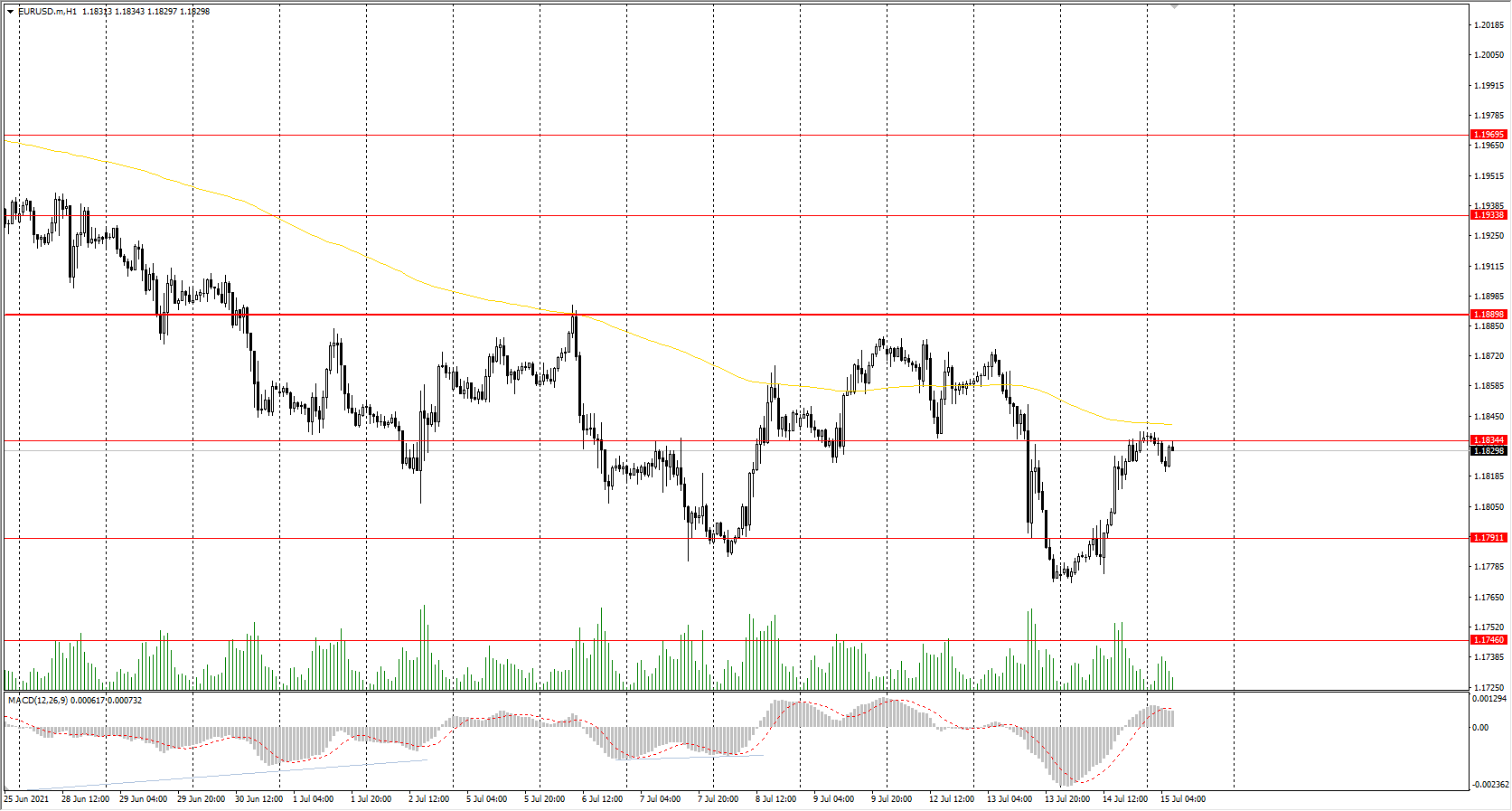
The EUR/USD currency pair
Technical indicators of the currency pair:
Prev Open: 1.1775
Prev Close: 1.1836
% chg. over the last day: +0.52%
With the Fed not planning to cut the QE program, the dollar index started moving downward again, triggering a rise in the EUR/USD currency pair (inverse correlation). Investors are waiting for US labor market data and consumer price index data from European countries, which will be released today and tomorrow.
Trading recommendations
Support levels: 1.1791, 1.1746, 1.1609
Resistance levels: 1.1834, 1.1889, 1.1934, 1.1969
The trend is still bearish. After the decline in the dollar index, the buyers' pressure has increased again, making the price return to the wide range. The MACD indicator has returned to the positive zone. Under such market conditions, it is better to trade intraday. For sell positions, traders should wait for a pullback to the resistance level. Entries for long positions can be searched on support levels, but with short targets, as it will be trading against the trend.
Alternative scenario: if the price breaks out through the 1.1889 resistance level and fixes above, the general uptrend is likely to be resumed.
News feed for 2021.07.15:
- US Initial Job Claims (w/w) at 15:30 (GMT+3);
- US Philadelphia Fed Manufacturing Index (m/m) at 15:30 (GMT+3);
- US Industrial Production (m/m) at 16:15 (GMT+3);
- US Fed Chair Jerome Powell’s Testimony at 16:30 (GMT+3).
The GBP/USD currency pair
Technical indicators of the currency pair:
Prev Open: 1.3811
Prev Close: 1.3858
% chg. over the last day: +0.34%
Inflation in the UK exceeded the Bank of England target of 2% and reached 2.5%. This is the highest level since August 2018. Bank of England deputy governor John Cunliffe said that the central bank would carefully examine how sustainable inflation can be and only then will take action. For now, the Bank of England predicts that the inflation rate will reach 3% by the end of the year. The UK is getting ready to reopen the economy.
Trading recommendations
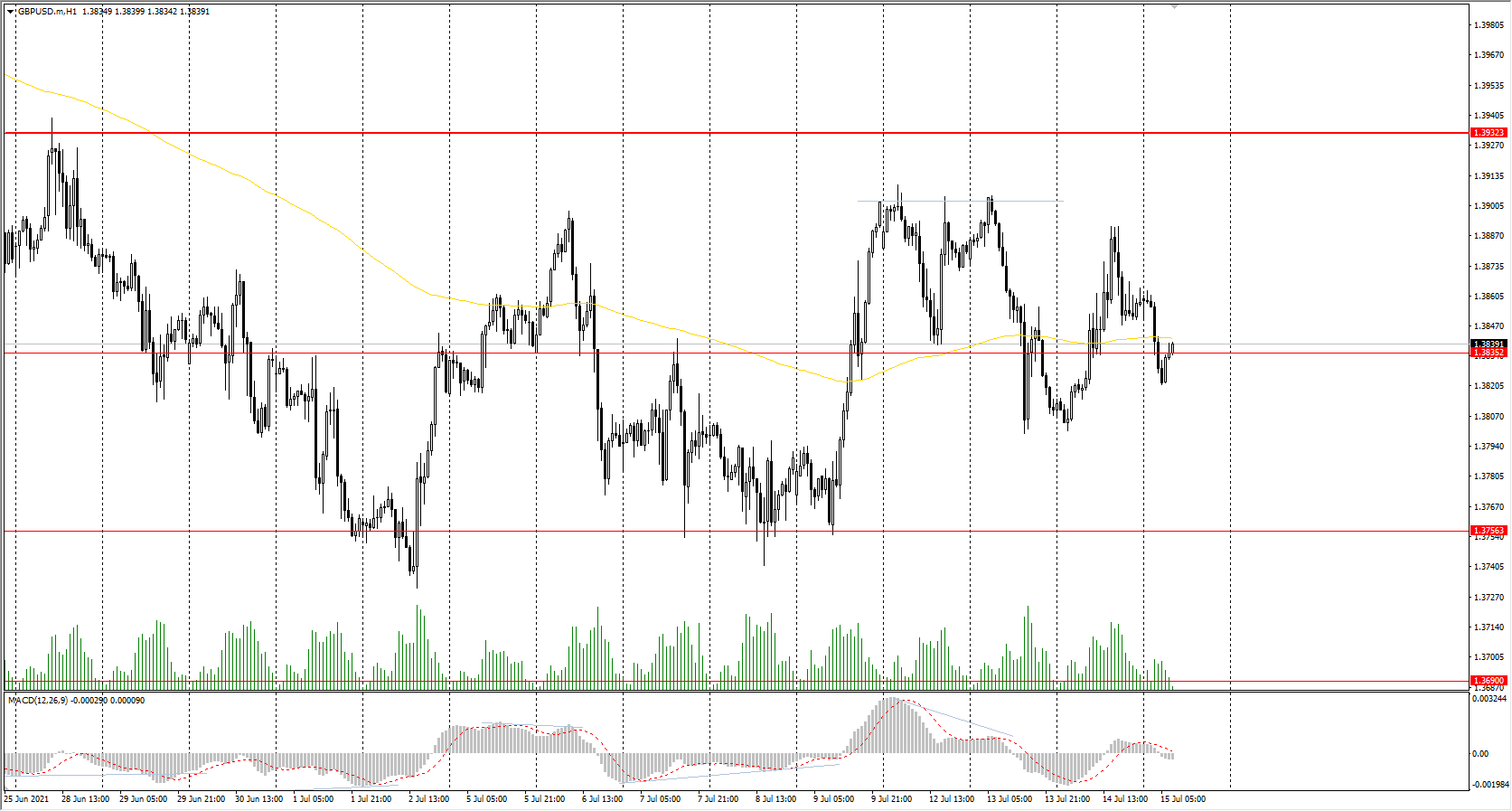
Support levels: 1.3835, 1.3756
Resistance levels: 1.3923, 1.4002, 1.4075, 1.4101, 1.4138, 1.4191
The GBP/USD trend is bearish on the H1 timeframe. The price is trading in a wide range now. The MACD indicator has become inactive. Under such market conditions, it is better to trade intraday. For sell positions, traders should wait for a pullback to the resistance level. Entries for long positions can be searched on support levels.
Alternative scenario: if the price breaks out through the 1.3922 resistance level and consolidates above, the bearish scenario is likely to be canceled.
News feed for 2021.07.15:
- UK Average Earnings Index (m/m) at 09:00 (GMT+3);
- UK Claimant Count Change (m/m) at 09:00 (GMT+3);
- UK Unemployment Rate (m/m) at 09:00 (GMT+3).
The USD/JPY currency pair
Technical indicators of the currency pair:
Prev Open: 110.62
Prev Close: 110.94
% chg. over the last day: -0.62%
USD/JPY quotes sharply decreased amid the falling dollar index. The representative of the ruling party of Japan, Heizo Takenaka, in his interview for Bloomberg, said that Japan needs an additional $270 billion to support economic growth after the pandemic. It will take a long time before the gap between supply and demand in the economy is filled. Japan's central bank is unlikely to change its monetary policy at its meeting tomorrow.
Trading recommendations
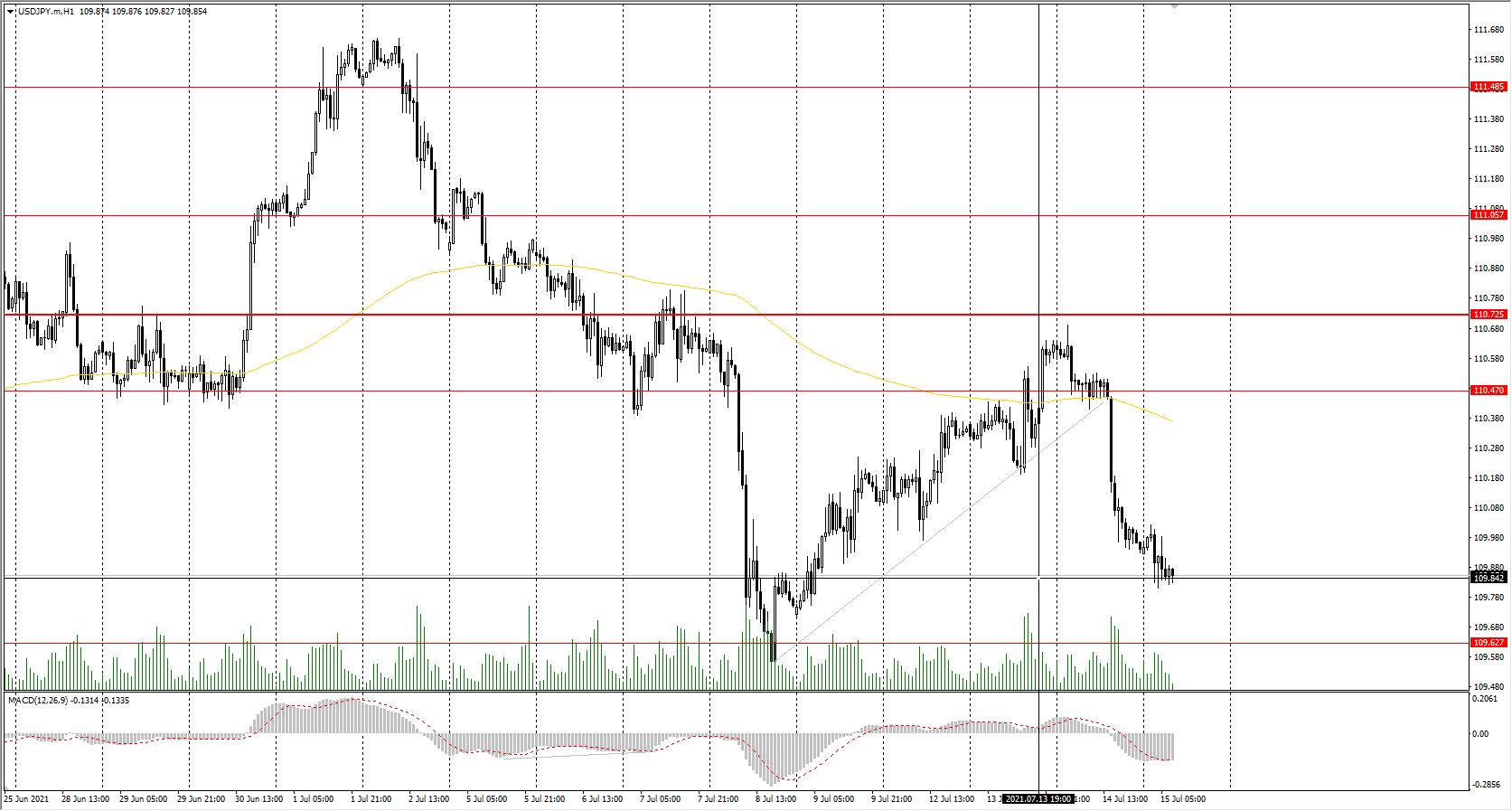
Support levels: 109.63, 109.31
Resistance levels: 110.47, 110.73, 111.06, 111.48, 110.73, 112.18
From the point of view of technical analysis, there is a downward trend on the H1 timeframe, as the price is still trading below the priority change level. The MACD indicator returned to the negative zone. Under such market conditions, traders are better to look for sell positions from the resistance levels on intraday timeframes. Buy positions should be considered from support levels, but only with short targets.
Alternative scenario: if the price rises above 110.73, the uptrend is likely to be resumed.
The USD/CAD currency pair
Technical indicators of the currency pair:
Prev Open: 1.2510
Prev Close: 1.2506
% chg. over the last day: -0.03%
Canada's central bank kept its key interest rate at 0.25% but cut its growth economy forecast for 2021 and plans to cut weekly federal bond purchases from $3 billion to $2 billion. The central bank said it expects the economy to grow 6.0% in 2021 (previous forecast 6.5%) and 4.6% in 2022 (previous forecast 3.7%). Also, the Bank will keep the rate near zero until the economy is ready to handle a rate hike, which is not scheduled until the second half of 2022.
Trading recommendations
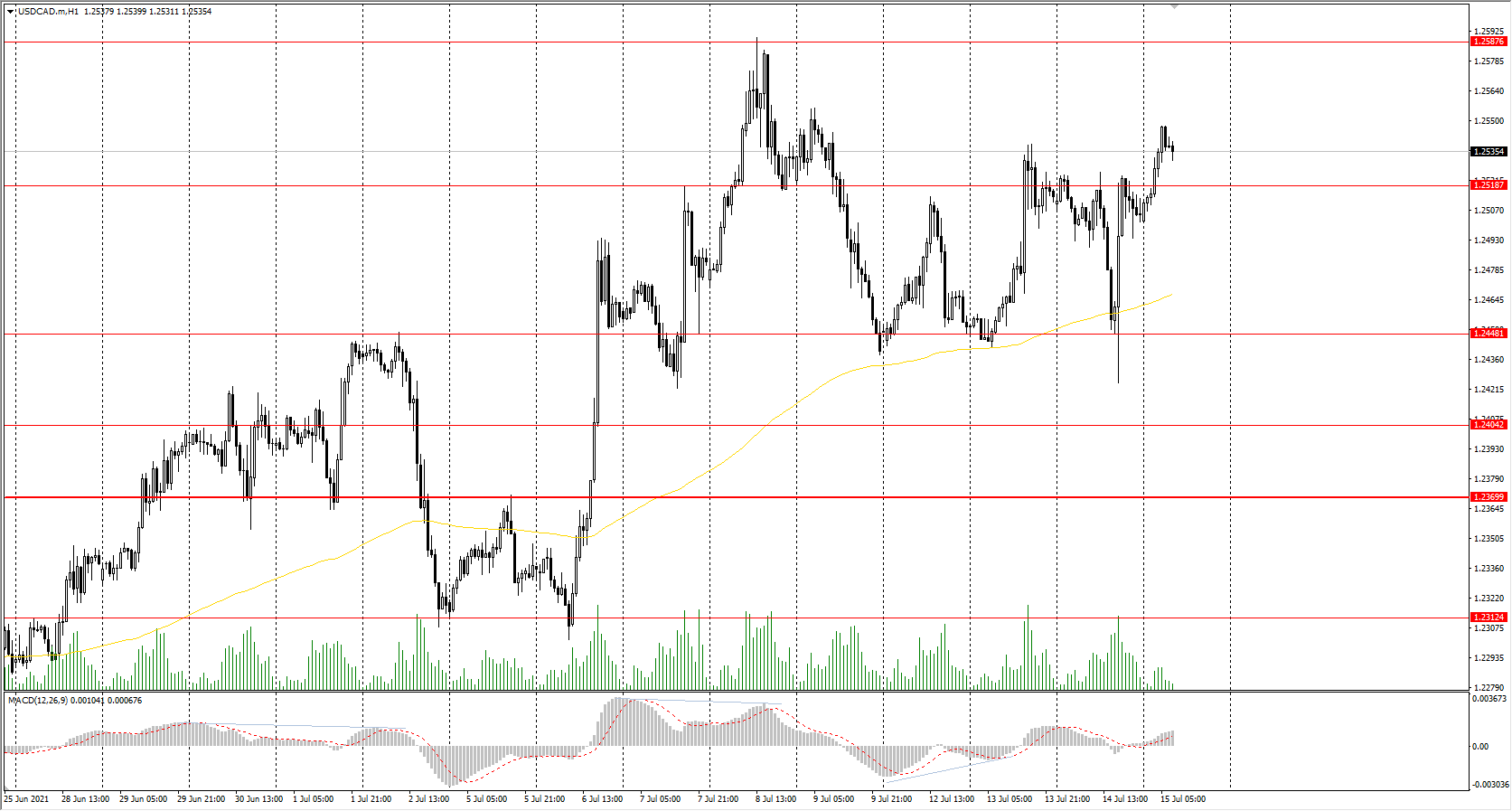
Support levels: 1.2519, 1.2448, 1.2404, 1.2347, 1.2312, 1.2260, 1.2190
Resistance levels: 1.2587
Technically, the trend remains bullish. The price is still trading above the moving average and above the priority change level. The MACD indicator is in the positive zone with no signs of reversal. Under such market conditions, it is best to trade on the lower timeframes. Buyers may look for trades from the support levels within the day. There are no optimal entry points to open sell positions now.
Alternative scenario: if the price breaks down through the 1.2370 support level and fixes below, the downtrend is likely to be resumed.
USD Weakened By Powell’s Dovish Tone
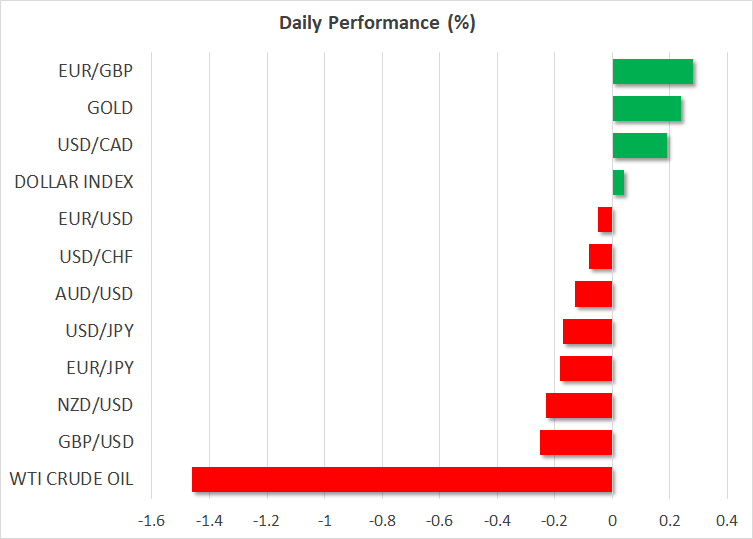
The greenback weakened against a number of its counterparts yesterday while US stockmarkets gained as did also gold after Fed Chairman Powell struck a dovish tone in his testimony before Congress yesterday. Powell eased market worries for a tightening of the bank's monetary policy, as he stated that high inflation seemed linked to the U.S. economy's reopening, that it would be a mistake to act prematurely and that economic conditions for tapering bond buying was "still a ways off". On the other hand, analysts tend to note that spiking coronavirus cases across the globe, from the US to Sydney, may have created some safe haven inflows for the greenback. Today we highlight the US financial releases and note the second testimony of Fed Chairman Powell before Congress.
EUR/USD rose yesterday after bouncing on the 1.1785 (S1) support line yet remained with the boundaries of its sideways movement. We tend to maintain our bias for a sideways movement between the 1.1885 (R1) and the 1.1785 (S1) levels. It should be noted that the RSI indicator below our 4-hour chart is at the reading of 50 also implying a rather indecisive market. Should a buying interest be displayed by the market we may see EUR/USD breaking the 1.1885 (R1) resistance line and aim for the 1.1995 (R2) resistance level. Should sellers be in charge of the pair's direction, we may see the pair breaking the 1.1785 (S1) support line and aim for the 1.1695 (S2) support level.
BoJ to sound cautiously optimistic?
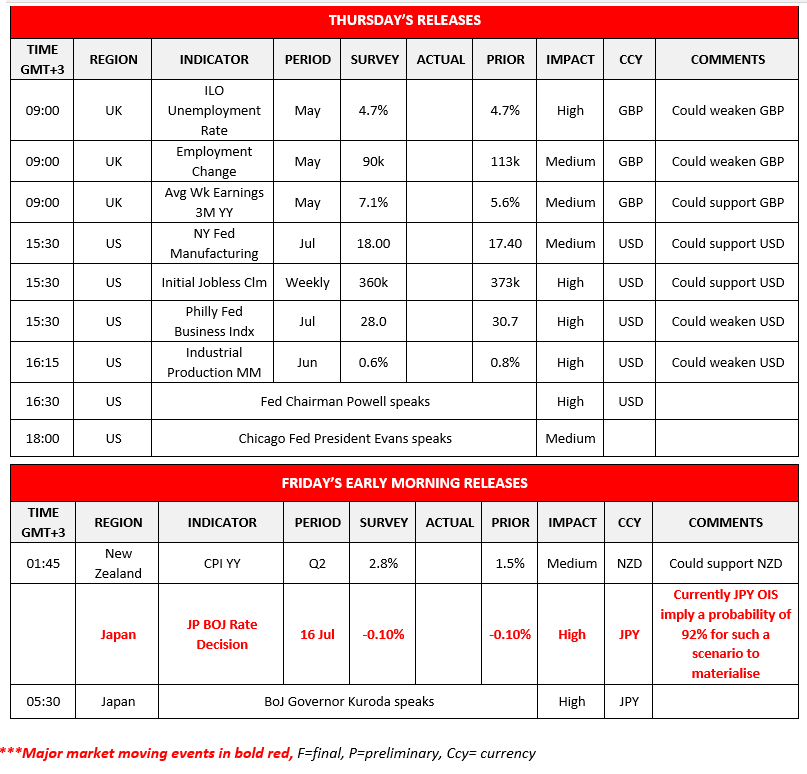
During Friday's Asian session, we get from Japan BoJ's interest rate decision. The bank is widely expected to remain on hold, keeping rates at -0.10% and currently JPY OIS imply a probability of 91.62% for such a scenario. One highlight could be whether the bank is to cut back on the economy's growth rate projection or not, which would enhance its dovishness even further or offer a cautiously optimistic view of the economy in the fresh quarterly projections due out tomorrow. The renewed state of emergency to weaken the spreading of Covid 19 could hurt local consumption and increase the reliability of the growth factor for the economy on exports. Overall, the bank is expected to retain its expectations for a moderate recovery and may lower the GDP growth rate somewhat for the current year, while at the same time upgrade it for the coming year. Should the bank rely more on its usual dovishness, we may see the Yen weakening somewhat, albeit JPY may be more sensitive to safe haven flows.
USD/JPY dropped yesterday breaking the 109.95 (R1) support line, now turned to resistance. We tend to maintain a bearish outlook for the pair, given that the RSI indicator below our 4-hour chart is at the reading of 50, implying a rather indecisive market. Should the bears actually be in control of the pair's direction, we may see USD/JPY, aiming if not breaking the 109.25 (S1) support line. Should the bulls take over, we may see the pair breaking the 109.95 (R1) resistance line and aim for the 110.90 (R2) resistance level.
Other economic highlights today and the following Asian session:
Today during the European session, we note the release of the UK employment data for May. In the American session, we get from the US the NY Fed Manufacturing for July, the weekly initial jobless claims figure, the Philly Fed Business index and the industrial production growth rate for June. On the monetary front, besides the second testimony of Fed Chair Powell before Congress we also note the release of Chicago Fed President Evans. During tomorrow's Asian session, before BoJ's interest rate decision, we get New Zealand's CPI rates for Q2.
EUR/USD H4 Chart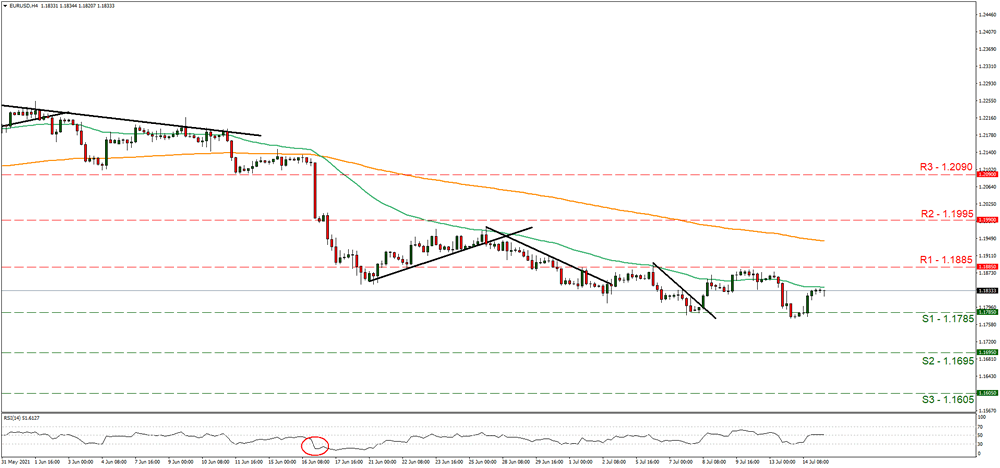
Support: 1.1785 (S1), 1.1695 (S2), 1.1605 (S3)
Resistance: 1.1885 (R1), 1.1995 (R2), 1.2090 (R3)
USD/JPY H4 Chart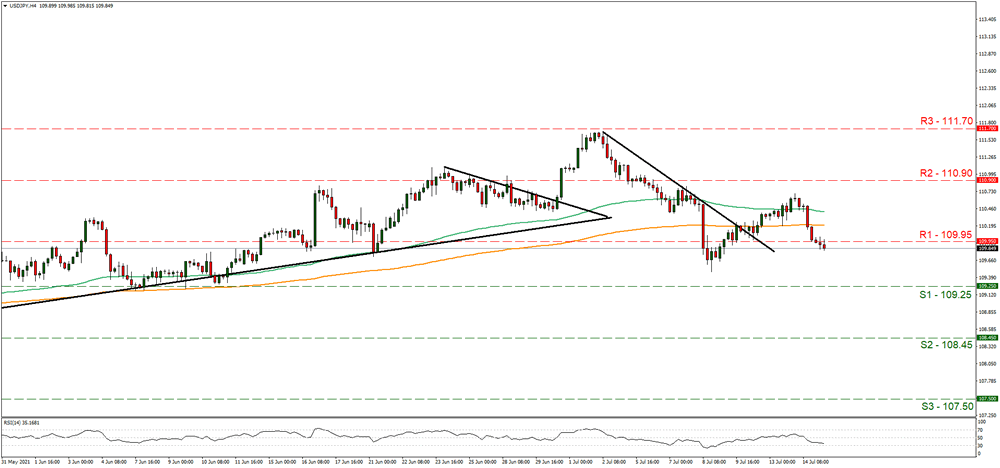
Support: 109.25 (S1), 108.45 (S2), 107.50 (S3)
Resistance: 109.95 (R1), 110.90 (R2), 111.70 (R3)
Powell Calms Inflation Nerves, Dollar And Yields Dip But Stocks Unfazed
- Fed chief Powell plays down inflation spike, says tapering is “a ways off”
- Dollar and yields head back down before virus fears re-emerge, yen climbs
- Equities only modestly boosted as growth concerns weigh after China GDP miss
Powell soothes nerves but hints at U-turn
Fed Chair Jerome Powell sought to allay growing worries that the bout of higher inflation is here to stay and that stimulus would have to be dialled back soon when testifying before lawmakers on Wednesday. While recognising that policymakers lack certainty about whether or not inflation will fall back, Powell stuck to the view that the surge is transitory.
Data out on Tuesday showed annual CPI in the US jumped to 5.4% in June, piling pressure on the Fed chief ahead of Wednesday's and Thursday's congressional hearings. Despite getting grilled by lawmakers about the Fed's stance on letting inflation run hot, Powell's priorities seem to lie with the jobs market. The Fed is determined to get the US economy back to full employment and will hold off from tapering for as long as possible.
Nevertheless, Powell is showing increasing signs of being ready to do a complete turnabout on inflation, hinting that the Fed's narrative could “flip” if the numbers don't come down and that policymakers will react if inflation expectations move up in a way that is “troubling”.
But for now, Powell's lax attitude was enough to put renewed downward pressure on Treasury yields, with markets not expecting the Fed to respond very aggressively even if inflation does end up staying elevated for too long.
Yields slip further but dollar steadies amid virus woes
The 10-year yield has plunged back below 1.32%, having brushed the 1.42% neighbourhood only 24 hours ago. The US dollar was also dragged lower as a result, sliding against all of its main peers on Wednesday. However, the greenback drew support from some mild risk-off flows on Thursday, halting its decline, while the safe-haven Japanese yen and Swiss franc were broadly firmer.
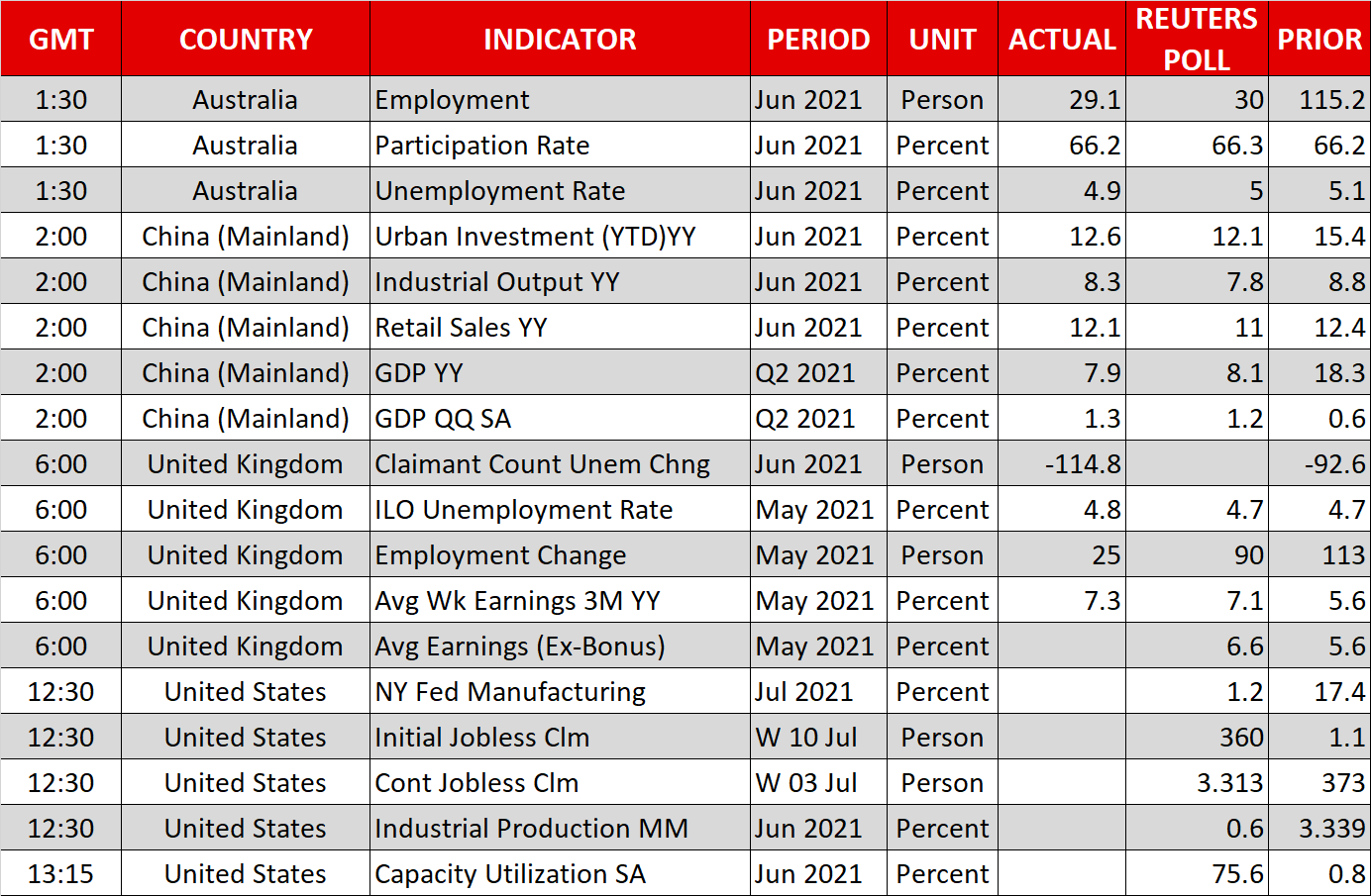
Disappointing GDP numbers out of China today have dented yesterday's small boost to sentiment from Powell's testimony. The Chinese economy grew by a slightly less-than-expected 7.9% y/y in the second quarter, reviving fears that the recovery in the world's number two powerhouse is stalling.
Monthly data on industrial output and retail sales were somewhat above estimates but not substantially enough to ease concerns about a weakening growth outlook.
While it's not clear to what extent the slowdown is related to the recent spike in Covid infections in the region, brought on by the outbreak of the Delta variant, the fact that daily cases keep going up in more and more countries is starting to worry investors and is taking the shine off the vaccine-fuelled optimism.
Pound and loonie steadier but lack direction
In other currencies, the pound was choppy but pinned below the $1.38 level amid a flurry of remarks by BoE policymakers over the last day as well as some conflicting economic data. Britain's inflation rate accelerated more than expected in June but the unemployment rate ticked slightly higher in the three months to May. Like the Fed, BoE Governor Andrew Bailey doesn't think it would be a good idea to “rush” into making a decision on raising rates, though his deputy, Dave Ramsden, suggested that the current round of QE could be cut short.
The Bank of Canada, meanwhile, took another step towards ending QE by reducing its weekly bond purchases as expected at its policy meeting yesterday. The Canadian dollar firmed slightly after the decision before retreating again on news that Saudi Arabia and the UAE have reached a compromise on an output deal that should pave the way for more oil supply in the coming months. WTI and Brent Crude futures slid to one week-lows.
Mixed mood in equities with focus on earnings
There wasn't a great deal of cheer in equity markets either, with Asian stocks ending the session mixed but European bourses starting the day in negative territory. S&P 500 futures were last trading flat after marginally closing higher on Wednesday. Nasdaq futures were up 0.4%, however, on track to more than reverse yesterday's losses and likely boosted by the fresh slump in yields.
Overall, markets seem to be caught between optimism and caution as rising vaccination rates and assurances of ongoing ultra-loose monetary policy are running in parallel with an alarming escalation in virus numbers.
The thickening fog over the outlook could overshadow the so-far encouraging earnings season, which continues today with Morgan Stanley.
ECB Visco: No tapering before the time comes
ECB Governing Council member Ignazio Visco told Bloomberg that, "we have to avoid tapering before the time comes that we're really confident we're back where we should." He emphasized, "we really have to show to be determined".
"Financial conditions are to remain favorable even if we have signs of some price increases that are above the target that the central banks have set," he said.
"I don't expect monetary policy to be tightened for a long period," Visco added, as there is still "substantial slack" in the economy. Also, there are risks of another wave of coronavirus infections. Nevertheless, there is no discussion on extending the PEPP beyond end date in March.
Jerome Powell’s Speech Reassured Investors. Fed Believes That The Recent Spike In Inflation Is Termporary
Yesterday, the Fed Chairman Jerome Powell pointed out that the economic situation wouldn’t allow Fed to reduce the QE program in the near future, as 7.5 million jobs weren’t provided to reach previous levels. When it comes to the rise in inflation, Mr. Powell said that the increase in prices is predetermined by the country's recovery from the pandemic and is temporary, but inflation will remain high in the coming months. This year, the Fed promises strong support to complete the US economic recovery. The US stock indices closed a trading session without a single trend on Wednesday.
Meanwhile, tensions between China and the US continue to escalate as the US announced that it has no plans to resume the economic dialogue with China that was suspended during the presidency of Donald Trump. The US Senate also passed a law banning all products from China's Xinjiang province.
The EU is targeting airlines due to a major shift in climate policy. Airlines could lose their jet fuel tax credit and may pay a larger bill for emissions. This could deal a serious blow to European airlines, which are already on the brink of survival during the quarantine period. In its turn, the European Central Bank is launching a pilot project of the "digital euro". It’s a fully electronic version of the European currency, which will differ from both the paper prototype and cryptocurrencies. The digital euro will be in the test mode for two years.
Yesterday, oil prices fell sharply as anonymous OPEC+ sources reported that the United Arab Emirates and Saudi Arabia reached an agreement on production quotas in August. There is no official confirmation of this information yet. But the oil problems are not limited to OPEC+. The rapid spread of the Delta strain of coronavirus continues to threaten the global economic recovery.
Against the background of the decrease the dollar index, the government bonds yield also decreased, which led to a rise in prices for gold and silver. While the US monetary policy remains unchanged, the fundamental picture is in favor of rising prices on precious metals.
The Asian stock market also closed a trading session without a single trend on Wednesday. South Korea's central bank kept its interest rate at a record low of 0.5%. China's GDP increased by 7.9% in the second quarter (with the forecast of 8.1%), relative to the same period last year, but the economy slowed down compared to a record jump of 18.3% in the first quarter. China's industrial production increased by 8.3% at an annual rate in June (with the forecast of 7.8%), but it’s lower than the 8.8% increase recorded in May. China's unemployment rate was unchanged and remained at the level of 5%. Indonesia is preparing for a worsening COVID-19 outbreak as the Delta strain is spreading faster than expected. Thailand reported a record number of deaths in the last 24 hours from the coronavirus.
Main market quotes:
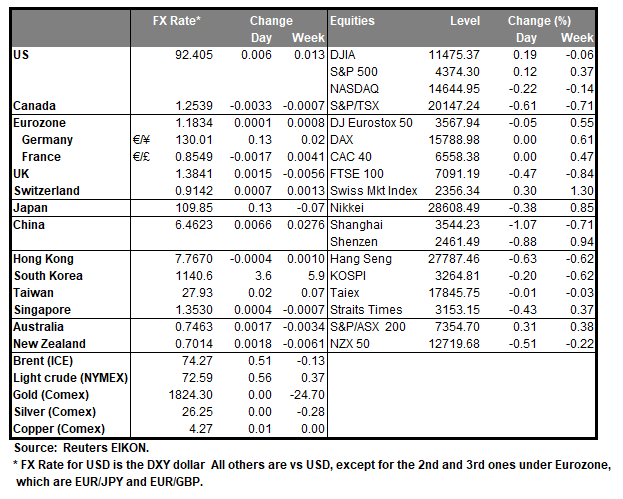
- S&P 500 (F) 4,374.30 +5.09 (+0.12%)
- Dow Jones 34,933.23 +44.44 (+0.13%)
- DAX 15,788.98 -0.66 (-0.01%)
- FTSE 100 7,091.19 -33.53 (-0.47%)
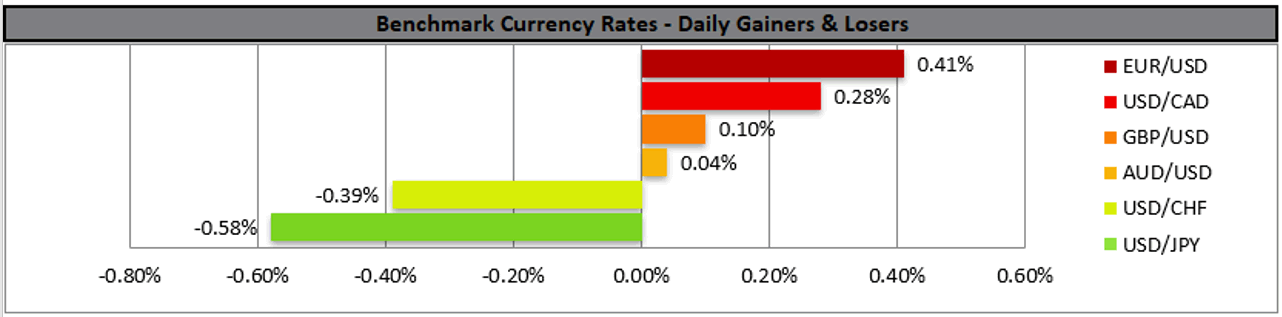
- USD Index 92.37 -0.38 (-0.41%)
Important events:
- Australia Employment Change (m/m) at 04:30 (GMT+3);
- Australia Unemployment Rate (m/m) at 04:30 (GMT+3);
- China GDP (q/q) at 05:00 (GMT+3);
- China Industrial Production (m/m) at 05:00 (GMT+3);
- China Unemployment Rate (m/m) at 05:00 (GMT+3);
- UK Average Earnings Index (m/m) at 09:00 (GMT+3);
- UK Claimant Count Change (m/m) at 09:00 (GMT+3);
- UK Unemployment Rate (m/m) at 09:00 (GMT+3);
- US Initial Job Claims (w/w) at 15:30 (GMT+3);
- US Philadelphia Fed Manufacturing Index (m/m) at 15:30 (GMT+3);
- US Industrial Production (m/m) at 16:15 (GMT+3);
- US Fed Chair Jerome Powell’s Testimony at 16:30 (GMT+3);
- Natural Gas Storage (w/w) at 17:30 (GMT+3).
Oil Lower On OPEC+, Gold Rallies On Powell
OPEC+ sends oil lower
Reports are emerging that Saudi Arabia and the UAE have reached an agreement on their dispute, with the UAE apparently securing a higher production baseline. That followed official US crude inventory data that showed another large fall in headline inventories but a significant increase in gasoline and distillate stocks.
That combined to seen oil prices sharply lower, with Brent crude falling by 2.40% to USD 74.50 a barrel and WTI falling by 3.0% to USD 72.90 a barrel. The sell-off has continued in Asia, with both contracting falling around 0.50% to USD 74.20 and USD 72.50 a barrel, respectively.
Any agreement between Saudi Arabia and the UAE must be signed off by the whole OPEC+ grouping, adding a layer of uncertainty to the proceedings. Further muddying the waters, Iraq has also allegedly now asked for a higher production baseline. If this is the start of a flood of member requests, then oil prices are now vulnerable to a deeper correction lower.
The threat of weaker OPEC+ cohesion and higher than anticipated production will cap oil price gains for now. Brent crude has support at USD 74.00 and USD 72.00 a barrel, and failure of USD 72.00 could see a speculative capitulation trade occur, although I expect its duration to be short, if brutal. WTI's line in the sand will be at USD 70.00 a barrel, and I expect some similarly ugly stop-loss selling to occur if it fails.
Oil's underlying positive fundamentals remain intact, despite the Covid-19 issues across Asia, ex-China. Oil's short-term price action will revolve around OPEC+ cohesion and whether higher baseline production requests start flowing in from other members.
Gold's price action looks impressive
Gold prices rallied overnight after Jerome Powell was suitably dovish in his congressional testimony. Gold rose 1.10% to USD 1827.50 an ounce, closing just above its 200-day moving average (DMA) at USD 1826.50 an ounce, a bullish technical development.
Gold has weathered the storm of higher US yields and a higher US dollar with aplomb this week, remaining rock solid at USD 1800.00 an ounce and comfortably above support at its 100-DMA at USD 1790.00 an ounce. It has resumed its rally powerfully as soon as those pressures alleviated, and this implies to me that gold is targeting further gains ahead.
Gold has support at USD 1820.00 and USD 1800.00 an ounce, with the bullish outlook intact as long as the 100-DMA at USD 1791.00 holds on a closing basis. Gold's next upside targets are USD 1845.00 and USD 1860.00 an ounce, although I expect more of a slow grind higher, rather than the fast jump seen overnight.
Powell Remains In Transit
The Federal Reserve Chairman steadied the post-US-inflation ship overnight, reiterating that virus-disrupted price increases among the CPI components would ease in the coming months. Regarding the labour market, Mr Powell felt that when holidays finished, schools reopened, and federal unemployment benefits rolled off, labour market pressures would alleviate. In other words, the Federal Reserve remains with its tent firmly pitched in the transitory inflation camp, and that the FOMC were still far away from meeting the conditions to begin tapering monetary stimulus.
US yields, dollar edge lower
Bond yields, which had only grudgingly moved higher post the US inflation data, quickly retraced those rises overnight, precious metals rose, and the US dollar retraced some of its previous days’ gains. The biggest sigh of relief was probably heard around Asia, where the threat of a divergence in the direction of monetary policy would have weighed heavily.
US stock markets had a mixed day, giving back intraday gains, with the main indexes finishing each side off unchanged. The no news is good news from Mr Powell, perhaps offset by the Fed Beige Book, which showed many businesses expected to see rising input and selling prices in the months ahead. Additionally, after a decent run higher, the US earnings season may well have elements of buying the rumour, selling the fact with lots of good news priced into upcoming results. Still, equities remain near record highs, so despite the sideways shuffle last night, it really is business as usual.
The US releases another plethora of data this evening, including Industrial Production, Initial Jobless Claims, the NY Empire State Manufacturing Index and Import and Export Prices. The impact on markets will be minimal now that Mr Powell has held fast on the transitory mantra and steadied the ship. As I stated earlier in the week, respect the momentum, and follow the momentum until it changes as many intelligent people worldwide are as divided as a US Congress on whether we are sticky or transitory.
The data calendar has been busy today in Asia. South Korea held rates unchanged this morning at 0.50%, although the decision was not unanimous. The Bank of Japan will meet tomorrow amid speculation in Tokyo that they will downgrade the GDP outlook for 2021. I am expecting no change in policy, however.
China released a solid, if unspectacular by their standards set of data this morning. Retail Sales rose by 12.1% YoY for June, slightly better than expected. In June, Fixed Asset Investment (YTD) rose 12.40%, less than May but better than forecast. Industrial Production rose by 8.30%, while GDP YoY for Q2 rose 7.90%, and QoQ by 1.30%. The data mostly showed an easing from the high baseline effects but was modestly above expectations.
On releasing the data, China’s National Bureau of Statistics (NBS) noted still faces external uncertainties and an unbalanced recovery between the export-facing and domestic sides of the economy. After setting a slightly weaker USD/CNY fix today (in yuan terms), the PBOC also rolled over a maturing 100 billion yuan one-year MLF facility today, injecting funding at the one-year Loan Prime Rate. That is very much a similar mantra of many a central bank at the moment. Coming after the RRR cut last Friday, it seems the monetary policy is quietly moving to the side of caution in China, especially with the World Bank downgrading Asian GDP, ex-China, overnight.
Australia may be in various stages of lockdown, but it continues to push out data that supports its “lucky country” nickname. Employment data was impressive, with a fall in part-time jobs by 22,500 handsomely offset by a rise in full-time employment by 51,600, while the unemployment rate eased to 4.90%. That won’t budge the RBA from its dovish perch, which wants to see even lower unemployment pushing up wages before it moves. It does, however, show that Australia’s economy continues to power through the rolling lockdowns. The currency didn’t react, though, as local markets are cautious about the whack-a-mole spread of the delta-variant to Melbourne, South Australia and the extension of the Sydney lockdown.
India dodged a stagflationary bullet last night, as WPI Inflation stays elevated about the RBI target but eased slightly from the month before. That has taken some temporary pressure on the Indian rupee for now. Sentiment in Asia, ex-China, remains fragile, though. Covid-19 is the reason, and here in Indonesia and Malaysia, the situation is dire indeed. But the rest of the region is also playing a catchup game, and this will continue to mute sentiment, with the World Bank growth downgrade likely to be the first of many.
Powell’s Dovish Stance Sends Dollar Down
Transitory Fed weakens US dollar
With Jerome Powell firmly camped still in the transitory inflation corner, US bond yields unwound their previous day's rise, and that saw the US dollar give back part of its previous session's gains. The dollar index fell 0.44% to 92.37 overnight, leaving it mid-range between support at 92.00 and resistance at 92.85, which it once again tested and failed at intra-session overnight. Currency markets continue to show more caution on the inflation equation than either stocks or bonds, and this has been the case for the past couple of weeks. In the meantime, a break of the aforementioned support/resistance levels is now required to signal the US dollar's next directional move.
A dovish Powell lifted EUR/USD off its 1.1770 lows overnight, rallying to 1.1850, where it remains in moribund trade in Asia. With inflation data remaining soggy in Europe, the single currency needs to recapture the 1.1900 regions to signal a greater recovery. Otherwise, a break of 1.1770 could still signal a deeper correction to between 1.1500/1.1600. A Bank of England official suggested that UK rate hikes could be getting closer overnight, which saw sterling climb 0.35% to 1.3860. That rally has faded in Asia, with GBP/USD falling to 1.3840. GBP/USD has clear support at 1.3800 and resistance at 1.3900.
AUD/USD has fallen 0.30% to 0.7460 in Asia, despite very impressive employment data. Covid-19 worries are clearly perceived as a more immediate threat to AUD/USD today, and resistance at 0.7500 looks safe for now. Large options expiries at that level today, though, mean that AUD/USD is unlikely to track much lower intra-session. AUD/NZD selling may also be weighing on the Australian dollar after a hawkish RBNZ pushed the NZD/USD higher yesterday. NZD/USD has held gains above 0.7000 overnight, and if inflation data released tomorrow morning is higher than expected, the tightening noise will increase. That should see the kiwi continue to rally versus the US and Australian dollars.
Asian currencies have recorded modest gains overnight in a collective sigh of relief after Jerome Powell kept the Fed in the dovish corner. USD/INR has fallen to 74.476 and USD/KRW to 1141.10, helped along by firm India inflation data and a slightly hawkish Bank of Korea. However, the retracements are shallow, and in the case of USD/IDR, USD/THB and USD/MYR, they are almost non-existent. The latter three remain the most vulnerable to further weakness along with the Philippines as all four continue to grapple with challenging Covid-19 situations. The fall in oil prices overnight will have done the IDR and MYR no favours, and you can throw in political uncertainty into the ringgit as well. With USD/CNY content to range between 6.4500 and 6.5000, it is regional Asia that remains the most vulnerable to further losses for now.
Stock Markets Are Mixed In Asia
Japanese equities dip, China edges higher
Stock markets are a mixed bag in Asia after Wall Street limped to an almost unchanged finish despite the Powell testimony steadying the ship. The S&P 500 finished 0.12% higher, the Nasdaq closed 0.22% lower, and the Dow Jones edged 0.13% higher. With little direction from Wall Street, which seems to be focusing on upcoming earnings now, Asian markets have been left to their own individual devices
The Nikkei 225 has fallen 0.88% as speculation mounts that the Bank of Japan will downgrade its outlook for the economy at tomorrow’s policy meeting. Despite a slightly hawkish bent to the statement, the Bank of Korea kept rates at a record low of 0.50% this morning, which has lifted the Kospi by 0.45%.
In China, the solid, if unspectacular data dump today see the Shanghai Composite edging 0.20% higher, while the CSI 300 is up just 0.10%. However, Hong Kong has jumped 1.15% as China tech giants talk about opening up their ecosystems to each other, something markets feel will please their ultimate bosses in Beijing. Hong Kong should also benefit from a rotation of China IPOs from the US going forward.
Taipei has risen by 0.45% today, while Singapore has fallen 0.40% after another surge in Covid-19 cases. Kuala Lumpur and Jakarta have, quite surprisingly, climbed by 0.50% in what I assume are technical moves after some previously tricky sessions. I would approach rallies in each with a large grain of salt given the Covid-19 situations both are experiencing. Regional Asia had the most to lose from a change in Fed tone, and the Powell testimony overnight has likely driven the gains. Bangkok is 0.20% higher while Manila has fallen 0.80%.
The impressive Australian employment data has not been enough to keep markets in the green there, as new cases of Covid-19 pop up across Australia, raising fears of ever-expanding lockdowns. The ASX 200 is 0.30% lower, while the All Ordinaries has eased by 0.10%.
European stock markets should ignore Asia as a result of their vaccination premium. With the Fed still unconcerned about inflation, that should be enough to lift European stocks initially. It is unlikely that Wall Street will sustain any significant dips into the end of the week either. As I have said before, respect the momentum.
Crude Oil Growth Impulse Questioned On Supply Increase
Oil is losing for a second consecutive day on fears of oil supply expansion from both OPEC+ and the US.
Despite some contradictory reports, there is still a growing chance that the UAE will agree to a quota increase. The UAE is pushing for an increase in the baseline production level in 2022 from 3.17m b/d to 3.65m b/d. This level is used as a reference point for the cartel's quota allocation, so raising it would allow the UAE to produce more crude.
The market fears that production will increase by 0.5M BPD but that others will follow. Already today, Iraq has announced that it intends to seek a quota increase for itself. There is no doubt that this is just the beginning.
Separately, Saudi Arabia is reducing its voluntary production cuts, which it resorted to earlier this year to support prices.
With indirect ways, the cartel is ramping up production and will do so further, shifting the focus from maximising price to maximising revenues. OPEC+ has no other choice.
After a period of stagnant production near 11M BPD for the previous 12 months, the US has started to ramp it up. Figures published yesterday for last week showed a rise to 11.4M.
At this stage, US production growth has not kept pace with the recovery in demand, and commercial inventories continue to fall. This decline in stocks is temporary as the US has vast potential to ramp up production, which was as high as 13.4M before the pandemic hit.
A look at the oil chart from a technical analysis perspective suggests that the bullish momentum from early July is wearing off, with new highs in price accompanied by lower RSI highs.
We will get a stronger signal to downside trend reverse after a break below the 50-day average, which now passes through $71.50 per barrel Brent. Without this confirmation, the bullish trend in oil persists, and the slippage and consolidation could only be a prologue for new growth momentum, as was the case in March and May.