

Sample Category Title
We Have Revised Our AUD Outlook
Despite the fall in the AUD from around USD0.80 in February to the current USD0.74 we do not believe that the long term upswing in the AUD which began from around USD 0.60 last March has run its course.
Certainly, we have shaved our target levels for end 2021 from USD0.80 to USD0.78 and the target expected peak in the second half of 2022 from USD0.85 to USD0.82 but we are still expecting a solid net US 8¢ lift in the AUD from its current level over the course of the next year.
In the attached Figures 1–3 we allocate the movements in the AUD/USD between the USD itself (as measured by DXY) and “other factors” which are specific to the AUD. Figure 1, covers the period of recovery in the AUD from March 2020 to February 2021. It shows that only around 30% of the AUD strength was due to a weaker USD.
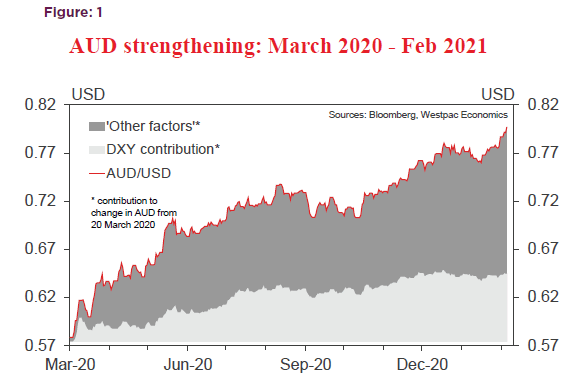
The 'other factors' that were boosting the AUD during that period were the 30% lift in Australia’s commodity price Index; global recognition of Australia’s outstanding success in dealing with Covid; an unexpectedly aggressive boost to fiscal policy; reluctance (until November) by the RBA to adopt quantitative easing; a non-negotiable stance by the RBA against negative interest rates; Australia’s rapid economic recovery with pre Covid activity levels being reached in the March quarter, ahead of its OECD rivals; and the usual benefit which AUD receives from markets’ acceptance of the strong global recovery underpinned by the rapid development of vaccines, supporting confidence in 'risk on' currencies.
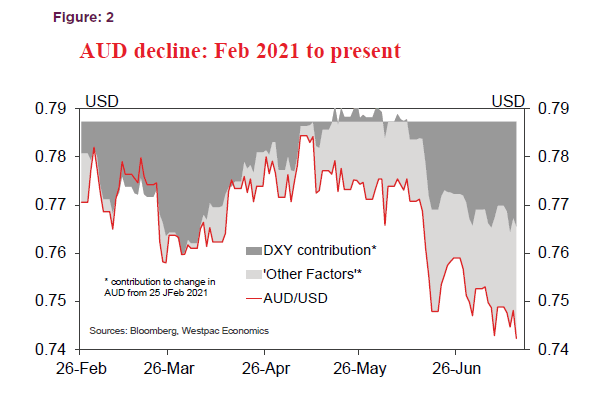
Figure 2, shows the movement in AUD from that peak in February, highlighting the importance of the USD. AUD’s initial weakness in February – March period was largely due to the lift in US bond rates and the USD that unnerved the equity market weighing on 'risk" currencies; those pressures gradually eased as markets backed off from the reflation trade; thereafter there was an emerging perception that while Australia had excelled at the first stage of the Covid crisis it was struggling with its vaccine rollout with fully vaccinated numbers for Australia falling well short of the other developed economies.
With AUD now looking vulnerable markets were also punishing the AUD on the basis of trade tensions with China even though Australia’s trade surplus with China had reached record levels
The RBA’s QE program was also weighing on the AUD. Markets were surprised when the Governor announced a second $100 billion QE program at the February 2 Board meeting while, a confident RBA Assistant Governor Kent speculated that QE had been responsible for AUD being 5% lower than otherwise would have been the case.
These 'other factors' were offsetting the further 20% lift we have seen in Australia’s Commodity Price Index since February. Markets may be taking this improvement for granted describing the commodity price out performance as a 'known positive' while anticipating that it would eventually fade.
Finally, as is clearly shown by Figure 2, a rising USD, in June, then played a key role in again weighing on AUD. Most of that move came after the FOMC meeting in June when AUD quickly fell from USD0.77 to USD 0.75 as markets reassessed a more hawkish stance from the FOMC.
In particular, the FOMC's range of forecasts indicated an earlier than previously expected beginning to the rate hike cycle. By implication, markets also brought forward their timing for the tapering of the FOMC’s QE policy.
From the perspective of AUD, the markets seemed to ignore the stunning fall in Australia’s unemployment rate in May from 5.5% to 5.1% concentrating entirely on the revised outlook for the FOMC. At that time Westpac revised its policy rate outlook for both the RBA and the FOMC bringing forward the timing for the beginning of the rate hike cycles for both central banks. Our relative timing of the moves by the two central banks is similar to market pricing so not a significant factor in our outlook for the AUD.
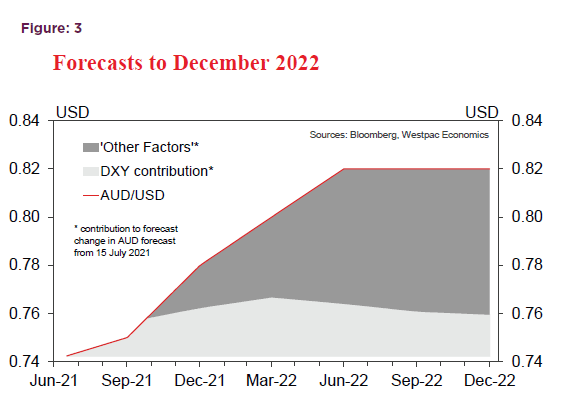
Figure 3, shows our forecast for AUD, including the 'contribution' from the USD out to end 2022.
Readers will note that we are expecting a modest (around 3%) depreciation of the USD to the first half of 2022 after which USD appreciates somewhat.
Generally, our expectations for a lift in global optimism as vaccine distribution surges, will also weigh on the USD which is typically the 'safe haven' currency.
As discussed in our recent Market Outlook that modest depreciation will hinge on a relatively more aggressive wind back of QE by the ECB over the next six months. Thereafter we would expect the USD to appreciate as the ECB does not respond to the expected tightening cycle by the FOMC.
So the dominant reasons for the expected lift in AUD will come from 'other factors'.
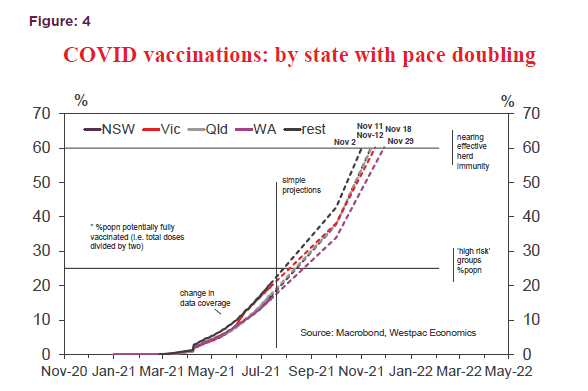
These factors are going to include Covid. It has been a drag on AUD in 2021 because of the slow vaccination program (see Figure 4) and lock downs. That failure has been due to a combination of vaccine complacency (Australians did not feel threatened by Covid due to very low number of cases); vaccine hesitancy (concerns with side effects of Astrazeneca); and a limited supply of Pfizer and Moderna.
The latest lock downs in Sydney and Melbourne are highlighting to Australians that vaccines are the only way to end the cycle of lock downs; the risk of catching Covid is more real under the delta strain; and the medical advice favours Pfizer and Moderna for those under 60.
Government advice points to adequate supply of Pfizer and Moderna through the second half of 2021. Optimistically Australia can be on track for 60% fully vaccinated (compared to the current 10%) by late November with the possibility of moving further although with 25% of the population under 20 there will be a natural limit to the proportion of population vaccinated.
Australia's adult population could become one of the most highly vaccinated globally by the first quarter of 2022. That would be a Game Changer for Australia and the Confidence that would earn from markets
Just as Covid was a positive for AUD in 2020; a negative in 2021 to date; it is likely to pivot to being a significant positive from the December quarter and in 2022.
On July 6 the RBA announced that it will be tapering its purchases of bonds from the current pace of $5 billion per week to $4 billion from early September with a further review scheduled for the November Board meeting. We expect the decision will be made to further scale back purchases to $3 billion per week from November; falling to $2 billion from February with the program to be concluded by May. That would mean around $100 billion of purchases from September, down from the $150 billion we had previously expected.
An earlier than expected scaling back of the RBA’s QE program will support the AUD just as the faster than expected pace of QE in the first half of 2021 restrained the AUD.
While we expect commodity prices to ease back by around 10% in the first half of 2022 due to supply adjustments they will still hold at very high levels. Our Commodity Price Index is forecast to average around 295 in the first half of 2022.
Recall that in calendar 2012 when AUD/USD was consistently above parity the Index averaged around 305.
So while markets have been largely over looking Australia’s commodity price 'windfall' and focussing on the negatives around QE; Covid management; and China trade tensions the easing of these restraining forces (excluding the China tension issue) in 2022 is likely to refocus some attention on the commodity and current account story.
Globally, prospects for the boost to activity and confidence from the ever increasing coverage from vaccines, is also likely to support risk currencies such as AUD and CNY with the associated spill over to other developing world currencies in preference to the 'safe haven' currencies.
We are expecting this uplift in the AUD but Australia’s current malaise, with lock downs and low vaccination rates, is likely to weigh on AUD until we gain sufficient vaccine coverage.
We have revised back our forecast for AUD by September 2021 from USD0.78 to USD0.75 and recognise that during the September quarter there will be significant volatility.
Markets are also likely to overestimate the damage done to the Australian economy over this period. Governments are committed to strong support, particularly given the sharp improvements in the underlying fiscal position, momentum outside NSW is strong while there is ample evidence that economies bounce back from snap lockdowns on government support and pent up demand. Nevertheless that is likely to mean significant volatility.
With high levels of vaccination expected by end November we expect that governments will be much more cautious in resorting to lock downs, laying the foundations for the US3¢ lift in AUD by year’s end.
USD/CAD Daily Outlook
Daily Pivots: (S1) 1.2527; (P) 1.2570; (R1) 1.2639; More...
USD/CAD's rise from 1.2005 resumes by taking out 1.2589 today. Intraday bias is back on the upside for 1.2653 structure resistance. Decisive break there would confirm larger bullish reversal and target 1.3022 fibonacci level next. On the downside, break of 1.2423 support is needed to indicate short term topping. Otherwise, outlook will stay mildly bullish in case of retreat.
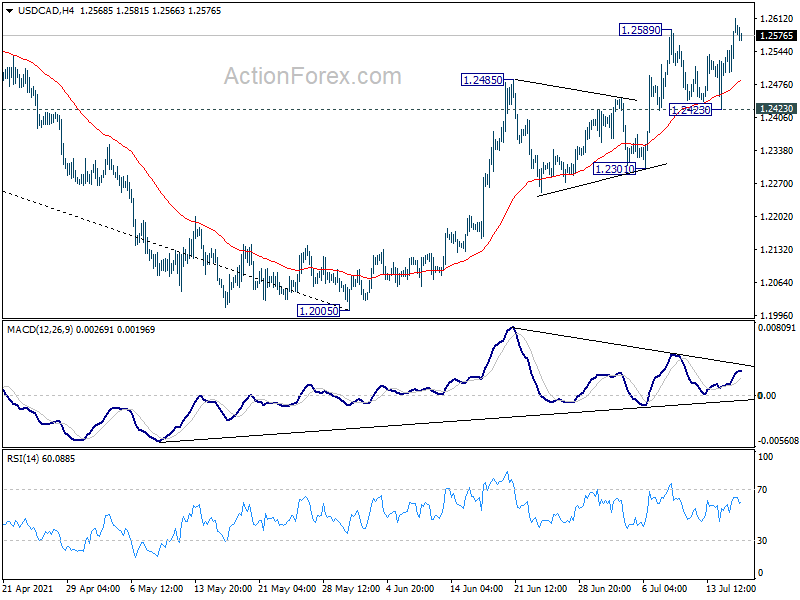
In the bigger picture, fall from 1.4667 is seen as the third leg of the corrective pattern from 1.4689 (2016 high). It might have completed after hitting 1.2061 (2017 low) and 50% retracement of 0.9406 to 1.4689 at 1.2048. Sustained break of 38.2% retracement of 1.4667 to 1.2005 at 1.3022 will pave the way to 61.8% retracement at 1.3650. Overall, medium term outlook remains neutral at worst with 1.2048/61 support zone intact.
New Zealand Dollar Surges on Strong CPI, Aussie and Loonie Lag Behind
New Zealand Dollar surges broadly again today as decade high CPI reading prompted more speculations on RBNZ rate hikes. That somewhat helps stabilizes the selloff in Aussie and Loonie. On the other hand, Yen appears to be softening slightly as rally lost steam. Dollar, Euro and Sterling are mixed. As for the week, Kiwi is overwhelmingly the strongest one, but Loonie and Aussie are the worst performers so far.
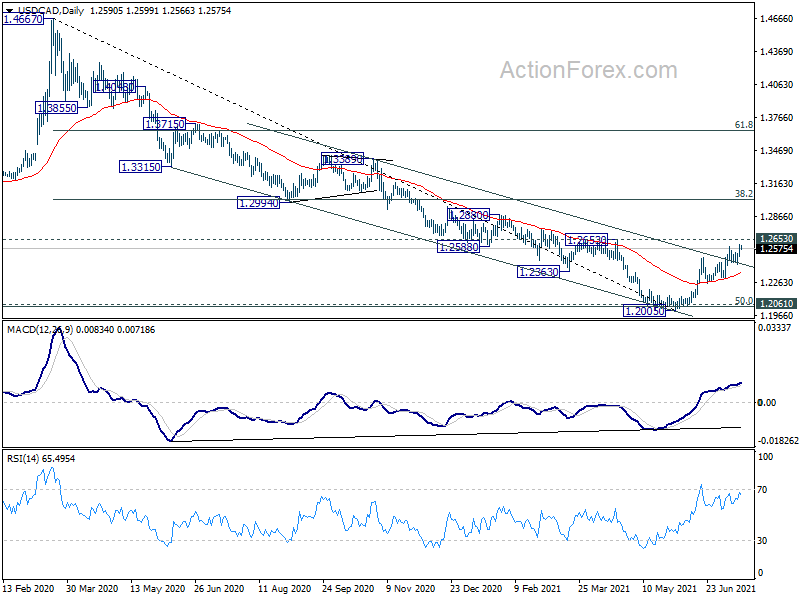
Technically, focus will stays on Dollar today, especially with retail sales data featured. USD/CAD's break of 1.2589 resistance suggests resumption of rally from 1.2005. But no corresponding movement is seen in other Dollar pairs yet. Based on this week's development elsewhere, we'd pay special attention to AUD/USD's reaction to 0.7413 key support level, which it's still defending. Sustained break there would indicate deeper medium term correction is underway, probably back to around 0.7.
In Asia, Nikkei closed down -0.98%. Hong Kong HSI is up 0.31%. China Shanghai SSE is down -0.60%. Singapore Strait Times is up 0.41%. Japan 10-year JGB yield is up 0.0083 at 0.023. Overnight, DOW rose 0.15%. S&P 500 dropped -0.33%. NASDAQ dropped -0.70%. 10-year yield dropped -0.059 to 1.297, back below 1.3 handle.
BoJ stands pat, upgrades inflation forecasts
BoJ kept monetary policy unchanged today. Under yield curve control framework, short term interest rate is held at -0.1%. 10-year JGB yield target is kept at around 0%, without upper limit on JGB purchases. The decision was made by 8-1 vote, with Goushi Kataoka dissented again, pushing for further strengthening of monetary easy, by lowering short and long term interest rates. BoJ will will also continue to buy ETFs and J-REITS with upper limit of JPY 12T and JPY 180B respectively.
In the new economic forecasts, BoJ:
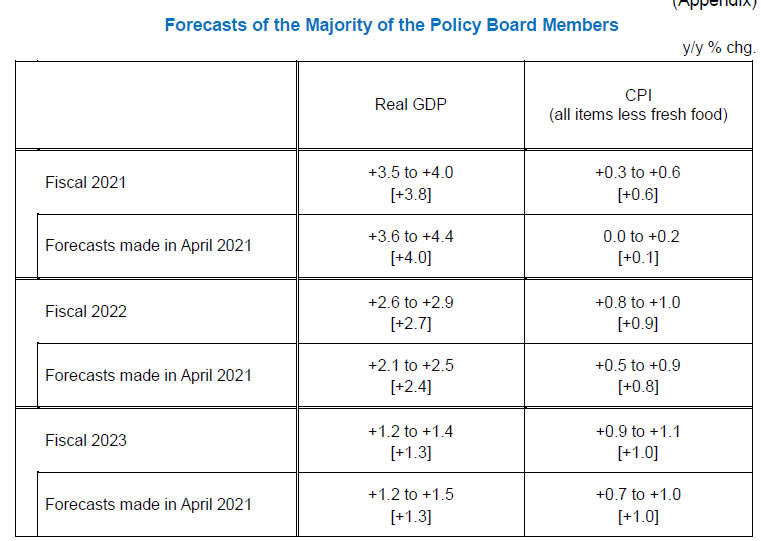
- Downgraded fiscal 2021 GDP growth to 3.8% (from April's 4.0%)
- Upgraded fiscal 2022 GDP growth to 2.7% (from 2.4%).
- Kept fiscal 2023 GDP growth at 1.3% (unchanged).
- Upgraded fiscal 2021 CPI core to 0.6% (from 0.1%).
- Upgraded fiscal 2022 CPI core to 0.9% (from 0.8%).
- Kept fiscal 2023 CPI core at 1.0% (unchanged).
New Zealand CPI rose 1.3% qoq, 3.3% yoy in Q2, RBNZ hike speculation intensifies
New Zealand CPI rose 1.3% qoq in Q2, well above expectation of 0.7% qoq. For the 12-month. CPI accelerated to 3.3% yoy, up from 1.5% yoy, well above expectation of 2.8% yoy. The annual rate is the highest in nearly a decade. Also, the figures were well above RBNZ's forecast of 0.6% qoq 2.6% yoy inflation.
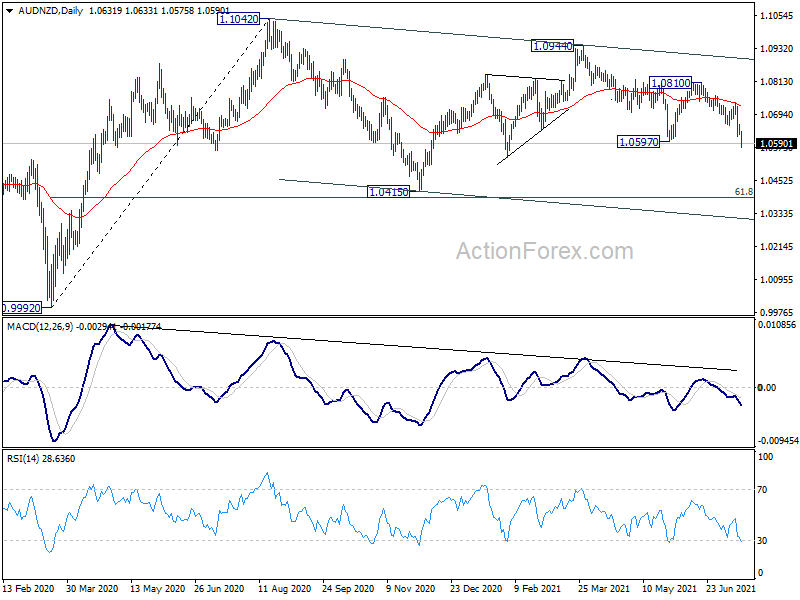
Speculations of an early RBNZ hike intensified further after the release. Westpac now expects a hike in OCR by 0.25% in August, with another hike at both October and November meeting. The developments pushed AUD/NZD through 1.0597 support today to resume the near term fall from 1.0944. Deeper decline could be seen towards lower part of the medium term range at 1.0415.
New Zealand BusinessNZ manufacturing rose to 60.7, facing labor shortages and logistics disruptions
New Zealand BusinessNZ Performance of Manufacturing Index rose from 58.6 to 60.7 in June. Looking at some details, production dropped slightly form 64.8 to 64.5. Employment rose from 52.0 to 56.5. New orders rose slightly from 63.5 to 63.6. Finished stocks rose from 53.6 to 57.3. Deliveries rose from 53.4 to 55.0.
BusinessNZ's executive director for manufacturing Catherine Beard said: "Despite the overall pick-up in activity, the proportion of negative comments (53.1%) remained higher than positive ones (46.8%). Many of the positive comments outlined increased demand, but this is counterbalanced by significant labour shortages and logistics disruptions many manufacturers are now facing."
Looking ahead
Eurozone CPI final, trade balance, Italy trade balance will be featured in European session. Later in the day, Canada will release housing starts, foreign securities purchase and whole sales sales. US retail sales will be the main focus while U of Michigan sentiment and business inventories will also be featured.
USD/CAD Daily Outlook
Daily Pivots: (S1) 1.2527; (P) 1.2570; (R1) 1.2639; More...
USD/CAD's rise from 1.2005 resumes by taking out 1.2589 today. Intraday bias is back on the upside for 1.2653 structure resistance. Decisive break there would confirm larger bullish reversal and target 1.3022 fibonacci level next. On the downside, break of 1.2423 support is needed to indicate short term topping. Otherwise, outlook will stay mildly bullish in case of retreat.
In the bigger picture, fall from 1.4667 is seen as the third leg of the corrective pattern from 1.4689 (2016 high). It might have completed after hitting 1.2061 (2017 low) and 50% retracement of 0.9406 to 1.4689 at 1.2048. Sustained break of 38.2% retracement of 1.4667 to 1.2005 at 1.3022 will pave the way to 61.8% retracement at 1.3650. Overall, medium term outlook remains neutral at worst with 1.2048/61 support zone intact.
Economic Indicators Update
| GMT | Ccy | Events | Actual | Forecast | Previous | Revised |
|---|---|---|---|---|---|---|
| 22:30 | NZD | BusinessNZ Manufacturing Index Jun | 60.7 | 58.6 | ||
| 22:45 | NZD | CPI Q/Q Q2 | 1.30% | 0.70% | 0.80% | |
| 3:00 | JPY | BoJ Interest Rate Decision | -0.10% | -0.10% | -0.10% | |
| 8:00 | EUR | Italy Trade Balance (EUR) May | 5.87B | |||
| 9:00 | EUR | Eurozone Trade Balance (EUR) May | 8.2B | 9.4B | ||
| 9:00 | EUR | Eurozone CPI M/M Jun F | 0.30% | 0.30% | ||
| 9:00 | EUR | Eurozone CPI Y/Y Jun F | 1.90% | 1.90% | ||
| 9:00 | EUR | Eurozone CPI Core M/M Jun F | 0.30% | 0.30% | ||
| 9:00 | EUR | Eurozone CPI Core Y/Y Jun F | 0.90% | 0.90% | ||
| 12:15 | CAD | Housing Starts Jun | 270.0K | 275.9K | ||
| 12:30 | CAD | Foreign Securities Purchases (CAD) May | 9.95B | |||
| 12:30 | CAD | Wholesale Sales M/M May | -0.90% | 0.40% | ||
| 12:30 | USD | Retail Sales M/M Jun | -0.60% | -1.30% | ||
| 12:30 | USD | Retail Sales ex Autos M/M Jun | 0.40% | -0.70% | ||
| 14:00 | USD | Michigan Consumer Sentiment Index Jul P | 86.5 | 85.5 | ||
| 14:00 | USD | Business Inventories May | 0.40% | -0.20% |
New Zealand CPI rose 1.3% qoq, 3.3% yoy in Q2, RBNZ hike speculation intensifies
New Zealand CPI rose 1.3% qoq in Q2, well above expectation of 0.7% qoq. For the 12-month. CPI accelerated to 3.3% yoy, up from 1.5% yoy, well above expectation of 2.8% yoy. The annual rate is the highest in nearly a decade. Also, the figures were well above RBNZ's forecast of 0.6% qoq 2.6% yoy inflation.
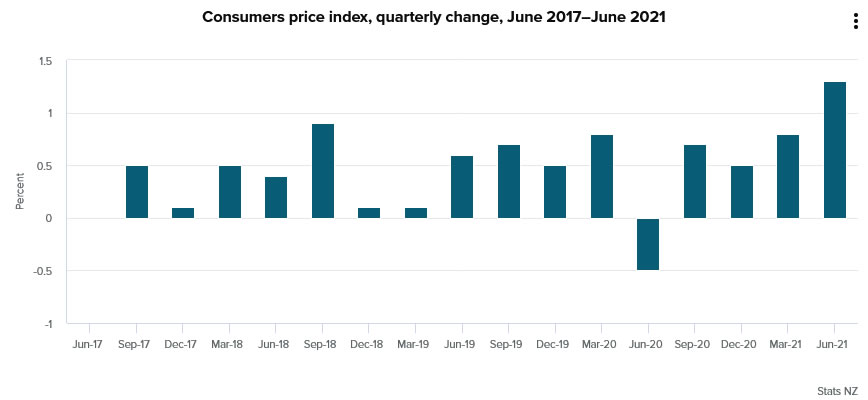
Speculations of an early RBNZ hike intensified further after the release. Westpac now expects a hike in OCR by 0.25% in August, with another hike at both October and November meeting. The developments pushed AUD/NZD through 1.0597 support today to resume the near term fall from 1.0944. Deeper decline could be seen towards lower part of the medium term range at 1.0415.
New Zealand BusinessNZ manufacturing rose to 60.7, facing labor shortages and logistics disruptions
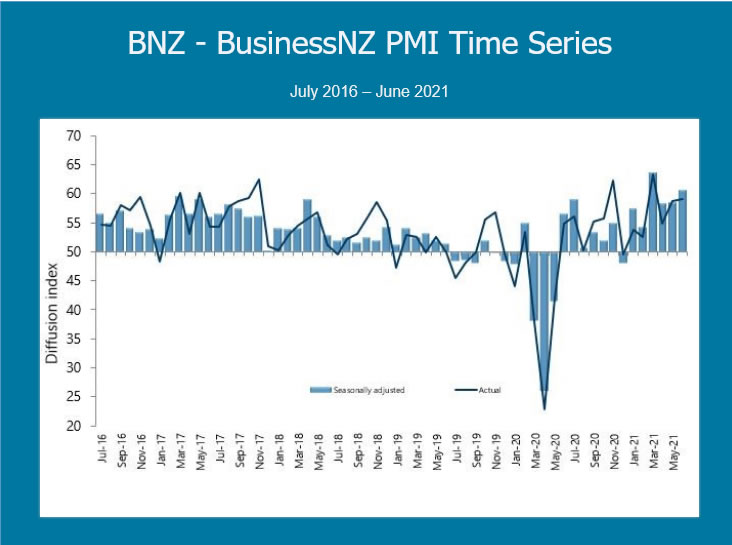
New Zealand BusinessNZ Performance of Manufacturing Index rose from 58.6 to 60.7 in June. Looking at some details, production dropped slightly form 64.8 to 64.5. Employment rose from 52.0 to 56.5. New orders rose slightly from 63.5 to 63.6. Finished stocks rose from 53.6 to 57.3. Deliveries rose from 53.4 to 55.0.
BusinessNZ's executive director for manufacturing Catherine Beard said: "Despite the overall pick-up in activity, the proportion of negative comments (53.1%) remained higher than positive ones (46.8%). Many of the positive comments outlined increased demand, but this is counterbalanced by significant labour shortages and logistics disruptions many manufacturers are now facing."
BoJ stands pat, upgrades inflation forecasts
BoJ kept monetary policy unchanged today. Under yield curve control framework, short term interest rate is held at -0.1%. 10-year JGB yield target is kept at around 0%, without upper limit on JGB purchases. The decision was made by 8-1 vote, with Goushi Kataoka dissented again, pushing for further strengthening of monetary easy, by lowering short and long term interest rates. BoJ will will also continue to buy ETFs and J-REITS with upper limit of JPY 12T and JPY 180B respectively.
In the new economic forecasts, BoJ:
- Downgraded fiscal 2021 GDP growth to 3.8% (from April's 4.0%)
- Upgraded fiscal 2022 GDP growth to 2.7% (from 2.4%).
- Kept fiscal 2023 GDP growth at 1.3% (unchanged).
- Upgraded fiscal 2021 CPI core to 0.6% (from 0.1%).
- Upgraded fiscal 2022 CPI core to 0.9% (from 0.8%).
- Kept fiscal 2023 CPI core at 1.0% (unchanged).
Market Morning Briefing: Pound Is Ranged Within 1.39-1.3735
STOCKS
Dow hovers near its key resistance zone of 35000-35100 which we expect to break if not immediately but eventually and see a fresh rise. DAX has come-off from 15800 and can continue to retain its 15300-15800 range. The upside breakout of this range is getting delayed. Nikkei is coming down and has room to fall further within its overall uptrend. Shanghai is retaining its 3500-3625 range. The bias is bullish to see an upside breakout of this range. Sensex and Nifty have broken their respective range on the upside and are looking bullish to see further rise towards 54000-56000 and 16000-16200 respectively. Sensex and Nifty are likely to outperform others.
Dow (34987.02, +53.79, +0.15%) hovers near 35000. Immediate support is at 34500 and the bias is bullish to break 35100 and see a rise to 36000. However, in case if the Dow breaks below 34500, a test of 34000-33500 is possible and the expected rise to 36000 will be delayed. The overall trend is up while the Dow remains above 33500.
DAX (15629.66, −159.32, -1.01%) has failed to break above 15800 and has come-off sharply yesterday. The 15300-15800 range can now continue for some more time. The bias is bullish to see an upside break above 15800 and a rise to 16000-16200 eventually.
Nikkei (27970.77, −308.32, -1.09%) is heading down towards 27500 as expected and can even test 27200-27000. While above 27000, Nikkei can consolidate between 27000 and 29500 and then see an upside breakout of this range eventually. But, in case of a break below 27000, Nikkei can see a deeper fall to 26000 before the overall uptrend resumes.
Shanghai (3558.24, −6.34, -0.18%) is managing to hold above 3500. The 3500-3625 range is likely to remain intact for some more time. The bias is bullish to see an upside breakout of this range and a rise to 3700-3800. In case if Shanghai breaks below 3500 a fall to 3450-3400 can be seen before a fresh rally begins. While above 3400, the long-term view is bullish.
Sensex (53158.85, +254.80, +0.48%) has broken the 52000-53000 range on the upside and is bullish to test 54000 initially and then further higher levels eventually in the coming weeks. A strong base has been built now above 52000 which will now be difficult to break in the absence of any strong and fresh trigger.
Nifty (15924.20, +70.25, +0.44%) has risen above 15900 and is indicating a triangle breakout. The view is bullish to see a rise to 16000-16200 in the coming weeks. Strong support is now in the broad 15800-15600 region.
COMMODITIES
Brent and WTI have trade lower and looks bearish for the medium term. Gold has dipped but may continue to rise towards 1840-60 in the medium term.Silver may break 26.50 and eventually head towards 27. Copper continues to consolidate within 4.40-4.20/15.
Brent(73.41) and WTI(71.33) has risen slightly after falling sharply yesterday. While Brent has managed to hold above support near 73, WTI has broken below 72 and may fall towards 71/70 in the near term. WTI may continue to fall towards 70/68 while Brent has scope to test 70 on a break below 73. A strong bounce is needed to take the prices higher towards respective resistances again.
Gold(1827.60) has come off slightly today after testing the level of 1835 yesterday. But overall bullish view remains to see a test of 1840-1860 in the coming sessions.
Silver(26.46) has risen sharply. A rise above 26.50 will pave way towards 27 in the near to medium term.
Copper(4.3385) has bounced back sharply, heading towards the upper end of the 4.15-4.40 range contrary to our expectation of a fall towards 4.15. The range of 4.15/20-4.40 may continue to hold and a strong break on either side of the range is now needed to give clarity on further direction.
FOREX
Dollar Index has risen sharply and could be headed towards 92.80-93 while Euro can re-test 1.1780/70-1.1750 on the downside. Aussie and Pound looks ranged. EURJPY and Yen looks weak towards 129 and 110.80 respectively. USDCNY can rise towards 6.48/50 while above 6.46. USDINR can rise to 74.60/80 but may come off from there towards 74.40/20 soon.
Dollar Index (92.60) has risen from levels seen yesterday and can test 92.80/85-93.00 on the upside before deciding whether to come off from there or continue to rise higher. Watch price action near 92.80/85-93 closely.
Euro (1.1807) has dipped back to test 1.18 and a break below 1.18 can again take it lower to test 1.1780/70 which is an important and immediate support followed by deeper support at 1.1750. We need a cose watch at these levels as any indication of a break below 1.1750 may be vulnerable for Euro for a strongly bearish sentiment for the medium to long term. Watch price action near 1.1780/70 and 1.1750 respectively.
EURJPY (129.91) can be headed towards 129. Thereafter a bounce to 130-130.50 could be possible.
Dollar-Yen (110) has bounced well from lower levels seen yesterday in line with the rise in Dollar Index. A range of 109.50-111 can hold for the near term. While the Dollar Index rises towards 92.85-93, Dollar-Yen can move up towards 110.50/80 too.
Aussie (0.7433) has bounced a bit but a sideways range of 0.74-0.75 may hold for some more time before a break on either side of the range is seen.
Pound (1.3830) is ranged within 1.39-1.3735 and may continue so for the near term.
USDCNY (6.4653) trades within 6.44-6.48/50 and needs a clear and sustained break on either side to indicate further direction from here. While above 6.44/46, immediate view is bullish towards 6.48/50.
USDINR (74.4850) can continue to hold within 74.40-74.60 and broad range of 74.20-74.80 region. While Euro and Chinese Yuan has weakened a bit against the Dollar, we may expect Rupee too to weaken a bit today towards 74.60/80 but may not sustain higher levels for long and could come off towards 74.40/20 in the medium term. Also watch if the rise above 15900 in Nifty sustains today as that may give some relief to Rupee weakness in the very near term. A fall in Nifty from current levels may add on to factors supporting Rupee weakness.
INTEREST RATES
The US Treasury yields remain lower and can dip further to test their crucial supports. A corrective bounce is possible in the coming weeks before the long-term downtrend resume breaking below the supports that are coming up. German yields remain lower and are keeping our bearish view intact. A further fall is possible in the coming days. The 10Yr GoI has support at 6.18% from where a bounce is possible before the overall downtrend resumes.
The US 2Yr (0.23%) and 5Yr (0.79%) Treasury yields remain stable while the 10Yr (1.31%) and 30Yr (1.93%) have dipped further. 1.25%-1.2% is a good support from where we can expect a corrective bounce to 1.5%. Similarly, the 30Yr can bounce from 1.9% to 2.1%. However, from a long-term perspective we expect the yields to break below the above mentioned supports and see a deeper fall eventually in the coming months.
The German 2Yr (-0.69%), 5Yr (-0.63%) and the 10Yr (-0.34%) yields have dipped slightly while the 30Yr (0.15%) has declined sharply below 0.20%. Our bearish view remains intact. The yields have room to test -0.45%/-0.50% (10Yr) and 0.10%-0.08% (30Yr) in the coming weeks. Thereafter a fresh bounce is possible
The 10Yr GoI (6.1915%) has dipped below 6.2% but has immediate support at 6.18%. While that holds a rise to 6.3%-6.32% is still a possibility. 6.3%-6.32% is a strong resistance which can cap the upside and can a fresh fall. The broader trend is down while the 10Yr remains below the 6.3%-6.32% resistance zone. The 5Yr (5.6910%) can trade in the range of 5.64%-5.7% with a bearish bias to break the range on the downside and test 5.6% eventually.
Elliott Wave View: CAD/JPY May See Support Soon
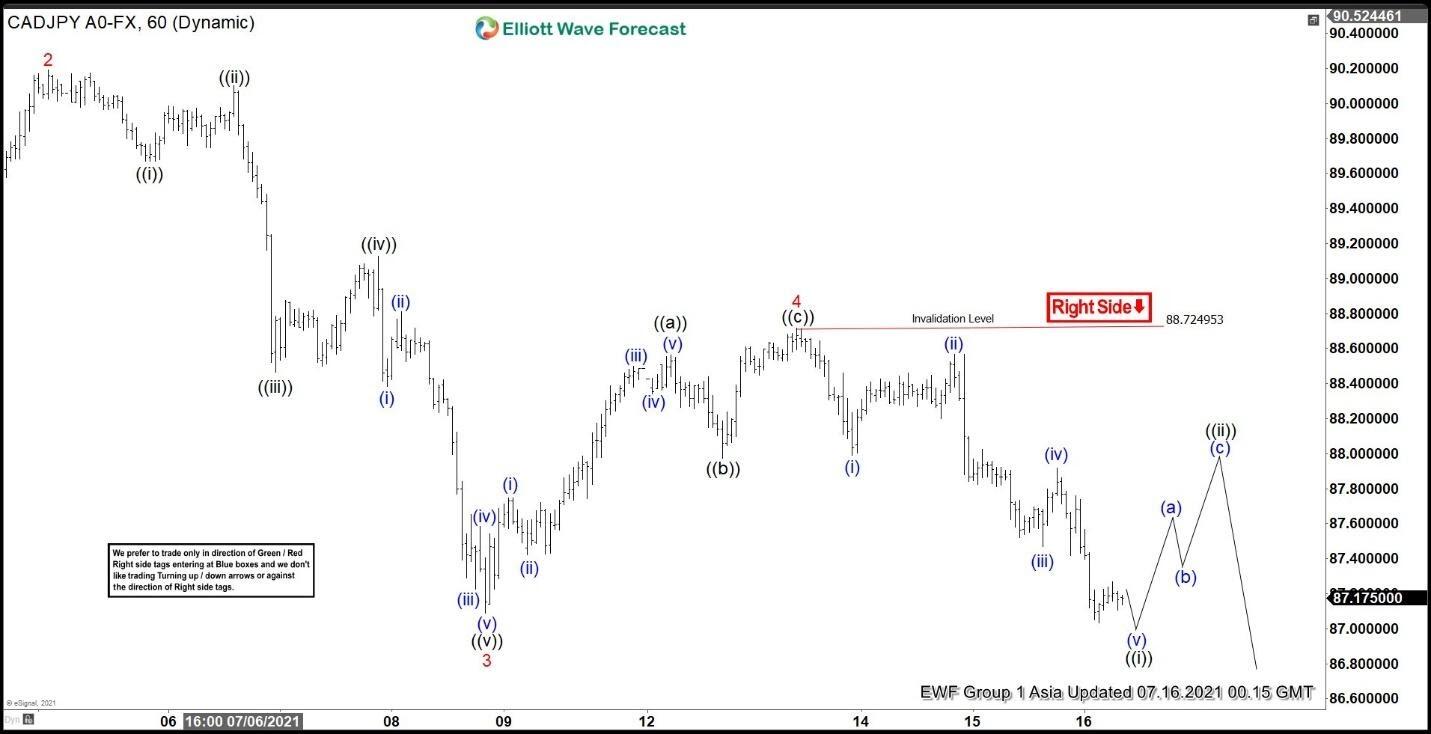
Short term Elliott Wave in $CADJPY suggests cycle from June 23 high is unfolding as a 5 waves impulse Elliott Wave structure. Down from June 23 high, wave 1 ended at 88.89 and rally in wave 2 ended at 90.19. Pair then resumes lower in wave 3 towards 87.09 and bounce in wave 4 ended at 88.71. Internal subdivision of wave 4 unfolded as a zigzag structure. Up from wave 3, wave ((a)) ended at 88.56, wave ((b)) ended at 87.97, and wave ((c)) ended at 88.715.
Wave 5 is currently in progress with internal subdivision as another 5 waves in lesser degree. Down from wave 4, wave (i) ended at 88 and bounce in wave (ii) ended at 88.56. Pair resumes lower again in wave (iii) to 87.46, and rally in wave (iv) ended at 87.91. Expect wave (v) to end soon which should complete wave ((i)) of 5 in higher degree. Pair should then bounce in wave ((ii)) to correct cycle from July 13 peak (88.72) before the decline resumes. As far as July 13 high pivot at 88.7 stays intact, expect rally to fail in 3, 7, or 11 swing for further downside.
CAD/JPY 60 minutes Elliott Wave chart
USD/JPY Holds Key Support, What Could Trigger Fresh Increase?
Key Highlights
- USD/JPY corrected heavily after it tested the 111.65 resistance zone.
- A short-term bearish trend line is forming with resistance near 110.30 on the 4-hours chart.
- EUR/JPY is struggling below 131.00, while GBP/JPY eyes a decent increase above 153.00.
- The US Initial Jobless Claims declined from 386K to 360K in the week ending July 10, 2021.
USD/JPY Technical Analysis
The US Dollar started a major decline after trading as high as 111.65 against the Japanese Yen. USD/JPY declined below the 110.50 support zone, but the bulls protected 109.50.
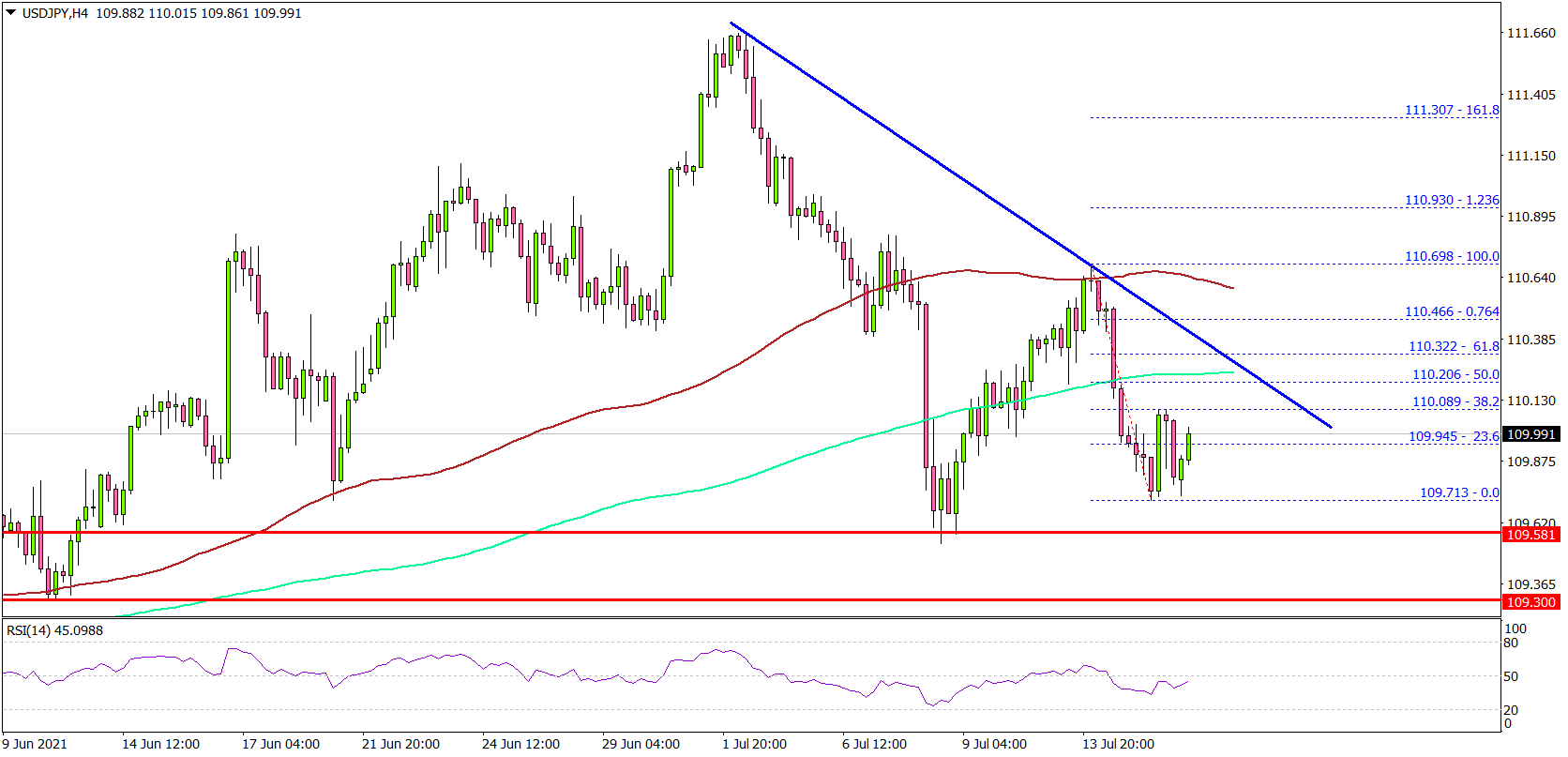
Looking at the 4-hours chart, the pair seems to be forming a decent support base above 109.50. The recent swing low was near 109.73 and the pair is now consolidating losses.
The first key resistance is near the 110.20 level. It is close to the 50% Fib retracement level of the downward move from the 110.69 high to 109.73 low. There is also a short-term bearish trend line forming with resistance near 110.30 on the same chart.
Besides, the 200 simple moving average (green, 4-hours) is also near the 110.20 level. The next major resistance is near the 110.65 level and the 100 simple moving average (red, 4-hours).
A successful break above the trend line and then a follow up move above 110.65 could set the pace for a fresh increase. If not, there is a risk of a major decline below the 109.50 support zone.
Looking at EUR/USD, the pair is still trading heavily below 1.1850. Similarly, GBP/USD is struggling to gain momentum above the 1.3900 resistance zone.
Economic Releases
- Euro Zone CPI for June 2021 (YoY) - Forecast +1.9%, versus +1.9% previous.
- Euro Zone CPI for June 2021 (MoM) - Forecast +0.3%, versus +0.3% previous.
- US Retail Sales for June 2021 (MoM) – Forecast -0.4%, versus -1.3% previous.
Eco Data 7/16/21
[php_everywhere instance="1"]