Sample Category Title
AUD/USD Daily Report
Daily Pivots: (S1) 0.7393; (P) 0.7440; (R1) 0.7469; More...
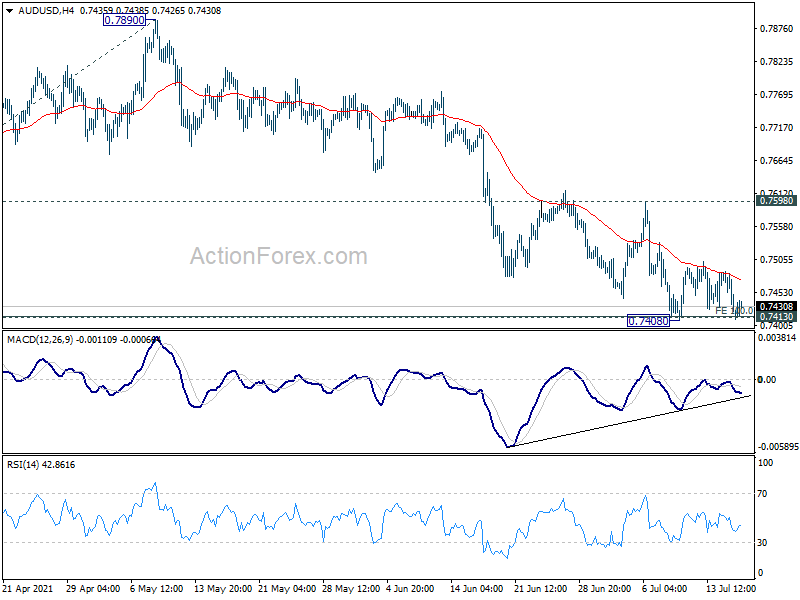
Outlook in AUD/USD remains unchanged and intraday bias stays neutral first. We'd continue to expect strong support from 100% projection of 0.8006 to 0.7530 from 0.7890 at 0.7414 to complete the correction from 0.8006. On the upside, break of of 0.7598 resistance will turn bias back to the upside for 0.7890 resistance first. However, sustained break of 0.7414 will argue it's at least in larger scale correction, and target 161.8% projection of 0.8006 to 0.7530 from 0.7890 at 0.7120 next.
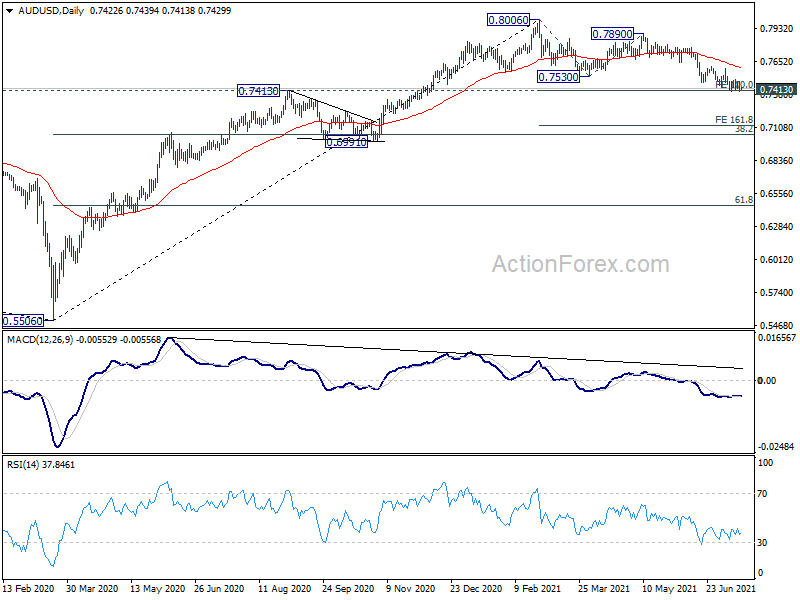
In the bigger picture, rise from 0.5506 medium term bottom could either be the start of a long term up trend, or a corrective rise. Reactions to 0.8135 key resistance will reveal which case it is. Rejection by 0.8135 key resistance, followed by firm break of 0.7413 resistance turned support, will favor the latter case. Deeper decline would be seen to 38.2% retracement of 0.5506 to 0.8006 at 0.7051 first.
XRPUSD At Risk
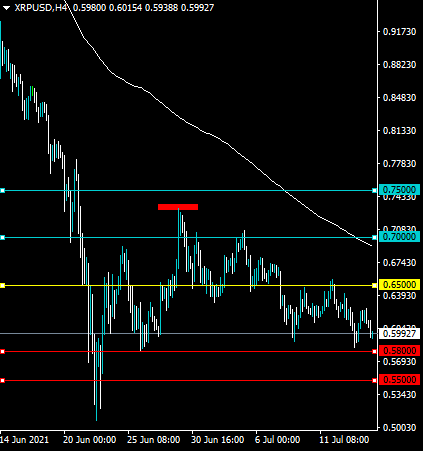
Ripple is at risk of greater losses as Bitcoin and other top cryptocurrencies fail to find a meaningful buying interest or a price floor. The XRPUSD pair could fall towards the 0.5500 support level if sellers hold the price below the 0.5800 support level due to the presence of a head and shoulders pattern. XRPUSD short-term bulls need to reverse the short-term bearish trend by holding the price above the 0.6500 resistance area.
The XRPUSD pair is only bullish while trading above the 0.6500 level, key resistance is found at the 0.7000 and the 0.7500 levels.
If the XRPUSD pair trades below the 0.6500 level, sellers may test the 0.5800 and 0.5500 levels.
GBPAUD Looks Very Bullish
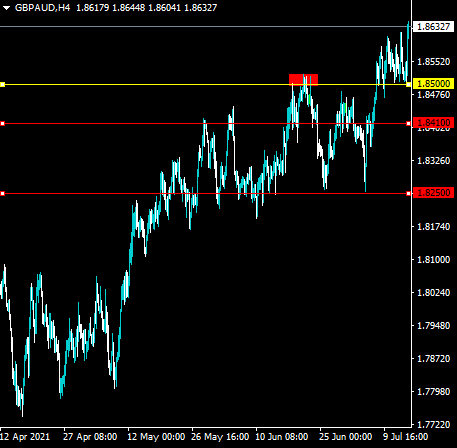
The British pound is looking increasingly bullish against the Australian dollar currency as the aussie continues to tumble on the foreign exchange market. The four-hour time frame clearly shows that a large bearish head and shoulders pattern has been invalidated. According to the overall size of the invalidated pattern the GBPAUD pair could be about to rally towards the 1.8800 level.
The GBPAUD pair is only bullish while trading above the 1.8500 level, key resistance is found at the 1.8800 and the 1.8850 levels.
If the GBPAUD pair trades below the 1.8500, sellers may test the 1.8410 and 1.8250 support levels.
BTCUSD Is Possibly Bearish
Technical analysis
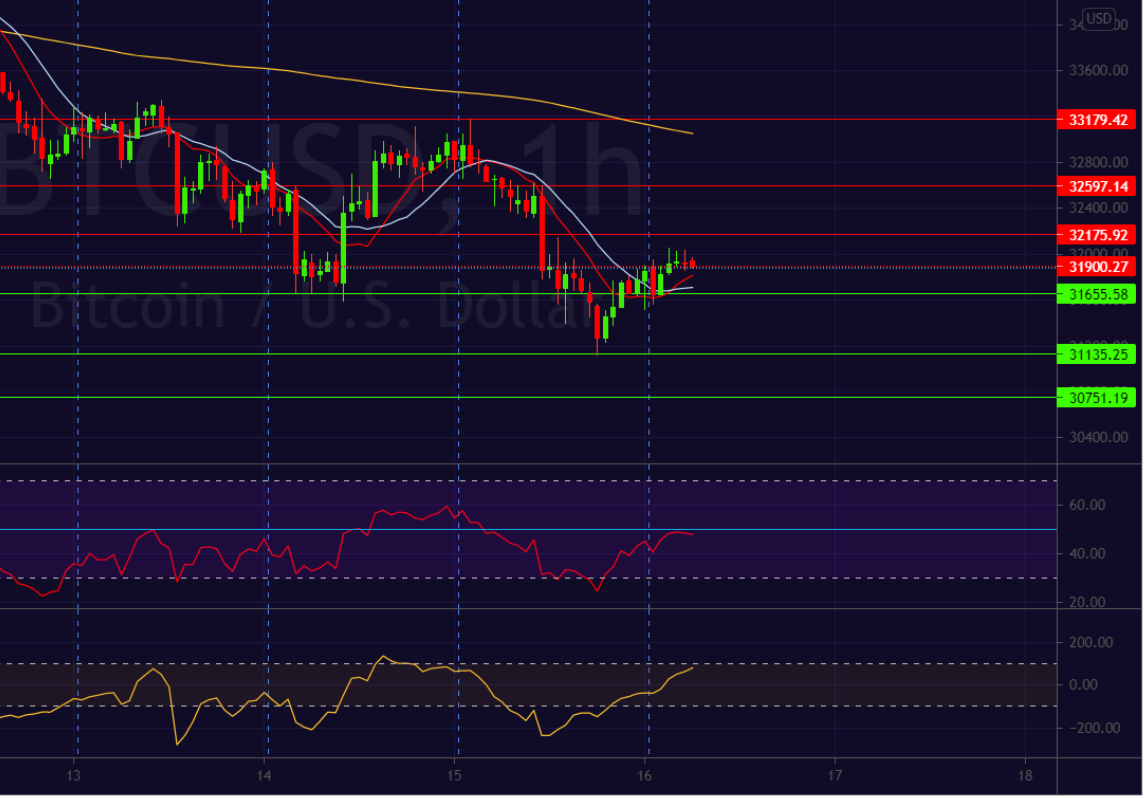
The RSI is under line 50, with the price under MA (200) indicating that the downtrend may prevail
The price is slightly above MA(10) and MA(15), together with the CCI suggesting a possible upwards correction.
What the possible outcomes are
The BTCUSD pair fell to the level of 31,400 USD, the minimum since June 26. According to CoinGecko, the capitalization of bitcoin has fallen to 596 billion USD. Over the past week, the digital coin has dropped in price by 6%, the decrease for the month was 21%. On July 15, it became known that the U.S. authorities will tighten control over cryptocurrency transactions to prevent hackers' actions using ransomware viruses. The administration of U.S. President Joe Biden will carefully monitor the transfers of funds in digital assets used for hackers' payments.
BTCUSD may experience a downward correction towards the first support level of 31,655. If the pair falls below the first support level, we can expect a continued downtrend towards the second support level of 31,135, with a continued downtrend towards 30,750.
Alternatively, the BTCUSD pair may rise towards the first resistance level of 32,175. If the pair manages to surpass the first resistance level, we should expect a continued surge towards the resistance level of 32,597.
Key levels
Support 30,751 31,135 31,655
Resistance 32,175 32,597 33,179
Dow Jones Stalls As Intel And Globalfoundries Advance
US stocks wavered as the earning season as corporate consolidation continued. Dow Jones futures dropped by 54 points while those tied to the S&P 500 and Nasdaq 100 declined by 0.20% and 0.30%, respectively. This happened after companies like Progressive, UnitedHealth Group, and Morgan Stanley released relatively strong quarterly results. Later today, companies like Charles Schwab, State Street, and Kansas City Southern will publish their results. Meanwhile, investors reacted to the ongoing wave of M&A. Overnight, it was revealed that Intel was in talks to buy GlobalFoundries in a deal valued at more than $30 billion. This is an attempt for Intel to become a leading player in manufacturing chips for other companies. If the deal goes well, Intel will become a competitor to Taiwan Semiconductor. Global Foundries was spun off from AMD in 20008.
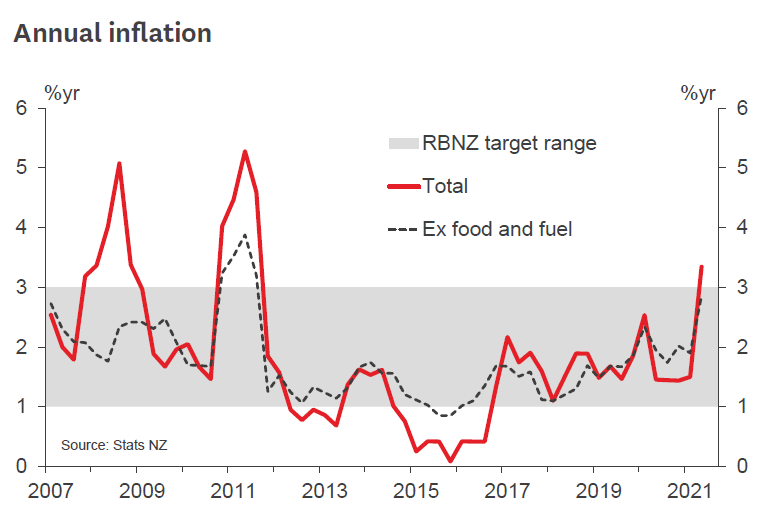
The New Zealand dollar was mixed in early trading after the latest inflation data. According to the statistics agency, New Zealand’s headline consumer price index rose from 0.8% in the first quarter to 1.3% in Q2. This increase was better than the median estimate of 0.8%. As a result, the prices rose from 1.5% to 3.3% on a year-on-year basis. The number was significantly higher than the median estimate of 2.8%. The strong inflation numbers came two days after the RBNZ left interest rates unchanged and decided to end its asset purchases later this month.
The US dollar was little changed during the American session ahead of the latest retail sales numbers. Economists expect the data to show that the headline retail sales declined by 0.4% in June after falling by 1.3% in the previous month. Core retail sales are expected to increase by 0,4%. These numbers are important because they measure the health of consumer spending. Household consumption is the biggest contributor to the US GDP. Other top things to watch for today are the Bank of Japan (BOJ) interest rate decision, European car registrations, and inflation numbers.
AUDNZD
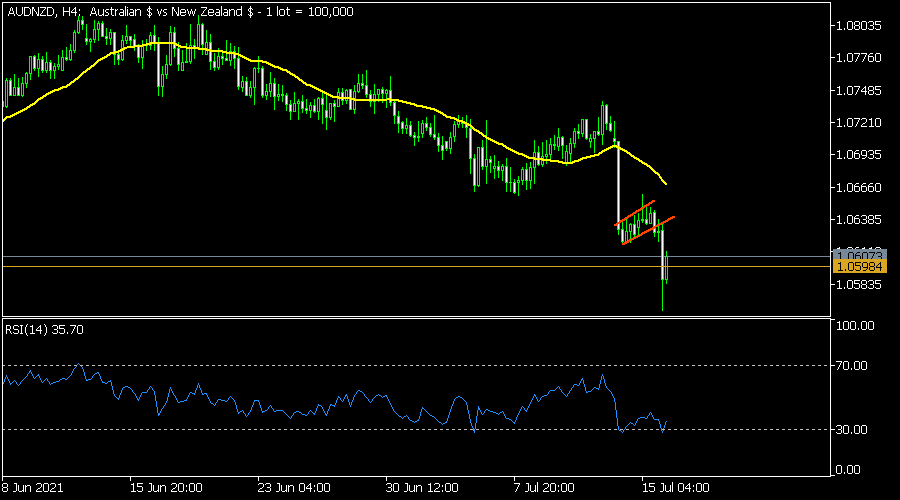
The AUDNZD pair has been under pressure this week. The pair declined sharply after the latest RBNZ decision. It then formed a bearish flag pattern yesterday and dipped again today after the New Zealand inflation data. It declined to 1.0560. By so doing, it moved below the important support at 1.0598, which was the lowest level since May 27. It moved below the short and longer-term moving averages while the Relative Strength Index (RSI) is hovering above the oversold level of 30. Therefore, the pair may keep falling amid a hawkish RBNZ.
EURUSD
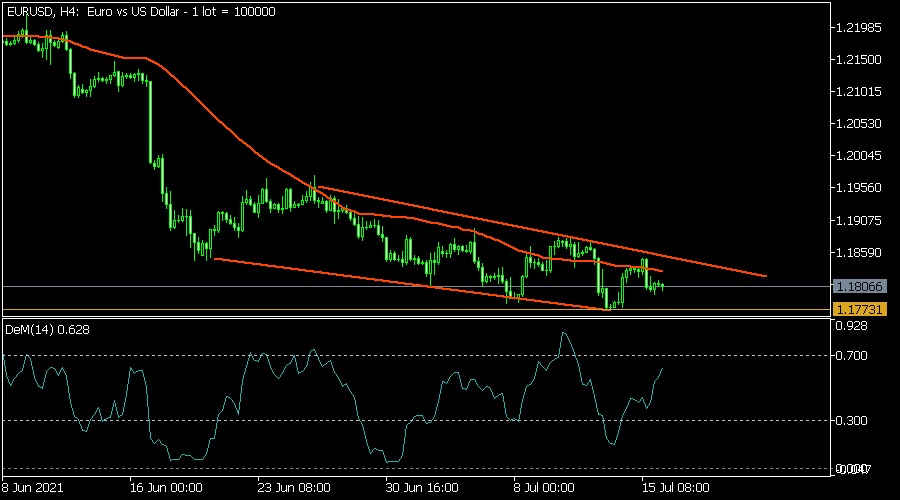
The EURUSD pair declined to a low of 1.1793 during the overnight session. On the four-hour chart, the pair moved below the upper side of the descending channel. It also moved below the 25-day moving average while the DeMarker indicator has moved slightly above the oversold level. The pair will likely remain in this range ahead and after the latest Eurozone inflation and US retail sales numbers.
US30
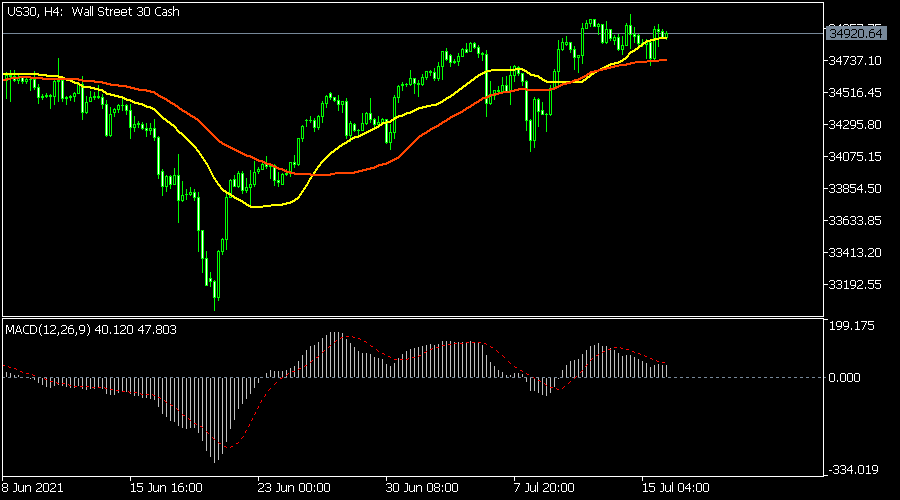
The Dow Jones index wavered as the earnings season continued. The index is trading at $34,915, which was slightly below the year-to-date high of $35,000. On the four-hour chart, the index has formed what looks like an inverse head and shoulders pattern. It is also being supported by the 25-day and 15-day moving averages. Therefore, the pair will likely keep rising as bulls attempt to move above the resistance at $35,000.
BoE In Pole Position Amongst G4 Central Banks
Markets
Higher UK CPI readings, a solid jobs report, and hawkish shifts by Bank of England members Ramsden and Saunders. Yet sterling gains remain very modest this week. GBP/USD fails to regain the (technically minor) 1.39 resistance. EUR/GBP remains stuck in the lower half of the 0.8471/0.8731 sideways range in place since March but didn’t go for a test sub 0.85 yet. Are investors fearful for a surprise on the euro side of the story at next week’s hyped ECB meeting? Hard to tell since dovish stakes have been building after a series of Lagarde interviews. In any case, we think sterling will get momentum going into the August 5 BoE meeting which features an updated monetary policy report and could well be talking about a rate hike next year. Short-term UK money markets discount a first (15 bps) hike to 0.25% by the end of Q1 with an additional 25 bps in the cards by the end of 2022. It would put the BoE in pole position amongst G4 central banks. The UK 2-yr yield (+6.3 bps) closed at its highest level since March last year, testing 0.15% resistance. The long end of the UK curve rose as well, adding around 4 bps and resulting in a significant underperformance of UK Gilts compared to US Treasuries or German Bunds. Next week’s key things to watch for UK investors are a speech by BoE Haskel on scarring (on Monday), June UK retail sales, and July UK PMI’s (both on Friday).
The US yield curve flattened again with yields shedding up to 5 bps at the very long end of the curve. The move came amid a flurry of ignored US eco data; most of them solid with an exceptional US empire manufacturing survey. Risk aversion initially played in bonds’ favor, but US stock indices eventually closed off the intraday lows. Fed Chair Powell’s dovish message ahead of US Congress still resonated. EUR/USD at first tried to prolong Wednesday’s comeback but soon turned south again to close near 1.1810. Bunds’ relative underperformance against US Treasuries didn’t play. Even as the US 10y real yield dived deeper below -1% (-1.05%). The cycle low stands at -1.11%. US inflation expectations are rangebound around 2.3%-2.35%. The German yield curve flattened with yields shedding up to 2.5 bps. Today’s eco calendar includes June US retail sales and July University of Michigan consumer confidence. They are unlikely to leave a mark on trading. Ruling trends continue to favor US Treasuries in the counter-intuitive flattening trend while the dollar continues to stand its ground in FX space.
News headlines
Inflation in New Zealand accelerated to 3.3% in the second quarter this year. That’s up from 1.5% in Q1 and more than the 2.7% expected by markets and the RBNZ. The fastest inflation since 2011 comes days after the central bank took a hawkish turn by stopping its bond-buying program with almost immediate effects as the economy is topping estimates and more persistent inflation pressures are expected. The inflation figures may strengthen the RBNZ’s hawkish stance in upcoming meetings by pulling forward the timing of the first-rate hike from Q3 2022 currently suggested by the May forecasts. The kiwi dollar again attacks the 0.70 NZD/USD barrier.
The Bank of Japan left its policy parameters unchanged at -0.10% for the base rate and 0% for the 10y target rate. It trimmed its GDP forecast for the current fiscal year to 3.8% but boosted inflation to 0.6%. Growth is seen higher for next year at 2.7% before normalizing to 1.3% while inflation over the next years is expected to remain well below target. The BoJ has also announced a series of initiatives to help the economy turn greener. It will offer zero interest rate funds for climate-related loans or investments. For every yen lent out for climate purposes, the BoJ will also exempt two from its negative interest rate. Finally, the central bank said it would buy green bonds denominated in foreign currencies using its own FX reserves.
Is The Fed Mistaken?
The Federal Reserve (Fed) Chair Jerome Powell's doggedness about the ‘transitory' inflation starts being a problem for an increasing number of investors, as, although investors love cheap liquidity and favourable market conditions, an increasing number of them think that the fast monetary expansion should no longer happen at any cost. Powell's ignorance of the accelerating inflation is now bringing up the question of, is he making a policy mistake, and whether the US monetary policy and hence, the markets are safe in his hands.
Powell said at his testimony this week that ‘inflation will likely remain elevated in the coming months' before easing. He added that expectations are ‘broadly consistent' with the Fed target. Yet, inflation is skyrocketing, there is an extra $3.5 trillion fiscal spending bill waiting to get approved on the US government agenda - which will add an additional pressure on inflation, but the Fed's inflation rhetoric remains the same. As a results, the broader view on data and markets make Powell's latest statement largely questionable. Is the Fed losing ground?
European and US indices were mostly offered yesterday. Dow Jones eked out slight gains, but Nasdaq slid 0.70% as the US monetary policy fears eclipsed the idea that rising Covid cases would re-fuel demand in most beloved tech stocks.
With thin summer volumes and mounting pessimism, we could see Nasdaq correct some 5 to 7% to the downside, toward the 50 and 100-day average levels respectively, but the medium-term outlook remains positive on the back of strong earnings growth and a more-than-favourable monetary conditions, despite rising prospects of an early policy tightening.
Activity in FTSE futures (+0.32%) hint at a positive start on Friday, as the recent pound depreciation should partly compensate losses in energy and commodity prices. Yet, the FTSE 100 may not hold the 7000p support before the weekly closing bell, if the overall risk sentiment remains dull due to rising Covid cases and prospects of softer economic recovery.
In commodities, the barrel of US crude is headed toward the $70 per barrel on news that Saudi Arabia and the United Arab Emirates reached an agreement to unlock more oil supply. There is no agreement on the UAE baseline production yet, but the latest news suggest that discussions are going in the right direction for the OPEC unity, and in the wrong direction for oil bulls. In this sense, even an almost 8-million-barrel decline in US oil inventories last week couldn't give a kick to the bulls. There is a clear toppish formation in crude oil price near the $75 per barrel. The $70 mark will likely be tested in the continuation of the actual downside correction, as the rising Covid cases also weigh on sentiment even though the recovery in traveling hasn't taken a hit for the moment. On the contrary, Delta Airlines CEO said that leisure travel fully recovered to 2019 levels. But the Covid risks increase by the day, along with an eventual US-Iran nuclear deal that would boost Iranian oil, and the OPEC relaxing its restrictive measures. We see more factors that justify a further a slide below the $70 per barrel level, than a rally above the $75pb mark.
BoJ Launches Scheme On Climate Change
Market movers today
- US retail sales for June are the key release for markets today. May figures already pointed towards an increasing shift away from goods spending more towards services and focus will be on whether this trend accelerated even further in June. University of Michigan consumer sentiment for July will also be released and developments in inflation and employment expectations will be of particular interest.
- In the euro area, final HICP figures for June will reveal more of the drivers behind the recent acceleration in goods price inflation and the weakness in services prices.
The 60 second overview
BoJ: As expected Bank of Japan (BoJ) kept its QQE with yield curve control policy unchanged this morning. Following fresh restrictions in Tokyo, the growth outlook for the new fiscal year 2021 (ending in March 2022) was revised slightly down to 3.8%, indicating pandemic stimulus will not be withdrawn any time soon. The BoJ's new scheme to boost funding for activities related to climate change will be launched this year and last until fiscal 2030. Here the BoJ will invest in green bonds and sustainability-linked bonds and offer funds to banks that extend green and sustainability-linked loans. Transition finance loans will also be applicable.
China: We got strong data out of China yesterday with Q2 GDP growth broadly in line with expectations but June retail sales and industrial production surprising to the upside. Overall the numbers do not change our forecast of a gradual decline in manufacturing PMI in H2.
Equities: This morning the tech-heavy Japanese Nikkei index declined 1.1% following yesterday's 0.7% drop in Nasdaq. The Japanese market is weighed down by a new surge in COVID-19 infections with numbers hitting the highest level since May yesterday. The Shanghai Composite index is broadly unchanged today.
FI: US government bond yields continue to decline as Federal Reserve Chairman Powell continued the dovish approach at the second day of the hearing in the US congress. He was pressed on the inflation outlook during the Q&A session, but again he stated that they are watching whether the inflation is transitory or more persistent. Given the comments and the uncertainty regarding the growth outlook combined with the weak sentiment in the equity market, 10Y US Treasury yields fell below 1.30% on the back of the comments from Powell and the US curve continued to flatten from the long-end as there was limited movement in the 2Y segment.
FX: Souring risk appetite and hawkish Bank of England remarks have left USD and GBP the outperformers in FX majors space in recent sessions. At the same time the commodity cluster in NOK, AUD, NZD and even CAD has traded on the back foot. Yesterday we published the summer update of our FX forecasts. In short, we have made few changes and continue to pencil in more USD strength and weaker scandies in H2.
Credit: Credit indices correlated somewhat to weak equity market sentiment on Thursday. iTraxx Xover widened 3.8bp (closed at 237.2bp) and iTraxx Main widened 0.6bp (closed at 47.4bp). HY cash bonds were slightly wider (+0.8bp) IG cash bonds were roughly unchanged (+0.5bp)
New Zealand Dollar And Bond Yields Rise After CPI
General Trend
- Nikkei has remained lower during the session [Big component Fast Retailing drops after outlook].
- Shanghai Composite ended the morning session flat [Consumer indices decline].
- Hang Seng moved modestly higher after the lower open.
- S&P ASX 200 has remained generally flat [Rio Tinto has weighed on Resources index; Consumer Discretionary index rises].
- Taiwan Semi drops over 3% following results.
- Companies due to report during the NY morning include Autoliv, Charles Schwab, State Street.
Headlines/Economic Data
Australia/New Zealand
- ASX 200 opened flat.
- Rio Tinto [RIO.AU]: Guides FY21 Pilbara Iron Ore shipments at 'lower end of 325-340Mt' (prior 325-340Mt); Raises FY21 Pilbara iron ore unit cash costs at $18-18.50/wmt (prior $16.70-17.70) v $15.40 y/y.
- (AU) Australia sells A$700M v A$700M indicated in 0.25% Nov 2025 bonds, avg yield 0.508%, bid to cover 6.57x.
- (AU) Reserve Bank of Australia (RBA): Excess cash at exchange settlement (ES) accounts at A$334.6B v A$330.8B prior (Record high).
- (NZ) NEW ZEALAND Q2 CPI Q/Q: 1.3% V 0.7%E; Y/Y 3.3% V 2.7%E (First move above target range in 19 quarters) [this was the biggest increase in nearly 10 years and was driven by higher prices for new housing and petrol].
- (NZ) New Zealand Q2 RBNZ Sectoral Factor Model inflation Index Y/Y: 2.2% v 1.9% prior.
- (NZ) Kiwibank now sees RBNZ raising OCR in August 2021 (in line with 3 other calls).
- (NZ) Westpac sees RBNZ raising OCR rate 3x during 2021, in Aug, Oct, and Nov (5th call for a rate hike in Aug).
- (NZ) New Zealand Jun Business Manufacturing PMI: 60.7 v 58.6 prior.
China/Hong Kong
- Hang Seng opened -0.1%, Shanghai Composite -0.1%.
- (CN) China said to have refused to grant a meeting with US counterpart (Wendy Sherman) - FT.
- (US) Pres Biden: the situation in Hong Kong is deteriorating; The Chinese govt is not keeping its commitment there.
- (HK) US to flag 4 categories of risk in Hong Kong.
- (CN) China PBOC Open Market Operation (OMO): Injects CNY10B in 7-day reverse repos v CNY10B in 7-day reverse repos prior; Net CNY0B v Net CNY0B prior.
- (CN) China Sec Journal: PBOC Liquidity operations are sending a stable signal to the market.
- (CN) China PBOC sets Yuan reference rate: 6.4705 v 6.4640 prior.
- (CN) China is said to be mandating Property developers disclose their Commercial Paper Debt every month; regulators are interested in knowing exactly how much commercial paper is held by these cos. and whether the amounts are being fully disclosed - Press.
- (CN) Funds in China favor Consumer stocks - China Securities Journal.
- (CN) China Carbon Emissions Market opens up at CNY48/ton.
- (CN) China Industry Ministry (MIIT): China has built 961K base 5G Stations [v 718K prior reported]; To enhance crackdown on illegal apps; Coronavirus output capacity reached 5.0B doses/year as of July.
- (CN) China State Planner (NDRC): China to build coal reserve capacity of ~600Mt.
- (HK) Said that China will plan to exempt IPOs in Hong Kong from Cybersecurity reviews.
Japan
- Nikkei 225 opened -0.8%.
- (JP) BANK OF JAPAN (BOJ) LEAVES INTEREST RATE ON EXCESS RESERVES (IOER) UNCHANGED AT -0.10%; AS EXPECTED; Maintains 10-year JGB yield target (YCC) of 'around 0.00%' (as expected).
- (JP) Bank of Japan (BOJ) issues strategy on Climate Change: Confirms to Purchase FX Denominated green bonds from governments and institutions.
- (JP) Japan Chief Cabinet Sec Kato: Will Promptly consider State of Emergency if Kanagawa Prefecture requests it.
Korea
- Kospi opened -0.1%.
- (KR) Bank of Korea (BOK) Gov Lee: Reiterates still think rates can be increased this year [2021]; Not desirable to prolong low rate expectations - Addressing parliament.
- (KR) South Korea said to be hiring 'arrangers' in order to issue Foreign Currency Denominated bonds - Press.
Other Asia
- (SG) SINGAPORE JUN NON-OIL DOMESTIC EXPORTS M/M: 6.0% V 1.0%E; Y/Y: +15.9% V 8.0%E.
North America
- (US) Fed Chair Powell: bar for the Fed to start tapering asset purchases is still a ways off - Senate testimony.
- (US) Fed's Evans (dove, voter): if unemployment is at 4.5% by the end of 2021, would guess some adjustment instance would be appropriate.
- Intel [INTC]: Said to be considering the acquisition of Globalfoundaries, transaction could value Globalfoundries at ~$30.0B - US financial press.
- (CA) Follow Up: Said that Canada may allow Vaccinated visitors from the US to enter the country for non-essential travel starting mid-August - Press.
Europe
- (UK) PM Johnson said to support a tax to transform 'social care' – Press.
- (UK) Certain UK Lords: BOE Asset purchases stoking inflation, Program has only benefitted rich and has done little for GDP Growth - financial press.
- Levels as of 01:20 ET
- Nikkei 225, -0.4%, ASX 200 flat , Hang Seng +0.5%; Shanghai Composite -0.2% ; Kospi -0.3%.
- Equity S&P500 Futures: flat; Nasdaq100 flat, Dax +0.1%; FTSE100 +0.3%.
- EUR 1.1817-1.1802 ; JPY 110.07-109.73 ; AUD 0.7441-0.7413 ;NZD 0.7037-0.6968.
- Gold flat at $1,828/oz; Crude Oil +0.1% at $71.68/brl; Copper +0.7% at $4.3412/lb.
NZ: Review of June Quarter CPI and RBNZ OCR Forecast Update
- We expect that the RBNZ will increase the cash rate by 0.25 ppts at the time of the August Monetary Policy Statement, and that this will be followed by 0.25 ppt increases at both the October review and at the November Monetary Policy Statement.
- Underlying our expectations for this sequence of rate hikes are signs of solid momentum in domestic economic activity, as well as a strong increase in inflation pressures.
- Last Wednesday's announcement from the RBNZ highlighted that the central bank is ready and willing to adjust policy settings as economic conditions dictate. It also showed that they are ready to adjust policy at ‘Review' meetings (not just when they release ‘Monetary Policy Statements').
- We think that today's CPI result, along with other recent developments will see the RBNZ revising up their assessment of medium-term inflation pressures. That means OCR hikes are also likely to come faster
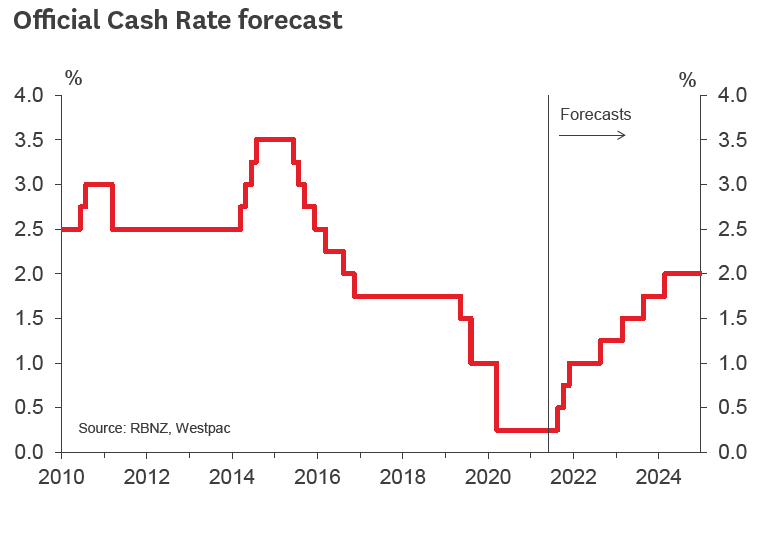
We have updated our forecast for the Official Cash Rate.
As we detailed earlier this week, we now expect that the RBNZ will increase the cash rate by 0.25 ppts at the time of the August Monetary Policy Statement.
This is expected to be followed by 0.25 ppt increases at both the October review and at the November Monetary Policy Statement.
Following the November policy statement, we expect that the RBNZ will pause to assess how the economy is tracking, with further gradual rate increases beginning again in mid-2022.
Underlying our expectations for this sequence of rate hikes are signs of solid momentum in domestic economic activity, as well as clear signs that the strength in demand is flowing through to a strong increase in inflation pressures. That combination of conditions was evident in today's inflation release.
Consumer prices rose by 1.3% in the June quarter. That was well above our forecast and the median market prediction
The result was also much higher than the 0.6% increase the RBNZ assumed in its last set of published forecasts (released in May).
Today's sharp increase took the annual inflation rate to 3.3% - above the RBNZ's target band and the highest pace in a decade. The last time inflation was this high was after 2010's GST increase.
Inflation has been boosted by very large increases in construction costs, as well as increases in petrol prices. However, inflation pressures have been broad based. That was reflected in the measures of core (underlying) inflation which have spiked higher. In fact, most of the core inflation measures released by Stats NZ today were at or above 3% (previously they were around 2%).
In part, this strength in inflation has been due to disruptions to supply chains and the closure of the borders in the wake of last year's outbreak. The resulting shortages of materials, finished goods and labour have all pushed costs of production higher for local businesses.
However, the more notable development has been the strength of consumer demand. That has given businesses greater leeway to pass on cost increases into the prices of consumer goods.
We expect that inflation will linger above the RBNZ's 1 to 3% target band for the remainder of this year and the early part of 2022. While we do expect that inflation will moderate further ahead as supply constraints ease, the current strength in inflation is likely to see inflation expectations pushing to levels above the RBNZ's 2% target. Recent months have already seen some measures of expectations starting to creep higher. And if this becomes embedded in wage and price setting decisions, it would be a major concern for the central bank as it could result in a more protracted inflation cycle.
On top of the lift in inflation, mid-2021 has seen solid momentum in economic activity, including firmness in household spending, construction activity and surveys of business conditions. As a result, it's now looking likely that the strong 1.6% rise in March quarter GDP will be followed by another strong print in June.
In addition, we're also seeing related positive indications for the labour market, with strength in hiring intentions and job ads, as well as widespread reports of labour shortages. That points to a continued drop in the unemployment rate over the coming quarters, along with a lift in wage inflation.
Putting this altogether, the current level of monetary stimulus (which was put in place when the economy entered Level 4 lockdown) is no longer appropriate. The elimination of Covid on our shores means that domestic households and businesses have been able to operate largely free from restrictions. That's meant that (in contrast to regions like the US and Australia), domestic economic activity is now back around trend.
Wednesday's announcement from the RBNZ highlighted that the central bank is ready and willing to adjust policy settings as economic conditions dictate. And they clearly don't see the distinction between a ‘Policy Review' and ‘Monetary Policy Statement' as a hurdle. Rather than waiting until August (when they will release a full statement and projections), the RBNZ effectively kicked off the tightening cycle at an interim review when it announced the cessation of the LSAP programme. That clearly signalled that the RBNZ thinks the inflation outlook is strong enough to warrant acting now, rather than waiting six weeks.
We think that today's result, along with other recent developments will see the RBNZ revising up their assessment of medium-term inflation pressures. And that means that OCR hikes are also likely to come faster