Sample Category Title
EURJPY Bounces on Support Base Formed in April
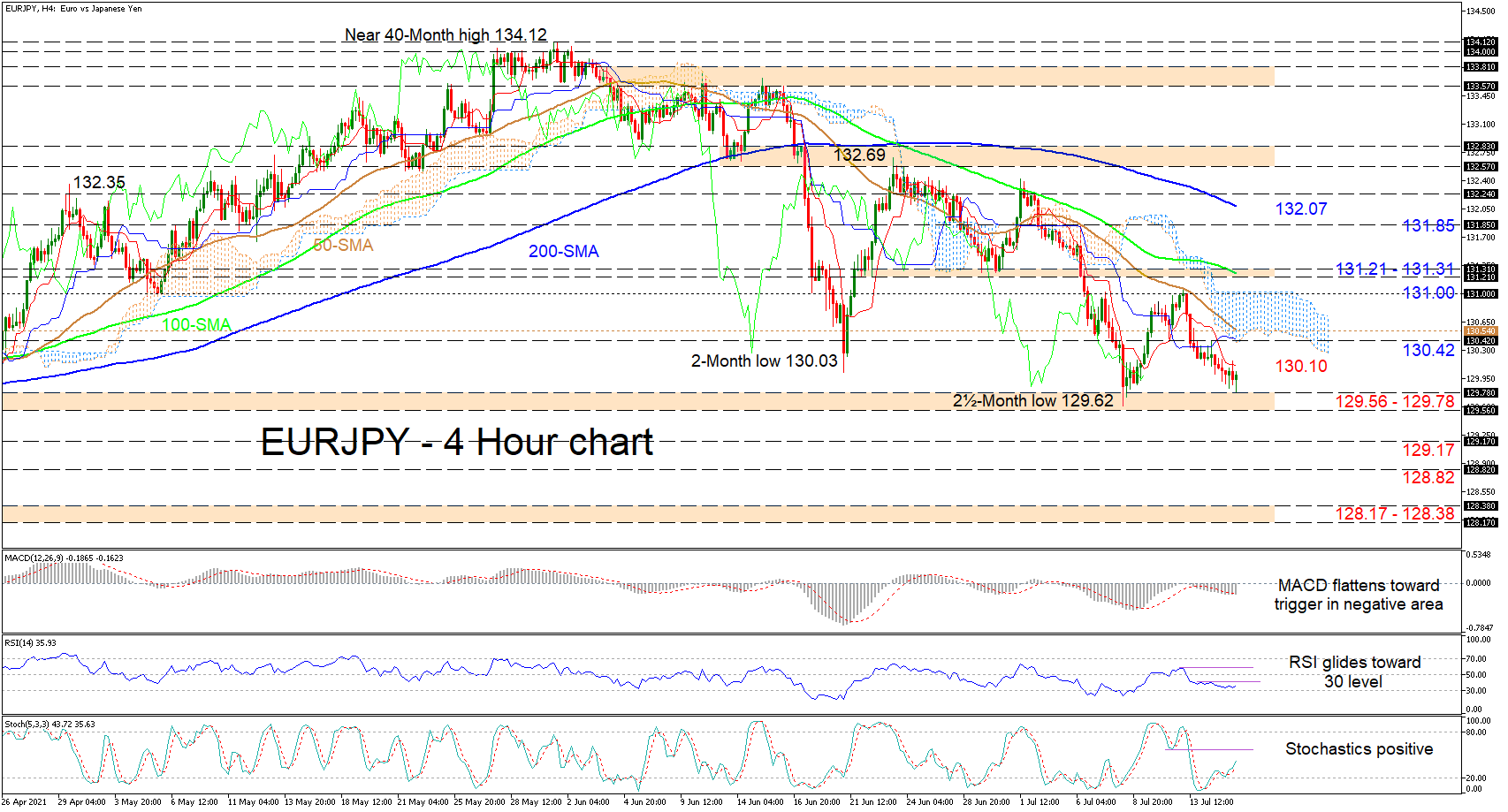
EURJPY has found footing for a second time in the vicinity of the support boundary of 129.56-129.78, formed by the lows in April. In spite of this, the simple moving averages (SMAs) are maintaining their bearish bearings, feeding the downward price pressures.
The Ichimoku lines are holding a minor negative bias, while the short-term oscillators are mixed over directional momentum. The MACD, in the negative zone, is edging towards its red trigger line, while the RSI is floating above the 30 level. That said, the stochastic oscillator has regained its positive charge and is promoting stronger traction off the 129.78 upper frontier.
Pushing off the 129.78 level, initial upside friction could occur at the red Tenkan-sen line at 130.10 before buyers face a tough resistance zone existing between the 130.42 high and the 50-period SMA at 130.54. Should upside pressure grow, the price may then meet the 131.00 handle, which overlaps with the cloud’s upper band and the July 13 high. In the event upside momentum recaptures the area above the critical 131.21-131.31 border, the July 6 high of 131.85 could come into focus.
Alternatively, if the price dives beneath the durable base of 129.56-129.78, sellers may target the troughs of 129.17 and 128.82 respectively, from the end of March. Deteriorating further, the bears may challenge the support obstacle of 128.17-128.38.
Summarizing, EURJPY is sustaining a neutral-to-bearish demeanour below the SMAs and the 131.00 hurdle. Yet, a break below 129.56-129.78 would be needed to accelerate the downward pace in the pair.
NZ Dollar Under Pressure ahead of CPI
The New Zealand dollar has reversed directions and is down considerably on Thursday. Currently, NZD/USD is trading at 0.6986, down 0.61% on the day.
New Zealand CPI eyed
After the RBNZ grabbed the headlines on Wednesday and sent the New Zealand dollar sharply higher, attention now shifts to New Zealand CPI for the second quarter. The consensus is for a strong gain of 2.8% YoY, up sharply from 1.5% in Q1. Keeping in mind that the RBNZ has set an inflation target in the 1-3% range, the upcoming CPI release could well overshoot the target, which would raise pressure on the bank to tighten policy. A reading that is higher than expected should lift the New Zealand dollar.
With the RBNZ announcing that is halting asset purchases, the markets will be looking for hints as to when the bank plans to raise rates. The bank could hike as early as August, but could opt to wait. The upcoming CPI report will be a key consideration in the bank’s thinking – a weak inflation report would provide some breathing room, while a high reading would raise pressure on the RBNZ to raise rates.
Powell remains dovish
Inflation in the US is red-hot, but the Fed has maintained that this is a transitory event. Fed Chair Jerome Powell maintained this view in testimony before a House committee on Wednesday. Powell acknowledged that inflation has “increased notably”, but blamed the surge on temporary factors, such as shortages of used cars and semiconductors, and argued that inflation would ease when conditions returned to normal. Powell’s message to the markets was that the Fed would not change monetary policy before the economy showed “substantial progress”, notwithstanding the jump in inflation.
As US inflation levels continue to head higher, the markets have been looking for clues as to when the Fed will tighten policy and taper its bond purchases. Powell did not shed any light in this regard, saying only that Fed officials are discussing scaling back the pace of bond purchases.
NZD/USD Technical
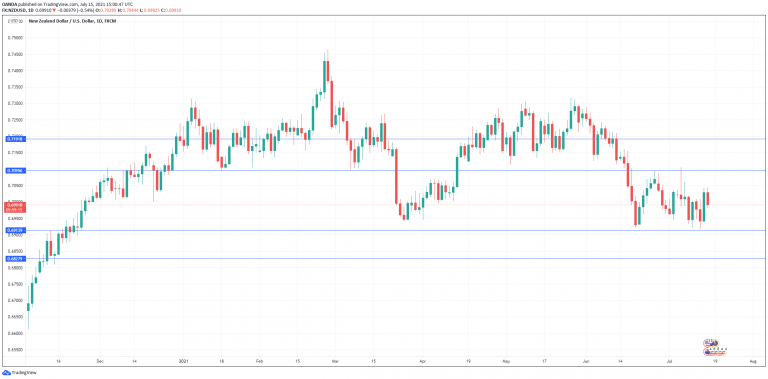
- There is resistance at 0.7095. Above, we find resistance at 0.7191
- On the downside, there is support at 0.6913 which is protecting the round number of 0.6900. Below there is support at 0.6827
UK Job Report Shines But Pound Dips
In North American trade, GBP/USD is trading at 1.3861, up 0.01% on the day. Earlier in the day, the British pound climbed close to the 1.39 level before retracing these gains.
UK wages jump, unemployment claims slide
The June employment report was strong, which briefly sent the pound to higher ground. Unemployment claims fell by 114 thousand in June, after a decline of 92 thousand in May. Wages were up strongly in May, with the 7.3% gain outperforming the previous read of 5.7% and beating the consensus of 7.1%. The services sector showed a significant gain in payrolls, as the reopening of businesses has enabled the labour market to continue its strong recovery.
Unemployment remains low, although it ticked upwards to 4.8% in May, up from 4.7%. This figure is artificially low, since the government’s furlough programme has some 2 million workers, and the plan is due to expire in September. Still, the labour market is showing less slack, and with the government committed to completely opening the economy on July 19, there should be even greater demand for workers in the coming months.
Powell remains dovish
For months, the Fed has insisted that the surge in inflation is transitory, and Fed Chair Jerome Powell did not budge from this stance in testimony before the House on Wednesday. Powell admitted that inflation has “increased notably”, but insisted that the jump is due mostly to temporary factors, such as shortages of used cars and semiconductors, and that inflation would ease when conditions returned to normal. Powell stressed that the Fed would not change monetary policy before the economy showed “substantial progress”.
As US inflation levels continue to head higher, the markets have been looking for clues as to when the Fed will taper its minimum USD 120 billion/mth in bond purchases. Powell did not provide any taper timelines, saying only that Fed officials are discussing scaling back the pace of bond purchases.
GBP/USD Technical Analysis

- There is resistance at 1.3953. Above, there is resistance at 1.4007
- On the downside, 1.3794 is providing support. This is followed by support at 1.3689
Fed Chair Powell testifies before Senate, live stream
https://www.youtube.com/watch?v=JUAb0oxAAP8
Sunset Market Commentary
Markets
The hawk is back. Bank of England member Saunders swapped his hawkish label for a dovish one end of 2019 when Brexit uncertainty was hurting sentiment and the economy. He stayed on the dovish side throughout the pandemic. Until today. Commenting on the economy and (yesterday’s stronger-than-expected) inflation, Saunders said that with inflation seen above target for two to three years, it may be appropriate to withdraw stimulus soon, in “the next month or two”. The labor market slack is shrinking, he noted, adding that guidance conditions for tightening policy are now met. Saunders’ comments follow deputy governor Ramsden’s yesterday. Although their views are not shared by a majority of the MPC yet - governor Bailey for example remained more neutral in an interview - it does suggest a general shift in thinking is underway. The pound thinks so too and strengthens. EUR/GBP went back to test the 0.853 support which is the final hurdle before the April 2021 low (0.8472) pops up. It’s still hesitant to really push through. Markets don’t want to be wrongfooted with the August 5 policy meeting, which just turned into a crucial one after all, looming on the horizon. The risk-off climate (stocks slip more than 1% in Europe) is capping sterling’s momentum as well, which can be seen in cable (GBP/USD) holding stable near 1.384 due to a generally solid dollar, despite a mixed bag of US data (see below). The trade-weighted index is nicely holding the upward sloping trend channel, bringing DXY to 92.6 today. EUR/USD retreats from intraday highs of around 1.185 back to the low 1.18 area. The yen is the only major currency able to make a fist. USD/JPY is flat at 110. The Swiss franc initially was well bid with EUR/CHF (currently 1.083) nearing 1.08 before the market decided it went far enough.
The all-too-familiar bull flattening trend continued in fixed income. If sentiment is constructive, markets assume a solid economic recovery with low inflation and ample monetary support to keep (long) rates low. Not even an increasingly assertive Bullard can change market’s thinking. The St Louis Fed governor said it is time to end “these emergency measures”, saying the economy has made the substantial progress needed. He wants to kick off the tapering though not on an automatic pilot and with respect for a still-uncertain environment. If the general climate worsens, like today, safe haven bids for core bonds generate the same effect on yields. US yield changes vary from -1.4 bp (5y) to -2.8 bps (30y). We’re keeping a close eye at the 134 level in the US Treasury 10y note which acted as resistance already quite a few times. The German yield curve bull flattens with declines of 1.4 bps (10y, just shy of support at -0.34%) to 2.4 bps (30y). Peripheral spreads widen slightly (+1 bp).
News Headlines
In its monthly report, OPEC expects global demand for crude oil to return to pre-pandemic levels in the second half of next year. In this scenario global oil demand will surpass the mark of 100 million per day in the third and the fourth quarter of 2022. According to OPEC, oil demand averaged 99.98 million bpd in 2019. However, it expects consumption to suffer a setback in the first quarter of next year, which might lead to surplus in the market at that time. An important part of the rise in demand is expected to be supplied by non-OPEC producers, including the US. Uncertainty on demand and on non-OPEC production probably explains Saudi-Arabia’s aim to maintain the OPEC+ production agreement beyond the April 2022 deadline.
US eco data printed mixed today. The July Empire Manufacturing index surged from 17.4 to 43, the highest level on record (vs 18 expected). Details showed surging new order and shipments while price indicators remained sky high as well. A measure of hiring reached a record as well. The July Philly Fed Business Outlook declined from 30.7 to 21.9 (vs 28 forecast). Details showed that the setback was broad-based from price indicators over employment to orders and the outlook. Weekly jobless claims set a minor new cycle low at 360k (vs 350k consensus). Import (1% M/M & 11.2% Y/Y) and export prices (1.2% M/M & 16.8% Y/Y) showed similar price pressures as CPI and PPI numbers earlier this week. June industrial production rose by 0.4% M/M.
Fed Bullard: We’re in a situation where we can taper
St. Louis Fed President James Bullard told Bloomberg TV, "I think we are in a situation where we can taper." He added, "We don't want to jar markets or anything -- but I think it is time to end these emergency measures."
"On the labor market I think we have made substantial progress," Bullard said. "The committee is going to debate that in earnest now at the July meeting."
After tapering begins, "You probably don't want to be on automatic pilot in this situation," Bullard said. "We are not quite sure where this inflation process is going to go. We need some optionality on the upside with respect to possible inflation shocks."
EUR/USD Mid-Day Outlook
Daily Pivots: (S1) 1.1794; (P) 1.1816; (R1) 1.1861; More...
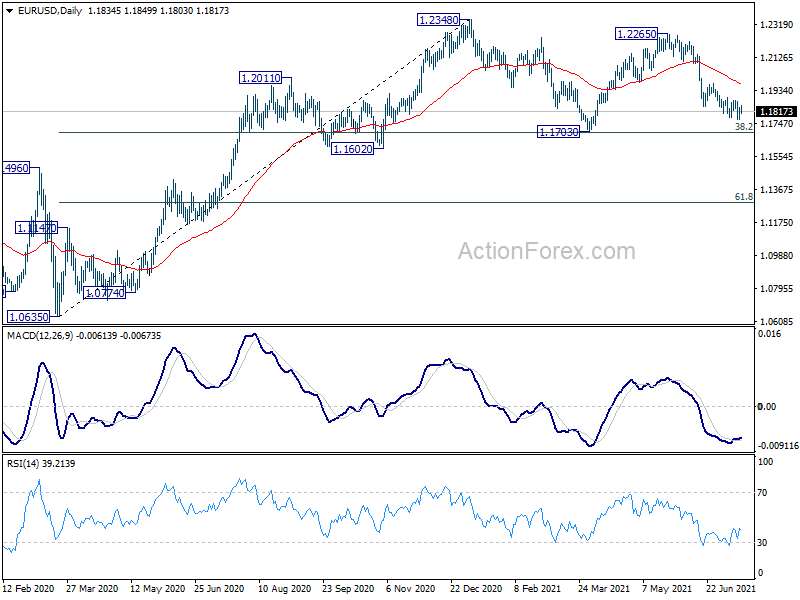
Further decline is still expected in EUR/USD with 1.1880 resistance intact. Current decline from 1.2265, as the third leg of correction from 1.2348, could target 1.1703 support. On the upside, though, break of 1.1880 resistance should indicate short term bottoming, and bring stronger rebound to 1.1974 resistance first.
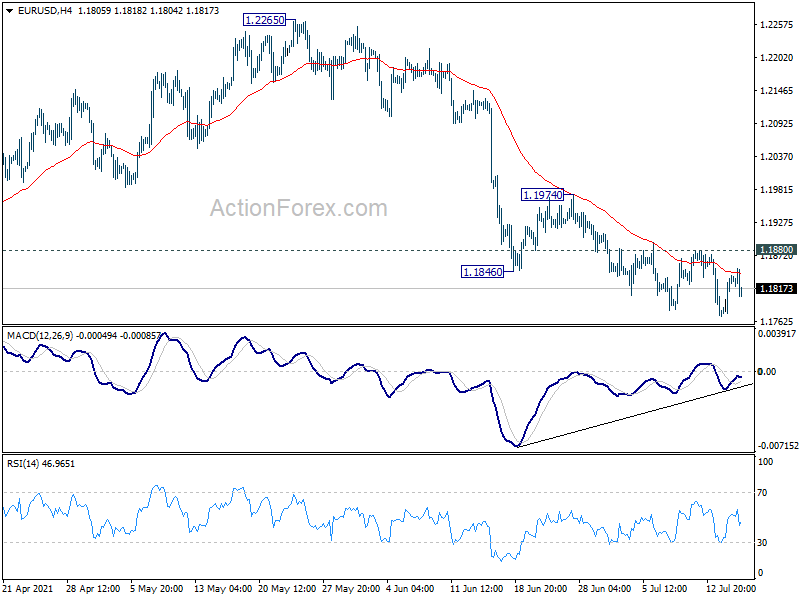
In the bigger picture, rise from 1.0635 is seen as the third leg of the pattern from 1.0339 (2017 low). Further rally could be seen to cluster resistance at 1.2555 next, (38.2% retracement of 1.6039 to 1.0339 at 1.2516). This will remain the favored case as long as 1.1602 support holds. Reaction from 1.2555 should reveal underlying long term momentum in the pair. However sustained break of 1.1602 will argue that the rise from 1.0635 is over, and turn medium term outlook bearish again.
GBP/USD Mid-Day Outlook
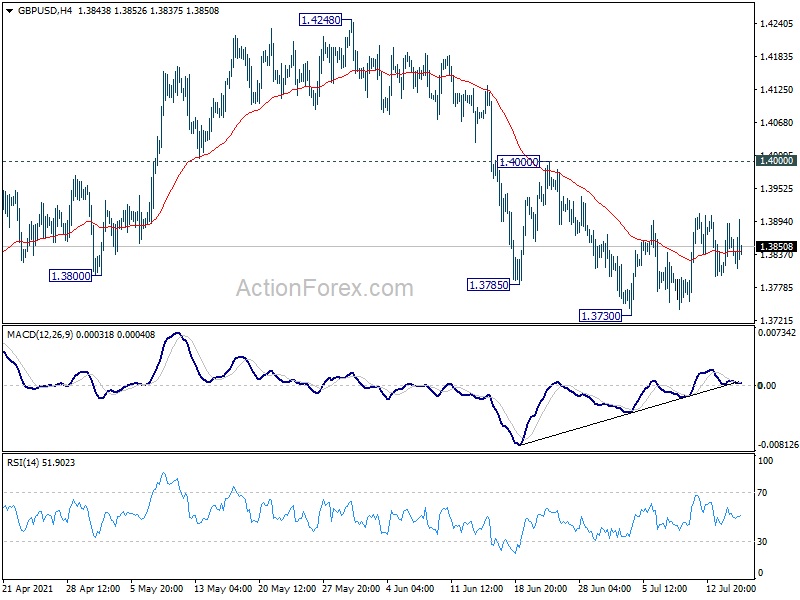
Daily Pivots: (S1) 1.3813; (P) 1.3852; (R1) 1.3903; More....
GBP/USD is still bounded in range above 1.3730 and intraday bias stays neutral at this point. On the downside, break of 1.3730 will resume the fall from 1.4248, as the third leg of the consolidation pattern from 1.4240, to 1.3668 support and possibly below. On the upside, break of 1.4000 will turn bias back to the upside for retesting 1.4240/8 resistance zone instead.
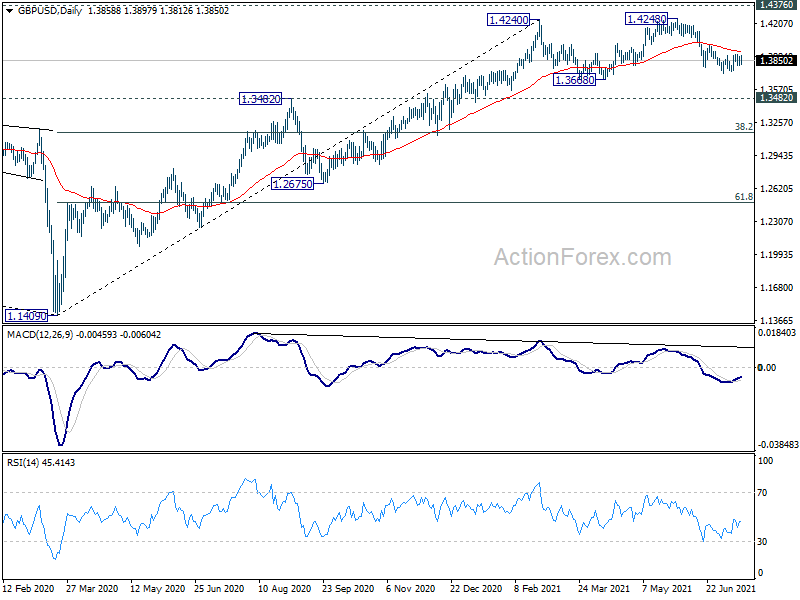
In the bigger picture, as long as 1.3482 resistance turned support holds, up trend from 1.1409 should still continue. Decisive break of 1.4376 resistance will carry larger bullish implications and target 38.2% retracement of 2.1161 (2007 high) to 1.1409 (2020 low) at 1.5134. However, firm break of 1.3482 support will argue that the rise from 1.1409 has completed and bring deeper fall to 1.2675 support and below.
USD/CHF Mid-Day Outlook
Daily Pivots: (S1) 0.9124; (P) 0.9161; (R1) 0.9181; More....
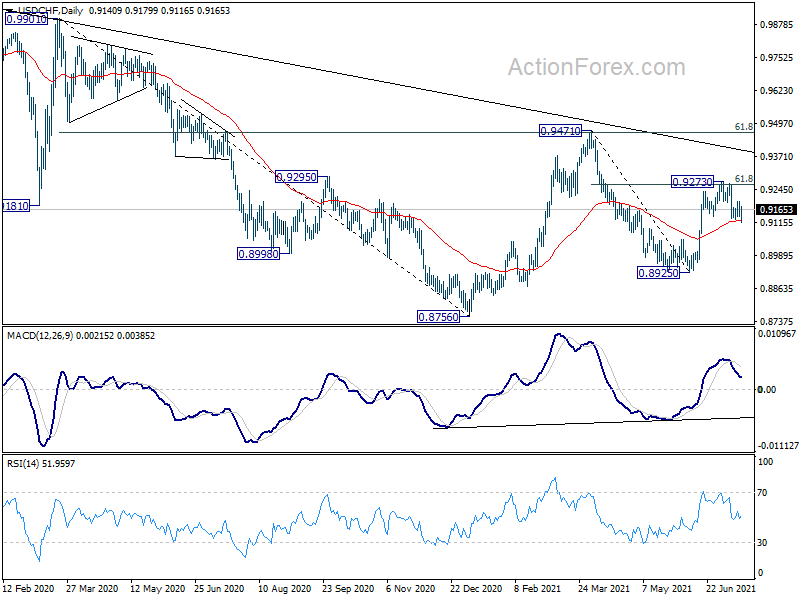
USD/CHF dipped to 0.9116 earlier today, but failed to sustain below 55 day EMA. Intraday bias remains neutral first. On the downside, sustained trading below 55 day EMA (now at 0.9126) will affirm the case that rebound from 0.8925 has completed at 0.9273. Deeper fall would then be seen back to retest 0.8925 low. On the upside though, break of 0.9273 and sustained trading above 61.8% retracement of 0.9471 to 0.8925 at 0.9262 will target 0.9471 resistance next.
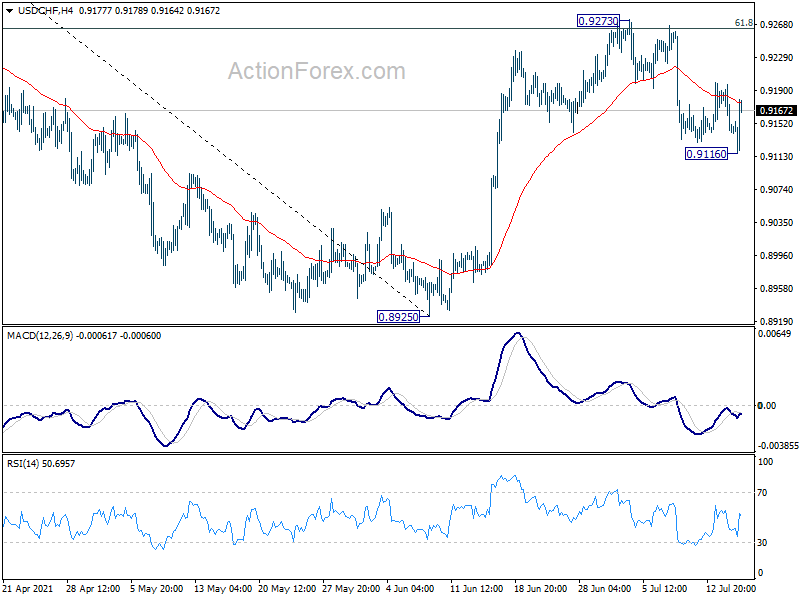
In the bigger picture, medium term outlook is currently neutral with focus on 0.9471 resistance. Sustained break there will indicate completion of whole decline from 1.0342 (2016 high). Medium term outlook will be turned bullish for a test on 1.0342 high. But, rejection by 0.9471 again will revive bearishness for another fall through 0.8756 low.
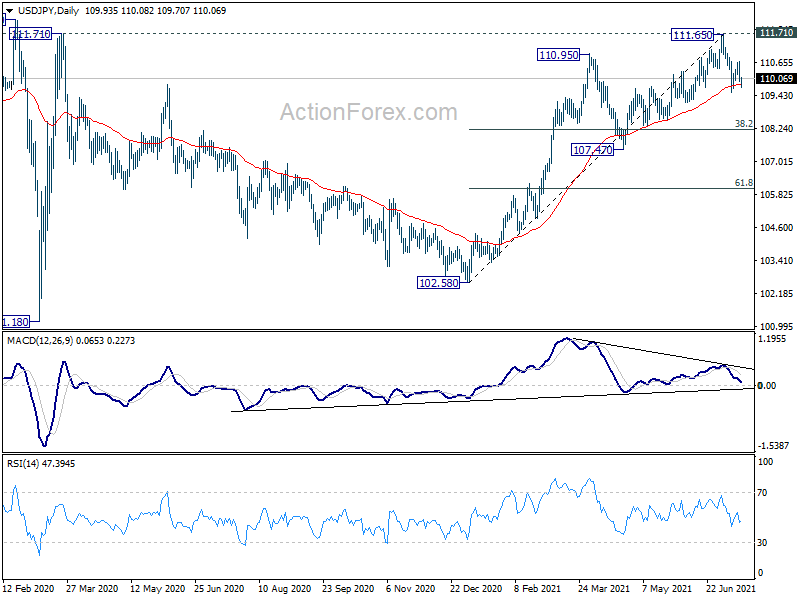
USD/JPY Mid-Day Outlook
Daily Pivots: (S1) 109.69; (P) 110.19; (R1) 110.45; More...
USD/JPY recovers mildly but stays in established range. Intraday bias remains neutral first. Also, risk stays mildly on the downside with 111.65 resistance intact. On the downside, break of 109.52, and sustained trading below 55 day EMA (now at 109.85) will suggest that it's at least correcting the rise from 102.58. Deeper fall would be seen to 38.2% retracement of 102.58 to 111.65 at 108.18 next.
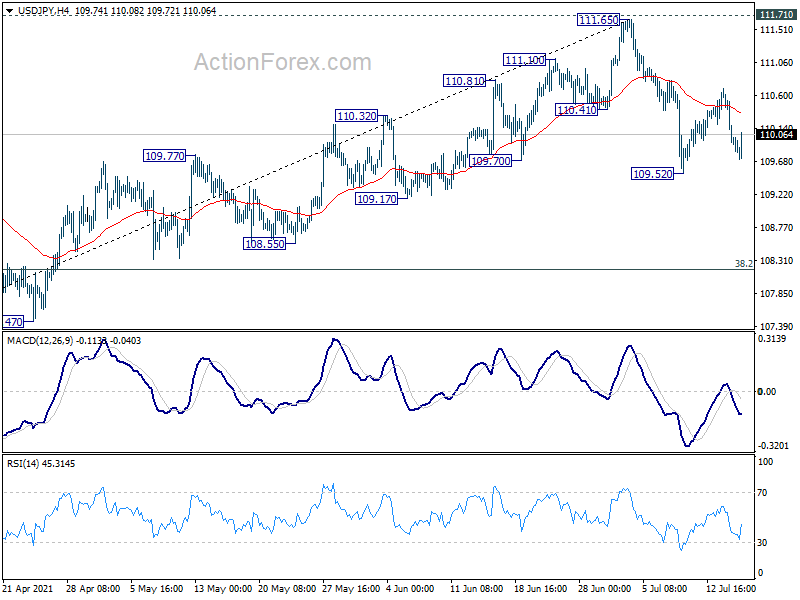
In the bigger picture, medium term outlook is staying neutral with 111.71 resistance intact. Though, as notable support was seen from 55 day EMA, rise from 102.58 is mildly in favor to extend higher. Decisive break of 111.71/112.22 resistance will suggest long term bullish reversal. Rise from 101.18 could then target 118.65 resistance (Dec 2016) and above. However, sustained break of 55 day EMA would revive some medium term bearishness, and open up deep fall back towards 102.58 support.