Sample Category Title
Plenty For Asia To Think About Today
There is plenty for Asia to think about today, with the BoJ unchanged, China clamping down on property developers, Australian lockdowns widening, New Zealand inflation ballooning, President Biden in Sino disconnect mode and of course, the delta-variant across Southeast Asia.
Before we get to all of that, though, a quiet look at the US overnight, Chairman Powell held his transitory inflation line in his second day of testimony on the Hill, with Treasury Secretary Yellen backing him up. However, she expressed some disquiet over rising house prices.
US bond yields fell once again, with the curve continuing to flatten, but the US dollar instead surprisingly remained firm, while US stocks retreated. The mixed bag of US data may account for some of the price action. Initial Jobless Claims fell to a pandemic low of 360,000 while the New York Empire State Manufacturing rose to a record high of 43. Industrial and Manufacturing Production slipped, though, as US businesses grapple with supply chain bottlenecks. Therefore, the overall picture remains an inflationary one, and although bond markets seem content with the transitory line, currency markets and stocks are expressing some disquiet, hence the disconnect.
The picture on Capitol Hill is turning murkier by the day and regards to budgets and stimulus packages. I can honestly say I am not sure who on either side is going to vote for what or not, with some competing versions of legislation emerging from both sides. President Biden continued with his Sino disconnect policy, warning US companies about the undermining of the Hong Kong judiciary and doing business there and adding more China tech companies to the US entity list. He also threw a few barbs at Facebook, and the legislative threat to big-tech globally across international jurisdictions just isn’t going away. It is something I have touched on before and may also have weighed on the Nasdaq overnight.
Turning to Asia, President Biden’s comments and actions were never going to set up China markets for a good start, already nervous after middling data this week and government tech-clampdown nerves. China authorities announced today that they would require property developers to disclose commercial paper debt each month, another escalation in China’s deleveraging process for the sector. Geopolitics and domestic clampdowns will continue to cloud investors’ sentiment in China for the rest of the session.
One bright spot was Singapore’s Non-oil Domestic Exports, which shrugged of virus restrictions in June to 6.0% MoM for June, well above forecast. Geographical growth was strong across the board and with the City-state’s vaccination programme moving at a breakneck pace, I am now expecting Singapore to be ASEAN’s outperformer into Q3 and Q4.
Sadly, for the rest of ASEAN, the delta variant continues to wreak havoc across the region and Goldman Sachs today sharply downgraded growth forecasts for the rest of the year. They aren’t the first, and they won’t be the last to do that. Indonesia, Malaysia, Thailand and the Philippines will remain acutely sensitive to a negative shift in investor sentiment, especially if the Fed blinks on inflation later in September.
Despite solid employment data this week, Australian investors may need to swallow some concrete pills into next week as the delta variant outbreak leads Melbourne into a snap lockdown today. Restrictions look set to be tightened further in the greater Sydney region as well. That is weighing on the currency and equity markets today and by association New Zealand markets as well, with the trans-Tasman travel bubble likely to be further shrunk. The lucky country remains lucky; the stream of impressive economic data shows that. But that will change if the restrictions in New South Wales continue, and the next couple of weeks will be vital for Australian asset markets, which have a lot of good news already baked into them.
New Zealand inflation surges
I mentioned New Zealand inflation yesterday, and the release this morning blew expectations out of the water. Inflation rose to 1.30% (0.80 exp) QoQ for Q2, while the YoY number surged to 3.30%. Business PMI, meanwhile, leapt to 60.7. That had bank forecasters scrambling to pencil in RBNZ rate hits starting almost straight away and continuing through 2022. The New Zealand dollar is up 0.50% this morning. The expectations of a much faster and sooner tightening cycle should see the Flightless Bird outperform the Australian dollar and US dollar going forward. Only the Covid-19 situation in nearby(ish) Australia is tempering that rally, I believe.
Finally, the Bank of Japan has just released its latest monetary policy statement, maintaining its 10-year JGB yield target at 0.00% and its short-term rate target at -0.10%. As expected, it has adjusted GDP growth forecast for 2021 and 2022 slightly lower but still expects inflation this year to hit 0.60%, which would be an awe-inspiring feat for Japan. None of the announcements was a surprise, and like many central banks right now, the BoJ is noting both global and domestic risks, especially regarding Covid-19, and waiting to see which way the cards fall. USD/JPY was sharply unchanged on the news.
This evening we see Eurozone Inflation and Core Inflation released, with the former expected to print around 2.0%. That should be right on the ECB’s new “strategy target.” Still, with their inflation forecasts showing a softening over the coming quarters, some monetary policy divergence could be on the cards with the Federal Reserve. Next week’s ECB policy meeting could be the most interesting one for a while, and dovish ECB expectations may go some way to explaining euro’s relative underperformance this week.
The week rounds out with US Retail Sales data. The MoM figure is expected to fall by -0.40%, less than last month’s -1.30%. The risk here is that Americans may well be spending more on reopening services and having fun rather than goods from the shops. As such, a lower number may set US stock markets up for a weak finish to the week.
That’s a lot to cover today. From an Asian perspective, the delta-variant discount still looms large across Asia-Pacific markets. US-Sino relations appear to be taking another turn south which will further erode sentiment. China’s subtle easing measures are also causing some recovery disquiet while its property sector deleveraging and ongoing tech-clampdown has further clouded the picture. The US and Europe may be doing the heavy lifting on the global recovery trade in Q3.
EUR/USD Daily Outlook
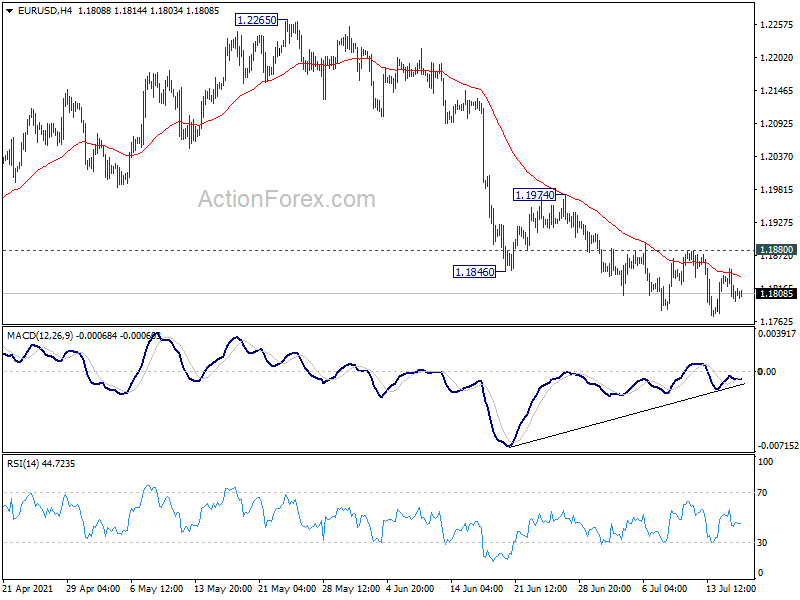
Daily Pivots: (S1) 1.1788; (P) 1.1820; (R1) 1.1843; More...
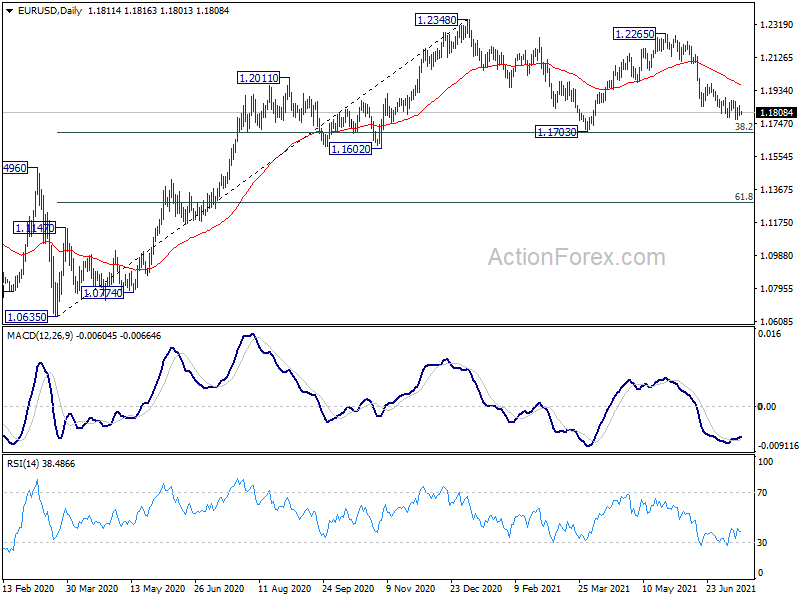
No change in EUR/USD's outlook as further fall is expected with 1.1880 resistance intact. Current decline from 1.2265, as the third leg of correction from 1.2348, could target 1.1703 support. On the upside, though, break of 1.1880 resistance should indicate short term bottoming, and bring stronger rebound to 1.1974 resistance first.
In the bigger picture, rise from 1.0635 is seen as the third leg of the pattern from 1.0339 (2017 low). Further rally could be seen to cluster resistance at 1.2555 next, (38.2% retracement of 1.6039 to 1.0339 at 1.2516). This will remain the favored case as long as 1.1602 support holds. Reaction from 1.2555 should reveal underlying long term momentum in the pair. However sustained break of 1.1602 will argue that the rise from 1.0635 is over, and turn medium term outlook bearish again.
GBP/USD Daily Outlook
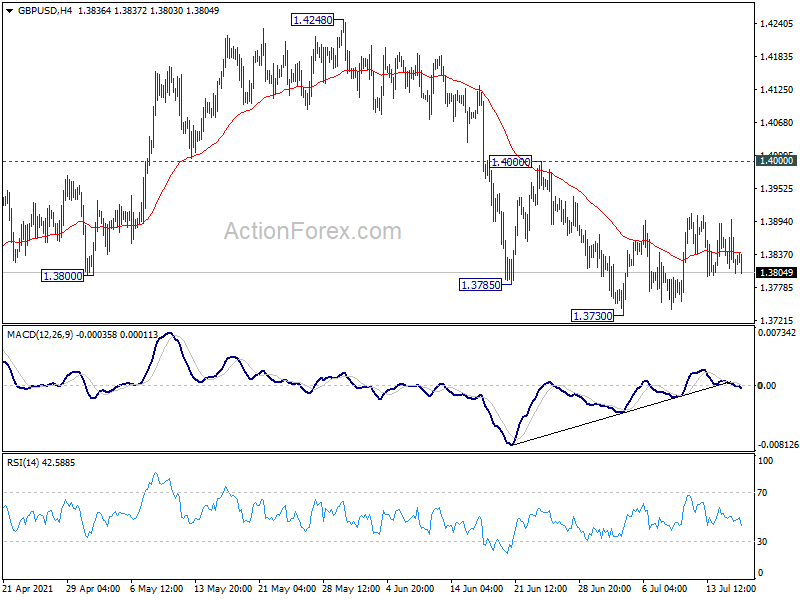
Daily Pivots: (S1) 1.3788; (P) 1.3844; (R1) 1.3882; More....
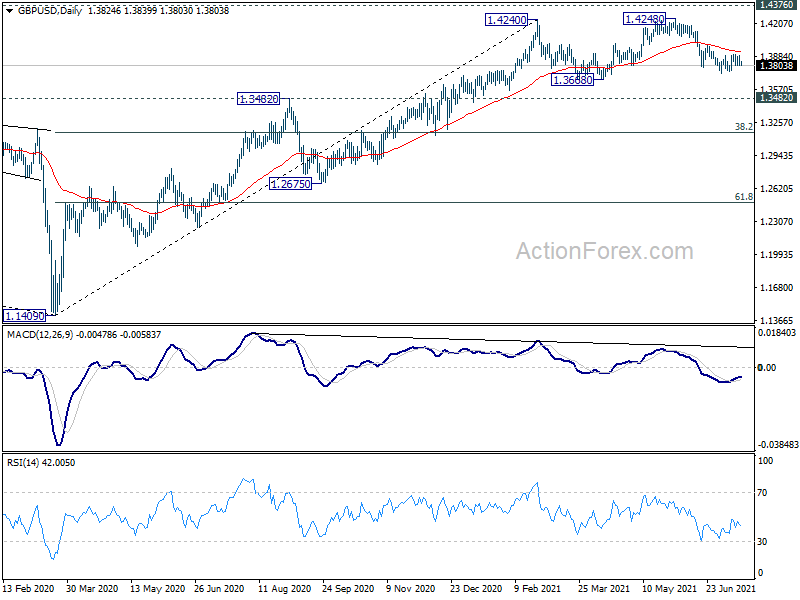
Intraday bias in GBP/USD remains neutral as sideway trading continues above 1.3730. On the downside, break of 1.3730 will resume the fall from 1.4248, as the third leg of the consolidation pattern from 1.4240, to 1.3668 support and possibly below. On the upside, break of 1.4000 will turn bias back to the upside for retesting 1.4240/8 resistance zone instead.
In the bigger picture, as long as 1.3482 resistance turned support holds, up trend from 1.1409 should still continue. Decisive break of 1.4376 resistance will carry larger bullish implications and target 38.2% retracement of 2.1161 (2007 high) to 1.1409 (2020 low) at 1.5134. However, firm break of 1.3482 support will argue that the rise from 1.1409 has completed and bring deeper fall to 1.2675 support and below.
Daily Tecnical Analysis
EUR/USD
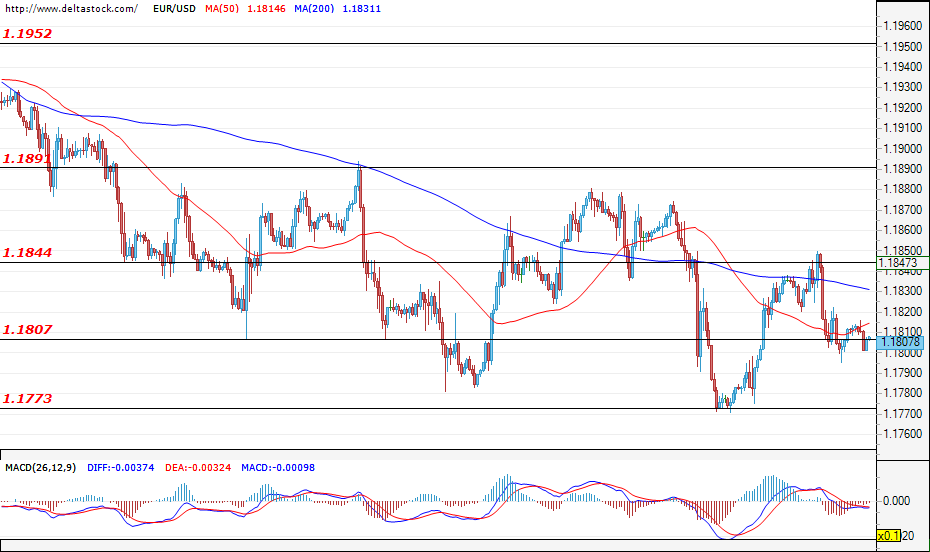
Current level - 1.1807
The euro continues to lose value against the dollar and, despite its short-term correction from Wednesday, during yesterday's trading session the pair was down again. The forecasts are that this downward movement will continue and the pair will focus on a test of the local bottom and important support at 1.1773. The first important resistance is at 1.1891. During today's trading session, investors' attention will be focused on the data on the consumer price index for the Eurozone (09:00 GMT).
| Resistance | Support | ||
| intraday | intraweek | intraday | intraweek |
| 1.1807 | 1.1891 | 1.1750 | 1.1700 |
| 1.1844 | 1.1950 | 1.1717 | 1.1630 |
USD/JPY
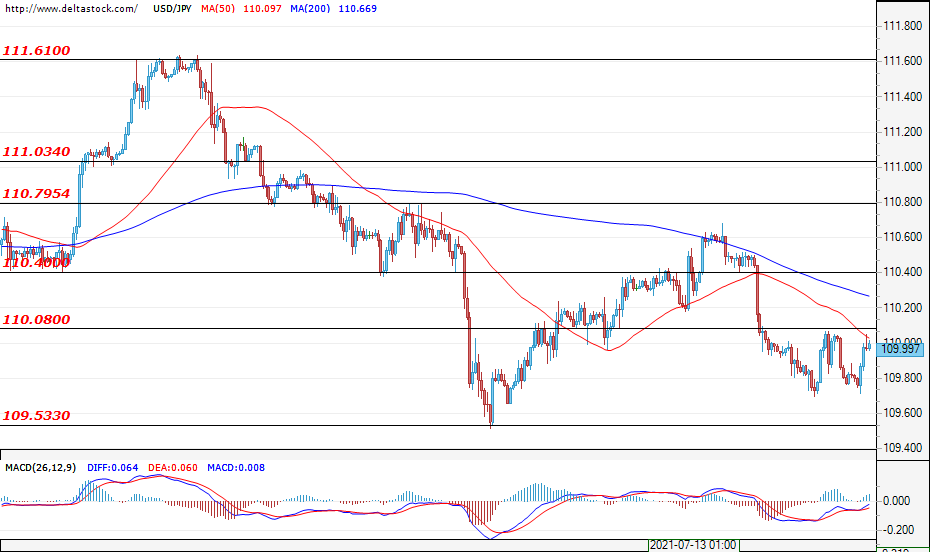
Current level - 109.99
Although in the first hours of today's trading session the currency pair saw an upward movement, the forecasts are that it will be short-term, after which the downward movement will continue. The first important support is the level at 109.53 and, if it is not broken, a short-term correction may follow. An important resistance is the level at 110.40.
| Resistance | Support | ||
| intraday | intraweek | intraday | intraweek |
| 110.79 | 111.03 | 109.53 | 109.00 |
| 111.03 | 111.61 | 109.53 | 108.50 |
GBP/USD
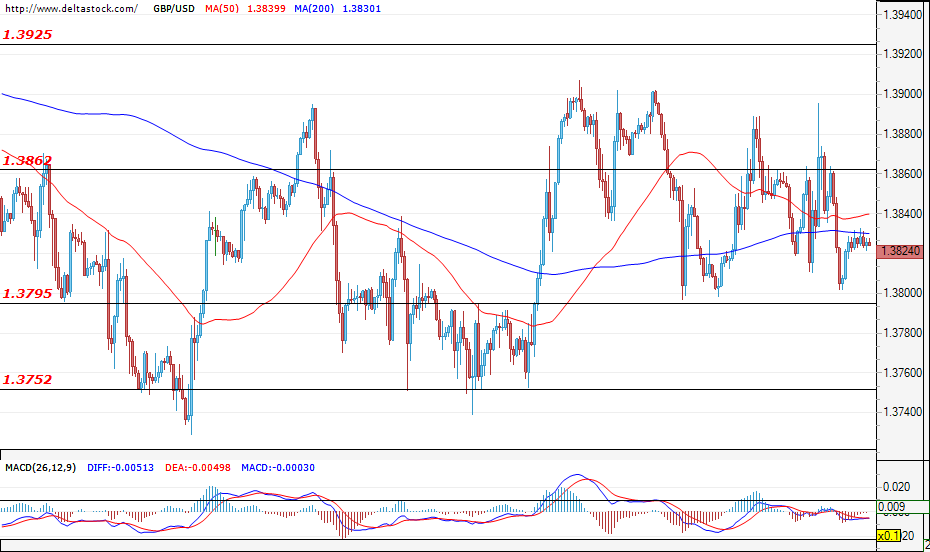
Current level - 1.3824
Since the beginning of the week, the currency pair is in a relatively narrow range between 1.3909 and 1.3795 and these are the critical support and resistance. As a rule, if any of them is broken, this will determine the direction of the subsequent movement. However, expectations are for a downward movement and strengthening of the dollar against the pound.
| Resistance | Support | ||
| intraday | intraweek | intraday | intraweek |
| 1.3862 | 1.4000 | 1.3795 | 1.3660 |
| 1.3925 | 1.4118 | 1.3750 | 1.3610 |
USD/CHF Daily Outlook
Daily Pivots: (S1) 0.9133; (P) 0.9163; (R1) 0.9208; More....
Intraday bias in USD/CHF remains neutral for the moment. On the downside, sustained trading below 55 day EMA (now at 0.9126) will affirm the case that rebound from 0.8925 has completed at 0.9273. Deeper fall would then be seen back to retest 0.8925 low. On the upside though, break of 0.9273 and sustained trading above 61.8% retracement of 0.9471 to 0.8925 at 0.9262 will target 0.9471 resistance next.
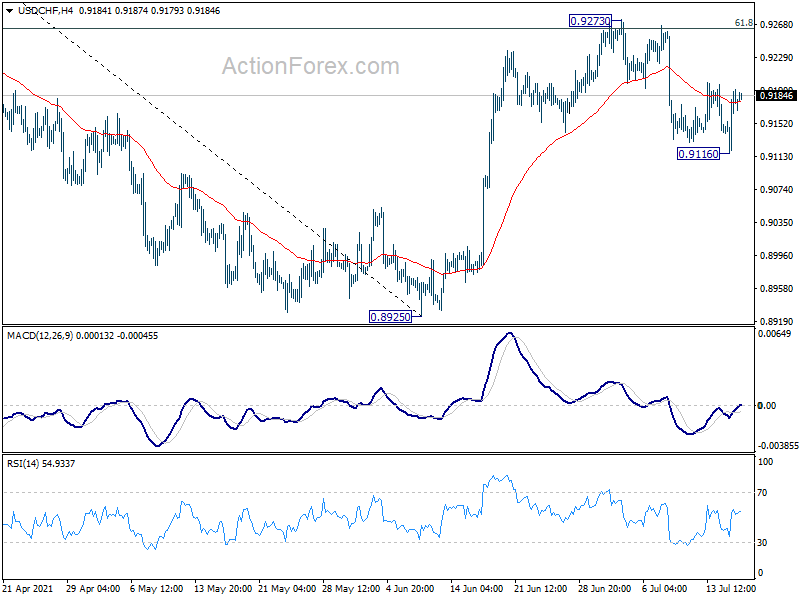
In the bigger picture, medium term outlook is currently neutral with focus on 0.9471 resistance. Sustained break there will indicate completion of whole decline from 1.0342 (2016 high). Medium term outlook will be turned bullish for a test on 1.0342 high. But, rejection by 0.9471 again will revive bearishness for another fall through 0.8756 low.
US 30 Rally Seems Overstretched
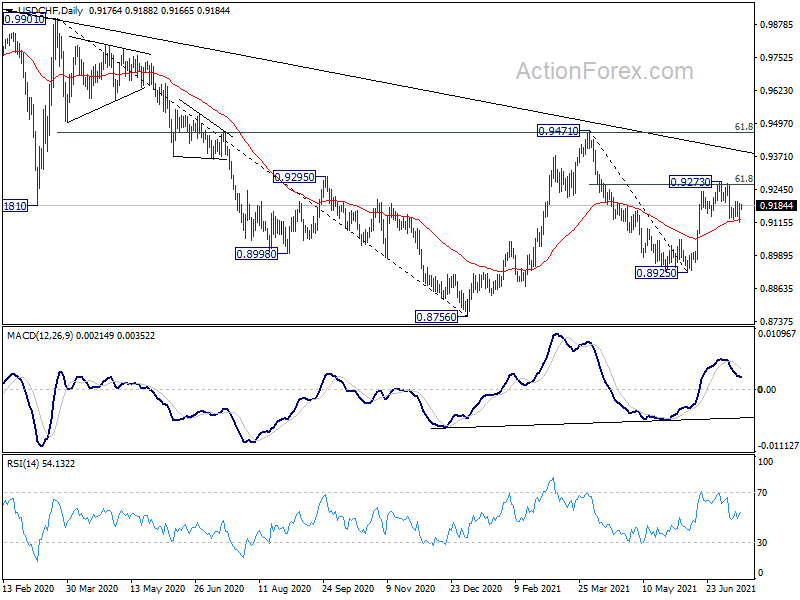
The Dow Jones consolidates as Fed Chairman Jerome Powell stressed again on the temporary nature of inflation. The rally has halted at May’s high at 35090.
The RSI divergence shows a loss in the upward momentum, suggesting that buyers were eager to take profit. A shooting star at the latest high is another indication of a lack of commitment from the buy-side, which may foreshadow a correction.
34660 is the key support and its breach would prompt short-term buyers to bail out, confirming the U-turn in the process.
EUR/GBP Capped By Resistance
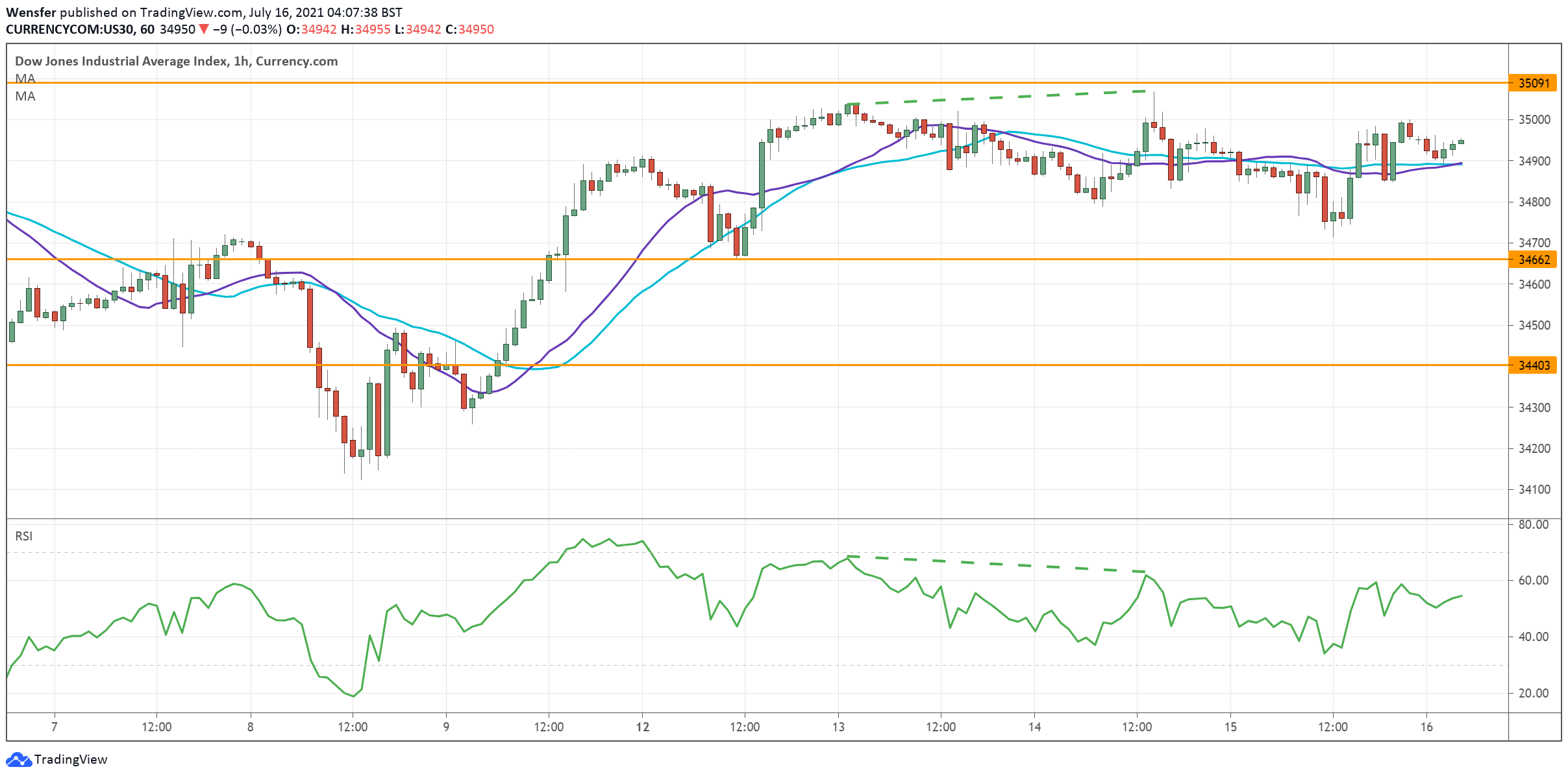
The Pound rallied after average earnings jumped in the past three months. The euro’s latest rebound was capped by 0.8565, where strong selling interest pushed it back to the base.
From the daily chart’s perspective, the pair moves south in a falling channel in spite of a choppy path. A break below the floor at 0.8510 could send the price towards 0.8480, key support from April’s rally.
On the upside, even if buyers succeed in clearing 0.8565, 0.8595 could be a tough resistance to crack in the short term.
USD/JPY Daily Outlook
Daily Pivots: (S1) 109.67; (P) 109.88; (R1) 110.04; More...
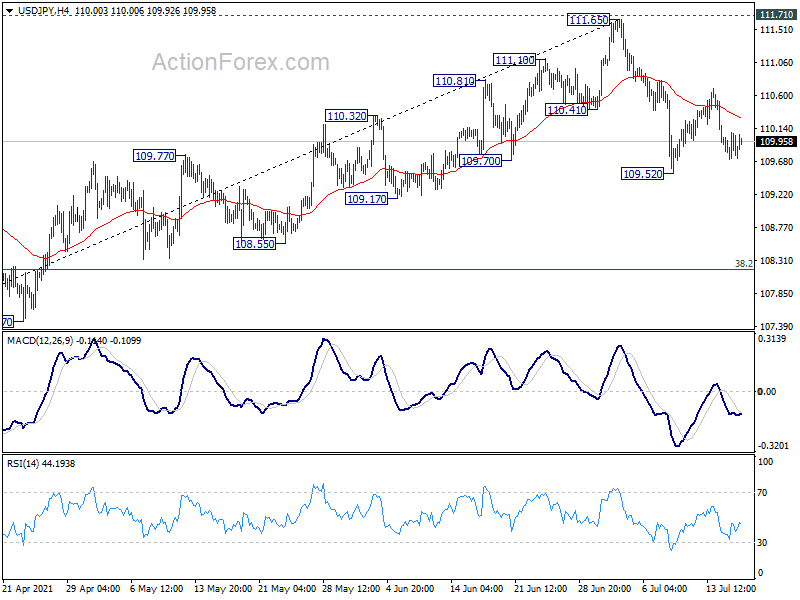
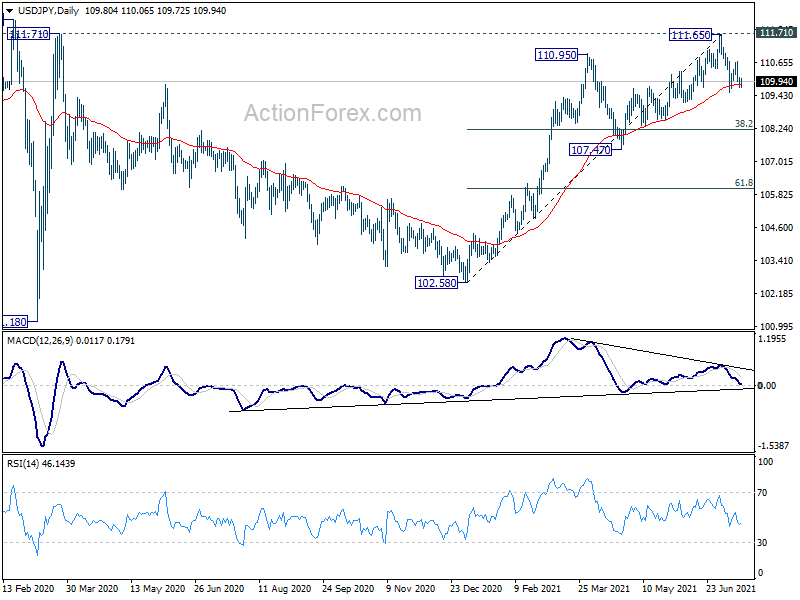
Intraday bias in USD/JPY remains neutral first and risk stays Also, risk stays mildly on the downside with 111.65 resistance intact. On the downside, break of 109.52, and sustained trading below 55 day EMA (now at 109.83) will suggest that it's at least correcting the rise from 102.58. Deeper fall would be seen to 38.2% retracement of 102.58 to 111.65 at 108.18 next.
In the bigger picture, medium term outlook is staying neutral with 111.71 resistance intact. Though, as notable support was seen from 55 day EMA, rise from 102.58 is mildly in favor to extend higher. Decisive break of 111.71/112.22 resistance will suggest long term bullish reversal. Rise from 101.18 could then target 118.65 resistance (Dec 2016) and above. However, sustained break of 55 day EMA would revive some medium term bearishness, and open up deep fall back towards 102.58 support.
AUD/USD Tests Key Support
The Australian dollar softens as the state of Victoria goes into a five-day lockdown.
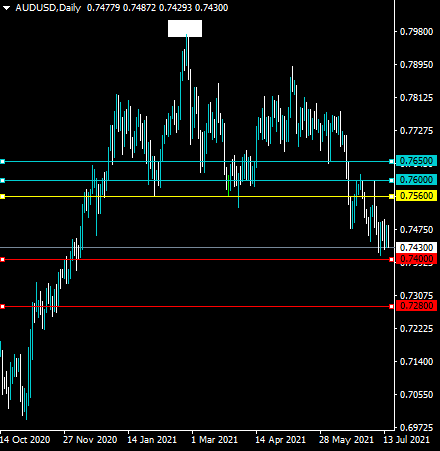
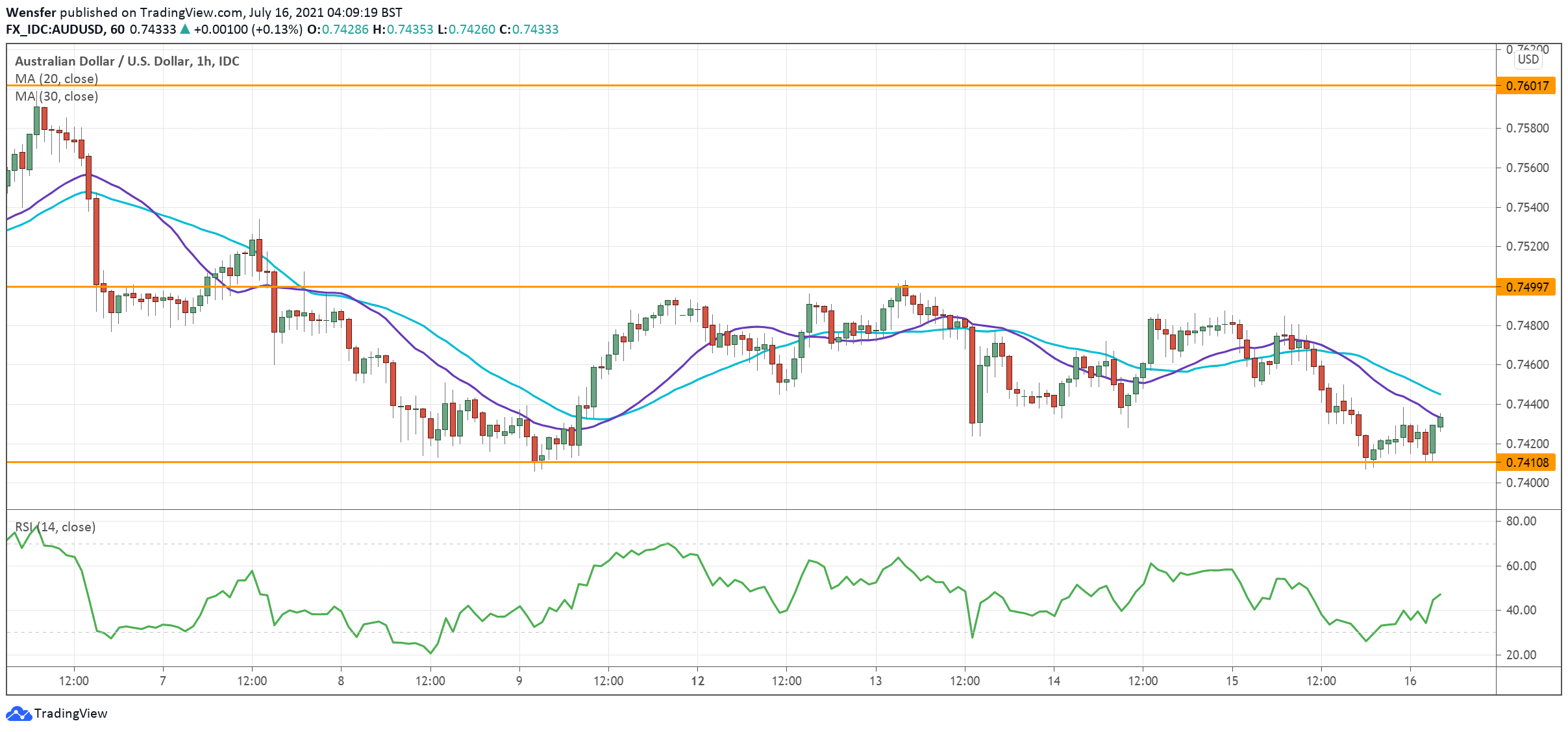
Last week’s bearish breakout below 0.7450 has given the bears the upper hand. The price’s failure to lift offers around 0.7500 further confirms the downward bias. The current consolidation is likely an accumulation phase for the sell-side.
Buyers are struggling to hold above the critical support at 0.7410. A drop could invalidate the timid rebound and trigger a new round of sell-off towards 0.7300.
AUDUSD Weakness Expected
The Australian dollar currency looks vulnerable to further losses against the US dollar due to broad based weakness amongst commodities. The AUDUSD pair could reach the initial target of a large bearish patter, around the 0.7280 level if the 0.7400 level is broken. Overall, watch out for a continuation of the bearish trend if the AUDUSD pair continues to make fresh lower lows.
The AUDUSD pair is only bullish while trading above the 0.7560 level, key resistance is found at the 0.7600 and 0.7650 levels.
The AUDUSD pair is only bearish while trading below the 0.7560 level, key support is found at the 0.7400 and 0.7280 levels.