Sample Category Title
Eurozone CPI finalized at 1.9% yoy in Jun, EU at 2.2% yoy
Eurozone CPI was finalized at 1.9% yoy in June, down from May's 2.0% yoy. The highest contribution came from energy (+1.16%), followed by non-energy industrial goods (+0.31%), services (+0.28%) and food, alcohol & tobacco (+0.15%).
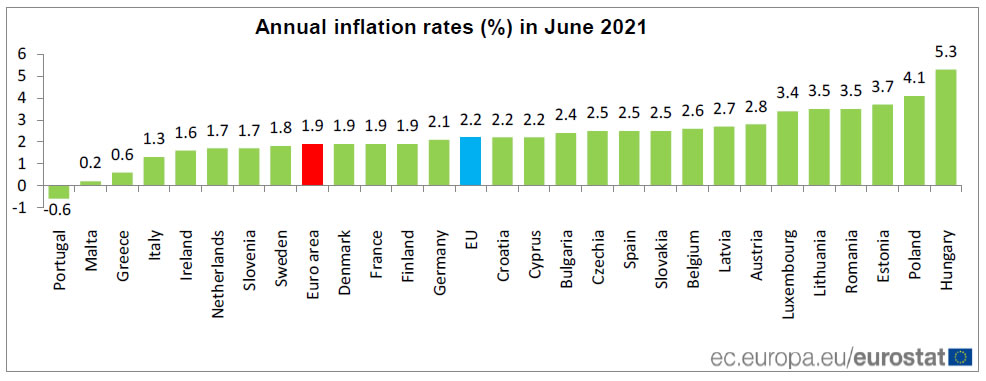
EU CPI was finalized was finalized at 2.2% yoy, down from May's 2.3% yoy. The lowest annual rates were registered in Portugal (-0.6%), Malta (0.2%) and Greece (0.6%). The highest annual rates were recorded in Hungary (5.3%), Poland (4.1%) and Estonia (3.7%). Compared with May, annual inflation fell in twelve Member States, remained stable in four and rose in eleven.
Dollar Heads For Weekly Gains, Only Kiwi Can Keep Up
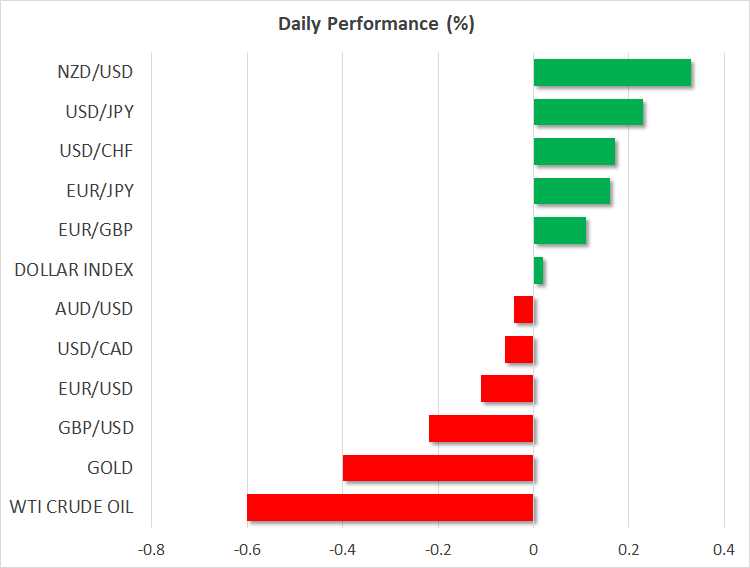
- The US dollar is eyeing a strong close to the week; can retail sales ruin its chances?
- Other majors flounder, except for kiwi, as strong CPI reinforces RBNZ rate hike bets
- Stocks struggle despite ultra-dovish Powell amid fears growth momentum has peaked
 Safe havens thrive as outlook gets cloudier
It’s been an action-packed and what should have been a positive week for risk assets, with the earnings season getting off to a good start, the Fed’s Powell maintaining his pledge for ultra-accommodative policy and Congress edging closer on both the partisan and bipartisan components of Biden’s infrastructure plan. However, the prevalent theme during all this has been the ever-escalating spread of the Delta variant that’s clouding the outlook for global growth.
Worries that the economic recovery will be stymied by the Delta wave sweeping the world have been gradually building up in recent weeks. Initially, the fears were confined mainly to Asia-Pacific countries that have a low vaccination rate. But now that the Delta strain has become rampant in places like the United Kingdom, which has one of the highest vaccine uptakes in the world, investors have started to panic a bit as hopes that lockdowns had become a thing of the past are starting to look premature.
Investors will be watching in earnest to see whether the British government’s gamble of removing all virus restrictions and relying on vaccines to keep hospitalizations and deaths low will pay off. But the problem for the risk rally is that there are signs the global recovery lost steam even before the Delta variant became such a concern. Hence, the steady rush towards safe havens over the past month that has boosted the likes of the US dollar, yen and Swiss franc, as well gold and government bonds.
Dollar reign continues as yields rebound
The US dollar has survived Fed Chair Powell’s dovish rhetoric in his testimonies this week as, apart from the risk-off trades, there’s a growing sense that policymakers won’t be able to keep the stimulus taps open for too long. Powell is only doing his job in keeping market nerves calm but it’s hard to ignore all the evidence that points to the current burst of inflation being too great and too widespread for it to be transitory.
Even the Fed’s traditionally more dovish FOMC members are nervous. St. Louis Fed President James Bullard yesterday reaffirmed his hawkish shift, saying “I think we are in a situation where we can taper”. Unless Powell changes his tune on inflation soon, there’s a danger markets will interpret this as a sign that he is more worried about the recovery than he is letting on, potentially sparking even more risk aversion.
However, the market mood is looking somewhat more upbeat on Friday, with the yen, franc and gold slipping, and the 10-year Treasury yield rebounding four basis points from yesterday’s one-week low of 1.2920%.
The dollar was flat against a basket of currencies, on track for a weekly gain of 0.5%. The euro struggled to capitalize on the improved sentiment but the pound advanced towards $1.3860 after surprisingly hawkish comments from the BoE’s Michael Saunders, who on Thursday became the second MPC member this week to call for an early end to QE.
Kiwi surges again, US retail sales coming up
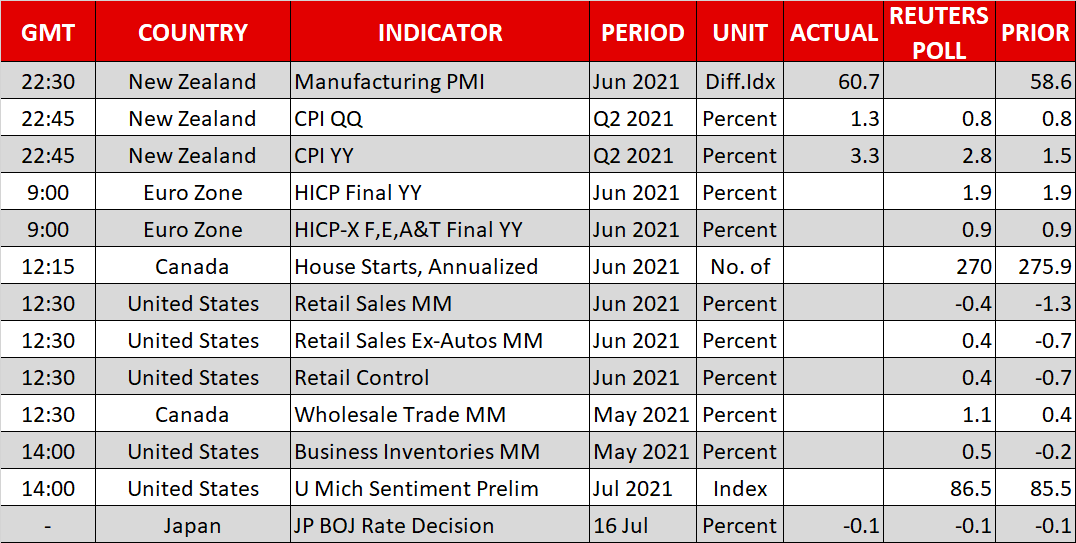
However, the big winner on Friday was the New Zealand dollar, which got a lift from stronger-than-expected CPI numbers. New Zealand’s inflation rate jumped to 3.3% in the second quarter, above the RBNZ’s target band of 1-3%. Earlier in the week, the RBNZ shocked markets by announcing it will halt its bond purchases later this month, prompting investors to price in a rate hike in August. The inflation data has only reinforced those expectations and the kiwi could extend its gains in the coming weeks, or at the very least, be immune to selling episodes.
There was little reaction in the yen after the Bank of Japan kept policy on hold as expected. Later in the day, US retail sales will take centre stage, which could weigh on the greenback if they decline again in June. But after yesterday’s relatively robust data from the jobless claims and manufacturing surveys, a positive surprise could further boost the US currency.
US futures turn positive after tech scare
In equity markets, European shares and US stock futures were in the green despite tech stocks coming under pressure. The Nasdaq Composite slipped 0.7% on Thursday and the S&P 500 fell 0.3%, with financial stocks being the few winners after this week’s stellar earnings results from the big banks.
Asian tech stocks were also feeling the heat today after shares of Taiwan Semiconductor Manufacturing Co tumbled 4%. Weaker-than-expected profit margins by the company has added to concerns about whether the incredible growth in earnings is sustainable going forward and that is something that Wall Street might have to contend with as well this season.
GBPJPY Dips Back Below Ichimoku Cloud, Bearish Tone Persists
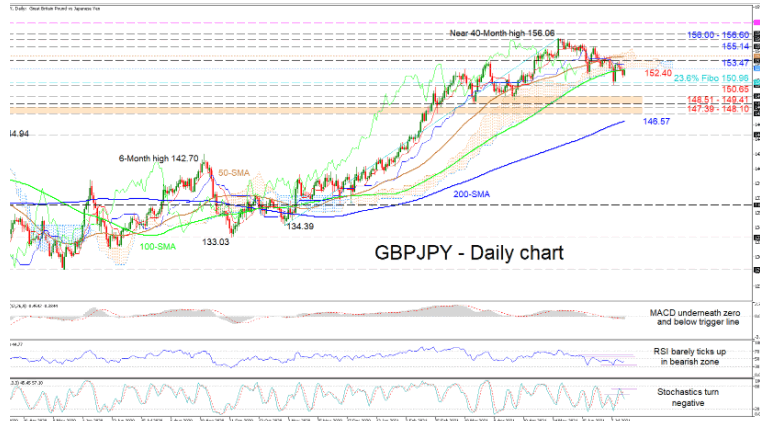
GBPJPY has been deteriorating for around a month-and-a-half now, logging lower highs and lows from its near 40-month peak of 156.06. The bullish charge in the 50- and 100-day simple moving averages (SMAs) is becoming slightly sluggish, with their slopes suggesting positive drive has abated somewhat. Even though the Ichimoku lines are demonstrating a pause in negative momentum, they are retaining a slight bearish preference.
The short-term oscillators are transmitting conflicting signals in directional momentum. The MACD, not too far under the zero level, is below its red trigger line, while the RSI is marginally improving in bearish territory. In spite of buyers pushing back, the negative bearing of the stochastic oscillator is implying negative price action may resume sooner rather than later.
To the upside, buyers face an immediate zone of resistance from the red-Tenkan-sen line merged with the 100-day SMA at 152.40 until the 153.47 nearby high. Conquering this obstacle and overstepping the cloud, the 50-day SMA at 154.00 could impede the price from jumping to test the June 23 high of 155.14. Should buyers’ confidence grow, they could then try to pilot past the resistance ceiling shaped between the 156.00 hurdle and the February 2018 rally peak of 156.60, an area that also contains the 156.06 multi-year high of a near seven-month uptrend.
If sellers resume control, initial support could come from the 150.96 and the 150.65 barriers respectively, the former being the 23.6% Fibonacci retracement of the up leg from 134.39 until 156.06. However, a sharp dive below these upside defences could drive the pair towards the vital support base of 148.51-149.41. Should a deeper price retraction mature below this limiting region, the critical border of 147.39-148.10, which also contains the December 2019 high of 147.95, may then be challenged.
In conclusion, GBPJPY is demonstrating a bearish demeanour in the near-term and a break below the 150.65 trough could boost negative price action. Yet, a shift above the cloud is needed to realign the pair with the broader bullish picture.
Oil Is Bearish As 280 Pips Have Been Secured
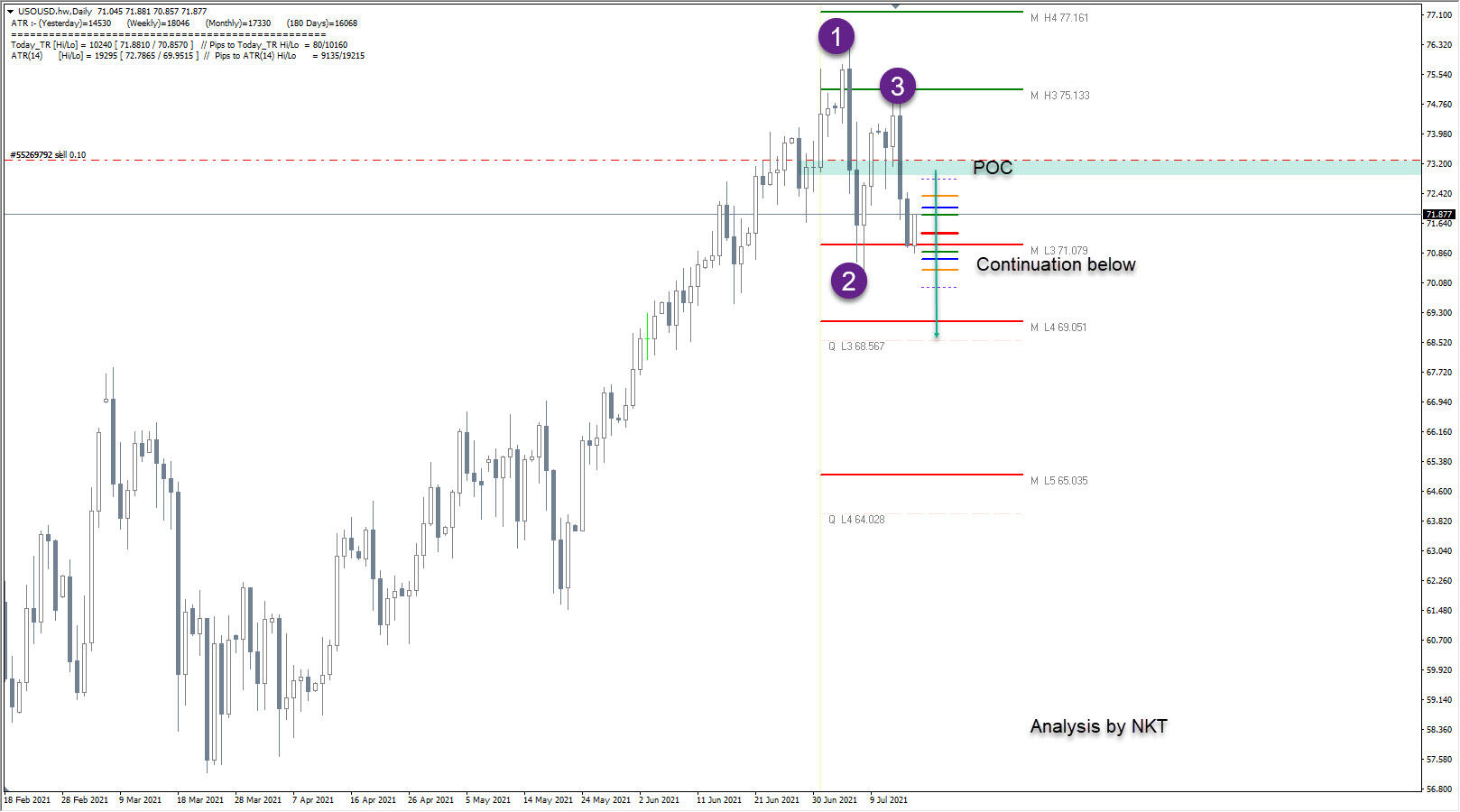
Oil has formed a 1-2-3 pattern and we might see further move down. I have secured 280 pips from my entry.
Historical selling has been aligned with the now moment. 71.00 is major support now. If the price makes a close below on a daily timeframe we should see a continuation down towards 69.05 and 68.56. As long as the current high is a resistance we should see a bearish correction down. Watch for price action.
Focus On US Data, Corporate Earnings
Notes/Observations
- BOJ became the latest central bank to join the battle against climate change.
Asia
- New Zealand Q2 CPI data saw the annual pace above target range for 1st time in 19 quarters (YoY: 3.3% v 2.7%e).
- BOJ left Interest Rate on Excess Reserves (IOER) unchanged at -0.10% and maintained Yield Curve Control (YCC) around 0.00% (both as expected).
- BOJ Quarterly Outlook for Economic Activity and Prices mixed.
- China said to plan to exempt IPOs in Hong Kong from Cybersecurity reviews.
Coronavirus
- Los Angeles to return to mandatory mask wearing indoors, even for people that have been vaccinated..
Europe
- Certain UK House of Lord Members: BOE Asset purchases stoking inflation, Program has only benefited rich and has done little for GDP growth.
- UK PM Johnson said to be backing new tax proposals in order to pay for reforms to the social care system which may include a cap on people paying towards their own care of £50K. Plan could be agreed within weeks.
Americas
- Treasury Sec Yellen stated that she believed that country to have several more months of rapid inflation; Recent drop in yields showed inflation remained under control.
- Biden Administration to meet with Unions and Builders on Housing shortages and sought to ease house price pressures.
- Biden administration to impose sanctions on seven officials from China’s Hong Kong liaison office as well as a warning to international businesses operating in Hong Kong about deteriorating condition.
Speakers/Fixed income/FX/Commodities/Erratum
Equities
- Indices [Stoxx600 +0.21% at 457.18, FTSE +0.48% at 7,045.55, DAX +0.35% at 15,686.80, CAC-40 -0.01% at 6,492.53, IBEX-35 +0.57% at 8,574.00, FTSE MIB +0.39% at 24,973.50, SMI +0.37% at 12,021.65, S&P 500 Futures +0.08%].
- Market Focal Points/Key Themes: European indices open mixed but quickly moved to trade modestly in the green; sectors leading to the upside include consumer discretionary and real estate; while technology and energy sectors were underperforming; Ericsson reaches deal on 5G with Verizon; Acciona and Ferrovial JV awarded major contract in Australia; GP Strategies to be acquired by Learning Technologies; focus on extraordinary APEC meeting over the weekend; earnings expected in the upcoming US session include Autoliv, Atlas Copco and State Street.
Equities
- Consumer discretionary: Burberry [BRBY.UK] -4% (trading update), Richemont [CFR.CH] -1% (trading update), Puma [PUM.DE] -2% (prelim results).
- Industrials: Jenoptik [JED.DE] +10% (raises outlook).
- Telecom: Ericsson [ERICB.SE] -8% (earnings).
Speakers
- BOJ Gov Kuroda post rate decision press conference reiterated its overall assessment that domestic economy was picking up as a trend. He also reiterated his stance that would not hesitate to add to easing if necessary. uncertainty of economic outlook was high due to pandemic and that consumption was stagnating due to weak service-sector spending. Capex was recovering but showed some signs of weakness. Inflation remained around 0% as energy prices gain; risks remained skewed to the downside.
- India Finance Ministry chief economic advisor Subramanian stated that GDP growth could test 7.0% in the next fiscal year due to impact of reforms and accelerate beyond that.
- China PBOC released a white paper on digital yuan (digital CNY) development. Top level design in digital yuan was basically completed and transactions totaled CNY34.5B in trials.
- China Foreign Ministry spokesperson stated that it would make a firm response to any US action on Hong Kong.
- China govt said to still be planning to host senior US diplomat Wendy Sherman (#2 at the State Dept). Move could indicate that a potential Xi-Biden summit was moving closer.
Currencies/ Fixed income
- Quiet end to the week in FX.
- EUR/USD steady at 1.1815 at mid-session and little moved after EU final CPI reading for Jun saw the inflation back under ECB target. Focus turning to next week’s ECB policy decision.
- GBP was off its worst level as a report circulated that certain UK House of Lord Members attacks quantitative easing. Noting that the purchases were stoking inflation and done little for GDP growth. Analysts noted that August seemed the only possible month for the BOE to announce another slowdown in the pace of gilt purchases and a majority vote backing this seemed unlikely. BOE had used up to £815B of the £875B gilt purchase target and would need to reduce its weekly purchase pace from £3.4B/week for the program to last until end-2021.
- USD/JPY holding above the 110 level after BOJ kept its policy steady.
Economic data
- (EU) EU27 Jun New Car Registrations: 10.4% v 53.4% prior (4th straight rise).
- (AT) Austria Jun Final CPI M/M: 0.5% v 0.4% prelim, Y/Y: 2.8% v 2.7% prelim.
- (CN) Weekly Shanghai copper inventories (SHFE): 113.6K v 129.5K tons prior.
- (ES) Spain May Trade Balance: +€0.1B v -€1.3B prior.
- (IT) Italy May Total Trade Balance: €5.6B v €5.9B prior; Trade Balance EU: €0.9B v €1.0B prior.
- (TR) Turkey Jun Central Gov't Budget Balance (TRY): -25.0B v -13.4B prior.
- (RU) Russia Narrow Money Supply w/e July 9th (RUB): 14.15 v 14.05T prior.
- (EU) Euro Zone Jun Final CPI Y/Y: 1.9% v 1.9%e; CPI Core Y/Y: 0.9% v 0.9%e; CPI M/M: 0.3% v 0.3%e.
- (EU) Euro Zone May Trade Balance (seasonally adj): €B v €8.0Be; Trade Balance NSA (unadj): €B v €10.9B prior.
- (CY) Cyprus Jun CPI Harmonized M/M: 1.0% v 0.4% prior; Y/Y: 2.2% v 1.5% prior.
Fixed income issuance
- None seen
Looking ahead
- 05:25 (EU) Daily ECB Liquidity Stats.
- 05:30 (IN) India to sell combined INR320B in 2026, 2033, 2035 and 2050bonds.
- 05:30 (ZA) South Africa to sell combined ZAR1.2B in I/L 2029, 2033 and 2046Bonds.
- 06:00 (PT) Portugal Jun PPI M/M: No est v 1.6% prior; Y/Y: No est v 7.8% prior.
- 06:00 (UK) DMO to sell £3.0B in 1-month, 3-month and 6-month bills (£0.5B, £1.0B and £1.5B respectively).
- 06:45 (US) Daily Libor Fixing.
- 07:00 (BR) Brazil July FGV Inflation IGP-10 M/M: 0.2%e v 2.3% prior.
- 07:30 (IN) India Weekly Forex Reserve w/e July 9th: No est v $610.0B prior.
- 08:00 (PL) Poland Jun CPI Core M/M: 0.3%e v 0.3% prior; Y/Y: 3.6%e v 4.0% prior.
- 08:00 (UK) Daily Baltic Dry Bulk Index.
- 08:00 (IN) India announces upcoming bill issuance (held on Wed).
- 08:15 (CA) Canada Jun Annualized Housing Starts: 270.0Ke v 275.9K prior.
- 08:30 (US) Jun Advance Retail Sales M/M: -0.3%e v -1.3% prior; Retail Sales (ex-auto) M/M: +0.4%e v -0.7% prior; Retail Sales (ex-auto/gas): +0.5%e v -0.8% prior; Retail Sales (control group): +0.4%e v -0.7% prior.
- 08:30 (CA) Canada May Int'l Securities Transactions (CAD): No est v 10.0B prior.
- 08:30 (CA) Canada May Wholesale Trade Sales M/M: 1.1%e v 0.4% prior.
- 09:00 (IT) Bank of Italy (BOI) Quarterly Economic Bulletin.
- 10:00 (US) May Business Inventories: +0.5%e v -0.2% prior.
- 10:00 (US) July Preliminary University of Michigan Confidence: 86.5e v 85.5 prior.
- 11:00 (US) Fed’s Evans on economy.
- 11:00 (EU) Potential sovereign ratings after European close (Moody’s on Finland sovereign rating; S&P on Russia sovereign rating; Fitch on Greece sovereign rating).
- 12:00 (RU) Russia Jun PPI M/M: 2.0%e v 2.3% prior; Y/Y: 29.3%e v 35.3% prior.
- 13:00 (US) Weekly Baker Hughes Rig Count.
- 16:00 (US) May Total Net TIC Flows: No est v $101.2B prior; Net Long-term TIC Flows: No ext v $100.7B prior.
Will The Gold Rise? Silver Knows
Since late June, gold has been rising almost every trading session, reaching $1822 per troy ounce on Friday morning. The easy part of the rise is left behind, and now the bulls have to prove that they are serious.
Over the last three weeks, the systematic rise has only recouped half of the losses from last month's drop. Despite the sustained presence, buyers are acting much more cautiously or simply have less strength.
The latest bounce took the prices yesterday to the area between the 50- and 200-day moving averages. A decisive move higher can initiate a rally in the following days, as the crossing of these lines often triggers a mechanical market reaction in the direction of the break-up.
In the last 24 hours, gold lost its growth impulse, wandering around its 200 MA, a precursor for a prolonged consolidation or a reversal downwards.
Mostly this month rally has been due to the support of a long-term uptrend. Fundamentally, the trend was shaped by the soft monetary policy of the major central banks, led by the Fed.
Earlier this week, Powell confirmed the continuation of the pigeon policy. We got the same signals from the ECB and from the Bank of Japan today.
Even more exciting and contradictory is the picture of silver. It missed the rally of gold and moved in a very narrow $25.6-$26.4 range for the last four weeks, and it found firm support at the 200 MA.
We will soon get a confirmation that the QE and inflation are no longer the drivers for gold and silver. It will happen in case of the break-down of the crucial supports at $1750 and $25.5, which were the previous local lows for these two metals. The key support for silver is one step away from the current price so that we might get a meaningful signal for the direction of the precious metals here.
Whichever way the price goes, the dynamics promises to be bold and indicative, as both sides have built up strength over the weeks of consolidation, and speculators have pulled stop orders close to the market quotes.
Optimistic Quarterly Corporate Results Are Not Enough To Keep The Growth Of The Main Indicses
Jobless claims in the United States decreased by 26,000 to 360,000. It’s the lowest number in the last 16 months. The number of repeated claims also fell by 126,000 to 3.2 million. The labor market is recovering, but the US stock market closed without a single trend yesterday. The oil and gas, technology, and consumer services sectors showed negative index dynamics. The financial sector and utilities sectors showed growth dynamics. The S&P 500 decreased by 0.33%, the Dow Jones increased by 0.15% and the Nasdaq fell by 0.7%. At the same time, the positive quarterly results of the banks, which surpassed all expectations, do not contribute to the growth of indices, as investors are concerned about the rapid spread of the Delta strain and the possible beginning of a new wave of a global pandemic.
The European stock market closed in the red zone yesterday. Markets were put under pressure by concerns about the faster-than-expected tightening of monetary policies of the central banks and the rapid spread of the Delta strain of the coronavirus. Europe is reporting on inflation today. Economists are confident that the CPI will not exceed the target of 2% (the previous figure was 1.9%). A value above 2% may trigger a sell-off in the stock market.
Oil prices are falling as news that the UAE has reached a compromise on increasing oil production quotas with OPEC+ countries was confirmed. According to the new data, UAE has agreed on a new production benchmark of 3.65 Mbps (currently 3.17 Mbps).
The situation with gold remains unchanged. Prices of precious metals are highly dependent on two factors: the dollar index and, especially, the US government bond yields. The lower the government bond yields are, the higher the gold prices will be. It should also be noted that gold imports into India increased by 4.4 times in the first half of the year compared to the same period in 2020. India is one of the largest consumers of gold in the world, with almost no production of its own.
The Bank of Japan kept key monetary policy parameters unchanged, but slightly raised its inflation forecast and lowered its GDP growth forecast for next year. Inflation in Japan is expected to be 0.6% in the current fiscal year and strengthen to 0.9% and 1% in the next two years, respectively. The regulator also said it will provide zero-percent loans to boost investment in green initiatives.
Main market quotes:
- S&P 500 (F) 4,360.03 -14.27 (-0.33%)
- Dow Jones 34,987.02 +53.79 (+0.15%)
- DAX 15,629.66 -159.32 (-1.01%)
- FTSE 100 7,012.02 -79.17 (-1.12%)
- USD Index 92.58 +0.17 (+0.19%)
Important events:
- New Zealand Consumer Price Index (m/m) at 01:45 (GMT+3);
- BoJ Monetary Policy Statement at 06:00 (GMT+3);
- BoJ Outlook Report at 06:00 (GMT+3);
- BoJ Press Conference at 06:00 (GMT+3);
- Eurozone Consumer Price Index (m/m) at 12:00 (GMT+3);
- US Retail Sales (m/m) at 15:30 (GMT+3);
- US UoM Consumer Sentiment (m/m) at 17:00 (GMT+3).
Oil Prices Ease, Gold Remains Steady
OPEC+ nerves weigh on oil
Oil prices continued to fade overnight, as markets that were already heavily long weighed up the implications of the apparent higher baseline production levels for the UAE. More importantly to markets, though, is whether it will lead to a flurry of demands from other members for similar concessions, leading to the spectre of much higher volumes of oil hitting global markets as growth start to slow in parts of the world. OPEC’s monthly report overnight lifted its consumption forecast to above pandemic levels for 2022, but oil prices refused to halt their downward move.
Brent crude fell 1.70% to USD 73.25 a barrel, which WTI retreated by 2.0% to USD 71.45 a barrel. Both are unchanged in Asia, with regional markets content to remain on the sidelines as the week closes out. The threat of weaker OPEC+ cohesion and higher than anticipated production will cap oil price gains for now. Brent crude has support at USD 72.00 a barrel, and failure could see a speculative capitulation trade occur, although I expect its duration to be short, if brutal. WTI’s line in the sand remains at USD 70.00 a barrel, and I expect some similarly ugly stop-loss selling to occur if it fails.
Oil markets will remain on edge until OPEC+ baseline clarity emerges, and the virus situation in Asia shows material signs of stabilising.
Gold holds above the 200-day moving average
Gold finished modestly higher overnight, with dips well-supported intra-day despite a generally stronger US dollar. A further fall in US bond yields helped its cause, and gold continues to show positive technical signals that more gains lie ahead.
Although gold finished the overnight session only 0.12% higher at USD1829.50 an ounce, it recorded its second consecutive daily close above the 200-day moving average (DMA), at USD1827.00 an ounce. In Asia, gold has eased to the USD1827.00 support in generally moribund trading, with regional investors eyes elsewhere.
Gold has support at USD1820.00 and USD1800.00 an ounce, with the bullish outlook intact as long as the 100-DMA at USD1792.00 holds on a closing basis. Gold’s next upside targets are USD1845.00 and USD1860.00 an ounce, although I expect this to be a slow grind higher like previous sessions this week.
EURUSD Close To Breakout
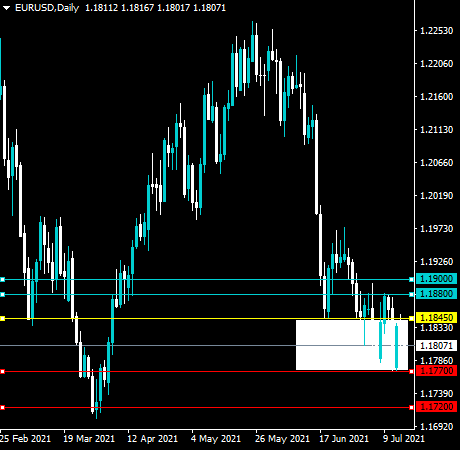
The euro currency remains depressed against the US dollar as the pair struggles to stage a meaningful rebound from the 1.1800 support level. At present levels the EURUSD pair is currently oncourse for its lowest weekly price close since late-March this year. The next 50 points directional move should take place once the EURUSD pair breaks the 1.1770 to 1.1845 price range.
EURUSD pair is only bearish while trading below the 1.1845 level, key support is found at the 1.1770 and 1.1720 levels.
The EURUSD pair is only bullish while trading above the 1.1845 level, key resistance is found at the 1.1870 and 1.1900 levels.
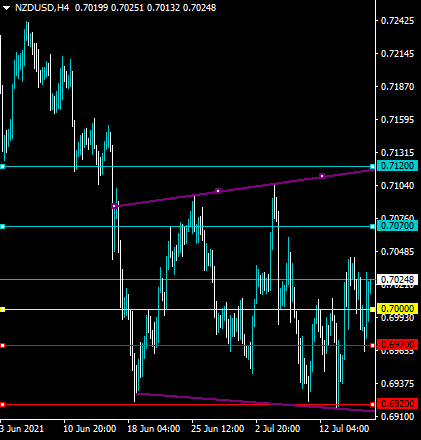
NZDUSD Bullish Above 0.7000
The New Zealand dollar is on the rise against the US dollar after the New Zealand inflation report came in much stronger than the market had been expecting. The four-hour time frame shows that the NZDUSD pair is trading inside a large broadening expanding wedge pattern. Sustained gains above the 0.7000 level could encourage bulls to test towards the top of the wedge pattern.
The NZDUSD pair is only bullish while trading above the 0.7000 level, key resistance is found at the 0.7070 and 0.7120 levels.
The NZDUSD pair is only bearish while trading below the 0.7000 level, key support is found at the 0.6970 and 0.6920 levels.