Sample Category Title
Week Ahead – ECB on Deck as Stimulus Debate Heats Up
Financial markets want to know if the Fed is committed to a sustained inflation overshoot. The bond market flattener trade suggests many market participants think we have seen the peak in yields. Inflationary pressures are showing no signs of easing just yet and the market will soon look to test the Fed’s patience. The dollar has been stuck in a tight trading range since the middle of June but that could soon change if the rest of the world shifts to a tightening mode more quickly than the Fed.
The upcoming week is filled with many catalysts that stem from a deadline to finalize a bipartisan infrastructure package, persistent global delta variant concerns, widespread inflationary pressures, central bank rate decisions, and a busy week of earnings results. The main event will be the ECB rate decision and press conference. This will be the first meeting since their strategy review that aimed for a slightly higher inflation target. It appears that a divide is growing in the ECB over stimulus guidance, a sign that the hawks will be strongly push for tightening in the fall.
All eyes will be on England after UK PM Johnson has decided to move forward in lifting most pandemic restrictions on July 19th. The UK has had one of the best COVID-19 vaccination campaigns in the world, with more than 46 million people having received at least one dose of coronavirus vaccine. BOE's Saunders noted that withdrawing stimulus measures may be appropriate soon. Deputy Governor Ramsden stated "envisage those conditions for considering tightening being met somewhat sooner than I had previously thought." Currency traders will pay close attention to BOE's Haskel on Monday to see if the bank is quickly shifting to taper mode.
Country
US
Wall Street had a very choppy trading week after a mixed start to earnings season, a dovish semi-annual monetary policy testimony from Fed Chair Powell, and fading confidence from the US consumer. When the dust settled the dollar was stronger, Treasury yields were lower, but confidence in risky assets started to wane. The second week of earnings will provide a broader look into several sectors of the economy, which might support the argument that inflation is looking more persistent.
Wall Street will closely follow every development with the bipartisan infrastructure proposal on Capitol Hill. Senate Majority Leader Schumer will try to deliver on his ambitious timeline to get this bill passed. A key procedural step should occur on Monday and that could set up an initial vote on Wednesday for the $579 billion infrastructure deal.
With the Fed entering the blackout period ahead of the July 29th FOMC policy decision, it is a busy week of economic data, but nothing like the past one. On Monday, the NAHB housing market index is expected to tick higher to 82, still well off the highs seen at the end of last year. On Tuesday, both Building Permits and Housing Starts should post modest gains, a sign the housing market isn’t ready to cool. Thursday is all about weekly initial jobless claims and if the rate of decline can speed up. Friday is all about the flash PMI readings which should show steady activity in both the manufacturing and service sectors.
EU
The ECB holds its monetary policy meeting on Thursday, and the central bank is widely expected to implement significant changes in monetary policy. The July meeting was expected to be a non-event, but the release of the ECB’s strategy review last week has the markets buzzing since the Thursday meeting should provide more clarity on how the bank plans to implement this new strategy.
At the presentation of the strategy review, ECB President Christine Lagarde said that there would be a review of forward guidance to align it to the strategy review. This means that we could see some important changes in forward guidance at the meeting.
The strategy review has changed the inflation target from “below, but close to 2%”, to “2%”, and also stated that the bank is willing to accept “a transitory period in which inflation is moderately above target.” The ECB is likely to incorporate these changes in its forward guidance.
The ECB is unlikely to increase the size of bond purchases through the Pandemic Emergency Purchase Programme at this meeting but may indicate that these purchases will be increased in September.
On Friday, Germany releases July PMI reports. Manufacturing PMI is forecast to come in at 65.0, while the estimate for Services PMI stands at 60.0 points. Both of these estimates are indicative of strong growth.
UK
On Monday, the government is scheduled to lift all Covid restrictions, with mask-wearing and social distancing optional but not mandatory. However, there is opposition from health officials who fear the move could lead to a surge in Covid infections. As well, the mayor of London has said that passengers on public transport will still be required to wear masks.
BoE member Jonathan Haskel will deliver a speech at the University of Liverpool School of Management, on the topic “Will the pandemic scar the economy?”
On Tuesday, U.K. Business Secretary Kwasi Kwarteng testifies before a parliamentary committee on how to protect the nation’s steel industry following the massive collapse of Greensill Capital.
The week finishes on a busy note. The consensus for UK Retail Sales for June is 0.4% MoM and 9.8% YoY. The July PMIs are projected to remain well into expansionary territory, with a forecast of 62.0 for Manufacturing PMI and 62.5 for Services PMI.
Emerging Markets
Russia
On Friday, the Bank of Russia holds a policy meeting. The central bank may tighten policy and raise interest rates by 75 basis points or more, with inflation running well above the bank’s target of 4.0%. In June, the bank raised rates from 5.0% to 5.5%
South Africa
South Africa releases June CPI on Wednesday. The consensus stands at 4.8% YoY, down from 5.2% in May.
On Thursday, the South African Reserve Bank is expected to keep interest rates unchanged at 3.50%.
Asia Pacific
China
The afterglow from last Friday’s RRR cut has quickly faded. China data this past week appeared to show the economic recovery slowing. Washington DC is ramping up the anti-HK and Xinjiang and adding more China tech companies to the entity list. Additionally, China announced tighter supervision of property developer debt levels and continues broadening its China-tech clampdown.
Unsurprisingly, China equities are struggling to maintain gains in this environment with Covid-19 swirling around the rest of Asia adding to the gloom. The PBOC has moved to a weaker Yuan bias and slighter softer policy and that means that China’s one and three-year Loan Prime Rates will remain unchanged this week.
With no other data of note this week, China markets will be at the mercy of US-Sino rhetoric and China’s internal clampdowns on technology, property etc.
India
India’s COVID-19 cases were appearing to be on the right track but a recent increase in cases has many worried that a third wave could be coming. Until COVID cases start trending lower, the Indian rupee still remains vulnerable to the dollar. A pullback with oil prices has provided some modest support for the rupee.
No significant data this week, with India and ASEAN currencies to be dominated by their internal trajectories of the delta-variant Covid-19. The Rupee remains vulnerable to more US Dollar strength.
Australia & New Zealand
Australian stock markets are trading sideways despite another impressive set of jobs data this past week. The focus remains on the NSW Covid-19 outbreak and deepening restrictions in Sydney. Melbourne also entered a snap lockdown today as cases spread to Victoria and also South Australia. Markets remain on tenterhooks and extended closures in Sydney and Melbourne will surely see AUstralia recovery projections adjusted lower.
The RBNZ announced an end to bond buying this week, a surprise to markets. NZ inflation blew higher this week as well resulting in every NZ Bank pricing multiple rate hikes this year. That has lifted both the NZD/USD, and to a lesser extent AUD/USD. The New Zealand Dollar is set to perform strongly against both the US and Australian Dollars this week.
THE RBA Minutes will be ignored by local markets which will remain fixated on Covid-19 domestically, and this will drive market movements downunder this week. Aust. Retail Sales and PMI will be of only passing interest.
Japan
Risk appetite for Japanese assets took a big hit after news that fans will be banned at the Summer Olympics. Japan is clearly still in the middle of its fight against COVID and the decision to declare a state of emergency through August 22nd will dramatically force investors to downgrade their growth forecasts. The Bank of Japan downgraded GDP growth only slightly at its policy meeting today but Japan equities have given back all of their week’s gains as fears over a Covid slowdown intensify. Like the rest of Asia, Japan markets will be vulnerable to Covid-19 caseloads in the week ahead. USD/JPY remains a purely US/Japan rate differential play at the moment.
Japan has a short week ahead with Thursday and Friday both national holidays. WIth Covid-19 and the Olympics foremost, and with the BoJ policy meeting out of the way, Tuesday’s Inflation and Balance of Trade will not be market moving releases.
Markets
Oil
Covid-19 concerns are not easing up at the moment and that has been sending oil prices lower. Even countries with successful vaccine campaigns are struggling with the Delta variant and that is proving disruptive to the short-term crude demand outlook. The drama between the UAE and Saudi Arabia appears to be over and if OPEC+ can ratify that this week, more supply will be welcomed.
A big driver for oil prices will be Iranian output and that question won’t get answered until well after Iranian hardliner Raisi will be inaugurated president in early August.
If risk aversion becomes the dominant theme and the dollar rallies on safe-haven flows, WTI crude could start to see significant momentum selling.
Gold
Gold prices were having a tremendous July until the rally ran into a brick wall of technical resistance at around the $1,835 area. Gold has been supported by the belief that many on Wall Street believe we saw the peak in rates and that has been good news for gold. It seems we are seeing a long-term secular declining trend in rates as the US will have a high debt burden problem going forward and can’t afford to raise rates. The longer-end of the Treasury curve will struggle to see the steepener trade return and that should be good news longer-term for gold.
The bullish move appears to have been exhausted post Fed Chair Powell’s testimony, which means prices could consolidate until the end of the month. The Fed’s blackout period is beginning, so gold should remain confined by the $1800 and $1850 range.
Bitcoin
Bitcoin continues to consolidate, trading consistently in the lower boundaries of the $30,000.00 and $40,000.00 trading range. Bitcoin weakness from further China crackdown news or negative endorsements has yet to seriously threaten the $30,000 level as many traders still remain committed to their longer-term bets.
The upcoming week includes a key event on Wednesday, called “The B word”, which attempts to show how institutions can embrace Bitcoin. Every crypto trader will definitely listen closely to hear any updates over Bitcoin mining clean energy initiatives. Tesla CEO Elon Musk, Square Co-Founder Jack Dorsey, and ARK Invest CEO Cathy Wood will all speak.
Key Economic Events
Monday, July 19
- PM Johnson lifts Covid restrictions in England
- BOE policy maker Haskel speaks at the University of Liverpool School of Management on “Will the pandemic scar the economy?”
Economic Data/Events:
- UK Rightmove house prices
- Turkey consumer confidence
- Poland employment, average gross wages
Tuesday, July 20
- US Secretary of Transportation Buttigieg speaks at the Economic Club of Washington D.C.
- UK Business Secretary Kwarteng speaks to Parliament committee on how to protect the nation’s steel industry
Economic Data/Events:
- US housing starts, building permits
- Netflix Earnings
- Eurozone Current Account Balance
- Italy Current account balance
- Australia RBA meeting minutes
- China loan prime rates
- Japan CPI
- Switzerland trade, watch exports
- South Africa leading indicator
- Germany PPI
- Czech Republic PPI
- Poland PPI
Wednesday, July 21
- Tesla CEO Elon Musk and Square Co-Founder/CEO Jack Dorsey will discuss Bitcoin at an event called “The B Word.”
Economic Data/Events:
- Australia Retail Sales
- Poland Retail Sales
- Italy industrial Sales
- Japan trade
- UK public sector net borrowing
- South Africa CPI
- EIA Crude Oil Inventory Report
Thursday, July 22
Economic Data/Events:
- ECB Rate decision: To commit in its forward guidance to keeping interest rates unchanged until inflation is forecast to reach or slightly surpass 2%.
- US initial jobless claims, leading index, existing home sales
- South Africa central bank (SARB) Rate Decision: to keep rates on hold
- Eurozone Consumer confidence
- France manufacturing confidence
- Netherlands unemployment, consumer spending
- Russia Industrial production, gold and forex reserves
- Ireland PPI
Friday, July 23
- ECB to decide on whether to lift the bank dividend cap.
- Spain PM Sanchez speaks and to meet with technology CEOs.
- The Tokyo Summer Olympics begin.
Economic Data/Events:
- US July prelim Markit Manufacturing PMI: 62.1e v 62.1 prior
- Germany July prelim Manufacturing PMI: 65.0e v 65.1 prior
- Eurozone July prelim Manufacturing PMI: 62.1e v 63.4 prior
- UK July prelim Manufacturing PMI: 62.0e v 63.9 prior, GfK consumer confidence, retail sales
- Russia central bank (CBR) rate decision: Expected to raise interest rates 75 basis points to 6.25%
- Singapore CPI, private home prices
- Poland unemployment rate
- Spain mortgage lending
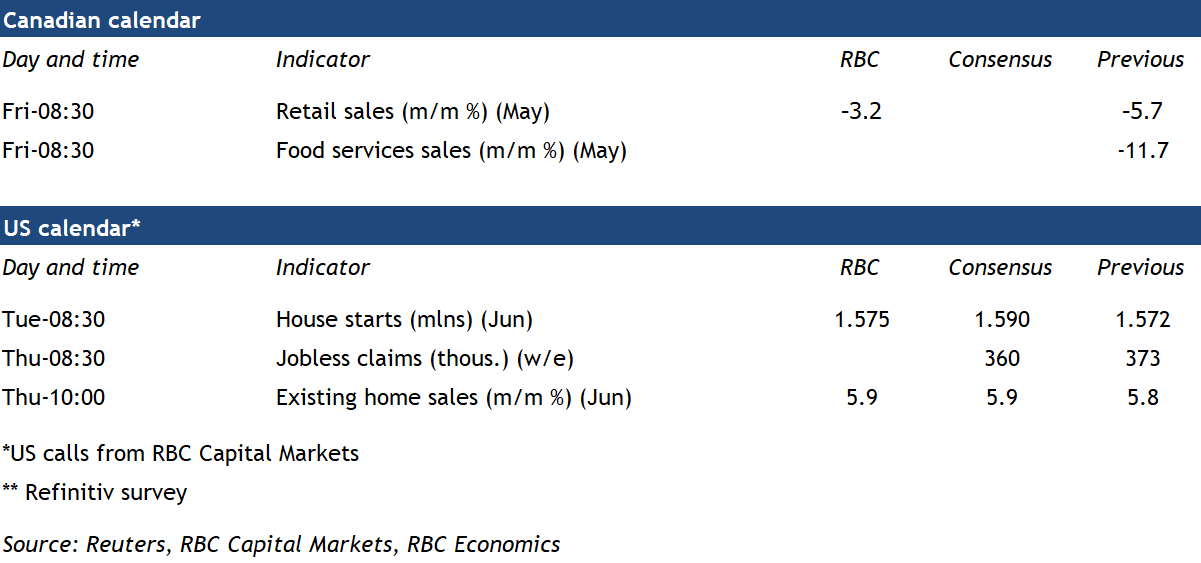
- Canada retail sales
- ECB survey of professional forecasters
Sovereign Rating Updates:
- Cyprus (Moody’s)
- EFSF(DBRS)
- ESM (DBRS)
Forward Guidance: Canadian Retail Sales Rebound; Services Take Over as Driver of Spending Growth
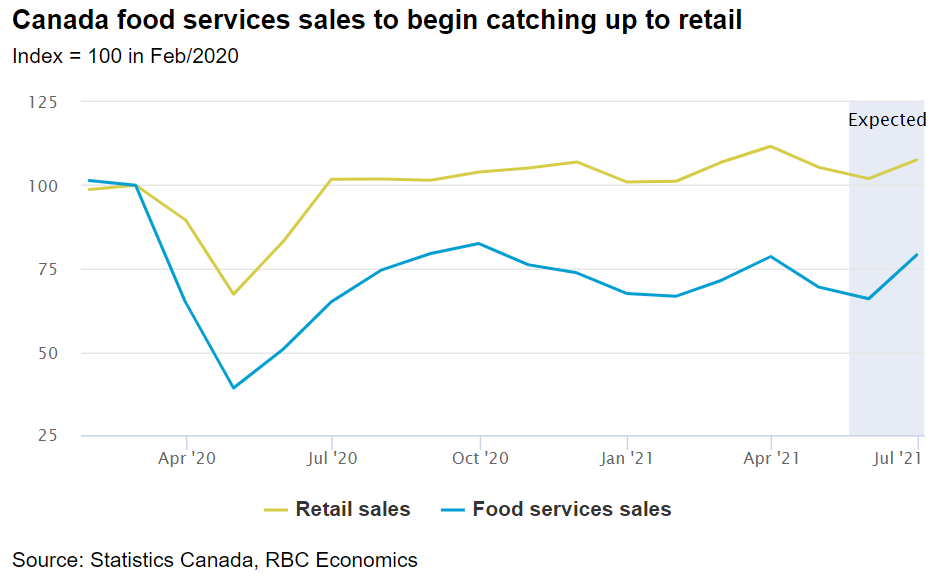
The big story next week will be the preliminary read on June retail sales after softer readings in April and May. Our own consumer tracker points to a sizable rebound in June sales, up 5-6% month over month after a decline in May similar to the 3.2% advance Statistics Canada estimate. The rebound in June came as provincial economies started to reopen - with particular gains for store types that were hit hard by lockdowns, such as clothing and footwear.
In fact, retail spending on goods outside of items like clothing has actually been quite strong. Even sizeable declines in April and May do not appear large enough to have pushed sales below pre-pandemic levels. In part, that’s because contactless shopping for goods has been made easier by expanded e-commerce infrastructure. Meantime, household purchasing power has been propped up by government support payments all while many services—which aren’t counted in the monthly retail sales data—have simply been unavailable for consumption. But as pandemic restrictions are gradually lifted, there are signs that a long-awaited rotation in household spending back to 'high-contact' services is finally beginning. Data on food services spending for May (to be released next week) will still be weak, but we expect a significant strengthening in June and the months to follow, as travel and hospitality services become the primary fuel for consumer spending growth.
Week ahead data watch:
- Vaccine distribution continues to progress, with close to 80% of the eligible (age 12+) population in Canada having received at least one dose and more than half now fully vaccinated with two doses. Provinces continue to ease restrictions, with Ontario entering Step 3 of the reopening process on July 16.
- US existing home sales are expected to hold close to May levels in June—still high by historical comparison but a decline from exceptionally strong levels earlier in the spring.
Next week’s flash PMI releases will offer an early guide to the health of the manufacturing sector in July in Europe and the US.
ECB Preview – Aligning Forward Guidance to Strategic Review Outcome
When ECB meets next week, the market attention turns to the implications and new communication on the back of the new strategic framework. We do not expect new policy signals coming from the change in language.
We expect an acknowledgement of the improving data which has come in according to expectations and the positive contribution from the roll-out of the vaccines, however risks will also be mentioned, notably the by-now dominating Delta variant with a reference to still uneven and fragile recovery.
With markets having to adjust to the new communication style and potentially also new language, there is risks of larger than usual market moves, although such moves should not be over-interpreted, especially in a less liquid seasonal summer market.
We expect new policy signals after summer on issues such as bond buying, but are open for TLTRO liquidity operations to be coined standard already at the upcoming meeting.
Week Ahead – ECB Meeting Poses Another Headache for Euro
The main event next week will be the ECB meeting, where the forward guidance will likely be changed to commit to negative rates for longer. That could cement the divergence with the Fed and other central banks that are moving towards higher rates. There’s also a volley of economic data while the earnings season gets rolling.
What inflation?
Another week, another scorching US inflation number that markets did not care much about. Most of the acceleration in inflation was concentrated in reopening-linked sectors, so both the Fed and bond markets continue to dismiss this phenomenon as something that will fade soon as supply chain disruptions ease.
The counter argument is that once the reopening momentum fades, other elements might step up to keep inflation hot. For instance, home prices have gone berserk this past year but rents haven’t followed suit, thanks to the eviction moratorium. The moratorium ends this month, so will rents fire up in August? Remember that ‘shelter’ holds one-third of the entire CPI weight.
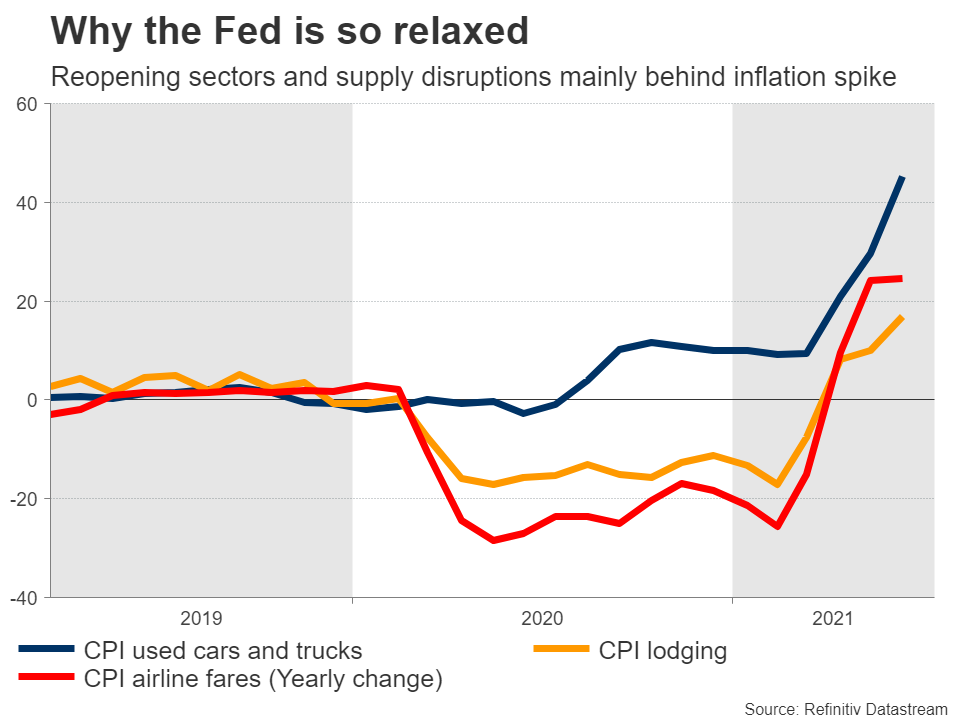
Meanwhile, many Republican-governed states have already cut the generous federal unemployment benefits, which will expire in September nationwide. This means that a flood of workers could return soon, making for some stellar jobs reports. Add on top the $4.1 trillion in new spending that Biden is trying to roll out, and it’s a recipe that can keep inflation going.
Long story short, America may not escape this inflationary environment as quickly as the Fed and markets currently think. With the economy approaching full employment and inflation riding high in the autumn, the Fed might have to slam on the brakes. This means less money printing and eventually higher interest rates, which is good news for the dollar.
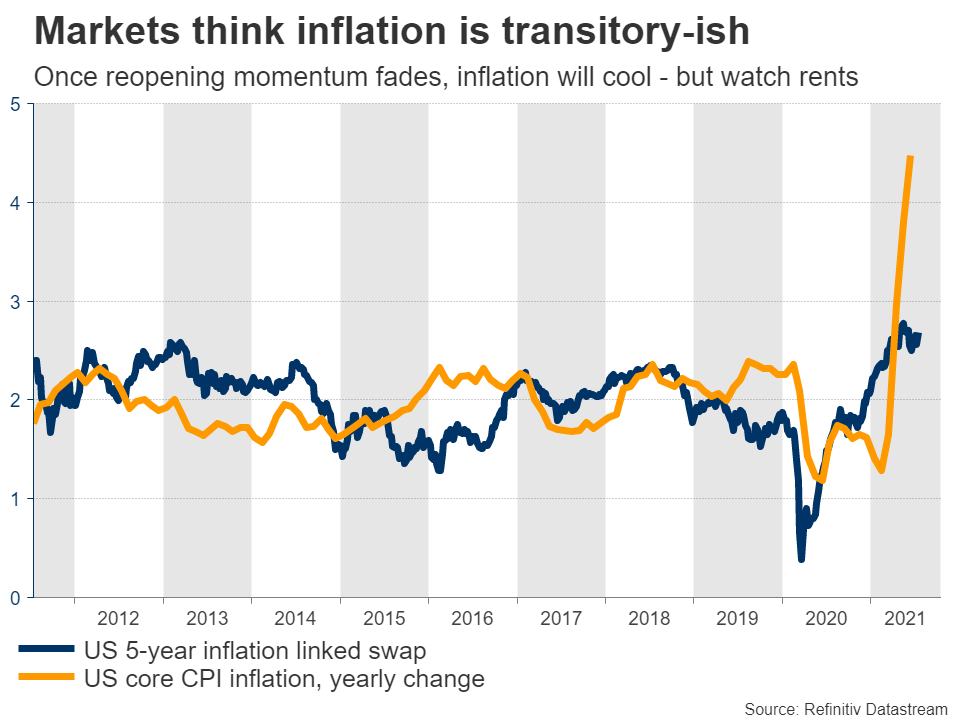
It’s a similar story in New Zealand, Canada, and to a lesser extent the United Kingdom. The RBNZ will end its asset purchases next week and markets are pricing in a 88% probability for a rate increase next month already. The kiwi hasn’t responded much so far as rising yields have been accompanied by rising inflation expectations, keeping real yields flat.
That could change soon. Inflation fears could ease as the RBNZ actually raises rates, allowing real yields to rise and boosting the kiwi, especially against the yen and the franc that will not be enjoying higher rates anytime soon.
ECB to lock itself into negative rates
All eyes will be on the European Central Bank on Thursday, after President Lagarde promised to deliver new policy signals at this meeting. The ECB recently raised its inflation target and policymakers want to demonstrate they are serious about hitting it. That’s done by signaling to the markets that rates won’t rise for a very long time.
Beyond committing to negative rates for longer, the ECB could also send a clear message that once its pandemic asset purchase program ends next year, it will likely be replaced by regular asset purchases. In short, more quantitative easing for longer.
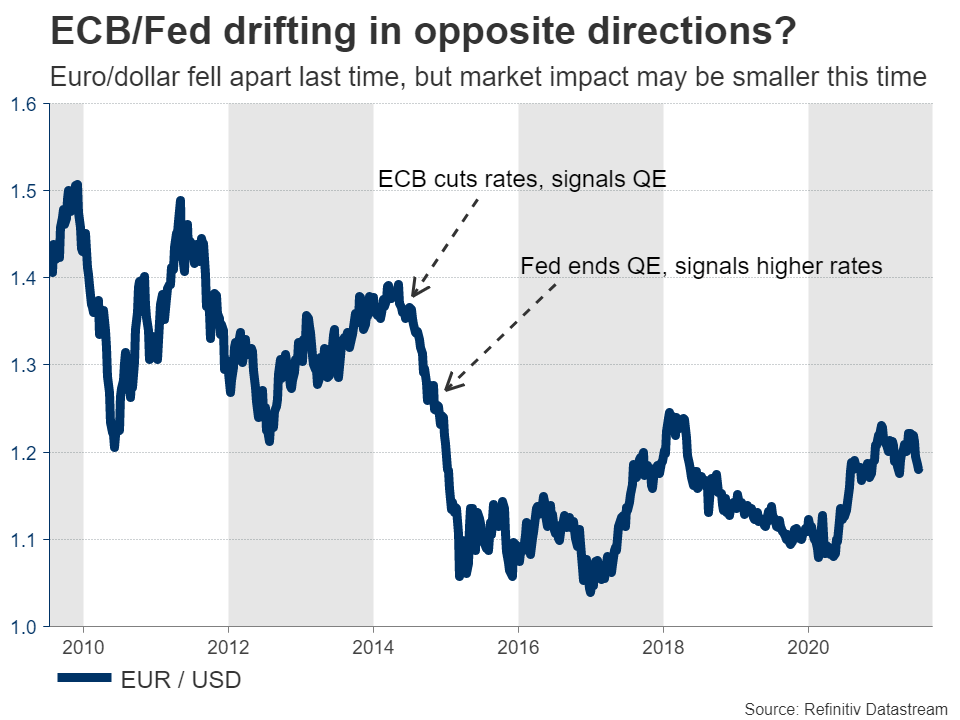
That’s bad news for the euro. With the ECB locking itself into negative rates but the Fed moving towards rate increases, yield differentials could widen further in the dollar’s favor, pushing euro/dollar lower over time. The last time these central banks drifted in opposite directions was in 2014-2015, a period of carnage for euro/dollar. The impact might be smaller this time as the ECB won’t be cutting rates like back then, but the direction is the same.
Beyond the ECB, the euro will also keep an eye on the preliminary PMI surveys for June, out on Friday. Economic reopening momentum remained strong in July, but the Delta variant that is spreading like wildfire is a threat. Spain, Portugal, and the Netherlands have seen new outbreaks. It’s almost impossible for governments to lock everyone down when half the population is vaccinated, but milder restrictions are plausible.
America and Britain await PMIs too
Over in the UK, Friday will bring the PMIs for July and retail sales for June. The British economy is humming along nicely and the data are likely to confirm that, despite the latest covid outbreak. Much of the population is now vaccinated and hospitalizations thankfully remain low.
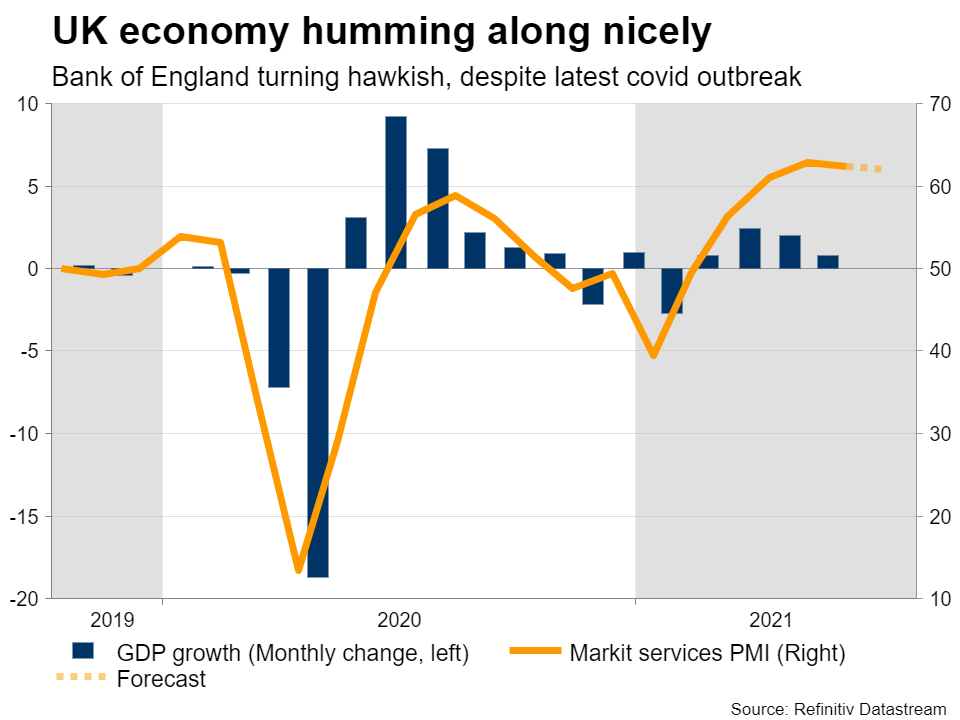
A couple of Bank of England officials recently suggested the central bank should withdraw some stimulus soon, making the next meeting in August ‘live’. The BoE will likely signal that the end of asset purchases is close and set the stage for rate increases, which the markets are currently pricing in for next summer. That’s a favorable landscape for sterling.
The Markit PMI surveys from the US will also be released Friday, although traders usually pay more attention to the ISM surveys.
RBA minutes, Canadian data, and earnings
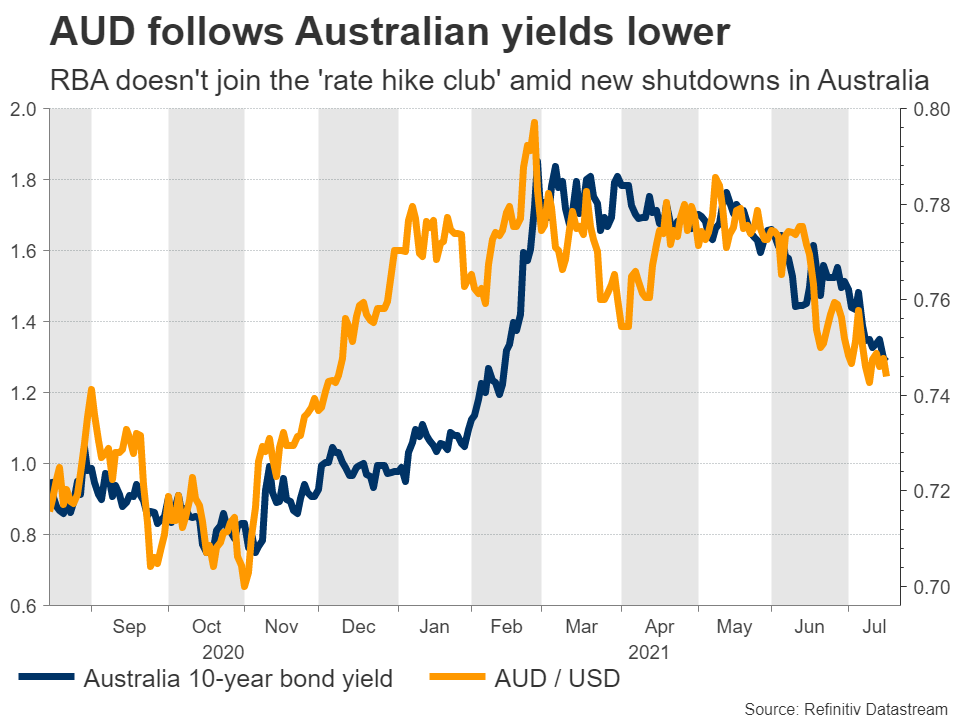
In the commodity currency sphere, the Reserve Bank of Australia will release the minutes of its July meeting on Tuesday. This was the meeting where the RBA slowed its asset purchases but repeated that rates are unlikely to rise before 2024, neutralizing the hawkish signal.
The latest shutdowns in Australia have thrown a monkey wrench into the RBA’s normalization plans, as vaccinations have also been slow. Unlike its kiwi cousin, the aussie won’t enjoy higher rates in the next few years, which spells downside risks for the aussie/kiwi pair.
In Canada, retail sales for May will hit the markets on Friday. The loonie has taken a beating lately from the pullback in oil prices and a resurgent US dollar, but vaccination rates are high and the outlook for the economy remains bright with US spending benefits likely to spill over. The Bank of Canada seems set to raise rates by next summer.
Finally, the earnings season will kick into high gear with household names like Netflix, Intel, Coca Cola, Johnson & Johnson, and Verizon reporting their quarterly results.
Sunset Market Commentary
Markets
US Treasuries slightly underperformed German Bunds today in rather dull trading session. Stellar June retail sales contributed to this different performance. Headline retail sales rose by 0.6% M/M with the GDP-relevant control group adding 1.1% on a monthly basis. May numbers did face a downward revision. US yields currently add 1.4 bps (2-yr) to 3 bps (5-yr) in a daily perspective. Changes on the German curve are negligible. The US dollar is marginally stronger in a daily perspective. The trade-weighted greenback changes hands near 92.70 and seems happy to end the week below intermediate resistance of 92.85. EUR/USD finds itself near the 1.18 big figure with EUR/USD 1.1772 support probably also safe ahead of the weekend. EUR/GBP is near unchanged at 0.8545 with sterling still not picking up the potential hawkish BoE shift in August. Hanging on the other side of the balance is the threat of new lockdown restrictions as pointed out by solicitor general Frazer with the delta variant running riot in the UK.
Focus will shift to Europe next week with the hyped July policy meeting and EMU PMI’s. ECB Lagarde recently stressed the importance of the otherwise dull July meeting after the unexpected conclusion of the central bank’s Strategy Review. The ECB swapped the close to, but below 2% inflation target for a hard 2% one while allowing for temporary deviations (symmetry). Lagarde added that this new inflation target might take a little longer to reach and stressed the acceptance and tolerance of temporary higher inflation. The new inflation target calls for new wordings around forward guidance on both interest rates and asset purchases, something the ECB will update next week. Apart from the semantics, ECB Lagarde indicated additional clarity on the post-PEPP period. The ECB’s current €1.85tn Pandemic Emergency Purchase Programme runs at least until March 2022. Since March, the weekly pace stands at €15/20bn. We argued before that around the PEPP shelf date, the ECB could temporary raise asset purchases under the regular APP (currently €20bn/month) in order to smoothen the eventual exit process. Lagarde hinted in that direction by talking about a “transition into a new format”. By tackling the asset purchases issue already in July, the ECB avoids an unwarranted build-up in tapering expectations: “We need to be very flexible and not start creating the anticipation that the exit is in the next few weeks, months”. Besides clearing the air on future policy (= removing uncertainty), the central bank will simultaneously extend the time frame for which ultra-easy monetary policy conditions will remain in place. By doing so, she breaks ranks with the current views inside the Fed (tapering discussion ongoing) and BoE (net asset buying to end by the end of the year).
News Headlines
Core inflation in Poland as calculated by the National Bank of Poland slowed slightly more than expected. Inflation excluding food and energy prices was 0.0% M/M and 3.5% Y/Y, down from 4.0% Y/Y in May. Core inflation excluding administered prices slowed to 0.1% M/M and 4.0% (from 4.4%). Despite the June easing in inflation, the NBP at this July Policy meeting substantially raised its inflation forecasts (expected 4.1% for 2021). However, it sees inflation as due to temporary factors or factors that are out of scope of monetary policy. In this same ‘soft’ narrative, MPC member Lon on Reuters said that "In a situation where the impact of the fourth wave on the outlook for economic growth turned out to be significant, we could cut interest rates or increase the scale of asset purchases, or both." At EUR/PLN 4.585, the zloty is trading near the weakest level against the euro since end April.
A report of the UK House of Lords Economic affairs Committee asked the BoE to provide better justification for its assessment that inflation is temporary and raises questions on the efficacy of the BoE’s QE programme. The Committee concluded that the BoE’s Asset Buying programme risks stoking inflation, widening inequality and has done little to boost economic growth. In a response, the BoE reiterated its commitment to price stability and stressed the programme supported all borrowers at time of extreme economic distress.
Retail Sales Were Stronger than Expected in June
- Retail sales rose by 0.6% in June, well above the median consensus forecast for a 0.3% decline. However, May's reading was revised down from to -1.7% (from -1.3%), removing some froth off today's gain.
- Trade in the auto category was particularly weak, with sales at motor vehicle dealers declining by 2.0% from the downwardly revised reading of -4.7% (revised from -3.9% m/m in May). Excluding auto, retail sales increased by 1.1%, more than the expected increase of 0.4%.
- Sales in other relatively more volatile categories were mixed in June. Building materials and equipment dropped by 1.6% m/m, but gasoline stations rose 2.5% m/m gain.
- The "control group", which excludes the most volatile components, was strongly in the black June with a 1.1% gain, but May's reading was revised down to -1.4% from (-0.7% previously).
- Food services & drinking places and clothing & accessory stores rose by 2.3% and 2.6% m/m, respectively. May's reading of the former was also revised up to 3.7% from 1.8% – a sizable upgrade, especially given downgrades elsewhere.
Key Implications
- With sales in categories lifted by the pandemic (auto dealers, building materials retailers, home furniture & appliance stores) declining for the second month in a row, the shift in the composition of consumer spending continues. Consumer preferences are now turning to spending more to update wardrobes in anticipation of long-awaited outings with friends and families.
- Declining sales at auto dealerships likely reflects supply issues more than demand that has led this red-hot sector to be the biggest contributor to consumer prices in recent months. The ratio of inventories to sales at motor vehicle and parts dealers dropped from roughly 2.3 before the pandemic to an all-time low of 1.2 in April (the most recent estimate). As supply catches up and demand cools, we hope to see this ratio normalize in the coming months, taking some steam out of prices.
- All in all, today's report was stronger than we expected and, despite downward revisions of the previous month, is consistent with our second quarter consumption forecast for double digit growth (annualized).
Canadian Housing Starts Remained Very Strong in June
- Canadian housing starts came in at a very healthy 282.1k annualized units in June, marking a modest 1.5% m/m decline from May's superheated level. Despite the decline, the six-month moving average remained exceptionally strong at 293.6k units.
- June's decline in urban starts was driven by the single-detached category, which fell 8.5% m/m to 60.1k units. Meanwhile, multi-family starts increased by 0.6% m/m to 191.1k units.
- Starts were lower in six of 10 Provinces:
- In Ontario, starts fell back from their extremely strong May level (-12.8k to 89.0k units)
- Starts fell by 4.0k units in the Prairies, leaving their level at 45.7k units. Alberta and Saskatchewan were the drags.
- In the Atlantic Region, starts plummeted from their historically strong May level (-9.4k to 9.7k units), weighed down primarily by Nova Scotia and New Brunswick.
- Starts increased by 1.4k in Quebec to 69.6k units and jumped by 20.5k to 68.1k units in B.C.
Key Implications
- Starts remained very strong to begin the summer, supported by elevated home prices and low interest rates. For context, June's figure was a meaty 40% above the 2011- 2019 average. However, they did recede by 8% in the second quarter from their record first quarter pace, consistent with our forecast calling for residential investment to be a drag on overall economic growth for the first time in a year.
- Moving forward, we expect starts to continue to cool from their exceptionally strong first half pace (and May's drop in residential building permits is consistent with this view). However, the level should remain strong compared to the pre-pandemic trend, as homebuilding continues to benefit from past sales gains. What's more, unsold inventories remain extremely low (falling yet again in June), and lumber prices have receded significantly in recent months.
US Open: Futures Advance as Retail Sales Unexpectedly Rise
US futures
- Dow futures +0.15% at 34758
- S&P futures +0.2% at 4370
- Nasdaq futures +0.3% at 14844
In Europe
- FTSE +0.11% at 7023
- Dax 0% at 15624
- Euro Stoxx -0.1% at 4050
A positive end to a choppy week
US futures are pushing higher on the open. Investors are brushing off news that the Biden administration will warn businesses over rising risks of doing business in Hong Kong and instead are focusing on better than forecast retail sales and a relatively upbeat start to earnings season.
The US banks have kicked off earnings season, most beat forecast on both earnings and revenue thanks in part to a surge in deal making. The low interest rate environment combined with businesses eager to reorganize and digitalise has sent deal making to record levels.
Retail sales rose by a better than expected 1.3% MoM in June, up from an upwardly revised -0.9% decline in May and well ahead of the -0.4% drop expected. Retail sales are notoriously volatile and this year this is particularly the case. As a result, its proving difficult to draw any strong trends for the data. The fact that it rose and firmly is a good sign for now. Jerome Powell said that the recovery still had a way to go. This is movement in the right direction.
Looking ahead Michigan consumer confidence data will be in focus.
Where next for the Nasdaq?
The Nasdaq refreshed its all time high earlier in the week before easing lower. Yesterday’s selloff took the index through its 50 sma on the 4 hour chart. The price is rebounding after finding support on the ascending trendline dating back to mid May. The MACD’s receding bearish bias is supportive of a move back over the 50 sma and back towards 15000. A break out of the ascending channel could prompt a deeper selloff to 14550.

FX – USD rises, EUR shrugs off in line inflation
The US Dollar is moving higher, extending gains from the previous session. The US Dollar is set to gain over 0.5% this week its strongest weekly gains in over a month, boosted by safe haven flows as delta cases rise and elevated inflation prompts speculation of the Fed tightening policy.
EUR/USD hovers around 1.18. Final Eurozone CPI came in as expected at 1.9% YoY in June, down from 2% in May. Concerns over the spread of the Delta variant are also dragging on sentiment for the common currency,
- GBP/USD -0.14% at 1.3810
- EUR/USD -0.28% at 1.1795
Oil set for 4% losses across the week
Oil prices are edging higher but are set for steep weekly declines. Both benchmarks are looking at losses of over 4% across the week. A compromise at OPEC paves the way for output increases to match surging demand as economies reopen.
Concerns over a rise in fuel inventories is also capping gains, particularly given that the driving season should be ramping up in the US around 4th July holiday.
- US crude trades +0.25% at $71.59
- Brent trades +0.13% at $73.14
Looking ahead
- 14:00 Fed Williams Speaks
- 15:00 Michigan Consumer Confidence
- 18:00 Baker Hughes Oil Rig Count
Dollar Firms Up Slightly after Retail Sales, Kiwi Still the Strongest
Dollar trades mildly higher in early US session after better than expected retail sales data, but upside moment is weak so far. Mild strength in US futures sends Swiss Franc and Yen slightly lower. Overall, New Zealand Dollar is set to end as the best performer for the week, as RBNZ hike speculations intensified. Dollar is following as second, then Yen. Australian and Canadian Dollar are the worst performers and there is no sign of a turn around.
In Europe, at the time of writing, FTSE is up 0.09%. DAX is down -0.05%. CAC is down -0.46%. Germany 10-year yield is down -0.011 at -0.342. Earlier in Asia, Nikkei dropped -0.98%. Hong Kong HSI rose 0.03%. China Shanghai SSE dropped -0.71%. Singapore Strait Times rose 0.39%. Japan 10-year JGB yield rose 0.0069 to 0.021.
US retail sales rose 0.6% in Jun, ex-auto sales rose 1.3%
US retail sales rose 0.6% mom to USD 621.3B in June, much better than expectation of -0.6% mom decline. Ex-auto sales rose 1.3% mom, above expectation of 0.4% mom. Ex-gasoline sales rose 0.4% mom. Ex-auto, ex-gasoline sales rose 1.1% mom.
Also released, Canada housing starts rose to 282k in June. Foreign securities purchases rose to CAD 20.79B in May. Wholesale sales rose 0.6% mom in June.
Eurozone CPI finalized at 1.9% yoy in Jun, EU at 2.2% yoy
Eurozone CPI was finalized at 1.9% yoy in June, down from May's 2.0% yoy. The highest contribution came from energy (+1.16%), followed by non-energy industrial goods (+0.31%), services (+0.28%) and food, alcohol & tobacco (+0.15%).
EU CPI was finalized was finalized at 2.2% yoy, down from May's 2.3% yoy. The lowest annual rates were registered in Portugal (-0.6%), Malta (0.2%) and Greece (0.6%). The highest annual rates were recorded in Hungary (5.3%), Poland (4.1%) and Estonia (3.7%). Compared with May, annual inflation fell in twelve Member States, remained stable in four and rose in eleven.
Eurozone exports rose 31.9% yoy in May, imports rose 35.2% yoy
In May, Eurozone Exports rose 31.9% yoy to EUR 188.2B. Imports rose 35.2% yoy to EUR 180.7B. As a result Eurozone recorded a EUR 7.5B surplus in trade in goods. Intra-Eurozone trade rose 45.4% yoy to EUR 181.5B.
In seasonally adjusted terms Eurozone exports dropped -1.5% mom to EUR 195.1B. imports rose 07% mom to EUR 185.8B. Trade surplus narrowed to EUR 9.4B. Intra-Eurozone trade rose to EUR 183.7B.
BoJ stands pat, upgrades inflation forecasts
BoJ kept monetary policy unchanged today. Under yield curve control framework, short term interest rate is held at -0.1%. 10-year JGB yield target is kept at around 0%, without upper limit on JGB purchases. The decision was made by 8-1 vote, with Goushi Kataoka dissented again, pushing for further strengthening of monetary easy, by lowering short and long term interest rates. BoJ will will also continue to buy ETFs and J-REITS with upper limit of JPY 12T and JPY 180B respectively.
In the new economic forecasts, BoJ:
- Downgraded fiscal 2021 GDP growth to 3.8% (from April's 4.0%)
- Upgraded fiscal 2022 GDP growth to 2.7% (from 2.4%).
- Kept fiscal 2023 GDP growth at 1.3% (unchanged).
- Upgraded fiscal 2021 CPI core to 0.6% (from 0.1%).
- Upgraded fiscal 2022 CPI core to 0.9% (from 0.8%).
- Kept fiscal 2023 CPI core at 1.0% (unchanged).
New Zealand CPI rose 1.3% qoq, 3.3% yoy in Q2, RBNZ hike speculation intensifies
New Zealand CPI rose 1.3% qoq in Q2, well above expectation of 0.7% qoq. For the 12-month. CPI accelerated to 3.3% yoy, up from 1.5% yoy, well above expectation of 2.8% yoy. The annual rate is the highest in nearly a decade. Also, the figures were well above RBNZ's forecast of 0.6% qoq 2.6% yoy inflation.
Speculations of an early RBNZ hike intensified further after the release. Westpac now expects a hike in OCR by 0.25% in August, with another hike at both October and November meeting.
New Zealand BusinessNZ manufacturing rose to 60.7, facing labor shortages and logistics disruptions
New Zealand BusinessNZ Performance of Manufacturing Index rose from 58.6 to 60.7 in June. Looking at some details, production dropped slightly form 64.8 to 64.5. Employment rose from 52.0 to 56.5. New orders rose slightly from 63.5 to 63.6. Finished stocks rose from 53.6 to 57.3. Deliveries rose from 53.4 to 55.0.
BusinessNZ's executive director for manufacturing Catherine Beard said: "Despite the overall pick-up in activity, the proportion of negative comments (53.1%) remained higher than positive ones (46.8%). Many of the positive comments outlined increased demand, but this is counterbalanced by significant labour shortages and logistics disruptions many manufacturers are now facing."
EUR/USD Mid-Day Outlook
Daily Pivots: (S1) 1.1788; (P) 1.1820; (R1) 1.1843; More...
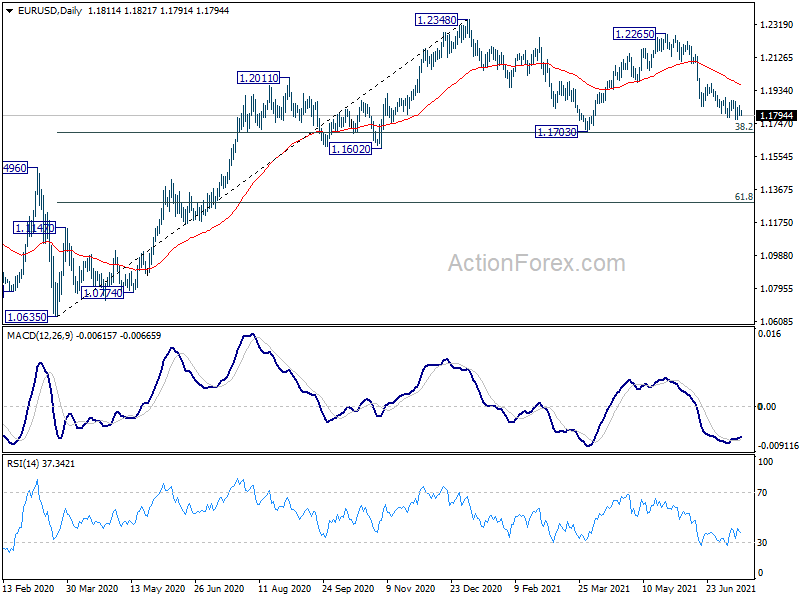
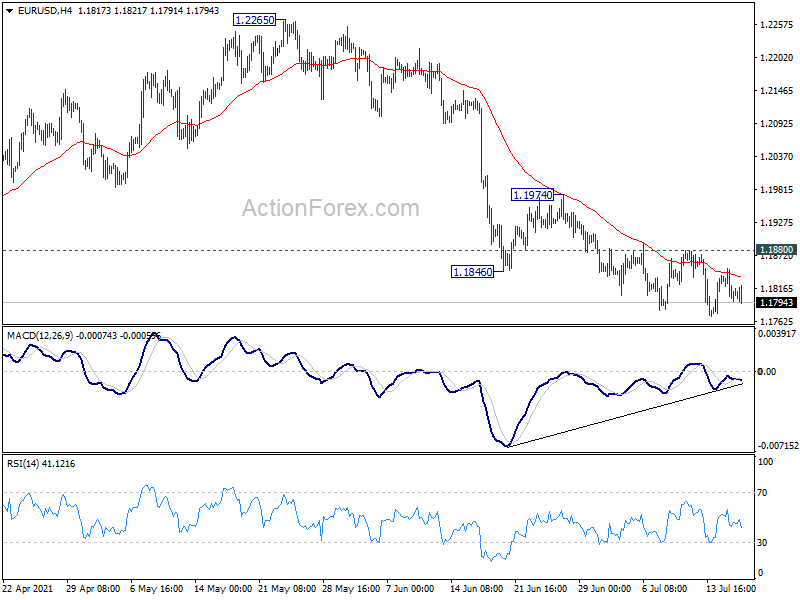
EUR/USD is staying in tight range below falling 4 hour 55 EMA and outlook is unchanged. With 1.1880 resistance intact, further fall is expected. Current decline from 1.2265, as the third leg of correction from 1.2348, could target 1.1703 support. On the upside, though, break of 1.1880 resistance should indicate short term bottoming, and bring stronger rebound to 1.1974 resistance first.
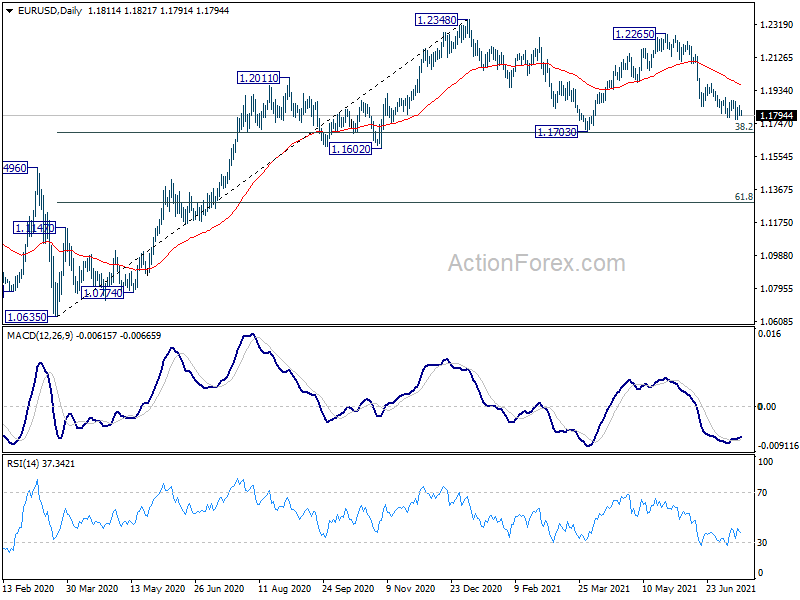
In the bigger picture, rise from 1.0635 is seen as the third leg of the pattern from 1.0339 (2017 low). Further rally could be seen to cluster resistance at 1.2555 next, (38.2% retracement of 1.6039 to 1.0339 at 1.2516). This will remain the favored case as long as 1.1602 support holds. Reaction from 1.2555 should reveal underlying long term momentum in the pair. However sustained break of 1.1602 will argue that the rise from 1.0635 is over, and turn medium term outlook bearish again.
Economic Indicators Update
| GMT | Ccy | Events | Actual | Forecast | Previous | Revised |
|---|---|---|---|---|---|---|
| 22:30 | NZD | BusinessNZ Manufacturing Index Jun | 60.7 | 58.6 | ||
| 22:45 | NZD | CPI Q/Q Q2 | 1.30% | 0.70% | 0.80% | |
| 03:00 | JPY | BoJ Interest Rate Decision | -0.10% | -0.10% | -0.10% | |
| 08:00 | EUR | Italy Trade Balance (EUR) May | 5.64B | 5.87B | ||
| 09:00 | EUR | Eurozone Trade Balance (EUR) May | 9.4B | 8.2B | 9.4B | 13.4B |
| 09:00 | EUR | Eurozone CPI M/M Jun F | 0.30% | 0.30% | 0.30% | |
| 09:00 | EUR | Eurozone CPI Y/Y Jun F | 1.90% | 1.90% | 1.90% | |
| 09:00 | EUR | Eurozone CPI Core M/M Jun F | 0.30% | 0.30% | 0.30% | |
| 09:00 | EUR | Eurozone CPI Core Y/Y Jun F | 0.90% | 0.90% | 0.90% | |
| 12:15 | CAD | Housing Starts Jun | 282K | 270.0K | 275.9K | |
| 12:30 | CAD | Foreign Securities Purchases (CAD) May | 20.79B | 7.80B | 9.95B | |
| 12:30 | CAD | Wholesale Sales M/M May | 0.50% | -0.90% | 0.40% | |
| 12:30 | USD | Retail Sales M/M Jun | 0.60% | -0.60% | -1.30% | -1.70% |
| 12:30 | USD | Retail Sales ex Autos M/M Jun | 1.30% | 0.40% | -0.70% | -0.90% |
| 14:00 | USD | Michigan Consumer Sentiment Index Jul P | 86.5 | 85.5 | ||
| 14:00 | USD | Business Inventories May | 0.40% | -0.20% |
EUR/USD Mid-Day Outlook
Daily Pivots: (S1) 1.1788; (P) 1.1820; (R1) 1.1843; More...
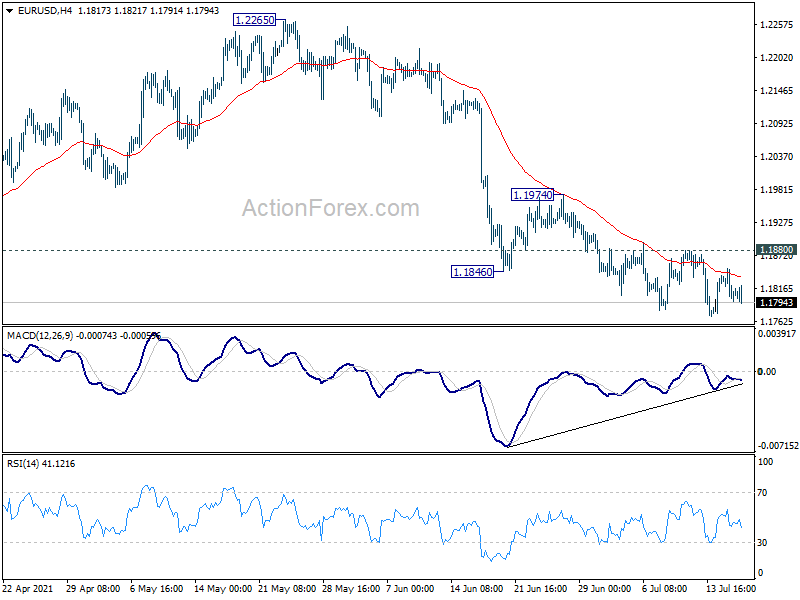
EUR/USD is staying in tight range below falling 4 hour 55 EMA and outlook is unchanged. With 1.1880 resistance intact, further fall is expected. Current decline from 1.2265, as the third leg of correction from 1.2348, could target 1.1703 support. On the upside, though, break of 1.1880 resistance should indicate short term bottoming, and bring stronger rebound to 1.1974 resistance first.
In the bigger picture, rise from 1.0635 is seen as the third leg of the pattern from 1.0339 (2017 low). Further rally could be seen to cluster resistance at 1.2555 next, (38.2% retracement of 1.6039 to 1.0339 at 1.2516). This will remain the favored case as long as 1.1602 support holds. Reaction from 1.2555 should reveal underlying long term momentum in the pair. However sustained break of 1.1602 will argue that the rise from 1.0635 is over, and turn medium term outlook bearish again.