

Sample Category Title
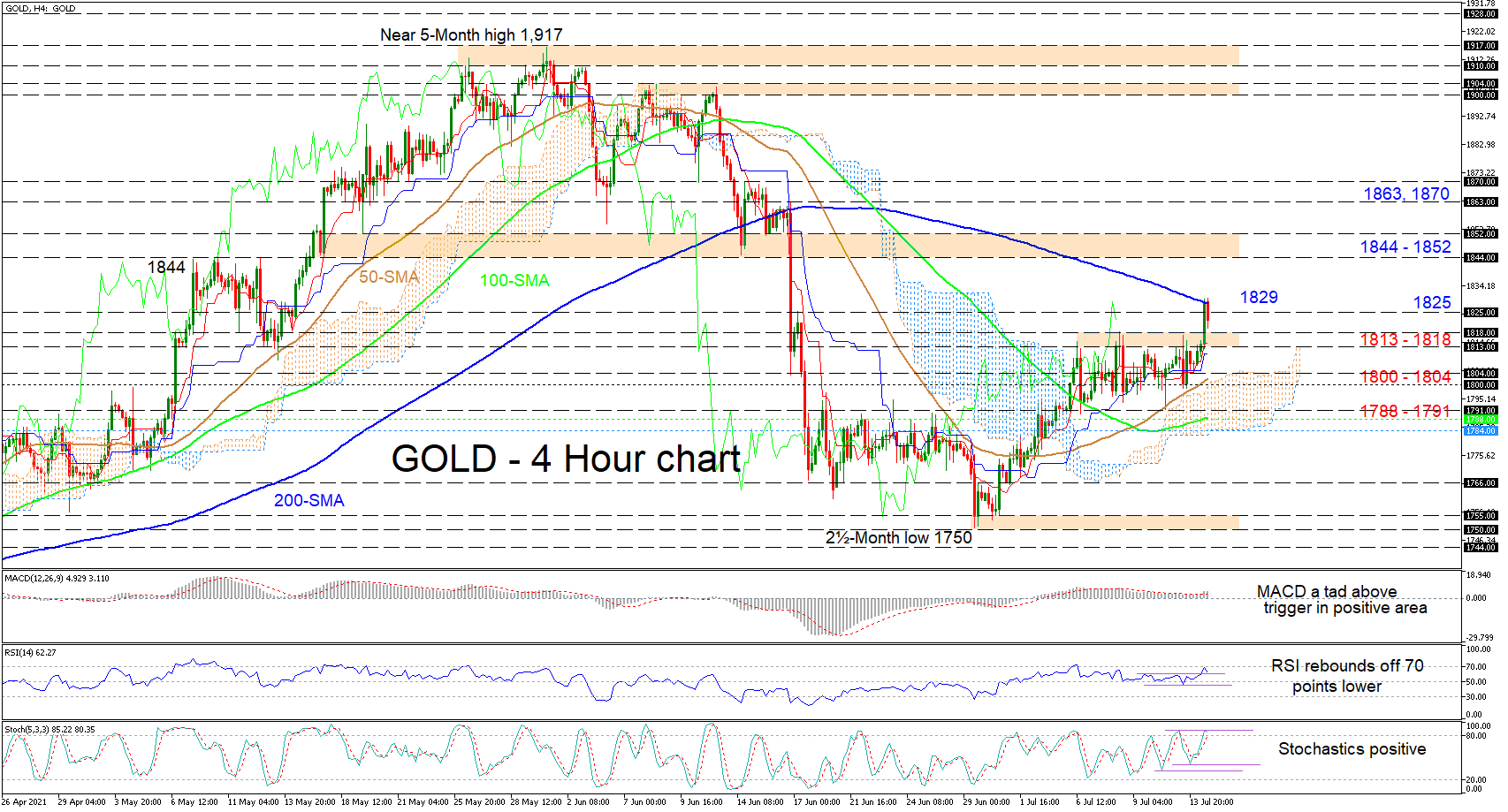
Gold advances under strain as 200-MA applies the brakes
Gold’s recent surge in positive impetus has been capped by the 200-period simple moving average (SMA) at 1,829. Sellers seem to have gained the upper hand, steering the price back underneath the 1,825 level (previous resistance-now-support). In spite of the downward bearing of the 200-period SMA, the bullish 50- and 100-period SMAs continue to underpin the commodity’s recent progress.
The Ichimoku lines are indicating feeble upward drive, while the short-term oscillators are conveying mixed signals in directional momentum. The MACD is holding above its red trigger line, while the RSI has deflected off the 70 overbought level. The stochastic oscillator also seems to be struggling to sustain its positive charge, suggesting upward forces may be lacking.
If sellers stay in charge, initial downside constraints could occur around the 1,813-1,818 area, shaped by the recently conquered highs. Should the price retreat further, a vital support zone from the 1,804 low until the 1,800 barrier could come under the spotlight. Additional fading in the price below the 50-period SMA could sink it to test a support belt, moulded between the 1,791 trough and the 100-period SMA at 1,788.
Alternatively, a convincing thrust above the 200-period SMA at 1,829 may encourage buyers to challenge the resistance border of 1,844-1,852. Furthermore, triumphing over this critical boundary could significantly bolster upside momentum, with the price targeting the mid-June highs of 1,863 and 1,870 respectively.
Summarizing, gold’s advances remain subdued in the short-term picture by the 200-period SMA at 1,829. That said, a break above the 200-period SMA may be the catalyst for additional improvements, while a break below the 100-period SMA may reinforce negative tendencies.
Bank of Canada Reduces Bond Purchases, Expects Economic Slack to be Absorbed in Second Half of 2022
- The Bank of Canada (BoC) kept the overnight rate at 0.25% but continued to taper the quantitative easing (QE) program. The Bank reduced the pace of asset purchases from at least $3 billion per week to $2 billion per week.
- In terms of the overnight rate, the Bank said that the interest rate would remain at its effective lower bound until economic slack is absorbed and the 2 percent inflation target is sustainably achieved, which it continued to expect would occur in the second half of 2022.
- The Bank of Canada also released the July Monetary Policy Report (MPR) today. The economic forecast has incorporated sizeable changes from the April edition. For 2021, real GDP growth was revised down half a percentage point to 6%, 2022 was upgraded to 4.6% from 3.7%, and 2023 was little changed at 3.3%. The downgrade in 2021 comes as a result of a weaker than expected first half of the year, but the Bank continues to expect a strong rebound in growth in the third and fourth quarters. The upward revision in 2022 was mainly a result of the BoC now assuming that households will spend 20 percent of the extra savings they accumulated during the pandemic on consumption. Previously, they had expected none of these funds would be used for consumption purposes.
- The Bank also lifted potential GDP growth in 2021-23 to average around 1.8% per year, approximately 0.2 percentage points higher than what was assumed in the April MPR. As a result, combined with the real GDP forecast, the Bank continues to expect the output gap to close sometime in the second half of 2022.
- In terms of inflation, the consumer price index (CPI) inflation forecast was revised higher. The 2021 forecast was increased to 3% from 2.3%, and 2022 was revised up to 2.4% from 1.9%. The projection for 2023 was pretty much unchanged at 2.2%.
Key Implications
- As was widely expected, the Bank of Canada opted to reduce monetary stimulus today. With the economic recovery strengthening on the back of easing public health restrictions, it was a prudent move by the Bank to remove some policy support.
- Still, considerable monetary stimulus is flowing into the economy and with the labour market still quite a long way away from a full recovery, the BoC will not be turning off the taps anytime soon. Today's MPR reiterated that it will take time for a full and inclusive recovery in employment, especially as workers take on new jobs.
- However, labour market slack has not blunted near-term price pressures. In fact, the Bank now expects inflation to push higher than its previous forecast aided by reopening and supply chain impacts. But just as in April, the BoC believes transitory forces are lifting inflation currently and they will fade with time. Even so, the Bank's commitment to keep the policy rate at its effective lower bound well into 2022 will lead to inflation moving above the 2 percent target in 2023 before returning a year later. The Bank recognizes there is a lot of uncertainty around inflation at the moment, so it will continue to closely watch the persistence and magnitude of price pressures as the economy reopens.
BoC press conference live stream
https://www.youtube.com/watch?v=C1b9t-7Wu_I
BOC Tapers Again, Powell Stays Dovish
The Canadian dollar posted considerable gains earlier in the day but has retreated. Currently, USD/CAD is trading at 1.2491, down 0.18%.
BoC scales back QE
At today’s policy meeting, the Bank of Canada maintained its key lending rate at 0.10%, as expected. The bank tapered its bond-buying program for a third straight month, reducing its weekly purchases from CAD 3 billion to 2 billion dollars. While tightening policy at the meeting, the BoC is still sounding dovish about the economy. The bank cut its growth forecast for 2021 from 6.5% to 6.0% and says it does not expect to raise rates prior to H2 of 2022.
What’s next for the BoC? There are expectations that the bank could wind up asset purchases by the end of the year, with rate hikes to follow. This exit strategy will depend on the Canadian economy continuing to gain steam, but a resurgence of the Covid pandemic could delay these plans.
The Federal Reserve has long insisted that higher inflation levels are transitory and that it plans to maintain its dovish policy stance. However, this position is becoming increasingly difficult to defend, especially in light of the latest surge in US consumer inflation. CPI for June jumped 5.4% and the core reading rose 4.5%, its highest level since 1991. The Fed has tried to adjust to the shifting sands and adopted a more hawkish tone when it projected two rate hikes in 2023, but even that may not be enough for the markets.
Fed Chair Jerome Powell’s testimony, ahead of his appearance in the House later today, does not contain anything new and reiterates the central bank’s dovish stance. Powell said that the economy would have to show “substantial progress before the Fed tapers stimulus and policymakers will discuss the issue in coming meetings.
USD/CAD Technical
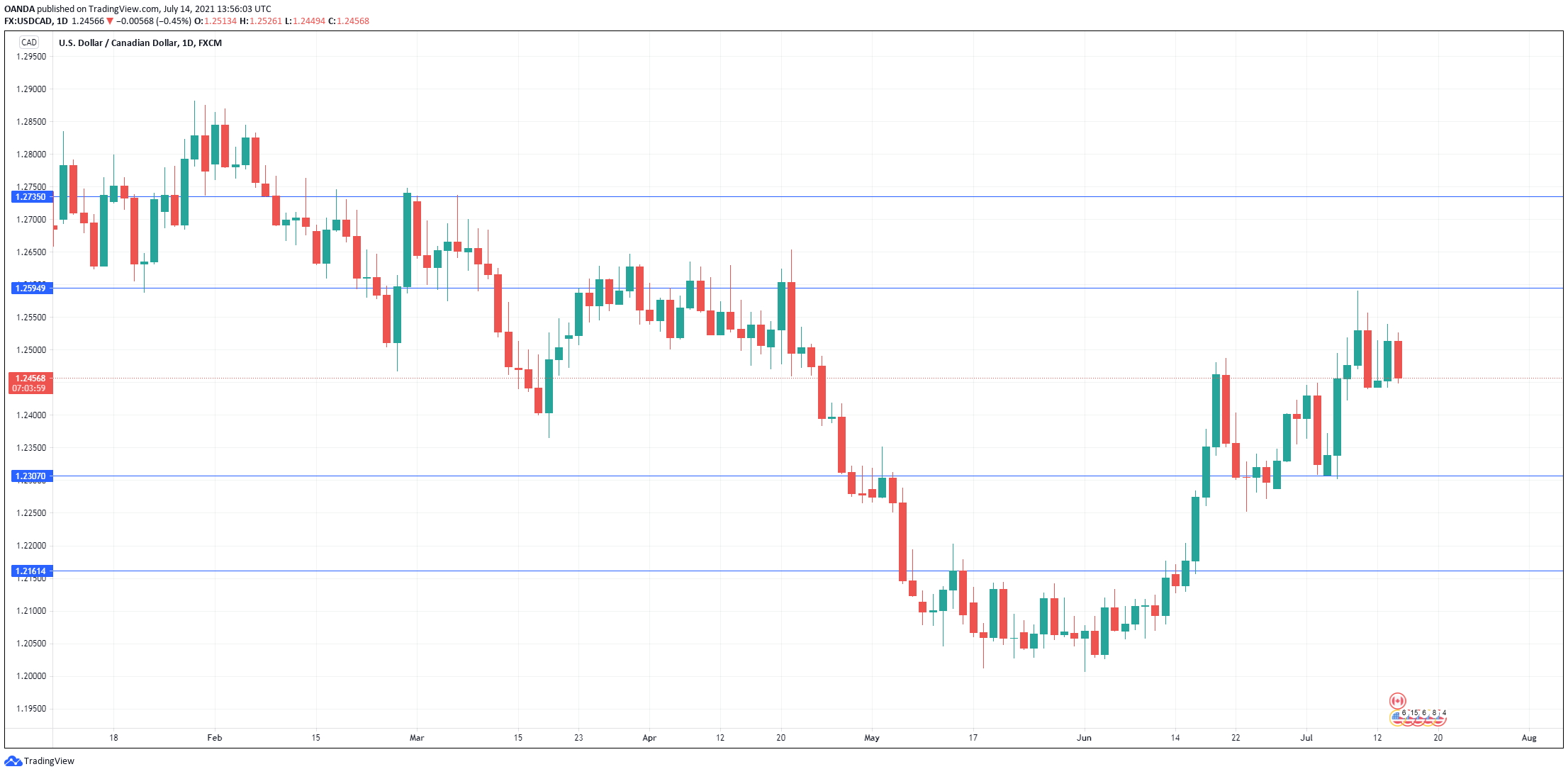
- USD/CAD faces resistance at 1.2594. Above, there is resistance at 1.2735
- On the downside, there is support at 1.2307. Below, there is support at 1.2161
ECB Schnabel: We intend to react especially forcefully or persistently to disinflationary shocks
In a speech, ECB Executive Board member Isabel Schnabel said, "to avoid that low inflation becomes entrenched in expectations and activity, we have changed our definition of price stability to a clear and symmetric 2% target in the medium term."
Also, with policy rates close to the "lower bound", "we intend to react especially forcefully or persistently to disinflationary shocks." The may imply a "transitory period" with inflation moderately above target.
Fed Powell: We will provide advance notice before adjusting asset purchases
In a testimony to Congress, Fed Chair Jerome Powell said, at the June FOMC meeting, "while reaching the standard of 'substantial further progress' is still a ways off, participants expect that progress will continue." These discussions will continue in coming meetings. He pledged, "we will provide advance notice before announcing any decision to make changes to our purchases."
Sunset Market Commentary
Markets
The combination of sharply higher US inflation yesterday and, a few hours later, a poorly accepted US 30-y auction temporarily triggered a corrective move on recent trends of persistently low/declining (US) yields and a flattening yield curve. However, a pause obviously isn’t a trend reversal yet. During the morning session, the flattening trend resumed as investors counted the down for the US PPI data and for Fed Powell’s appearance before the House Financial Services Committee. The US May PPI copied the yesterday’s message from the CPI’s with both final demand PPI (1.0% M/M and 7.3% Y/Y) and underlying measures signaling accelerating price increases. Still the (bond) market didn’t see much new. In the transcript text for the House hearing, the Fed chair still holds the line from after the June policy meeting. Most FOMC members apparently still assess expect that, while further progress will continue, the standard of substantial further progress that is needed to start scaling back of asset purchases, hasn’t been met. Powel acknowledges rising prices due to bottlenecks and supply constraints, but stops shorts of labeling this as the potential start of sustained prices rises yet. He still downplays the risks to financial stability of the persistent ultra-supportive policy. This ‘balanced’ assessment provided the all-clear for markets to resume its recent habits. The US yield curve bull flattens with yields declining between 2 bp and 4.5/5.0 bp (30-y & 10-y). The German yield curve followed the path of least resistance declining between 0.1 bp (2-y) and 2.1 bp (30-y). Oil gaining some modest ground after the UAE and Saudi Arabia reached an agreement on future production. Again it didn’t revive any reflationary spirits on core bond markets. Intra-EMU 10-y government bonds spreads are trading little changed. European equities show a mixed, indecisive picture. US indices are again near record levels as investors took comfort from several US big banks publishing Q2 earnings.
The dollar this morning still profited from yesterday’s rise in US yields. However, the resumption of the bull flattening yield trend didn’t help further USD gains. Losses even accelerated after the release of Powell’s testimony. EUR/USD tries to regain the 1.18 big figure. The trade-weighted DXY index failed to clear 92.85 resistance and currently again trades near 92.45. USD/JPY (110.15) struggles not to fall below the 110 mark. Higher-than-expected headline (2.5 Y/Y) and core (2.3%) UK inflation finally caused EUR/GBP to break below the 0.8530 support. The pair trades at around 0.8510, with the 0.08472 April low now within reach.
News Headlines
The Turkish central bank kept its policy rate unchanged at 19%. Earlier this month, June Turkish inflation unexpectedly jumped to 17.5% Y/Y. The Turkish central bank pledged to keep real interest rates positive and expects volatility in inflation during the summer due to the reopening. The CBRT for now withstands political pressure to reverse its tightening cycle. President Erdogan early June said that he spoke with the new central bank governor. He concluded that “it’s an imperative that we lower interest rates. For that, we will reach July and August thereabouts so that rates can begin to fall”. The Turkish lira trades a tad firmer, but EUR/TRY remains north of 10. It’s probably only a matter of time before the CBRT turns to unorthodox rate cuts, breaking ranks with tightening cycles in other emerging markets and highlighting the vulnerability of the lira.
The United Arab Emirates reached a preliminary oil agreement with Saudi Arabia which needs to be approved by all OPEC+ members and which would end the deadlock from earlier this month. The UAE last week blocked a tentative deal to raise oil production because it argued in favour for a higher (personal) production baseline. The UAE’s new baseline production will be 3.65mn barrels from April 2022 from about 3.17mn currently (locked in 2018 before infrastructure spending). In return, the Emirates now back the Kingdom’s proposal to extend the duration of the OPEC+ production cut agreement to December 2022. Brent crude remains near cycle highs around $76.5/b.
BoC tapers asset purchase to CAD 2B per week, no hike until H2 next year
BoC left overnight rate unchanged at effective lower bound of 0.25% as widely expected. Bank rate and deposit rate are held at 0.50% and 0.25% respectively. It maintained the forward guidance that conditions for rate hike is expected to happen "some time in the second half of 2022".
The central bank also continued tapering and reduce weekly asset purchase target to CAD 2B, down from CAD 3B. It said that, "this adjustment reflects continued progress towards recovery and the Bank's increased confidence in the strength of the Canadian economic outlook."
As third wave of coronavirus slowed growth in Q2, BoC now expects around 6% GDP growth in 2021, "a little slower than was expected in April". But it has revised up its 2022 forecast to 4.50% and projects 3.25% growth in 2023.
On inflation,with higher gasoline prices and on-going supply bottlenecks, it's likely to "remain above 3 percent through the second half of this year", then ease back to 2% in 2022.
(BOC) Bank of Canada maintains policy rate and forward guidance, adjusts quantitative easing program
The Bank of Canada today held its target for the overnight rate at the effective lower bound of ¼ percent, with the Bank Rate at ½ percent and the deposit rate at ¼ percent. The Bank is maintaining its extraordinary forward guidance on the path for the overnight rate. This is reinforced and supplemented by the Bank's quantitative easing (QE) program, which is being adjusted to a target pace of $2 billion per week. This adjustment reflects continued progress towards recovery and the Bank's increased confidence in the strength of the Canadian economic outlook.
The global economy is recovering strongly from the COVID-19 pandemic, with continued progress on vaccinations, particularly in advanced economies. However, the recovery is still highly uneven and remains dependent on the course of the virus. The recent spread of new COVID-19 variants is a growing concern, especially for regions where vaccinations rates remain low.
Global GDP growth is expected to reach 7 percent this year and then moderate to about 4 ½ percent in 2022 and just over 3 percent in 2023. This a slightly stronger forecast than the one in the Bank's April Monetary Policy Report (MPR) and primarily reflects a stronger US outlook. Global financial conditions remain highly accommodative. Rising demand is supporting higher oil prices, while non-energy commodity prices remain elevated. The Canada-US exchange rate is little changed since April.
In Canada, the third wave of the virus slowed growth in the second quarter. However, falling COVID-19 cases, progress on vaccinations and easing containment restrictions all point to a strong pickup in the second half of this year. The Bank now expects GDP growth of around 6 percent in 2021 – a little slower than was expected in April – but has revised up its 2022 forecast to 4 ½ percent and projects 3 ¼ percent growth in 2023.
Consumption is expected to lead the recovery as households return to more normal spending patterns, while housing market activity is projected to ease back from historical highs. Stronger international demand should underpin a solid recovery in exports. As domestic and foreign demand increases and confidence improves, business investment will gain strength. Employment has once again begun to rebound, and we expect the hardest-hit segments of the labour market to post strong gains as the economy re-opens. However, the pace of the recovery will vary among industries and workers, and it could take some time to hire workers with the right skills to fill jobs. The aftermath of lockdowns and ongoing structural changes in the economy both mean that estimates of potential output and when the output gap will close are particularly uncertain.
CPI inflation was 3.6 percent in May, boosted by temporary factors that include base-year effects and stronger gasoline prices, as well as pandemic-related bottlenecks as economies re-open. Core measures of inflation have also risen but by less than the CPI. In some high-contact services, demand is rebounding faster than supply, pushing up prices from low levels. Transitory supply constraints in shipping and value chain disruptions for semiconductors are also translating into higher prices for cars and some other goods. With higher gasoline prices and on-going supply bottlenecks, inflation is likely to remain above 3 percent through the second half of this year and ease back toward 2 percent in 2022, as short-run imbalances diminish and the considerable overall slack in the economy pulls inflation lower. The factors pushing up inflation are transitory, but their persistence and magnitude are uncertain and will be monitored closely.
The Governing Council judges that the Canadian economy still has considerable excess capacity, and that the recovery continues to require extraordinary monetary policy support. We remain committed to holding the policy interest rate at the effective lower bound until economic slack is absorbed so that the 2 percent inflation target is sustainably achieved. In the Bank's July projection, this happens sometime in the second half of 2022. The Bank's QE program continues to reinforce this commitment and keep interest rates low across the yield curve. Decisions regarding further adjustments to the pace of net bond purchases will be guided by Governing Council's ongoing assessment of the strength and durability of the recovery. We will continue to provide the appropriate degree of monetary policy stimulus to support the recovery and achieve the inflation objective.
Information note
The next scheduled date for announcing the overnight rate target is September 8, 2021. The next full update of the Bank's outlook for the economy and inflation, including risks to the projection, will be published in the MPR on October 27, 2021.
Canada’s Manufacturing Sales Decline Again in May
- Canada's manufacturing sales fell 0.6% (m/m) in May. This was well below Statistics Canada's flash estimate for a 1% increase. The picture was even more disappointing after accounting for price effects, with manufacturing shipments volumes down 2.5% on the month.
- The decline in manufacturing shipments was predominantly led by the machinery (-16.9%) and chemicals (-2%) industries, but weaknesses were seen elsewhere, including in food (-0.6%), non-metallic minerals (-2.9%), and fabricated metals (-1.8%) industries. Strong sales in the wood product (+6.1%) and primary metals industries (+3.6%) provided some offset.
- Forward looking indicators were negative, with new orders down 4% and unfilled orders down 4.1%. Inventories rose 0.7%, bringing the inventory to sales ratio up to 1.56 (from 1.54 in April).
Key Implications
- It is difficult to find a silver lining in May's manufacturing sales report. This time around, weaknesses extended beyond the auto industry. The one point of respite is that some of these large movements appear to be transitory. For instance, the decline in May was largely driven by a significant retracement in sales of machinery following an unusually strong outturn in April. The drop in unfilled orders was also mainly attributable to the volatile aerospace category.
- The outlook for manufacturing should gradually improve as auto production resumes and supply chain disruptions slowly dissipate, though some of these constraints may take time to resolve. On the demand front, the vaccine-led reopening in Canada and the U.S. should bode well for previously hard-hit sub-industries.