Sample Category Title
EUR/USD Mid-Day Outlook
Daily Pivots: (S1) 1.1741; (P) 1.1808; (R1) 1.1844; More...
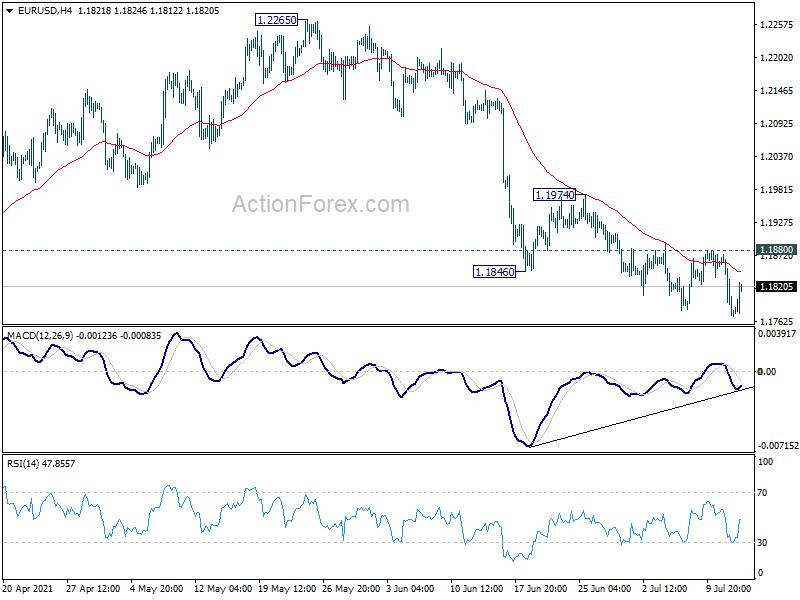
Further fall is expected in EUR/USD with 1.1880 resistance intact. Current decline from 1.2265, as the third leg of correction from 1.2348, would target 1.1703 support. On the upside, though, break of 1.1880 resistance should indicate short term bottoming, and bring stronger rebound to 1.1974 resistance first.
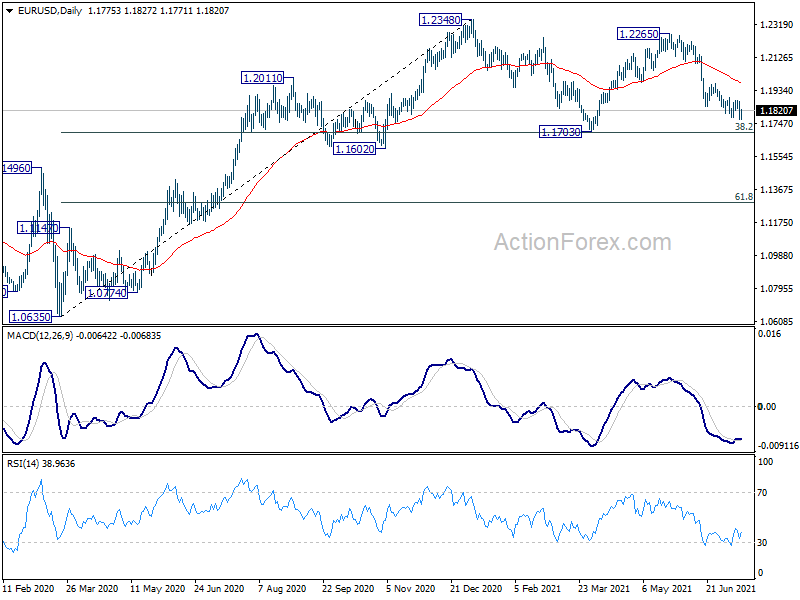
In the bigger picture, rise from 1.0635 is seen as the third leg of the pattern from 1.0339 (2017 low). Further rally could be seen to cluster resistance at 1.2555 next, (38.2% retracement of 1.6039 to 1.0339 at 1.2516). This will remain the favored case as long as 1.1602 support holds. Reaction from 1.2555 should reveal underlying long term momentum in the pair. However sustained break of 1.1602 will argue that the rise from 1.0635 is over, and turn medium term outlook bearish again.
GBP/USD Mid-Day Outlook
Daily Pivots: (S1) 1.3776; (P) 1.3840; (R1) 1.3881; More....
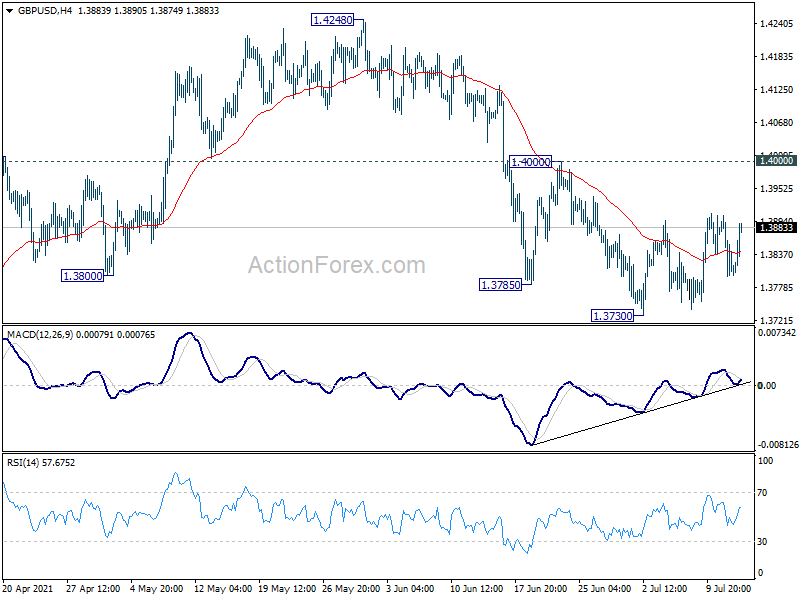
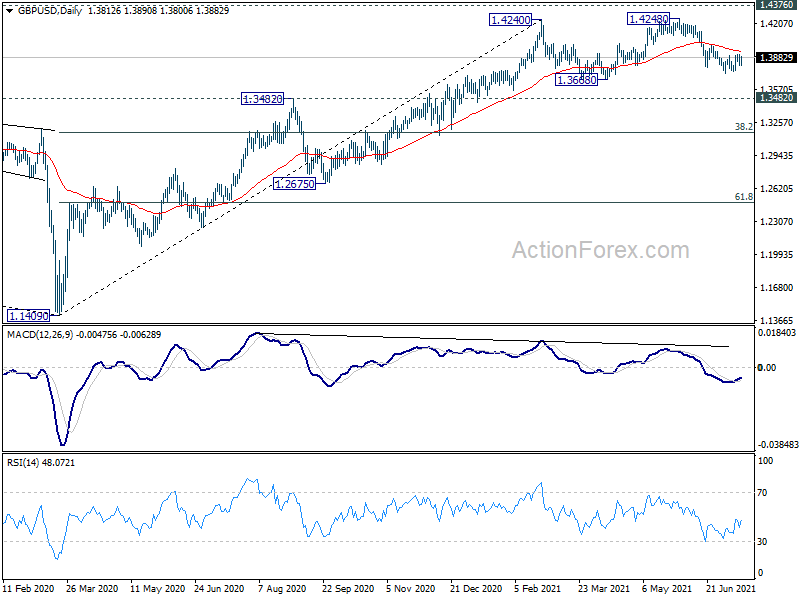
Range trading continues in GBP/USD and intraday bias remains neutral at this point. On the downside, break of 1.3730 will resume the fall from 1.4248, as the third leg of the consolidation pattern from 1.4240, to 1.3668 support and possibly below. On the upside, break of 1.4000 will turn bias back to the upside for retesting 1.4240/8 resistance zone instead.
In the bigger picture, as long as 1.3482 resistance turned support holds, up trend from 1.1409 should still continue. Decisive break of 1.4376 resistance will carry larger bullish implications and target 38.2% retracement of 2.1161 (2007 high) to 1.1409 (2020 low) at 1.5134. However, firm break of 1.3482 support will argue that the rise from 1.1409 has completed and bring deeper fall to 1.2675 support and below.
USD/JPY Mid-Day Outlook
Daily Pivots: (S1) 110.34; (P) 110.50; (R1) 110.79; More...
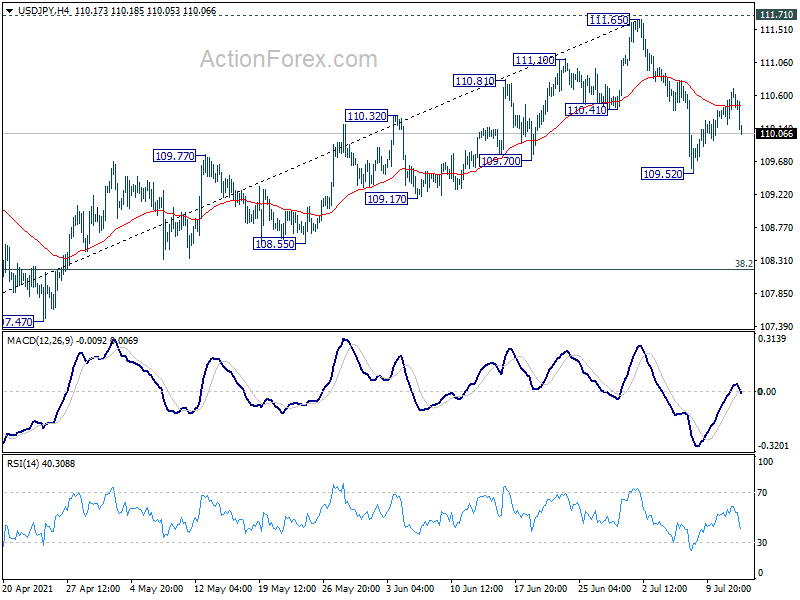
USD/JPY drops notably in early US session but stays above 109.52 support. Intraday bias remains neutral fist. Risk stays mildly on the downside with 111.65 resistance intact. On the downside, break of 109.52, and sustained trading below 55 day EMA (now at 109.85) will suggest that it's at least correcting the rise from 102.58. Deeper fall would be seen to 38.2% retracement of 102.58 to 111.65 at 108.18 next.
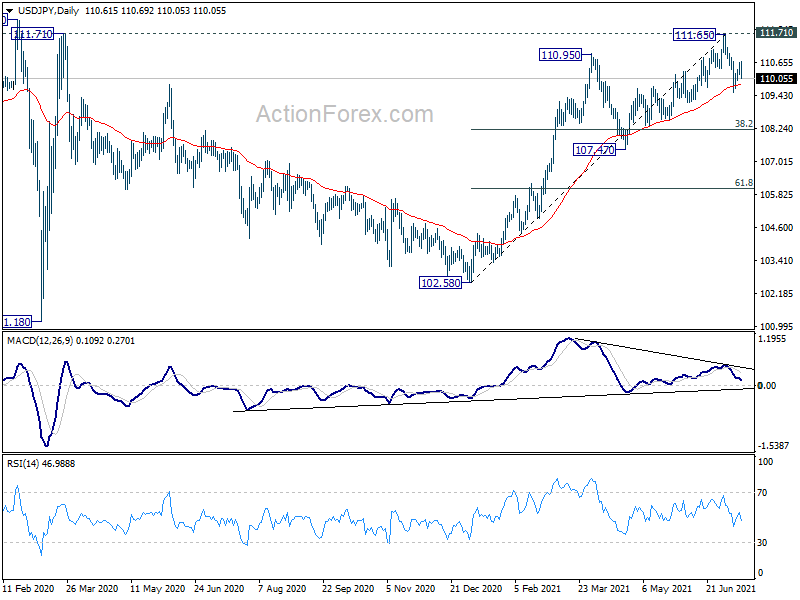
In the bigger picture, medium term outlook is staying neutral with 111.71 resistance intact. Though, as notable support was seen from 55 day EMA, rise from 102.58 is mildly in favor to extend higher. Decisive break of 111.71/112.22 resistance will suggest long term bullish reversal. Rise from 101.18 could then target 118.65 resistance (Dec 2016) and above. However, sustained break of 55 day EMA would revive some medium term bearishness, and open up deep fall back towards 102.58 support.
USD/CHF Mid-Day Outlook
Daily Pivots: (S1) 0.9153; (P) 0.9177; (R1) 0.9211; More....
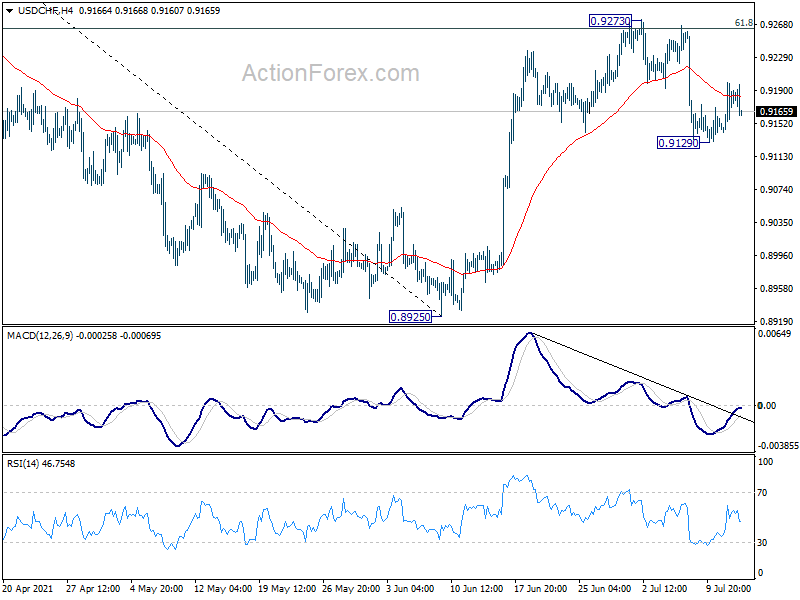
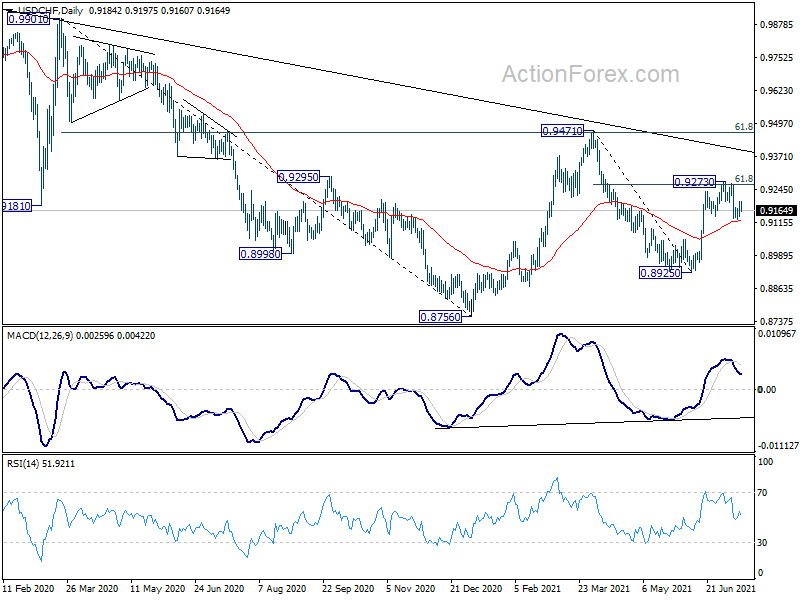
USD/CHF weakens after failing to sustain above 4 hour 55 EMA, but downside is contained well above 0.9129 support. Intraday bias remains neutral first. Risk is mildly on the downside with 0.9273 resistance intact. On the downside, sustained trading below 55 day EMA (now at 0.9126) will affirm the case that rebound from 0.8925 has completed at 0.9273. Deeper fall would then be seen back to retest 0.8925 low. On the upside though, break of 0.9273 and sustained trading above 61.8% retracement of 0.9471 to 0.8925 at 0.9262 will target 0.9471 resistance next.
In the bigger picture, medium term outlook is currently neutral with focus on 0.9471 resistance. Sustained break there will indicate completion of whole decline from 1.0342 (2016 high). Medium term outlook will be turned bullish for a test on 1.0342 high. But, rejection by 0.9471 again will revive bearishness for another fall through 0.8756 low.
Gold Upside Breakout, Dollar Back Under Pressure
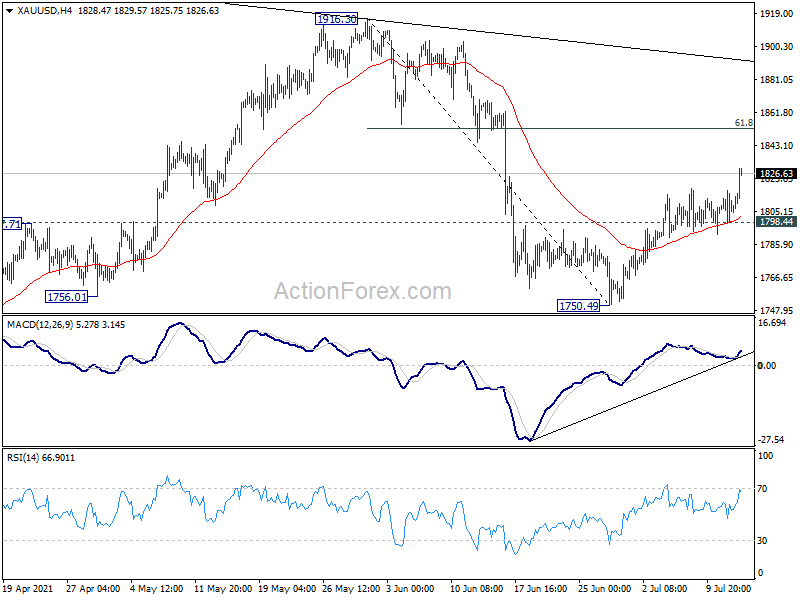
Dollar is back under pressure again as risk-on sentiments seem to be back as indicated by US futures. Swiss Franc and Euro are not too far away, as both turn softer, while Yen is following. On the other hand, New Zealand Dollar continues to lead the way after RBNZ's halt of asset purchase program. Canadian Dollar is also firm as focus turns to BoC policy decision, at which further tapering should be announced.
Technically, Gold's upside breakout suggests that rebound from 1750.49 has resumed. Notable support was seen from 4 hour 55 EMA, which is a near term bullish sign. Further rise is expected as long as 1798.44 support holds, targeting 61.8% retracement of 1916.30 to 1750.49 at 1852.96. Sustained break there will pave the way to 1916.30 key structural resistance. Such development could be an indication of more downside in Dollar ahead.
In Europe, at the time of writing, FTSE is down -0.38%. DAX is up 0.04%. CAC is down -0.07%. Germany 10-year yield is down -0.0145 at -0.308. Earlier in Asia, Nikkei dropped -0.38%. Hong Kong HSI dropped -0.63%. China Shanghai SSE dropped -1.07%. Singapore Strait Times dropped -0.43%. Japan 10-year JGB yield dropped -0.0047 to 0.021.
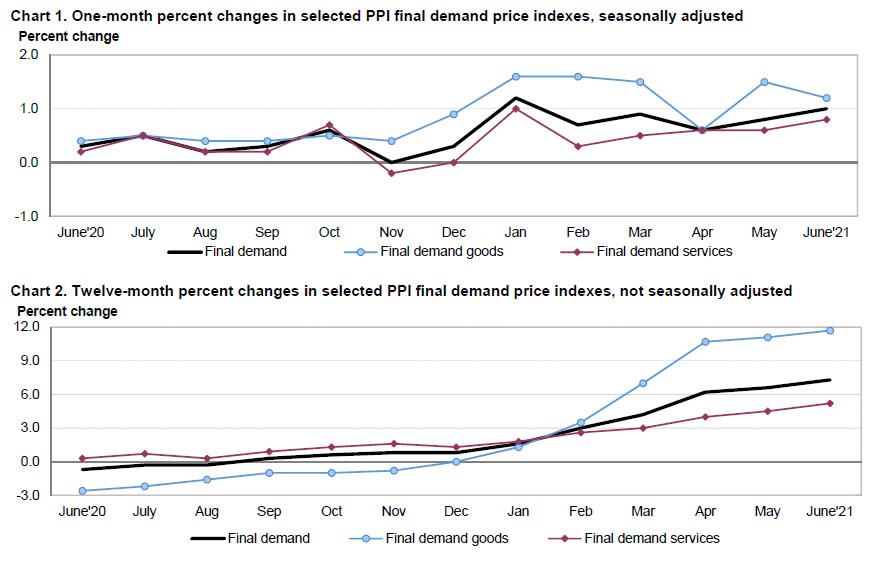
US PPI accelerated to new record of 7.3% yoy
US PPI for final demand rose 1.0% mom in June, above expectation of 0.5% mom. For the 12 month period, PPI accelerated to 7.3% yoy, up from 6.6% yoy, above expectation of 7.1% yoy. That's the largest annual rise since 12-month data were first calculated in November 2021. PPI core came in at 1.0% mom, 5.6% yoy, above expectation of 0.4% mom, 5.3% yoy.
From Canada, manufacturing sales dropped -0.6% mom in May, better than expectation of -1.1% mom.
BoE Cunliffe not expecting smooth reopening, but with bumps in way
BoE Deputy Governor Jon Cunliffe told CNBC, "one shouldn't expect the reopening of the economy to be smooth, this is not something that you can just close down and reopen without bumps in the way." He admitted, "we're seeing a surge in demand. We're seeing some constrictions in supply that's driving inflation."
"Are these factors that the economy will then adjust, supply will recover and adjust, and demand after the initial burst will cool off, or is this something more persistent that will become embedded in people's expectations?" he questioned. But he emphasized that BoC will try to analyze the situation as the economy returns tor normal.
UK CPI jumped to 2.5% yoy in Jun, highest since Aug 2018
UK CPI surged to 2.5% yoy in June, up from 2.1% yoy, above expectation of 2.2% yoy. That's also the highest reading since August 2018. Core CPI also rose to 2.3% yoy, up from 2.0% yoy, above expectation of 2.0% yoy. RPI rose to 3.9% yoy, up from 3.3% yoy, above expectation of 3.4% yoy.
Also released, PPI input came in at -0.1% mom, 9.1% yoy in June, versus expectation of 1.2% mom, 10.8% yoy. PPI output was at 0.4% mom, 0.6% yoy, versus expectation of 4.3% mom, 4.8% yoy. PPI core output was at 0.3% mom, 2.7% yoy, versus expectation of 0.3% mom, 3.2% yoy.
Eurozone industrial production dropped -1.0% mom in May, EU down -0.9% mom
Eurozone industrial production dropped -1.0% mom in May, much worse than expectation of 0.2% mom rise. Production of non-durable consumer goods fell by -2.3%, energy by -1.9%, capital goods by -1.6% and intermediate goods by -0.2%, while production of durable consumer goods rose by 1.6%.
EU industrial production dropped -0.9% mom. Among Member States for which data are available, the largest decreases were registered in Romania (-8.5%), Greece (-4.7%) and Ireland (-4.6%). The highest increases were observed in Lithuania (+7.7%), Hungary (+3.4%) and Finland (+2.2%).
Australia Westpac consumer sentiment rose to 108.8 despite NSW lockdown
Australia Westpac-Melbourne Institute Consumer Sentiment rose 1.5% to 108.8 in July, up from 107.2. Confidence has "held up overall" despite a sharp fall in New South Wales, as Victoria and Western Australia recorded strong "bounce-backs".
Westpac said RBA is not expected announce any change at August 3 meeting. The focus would mainly be on the Statement on Monetary Policy on August 6. RBA would have a few more weeks to assess the impact of the lockdown in Sydney.
RBNZ halts asset purchases
RBNZ surprised the markets as it announced to halt the additional asset purchases under the Large Scale Asset Purchase (LSAP) program by July 23. Meanwhile, OCR was kept unchanged at 0.25%. and the Funding for Lending Program was maintained. The Committee agreed that "the level of monetary stimulus could now be reduced to minimise the risk of not meeting its mandate."
The central bank said the economy "remains robust" despite ongoing impact from international border restrictions. Aggregate economic activity is already "above its pre-COVID-19 level". It expected "near-term spikes" in headline CPI in Q2 and Q3, reflecting "one-off" or "temporary" factors. In the absence of any further significant shocks, "more persistent consumer price inflation pressure is expected to build over time due to rising domestic capacity pressures and growing labour shortages".
USD/CHF Mid-Day Outlook
Daily Pivots: (S1) 0.9153; (P) 0.9177; (R1) 0.9211; More....
USD/CHF weakens after failing to sustain above 4 hour 55 EMA, but downside is contained well above 0.9129 support. Intraday bias remains neutral first. Risk is mildly on the downside with 0.9273 resistance intact. On the downside, sustained trading below 55 day EMA (now at 0.9126) will affirm the case that rebound from 0.8925 has completed at 0.9273. Deeper fall would then be seen back to retest 0.8925 low. On the upside though, break of 0.9273 and sustained trading above 61.8% retracement of 0.9471 to 0.8925 at 0.9262 will target 0.9471 resistance next.
In the bigger picture, medium term outlook is currently neutral with focus on 0.9471 resistance. Sustained break there will indicate completion of whole decline from 1.0342 (2016 high). Medium term outlook will be turned bullish for a test on 1.0342 high. But, rejection by 0.9471 again will revive bearishness for another fall through 0.8756 low.
Economic Indicators Update
| GMT | Ccy | Events | Actual | Forecast | Previous | Revised |
|---|---|---|---|---|---|---|
| 00:30 | AUD | Westpac Consumer Confidence Jul | 1.50% | -5.20% | ||
| 02:00 | NZD | RBNZ Interest Rate Decision | 0.25% | 0.25% | 0.25% | |
| 04:30 | JPY | Industrial Production M/M May F | -6.50% | -5.90% | -5.90% | |
| 06:00 | GBP | CPI M/M Jun | 0.50% | 0.20% | 0.60% | |
| 06:00 | GBP | CPI Y/Y Jun | 2.50% | 2.20% | 2.10% | |
| 06:00 | GBP | Core CPI Y/Y Jun | 2.30% | 2.00% | 2.00% | |
| 06:00 | GBP | RPI M/M Jun | 0.70% | 0.30% | 0.30% | |
| 06:00 | GBP | RPI Y/Y Jun | 3.90% | 3.40% | 3.30% | |
| 06:00 | GBP | PPI Input M/M Jun | -0.10% | 1.20% | 1.10% | 1.20% |
| 06:00 | GBP | PPI Input Y/Y Jun | 9.10% | 10.80% | 10.70% | 10.40% |
| 06:00 | GBP | PPI Output M/M Jun | 0.40% | 0.60% | 0.50% | 0.80% |
| 06:00 | GBP | PPI Output Y/Y Jun | 4.30% | 4.80% | 4.60% | 4.40% |
| 06:00 | GBP | PPI Core Output M/M Jun | 0.30% | 0.30% | 0.40% | 0.70% |
| 06:00 | GBP | PPI Core Output Y/Y Jun | 2.70% | 3.20% | 2.70% | 2.30% |
| 09:00 | EUR | Eurozone Industrial Production M/M May | -1.00% | 0.20% | 0.80% | 0.60% |
| 12:30 | USD | PPI M/M Jun | 1.00% | 0.50% | 0.80% | |
| 12:30 | USD | PPI Y/Y Jun | 7.30% | 7.10% | 6.60% | |
| 12:30 | USD | PPI Core M/M Jun | 1.00% | 0.40% | 0.70% | |
| 12:30 | USD | PPI Core Y/Y Jun | 5.60% | 5.30% | 4.80% | |
| 12:30 | CAD | Manufacturing Sales M/M May | -0.60% | -1.10% | -2.10% | |
| 14:00 | CAD | BoC Interest Rate Decision | 0.25% | 0.25% | ||
| 14:30 | USD | Crude Oil Inventories | -4.3M | -6.9M | ||
| 15:15 | CAD | BoC Press Conference | ||||
| 18:00 | USD | Fed's Beige Book |
US PPI accelerated to new record of 7.3% yoy
US PPI for final demand rose 1.0% mom in June, above expectation of 0.5% mom. For the 12 month period, PPI accelerated to 7.3% yoy, up from 6.6% yoy, above expectation of 7.1% yoy. That's the largest annual rise since 12-month data were first calculated in November 2021. PPI core came in at 1.0% mom, 5.6% yoy, above expectation of 0.4% mom, 5.3% yoy.
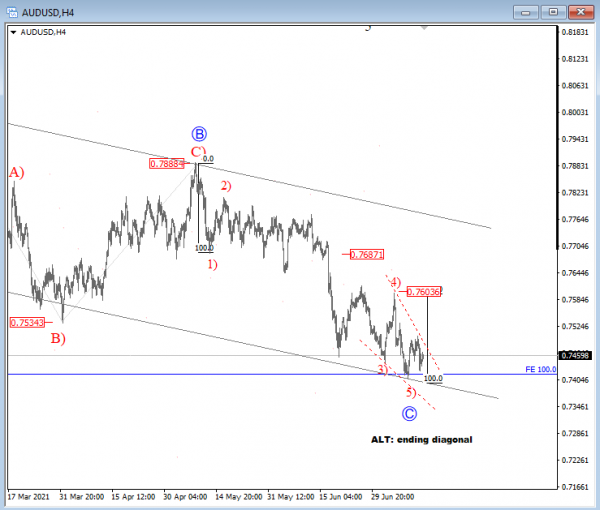
AUD/USD Has Strong Support at 0.7360
AUDUSD is not really clear at the moment; bulls are still struggling after reaching a low last week at 0.7400.
We see slow price action now so I am considering another wave count; an ending diagonal where the final leg is missing, but it may cause a strong bounce after that fifth wave drop. Support is then around 0.7360.
AUD/USD 4h Elliott Wave analysis chart
BoE Cunliffe not expecting smooth reopening, but with bumps in way
BoE Deputy Governor Jon Cunliffe told CNBC, "one shouldn't expect the reopening of the economy to be smooth, this is not something that you can just close down and reopen without bumps in the way." He admitted, "we're seeing a surge in demand. We're seeing some constrictions in supply that's driving inflation."
"Are these factors that the economy will then adjust, supply will recover and adjust, and demand after the initial burst will cool off, or is this something more persistent that will become embedded in people's expectations?" he questioned. But he emphasized that BoC will try to analyze the situation as the economy returns tor normal.
NZD Soars As RBNZ Stops Asset Purchases
The New Zealand dollar has soared on Wednesday, punching above the symbolic 70-level. Currently, NZD/USD is trading at 0.7015, up 1.07% on the day.
Suddenly, the hawks are everywhere
This was the caption in one financial publication this morning, as the Reserve Bank of New Zealand surprised the markets by announcing that it would halt asset purchases as of July 23. This opens the door to reducing the LSAP stimulus programme and has raised speculation over a rate hike.
The central bank has become more hawkish, and the rate statement made no mention of inflation and employment targets requiring “considerable time and patience”, which was stated in the previous rate statement. Instead, the statement noted “that the significant level of monetary support in place since mid-2020 could be reduced sooner”.
Will we see a rate hike in August? With the halt in asset purchases, policymakers are now free to raise the Official Cash Rate from the record low level of 0.25%. A rate hike is just an option, and the direction that the bank chooses will depend greatly on two key releases in the coming weeks – CPI for Q2 (July 16th) and the employment report (August 4th).
The RBNZ has set an inflation target in the 1-3% range, and if CPI comes in above 3%, the bank will face pressure to raise rates. On the employment front, unemployment is currently at a low level of 4.7%, and if there are signs of a shortage of workers and pressure on wages, then policymakers will be giving serious consideration to a rate hike.
Attention will shift from the RBNZ to inflation, with New Zealand releasing Q2 CPI on Thursday (22:45 GMT). Inflation is expected to jump to 2.8% YoY, up sharply from 1.5% beforehand.
NZD/USD Technical
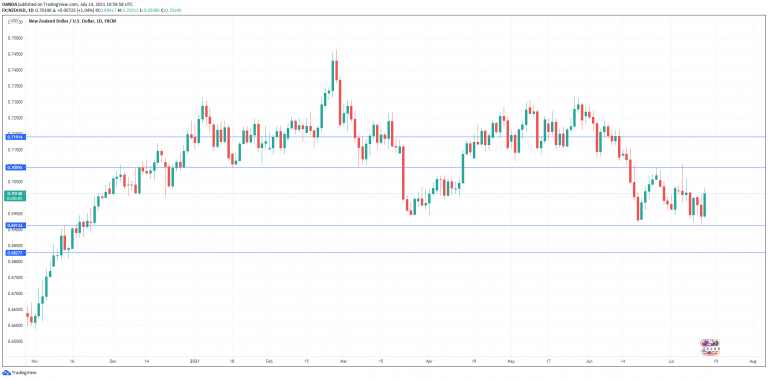
- There is resistance at 0.7095. Above, we find resistance at 0.7191
- On the downside, there is support at 0.6913 which is protecting the round number of 0.6900. Below there is support at 0.6827
NZDUSD Stabilizes Below 200-MA, Negative Pressures Endure
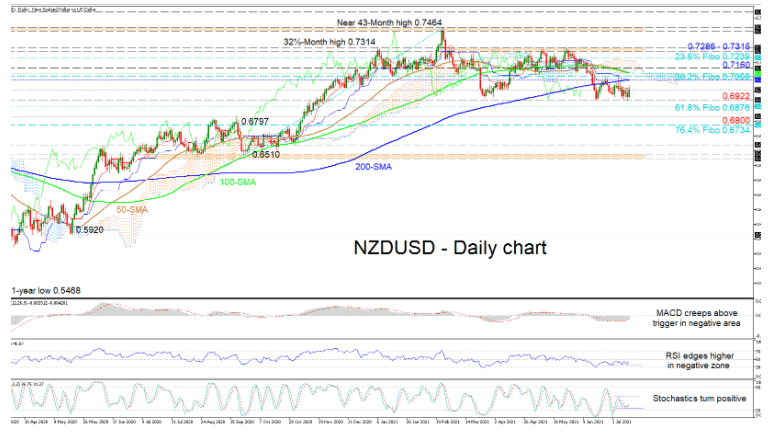
NZDUSD is ranging around the 0.7000 hurdle ever since the pair manoeuvred below the 200-day simple moving average (SMA). Although the pair is exhibiting a slight negative preference, buyers are currently labouring to return back above the 0.7000 mark. Endorsing negative price tendencies are the converged 50- and 100-day SMAs, which are dipping, and are looking positioned to complete a bearish overlap of the 200-day SMA.
The negatively charged Ichimoku lines are also gliding lower, signalling that sellers are still ahead. Nonetheless, the short-term oscillators are conveying growing positive momentum. The MACD, in the negative zone, is cruising above its red trigger line, while the RSI is heading up towards the 50 level. The stochastic %K line has jumped back above its %D line, implying positive price action is rising.
If the price decisively navigates above the 0.7000 obstacle and the adjoining red Tenkan-sen line, it may encounter an initial zone of upside limitations, which could prove difficult to conquer, existing between the 200-day SMA at 0.7071 and the 100-day SMA at 0.7122. Triumphing over this barricade, which also encapsulates the 38.2% Fibonacci retracement of the up leg from 0.6510 until 0.7464, and the Ichimoku cloud, the bulls may then meet the 0.7160 nearby high. Should buyers’ confidence grow, they could propel the price towards the 23.6% Fibo of 0.7239 before challenging the ceiling of 0.7286-0.7315, accompanying a 4½-month sideways market.
Alternatively, a surge of selling orders may steer the price back to the June 18 barrier of 0.6922 and possibly lower to challenge the 61.8% Fibo of 0.6876. If the 61.8% Fibo fails to soften the pace of the descent, the pair could snowball towards the 0.6800 border. Should selling interest persist, the 76.4% Fibo of 0.6734 may then come into focus.
In conclusion, as negative forces have yet to abate NZDUSD is demonstrating a short-term neutral-to-bearish preference below the SMAs and the cloud.