Sample Category Title
CAD/JPY Points To Trend Deterioration
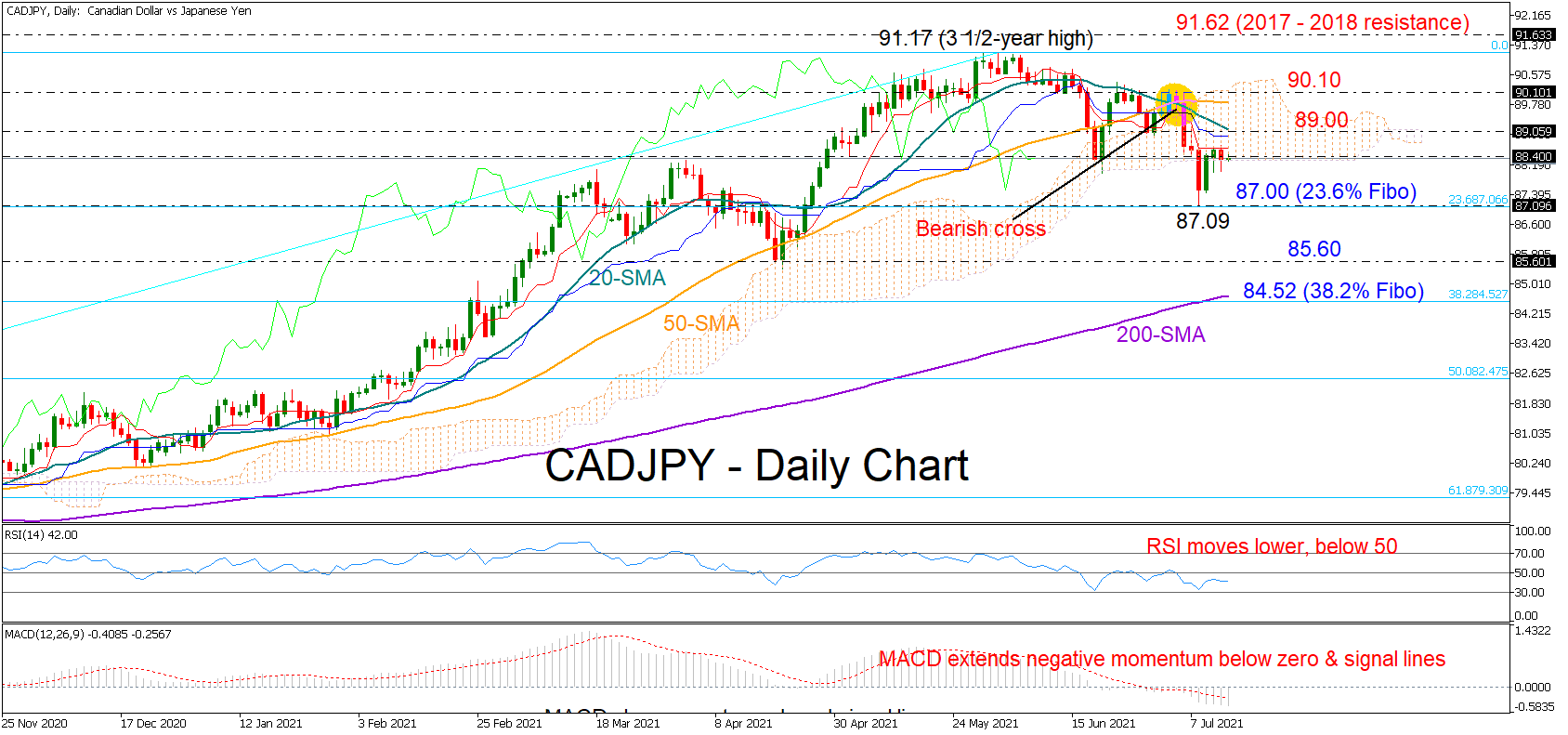
CADJPY stretched the downfall from the 91.17 top to a fresh low of 87.09 last week, downgrading the outlook in the short-term picture. The recent intersection between the 20- and 50-day simple moving averages (SMAs), which is the first since September 2020, is endorsing the bear turn in market trend.
This week, the pair managed to pare some losses but the red Tenkan-sen line is currently blocking the way higher at 88.64, questioning how long the bulls could persist. The downside reversal in the RSI and the negative momentum in the MACD are also raising some caution about the latest rebound.
Should the bears take control, pushing the price back below the Ichimoku cloud, the price could retest the 87.09 low. The 23.6% Fibonacci retracement of the long 73.85 – 91.17 uptrend is positioned around the same level. Hence, any violation here could add more fuel to the selling pressure, driving the price likely towards April’s trough of 85.63. Slightly lower, the 200-day SMA and the 38.2% Fibonacci of 84.45 could be a more important area to watch.
On the upside, traders will keep a close eye on the 20- and 50-day SMAs if the price manages to climb above 88.64. If the bulls claim the 90.10 resistance area too, the door would open again for the 2017 – 2018 ceiling of 91.62.
In brief, the technical picture suggests that the short-term risk for CADJPY remains tilted to the downside, keeping the spotlight on the 87.09 support level.
Note that the Bank of Canada will announce its policy decision today at 14:00 GMT.
GBP/JPY Daily Outlook
Daily Pivots: (S1) 152.36; (P) 152.92; (R1) 153.43; More...
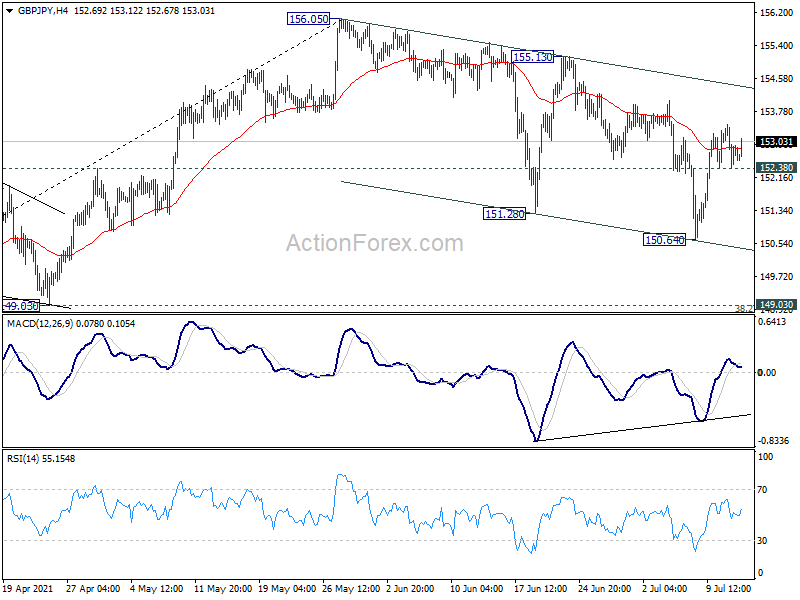
Further rise is still in favor in GBP/JPY with 152.38 minor support intact. Corrective fall from 156.05 could have completed with three waves down to 150.64, on bullish convergence condition in 4 hour MACD. Intraday bias is back on the upside for retesting 155.13/156.05 resistance zone next. On the downside, though, break of 152.38 minor support will dampen the bullish case and turn bias neutral first. In this case, correction from 156.05 might still extend with another falling leg.
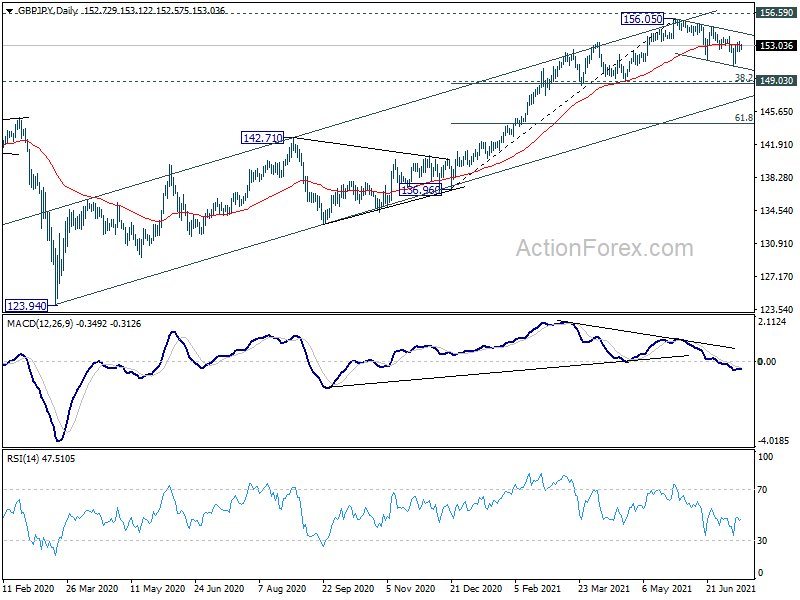
In the bigger picture, rise from 123.94 is seen as the third leg of the pattern from 122.75 (2016 low). Focus remains on 156.59 resistance (2018 high). Sustained break there should confirm long term bullish trend reversal. Next target is 61.8% retracement of 195.86 (2015 high) to 122.75 at 167.93. On the downside, break of 149.03 support is needed to be the first sign of completion of the rise from 123.94. Otherwise, outlook will remain bullish even in case of deep pull back.
EUR/JPY Daily Outlook
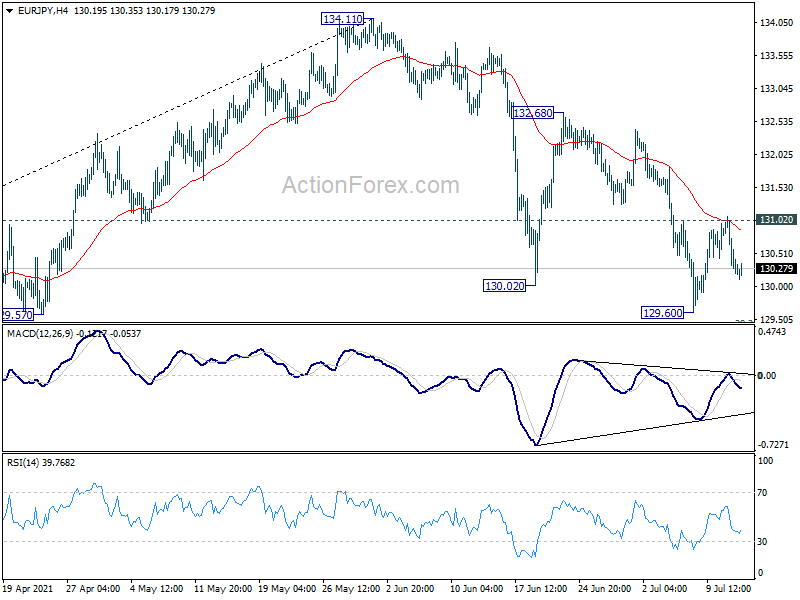
Daily Pivots: (S1) 129.98; (P) 130.54; (R1) 130.85; More....
EUR/JPY drops notably after rejection by 131.02 resistance and 4 hour 55 EMA. But downside stays above 129.60 support. Intraday bias remains neutral first. On the upside, firm break of 131.02 resistance will argue that corrective fall from 134.11 might have completed with three waves down to 129.60 already, on bullish convergence condition in 4 hour MACD. Intraday bias will be turned back to the upside for 132.68 resistance and above. On the downside, break of 129.60 will resume the the correction. But we'd expect strong support from 38.2% retracement of 121.63 to 134.11 at 129.34 to bring rebound.
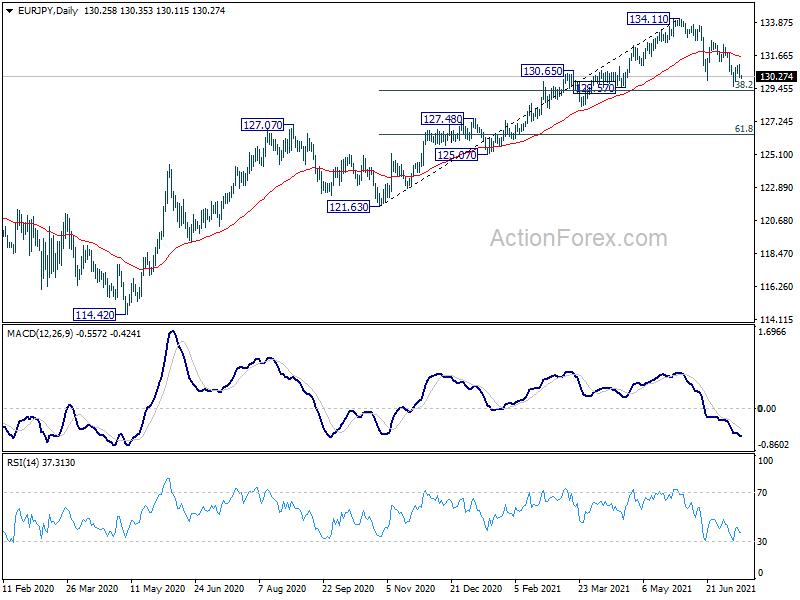
In the bigger picture, rise from 114.42 is seen as a medium term rising leg inside a long term sideway pattern. Next target is 137.49 (2018 high). Decisive break there will open up the possibility that it's indeed resuming the up trend from 94.11 (2012 low). For now, outlook will stay bullish as long as 127.07 resistance turned support holds, in case of pull back.
Asian Equities Edge Lower
Asian markets cautious ahead of Powell testimony
Wall Street closed slightly lower overnight, as stellar bank earnings results could not overcome the nerves caused by much higher than forecast US inflation data. Markets seem determined to wait for the Powell congressional testimony this evening before deciding whether more decisive inflation-related surgery is required. The net effect has been to push Asian markets lower after previous solid sessions, as investors take some risk off the table.
Muddying the waters have been more geopolitical noises between China and the US overnight. Hong Kong appears to be funnelling China IPOs towards Hong Kong, while President Biden warned about the risks of US companies doing business in Hong Kong and other parts of the mainland. It seems more restrictions are on the way from the US, and combined with US inflation nerves, the Shanghai Composite has eased by 0.80%, with the CSI 300 falling 0.90%. Hong Kong is also 0.80% lower.
Meanwhile, the Nikkei 225 has eased by 0.30% and the Kospi by 0.20%. Taipei is flat, with Singapore and Kuala Lumpur down 0.20%, with Jakarta and Bangkok reducing by 0.30%. By contrast, a federal support package for lockdown-hit Sydney and NSW has steadied the ship in Australia, with both the ASX 200 and All Ordinaries 0.10% higher.
European equities are likely to play catchup to Wall Street overnight and open slightly lower today. But the overriding impression I have is that today’s gentle retreat in Asia looks more precautionary. That sentiment could change this evening if Mr Powell starts saying taper too much, in which case, Asian markets are likely to have a tough day at the office tomorrow.
After Tuesday’s surge in US inflation, the markets will be looking for some insights from Powell’s testimony. Another juicy inflation reading for July could make August’s Jackson Hole symposium and the September FOMC key inflexion points for financial markets for 2021
EUR/GBP Daily Outlook
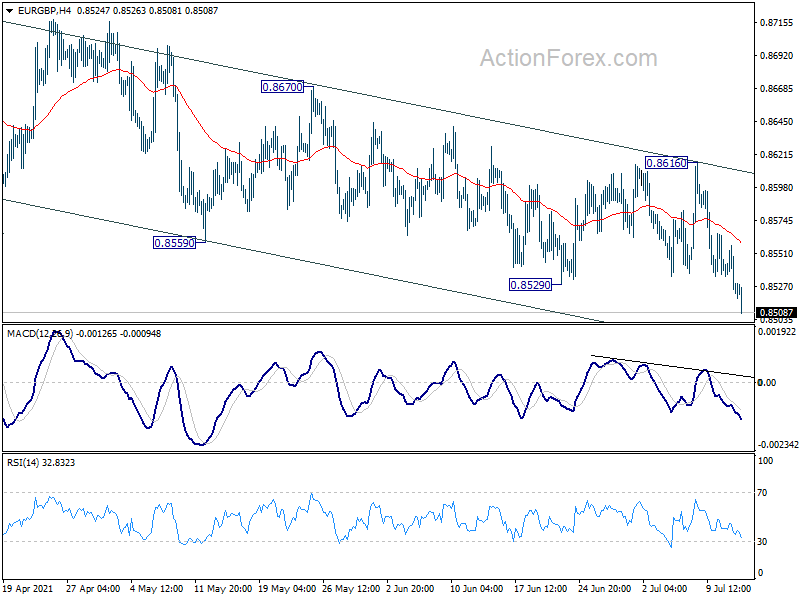
Daily Pivots: (S1) 0.8513; (P) 0.8535; (R1) 0.8547; More...
EUR/GBP's choppy decline from 0.8718 resumes by taking out 0.8529 support. Intraday bias is back on the downside for retesting 0.8470 low. On the upside, break of 0.8616 resistance is needed to indicate completion of the choppy fall. Otherwise, deeper decline will remain in favor in case of recovery.
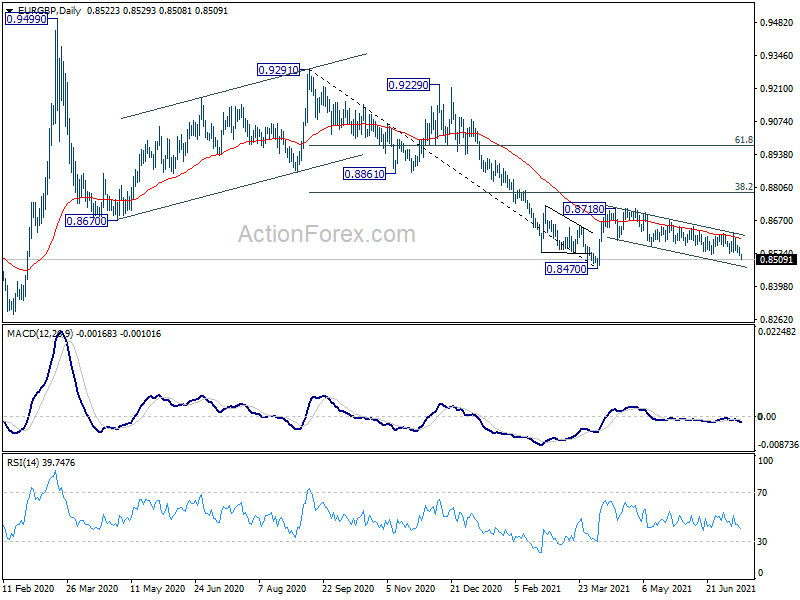
In the bigger picture, price actions from 0.9499 are still seen as developing into a corrective pattern. That is, up trend from 0.6935 (2015 low) would resume at a later stage. This will remain the favored case as long as 0.8276 support holds. However, firm break of 0.8276 support will suggest that rise from 0.6935 has completed and turn medium term outlook bearish.
Kiwis Do Fly
I do take pleasure in being a kiwi on many levels, one of which is the refreshing habit kiwis have of telling it like it is. Life really is much simpler when people say what they mean in this kiwi’s mind. Clearly, the Reserve Bank of New Zealand (RBNZ) feel the same as they took the monetary meat cleaver to quantitative easing in the just-announced Monetary Policy Decision.
RBNZ announces end of QE
The minutes are efficiently released with the decision, and the RBNZ has taken the “least regrets” decision to cease their quantitative easing programme from next week. No multi-month hand-holding and fluffy language or first date hints. From next week they stop. Now that’s what I call a taper. To be sure, the RBNZ is still dovish. The MPC expect spikes in inflation in the coming months to be transitory, aka the Fed. Inflation will run below target in the medium term, so we can expect interest rates to remain lower for longer.
Those details were lost on the markets, though, as traders looked at the headlines and promptly sent the kiwi higher, proving that the flightless bird has wings. NZD/USD jumped 0.85% to 0.7005, and AUD/NZD falling 0.70% to 1.0650. Whether the market looks below the bonnet of the statement and sustains those gains is another story, of course. Federal Reserve Chairman Jerome Powell begins his two-day congressional testimony tonight, and much will depend on how transitionally transitional he is on inflation after yesterday’s blockbuster US CPI data.
Before we come to that, it is worth noting that French and German CPI’s yesterday both came in on expectations, with no signs of overheating in Europe. But let’s be honest, only the Germans, Austrians and Dutch have been worried about that in Europe at any time in the last 20 years. The sharp divergence between the US and French/German CPI prints saw EUR/USD unceremoniously bashed overnight.
Circling back to the US and inflation, Core Inflation exploded higher (as did the headline), to 4.50% overnight, the highest since 1991 apparently. Spiralling used car prices accounted for a goodly proportion of the increase, and once rental car companies stop buying them, they should mollify. However, rents and other measures also increased, with oil prices impacting the headline number. Fast-moving small business surveys and GDP Nowcasts also suggest that pricing pressures remain in the US, making it harder to maintain the Fed’s transitory versus sticky inflation mantra.
Reading two well-respected sets of economists I follow overnight and this morning on the US inflation data, the tomato tomatoes, transitory or sticky inflation outlook is as stark as ever. Like a bi-partisan bill in Congress, they are as far apart as ever. Never has it been harder to ask how many economists it takes to change a lightbulb. The answer is many or none. The lights are now all LEDs with long lives, so they have to go away and adjust their models. But hang you say, that’s not a real answer. Exactly.
Mr Powell should give us some insight into his and the Fed’s thinking this evening. And depending on what he says, the US bond market malaise, only gently interrupted overnight, may or may not continue. Similarly, the overnight US dollar gains post-inflation data may, or may not continue. Another juicy inflation reading for July could make August’s Jackson Hole symposium and the September FOMC key inflexion points for financial markets for 2021. The Fed doesn’t have the RBNZ luxury of deciding to tell the markets they’re tapering from next week. It would be good for vol though.
Nowhere is probably going to be more nervous that the Fed finally blinks than Asia. With much of the region from Australia to Japan down the Covid-19 rabbit hole, emerging Asia, in particular, is in no position to tighten monetary policy to maintain those soft US dollar pegs if the US monetary policy direction starts diverging from the still ultra-soft one across Asia. The China RRR cut on Friday muddies those waters more, although I suspect China is quite happy to see some yuan weakness.
The data releases came thick and fast for the Asia Pacific this morning but didn’t set the world on fire. Australia’s Westpac Consumer Confidence rose slightly despite the soon-to-be-extended Sydney lockdown. South Korean employment held steady at 3.70%, while Japan’s Reuters Tankan Index rose slightly to 25% for July, with exports rising but domestic demand fading. Similarly, Singapore’s Q2 Advanced GDP fell by 2.0%, indicating its recovery is slowing. Fitch overnight downgraded the Philippines credit rating outlook to negative, and the Bank of Indonesia Governor revised the country’s GDP outlook lower for 2021 this week.
All-in-all, Asia has a few challenges now. A potentially slowing recovery across the region as higher prices, components shortages and logistical challenges bite. ASEAN continues to face a Covid-19 nightmare which is now a real danger to growth forecasts. Malaysia can also throw in a messy political situation that is impressive, even by its Game of Thrones standards.
The last thing ASEAN and Asia, in general, need right now is the prospect of tightening monetary policy in the US, when policy settings in Asia can and must remain ultra-easy. Hopefully, the region dodges a Fed bullet tonight, but if Mr Powell talks taper, we could be in for an extended period of Asian currency and equity weakness.
Inflation data from India this afternoon may give more inflationary/stagflationary food for thought as it emerges from its Covid-19 tragedy. UK inflation today will probably print benignly around 2.20% YoY, with the PPI and RPI data holding more interest, particularly with the government pushing on for full reopening from next week. Sterling could get an inflationary jolt higher. Finally, spare a thought for the Turkish Central Bank Governor, who announces the latest TCMB Rate Decision this evening. Undoubtedly the most thankless job in central banking.
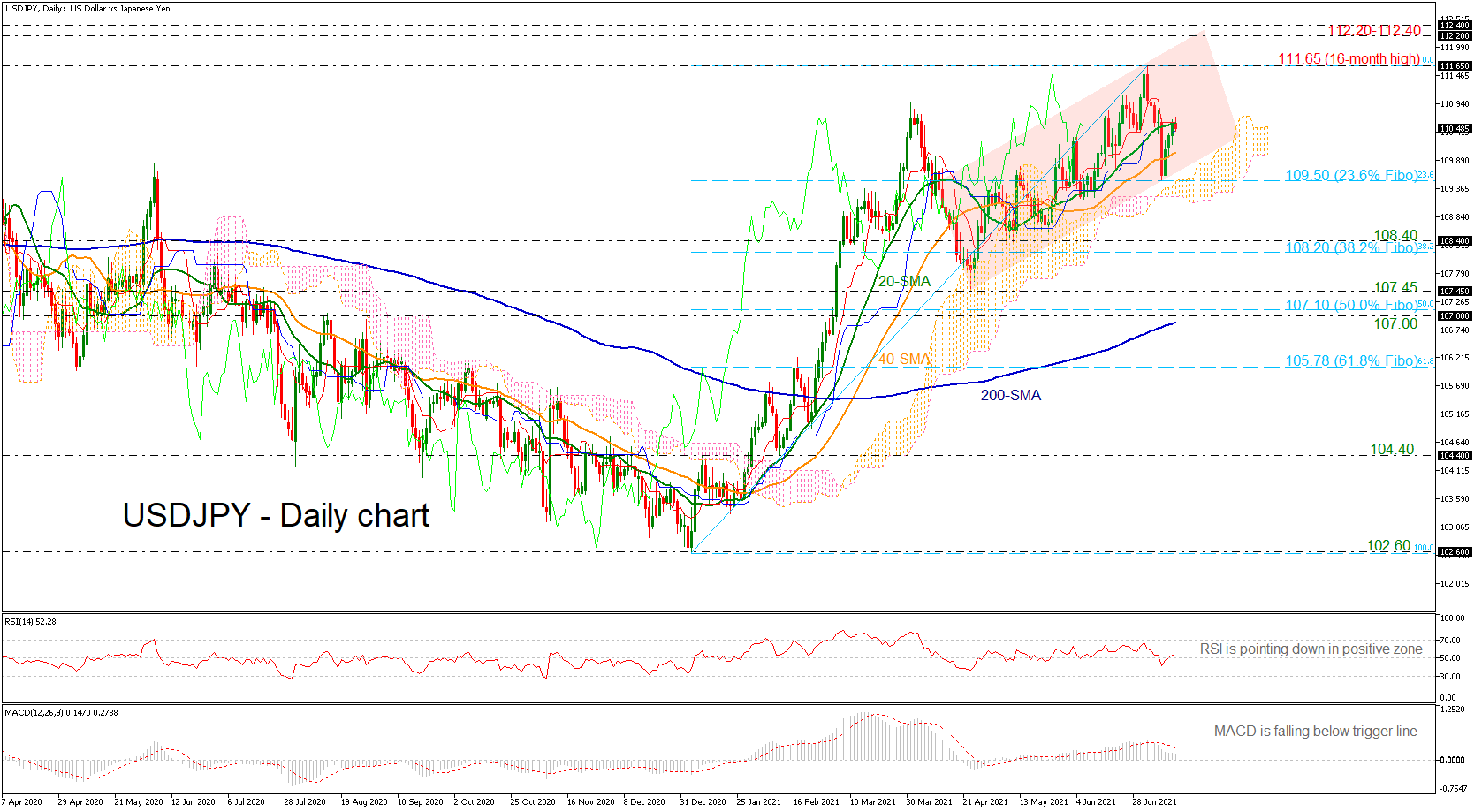
USDJPY Fails To Beat 20-Day SMA, Holds In Ascending Channel
USDJPY is facing strong resistance at the 20-day simple moving average (SMA) near 110.60, looking set for a red session after three consecutive green days.
Previously, the 23.6% Fibonacci retracement level of the up leg from 102.60 to 111.65 at 109.50 managed to defend the bulls, holding the price within an ascending channel.
Looking at the technical indicators, the RSI is pointing south, ready to cross back below its 50 neutral mark, while the MACD is losing momentum in the positive region.
If the pair successfully jumps above the short-term 20-day SMA, the next target could be the 16-month peak of 111.65. Higher, the pair could revisit the 112.20-112.40 zone.
On the flip side, a tumble beneath the 40-day SMA could take the price until the 23.6% Fibo of 109.50 and then towards the lower surface of the Ichimoku cloud at 109.08. Breaking these lines, the 108.40 level and the 38.2% Fibo of 108.20 could come into the spotlight, shifting the bias to neutral.
All in all, USDJPY has been in a rising channel since April 23. Any decline below the cloud may switch the broader outlook to neutral and a drop beneath the 200-day SMA could turn the view to bearish.
EUR/AUD Daily Outlook
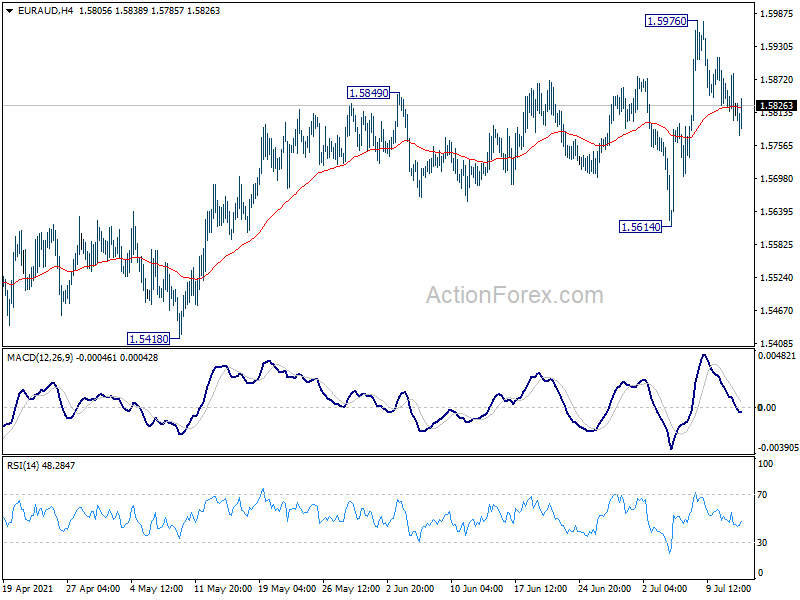
Daily Pivots: (S1) 1.5785; (P) 1.5835; (R1) 1.5868; More...
Intraday bias in EUR/AUD remains neutral first as consolidation from 1.5976 is still extending. Another rise could be seen with 1.5614 support intact. On the upside, break of 1.5976 will resume the choppy rise from 1.5250 to 1.6033 key support turned resistance next. Sustained break there will argue that longer term trend has reversed, and target 1.6827 resistance for confirmation.
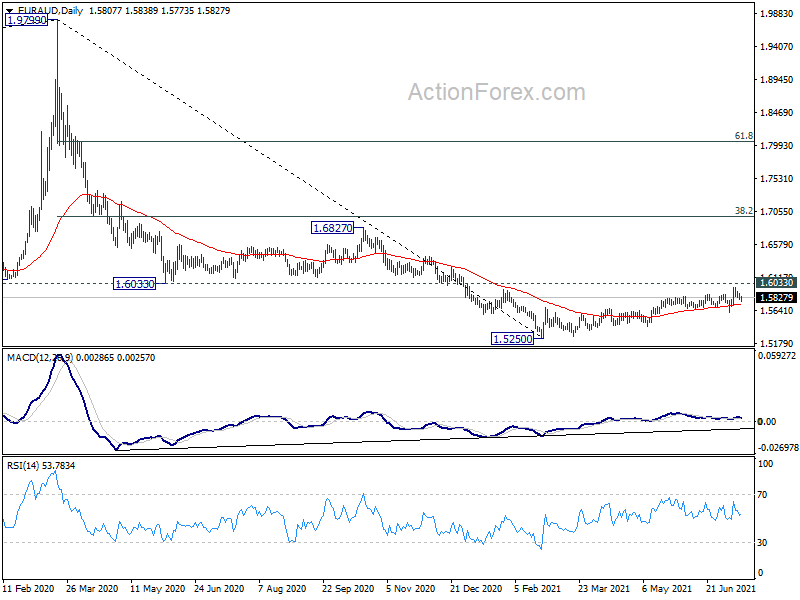
In the bigger picture, outlook stays bearish with 1.6033 support turned resistance intact for now. Fall from 1.9799, as a correction to to long term up trend from 1.1602 (2012 low) is still in favor to resume through 1.5250 later. However, However, firm break of 1.6033 will argue that such decline has completed. Stronger rebound would then be seen 38.2% retracement of 1.9799 to 1.5250 at 1.6988.
BTCUSD Could Target $31,000
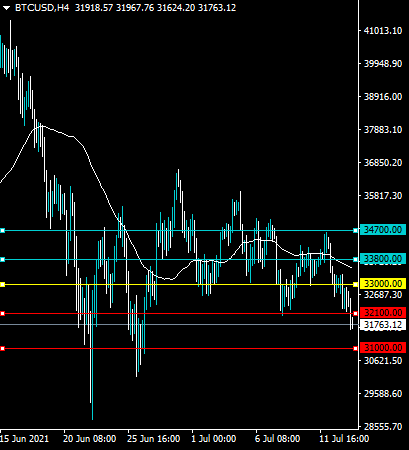
BTCUSD has fallen below the $32,000 support level after another Chinese province announced that they are banning Bitcoin mining. The BTCUSD pair is likely to target the $31,000 support level while weakness persists below the $33,000 resistance level. In order for a meaningful recovery to begin the BTCUSD pair needs to start to strengthen above the $33,800 resistance level.
The BTCUSD pair is only bullish while trading above the $33,000 level, key resistance is found at the $33,800 and the $34,700 levels.
If the BTCUSD pair trades below the $33,000 level, sellers may test the $31,500 and $31,000 levels.
NZDJPY Could Test 78.85
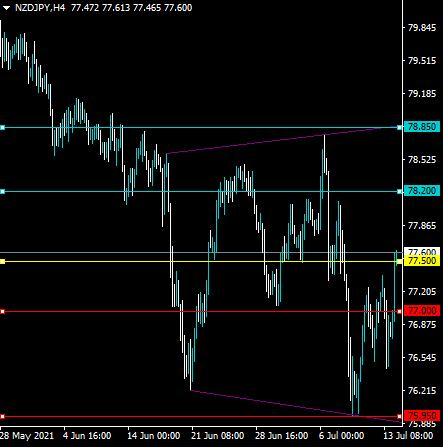
The New Zealand dollar has rallied against the US dollar after the Reserve Bank of New Zealand sound more hawkish than the market was expecting. The NZDJPY pair appears to be trading inside a large broadening expanding wedge pattern between the 75.90 and 79.00 level. Now that sellers have failed to break under the pattern we could see buyers rallying the pair towards the top of the wedge pattern.
The NZDJPY pair is only bullish while trading above the 77.50 level, key resistance is found at the 78.20 and 78.85 levels.
The NZDJPY pair is only bearish while trading below the 77.50 level, key support is found at the 77.00 and 75.95 levels.