

Sample Category Title
USD/JPY Daily Outlook
Daily Pivots: (S1) 110.34; (P) 110.50; (R1) 110.79; More...
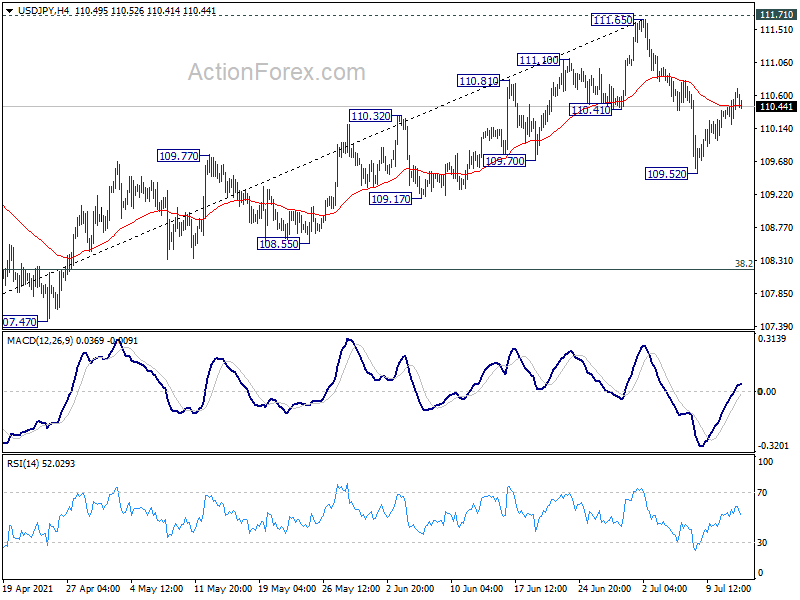
Intraday bias in USD/JPY stays neutral and outlook remains. Risk stays mildly on the downside with 111.65 resistance intact. On the downside, break of 109.52, and sustained trading below 55 day EMA (now at 109.85) will suggest that it's at least correcting the rise from 102.58. Deeper fall would be seen to 38.2% retracement of 102.58 to 111.65 at 108.18 next.
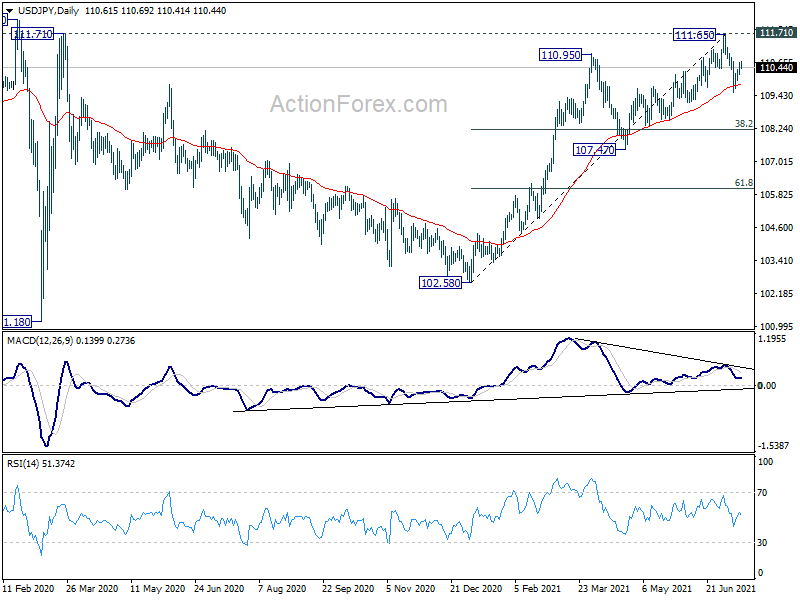
In the bigger picture, medium term outlook is staying neutral with 111.71 resistance intact. Though, as notable support was seen from 55 day EMA, rise from 102.58 is mildly in favor to extend higher. Decisive break of 111.71/112.22 resistance will suggest long term bullish reversal. Rise from 101.18 could then target 118.65 resistance (Dec 2016) and above. However, sustained break of 55 day EMA would revive some medium term bearishness, and open up deep fall back towards 102.58 support.
Up Goes Inflation, Down Go Equities
The US inflation data didn't enchant investors much at yesterday's release. Investors were ready to uncork the champagne with a figure below 5%, which would have confirmed the idea that inflation is only transitory, and the liquidity party should continue, but alas, the consumer prices grew 5.4% y-o-y in June, the fastest since 2008. The core inflation advanced to 4.5%, the largest in thirty years. Naturally, the latest inflation figures revived the worries that the Federal Reserve's (Fed) ‘transitory inflation' rhetoric is more of a wishful thinking, and something must be done before things get worse. It's certain that the Fed can not make a meaningful U-turn on its monetary policy due to the rise in second-hand car prices, yet other components such as surging energy and commodity prices, and rising leisure and travel activity could continue boosting inflation in the coming months.
As time goes by, and inflation goes high, the Fed's commitment to the ultra-supportive monetary policy will be severely tested. Even though the actual inflation levels are transitory, how long could the Fed wait before hitting the brake?
The market reaction to inflation was as expected. Investors didn't, or couldn't, ignore the rising inflation problem following the inflation print. All three major US indices fell off their all-time highs, but slightly. All three of them lost some 0.30%; the market reaction wasn't gory.
And the Chinese tech stocks came to the rescue of investors yesterday. JD.com jumped some 4.5%, Alibaba closed near 2% higher and Didi rallied 11% as the recent slump in Chinese ADRs' prices due to the government crackdown started looking appetizing to investors willing to take a chance in promising Chinese tech that currently trade at a meaningful discount.
Activity in European futures hint at a slow start to the session. Though, the softer euro and pound could counter a part of the weakness following a post-CPI appreciation in US dollar.
The US 10-year yield rose to 1.40%, and the long-end of the US yield curve flattened with the very long-end coming close to inverting as investors increased their bets that the Fed will need to hike rates sooner rather than later to remedy to the rising inflation, whether it's transitory or not.
What now? Will we see equities tumbling from here with expectations of tighter Fed policy?
Hardly. These is still a good amount of excess liquidity in the market. Realistically, the US equity prices could come off from their historical highs, but that doesn't mean that they will do badly in the foreseeable future. There are bubble warnings, the valuations are stretched, but the latest reports also show that the forward PE ratio on S&P500, for example, is less stretched than the beginning of the year. Therefore, solid earnings growth and the monetary stimulus - though lessened, should continue pushing the stock prices higher.
There is no doubt we will see downside corrections on equity prices, but the overall sentiment remains bullish for a reason: real yields on most less risky assets are low, or negative.
And gold? In theory, gold is a good hedge against inflation, but gold has been sputtering lately despite super-low US yields and a meaningful rise in inflation. Return on risk is too appetizing for investors to remain seated on gold given the actual market environment. Therefore, an eventual surge in gold prices could remain capped approaching the 200-day moving average, near $1826 per oz.
US Inflation Surprises On The Upside Again
Market movers today
- We expect Swedish inflation to continue to fall in June, with CPIF and CPIF excl. energy expected to print at 1.6% and 1.0%, respectively.
- The European Commission will unveil proposals for a legislative framework to support its climate ambition to reach net-zero by 2050. Measures will likely include a revamp of the Emissions Trading Scheme (ETS), tougher emissions standards for cars, a carbon tax on aviation, and a carbon border adjustment mechanism (CBAM) on imports.
- Fed Chair Powell will deliver his semi-annual monetary policy report to Congress. New policy signals are unlikely, with a QE tapering decision not expected until the autumn, but it will be interesting to hear how Fed assesses the state of the labour market and recent inflation surprises.
- Bank of Canada will deliberate whether another reduction in QE purchases is warranted.
The 60 second overview
US inflation surprised on the upside with 0.9% mom for both headline and core in June. That leaves headline inflation at 5.4% and core inflation at 4.5%. Used car prices continued to increase and now contributes 1.2 percentage points to the headline. The Mainheim used cars index indicates that we have seen the peak in used cars CPI yoy inflation.
New Zealand: This morning the Reserve Bank of New Zealand announced a surprising halt to its pandemic bond purchase programme leading to a surge in kiwi dollar as a rate hike now moves closer.
FI: Yesterday's market attention was focused on the EU deal as well as the US CPI figures. Despite the stronger than expected US inflation figure, the immediate 1-2bp sell-off quickly faded leading to a significant flattening of the curves as markets realising much of the inflation push seems transitory.
FX: Despite the steepening of yield curves post yesterday's US CPI release value assets generally underperformed peers. This was also evident in FX markets where ZAR, MXN, PLN, HUF and Scandies were the session's underperformers. In the other end of the spectre the broad USD gained. EUR/USD is now back below the 1.18 support level.
Credit: Credit indices were stable on Tuesday amidst a fairly mixed equity market. iTraxx Xover grinded a mere 0.5bp tighter (closed at 232.2bp) and iTraxx Main was completely flat (closed at 46.6bp, same as Monday). HY cash bonds widened slightly (+1.4bp) IG cash bonds were marginally tighter (-0.6bp).
Equities Trade Generally Lower After Declines On Wall Street
General trend
- Financials trade generally lower after US bank earnings.
- Nikkei 225 has remained lower [Topix Banks, Marine Transportation, Iron & Steel and Air Transportation indices decline; Information and Communication index rises].
- Shanghai Composite ended the morning session lower [Decliners included Financial, Consumer Discretionary, Industrial and Property indices; Consumer Staples outperform].
- Hang Seng has also declined after opening flat [Financial and Property names trade generally weaker].
- S&P ASX 200 has pared gain [Resources, Energy and Consumer indices rise; Financials lag].
- Fed Chair Powell due to testify on Wed-Thurs (14-15th).
- Companies due to report during the NY morning include Bank of America, BlackRock, Citi, Delta, Infosys, PNC, Wells Fargo.
Headlines/Economic data
Australia/New Zealand
- ASX 200 opened 0.0%.
- (NZ) NEW ZEALAND CENTRAL BANK (RBNZ) LEAVES OFFICIAL CASH RATE (OCR) UNCHANGED AT 0.25%; (AS EXPECTED); To discontinue LSAP purchases by July 23rd, 2021.
- (AU) New South Wales extends lockdown in Sydney through July 30th.
- (AU) Australia sells A$800M v A$800M indicated in 1.25% May 2032 bonds, avg yield 1.3878%, bid to cover 5.32x.
- (AU) Reserve Bank of Australia (RBA): Excess cash at exchange settlement (ES) accounts at A$330.8B v A$326.8B prior (Record high).
Japan
- Nikkei 225 opened -0.7%
- JEF Sumitomo Mitsui Financial to acquire 5% stake for $380M, in a capital tie up - Nikkei.
- (JP) Japan May Final Industrial Production M/M: -6.5% v -5.9% prelim; Y/Y: 21.1% v 22.0% prelim.
Korea
- Kospi opened -0.0%
- (KR) South Korea Jun Export Price Index Y/Y: 12.7% v 12.6% prior; Import Price Index Y/Y: 14.0% v 14.2% prior.
- (KR) South Korea President Moon: To increase New Deal spending up to KRW220T up from KRW160T by 2025.
China/Hong Kong
- Hang Seng opened 0.0%; Shanghai Composite opened -0.2%.
- (CN) China Jun YTD Foreign Direct Investment FDI (CNY) Y/Y: +28.7% v 35.4% prior.
- (CN) China Premier Li Keqiang: Reiterates stance to keep its macro policy stable; to keep economic activity within reasonable range through next year; recent RRR cut should focus support on small and medium enterprises (SMEs) (yesterday after the close).
- (CN) China PBOC Open Market Operation (OMO): Injects CNY10B in 7-day reverse repos v CNY10B in 7-day reverse repos prior; Net CNY0B v Net CNY0B prior.
- (CN) China PBOC sets Yuan reference rate: 6.4806 v 6.4757 prior.
- (CN) China NDRC Deputy Dir Zhao Penggao: To promote adjustment to industrial sector and strictly control overcapacity of coal and steel industry (update).
Other
- (SG) SINGAPORE ADVANCED Q2 GDP Q/Q: -2.0% V 1.8%E; Y/Y: 14.3% V 14.6%E.
North America
- (US) Senator Schumer (D-NY): Senate Democrats have arrived at a $3.5T budget deal for spending and tax plans; budget to include medicare expansion.
- (US) Weekly API Crude Oil Inventories: -4.1M v -8.0M prior.
- AAPL Said to be seeking 20% increase in iPhone production in the current year - Press.
Europe
- (UK) Members of Parliament reportedly call for halt to sale of UK's largest microchip plant, Newport Wafer Fab, to Dutch co Nexperia, owned by China co Wingtech - UK's Telegraph.
Levels as of 01:15ET
- Hang Seng -0.6%; Shanghai Composite -0.8%; Kospi -0.3%; Nikkei225 -0.3%; ASX 200 +0.2%.
- Equity Futures: S&P500 -0.2%; Nasdaq100 -0.0%, Dax -0.1%; FTSE100 -0.1%.
- EUR 1.1785-1.1772; JPY 110.70-110.44; AUD 0.7467-0.7437; NZD 0.7024-0.6939.
- Commodity Futures: Gold +0.2% at $1,812/oz; Crude Oil -0.4% at $74.96/brl; Copper -0.3% at $4.28/lb.
AUD/USD Daily Report
Daily Pivots: (S1) 0.7414; (P) 0.7459; (R1) 0.7490; More...
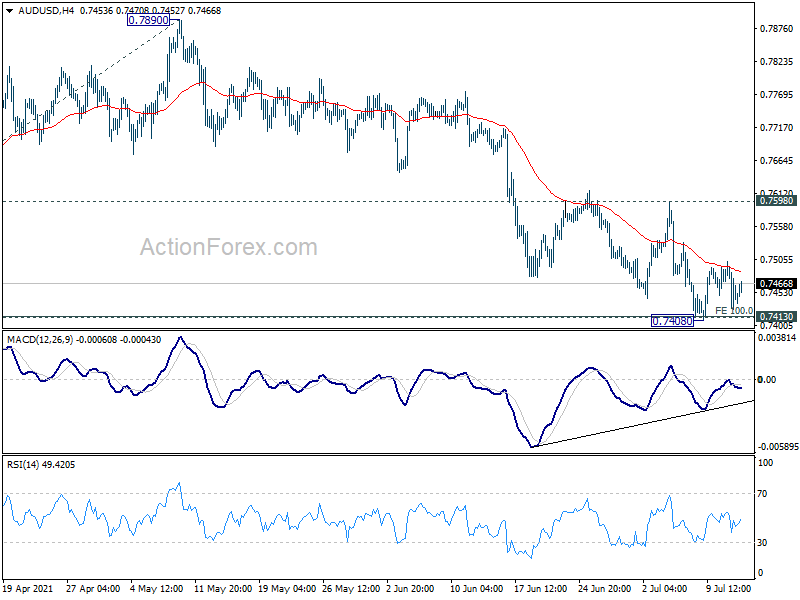
AUD/USD is staying in tight range above 0.7408 and intraday bias remains neutral first. We're continue to expect strong support from 100% projection of 0.8006 to 0.7530 from 0.7890 at 0.7414 to complete the correction from 0.8006. On the upside, break of of 0.7598 resistance will turn bias back to the upside for 0.7890 resistance first. However, sustained break of 0.7414 will argue it's at least in larger scale correction, and target 161.8% projection of 0.8006 to 0.7530 from 0.7890 at 0.7120 next.
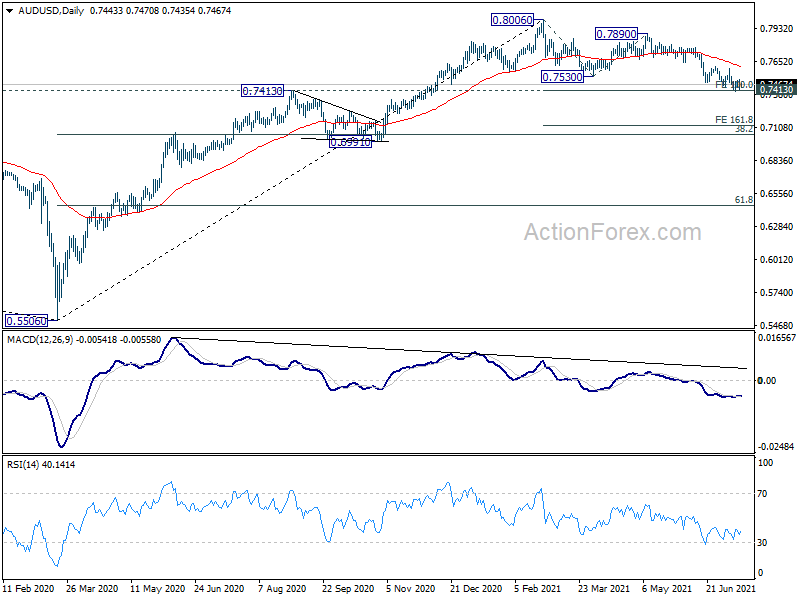
In the bigger picture, rise from 0.5506 medium term bottom could either be the start of a long term up trend, or a corrective rise. Reactions to 0.8135 key resistance will reveal which case it is. Rejection by 0.8135 key resistance, followed by firm break of 0.7413 resistance turned support, will favor the latter case. Deeper decline would be seen to 38.2% retracement of 0.5506 to 0.8006 at 0.7051 first.
Stand By For Action – RBNZ Monetary Policy Review, July 2021
- We now think that the Reserve Bank will start increasing the OCR at the August Monetary Policy Statement.
- Today's Monetary Policy Review was more hawkish than we expected.
- The RBNZ has significantly upgraded its assessment of economic activity, in keeping with the recent flow of data.
- It continues to see the upcoming spike in inflation as due to temporary factors.
- However, the strength of demand and rising capacity pressures have increased the risk that more persistent inflation pressures emerge.
- As a first step along the road to tightening, the RBNZ announced an end to its weekly purchases of Government bonds.
- Our view is that the reduction in purchases itself is less important than the signal that it sends – monetary policy is going to get tighter.
Today's Reserve Bank statement demonstrates how quickly the ground is shifting on the New Zealand economy. Only three months ago, the RBNZ was still emphasising that “it was prepared to lower the OCR if required”. Now, not only has the outlook for interest rates flipped in the other direction, but the RBNZ has already delivered its first tightening of sorts.
Overall, today's statement was more hawkish than we expected from the RBNZ at this point. We were previously forecasting the first OCR hike to come in November this year, but the odds have now shifted towards a hike as soon as the next Monetary Policy Statement in August.
The most notable change in the statement was that the RBNZ has called time on its Large-Scale Asset Purchase (LSAP) programme, with its weekly purchases of Government bonds set to end next week. This was explicitly described as a reduction of monetary stimulus, with the Monetary Policy Committee noting that the level of stimulus could be reduced now to minimise the risk of overshooting on its inflation and employment mandates.
What's notable is that this decision was elevated to the level of a Monetary Policy Review statement. The RBNZ has already run the weekly pace of purchases down to minimal levels over recent months – from $650m per week at the start of this year, to $200m per week now – and it hasn't felt the need to explain this as anything other than an operational decision. In that respect, going from $200m to zero is much less of a tightening than it has already delivered so far this year. However, the important issue here is not the reduction in purchases, but the message that it sends – namely, that monetary policy is going to get tighter from here.
The motivation behind this is that the RBNZ has significantly upgraded its assessment of economic activity, in keeping with the recent flow of data. It continues to regard the upcoming spike in inflation as being due to temporary factors. However, with demand running hot, there's a growing risk of more persistent inflation pressures emerging. This is very much in line with how our assessment of the economy has evolved in recent weeks.
RBNZ's media release did not give any guidance on future policy moves. That's not unusual – when the RBNZ loosens or tightens monetary policy, it often focuses on explaining its latest decision rather than signalling what might come afterwards. The lack of a clear signal for an August OCR hike doesn't rule it out, rather it suggests that it will be datadependent. Between now and the August MPS we have quarterly releases on inflation and the labour market. We think these will be supportive of higher interest rates, but it's not a fait accompli.
On a final note, while we think that the RBNZ is prepared to start hiking the OCR in August, we're not entirely sure that this is the right move. New Zealand is a long way from reaching a satisfactory level of Covid-19 vaccination, and the possibility of border breaches and time spent in lockdowns still looms large. From a “least regrets” perspective, there's plenty of room for regret if the RBNZ were to start tightening policy now, only to have to provide more stimulus (including, most likely, reopening the bond purchase programme) a few months down the track
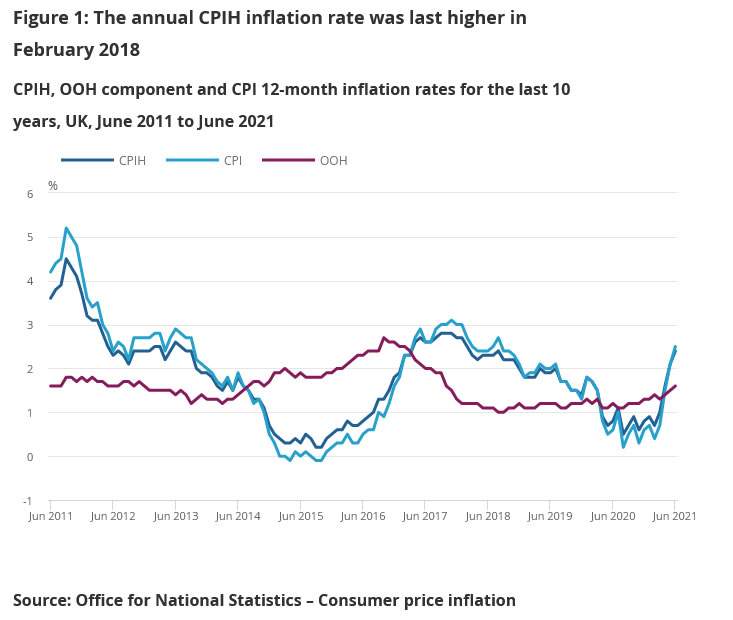
UK CPI jumped to 2.5% yoy in Jun, highest since Aug 2018
UK CPI surged to 2.5% yoy in June, up from 2.1% yoy, above expectation of 2.2% yoy. That's also the highest reading since August 2018. Core CPI also rose to 2.3% yoy, up from 2.0% yoy, above expectation of 2.0% yoy. RPI rose to 3.9% yoy, up from 3.3% yoy, above expectation of 3.4% yoy.
Also released, PPI input came in at -0.1% mom, 9.1% yoy in June, versus expectation of 1.2% mom, 10.8% yoy. PPI output was at 0.4% mom, 0.6% yoy, versus expectation of 4.3% mom, 4.8% yoy. PPI core output was at 0.3% mom, 2.7% yoy, versus expectation of 0.3% mom, 3.2% yoy.
USD/CAD Daily Outlook
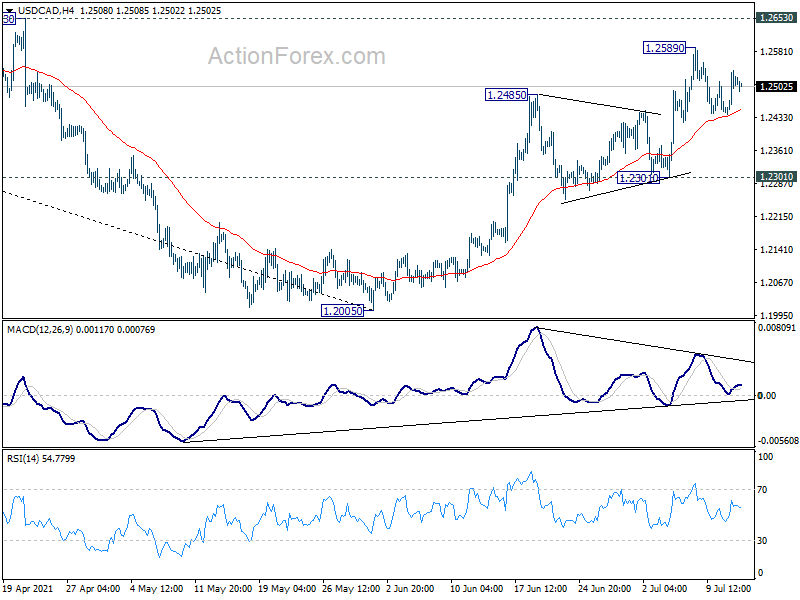
Daily Pivots: (S1) 1.2458; (P) 1.2499; (R1) 1.2554; More...
Intraday bias in USD/CAD remains neutral as consolidation from 1.2589 is extending. Another rise is still in favor as long as 1.2301 support holds. Break of 1.2589 will target 1.2653 structural resistance to confirm larger bullish reversal. However, on the downside, break of 1.2301 support will dampen the bullish case and turn bias back to the downside for 1.2005 low instead.
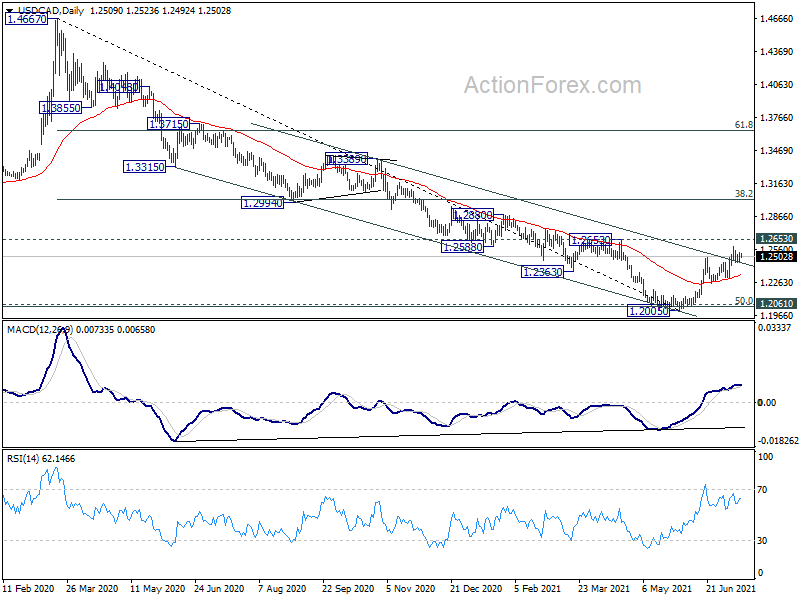
In the bigger picture, fall from 1.4667 is seen as the third leg of the corrective pattern from 1.4689 (2016 high). It might have completed after hitting 1.2061 (2017 low) and 50% retracement of 0.9406 to 1.4689 at 1.2048. Sustained break of 38.2% retracement of 1.4667 to 1.2005 at 1.3022 will pave the way to 61.8% retracement at 1.3650. Overall, medium term outlook remains neutral at worst with 1.2048/61 support zone intact.
Kiwi Surges on RBNZ, Focus on BoC Next
New Zealand Dollar rises broadly after RBNZ halts its asset purchase program. The movement also takes Aussie slightly higher. On the other hand, Dollar is not quite able to extend the post-CPI rally, and softens slightly. European majors are currently mixed. Focus will now turn to BoC policy decision and the reaction in Canadian Dollar next.
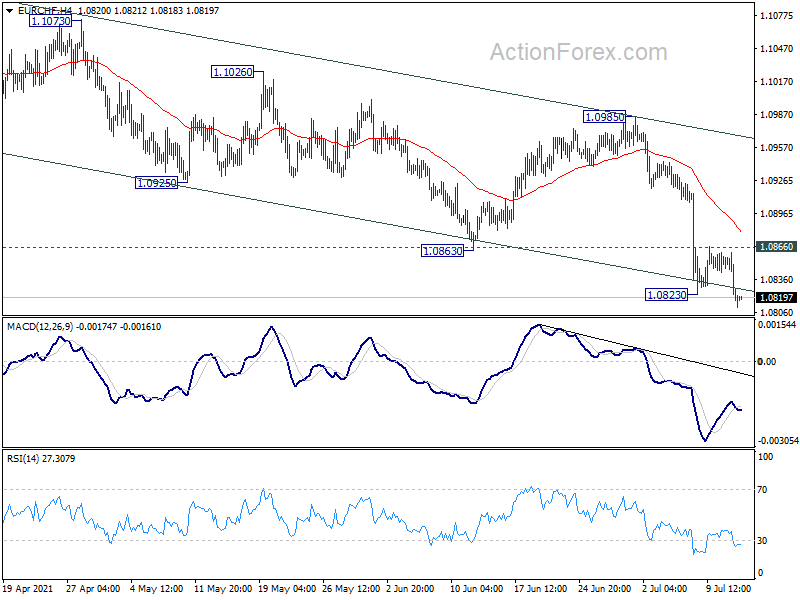
Technically, EUR/USD's break of 1.1780 temporary low suggests resumption of recent decline. But corresponding levels in GBP/USD, AUD/USD, USD/CHF and USD/CAD are still holding. On the other hand, EUR/GBP has taken out 0.8529 support to resume the choppy fall from 0.8718. EUR/CHF has also broken 1.0823 support to resume the fall from 1.1149. Hence, the fall in EUR/USD is more due to weakness in Euro for now.
In Asia, at the time of writing, Nikkei is trading down -0.26%. Hong Kong HSI is down -0.56%. China Shanghai SSE is down -0.48%. Singapore Strait Times is down -0.07%. Japan 10-year JGB yield is down -0.0040 at 0.021. Overnight, DOW dropped -0.31%. S&P 500 dropped -0.35%. NASDAQ dropped -0.38%. 10-year yield rose 0.052 to 1.415.
RBNZ halts asset purchases, NZD/JPY jumps
RBNZ surprised the markets as it announced to halt the additional asset purchases under the Large Scale Asset Purchase (LSAP) program by July 23. Meanwhile, OCR was kept unchanged at 0.25%. and the Funding for Lending Program was maintained. The Committee agreed that "the level of monetary stimulus could now be reduced to minimise the risk of not meeting its mandate."
The central bank said the economy "remains robust" despite ongoing impact from international border restrictions. Aggregate economic activity is already "above its pre-COVID-19 level". It expected "near-term spikes" in headline CPI in Q2 and Q3, reflecting "one-off" or "temporary" factors. In the absence of any further significant shocks, "more persistent consumer price inflation pressure is expected to build over time due to rising domestic capacity pressures and growing labour shortages".
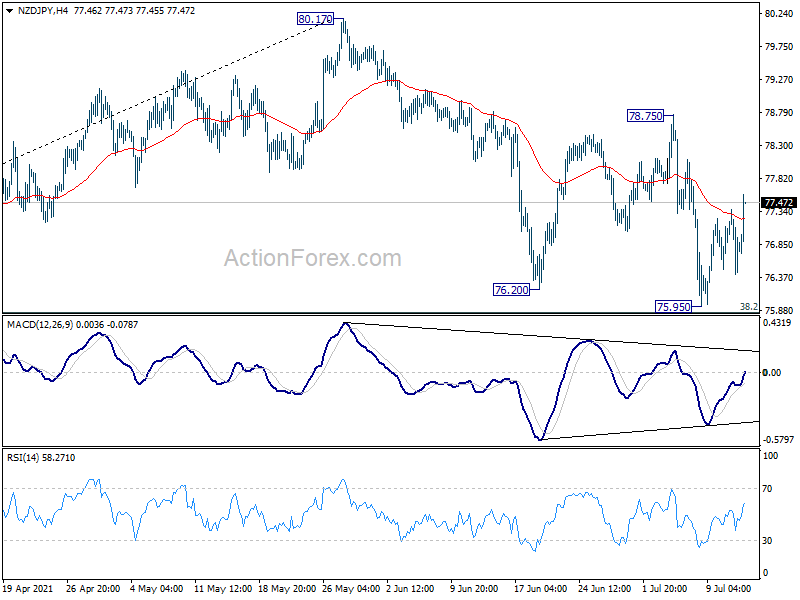
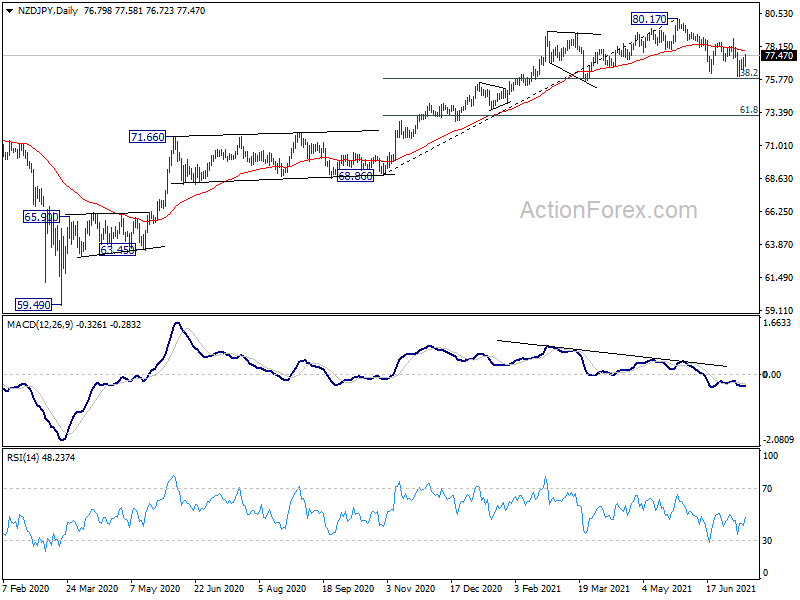
New Zealand Dollar jumps broadly after the surprised move by RBNZ. NZD/JPY is back above 77 handle after hitting 75.95 last week. Overall outlook is unchanged that price actions from 80.17 are seen as a correction to rise from 68.86 only. We'd expect strong support from 38.2% retracement of 68.86 to 80.17 at 75.84 to complete the correction.
Focus will now turn to whether current rebound could extend through 78.75 resistance to indicate that such correction has completed. In this case, stronger rise would be seen back to retest 80.17 high first.
Australia Westpac consumer sentiment rose to 108.8 despite NSW lockdown
Australia Westpac-Melbourne Institute Consumer Sentiment rose 1.5% to 108.8 in July, up from 107.2. Confidence has "held up overall" despite a sharp fall in New South Wales, as Victoria and Western Australia recorded strong "bounce-backs".
Westpac said RBA is not expected announce any change at August 3 meeting. The focus would mainly be on the Statement on Monetary Policy on August 6. RBA would have a few more weeks to assess the impact of the lockdown in Sydney.
Fitch affirms US rating at AAA with negative outlook
Fitch Ratings affirmed US Long-Term Foreign Currency Issuer Default Rating (IDR) at "AAA" with a "negative" outlook. It said, the rating is "supported by structural strengths that include the size of the economy, high per capita income and a dynamic business environment." It's "debt tolerance" is considered "higher" than that of other AAA sovereigns.
The negative outlook reflects "ongoing risks to the public finances and debt trajectory, notwithstanding the improvement in Fitch's fiscal and debt projections since its last review". Key variables including "real interest rates and fiscal deficits may not follow the expected path, potentially creating downside risk."
BoC to continue tapering, EUR/CAD range bound
BoC is generally expected to continue with tapering today, reducing weekly asset purchases from CAD 3B to CAD 2B. It's also expected to maintain the projection that first rate hike would happen in H2 of 2022. The focuses would be on new economic projections, in particular, on whether inflation forecasts would be up graded significantly.
Here are some previews on BoC:
- BOC Preview – Hawkish Stance to Maintain with More Tapering
- BOC Preview: Ready To Continue Tapering, But Does That Mean USD/CAD Will Move Lower?
- Bank of Canada to Taper Again as Loonie Succumbs to Delta Concerns
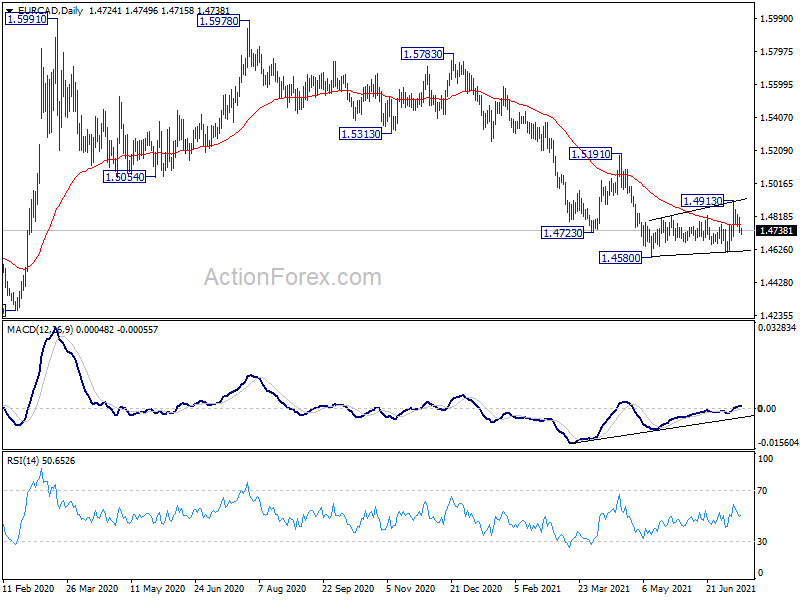
Canadian Dollar's reaction to BoC's tapering hasn't been positive so far. Outlook in EUR/CAD is unclear. Bullish convergence in daily MACD argues that medium term momentum is diminishing. Yet, it failed to sustain above the 55 day EMA, despite rebounding to 1.4913. Also, price actions from 1.4580 are more corrective looking than not. So, we'd see if today's BoC announce could finally trigger deeper fall back towards 1.4580.
Looking ahead
UK CPI and PPI are the main focuses in European session while Eurozone will release industrial production. Later in the day, Canada will release manufacturing sales alongside BoC rate decision. Fed will release Beige Book economic report.
USD/CAD Daily Outlook
Daily Pivots: (S1) 1.2458; (P) 1.2499; (R1) 1.2554; More...
Intraday bias in USD/CAD remains neutral as consolidation from 1.2589 is extending. Another rise is still in favor as long as 1.2301 support holds. Break of 1.2589 will target 1.2653 structural resistance to confirm larger bullish reversal. However, on the downside, break of 1.2301 support will dampen the bullish case and turn bias back to the downside for 1.2005 low instead.
In the bigger picture, fall from 1.4667 is seen as the third leg of the corrective pattern from 1.4689 (2016 high). It might have completed after hitting 1.2061 (2017 low) and 50% retracement of 0.9406 to 1.4689 at 1.2048. Sustained break of 38.2% retracement of 1.4667 to 1.2005 at 1.3022 will pave the way to 61.8% retracement at 1.3650. Overall, medium term outlook remains neutral at worst with 1.2048/61 support zone intact.
Economic Indicators Update
| GMT | Ccy | Events | Actual | Forecast | Previous | Revised |
|---|---|---|---|---|---|---|
| 0:30 | AUD | Westpac Consumer Confidence Jul | 1.50% | -5.20% | ||
| 2:00 | NZD | RBNZ Interest Rate Decision | 0.25% | 0.25% | 0.25% | |
| 4:30 | JPY | Industrial Production M/M May F | -6.50% | -5.90% | -5.90% | |
| 6:00 | GBP | CPI M/M Jun | 0.20% | 0.60% | ||
| 6:00 | GBP | CPI Y/Y Jun | 2.20% | 2.10% | ||
| 6:00 | GBP | Core CPI Y/Y Jun | 2.00% | 2.00% | ||
| 6:00 | GBP | RPI M/M Jun | 0.30% | 0.30% | ||
| 6:00 | GBP | RPI Y/Y Jun | 3.40% | 3.30% | ||
| 6:00 | GBP | PPI Input M/M Jun | 1.20% | 1.10% | ||
| 6:00 | GBP | PPI Input Y/Y Jun | 10.80% | 10.70% | ||
| 6:00 | GBP | PPI Output M/M Jun | 0.60% | 0.50% | ||
| 6:00 | GBP | PPI Output Y/Y Jun | 4.80% | 4.60% | ||
| 6:00 | GBP | PPI Core Output M/M Jun | 0.30% | 0.40% | ||
| 6:00 | GBP | PPI Core Output Y/Y Jun | 3.20% | 2.70% | ||
| 9:00 | EUR | Eurozone Industrial Production M/M May | 0.20% | 0.80% | ||
| 12:30 | USD | PPI M/M Jun | 0.50% | 0.80% | ||
| 12:30 | USD | PPI Y/Y Jun | 7.10% | 6.60% | ||
| 12:30 | USD | PPI Core M/M Jun | 0.40% | 0.70% | ||
| 12:30 | USD | PPI Core Y/Y Jun | 5.30% | 4.80% | ||
| 12:30 | CAD | Manufacturing Sales M/M May | -1.10% | -2.10% | ||
| 14:00 | CAD | BoC Interest Rate Decision | 0.25% | 0.25% | ||
| 14:30 | USD | Crude Oil Inventories | -6.9M | |||
| 15:15 | CAD | BoC Press Conference | ||||
| 18:00 | USD | Fed's Beige Book |
BoC to continue tapering, EUR/CAD range bound
BoC is generally expected to continue with tapering today, reducing weekly asset purchases from CAD 3B to CAD 2B. It's also expected to maintain the projection that first rate hike would happen in H2 of 2022. The focuses would be on new economic projections, in particular, on whether inflation forecasts would be up graded significantly.
Here are some previews on BoC:
- BOC Preview – Hawkish Stance to Maintain with More Tapering
- BOC Preview: Ready To Continue Tapering, But Does That Mean USD/CAD Will Move Lower?
- Bank of Canada to Taper Again as Loonie Succumbs to Delta Concerns
Canadian Dollar's reaction to BoC's tapering hasn't been positive so far. Outlook in EUR/CAD is unclear. Bullish convergence in daily MACD argues that medium term momentum is diminishing. Yet, it failed to sustain above the 55 day EMA, despite rebounding to 1.4913. Also, price actions from 1.4580 are more corrective looking than not. So, we'd see if today's BoC announce could finally trigger deeper fall back towards 1.4580.