

Sample Category Title
BoC to continue tapering, EUR/CAD range bound
BoC is generally expected to continue with tapering today, reducing weekly asset purchases from CAD 3B to CAD 2B. It's also expected to maintain the projection that first rate hike would happen in H2 of 2022. The focuses would be on new economic projections, in particular, on whether inflation forecasts would be up graded significantly.
Here are some previews on BoC:
- BOC Preview – Hawkish Stance to Maintain with More Tapering
- BOC Preview: Ready To Continue Tapering, But Does That Mean USD/CAD Will Move Lower?
- Bank of Canada to Taper Again as Loonie Succumbs to Delta Concerns
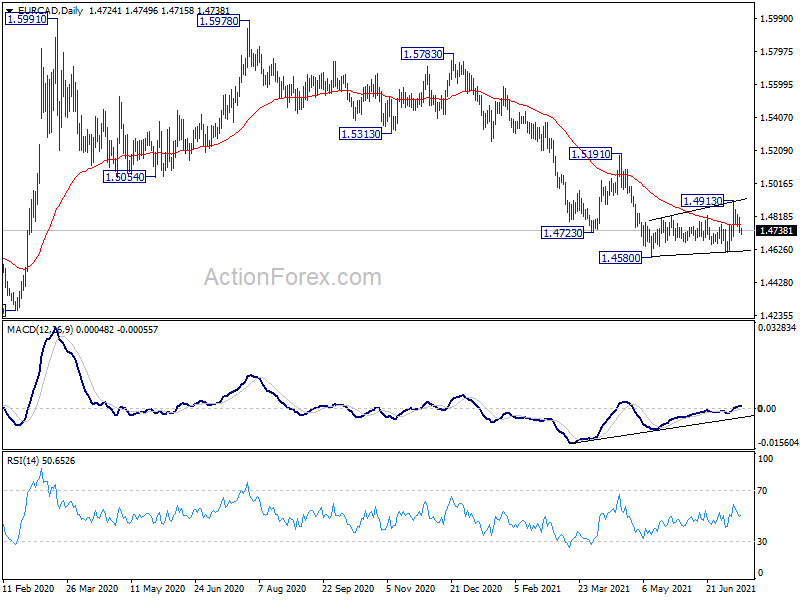
Canadian Dollar's reaction to BoC's tapering hasn't been positive so far. Outlook in EUR/CAD is unclear. Bullish convergence in daily MACD argues that medium term momentum is diminishing. Yet, it failed to sustain above the 55 day EMA, despite rebounding to 1.4913. Also, price actions from 1.4580 are more corrective looking than not. So, we'd see if today's BoC announce could finally trigger deeper fall back towards 1.4580.
Fitch affirms US rating at AAA with negative outlook
Fitch Ratings affirmed US Long-Term Foreign Currency Issuer Default Rating (IDR) at "AAA" with a "negative" outlook. It said, the rating is "supported by structural strengths that include the size of the economy, high per capita income and a dynamic business environment." It's "debt tolerance" is considered "higher" than that of other AAA sovereigns.
The negative outlook reflects "ongoing risks to the public finances and debt trajectory, notwithstanding the improvement in Fitch's fiscal and debt projections since its last review". Key variables including "real interest rates and fiscal deficits may not follow the expected path, potentially creating downside risk."
Australia Westpac consumer sentiment rose to 108.8 despite NSW lockdown
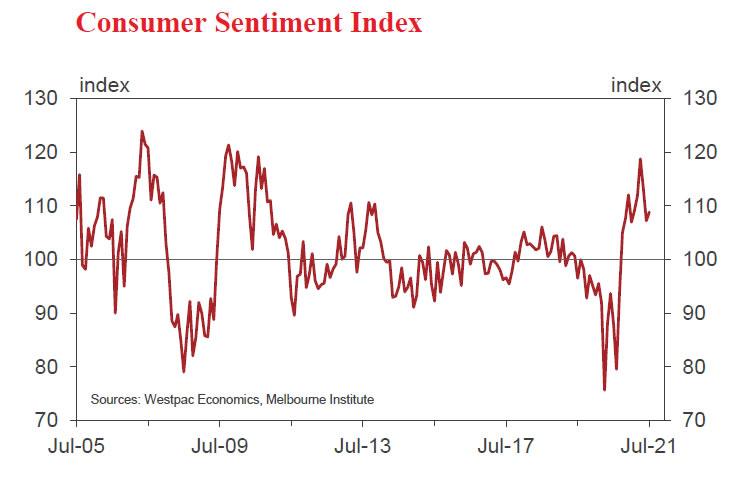
Australia Westpac-Melbourne Institute Consumer Sentiment rose 1.5% to 108.8 in July, up from 107.2. Confidence has "held up overall" despite a sharp fall in New South Wales, as Victoria and Western Australia recorded strong "bounce-backs".
Westpac said RBA is not expected announce any change at August 3 meeting. The focus would mainly be on the Statement on Monetary Policy on August 6. RBA would have a few more weeks to assess the impact of the lockdown in Sydney.
RBNZ halts asset purchases, NZD/JPY jumps
RBNZ surprised the markets as it announced to halt the additional asset purchases under the Large Scale Asset Purchase (LSAP) program by July 23. Meanwhile, OCR was kept unchanged at 0.25%. and the Funding for Lending Program was maintained. The Committee agreed that "the level of monetary stimulus could now be reduced to minimise the risk of not meeting its mandate."
The central bank said the economy "remains robust" despite ongoing impact from international border restrictions. Aggregate economic activity is already "above its pre-COVID-19 level". It expected "near-term spikes" in headline CPI in Q2 and Q3, reflecting "one-off" or "temporary" factors. In the absence of any further significant shocks, "more persistent consumer price inflation pressure is expected to build over time due to rising domestic capacity pressures and growing labour shortages".
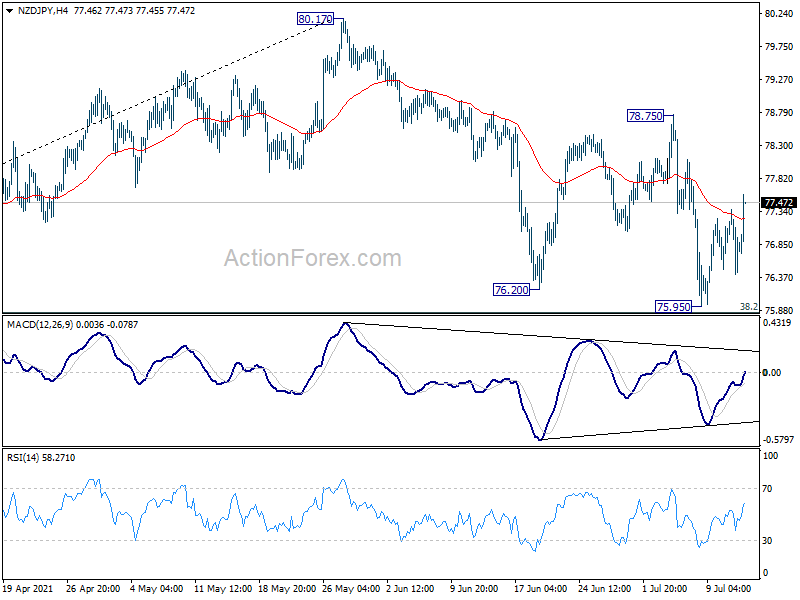
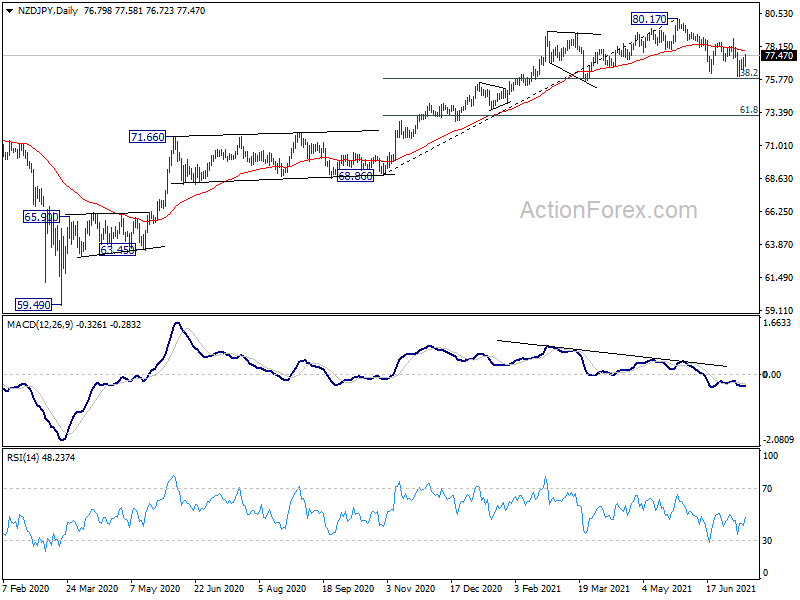
New Zealand Dollar jumps broadly after the surprised move by RBNZ. NZD/JPY is back above 77 handle after hitting 75.95 last week. Overall outlook is unchanged that price actions from 80.17 are seen as a correction to rise from 68.86 only. We'd expect strong support from 38.2% retracement of 68.86 to 80.17 at 75.84 to complete the correction.
Focus will now turn to whether current rebound could extend through 78.75 resistance to indicate that such correction has completed. In this case, stronger rise would be seen back to retest 80.17 high first.
(RBNZ) Monetary Stimulus Reduced
The Monetary Policy Committee agreed to reduce the current stimulatory level of monetary settings in order to meet its consumer price and employment objectives over the medium-term.
The Reserve Bank will halt additional asset purchases under the Large Scale Asset Purchase (LSAP) programme by 23 July 2021. The Committee will keep the Official Cash Rate (OCR) at 0.25 percent and the Funding for Lending Programme unchanged.
The global economic outlook continues to improve, providing ongoing price support for New Zealand's export commodities. Global monetary and fiscal settings remain at accommodative levels supporting the recovery in economic activity. Rising vaccination rates across many countries are providing further economic impetus. However, the need to reinstate COVID-19 containment measures in some regions highlights the ongoing global health and economic risks posed by the virus.
Recent data indicate the New Zealand economy remains robust despite the ongoing impact from international border restrictions. Aggregate economic activity is above its pre-COVID-19 level. Household spending and construction activity are at high levels and continue to grow. Business investment is now responding to capacity pressures and labour shortages, and measures of economic confidence continue to improve.
The Committee reiterated that there will be near-term spikes in headline CPI inflation in the June and September quarters. These reflect factors that are either one-off in nature, such as high oil prices, or expected to be temporary in duration, such as supply shortfalls and higher transport costs.
The Committee agreed that, in the absence of any further significant economic shocks, more persistent consumer price inflation pressure is expected to build over time due to rising domestic capacity pressures and growing labour shortages. However, the Committee noted that uncertainties remain as to the pace and magnitude of any pass-through of costs onto medium term inflation, especially given reported underutilisation of labour, modest wage growth, and well anchored inflation expectations.
The Committee noted that medium-term inflation and employment would likely remain below its Remit objectives in the absence of some ongoing monetary support. However, the Committee agreed that the level of monetary stimulus could now be reduced to minimise the risk of not meeting its mandate.
Summary Record of Meeting
The Monetary Policy Committee discussed the economic developments since the May Statement. The Committee noted that global economic growth continued to recover. The positive outlook for economic activity is being supported by rising vaccination rates in many countries, and continued accommodative monetary and fiscal policies supporting household spending. The Committee noted, however, that the need to reinstate COVID-19 containment measures in some regions highlights the ongoing global health and economic risks posed by the virus.
The Committee noted that recent economic data indicate the New Zealand economy remains robust despite international border restrictions. Aggregate economic activity is above its pre-COVID-19 level. Household spending and construction activity are at high levels and continue to grow, and there has been an improvement in business confidence and rising business investment intentions.
The Committee agreed that economic conditions since late 2020 have been persistently stronger than anticipated. Members noted that capacity pressures were now evident, reflecting domestic spending recovering more quickly than production. Domestic incomes are being supported by fiscal and monetary policies, and the ongoing strong terms of trade. Employment growth has remained strong and survey measures of economic confidence have risen from their extreme low levels.
The Committee agreed that, on aggregate and for the time being, domestic spending and export earnings have compensated for the absence of international tourism earnings. While important regional and industry differences remain, the New Zealand economy has recovered strongly since the relaxation of the health-led lockdowns of mid-2020.
The Committee reiterated that there will be near-term spikes in headline CPI inflation over the June and September quarters. These reflect factors that are either one-off in nature, such as high oil prices, or expected to be temporary in duration, such as supply shortfalls and higher transport costs.
The Committee agreed that, in the absence of any further significant economic shocks, more persistent consumer price inflation pressure is expected to build over time due to rising domestic capacity pressures and growing labour shortages. However, the Committee noted that uncertainties remain as to the pace and magnitude of any pass-through of costs onto medium term inflation, especially given reported underutilisation of labour, modest wage growth, and well-anchored inflation expectations.
The Committee discussed the stance of monetary policy in light of the improving economic activity. Members agreed that the major downside risks of deflation and high unemployment have receded. The Committee agreed that a 'least regrets' policy now implied that the significant level of monetary support in place since mid-2020 could be reduced sooner, so as to minimise the risk of not meeting its mandate.
As required by their Remit, the Committee assessed the impact of monetary policy on the Government's objective to support more sustainable house prices. The Committee agreed that the recent rate of growth in house prices remains unsustainable. Members noted that some of the factors supporting the ongoing house price increases have eased. These include a rise in housing supply as construction picks up pace, and more constrained investor demand due to increased loan-to-value restrictions and changes to housing tax policies. The Committee agreed that any future increases in mortgage rates will further dampen house price growth.
The Committee noted staff advice that while the Large Scale Asset Purchase (LSAP) programme has been an effective policy instrument to-date, market conditions and functioning have improved substantially since the programme's inception. The Committee agreed that further asset purchases under the LSAP programme were no longer necessary for monetary policy purposes and directed staff to halt purchases by 23 July 2021. Members noted that the LSAP programme remains an important tool for supporting the efficient functioning of the New Zealand debt market if required, and remains an important monetary policy tool if needed.
The Committee noted that the Funding for Lending Programme (FLP) would continue to be available to participants. Members agreed this tool provides a useful means of transmitting monetary policy given the pricing moves in line with the prevailing Official Cash Rate (OCR).
Members reiterated their opinion that the OCR is the preferred tool when responding to economic conditions in the future. The Committee agreed that some monetary stimulus remains necessary to best ensure CPI inflation will be sustained at the 2 percent per annum target midpoint, and that employment is at its maximum sustainable level. However, the Committee also agreed that the level of monetary stimulus could now be reduced to minimise the risk of not meeting its mandate.
On Wednesday 14 July, the Committee reached a consensus to:
- hold the OCR at 0.25 percent;
- discontinue LSAP purchases by 23 July 2021; and
- maintain the existing Funding for Lending Programme (FLP) conditions.
Attendees:
Reserve Bank staff: Adrian Orr, Geoff Bascand, Christian Hawkesby, Yuong Ha
External: Bob Buckle, Peter Harris, Caroline Saunders
Observer: Caralee McLiesh
Secretary: Sandeep Parekh
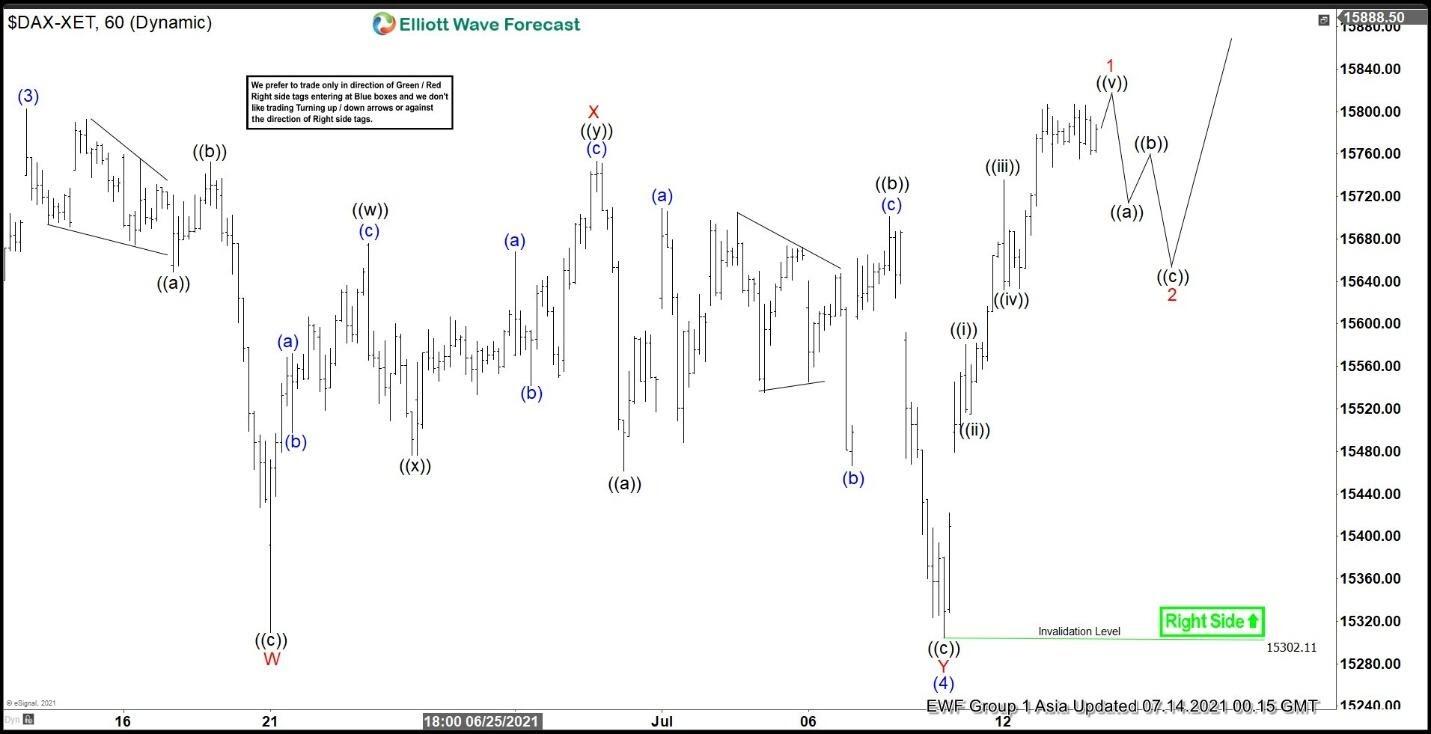
Elliott Wave View: DAX Pullback Should Be Well Supported
Rally in DAX from November 2, 2020 low is unfolding as a 5 waves impulse Elliott Wave structure. In the 60 minutes chart below, wave (3) of this rally can be seen to have ended at 15802.67 and pullback in wave (4) ended at 15304.41. Internal of wave (4) unfolded as a double three Elliott Wave structure. Down from wave (3), wave ((a)) ended at 15649.22 and rally in wave ((b)) ended at 15752.34. Last leg lower wave ((c)) ended at 15309.44 and this completed wave W in higher degree. Bounce in wave X took form of a double three structure. Up from wave W, wave ((w)) ended at 15675.90, wave ((x)) ended at 15476.11, and wave ((x)) ended at 15752.93. This completed wave X in higher degree.
Index then resumed lower in wave Y as a zigzag structure. Down from wave X, wave ((a)) ended at 15461.2 and rally in wave ((b)) ended at 15700.95. Last leg lower wave ((c)) ended at 15302.11 and this completed wave Y of (4) in higher degree. Index has resumed higher and broken above previous wave (3) peak at 15802.67 on June 14 high. Up from wave (4), wave ((i)) ended at 15580.81 and pullback in wave ((ii)) ended at 15515.12. Index rallied in wave ((iii)) towards 15735.63, and pullback in wave ((iv)) ended at 15631.84. Final leg higher wave ((v)) of 1 should end soon. Index should then pullback in wave 2 to correct cycle from July 8 low before the rally resumes. As far as July 8 low pivot at 15302.11 stays intact, expect dips to find support in 3, 7, or 11 swing for more upside.
DAX 60 Minutes Elliott Wave Chart
Market Morning Briefing: Dollar-Yen Has Dipped From 110.70
STOCKS
Dow has come-off after testing 35000 and needs to sustain above 34500 to keep the chances alive of breaking above 35100 from here. DAX hovers at the upper end of its 15400-15800 range and needs to see if it is breaking above 15800 or will retain the sideways range. Nikkei sustains above 28500 and has room to move up in the near-term. Shanghai can remain within its 3500-3625 range for some more time. Sensex and Nifty can also continue to oscillate within their 52000-53000 and 15600-15900 range respectively.
Dow (34888.79, −107.39, -0.31%) failed to sustain the break above 35000 yesterday and has closed lower. We reiterate that a strong rise past 35100 is needed to strengthen the bullish case for a rise to 36000. For this the Dow has to sustain above 34500 in the coming days. A break below 34500 will increase the chances of revisiting 33500 levels on the downside.
DAX (15789.64, −0.87, -0.01%) hovers at the key resistance level of 15800. A strong break above 15800 is needed for the DAX to move further up towards 16000 and 16200. Else the 15400-15800 range can continue to remain intact for some more time. Also as mentioned yesterday, DAX will have to rise past 16200 to become extremely bullish.
Nikkei (28652.19, −66.05, -0.23%) sustains above 28500 and keeps intact our view of seeing a rise to 29000-29500 in the coming days. Inability break 29500 from here can keep the index in the range of 27500-29500 for some time. However, the bias is positive to see a strong break above 29500 and a subsequent rise past 30000 to target 31000-32000 if not immediately but eventually over the medium-term.
Shanghai (3529.64, −36.88, -1.03%) oscillates near the middle of its 3500-3625 range. We expect it to retain this range for some more time before a break above 3625 and a rise to 3700-3800 is seen over the medium-term. In case if Shanghai breaks below 3500, an extended fall to 3450-3400 is possible before a fresh rise which in turn will delay the rally to 3700-3800 mentioned above.
As expected, the Sensex (52769.73, +397.04, +0.76%) and Nifty (15812.35, +119.75, +0.76%) moved up within their 52000-53000 and 15600-15900 range respectively yesterday. The indices can remain stuck inside this range for some more time before we get an eventual break on the upside and see a rise to 54000 (Sensex) and 16000-16200 (Nifty) going forward.
COMMODITIES
Commodities see a short pull back today but may soon recover to head back to higher levels. The International Energy Agency (IEA) in its monthly report released yesterday mentioned a possibility of depending oil supply deficit if OPEC+ is unable to reach on a deal. The agency expects crude price to remain volatile until the OPEC+ gives further clarity on its production policy. Crude prices have dipped a bit but can rally towards $78-80 soon before a decline is seen in the medium term. Gold, Silver and Copper have dipped too and could rise back soon in the coming sessions. A range of 1770-1820/40, 25.80-26.50 and 4.15-4.40 may hold respectively on Gold, Silver and Copper.
Brent (76.31) and WTI (75.02) have dipped slightly from $76.48 and $75.22 respectively. A short pull back is possible while below $77/78 levels before attempting to move higher and test resistance zone of $78-80 on the upside. The current dip is short lived and we may expect a rise in the prices soon towards crucial resistance levels.
Gold (1810.40) rose to test 1813 yesterday but has not been able to rise further to test 1820. While below 1820, we may expect a ranged movement between 1820-1790 region before the price attempts to rise towards 1840 or higher in the longer run. Trend support is seen near 1780/70.
Silver (26.07) has dipped instead of moving higher to test 26.50-27. The price can test 26.0-25.80 before again bouncing back to higher levels. A range of 25.80-26.50 may hold well for the near term.
Copper (4.2720) has dipped after a short rise seen yesterday. Overall range of 4.15-4.40 may hold for another week or so before a break on either side is seen.
FOREX
Dollar Index moved up sharply to test 92.80 after a higher than expected US CPI data release yesterday, dragging down Euro to levels below 1.18 and pulling down other currencies globally. Aussie and Pound have fallen sharply too but could soon bounce back from current levels. EURJPY has fallen sharply and could head towards 129.50 while below immediate resistance at 131. Dollar Yen rose to test 110.80 as expected and could now see a corrective dip towards 110.50/30 before again attempting to rise further. USDINR may rise to test 74.60 and any break on the upside can open up chances of a rise to 74.80 or even 75. Weak Chinese Yuan and weak Euro may support weak Rupee today.
Dollar Index (92.7250) is holding below 92.80 just now. The index saw a sharp rise to 92.80 yesterday after the US CPI data release that came out higher than expected. We need to see if the rise sustains or the index falls back towards 92 in the coming sessions.
Euro (1.1783) fell sharply below 1.18 and is yet to see any corrective rise from there. Any fall below current levels would make Euro vulnerable to test 1.1750 on the downside before a bounce is seen. Watch price action near current levels.
EURJPY (130.21) fell sharply and could not sustain a rise above 131. We may expect a fall in the cross towards 129.50-129.00 in the near to medium term.
Dollar-Yen (110.49) has dipped from 110.70 as expected yesterday. We may now see the corrective dip to extend towards 110.50/110.30 before a rise back to higher levels is seen. Immediate support is seen at 110 and while that holds, overall view is bullish to test 111 or higher.
Aussie (0.7463) has bounced well and can rise towards 0.75 in the near term. View is bullish for the very near term.
Pound (1.3820) has bounced a bit after facing a sharp fall yesterday. A rise back towards 1.3850-1.3900 can be possible soon.
USDCNY (6.4748) has bounced well as expected and can be headed towards 6.48/50 in the near term. View is bullish while above 6.46.
USDINR (74.5750) could possibly attempt to rise within the 74.40-74.60 range as Euro has weakened a bit along with some weakness in the Chinese Yuan. Any break above 74.60 would again open up chances of a rise to 74.75/80 on the upside, delaying immediate chances if falling towards 74.20/74.00. Watch for a possible rise today and price action near 74.60.
INTEREST RATES
The US Treasury yields had risen yesterday following the inflation data release. The US Headline CPI rose 5.3% (YoY) and the Core CPI surged 4.45% (YoY) in June. The expected corrective rise in the Treasury yields is happening now and there is room to move up further from here. The German yields remain lower and stable. The view is bearish to see further fall from here. The 10Yr GoI fell yesterday but is holding well above its support at 6.18%. While above this support the near-term outlook is bullish.
The US 2Yr (0.25%), 5Yr (0.83%), 10Yr (1.40%) and 30Yr (2.03%) Treasury yields have moved up across tenors. The corrective rise to 1.45%-1.5% on the 10Yr and 2.1%-2.2% 30Yr is happening in line with our expectation. Thereafter a fresh fall is possible. We will have to wait and watch. Supports are at 1.25%-1.2% (10Yr) and 1.9% (30Yr).
The German 2Yr (-0.68%), 5Yr (-0.60%), 10Yr (-0.30%), 30Yr (0.20%) continues to trade stable. We retain our bearish view of seeing a fall to 0.10%-0.8% (30Yr) and -0.45% / -0.50% (10Yr) in the coming weeks.
The 10Yr GoI (6.2044%)has risen back sharply from the low of 6.1885% yesterday. 6.19%-6.18% is a good support zone while above which the outlook is bullish to see a test of 6.3%-6.32% on the upside. Thereafter a fresh fall is possible.
Gold Price Eyes Strong Recovery Above $1,840
Key Highlights
- Gold price started an upside correction from the $1,750 support.
- It is facing resistance near $1,820 and $1,835 on the 4-hours chart.
- EUR/USD could extend losses below 1.1750, GBP/USD failed to surpass 1.3900 and declined.
- The US CPI increased 5.4% in June 2021 (YoY), up from the last 5%.
Gold Price Technical Analysis
This past month, gold price saw a steady decline below $1,850 against the US Dollar. The price even traded below the $1,800 level before the bulls appeared near the $1,750 level.
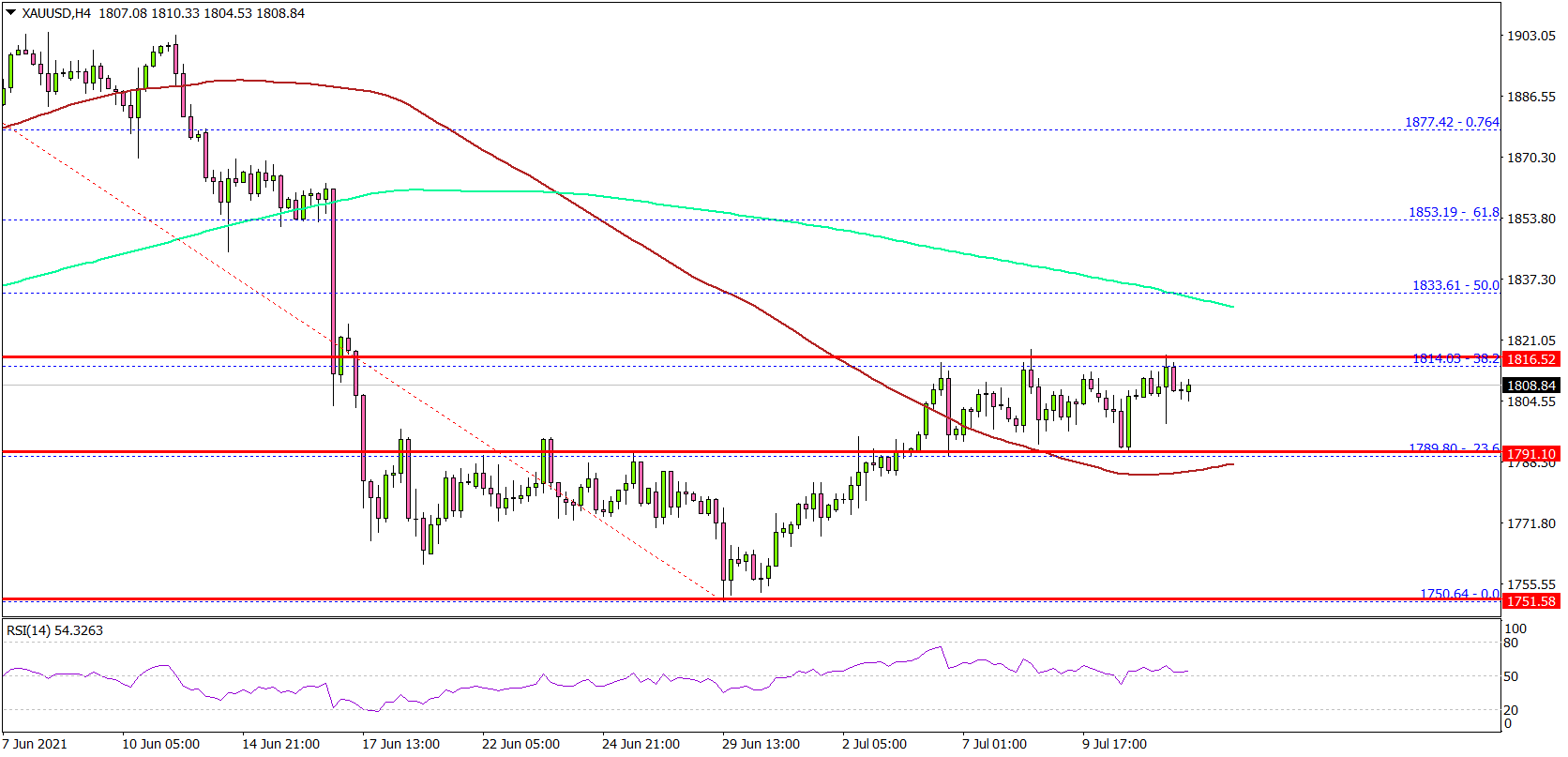
The 4-hours chart of XAU/USD indicates that the price started a decent recovery wave from the $1,750 swing low. The price climbed above the $1,780 and $1,800 resistance levels.
There was also a close above $1,800 and the 100 simple moving average (red, 4-hours). However, the price is struggling to gain pace above $1,815 and $1,820. The next key resistance is near $1,835 and the 200 simple moving average (green, 4-hours).
The 50% Fib retracement level of the main decline from the $1,916 swing high to $1,750 low is also near the $1,833 level. A close above the $1,835 and $1,840 levels could start a steady increase towards the $1,900 level.
If not, the price could start a fresh decline below the $1,790 support level and the 100 SMA. The next major support is near the $1,750 level.
Fundamentally, the US CPI report for June 2021 was released yesterday by the US Bureau of Labor Statistics. The market was looking for an increase of 4.9% in the CPI compared with the same month a year ago.
The actual result was above the market forecast, as the US CPI increased 5.4% (YoY). Looking at the monthly change, there was an increase of 0.9%, up from the last 0.6%.
Overall, the US Dollar saw bullish moves after the release. It impacted both EUR/USD and GBP/USD, with bearish moves below 1.1850 and 1.3850.
Economic Releases to Watch Today
- UK Consumer Price Index for June 2021 (YoY) – Forecast +2.2%, versus +2.1% previous.
- UK Core Consumer Price Index for June 2021 (YoY) – Forecast +2.0%, versus +2.0% previous.
- US Producer Price Index for June 2021 (MoM) – Forecast +0.6%, versus +0.8% previous.
- US Producer Price Index for June 2021 (YoY) – Forecast +6.8%, versus +6.6% previous.
- BoC Interest Rate Decision – Forecast 0.25%, versus 0.25% previous.
Eco Data 7/14/21
[php_everywhere instance="1"]
Hot Inflation Surprise, Choppy Stock Session, Earnings JPM, GS, & Pepsi, Bitcoin Lower
US stocks initially shrugged off a strong start to earnings seasons and traded lower after a hot inflation report unnerved some investors as expectations grow that the Fed will have to acknowledge that higher inflation will stick around. Today’s earnings season kick-off saw spectacular results from Pepsico, solid numbers from Goldman Sachs and mixed earnings from JPMorgan. The bar is set very high for this earnings season and given the valuation peaks with tech stocks, it will take several upside surprises to keep the major indexes making fresh record highs.
After Wall Street had some time to digest the hot CPI report, the transitory argument still holds water and stocks quickly pared those losses. Boeing’s news that they have a new issue and will cut 787 Dreamliner production was very disappointing and is weighing heavily on the Dow Jones Industrial Average.
JPMorgan
JPMorgan shares traded lower after a busy earnings report showed many strong beats that could not beat all the high expectations. A slight miss in both managed Net Interest Income and fixed income sales & trading miss disappointed many as that is actually their bread and butter. Second quarter Managed NII fell 9% from a year ago to USD 12.9 billion, also a miss of the $13.1 billion analysts’ forecast, while FICC sales and trading came in at USD 4.10 billion, a miss of the USD 4.12 billion.
JPMorgan’s cash situation improved after a USD 3 billion credit reserve release.
The bar was set too high for JPMorgan and today’s results don’t paint a good picture for the rest of the banks. Loan growth might not really improve until next year and that might be a drag for financials in the short-term.
Goldman
Goldman Sachs shares initially surged after a robust earnings beat, EPS of USD 15.02, much higher than the USD 9.57 estimate and revenue of USD 15.4 billion which easily beat the USD 11.5 billion estimate. Goldman had lighter FICC sales and trading revenue, but lower expenses which highlight an efficiency advantage over JPMorgan.
Goldman Sachs noted that inflation is likely to be transitory, but also emphasized concern about the prospect of a pandemic resurgence.
Pepsi
PepsiCo had a textbook solid earnings report, strong organic revenue growth and raised forecasts sent shares higher. The return of restaurants is driving Pepsico’s success and that allowed them to raise their full-year earning growth target.
US CPI surges in June
The June CPI report showed that everything is getting more expensive for the US consumer. Wall Street reacted strongly to a hotter than expected CPI data that sent short-end Treasury yields higher. Pricing pressures were most notable with used auto prices, hotel room rates, airline fares, clothing and food and lodging away from home. A lot of this still looks transitory, but if prices continue to stay elevated, the Fed will have to concede that parts of the surge prices will be transitory.
Today’s CPI data continues to support the idea of a taper announcement at the Jackson Hole Symposium.
Oil steadies, gold whips around
Crude prices are all over the place as energy traders try to price in a tighter market thanks to OPEC+ while a hot inflation report sent the dollar higher. Many traders are looking ahead to the US crude oil inventory data which could show yet another significant drop in stockpiles. The supply deficit story along with still improving demand in Q3 suggests whatever oil weakness is happening could be short-lived. The oil market could get a lot tighter very quickly and that could mean the recent pullback might have run its course.
Gold retreats after US CPI jumps
Gold gave up earlier gains after hot inflation data sent the dollar higher as investors scrambled to sell Treasuries. Expectations were for inflation to remain tame or slightly ease and that did not happen today. Despite a little inflation shock, after traders processed the report, the argument can still be made that most of this will be transitory. Used cars and trucks were responsible for one-third of the seasonally adjusted increase. The playbook for the Fed still looks like a taper announcement to be made at Jackson Hole, or at the September policy meeting at the latest. Policy normalization expectations may move forward following today’s data, but the bull case still remains in place for gold.
After the dust settled from the hotter-than-expected CPI report, gold prices edged higher as this still probably won’t move the needle for the Fed.