Sample Category Title
UK CPI Remains Above BOE Target, Awaiting Powell Semi-Annual Testimony
Notes/Observations
- Various global inflation data over the past 24 hours running hotter…key question that remains with the trend is transitory.
- UK CPI remained above BOE target for the 2nd straight month; could test the BOE’s view that inflation is transitory.
- Hawkish RBNZ as it halted its QE bond-buying program as a possible prelude to rate hikes.
- Awaiting Fed Chair Powell semi-annual testimony in Congress.
Asia
- Singapore Q2 Advance GDP Q/Q: -2.0% v -1.8%e; Y/Y: 14.3% v 14.6%e.
- RBNZ left the Official Cash Rate (OCR) unchanged at 0.25% (as expected) but announced would reduce the stimulus for the economy as inflation pressures rose and growth rebounded from the pandemic. To halt its purchases of NZ government bonds by July 23rd while maintaining the funding for the lending program for banks.
- Xi-Biden summit said to be moving closer with senior US diplomat Wendy Sherman’s China visit. US State Department No 2 will meet Chinese foreign vice-minister, Xie Feng, next week, paving the way for top-level encounter.
Americas
- Senate Democrats announce plans for $3.5 trillion budget package to expand Medicare.
- Senator Schumer (D-NY) stated that Senate Democrats had arrived at a $3.5T budget deal for spending and tax plans; budget to include medicare expansion.
- Democrats said to be quite confident they’ll pass Biden’s infrastructure deal and the rest of his economic plans through reconciliation.
- Fitch affirmed United States sovereign rating at AAA; Outlook Negative.
Energy
- Weekly API Crude Oil Inventories: -4.1M v -8.0M prior (8th straight weekly draw).
Speakers/Fixed income/FX/Commodities/Erratum
Equities
- Indices [Stoxx600 -0.31% at 459.54, FTSE -0.56% at 7,088.45, DAX -0.21% at -0.21% at 15,755.15 , CAC-40 -0.30% at 6,539.10 , IBEX-35 -0.54% at 8,648.00, FTSE MIB -0.03% at 25,149.50, SMI -0.58% at 12,001.39, S&P 500 Futures -0.03%].
- Market Focal Points/Key Themes: European indices open modestly lower across the board and failed to gain momentum as the session wore on; better performing sectors include technology and materials; while consumer discretionary and financials among those trending to the downside; Nordax raises offer for Norwegian Fians Holding; earnings expected in the upcoming US session include Bank of America, PNC Financial Services, Blackrock and Delta Airlines.
Equities
- Consumer discretionary: Hugo Boss [BOSS.DE] +5% (prelim earnings), Dunelm [DNLM.UK] -3% (trading update).
- Energy: Tullow Oil [TLW.UK] +3% (trading update; cuts outlook).
- Materials: SIG plc [SHI.UK] +4% (trading update).
- Telecom: Tele2 [TEL2B.SE] +4% (earnings).
Speakers
- Germany Economy Ministry saw inflation at 3.0% or higher but would to slow significantly in early 2022. Outlook for industrial economy remained positive. Bottlenecks for immediate products were having a dampening effect but not impacting the overall positive tone.
- Czech Central Bank Vice Gov Mora stated that was convinced to raise interest rates again during 2021 but not sure how many times. Pace of policy tightening would be determined by the shape of economic recovery.
- Germany HDE Retail Association: sees 2020 Retail Sales growth at 1.5%.
- China Banking Regulator (CBIRC): End-Jun Non-performing Loans at CNY3.5T; Bad Loan Ratio (NPLs): 1.86%. Liquidity risks were controllable. Expect banking sector profit growth to quicken notably in H1 as economy rebounds.
- Iran out-going President Rouhani stated that could enrich uranium to 90% purity if desired.
Currencies/Fixed Income
- Overall USD price action was subdued ahead of Fed Chair Powell semi-annual testimony in Congress. Some analysts believe Powell could be a tad more hawkish after US Jun CPI data hit a 13-year high at 5.4% on Wed.
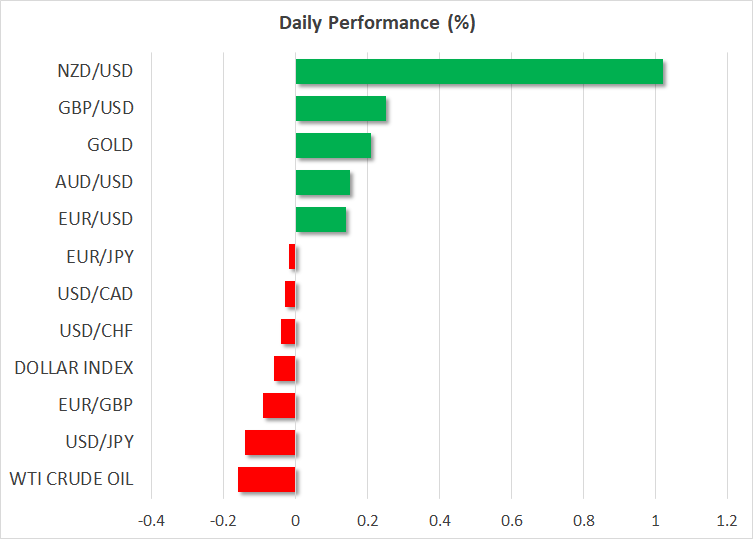
- GBP was firmer in the aftermath of the higher Jun CPI reading from the UK. Analysts note reading could put pressure on BOE to scale back pandemic-era stimulus,.
- NZD currency (Kiwi) was firmer in the session after RBNZ announced it would reduce stimulus for the economy as inflation pressures rose and growth rebounded from the pandemic. Analysts now expect a potential rate hike as soon as next month (Aug).
Economic data
- (NL) Netherlands May Trade Balance: €4.8B v €5.2B prior.
- (FI) Finland Jun CPI M/M: -0.1% v +0.2% prior; Y/Y: 2.0% v 2.2% prior.
- (FI) Finland May Final Retail Sales Volume Y/Y: 4.8% v 1.6% prelim.
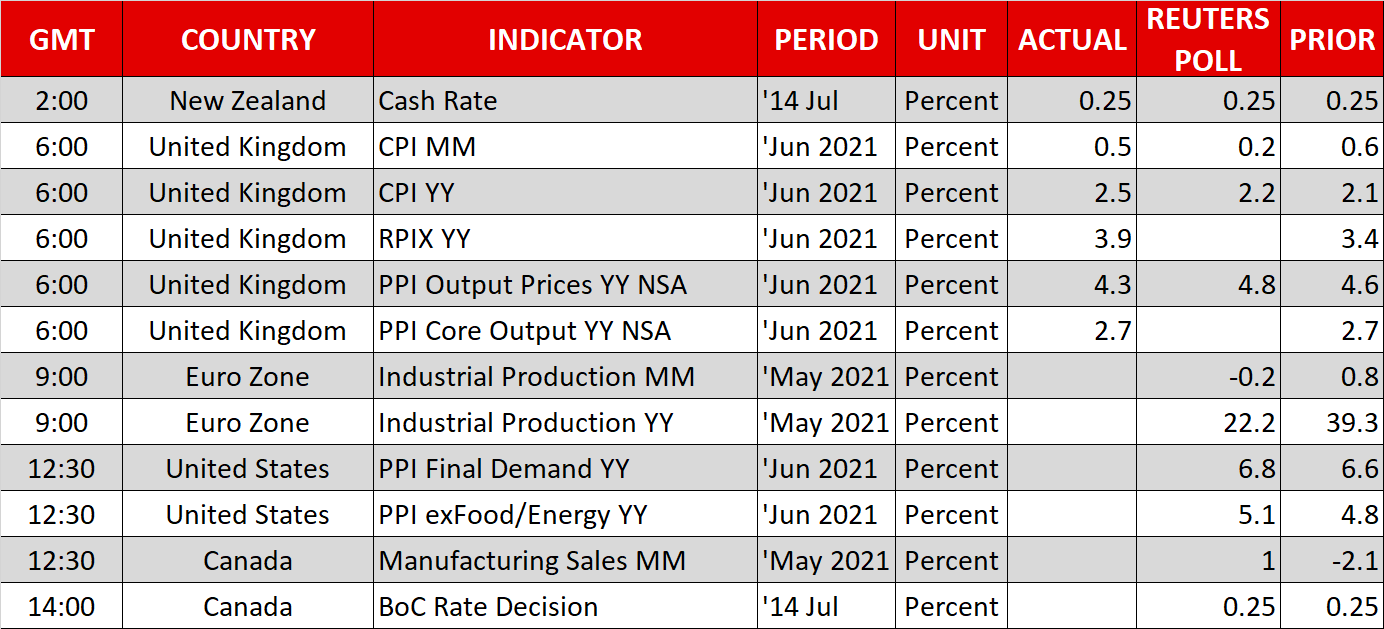
- (UK) Jun CPI M/M: 0.5% v 0.2%e; Y/Y: 2.5% v 2.2%e(2nd month annual pace above BOE target and highest since 2018); CPI Core Y/Y: 2.3% v 2.0%e; CPIH Y/Y: 2.4% v 2.2%e.
- (UK) Jun RPI M/M: 0.7% v 0.3%e; Y/Y: 3.9% v 3.4%e; RPI-X (ex-mortgage interest payments) Y/Y: 3.9% v 3.5%e; Retail Price Index: 304.0 v 302.7e.
- (UK) Jun PPI Input M/M: -0.1% v +1.1%e; Y/Y: 9.1% v 11.0%e.
- (UK) Jun PPI Output M/M: 0.4% v 0.6%e; Y/Y: 4.3% v 4.8%e.
- (IN) India Jun Wholesale Prices (WPI) Y/Y: 12.1% v 12.2%e.
- (ES) Spain Jun Final CPI M/M: 0.5% v 0.4%e; Y/Y: 2.7% v 2.6%e.
- (ES) Spain Jun Final CPI EU Harmonized M/M: 0.5% v 0.4%e; Y/Y: 2.5% v 2.4%e.
- (ES) Spain Jun CPI Core M/M: 0.1% v 0.3% prior; Y/Y: 0.2% v 0.2% prior.
- (SE) Sweden Jun CPI M/M: 0.1% v 0.1%e; Y/Y: 1.3% v 1.3%e; CPI Level: 341.32 v 341.32e.
- (SE) Sweden Jun CPIF M/M: 0.1% v 0.1%e; Y/Y: 1.6% v 1.5%e.
- (SE) Sweden Jun CPIF (ex-energy) M/M: 0.0% v 0.0%e; Y/Y: 0.9% v 0.9%e.
- (CZ) Czech May Current Account Balance (CZK): 7.2B v 15.5Be.
- (UK) May ONS House Price Index Y/Y: 10.0% v 9.4%e.
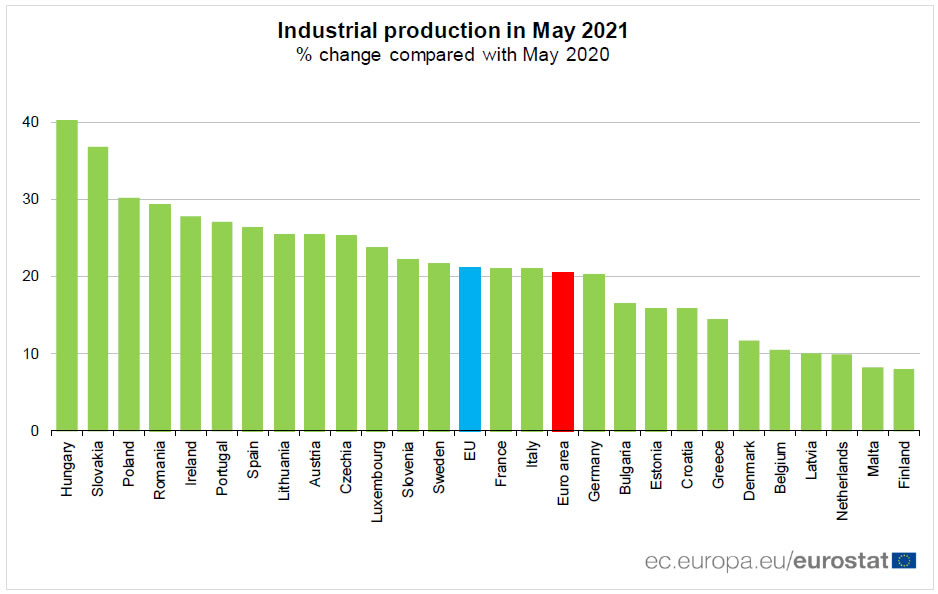
- (EU) Euro Zone May Industrial Production M/M: -1.0% v -0.3%e; Y/Y: 20.5% v 22.2%e.
- (IS) Iceland Jun International Reserves (ISK): 856B v 839B prior.
Fixed income Issuance
- (IN) India sold total INR170B vs. INR170B indicated in 3-month, 6-month and 12-month bills.
- (DK) Denmark sold total DKK5.0B in 3-month, 6-month, 9-month and 12-month bills.
Looking Ahead
- (CH) Switzerland to sell 2026, 2031 and 2055 Bonds.
- 05:25 (EU) Daily ECB Liquidity Stats.
- 05:30 (DE) Germany to sell €4.0B in 0% Aug 2031 Bunds.
- 05:30 (PT) Portugal Debt Agency (IGCP) to sell €0.75-1.0B in 2030 and 2037 OT bonds.
- 05:30 (ZA) South Africa announces details of next bond auction (held on Tuesdays).
- 06:00 (IE) Ireland May Property Prices M/M: No est v 0.8% prior; Y/Y: No est v 4.5% prior.
- 06:45 (US) Daily Libor Fixing.
- 07:00 (RU) Russia to sell combined RUB20B in 2029 and 2036 OFZ Bonds.
- 07:00 (US) MBA Mortgage Applications w/e July 9th: No est v -1.8% prior.
- 07:00 (ZA) South Africa May Retail Sales M/M: +0.9%e v -0.8% prior; Y/Y: 12.3%e v 95.8% prior.
- 07:00 (TR) Turkey Central Bank (CBRT) Interest Rate Decision: Expected to leave One-Week Repo Rate unchanged at 19.00%.
- 07:00 (UK) Weekly PM Question time in House.
- 08:00 (PL) Poland May Current Account Balance: €1.3Be v €1.7B prior; Trade Balance: €1.0Be v €1.3B prior; Exports: €22.9Be v €23.4B prior; Imports: €21.8Be v €22.1B prior.
- 08:00 (BR) Brazil May Economic Activity Index (Monthly GDP): M/M: 1.1%e v 0.4% prior; Y/Y: 15.7%e v 15.9% prior.
- 08:00 (UK) Daily Baltic Dry Bulk Index.
- 08:30 (US) Jun PPI Final Demand M/M: 0.6%e v 0.8% prior; Y/Y: 6.7%e v 6.6% prior.
- 08:30 (US) Jun PPI (ex-food/energy) M/M: 0.5%e v 0.7% prior; Y/Y: 5.1%e v 4.8% prior.
- 08:30 (US) Jun PPI (ex-food/energy/trade) M/M: 0.5%e v 0.7% prior; Y/Y: 5.6%e v 5.3% prior.
- 08:30 (CA) Canada May Manufacturing Sales M/M: +1.0%e v -2.1% prior.
- 08:45 (DE) ECB’s Schnabel (Germany).
- 09:45 (UK) BOE to buy £1.147B in APF Gilt purchase operation (7-20 years).
- 10:00 (CA) Bank of Canada (BOC) Interest Rate Decision: Expected to leave Interest Rates unchanged at 0.25%.
- 10:30 (US) Weekly DOE Oil Inventories.
- 12:00 (US) Fed chief Powell semi-annual testimony in Senate.
- 13:00 (UK) BOE's Ramsden.
- 13:30 (US) Fed’s Kashkari.
- 14:00 (US) Federal Reserve Beige Book.
- 15:00 (AR) Argentina May Capacity Utilization: No est v 63.5% prior.
- 18:00 (CL) Chile Central Bank (BCCh) Interest Rate Decision: expected to raise Overnight Rate Target by 25bps to 0.75%.
- 21:00 (KR) Bank of Korea (BoK) Interest Rate Decision: Expected to leave 7-Day Repo Rate unchanged at 0.50%.
- 21:00 (AU) Australia July Consumer Inflation Expectation Survey: No est v 4.4% prior.
- 21:30 (CN) China Jun New Home Prices M/M: No est v % prior.
- 21:30 (AU) Australia Jun Employment Change: +20.0Ke v +115.2K prior; Unemployment Rate: 5.1%e v 5.1% prior; Full Time Employment Change: No est v +97.5K prior; Part Time Employment Change: No est v +17.7K prior; Participation Rate: 66.2%e v 66.2%.
- 22:00 (CN) China Q2 GDP Q/Q: 1.0%e v 0.6% prior; Y/Y: 8.0%e v 18.3% prior; GDP YTD Y/Y: 12.7%e v 18.3% prior.
- 22:00 (CN) China Jun Retail Sales Y/Y: 10.8%e v 12.4% prior; Retail Sales YTD Y/Y: 22.8%e v 25.7% prior.
- 22:00 (CN) China Jun Industrial Production Y/Y: 7.8%e v 8.8% prior; Industrial Production YTD Y/Y: 16.0%e v 17.8% prior.
- 22:00 (CN) China Jun YTD Fixed Urban Assets Y/Y: 12.0%e v 15.4% prior.
- 22:00 (CN) China Jun YTD Property Investment Y/Y: 16.0%e v 18.3% prior.
- 22:00 (CN) China Jun Surveyed Jobless Rate: 5.0%e v 5.0% prior.
- 23:30 (JP) Japan to sell 3-Month Bills.
Oil Dips Ahead Of EIA, Gold Rises Slightly
Oil – edges lower EIA data up next
Oil is trading with a slight negative bias after strong gains in the previous session. A report that Chinese imports dropped in the first half of 2021 compared to a year earlier has raised some questions over demand, taking the edge off yesterday’s strong rally. Chinese imports declined by 3% in the first half of 2021, compared to 2020. This is the first crude import decline in eight years. The concern here is that elevated oil prices are eroding demand.
Despite today’s decline, oil prices are holding near weekly highs after API inventory data revealed that stockpiles fell for an eighth straight week as demand continues to outstrip supply. Crude inventories declined by 4.1 million barrels for the week ending 9 July.
While OPEC+ is yet to agree to production increases, a cloud of uncertainty hangs over the oil market. Oil prices are unlikely to retake the multi-year high reached earlier this month while the OPEC+ impasse continues.
Attention will now turn to EIA crude stockpile data.
Inflation hedge gold rises
Gold prices are advancing after modest gains in the previous session. The precious metal managed to edge higher despite a jump in the US dollar and higher yields. Gold, which is often considered a hedge against inflation, benefitted from the sharp rise in US inflation, even though this could prompt the Fed to tighten monetary policy.
US CPI came in at 5.4% YoY in June, well up from 5% in May and ahead of the 4.9% decline forecast. Inflation grew at the fastest clip since 2008, heaping pressure on the Fed to tighten monetary policy sooner. In fact, expectations have now shifted towards a rate rise in late 2022 rather than 2023, which triggered a surge in US treasury yields, boosting the US dollar. The stronger greenback capped gains in gold. The downside remains cushioned by rising Covid cases.
Today the US dollar is heading back lower, lifting the price of dollar-denominated gold. Attention will now turn to PPI inflation data and Fed Chair Powell’s semi-annual testimony before Congress. Any comments on inflation and clues over the Fed’s next moves will be closely watched.
Inflation Spooks The Market, Powell’s Testimony In Focus
European stocks traded broadly lower on Wednesday amid rising concerns over surging global inflation.
An unexpected jump in US inflation to 5.4% is making it increasingly difficult for the Federal Reserve to defend its dovish monetary policy stance. While the Fed adopted a hawkish shift towards two interest rate rises in 2023, the market now doesn't think that's gone far enough. Rising expectations that the Fed could tighten monetary policy sooner than previously expected hit demand for stocks in the US and Asia and is weighing on demand in Europe.
Blowout inflation numbers have just kept on coming. UK CPI surged to 2.5% YoY in June, up from 2.1% and ahead of the 2.2% forecast. As inflation keeps rising, more questions are being asked over how transitory this spike actually is. Inflation concerns have been hovering over the financial markets for some time. Persistently higher prints are only adding to the unease.
The jump in inflation boosted the pound, pulling the internationally-focused FTSE lower. The UK index is underperforming its European peers.
Looking ahead, US futures are pointing to a mixed start, with tech stocks once again trumping value. Nasdaq futures are on the rise, while Dow futures look to extend losses.
Federal Reserve Chair Jerome Powell is due to testify before Congress in a semi-annual hearing. Needless to say, the markets will be watching closely to see if the latest CPI print has adjusted the Fed's thinking regarding elevated inflation being transitory. Any hint that the Fed's position is wavering could see stocks take another leg lower.
The US earning season continues with Bank of America under the spotlight, with Citigroup and Wells Fargo also due to report ahead of the opening bell.
FX – USD hovers around three-month high, GBP recovers
The US dollar hit a three-month high following blowout inflation data. For now, the greenback is ticking mildly lower as investors wait to hear more from Fed Chair Jerome Powell. Powell has repeatedly stated that he considers the spike in inflation to be transitory. Any deviance from this well-rehearsed line could send the greenback to fresh multi-month highs.
The pound is putting in a solid performance against the US dollar after stronger-than-expected inflation data. GBP/USD is recovering from losses in the previous session and is hovering around 1.3850. Whether the pair can head back towards 1.39 depends largely on what Fed Chair Powell has to say.
USD Supported By Accelerating Inflation Rates
The greenback got considerable support yesterday against a number of its counterparts as the US inflation rates accelerated beyond market expectations and its characteristic that the headline CPI rate year on year reached a level not seen since August 2013. The acceleration of the US inflation rates increased expectations for the Fed to tighten its monetary policy rather sooner than later. The market’s attention now turns to Fed Chair Powell’s testimony before Congress today and tomorrow for any signals on the timing of a tapering of stimulus and higher interest rates. Should Powell stress the need for patience in the face of accelerating inflation we may see the USD losing steam and weakening while should the Fed’s Chairman recognize or signal the need for an earlier tightening of the bank’s monetary policy, we may see the USD gaining further. The USD Index rose yesterday breaking the 92.30 (S1) resistance line, now turned to support, and continued higher yet seems to have reached a ceiling for now at the 92.75 (R1) resistance level. Given the index’s relative stabilisation during the Asian session today we may see it maintaining a sideways motion and for it to change for a bullish outlook we would require a clear breaking of the 92.75 (R1) resistance line. Please note that the RSI indicator below our 4-hour chart is between the readings of 50 and 70, implying an advantage for the bulls, yet Powell’s speech later today could affect the Index to either direction. Should the bull’s actually take over we may see the index breaking the 92.75 (R1) resistance line and aim for the 93.45 (R2) level. Should the bears prevail, we may see index breaking the 92.30 (S1) support line and aim for lower grounds.
BoC to taper QE program?
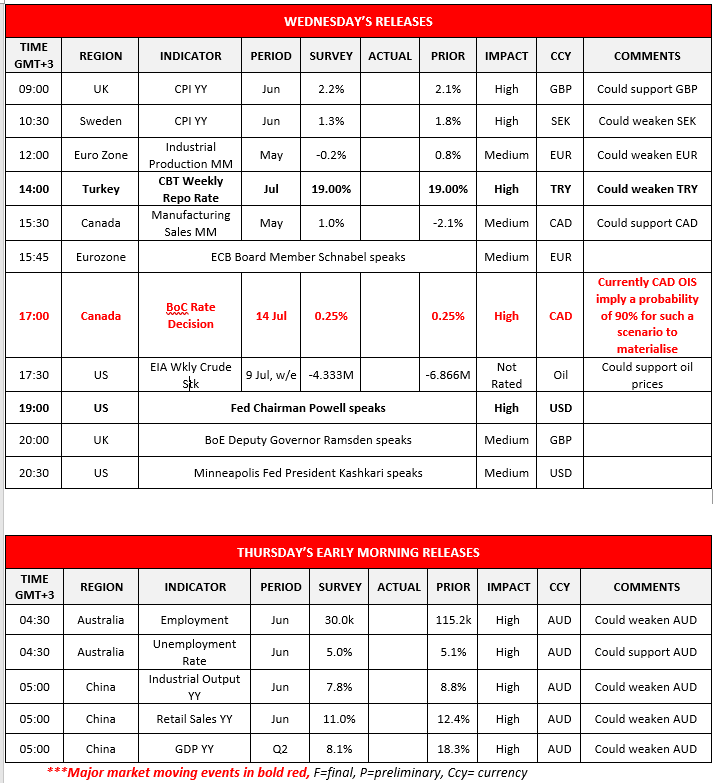
Today during the American session, we get from Canada, BoC’s interest rate decision. The bank is widely expected to remain on hold at 0.25% and currently CAD OIS imply a probability of 90% for such a scenario to materialize. We expect the bank to maintain a confident tone in its accompanying statement and could also taper its bond buying program. The rise of Covid cases could endanger the tightening of the bank’s QE program, as it could threaten the country’s growth potential. The tightening Canadian employment market, as well as the accelerating inflation rates could the bank towards further tightening of its QE program. Overall, we see the risks related to the event as tilted to the bullish side for the Loonie, unless the bank fails to reach the market’s hawkish expectations, in which case the CAD could weaken asymmetrically.
USD/CAD rose yesterday breaking the 1.2470 (S1) resistance line, now turned to support and stabilised between the S1 and R1 levels. We tend to maintain a bias for a sideways motion, yet BoC’s interest rate decision could create substantial volatility for the pair as well as Powell’s testimony. Should buyers be in control of the pair’s direction, we may see it breaking the 1.2560 (R1) resistance line and aim for the 1.2650 (R2) level. Should the market display a selling interest for the pair, we may see it breaking the 1.2470 (S1) support line and aim for the 1.2400 (S2) level.
Other economic highlights today and the following Asian session:
Today during the European session we get UK’s CPI rates for June and from Turkey we get CBRTs’ interest rate decision. The bank is expected to remain on hold at 19% and if so we may see TRY weakening given the accelerating inflation rates in Turkey and CBRTs’ unwillingness to act. Oil traders may be more interested in the release of the weekly US EIA crude oil inventories figure. During the Asian session we get from Australia June’s employment data and a bit later we get from China the industrial output and retail sales growth rates for June and the GDP rate for Q2. On the monetary front we note that ECB Board Member Schnabel, BoE Deputy Governor Ramsden and Minneapolis Fed President Kashkari are scheduled to speak.
USD Index H4 Chart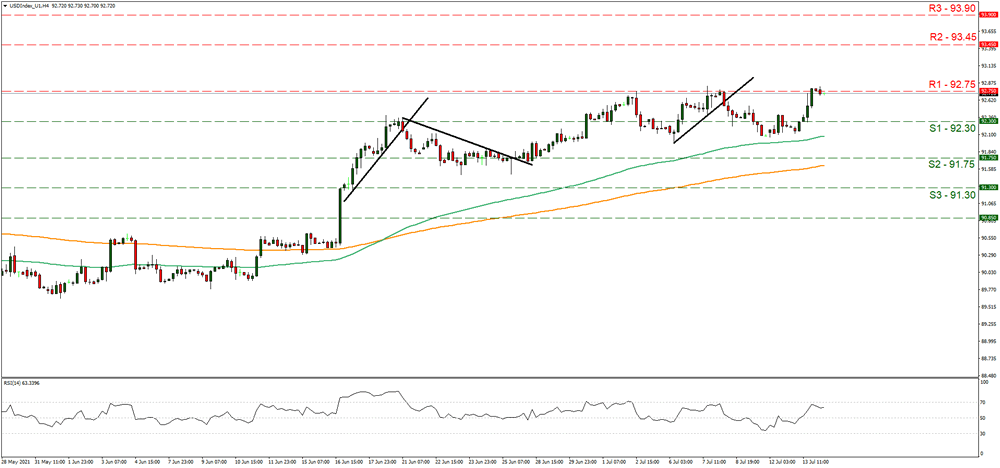
Support: 92.30 (S1), 91.75 (S2), 91.30 (S3)
Resistance: 92.75 (R1), 93.45 (R2), 93.90 (R3)
USD/CAD H4 Chart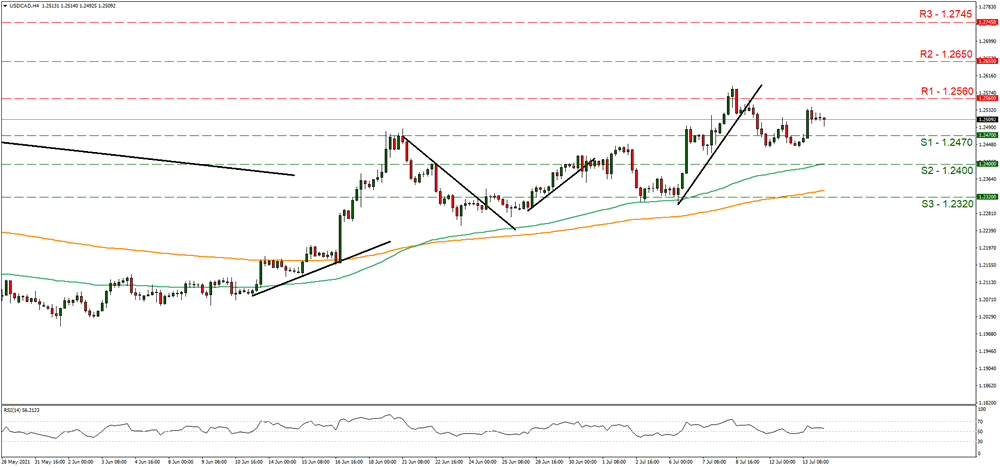
Support: 1.2470 (S1), 1.2400 (S2), 1.2320 (S3)
Resistance: 1.2560 (R1), 1.2650 (R2), 1.2745 (R3)
Dollar Index Has Hit A Three-Month High. Fed May Tighten The Monetary Policy
The consumer price index data slightly shocked financial markets. Annual consumer inflation accelerated to 5.4% from 5% (the forecast was 4.9%), and the core CPI increased to 4.5% from 3.8% (with the forecast of 4.0%), it’s a record for the last 30 years. This data shows that inflation is out of control and revives investor fears that the Fed will tighten monetary policy in the near term. Today, traders should be watching closely what Jerome Powell will say during his speech to Congress. However, the Chairman of the Federal Reserve Bank (FRB) of San Francisco, Mary Daley, still believes that the acceleration of inflation in the USA is temporary.
On the other hand, the dollar index, which has an inverse correlation to the euro, has increased, as investors expect that the Fed will start tightening policy very soon (buy the rumor, sell the fact).
Despite the rising quarterly results, the banking sector closed in the red zone yesterday. And this is the first sign that investors may use the current earnings season to close their positions, which will surely lead to the beginning of a corrective movement in the major indices.
European stock indices finished trading with a slight decline. Investors are waiting for the consumer price index data release in Europe, which will be published later this week.
The situation in the oil market remains unchanged. While the OPEC+ countries have not yet reached a consensus on boosting oil production, amid an expected further reduction of oil reserves in the USA, the fundamental picture is in favor of rising prices.
The situation with gold was unpredictable yesterday. Before the CPI data was released, gold and silver prices had increased. The price fell sharply on the news, but it rose again a few hours later. A lot will depend on the plans of the Fed regarding the further monetary policy now. If there are hints from the Fed's officials about tightening monetary policy, gold and silver prices could fall substantially.
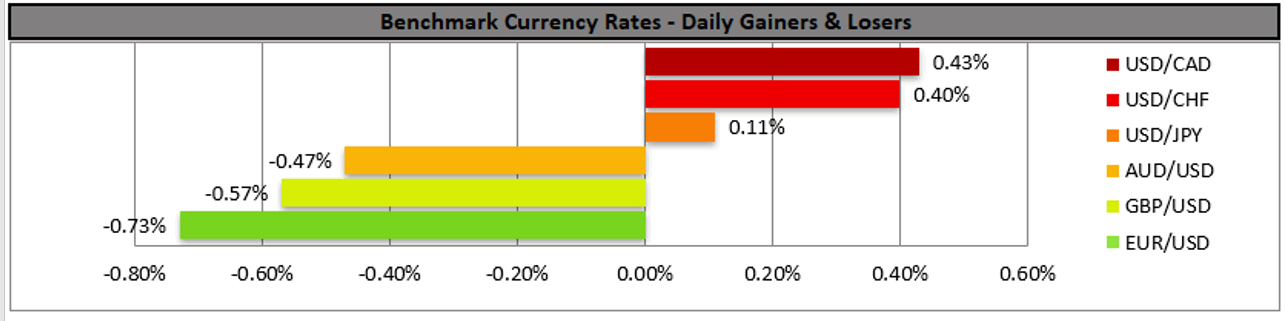
The Asian stock market also declined amid misgivings about the US inflation. Despite the fact that the interest rate in New Zealand remained unchanged, the New Zealand dollar increased by 0.8% as, on Wednesday, the Reserve Bank of New Zealand (RBNZ) announced that it would halt its large-scale asset-buying program. Australia extends quarantine restrictions in Sydney as the COVID-19 outbreak approaches new daily records.
Main market quotes:
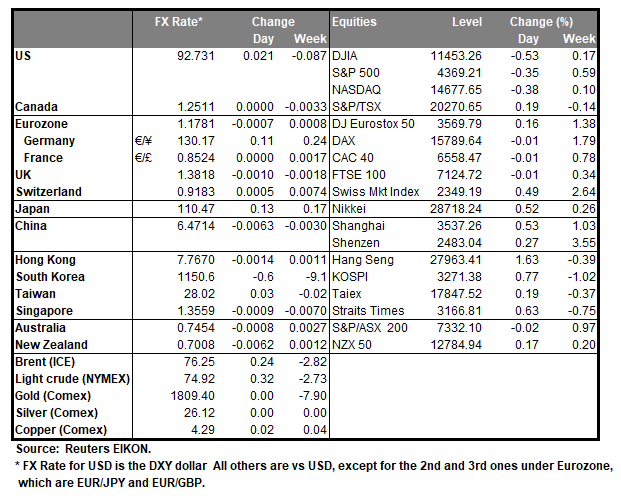
- S&P 500 (F) 4,369.21 -15.42 (-0.35%)
- Dow Jones 34,888.79 -107.39 (-0.31%)
- DAX 15,789.64 -0.87 (-0.01%)
- FTSE 100 7,124.72 -0.70 (-0.01%)
- USD Index 92.77 +0.51 (+0.55%)
Important events:
- RBNZ Interest Rate Decision at 05:00 (GMT+3);
- RBNZ Rate Statement at 05:00 (GMT+3);
- UK Consumer Price Index (m/m) at 09:00 (GMT+3);
- UK Core Consumer Price Index (m/m) at 09:00 (GMT+3);
- Europe Industrial Production (m/m) at 12:00 (GMT+3);
- US Producer Price Index (m/m) at 15:30 (GMT+3);
- Canada BOC Interest Rate Decision at 17:00 (GMT+3);
- Canada BOC Rate Statement at 17:00 (GMT+3);
- US Crude Oil Reserves (w/w) at 17:30 (GMT+3);
- BOC Press Conference at 18:00 (GMT+3);
- US Fed Chair Jerome Powell’s Testimony at 19:00 (GMT+3).
The Analytical Overview Of The Main Currency Pairs
The EUR/USD currency pair
Technical indicators of the currency pair:
Prev Open: 1.1860
Prev Close: 1.1776
% chg. over the last day: -0.71%
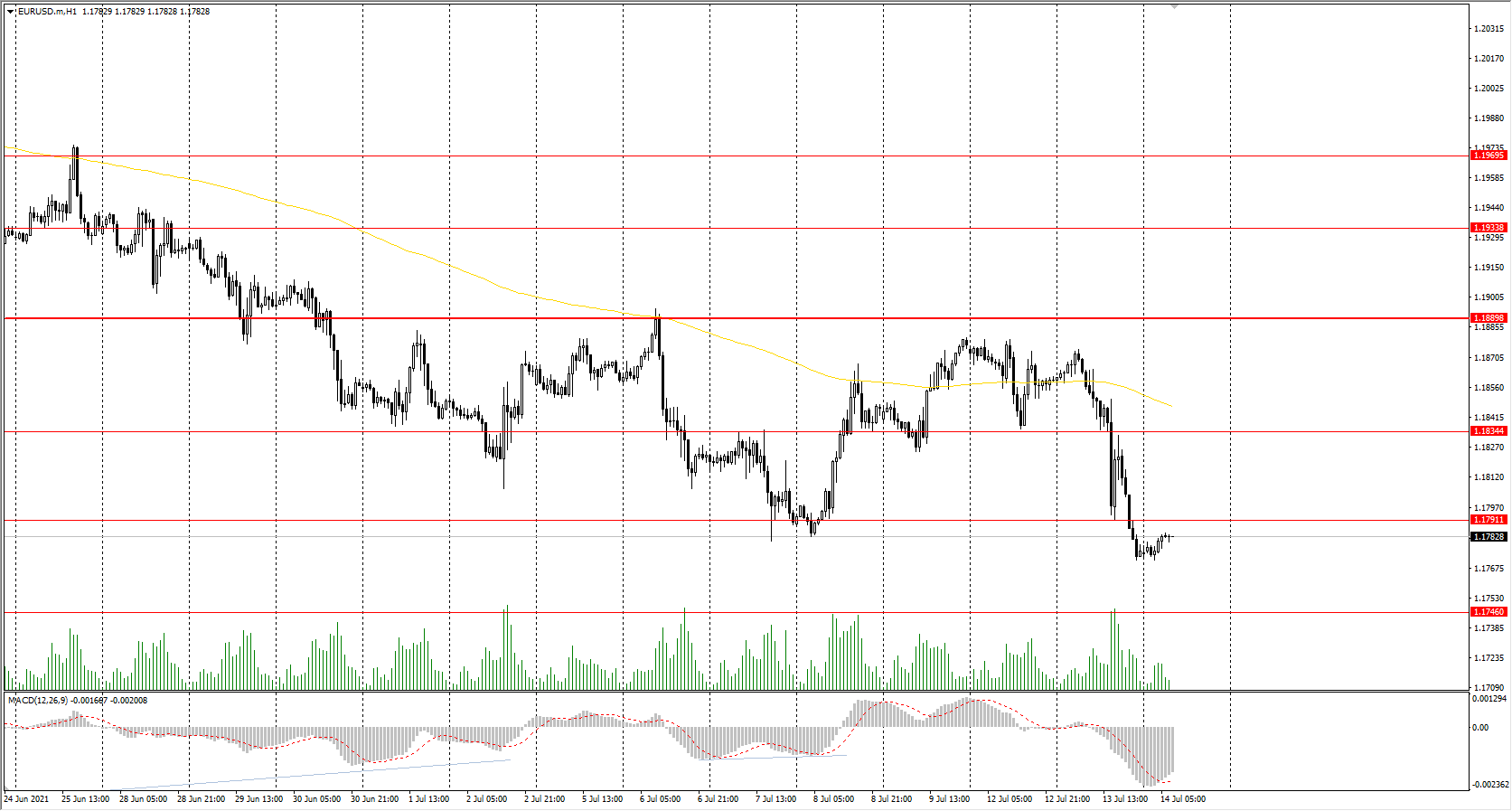
The EUR/USD currency pair has once again come under the control of sellers. In turn, the dollar index, which has an inverse correlation to the euro, has increased, as investors are pricing in expectations that the Fed will start to tighten policy very soon (buy the rumor, sell the fact).
Trading recommendations
Support levels: 1.1746, 1.1609
Resistance levels: 1.1791, 1.1834, 1.1889, 1.1934, 1.1969
The trend is still bearish. After the bad CPI data, the sellers' pressure grew again, which led to the breakdown of the previous minimum. The MACD indicator sharply returned to the negative zone without any signs of divergence. Under such market conditions, it is better to trade intraday. For sell positions, traders should wait for a pullback to the resistance level. Entries for long positions can be searched on support levels, but with short targets, as it will be trading against the trend.
Alternative scenario: if the price breaks out through the 1.1889 resistance level and fixes above, the general uptrend is likely to be resumed.
News feed for 2021.07.14:
- European Industrial Production (m/m) at 12:00 (GMT+3);
- US Producer Price Index (m/m) at 15:30 (GMT+3);
- US Fed Chair Jerome Powell’s Testimony at 19:00 (GMT+3).
The GBP/USD currency pair
Technical indicators of the currency pair:
Prev Open: 1.3877
Prev Close: 1.3810
% chg. over the last day: -0.48%
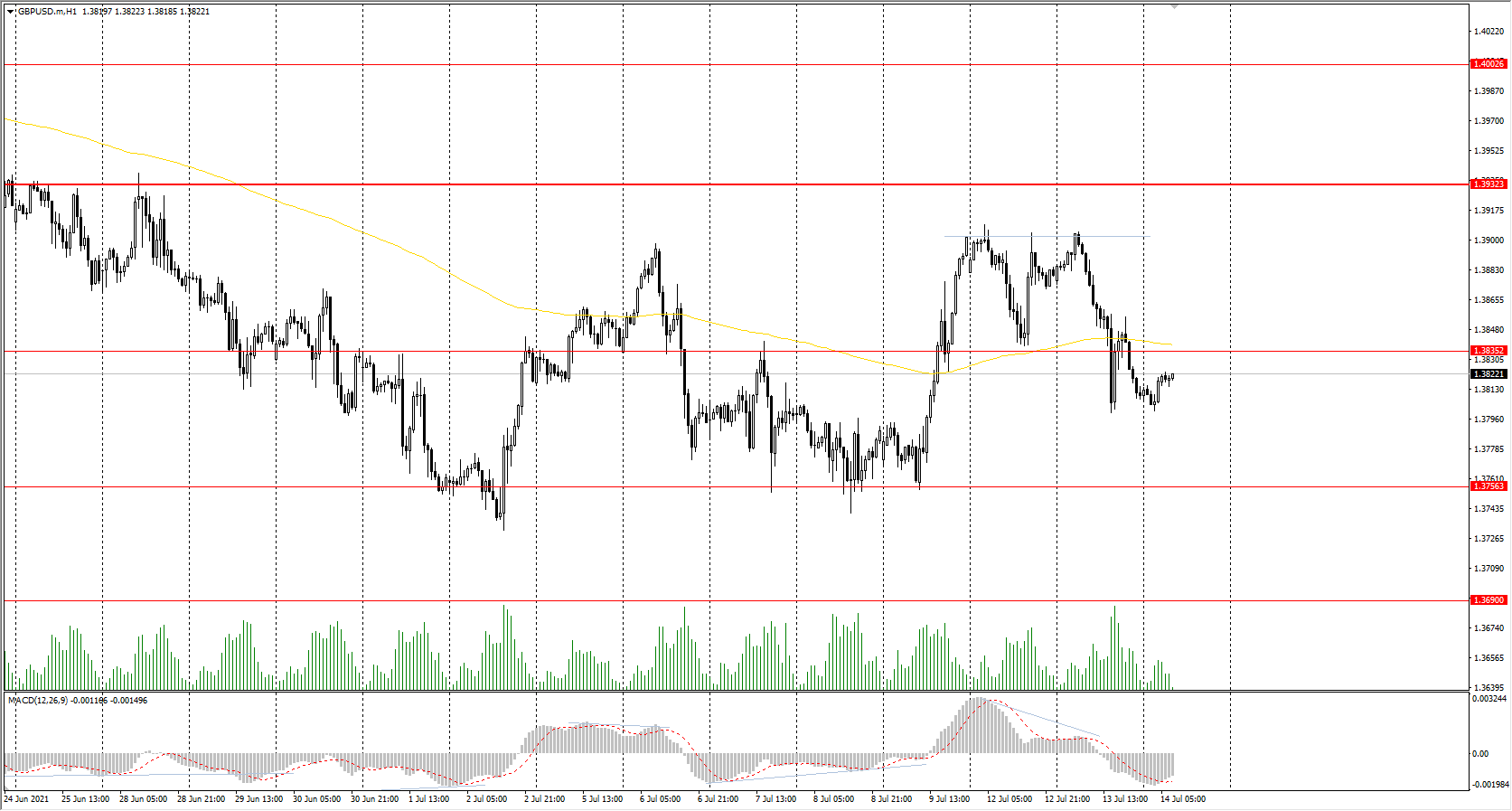
Despite the decline, the British pound looks more confident, as it correlates with Brent oil prices, which tend to rise. Moreover, the LIBOR 3-month dollar rate continues to decline slowly, providing support for the British currency. Today, the UK will report on the inflation rate, so the volatility will be high.
Trading recommendations
Support levels: 1.3756
Resistance levels: 1.3835, 1.3923, 1.4002, 1.4075, 1.4101, 1.4138, 1.4191
The GBP/USD trend is bearish on the H1 timeframe. But the pressure of buyers has become weak. The MACD indicator has returned to the negative zone with no signs of divergence. Under such market conditions, it is better to trade intraday. For sell positions, traders should wait for a pullback to the resistance level. Entries for long positions can be searched on support levels.
Alternative scenario: if the price breaks out through the 1.3922 resistance level and consolidates above, the bearish scenario is likely to be canceled.
News feed for 2021.07.14:
- UK Consumer Price Index (m/m) at 09:00 (GMT+3);
- UK Core Consumer Price Index (m/m) at 09:00 (GMT+3).
The USD/JPY currency pair
Technical indicators of the currency pair:
Prev Open: 110.36
Prev Close: 110.63
% chg. over the last day: +0.24%
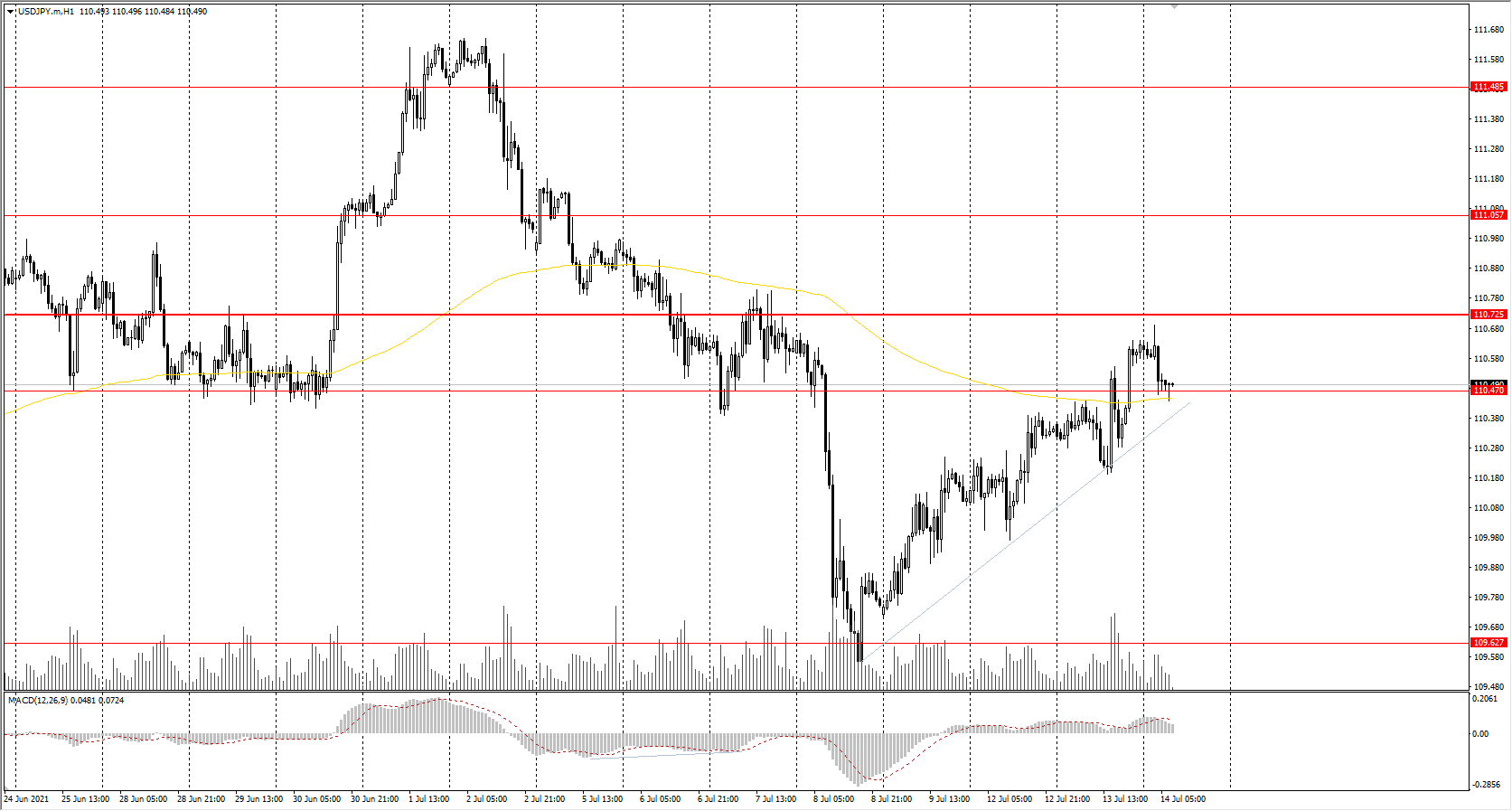
The dollar index growth pushes USD/JPY quotes up. The price is moving to the priority change level. Japan's economy will most likely grow at a slower pace in the third quarter than initially expected as new emergency measures to contain the spread of the coronavirus in Tokyo during the Olympic Games are affecting consumption.
Trading recommendations
Support levels: 110.47, 109.63, 109.31
Resistance levels: 110.73, 111.06, 111.48, 110.73, 112.18
From the point of view of technical analysis, there is a downward trend on the H1 timeframe, as the price is still trading below the priority change level. But the pressure of the buyers is increasing, and the price managed to consolidate above the level of the moving average. The MACD indicator is in the positive zone with no signs of divergence. Under such market conditions, traders are better to look for sell positions from the priority change level if the sellers show the initiative to defend the level. Buy positions should be considered only after the breakout of the 110.73 level.
Alternative scenario: if the price rises above 110.73, the uptrend is likely to be resumed.
The USD/CAD currency pair
Technical indicators of the currency pair:
Prev Open: 1.2452
Prev Close: 1.2514
% chg. over the last day: +0.50%
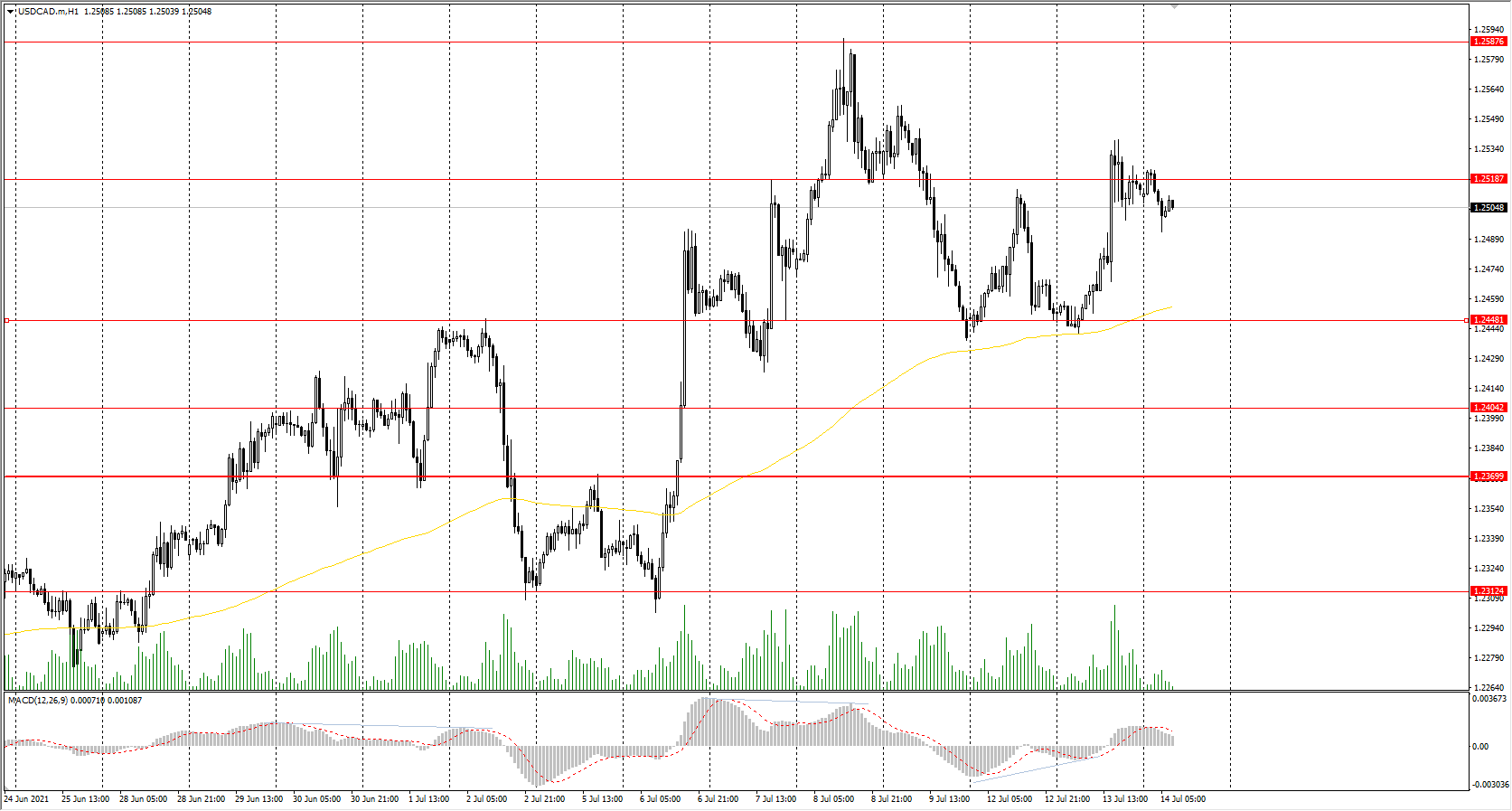
The Canadian dollar is highly correlated with the dollar index and oil prices. Yesterday, the dollar index rose sharply, which led to an increase in the USD/CAD quotes by 0.5%. The Bank of Canada will report on the interest rate today. Surprises are not expected, but the press conference may bring up the issue of future tightening policies in the following meetings since the growth of inflation increases, which will have a negative impact on consumption.
Trading recommendations
Support levels: 1.2448, 1.2404, 1.2347, 1.2312, 1.2260, 1.2190
Resistance levels: 1.2519, 1.2587
Technically, the trend remains bullish. The price is still trading above the moving average and above the priority change level. The MACD indicator returned to the positive zone. Under such market conditions, it is best to trade on the lower timeframes. Buyers may look for trades from the support levels within the day. There are no optimal entry points to open sell positions now.
Alternative scenario: if the price breaks down through the 1.2370 support level and fixes below, the downtrend is likely to be resumed.
News feed for 2021.07.14:
- BOC Interest Rate Decision at 17:00 (GMT+3);
- BOC Rate Statement at 17:00 (GMT+3);
- BOC Press Conference at 18:00 (GMT+3).
US CPI Spikes Again, Dollar Rallies, Kiwi Surges Too After RBNZ Ends QE
- US inflation jumps again, sending stocks spinning and dollar and yields flying
- RBNZ shocks by halting bond purchases, kiwi soars as August rate hike eyed
- Powell testimony in the spotlight as Fed's patience put to the test
Markets settle down after another CPI shock
Annual inflation in the United States hit a fresh 13-year high of 5.4% in June, surpassing the top estimates and casting doubt on the Fed's narrative that this inflationary episode will be transitory. Month-on-month, both the headline and core CPI rates jumped by 0.9% - around double the expectations. While most of the evidence suggests the price hikes are still being driven by temporary factors, fuelled by the reopening of the economy such as demand for used vehicles and air travel, there are worries that some of the increases being seen in sectors like food and energy are not necessarily transitory.
Treasury yields on both the short- and long-end of the curve spiked after the data, boosting the US dollar. Although the yield curve initially flattened, as short-term yields rose more steeply, longer-dated yields soon caught up after a Treasury auction for 30-year bonds was met with weak demand.
Investors were likely spooked by the latest inflation data, which hurt sentiment ahead of the auction. However, bond markets are much calmer today, helping FX markets to stabilize as well.
Dollar off highs but euro stays under pressure
The US dollar pared back some of its gains early on Wednesday following yesterday's CPI-led surge. The dollar index is easing after failing to break above last week's 3-month top of 92.845. Most majors are on a somewhat firmer footing versus the greenback today, but the euro is still looking very wobbly. Euro/dollar seems to have found near-term support at $1.1770. But with the European Central Bank getting ready to adjust its forward guidance, possibly to signal that it will tolerate inflation above 2%, the real test could soon be the $1.17 level, which was the March 31 trough.
The Australian dollar was struggling too after the lockdown in Sydney – Australia's largest city – was extended by another two weeks. But the pound got a lift from the UK's own CPI prints out today rising by more than expected, with the 12-month rate hitting 2.5% - the highest since August 2018.
Kiwi's not-so-spectacular climb after RBNZ's QE exit
But the winner so far on Wednesday is the New Zealand dollar, which skyrocketed after the Reserve Bank of New Zealand took markets by surprise by announcing an early end to its large scale asset purchase programme. The RBNZ will stop buying bonds on July 23.
The unexpected move prompted investors to price in an earlier rate hike than anticipated heading into the meeting. Markets had already brought forward rate hike expectations to November after the recent upbeat business confidence surveys, but consensus now seems to be forming for the August meeting.
Nevertheless, the kiwi's 1% gain today would have been much bigger had it not been for USD strength. Even with the RBNZ being on track to become the first major central bank to hike rates in a post-pandemic world, the bullish dollar is making it difficult for the kiwi to secure a grip above the $0.70 handle.
Unimpressed by earnings, higher yields weigh on Wall Street
In equity markets, the Dow Jones, S&P 500 and Nasdaq Composite all retreated from intra-day all-time highs after the US inflation data and subsequent rise in yields. But the positive momentum was weak to begin with and impressive earnings from JPMorgan and Goldman Sachs didn't really spark much excitement.
Today's earnings highlights will come from the Bank of America, Citigroup, Wells Fargo and Delta Air Lines. Nasdaq futures were last trading in slightly positive territory, with other futures still in the red, along with European indices.
Trading will likely remain subdued until Fed Chair Jerome Powell's statement before the House Financial Services Committee in Congress for his semi-annual testimony. Powell will probably steer clear of flagging any timeline around tapering but undoubtedly, he will be quizzed about the latest inflation surge by lawmakers.
It might be a bit more difficult this time for Powell to tread as carefully around the inflation being transitory narrative. But in a worst case scenario, risk assets might be able to find some support from progress in infrastructure talks after Senate Democrats reached a deal on a $3.5 trillion investment plan that will likely be passed using the budget reconciliation process.
Finally, the Bank of Canada will also be in focus today, amid expectations that it will taper its own asset purchase programme as well.
Blockbuster CPI Lifts US Dollar
US dollar rallies on US inflation data
The title says it all as much higher than expected US inflation data saw tapering sentiment rise sharply, pushing the US dollar higher across the board. That sentiment saw the overnight US 30-year bond auction underwhelm but overall, the reaction of US bond yields to the inflation data would have disappointed inflation vigilantes.
The dollar index rose 0.60% to 92.77, with some long-covering in Asia pushing it slightly lower to 92.72 today. The index now lies just below resistance, and a small gap on the charts, at 92.85. A daily close above 92.90 sets up a retest of 93.50 by the end of the week. That likely requires Chairman Powell to play the game, though.
Benign French and German inflation data and massively higher US inflation data saw the euro torpedoed by monetary policy divergence expectations. EUR/USD tumbled by 0.70% to 1.1775, near its overnight low and where it remains today. The single currency is now in danger of retesting 1.1700, setting up further losses to below 1.1600. Resistance is now distant at 1.1900. GBP/USD fell in sympathy by 0.50% to 1.3820, just above support at 1.3800. It remains enclosed in a 1.3700 to 1.3900 range between its 100 and 200-day moving averages. I am waiting for a break of either to signal its next directional move.
NZD/USD has held onto its 1.0% gain post-RBNZ this morning as the mighty Kiwi rests at 0.7020. In the broader picture, NZD/USD needs to break either 0.6900 or 0.7100 to signal its next directional move. I still need to remit NZD to pay the landscape gardeners; that’s as good a signal that kiwi is going higher than my readers need.
In Asia, the US dollar remains near its highs versus the won, ringgit, baht, rupiah and rupee. The first three look most vulnerable to further losses due to a combination of Asia recovery fears or Covid-19 fallout. USD/CNY remains comfortably mid-range between 4.4600 and 4.4900 for now, with the focus falling on regional Asia.
As I have touched on at the start of today’s note, regional Asia is now acutely vulnerable to a change in perceptions about the US tightening cycle. You can actually roll that out across the major currency space tonight as well. The fact that US bonds hardly moved overnight after the US inflation data suggests to me that the US Dollar rally will be short-lived if Mr Powell stays transitional at his testimony tonight, However, if that t-word emerges in the wrong context, the US dollar will rally strongly, and Asian currencies are set to suffer more than most.
Oil Climbs, Gold Holds Ground
Oil rallies but remains range-bound
With no news from the OPEC+ standoff, markets took their cues elsewhere. In this case, the IEA suggested that oil production needed to rise in tandem with the world recovery. US API crude inventories fell again by 4 million barrels. The US inflation data suggested the economy was firing on all cylinders and will need more oil in the months ahead.
All of that combined to send Brent crude higher by 1.60% to USD 76.40 a barrel, and WTI higher by 1.40% to USD 75.10 a barrel. Oil has moved sideways in Asia, but markets remain confined in a broad but choppy range in the bigger picture. Oil is unlikely to break out of its July highs until some clarity appears over resolving the Saudi Arabia/UAE production standoff. Markets likely have residual fears that the longer the situation remains unresolved, the more likely OPEC+ discipline is expected to fade or fracture, opening up the taps to a production free-for-all.
In the meantime, Brent crude has resistance at USD 78.00 a barrel, with pullbacks limited to USD 74.00 a barrel. WTI has resistance at USD 77.00 a barrel, with any pullbacks likely to be limited to USD 73.00 a barrel.
Gold might be finding its inflation mojo
Gold held up surprisingly well overnight after the US CPI data propelled the US dollar higher and lifted long-dated US bond yields slightly. That should give some comfort to bullish investors that gold may finally be regaining its inflation hedging mojo after being an inverse US dollar play for the past few weeks.
Gold finished almost unchanged at USD 1808.00 an ounce overnight, a solid performance given the broader US dollar strength. It has advanced in Asia, rising to USD 1813.00 an ounce, perhaps benefitting from some flows out of regional equities and into safety. Gold remains confined to a narrow USD 1800.00 to USD 1820.00 range for now, but the overnight performance suggests the downside looks solid now, and it should find support on dips to USD 1790.00 an ounce.
As with everything else, the next directional move lies with Jerome Powell in Congress tonight. If he remains transitional in his inflation outlook and unconcerned about tapering, US bond yields and the US dollar will fall, which should lift gold towards resistance. A hawkish Powell is likely to postpone the rally, but gold looks to be well supported on dips, as previously stated.
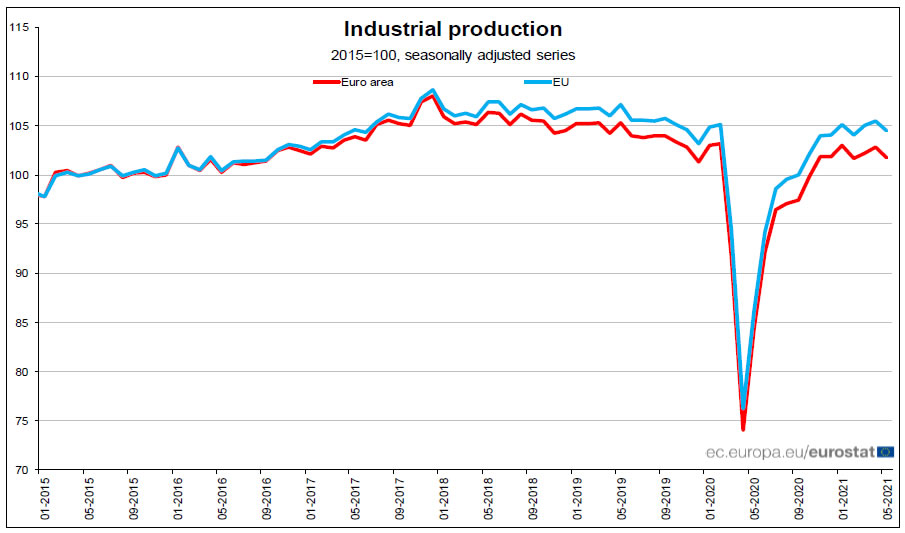
Eurozone industrial production dropped -1.0% mom in May, EU down -0.9% mom
Eurozone industrial production dropped -1.0% mom in May, much worse than expectation of 0.2% mom rise. Production of non-durable consumer goods fell by -2.3%, energy by -1.9%, capital goods by -1.6% and intermediate goods by -0.2%, while production of durable consumer goods rose by 1.6%.
EU industrial production dropped -0.9% mom. Among Member States for which data are available, the largest decreases were registered in Romania (-8.5%), Greece (-4.7%) and Ireland (-4.6%). The highest increases were observed in Lithuania (+7.7%), Hungary (+3.4%) and Finland (+2.2%).