Financial markets showed surprising resilience on Monday despite another escalation in the US-Iran conflict over the weekend. Brent crude briefly surged above $90 after opening with a gap higher but failed to sustain the advance, retreating back below that level during the European session. The inability of oil to extend its gains helped stabilize broader market sentiment, with European equities trading mixed rather than broadly lower, while US index futures pointed to a firmer Wall Street open.
Although the US completed its ninth consecutive day of strikes on Iran overnight, investors found reassurance in signs that diplomatic channels remain open. Iranian Foreign Ministry spokesman Esmail Baghaei said negotiations with the US could still proceed if they align with Iran’s national interests, adding that intermediaries have continued exchanging messages despite the latest military exchanges. The comments reinforced the market’s prevailing view that, while geopolitical risks remain elevated, the conflict is still more likely to be contained than to develop into a prolonged regional war involving a significantly larger US military commitment.
Politics in the UK also attracted attention as Andy Burnham formally became the country’s seventh prime minister in a decade after being invited by King Charles to form a government. However, financial markets reacted with little enthusiasm or concern. Investors appeared relieved by expectations that Home Secretary Shabana Mahmood will become chancellor instead of the more left-leaning Ed Miliband, while UK bond markets remained broadly stable, suggesting fiscal concerns are viewed as a longer-term issue rather than an immediate risk.
In the currency markets, Australian Dollar led gains, followed by New Zealand Dollar and Dollar, while Swiss Franc underperformed despite the geopolitical backdrop, further highlighting the absence of a classic flight to safety. Canadian Dollar and Euro also lagged, with Sterling and Yen trading near the middle of the performance table.
Attention now turns to New Zealand’s second-quarter CPI report in the upcoming Asian session. Headline inflation is expected to accelerate to 4.1% year-on-year from 3.1%, exceeding the RBNZ’s own 3.9% projection. With oil prices remaining elevated, policymakers will be particularly focused on whether higher fuel costs are beginning to spill over into broader inflation measures, making the various core inflation gauges just as important as the headline reading.
Silver Bears Miss Their Chance as Oil Rally Fails to Extend Selling
Silver briefly fell below $55 but quickly recovered as fresh geopolitical tensions failed to trigger another wave of selling. Despite Brent crude initially jumping above $90 after renewed US-Iran escalation, markets appeared to view the latest developments as largely priced in following last week’s sharp oil rally. Diplomatic signals from Tehran also helped calm fears of an immediate deterioration, although silver remains vulnerable if the Strait of Hormuz crisis deepens and Brent advances toward $100. Technically, downside risks persist below 59.66, but fading bearish momentum suggests a short-term bottom may be forming. Read More.
Brent Oil Above $90: Is $100 Next if Hormuz Blockade Persists?
Brent oil opened the week above $90 after renewed escalation in the US-Iran conflict, but restrained buying suggests much of the weekend’s developments had already been priced following last week’s 17% surge. The market’s focus is now shifting from geopolitical headlines to the duration of the Strait of Hormuz blockade, as every additional day of disruption increases the risk of genuine physical supply shortages. Technically, Brent’s breakout strengthens the case for a medium-term bullish reversal, with a sustained move above $95 potentially opening the way toward $100 and, eventually, a retest of this year’s highs. Read More.
Canada Inflation Cools Sharply as Lower Gasoline Prices Pull Headline CPI Below Expectations
Canada’s annual inflation rate slowed more than expected to 2.8% in June as lower gasoline prices drove the largest monthly decline in CPI since December 2024. Core inflation also eased, with both CPI Median and CPI Trimmed undershooting expectations, suggesting underlying price pressures continued to moderate despite elevated energy costs earlier in the quarter. Read More.
ECB SAFE Survey: Loan Conditions Tighten While Inflation Expectations Hold Steady
The ECB’s latest SAFE survey showed Eurozone firms continued to face tighter financing conditions in the second quarter, with a sharp increase in bank loan interest rates even as overall credit availability remained broadly stable. At the same time, businesses reported slower expected growth in selling prices, input costs and wages, while inflation expectations stayed well anchored across one-, three- and five-year horizons. Read More.
New Zealand Exports Surge 25% Y/Y, Imports Up 28% Y/Y in June, Leaving Trade Balance Near Flat
New Zealand’s June trade surplus came in well below expectations at NZD 23M, but underlying trade activity remained healthy. Exports expanded strongly across major trading partners, while imports increased even faster, pointing to firm domestic demand. Read More.
PBOC Holds Loan Prime Rates Steady, Keeps Easing Option Open as Growth Slows
China’s central bank left its one-year and five-year Loan Prime Rates unchanged at 3.0% and 3.5%, respectively, extending its policy pause to a 14th consecutive month. The decision reflects a cautious balance between slowing economic growth and rising external risks from the Middle East, while resilient exports and high-tech industries continue to support activity. Although the PBOC is expected to rely on targeted policy tools for now, modest rate cuts later this year remain possible if domestic demand weakens further and inflation stays subdued. Read More.
AUD/USD Daily Report
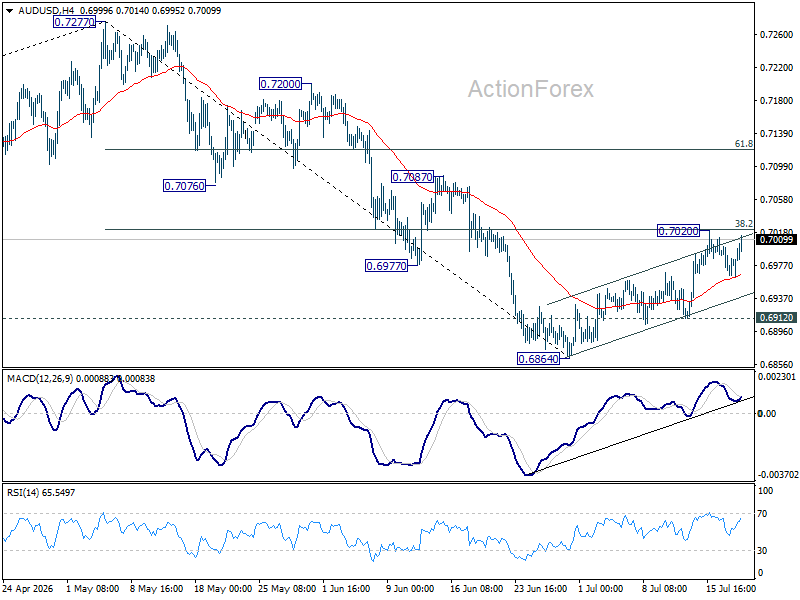
Intraday bias in AUD/USD remains neutral for the moment. As long as 38.2% retracement of 0.7277 to 0.6864 at 0.7022 holds, fall from 0.7277 is mildly in favor to continue. On the downside, below 0.6912 minor support will bring retest of 0.6864 low. However, sustained break of 0.7022 will bring stronger rally to 61.8% retracement at 0.7119 next.
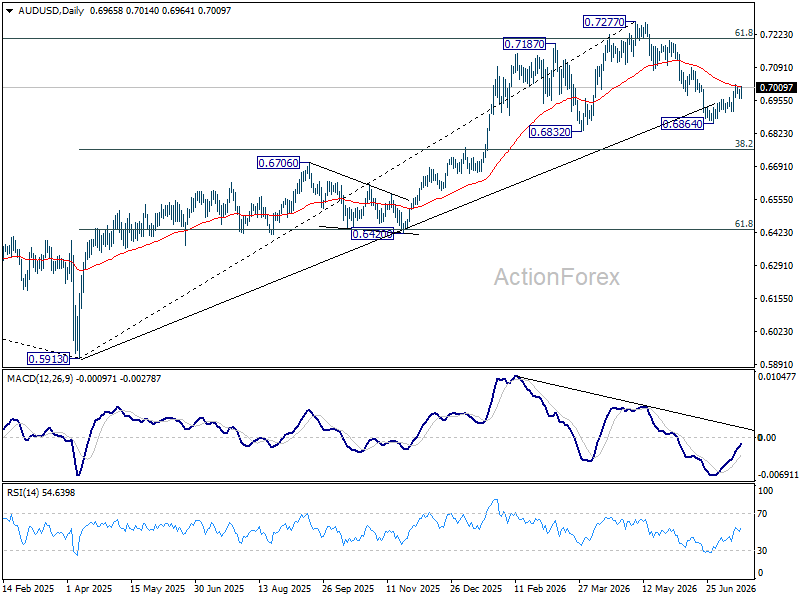
In the bigger picture, considering bearish divergence condition in D MACD, a medium term top could be formed at 0.7277 after failing to sustain above 61.8% retracement of 0.8006 (2021 high) to 0.5913 (2024 low) at 0.7206. Deeper fall could be seen to 38.2% retracement of 0.5913 to 0.7277 at 0.6756 as a correction. But strong support should be seen there to bring rebound. Consolidations would continue below 0.7277 for a while.