


TL;DR: AUD/USD is rallying on improving risk sentiment and a softer Dollar, but the same falling oil prices driving that optimism are also weakening two of Australia’s own fundamental supports — explaining why the pair has lagged the broader market risk momentum.
A Rally That Looks Surprisingly Restrained
AUD/USD has staged a rally over the past two days, benefiting from a broad improvement in global risk sentiment, a softer US Dollar, and surging industrial commodity prices. Yet the Aussie’s momentum has looked surprisingly restrained. Wall Street has pushed to fresh record highs, Asian equities have rebounded, and copper has climbed to another record — but AUD/USD has merely edged toward resistance rather than breaking decisively higher.
The contrast suggests the market is weighing two very different implications of the same geopolitical story. Optimism that the Strait of Hormuz could reopen is undoubtedly supporting risk assets globally, but it’s also lowering oil prices in a way that weakens some of Australia’s own fundamental supports. The result is a currency pair caught between powerful global tailwinds and equally meaningful domestic headwinds.
Risk Appetite Is Providing Plenty of Support
There’s little doubt the global backdrop has become more supportive for growth-sensitive currencies. The Dow Jones Industrial Average climbed to another record high overnight, while both Japan’s Nikkei and South Korea’s KOSPI surged more than 3.5%, reflecting a broad-based improvement in investor confidence rather than isolated strength in individual markets. Such an environment has traditionally favored the Australian Dollar, often treated as a high-beta proxy for global growth expectations.
Commodity markets have reinforced that narrative. Copper has climbed to fresh record highs this week, supported by structural demand from AI-related infrastructure investment and ongoing supply constraints in China. For Australia, this is particularly significant — copper isn’t merely another commodity but an important contributor to the country’s terms of trade, meaning sustained gains normally translate into stronger support for the Australian Dollar.
At the same time, the US Dollar has weakened as markets rapidly scaled back expectations for further Federal Reserve tightening. The probability of the Fed leaving rates unchanged in September has risen sharply over the past two days, as hopes of a Strait of Hormuz reopening reduced fears of another energy-driven inflation shock. Lower Treasury yields have weighed broadly on the Dollar, providing AUD/USD with an additional lift even without any improvement in Australia’s own economic outlook.
The Same Oil Story Is Working Against Australia
The complication is that the very catalyst supporting global markets is simultaneously creating domestic headwinds for the Australian Dollar.
Lower oil prices reduce imported inflation pressures, reinforcing recent market repricing that the Reserve Bank of Australia can comfortably remain on hold after softer inflation and cooling labor market data. Markets had already moved toward expecting a prolonged pause in the RBA’s tightening cycle; falling energy prices only strengthen that conviction by reducing one of the principal upside risks to inflation.
Oil also matters to Australia through a less obvious but equally important channel. A large share of Australia’s LNG exports is priced against Japanese Customs-Cleared Crude benchmarks. As Brent declines, Australia’s export revenues from LNG become less supportive for the country’s terms of trade. In other words, the same fall in oil prices that boosts global equities also removes one of the Australian Dollar’s traditional sources of fundamental support.
This explains why AUD/USD has lagged behind the broader improvement in market sentiment. The global risk environment argues for a stronger Australian Dollar, but Australia’s own interest rate outlook and export dynamics are pulling in the opposite direction.
ActionForex’s Technical View on AUD/USD
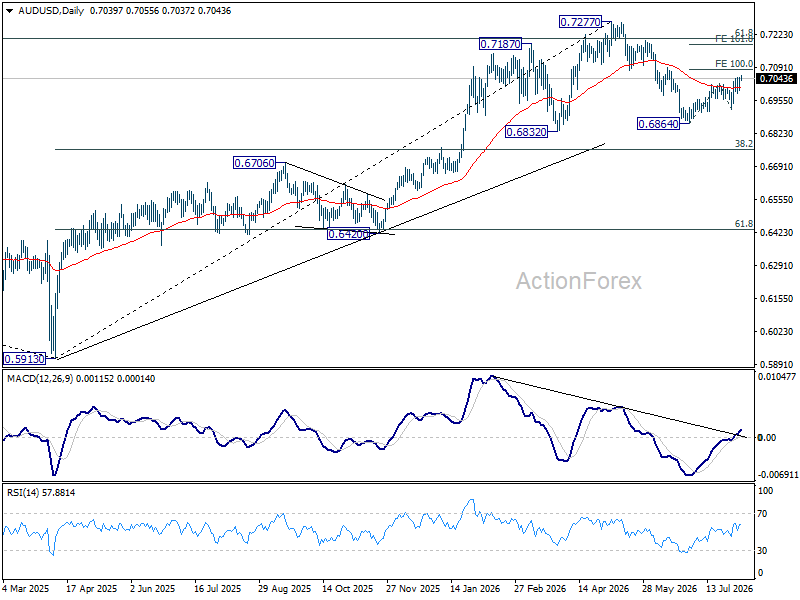
Technically, AUD/USD’s rebound from 0.6864 resumed by breaking through temporary top today. For now, further rally is expected as long as 0.6983 minor support holds. The next target is the 100% projection of 0.6864 to 0.7026 from 0.6921, at 0.7021. A decisive break there would argue the rebound is an impulsive move — and, more importantly, add to the case that it’s reversing the whole fall from 0.7277. In that scenario, further rally should be seen to the 161.8% projection at 0.7183 next.
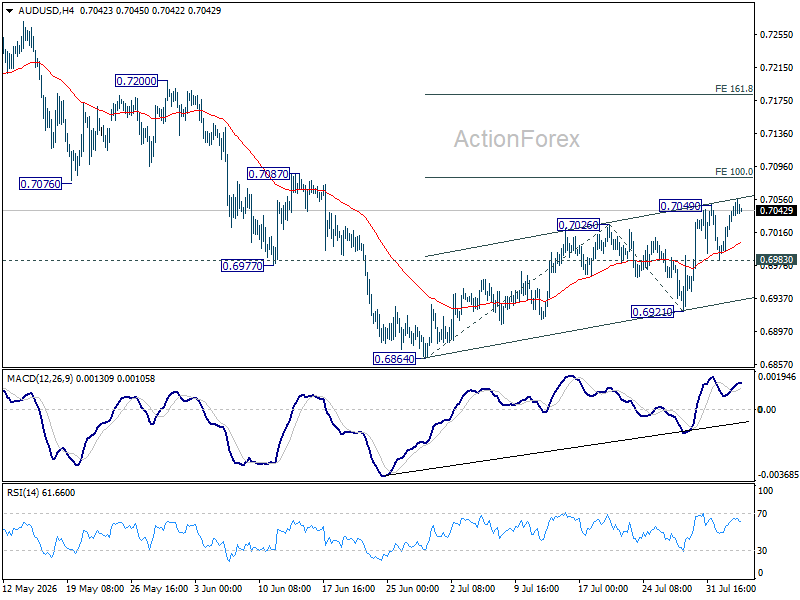
However, rejection at or below 0.7021, followed by a break of 0.6983, will turn focus back to 0.6921. A firm break there would argue the rebound has completed as a corrective move, in turn suggesting the fall from 0.7277 is ready to resume through the 0.6864 low.
Key Takeaways
- AUD/USD has lagged Wall Street’s record highs, a 3.5%+ Asian equity surge, and record copper prices despite the same optimism driving all three.
- Falling oil prices, tied to Strait of Hormuz reopening hopes, are cutting two ways: supporting global risk assets while reducing Australia’s imported inflation and LNG export revenue.
- Markets are increasingly confident the RBA can stay on hold, and falling energy prices reinforce that view by removing a key upside inflation risk.
- A softer US Dollar, driven by fading Fed tightening expectations, is providing AUD/USD support independent of any change in Australia’s own outlook.
- 0.7021 is the key resistance for confirming an impulsive rebound toward 0.7183; a break of 0.6921 would instead point to a resumed fall toward 0.6864.





