ECB’s Stournaras advocates for insurance rate cut to nurture Eurozone recovery

    ECB Governing Council member Yannis Stournaras expressed the need for an “insurance rate cut” to bolster the nascent recovery within Eurozone. Speaking to Bloomberg, Stournaras highlighted the critical balance the ECB aims to maintain in fostering economic growth without stifling it with persistently high interest rates.

    Stournaras detailed the emerging signs of economic recovery across the Eurozone, particularly noting positive developments in Germany. “We see the first seeds of a recovery in Europe — also in Germany,” he remarked, emphasizing “We don’t want to kill these first seeds of recovery.”

    The concept of an insurance rate cut, as described by Stournaras, is intended to preemptively address potential downturns, mirroring the approach taken last September when rates were increased to guard against surging inflation.

    Reflecting on the past year’s policy decisions, Stournaras acknowledged that the situation has reversed, with new risks that “fall too far below the 2% target”. Hence, “We now need an insurance in order not to get behind the curve,” he added.

    Moreover, Stournaras argued for a divergence from Fed’s current monetary policy approach, citing fundamental differences between the economic environments in Eurozone and the US. He pointed out that unlike the US, where demand is buoyed by significant governmental budgetary measures, the Eurozone’s inflation dynamics have been primarily driven by supply-side factors, not by demand or wage increases.


    UK GDP rises 0.1% mom in Feb, led by production

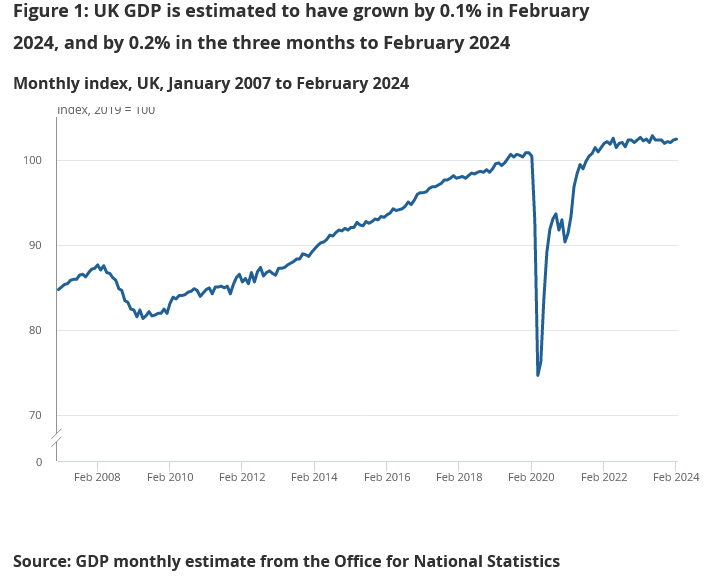
      UK GDP grew 0.1% mom in February, matched expectations. Services grew by 0.1% mom. Production output grew 1.1% mom, and was the largest contributor to growth in the month. Construction output fell -1.9% mom.

      For the three months to February, compared with the three months to November 2023, GDP has grown 0.2%. Services rose 0.2%. Production grew 0.7%. Construction fell -1.0%.

      Full UK GDP release here.

      Gold surges to new record, but anticipates stiff resistance at 2500

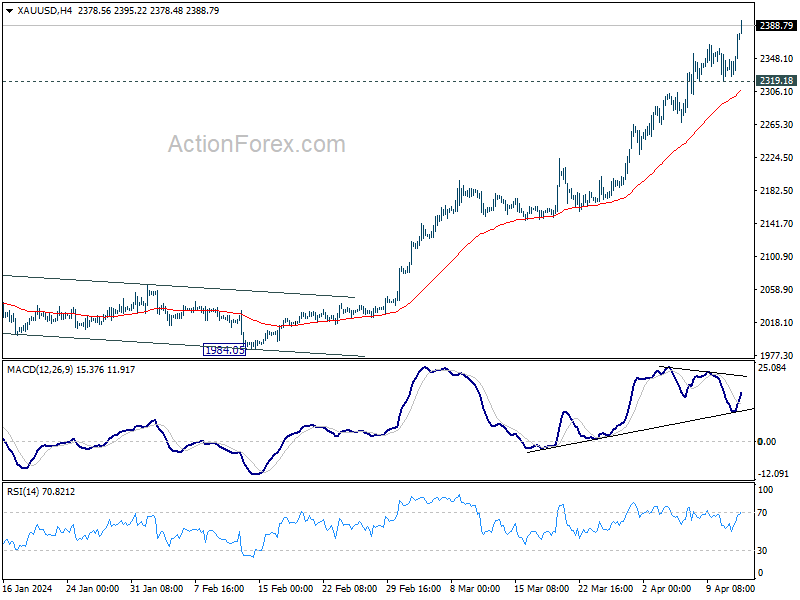
        Gold’s bullish momentum appears unstoppable for now as it surged to new record high in Asian session, now eyeing 2400 mark. This surge is driven by a confluence of factors that indicate broader market apprehensions, particularly about resurgence of inflation risks, with geopolitical tension in the background.

        This shift in sentiment is evident in the sharp increase in benchmark treasury yields across various regions, including US, Europe, and even Japan. Concurrently, major stock indices are showing signs of a looming correction.

        Judging from these developments, Gold’s rally is more fueled by safe-haven flows, partly as hedge against selloff in stocks and bonds, and partly on geopolitical risks.

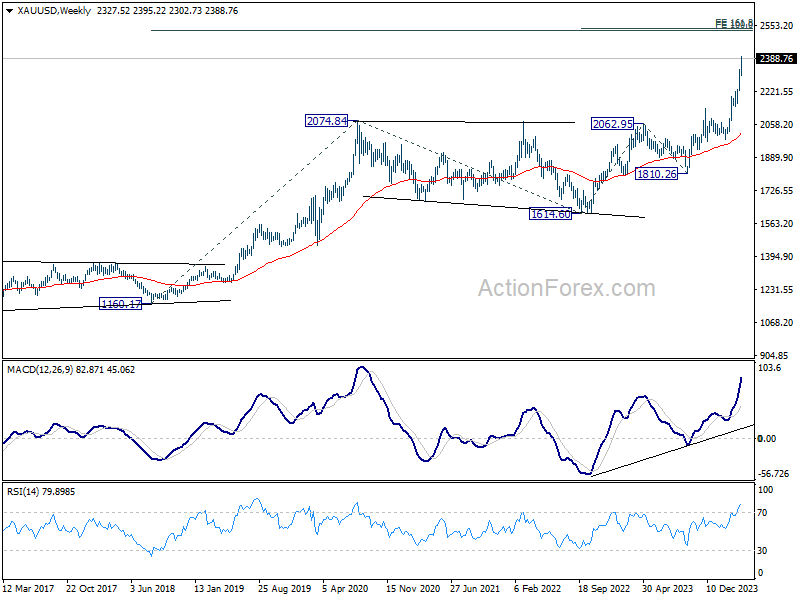
        Technically, near term outlook in Gold will stay bullish as long as 2319.18 support holds. Next target is 2500 psychological level. Strong resistance is expected there to limit upside, at least on first attempt, to bring a notable correction.

        Overbought condition, as seen in weekly RSI is a factor that could limit Gold’s momentum ahead. More importantly, 2500 represents a cluster medium and long term projection levels. There lies 161.8% projection of 1614.60 to 2062.95 from 1810.26 at 2535.69, and 100% projection of 1160.17 to 2074.84 at 1614.60 at 2529.27.

        NZ BNZ manufacturing falls to 47.1, 13th month of contraction

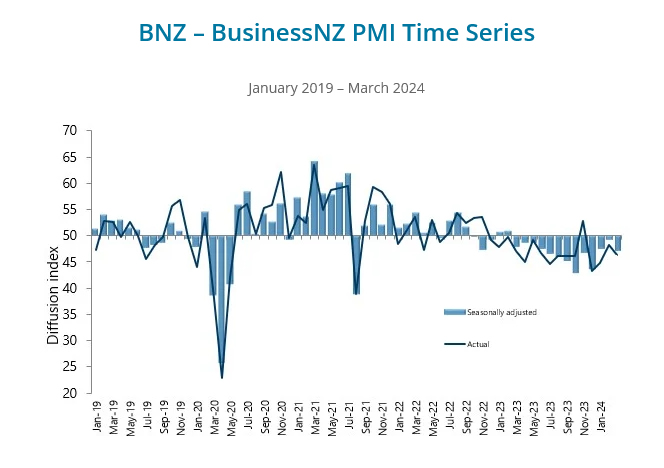
          New Zealand BusinessNZ Performance of Manufacturing Index PMI fell from 49.1 to 47.1 from 49.1 in February, marking the lowest level since last December and indicating that the sector has been in contraction for 13 consecutive months.

          Key components painted a concerning picture. Production experienced a notable decline from 49.1 to 45.7. Employment also fell from 49.2 to 46.8, suggesting that businesses are reducing their workforce in response to reduced demand. New orders, a critical indicator of future activity, decreased from 47.5 to 44.7.

          Finished stocks were the only component of the index to show an increase, from 48.8 to 49.2. This could indicate that products are remaining in inventory longer due to lower sales volumes. Delivery times also worsened from 51.1 to 47.8, which could reflect logistical issues or supply chain disruptions.

          The proportion of negative comments from survey respondents increased to 65% in March, up from 62% in February and 63.2% in January. Many cited a lack of orders and the general economic slowdown as major concerns.

          Full NZ BNZ PMI release here.

          IMF Georgieva: Possible Fed rate cut in late 2024, but don’t hurry

            In an interview with CNBC overnight, IMF Managing Director Kristalina Georgieva projected that by the end of the year, Fed would be positioned to lower interest rates. Nevertheless, She emphasized the importance of data-driven decisions, advising against premature action.

            “We remain on our projection that we would see, by the end of the year, the Fed being in a position to take some action in a direction of bringing interest rates down,” adding, “But again, don’t hurry until the data tells you you can do it.”

            Georgieva also highlighted reasons for optimism regarding the US economy’s future. She pointed out that the US is experiencing less upward pressure on labor costs compared to other regions, which helps in maintaining economic stability without the immediate threat of overheating.

            Fed’s Collins signals reduced urgency for rate cuts and lesser easing in 2024

              Boston Fed President Susan Collins suggested that the recent economic data do not necessitate an immediate adjustment in monetary policy, indicating that less easing might be required this year than previously anticipated.

              At an even overnight, Collins highlighted that while recent data have not significantly altered her economic outlook, they but “highlight uncertainties related to timing” of economic developments. She stressed the importance of patience, acknowledging that “disinflation may continue to be uneven”.

              “This also implies that less easing of policy this year than previously thought may be warranted,” she added.

              Furthermore, “incoming data have eased my concerns about an imminent need to reassess the stance of monetary policy,” she explained. And, “it may just take more time than previously thought for activity to moderate, and to see further progress in inflation returning durably to our target.”

              Fed’s Williams: Fed to stay data-dependent as outlook ahead is uncertain

                New York Fed President John Williams suggested that, should the economy evolve as anticipated, it would be prudent to “dial back the policy restraint gradually over time, starting this year.”

                However, he was quick to stress the inherent uncertainty in the economic outlook, underscoring the need for Fed to maintain a data-dependent approach.

                “The outlook ahead is uncertain, and we will need to remain data-dependent,” he said in a speech, adding “I will remain focused on the data, the economic outlook, and the risks as we evaluate the appropriate path for monetary policy to best achieve our goals.”

                Williams also touched upon inflation, projecting a continued but gradual decline towards Fed’s 2% target. He cautioned, however, that this trajectory might not be smooth, referencing “bumps along the way” evidenced by some recent inflation data.

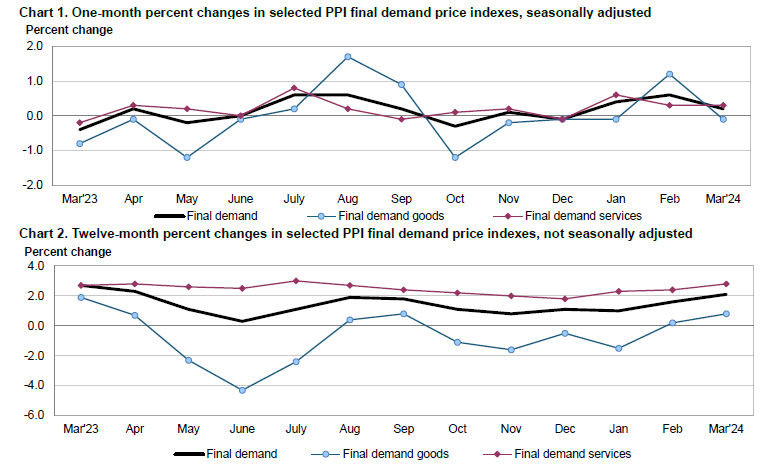
                US PPI at 0.2% mom, 2.1% yoy in Mar, below expectations

                  US PPI for final demand rose 0.2% mom in March, below expectation of 0.3% mom. PPI final demand services rose 0.3% mom while final demand goods fell -0.1% mom.

                  For the 12-month period, PPI jumped from 1.6% yoy to 2.1% yoy, below expectation of 2.3% yoy. But that was still the highest reading since April 2023.

                  PPI for final demand less goods, energy, and trade services rose 0.2% mom. For the 12-month period, PPI for final demand less foods, energy and trade services rose 2.8% yoy.

                  Full US PPI release here.

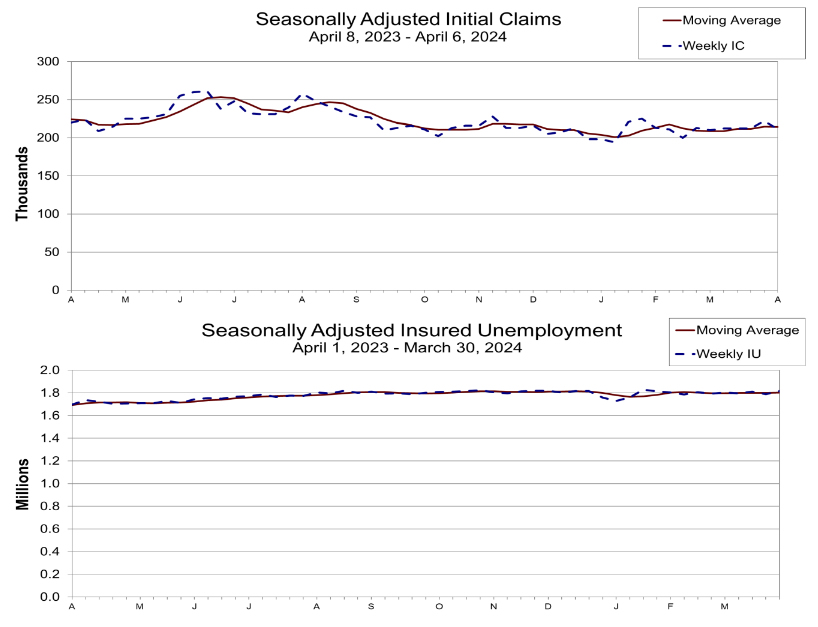
                  US initial jobless claims falls to 211k

                    US initial jobless claims fell -11k to 211k in the week ending April 6, below expectation of 215k. Four week moving average of initial claims fell -250 to 214k.

                    Continuing claims rose 28k to 1817k in the week ending March 30. Four-week moving average of continuing claims rose 3.5k to 1803k.

                    Full US jobless claims release here.

                    ECB explicitly opens door to rate cuts

                      ECB maintained its interest rates as widely expected, holding main refinancing rate and deposit rate at 4.50% and 4.00%. Most importantly, for the first time, the central bank explicitly indicated the possibility for future interest rate cuts, which would be seen as a conditional guidance for a June adjustment.

                      “If the Governing Council’s updated assessment of the inflation outlook, the dynamics of underlying inflation and the strength of monetary policy transmission were to further increase its confidence that inflation is converging to the target in a sustained manner, it would be appropriate to reduce the current level of monetary policy restriction,” ECB said. Nevertheless, the decision will still be data depended, and meeting-by meeting.

                      Current observations have “broadly confirmed” ECB’s medium-term inflation outlook, with continued decline in inflation rates primarily driven by decreases in food and goods price inflation. Most measures of underlying inflation are showing signs of easing, and there is a gradual moderation in wage growth. Additionally, firms seem to be accommodating some of the labor cost increases within their profit margins, which is a positive development for inflationary pressures.

                      Meanwhile, financing conditions remain restrictive and previous interest rate hikes are still impacting demand, contributing to the downward pressure on inflation. Yet, the persistence of strong domestic price pressures, particularly in the services sector, indicates that services price inflation remains elevated.

                      Full ECB statement here.

                      BoE’s Greene cautions inflation persistence more pronounced in UK than in US.

                        In an opinion piece in FT, BoE MPC member Megan Greene explicitly urges market participants to “stop comparing” the monetary policies of the UK and US.

                        Greene’s commentary comes in the wake of the US March CPI inflation report released yesterday, which surpassed market expectations that “the Bank of England will cut rates earlier and by more than the Federal Reserve this year”.

                        “The markets are moving rate cut bets in the wrong direction,” Greene asserts, emphasizing that, contrary to market speculation, “rate cuts in the UK should still be a way off as well.”

                        Highlighting the unique challenges faced by the UK economy, Greene notes the “double whammy” of a tight labor market coupled with a more substantial impact from energy price shocks, which has made “inflation persistence” a more pressing issue for the UK compared to the US and other advanced economies.

                        China’s CPI falls back to 0.1%, PPI negative for 18th month

                          China’s CPI slowed significantly from 0.7% yoy to 0.1% yoy in March, coming in below expectation of 0.4% yoy. Core CPI, which strips out food and energy prices, also decelerated from 1.2% yoy to 0.6% yoy. This shift was largely influenced by a notable -2.7% decrease in food prices, while non-food prices edged up rose 0.7%. Month-on-month, CPI declined -1.0% mom.

                          NBS attributed this March dip in CPI to a “seasonal decline in consumer demand following the holidays and the overall sufficient market supply.”

                          In parallel, PPI, a measure of factory-gate prices, edged down further to -2.8% yoy from February’s -2.7% yoy, aligning with market expectations. This continuation of downward trend for the 18th consecutive month emphasizes persistent deflationary pressures within the manufacturing sector. On a month-on-month basis, PPI contracted by -0.1%.

                          Japan’s Suzuki and Kanda: No predetermined Yen levels for currency intervention

                            Japanese Yen’s steep decline through 152 mark against Dollar overnight has put attention on potential currency intervention. However, responses from key officials today suggest a more measured approach is being considered at this point. In particular, Finance Minister Shunichi Suzuki acknowledged the mixed implications of a weakening Yen, with pros and cons. Its looks like Japan is not gearing up for direct intervention at the current level.

                            Suzuki highlighted the government is looking at the currency markets “with a high sense of urgency”. But he also emphasized that Japan is “not just looking at levels” such as 152 or 153, but also the underlying factors driving Yen’s depreciation.

                            Suzuki reiterated the government’s preference for currency stability, emphasizing that exchange rates should reflect economic fundamentals rather than short-term volatilities.

                            Masato Kanda, Japan’s top currency diplomat, echoed this sentiment by highlighting the recent pace of Yen’s movements as “rapid.” While not dismissing interventions, Kanda pointed out the absence of a fixed level that would trigger such actions. “I don’t have any particular level in mind,” he noted.

                            DOW takes a dive and Dollar leaps, as traders start to dismiss June Fed cut

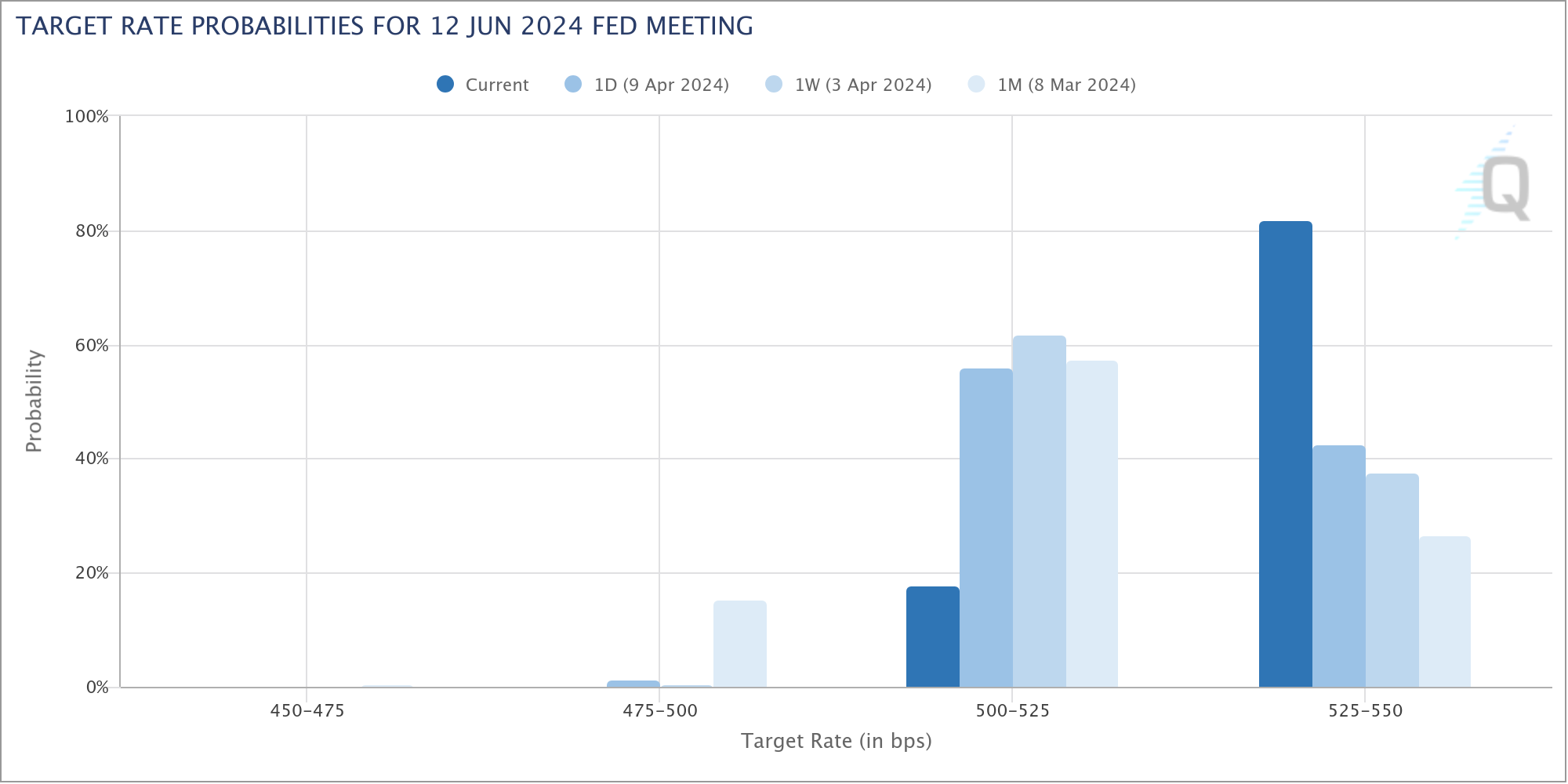
                              Bets on a Fed rate cut in June receded sharply following yesterday’s stronger than expected US CPI report. The drastic shift in sentiment led to steep decline in DOW and strong rally in Dollar index. FOMC minutes further cemented this outlook, revealing Fed’s cautious stance on interest policy easing and its desire for more evidence of disinflation progress before considering rate cuts.

                              The March FOMC minutes highlighted a consensus among members regarding the “uncertainty” surrounding the “persistence of high inflation”. Recent economic data did little to assuage these concerns, failing to increase the Committee’s confidence that inflation was on a steady decline toward 2% target.

                              The minutes further detailed concerns over the “relatively broad based” nature of recent inflation increases, cautioning against dismissing these trends as mere statistical outliers. This characteristic led to a consensus that these developments should not be hastily dismissed as “merely statistical aberrations.”

                              Fed fund futures are now pricing in just 18% chance of a Fed rate cut in June, comparing to 58% a day ago.

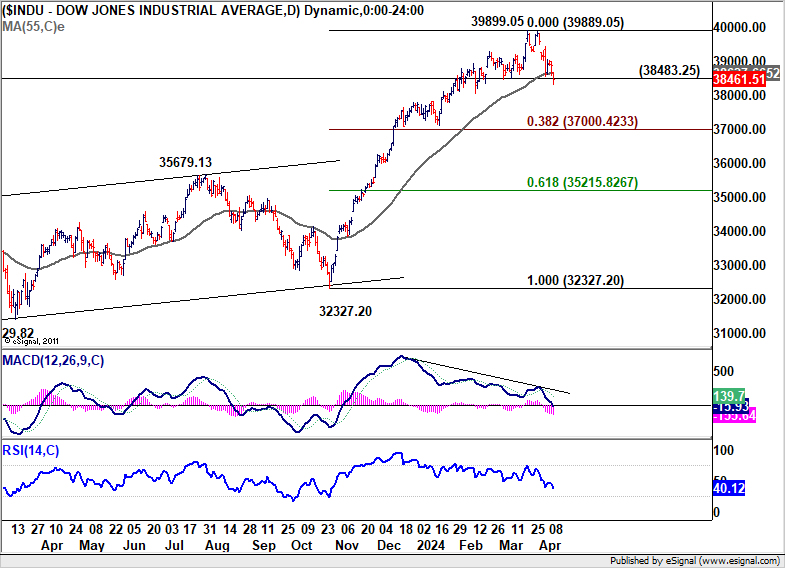
                              DOW closed down -422 pts or -1.09% at 38461.51. Technically, the break of 38483.25 support and 55 D EMA suggest that rise from 32327.20 has completed at 39899.05, on bearish divergence conditions in D MACD. Deeper correction is in favor to 38.2% retracement of 32327.20 to 39899.05 at 37000.42.

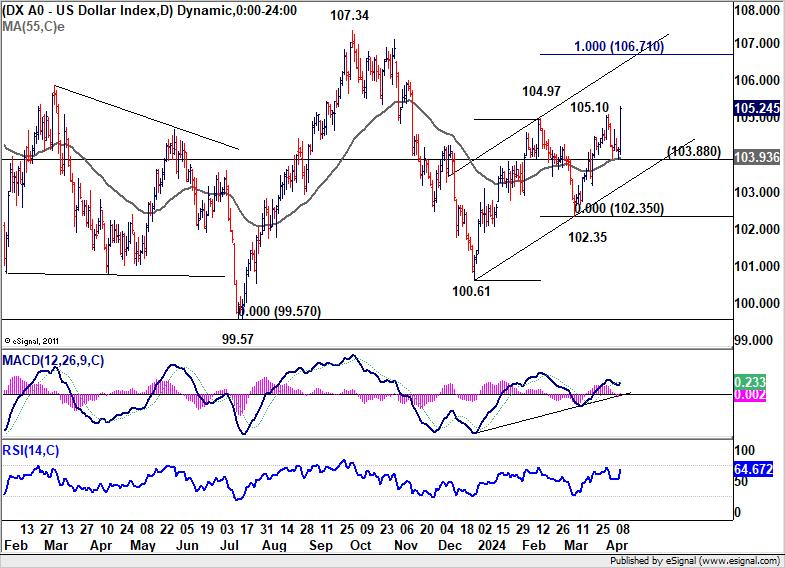
                              Dollar Index surged sharply to close at 105.24. Break of 150.10 resistance indicates resumption of whole rally from 100.61. Also, the strong support from 55 D EMA is a clear near term bullish sign. Further rally is now expected as long as 103.93 support holds. Next target is 100% projection of 100.61 to 104.97 from 102.35 at 106.71.

                              BoC stays the course, no explicit hint on rate cut

                                BoC maintains overnight rate at 5.00% as widely expected. The central bank’s statement highlighted that both the CPI and core inflation have “eased further” in recent months, though they remain at elevated levels. BoC emphasized its intention to monitor whether the observed “downward momentum is sustained”. But there is no explicit hint on rate cuts.

                                In its latest economic projections, BoC forecasts GDP growth of 1.5% for 2024, an uptick from previously projected 0.8%. The outlook for the subsequent years also remains optimistic, with growth expected at 2.2% in 2025 (down from previous 2.5%) and 1.9% in 2026.

                                On the inflation front, BoC projects CPI to hover close to 3% during the first half of this year, with a downward trend anticipated in the latter half to below 2.5%, and reach 2% inflation target in 2025.

                                Full BoC statement here.

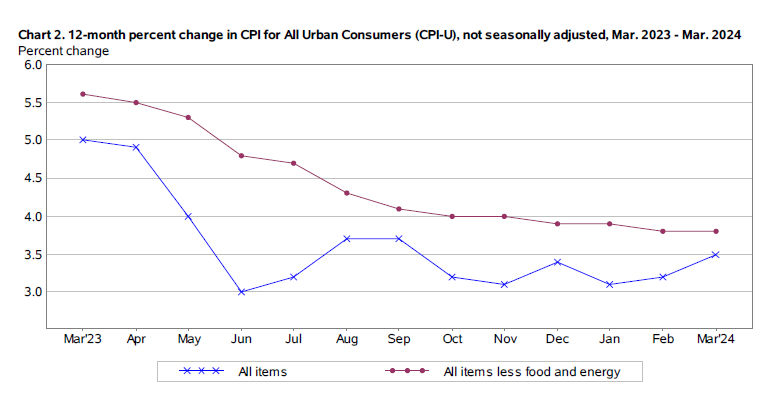
                                US CPI jumps to 3.5% yoy in Mar, CPI core unchanged at 3.8% yoy

                                  US CPI rises 0.4% mom in March, above expectation of 0.3% mom. CPI core (all items less food and energy) rises 0.4% mom, also above expectation of 0.3% mom. Energy index rose 1.1% mom. Food index rose 0.1% mom.

                                  For the 12 months period, CPI accelerated from 3.2% yoy to 3.5% yoy, above expectation of 3.4% yoy. CPI core was unchanged at 3.8% yoy, above expectation of 3.7% yoy. Energy index was up 2.1% yoy while food index was up 2.2% yoy.

                                  Full US CPI release here.

                                  Will BoC’s Macklem Pave the Way for June Rate Reduction?

                                    BoC is widely expected to keep interest rate unchanged at 5.00% today and the main focus is whether Governor Tiff Macklem would start to change the tune to lay down the groundwork for a June rate cut. With new economic projections on the table, this meeting presents an opportune moment for such indications.

                                    A recent Reuters poll revealed a consensus among economists, with 27 out of 38 forecasting a 25 bps cut by BoC in June. Meanwhile, 7 expected the cut in July and 4 in September. By the year’s end, the expectation is for a 100 bps cumulative reduction, bringing the rate down to 4.00%.

                                    Despite these anticipations, a noteworthy portion of economists — 13 out of 16 — who responded to an additional query, suggested that the timing of the first rate cut is more likely to be delayed than they expected. Moreover, 11 of them believe there’s a heightened risk of fewer rate cuts than initially forecasted.

                                    More on BoC here.

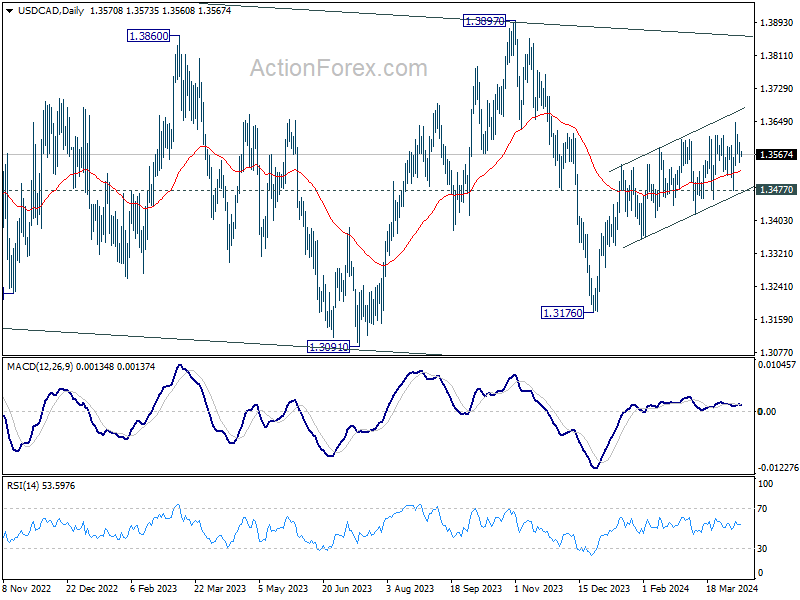
                                    While USD/CAD’s rebound from 1.3176 has persisted in the last few months, momentum is clearly lacking as seen in both the structure of the rise, as well as in D MACD. Break of 1.3477 support the first signal that such rebound has completed as a corrective move. Nevertheless, firm break of the upper channel line will likely prompt upside acceleration towards 1.3897 resistance. Today’s BoC decision is poised to significantly influence the currency’s next move.

                                    NZD/JPY steady after RBNZ, pressing 92.18 resistance

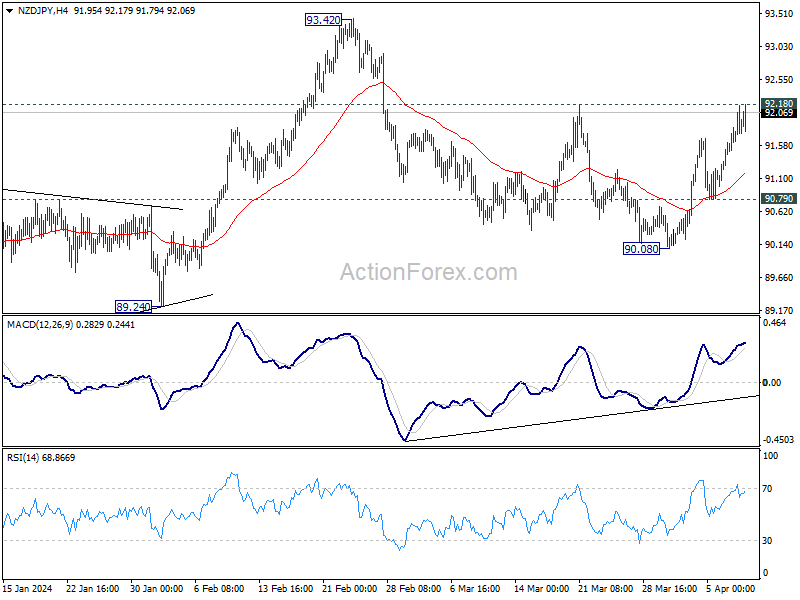
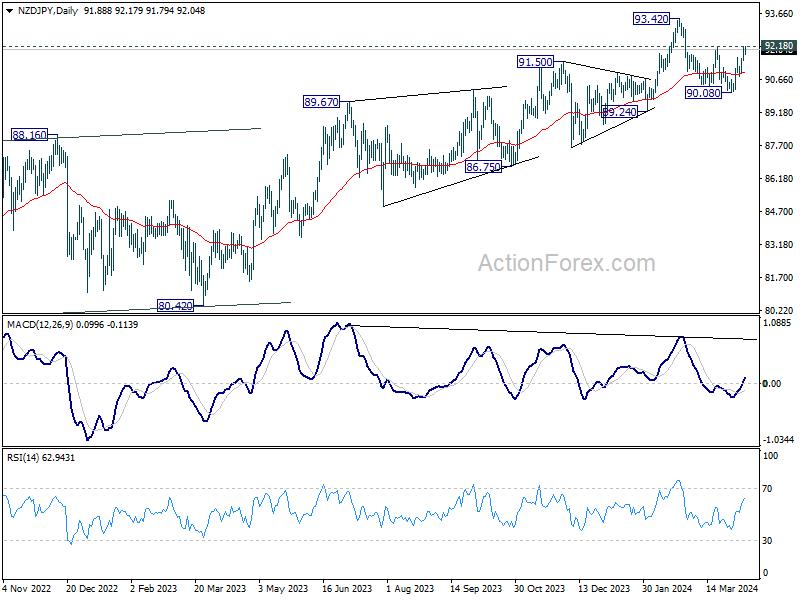
                                      New Zealand Dollar is steady after RBNZ left interest rate unchanged and drops not clue on the timing of interest rate cuts. NZD/JPY’s focus is staying on 92.18 resistance. Decisive break there will argue that corrective pull back from 93.42 has completed with three waves down to 90.08. larger rise from 80.42 would then be ready to resume through 93.42 high.

                                      However, rejection by 92.18, followed by break of 90.79 support, will turn bias back to the downside for 90.08 support. Further break there will argue that NZD/JPY is possibly in larger scale correction.

                                      RBNZ holds OCR steady, no room for delay in bring down inflation to target band

                                        RBNZ maintained Official Cash Rate unchanged at 5.50%, aligning with market expectations. This decision comes with reiterated commitment to “restrictive monetary policy stance,” deemed necessary to alleviate capacity pressures and guide inflation back within the target range of 1 to 3 percent within “this calendar year”.

                                        During the recent meeting, members concurred that there has been “no material change in economic outlook” since their February Statement. There remains a “limited tolerance” for prolonging the timeframe to meet the inflation target, especially with inflation expectations and pricing intentions continuing to “remain elevated”.

                                        The “persistence of services inflation” and “elevated” goods price inflation were identified as continuous risks, with expected near-term increases in local government rates, insurance, and utility costs potentially decelerating the reduction in headline inflation.

                                        On the flip side, RBNZ acknowledges potential downside risks to the inflation outlook, notably the impact of continued restrictive monetary policy amid weak global growth. This environment could precipitate a quicker than anticipated reduction in inflation. Weak business and consumer confidence, coupled with potential increases in unemployment and financial stress, are areas of concern. Additionally, structural economic challenges in China are highlighted as significant, given its critical role in the global economy and as a major trading partner for New Zealand.

                                        Full RBNZ statement here.

                                        BoJ’s Ueda: Accommodative monetary policy to continue

                                          In today’s parliamentary address, BoJ Governor Kazuo Ueda reaffirmed the Bank of Japan’s stance on continuing its accommodative monetary policy, underscoring the short-term interest rate as the “primary policy tool.”

                                          A key focus for BoJ, as Ueda noted, is the scrutiny of trend inflation’s progress towards 2% target in judging “appropriate degree of monetary support.”

                                          Meanwhile, Ueda clarified that BoJ would not alter its monetary policy solely in response to FX fluctuations. However, he acknowledged that significant FX movements, if they lead to an unexpected increase in import prices and thereby risk elevating trend inflation beyond projections, could necessitate a reassessment of monetary policy.